Vol.62, No. 10 JOURNALOFVIROLOGY, Oct. 1988,p.3631-3641
0022-538X/88/103631-11$02.00/0
Copyright X) 1988, American Society for Microbiology
Structure
and
Function of Endogenous Feline Leukemia Virus Long
Terminal
Repeats and Adjoining Regions
BRIAN T. BERRY,1 ANANTA K. GHOSH,1 D. VINOD
KUMAR,'
DAVID A.SPODICK,2
AND PRADIPROY-BURMAN'
2*Departmentsof
Pathology1
andBiochemistry,2 University of Southern California School of Medicine,Los
Angeles, California
90033Received 9 May 1988/Accepted 28 June 1988
The nucleotidesequenceofthe5'long terminal repeat (LTR) of three independent loci (CFE-6, CFE-16, and
CF-14) of endogenous felineleukemia virus(FeLV)DNAs of the domestic cat genome was determined. The 3' LTRoftheCFE-6clone was also sequenced. The endogenous FeLV LTRs, which were very similar to each
other in sequence and in organization ofthefunctional domains, differed considerably from the exogenous
FeLV LTR intheU3region. The major differences in U3 included variations in sets of small (14 to 19 base pair)
directrepeats, alteredlocation of the simian virus 40 core enhancer-like sequence, and occurrence of three segments of largely nonhomologous sequences. There was extensive homology between endogenous and exogenousFeLV LTRs insequencesbeginning fromthe TATAboxthrough the R region down to the 3' end
of theU5 region. The DNAsequencedownstreamofthe5'LTR encompassing the primer-binding site, leader,
and almosttotheendofthepl5$ag coding region, apointup towhich the sequencing was carried out, also
revealedahighdegreeofconservation. However, the detection of frameshift and nonsense mutations in this
regionofanearlyfull-lengthendogenous provirus sequence (CFE-6) predicted its defectiveness and correlated
with the lack of infectivity ofthis DNA. The functional studies of the endogenous LTRs, based on linkage to the
bacterialcatgeneand transientexpressioninfeline cell lines, indicated that although the basiccharacteristics
for promotion and enhancement of transcriptionwereretainedineach LTR, therewas asignificantvariation intheactivity of thecat constructs.Reconstruction and deletion analyseswiththe CFE-65'LTR revealed the presenceofstrongtranscription regulatorysequencesin the702-base-pair region immediatelyupstream of the
5' boundary of the endogenous LTR. These and related data suggest that in addition tothe
transcription-modulating elements occurring within the LTR, thecis-acting nucleotide sequences inthe upstream cellular
DNAmay determine the overallefficiency of transcription of the defective endogenous FeLVprovirus lociof thefelidgenome.
The cellular DNA ofthe domestic cat (Felis catus)
con-tainsmultiple copiesofendogenous proviruses related to the
infectious feline leukemia virus (FeLV) (1, 3, 22). These
inherited endogenous sequences are dispersed throughout the cat genome and areexpressed assubgenomic transcripts
in atissue-specific manner(4, 17-19) but do notgive rise to
detectableinfectious virus(3, 22). A numberof the endoge-nousFeLVsequences werecloned and theirstructures were
analyzedby restriction mapping (30, 31). These long termi-nalrepeat(LTR)-flankedsequencesdemonstrated the
exist-ence of different size classes of endogenous lociin the cat genome, including those of nearly full length to those with major deletions in gag orpol or both gag andpolgenes.
Whilenoneofthe endogenous cloneswereinfectious inthe DNA transfection studies, a differential expression was
observed with the genes introduced intoheterologous cells (31).
Sincethe 5' LTRofthe
integrated provirus regulates
theexpression of the viral genes through the interaction of various cis-acting elements and trans-acting
factors,
weasked if the variation in the
transcription
efficiency
of thecloned endogenous FeLV DNAs
might
be the result of alterations in sequences in or around the 5' LTRs. In this paper, weexaminetheability
of severaldifferent 5' LTRsofthe endogenous clones to promote or enhance transient
expression of a linked gene in cells of the
homologous
species. We also present and compare the DNA sequences
*Correspondingauthor.
of three LTRs, each representing a different class, for an
analysis of the regions which are likely to influence their abilitytodrivetranscription andtoexaminetheevolution of
theseproviral sequences.
MATERIALSANDMETHODS
Cell lines. H927feline embryo fibroblasts (23), the feline T-lymphoid tumor cell line 3201B (29), and the NIH 3T3 mouse fibroblast cell line were maintained at 5% CO2 in
Dulbecco modified Eagle medium (DMEM) with high
glu-cose, supplemented with 10% fetal bovine serum and anti-biotics.
Transfections and CAT assays. H927 feline or NIH 3T3 mousefibroblasts were transfected bya modificationofthe
calciumphosphate method ofGraham and Van derEb
(11).
Briefly, 5 x 10⁵cells were seededonto 100-mmdishes1
day
priortotransfectionin DMEM
plus
10%fetalbovineserum.CalciumphosphateDNA
precipitates
wereprepared
from 40 ,ugofplasmidDNAwith 60 ,ugof sheared calfthymus
carrier DNA in 1 mlof HEPES (N-2-hydroxyethylpiperazine-N'-2-ethanesulfonic acid)-buffered salinebyconstantly
bubbling
nitrogen gas through the solution while
adding
calcium chloride. Afterallowing
atleast 20min for theprecipitate
toform, one-half (20,ugof
plasmid DNA)
of theprecipitate
wasaddedtoeach dish and incubatedat
37°C
for4 h. The cells were thenglycerol shocked(15% glycerol
in HEPES-buff-ered saline) for 4 min, washed with freshmedium,
and incubated for 36to48hat37°C
prior
toharvesting (21, 32).
Thefeline
T-lymphoid
tumorcellline3201Bwastransfec-3631
on November 10, 2019 by guest
http://jvi.asm.org/
3632 BERRY ET AL.
ted with the plasmid DNAs by a modified DEAE-dextran protocol (2). Briefly, 2x
107
cells were washed twice withserum-free DMEM and once with TBS (25 mMTris hydro-chloride [pH 7.4], 137 mM NaCl, 5 mM
KCl,
0.6 mMNa2HPO4, 0.7 mMCaCl2, 0.5mMMgCl2) by gentle
centrif-ugation. The cells were then incubated at room temperature in 2 ml of TBS containing 500
,ug
of DEAE-dextran(Phar-macia) per ml and 20
,ug
ofplasmid DNA for 90min.
TheunadsorbedDNA was removed by
washing
twice with TBSand once with serum-free DMEM, and the cells were
repla-ted in 20 ml of serum-containing DMEM. After 48 h of incubation at 37°C, the cells were harvested for the
chlor-amphenicol acetyltransferase (CAT) assay.
Transfected cells were washed three times with cold
phosphate-buffered saline and lysedbyfreeze-thawing three times or by sonication in 100
,ul
of 250 mMTrishydrochlo-ride (pH7.8). Cell debris was pelleted by centrifugation, and 40,lIof cellular supernatant was assayed for CATactivityas
describedby Gorman et al. (10). The percent acetylation of
['4C]chloramphenicol was determined by separating the
acetylated and unacetylated forms by thin-layer
chromatog-raphy, followed by liquid scintillation counting of spots
scrapedfrom the silica gel plates.
Plasmid constructions. Plasmids pSVO-CAT and pSV2-CAT have been described previously (10). The plasmid pSVO-CATcontains the bacterial cat gene linked to a simian virus 40 (SV40) polyadenylation signal but without any
promoteror enhancer signal sequences. The plasmid
pSV2-CAT isidentical topSVO-CAT except that it also contains the SV40 early promoter-enhancer region upstream of the catgene. Restriction maps of six cloned endogenous FeLV DNA sequenceswere reported previously (31). Five
endog-enousFeLV proviral elements (6, 8, CF-14, CFE-16, and CFE-54)were isolated from EcoRI-digested phage
DNA. The 5' LTR-containing fragments from these five
clones andfrom the exogenous Gardner-Arnstein strain of
FeLVsubgroupB (9) were isolated and placed upstream of thecat gene by blunt-end ligation into theHindIII site of the
plasmid pSVO-CATfor analysis of promoter activity or the
BamHI site of pSV2-CAT for analysis of enhancer activity.
Recombinant
plasmids which contained the inserted 5'LTR-containing fragmentwere isolated either in the correct 5' to 3' direction relative to the provirus, designated orientation A, orthe incorrect (inverted) orientation, B. The
mix-and-match plasmids involving CFE-6 and CFE-16 LTRs were
created by replacing the 448-base-pair (bp)
EcoRV-BglII
fragmentofCFE-6with the 451-bpEcoRV-BglII fragment of
CFE-16. Similarly, the 451-bp fragment of CFE-16 was
replacedbythe 448-bp fragment from CFE-6. Plasmids were
purified by two CsCl centrifugations (16), and the orienta-tions were verified by restriction analysis prior to use in
transfections.
For generation of CFE-6 5'
LTR
deletion mutants, the1.37-kilobase (kb) BamHI-SstI fragment encompassing the LTR was first cloned into the same restriction sites of
pUC18.Therecombinantplasmid was then cut with PstI and
PpuMI to remove 524 nucleotides from the 5' end of the
702-nucleotide-long
upstream flanking region of the LTR.Further
unidirectional
deletions from the PpuMI site weremadebytreatingthe linear plasmid with exonuclease III for
different time periods, followed by removal of the
single-stranded regionbymung bean nuclease. After recirculariza-tion ofthe plasmids by T4 ligase, the 5' deletion endpoints weredeterminedbythe method of double-stranded sequenc-ingwith the 17-mer universalprimer (Boehringer Mannheim
guidelinesfor quick and simple plasmid sequencing, 1986).
Variously deleted LTR fragments were then excised from
the plasmidsbydigestion with
HindIII
and SstI,blunt-endedby T4 polymerase, and cloned upstream of the cat gene of
pSVO-CAT.
DNA sequence analysis. Threeendogenous FeLV 5' LTRs (CFE-6, CF-14, and CFE-16), each representing adifferent
proviral size class, and the 3' LTR of the CFE-6 provirus
were selected for DNA sequencing. For
sequencing
ofthe 5' LTRs, the BamHI-SstI fragment from CFE-6 and the SstI fragments of CF-14 and CFE-16 were blunt-endligated intoM13mpl9
at the SmaI site. Similarly, theHindIII-EcoRI
fragment encompassing the 3' LTR wasligatedinto theM13 vector. Both orientations were isolated, and
overlapping
clones were generated by therapid deletion method(7) and sequenced by the dideoxy chain termination method (26).Analysisand alignment ofthe sequences were aided
by
the Bionet Resource.RESULTS
Sequence of the endogenous FeLV LTRs and comparison with the corresponding exogenous sequence. To examine the structural relationship among various endogenous FeLV 5' LTRs, the sequences of three
endogenous
LTRs, eachderived from a different size class of provirus loci, were determined. The clone CFE-6 represented the 5' LTRof an endogenous locus close to full length, while clones CFE-16 and CF-14 represented the truncated provirusloci deletedin
pol
or in both gag andpol,
respectively (30, 31). The determination of the boundaries of each LTR and assign-ment of the U3, R, andU5
regions as well as functional domains for CAAT, TATA, and polyadenylation signal boxes were based on similarities to reported mammalian retroviral LTR consensus sequences (6) and comparison with the published sequences of exogenous FeLV LTRs (11, 20, 27). The R andU5
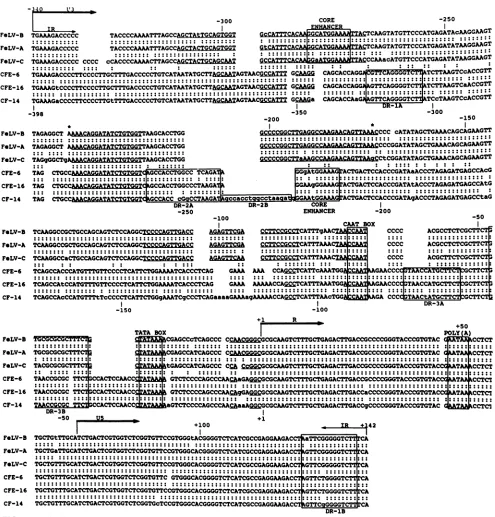
sequences of the endogenous LTRs were highly related among themselves as well as to different subgroups (27, 28) of exogenous FeLV (Fig. 1). Of 142 nucleotides encompassing the R andU5
regions, exogenous FeLVs showed differences at only 4 nucleotide positions due to a single nucleotide deletion or base substitution. Endog-enous sequences also differed in 4 nucleotides, 2 being at different positions compared with the changes observed among exogenous LTRs. The U3 region of the endogenous LTRs, however, revealed significant divergence from the exogenous counterparts. The features contributing to the diversity were (i) the length of U3, the endogenous segment being approximately 30 to 60 bp larger than the exogenous unit; (ii) the presence of stretches of sequences, either homologous or largely nonhomologous, to exogenous U3 scattered on the endogenous element, beginning immedi-ately after the 5' inverted repeat (IR) down to the start of the TATA box; (iii) the presence of three different sets of direct repeats either absent, partially present, or present only as single copies in the exogenous U3; and (iv) the location of the SV40core enhancer-like sequence of endogenous U3 at a position about 90 bp downstream relative to its position in the exogenous U3. These major differences between endog-enous and exogendog-enous FeLV LTRU3s
are schematically presented in Fig. 2. The 14-bpDR-1Aof the endogenous U3 was not detected in the exogenous LTR. Its second copy (DR-1B), which contained a maximum of 2 base changes, however, was present in both exogenous and endogenous sequences partly overlapping with the 3' IR region (Fig. 1 and 2). The 19-bp DR-2A, located immediately upstream of the SV40 core enhancer-like sequence of the endogenousJ. VIROL.
on November 10, 2019 by guest
http://jvi.asm.org/
SEQUENCE AND ACTIVITY OF ENDOGENOUS FeLV LTRs 3633
_ 40 L'3 _
-300 CORE -250
TGAAAGACCCCC TACCCCAAAATTTAGCCAGCTAtTGCAGTGGT GcC A CATGG CAAGTATGTTCCCATGAGATAcAAGGAAGT
TGAAAGACCCCC TACCCCAAAATTTAGCCAGCTACTGCAGTGGT CATCACATGG CAAGTATGTTCCCATGAGATATAAGGAAGT
TGAAAGACCCCC CCCC cCACCCCAAAACTTAGCCCACCGCAAM GCCATTT GCCAAacATGTTCCCATGAGATATAAGGAAGT
TGAAAGACCCCTTCCCCTTGCTTTGACCCCCTGTCATAATATGCTTAGCTAGTAACGCCAm GCAAGG CAGCACCAGGCGTT G CATCTTAAGTCcACCGTT
TGAAAGtCCCCTTCCCCTTGCTTTGACCCCCTGTCATAATATGCTT&A MAAGTAAC Gcm GCAAGG CAGCACCAGG AGTTCAGGGGTCT ATCTTAAGTCaACCGTT TGAAAGaCCCCTTCCCCTTGtTTTGACCCCCTGTCATAATATGCTT&AGAMAGTAACGC Am GCAAGa CAGCACCAaG GTTCAGGGGTCT TCcTAAGTCCACCGTT
I - DR-1A -30
-398 -350 -300
TAGAGGCT AAAACAGGATATCTGTGGTTAAGCACCTGG
TAGAGGCT AAAACAGGATATCTGTGGTTAAGCACCTGG TAGaGGCTqAAAACAGGATATCTGTGGTTAAGCACCTGG
TAG CTGCCAAACAGGATATCTG CCACCTGGCC TCAGAA
TAG CTGCCAAACAGGATATCTGTGGT CCCTGGCCCTAAGAS
:::::::::::::: :::::::: : :::::::..
TAG CTGCCAAACAGGATCGGCGCCACCcGaSCCTAAGAI _q=c~ctacctaa
TCAAGGCCGCTGCCAGCAGTCTCCAGGCTCCCCAGTTGAC TCAAGGCCGCTGCCAGCAGTCTCCAGGCTCCCCAGTTGACC
TCAAGGCCaCTGCCAGCAGTCTCCAGGCTcCCcAGG TCAGCCACCCATGTTTGTTCCCCTCATTCTGGAAAATCACCCTCJ
TCAGCCAtCCATGTTTGTTCCCCTCATTCTGGAAAATCACCCTCJ
-100
AGAGTTCGA AGAGTTCGA
AG GAAA
AG GAAA
-200 -lbu
l ~~~~~~~~~*
GCCCCGGCTTGAGGCCAAGAACAGTTAAACCCC CATATAGCTGAAACAGCAGAAGTT GCCCCGGCTTGAGGCCAAGAACAGTTAAACCCCGGATATAGCTG,AAACAGCAGAAGTT GCCCCGGCTTaAAGCCAAGAACAGTTAAgCtCGGATATAGCTGAAacAGcAGAAGTT GGgAtGGAGftACT ACTCCACCCGATAaACCCTAGAGATGAGcCAXC siAAqGC fAGrA(T ACTCCACeCGATAtACCCTAGAGATGAGCCAtG
-_GAAtGG
ACTGACTCCACCCGATAgACCTAGAGATGAGCctaT-^^r CORE ENHANCER
CAAT BOX
CCTTCCGCTCTTgAA CCTCCGCTAAA CCTTCCGCCATTTAAA
AAA CCAQ=TCATTCAAATGG PAG
AAAACCAG~TCATTAAA C
gAAAAACCAgS_TCATTTAACTGG
-100
-200
CCCC CCCC CCCC
TGCGCGCGCTTTC
TACGCGCG
TAACCGCGCTTC:
TAACCGCGC TTC
TAACCGCG TTC
DR-3B
-50 Us
I~~~
a
.CCACTCCAACC,
: : : : : :: :::::
TATA BOX
ITAM
CGAGCccTcAGccc ccAAcGrG6CCGrCAAGTCTTTGCTtGAGACTTGACCGCCCCCGGCTACCCGTG.TAC
+50
POLY(A)
GDMCCTCT GAGCCATCAGCCC C,CACGGCGCGCAAGTCTTTGCTGAGACTTGACCGCCCCGGGTACCCGTGTAC GJAATA4 CCTCT
tGAGCCATCAGCCC C CCTCCAAGTCTTTGCTAGACTTGACCGCCCCGGTACCCGTGTAC
GTCTCCCCAGCCCAACAaGAgCGCGCAAGTCTTTGCTGAGACTTGACCGCCCCGGGTACCCGTGTACO ATAI .CCTC
VCACTCCAACCO *GTCTCCCCAGCCCAA.QjGAGCGCGCAAGTCTTTGCTGAGACTTGACCaCCCCGGGTACCCGTGTACC AATAIICCTC2
GCCACTCCAACCdttaZM &haGTCTCCCCACC
+100
Ca:::::::
:::::::::::::::::::::::::::::::L&::
ICCAAChaaAgSCG GTTTGAGAG C CCTGCgCCGTACCC GTGTACG
+1
fCCTCi
TR +442
FeLV-B
FoLV-A
FeLV-C
CFE-6
CFE-16
CF-14
TGCTGtTTGCATCTGACTCGTGGTCTCGGTGTTCCGTGGGtACGGGGTCTCATCGCCGAGGAAGACCl. aTCGGGGTCT rCA
TGCTGTTTGCATCTGACTCGTGGTCTCGGTGTTCCGTGGGCACGGGGTCTCATCGCCGAG4GAAGACC¶ KGTTCGGGGGTCT rcA
TGCTGMTGCATCTGACTCGTGGTCTCGGTGTTC GTGGGCACGGGGTCTCATCGCCGAGGAAGACC' MG1TGWSTCTrCA
::C:::::::::::::::::::::::::::::::C:::::::::::::::::::::::::::::::::
GTCTGGCTGCTGTMTGCATCTGACTCGTGGTCTCGGTGTTCCGTGGGCACGGGGTCTCATCGCCGAGGAAGACC'GTTCGGGGTT CA
TGCTGTtTTGCATCTGACTCGTGGTCTCGGTGcTCCGTG4GGCACGGG4GTCTCATCGCCGAGGAAGACC GTC'GGGGTCTT rCA
DR-1B
FIG. 1. Nucleotidesequencecomparison of the5' LTRsfromthree endogenous FeLV provirus loci, clones CFE-6, CFE-16 and CF-14, withthat of threeexogenousFeLVisolates, GA-FeLV-B(13),FeLV-A/Glasgow(34),andFeLV-C/Sarma(25). Important structural features, namely, theSV40coreenhancer-like sequence,directrepeats(DR)of three differentsets(DR-1,DR-2,and DR-3), CAAT, TATA, and the poly(A) signalsequencesareboxed. Features marked byarrowsareIRsdelineatingthe LTRs, and the beginnings of the U3, R, and U5 regions. The first nucleotide of R is numbered +1 for all LTRs, and the numbers on the top indicate the nucleotide positions for the GA-FeLV-BLTR, while those underneath the nucleotidesequencemark the positions for the endogenous CF-14LTR.Gapsareinsertedto
align homologous regions of the sequences. The region within the positions marked by asterisks exhibits partial homology to the 72-bp
enhancerelement ofSV40 DNA, and theunderlinedsequencesindicate the positions thatareconservedinmammaliantypeCretroviruses (6).
U3, was duplicated (witha 1-bp change)in tandem only in
the CF-14 clone. A very close version of this sequence
occurred as asingle copy inboth CFE-6 and CFE-16, but
onlyas apartially homologous single copy(8 of 19 nucleo-tides)ineachof thethreeexogenousLTRscompiled for this
comparison. The DR-3Aconsisted of 14bp, wellconserved amongtheendogenoussequences,andrepeatedaftera7-bp
spacer asDR-3B with 2 base changes. This second repeat,
including the spacer sequences, was also retained in the
exogenous LTR, while the DR-3A unit, like DR-2A, was VOL. 62, 1988
FeLV-B
FeLV-A FeLV-C
CFE-6
CFE-16 CF-14
FeLV-B FeLV-A FeLV-C
CFE-6
CFE-16
CF-14
FeLV-B
FeLV-A
FeLV-C
CFE-6
CFE-16
CF-14
DR-2A
-250
TCAGCCAcCCATGTTTtTcCCCCTCATTCTGGgAAATCgCCCTCAGaaaaGAAAa4
1 -150
-50
ACGCCTCTCGCTTCT
ACGCCTCTCGCTTCT ACGCTTrCTCGCTTCT
FeLV-B
FoLV-A
FoLV-C
CFE-6
CFE-16
CF-14
vAACCCELAA,CCATGCTTJ'C.GCTTC
GA CCCC[rTAACtATGCTTCrGCTTC DR-3A
-- - Wft- ftn
:: :
i: =::
::I- 1
~t
1.
:;F-...7---.7-
DR-2Bon November 10, 2019 by guest
http://jvi.asm.org/
[image:3.612.60.555.67.584.2]3634 BERRY ET AL.
-400 -360 -320 -280 -240 -200 -160 -120 -80 -40
1 1 1 1 1 1 1
EX-FeLV U3
EN-FeLV U3
-4
~~~~~~~~~~~~~~~~~~~~~~~~~~~~~~~~~~~~~~~...
_..
...
..11
DR-IA DR-2A DR-2B CAAT DR-3A DR-3B TATA
FIG. 2. Schematicrepresentation of thedivergencebetweenexogenousandendogenousFeLV U3nucleotidesequences.
Regions
of theendogenous LTR(EN-FeLVU3) thatarehomologoustotheexogenous LTR(EX-FeLV U3)areindicatedbywhite boxedareas,and the
regions thatarelargelynonhomologousareshownasshadedareas. Solidregionsin EN-FeLVU3are
portions
ofsequences notpresent intheEX-FeLV U3within thehomologous regions.Otherfeatures illustrated include thin-lined boxestoindicate the
position
ofSV40core enhancer-like sequencesandbold-lined boxestomark the locations ofdifferentdirect repeats(DR),CAAT,and TATA boxes. The scaleon thetopindicates theapproximate nucleotidepositionsofthesequence,and theasterisk marksthe DRunit,whichispresent in thesequence oftheendogenous LTRof the CF-14 clonebutnotinthe other clonessequenced.partially deletedin the exogenousunit (Fig. 2). In
regard
tothe functional domains, which may be important for
tran-scriptional promotion, the CAAT and TATA boxes were
identical in sequence. They were, however, placed further apart relative to theirpositions on the 3' end of exogenous U3 because ofinsertions of three stretches of nucleotides
(totaling 21 to 22 bp) into the endogenous U3 or,
alterna-tively, by deletion oftheseregions from the exogenous U3
(Fig. 2).
The sequenceofthe 3' LTRofCFE-6 (data not shown)
was nearly identical to its 5' LTR with only three point mutations.Thesemutationsincludedan insertion ofaC and
a transversion mutation (C toA) in the DR-2A sequence,
AGCCACCTGGCCTCAGAT, of the 5' LTR, altering itto
AGCCACCTGGCCCTAAGAT in the 3' LTR. The other base change wasa transition (Tto C) in the core enhancer sequence. It wasalso noted thataputativeprimersequence
(AAGAAAAGGGGGAAA) was retained immediately up-streamofthe 3' LTR. Thispolypurine tractdiffered inonly three positions from the corresponding exogenous FeLV sequence, AGAAAAAGGGGGGAA, conserved in each of
theA, B, and C virus subgroups.
Itshould be noted that themajor characteristic sequence
divergence between endogenous and exogenous FeLV
LTRs, as seen from the comparison of endogenous se-quenceswith those FeLV A, B, and C subgroups, remained
unchanged when the comparison was extended to other
isolates of pathogenic feline retroviruses, such as feline sarcoma virus (FeSV) or FeLV inducing fatal
immunodefi-ciency diseasein cats. The reasonis that the LTRs of FeSV
isolates, e.g., Gardner-Arnstein-FeSV,
Synder-Theilen-FeSV, and Sarma-McDonough-FeSV, revealed extensive
homologyto each other as well as to FeLV (12, 13). These are, however, point mutations and small insertions which
distinguish one FeSV isolate from the other, but they are
considered minorin comparison to the differences observed with the endogenous FeLV LTRs. The largest insertion in
ST-FeSV LTR relative to GA-FeSV is a stretch of four
cytosines positioned immediately 3' to the first IR (13).
Interestingly, these four C's were also found in the same
position in each of the three endogenous LTRs sequenced
(Fig. 1); similarly, a stretch of five C's was present in an
isolate of FeLV-C (25). The feline AIDS (14)-associated
viruseswhose LTR sequences were determined also reveal a
high degreeof homology (94 to 97%) to prototype B and C
subgroups of FeLV, with only a slightly higher (98%)
ho-mology tothe FeLV-A subgroup (8, 20).
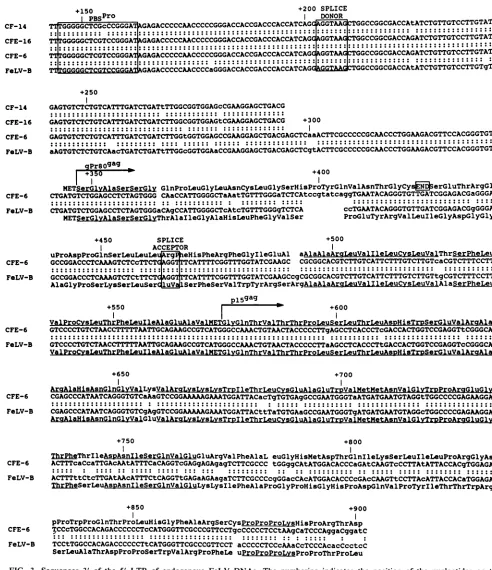
Comparison of sequences downstream of the 5' LTR. All threeendogenous FeLV DNAs were sequenced to the +294 nucleotideposition, and the sequencing continued to about +900 for the full-length clone CFE-6 (Fig. 3). There was
extensive homology at the nucleotide level between the endogenous DNAs and between theendogenous and exog-enousFeLV(ST-FeLV-B) in the internal regionsequenced, except for scattered single basealterations, including substi-tutions, deletions, and insertions. In two locations, one at
approximately +400 and the other at about +500, CFE-6 differed from the exogenous virus due to a 9-bp insertion and 2-bp deletion, respectively. Two of the endogenous clones (CFE-16 andCFE-6) were shown to match 18 of 18 nucleo-tides in the region of the putative primer-binding site that correspondedtoproline tRNA. The third one varied inonly
onenucleotide due toatransitionmutation. Splice donor and acceptorsignals of the leader sequence were conserved, and the first six amino acids of the gPr85gag were identical to
those of the exogenous virus. A base deletion in CFE-6 after these six aminoacids,however, caused a shift in thereading frame, which returned to homology with the exogenous FeLV after 42 amino acids. The homology continued and had encompassed more than half of the p159a9 polypeptide when in-frame base substitutions (beginning at the +767 nucleotide position), followed shortly by a base deletion, altered the amino acid sequence again. In addition to this large number of missense mutations, it appeared that syn-thesis ofgPr8g5ag would be blocked due tothegeneration of atermination codonat +422position fromframeshift muta-tions intheCFE-6 DNA.
Promoter and enhancer functions of endogenous FeLV LTRs. In ourprevioustransient expression studies in NIH 3T3 cells with the provirus DNAcontaining both 5' and 3'
LTRs, we observed that some of the truncated elements wereactively transcribed, while the nearly full-length clones
wereinactive(31). In order todefine further the transcription promotion capacity of the various cloned endogenous 5'
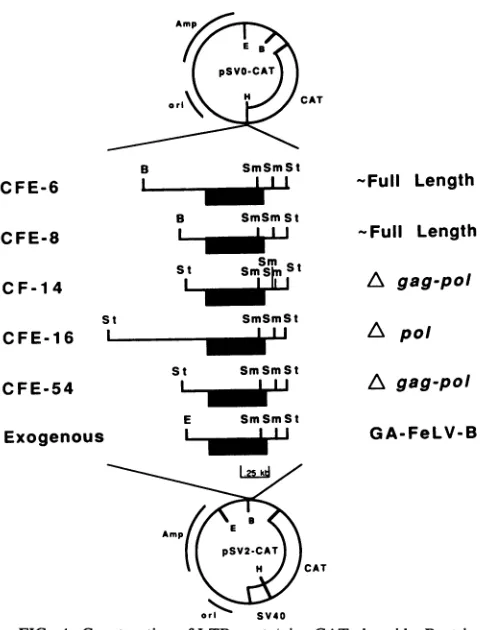
LTRs, we tested the ability of individual LTRs to direct transient expression of the cat gene when transfected into cells of the homologous species. All 5' LTR-containing fragments used for making CAT expression plasmids had similar structuralfeatures.Asshown in Fig. 4, all of the five DNAfragmentshadaconserved SstI site located about 152
bp downstream of the LTR, and three DNAs had a conve-nient SstIorBamHIsite at approximately 0.3 kb upstream of theLTR. TheCFE-16 clone contained the upstream SstI site about 0.8 kb away from the LTR, while the CFE-6 LTR had
[image:4.612.102.523.69.181.2]. . II I I
...
J. VIROL.
on November 10, 2019 by guest
http://jvi.asm.org/
VOL. 62, 1988 SEQUENCE AND ACTIVITY OF ENDOGENOUS FeLV LTRs 3635
+150 +200 SPLICE
PEBSPro DONOR
CF-14 TTGGGGGCTCGcCCGGGA AGAGACCCCCAACCCCCGGGACCACCGACCCACCATCAG GGTAA TGGCCGGCGACCAtATCTGTTGTCCTTGTAT CFE*16TTrGGGGGCTCGTCCGGGAT::::::::::::::::::::::::::::::::::::::: TA::::::CG:::::::::::::TC: CFE-16 TTrGGGGGCTCGTCCGGGAT GAGACCCCCAACCCCCGGGACCACCGACCCACCATCAGG GGTAA GGCCGGCGACCAGATCTGTTGTCCTTGTAT CFE-6 T GGGGGCTCGTCCGGGA iGAGACCCCCAACCCCCGGGACCACCGACCCACCATCAGG GGTAAGCTGGCCGGCGACCAGATCTGTTGTCCTTGTAT FeLV-B TT GGGGG CCGGGAT GAGACCCCCAACCCCaGGGACCACCGACCCACCATCAG
kGGTAACTGGCCGGCGACCAtATCTGTTGTCCTTGTgT
+250
CF-14 GAGTGTCTCTGTCATTTGATCTGATtTTGGCGGTGGAGcCGAAGGAGCTGACG
CFE-16 GAGTGTCTCTGTCATTTGATCTGATCTTGGCGGTGGAGtCGAAGGAGCTGACG +300
CFE-6 GAGTGTCTCTGTCATTTGATCTGATCTTGGtGGTGGAGCCGAAGGAGCTGACGAGCTCaaACTTCGCCCCCGCAACCCTGGAAGACGTTCCACGGGTGT FeLV-B aAGTGTCTCTGTCAacTGATCTGATtTTGGcGGTGGAacCGAAGGAGCTGACGAGCTCgtACTTCGCCCCCGCAACCCTGGAAGACGTTCCACGGGTGT
PrS0gag
I+350 * +400
METSerGlyAlaSerSerGly
GlnProLeuGlyLeuAsnCysLeuGlySerHisProTyrGlnValAsnThrGlyCys
jerGluThrArgG1 CFE-6 CTGATGTCTGGAGCCTCTAGTGGG CAaCCATTGGGGCTaAatTGTTTGGGaTCTCAtccgtatcaggTGAATACAGGGTGTTGATCGGAGACGaGGGA FoLV-B CTGATGTCTGGAGCCTCTAGTGGGaCAgCCATTGGGGCTcAtcTGTTTGGGgTCTCA ccTGAATACAGGGTGTTGATCGGAGACGgGGGAKETSerGlyAlaSerSerGlyThrAlaIleGlyAlaHisLeuPheGlyValSer ProGluTyrArgValLeuIleGlyAspGlyGly
+450 SPLICE +500
ACCEPTOR
uProAspProGlnSerLeuLeuLe rg eHisPheArgPheGlyIleGluAl aAlaAlaArgLeuValIleLeuCysLeuValThrSerPheLeu CFE-6 GCCGGACCCTCAAAGTCTCcTTCTG AGGTCATTTTCGGTTTGGTATCGAAGC CGCGGCACGTCTTGTCATTCTTTGTCTTGTcaCGTCTTTCCTT
FeLV-B GCCGGACCCTCAAAGTCTCtTTCTGAGTCATTTTCGGTTTGGTATCGAAGCcgCGCGGCACGTCTTGTCATTCTTTGTCTTGTtgCGTCTTTCCTT AlaGlyProSerLysSerLeuSerG uVa SerPheSerValTrpTyrArgSerArgAlaAlaArgLeuValIleLeuCysLeuValAlaSerPheLeu
5plgag
+550 b +600
ValProCysLeuThrPheLeuIleAlaGluAlaValMETGlyGlnThrValThrThrProLeuSerLeuThrLeuAspHisTrpSerGluValArgAla CFE-6 GTCCCCTGTCTAACCTTTTTAATTGCAGAAGCCGTCATGGGCCAAACTGTAACTACCCCCTTgAGCCTCACCCTcGACCACTGGTCCGAGGTtCGGGCA
FeLV-B GTCCCCTGTCTAACCTTTTTAATTGCAGAAGCCGTCATGGGCCAAACTGTAACTACCCCCTTaAGCCTCACCCTtGACCACTGGTCCGAGGTcCGGGCA
ValProCysLeuThrPheLeuIleAlaGluAlaValMETGlyGlnThrValThrThrProLeuserLeuThrLeuAsRHisTrpSerGluValArgAla
+650 +700
ArgAlaHisAsnG1nGlyValLysValArgLysLysLysTrRIleThrLeuCysGluAlaGluTrRValMetMetAsnValGlyTrRProArgGluGly
CFE-6 CGAGCCCATAATCAGGGTGTCaAaGTCCGGAAAAAGAAATGGATTACacTgTGTGAgGCCGAATGGGTaATGATGAATGTAGGtTGGCCCCGAGAAGGAFeLV-B CGAGCCCATAATCAGGGTGTCgAgGTCCGGAAAAAGAAATGGATTACttTaTGTGAaGCCGAATGGGTgATGATGAATGTAGGcTGGCCCCGAGAAGGA
ArgAlaHisAsnGlnGlyValGluValArgLysLysLysTrpIleThrLeuCysGluAlaGluTrRValMetMetAsnValGlyTrpProArgGluGly
+750 +800
ThrPheThrIleAsRAsnIleSerGlnValGluGluArgValPheAlaL euGlyHisMetAspThrGlnIleLysSerLeulleLeuProArgGlyAs CFE-6 ACTTTcaCcaTTGAcAAtATTTCaCAGGTcGAGgAGAgagTCTTCGCCC tGGggCAtATGGACACCCaGAtCAAGTcCCTTAtATTACCACgTGGAGA
FeLV-B ACTTTttCtcTTGAtAAcATTTCtCAGGTtGAGaAGAagaTCTTCGCCCcgGGacCAcATGGACACCCcGAcCAAGTtCCTTAcATTACCACaTGGAGA ThrPheSerLeuAsRAsnIleSerGlnValGluLysLysIlePheAlaProGlyProHisGlyHisProAspGlnValProTyrIleThrThrTrpArg
+850 +900
pProTrpProGlnThrProLeuHisGlyPheAlaArgSerCysProProProLysHisProArgThrAsp
CFE-6 TCCcTGGCCACAGACCCCCCTcCATGGGTTCGCCCGTTCCTgcCCCCCTCCtAAgCaTCCCAggaCggatC FeLV-B TCCtTGGCCACAGACCCCCCTtCATGGGTTCGCCCGTTCCT aCCCCCTCCcAAaCcTCCCAcacCcctcC
[image:5.612.52.544.81.651.2]SerLeuAlaThrAspProProSerTrpValArgProPheLe
uProProProLysProProThrProLeu
FIG. 3. Sequences 3' ofthe 5' LTR of endogenous FeLV DNAs. The numbering indicates the position of the nucleotides on the endogenous proviralDNAwith reference to the viral RNA cap site marked +1 (as shown in Fig. 1). The amino acid sequence identities betweenendogenous and ST-FeLV-Bexogenous (15) FeLVs have been underlined. The correspondences established are based on blocks of homologies. Featureshighlighted include the primer-binding site complementary to proline tRNA(PBSPrO),the conserved splice donor and acceptorsites, the beginning ofgPr809a9polypeptide, a nonsense mutation, and the beginning ofp159a9.The sequence ends 17 amino acids priortotheendofthep159a9protein of ST-FeLV-B.
on November 10, 2019 by guest
http://jvi.asm.org/
3636 BERRY ET AL.
CAT
B SmSmSt
B SmSmSt
It
SmSmSt
St SmSmSt
E SmSmSt
I_-J
-Full Length
-Full Length
A gag-pol
A po/
A
gag-pol
GA-FeLV-B
3-Cm
**
***
1--Cm*
Cm i _ _ _ _
1 2 3 4 5 6 7 8 9 10
FIG. 5. Comparisonof the promoterand enhanceractivities of feline LTR-catgeneconstructsin felineembryonicfibroblasts(H927 cells).The cellsweretransfected with 20 i.g of eachrecombinant cat plasmid andassayedfor CATactivity. Theautoradiogramfrom a typical assayis shown here. Thepositions ofmigrationfor chlor-amphenicol (Cm)and its acetylated forms (1-Cm,3-Cm) are indi-cated. The plasmids usedwere: 1, pSVO-CAT; 2, pSV2-CAT; 3,
pCAT-L3-A (afeline endogenous RD-114 5' LTR clone [32]); 4, pCAT-16-A; 5, pCAT-EX-A (exogenous GA-FeLV-B 5' LTR clone); 6, pCAT-EX-B; 7, pSV2-CAT-6-A; 8, pSV2-CAT-6-B; 9, pSV2-CAT-8-A; and 10, pSV2-CAT-8-B. Plasmids containing the inserted LTRfragmentin the 5' to3'directionaredesignated byA and the invertedorientation(3'to5') byB.
orl - SV40
FIG. 4. Construction of LTR-containing CAT plasmids. Restric-tionfragments containing5' LTRs from exogenousGA-FeLV-B(30) and different endogenous FeLV proviral loci were isolated, end-repaired, and ligated into eithertheHindIII siteupstreamofthe cat geneinpSVO-CATorthe BamHIsite downstream ofthe cat gene inpSV2-CAT.Bothorientationsof theinsertwereisolated,but only the5' to 3'orientation of each hybridDNAispresentedhere. The position of each LTR is indicated byashadedbox.Restriction sites: B, BamHI;E, EcoRI; H,HindIII;Sm,SmaI; St,SstI.
702-bp upstream flanking sequences. LTR fragments were
insertedupstream ofthe cat gene of the plasmid pSVO-CAT and the correct orientation of the recombinant DNAs iso-lated and transfected into H927feline fibroblast cells. The
results ofthe transient cat expression assay are shown in
TABLE 1. Relative promoter activity of endogenous FeLV 5' LTRsasassayedbytransientexpression of CAT activity
in H927feline embryonic fibroblasts
Plasmid Mean relative CAT activitya
± SD(no.of expt)
pSVO-CAT 0.08 ± 0.06 (7)
pSV2-CAT 1.00 (7)
pCAT-EX 3.55 ±0.78 (4)
pCAT-6 0.07 ±0.01(3)
pCAT-8 0.08 ±0.01(3)
pCAT-14 0.07 ±0.02 (3)
pCAT-16 4.87 ±0.75 (3)
pCAT-54 0.07 ±0.01(3)
aCATactivity is expressedas the level ofconversionofchloramphenicolto
acetylated formsrelative to the conversion ofpSV2-CAT.Thevaluesfrom all experiments are reported here as the mean plus or minus the standard
[image:6.612.63.303.67.382.2]deviation. The number of CATassays isshownin parentheses.
Table 1. Only two of the various LTRs examined showed detectable transcriptionalpromoteractivity. The5' LTR of
exogenous GA-FeLV-B (pCAT-EX) expressed
approxi-mately fourfold-higher activity than the controlpSV2-CATplasmid (Fig. 5, lanes 2 and5, and Table 1). Theendogenous
LTR of CFE-16 locus (pCAT-16) showed activity even
higher than that ofpCAT-Ex (Fig. 5, lane4, andTable
1),
while the otherendogenous clones tested failed to exhibit detectableactivity(Table 1).Toassessthepotential enhanceractivity separately from the promoter function, the endogenous LTRs were linked downstream of thecatgenein theSV2-CATplasmid (Fig.4)
for analysis of expression in the same feline fibroblast cell line. Some representative results of these experiments are
illustratedin Fig. 5, and all dataaresummarized in Table 2. Incontrast tothe results of thepromoterabilitytest, mostof the endogenous LTRs examined indicated activity higher
TABLE 2. Relativeenhancer activity of endogenousFeLV 5' LTRsasassayedby transient expression of CAT activity
in H927 feline embryonic fibroblasts
PamdOiia MeanrelativeCATactivityb
Plasmid Orientation" +SD(no. ofexpt)
pSVO-CAT 0.08 + 0.06 (7)
pSV2-CAT 1.0(7)
pSV2-CAT-EX A 5.4 ±0.1 (3)
pSV2-CAT-EX B 3.1 ± 1.4 (5)
pSV2-CAT-6 A 1.4 ±0.8 (5)
pSV2-CAT-6 B 4.8± 2.8(5)
pSV2-CAT-8 A 4.8± 0.5 (5)
pSV2-CAT-8 B 2.5 ± 1.2 (5)
pSV2-CAT-14 A 2.9 ± 1.0 (5)
pSV2-CAT-14 B 3.1 ± 1.2 (5)
pSV2-CAT-16 A 3.8 ± 1.3 (5)
pSV2-CAT-16 B 2.9± 1.6 (5)
pSV2-CAT-54 A 1.5± 0.6 (5)
pSV2-CAT-54 B 2.3 ± 1.2(5)
aOrientationindicatesthat the LTRis eitherin the
correct
5'-3'positionrelativeto cat(A) orin the opposite orientation(B).
bCAT activityisexpressedasthelevelof conversionofchloramphenicolto
itsacetylated forms relativetotheconversion obtained withpSV2-CAT.The number of CATassaysis shownin parentheses.
CFE-6
CFE-8
CF-14
st
CFE-16
CFE-54
Exogenous
I
J. VIROL.
on November 10, 2019 by guest
http://jvi.asm.org/
[image:6.612.344.538.73.170.2] [image:6.612.322.561.528.683.2] [image:6.612.64.302.589.689.2]SEQUENCE AND ACTIVITY OF ENDOGENOUS FeLV LTRs
(-252) (+196)
EcoRV BglII
SstI
_R
~~~~~~~~~~~~~~~~~~~I
BglII
B
3-Cm
1-Cm do
Cm@@ * * @
(-255)
EcoRV
SatI
o G C,
a b C d
pCAT-6/1 6
pCAT-1 6/6
satI
EcoRV BglII
SatI
licoRV BglIII
S st I
[image:7.612.88.527.75.316.2].-I ---.-I2
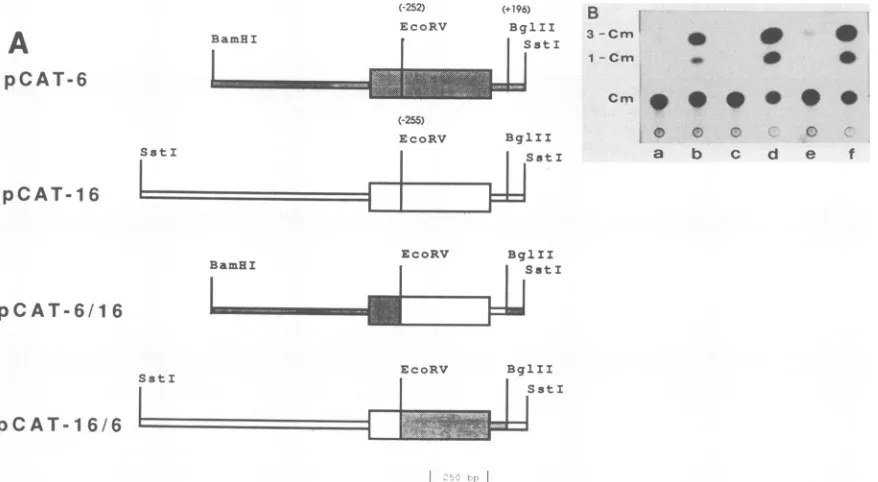
FIG. 6. Effect of flanking regionsoncatexpression.(A)Mix-and-matchconstructsweregenerated.(B) LevelsofCAT activity monitored
in H927 cells after transfection with (a) pSVO-CAT, (b) pSV2-CAT, (c) pCAT-6, (d) pCAT-16, (e) pCAT-6/16, and (f) pCAT-16/6. The orientation ofeach insertwasin the5'to3'direction.
thantheSV2-CAT control activity. The observed effectwas
generally bidirectional, with a variable degree of
enhance-mentdependingonthe cloned DNA. Although the degree of
enhancementwasno greaterthantwo- tofive-fold overthe
pSV2-CAT control, thevalues.obtained might be considered significant since the pSV2-CAT backbone of theconstructs
already contained ahighly potent SV40 enhancer and the inserted FeLV sequences had to stimulate activity above this high background.
Sequences outside the endogenous LTRsmayinfluence their
transcription regulatory activity. Nucleotide sequence data
revealed thatexceptfor theoccurrenceof DR-2B in CF-14,
all three endogenous LTRs were very similar in their
se-quenceandorganization of the potential functional domains. This structural similarity, however, did not correlate with the observedpromoterabilities of these LTRs. For example, pCAT-16 displayed marked promoter activity in the
tran-sientexpressionassays,whileneither pCAT-6norpCAT-14
showed any detectable activity. CFE-16 and CFE-6 LTRs were, however, highly homologous, retaining over 97% sequence homology, with mostly single base alterations or
deletions at 15 positions of the 518-bp length in the entire LTR. These alterations were scatteredthroughout the LTR
and did not involve the conserved sequences offunctional domains like the CAAT andTATA boxes. Toexamine the
potential consequences ofthese nucleotide changes in the
LTRsof theendogenous provirus loci, wemadeconstructs
in which the majority of the LTR sequence (U5, R, 252 to
255bp of U3) from theEcoRVsite(GATATCat-255bpfor
CFE-16orat-252 forCFE-6)totheBglIIsiteat+196bpof
pCAT-16 and pCAT-6wereexchanged to createthehybrid plasmids pCAT-6/16andpCAT-16/6 (Fig. 6A).The resultsof
CATexpression assaysin H927 cells transfectedwith these
plasmid DNAsareillustratedinFig. 6B.Replacementof the
region encompassing -252 to +196bpof the CFE-6clone
with thecorresponding region ofthe CFE-16 element didnot
restore itsactivity, while the inverse exchange (CFE-6 into CFE-16) didnoteliminate theactivity. Thus, this portion of the LTR leader sequence was interchangeable and
appar-ently did not contain the sequences responsible for the
drastic difference in the levels of activity between the two
cloned DNAs. The differential transcription efficiency of the reconstructed DNAswasnotrestrictedtoH927feline fibro-blasts, since a similar effectwas also observed with feline
T-lymphoid tumor cells and NIH 3T3 mouse fibroblasts
(Table 3).
It should be noted that only three single nucleotide changes between CFE-6 and CFE-16 in the 129-bp region of U3 upstream of the EcoRI site were not included in the mix-and-match constructs. It appeared unlikely that minor
sequencevariationsinthisshorterareacould be sufficientto account for the dramatic differences in function. It was
consideredmorelikely that the sequencesinthe 5'-flanking
region of CFE-6 might be dominant in the strong negative effect observed in the CAT assays. To examine this point further, the DNA of the CFE-6 clone was progressively
deleted from the BamHI site at the 5' end of the insert.
Deletion mutants were transfected into H927 cells and
assayed for CAT activity. The5' boundaryof each deletion
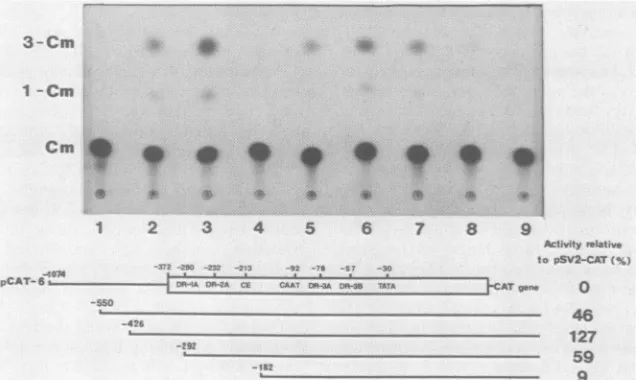
and the results ofa typical CAT analysis with these con-structs are shown in Fig. 7. The CAT activity ofpCAT-6
increasedsignificantly whenthe first 524bp (-1074to-550
bp) of the 5'-flanking DNAweredeleted. Subsequent
dele-tion of124bp(-550to-426bp)further restored theactivity
toa levelcomparable toor evenhigherthan that of pSV2-CAT. Additional deletions extending to the interior
se-quences ofthe LTR led to progressive reductions of CAT
activity. For example, sequentialdeletions of 134bp (-426
to -292bp)and 80bp (-292to-182bp)resultedin relative
activities of59 and 9%, respectively. Since the 80-bp dele-tioneliminatedtheDR-1Aand DR-2Arepeatsaswellasthe
SV40 core enhancer-like sequence, the differentialactivity
BaamHI
A
pCAT-6
pCAT-1 6
S a t I
BamBI
O
e f
"Mmoomms
VOL.62, 1988 3637
on November 10, 2019 by guest
http://jvi.asm.org/
3638 BERRY ET AL.
TABLE 3. Influenceofadjoining regionsonthe promoteractivityofendogenousLTRsassayedbytransientexpressionof CATactivity
Mean relative CATactivitya + SD Plasmid
H927 cells 3201Bcells NIH 3T3cells
pSV2-CAT 1.00(27 ± 18%) 1.00(0.18 ± 0.02%) 1.00(25 ± 16%)
pSVO-CAT 0.07 ± 0.03 0.08 ± 0.01 0.09 ± 0.05
pCAT-6 0.09± 0.04 0.07 ± 0.01 0.12± 0.09
pCAT-16 3.47± 2.09 3.75 ± 2.05 0.32± 0.14
pCAT-6/16 0.09± 0.01 0.09 ± 0.01 0.06± 0.06
pCAT-16/6 2.56± 1.38 2.77 ± 1.18 0.49± 0.27
a Levels of CAT activity are expressed relativetothelevel obtained withpSV2-CATin each celltype.Each value represents themeanfromthreesetsof experiments for H927 or 3201B cells and from foursetsofexperimentsforNIH3T3 cells.Theactual percentacetylationforextractsofpSV2-CAT-transfected cells is shown in parentheses.
between the 134-bpand 80-bp deletions also suggestedthat the region encompassing the DR-1A/DR-2A/core enhancer sequences contained atleast a portion of the
transcription
enhancementabilitythat weobserved withthe LTRslinked downstream of pSV2-CAT. Furthermore, the reduction of
relative activityfrom 127 to 59% withthe change ofthe 5'
boundary from -426 to -292 bp implied the presence of additionalpositive regulatory elements in this134-bp region. This region contained 80bp ofthe 5' terminus of the LTR and 54 bp of the immediately adjacent 5'-flanking cellular
DNA.
Based on thehigh degree of nucleotide homologybetween
CFE-6andCFE-16 withinthe 5' LTRsequence, itappeared
verylikelythattranscriptionaltransactivation domainswere the same inboth LTRs. It is possible, however, that addi-tionalpositive regulatory elements might be located in the
5'-flanking region of CFE-16.
The deletion mutation studies confirmed that the
5'-flankingsequences werelargelyresponsible forthenegative regulation of the pCAT-6constructin the transient
expres-sionassays. ThenucleotidesequenceoftheflankingDNAof
3-Cm 1 -Cm
CFE-6 is shown in Fig. 8. This sequence and those of the 5'-flanking DNAs of the CFE-16 and CF-14 LTRs(data not
shown) are not homologous toeach other, consistent with the origin of the proviral clones from different loci. The
702-bp flankingDNA ofCFE-6 could be divided intoatleast two domains on the basis of the CAT analysis. These domains are 524bp (-1074 to -550bp)and 124bp (-550to -426 bp) in length, each containing structurally different
negative transcription regulatory elements. Furtheranalysis
would berequired todefinethe precise boundaries ofthese
cis-acting domains.
DISCUSSION
Theinterest ofthiswork isthreefold. First, the structure
of the endogenous FeLV LTR has been defined at the
nucleotide level. Second, the structural analysis providesa
basis on which to explore the evolutionary relationship
between the noninfectious proviral sequence ofcat DNA and the genome of infectious FeLV. Third, theintegrityof the transcription-regulating sequences and results of the
C:m~
*
-1*.i: * * A* V
1 2 3 4 5 6 7 8 9
-tQ7M4 a
pCAT-6I ^4F'E:t
P--CAA 'gP._3A. :)-30 -. A'
PAct4yifyrelative to pSV2-CAT (I
}CATqp,f 0
46 127
59 9
FIG. 7. CAT activity of 5' deletion mutants in transfected H927 cells. In the autoradiogram of a typical assay (top), the plasmids used were:1,pSVO-CAT; 2, pSV2-CAT; 3, pCAT-16; 4, pCAT-6; 5, pCAT-6 deleted up to position -500; 6, pCAT-6 deleted to-426;7, pCAT-6 deletedto-292; 8,pCAT-6 deleted to -182; and 9, untransfected cell lysate. A schematic diagram of pCAT-6 and its 5' deletion mutants with theindicated endpoints is shown below. The boxed region depicts the 5' LTR in which the positions of the direct repeats(DR-1A, DR-2A, DR-3A, and DR-3B), SV40 core enhancer-like sequence (CE), and CAAT and TATA boxes are indicated in the order of occurrence but not toscale. The relative activity value for each mutant, shown on the right, was the average of two experiments, with the variation between experiments less than 20% of the average. The data were calculated after adjusting for pSVO-CAT background and normalizing the
pSV2-CATvalueto100%. The level of pCAT-6 activity was equal to the pSVO-CAT background activity (0.06% of pSV2-CAT activity). J. VIROL.
187
on November 10, 2019 by guest
http://jvi.asm.org/
[image:8.612.155.474.460.650.2]SEQUENCE AND ACTIVITY OF ENDOGENOUS FeLV LTRs
-586
Ppi
-516
-446
* -376
U3
1AATG G T ~ GT T rr
FIG. 8. Nucleotide sequence of cellular DNA immediately up-streamof theCFE-6 5' LTR. 5' deletion mutation analysis indicated the location of two sets of negative transcription regulatory ele-ments, one setbeing in the region marked byBamHI andPpuMI
restriction sites (-1074 to-550bp), andthe other within thePpuMI
site and the position marked by an asterisk (-550 to -426 bp).
functional studies with the endogenous LTRs suggest that
although the basic characteristics for promotion and
en-hancement of transcriptionareretained,additionalcis-acting
elements may strongly influence the activity ofthe LTR.
These three issues arediscussed below.
Nucleotidesequencedata show that allof theendogenous
5' LTRs examined are more closely related to each other
than to the exogenous LTRs. Analogous to the diversity observed in the U3region of the avianandmurine
endoge-nous and exogenous proviral LTRs (35), the variability between endogenous and exogenous FeLV LTRs is also extensive in this region. Three major segments in
endoge-nous U3 arelargelynonhomologous totheexogenous LTR,
andthese stretches of
nucleotides
probably confer theU3-specific hybridization used previouslyto
distinguish
between exogenous and endogenous FeLV sequences (5). Locatedwithin the endogenous U3, there are three sets of direct
repeats(DR-1,DR-2, and DR-3),ranging in length from14to
19bp, each except DR-2occurring in duplicate in all three endogenous LTRs. A second copy ofDR-2is found in the
CF-14 clone but not in the others. The exogenous LTR of FeLV
subgroup
A, B, and C hasonly
onecopyofDR-1,part of DR-2, and one and a half copies of DR-3. The DNA sequenceofR-U5 and theregion
downstreamof the 5' LTRencompassingtheprimer-bindingsite, leader, and almostto
the end of
p15rag
reveals a high degree of conservation.However,thepresenceof
frameshift
mutations anda termi-nation codonpredict alteredgPr8orag
andplS1a9proteins,
if anyareproduced atall.Two possibilities may be considered to
explain
theob-served divergencebetween the
endogenous
andexogenousFeLV LTRs. Theprogenitor mammalian retrovirus,
proba-bly ofrodentorigin(3),which introduced the viral sequences
into the feline germ line might have been similar to the present-day FeLV in the structure of its U3 region. The proviral lociin the hostgenome weresubsequentlysubjected
to modifications, including insertions and additional
muta-tions in U3 and other regions, for selective advantages. Alternatively, the evolutionary progenitor of FeLV might havebeenmoreclosely relatedtowhatisnowretainedinthe endogenous elements, but the present-day FeLV, originating
fromthe prototypevirus, has undergone mutations overthe evolutionary period. This second possibility may find sup-port in the results of the present study. The major LTR variation between endogenous and exogenous FeLV se-quencesis located in the U3 region, implicated in replication and in species and tissue specificities (35). The divergence
involves the directrepeatsandseveralstretches of sequence
thatareconserved inreplication-competent mammalian
ret-roviruses. Deletion of direct repeats within LTRs is not uncommon in naturally occurring retroviruses (35), and it has been shown experimentally that large direct repeats carried within retroviral vectors are unstable and are fre-quently deleted during virus replication (24). Thus, the progenitor FeLV might have undergone deletions in certain duplicate sequences and acquirednew sequencesin the U3 region that conferred replication efficiency and other selec-tive advantagesto the virus. Both deletion and acquisition
events might have been accomplished simultaneously by recombination with othermammalian retroviruses, although
currently there is no direct evidence to substantiate this speculation on theorigin of FeLV.
The results offunctionalactivity studies with constructs having similar structural features except for cellular flanking
sequencesshow thatmostof theendogenous FeLV 5' LTRs carry the potential to enhance the transcription of a gene linked 5' to the LTR. In contrast to the observed enhancing effect, the promoterabilityof most of the endogenous LTR constructsin the in vitro testsystem is poor, except for one cloned DNA(CFE-16) that displays an activity as robust as that of the exogenous LTR construct. TheCFE-16locusisa truncated provirus, and the CAT activity of its 5' LTR in feline cells is consistent with the transcription efficiency of thisproviral DNA in mouse cells (31). Transcriptional inef-ficiency of the cloned DNAs of thenearlyfull-length provi-ruses (31) is also consistent with the lack of promoter activity of their 5' LTRs in the transientexpressionassays in
felinecells. In viewof thesimilarityof the sequences within the 5' LTRs of theseendogenousFeLVDNAs, and since all LTR constructs contained variable lengths of flankingDNA sequences, it is likely that the overall efficiency of the cat constructs is influenced by adjoining proviral DNA se-quences. Infact, reconstruction and deletion analyses
indi-catethe presence ofnegativeregulatoryelements outsidethe 5' LTR ofthe CFE-6 full-length proviral clone. Since the
resultsof CAT assays with the mix-and-match constructs are
independent ofthe cell typesused, the negative regulatory
elements mightthen be interacting with non-tissue-specific factors. The interaction must bevery strongto overridethe effect of other
transcription-initiating
interactions involvingthe common functional domains within the endogenous
FeLV LTRs.
Although there is agood correlation between promoter
ability ofthe 5' LTR
region
andtranscription
efficiency
of theproviralDNAin the CFE-16 and CFE-6clones, there is anapparentlack of correlation in the data obtained with the CF-14 DNA. CF-14 is ahighly truncated locus, itsgenomeVOL.62, 1988 3639
on November 10, 2019 by guest
http://jvi.asm.org/
3640 BERRY ET AL.
size
being only
4.8 kb(31).
The 5' LTRregion
of CF-14 didnot support cat
expression
in eitherfeline cells(described
here)
or mousecells(data
notshown).
Alsonotshownis the RNA dot blotanalysis
with cells transfected with CFE-16and CF-14 cat constructs
(pCAT-16
andpCAT-14).
ThisRNA
analysis
confirmed thatpCAT-14
did not supportdetectable
transcription
ofthecatgene,whilecattranscripts
could be
readily
seen in cells transfected withpCAT-16.
However,
thecorresponding
CF-14proviral
DNA,
contain-ing
both the5' and 3'LTRs,
wastranscriptionally
active inmouse cells
(31).
Since the CF-14 LTR sequence is verysimilar to those of CFE-16 and
CFE-6,
it islikely
that itstranscription-promoting inefficiency
maybe relatedtopoten-tial
negative
regulatory
elements present in the5'-flanking
DNA,
inanalogy
totheCFE-6 clone. This inhibition isthenapparently
overcomeby
theregulatory
elements in thedownstream viral and cellular sequences of this truncated
provirus.
Itseemsverylikely
thatthe3'LTRpresentonly
at adistance of4.0 kb from the5' LTRinthe CF-14provirus
mayplay
asignificant positive
role in itstranscription.
Thisproposal
on the interaction betweenpositive
andnegative
regulatory
elements in thevicinity
of the CF-14provirus,
however,
awaitsfurtheranalysis.
In
conclusion,
the nucleotidehomology
ofthe three 5'LTRs derived from three
independent endogenous
FeLVproviral
locistrongly
supports theconcept thatmostmem-bersof this
provirus family
retaintheability
topromote andenhance
transcription.
Differencesintheirinvitropromoterfunction are
probably
not indicative of minor sequencedivergence
but reflect an effect ofcis-acting
regulatory
elementspresent in the
adjacent
cellular DNA. Thisimpliesthat
expression
ofendogenous
FeLVproviruses
istightly
regulated by proximal
host DNA sequences.Likewise,
demonstration of enhancer functions
residing
in these LTRs supports theideathatendogenous
LTRs may influencetheexpression
of cellular genes which may be located in thevicinityof the proviralloci.
ACKNOWLEDGMENTS
We thankB. Howardfor plasmids pSVO-CATandpSV2-CAT,
A.Roy-Burmanforcomputer-assistedartwork,E. Mader for criti-calreading,andR. Potasiand L.Doumak for carefultypingofthe
manuscript.
This workwassupportedbyPublic Health Service grant CA40590 from the National Institutes of Health.
LITERATURECITED
1. Baluda,M.A.,and P.Roy-Burman. 1973.Partial characteriza-tion of RD-114 virus by DNA-RNA hybridization studies. Nature(London)NewBiol. 244:59-62.
2. Banerji, J., L. Olson, and W.Schaffner. 1983. A
lymphocyte-specificcellular enhancer is locateddownstream of thejoining
regioninimmunoglobulinheavychain genes. Cell 33:729-740. 3. Benveniste, R.E.,C. J.Sherr, andG.J. Todaro. 1975.
Evolu-tion of type C viral genes: origin of feline leukemia virus. Science 190:886-888.
4. Busch,M.P., B.G.Devi,L. H.Soe,B. Perbal,M. A.Baluda, and P.Roy-Burman.1983.Characterizationofthe expression of cellularretrovirus genes and oncogenes infeline cells.Hematol. Oncol. 1:61-75.
5. Casey, J. W., A. Roach, J. I. Mullins, K. B. Burck, M. 0. Nicolson,M. B.Gardner,and N.Davidson.1981.TheU3portion offeline leukemiavirus DNA identifies horizontally acquired
proviruses in leukemic cats. Proc. Natl. Acad. Sci. USA 78: 7778-7782.
6. Chen,H.R., andW.C. Barker. 1984.Nucleotide sequences of the retroviral longterminal repeatsandtheiradjacent regions. Nucleic Acids Res. 12:1767-1778.
7. Dale,R. M.K.,B. A.McClure,andJ. P. Houchins. 1985.Rapid
single-stranded cloningstrategyforproducing asequential se-ries ofoverlappingclones forusein DNAsequencing:
applica-tiontosequencingthe cornmitochondrial 18S rDNA. Plasmid 13:31-40.
8. Donahue, P. R., E. A. Hoover, G. D. Beltz, N. Riedel, V. M. Hirsch,J. Overbaugh, andJ. I. Mullins. 1988. Strong sequence conservation among horizontally transmissible, minimally pathogenicfeline leukemia viruses. J. Virol. 62:722-731. 9. Elder, J.H.,andJ. I. Mullins. 1983. Nucleotide sequence of the
envelope gene of Gardner-Arnstein feline leukemia virus B reveals unique sequence homologies witha murine mink cell
focus-formingvirus. J. Virol. 46:871-880.
10. Gorman, C. M., L. F. Moffat, and B. H. Howard. 1982. Recombinant genomes which expresschloramphenicol
acetyl-transferase inmammalian cells. Mol. Cell. Biol.2:1044-1051. 11. Graham,F.L.,and A.J. Van der Eb. 1973. Anewtechniquefor
the assayof human adenovirus 5 DNA. Virology52:456-467. 12. Guilhot, S., A. Hampe, L. D'Auriol, and F. Galibert. 1987.
Nucleotide sequence analysis of the LTRs andenv genes of SM-FeSV andGA-FeSV.Virology 161:252-258.
13. Hampe, A., M. Gobet, J. Even, C. J. Sherr, and F. Galibert. 1983.Nucleotide sequence of felinesarcomaviruslong terminal repeats and 5' leaders show extensive homology to those of other mammalian retroviruses. J.Virol. 45:466-472.
14. Hoover, E. A.,J. I. Mullins, S. L. Quackenbush, and P. W. Gasper. 1987. Experimental transmission and pathogenesis of feline AIDS. Blood70:1880-1892.
15. Laprevotte, I., A. Hampe, C. J. Sherr, and F. Galibert. 1984. Nucleotide sequenceof the gag andgag-poljunction of feline leukemiavirus. J. Virol. 50:884-894.
16. Maniatis, T., E. F.Fritsch, and J. Sambrook. 1982. Molecular cloning:alaboratory manual. Cold Spring HarborLaboratory, ColdSpring Harbor, N.Y.
17. Niman, H. L., M. Akhavi, M.B.Gardner, J. R. Stephenson, and P. Roy-Burman. 1980. Differential expression oftwo distinct endogenous retrovirus genomes in developing tissues of the domestic cat.J. Natl. Cancer Inst. 64:587-594.
18. Niman, H. L., M. B. Gardner, J. R. Stephenson, and P. Roy-Burman. 1977. Endogenous RD-114 virus genome expres-sion inmalignant tissues of domesticcats.J.Virol. 23:578-596. 19. Niman, H. L., J. R. Stephenson, M. B. Gardner, and P. Roy-Burman. 1977. RD-114 and feline leukemia virus genome expression in natural lymphomas of domestic cats. Nature (London) 266:357-360.
20. Overbaugh, J., P. R. Donahue, S. L. Quackenbush, E. A. Hoover, and J. I. MuUlins. 1988. Molecular cloning of a feline leukemiavirus that induces fatalimmunodeficiency disease in cats. Science 239:906-910.
21. Parker, B., and G.R.Stark. 1979.Regulation of simian virus 40 transcription: sensitive analysis of the RNA species present early in infections by virusorviralDNA. J.Virol. 31:360-369. 22. Quintrell, N.,H. E.Varmus, J.M.Bishop, M. 0. Nicolson,and R. M. McAllister. 1974. Homologies among the nucleotide sequences of the genomes ofC-type viruses. Virology 58:569-575.
23. Rasheed,S.,andM. B.Gardner. 1980. Characterization ofcat cellcultures for expression of retrovirus, FOCMA and endog-enous sarcgenes, p.393-400. In W. D.Hardy, Jr., M. Essex, and A. J. McClelland (ed.),Proceedings of the Third Interna-tional Feline Leukemia Virus Meeting. Elsevier/North-Holland Publishing Co.,NewYork.
24. Rhode,B.W.,M.Emerman, and H. M. Temin. 1987. Instability oflarge direct repeats in retrovirus vectors. J. Virol. 61:925-927.
25. Riedel, N.,E. A. Hoover, P. W. Gasper, M. 0. Nicolson, and J.I.Muilins. 1986.Molecularanalysis and pathogenesis of the feline aplastic anemia retrovirus, feline leukemia virus C-SARMA.J.Virol. 60:242-250.
26. Sanger, F., A. R.Coulson, B. G. Barrell, A. J. H. Smith, and B. A. Roe.1980.Cloning in single-stranded bacteriophage as an aidtorapidDNAsequencing. J. Mol. Biol. 143:161-178. 27. Sarma, P. S., and T. Log. 1971. Viral interference in feline
J. VIROL.
on November 10, 2019 by guest
http://jvi.asm.org/
SEQUENCE AND ACTIVITY OF ENDOGENOUS FeLV LTRs leukemia-sarcoma complex. Virology 44:352-358.
28. Sarma, P.S.,T. Log, S. Skuntz, S.Krishnan, and K.Burkley. 1978. Experimental horizontal transmission of feline leukemia virusesof subgroups A, B and C. J.Natl.Cancer Inst. 60:871-874.
29. Snyder, H. W., W. D. Hardy, E. E. Zuckerman, and E. Fleissner.1978.Characterization ofatumour-specific antigenon
the surface of feline lymphosarcoma cells. Nature (London) 275:656-658.
30. Soe, L. H., B. G. Devi, J. I. Mullins, and P. Roy-Burman.1983. Molecular cloning and characterization of endogenous feline leukemiavirussequences fromacatgenomic library.J. Virol. 46:829-840.
31. Soe,L. H., R. W.Shimizu,J.R.Landolph,and P.Roy-Burman. 1985.Molecular analysis of several classes of endogenous feline leukemia virus elements.J. Virol. 56:701-710.
32. Spodick, D. A., A. K. Ghosh, S. Parimoo, andP. Roy-Burman. 1988. The long terminal repeat of feline endogenous RD-114 retroviral DNAs: analysis of transcription regulatory activity andnucleotidesequence. VirusRes. 9:263-283.
33. Spodick, D. A., L. H. Soe, and P. Roy-Burman. 1984. Genetic analysis of the feline RD-114 retrovirus-related endogenous elements. Virus Res. 1:543-555.
34. Stewart, M. A., M. Warnock, A. Wheeler, N. Wilkie, J. I.
Mullins, D. E. Onions, and J. C. Neil.1986. Nucleotidesequence
ofafelineleukemiavirussubgroupAenvelopegene andlong
terminalrepeat and evidence for the recombinationaloriginof subgroupB viruses. J. Virol. 58:825-834.
35. Weiss, R., N.Teich,H.Varmus, and J. Coffin (ed.). 1985. RNA tumor viruses: molecular biology of tumor viruses, 2nd ed., supplementand appendixes. Cold Spring HarborLaboratory, ColdSpring Harbor,N.Y.
VOL. 62, 1988 3641