CopyrightC 1986, American Societyfor Microbiology
Transduction of
c-src
Coding and
Intron
Sequences by
a
Transformation-Defective
Deletion
Mutant
of
Rous
Sarcoma Virus
MEEI-MEEI SOONG,1t SHINJI IIJIMA,t ANDLU-HAI WANG* TheRockefeller University, New York, New York10021-6399
Received 6March 1986/Accepted 13 May 1986
Themechanism of cellularsrc(c-src) transduction byatransformation-defective deletionmutant,td109, of Roussarcomaviruswasstudied bysequenceanalysis of the recombinational junctionsin threetdlO9-derived
recovered sarcomaviruses (rASVs). Ourresults show thattwo rASVs havebeen generated by recombination betweentdlO9 andc-srcattheregion betweenexons 1and2definedpreviously. Significanthomology between
td109andc-srcsequenceswaspresent atthe sitesofrecombination. The viral andc-srcsequencejunction of thethirdrASVwasformed bysplicingacryptic donor siteatthe 5' region ofenvof tdlO9toexon1ofc-src. Various lengthsofc-src internal intron 1 sequenceswere incorporated into all three rASV genomes, which
resulted from activation of potential splice donor andacceptorsites. The incorporated intron1sequenceswere
absent in thec-srcmRNA, excludingitsbeingtheprecursorforrecombinationwith l109andimplying that initial recombinations most likely took place at the DNA level. A potential splice acceptor site within the
incorporated intron 1 sequences in two rASVs was activated and was used for the src mRNA synthesis in infected cells. The normalenvmRNA spliceacceptorsitewasused forsrcmRNA synthesisfor the third rASV.
A unique feature of acute oncogenic retroviruses is the
presence of transforming genes in their genomes. These genes are obtained from the host by retroviruses via rare
recombinationalevents (1). Sofar,the vast majority of the
acuteoncogenic retroviruseshave beenisolatedfromtumors
developed in the field or in laboratory animals infected
spontaneouslyorexperimentally withnonacuteretroviruses
(42). However, evenin theexperimentally infected animals,
thefrequency forthe conversion ofa nonacute to an acute
oncogenic virus is solow that theeventcannot necessarily
be reproduced under any given experimental conditions.
This is notso witha series oftransformation-defective (td)
deletion mutants ofRous sarcoma virus (RSV) (14). These
mutants,whichallretainaportion oftheRSVtransforming
gene src,arecapable of recombining with cellularsrc(c-src)
toregeneratetransformingviruses atpredictable frequencies (10,13, 14, 46,52,53).Analyses ofthegenomicsequencesof mutantsandof recovered sarcomaviruses (rASVs) derived
from them enabledus toconcludethatretention ofaportion
of the 3' srcsequence inthe mutantvirus isboth necessary
andsufficient forthegeneration ofrASVs(29,48). Although
retention of the 5' src sequence is notessential for
genera-tion of rASVs, it appears to be important for producing
nondefective rASVs(29,48). All therASVs derived fromtd
virusesretaining both5'and3' src sequencesare
nondefec-tive (50, 52-54), whereas all the rASVs derived from a td
mutant, tdlO9, which retains the 3' srcbut lacksthe 5' src, and its upstream c-src-derived sequences, are replication
defective due to deletions ofvarious lengths of
replicative
genes (48). A simple
explanation
for these observations is that the td viruses containing both 5' and 3' src sequencesare able to undergo homologous recombination with c-src,
resulting in the insertion ofthe deleted sequences into the
original position. Bycontrast, tdlO9 would havetoundergo
nonhomologous recombination at the 5' end with c-src,
* Correspondingauthor.
tPresentaddress: Department ofVeterinary Pathology, Univer-sityofIllinois, Urbana, IL61801.
tPresentaddress: NagoyaUniversity, Nagoya, Japan.
resulting in the loss of certain replicative sequences (48).
This process is similar to the transduction of most c-onc sequences intoretroviruses (1).
To understand better the mechanism of recombination
betweentdlO9andc-srcandtoexplaintheorigin of deletions
in tdlO9-derived rASVs, we molecularly cloned and
ana-lyzed the nucleotide sequences of tdlO9 and three rASVs
derived from it. Our data provide evidence that initial
recombination betweentd109and c-src mostlikelyoccurred
at the DNA level and was mediated by certain partially
homologoussequencesinthetdlO9genomeand in c-src.Our
results also show that some recombinationjunctions were
formed by splicings involving cryptic donor and acceptor
sites in the tdlO9 genome and c-src sequences.
MATERIALSAND METHODS
Molecularcloning.Circular viralDNAswereisolated from
infected cells as described previously (27, 50). Briefly,
DNAs from 20 10-cm dishes of virus-infected cells were
extracted bythe procedure of Hirt (15); supernatnat DNAs
wereenrichedfor thecircular forms by acidicphenol
extrac-tion (57) followed bypassagethroughaBio-Gelcolumn (36).
The circular DNA-enriched materialswere checked forthe
presence andpurity of viral DNAs by Southern blots (38).
Afterconfirmation, 2to3
pLg
ofthe DNAwas digestedwithan
appropriate
restriction enzyme and was cloned intopBR322 DNA according to the standard procedure (22).
td109 DNA was digested with EcoRI, and the resulting
2.5-kilobase (kb)gag and 3.6-kbpol-env
subgenomic
DNAfragments were cloned separately into the EcoRI site of
pBR322. rASV3812 and rASV382 circular DNAs were
di-gested withHindIII, and the linearized full-lengthgenomes
were cloned into the HindIII site of pBR322. Because of deletions in these rASV genomes, HindIII becamea
single-cut enzyme for their DNAs. rASV374 DNA was
digested
with EcoRI, and the linearized full-length genome was
cloned into the EcoRI site of pBR322.
Similarly,
only
theEcoRIsites in the U3
regions
of the rASV374 DNAremain,
because of its internal deletion. The
potential
DNAfragment
556
on November 10, 2019 by guest
http://jvi.asm.org/
td109
rASV382
rASV3812
rASV374
gag pol env Asrc u3
BgIlI0.36pvull Xbol0.33 KpnI 0.30XhoI
BamHI
gag pol src u3
I0 No
Kpnl 0.52 Nco I
gag I apol src u3
Xba 0.36 Nco
Agag src u3
bgI1I 0.44 Ncol
Exon 1
c-src
Intron 1 Exon2
_c:-0.8
FIG. 1. Regions of viral genome and c-src DNAs sequenced.
Viralgenomes areshownasRNAmolecules without poly(A)tails.
Thesrcin tdlO9representsthe 3' 296nucleotidesofsrc(29).pol and gag represent the remaining 5' pol and 5' gag sequences in
rASV3812and rASV374 genomes, respectively, asdescribed inthe
text. Symbols: ,partofc-srcintron 1sequences; regions
andsizes (in kilobases) of viralgenome andc-src DNAsequences,
shown under viral genomes or c-src DNA. Enzymes used for
preparing DNA fragments are shown. Corresponding positions of
those restriction enzyme cleavage sites in PR-C RSV (33) as
measured by numberof nucleotidesfromthe 5' endof the viralRNA
genome are asfollows: BglIl (no. 1630in p27), PvuII (no. 1987 in
p12),XbaI (no. 3378 inpol),BamUll(no.3707inpol),KpnI(no. 4999
inpol), and XhoI (no. 5258 in env). Ncol cleaves at the initiation
codon ofsrc.Thestructureofthec-srcgeneisasdefined previously (41).
containingthe recombinationjunction in each rASV (Fig. 1)
as suggested by previous study (48) was prepared from the
respective molecularly cloned viral DNAs. The gaps in the
the termini ofthe DNAfragments were filled, and then the
fragments were subcloned into the SmiaI site in the
polylinker region of M13mp8 replicative-form DNA (24). After initial sequencing and identification of the recombina-tion sites, the corresponding DNA fragments fromparental
tdlO9 (Fig.1)wereisolated andweresubcloned into M13by a similar method. The c-src intron 1 DNA fragments were
prepared from the plasmid clones pFCI and pFCII, which have been described by Takeya and Hanafusa (41). These fragmentswerealso subcloned into M13 DNAasabove. For
each DNA fragment subcloned into M13, clones with
oppo-site orientations of the insertwere isolated.
Nucleotide sequencing. For viralDNA subcloned in M13,
the dideoxy method (32) was used to sequence pairs of
clones with opposite polarity. For c-src DNA, sequencing
methods of Maxam and Gilbert (23) and Sanger et al. (32)
were used.
RNA blotting and hybridization. Poly(A)+ RNAs from rASV3812-infected cells or normal chicken embryo
fibro-blasts (CEF) were prepared as described before (49, 51).
Poly(A)+ RNAs from 12-day-old chicken embryonic brain
were isolated by sodium thiocyanate extraction and
CsCl-cushionedcentrifugation (12, 44). An appropriate amountof
RNA fromeachsource was analyzed byagarose gel electro-phoresis and RNA blotting (43), and subsequent hybridiza-tion and washing were performed as described previously (51). The 32P-labeled DNA probes used for hybridization
included the 3' PvuII src fragment (40) and the 0.36-kb
XbaI-to-NcoI fragment of rASV3812 DNA (Fig. 1). The
RNA blots were hybridized sequentially with the intron 1 and the srcprobes.
Sl nuclease analysis. Poly(A)+ RNAs from individual rASV-infected cells were isolated as described above. The recombinationjunction fragment of each rASV(Fig. 1) was prepared from the viral DNA in plasmid clone and was labeled with
32P
at its 5' ends, using bacteriophage T4 polynucleotide kinase (22). The plus-strand DNA was re-moved partially byhybridizingthedenatured [32P]DNAwith the single-stranded M13 DNA containing the homologousinsert in opposite polarity from the plus-strand DNA, fol-lowed by gel separation of the hybrid complex from the unhybridized minus-strand DNA. The minus-strand DNA recovered from the gel was used as an Si nuclease probe.
Conditions for DNA-RNAhybridizationandfor Si nuclease
digestion were similar to thepublishedmethods(4, 11). A
10-to 20-,ug amount of poly(A)+ RNAs from rASV-infected
cells was mixed withthe S1nucleaseprobe, heat denatured,
and then precipitated in ethanol. The nucleic acids were
redissolved in 10to 15
,il
ofhybridization buffer containing14 mM PIPES [piperazine-N-N'-bis(2-ethanesulfonic acid)],
pH 6.5, 80%formamide, 0.4 N NaCl, and 1 mMEDTA; the mixture wassealed inacapillary. Afterheatingat85°C for5 min, the mixture was incubated at 53°C for 15 h. The hybridization mixture was then ejected into 0.2 ml of Si
nuclease buffer containing 50 mM sodium acetate, pH
4.5,
0.25 N NaCl, 1 mMZnSO4, 50%glycerol, and 3,000to5,000
U ofS1 nuclease per ml (Bethesda Research
Laboratories,
Inc.,Gaithersburg, Md.);themixturewas incubated at
37°C
for 30min. A10-,Ivolumeof 0.2 M EDTA and 20
RI
of 1 M Tris hydrochloride, pH 8, were added afterdigestion,
and the mixture was extracted with buffered phenol and chloro-form. The nucleic acids were concentrated by ethanol pre-cipitation and then were analyzed in sequencing gelsby
using appropriate sequencing leaders as size markers.
RESULTS AND DISCUSSION
v-src and c-src sequences at the sites of recombination.
Previous sequence analysis of the tdlO9 genome, using
defined DNAprimers and purified viralRNA, enabled us to
determine the precise src deletion in the mutant (29). tdlO9
retains 296nucleotides of the 3' src sequencebut lacks
all
ofthe 5' src and 316 nucleotides of its upstream region,
including the src mRNA splice acceptor site. In two other
studies, theapproximateextentofdeletionsandjunctions of
recombination in a series oftdlO9-derived rASVs,
including
the three studied here, were mapped (47, 48). To further pursue the mechanisms for recombination between tdlO9 and c-src, we set out to determine the tdlO9-derived rASV
and c-src sequences at the recombination junctions. We cloned a portion of the tdlO9 genome and the complete
genomes of rASV3812, rASV374, and rASV382. The genomicstructure of the threerASVs(48) is shown inFig. 1.
The subgenomic DNA fragment presumed to contain the
junction of recombination in each rASV genome was
pre-pared. In each case, the fragment was flanked by an NcoI
site at its3' end(Ncol cutsatthe initiationcodonof src [40,
41]) and by a6-base restriction enzyme site closest to the 5'
deletion boundary at its 5' end (Fig. 1). In addition, tdlO9
DNA fragments correspondingto the recombinationsites for
thethree rASVs, and the intron 1 region of c-srcDNA, were
alsoisolated (Fig. 1). Theintron1regionofc-src was chosen
foranalysis becausewe suspectedthat it wasinvolved in the
recombination with tdlO9. Thethree rASVscontained all of
on November 10, 2019 by guest
http://jvi.asm.org/
[image:2.612.54.297.71.257.2]the normal 5' src-specific oligonucleotides (48) and the N-terminal tryptic peptides (17), which suggested that the
viruses had the normal src initiation codon located 10
nucleotides downstream from the beginning of exon 2 (41).
Therefore, the c-src recombination sites must be located
upstream from exon 2. All of the v-src and c-src DNA
fragments of interest were subcloned into M13mp8 and
sequenced.
Figure 2 shows the nucleotide sequence of the 0.36-kb
XbaI-to-NcoI fragment (Fig. 1) of rASV3812. Comparison of this sequence with those of the 0.33-kb XbaI-to-BamHI
fragment in td109 pol gene (Fig. 1) and with the intron 1
sequence of c-src revealed the junction of recombination (Fig. 2). The rASV3812 andtdlO9sequencesmatch up to the
position corresponding tonucleotide3557 in the pol geneof
PR-C RSV (33). Subsequently, the rASV sequence matched instead with a c-src intron 1 sequence beginning 662
nucle-otides,upstreamfrom exon 2 and continuing for 174
nucleo-tidesbefore skipping the remaining 488 nucleotides of the 3'
intron 1 sequenceand joining to the c-src exon 2 sequence.
At the site ofrecombination, a significant sequence
homol-ogy was found between
tdlO9
and c-src (Fig. 2). Thecrossover point is apparently located within the CTCCAC
sequence, which is identicalbetween tdlO9 and c-src. This sequenceanditsupstreamhomology probably mediated the
recombination.The 3' boundary of the 174-base-pairinternal
segment of c-src intron 1 was marked by a potential splice
donorsignal sequence GGAGGTAT on c-src DNA (Fig. 3).
The joining of this intron 1 sequence to exon 2 apparently
tdlO9
rASV3812
tdlO9 rASV3812
tdlO9
rASV3812 tdlO9
rASV3812
c-src
rASV3812
c-src
rASV3812
c-src
rASV3812
c-src
rASV3812
c-src
3379
pol
50
CTAGACATGA AAATGGCCTG GAGAGAGATC GTACAGCTCA GCACCACGGC
**********T 100
TGCCTTGGAA CGATGGGACC CTGCCCTGCC TCTGGAAGGA GCGGTCGTCA
*0*****C*****-C-A***** i50
GATGTGAACA GGGG3CAATA GGGGTCCTGG GACAGGGACT GTTCGCACAC
pol Q ,33557
CCAAGGCCAT GCITGTGGTT ATT TCCAC CAACCCACCA 200
CCAAGGCCAT GTTTrGTT ATICTCCACIT CCTGCCTGCC CGGATTTTCT
CCAAGGC TtICCCC TGC ***C ***
AA-Ar ntron 1 250
TACTAGGGAG ATTCTCCACC TCCGTTCTCC ATCCTGCCAT GCGTGATCTA
300
GCCTAAATAT TCCCTTCCGT AGCTTCAGGA CGCTGCTGTG TATCCTGCCA
350
TCTTTGGAGA CTGCGAATAA TTCCCTTCCT TCATTTATAT CATTACCTCG
GAGCCCACCA CCATG
***L-->c-srcExon2
174bp
c-src
Exonl Intron Exon2
FIG. 2. Recombinationjunction in the rASV3812 genome. The
nucleotide sequenceof the 0.36-kbDNAfragment of rASV3812 is
compared with that of the 0.33-kb tdlO9 DNA fragment andwith the 3'regionofc-srcintron 1. Numbersatbeginningofsequenceandat recombination siteindicate corresponding positions in PR-C RSV. The sequences of tdlO9 and c-src with significant homology are
boxed. The AA dinucleotide shown below the box is part of the GGAACC sequence ofthe c-src intron 1. Symbols: *, tdlO9 and
c-src sequences identical to that of rASV3812; putative
recombination site; within intron 1 sequence, potential splice
acceptor site; ezz, region of c-src intron 1 incorporated into rASV3812genome(sizeis in basepairs).Aportionof thec-srcgene
structureis shown below the intron 1sequence.
td 109
rASV374 rASV3812
Exon 1 137 Exon2
c-src
174
GGAGGTAT TCCTCTCCAGCCCA
Splice
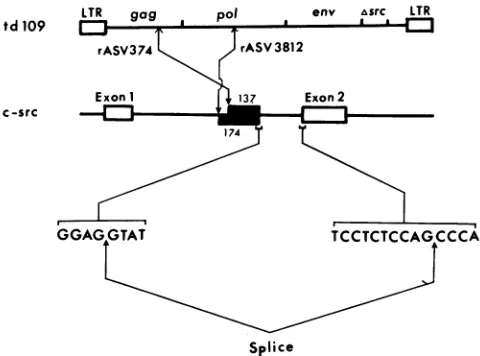
FIG. 3. Mechanismfortheformation of recombination junctions inrASV3812 and rASV374genomes.Initial recombinationbetween tdlO9 andc-src arepresumedtooccur attheDNAlevel. The 3' gag and middle pol regions of tdlO9 recombined with c-src at the indicated sitestoform the5'recombination junctions for rASV374 andrASV3812, respectively. Acryptic splice donor site in intron1 downstreamfrom the recombination sitewasactivatedandspliced to exon2, resultinginthe incorporation of intron1 sequences (_) into the rASVgenomes.Sizes of the incorporatedintron regions are shown innumber of nucleotides.The sequencesof the cryptic splice donor site and the normalexon2 spliceacceptorsiteareshown.
occurredby splicing the potential donor site to the normal exon2acceptor site (Fig. 3).
The sequence of the 0.44-kb rASV374 DNA fragment is compared with that of the 0.36-kb 3' gag DNA fragment of tdlO9 and with the c-src intron 1 sequence (Fig. 4). The recombination inrASV374 appears to have occurred in the middle of p12 of tdlO9, corresponding to nucleotide 1934 in
PR-CRSV(33). Downstreamfromthis region, the rASV374 sequence matches with c-src intron 1 sequence beginning
625 nucleotides upstream fromexon2 andcontinuingfor 137 nucleotides before skipping the remaining intron1sequence
andjoining to exon2. As in the case of rASV3812, similar
sequence homology (Fig. 4) between tdlO9 and c-src was
observed at the site of recombination and probably pro-moted the recombinationin thegenerationof rASV374. The sequence data suggest that the recombination junction is locatedwithintheTC dinucleotide(Fig. 4). Interestingly,the
same cryptic splice donor site ofc-src intron 1 mentioned above was used to join the 3' boundary of the intron 1
sequence in rASV374to exon2ofc-src.
The mechanism for the generation of rASV3812 and rASV374 is shown in Fig. 3. The recombinations between tdlO9 and c-src occurred at multiple sites and apparently
involved short stretches ofhomologous sequences. A 5/5-and a 10/11-nucleotide homology between FBJ murine leu-kemia virus genome and c-fos was seen at the 5' and 3' recombination sites, respectively (45). However, it cannot
be generalized that such sequence homology is always
neededfor recombination betweenaviral genomeand c-onc
sequences. Forexample, nosimilar homology is presentat
therecombinationjunctionsofsrcinSR-AorPR-C RSV(33,
41),althoughsomehomologyis present betweenthepol-env
junction of avian retroviruses andthe regionofc-src DNA
corresponding to the 5' recombinationjunction ofv-src in
BH RSV and in RSV29 (8, 21). In addition, there are only
patchy sequence similarities between c-fps and the viral
on November 10, 2019 by guest
http://jvi.asm.org/
[image:3.612.322.562.74.252.2]1630
tdO - p27
tdlO9 .********** ******A******* ******50
rASV374 AGATCTCCCG CCTTCCGCGC GGGCTCCGGT GATCATTGAC TGCTTTAGGC
tdlO9 *100
rASV371" AGAAGTCACA GCCAGATATT CAGCAGCTTA TACGGGCAGC ACCTTCCACG
tdlO9 *150
rASV374 CTGACCACCC CAGGAGAGAT AATTAAATAT GTGCTAGACA GGCAGAAGAC
tdlO9 *200
rASV374 TGCCCCTCTT ACGGATCAAG GCATAGCCGC GGCCATGTCG TCTGCTATCC
td109 ' 2502
rASV374 AGCCCTTAGT TATGGCAGTA GTCAATAGAG AGAGGGATGG ACAAACTGGG
tdlO9 *290
rASV374 TCGGGTGGTC GTGCCCGAGG GCTCTGCTAC ACTTGTGGAT
4 1934
tdlO9 CCCC GGACA TTAT GGCG CAGTGCCCGA 340
rASV374 CCCCGGGACA TTAT ACCT CCGTTCTCCA TCCTGCCATG CGTGATCTAG
c-src ACTAGGGAGA TTCT ****
>Intron
1,
390rASV374 CCTAAATATT CCCTTCCGTA GCTTCAGGAC GCTGCTGTGT ATCCTGCCAT
c-src
rASV374 CTTTGGAGAC TGCGAATAAT TCCCTTCCTT CATTTATATC ATTACCTCGG 440
c-src
rASV374 AGCCCACCAC CATG
c-src **L. Exon 2
c-src 7--J
ExonI Intron 1 137bp Exon2
FIG. 4. Recombinationjunction in the rASV374 genome. The nucleotide sequence of the rASV374 0.44-kb DNA fragment is compared with that of the tdlO90.36-kbfragmentandwith the 3' region ofc-srcintron 1.Allsymbolsarethesame asinFig. 2.
donor site observed for the generation of the two rASVs described above. The env-exon 1 junction apparently was formedbysplicing between tdlO9 and c-src, using a cryptic splice donor signal, GGGGGTAA, located 43 nucleotides 3' to thepol termination codon oftdlO9 and the normal c-src exon 1 acceptor site. This potential viral splice donor site
apparently isnotused intheprocessing of viralRNAs,since
no viral RNAs corresponding to this splice site have been observed(4). It is not clear how this site wasactivated in the presumedtdlO9-c-srchybridmolecule. Interestingly, Nilson et al. (28)observed that the same potential donorsite ofan avianleukosis viruswas used forsplicingtoc-erbB, result-ing in the joinresult-ing of theviralsequence to c-erbB at the same point. Activation of the same cryptic viral splice donor site in these totally independent transductional events implies
thatalthough this site appearsto be suppressedinthe regular
processingof viral RNAtranscripts,itcan beactivatedif the
viral sequence is truncated or joined to a foreign sequence. The secondary structure of the mRNA precursor can affect
the patternofsplicing(37).
Thejoiningofexon 1 tothe 5'end oftheinternal intron 1 sequence transduced into the rASV382 genome appears to be formed by splicing between exon 1 donor site and a
cryptic acceptor sequence, TTCTTCTCCCAAGGAAC,
lo-cated 700nucleotidesupstreamfromexon 2(Fig.6). Similar to thecrypticintron 1splicedonor sitedescribed above,this
4995
GGTACCCTCT CGAAAAGTTA AACCGGACAT CACCCAAAAG GATGAGGTGA 50
envsplice
CTAAGAAAGA TGAGGCGAAC CCTCTTTTTG CAGGCATTTC TGACTGGGCA 100
genonle near the 5' recombination sites offps in Fujinami
sarcomavirusandin PRCII (16, 35). Nevertheless, thelack
ofhomology could be due to sequence divergence or
dele-tion oftheoriginal recombination junction, particularlyif the
virus has been passaged extensively following the initial
transduction and if there is no selective pressure for the
conservation ofthosejunction sequences.
Thecryptic splice donor site in c-src intron 1 described
above was activated probably byjoining the 5' tdlO9
se-quence to c-src.This potential donor sitewas notdetected in
aprevious analysis ofthe c-src mRNA(39). However,useof
thispotentialsplice donor site maybe tissue specific.
Splic-ing
of thisdonor
siteto c-src exon2removed488nucleotidesof the3' intron 1 sequence and resulted in
incorporation
of174 and 134 nucleotides of internal intron 1 sequences, in
addition to the
p60c-src
coding region, into rASV3812 andrASV374,
respectively.
It is not clear whether removal ofthose 3' intron 1 sequences of c-src occurred at the initial stages ofrecombination or subsequent to the formation of
rASVs.
Comparisonof thesequence of the 0.52-kbrASV382DNA
fragment with those ofthe relevant regions in
tdlO9
(the0.3-kbpol-envDNA
fragment)
and c-src (exon 1 andintron1) revealed an even more complicated sequenceorganization
onthe rASV382 genome(Fig. 5and6). The 5' env sequence
oftdlO9 corresponding to nucleotide 5236 (46 nucleotides
downstream from the termination codon ofpol) in PR-C
RSV (33) was fused to exon 1 ofc-src, which was in turn
joinedto intron 1 sequence 687 nucleotides upstream from
exon 2. Theintron 1sequence continuesfor199 nucleotides and thenjoinstoexon 2by skipping488nucleotidesofthe3'
intron 1 sequences, and by using the same potential splice
CCCTGGGAAG GCGAGCAAGA AGGATTCCAA
GCAAGAAAGA CCCGGAGAAG ACACCCTTGC ATTCTCATTA TTGGTGTCCT GGTCTTGTGT
CTGACTCTGC TGGTGGCCTC GCGTACCACT
GAAGAAACCG CTAGCAACAA 150
pol
TGCCAACGAG AGTTAATTAT 200
env 5 Exon 1 GAGGTTACGG GGGAGCTGAG 250
GTGGCCAGGC GGTAGCTGGG 300 Exonl IDeontroni I
ACGTGCAGGA ACCTGCTGTT CCCCTGCCTC CACTCCTGCC
T
TGCCCGGATT 350
TTCTTACTAG GGAGATTCTC CACCTCCGTT CTCCATCCTG CCATGCGTGA 400
TCTAGCCTAA ATATTCCCTT CCGTAGCTTC
AG%ACGCTGC
TGTGTATCCT 450GCCATCTTTG GAGACTGCGA ATAATTCCCT TCCTTCATTT ATATCATTTC 500 A
CTCGGAGCCC ACCACCATG Intron 1 l Exon2
199bp
c-src
Exonl IntronI Exon2
FIG. 5. Recombinationjunction in the rASV382 genome. The nucleotide sequence ofrASV3820.52-kb DNAfragmentwas com-paredwith thoseofthetdlO90.30-kbfragmentand c-src exon 1 and intron 1 regions. The rASV382 sequence is shownwiththe
differ-encesfrom either tdlO9 orc-srcindicatedbelow it. The nucleotide G* is missing in SR-A, but is present in PR-C RSV (33, 41). By comparing the rASV382 sequence with those of its parents, the domains ofsequences can be defined as shown. The tdlO9-c-src recombinationjunction is betweenenvandexon1.Symbolsarethe
same as inFig. 2.
on November 10, 2019 by guest
http://jvi.asm.org/
[image:4.612.51.297.69.360.2] [image:4.612.321.554.362.644.2]potential acceptor site was not observed previously in the
analysis ofc-src mRNA (39). Theintron 1-exon 2joiningin
rASV382 involved the same cryptic splice donor site in intron 1 as for the other two rASVs. A stretch of 199 nucleotides of the c-src intron 1 sequence wasincorporated intothe rASV382 genome.
We could not discern whether the env-exon 1 junction resulted from a primary or secondary event ofrecombination
between tdlO9 and c-src. For example, the initial
recombi-nation could have occurred between a region downstream
fromthe 5' envsite intdlO9and a region upstreamfromexon 1 in c-src, and the env-exon 1 junction was subsequently
formed by splicing of the tdlO9-c-src primary RNA
tran-script.Additionally, an intact or 3'-truncated tdlO9 provirus
integrated upstreamfrom the c-src genecould alsopromote
the synthesis ofa td1O9-c-srcreadthroughtranscript, which
uponsplicinggaverise to therecombination junctionsin the
rASV382 genome. In a separate study, we showed that in
aviansarcomavirusUR2, the gagandrosjunctionhad most
likelybeenformed by a splicing event (26). Similarly, it was
proposed that the 5' recombination junction between the transforming gene, rel, and the viralreplicative sequence in avian reticuloendotheliosis virus strain T, was a result of
splicing (55).
A
few
nucleotide differences within the homologousre-gions were found between the rASVs and their parental
tdlO9 and c-src sequences (Fig. 2,3 and 5). Thedifferences
may have resultedfromdivergenceaftertherecombination,
particularly since there is no selection pressure for the
conservation ofprotein functions encodedby theremaining
gag and pol sequences in rASV374 and rASV3812. The
incorporated intron 1 sequences of c-src have no obvious
function either.Nosequencevariationswerefoundbetween
td109
c-src
TTCTTCTCCCAAG GAAC
[image:5.612.323.564.76.200.2]SpliceAcceptor
FIG. 6. Mechanism for formationof recombinationjunctions in the rASV382 genome. The tdlO9-c-src junction was formed by
splicing betweenacryptic splice donor site in the 5' envoftdlO9
genomeandthespliceacceptorsite ofc-src exon1. Acryptic splice
acceptor and a donor site in c-src intron 1 were activated for
splicing, resultingintheincorporation ofasegmentof intron 1 (_) into the rASV382 genome. Sizes of exon 1 and the incorporated intron 1regionareshown inbase pairs. Nucleotidesequencesof the
cryptic donor site in the tdlO9genomeand thecrypticacceptorsite inc-src areshown.
.TCCCTTCCGTAGCTTCAGGACG,
LTR
rASV3812 E1- gag
Acceptor
apol 174 src LTTR
in t
mnt.
Acceptor
LTR "gag 137 src LTR
rASV374 J ii
tint.1t
LTR
rASV382 =
gag
,CCCTCTTTTTGCAGGCAT,
Acceptor Acceptor
pol 14 4199 | src LTR
exonl int.
FIG. 7. Structure ofthree rASV genomes. Intron (int)-derived sequences areshown(_) and their sizesareshownasnumberof nucleotides. ThetdlO9 andc-srcsequencejunctions formed presum-ably by recombination (A) and those by splicing(A) areindicated. The sequences flanking apotential splice acceptorsite within the transduced intron 1 sequenceand the env mRNAsplice acceptor site are shown. Potential acceptor site is located 84 nucleotides upstreamfrom initiation ofsrcinthe three rASVgenomes.Theenv mRNAspliceacceptorsite is located159nucleotidesupstreamfrom theexon1 ofsrcinrASV382.
the pol region of tdlO9 and that of rASV382, which was
shown to encode afunctional reversetranscriptase (48). src mRNAsplicing acceptor sites in rASV genomes. The src
mRNA splice acceptor site of SR-A RSV was deleted in
tdlO9 and was not regained from c-src in the three rASV
genomes. Previous analyses of the viral RNAs in
tdlO9-derived rASV-infected cells showed that the spliced src
mRNAs of rASV3812andrASV374 hadasize
indistinguish-ablefromthat ofSR-A and that the src mRNAofrASV382 was larger than that of SR-A (47, 48). It was suggested
previously that the env gene splice acceptor site could be
usedfortheformation ofsrc message inrASV382-infected
cells (47, 48). However, new splice acceptor sites must be
created in rASV3812 and rASV374 genomes for the v-src
mRNA formation. Examination ofthe sequences upstream
from the src coding region in the three rASV genomes revealed that there is a potential acceptor site within the
intron 1-derived sequence located 84 nucleotidesupstream
fromtheAUG codonofsrc(Fig. 7). To seeifthis potential
acceptorsite is usedfor splicing ofsrc mRNAfrom these
rASVs, we prepared
32P-labeled
recombination junctionDNA fragments (Fig. 1) from individual rASVs and
per-formed S1 nuclease experiments. The results (Fig. 8)
dem-onstrate thata434-nucleotide DNAfragmentwasgenerated
inrASV382,andthataseries offragmentswith the top band
atthepositionof 85 nucleotides weregeneratedin rASV374.
Results similar to those ofthe rASV374 experiment were
obtained with rASV3812 (data not shown). The
spliced
5'leader sequence isexpected to protect twonucleotides5' to both of the acceptor sites. The series of DNA fragments
separatedfromoneanotherbyone nucleotidein the
exper-iments with rASV3812 and
rASV374
were probably gener-ated due to melting of the DNA-RNA hybrid at the ends,followedby digestion of the upaired DNA terminus by S1
nuclease. Theminorbandsatposition of 93to 95nucleotides
were also seen inrASV374 and rASV3812(Fig. 7and data not shown). The origin ofthese bands isnotclear.
The S1 nuclease experiments confirmed our prediction
that the env acceptor site would be used for rASV382 and that the new potential acceptor site in the incorporated
intron1sequence wouldbe used for rASV374 and rASV3812 in the srcmRNAsplicing. Sinceno detectable amountofthe
A I+
-I I
on November 10, 2019 by guest
http://jvi.asm.org/
[image:5.612.79.288.428.633.2]TRANSDUCTION OF c-src SEQUENCES 561
A
rASV374
BrASV382
G A T C S1 G A T C SI
W~-7
-:.434
[image:6.612.92.260.77.320.2]
-Z.
FIG. 8. 51nuclease analysis ofthe rASV374 and rASV382 src
mRNAs.The 5'-labeled minus-strand DNAsof the 0.44-kb and the 0.52-kb recombination junction-containing fragments (Fig. 1) of rASV374 and rASV382, respectively, were used as 51 probes. Conditionsare asdescribedin thetext.The sequence leadersof the rASV382 0.52-kb DNA and td109 0.30-kb DNA were used as size markers for theanalysisof rASV382 and rASV374RNAs,
respec-tively. The sizesof the relevant bandpositionsare indicated.
85-nucleotide
fragment
was seen in rASV382 RNA, itap-peared
that theenvacceptorsitewasstrongly
preferred
overthe new acceptor site in this virus. This new acceptor site
wasnot
functioning
in the formationof the 4-kbc-srcmRNAasshown
previously
by
Sinucleaseanalysis (39)
andby
ourRNA
blotting
andhybridization experiments (Fig.
9).Initial stepof recombination between td109 andc-src. The data show that various
lengths
of c-src sequence definedpreviously
astheintron 1region
(41)wereincorporated
into the rASV genomes. The intron 1region
was definedby
comparing
the c-src DNA sequence with that ofv-src(41),andthisdefinition is
supported by
Si nucleaseanalysis
of thec-src mRNA
(39).
Our resultsimply
that initial recombina-tions between tdlO9and c-srchave takenplace
at the DNA level. To assess thishypothesis,
weprepared
aprobe
containing
the transduced c-src intron 1 sequences from rASV3812 and examined itto see whether the c-src mRNA contained these sequences. The mostcommonly
observedc-src4-kb mRNA from chicken
embryonic
brain(Fig.
9)orfrom CEF
(not
shown)hybridized strongly
with a v-srcprobe,
but notwith the intron 1probe,
which in thepositive
controldetected both the rASV3812
genomic
andspliced
src mRNAs. The result withbrainc-src RNA ispresented
here since the c-src RNA level ishigher
in theembryonic
brain thanin anyothertissue(26;L.-H.Wang,
unpublished
data);therefore,
its use should increase the chance ofdetecting
evenasmall amount oftheintron 1
probe
sequencepresent
in the mRNA. These results
provide
evidence that initialrecombinations
between tdlO9 and c-src tookplace
at theDNA level. Our data
agree
withprevious
evidence whichsuggestedthat transduction of c-src into avian leukosis virus
in the generation of RSV took place by recombinationatthe
DNA level, since the 5' recombination site was located 16
nucleotides upstream from the acceptorsite ofc-src exon 1 (39, 41). The 5'recombination between avian myeloblastosis
virus-associated helper virus and c-myb also occurredin the
intron region of c-myb(19). Precursors orcertainrareforms
of c-src mRNA containing those intron sequences could have participated in the recombinations. The level of those RNAs may be so low that it was not detected by our
analysis. Nevertheless, the precursor mRNA could exist
only in the nucleus and has a very short half-life. Therefore,
it is spatially and kinetically unfavorable for it to form a complex with the viral genome to be packaged for subse-quentrecombination during reverse transcription.
Overall, our data suggest strongly that transduction of
c-src canoccurthrough recombinationat the DNA level, by
involving short stretches of homologous sequences or by
splicingbetween theviralgenome and c-src sequences. It is
verydifficulttodecide experimentallythe stageof
recombi-nation between the viral genome and c-src during the viral
replication cycle. But it could occur during or after the
integration of the viral DNA genome. The recombination
junctionsobserved in these rASVs represent thefinal
prod-uctsof whatmaybeamultiple-stepped process of
recombi-nationbetween the td virus and c-src. However, itis likely
that the 5' v-src-c-src sequence junctions observed in
rASV3812 and rASV374 represent the primary event of
recombination. By contrast, the corresponding junction in
rASV382 is more likely formed afterthe initial recombina-tionevent. In the latter case, theinitialeventcouldbeeither
merely theintegration ofthe tdlO9 provirusupstream from
c-src, or a true recombination between td109 andc-src. Our
src int I
I
:R
k..
.:
li.
4
0-..4:.
src int
_-28
_ ...
c-srcmRNA rASV3812
FIG. 9. Hybridization ofc-src and rASV3812 RNAs with v-sr( and c-src intron 1probes.Afive-,ug amount of poly(A)+ RNA from an rASV3812-infected nonproducer CEF clone and 10 ,ug of RNA from 12-day-old chicken embryonic brain were analyzed. The src and intron probes indicate the v-src and c-src intron 1-derived probes described in the text. Exposure time with the rASV3812 RNAs wasfourfoldshorter than that for c-src RNA. Sizes of RNAs are shown inkilobases.
VOL.59, 1986
on November 10, 2019 by guest
http://jvi.asm.org/
[image:6.612.375.491.429.655.2]currentdataonly concern the 5' recombination. Obviously, asecond 3' recombination is needed to obtain the essential viral replicative sequences. The only major differenc be-tween td109 and other avian leukosis viruses such as Rous-associated viruses 1 and 2 (ATCC VR-334 and ATCC VR-657) is the presence of a certain 3' src sequence in the tdlO9 genome. The chance of a 5' recombination between a viral genome and c-src should be even among these viruses.
The3' src sequence present intdlO9 apparently is
responsi-ble for the great difference in the frequency of c-src
transduction into its genome. The 3' src presumably
pro-moted the 3' recombination between the initial tdlO9-c-src recombinant intermediate and the parental tdlO9 to obtain the 3' viral sequences essential forviral replication. The3'
src could also play a role in conferring the transforming potentialtothe otherwisenontransformingc-srcgenenewly obtained.
The genomic structure of the three rASVs is summarized in Fig. 7. All of them have incorporated a segment of c-src
internal intron1 sequenceinto theirgenomes resulting from
activation of potential splice donor and acceptor sites.
Although no other tdlO9-derived rASVs have been
se-quenced, previous analysis by RNase T1 oligonucleotide
fingerprinting didnotreveal unexpected oligonucleotides in
theirgenomes, in contrast tothe threerASVs studiedhere,
which were shown to contain one to three new
oligonucle-otides (48). The significance of the intron 1 sequence in
rASV382 is not clear, since it is not needed for the src
mRNA formation (as in the cases of rASV3812 and
rASV374), orfor viral replication, because apparently it is
missing in the genomes of several other tdlO9-derived
rASVs. Recombinations forthe generation ofthose
tdlO9-derived rASVsmighthaveoccurredin suchawaythatonly
a small amount ofsequences other than thep60c-src coding
region were incorporated. For example, recombinations
between tdlO9 and c-src could take place upstream from
exon 1,followed byanormalsplicingto exon 2,eliminating
all theintron1 sequences.Themajority ofthetdlO9-derived
rASVs containenvdeletions (48).This suggeststhat
recom-binationatthepol-env junctionhas beenpreferred. Whether
thereisacorresponding preferredc-src site is notclear. As
expected, rASVs derivedfrom td virusescapable of
under-going homologous recombination at the 5' region ofc-src
have a normal genomic size and do not contain extra
sequences (50, 52-54).
Detection ofthecryptic splice donorand acceptor sites in
c-src raises the question of their physiological significance.
Tissue-specific expression ofgene functions by alternative
splicing ofmRNAshas beenreportedfor severaleucaryotic
genes (2, 6, 7, 9, 18, 20, 25, 30, 31, 34, 56). We detected
multiple forms ofsmaller c-src-related mRNAs in chicken
muscle tissues which could be generated by alternative
splicing ofc-src RNA transcript (Iijima and Wang,
unpub-lished data). These muscle-specific c-src-related RNAs,
lacking most of thecoding sequences of
p60csr',
cannot beprecursorsfor recombination with tdlO9 in thegenerationof
rASVs, although they do contain certainsequencesderived
from the c-src intron 1 region. Embryonic neural tissues have been found to express significantly high levels of p60c-src kinase activity (5) and of c-src mRNA (26). The N-terminal polypeptide fragments of p60csrc from neural tissues hadaslowerelectrophoreticmobilitythanthose from CEForother tissues (J. Brugge, personal
communication).
Itwould beinterestingto seewhether thosepotential splice
donor and acceptor sites in the c-src intron 1 region are
activatedin atissue-specific manner.
ACKNOWLEDGMENTS
We thank Boris Lin for excellent technical assistance, and H. Hanafusa andR. Joveforcomments onthemanuscript.
This work was supported by Public Health Service grants CA29339 and CA18213 from the National Institutes of Health to L.H.W. M.M.S. was a visiting scientist and was supported by Public Health Service Training grant CA24930 from the National Cancer Institute.
LITERATURECITED
1. Bishop, J. M., and H. Varmus. 1982. Functions andoriginsof retroviral transforming genes. p. 999-1108. In R. Weiss, N. Teich, H. Varmus, and J. Coffin (ed.), RNA tumor viruses. Molecularbiology oftumorviruses, 2nd ed. Cold Spring Harbor Laboratory, ColdSpring Harbor,N.Y.
2. Breitbart,R. E., H. T. Nguyen, R. M. Medford, A. T. Destree, V.Mandavi,andB. Nadal-Ginard.1985. Intricate combinational patternsofexonsplicinggeneratemultiple regulated troponinT isoforms fromasinglegene.Cell41:67-82.
3. Broome,S.,and W.Gilbert. 1985. Rous sarcomavirus encodes
atranscriptional activator. Cell 40:537-546.
4. Chang, L.-J.,andC.M.Stoltzfus. 1985.Cloningandnucleotide sequences of cDNAs spanning the splice junctions of Rous sarcomavirusmRNAs. J. Virol. 53:969-972.
5. Cotton,P. C., andJ. S.Brugge. 1983. Neural tissuesexpress high levels of the cellularsrcgeneproduct pp60csrc. Mol. Cell. Biol. 3:1157-1162.
6. Crabtree, G. R., and J. Kant. 1982. Organization of the rat
-y-fibrinogen gene: alternative mRNA splice patterns produce the-yA and -yB (y') chains offibrinogen. Cell 31:159-166. 7. deFerra, F., H.Engh, L.Hudson, J. Kamholz,C.Puckett, S.
Molineaux, and R. A. Lazzarini. 1986. Alternative splicing ac-countsfor four forms ofmyelinbasicprotein. Cell 43:721-727. 8. Dutta, A., L.-H. Wang, T. Hanafusa, and H. Hanafusa. 1985. Partial nucleotide sequenceofRoussarcomavirus-29provides
evidence that theoriginal Rous sarcomavirus wasreplication
defective. J. Virol. 55:728-735.
9. Early, P., J. Rogers, M.Davis, K. Calame, M.Bond, R.Wall, and L. Hood.1980. Two mRNAscanbeproduced fromasingle immunoglobulin ,. gene by alternative RNA processing path-ways. Cell 20:313-319.
10. Enrietto,P.J.,L. N.Payne,andJ.A.Wyke. 1983. Analysisof the pathogenicity of transformation-defective partial deletion mutants of aviansarcomavirus: characterization of recovered viruses which encode novel src-specific proteins. Virology 127:397-411.
11. Fradin, A.,R.Jove,C.Hemenway,H. D.Keiser, J. Manley,and C. Prives. 1984. Splicing pathwayofSV40mRNAs in X. laevis oocytesdifferintheirrequirement forsnRNPs.Cell37:927-936. 12. Glisin, V.,R.Crkvenjakov,andC.Byus.1974.Ribonucleic acid isolated by cesium chloride centrifugation. Biochemistry 13:2633-2637.
13. Halpern, C. C., W. S. Hayward, and H. Hanafusa. 1979. Characterization of some isolates of newly recovered avian
sarcomavirus.J. Virol. 29:91-101.
14. Hanafusa, H., C. C.Halpern, D. L.Buchhagen,andS. Kawai. 1977.Recovery of aviansarcomavirus fromtumorsinducedby
transformation-defectivemutants.J.Exp.Med. 146:1735-1747. 15. Hirt, B. 1967. Selective extraction of polyoma DNA from
infectedmouse cell cultures.J.Mol. Biol.26:365-369. 16. Huang,C.-C.,C.Hammond,andJ.M.Bishop.1985.Nucleotide
sequenceandtopographyof chickenc-fps genesisofaretroviral oncogene encoding a tyrosine-specific protein kinase. J. Mol. Biol.181:175-186.
17. Karess, R. E., and H. Hanafusa. 1981. Viral and cellular src genes contribute tothe structure of recovered avian sarcoma
virus transforming protein.Cell 24:155-164.
18. King, G. R., and J. J. Piatigorsky. 1983. Alternative RNA
splicingof the murineaA-crystallinegene:protein-coding infor-mationwithinanintron. Cell 32:707-712.
19. Klempnauer, K.-H., andJ. M. Bishop. 1983. Transduction of
c-mybintomyeloblastosis virus: locating pointsof recombina-tion within the cellular gene. J.Virol.48:565-572.
on November 10, 2019 by guest
http://jvi.asm.org/
20. Kress, M.,D.Glaros, G. Khoury, and G.Jay. 1983. Alternative RNA splicing expression of the H-2K gene. Nature (London)
306:602-604.
21. Lerner, T. L., and H. Hanafusa. 1984. DNA sequence ofthe Bryan high-titer strain of Rous sarcoma virus: extent of env
deletion andpossible genealogicalrelationship with otherviral strains. J. Virol. 49:549-556.
22. Maniatis, T., E. F. Fritsch, andJ. Sambrook. 1982. Molecular cloning: alaboratory manual. ColdSpring HarborLaboratory,
ColdSpring Harbor, N.Y.
23. Maxam, A. M., and W. Gilbert. 1980. Sequencingend-labeled DNAwithbase-specificchemicalcleavages.MethodsEnzymol.
65:499-560.
24. Messing, J.,andJ.Vieira. 1982.A newpairof M13vectorsfor selecting either DNA strand ofdouble-digestedrestriction
frag-ments. Gene 19:269-276.
25. Nabashima, Y., Y. Kuriama-Fuji, M. Muramatsu, and K. Ogata. 1984.Alternativetranscriptionandtwomodesofsplicing
result intwomyosin light chains from onegene. Nature (Lon-don) 308:333-338.
26. Neckameyer,W. S., M.Shibuya, M.-T. Hsu, and L.-H.Wang. 1986.Proto-oncogenec-roscodes foramolecule with structural features common to those of growth factor receptors and displays tissue-specific and developmentally regulated expres-sion. Mol. Cell. Biol. 6:1478-1486.
27. Neckameyer, W. S., and L.-H. Wang. 1984. Molecularcloning
andcharacterization of avian sarcomavirus UR2 and
compari-son of its transforming sequence with those of other avian sarcomaviruses. J. Virol. 50:914-921.
28. Nilson,T.W.,P. A.Nuroney,R. G.Goodwin, F. M. Rottman, L. B. Crittenden,M. A. Raines, and H.-J. Kung. 1985. c-erbB activation in ALV-induced erythroblastosis: novel RNA proc-essing and promoter insertion result inexpressionofan amino-terminal EGF receptor. Cell 41:719-726.
29. Parvin, J. D., and L.-H. Wang. 1984. Mechanisms for the
generationof src-deletion mutants and recovered sarcoma vi-ruses:identification of viral sequences involved insrcdeletions and in recombination withc-src sequences. Virology 138:236-245.
30. Rosenfeld, M. G., S. G. Amara, and R. M. Evans. 1984. AlternativeRNAprocessing: determiningneuronalphenotype.
Science 225:1315-1320.
31. Rozek, C. E., and N. Davidson. 1983. Drosophila has one
myosine heavy chain gene withthreedevelopmentallyregulated
transcripts. Cell 32:23-34.
32. Sanger, F.,S.Nicklen,and A. R.Coulson. 1977.DNA
sequenc-ing with chain-terminating inhibitors. Proc. Natl. Acad. Sci. USA 74:5463-5467.
33. Schwartz, D. E., R. Tizard, and W. Gilbert. 1983. Nucleotide sequenceof Roussarcomavirus. Cell32:853-869.
34. Schwartzbauer, J. E., J.W.Tamkun,I.R.Lemischka,and R.0. Hynes. 1983. Threedifferent fibronectinmRNAsariseby alter-nativesplicing within thecoding region. Cell35:421-431. 35. Shibuya, M., and H. Hanafusa. 1982. Nucleotide sequence of
Fujinami sarcomavirus: evolutionaryrelationship of its
trans-forming gene withtransforming genes ofothersarcomaviruses. Cell 32:787-795.
36. Shibuya, M., L.-H. Wang, and H. Hanafusa. 1982. Molecular cloning of the Fujinamisarcomavirus genomeandits compar-ison with sequences ofother related transforming viruses. J. Virol. 42:1007-1016.
37. Solnick,D.1986.AlternativesplicingcausedbyRNAsecondary
structure. Cell43:667-676.
38. Southern, E. M. 1975. Detection ofspecific sequences among DNAfragments separated by gel electrophoresis. J.Mol. Biol. 98:503-517.
39. Swanstrom, R.,R.C.Parker,H. E.Varmus, andJ.M.Bishop. 1983.Transduction ofacellularoncogene: thegenesis ofRous
sarcomavirus. Proc. Natl. Acad. Sci. USA 80:2519-2523. 40. Takeya, T., R. A. Feldman, and H. Hanafusa. 1982. DNA
sequence of the viral and cellular src gene of chickens. I.
Completenucleotide sequence ofanEcoRIfragmentof
recov-ered aviansarcomavirus which codes forgp37andpp60sr. J. Virol.44:1-11.
41. Takeya,T.,andH. Hanafusa. 1983. Structure and sequence of the cellular gene homologous to the RSV src gene and the mechanismforgeneratingthetransforming virus. Cell 32:881-890.
42. Teich, N. 1982. Taxonomy ofretroviruses, p. 25-207. In R.
Weiss, N. Teich, H. Varmus, and J. Coffin(ed.),RNAtumor
viruses. Molecular biology of tumor viruses, 2nd ed. Cold
SpringHarborLaboratory,ColdSpring Harbor,N.Y. 43. Thomas,P.S.1980.Hybridizationof denaturedRNAandsmall
DNAfragmentstransferredtonitrocellulose. Proc. Natl.Acad. Sci. USA 70:5201-5205.
44. Ullrich, A., J. Shine, J. Chirgwin, R.Pietet,E. Tischer, W.J. Rutter,andH. M. Goodman. 1977.Ratinsulin genes:
construc-tion of plasmids containing the coding sequences. Science 196:1313-1319.
45. VanBeveren, C.,F. vanStraaten,T. Curran, R.Moeller, and I. M. Verma. 1983.AnalysisofFBJ-MuSV provirusandc-fos (mouse) gene reveals that viral and cellularfos gene products
have differentcarboxytermini. Cell32:1241-1255.
46. Vigne, R.,M. Breitman, C. Moscovici, and P. K. Vogt. 1979. Reinstitution of fibroblast-transforming ability in src deletion
mutantsof aviansarcomavirusduringanimal passage.Virology
93:413-426.
47. Wang, L.-H. 1985. Deletion inthe 3' pol sequence correlates with aberration of RNA expression in certain
replication-defective aviansarcomaviruses. J. Virol. 54:446-459. 48. Wang, L.-H., M. Beckson, S. M. Anderson,and H. Hanafusa.
1984. Identification of the viral sequence required for the
generation of recovered avian sarcoma viruses and character-ization of a series of replication-defective recovered avian
sarcomaviruses. J. Virol.49:881-891.
49. Wang, L.-H.,and P.Duesberg.1974. Propertiesand location of
Poly(A)inRoussarcomavirus RNA. J. Virol. 14:1515-1529. 50. Wang, L.-H.,B.Edelstein,and B.J.Mayer. 1984. Inductionof
tumors and generation of recovered sarcoma viruses by, and
mapping of deletions in, two moleculary cloned src deletion
mutants.J. Virol. 50:904-913.
51. Wang, L.-H.,R.Feldman,M. Shibuya,H. Hanafusa,M. F. D. Notter,and P. C. Balduzzi.1981. Genetic structure,
transform-ingsequence,andgeneproductof aviansarcomavirus URL. J. Virol. 40:258-267.
52. Wang, L.-H.,C. C. Halpern,M.Nadel,and H. Hanafusa.1978. Recombination between viraland cellularsequencesgenerated
transforming sarcoma virus. Proc. Natl. Acad. Sci. USA 75: 5812-5816.
53. Wang, L.-H., C. Moscovici, R. E. Karess, and H. Hanafusa. 1979.Analysisofthesrcgeneofsarcomavirusesgenerated by recombination between transformation-defective mutants and
quailcellular sequences.J. Virol.32:546-556.
54. Wang, L.-H.,P. Snyder,T. Hanafusa,and H. Hanafusa. 1980. Evidence forthecommonoriginof viralandcellular sequences involved in sarcomagenictransformation.J. Virol. 35:52-64. 55. Wilhelmsen, K. C., K. Eggleton, and H. M. Temin. 1984.
Nucleic acid sequence oftheoncogene v-rel in reticuloendothe-liosis virus strain T and its cellular homolog, the proto-onocogenec-rel. J. Virol.52:172-182.
56. Young,R. A.,0.Hagenbuchle,andU. Schibler. 1981. Asingle
mouse a-amylase gene specifies two different tissue-specific
mRNA. Cell23:451-458.
57. Zasloff, M., G. D. Ginder, and G. Felsenfeld. 1978. A new
method forthe purificationofcovalentlyclosedcircularDNA molecules. NucleicAcidsRes. 5:1139-1152.