BORANG PENGESAHAN STATUS TESIS*
JUDUL :
SESI PENGAJIAN : _ _ _ _
Saya
mengaku membenarkan tesis Projek Sarjana Muda ini disimpan di Perpustakaan Fakulti Teknologi Maklumat dan Komunikasi dengan syarat-syarat kegunaan seperti berikut:
Tesis dan projekadalah hak milik Universiti Teknikal Malaysia Melaka.
Perpustakaan Fakulti Teknologi Maklumat dan Komunikasi dibenarkan membuat salinan untuk tujuan pengajian sahaja.
Perpustakaan Fakulti Teknologi Maklumat dan Komunikasi dibenarkan membuat salinan tesis ini sebagai bahan pertukaran antara institusi pengajian tinggi.
** Sila tandakan (/)
SULIT (Mengandungi maklumat yang berdarjah keselamatan atau kepentingan Malaysia seperti yang termaktub di dalam AKTA RAHSIA RASMI 1972)
TERHAD (Mengandungi maklumat TERHAD yang telah ditentukan oleh organisasi/badan di manapenyelidikan dijalankan)
TIDAK TERHAD
(TANDATANGAN PENULIS) (TANDATANGAN PENYELIA)
Alamat tetap
Taman Kemuning Senawang, Nama Penyelia 70450 Seremban, Negeri Sembilan.
Tarikh:
T Tarikh:
CATATAN: * Tesis dimaksudkan sebagai Laporan Projek Sarjana Muda (PSM).
** Jika tesis ini SULIT atau atau TERHAD, sila lampirkan surat daripada pihak berkuasa.
2010 / 2011
Investigating Android Malware (Droidkungfu 4) Behavior Through Static Analysis
SITI NUR ATIKAH BT SHEIKH ABDUL HADI
174 Jln Kemuning 4,
INVESTIGATING ANDROID MALWARE (DROIDKUNGFU 4) BEHAVIOR THROUGH STATIC ANALYSIS
SITI NUR ATIKAH BT SHEIKH ABDUL HADI
This report is submitted in partial fulfilment of the requirements for the Bachelor of Computer Science (Computer Networking)
FACULTY OF INFORMATION AND COMMUNICATION TECHNOLOGY UNIVERSITI TEKNIKAL MALAYSIA MELAKA
i
DECLARATION
I hereby declare that this project report entitled
INVESTIGATING BEHAVIOR OF ANDROID MALWARE (DROIDKUNGFU 4)
THROUGH STATIC ANALYSIS
is written by me and is my own effort and that no part has been plagiarized without citations.
_______________________________________________
STUDENT : SITI NUR ATIKAH BT SHEIKH ABD HADI
Date
________________________________________________
SUPERVISOR : PROF MADYA DR. MOHD FAIZAL BIN ABDOLLAH
Date
: 28 OGOS 2013
ii
DEDICATION
This paper is especially dedicated to my lovely and respective parents who have inspired me all this while. They thought me to face the entire problem calmly instead of run from it. Without their sincere love and continuous support for me, this research may not be successfully complete. I would like to dedicate this research project work to my family and all my fellow friends for giving me fully encouragement to complete this research project. Not forgotten, I dedicate this work to my supervisor for his guidance, encouragement, and support for the sake of this project completion.
iii
ACKNOWLEDGEMENTS
iv ABSTRACT
v ABSTRAK
vi
TABLE OF CONTENT
CHAPTER SUBJECT PAGE
DECLARATION i
DEDICATION ii
ACKNOWLEDGEMENT iii
ABSTRACT iv
ABSTRAK v
TABLE OF CONTENT vi
LIST OF FIGURES x
LIST OF TABLES xii
1.0 CHAPTER I: INTRODUCTION
1.1 Introduction 1
1.2 Problem statement 2
1.3 Research Objective 3
1.4 Scope 4
1.5 Expected output 5
1.6 Research contribution 5
1.7 Report Organization 6
vii 2.0 CHAPTER II: LITERATURE REVIEW
2.1 Introduction 7
2.2 Related work 8
2.2.1 Android 8
2.2.2 Malware 9
2.2.3 Trojan 13
2.2.4 Trojan classification 13
2.2.5 DroidKungFu 14
2.2.6 DroidKungFu characteristic 15
2.3 Attack pattern 16
2.3.1 Definition attack pattern 17
2.3.2 Importance of attack pattern 17
2.4 Malware analysis 17
2.4.1 Static analysis 17
2.4.2 Dynamic analysis 18
2.5 Conclusion 19
3.0 CHAPTER III: METHODOLOGY
3.1 Introduction 20
3.2 Methodology Phases 21
3.2.1 Phase I: Literature review 21
3.2.2 Phase II: Requirement analysis 21
3.2.3 Phase III: Design and development 22
3.2.4 Phase IV: Implementation 22
viii
3.3 Milestone 23
3.4 Gantt chart 24
3.5 Conclusion 24
4.0 CHAPTER IV: DESIGN AND IMPLEMENTATION
4.1 Introduction 25
4.2 Hardware and software requirement 25
4.2.1 Software 26
i) Android SDK 26
ii) VMware workstation 26
4.2.2 Hardware 27
i) Laptop 27
4.2.3 Tools 27
i) ApkTool 27
ii) Dex2jar 27
iii) JD-GUI 28
4.3 Design 28
4.3.1 General Flow Chart 29
4.3.2 First Script Design 31
4.3.3 Second Script Design 32
4.4 Implementation 33
4.4.1 Download Apktool 33
4.4.2 Download dex2jar 35
4.4.3 Installation of ADT Bundle 37
ix
4.5 Conclusion 39
5.0 CHAPTER V: TESTING AND ANALYSIS
5.1 Introduction 40
5.2 Testing 40
5.2.1 Testing Design 40
i) Sample of data 41
5.2.2 Testing Sample 41
5.3 Analysis 42
5.3.1 Malware General Attack Pattern 49
5.3.2 Comparison between normal and abnormal 51
5.4 Result 55
5.5 Conclusion 57
6.0 CHAPTER VI: CONCLUSION
6.1 Introduction 58
6.2 Research Summarization 58
6.3 Limitations 59
6.4 Research Contributions 60
6.4.1 Behavior Profiling 60
6.5 Future Works 60
6.6 Conclusion 60
REFERENCES 61
APPENDIX A 62
x
LIST OF FIGURES
TABLE TITLE PAGE
2.1 Literature Review Phase 8
2.2 Malware Distribution 10
2.3 Malware Infection by type 11
2.4 Malware Category 11
3.1 Methodology Phases 21
3.2 Milestone 23
3.3 Gantt Chart 24
4.1 General Flow Chart 29
4.2 Script design for extracting the .apk file using netbean 31
4.3 Script design for searching malware parameters 32
4.4 Apktool prepackaged 33
4.5 Decompile the apk file 34
4.6 Folder with malware name created 35
4.7 Dex2jar execution 36
4.8 File name .jar created 36
4.9 Sample file .class 37
4.10 Eclipse launching 37
4.11 Emulator interface 38
4.12 Malware installation 38
4.13 Malware icon in emulator 39
5.1 Retrieve sensitive information 43
5.2 Telephony Manager 44
5.3 Telephony Manager 45
xi
5.5 Fail to copy asset 46
5.6 Telephony Manager 47
5.7 Retrieve sensitive information 48
5.8 Mobile Sandbox analysis report 50
5.9 Normal apk folder 51
5.10 Abnormal apk folder 52
5.11 Virus Total Report 53
5.12 Normal java class 54
5.13 Abnormal java class 55
5.14 First script output 56
xii
LIST OF TABLES
TABLE TITLE PAGE
1.1 Research Problem 2
1.2 Research Question 2
1.3 Research Objectives 3
2.1 Definition for each Malware Category 12
2.2 Description of Trojan Types 13
5.1 Test Sample 41
5.2 DroidKungFu 4 Parameter 48
5.3 Permissions Uses 49
1 CHAPTER 1
INTRODUCTION
1.1 Introduction
Nowadays, androids are the leading smartphone as well as outselling every other brand by a huge majority. Based on Linux and Java, users download applications from Google's Play Store (formerly Android Market), the Amazon Appstore and other online sources (see Google Play and Amazon Appstore). Android is a Linux-based OS specially design for touchscreen mobile phone developed by Google. Android is quite different and special because Google is actively developing the platform but giving it away with no charge to hardware manufacturers and phone carriers who want to use Android on their mobile devices.
2
This project will use static analysis to analyze the malware which will focus more on the behavior of the malware as well as the generated attack pattern of the android malware and the formulated procedure of extracting the attack pattern.
The goal of this project is to understand the behavior of an android malware. Android OS is now a popular environment or platform for mobile malware. Thus, we need to overcome it before it getting more serious. However, we need to understand how it works before we can overcome it.
An android environment of this project is conducted by using emulator. The network is purposely infected by sample of (DroidKungFu4) malware. Then, collect and analyze the sample. The worm attack pattern is important in order to provide a clear view on how the attack has performed and from the result of it ,the attacker and victim also can be identified which will help how the crime is being committed.
1.2 Problem Statement
Table 1.1: Research Problems No Research Problem
1 Lack of understanding about how to formulate the procedure of extracting
the attack pattern as well as lack of clear evidence on the malware behavior.
Table 1.2: Research Question
RP RQ Research Question
RP1 RQ1 What is the behavior of android malware?
RP2 RQ2 How to differentiate behavior of android during infected and normal condition?
3
RQ1: What is the behaviour of android malware?
This research question is formulated by considering the malware’s parameter issue which is epidemic as highlighted in RP1 in Table 1.1. This RQ1 is the primary guides to formulate the research objectives (RO1) of this project.
RQ2: How to differentiate behavior of android during infected and normal condition?
This research question is formulated by considering the malware’s behavior issue which is epidemic as highlighted in RP2 in Table 1.1. This RQ2 is the primary guides to formulate the research objectives (RO2) of this project.
RQ3: What is the formulated procedure of extracting the pattern?
This research question is formulated by considering the android’s parameter issue which is epidemic as highlighted in RP3 in Table 1.1. This RQ3 is the primary guides to formulate the research objectives (RO3) of this project.
1.3 Objective
Table 1.3: Research Objectives
RP RQ RO Research Objective
RP1 RQ1 RO1 To identify the behavior of android malware.
RP2 RQ2 RO2 To differentiate the behavior of android during infected and normal condition.
4
RO 1: To identify the behavior of android malware.
While doing the analysis of android malware, we must investigate the behavior of DroidKongfu4 malware.
RO 2: To differentiate the behavior of android during infected and normal condition.
Behavior of android during infected and normal condition will be differentiated.
RO3: To formulate the procedure extracting the attack pattern (script). The procedure for extracting the attack pattern of Droidkungfu4 will be formulated.
1.4 Scope
Scope of project is going to be conducted as follows:
i. Analyzes only on one specific type of android malware – DroidKongfu4
ii. Focusing on generating the attack pattern of android malware.
iii. Focusing on static analysis which is analyzes the behavior of malware.
iv. Focusing on the formulating the procedure of extracting the attack pattern.
1.5 Expected Output
5 1.6 Research Contribution
As the Android malware has been a big issue recently, identify the behavior and generate attack pattern of android malware will be a big help for us to understand on how the malware works on Android. Thus, precaution step can be taking in order to prevent Android’s smartphone from being attack by malware.
1.7 Report Organization
i) Chapter 1: Introduction
This chapter will discuss the introduction, project background, research problem, research question, research objective, scope, project significant and report organization.
ii) Chapter 2: Literature Review
This chapter will explain related work of this project, such as network traffic, system parameter and malware type.
iii) Chapter 3: Methodology
This chapter will explain the method use to analyse the malware and organize the sequence of project work phase by phase.
iv) Chapter 4: Design and Implementation
This chapter will introduce the software and hardware use in this project, environment setup, implementation of malware as well as the sample output collected.
v) Chapter 5: Testing and Analysis
6
vi) Chapter 6: Conclusion
This chapter will summarized all chapters as a conclusion.
1.8 Conclusion
As a conclusion, at the end of this project, the behavior and effect of android malware (DroidKungFu4) will be identified, as well as the attack pattern of android malware that had been generated. For the next chapter which is literature review, will explain the related work of this project.
7 CHAPTER II
LITERATURE REVIEW
2.1Introduction
8
Figure 2.1: literature review phase
In the literature review phase, further discussion on malware, attack pattern and malware analysis issues will be discussed in details. In addition, all the relevant literature sources like articles, journals, thesis, websites and other sources are reviewed.
2.2 Related Work
2.2.2 Android
In recent years, there is an explosive growth in smartphone sales and adoption. Smartphone is a mobile phone that offers more advance computing ability and connectivity than a conventional phone. The mobile operating system for smartphone includes Android, iOS,
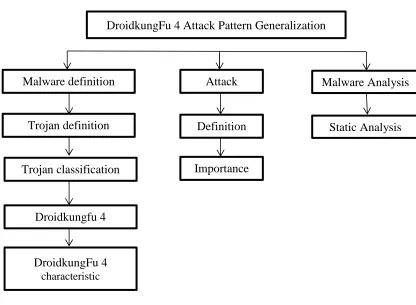
DroidkungFu 4 Attack Pattern Generalization
Malware definition Attack
pattern
Malware Analysis
Trojan definition
Trojan classification
Droidkungfu 4
Definition
Importance
DroidkungFu 4 characteristic
9
Microsoft’s Windows Phone and others. It can be used for many different smartphone models, unless for the the iOS because the operating system by Apple for iPhone, iPad and other iDevices only.
Android is a operating system that designed for touch screen mobile devices and delivers full set of software. Android is an open source and all application can be used by any manufactures of device except for smartphone like iOS because they have their own operating sytem to operate. It’s also give a world-class platform for fast and easy creating applications for Android user everywhere. Android is continuously pushing the boundaries of hardware and sofware forward to bring new capabilities to users.
Android is the best power device from some of the best smartphone and tablet manufactures in the world, like Samsung,HTC,Sony and more. Some local manufactures such as Micromax, Karbon, Hawai also use android phones on their portable devices.
Android is one the hottest and popular mobile operating systems for mobile
devices available today. Samsung is the Largest Manufacturer of android
phones and tablets. LG, HTC, Sony, are other top manufacturers of android
phones and tablets. Some other local manufacturers such as Micromax,
Karbon, Hawai, also use android Phones on their portable devices.
2.2.2 Malware
10
some of them narrowly escape. It is essential that a reverse engineer must analyze such malwares which change the registry values, tamper data, and download payloads in short which shows unusual behavior. Reverse Engineer must analyze malware of that particular Operating system and study the environmental variables and activity performed by that malicious software.
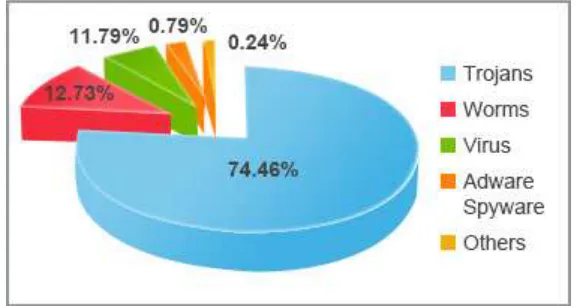
[image:24.612.183.471.402.555.2]According to (Panda Labs, 2013) Panda Security’s anti malware laboratory had published its Quarterly Report for Q1 in which it analyzed the IT security events and incidents from January through March 2013. From the report published, trojans continue to dominate the threat landscape, representing nearly three out of every four new malware samples in circulation and almost similar numbers to those of in 2012. Panda Lab’s reports come out with the graph of malware distribution as shown in the Figure 2.2 and Figure 2.3 below.