Open Access
Technical advance
Evidence and Value: Impact on DEcisionMaking – the EVIDEM
framework and potential applications
Mireille M Goetghebeur*
1, Monika Wagner
1, Hanane Khoury
1,
Randy J Levitt
1, Lonny J Erickson
1,2and Donna Rindress
1Address: 1BioMedCom Consultants inc, 1405 Transcanada Highway, suite 310, Dorval, Québec H9P 2V9, Canada and 2Centre Hospitalier Universitaire de Montreal – McGill University Hospital center (CHUM-MUHC) Technology Assessment Unit, Montreal, Québec, Canada
Email: Mireille M Goetghebeur* - [email protected]; Monika Wagner - [email protected]; Hanane Khoury - [email protected]; Randy J Levitt - [email protected];
Lonny J Erickson - [email protected]; Donna Rindress - [email protected] * Corresponding author
Abstract
Background: Healthcare decisionmaking is a complex process relying on disparate types of evidence and value judgments. Our objectives for this study were to develop a practical framework to facilitate decisionmaking in terms of supporting the deliberative process, providing access to evidence, and enhancing the communication of decisions.
Methods: Extensive analyses of the literature and of documented decisionmaking processes around the globe were performed to explore what steps are currently used to make decisions with respect to context (from evidence generation to communication of decision) and thought process (conceptual components of decisions). Needs and methodologies available to support decisionmaking were identified to lay the groundwork for the EVIDEM framework.
Results: A framework was developed consisting of seven modules that can evolve over the life cycle of a healthcare intervention. Components of decision that could be quantified, i.e., intrinsic value of a healthcare intervention and quality of evidence available, were organized into matrices. A multicriteria decision analysis (MCDA) Value Matrix (VM) was developed to include the 15 quantifiable components that are currently considered in decisionmaking. A methodology to synthesize the evidence needed for each component of the VM was developed including electronic access to full text source documents. A Quality Matrix was designed to quantify three criteria of quality for the 12 types of evidence usually required by decisionmakers. An integrated system was developed to optimize data analysis, synthesis and validation by experts, compatible with a collaborative structure.
Conclusion: The EVIDEM framework promotes transparent and efficient healthcare decisionmaking through systematic assessment and dissemination of the evidence and values on which decisions are based. It provides a collaborative framework that could connect all stakeholders and serve the healthcare community at local, national and international levels by allowing sharing of data, resources and values. Validation and further development is needed to explore the full potential of this approach.
Published: 22 December 2008
BMC Health Services Research 2008, 8:270 doi:10.1186/1472-6963-8-270
Received: 25 January 2008 Accepted: 22 December 2008
This article is available from: http://www.biomedcentral.com/1472-6963/8/270
© 2008 Goetghebeur et al; licensee BioMed Central Ltd.
Background
The objective of any healthcare intervention is to improve health; preventive measures, non-pharmacological and pharmacological treatments, and medical procedures are among the numerous available options. Decisionmaking in healthcare is a complex process taking place along a continuum that moves from evidence generation to delib-eration on each particular intervention and communica-tion of the resultant decision.
Evidence-based medicine and evidence-informed health policymaking rely on evidence generated by developers of healthcare interventions, at least in the initial stages of the life cycle of an intervention. Evidence quantity, quality, usability and accessibility have been identified as hin-drances to informed policymaking,[1] highlighting the disconnect between those who need evidence to make a decision and those who generate this evidence. Beyond evidence, decisionmaking requires value judgment. [2,3] Tunis argues that controversy around decisions may stem from the absence of shared views about the role of evi-dence versus judgment in evievi-dence-based healthcare poli-cies.[3]
Frequent controversy surrounding drug coverage variation across jurisdictions with similar levels of economic devel-opment, values and political systems [4-7] highlights a need for rational and transparent approaches to decision-making. Surveys have recognized a need for fair and explicit healthcare decisionmaking processes that are more defensible.[8,9]
Such processes should fulfill two main functions. Firstly, they should support the complex deliberative process that requires simultaneous consideration of multiple factors such as clinical benefit,[10] level of innovativeness,[6,10] quality of clinical evidence,[4,10] quality of dossier [i.e., organization, accuracy of information presented],[10] cost-effectiveness,[10,11] price and budget impact,[6,10] value judgments,[10] and colloquial evidence [anything that establishes a fact or gives reason for believing some-thing].[12] Without an explicit process to structure such complex deliberation, decisionmakers are likely to resort to intuitive and subjective approaches, potentially miss-ing important information.[13]
Secondly, such processes should help legitimize the deci-sion by ensuring that conditions for 'accountability for reasonableness' (A4R) are met by structuring the deliber-ative process to make rationale and principles on which decisions are based explicit and ultimately publicly avail-able. Within the A4R framework, availability to public scrutiny is a necessary prerequisite to legitimizing deci-sions.[14] As suggested by Dhalla and Laupacis, transpar-ency in all areas of healthcare policymaking, including
availability of data and decisionmaking rationales, is likely to raise public confidence in the process and may ultimately lead to better decisions.[15]
Several approaches have been published for making healthcare coverage decisionmaking more consistent, rational and transparent. [16-19] For example, the Cancer Care Ontario Policy Advisory Committee developed a tool that supports the deliberative process by presenting structured synthesized information on various aspects of the drugs considered.[17] A number of UK Health Author-ities have developed explicit multicriteria models to facil-itate prioritization decisions.[18] These attempts highlight growing awareness in those at the forefront of decisionmaking, and others in the field, of the need for a more holistic approach that goes beyond reliance on cost-effectiveness criteria. [20-23]
In this context, we hypothesized that healthcare decision-making could be facilitated by structuring access, consid-eration and communication of the evidence and the value judgments on which it is based. The objective of this study was to develop a practical framework to facilitate deci-sionmaking by supporting the deliberative process, per-mitting access to relevant evidence, and enhancing effective communication of decisions.
Methods
Extensive analyses of the literature and of current deci-sionmaking processes were performed to identify steps leading to decisions, as well as the components of the thought processes underlying decisions. Needs and meth-odologies available to support such processes were identi-fied to lay the groundwork on which to build the EVIDEM framework.
ⴰ systematic and explicit consideration of all key elements of decision during the deliberative process;[17,18]
ⴰ each committee member's perspective needs to be cap-tured and values shared in the committee;[16,45]
ⴰ relevant evidence in a digested, unbiased and systematic format;[16,17]
ⴰ data on quality of evidence in a structured system for all types of evidence considered;[18] and
ⴰ transparent, understandable, and acceptable communi-cation of decision.[15,41]
These needs were all considered in developing the frame-work. Analysis of the literature revealed that decisionmak-ing can broadly be subdivided into scientific judgment and value judgment.[2,3]
Scientific judgment relies on globally accepted standards defining the quality of evidence. Such technical judgment can be applied using a system in which the elements of quality are explicitly identified and quantified (scored). Scientific technical judgments are not highly dependent of the evaluator (compared to value judgments) and can be standardized. A number of quality standards, country spe-cific guidelines, checklists and instruments are available to assess the quality of various types of evidence (e.g., CONSORT,[46] CHEC,[47] STROBE[48], QUOROM[49], MOOSE[50],. GRADE[51,52], QHES[53,54] and others [24-27,29-40,55-67]). While these provide a rigorous sci-entific basis for quality assessment of evidence, additional elements were identified that could integrate scientific judgment into a practical approach to healthcare deci-sionmaking. These include:
ⴰ streamlining quality assessment for all types of evidence;
ⴰ distinguishing between quality of reporting, and rele-vance and validity of evidence;
ⴰ providing the rationale behind scoring for full transpar-ency; and
ⴰ using systematic deliberative processes to collaboratively evaluate the quality of evidence.
Analysis of the literature on quantifiable tools for value judgments considered in decisionmaking pointed to mul-ticriteria decision analysis (MCDA). MCDA structures the deliberative process by breaking down a problem into the components expected to impact the value of an option, and by quantifying them using a scale with defined anchors.[13,68] MCDA explores value judgment from
two standpoints: the value system of the evaluator with regard to the importance of each value components (weights) and the actual performance of an intervention (scores). A value estimate is obtained by combining weights and scores using simple or complex mathematical models. MCDA is widely used to support decisions in environmental engineering, agriculture, and market-ing[13] and is a promising approach to healthcare deci-sionmaking [69-74].
Review of decisionmaking processes revealed that not all value components usually considered in decisionmaking are readily quantifiable.[10,24-44,61-67] A commonly shared direction of scoring is needed to define low and high ends of a scale to make quantification meaningful. In general, components defining the intrinsic value of an intervention are quantifiable from a universal standpoint, while extrinsic or system-related components are not readily quantifiable or quantification scales depend on specific local considerations. For example, when consider-ing the intrinsic value component "improvement of effi-cacy", it is generally agreed that, all else being equal, an intervention that brings major efficacy improvement has a higher value than one with minor improvement. How-ever, components such as historical context, stakeholder pressure, population priorities and access, and ability of a healthcare system to make appropriate use of interven-tion, factors often critical in healthcare deci-sions,[41,75,76] do not have consistent impact on how an intervention is valued. For these components, what con-stitutes increase or decrease in value requires definition during deliberation at the jurisdictional level and on a case-by-case basis. Consideration of extrinsic components is easier once intrinsic value components have been defined.
To facilitate value judgments related to a healthcare inter-vention, following needs were identified:
ⴰ disentangle intrinsic and extrinsic value compo-nents;[75,76]
ⴰ develop a simple and rigorous system that applies MCDA from a pragmatic standpoint based on actual thought processes;
ⴰ provide practical access to the evidence on which value judgments are based; and
ⴰ provide a practical method for decisionmakers to pro-vide feedback to data producers and all other stakehold-ers.
Results
Framework
A practical framework was developed structuring and making more shareable what is currently being done around the world. It was based on three main principles:
ⴰ Support deliberative process by disentangling and quan-tifying when possible scientific judgment (quality of evi-dence) and value judgment (intrinsic and extrinsic value of intervention);
ⴰ Facilitate access to relevant evidence over the life cycle of a healthcare intervention using a collaborative structure; and
ⴰ Enhance communication of decisions using transparent tools.
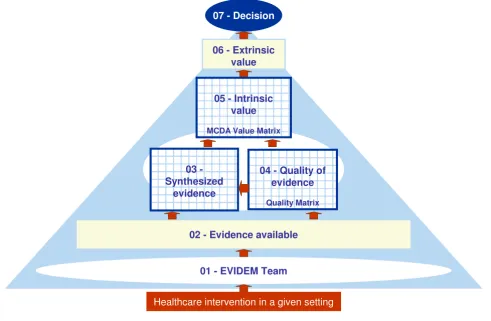
The framework structures the context of decisions for a healthcare intervention in a given setting into seven mod-ules (Figure 1). The centerpiece of the framework is the MCDA Value Matrix (module 5) which is both a
quantifi-cation tool for the intrinsic value of an intervention and a portal to evidence (synthesized [module 3] with elec-tronic links to full text source information [module 2]) and to data on quality of evidence (module 4 – Quality Matrix). Extrinsic value is considered in module 6 and communication of the decision is module 7. Applying the full framework from the early stage of development of a healthcare intervention requires a collaborative approach (module 1) in which all stakeholders are involved, i.e., decisionmakers, experts, data assessors and data produc-ers. The result of the process is an EVIDEM record, mod-ules of which can be shared in a web-based collaborative database for transparency and application by other deci-sionmaking groups or individuals. The modular aspect facilitates access to evidence and decisions, updates, and database development.
Value of intervention – Value Matrix
A MCDA Value Matrix (VM) was developed to include the value components usually considered in policy decision-making. MCDA was selected as a methodological model for the VM for its versatility, transparency and ease of
[image:4.612.60.551.366.687.2]Conceptual framework for healthcare decisionmaking in a given setting
Figure 1
Conceptual framework for healthcare decisionmaking in a given setting.
07 - Decision
06 - Extrinsic value
02 - Evidence available
01 - EVIDEM Team
Healthcare intervention in a given setting
04 - Quality of evidence
Quality Matrix
03 -Synthesized
evidence
05 - Intrinsic value
application by a wide range of stakeholders. Value com-ponents that can not be readily incorporated into a matrix were not included and were listed as extrinsic components for consideration at the jurisdictional level or on a case-by-case basis (e.g., equity, historical context, stakeholder pressure, population priorities and access, ability of healthcare system to make appropriate use of interven-tion) (module 6).
The VM (module 5) was designed to address the key ques-tion: What is the value of a healthcare intervention with respect to its intrinsic characteristics? In other words, what does it bring to the health of society (for the jurisdiction being considered)? Such a question involves probing the value system of decisionmakers (weights) and assessing the healthcare intervention based on evidence available using defined scales (scores). The value estimate of an intervention is the combination of weights and scores.
Components of decisionmaking identified in the analysis of current decisionmaking processes were specifically defined and structured to fulfill MCDA methodological requirements.[68] These are:
• Completeness: all currently-understood components defining the intrinsic value of an intervention are included;
• Non-redundancy: all components are necessary, impor-tant and there are no duplicates;
• Mutual independence: scoring of each component is independent from scoring of all other components (i.e., scores for each component can be assigned without con-sidering scores for other components); and
• Operationality: each component is defined unambigu-ously; data on which to base the evaluation is available; the numerical scale follows a shared sense of direction.
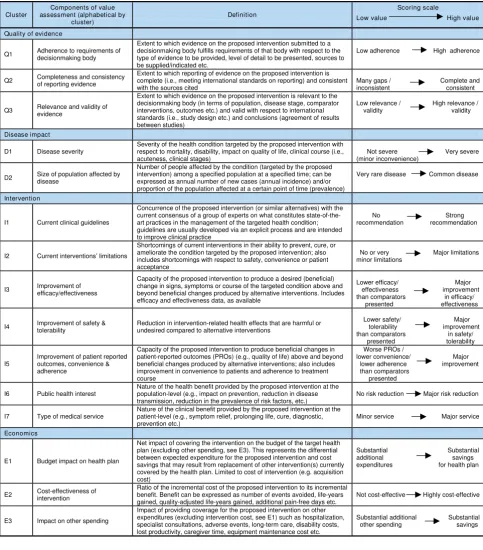
Fifteen components were thus defined and grouped into four clusters; scoring directions were defined from a soci-etal perspective (Figure 2)[68]. The first cluster assesses the impact of the quality of evidence on the value of an intervention (e.g., how the relevance and validity of evi-dence impacts the value of an intervention). This is not to be confused with the assessment of the quality of evi-dence, which is performed separately using the Quality Matrix (QM, see below). One key principle of EVIDEM is that reasoning is facilitated and made more objective by disentangling these distinct concepts (quality of evidence based on scientific standards versus the value assigned to the quality of evidence). The first cluster was broken down into three components corresponding to the three criteria of the QM.
The disease impact cluster was broken down into two components: disease severity (D1) and size of affected population (D2). It was assumed that an intervention for a very severe disease has more value than an intervention for a mild disease (D1) and that an intervention that ben-efits a large number of patients has more value than one that benefits a small number of patients (D2).
The intervention cluster was broken down into seven components. The first (I1) explores the impact of clinical guidelines. Clinical guidelines serve multiple functions for numerous groups and have become ubiquitous.[77] They can have considerable impact on practice and per-ceived value of an intervention.[78] It was assumed that guidelines represent current consensus and that strong (e.g., Class I)[79] recommendations for the intervention under consideration or for a similar intervention (e.g., a product structurally related[80]) would result in a high value score. The second component assesses the impact of limitations of current interventions (I2) on the value of a new intervention.
The concept of improvement of medical service, used by the Commission de la Transparence in France,[81] was used to define three key components of the value of an intervention: efficacy and effectiveness (I3); safety and tol-erability (I4); and patient reported outcomes, conven-ience and adherence (I5). Assessing these components required clearly defining which existing medical services and medical practices the new treatment is meant to replace or complement. Data for these existing services provides the evaluator with an evidence-based frame of reference for components I3 to I5. Components I6 "Public health interest" and I7 "Type of medical service" capture the nature of the health benefit of the intervention respec-tively at the population level and at the individual level.
Value Matrix – definitions of components and scoring scales
Figure 2
Value Matrix – definitions of components and scoring scales.
Cluster
Components of value assessment (alphabetical by
cluster)
Definition
Scoring scale
Low value High value
Quality of evidence
Q1 Adherence to requirements of decisionmaking body
Extent to which evidence on the proposed intervention submitted to a decisionmaking body fulfills requirements of that body with respect to the type of evidence to be provided, level of detail to be presented, sources to be supplied/indicated etc.
Low adherence High adherence
Q2 Completeness and consistency of reporting evidence
Extent to which reporting of evidence on the proposed intervention is complete (i.e., meeting international standards on reporting) and consistent with the sources cited
Many gaps / Complete and inconsistent consistent
Q3 Relevance and validity of evidence
Extent to which evidence on the proposed intervention is relevant to the decisionmaking body (in terms of population, disease stage, comparator interventions, outcomes etc.) and valid with respect to international standards (i.e., study design etc.) and conclusions (agreement of results between studies)
Low relevance / High relevance / validity validity
Disease impact
D1 Disease severity
Severity of the health condition targeted by the proposed intervention with respect to mortality, disability, impact on quality of life, clinical course (i.e., acuteness, clinical stages)
Not severe Very severe (minor inconvenience)
D2 Size of population affected by
disease
Number of people affected by the condition (targeted by the proposed intervention) among a specified population at a specified time; can be expressed as annual number of new cases (annual incidence) and/or proportion of the population affected at a certain point of time (prevalence)
Very rare disease Common disease
Intervention
I1 Current clinical guidelines
Concurrence of the proposed intervention (or similar alternatives) with the current consensus of a group of experts on what constitutes state-of-the-art practices in the management of the targeted health condition; guidelines are usually developed via an explicit process and are intended to improve clinical practice
No Strong recommendation recommendation
I2 Current interventions’ limitations
Shortcomings of current interventions in their ability to prevent, cure, or ameliorate the condition targeted by the proposed intervention; also includes shortcomings with respect to safety, convenience or patient acceptance
No or very Major limitations minor limitations
I3 Improvement of
efficacy/effectiveness
Capacity of the proposed intervention to produce a desired (beneficial) change in signs, symptoms or course of the targeted condition above and beyond beneficial changes produced by alternative interventions. Includes efficacy and effectiveness data, as available
Lower efficacy/ Major effectiveness improvement than comparators in efficacy/ presented effectiveness
I4 Improvement of safety & tolerability Reduction in intervention-related health effects that are harmful or undesired compared to alternative interventions
Lower safety/ Major tolerability improvement than comparators in safety/ presented tolerability
I5
Improvement of patient reported outcomes, convenience & adherence
Capacity of the proposed intervention to produce beneficial changes in patient-reported outcomes (PROs) (e.g., quality of life) above and beyond beneficial changes produced by alternative interventions; also includes improvement in convenience to patients and adherence to treatment course
Worse PROs /
lower convenience/ Major lower adherence improvement than comparators
presented
I6 Public health interest
Nature of the health benefit provided by the proposed intervention at the population-level (e.g., impact on prevention, reduction in disease transmission, reduction in the prevalence of risk factors, etc.)
No risk reduction Major risk reduction
I7 Type of medical service
Nature of the clinical benefit provided by the proposed intervention at the patient-level (e.g., symptom relief, prolonging life, cure, diagnostic, prevention etc.)
Minor service Major service
Economics
E1 Budget impact on health plan
Net impact of covering the intervention on the budget of the target health plan (excluding other spending, see E3). This represents the differential between expected expenditure for the proposed intervention and cost savings that may result from replacement of other intervention(s) currently covered by the health plan. Limited to cost of intervention (e.g. acquisition cost)
Substantial Substantial additional savings expenditures for health plan
E2 Cost-effectiveness of intervention
Ratio of the incremental cost of the proposed intervention to its incremental benefit. Benefit can be expressed as number of events avoided, life-years gained, quality-adjusted life-years gained, additional pain-free days etc.
Not cost-effective Highly cost-effective
E3 Impact on other spending
Impact of providing coverage for the proposed intervention on other expenditures (excluding intervention cost, see E1) such as hospitalization, specialist consultations, adverse events, long-term care, disability costs, lost productivity, caregiver time, equipment maintenance cost etc.
component is partly redundant with several VM compo-nents, it was included in the VM to reflect current deci-sionmaking practices.
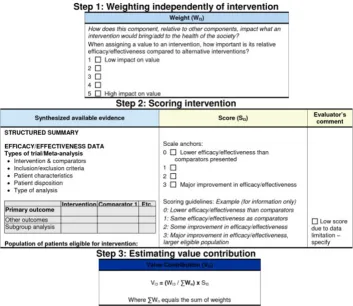
The VM was then designed to be self-contained, with an emphasis on practicality (Figure 3). It contains:
• A weighting scale (1 to 5) to capture the value system of each evaluator independent of the healthcare intervention under scrutiny; standard deviation of weights for each VM component (Wx) among a group of evaluators can be used to support discussion among evaluators;
• Synthesized evidence for the healthcare intervention under scrutiny prepared using a standardized methodol-ogy to minimize bias (see below);
• A scoring scale (0 to 3) with defined anchors and scor-ing guidelines; it includes four scorscor-ing options to stimu-late thought processes and avoid loss of information with a middle score, and zero to allow for exclusion of a com-ponent that does not bring any value (e.g., safety less than current practice); standard deviation of scores for each VM component (Sx) can further stimulate deliberative process among evaluators;
• A comments section for decisionmakers to provide feedback to the producers of evidence; includes a prompt to indicate whether low score is due to data limitation, providing a way to capture and communicate data needs;
• A simple MCDA linear model to capture a value esti-mate (V) of the intervention for each evaluator:
Where
Wx is the weight for each VM component Sx is the score for each VM component
∑Wn is the sum of all weights (i.e., for all n VM compo-nents)
Vx is the value contribution for each VM component An example of how a VM component is assessed is shown in Figure 4 (I3: Improvement of efficacy/effectiveness).
The value estimate of a healthcare intervention obtained from an individual or from a group of evaluators is
V V W S
n
= =
∑ ⎛ ⎝
⎜ ⎞
⎠ ⎟
= =
∑ ∑
xx
x x
n x Wn
1 1
[image:7.612.66.544.424.682.2]Value Matrix – assessment of the intrinsic value of a healthcare intervention
Figure 3
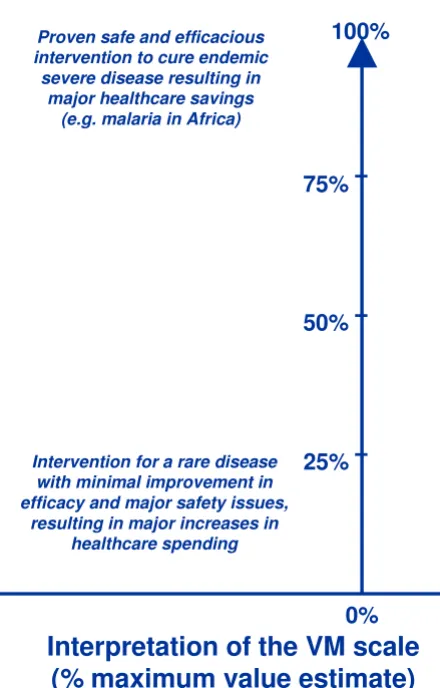
reported in the VM Comparative Scale as a percentage of maximum score allowing for comparison across health-care interventions (Figure 5). Interpretation of results requires clear understanding of the meaning of the value estimate, including its maximum and minimum anchors. Anchors incorporate all the dimensions captured by the components of the VM, thus providing a broad scale for valuing all types of interventions. Because some compo-nents of the VM are time bound (e.g. improvement of effi-cacy over existing intervention at a point in time), the value estimate will change over the life cycle of the inter-vention as new interinter-ventions are made available.
Access to evidence – synthesized and full text
Access to high level synthesized evidence is necessary to focus the thought process on key elements of decision but should be complemented by easy access to full text sources for those who want to access more details.
To ensure minimally biased evidence is available to stake-holders, a methodology was developed to synthesize this evidence for each component of the VM (module 3). The principal objective was to provide the information neces-sary and sufficient to score each component with access as
needed to full text sources. A template with instructions was developed for each component of the VM indicating where and how to find evidence (search algorithms, bio-medical and economic databases, registries, manufac-turer, health technology assessment reports, Cochrane reviews, etc.), what to report and how (i.e., standard for-mat). For full traceability, electronic links to full text sources were integrated into module 2.
For example, to assess "disease severity", data to be iden-tified and reported included disease acuteness, morbidity (disability, quality of life) and mortality, as well as disease stages or subtypes that differentiate therapies and target populations. Besides extracting study results, key elements used to define their validity are also reported, such as, number of patients included in pivotal trials, follow-up duration for safety data, key model features for economic evaluations and sources used for budget impact projec-tions. For the quality of evidence cluster, quality scores for each type of evidence are provided by criterion of quality assessment (quality scores are obtained via an explicit process described below), providing decisionmakers with structured access to results and rationale of quality assess-ment for each type of evidence.
[image:8.612.128.482.88.394.2]Value Matrix – assessing Improvement of efficacy/effectiveness (component I3)
Figure 4
Quality of evidence – Quality Matrix
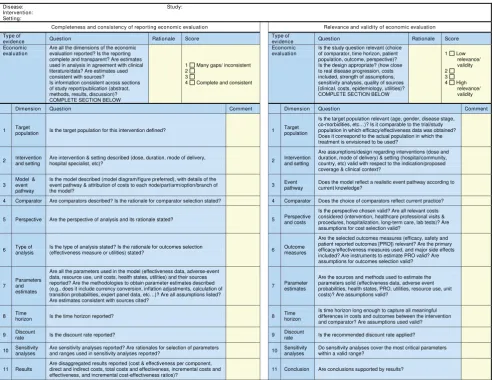
The QM was designed to quantify the quality of evidence generated for a healthcare intervention; it is grounded in current evidentiary requirements of healthcare decision-making bodies and derives from numerous existing tools and instruments to assess quality of evidence. The QM streamlines quality assessment of all types of evidence, disentangles criteria of quality, and provides access to a rationale for each score attributed via a deliberative proc-ess. The QM was designed with an emphasis on practical-ity and includes (Figure 6):
• Three criteria of quality assessment (columns);
• 12 types of evidence currently required (rows);
• For each cell of the QM:
ⴰ Questions or instruments based on global standards
ⴰ Prompt for evaluator to provide rationale for score
ⴰ Scoring scales
Five elements defining quality were identified and clus-tered in three criteria (Figure 6):
• Q1 Adherence to the requirements established by the decisionmaking body to which evidence is submitted;
• Q2: Completeness of reporting, as prescribed by report-ing guidelines, and consistency with cited sources and throughout the document; this criterion can be applied to individual studies or to a high-level document (e.g., dos-sier) that includes several studies;
• Q3: Relevance of evidence to the decisionmaking body and validity of evidence, with respect to scientific stand-ards and methodological guidelines in applicable fields of research.
Selection of the types of evidence (12 rows of the QM, each representing a research field, such as clinical research, health economics, epidemiology, pathology) for inclusion in the QM was based on an analysis of current evidentiary requirements of over 20 decisionmaking bod-ies worldwide [24-28,30-40,42-44,76] ensuring that all essential requirements were covered. This analysis also permitted creating definitions for each type of evidence that were sufficiently detailed to standardize QM use and support cross-jurisdictional comparability (Figure 6).
Evidence concerning the disease and its management was broken down into three types: disease description (#1), current treatment patterns including practices and guide-lines (#2), and impact of new intervention on therapy (#3). Epidemiology data included standard metrics and risk factors (#4). Information on the new intervention was broken down into four types: characteristics of interven-tion (#5), efficacy and safety data obtained from clinical trials (#6), patient reported outcomes (PRO) data (#7) and effectiveness data from trials and registries (#8) For the last type of evidence, identification of effectiveness used the criteria defined by the US Agency for Healthcare Research and Quality (AHRQ).[83] Data on current inter-ventions that the new intervention is projected to replace or complement was captured in a separate component (Comparator intervention data # 9) including efficacy, safety, PRO and effectiveness data, and characteristics. Economic data was broken down into three types of evi-dence: price and price justification (#10); economic eval-uation including impact of the new intervention on healthcare utilization and costs, and on society (#11); and impact of reimbursing the new intervention on the health plan budget (#12).
[image:9.612.67.287.86.430.2]Value Matrix comparative scale
Figure 5
Value Matrix comparative scale. Proven safe and efficacious intervention to cure endemic
severe disease resulting in major healthcare savings
(e.g. malaria in Africa)
Intervention for a rare disease with minimal improvement in efficacy and major safety issues,
resulting in major increases in healthcare spending
Interpretation of the VM scale
(% maximum value estimate)
100%
For each type of evidence contained in the QM, instruc-tions, quesinstruc-tions, and for the most complex types of evi-dence, specific instruments were developed. They were derived from current tools (e.g., GRADE, CHEC, etc.) to streamline scoring processes across types of evidence, dis-tinguishing criteria of quality (e.g., reporting versus valid-ity) while keeping the whole system practical. For example, for type of evidence "Economic evaluation", two 11-dimension instruments were developed: 1) an instru-ment to assess the completeness and consistency of reporting of the study; and 2) an instrument to assess the relevance and validity of study design and results (Figure 7).
A scoring scale with defined anchors was developed and full transparency requires that each score be justified by the investigator. Rationale and scores are reviewed by another investigator and validated by experts through deliberative process until consensus is reached. Com-ments, rationale and scores are all integrated into the QM for full traceability. Aggregated quality scores are
esti-mated as a percentage of maximum score by criterion, by type of evidence or for the whole QM.
Discussion
The EVIDEM framework was tailored to reflect the thought process underlying decisionmaking and to fit the continuum from data generation to decision to communi-cation of decision. It supports decisionmaking and delib-erative processes by structuring, segregating and providing transparent access to evidence (incorporating quality assessment), while facilitating communication about value judgments and data needs among stakeholders.
[image:10.612.60.551.87.400.2]The instruments developed to operationalize the EVIDEM framework are rooted in existing processes and instru-ments; however, they integrate the essential components of decisionmaking into a comprehensive and cohesive structure. The VM draws on the flexibility and comprehen-siveness of MCDA while disentangling extrinsic from intrinsic value components, and providing structured access to the evidence on which those value judgments are Quality Matrix – assessment of quality of evidence for a healthcare intervention
Figure 6
Quality Matrix – assessment of quality of evidence for a healthcare intervention.
Type of evidence Definition
Q1: Adherence to requirements*
score
Q2: Completeness & consistency score
Q3: Relevance & validity
score 1 Disease information Disease description, disease progression/duration,
pathophysiology, clinical presentation, severity of disease etc
2 Treatment patterns & guidelines
Treatment patterns & current practices, treatment guidelines
3 Impact of intervention on therapy
Expected role of intervention, impact on healthcare system, place of intervention in therapy
4 Epidemiology Epidemiology of disease treated by intervention (prevalence, incidence, trends, sub-population etc, where applicable) and risk factors
5 Characteristics of intervention
Indication, technical characteristics (e.g., for drugs, pharmacology, pharmacokinetics, interactions, contra-indications, warnings, dosing and administration & concomitant therapies)
6 Clinical data Efficacy and safety data from clinical trials (published, unpublished, meta-analyses, reviews) and from documents submitted to regulatory bodies
7 Effectiveness datag Effectiveness data (naturalistic/real life trials, effectiveness estimates, registry requirements, etc)
8 Patient reported outcomes Patient reported outcomes for intervention including quality of life, satisfaction, convenience etc
9 Comparator data Data on efficacy, safety, patient reported outcomes, intervention characteristics for comparators, where applicable
10 Price information/ justification
Price of intervention and comparators; price justification
11 Economic evaluation Economic evaluation; impact of intervention on healthcare utilization and associated costs; impact on society and associated cost, where applicable
Scoring See Figure 7
Scoring see Figure 7
12 Budget impact Budget impact analyses if intervention reimbursed (impact on health plan/drug plan)
based. Unlike some earlier applications of MCDA,[69,74] the VM does not require complicated mathematical mod-els or computation, but rather serves as a communication tool among and between stakeholders. Specific ments developed for the QM draw on existing instru-ments in each respective field of research. These often combine in one instrument dimensions pertaining to quality of reporting and to relevance and validity of a study (e.g., for economic evaluations[47,54,56]). QM instruments disentangle quality of reporting (Q2 com-pleteness and consistency) from relevance and validity (Q3), requiring the reviewer to focus specifically on each aspect of quality, bearing in mind that relevance and validity require good reporting practices to be fully evalu-ated. Because results of quality assessment are highly dependent on the assessor, rather then on the instrument, it was suggested by Gerkens et al,[84] that assessors
should reach a consensus on scores, which is required when applying the QM instruments.
The EVIDEM framework needs to be tested in context, val-idated and further developed through iterative collabora-tive processes. In a proof of concept approach, the system was pilot-tested using historical cases in the Canadian context with the objective of assessing feasibility, practi-cality and value to end users. The Canadian Value Panel convened for the pilot study indicated that the VM with embedded synthesized data would be highly useful as a support for healthcare decisionmaking, to guide discus-sion and share values among decidiscus-sionmakers, at both the policy and clinical levels, by systematically assessing strengths and weaknesses of healthcare interventions in a comprehensive and structured fashion.
[image:11.612.58.551.89.469.2]Quality Matrix – assessing quality of economic evaluations
Figure 7
Quality Matrix – assessing quality of economic evaluations. Disease: Study:
Intervention: Setting:
Completeness and consistency of reporting economic evaluation Relevance and validity of economic evaluation Type of
evidence Question Rationale Score
Type of
evidence Question Rationale Score Economic
evaluation
Are all the dimensions of the economic evaluation reported? Is the reporting complete and transparent? Are estimates used in analysis in agreement with clinical literature/data? Are estimates used consistent with sources?
Is information consistent across sections of study report/publication (abstract, methods, results, discussion)? COMPLETE SECTION BELOW
1 Many gaps/ inconsistent 2
3
4 Complete and consistent
Economic evaluation
Is the study question relevant (choice of comparator, time horizon, patient population, outcome, perspective)? Is the design appropriate? (how close to real disease progression, costs included, strength of assumptions, sensitivity analyses, quality of sources [clinical, costs, epidemiology, utilities)? COMPLETE SECTION BELOW
1 Low relevance/ validity 2 3 4 High
relevance/ validity
Dimension Question Comment Dimension Question Comment
1 Target population Is the target population for this intervention defined? 1 Target population
Is the target population relevant (age, gender, disease stage, co-morbidities, etc…)? Is it comparable to the trial/study population in which efficacy/effectiveness data was obtained? Does it correspond to the actual population in which the treatment is envisioned to be used?
2 Intervention and setting Are intervention & setting described (dose, duration, mode of delivery, hospital specialist, etc)? 2 Intervention and setting
Are assumptions/design regarding interventions (dose and duration, mode of delivery) & setting (hospital/community, country, etc) valid with respect to the indication/proposed coverage & clinical context?
3 Model & event pathway
Is the model described (model diagram/figure preferred), with details of the event pathway & attribution of costs to each node/part/arm/option/branch of the model?
3 Event pathway
Does the model reflect a realistic event pathway according to current knowledge?
4 Comparator Are comparators described? Is the rationale for comparator selection stated? 4 Comparator Does the choice of comparators reflect current practice?
5 Perspective Are the perspective of analysis and its rationale stated? 5 Perspective and costs
Is the perspective chosen valid? Are all relevant costs considered (intervention, healthcare professional visits & procedures, hospitalization, long-term care, lab tests)? Are assumptions for cost selection valid?
6 Type of analysis Is the type of analysis stated? Is the rationale for outcomes selection (effectiveness measure or utilities) stated? 6 Outcome measures
Are the selected outcomes measures (efficacy, safety and patient reported outcomes [PRO]) relevant? Are the primary efficacy/effectiveness measures used, and major side effects included? Are instruments to estimate PRO valid? Are assumptions for outcomes selection valid?
7
Parameters and estimates
Are all the parameters used in the model (effectiveness data, adverse-event data, resource use, unit costs, health states, utilities) and their sources reported? Are the methodologies to obtain parameter estimates described (e.g., does it include currency conversion, inflation adjustments, calculation of transition probabilities, expert panel data, etc…)? Are all assumptions listed? Are estimates consistent with sources cited?
7 Parameter estimates
Are the sources and methods used to estimate the parameters solid (effectiveness data, adverse event probabilities, health states, PRO, utilities, resource use, unit costs)? Are assumptions valid?
8 Time horizon Is the time horizon reported? 8 Time horizon
Is time horizon long enough to capture all meaningful differences in costs and outcomes between the intervention and comparator? Are assumptions used valid?
9 Discount rate Is the discount rate reported? 9 Discount rate Is the recommended discount rate applied?
10 Sensitivity analyses Are sensitivity analyses reported? Are rationales for selection of parameters and ranges used in sensitivity analyses reported? 10 Sensitivity analyses Do sensitivity analyses cover the most critical parameters within a valid range?
11 Results
Are disaggregated results reported (cost & effectiveness per component, direct and indirect costs, total costs and effectiveness, incremental costs and effectiveness, and incremental cost-effectiveness ratios)?
Practical use of this approach faces significant challenges. Among these are uptake by decisionmaking bodies; this will only happen if the new process is perceived as facili-tating and simplifying their task, rather than adding com-plexity. The EVIDEM framework was designed to create a simple and practicable series of freely accessible tools that could be easily integrated into existing processes, while providing a common ground. In addition, integration of EVIDEM records into a web-based collaborative database is intended to provide a platform to all stakeholders for easy access to high level data on evidence available for healthcare interventions, as well as to value estimates.
Another major challenge will be the bringing together of data producers and those who make decisions. There are issues of trust and bias that need to be surmounted to pro-vide the collaborative environment that this process would need. This would permit the 360 degree transpar-ency as envisioned by Dhalla & Laupacis.[15]
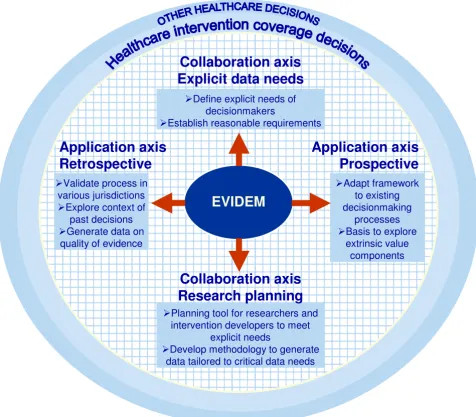
The framework was designed to be of use to a variety of healthcare decisionmakers. Several applications are envi-sioned (Figure 8). Retrospectively, the approach can be used to explore the context of past decisions, assess the quality of evidence available for a healthcare intervention at a point in time, and validate the process in a given juris-diction (Figure 8 – Application axis). Prospectively, it can be used to evaluate new interventions and to maintain a transparent record of evidence and decisions over its entire the life cycle. Several studies assessing healthcare decisionmaking processes in various regions of the world have highlighted the importance of transparency and fair-ness.[8,85,86] A number of initiatives have been imple-mented globally to increase transparency in access to both evidence and rationale for policy decisions. In Canada, the Common Drug Review recently implemented a trans-parency initiative.[87] while in the UK, the National Insti-tute for Excellence is now providing full access to manufacturer dossiers on their web site.[88] However, current processes for coverage decisions are generally organized in such a way that decision rationales cannot easily be shared among members of the decision commit-tee, let alone members of the public. Using an approach such as EVIDEM to make and communicate decisions could represent a significant step towards a more account-able and transparent process. Better understanding of the rationale behind decisions by all stakeholders could in turn enhance the legitimacy and acceptability of deci-sions.[5,14,15] Similar reasoning could apply to decision-making at the individual level; patients and their healthcare team could use such an explicit framework to assist consideration of all the components of complex decisions.
Another aspect of healthcare decisionmaking, which requires further development, is extrinsic or system-related value judgments (Figure 8 – application axis). These may be critical in decisions and require focused dis-cussion and elicitation of preferences or consensus build-ing at the jurisdictional level. One study applybuild-ing an MCDA approach to healthcare priority-setting in Ghana identified extrinsic factors such as 'age of target group' and 'poverty reduction' as critical factors through discussion with stakeholders and local policymakers.[72] Research in this area is essential to identify and structure system-related factors in decisions, which will be easier if predi-cated on transparent assessment of the intrinsic value of interventions.
Several features are integrated in the EVIDEM framework to facilitate communication between those who generate data and those who need data to make decisions. Through iterative processes, the framework can help define eviden-tiary needs of decisionmakers and be used as a planning tool for researchers and developers of new interventions, to ensure that the data that is generated addresses the needs explicitly defined (Figure 8 – Collaborative axis). Knowledge transfer and exchange (KTE), an interactive process between research users and research producers, aims to increase the likelihood that evidence will be used in practice and policy decisions.[89] A recent review sug-gests that this field of research, still in its infancy, has yet to identify KTE strategies that best support health policy decisionmaking.[89] Finally, the EVIDEM framework can also be used for educational purposes to explore the thought processes underlying healthcare decisionmaking and the concepts that define quality of evidence.
Conclusion
value assessment is expected to help optimize decisions, resources, and health.
Abbreviations
AHRQ: US Agency for Healthcare Research and Quality; CHEC: Consensus on Health Economic Criteria; CON-SORT: Consolidated Standards of Reporting Trials; EVI-DEM: Evidence and Value: Impact on DEcisionMaking; KTE: Knowledge transfer and exchange; MCDA: MultiCri-teria Decision Analysis; MOOSE: Meta-analysis Of Obser-vational Studies in Epidemiology; PRO: Patient reported outcomes; QoL: Quality of life; QUOROM: Quality of
Reporting of Meta-analyses; STROBE: STrengthening the Reporting of OBservational studies in Epidemiology.
Competing interests
The authors declare that they have no competing interests.
Authors' contributions
MMG, DR & MW conceived the framework, developed the instruments and drafted the manuscript. HK, RL and LJE participated in the design of the methodology and draft-ing of the manuscript. All authors read and approved the final manuscript.
[image:13.612.66.542.97.514.2]Potential applications of the EVIDEM framework
Figure 8
Potential applications of the EVIDEM framework.
EVIDEM
¾Adapt framework to existing decisionmaking
processes ¾Basis to explore
extrinsic value components
Application axis
Prospective
Application axis
Retrospective
¾Validate process invarious jurisdictions ¾Explore context of
past decisions ¾Generate data on
quality of evidence
¾Planning tool for researchers and intervention developers to meet
explicit needs
¾Develop methodology to generate data tailored to critical data needs
Collaboration axis
Research planning
¾Define explicit needs of decisionmakers
Acknowledgements
This study was made possible by an unrestricted research grant from Pfizer Canada.
References
1. Jewell CJ, Bero LA: "Developing good taste in evidence": facili-tators of and hindrances to evidence-informed health policy-making in state government. The Milbank Quarterly 2008,
86:177-208.
2. Eddy DM: Clinical decision making: from theory to practice. Anatomy of a decision. JAMA 1990, 263:441-443.
3. Tunis SR: Reflections on science, judgment, and value in evi-dence-based decision making: a conversation with David Eddy. Health Aff (Millwood) 2007, 26:w500-w515.
4. Menon D, Stafinski T, Stuart G: Access to drugs for cancer: Does where you live matter? Can J Public Health 2005, 96:454-458. 5. Morgan SG, McMahon M, Mitton C, Roughead E, Kirk R, Kanavos P,
et al.: Centralized drug review processes in Australia, Can-ada, New Zealand, and the United kingdom. Health Aff (Mill-wood) 2006, 25:337-347.
6. Anis AH, Guh D, Wang X: A dog's breakfast: prescription drug coverage varies widely across Canada. Med Care 2001,
39:315-326.
7. Gregoire JP, MacNeil P, Skilton K, Moisan J, Menon D, Jacobs P, et al.:
Inter-provincial variation in government drug formularies.
Can J Public Health 2001, 92:307-312.
8. Teng F, Mitton C, Mackenzie J: Priority setting in the provincial health services authority: survey of key decision makers.
BMC Health Serv Res 2007, 7:84.
9. Dionne F, Mitton C, Smith N, Donaldson C: Decision maker views on priority setting in the Vancouver Island Health Authority.
Cost Eff Resour Alloc 2008, 6:13.
10. PausJenssen AM, Singer PA, Detsky AS: Ontario's formulary com-mittee: how recommendations are made. Pharmacoeconomics 2003, 21:285-294.
11. Bloom BS: Use of formal benefit/cost evaluations in health sys-tem decision making. Am J Manag Care 2004, 10:329-335. 12. Lomas J, Culyer T, McCutcheon C, McAuley L, Law S:
Conceptual-izing and combining evidence for health system guidance.
Ottawa, Canada; 2005.
13. Baltussen R, Niessen L: Priority setting of health interventions: the need for multi-criteria decision analysis. Cost Eff Resour Alloc 2006, 4:14.
14. Daniels N: Decisions about access to health care and account-ability for reasonableness. J Urban Health 1999, 76:176-191. 15. Dhalla I, Laupacis A: Moving from opacity to transparency in
pharmaceutical policy. CMAJ 2008, 178:428-431.
16. Browman GP, Manns B, Hagen N, Chambers CR, Simon A, Sinclair S:
6-STEPPPs: A modular tool to facilitate clinician participa-tion in fair decisions for funding new cancer drugs. Journal of Oncology Practice 2008, 4:2-7.
17. Martin DK, Pater JL, Singer PA: Priority-setting decisions for new cancer drugs: a qualitative case study. Lancet 2001,
358:1676-1681.
18. Mullen PM: Quantifying priorities in healthcare: transparency or illusion? Health Serv Manage Res 2004, 17:47-58.
19. Wilson E, Sussex J, Macleod C, Fordham R: Prioritizing health technologies in a Primary Care Trust. J Health Serv Res Policy 2007, 12:80-85.
20. Camidge DR, Oliver JJ, Skinner C, Attwood B, Nussey F, Jodrell D, et al.: The impact of prognosis without treatment on doctors' and patients' resource allocation decisions and its relevance to new drug recommendation processes. Br J Clin Pharmacol 2008, 65:224-229.
21. Schlander M: The use of cost-effectiveness by the National Institute for Health and Clinical Excellence (NICE): no(t yet an) exemplar of a deliberative process. J Med Ethics 2008,
34:534-539.
22. Wilson EC, Peacock SJ, Ruta D: Priority setting in practice: what is the best way to compare costs and benefits? Health Econ 2008.
23. Tappenden P, Brazier J, Ratcliffe J, Chilcott J: A stated preference binary choice experiment to explore NICE decision making.
Pharmacoeconomics 2007, 25:685-693.
24. Commission de la transparence: Dossier-type pour une demande d'inscription ou de modification d'inscription ou de renouv-ellement d'inscription sur la liste des médicaments rem-boursables et/ou sur la liste des produits agréés à l'usage des collectivité et divers services publics. 2007 [http://www.has-sante.fr/portail/display.jsp?id=c_412104].
25. National Institute for Clinical Excellence: Guide to the methods of technology appraisal. [http://www.nice.org.uk/ page.aspx?o=114264]. 4-30-2004.
26. Comité économique des produits de santé and Les entreprises du médicament: Accord cadre entre le Comité économique des produits de santé et les entreprises du médicament pour la période 2003–2006. [http://www.sante.gouv.fr/ceps/hregul2.htm]. 11-14-2007.
27. Australian Government Department of Health and Ageing and Phar-maceutical Benefits Advisory Committee: Guidelines for the phar-maceutical industry on preparation of submissions to the Pharmaceutical Benefits Advisory Committee, including major submissions involving economic analyses.
[http:www.health.gov.au/internet/maipublishing.nsContenpbacguide-lines-index]. 12-24-2007.
28. Biomedcom Consultants Inc: BioMedCom Interface database.
[http://www.biomedcom.org/en/resources-BMC-INTERFACE-DB.html].
29. Commonwealth Department of Health and Ageing: Guidelines for the pharmaceutical industry on preparation of submissions to the Pharmaceutical Benefits Advisory Committee, including major submissions involving economic analyses.
2002 [http://www.health.gov.au/internet/wcms/Publishing.nsf/Con tent/health-pbs-general-pubs-guidelines-index.htm].
30. Scottish Medicines Consortium: Guidance to manufacturers for completion of New Product Assessment Form (NPAF) (Clinical and Economic Sections combined). [http:// www.scottishmedicines.org.uk]. 7-5-2005.
31. Academy of Managed Care Pharmacy: The AMCP format for for-mulary submissions. Version 2.1. 2005 [http://www.fmcp net.org/].
32. BC Ministry of Health Services: Drug submissionrequirements.
[http://www.healthservices.gov.bc.ca/pharme/drugsub.html]. 12-17-2007.
33. Conseil du Médicament Québec: Demande d'inscription d'un médicament. 2007 [http://www.cdm.gouv.qc.ca/site/ fr_liste_demandes_inscription.phtml].
34. Canadian Agency for Drugs and Technologies in Health: Common Drug Review – Submission Guidelines for Manufacturers.
[http://www.cadth.ca/index.php/en/media-centre/2007/06/29/116]. 4-8-2008.
35. Japan Economic Affairs Division of Ministry of Health, Labour and Welfare: Notification 0213006 – Submission of reimburse-ment price listing request forms for prescription drugs.
[http://www.jouhoukoukai.com/company/contact_jks.htm]. 11-20-2007.
36. National Institute for Health and Clinical Excellence: Guide to the single technology appraisal (STA) process. 2006 [http:// www.nice.org.uk/page.aspx?o=STAprocess].
37. National Institute for Health and Clinical Excellence: Single technol-ogy appraisal (STA): specification for manufacturer/sponsor submission of evidence. 2006 [http://www.nice.org.uk/ page.aspx?o=STAprocess].
38. WellPoint Pharmacy Management: Policy and procedures for National Pharmacy & Therapeutics Committee and National Formulary Review and Benefit Design Committee.
2005 [https://www.wellpointrx.com/wps/portal/!ut/p/kcxml/ 04_Sj9SPykssy0xPLMnMz0vM0Y_QjzKLN4i3NDIHSYGZhkH6kRhig RhijggRX4_83FT9IH1v_QD9gtzQ0IhyR0UA-zhyYQ!!/delta/ base64xml/L3dJdyEvd0ZNQUFzQUMvNElVRS82XzBfOTFW]. 39. Alberta Health and Wellness: Submission and drug review
proc-ess requirements and criteria. [http://www.ab.bluecross.ca/dbl/ manufacturers.html]. 4-1-2008.
40. Norwegian Medicines Agency: Norwegian guidelines for phar-macoeconomic analysis in connection with applications for reimbursement. [http://www.legemiddelverket.no]. 10-27-2005. 41. Vuorenkoski L, Toiviainen H, Hemminki E: Decision-making in
pri-ority setting for medicines – a review of empirical studies.
42. Federal Department of Home Affairs: Instructions concernant la Liste des Spécialités. [http://www.bag.admin.ch/themen/kranken versicherung/00263/00264/00265/index.html?lang=fr]. 8-29-2008. 43. Danish Medicines Agency (Laegemiddel Styrelse): Guidelines for
application for general reimbursement of medicinal
prod-ucts. [http://www.dkma.dk/1024/visUKLSAr
tikel.asp?artikelID=6450]. 5-19-2008.
44. Pharmaceutical Management Agency of New Zealand: Recom-mended methods to derive clinical inputs for proposals to PHARMAC. [http://www.pharmac.govt.nz/PTAC]. 7-20-2005. 45. Sinclair S, Hagen NA, Chambers C, Manns B, Simon A, Browman GP:
Accounting for reasonableness: Exploring the personal inter-nal framework affecting decisions about cancer drug fund-ing. Health Policy 2008, 86:381-390.
46. Moher D, Schulz KF, Altman DG: The CONSORT statement: revised recommendations for improving the quality of reports of parallel-group randomized trials. JAMA 2001,
285:1987-1991.
47. Evers S, Goossens M, de Vet H, van Tulder M, Ament A: Criteria list for assessment of methodological quality of economic evalu-ations: Consensus on Health Economic Criteria. Int J Technol Assess Health Care 2005, 21:240-245.
48. The STROBE group: The STROBE statement: checklist of essential items. 2005 [http://www.strobe-statement.org]. 49. Moher D, Cook DJ, Eastwood S, Olkin I, Rennie D, Stroup DF:
Improving the quality of reports of meta-analyses of ran-domised controlled trials: the QUOROM statement. Quality of Reporting of Meta-analyses. Lancet 1999, 354:1896-1900. 50. Stroup DF, Berlin JA, Morton SC, Olkin I, Williamson GD, Rennie D,
et al.: Meta-analysis of observational studies in epidemiology: a proposal for reporting. Meta-analysis Of Observational Studies in Epidemiology (MOOSE) group. JAMA 2000,
283:2008-2012.
51. Atkins D, Briss PA, Eccles M, Flottorp S, Guyatt GH, Harbour RT, et al.: Systems for grading the quality of evidence and the strength of recommendations II: pilot study of a new system.
BMC Health Serv Res 2005, 5:25.
52. Treadwell JR, Tregear SJ, Reston JT, Turkelson CM: A system for rating the stability and strength of medical evidence. BMC Med Res Methodol 2006, 6:52.
53. Ofman JJ, Sullivan SD, Neumann PJ, Chiou CF, Henning JM, Wade SW, et al.: Examining the value and quality of health economic analyses: implications of utilizing the QHES. J Manag Care Pharm 2003, 9:53-61.
54. Chiou CF, Hay JW, Wallace JF, Bloom BS, Neumann PJ, Sullivan SD, et al.: Development and validation of a grading system for the quality of cost-effectiveness studies. Med Care 2003, 41:32-44. 55. Silber S: A new and rapid scoring system to assess the
scien-tific evidence from clinical trials. J Interv Cardiol 2006,
19:485-492.
56. Siegel JE, Weinstein MC, Russell LB, Gold MR: Recommendations for reporting effectiveness analyses: Panel on cost-effectiveness in health and medicine. JAMA 1996,
276:1339-1341.
57. Mauskopf JA, Sullivan SD, Annemans L: Principles of good practice for budget impact analysis. 2007 [http://www.ispor.org/workpa per/budget_impact.asp].
58. Weinstein MC, O'Brien B, Hornberger J, Jackson J, Johannesson M, McCabe C, et al.: Principles of good practice for decision ana-lytic modeling in health-care evaluation: report of the ISPOR Task Force on Good Research Practices – Modeling Studies.
Value Health 2003, 6:9-17.
59. Baladi J-F, and Canadian Coordinating Office for Health Technology Assessment: A guidance document for the costing process: version 1.0. 1996 [http://www.cadth.ca].
60. Task Force on Principles for Economic Analysis of Health Care Tech-nology: Economic analysis of health care technology. A report on principles. Ann Intern Med 1995, 123:61-70.
61. Biomedcom Consultants Inc: BioMedCom Health Economic Guidelines database. 2007 [http://www.biomedcom.org/en/ resources-BMC-HEGDB.html].
62. Canadian Agency for Drugs and Technologies in Health: Guidelines for the economic evaluation of health technologies: Canada.
2006 [http://www.cadth.ca].
63. Ontario Ministry of Health and Long-Term Care: Ontario guide-lines for economic analysis of pharmaceutical products. 1994
[http://www.health.gov.on.ca/english/providers/pub/pub_menus/ pub_drugs.html].
64. Collège des Économistes de la Santé (CES): French guidelines for the economic evaluation of health care technologies: meth-odological recommendations. 2004 [http://www.ces-asso.org/ PagesGB/defaut_gb.htm].
65. Annemans L, Crott R, Degraeve D, Dubois D, Huybrechts M, Peys F, et al.: Recommended structure for reporting economic eval-uation on pharmaceuticals in Belgium. Pharm World Sci 2002,
24:5-7.
66. Health Insurance Council: Dutch guidelines for pharmacoeco-nomic research. Amstelveen, The Netherlands. 8-27-2005. 67. Noorani HZ, Husereau DR, Boudreau R, Skidmore B: Priority
set-ting for health technology assessments: a systematic review of current practical approaches. Int J Technol Assess Health Care 2007, 23:310-315.
68. National Economic Research Associates: Multi-criteria analysis manual. 2000 [http://www.communities.gov.uk/publications/corpo rate/multicriteriaanalysismanual].
69. Le Gales C, Moatti JP: Searching for consensus through multi-criteria decision analysis. Assessment of screening strategies for hemoglobinopathies in southeastern France. Int J Technol Assess Health Care 1990, 6:430-449.
70. Mussen F, Salek S, Walker S: A quantitative approach to benefit-risk assessment of medicines-part 1: the development of a new model using multi-criteria decision analysis; part 2: the practical application of a new model. Pharmacoepidemiol Drug Saf 2007:S42-S46.
71. Mussen F, Salek S, Walker S: A quantitative approach to benefit-risk assessment of medicines – part 2: the practical applica-tion of a new model. Pharmacoepidemiol Drug Saf 2007:S16-S41. 72. Baltussen R, Stolk E, Chisholm D, Aikins M: Towards a
multi-cri-teria approach for priority setting: an application to Ghana.
Health Econ 2006, 15:689-696.
73. Wilson EC, Rees J, Fordham RJ: Developing a prioritisation framework in an English Primary Care Trust. Cost Eff Resour Alloc 2006, 4:3.
74. Nobre FF, Trotta LT, Gomes LF: Multi-criteria decision making – an approach to setting priorities in health care. Stat Med 1999, 18:3345-3354.
75. Jenkings KN, Barber N: What constitutes evidence in hospital new drug decision making? Soc Sci Med 2004, 58:1757-1766. 76. Wirtz V, Cribb A, Barber N: Reimbursement decisions in health
policy – extending our understanding of the elements of decision-making. Health Policy 2005, 73:330-338.
77. Weisz G, Cambrosio A, Keating P, Knaapen L, Schlich T, Tournay VJ:
The emergence of clinical practice guidelines. The Milbank Quarterly 2007, 85:691-727.
78. Niessen LW, Grijseels E, Koopmanschap M, Rutten F: Economic analysis for clinical practice – the case of 31 national consen-sus guidelines in the Netherlands. J Eval Clin Pract 2007,
13:68-78.
79. Fuster V, Ryden LE, Cannom DS, Crijns HJ, Curtis AB, Ellenbogen KA, et al.: ACC/AHA/ESC 2006 Guidelines for the Management of Patients with Atrial Fibrillation: a report of the American College of Cardiology/American Heart Association Task Force on Practice Guidelines and the European Society of Cardiology Committee for Practice Guidelines. Circulation 2006, 114:e257-e354.
80. WHO Collaborating Centre for Drug Statistics Methodology: ATC index with DDDs 2006. Oslo, Norway; 2006.
81. Commission de la transparence: Haute Autorité de santé – Rap-port d'activité 2006. 2007 [http://www.has-sante.fr/portail/jcms/ c_452559/presentation-de-la-has].
82. Detsky AS, Laupacis A: Relevance of cost-effectiveness analysis to clinicians and policy makers. JAMA 2007, 298:221-224. 83. Gartlehner G, Hansen RA, Nissman D, Lohr KN, Carey TS: Criteria
for distinguishing effectiveness from efficacy trials in system-atic reviews. Technical Review 12. 2006 [http://www.ahrq.gov/ clinic/tp/efftrialtp.htm].
Publish with BioMed Central and every scientist can read your work free of charge "BioMed Central will be the most significant development for disseminating the results of biomedical researc h in our lifetime."
Sir Paul Nurse, Cancer Research UK
Your research papers will be:
available free of charge to the entire biomedical community
peer reviewed and published immediately upon acceptance
cited in PubMed and archived on PubMed Central
yours — you keep the copyright
Submit your manuscript here:
http://www.biomedcentral.com/info/publishing_adv.asp
BioMedcentral
85. Mitton CR, McMahon M, Morgan S, Gibson J: Centralized drug review processes: are they fair? Soc Sci Med 2006, 63:200-211. 86. Morgan S, McMahon M, Mitton C: Centralising drug review to
improve coverage decisions: economic lessons from (and for) Canada. Appl Health Econ Health Policy 2006, 5:67-73. 87. Tierney M, Manns B: Optimizing the use of prescription drugs
in Canada through the Common Drug Review. CMAJ 2008,
178:432-435.
88. National Institute for Health and Clinical Excellence: National Insti-tute for Health and Clinical Excellence website. 2006 [http:// www.nice.org.uk/].
89. Mitton C, Adair CE, McKenzie C, Patten SB, Waye Perry B: Knowl-edge transfer and exchange: review and synthesis of the lit-erature. The Milbank Quarterly 2007, 85:729-768.
90. Lomas J: Decision support: a new approach to making the best healthcare management and policy choices. Healthc Q 2007,
10:16-18.
Pre-publication history
The pre-publication history for this paper can be accessed here: