JOURNALOFVIROLOGY,Dec. 1993, p. 7106-7117 0022-538X/93/127106-12$02.00/0
5'
Sequences
of Rubella
Virus RNA
Stimulate Translation of
Chimeric
RNAs
and
Specifically
Interact
with
Two
Host-Encoded Proteins
GREGORYP. POGUE,XI-QING CAO,t NISHI K.SINGH,AND HIRA L. NAKHASI*
LaboratoryofMolecular Pharmacology, Divisionof Hematologic Products, Center for Biologics Evaluationand
Research/Office of Therapeutic Research and Review, Food and Drug Administration, Bethesda, Maryland 20892
Received 19July 1993/Accepted8September1993
Sequencesatthe 5' and 3' endsof the rubella virus (RV)genomicRNAcanpotentiallyformstable stem-loop
(SL) structuresthatarepostulatedtobe involved in virus replication. We have analyzed the function of these
putative SLstructuresinRNAtranslationbyconstructing chimericchloramphenicol acetyltransferase (CAT)
RNAs, flankedeither by both5'-and3'-terminal sequencedomains from the RVgenome orseveraldeletion
derivativesofthesamesequences.Afterin vitrotranscription of chimericRNAs, the translational efficiencies of these RNAs were compared by the rabbit reticulocyte lysate translation system. For in vivo translation
studies,the levelof CATactivitywas measuredfor chimeric RV/CAT RNAs expressed in transfected cells by theadenovirus major late promoter. Both in vivo and in vitro translation activities of the chimeric RNAs revealed that the presence of5' and 3' SL sequences of RV RNA, in correct (+) orientation and context
[5'(+)SLand3'(+)SL, respectively] was necessary for efficienttranslationofchimeric RV/CAT RNAs. The presenceoftheRV5'(+)SLsequencehad the primaryenhancing effectontranslation. To identify host proteins
which interact with the 5'(+)SL which may be involved in RV RNA translation, RNA gel-shift and UV
cross-linkingassays wereemployed.Twohostproteins 59and52kDa insize,presentincytosolicextractsfrom
both uninfected and RV-infected cells, specifically interacted with the RV 5'(+)SL RNA. Direct binding comparisons between
wild-type
and mutant5'(+)SLRNAsdemonstrated that sequences inand around thebulgeregionof theterminalstemdomain of thisstructureconstitutedaprotein binding determinant.Human serum, qualified for anti-Ro/SS-A antigen specificity, immunoprecipitated 59- and 52-kDa protein-RNA
complexes containing the RV 5'(+)SL RNA. However, poly- and monoclonal antisera raised against the
recombinant 60- and 52-kDa Ro proteinsfailed toprecipitate complexes containingthe 5'(+)SLRNA. The
identityof theproteins bindingthis RVcis-actingelement remainstobedetermined; however,their role in RV translation is discussed.
Rubellavirus(RV), thecausativeagentof Germanmeasles, is apositive-strand RNA viruscomposed ofa single genomic RNA (9,757 nucleotides [nt]) beginning with a 5' 7-methyl
guanosine capstructure and3'poly(A) tract(6, 31). The RV genome containstwo longopen readingframes (ORFs), a5'
proximal ORFthatencodesthenonstructuralproteins (6)and a 3' proximal ORF that encodes the three virus structural
proteins (25, 30, 31, 41). In RV-infected cells, a subgenomic RNA is synthesized from which the 3' proximal ORF is
expressed (31).
Comparison of RV genomic sequences with those of the
Alphaviruses does not reveal significant overall homology;
however, some sequence elements conserved among the
Al-phavirusesare alsofoundwithinthe RVgenome (6).A short
(41-nt)5' nontranslated region(NTR) precedes theinitiation codon fornonstructural protein synthesis, which is contained within aputative stem-loop (SL) structure (AG = -19 kcal/
mol [see Fig. 5]) (6) and isstructurally conserved betweenRV andSindbis virusgenomes.Primerextension analysisof the 5' end of the RVgenomic RNArevealed strong signals
corre-spondingtothepositionof thispredictedSLstructure,strongly suggestingitsexistence insolution(6).The3'-terminalregion
of theRVgenomealsocontainsastable SLstructurewhich is bound specifically by three host-encoded proteinspresent in
*Correspondingauthor.
tPresentaddress:LaboratoryofPulmonaryandMolecular
Immu-nology, National Heart, Lung, and Blood Institute, Bethesda, MD 20892.
Vero76cytosolic extracts(26).These interactionsdependon the phosphorylation status of such proteins (26), and the
identity of one protein has now been established (27) as calreticulin (18, 38).
SLstructureshave beenimplicatedin theprocessesof RNA virustranslation, RNAreplication,andencapsidation (1, 8, 11, 19, 20, 21, 24, 26, 32, 35, 39). Recently,wehaveshownthat the
presenceof both the 5' and 3' SLsequencesof RV RNA in the
correct orientation [5'(+)SL and 3'(+)SL, respectively] is necessary for the initiation ofnegative-strand synthesis from chimericchloramphenicol acetyltransferase (CAT) templatein RV-infected cells (27). Indeed, binding determinants of sev-eral cellular and virus-encoded RNA binding proteins have beendemonstrated tobe contained within SLstructures(1, 3, 5, 13, 20, 21, 23, 24, 26, 32). Many recentstudies havesought
to define sequence and structural domains responsible for
promotingtranslation of RNA virusgenomes.Themajorityof theseefforts have focusedondefiningsequenceelements that facilitate cap-independent translation of picornavirus
ge-nomes. Translation of genomic RNA from this group of
viruses, which includes poliovirus and encephalomyocarditis virus,isdependenton anextended domain within the 5' NTR sequencetermed the internal ribosomal entry siteorribosomal
landing pad (8, 12, 28, 33, 34). Within this domain of highly complex secondary structure, several structural features, a
polypyrimidine tract flanked by two extended SL structures,
profoundly influence translation of poliovirus proteins (11).
TheSLstructurepresentimmediately 5' of thepolypyrimidine
tract must be preserved for both poliovirus translation and
7106
Vol.67, No. 12
on November 9, 2019 by guest
http://jvi.asm.org/
infectivity (11). Recently, it has been shown that a host-encoded protein, the La antigen, which binds to an SL
structure in the poliovirus 5' NTR can stimulate and correct
aberrant translation in rabbit reticulocytelysate (21).
We are interested in determiningsequenceswithin the RV genome which promote translation from RV-encoded initia-tion codons and identifying cellular proteins which may be involved in thisprocess. Inthe absence ofan RVcDNA clone
from which infectious RNA can be derived, we have
con-structed chimeric reporter RNAscomposed of the CATgene
flanked by the RV 5'- and 3-terminal sequence domains, which contain putative SLstructures.Theseconstructs, includ-ing several mutant derivatives,were tested for their ability to promotetranslation bothinvitro andinvivo. SyntheticRNAs
corresponding to specific sequence elements within the RV genome were used tostudy RNA-protein interactions.
In the present study, we demonstrate that the 5'- and
3'-terminal sequence elements from RV RNA promote the
translation of chimeric CATRNAsinvitro and invivo.AnSL structure,containing the authentic RVinitiationcodon, within the RV 5' cis-acting element is specifically bound by two
host-encoded proteins which showspecificity for autoimmune
sera.
MATERIALS AND METHODS
Virus infection of cells. Vero 76cellsweregrownin Dulbec-co's modified Eagle's medium supplemented with 10% fetal calf serum (Hyclone Inc.). Cells were infected with
plaque-purified
M33 strain ofRV(5 PFU/cell)
aspreviously
described (26).Preparationof celllysates. Celllysates from both uninfected
and infected cells were prepared as described
previously
(26)in acytolysis buffer (25 mMTris-HCl buffer
[pH 7.5]
contain-ing 40 mM KCl, 1% Triton X-100, 25 ,uMp-nitrophenyl
p'-guanidino-benzoate,
and 10 ,ugofleupeptin
perml).
Protein concentrationwasdeterminedby
the bicinchoninic acidassay(Pierce).
Invitrosynthesis of RNAtranscripts.
Synthesis
andpurifi-cationof
oligonucleotide
templates that include a 17-baseT7 promoter were performed as previously described(22,
26). Transcription reactions with T7 polymerase wereperformed
with the T7 Megascript Kit (Ambion, Inc.) according to the manufacturer's protocol. The reverse-complement sequences
of the
putative
structurespresented
inFig.
5comprise
theoligonucleotide
sequence used for thesynthesis
of the wild-type RV5'(+)SLRNAandderivative mutants. Forexample,
the
oligonucleotide
sequencefor thewild-type 5'(+)RV (with
the complementary sequence of the T7 promoter
underlined)
is:
5'ACCTCATCTAGGAGITTCTCCATGGGAATGGGA
GTCCTAAGCGAGGTCCTATA
[GTGAGTCGTATTA
5'(+)SL].
pT7hY3RNAplasmid
DNA(the
kindgift
ofSandraWolin,
YaleUniversity)
was linearized withDraI,
and runoffT7 RNA transcripts were
synthesized
in vitro with the T7Megascript Kit.
RNA gel-retardation assays. RNA gel-shift assays were conductedby
incubating
0.3 ng(20,000
cpm)
ofahigh-specific-activity (70,000 cpm/ng)RNAprobewith 20
p.g
ofcytoplasmic
lysates from mock- or RV-infected cells in cytolysis buffer
containing
2U ofInhibit-ACE(5'-3' Inc.).
Reaction mixtureswere incubated at room temperature for 30 min and resolved for 1.5 h in6%
polyacrylamide gel (Protogel;
NationalDiag-nostics)
buffered in Tris-borate-EDTA buffer(0.089
MTris-HCl
[pH
8.3] containing
0.089 M boric acid and 0.002 MEDTA). After
electrophoresis, gels
were dried andRNA-protein complexeswere visualized by subsequent
autoradiog-raphy.
InvitroUV-induced cross-linking and SDS-PAGE analysis of cross-linked proteins. Cell lysates (28 ,ug ofprotein) from
uninfectedorinfectedcells wereincubated with0.7ng(-3.55 nM) ofhigh-specific-activity RNA probe (70,000 cpm/ng) for 30 min at either 0°C or room temperature. RNA-protein complexes were cross-linked at 0°C with a UV Stratalinker
2400 (Stratagene Inc.) for 30 minat 1,200 ,uJ x 100.Samples
weretreated with 1 UofRNase
T,
(GIBCO/BRL) for 10 min at room temperature. Thisstepwas not included inall assaysbecause RNA-protein complexes of the samemolecularmass were obtained in assays with orwithout RNase
T,
treatment(36). Samples were boiled in Laemmli sample buffer and
analyzed by sodium dodecyl sulfate-polyacrylamide gel
elec-trophoresis (SDS-PAGE
[10% polyacrylamide]) (Protogel;
National Diagnostics) and autoradiography.
Immunoprecipitation of protein-RNA complexes. Various antisera were employed in
immunoprecipitation reactions,
including (i)
humanpolyclonal
serum(Ge)
derived from patients sufferingfrom autoimmune disorders with antibodiestoboth the60- and the 52-kDa Ro/SS-A
proteins (2,
2a), (ii)
mousemonoclonal antiserum (A6) raised
against
recombinant 60-kDaRo/SS-A protein
(kind gift
of E. K. L.Chan), (iii)
rabbitpolyclonal antiserum raisedagainstrecombinant 60-kDa Ro/SS-A
protein (kind gift
ofJackKeen),
(iv)
rabbitpolyclonal
serum
(no. 6739)
raisedagainst
recombinant 52-kDaRo/SS-A
protein
(kind
gift of E. K. L.Chan),
and(v)
rabbitpolyclonal
antiserum raised
against
N-andC-terminalpeptides
of human calreticulin(kind gift
ofR. D.Sontheimer).
After exposureofcelllysates (60
[Lg)
containing
106 cpmofRV5'(+)SL
RNAor hY3RNAtoUVlight, appropriate volumes of antiserumwereadded to reaction mixtures and incubated at 4°C
overnight
withgentle rocking.Asuspension of heat-killed, formalin-fixed
Staphylococcus
aureuscells(Immunoprecipitin;
Bethesda Re-searchLaboratories)
wasaddedtoimmunoprecipitation
reac-tion mixtures to a final concentration of 5%. After a 3-h incubation at 4°C, material
adhering
to S.alureius
cells wassubjected
toextensivewashings
withstandard NETbuffer(50
mM Tris [pH
8.0],
400 mM NaCl, 5 mM EDTA, 1% TritonX-100).
Products fromthese reaction mixtureswereanalyzed
by
SDS-PAGE(10% polyacrylamide).
Quantitation
of result-ing autoradiographs was performed with an LKB 2222-020 laser densitometer and a MolecularDynamics personal
laserdensitometer.
Construction ofplasmids.
BamHI-digested
CAT insert de-rived from thepCM4
vector(Pharmacia),
which contains the5' and 3'
noncoding
sequencealong
with the entire CATcoding
sequence,wasisolated,
and theendswerefilled in withKlenow enzyme.This
fragment
wasthen blunt-endligated
intothefilled-in
SpeI
site of the enhancedpADMLP
vector(pD5;
kindly provided by George Mark,
MerckSharp
& DohmeResearch
Laboratories, Rahway, N.J.),
which hasanadenovi-rus major late promoter and simian virus 40
polyadenylation
site. This construct was
designated pPDCAT.
ThepPDCAT
plasmid
wasdigested
withClal
andNdeI restrictionenzymes, filled in at both ends, andblunt-endligated
with the filled-in ends of a165-bp
NarI-EcoRIfragment
of the RV RVVC4 cDNAclone (41) anddesignated
pPDCATSL4.
The 165 ntof the RV 3' terminus includes the 3' SLstructureanda27-basepoly(A)
tail. ThepPDCATSL4
plasmid
waspartially digested
withBamHI.The linearized
plasmid
wasligated
withBamHI-digested
double-strandedoligonucleotide adapter,
whichcon-tains the 65 5'ntof the RV
genomic RNA,
andwasdesignated
pPDCATSL1.
Theplasmid
with the5'(+)SL
sequence in thereverse orientation was
designated
pPDCATSL2.
Aon November 9, 2019 by guest
http://jvi.asm.org/
7108 POGUE ET AL.
stranded
oligonucleotide adapter
without the sequences ofloop
ml(see Fig. 5)
of the5'(+)SL
structure(6)
wasligated
topPDCATSL4 plasmid
anddesignated pPDCATSL3.
Asingle
nucleotide deletion
adjacent
to AUG(nt
57)
brought
this codon inframe with the CATORF. ThepPDCATSL5 plasmid
was derived
by digesting
thepPDCATSL1
plasmid
withNheI,
whichremoves 105ntfrom the 3' end ofRV RNAsequences.
This modification deletes the 3' SL structure but leaves the
poly(A)
tailregion
intact.pPDCATSL6
hasasingle
nucleotidedeletionin the RV5' NTR
adjacent
to AUG(nt
57), placing
it in thesame
reading
frameasthe CAT AUG andshifting
theRVAUG
(nt 41)
outof frame. The nucleotidesequencesofallof theconstructs weredetermined to
verify
the orientationofchimeric DNAs and the sequence atthe
junction regions.
Subcloning
of PD5-derivedplasmids
in thepPGEM7Zf(+)
vector.
Oligonucleotide primers
with restriction enzyme sitesKpnI
andXbaI at the 5' and the 3'ends, respectively,
wereused to
amplify
the CATSL sequences frompPDCATSL
plasmids.
Amplified polymerase
chain reaction DNA wasdigested
withKpnI
and XbaI andligated
withpPGEM7Zf(+)
vector(Promega).
The nucleotidesequencesof theconstructs were determined toverify
the orientation ofchimeric DNAsand the sequence at the
junction regions.
In vitro transcription and translation. 5' capped RNA
transcripts
weresynthesized
in vitro from linearizedplasmid
pGEM-PDCAT
and derivative vectors with SP6 RNApoly-merase
according
tothe SP6Megascript
Kittechnical manual(Ambion,
Inc.).
RNA wasquantitated by optical density
andanalyzed
after agarosegel electrophoresis. Equal
amounts ofRNA
(0.5
[1g)
from eachsample
were translated in vitro inrabbit
reticulocyte
lysates
in the presence of[35S]methionine.
Total translation
products
wereanalyzed by
SDS-PAGE(12%
polyacrylamide)
andsubsequent
fluorography (26).
Transfection of
plasmid
DNA and measurement of CATactivity.
Subconfluentmonolayers
ofVero 76 cells in 60-mmtissue culture
plates (about 10" cells)
were usedfor transfec-tion. Cells were washed twice with coldphosphate-buffered
saline,
and fresh Dulbecco's modifiedEagle's
medium was added. PlasmidDNA(10
p.g)
wasdiluted with50[lI
of sterilewater and
gently
mixed with 50pLg
(1
p.g/,ul)
oflipofectin
(GIBCO/BRL)
perRIl.
The transfection mixturewasincubatedat room temperature for 10 min in a
polystyrene
tube andslowly
dropped
onto cellsby gentle
swirling
oftheplate.
Cellswere incubated at
37°C
for differenttimeperiods
after DNAtransfection. Cellswere harvested andCAT
activity
was mea-sured as described in theStratagene
technical manual. Theamountof
radioactivity
innonacetylated
andacetylated
formsof
chloramphenicol
wasquantitated
witha Betascope603 blotanalyzer.
Otherquantitation
wasperformed
with an LKB 2222-020laserdensitometer.RNAisolation and Northern blotanalysis. Total RNAwas
isolated from cells at
different
times after transfection(25).
Northern
(RNA)
blotanalysis
was done aspreviously
de-scribed
(7, 35).
RESULTS
Role of RV5'- and3'-terminalsequences in the translation ofchimeric
RV/CAT
RNAs in vitro. Toassessthe translational role of the RV-terminal sequences, chimeric reportercon-structs
containing
the CAT ORF flankedby
the RV 5'- and3'-terminal sequences were made. The
resulting
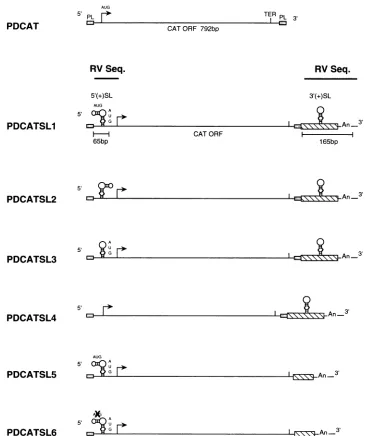
plasmid, denotedpPDCATSLl (Fig. 1),
contained the 5' RV-terminal sequence(65
bp),
which includes the5'(+)SL (sense
strand of RVvirionRNA)
andthe3'-terminal165ntof theRVgenome,including
thevirus-encodedpoly(A)
sequence. This constructallowed in vitro transcription of RNA(PDCATSL1) with SP6 RNA polymerase. It should be noted that the authentic RV
AUG initiation codon (nt 41 [Fig. 5]) (6) is in the same translational frame as the CATreading frame. Two additional
AUG codons (nt3 and 57 [Fig. 5]) (6), contained within the 5'(+)SL, are normally not in frame with the RV-encoded nonstructural proteins (6). Translational initiation from the RV-encoded AUG (nt 41) of PDCATSLI RNA should result in achimeric RV/CAT protein -29kDa in size containing an additional 9 amino acids from RV nsPI and 11 amino acids derived from the CAT 5' NTR. Various mutations were introduced into the 5' and 3' SL regions of thepPDCATSLI
construct to ascertain which sequence domains are important
in directing translation (Fig. 1). Schematic diagrams of each construct areshown in Fig. 1.
Inorder to determine nonsaturating concentrations of
tran-scripts, various amounts of RNAtranscripts from these con-structs were tested for translational efficiency in the rabbit
reticulocyte lysate translation system. On the basis of these
results, translational comparisonswerecarriedoutwith0.5 p.g of the RNA transcripts, whose integrity was confirmed by agarose gel electrophoresis. Products were labeled with
[35S]methionine. Qualitative differences in protein species
synthesized from each RNA as well as relative quantitative
differences in product levels could be determined bythese in vitro assays.
PDCATRNA, which lacks both RV flanking sequences and a poly(A) tail, did not function efficiently as a template for translation(Fig. 2,lane2; Table 1). Addition of the 3' 165bp
of RVRNA,whichincludesboth the3'(+)SLstructure(sense strand ofRVvirion RNA) and RV-encoded poly(A) tail, to the CATORF(PDCATSL4 RNA) enhanced thesynthesis of a 27-kDa CAT protein by 37-fold (Fig. 2, lane 6; Table 1).
When both 5' and 3' RV sequences flanked the CAT ORF
(PDCATSLI RNA), two protein products were synthesized,
one initiated from the CAT AUG codon (27 kDa) and a
chimericprotein (RV/CAT hybrid) ofhigher molecular mass
(29kDa[Fig. 2, lanes3 and9]).Bothprotein products couldbe
immunoprecipitated with antibodies raised against the CAT
protein sequence (36). The RV/CAT chimeric protein (29 kDa) was the predominant protein product synthesizedfrom
PDCATSL1 RNA. Initiation from the CAT AUG of PD-CATSLI RNA (27-kDa CAT protein) was reduced by over
67%
compared
with that from PDCATSL4 RNA (Table 1). When the orientation of the 5' RV leader sequence wasreversed
(PDCATSL2
RNA),leaving the CAT-encoded initi-ation codon and 3' RV sequence unaltered, virtually noincorporation of radioactivity was observed (Fig. 2, lane 4), indicatingthat this inverted configuration ofthe 5' SL struc-ture strongly inhibited translation. A high level of the CAT
protein product was synthesized in the reticulocyte lysate
system from PDCATSL3 RNA, which contains a deletion in the RV 5' leader sequence (nt 32 through 46) including the
authentic RV-encodedAUG(Fig. 2,lane5).Asecondprotein,
ofslightly highermolecularmass(-28 kDa),wasalso synthe-sized fromthis RNA(Fig. 2,lane5). This proteinwasprobably
initiatedfromanRV-encoded AUG codon at nt 57, placedin the same reading frame as the CAT initiation codon by a second deletion ofsingle nucleotide directly adjacenttoAUG
(nt 57). This protein would be predicted to contain 4 RV-encodedamino acids and the 11 amino acids encodedby the
CAT 5' NTR inadditiontothe CATprotein.The65% lower amount of RV/CAT chimeric protein produced from
PD-CATSL3
RNA, compared
with that synthesized fromPD-CATSL1 RNA,shows theimportance ofsequence context on J VlIROL.
on November 9, 2019 by guest
http://jvi.asm.org/
TERPL 3' CAT ORF 792bp
CATORF
Lt
A..An_3'
165bp
J-<
A An_3
In_3An3
5' [*
j-ILA-
An-3AUG A
;
X'
-Li;.An_3'
5'
PDCATSL6 5' ° I ____An93
FIG. 1. Schematic representation ofRV/CAT chimericconstructs. PDCATconsists of CAT coding region and itsown 5' and 3' noncoding
sequences.PDCATSLIconsists of CATsequencesplusboth the initial 5' 65 bases and the 3-terminal 165bases ofRVgenomicRNA.PDCATSL2
is thesame asPDCATSL1,exceptthe initial 5' 65 basesareinareverseorientation.PDCATSL3has nucleotides32 through 46 deleted from the
5' 65 bases and AUG(nt 57) has beenplacedintheCATreadingframebyasingle nucleotide deletion. PDCATSL4has no5' 65 basesofRV
genomicRNA. PDCATSL5 has 105 bases deletedfrom the3' 165 basesof RVRNA, which includes the 3'(+)SLsequences.PDCATSL6,which
containsa3'-terminal regionidenticaltothat ofPDCATSL5,possessesasinglebasedeletion inthe5' RVsequences,placingthe AUG (nt 41)
outof frame and the AUG(nt 57)inframe with theCAT ORF. All oftheseconstructswereeither cloned intothe enhancedpADMLPvector (PD5)orpGEM7Zf(+) vector.Arrows indicate theAUG codon in the CATcodingsequence. Therelationship betweenthe two RV-encoded
AUGs and thatpresent inthe CATcoding regionisshown in PDCATSL1.TERrepresentsthe terminationcodon,whilePLindicatesafew5' and 3' nucleotides derived from vector-encodedpolylinkersequences.Seq., sequence.
the initiation oftranslation from the authentic RV-encoded AUG codons (Table 1).
PDCATSL5 RNA hasan unaltered 5' RV leadersequence
andpoly(A) tail, but the 3'(+)SLsequence (nt 9669to9700 of the RVgenomicRNA[6])and immediateflanking bases have been deleted. A similarprofile of protein products, compared with PDCATSLI RNA, was synthesized from PDCATSL5
RNA with the overall level of translation reduced by -50% (Fig. 2, lane 10; Table 1). This result, taken together with the large increase in translation activity of PDCAT upon the
addition of the 3' nontranslated RV sequence (PDCATSL4
RNA), demonstrated the ability of the RV 3'(+)SL and flanking sequences to enhance overall translational activity (Fig. 2). In addition, we tested the ability of the 3'
nontrans-latedRVsequencetoenhancetranslation from alternativeRV initiation codons. pPDCATSL6 contains a single nucleotide
deleted from the RV 5' sequence domain in pPDCATSL5, moving the AUG (nt 41)outofthe CAT ORFandplacingthe AUG(nt 57) in frame with the CAT ORF (Fig. 1).Translation ofPDCATSIL6RNA in thereticulocytelysatesystemproduced
AUG
5 PL
PDCAT
PDCATSL1
RV
Seq.
5'(+)SL
AUG
U 65bp
RV
Seq.
3'(+)SL
PDCATSL2
PDCATSL3
PDCATSL4
PDCATSL5
A
5- (U.3.
on November 9, 2019 by guest
http://jvi.asm.org/
[image:4.612.118.483.81.517.2]7111) POGUE ET AL.
cJ
4) C
4< < 4
C) C) C) CD
0 0 0 0
Mr(kD) ma L EL
97 -68
-
43-4j -j 0j) -j
co C1) Co co Co Co
4 4 4 w 4 4
c0 0 0 0 a
0. 0. 0. -i a. a.
_- Luciferase
- RVi;CAT
-- CAT
[image:5.612.62.559.641.691.2]
21-1 2 3 4 5 6 7 8 9 10
FIG. 2. Total invitrotranslation productsofchimcricRV/CAT RNAs. Lane 1,noRNA;lancs2to7 and9to 10,translationalproductsfrom
indicated transcribed RNAs incubated in a rabbit reticulocyte lysate translation system (Promegia) and separated by SDS-PAGE (l12Y> polyacrylamide). Lanes9and 10werederived from aInSDS-PAGE gelscparatefrom thatcontaining lances I to8. Lane 8showstheresults ofa
control translation assaywithluciferase RNA. Rcprcsentativcdata from fourindependent expcrimentsareshown.
a protein product pattern identical to that produced by PD-CATSL3RNA, butatalevel 65%Icss(Fig. 2, lane 7; Tablc 1).
In additional experiments, in vitro translation products from PDCATSLI and derivative mutant RNAs were
immunopre-cipitated with antibodies raiscd against the CAT coding se-quence. The profile of immunoprecipitated proteins was the same asthatobservedinFig.2,exceptforPDCAT, in whichno
protein was immunoprecipitated (36). These in vitro data demonstrate that the RV 5' and 3' sequences stimulate translationand, when presentincis,additively enhancc initia-tion fromRV-encodcd initiation codons.Inaddition, the AUG codonpresentat nt41 ofthe RV5'-terminalsequcncewasthe preferred site of translation initiation (Tablc 1).
The kinetics of[35S]methionine incorporation for each RNA
constructwere monitored during the course of the 60-min in
vitro translation reactions. Although the absolute levels of incorporation between constructs tested differed, the kinetic profiles were virtually identical, except for the essentially nonfunctional PDCAT and PDCATSL2 RNAs (36). These datasuggested that themessagestabilitiesweresimilarinvitro and that the quantitative differences in protein products truly reflect differential template translatability.
Role of the RV cis-acting elements in the translation of RV/CAT chimeric RNAs in vivo. The chimeric RV/CAT con-structs (Fig. I) were cloned into a pD5 vector which directs RNA expression in transfected mammalian cells by the ade-novirusmajor late promoter.The DNAconstructswere
trans-fected into Vero 76cells, and CAT activity was measured at
different time periods after transfection. Initial studies indi-cated that the maximal level of CAT activity generated by theseconstructswasreached 24 h posttransfcction (hpt), with a plateau in activity maintained through 48 hpt (36). This saturation of measurable CAT activity probably reflects the accumulation and stability of the CAT enzyme within
trans-fected cells. We further investigated the translational activity ofPDCATSLI, PDCATSL4, and PDCATSL5 RNA in vivoat
time points within the linear range of CAT activity. These
constructswere chosen forfocused studiesbecause they con-tained both 5' and 3' RV-terminal sequence domains, or deletions of either the entire 5'(+)SLor3'(+)SL structures.
CAT activity 12 hpt derived from cells transfected with PD-CATSLI vector was three times greater than thatpresent in cells transfected with PDCATSL5 vector and was five times greater than that of cells expressing PDCATSL4 RNA (Fig. 3A). Cells transfected with the PDCATSL4vector,which lacks the5' RVsequencedomain, produced approximatelyhalfthe CATactivityat24hptobservedincellsexpressingPDCATSLI and PDCATSL5, both ofwhich contain the 5' RV sequence (Fig. 3A). This observation contrasted with our previous
results in vitro, in which PDCATSL4 RNA generated CAT protein atalevelcomparable with that of PDCATSL5 (Table
1). The greater ability of RNAs containing the 5'-terminal sequence of RV (PDCATSL1 and PDCATSL5) to generate CATactivityinvivo,comparedwith RNAslackingthisdomain (PDCATSL4), indicated that this 5' elementwas the primary stimulant ofRV-initiated translation in vivo.Thesc data also
TABLE 1. Quantitation of RV/CAT and CAT proteins synthesized fromPDCATandderivativcchimcric RNAsin rabbit reticulocytclysatcs" Levcloftranslation (optical dlensiltyarca)for":
Protein
PDCAT PDCATSLI PDCATSL2 PDCATSL3 PDCATSL4 PDCATSL5 PDCATSL6
RV" 6.3 ND 2.2 2.6 0.58
CAT'' 0.16 1.9 ND 8.5 5.9 1.4 3.9
"The ratios(averagederivedfromtwoindependcntcxperiments) ol translation products (RV/('AT)are asfollows:P1DCAT,0:1;PDCATSL I,3.2:1 IDCATSL2, not detectable(ND);PDCATSL3, 0.26:1;PDCATSL4,():1;PDCATSL5,2:1; PDCATSL6, (0.2:1.
Reprcsentativcdata(derivedbylaserdensitometry) fromoneexpcriment.
Translationprodluctsinitiated from RV-encodedAUG codons. "TranslationproduLctsinitiated fromCAT-encodcd AUGcodon.
30
RVCAT -CAT
--J.VlIKOL.
on November 9, 2019 by guest
http://jvi.asm.org/
A.
PDCATSL1
3S
AAAA
.L65bp
PDCATSL4
3SL
AAAA
Time (hr.)
0 I
12
1
24 1
O
12 1
24
PDCATSL5
AAAA
I
0
12
24 *
*@0
B.
LO) C) LI)
--Cll U u U
U) C- EL a- .-.Q.
it
1 2 3 4 5
1.0 08 0.7
FIG. 3. (A) Functional anal)
RV RNA in transfected cells
ysis of the 5' and 3' SL sequences of
s. DNA from three constructs,
PD-CATSL1,PDCATSL4, andPDCATSL5,wastransfectedinto Vero 76 cells withlipofectin. CAT activitywasmeasuredfromcellsat0,12,and 24haftertransfection.Thepercentageofactivity of eachconstructwas
derivedbyquantitating theconversion of['4C]chloramphenicol from nonacetylated to both mono- and diacetylated forms. Schematic
diagrams of the three constructs are also shown. (B) Northern blot analysis of total RNA (50 ,ug) from Vero 76cells 24 h after transfection withPDCATSLI, PDCATSL4, and PDCATSL5 DNAs. Lane 1, RNA
fromnontransfectedcells; lane 2, RNA fromPDCATSLl-transfected
cells; lane 3, RNA from PDCATSL4-transfected cells; lane 4, RNA fromPDCATSL5-transfectedcells; lane 5, invitro-transcribed RNA (5 ng) from the PDCATSL4 vector. The ratios beneath lanes 3 and 4 allow comparison of the amount ofhybridized signal quantitated in each sample standardizedagainst PDCATSL1. These ratiosare
aver-age values derived from three independent experiments. Arrows, expected size of RNAs.
confirmed the previous observations that both the 5' and 3'
structures are required for achieving maximal translation
ac-tivity.
To ensure that the observed differences in CAT activity in vivo were not due to variations in RNA transcription or
stability, Northern blot analysis was performed with RNA
extracted from cells transfected with the above constructs at varioustimesposttransfection. Differences in RV/CATmRNA levelsproducedby the threeconstructswerenoted 24 hpt (Fig.
3B, lanes 2 to 4). Although PDCATSL4- and
PDCATSL5-transfected cells contain comparable amounts of RNA at 24 hpt (Fig. 3B, compare lanes 3 and 4), cells transfected with
PDCATSL5 exhibited twice the CAT activity as those
express-ing PDCATSL4 (Fig. 3A). The lack of correlation of CAT
activity and RNA level is also seen when comparing the
essentially equivalent levels of CAT activity 24 hpt (Fig. 3A) in cells transfected with PDCATSL1 and PDCATSL5, in which some differences in RNA levels were observed. These results
suggested that RNA stability was not a major determinant of the observeddifferencesin RNA translation. Nohybridization
occurred with RNA extracted from nontransfected Vero 76 cells (Fig. 3B, lane 1). The broad nature of the hybridized bands corresponding to the RV/CAT mRNAs reflects their
comigrationwith the 18S rRNA and the large amount of RNA
requiredtovisualizethese chimericRNAs. Invitro-transcribed
RNAfrom the pPDCATSL4 vectorwas used as a marker to
identify the approximate size of the in vivo-transcribed RNA (Fig. 3B, lane 5). Increase in the size of in vivo-transcribed
RNA is due to thepresence ofsimian virus40polyadenylation
sequences at the 3' end.
Characterization of host protein interactions with the RV 5'(+)SL structure. Both in vitro and in vivo translation assays showed that the presence of both 5'- and 3-terminal se-quences of RV RNA efficiently enhanced the translation of RV/CAT chimeric RNAs (Fig. 2 and 3A). Although PD-CATSL4 RNA, which lacks the 5' RV SL sequences, was an efficient template for in vitro translation (Table 1), it
consis-tently generated only half the level of CAT activity in trans-fected Vero 76 cells generated by PDCATSLI and
PD-CATSL5,which both contain thisstructure (Fig. 3A). The lack of agreement between these assay systems suggested that the RV5'-terminal RNA sequence was recognizedbycomponents
of the Vero 76 cell-encoded translation system or associated
factors. We investigated this possibility by synthesizing uni-formly radiolabeled RNA molecules encompassing the 5'(+)SL structure and incubating this probe with cytosolic
extracts derived from uninfected and RV-infected Vero 76 cells. RNA-binding proteins present in these extracts were visualized by RNA gel-shift assays and UV cross-linking tech-niques (Fig. 4). Severalpreparations ofcytolysatesweretested for their ability to bind RV 5'(+)SL RNA to ensure consis-tency ofresults and to control for artifactual interactions.
Incubation of radiolabeled 5'(+)SL RNA with cytolysates derived from mock-infected or RV-infected Vero 76 cells resulted in four RNA-protein complexes(Fig.4A, lanes 2 and 7). Increasing amountsofspecific and nonspecific RNAs were used for thecompetition assays. Upon theaddition of100-fold
molar excess of unlabeled RNA of identical sequence and polarity, the binding of proteins withincomplexes I and II was reduced by >90% in either infected oruninfected lysates (Fig. 4A,lanes 3 and 8). Addition ofunrelated RNAs such as globin and poly(I-C) resulted in only modest reductions in these complexes (Fig. 4A, lanes 5, 6, 10, and 11). Interestingly,
addition of one RNA species, hY3RNA, a low-abundance
RNA present in cytoplasmic ribonucleoprotein complexes (40), did selectively compete
(>851c)
for the binding ofproteinswithin complexesI and II (Fig. 4A, lanes 4 and 9). In
contrast to the consistent and specificpattern ofbindingseen with these
complexes
(I and II), otherslower-migrating com-plexes showed no specificity and varied in their intensity, depending on the preparation of the cytolysates (Fig. 4A).In order to ascertain the nature of the binding proteins
within the
Vero
76cytolysates, complexesfrom 5'(+)SL RNAmobility-shift assays were exposed to UV light and products wereresolved bySDS-PAGE.Twomajorproteins
--59
and 52 kDa in size were found to specifically interact with the5 C'. .r,,h .-% .I-,-.
on November 9, 2019 by guest
http://jvi.asm.org/
[image:6.612.52.287.75.444.2]7112 POGUE ET AL.
A. B.
Probe 5-(+)SL
Lysate
Uninf. + + + + +
lnf. + + + + +
Competitor u+ cc D
t;_u) I:=RLn)raa
U w ....
0
Probe --5'(+)SLL Lysate
Inf. + + + + + +
Competitor Mr (kD)
68--of u-I
I-II
Z c
9) CC '-,:5Z
+
_ J C, -X m
nL (.-~E
0A*'
30-1 2 3 4 5 6
1 2 3 4 5 6 7 8 9 10 11
FIG. 4. Specific binding of cytosolic protcinsto the RV-encoded 5'(+)SL RNA. (A) Radiolabeled RNA (0.3 ng) correspondingto the RV
5'(+)SLstructurcwas incubated with 2() pgofcytosoliclysatesderived from eitheruninfected (uninf. [lanes I to6])orRV-infected(inf. [lanes
7to 11])cells. UnlabeledcompetitorRNAs, either of thesarmesequenceandpolarityasthe RV5'(+)SL (lanes 3 and 8)orunrelatedinsequence (lanes 4to6 and9to I 1),weresuppliedat100-fold molarexcesses asindicated.Protein-RNAcomplexeswereresolvedby electrophoresis through
a6%polyacrylamide gel in Tris-borate-EDTA buffer and visualized by autoradiography. The mobilities of specific complexes I andIIareindicated
atthe right. Frccprobeisseeninlane 1. (B) Radiolabeled RNA (0.7ng[3.55nM]) correspondingtothe RV5'(+)SLwasincubated with 28 ,ug ofcytosoliclysatesderived from infected celllysates(lane 1)orwith the addition of unlabeled wild-type 5'(+)SL RNA(100)-foldmolarexcess[lane
2])orthe indicatedunrelated RNAs, each supplied at 100)-foldmolarexcess(lanes 3to6). Rccction mixturcswereexposcdtoUVcross-linking procedures, andprotcinsbearing transfcrred labelwcre resolvedby SDS-PAGE and subsequcnt autoradiography.Themobilitics ofthe 59- and
52-kDaproteins are indicatedbyarrowsatright. Reprcsentative data fromatleast twoindependent experimentsare shown.
radiolabeled 5'(+)SL RNA probe when incubated with either uninfected or infected cellular lysates (Fig. 4B). The ratio of 59- to 52-kDa proteins binding the 5'(+)SL structure was generally 1.4:1, butsomevariation betweenlysatepreparations
was observed. A l()0-fold molar excess of RNA identical in
sequenceandpolarity specifically reduced (--90%) the binding ofthe 59- and 52-kDa proteins to the labeled5'(+)SL RNA (Fig. 4B, compare lanes 1 and 2). Indeed, only 25-fold molar
excessof the unlabeled5'(+)SLRNAwasrequiredtoachieve similar (>80%) reductions in protein binding. Unrelated RNAs, such as the iron-responsive element, poly(I-C), and
globin RNA, when supplied at a 100-fold molar excess,
re-ducedbinding of the 59- and 52-kDa proteins to the labeled RV5'(+)SL RNA byanaverageof -26% (Fig. 4B, lanes 3, 5, and 6). These results, coupled with those in Fig. 4A, estab-lished the specificity of the interactions between the 59- and 52-kDaproteins and the labeled RV5'(+)SL RNA. However, hY3RNA did selectively compete for the binding of the 59-kDaprotein, reducing its level by 73% (Fig. 4B, lane 4). The level ofcompetition was dependent on the amount of unla-beled RNA included in a given assay. Essentially identical
results were obtained when uninfected cell lysates containing
radiolabeled 5'(+)SL were exposed to UV light and subse-quently challenged with unlabeled RNAs.
Identification of the protein binding site(s) within the 5'(+)SL RNA. In order to tentatively localize the binding site(s) of 59- and 52-kDa proteins within the 5'(+)SL,aseries
ofmutantSLstructureswereconstructed in whichcertainstem
regions of the 5'(+)SL were destabilized or single-stranded
bulge regions were removed (Fig. 5). Radiolabeled RNAs
corresponding to cach of these structureswere transcribed in
vitro andtheir abilitytobind cytosolic proteinswascompared
with the binding ability of the wild-type RV5'(+)SL RNA.
Initially, RNA mobility-shift assayswere employedto com-parethe relative affinitiesofproteinswithincomplexesI andII
with those of the various RNA probes (Fig. 6A). When the binding of proteins within complexes I and II of mutant
5'(+)SL-ml (Fig. 5), which lacks the SL region containing AUG (nt 41), was investigated with uninfected and
RV-infected lysates,the amounts of material presentwithin these complexeswere77 and64%, respectively,of that boundbythe
wild-type5'(+)SL RNA (Fig. 6A, lanes 3 and 10). Deletionof three adenosines within a loop region (Fig. 5) created 5'(+)SL-m3,whichwas boundby proteinsincomplexesI and
II equally as well as the wild-type RNA in repeated experi-ments(Fig. 6A, lanes 4 and 11).
Mutantscontaining alterations inthe terminalstem region of the5'(+)SLstructure [5'(+)SL-m6, -m7, and -m9(Fig. 5)] displayed disparate binding affinities for host-encoded pro-teins. Upon incubation of5'(+)SL-m6 RNA with cytolysates from mock-orRV-infectedcells, complexesI andII contained
-35% of the amount of bound RNA, as seen with the wild-type RNA(Fig. 6A, lanes 5and 12). Incontrast,addition of mutant RNAs 5'(+)SL-m7 and -m9, each predicted to
contain increased single-stranded RNAcharacter (Fig. 5), to
the binding assays resulted in >250 and >220% increases in
boundRNAwithincomplexesI andII,respectively, compared
with the wild-type5'(+)SLRNA (Fig. 6A,lanes 6, 7, 13, and 14). The 5'(+)SL-m6 mutantcontains asingle base mutation removingthesingle-stranded bulge regionin the terminalstem
region of the 5'(+)SLstructure (Fig. 5). However, destabili-zation of either theupperportionof theterminalstem(m9)or
the lowerportion (m7)of the5'(+)SLstructureispredictedto
result in larger single-stranded RNA domains (Fig. 5). The differential levels ofbinding observed with mutants 5'(+)SL-m6, -m7, and -m9 (Fig. 6A), compared with that of the
*-59 kDa
--52 kDa
43-J.VlROL.
on November 9, 2019 by guest
http://jvi.asm.org/
[image:7.612.140.493.78.285.2]RV5'(+)SL
-m3
]GAG A
-ml CUACC UCc
AU
GC
GO
AU 9
UA
-m6 (
G U CG
-m7 uA
CG .C G A U
17 63
C A A
C AUGG AG A
C UACC UC C
U c AU
GC GC AU UA CG UA GU
5'(+)SL-m6 C G
UA CG CG
5 A U
17
A A
U A
C C
A U G C G C A U U A G
5'(+)SL-ml U A
C
GU
C G
U A C G C G A U 17
C A A
C AUGG AG A c UACC UC C
U AU
G C G C A U U A G G
A A
5'(+)SL-m7 U U
G G
A
G 5.G
17
c c u c
U A A U C G C G
C
U A C G
C
A U G C G C A U U A
5'(+)SL-m3 u AG
C
G U C G U A C G 5.C G A U
C AUGG AG C
cu UACC UC G
A G
G
G G
A G
U U
U G
C A
5(+)SL-m9 CGu
U A C G C G
5 A U
17
A G G
U
FIG. 5. Predicted structures ofthe RV 5'(+)SL and derivative mutants. Specific domains affected by each of the derivative mutants are
indicatedonthewild-typeRV5'(+)SLbylinesorcirclednucleotides.Thenumberingofnucleotides within the wild-typeandmutantSLstructures correspondstothosepresentwithin the RVgenome(5).AUGspresent atnt41 and57areboxed in thewild-typestructure.5'(+)SL-ml contains
adeletion ofnt32to46,while5'(+)SL-m3bearsadeletionofnt37to40. The un-base-paired cytosineatposition23wasremoved andplaced
at nt25 in5'(+)SL-m6, thereby removingthesingle-strandRNAbulge regionwithinthe terminalstemregion.Apredicted destabilizationofthe lowerportion of the terminal stem resulting from substitutions in nt 17 to24 iscontained within 5'(+)SL-m7. Mutant 5'(+)SL-m9contains substitutions innt51 to57,which arepredictedtodestabilize regionsin theupperregion of the terminalstemwithin these structures.
wild-type 5'(+)SL RNA, suggested that the terminal stem,
including the bulge region, of the5'(+)SL comprisedan area in which the binding proteins present in complexes I and II
interact. It should be noted that increased amountsofmutant
RNAs 5'(+)SL-m3, -m6, -m7, and -m9 were bound within slower-migrating protein-RNA complexes known to be not
specific for wild-type5'(+)SL RNA (Fig. 6A).
Wewished todetermine the ability ofmutant probes tobe boundby the 59- and 52-kDa cellular proteins, which specifi-cally interactwith the wild-type 5'(+)SL RNA. Radiolabeled wild-type RV 5'(+)SL and the derivative 5'(+)SL-m6 and -m9
mutant probes were individually incubated with cell lysates,
andtheresulting protein-RNA complexeswerevisualized after treatment with UV light and SDS-PAGE analysis (Fig. 6B). The amounts of the 59- and 52-kDa proteins present in complexes containing each of the mutant probes were com-pared with that of the wild-type RV 5'(+)SL RNA. The
amount of59- and 52-kDa proteins present in RNA-protein complexeswas 150%greaterwhen incubated with5'(+)SL-m9 RNAs thantheamountinthosecontaining thewild-type probe (Fig. 6B, compare lane 2with lane 1). A similar increase in binding affinity of the 59- and 52-kDa proteins wasalso seen
for5'(+)SL-m7, which is predictedtocontainadestabilization
intheterminalstem region. Thisresultwasinagreementwith their enhanced abilities to bind proteins contained in com-plexesIand IIin RNAmobility-shiftassays,although absolute
values differed(Fig.6A, lanes 6, 7, 13, and 14). Overall binding of the 59- and 52-kDa proteins to the 5'(+)SL-m6 probe,
whichwaspredictedtocontainnosingle-stranded character in the terminalstemregion (Fig.5),wasonly 41% of theamount
boundby the wild-type probe (Fig. 6B, lane 3). This effecton binding was in accord with its relatively poor ability to be bound incomplexes I andII in RNAmobility-shiftassays(Fig. 6A, lanes 5 and 12). It should be noted that few proteins corresponding tothe nonspecific, slower-migrating RNA-pro-teincomplexeswere seeninUVcross-linkingassays(compare Fig. 6A with 6B).
Partial identification of proteins which interact with the 5'(+)SL structure. It was curious to note that hY3RNA reduced thebinding of the 59-kDa protein tothe RV5'(+)SL probe by >85 and 73% in RNA mobility-shift and UV cross-linking assays, respectively (Fig. 4A, lanes 4 and 9, and 4B, lane 4). Furthermore, comparison of the 5'(+)SL RNA sequences with those from hYRNAs (40) revealed limited regions of sequence similarity (Fig. 7A) surrounding a con-served single-stranded bulge region containing an un-base-paired cytosine residue (Fig. 7A). It is known that the cytosine-containing RNA bulge regions present in the hYRNAs are boundbyaset ofcytoplasmic proteins knownasthe Ro/SS-A
antigen (40), the predominant protein within this complex having a molecular mass of 60 kDa (4, 17, 29, 37, 40).
Interestingly, removal of the cytosine-containing bulge from the RV mutant5'(+)SL-m6 RNA(Fig. 5)reduced bindingof the 59-and 52-kDaproteins byasmuchas65%(Fig. 6A,lanes 5 and 12). On the basis of theabilityof hY3RNAtoefficiently
compete with the RV 5'(+)SL probe for 59-kDa protein
5
on November 9, 2019 by guest
http://jvi.asm.org/
[image:8.612.115.509.87.363.2]7114 POGUE ET AL.
8 9 10 1112 13 14
B.
Lysate(Inf) + + +
Probe On
E E
J i J
ut cn
It,
M,(kD) e e i
200
97
68
59 kDa 2-k2IDa
43
[image:9.612.61.297.70.552.2]12 3
FIG. 6. Comparison of host-encoded protein binding to radiola-beledwild-type RV5'(+)SL and derivativemutant RNAs.(A) Radio-labeled RNA(0.3 ng)correspondingtoRV5'(+)SL (lanes 2 and 9),
5'(+)SL-ml (lanes 3 and 10),5'(+)SL-m3 (lanes4and 11), 5'(+)SL-m6(lanes 5 and 12),5'(+)SL-m7(lanes 6 and 13), and5'(+)SL-m9 (lanes 7 and 14)wereincubatedwith 20 p.gofcytosoliclysatesderived from either uninfected (Uninf. [lanes 2 to 7]) or RV-infected (Inf.
[lanes 9 to 14]) cells. Protein-RNA complexes were resolved as
described in the legend to Fig. 4 and Materials and Methods. Free probe isseeninlanes1and 8. Thepositions ofspecific complexes I and II are indicated to the right. Schematic drawings of the predicted structures of the radiolabeled RNA probes are shown above the appropriate lanes. Representative data fromtwoindependent
experi-mentsareshown.(B) The indicatedradiolabeledRNAs,wild-type RV
5'(+)SL (lane 1),5'(+)SL-m6 (lane 2), and 5'(+)SL-m9 (lane 3)were
incubated with 28 jig of RV-infected lysates and exposed to UV cross-linking procedures. RNA-protein complexes were resolved by SDS-PAGE (10% polyacrylamide) and subsequentautoradiography. Schematic drawings of the predicted structures ofthe radiolabeled
binding and the structural similarities of the protein binding domains within these RNA structures, we testedwhether the
59-and 52-kDaproteinsarerelatedtoproteins comprising the Ro/SS-A antigen orother autoantigens.
Cytosolic proteins from both uninfected and RV-infected cell
lysates
were covalently cross-linked to labeled 5'(+)SLRNAbyexposure to UV light, andthe resulting RNA-protein
complexes were immunoprecipitated with Ro-type human
polyclonal serum (Ge), which was derived from individuals suffering from autoimmune disorders (2, 2a). Proteins
ob-tained after these immunoprecipitation reactions were
re-solved by SDS-PAGE. This human Ro-type serum
immuno-precipitated labeled 59- and 52-kDa proteins from binding
reaction mixtures containing the radiolabeled RV 5'(+)SL RNAprobe(Fig. 7B,lanes 3and 4). Thepresence ofa52-kDa
protein in immunoprecipitations from uninfected lysates can
be seen upon longerexposure (Fig. 7B, lane 3). No proteins
were immunoprecipitated when the 5'(+)SL-protein
com-plexeswere incubated with eitherhuman serumfrom
individ-uals notsuffering from autoimmune disorders (normal serum
[Fig.
7B,
lanes 1 and2])
orserum raised against anunrelated protein, such as calreticulin (Fig. 7B, lanes 5 and 6). Inaddition, human Ge antiserum did not immunoprecipitate proteins associated with RNA probes derived from other
portions of theRVgenome(36).Thesedatasuggested thatthe 59- and 52-kDa proteins binding the RV 5'(+)SL RNA are
eitherantigenically relatedto Ro/SS-A antigensormake up a
distinct setof autoimmune antigens.
In order to determine whether these binding proteins
cor-responded to known components of the Ro/SS-A complex, immunoprecipitation reactions were performed with the monoclonal antibody A6, polyclonal antiserum generated against recombinant 60-kDa Ro protein, and polyclonal
anti-serum6739 raisedagainst the recombinant 52-kDacomponent
of theRocomplex.Inordertoqualifytheantibodies,
[35S]me-thionine-labeled proteins from mock and RV-infected cells
wereimmunoprecipitated with various antisera. The expected proteins were precipitated by antisera in the absence of any RNA probe (36). Duplicate immunoprecipitations were
per-formed (Fig.
7B,
lanes 7 to17)
with lysates incubated with either 5'(+)SL RNA or hY3RNA, a native substrate for Roprotein
binding. Preimmune(normal)
serumdid notimmuno-precipitate any RNA-protein complexes after exposure of lysatescontaining radiolabeled hY3RNAtoUVlight(Fig.
7B,
lane 13). With apolyclonal antiserum raised against
recombi-nant 60-kDa Ro protein, protein-hY3RNA complexes -68 and 60kDa in sizewereimmunoprecipitated (Fig.7B,lane14). Interestingly, monoclonal antiserum raised against a 60-kDa
Ro protein immunoprecipitated predominant complexes
con-taining hY3RNA -71 and 48 kDa in size (Fig. 7B, lane 15).
Human Ro-type serum (Ge) immunoprecipitated a
protein
complexcontaining hY3RNA68kDa in size andless-reactive complexes -60 and 48 kDa in size (Fig. 7B, lane 17). Anti-serum raised against recombinant 52-kDa Ro
protein
showedlittle reactivity (Fig.
7B,
lane 16). At present, the reasons for the observed differences in the molecular masses ofprotein-hY3RNAcomplexesprecipitated by monoclonal antibodyA6 and other Ro antisera are notclear.
In contrast to results with hY3RNA, in repeated
experi-ments, only human polyvalent serum (Ge) was found to
immunoprecipitate protein-RNA complexes containing RV
RNA probes are shown above the appropriate lanes. The arrows
indicatethe positionsof the59-and52-kDaproteins.
A.
Lysate Unif. Inf.
It
cProbe -J
ui
+ + + + + +
+ + + + +
1-E E ES - g EEEE
u)
0 v cn) u)LO U)enV)UnLO u)Inr U1 4-> UN) U) - U -~
wa.,~~~l
1 2 3 4 5 6 7
J. VIROL.
on November 9, 2019 by guest
http://jvi.asm.org/
An
C A A
C AUGG AG A
C , UACC UC C C A U
C G C
A U U A G ,U A
CC
G U C G
U A
G G C G
5 A
U-A
5'(+)SL RNA RV
0
a
a) c
a 4_
C
C---o 0
o o
0 C:
0 Co CS
Z < < <
5'(+)SL
o cc
o 0
-5 0 c'
0 C C0 C 0
z <h< <
hy3RNA
+ + +
Mr(kD)
- 200
-
-'97-1 2 3 4 5 6
+ + + + + + + + + +
[image:10.612.78.527.80.598.2]7 8 9 10 11 12 13 14 15 16 17 FIG. 7. (A) Comparisonofsequenceandpredictedstructural similarities between the RV5'(+)SLand the terminalstemregionofhYlRNA
and hY3RNA(40). Lines indicateregionsofsimilarityshared bythese RNAs. (B) Immunoprecipitation ofRNA-protein complexes containing
radiolabeled RV5'(+)SLand hY3RNA. Uninfected(Uninf.) and RV-infected(Inf.)cell lysates(60 p.g)were incubatedwith radiolabeled RV 5'(+)SL (1.4 ng)andsubjectedtoUVcross-linking proceduresfollowedby immunoprecipitationwith (normal)humanserumfrompatientsnot sufferingfromautoimmunity (lanes 1 and2),human Ro-type polyclonalantiserum Ge(lanes3 and4),orpolyclonalantibodies directedagainst
N- and C-terminal peptides ofhuman calreticulin (lanes5 to6). The mobilities of the 59- and 52-kDa proteins immunoprecipitated byGe
antiserumareindicatedtothe left.Immunoprecipitationdatarepresentativeofatleast threeindependent experimentsareshown. Uninfectedcell lysates (60 p.g) were incubated with radiolabeled (1.4 ng) 5'(+)SL RNA (lanes 8to l1) orhY3RNA (lanes 12 to 17) and subjected toUV cross-linking proceduresfollowedby immunoprecipitationwiththe indicated antiserum:preimmune (normal)serum(lanes8and 13), polyclonal serum directedagainstthe recombinant 60-kDa Roantigen (lanes 9and 14), monoclonal serumdirectedagainst the 60-kDa Ro/SS-Aantigen (lanes10 and15), polyclonalantiserumspecificfor the recombinant 52-kDa Roantigen (lanes 11to16),and humanRo-type polyclonalantiserum
(lane 17). Immunoprecipitated proteins were resolved by SDS-PAGE (10% polyacrylamide) and subsequent autoradiography. Control UV
cross-linkingreaction mixturescontaining 5'(+)SL (lane 7)and hY3RNA(lane 12) were notsubjectedto immunoprecipitation reactions and
generally requiredfivefold lessexposure than those involving immunoprecipitation.
G C A U U A G C U
G C G C A
A
A U
CG U
CC
.C G
lU A
G C
CU U A C G
G U 3
pppG C U UU
AU
C U
GCC
U A
GCC
A U
Grk;;
C C CU
U A
G C
G U
GC ppC G
G C
pppG C UUu
hyl RNA hy3 RNA
B.
E
Sera z
I
Probe 5'(+)SL
Lysate
Inf.
Uninf. +
59 kDa
52 kDa
-o-.W,,
"S'.
"I
_Aiffik..-,
-,-IMWF
on November 9, 2019 by guest
http://jvi.asm.org/
7116 POGUE ET AL.
5'(+)SLRNA(Fig. 7B, lanes 3 and 4). Theinability of
mono-and polyclonal antisera, raised against recombinant 60- and
52-kDa Ro/SS-A antigen components, to immunoprecipitate such complexes (Fig. 7B, lanes 9 to 11) indicates that the
proteins binding the RV 5'(+)SL cis-acting element are not
the known 60- and 52-kDa Ro proteins. However, their
rcactivity with antibodies derived frompatients suffering from
autoimmune diseasessuggeststhatthebinding proteinsmay be
associated with orrelated tocertain autoantigen complexes.
DISCUSSION
Results from both in vitro and in vivo translation assays demonstrate that the RV 5'- and 3-terminal sequence do-mains efficiently promote translation of chimeric RV/CAT RNAs. Comparison ofratios oftranslation products initiated
fromRV- andCAT-encoded AUGcodons (Table 1) revealed
thattranslation initiates withmuch greater frequency from the
RV-encoded AUG at nt 41 thanwith the AUG at nt 57. This
preference is observed regardless of the presence of the RV
3'(+)SL sequence (Fig. 2). Therefore, the sequence context
surrounding these RV AUG codonsseems to bethe primary factor dictating the preferential use of AUG (nt 41). The consensus sequence for the bases surrounding eucaryotic
ini-tiation codons containsaguanosine residueatthe +4position, which suggests that it is important for efficient translation (14-16). Indeed, this +4 guanosine is present immediately
downstream of the RVAUG(nt 41) and theCATAUGbut is
conspicuouslyabsentfrom sequences adjacentto RVAUG (nt 57[Fig.5]).Theabilityof the RV-terminalsequence elements toenhance thetranslational suitability of heterologous coding
regions emphasizes their importance in the translation of the RV nonstructural genes.
While analyzing the effects of RV 5'(+)SL and 3'(+)SL RNA sequences in directing translation, we observed differ-encesin the levelsof PDCATSL4RNAtranslation in vitroand invivo. PDCATSL4RNA,which lacks the5'(+)SLsequence, promoted CATactivity in vivo atonly 20 to 50% ofthe level
produced by PDCATSL1 RNA (Fig. 3). In contrast, in vitro studies showed that PDCATSL4 RNA produced translation products >70% the level observed with PDCATSL1 RNA
(Fig. 2; Table 1). This lack of agreement between assays
performedin vitro and in vivosuggestedagreatertranslational enhancing role for the 5'(+)SL structure in vivo than in
cell-free systems. Therefore, we sought to identify cellular proteins which specificallyinteractwith the RV 5'(+)SL RNA.
Indeed, two cellular protein species, 59 and 52 kDa in size,
specifically
bound the terminal stem region of the 5'(+)SLstructure
(Fig.
4and 6).Very few cellular proteins that interactwith virus-encoded cis-acting elementshavebeenidentified (21, 27).However,the
ability
of hY3RNAtocompetewiththe5'(+)SL for binding ofthe 59-kDa protein (Fig. 4), coupledwith similarities in their
predictedstructure and theapproximatesitesof protein
bind-ing (Fig. 7A), suggested that components of the Ro/SS-A
antigen complex (4, 29, 37, 40) may be interacting with the
5'(+)SL RNA. Indeed, human Ro-type serum Ge (2, 2a)
specifically immunoprecipitated 59- and 52-kDa proteins
boundtoradiolabeled RV5'(+)SLRNA(Fig. 7B). Immuno-precipitation of protein-hY3RNA complexes by the human serum Ge confirmed its ability to recognize RNA binding
proteins within the Ro/SS-Aantigen complex (Fig. 7B).
Fur-ther characterization of the RV 5'(+)SLRNA binding
pro-teins revealed that poly- and monoclonal antisera raised against recombinant 60-kDa Ro antigen, which
immunopre-cipitated complexes containing
hY3RNA,didnotimmunopre-cipitate complexes containing the RV 5'(+)SL. These data suggest that the 59- and 52-kDa proteins binding the RV 5'(+)SL RNA are novel polypeptides. Further studies, em-ployingadditional samples of autoimmune patient serum,will benecessary to confirm the association of the 5'(+)SL binding proteins with autoantigens. However, the identity of the 59-and52-kDa proteins will be established upon theirpurification.
The autoantigen La has recently been shown to correct and enhance translation initiation from the authentic poliovirus AUG invitro (21). In light of these observations, the binding ofhostproteinsreactive with humanautoimmune serum to the
5'(+)SL RNA may contribute to RV translation. These pro-teins have a higher binding affinity for RNA probes containing increased single-stranded nature and lower affinity for RNA probes lacking single-stranded domains (Fig. 6). Such
obser-vations suggest that these proteins could be involved in desta-bilizing or unwinding 5' NTR secondary structure elements,
thereby providing an attractive site for the translation
initia-tion. Interestingly, the complementary sequence of the RV 5'(+)SL RNA (anti-sense strand of virion RNA) exerts a strong inhibitory effect on translation from the CAT AUG (PDCATSL2; Fig. I and 2). It is also known that this RNA sequence is not bound by the 59- and 52-kDa proteins (24). Both the lack of interaction between the complementary
strand of the 5'(+)SL sequence with the host proteins and its inhibitory effect on translation may further support the in-volvement of the 59- and 52-kDa cellular proteins in transla-tion.
Initiation oftranslation from either the RV or CATAUGs was greatly enhanced (>37-fold in vitro and 3-fold in vivo) by thepresence of the RV 3'(+)SL sequences and poly(A) tract (Table 1; Fig. 3A). Indeed, removal of the 3'(+)SL and
immediateflankingsequences, leaving the poly(A) tract intact (PDCATSL5 RNA), resulted in >50% reduction in overall
translation (Table 1; Fig. 2). The additive enhancement in translation observed from RNAs containing both 5' and 3' SL structures suggests that thesesequencesmay interact with one
another. However, no regions of RNAcomplementarity have beenidentifiedtodate. It has been observed that the presence of a poly(A) tract and other 3'-terminal sequence elements
enhance mRNA stability and stimulate translation (9, 10). Although the manner in which the RV 3' sequences augment
translation is presently unclear and requires further study, the
possibility exists that RV 5'- and 3-terminal structures may
associate in vivo via protein-protein interactions to promote
translation.
ACKNOWLEDGMENTS
Giovanna Tosato, Gerardo Kaplan, and Barry Falgout are gratefully acknowledged for their critical review of the manuscript. We also thank E. K. L. Chan (Scripps Research Institute) for providing human Ro-type serum (Ge), monoclonal serum against recombinant 60-kDa Ro, andpolyclonal antiserum raised against recombinant 52-kDa Ro. We gratefully acknowledge R. D. Sontheimer (University of Texas Southwestern Medical Center) for providing human anti-calreticulin peptide serum, Jack Keene and Ameeta Kelkar (Duke University Medical Center) for polyclonal serum raised against recombinant 60-kDa Ro protein, and Sandra Wolin (YaleUniversity) for the gift of the pT7hY3RNA plasmid DNA. We thank John Ewell for the synthesis ofoligonucleotides.
REFERENCES
1. Andino, R., G. E.Rieckhof, and D.Baltimore. 1990. A functional ribonucleoprotein complex forms around 5' end of the poliovirus RNA. Cell 63:369-380.
2. Ben-Chetrit, E., E. K. L. Chan, K. F. Sullivan, and E. M. Tan. 1988. A 52 kD protein is a novel component of the SS-A/Ro J VIRC)L.
on November 9, 2019 by guest
http://jvi.asm.org/
antigenic particle.J. Exp. Med. 167:1560-1571.
2a.Chan, E. K. L., J. C.Hamel, J. P. Buyon,and E. M. Tan. 1991. Moleculardefinition andsequence motifs of the 52-kDa compo-nentof human SS-A/Ro autoantigen. J. Clin. Invest. 87:68-76. 3. delAngel,R.M.,A. G.Papavassiliou,C.Fernandez-Thomas,S.J.
Silverstein, and V. R. Racaniello. 1989. Cell proteins bind to multiple sites within the 5'untranslatedregionofpoliovirusRNA.
Proc. Natl. Acad. Sci. USA 86:8299-8303.
4. Deutscher, S.L., J.B.Harley, andJ. D. Keene. 1988. Molecular
analysis of the 60 kDa human Roribonucleoprotein. Proc. Natl.
Acad. Sci. USA 85:9479-9483.
5. Dildine, S. L., and B. L. Semler. 1992. Conservation of RNA-protein interactionsamongpicornaviruses.J. Virol. 66:4364-4376. 6. Dominguez, G.,C.-Y.Wang,and T. K.Frey.1990. Sequenceof the
genomeRNAof rubella virus: evidence forgeneticrearrangement
during togavirus evolution. Virology 177:225-238.
7. Dreher,T.W.,A. L. N.Rao, and T. C. Hall. 1989.Replication in vivo ofmutant brome mosaic virus RNAs defective in
aminoacy-lation. J. Mol. Biol. 206:425-438.
8. Duke, G. M., M. A. Hoffman, and A. C. Palmenberg. 1992. Sequence and structural elements that contribute to efficient encephalomyocarditis virus RNA translation. J. Virol.
66:1602-1609.
9. Gallie,D. R. 1991. Thecapandpoly (A)functionsynergisticallyto regulatemRNA translationalefficiency. GenesDev. 5:2108-2116.
10. Gallie, D. R., J. N. Feder, R. T. Schimke, and V. Walbot. 1991.
Functional analysis of the tobacco mosaicvirus tRNA-like struc-ture incytoplasmicgene regulation.Nucleic Acids Res.
19:5031-5036.
11. Haller,A.A.,and B. L. Semler.1992. Linkerscanning mutagenesis
of the internal ribosome entry site ofpoliovirus RNA. J. Virol.
66:5075-5086.
12. Jang,S.K.,T. V.Pestova,C. U. T.Hellen,G. W.Witherell,and E.
Wimmer. 1990. Cap-independent translation of picornavirus
RNAs:structureand function of theinternal ribosomalentrysite. Enzyme44:292-309.
13. Jang,S.K.,and E. Wimmer.1990.Cap-independenttranslation of encephalomyocarditisvirusRNA: structural element of the
inter-nal ribosomalentrysite andinvolvement ofacellular 57-kD RNA binding protein. Genes Dev. 4:1560-1572.
14. Kozak, M. 1986. Point mutations define a sequenceflanking the
AUG initiator codon that modulates translation by eukaryotic
ribosomes. Cell 44:283-292.
15. Kozak, M. 1989. Context effects and inefficient initiation at non-AUG codons ineucaryoticcell-free translationsystems. Mol.
Cell. Biol. 9:5073-5080.
16. Kozak,M. 1989. Circumstances and mechanisms of inhibition of
translation by secondary structure in eucaryotic mRNAs. Mol.
Cell. Biol. 9:5134-5142.
17. Lerner, M. R., J. A. Hardin, and J. A. Steitz. 1981. Two novel
classes of small ribonucleoproteinsdetectedbyantibodies
associ-ated with lupus erythematosus.Science 211:400-402.
18. McCauliffe, D. P., E. Zappi, T. S. Lui, M. Michalak, R. D.
Sontheimer,andJ.D.Capra. 1990. A humanRo/SS-A
autoanti-genisthehomologueof calreticulin and ishighly homologouswith OnchoceralRAL-1antigenandanAplysia "memorymolecule." J. Clin. Invest. 86:332-335.
19. Meerovitch, K., R. Nicholson, and N. Sonenberg. 1991. In vitro
mutational analysis of cis-acting RNA translational elements
within the poliovirus type 2 5' untranslated region. J. Virol.
65:5895-5901.
20. Meerovitch, K., J. Pelletier, and N. Sonenberg. 1989. A cellular proteinthat bindstothe5' noncoding regionofpoliovirusRNA: implicationsfor internal translationinitiation. Genes Dev.
3:1026-1034.
21. Meerovitch, K., Y. V. Svitkin, H. S. Lee, F. Lejbkowicz, D. J.
Kenan,E. K. L.Chan,V. I.Agol, J.D.Keene,and N.Sonenberg.
1993. Laautoantigen enhances and corrects aberrant translation
ofpoliovirus RNA inreticulocytelysate.J.Virol.67:3798-3807. 22. Milligan, J. F., D. R. Groebe, G. W. Witherell, and 0. C.
Uhlenbeck. 1987.
Oligoribonucleotide
synthesis using
T7 RNApolymerase and
synthetic
DNAtemplates.
Nucleic Acids Res.15:8783-8798.
23. Najita, L., andP.Sarnow. 1990.Interaction ofacellular 50 kDa
proteinwith an RNA
hairpin
in the 5'noncoding
region
of thepoliovirus
genome:evidence foratransient covalentRNA-protein
bond. Proc. Natl. Acad. Sci. USA87:5846-5850.
24. Nakhasi, H. L.,
X.-Q. Cao,
T. A.Rouault,
and T.-Y. Liu. 1991.Specific
binding
of host cellproteins
tothe 3-terminalstem-loop
structureof rubella virus
negative-strand
RNA.J. Virol. 65:5961-5967.25. Nakhasi, H. L., B. Meyer, and T.-Y. Liu. 1986. Rubella virus cDNA:sequence and
expression
of Elenvelope
protein.
J. Biol. Chem.261:16616-16621.26. Nakhasi,H. L.,T. A.
Rouault,
D.J.Haile,
T.-Y. Liu, and R. D.Klausner. 1990.
Specific
high-affinity binding
of hostproteins
to the 3'region
of rubella virus RNA. New Biol. 2:255-264. 27. Nakhasi, H. L.,N. K. Singh,G.P.Pogue,
X.-Q.
Cao,and T. R.Rouault. Identification and characterizationof host factor inter-actions with
cis-acting
elements of rubella virus RNA. In M. A. Brinton and R. Rueckert(ed.),
Proceedings
of the 3rd Interna-tional Positive Strand RNA VirusConference,inpress. AmericanSociety
ofMicrobiology.
Washington,
D.C.28. Nicholson, R., J.
Pelletier,
S.-Y.Le,
and N.Sonenberg.
1991. Structural and functionalanalysis
of the ribosomelanding pad
ofpoliovirus
type 2: in vivo translation studies. J. Virol. 65:5886-5894.29. O'Brien, A.
C.,
and J. B.Harley.
1990. Asubset ofhy
RNAs is associated witherythrocyte
Roribonucleoproteins.
EMBO J. 9:3683-3689.30.
Oker-Blom,
C.,
N. Kalkkinen, L.Kaiinianen,
R. F. Pettersson.1983. Rubella virus contains one
capsid protein
and threeenve-lope
glycoproteins,
El,
E2a,E2b. J.Virol. 46:964-973.31. Oker-Blom,
C.,
I. Ulmanen,L.Kaanianen,andR.F. Pettersson.1984.Rubella virus 40S genomeRNA
specifies
a24Ssubgenomic
mRNAthat codes foraprecursortostructural
proteins.
J.Virol. 49:403-408.32.
Pardigon, N.,
andJ.H.Strauss. 1992. Cellularproteins
bindtothe 3' end ofSindbisvirusminus-strandRNA. J.Virol. 66:1007-1015. 33.Pelletier,
J.,G.Kaplan,
V. R.Racaniello,
and N.Sonenberg.
1988.Cap-independent
translationofpoliovirus
mRNAisconferredby
sequenceelementswithin the 5'
noncoding
region.
Mol.Cell. Biol. 8:1103-1112.34.
Pelletier,
J., and N.Sonnenberg.
1988. Internal initiation of translation ofeukaryotic
mRNAdirectedby
asequence derivedfrom
poliovirus
RNA. Nature(London)
334:320-325.35. Pogue, G. P., and T. C. Hall. 1992. The
requirement
for a 5'stem-loop
structure in brome mosaic virusreplication
supportsanew model for viral
positive-strand
RNA initiation. J. Virol. 66:674-684.36.
Pogue,
G. P., N. K.Singh, X.-Q.
Cao, and H. L. Nakhasi.Unpublished
data.37. Rader,M.
D.,
C.O'Brien,Y.Liu,
J.B.Harley,
and M.Reichlin. 1989.Heterogeneity
of the Ro/SSAantigen.
J. Clin. Invest. 83:1293-1298.38.
Rokeach,
L.A.,J.A.Haselby,
J.F.Meilof,
R.J.T.Smeenk,T. R.Unnasch,B.M.
Greene,
andS.0.Hoch.1991.Characterization of theautoantigen
calreticulin. J. Immunol. 147:3031-3039. 39. Simoes, E. A.F.,
and P. Sarnow. 1991. An RNAhairpin
at theextreme 5' end of the
poliovirus
RNA genome modulates viral translation in humancells.J. Virol. 65:913-921.40. Wolin, S. L., andJ. A. Steitz. 1984. The Ro small
cytoplasmic
ribonucleoproteins:
identification of theantigenic
protein
anditsbinding
site on the Ro RNAs. Proc. Natl. Acad. Sci. USA 81:1996-2000.41. Zheng, D., L. Dickens, T.-Y. Liu, and H. L. Nakhasi. 1989.
Nucleotidesequenceof the 24S
subgenomic
mRNAofavaccinestrain


![FIG. 4.52-kDa5'(+)SLofprocedures,aat2])7(lanes 6% to the cytosolic Specific binding of cytosolic protcins to the RV-encoded 5'(+)SL RNA](https://thumb-us.123doks.com/thumbv2/123dok_us/1296905.82733/7.612.140.493.78.285/slofprocedures-lanes-cytosolic-specific-binding-cytosolic-protcins-encoded.webp)