This is a repository copy of
A miniature HIFU excitation scheme to eliminate
switching-induced grating lobes and nullify hard tissue attenuation
.
White Rose Research Online URL for this paper:
http://eprints.whiterose.ac.uk/126657/
Version: Accepted Version
Proceedings Paper:
Adams, C, Cowell, DMJ, Nie, L et al. (2 more authors) (2017) A miniature HIFU excitation
scheme to eliminate switching-induced grating lobes and nullify hard tissue attenuation. In:
IEEE International Ultrasonics Symposium. 2017 IEEE International Ultrasonics
Symposium (IUS), 06-09 Sep 2017, Washington, DC. IEEE . ISBN 9781538633830
https://doi.org/10.1109/ULTSYM.2017.8091887
© 2017 IEEE. This is an author produced version of a paper published in IEEE
International Ultrasonics Symposium. Personal use of this material is permitted.
Permission from IEEE must be obtained for all other uses, in any current or future media,
including reprinting/republishing this material for advertising or promotional purposes,
creating new collective works, for resale or redistribution to servers or lists, or reuse of any
copyrighted component of this work in other works. Uploaded in accordance with the
publisher's self-archiving policy.
[email protected] https://eprints.whiterose.ac.uk/
Reuse
Unless indicated otherwise, fulltext items are protected by copyright with all rights reserved. The copyright exception in section 29 of the Copyright, Designs and Patents Act 1988 allows the making of a single copy solely for the purpose of non-commercial research or private study within the limits of fair dealing. The publisher or other rights-holder may allow further reproduction and re-use of this version - refer to the White Rose Research Online record for this item. Where records identify the publisher as the copyright holder, users can verify any specific terms of use on the publisher’s website.
Takedown
If you consider content in White Rose Research Online to be in breach of UK law, please notify us by
A Miniature HIFU Excitation Scheme to Eliminate
Switching-induced Grating Lobes and Nullify Hard
Tissue Attenuation
Chris Adams, David M.J. Cowell, Luzhen Nie, James R. McLaughlan and Steven Freear
Ultrasonics and Instrumentation Group, School of Electronic and Electrical Engineering,
University of Leeds, Leeds, LS2 9JT, UK Email: [email protected]
Abstract—Phased array transducers are increasingly prevalent in a therapeutic contex as they facilitate precise control of the beam intensity and focus. To produce enough acoustic energy for ablation, large and costly amplifiers are required. Miniaturised switched circuits provide an alternative that is both more cost effective and more efficient. However, the high Q factor and curved geometry of a therapeutic transducer lends itself to grating lobes that deposit energy in undesirable areas when driven with switched circuitry. In this work, harmonic reduction pulse with modulation (HRPWM) is applied to a simulation of a therapeutic array. An array was simulated along with a skull that varied in attenuation. A number of switching schemes were tested and where possible, their amplitude was adjusted to reduce pressure variation in the acoustic field after propagation through the skull. Of the switched schemes tested, HRPWM performed best; reducing harmonically induced grating lobes by 12 dB and limiting pressure field variance to 0.1 dB which increases intensity at the focal point and makes therapy more efficient.
Index Terms—frequency modulation, ultrasonic transducers, harmonic distortion, ultrasonic therapy
I. INTRODUCTION
Phased array transducers have long been utilised in medical imaging partly because ultrasonic energy can be dynamically focused on a small regions of interest, which can improve contrast and resolution. More recently, higher power phased arrays have been applied to ultrasonic therapy as they can facilitate dynamic beamforming and more accurate ablation [1]–[3]. In transcranial therapy [4] they are of particular necessity to compensate skull’s varying attenuation [5]–[7]. To achieve the electrical powers required for tissue ablation, therapeutic excitation circuits typically use class A amplifiers which are costly and inefficient [8]. As the element count of therapeutic systems increases, so does the physical size and cost. If phased array ultrasonic therapy is to be more widely adopted, the cost of these systems should be minimised as should their physical size to increase portability.
An obvious candidate to reduce the size and cost of the excitation circuits might be to use switched excitation [9], [10]. These circuits however produce powerful third and fifth harmonics, which are within the bandwidth of the transducer. With phased array beamforming, the amplitude of grating
lobes depends on the ratio of element spacing to wavelength. These harmonics effectively have a smaller wavelength and so less of their energy will be directed at the focal point. This deposits harmful ultrasonic energy away from the intended target. The concave shape of therapeutic transducers makes this particularly hazardous because the grating lobes exist within the field of view. A solution that is employed is to use passive power filters, but these are also large.
By using three discrete voltage levels and governing the switching angle, authors have demonstrated techniques to reduce the third harmonic induced by switching [11]. The drawback to using third harmonic reduction however is that amplitude control is not possible. More recently, HRPWM (Harmonic Reduction Pulse Width Modulation) has been demonstrated to reduce both the third and fifth harmonics whilst retaining amplitude control [12]–[14]. HRPWM has supported a number of biomedical and NDT imaging pub-lications [15], [16].
Switched excitation will facilitate reductions in cost and improve efficiency of HIFU array systems. In this paper several excitation schemes were investigated to determine which were best able to minimise switching induced grating lobes and retain amplitude control.
II. METHOD
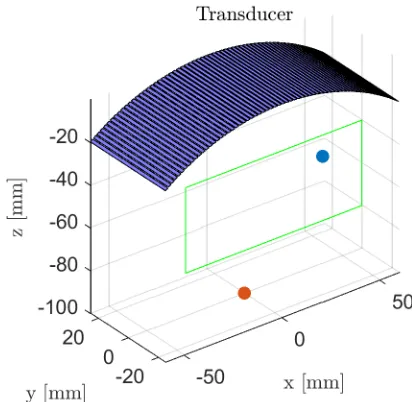
A prostate HIFU array [17] was simulated in Field II [18]. The concave array consists of 64 elements, 50 mm in height and 1.5 mm in width. The array elements are distributed on an arc with a radius of 100 mm. The natural focus of the transducer is at 0 mm laterally and -100 mm axially. The excitation for the array is a 1 MHz continuous wave, and delays were applied to focus the beam at -40 mm laterally and 50 mm axially. To reduce simulation time, only part of the field of view was simulated. Figure 1 depicts the transducer, its focal points and the simulation area.
the effects of any non-linear propagation. The peak pressure was 1.5 MPa. This impulse response was input into field II to improve modelling accuracy.
Four different excitation schemes are considered; analog, bipolar, third harmonic reduction (3HR) and HRPWM. Analog is defined as
a(t) = sin(2πf t) (1) wheref is 1 MHz. The bipolar excitation is formed by finding the sign of the analog excitation:
b(t) = sgn{sin(2πf t)} (2) Third harmonic reduction is defined as
c(t) =
1, for sin(7π/6)< a(t)≥sin(π/6) 0, for sin(7π/6)≤a(t)≥sin(π/6)
−1, for sin(7π/6)≥a(t)<sin(π/6)
(3)
HRPWM comprises multiple DSP stages and is difficult to represent analytically. Fundamentally, it involves modulating PWM switching angles in a manner that modulates the de-sired amplitude of the fundamental component of the signal without effecting the amplitude of undesired harmonics. The waveforms may be truly arbitrary in frequency and amplitude. Under the area of each element exists a piece of skull that varies randomly between 12 and 14 dB in attenuation. Here, attempts are made to adjust the power to minimise the effects of the attenuation and maximise energy at the focal point as is the case with transcranial therapy. When focusing ultrasound through the rib cage however, the opposite may be desirable; acoustic power is adjusted to reduce heating in the highly absorbing ribs. Either way, it will be demonstrated that amplitude control is an essential requirement for an HIFU system.
For analog excitation, the amplitude is adjusted for each element exactly. In a switched excitation phased array system however, the rail voltage can only be adjusted for the whole array and not for each element. Since both the bipolar and 3HR schemes have no inherent amplitude modulation capability, the rail voltage is set to the mean of the analog amplitude coefficients. For HRPWM, which can modulate amplitude, the rail voltage is set to the maximum amplitude coefficient. Figure 2 shows an example of each waveform. For the bipolar and 3HR waveforms, the rail voltage is the same as the average analog amplitude coefficient. For HRPWM however, the rail voltage exceeds the peak of the analog waveform as to accommodate the higher amplitude coefficient of another element. To retain the equivalent amplitude, the pulse width has been adjusted automatically. The voltage has arbitrary units because the density of the medium is not taken into consideration.
[image:3.612.320.526.85.286.2]III. RESULTS ANDDISCUSSION
Figure 3 shows the beam profiles for all the excitations. To create a beam profile, the maximum amplitude is obtained at each point then the absolute signal maximum is used as a reference to convert the image into power. Each excitation and image uses its own unique reference. The resulting images are
Fig. 1: An axonometric view of transducer geometry. The transducer has 64 elements and has a geometric focus at 100 mm which is indicated by the red dot. During simulations delays are applied to each element to steer the beam to the focal point which the blue dot represents. To reduce simulation time, only the area bounded by the green rectangle is simulated.
[image:3.612.312.542.432.640.2]thresholded at -20 dB. All excitation schemes correctly focus the beam to a small point. For the analogue excitation, there is little energy outside of the focal spot. For bipolar excitation, harmonics form a grating lobe of approximately -12 dB in addition to other large deposits of energy away from the focal point. Both 3HR excitations and HRPWM reduce the density of this energy, with HRPWM performing best.
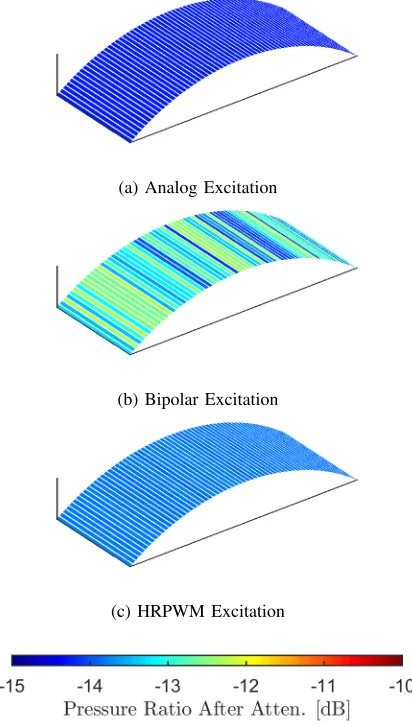
Figure 4 shows acoustic pressure after the sound has propa-gated through the skull. Only three of the four excitations are shown because bipolar and 3HR have no amplitude modulation capabilities, and so produce similar results. Since arbitrary units have been used in simulation, the results in this figure are presented as in decibels, with the RMS pressure of the maximum analog excitation being used as a reference. When analog excitation is used the pressure field exhibits an even attenuation of approximately 14 dB, irrespective of attenua-tion. This is the expected behaviour because the amplitude of the analog excitations for each element can be precisely controlled. For the bipolar and 3HR excitations, the rail voltage was set to the mean to reduce the variance in acoustic pressure as much as possible. Despite this, the pressure varies between 12 and 14 dB compared with the reference. When HRPWM excitation is used the variation is approximately 0.1 dB and nominally 13.5 dB.
The results show that overall analog excitation performs best in both amplitude control and harmonic control which was expected. The bipolar excitation is the worst performing as it is unable to perform any amplitude control and because of its high harmonic distortion, grating lobes and other deposits of energy exist outside the focal spot. Both 3HR and HRPWM schemes were able to reduce, but not completely remove the grating lobe, with HRPWM performing best. Whilst 3HR excitation was able to reduce the grating lobe, it was unable to compensate for variations in skull absorption leading to a large variance in acoustic pressure and so subsequently increased the size of the focal region. HRPWM was able to reduce the switching-induced grating lobes whilst retaining amplitude control.
IV. CONCLUSION
The desire to dynamically change the focal point is one factor that has led to the adoption of phased array trans-ducers in therapeutic ultrasound. Another motivator unique to transcranial therapy is compensation of localised attenuation in the skull. Either way, the number of driving elements in therapeutic array systems continue to increase. These systems use large, costly and inefficient class A amplifiers to generate the desired acoustic power. This culminates in systems that are costly and unwieldy in size.
Switched excitation could be used to resolve the cost and size implications of class A amplifiers. In this paper, a typical HIFU array was simulated with a variety of different excitation techniques. A skull with an attenuation that varies under each element was also simulated. Where possible, the attenuation was compensated for to reduce pressure variance. The beam
(a) Analog Excitations
(b) Bipolar Excitation
(c) 3HR Excitation
[image:4.612.327.540.86.645.2](d) HRPWM Excitation
(a) Analog Excitation
(b) Bipolar Excitation
[image:5.612.76.282.64.427.2](c) HRPWM Excitation
Fig. 4: Pressure field following subtraction of hard tissue attenuation for analog, bipolar and HRPWM excitations. The maximum pre-attenuation pressure from analog excitation is used as a reference. Even colour distribution shows good am-plitude control and inconsistent colour shows poor amam-plitude control.
was focused to a point and the results pressure fields were mea-sured. It was found that the bipolar excitation’s high harmonic content amassed as fields of energy away from the focal spot. It was also found that the the variance in the pressure after propagation through the skull was great. 3HR excitation was able to reduce the harmonic induced grating lobes, however pressure variance remained unsatisfactory. HRPWM excitation further reduced the grating lobes and was able to to reduce pressure variance to a satisfactory level.
It was found that some form of sophisticated switching scheme is required to miniaturise HIFU circuitry. HRPWM is a viable alternative to costly, inefficient and expansive class A amplifiers normally used in phased array therapeutic ultrasound. Further work should be conducted to observe the beam profile experimentally, particularly with transcranial therapy where the arrays are large and the geometry lends
itself to the production of harmful grating lobes. REFERENCES
[1] D. Bianchini, F. Marcocci, E. Menghi, V. D’Errico, E. Mezzenga, and A. Sarnelli, “Treatment plan verification in MRgFUs for bone metastasis pain palliation,”Physica Medica: European Journal of Medical Physics, vol. 32, p. 248, 2016.
[2] K. D. Evans, B. Weiss, and M. Knopp, “High-intensity focused ultra-sound (HIFU) for specific therapeutic treatments: a literature review,” Journal of Diagnostic Medical Sonography, vol. 23, no. 6, pp. 319– 327, 2007.
[3] G. Ter Haar, “Therapeutic applications of ultrasound,” Progress in biophysics and molecular biology, vol. 93, no. 1, pp. 111–129, 2007. [4] J. Blackmore, M. Veldsman, C. Butler, and R. Cleveland, “Focusing
ultrasound through the skull for neuromodulation,”The Journal of the Acoustical Society of America, vol. 141, no. 5, pp. 3549–3549, 2017. [5] C. Adams, J. R. McLaughlan, L. Nie, D. Cowell, T. Carpenter, and
S. Freear, “Excitation of leaky lamb waves in cranial bone using a phased array transducer in a concave therapeutic configuration,”The Journal of the Acoustical Society of America, 2017.
[6] M. Pernot, J.-F. Aubry, M. Tanter, A.-L. Boch, F. Marquet, M. Kujas, D. Seilhean, and M. Fink, “In vivo transcranial brain surgery with an ultrasonic time reversal mirror,”Journal of neurosurgery, vol. 106, no. 6, pp. 1061–1066, 2007.
[7] M. Pernot, J.-F. Aubry, M. Tanter, J.-L. Thomas, and M. Fink, “High power transcranial beam steering for ultrasonic brain therapy,”Physics in medicine and biology, vol. 48, no. 16, p. 2577, 2003.
[8] M. M. El-Desouki and K. Hynynen, “Driving circuitry for focused ultrasound noninvasive surgery and drug delivery applications,”Sensors, vol. 11, no. 1, pp. 539–556, 2011.
[9] R. Seip, W. Chen, J. Tavakkoli, L. Frizzell, and N. Sanghvi, “High-intensity focused ultrasound (HIFU) phased arrays: Recent developments in transrectal transducers and driving electronics design,” in Proc. 3rd
Int. Symp. on Therapeutic Ultrasound, 2003, pp. 423–428.
[10] C. Christoffersen, W. Wong, S. Pichardo, G. Togtema, and L. Curiel, “Class-de ultrasound transducer driver for HIFU therapy,”IEEE trans-actions on biomedical circuits and systems, vol. 10, no. 2, pp. 375–382, 2016.
[11] S. C. Tang and G. T. Clement, “A harmonic cancellation technique for an ultrasound transducer excited by a switched-mode power converter,” in Ultrasonics Symposium, 2008. IUS 2008. IEEE. IEEE, 2008, pp. 2076–2079.
[12] P. R. Smith, D. M. Cowell, and S. Freear, “Width-modulated square-wave pulses for ultrasound applications,”IEEE transactions on ultrason-ics, ferroelectrultrason-ics, and frequency control, vol. 60, no. 11, pp. 2244–2256, 2013.
[13] D. M. Cowell, P. R. Smith, and S. Freear, “Phase-inversion-based selec-tive harmonic elimination (PI-SHE) in multi-level switched-mode tone-and frequency-modulated excitation,”IEEE transactions on ultrasonics, ferroelectrics, and frequency control, vol. 60, no. 6, pp. 1084–1097, 2013.
[14] D. Cowell, T. Carpenter, P. Smith, C. Adams, S. Harput, and S. Freear, “Performance of switched mode arbitrary excitation using harmonic reduction pulse width modulation (HRPWM) in array imaging appli-cations,” in Ultrasonics Symposium (IUS), 2016 IEEE International. IEEE, 2016, pp. 1–4.
[15] S. Harput, M. Arif, J. McLaughlan, D. J. Cowell, and S. Freear, “The effect of amplitude modulation on subharmonic imaging with chirp excitation,”IEEE transactions on ultrasonics, ferroelectrics, and frequency control, vol. 60, no. 12, pp. 2532–2544, 2013.
[16] C. Adams, S. Harput, D. Cowell, T. M. Carpenter, D. M. Charutz, and S. Freear, “An adaptive array excitation scheme for the unidirectional enhancement of guided waves,”IEEE transactions on ultrasonics, fer-roelectrics, and frequency control, vol. 64, no. 2, pp. 441–451, 2017. [17] E. S. Ebbini, H. Yao, and A. Shrestha, “Dual-mode ultrasound phased
arrays for image-guided surgery,” Ultrasonic Imaging, vol. 28, no. 2, pp. 65–82, 2006, pMID: 17094688.
[18] J. A. Jensen, “Field: A program for simulating ultrasound systems,” in 10TH NORDICBALTIC CONFERENCE ON BIOMEDICAL IMAGING, VOL. 4, SUPPLEMENT 1, PART 1: 351–353. Citeseer, 1996. [19] J. Civale, R. Clarke, I. Rivens, and G. Ter Haar, “The use of a segmented