by
Heather Percey (BA, BSSc (Hons)(Psych))
Submitted in fulfilment of the requirements for the degree of
Doctor of Philosophy
Department of Rural Health
University of Tasmania
i I hereby declare that this thesis is my own work and contains no material which has been accepted for a degree or diploma by the University or any other institution, except by way of background information and duly acknowledged in the thesis, and to the best of my knowledge and belief no material previously published or written by another person except where due acknowledgement is made in the text of the thesis, nor does the thesis contain any material that infringes copyright.
Signed:
Heather Joy Percey
Date: 15th October 2013
This thesis may be made available for loan and limited copying and communication in
accordance with the Copyright Act 1968.
Signed:
ii
The research associated with this thesis abides by the international and Australian codes on
human and animal experimentation, as approved by the joint University of Tasmania and
State Government Department of Health and Human Services, Human Research Ethics
Committee (Tasmania) Network – Social Sciences, Ethics Reference No. H8714.
Signed:
Community development (CD) has been demonstrated to effectively deliver sought-after benefits towards improved economic, social, physical and psychological wellbeing. CD in rural areas is thus an important response to the change pressures in rural communities. Millions of dollars are spent annually on rural community development (RCD) activities. Yet CD is complex with many interacting variables and these dynamic processes are particularly visible in rural communities. RCD can have unintended (positive and negative) consequences upon the interwoven dynamics of the fabric of rural communities, independent of whether or not project objectives are achieved. A greater theoretical understanding of these processes is needed to better manage RCD outcomes and side effects. Such theoretical understanding is currently lacking in CD literature.
The purpose of this study was to use a grounded theory approach to generate a theoretical understanding of how RCD implementation processes interact with and affect the fabric of a community. Open interviews with twenty participants across three different RCD projects and rural sites were the key data source, contextualised by observation and written documentation.
Based on differing aetiologies, the study identified three types of community associated with and including the rural community: feature, interest and cause based. It was found that a multiplicity of these communities acted as constituents of each rural community, being part of, yet separate to the rural community. In coexisting, they were constituted by and subject to boundary processes. Literature describes such boundary processes in terms of differentiation and symbolic expression. This study identified additional processes of agendas, alignment and non-alignment.
of community ownership and support were also distinct processes with different roles in RCD. How all these processes were managed affected both the rural community fabric and the success of projects.
Completing this thesis has been a long journey which has not been traversed alone.
It has been a privilege to have the supervision of Dr Peter Orpin throughout the entire journey, challenging and encouraging me along the way. There has also been the guidance of supervisors, Associate Professor Rosalind Bull in the early stages of my candidate, Dr Christine Stirling at the beginning of my write-up, and Dr Tony Barnett as the thesis chapters took shape.
This research would not have been possible without the time willingly and generously given by the rural community members who participated.
Contents
Chapter 1: Introduction – Research orientation and motivation
1: 1. RESEARCH BACKGROUND AND PROBLEM ... 2
1: 2. RESEARCH BOUNDS AND DIRECTION ... 6
1: 3. THESIS STRUCTURE ... 8
1: 4. CONCLUSION ... 10
Chapter 2: Impetus Behind Rural Community Development Research
2: 1. WHAT IS RURAL COMMUNITY DEVELOPMENT? ... 112: 2. BENEFITS OF RURAL COMMUNITY DEVELOPMENT ... 16
2: 3. RENEWED FOCI ON RURAL COMMUNITY DEVELOPMENT ... 18
2:3.1 THE AUSTRALIAN RURAL CONTEXT ... 18
2:3.2 RENEWED FOCUS ... 21
2: 4. CONCLUSION ... 23
Chapter 3: Theory and Rural Community Development
3: 1. CONCEPTUALISING COMMUNITY ... 253:1.1 BRIEF HISTORY AND ORIENTATION ... 26
3:1.2 COMMUNITY AND IDENTITY ... 31
3:1.3 COMMUNITY BOUNDARIES ... 34
3:1.4 COMMUNITY AS RELATIONAL PROCESSES... 37
3: 2. CONCEPTUALISING RURAL COMMUNITY... 38
3:2.1 RURAL CLASSIFICATION: COMMUNITY BOUNDARY AND IDENTITY PROCESSES ... 39
3:2.2 RURAL AND NON-RURAL ... 41
3: 3. COMMUNITY DEVELOPMENT ... 45
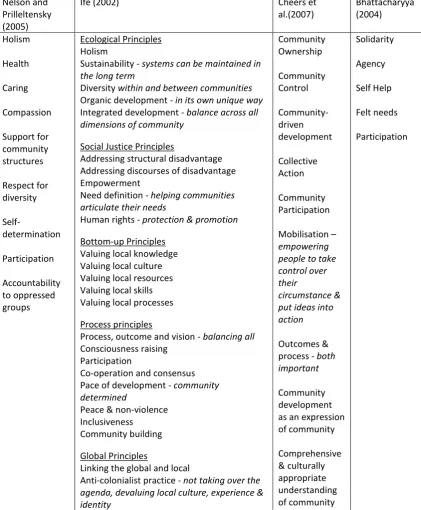
3:3.1 PRINCIPLES AND VALUES ... 46
3:3.2 THEORY AND COMMUNITY DEVELOPMENT ... 52
3: 4. RESEARCH OPPORTUNITY ... 62
3:4.1 RESEARCH INTEREST ... 66
Chapter 4: Research Strategy
4: 1. METHODOLOGY ... 684: 2. RESEARCH DESIGN... 74
4:2.1 INTERVIEW DESIGN ... 75
4:2.2 CONTEXTUAL DATA ... 76
4: 3. DATA COLLECTION... 77
4:3.2 RECRUITING PARTICIPANTS ... 78
4:3.3 IN THE FIELD ... 80
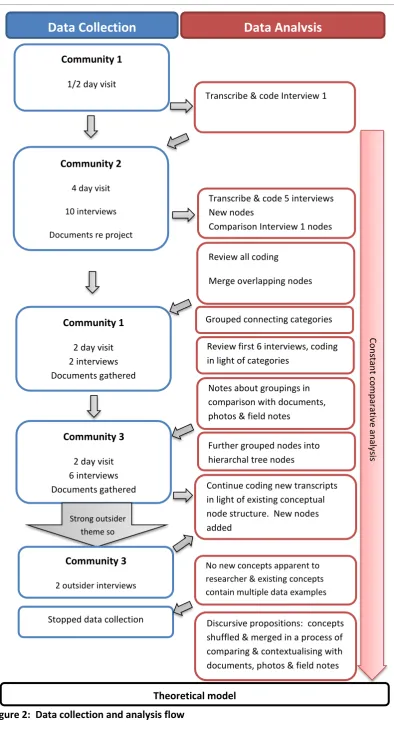
4: 4. DATA ANALYSIS ... 84
4: 5. DESIGN CONSTRAINTS ... 85
4: 6. PRESENTING THE FINDINGS ... 87
4:6.1 DEFINING TERMS ... 89
Rural community ... 89
Fabric of community ... 89
Collective identity ... 90
4: 7. CONCLUSION ... 90
Chapter 5: Community Processes in Rural Communities - Findings Part 1
5: 1. DESCRIBING COMMUNITY ... 925:1.1 GEOGRAPHICALLY DEFINED RURAL COMMUNITY ... 92
5:1.2 CONSTITUENT COMMUNITIES ... 98
5: 1.2.1 Feature-based communities ... 99
5: 1.2.2 Interest-based communities ... 110
5: 1.2.3 Communities of cause ... 111
5: 2. BOUNDARY PROCESSES WITHIN RURAL COMMUNITIES ... 117
5:2.1 SYMBOLIC EXPRESSION IN BOUNDARY PROCESSES ... 117
5: 2.1.1 Symbolic expression of rural community boundaries ... 117
5: 2.1.2 Symbolic expression of constituent community boundaries ... 120
5:2.2 AGENDAS AS BOUNDARY PROCESSES ... 123
5: 2.2.1 Forestry/agriculture and Green/alternative agendas ... 125
5: 2.2.2 ‘Progressive’ development and social values agendas ... 125
5: 2.2.3 Funding source agendas and the community voice ... 128
5:2.3 ALIGNMENTS IN BOUNDARY PROCESSES ... 129
5: 2.3.1 Individuals in constituent community alignments ... 130
5: 2.3.2 Multiple membership and alignment ... 131
5: 2.3.3 Formal community alignments ... 134
5: 2.3.4 Active non-alignment ... 135
5: 3. CONCLUSION ... 138
Chapter 6: Rural Community Development as a Constituent Cause Community -
Findings Part 2
6: 1. RCD AS A CONSTITUENT COMMUNITY ... 1396: 2. LEADERS AND CONSTITUENT COMMUNITIES ... 141
6: 3. BOUNDARY NEGOTIATION IN ESTABLISHING AN RCD COMMUNITY IDENTITY ... 149
6:3.1 EARLY ALIGNMENTS ... 150
6: 3.1.1 RCD and feature-based community boundary processes ... 152
6: 3.1.2 RCD and cause community boundary processes... 155
6:3.2 VALUES AND AGENDAS ... 156
6: 3.2.2 Team approach ... 158
6: 3.2.3 Maintaining a business-like approach ... 159
6: 3.2.4 Keeping broad community engagement for sustainability ... 159
6: 3.2.5 Mutual benefit ... 160
6: 3.2.6 Support the ‘common people’ ... 161
6: 3.2.7 Youth and leadership development ... 161
6:3.3 BOUNDARY CONSTRUCTION ... 162
6: 3.3.1 RCD community and rural community boundary ... 162
6: 3.3.2 RCD community and funder boundary ... 163
6:3.4 ONGOING BOUNDARIES PROCESSES WITHIN RCD CONSTITUENT COMMUNITIES ... 166
6: 3.4.1 With feature-based constituent communities ... 167
6: 3.4.2 With interest based constituent communities ... 170
6: 3.4.3 With other cause communities ... 171
6:3.5 SYMBOLIC EXPRESSIONS IN NEW RCD CONSTITUENT COMMUNITIES ... 171
6: 4. COMMUNITY OWNERSHIP ... 174
6:4.1 COMMUNITY OWNERSHIP PROCESSES ... 177
6: 5. COMMUNITY SUPPORT ... 181
6:5.1 COMMUNITY SUPPORT PROCESSES ... 183
6: 6. COMPARING OUTCOMES IN THE ESTABLISHMENT OF COMMUNITY IDENTITY, OWNERSHIP & SUPPORT ... 185
6: 7. CONCLUSION ... 191
Chapter 7: Community Process Modelling and Rural Community Development -
Discussion
7: 1. RURAL COMMUNITY AS PROCESS ... 1927:1.1 COMMUNITY DEFINED AND DEFINING ... 194
7:1.2 CONSTITUENT COMMUNITIES ... 200
7: 1.2.1 Feature-based communities ... 202
7: 1.2.2 Interest-based communities ... 206
7: 1.2.3 Communities of cause ... 207
7:1.3 COMMUNITY PROCESSES AND RURAL COMMUNITY DEVELOPMENT ... 210
7: 2. BOUNDARY PROCESSES OF CONSTITUENT COMMUNITIES ... 213
7:2.1 AGENDAS ... 215
7:2.2 ALIGNMENT ... 218
7:2.3 SYMBOLIC EXPRESSION ... 223
7: 3. RURAL COMMUNITY DEVELOPMENT BOUNDARY PROCESSES AND THE COMMUNITY FABRIC ... 227
7:3.1 COMMUNITY OWNERSHIP AND SUPPORT ... 230
7:3.2 ESTABLISHING A COLLECTIVE IDENTITY ... 236
7: 3.2.1 Values ... 236
7: 3.2.2 Early alignments ... 240
7:3.3 ONGOING BOUNDARY PROCESSES WITHIN RCD COMMUNITIES ... 247
7: 4. COMMUNITY DEVELOPMENT FRAMEWORKS AND RCD COMMUNITY PROCESS MODELLING. ... 251
Chapter 8: Conclusions
8: 1. IMPLICATIONS FOR RURAL COMMUNITY DEVELOPMENT PRACTICE ... 257
8:1.1 RURAL COMMUNITY AND RCD COMMUNITY BOUNDARY PROCESSES ... 258
8:1.2 RCD CAUSE COMMUNITY ESTABLISHMENT ... 261
8: 2. STRENGTHS AND LIMITATIONS ... 265
8:2.1 STRENGTHS AND LIMITS OF EXTRAPOLATION ... 265
8:2.2 THEORETICAL QUESTIONS FOR FURTHER RESEARCH ... 268
8: 3. CONCLUSION ... 270
References ... 272
Appendices
APPENDIX 1: INTERVIEW PROMPTS ... 288APPENDIX 2: SAMPLE INTRODUCTORY EMAIL FOR AGENCY CONTACT ... 289
APPENDIX 3: SAMPLE INTRODUCTORY EMAIL FOR POTENTIAL PARTICIPANTS ... 291
APPENDIX 4: SAMPLE INFORMATION SHEET ... 292
APPENDIX 5: SAMPLE CONSENT FORM ... 294
APPENDIX 6: ETHICS APPROVAL ... 295
x
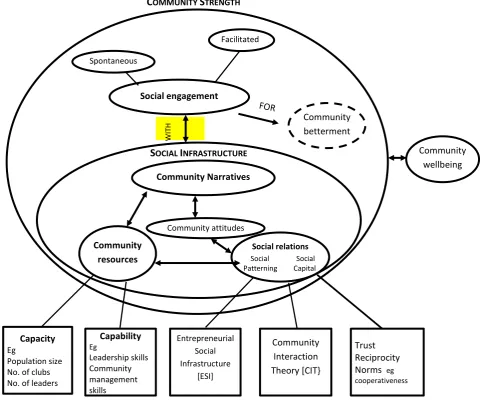
FIGURE 1: COMMUNITY STRENGTH ... 60
FIGURE 2: DATA COLLECTION AND ANALYSIS FLOW ……….… 83
FIGURE 3: RCD COMMUNITY PROCESSES MODEL ………..………. 228
TABLE 1: AUSTRALIAN POPULATION GROWTH PERCENTAGES FOR THE DECADE ENDING 2010 ... 199
TABLE 2: PRINCIPLES INFLUENCING COMMUNITY DEVELOPMENT ... 488
TABLE 3:RURAL COMMUNITY AS A PROCESS OF INTERSECTING COMMUNITIES ... 193
TABLE 4:COMMUNITY BOUNDARY PROCESSES ... 214
TABLE 5: RELATIONSHIP OF 'RCD COMMUNITY' VALUES & AGENDAS TO COMMUNITY DEVELOPMENT PRINCIPLES ... 238
Research orientation and motivation
This thesis explores the interaction of rural community development (RCD) implementation with the fabric of the rural community. It seeks to generate theoretical insights which can be used by those involved in RCD projects, to help navigate the complex dynamics of community. To this end, a grounded theory approach has been used to develop theory from the ground of people’s spoken experience of RCD projects.
This chapter provides an orientation to the thesis and establishes the motivation for the research. It briefly acknowledges the complexity of the field and introduces an example of how the fabric of community can be affected. The community fabric is comprised of the complex interwoven dynamics of the current and historical happenings, people and relational processes, and their interaction with and within the community space. The chapter highlights that the impact of RCD projects is not only associated with the targeted goals, but also affects the community fabric in ways that are often neither anticipated nor acknowledged by funding administrators. Despite not
necessarily being accounted for, these effects can be strongly felt by community members. Current literature relevant to RCD outlines the dynamic and relational nature of community and the role of meaning, identity and boundaries. The interaction of RCD processes and these community
1: 1. Research Background and Problem
RCD involves the implementation of community development activities within the rural context, where community processes are highly visible. Community development is widely used, affecting many people, yet it is also a complex arena of diverse disciplines, theory and practice,
interconnecting within the experience of community. These multiple sources of complexity mean that the process of achieving the purposive change of project tasks and goals, creates crescive changes or ‘side effects’ upon the community fabric as this process interacts with community processes. Managing these unintended consequences requires an understanding of these interactions.
Community development has been demonstrated to effectively create positive change in responding to rural and regional development needs. For these reasons and from a social justice perspective, it is considered a best practice approach within government policy and planning and by practitioners and academics alike. RCD particularly increased in popularity in the last two decades as a response to managing the specific pressures of the changing rural environment. Every year millions of dollars are spent through government and non-government services using community development to improve health, social, physical, psychological and economic well-being in rural communities around the world. Research in the field is thus important in its potential for broad reaching impact.
community development interplay with this complexity in the community fabric and such community processes are highly visible in the rural environment.
The community fabric includes the varying purposes and perspectives of participants and thus the agendas of funders, practitioners and community members. A quandary for the practitioner is that even when a project or program is seen as successfully achieving funded objectives, there can be an unintended and even negative experience and impact for participants. From the researcher’s personal experience of working in the field of RCD, it was apparent that there can be both positive and negative unintended impacts on the fabric of the community. For example, a project aiming to increase access to and understanding of Information Technology (IT) was embraced locally and the project setting became not only a learning space but a social space. The sharing of home grown produce together with people dropping by for ‘a chat’ became part of the interaction within the informal learning space. Strong local ownership led to high volunteer support and actions that instigated a range of IT activities based on community interest and locally expressed needs. The project’s social aspect was significant in reducing social isolation while at the same time increasing engagement in learning activities. Thus, although the social activity was not intended within the funding goals, the high level of community ownership and support meant that the contractual targets were met, if not exceeded.
However, over a five year period the focus of the funder administration shifted from
self-sustainability where community ownership and self-direction were encouraged, to a more narrow focus on training, with greater ‘top-down’ direction. The ‘bottom-up’ development of self-sustaining and broad ranging IT activities in response to community interest that initially underpinned the project, was now discouraged.
and detailing how community learning was to be done. Project reporting presented the number of courses and people receiving training, and the project continued to be considered a success in attaining contractual goals. Despite this apparent success, the impact on the community fabric also included conflict and tensions, a sense of disempowerment and reduced opportunity to address social isolation for some sections of the community. The impact of the dynamics behind the project was as important to the rural community members as were the learning outcomes in the project goals. However, this was not acknowledged by representatives of the funding source. Instead the community voice appeared to be viewed as dissention. It may have been possible to prevent isolating some sections of the rural community by understanding and managing these processes around project activities. These observations led to the researcher’s desire to better understand how the processes of implementing an RCD project or program affect the fabric of a rural community.
RCD clearly involves not only implementing activities and achieving contractual goals, but
simultaneously more widely affects the community fabric. Research exploring this interaction can shed light on these community processes. As de Berry (1999) indicated, relationships between non-government organisations and community based organisations have the potential to alter the balance of influence within a community, and community dynamics can in turn affect the process of community development. It is similarly conceivable that as identified in the researcher’s experience, other processes behind the implementation of RCD have the potential to affect the fabric of the community. To manage these influences positively, there is a need for theoretical understanding that directly addresses the nature of the interaction between RCD implementation and community processes.
dynamic experience of ever changing interwoven relationships, simultaneously affected by and interacting with the context in which they exist. Place based communities such as rural
communities, are not viewed as static entities. Community has been described as being constructed and reconstructed in an ongoing manner as people engage with others and attribute themselves and others to belong to varying forms of community. In this manner community can be understood as a relational process.
People engage in a multiplicity of communities at any one time, finding meaning, and gaining and expressing identity. The community fabric thus involves the interaction of multiple identities and their accompanying meanings. Meaning, identity and community are interconnected processes involving fluidity of construct, with each changing and shaping the other. This includes people identifying differences which then distinguish one community from another. These processes of differentiation mark the boundaries of the varying communities. Meaning and identity are associated with, and attributed to, these boundaries. The characteristics identified as marking a boundary also change in response to the purpose of distinction. As such, boundaries are dynamic and fluid both in where they are positioned and in the interconnection with meaning and identity. RCD implementation occurs amidst the interwoven dynamics of multiple communities and the associated meanings, identities and boundaries.
strength as part of the community fabric of rural communities, defined as the integrating function of community that exists not in the action of individuals, but in the capacity of communities to act as a cohesive identity (Cheers, et al., 2003).
Understanding how community strength is developed has implications for RCD policy and practice. However to achieve this, there needs to be an understanding of the processes happening on the ground. That is, looking beyond the purposive change associated with project targets to understand what occurs within the fabric of community. Because RCD strategies to improve community well-being engage with the social infrastructure of community, it is important to understand its broader effect. Theory directly related to the interaction of RCD implementation with rural community processes remains undeveloped. In particular, the question of how RCD implementation affects the community boundary and identity processes is not directly addressed. Such understanding could inform, for example, how a strong community fabric is protected or maintained during RCD projects.
1: 2. Research Bounds and Direction
The preceding quandary of side effects of successful RCD projects, research problem and nature of community set the bounds and direction of the research. The bounds provide the parameters within which the research takes place in the aim to contribute to theory regarding how RCD
implementation processes interact with and affect the community fabric.
As community is such a multifaceted concept and experience, research in the field needs to be founded in a sophisticated conceptualisation of community. Within the current study, ‘rural community’ is conceived as a dynamic and complex relational process within the context of a
geographic space, which is intersected by multiple forms of community. This includes the associated fluid meanings, identities and boundaries interwoven in the experience of communities.
processes are found in more than one environment and in more than one moment in time, there is potential for the extrapolation of these processes to other RCD environments and the construction of theory.
The array of disciplines involved in RCD, compels the researcher to utilise a multidisciplinary approach. For the research to be most accessible to RCD practitioners means drawing from knowledge across a variety of disciplines, and presenting the material in a manner that can be applied across varying approaches.
RCD practice is inherently value driven. In seeking to understand the impact of RCD upon
community processes, it is important to observe what is happening and not be distracted by what ‘should’ be happening as defined by an ideological expectation. Theory developed from the ground in this way, has the potential to be applied within a range of practices, underpinned by varying ideological and disciplinary perspectives.
In view of the research problem, this study is not about the funded objectives of RCD projects, but the dynamic interaction between project implementation processes and rural community processes. These processes potentially shape the course of project implementation and affect individuals and the fabric of the community, as individual and collective identity and meaning are shaped by the interaction.
RCD projects are the natural starting point for data collection, however although each project might be considered a case, the research does not use a case study methodology. While the broad contextual data of a particular case may further elucidate community dynamics, the interactive processes are the focus of inquiry, not individual cases. The experiences of RCD participants have been attained through the qualitative method of community members telling their stories in open interviews. Participants were chosen through theoretical sampling, by identifying people who are involved with RCD projects, and could thus “contribute to the evolving theory” (Cresswell, 1998, p. 118). Three different rural communities provided the setting for interviews, accessed through current RCD projects. Two projects had an economic orientation and the third related to social wellbeing. One was in rural eastern Victoria and two were from rural areas in southern and western Tasmania.
1: 3. Thesis Structure
The role of Chapter 2 is to provide the context by firstly defining how RCD is understood both in the literature and for the research, and then providing an understanding of the changing rural
environment which indicates the importance and context of RCD. It describes the capacity for community development to create positive change, the pressures experienced in rural communities and the resultant wide-ranging use of varying community development approaches in addressing development needs within rural communities. The chapter highlights: the significance of RCD in achieving well-being of and within communities; the breadth and complexity of the field; the challenges experienced in implementing projects; and the related importance of doing RCD research.
Chapter Three, focuses on theory relevant to the research. It first explores conceptualisations of community, rural community, and rural community development. From this review of the literature, community is concluded to be an ongoing relational process involving meaning, identity and
The visibility of community processes within small geographically separate communities is highlighted as an important consideration in contrasting rural and urban communities as sites for community research. Community development theory is explored and then considered in light of the effect of RCD upon and its interaction with community processes of the rural (place based) community fabric. The chapter closes with the questions of interest which guide the research.
The research strategy for the study is covered in Chapter Four. A discussion of the methodology explains the naturalistic inquiry and grounded theory approach taken in the research. The design of the research is presented and the data collection and analysis processes are detailed. The manner in which the data is managed in its presentation in the thesis is also described, along with definitions of key terms accepted in the thesis.
Chapters Five and Six are the Findings chapters where an analysis of the qualitative data from the interview transcripts is presented. Chapter Five recounts participants’ understanding of community, distinguishing varying community types, and identifying the community processes involved within the fabric of the rural communities of the participating projects. Chapter Six details the community boundary processes as they interact with RCD project implementation.
A discussion of the findings in light of existing research is presented in Chapter Seven. It outlines theory drawn from the data, modelling community processes regarding the interaction of RCD with the rural community processes. The proposed community processes model covers: rural
community as a process; the boundary processes involved; and how these relate to the effect of RCD in its interaction with the community fabric. The model is discussed in light of existing community development frameworks, and consideration given to where the model and existing frameworks interconnect.
The final chapter summarises the thesis with a discussion concerning the implications of the
the related extent to which the findings can be extrapolated beyond the rural community context are considered. Suggestions for further research are made.
1: 4. Conclusion
Rural community development scope and the rural context
The potential impact, complex nature and scope of rural community development (RCD), provide the backdrop for a renewed interest in RCD. Over the past decade, this interest has been evident within research and in all levels of government. This chapter discusses the impetus behind the current study, and examines why RCD is of growing importance. Beginning with a broad definition of RCD, the chapter clarifies the activities and approaches that are included under the banner of RCD and acknowledges the breadth and complexity of a field of endeavour full of interwoven dynamics and relationships. The chapter briefly reviews the capacity of community development to positively impact rural communities across a range of human concerns and then considers the current context of Australian rural communities which both contributes to a renewed interest in RCD and establishes some of the dynamics of the settings for RCD projects.
2: 1. What is Rural Community Development?
CD and RCD practice and research have considerable breadth. Any brief exploration of the terms will identify literature across a wide range of fields including policy development (rural and social), business and community partnerships, child welfare, community psychology, regional analysis, nursing, welfare services, social work, sociology, anthropology, arts, environment, rural and remote health, health education, applied psychology, vocational education, community development and paediatrics, to name a few. These fields of CD practice are found internationally and relate to developed and developing countries and cultures.
CD is complex, not just in the varying theoretical and practice perspectives from a range of
disciplines, orientations, activities and cultures, but also in the multiplicity of relationships involved within the community to which these perspectives are brought. The significance and complexity of relationships in community based work is apparent throughout CD literature. Casswell (2001, p. 23) describes community as “the site of the mediating structures that intervene between the domain of everyday life of individuals and the larger social, political and economic context”. More specifically addressing RCD, Cavaye (2001) acknowledges that
rural community development occurs within a complex interrelated ‘system’ of communities,
sub-communities, individuals, external agencies and internal organisation. Each entity
makes decisions and takes action under the influence of each other through a dynamic set of
relationships. (p. 115)
paradoxes. Because it is driven by politics and passion, and because it brings together values,
principles and practices . . .”.
Research in the area of RCD brings the challenge of finding a path through these interrelated
dynamics and multiple influences within the community fabric. This fabric is the dynamic product of interacting social dynamics, personalities, history, geography, and economic and social resources (Cheers & Luloff, 2001). RCD plays out an intricate dance influencing and influenced by the fabric of the community. In the same way that RCD cannot be separated from the history and social
dynamics of a community, rural community research needs to consider the community fabric. The current study focuses on this interaction between RCD activities and community fabric.
A wide range of activities fall under the banner of CD. A useful way to understand them is through a summary of what has varyingly been described as CD forms (Cheers, 1998; Cheers & Luloff, 2001), activity types (McArdle, 1999) or methods (Bhattacharyya, 2004). These include:
those focusing on the gathering, maintenance or provision of information;
those addressing power relations such as advocacy through one-to-one activities or seeking legislative change;
those with a networking orientation, building linkages between individuals and sectors; participation based activities, seeking involvement, planning and decision-making by all stakeholders;
capacity building activities such as awareness raising, self help, service provision, resource provision and a sense of ownership of community action to sustain CD capacity
(Cheers, 1998; Cheers & Luloff, 2001; McArdle, 1999). These activities are found within a range of projects such as social enterprises, leadership programs, infrastructure provision and skills
In implementing these activities the literature describes a range of stages and models. Kaufman (1959) first developed the concept of phases of community action as part of an interactional approach to community, which is further detailed by Wilkinson (1970; Taylor, Wilkinson and Cheers 2008). This details that CD moves through five phases, beginning with awareness (a rise in interest of a need and solution), moving to organisation of sponsorship and co-ordination of control over the action, followed by decision making to set the goals and strategies for their achievement), then resource mobilisation (gaining participation and resources) and finishing with resource application through implementing the activities. There are many other models that map the steps of doing community development. For example, Taylor, et al (2008) outline four other frameworks, including: ‘participative development’ covering ‘what’, ‘who’ and ‘how’, which is based on the empirical study of successes and failures of two decades of United Nations projects; ‘building capable communities’, an empowerment framework detailing the need to build capacity through the nine domains of participation, leadership, organisational structures, problem assessment, resource mobilisation, ‘asking why?’, linking with others, outside agents and program management; the ‘building collective capacity’ framework developed from an action research project which focuses on the four stages of identifying common ground, working cooperatively, working in partnership and working across the community; and Assets-Based Community Development (ABCD) which is a strengths based framework, which focuses on community engagement, community asset assessment, and using strengths to create action.
In a review of community projects, Taylor, et al (2008) identify four conceptual approaches: a contributions approach where professional developers engage voluntary community participation in a predetermined project; an instrumental approach where professionals lead community
engages “as an interactive, evolutionary process, embedded in a community” (Taylor, et al., 2008, p. 88).
In sociological literature on community development, a distinction has been made between the development in community and the development of community. Development in community focuses on community as a system of social processes and thus well-being can be improved through improved services or economic growth (Kaufman, 1959; Summers, 1986). Development of
community is based on the idea that being an active part of community is a causal factor in personal well-being and accordingly development is about building communication and co-operation amongst local groups (Summers, 1986; Wilkinson 1979). The two approaches are not necessarily exclusive in that through achieving development in a place-based community, the development of community may result (Summers, 1986).
Such a range of activities and perspectives leads to questions regarding what attributes these have in common as CD. Based on the four conceptual approaches identified above, it might be argued that only those falling within the bounds of a developmental approach are true CD, while the rest are other forms of community work. However, there are other perspectives on what constitutes CD. Bhattacharyya (2004, p. 14) notes that “to be called community development, the activity must be animated by the pursuit of solidarity and agency, by adhering to the principles of self-help, felt needs
and participation”, where solidarity means “a shared identity (derived from place, ideology, or interest) and a code for conduct or norms, both deep enough that a rupture affects the members
emotionally and other ways”. Bhattacharyya (2004, p. 5) further argues that “the purpose of community development should be seen as different both from its methods and the techniques to
implement the methods.”
what characterise CD (Blackshaw, 2010; Ife, 1995, 2002; Kenny, 2006). The current study encompasses projects underpinned by social justice values and from the preceding range of activities and conceptual approaches.
Therefore, RCD is varied and complex, not only in the variety of disciplines, orientations and
activities, but also in how RCD activities interact with the community fabric. Research in the area of RCD processes needs to be relevant across these variances, and cannot ignore the context and processes of the rural community.
2: 2. Benefits of Rural Community Development
CD has significant potential to positively impact health, and social and economic wellbeing within rural communities. Particularly pertinent is research demonstrating a positive relationship between active community involvement in community projects and activities, and sought-after results
including economic growth, reduced unemployment, higher employment and income levels, and the successful resolution of social problems (Brawley, 1994; Casswell, 2001; Chalmers & Bramadat, 1996; Cheers, et al., 2002). These benefits are also associated with the physical and psychological health and well-being of a community (Chalmers & Bramadat, 1996; Nowell, Berkowitz, Deacon, & Foster-Fishman, 2006; Taylor, et al., 2008). Consequently, CD is considered by practitioners, academics and within government policy and planning, to be a best practice approach for responding to the development needs of rural communities and regions.
CD activities have advantages over purely economic development as they can deliver broader benefits for a community. The link between CD and increased economic benefit initially dominated RCD thinking as the purpose of development. Later, concepts of human and social capacity building, and social capital developed as a having a role in supporting and complementing economic
which provide economic gain for communities. Efforts focused on human capacity building have been shown to complement other developmental foci, as well as generate benefits comparable to the provision of infrastructure (Brawley, 1994). There is considerable literature demonstrating direct economic benefit from CD activities (Brawley, 1994; Casswell, 2001; Chalmers & Bramadat, 1996; Cheers, et al., 2002; Ife, 1995). Further, while studies indicate that CD is likely to stimulate economic growth, economic focused development is not as likely to stimulate social development (Cheers, et al., 2002; Cheers & Luloff, 2001; Harvey & Cheers, 2003). For these reasons, fostering CD is now considered best practise as a component of regional development, which historically was based on assumptions that economic development improves health and well-being within a region (Brawley, 1994; Cheers, et al., 2002; Garlick & Pryor, 2002b; Sorensen, et al., 2002).
In the past two decades the Australian government has typically associated CD with achieving specific development targets as well as economic growth, when determining funding for rural communities. The growing CD profession considers that the effects on social well-being which accompany the processes of CD, are as important as achieving the project targets (Dibden & Cheshire, 2005; Ife, 2002; Kenny, 2006). There is an understanding amongst CD practitioners and academics that social life needs to be recognised in its own right within the process and planning of development. Improved quality of peoples’ lives due to the CD process is emphasised as a
significant end in itself, not just as an adjunct to specific project targets.
In summary, CD approaches and activities are effective in creating positive change in rural
goals with the less tangible but equally significant social benefits of people engaging within a development process.
2: 3. Renewed Foci on Rural Community Development
Worldwide, RCD has been rising in significance over the past three decades. Since the 1980’s there has been increasing pressure on rural communities in Australia, United States of America (USA), Canada, New Zealand (NZ), United Kingdom (UK) and Europe including the reduction of health, financial and other services in rural areas (Barr, 2005; Brawley, 1994; Cheers & Hall, 1994; Cheers & O'Toole, 2001; Courvisanos, 2001; Desjardins, Halseth, Leblanc, & Ryser, 2002; Dibden & Cheshire, 2005; Falk, 2001; Kenny, 2006; Kenyon, Black, Cavaye, Duff, O'Meara, & Palmer, 2001; Lawrence & Hungerford, 1994; Sorensen, et al., 2002). The initial decline and the continued disadvantage in many rural areas resulted in a renewed focus by governments on RCD as a mechanism to build local sustainable capacity. In the past decade the pressures of change on rural areas have continued to build, challenging rural culture and the sense of rural community identity experienced by long term residents. These challenges mean that the concurrent renewed interest within community literature in the link between community and identity and emotional wellbeing (Cheers, et al., 2003) is
significant for RCD.
2: 3.1 The Australian rural context
properties, or diversification of economic activity with ventures such as tourism and boutique farming. Simultaneously, there was a depopulation of the small towns which previously supported the greater number of families on the surrounding land. Instead, a few regional centres experienced growth, servicing as the name suggests, the larger region. There was also an exodus of youth, particularly young women, seeking increased education, training and employment opportunities in either regional centres or cities (Barr, 2005; Cheers & Hall, 1994; Kenyon, et al., 2001; Stockdale, 2004). In Australia, these changes have been evidenced throughout the past century, with around 60% of the Australian population living in rural and regional areas at the beginning of the 20th century, compared to 30% in 2000 (Kenyon, et al., 2001) and 12% by 2011 (Australian Bureau of Statistics, 2012).
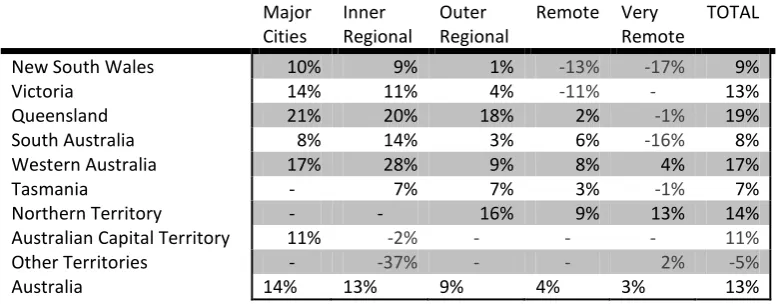
While, in the first decade of the new century there have been significant population increases in the major cities and overall, there is considerable variation at the state and territory level. There is a wide range in the percentage of the population living in outer regional and remote areas, from Victoria with less than 5% to 35% in Tasmania (Australian Bureau of Statistics, 2012). As summarised in Table 1, despite fluctuations in population growth, the overall trend for the last decade has been growth in regional areas, and stability or decline in remote and very remote areas throughout Australian states (Australian Bureau of Statistics, 2012).
Major Cities
Inner Regional
Outer Regional
Remote Very Remote
TOTAL
New South Wales 10% 9% 1% -13% -17% 9%
Victoria 14% 11% 4% -11% - 13%
Queensland 21% 20% 18% 2% -1% 19%
South Australia 8% 14% 3% 6% -16% 8% Western Australia 17% 28% 9% 8% 4% 17%
Tasmania - 7% 7% 3% -1% 7%
Northern Territory - - 16% 9% 13% 14% Australian Capital Territory 11% -2% - - - 11%
Other Territories - -37% - - 2% -5%
[image:30.595.93.483.553.705.2]Australia 14% 13% 9% 4% 3% 13%
Looking beneath the overall growth trends in population, there are mixed outcomes regarding socio-economic status (SES), with some areas considered advantaged and others disadvantaged. In rural towns and areas, those on the perimeter of peri-urban zones of large centres, are more likely to have experienced positive SES outcomes. However, overall there are more disadvantaged rural and remote towns and areas than there are advantaged (Baum, O-Connor, & Stimson, 2005).
The initial depopulation of regional and rural areas has slowed. In some areas there has been an influx of new residents due to a mining boom, however many of these are temporary and/or part-time, being fly-in/fly-out (FIFO) as they work for periods of time (eg a fortnight or month), then return home for a similar period. In others, there are new residents (often retired) who have moved from large metropolitan cities to embrace a change of lifestyle. Coined ‘sea change’ on coastal areas and ‘tree or hill change’ in inland areas, this phenomenon has affected change in the sense of community identity, particularly for long term residents as they adjust to new ideas, experiences and expectations of community life (Barr, 2005; Bourke, 2001b; Murphy, 2006). Sea/tree change in large non-metropolitan cities and towns has been associated with welfare and retirement drivers, while for smaller cities and towns it has been related to a broad range of lifestyle drivers. These smaller cities and towns, despite population growth, range in advantage and disadvantage, with sea/tree change and mining areas associated with positive SES outcomes. Conversely, in areas with a less diverse economic base, there are indicators of disadvantage (Baum, et al., 2005).
Rural communities have therefore experienced varied yet significant crescive change in the last three decades. From initial depopulation and economic pressures, some regions have more recently experienced population growth, while remote areas have either stabilised or declined. The
contributing to the impetus for RCD these issues of identity, and the economic and social conditions set the context and relational dynamics within which RCD occurs.
2: 3.2 Renewed focus
As a result of the economic and population changes occurring in rural communities, and arguably the influence of post-modern and neo-liberal thinking (Casswell, 2001; Courvisanos, 2001; Hudson, 2004; Liepins, 2000), RCD has greater importance internationally, nationally and locally. This is reflected in a renewed focus by governments on funding community initiatives, some through the structure of the countries’ government services, others through humanitarian organisations. By the late 1990’s in Australia, using CD approaches within rural development projects was an emergent response to rural down-turn (Dibden & Cheshire, 2005). The aim of such initiatives was to build community capacity in anticipation of it contributing to improved social and physical health within communities (Casswell, 2001; Cavaye, 2001; Cheers & O'Toole, 2001; Dibden & Cheshire, 2005; Kenny, 2006; Lennie & Hearn, 2003; Ritchie, Parry, Gnich, & Platt, 2004; Sorensen, et al., 2002).
As Hudson (2004, p. 253) succinctly states, “the language of community and community
development is heavily used in government discourse as a key policy initiative across the board…”. At a national level, the Australian Government budgets millions of dollars each year for community oriented programmes in rural areas (Anderson, Campbell, & Kelly, 2004; Dibden & Cheshire, 2005) For example, during the past decade in the 2003-04 financial year budget included, $61.8 million allocated for the Regional Partnership programme, $26.4 million towards the Sustainable Regions programme (Anderson & Tuckey, 2003), and $356.8 million over four years towards the Stronger Families and Communities Strategy programmes including Communities for Children and Local Answers (Anderson, et al., 2004). The stated approach and purpose for this funding “is to work in partnership with communities, government and the private sector to foster the development of
allocated over five years for Regional Development Australia to empower local community to develop local solutions (Australian Government, 2011b), and programs such as Communities for Children continue with expanded portfolios and districts and an extra $42.5 million over four years from July 2012 (this program covers rural and urban communities) (Australian Government, 2011a). Clearly the focus is on building community capacity (Dibden & Cheshire, 2005; Lennie & Hearn, 2003). Frequently the role of capacity building is given to the not-for-profit sector via tendered and contractual processes.
State governments in Australia also place significant emphasis on CD. This is apparent through the existence of departments such as the Department for Victorian Communities, Western Australia’s Department for Community Development, the Northern Territory’s Department for Community Development, Sport and Cultural Affairs, and South Australia’s Department for Families and Communities. In Tasmania, while there was no community development focused
department/ministry until 2006, the Tasmania Together state government initiative to provide a 20 year direction for Tasmania until 2020, has nine goals with 67 corresponding benchmarks directly relating to community (Tasmania Together Progress Board, 2005). There are also many community programmes for rural areas funded through departments such as the Department of Health and Human Services and the Department of Primary Industry, Water and Environment. Local governments throughout Australia also provide CD grants. Thus, across Australia there are thousands of not-for-profit non-government organisations receiving Australian, State and Local Government funding to develop, implement and run RCD programmes.
Community participation is associated with the provision of a sense of security, identity, purpose, and belonging (Bhattacharyya, 2004, Connell, 2002, Bauman, 2001, Burkett, 2001, Kenny, 2006) which also interconnect with members’ emotional, social and physical well-being. These aspects will be considered in more detail in the following chapter.
Over the past decade RCD has been subject to increasing attention across all levels of government, apparent in policy, the development of departments and the funding of projects and programs. This attention has resulted in funding RCD activity across the community sector. There has also been a renewed interest in the role of CD in identity and well-being.
2: 4. Conclusion
RCD is a complex field with varying perspectives, approaches and interacting variables. The significance of RCD is highlighted by the building change pressures in the rural context and the success of RCD in facilitating positive change. RCD has been demonstrated to effectively deliver sought-after benefits towards improved economic, social, physical and psychological wellbeing in communities. Therefore, RCD has become a popular approach in government and non-government arenas, across a range of nations seeking to address a wide range of needs. The considerable expenditure on CD activities by all levels of government and through the community sector, further accentuates the importance of the field.
processes needs to take into account the breadth of RCD and the complexity of relationships, all embedded in the community context. Further research will be useful not only for rural
Literature Review
In seeking to understand the impact of the dynamics of rural community development (RCD) implementation upon the community fabric, it is important to understand the current conceptual and theoretical perspectives influencing RCD. There is a long history of shifting understandings of the concepts, which have potential consequences for policy and ultimately communities’ members. Community theory provides insight into the form, functioning and key processes of rural
communities and thus establishes the foundations for the current study. The ideological underpinnings of community development (CD) and theory which directly address CD practice further provide a framework for comprehending the dynamics of RCD. Accordingly, the sections of this chapter cover:
Conceptualising Community with its changing and varying forms, and the inherent links with identity and boundaries as community unfolds as a relational process;
Conceptualising Rural Community in light of community as process, as well as the accentuated workings of community processes in the rural context;
Community and Rural Community Development as it is influenced and practiced, through ideological and theoretical frameworks; and establishes a
Research Opportunity, through summarising the case for a gap in theory regarding the interaction between community processes and RCD processes. This then sets the specific research question for the current study.
3: 1. Conceptualising Community
theoretical understandings of community are well documented (Bhattacharyya, 2004; Burkett, 2001; Cohen, 1989; Liepins, 2000; Montero, 2005; Shaw, 2008). Detailed reviews on the concept of community present a history of continued ambiguity and paradox (Barbesino, 1997). Given the renewed focus on community and CD activity, it is recognised across a range of disciplines that there is a need to better understand community (Cheers, et al., 2003; Cnaan, Milofsky, & Hunter, 2007; Connell, 2002). It has also been argued that the problem of an ontological understanding of
community be left to social science historians and instead, research should focus more pragmatically on its current plurality and use (Barbesino, 1997; Cohen, 1989; Plant, 1974). To this end, the
intention here is not to definitively address all the issues, but to provide the foundational
understanding of community for this research by highlighting key conceptualisations of community.
3: 1.1 Brief history and orientation
Blackshaw (2010) in his determination to offer conceptual precision to community, describes the pre-industrial community as “pre-modern community” and presents the case for it being the only ‘community’, in that it has a strong ontology in providing the foundation for human existence. Like the early writings on community he considers modern society and versions of community to have much weaker ontologies as while they contribute to identity, the structure and interactions do not define a person’s existence in full as they lack solid foundations, being always movable and
contestable. This perspective clearly highlights the role of community in identity and meaning, and indeed the role of identity in community which continue to be interwoven in community literature.
Defining the only ‘true’ community enters into a historical and philosophical debate. Blackshaw (2010) and Bauman (2008) argue that for conceptual precision, the term community should be used with critical forethought, not in contexts where alternative notions could be used. However, the present research proceeds from a more pragmatic understanding that the form of community may have changed, but ‘community’ continues to exist. These changing forms continue to involve the linking of people via commonalities and are inherently associated with identity.
place based community overlayed with this normative view of what community should ideally be, has maintained relevance due to the continued existence of both small place based communities and the coinciding individual needs of people that are met through engagement within these communities (Mannarini & Fedi, 2009).
Central to a normative understanding of community is the community experience of its members. This experience is associated with a sense of solidarity or belonging, and is connected to individual and collective identity. There is an anticipation of cohesion in how members engage with each other in the daily living activities within the space of the community. This is evident for example, in the description of a normative view as seeing community as
a structure within which people have a sense of solidarity – being in things together – and
this creates a sense of belonging to each other. This in turn results in positive affirmations
for people because of their membership of the community. (Taylor, et al., 2008, p. 30)
Normative expectations can be applied to place based community as well as other forms of community. For example, there has been research focused on community of place seeking to determine what should be, or what is ‘good’ community (Cheers, et al., 2003; Kenny, 2006). Similarly, although Hunter (2007) seeks to encompass the breadth and complexity of varying forms of community by conceptualising community as a “variable quality” rather than a “thing”, the position is still underpinned with normative assumptions. This is evident in then determining “the degree of communityness” of specific cases of community, based on the three dimensions of shared ecology, social organisation, and shared culture and symbolic meanings.
accommodate the variable conceptualisations of community, studying community as it is found, including but not founded on ideological orientations.
While community is frequently used in connection with the relational dynamics of people in a geographically bounded place, it has long been used functionally to encompass commonalities including demographic, psychological and social factors such as interests, age, economic status or gender, and particularly those aspects that engender a sense of connectedness and involve social relationship (Brawley, 1994; Burroughs & Eby, 1998; Casswell, 2001; Desjardins, et al., 2002; Dibden & Cheshire, 2005; Puddifoot, 1996). This descriptive perspective encompasses community in the varying forms in which it is perceived, and with less regard to spatial and temporal restrictions. It is also evident in community studies where the emphasis has involved consideration of power
relations, meanings informing identity and the symbolic nature in the experience and expression of community. Such research is founded in a phenomenological understanding of community, exploring and describing community as it is experienced by people (Blackshaw, 2010; de Berry, 1999).
A re-occurring topic throughout community studies literature is the concept of communities of interest. The generally accepted interpretation of community in this case is as a group of people with both an interest in common and social interaction of varying degrees in conjunction with the commonality (Blackshaw, 2010; Desjardins, et al., 2002; Kenny, 2006; Komaromi, 2003; Taylor, et al., 2008). The concept covers a broad range of pursuits across for example, recreational, political, spiritual or professional concerns and these are found within and across place based communities (Desjardins, et al., 2002; Kenny, 2006; Taylor, et al., 2008). Like the afore described
The concept of virtual communities is a phenomenon describing communication and social
networking of people via internet and mobile information technology. Due to the indirect nature of contact and interaction and that virtual communities are not constrained by proximity or place, there is debate regarding whether these are a different form of community or are better understood as social networks (Blackshaw & Fielding-Llyod, 2010). Although virtual communities are founded predominantly on weak ties, like communities of interest, they afford the opportunity for expressing identity and a sense of belonging (Blackshaw & Fielding-Llyod, 2010). Despite debate, the concept continues to be commonly utilised.
Contemporary Australian usages of community include both descriptive and normative perspectives. It is variously descriptive of social structure, social organisation and belonging, including the
manifestation of shared identity, a geographic locality, and as an administrative unit. There are also the normative value based perspectives of community in terms of ethical public good, as a symbol of civil society at work with shared values, meaning and activity (Cheers, et al., 2003; Dixon, 2003; Kenny, 2006). Research exploring how rural people understand their place based community has similarly found normative and descriptive understandings in participants’ dialogue, as well as a combination of the two (Cheers, et al., 2003).
Thus, community is not a homogeneous concept. The history of varying definitions, perspectives and ideological foundations, also influenced by different political paradigms (Brent, 1997; Shaw, 2008), often highlights what may be considered a weaknesses of imprecision in such diversity of interpretation. Yet it is also recognized that for CD, a conceptualisation of community needs to be sufficiently sophisticated to be able to accommodate the diversity and complexity of, within and between communities in their varying forms (Cheers, et al., 2003; Cnaan, et al., 2007; Connell, 2002; Kenny, 2006; Liepins, 2000). By acknowledging rather than ignoring the paradoxes and juggling both the state and process of community it is possible to strengthen the knowledge-base and
take up these challenges through recognising the complexity, variability and paradox of community, dealing with the normative and descriptive understandings and differing ideological positions as they interconnect with RCD processes. This is begun through drawing on common threads across these understandings. Recognisable within the perspectives reviewed is that community involves the grouping of people by self or others and that this is entwined with peoples’ individual and/or collective identity.
3: 1.2 Community and identity
Throughout the literature across the range of perspectives involved in community research, the connection with values, identity and meaning is either directly addressed or assumed. The interdependent nature of individual and collective identity in community processes and activity is explored through anthropology, psychology, sociology, community psychology, social work, and community development. Interest extends beyond academic disciplines, with for example, local governments seeking to understand the link between physical locality and identity (Puddifoot, 1996).
Farrar (2001) strongly present the enmeshment of community and identity in describing that It [community] draws its psychological strength from levels of motivation deeper than those
of mere volition or interest, and it achieves its fulfilment in a submergence of individual will
that is not possible in unions of mere convenience or rational assent. Community is fusion of
feeling and thought, of tradition and commitment, or membership and volition. It may be
found in, or given symbolic expression by, locality, religion, nation, race, occupation, or
crusade. (p. 4)
Likewise, Bhattacharyya (2004) argues for understanding community as solidarity, and defines this as a shared identity (derived form place, ideology, or interest) and a code for conduct or norms,
both deep enough that a rupture affects the members emotionally and other ways. (p. 14)
Both writers highlight the psychological investment of the individual in the collective experience.
Concordantly, community has been conceptualised as a repository for meaning and identity. Identity is expressed and symbolised in interactions, relationship, names, symbols and rituals (Brodsky & Marx, 2001; Cohen, 1989), which all create meaning. Further, members actively construct the community identity to give meaning to their experience (Colombo & Senatore, 2005; Hodgett & Royle, 2003; Kenny, 2006). In this manner, meaning, identity and community are interconnected processes involving fluidity of construct with each changing and shaping the others.
Referring to the geographical bounded community, Connell (2002) describes it as a place based communication system which reduces the complexity of life. Defining a place through
differentiating it from other places gives meaning and a sense of connectedness for people, making the world comprehensible. While Connell’s focus is community as a system of communication, the relationship with individual and collective identity is an assumed foundation, as is the importance of community in creating meaning. Similarly research on RCD community processes also cannot ignore these connections.
identity. In contrast, community has since had “the function of rendering meaning and evoking nostalgia and closeness” (Blackshaw, 2010, p. 28) in a world where individualisation rather than community provide the foundation for identity and being. Blackshaw (2010) contends that
community is now a place where identity is expressed and realised. In this manner communities can be understood as existing in response to identity rather than prior to identity (Bauman, 2001; Bauman, 2008).
Blackshaw (2010) considers community in its current forms to be “fragmentary and vulnerable to discontinuity” (p. 41) taking many different shapes, holding to varying standards and rules, and again a space for the expression of identity. He describes these as “ . . cleave communities – cleave meaning both to slice into episodes and to cling to . .” (p. 16) as they exist only for the period while people choose to belong, so to express identity.
Cleave communities describe well the interconnection of individual identity with community, responding particularly to the capacity for mobility into and out of communities. However, the collective identity of, for example, place based communities such as found in small rural towns, appears to involve a more lasting sense of community identity as reflected in narratives about historical community experiences. Cheers, Edwards and Graham’s (2003) account of narratives in small rural towns is an example of members shaping a collective identity which may continue to exist beyond the life of the initial members.
interaction of a multitude of other community forms, such as communities of interest, but also the dynamic interchange with identity. RCD is implemented amongst these complexities of the community fabric.
Further, identity is not a singular concept but involves multiple community memberships. Studies illustrate the existence of multiple communities within place based communities and that people simultaneously hold multiple membership across a range of communities (Brodsky & Marx, 2001; Cohen, 1982a, 1982b; Cohen, 1989; Hyde & Chavis, 2007; Kenny, 2006; Larsen, 1982). For example, Brodsky’s (2001) study of multiple psychological senses of community within a place based
community setting illustrates that people engage in multiple communities through an array of nested sub-communities which are defined by the individual and collective roles and experiences. Additionally, inherent in this experience is peoples’ concurrent engagement in multiple identities as associated with their roles across each community (Brodsky & Marx, 2001; Liepins, 2000; Vergunst, 2006). Thus studying community processes in RCD engages not only multiple forms of community but also the accompanying multiplicity of identities.
Research and work in the area of place based community must take into account the plurality of community and the associated significance for meaning and identity. While there are philosophical, ideological and political debates about what constitutes community, people in their daily living describe their experience of community in multiple forms and roles and as closely associated with identity.
3: 1.3 Community boundaries
collectively distinguish one entity from another (Cnaan & Breyman, 2007). These collective
boundaries are drawn to confirm and create a sense of identity in contrast to another (Brent, 1997).
Although there is a strong focus on the human interaction component of community, it is also clear that face-to-face interaction is not essential to identify as, or be identified as a member of a
community. Through drawing a boundary from which inclusion or exclusion in community can be determined, as a process of social identity individuals classify themselves or are categorised by others as being part of a community (Reisch & Guyet, 2007); an us-them delineation. Community boundaries are thus most apparent at the point of difference from another community. As such, boundaries are often highlighted when there are expressed struggles and conflicts due to
community differences. This has also been described as “community as a process of differentiation” (Shaw, 2008, p. 29).
Boundaries are temporal and dynamic in that they are defined at the time according to the purpose for distinguishing a community’s existence. Even the boundaries of place based communities are noted to be “continually recreated, through the interactions and perceptions of local people as they go about their daily lives” (Cheers & Luloff, 2001, p. 130). They can be endowed in geographical landmarks and waterways to distinguish one township from another. But they are also found in the associated shared meanings and in the identified differences of people’s experience of living in a place. Although a boundary may have been marked geographically, its significance is defined by its meaning to the member at the time thus simultaneously affecting identity (Cohen, 1989; Kenny, 2006; Shaw, 2008).
it is in determining how it differs from another community that the common understanding is most apparent.
While a significant focus in the literature is on the boundaries created internally by community members, boundaries can also be imposed externally. The rural boundary classifications used for decision making by government departments determine what substantiates the rural community for the purposes of funding and services. Literature indicates that boundary meanings can be effected by external policy (Brent, 1997; Shaw, 2008). Boundaries identified for funding purposes may differ to those identified through the experience of belonging. Boundaries then, are not fixed entities, but a constant process subject to the different views and meanings of both members and non-members.
This fluid quality of boundaries and its interaction with identity lends support to Blackshaw’s
conclusions in describing the experience as cleave communities. However, Blackshaw (2010) argues that while Cohen’s work has been well received due to the capacity for it to be applied across a range of social formations, it is this apparent strength that is also a weakness of Cohen’s theoretical contribution to understanding community. Determining communities through boundaries and differentiation could potentially conclude all forms of social interaction to constitute a community.
Yet Blackshaw’s view presupposes that community as a concept must not be bounded by the functional and laymen’s use of the term, instead dismissing these appropriations of community as misguided understanding. A less prescriptive approach is to consider community in its plurality of understandings and thus multifaceted existence. For the current study, accepting community as it is used embraces the paradoxes of the complexity of community in the current world, but it requires accommodating the limitation of the conceptual imprecision which Blackshaw sought to resolve.