RESEARCH
OptiMal-PK: an internet-based,
user-friendly interface for the
mathematical-based design of optimized
anti-malarial treatment regimens
Ghaith Aljayyoussi
1, Katherine Kay
1,2, Stephen A. Ward
1and Giancarlo A. Biagini
1*Abstract
Background: The search for highly effective anti-malarial therapies has gathered pace and recent years have seen a number of promising single and combined therapies reach the late stages of development. A key drug development challenge is the need for early assessment of the clinical utility of new drug leads as it is often unclear for developers whether efforts should be focused on efficacy or metabolic stability/exposure or indeed whether the continuation of iterative QSAR (quantitative structure–activity and relationships) cycles of medicinal chemistry and biological testing will translate to improved clinical efficacy. Pharmacokinetic and pharmacodynamic (PK/PD)-based measurements available from in vitro studies can be used for such clinical predictions. However, these predictions often require bespoke mathematical PK/PD modelling expertise and are normally performed after candidate development and, therefore, not during the pre-clinical development phase when such decisions need to be made.
Methods: An internet-based tool has been developed using STELLA® software. The tool simulates multiple differ-ential equations that describe anti-malarial PK/PD relationships where the user can easily input PK/PD parameters. The tool utilizes a simple stop-light system to indicate the efficacy of each combination of parameters. This tool, called OptiMal-PK, additionally allows for the investigation of the effect of drug combinations with known or custom compounds.
Results: The results of simulations obtained from OptiMal-PK were compared to a previously published and validated mathematical model on which this tool is based. The tool has also been used to simulate the PK/PD relationship for a number of existing anti-malarial drugs in single or combined treatment. Simulations were predictive of the published clinical parasitological clearance activities for these existing therapies.
Conclusions: OptiMal-PK is designed to be implemented by medicinal chemists and pharmacologists during the clinical anti-malarial drug development phase to explore the impact of different PK/PD parameters upon the pre-dicted clinical activity of any new compound. It can help investigators to identify which pharmacological features of a compound are most important to the clinical performance of a new chemical entity and how partner drugs could potentially improve the activity of existing therapies.
Keywords: PK/PD modelling, Malaria, Plasmodium, Pharmacokinetics, Artemisinin, Drug discovery, Pre-clinical, Medicinal chemistry, Lead optimisation, ADMET, DMPK
© 2016 The Author(s). This article is distributed under the terms of the Creative Commons Attribution 4.0 International License (http://creativecommons.org/licenses/by/4.0/), which permits unrestricted use, distribution, and reproduction in any medium, provided you give appropriate credit to the original author(s) and the source, provide a link to the Creative Commons license, and indicate if changes were made. The Creative Commons Public Domain Dedication waiver (http://creativecommons.org/ publicdomain/zero/1.0/) applies to the data made available in this article, unless otherwise stated.
Open Access
*Correspondence: [email protected]
1 Research Centre for Drugs and Diagnostics, Liverpool School of Tropical Medicine, Liverpool L3 5QA, UK
Background
Anti-malarial drug development has entered a new era where the community can boast to be in possession of thousands of anti-malarial active compounds with in vitro growth inhibition IC50 values in the sub-micro
molar range [1–3]. The increased activity in anti-malar-ial drug development within the context of the malaria eradication agenda, has resulted in the recommendation of a series of target candidate profiles (TCPs) and target product profiles (TPPs). The TCPs include; fast-parasite clearance drug profiles (TCP-1), long-duration of drug action profiles (TCP-2), liver-stage (including hypnozo-ites) and sexual-stage acting drug profiles (TCP-3), and chemoprotection profiles (TCP-4). The ambition is to combine drugs with one or more TCP attributes to either (i) generate a single exposure radical cure and prophy-laxis (TPP-1, SERCaP) treatment- or (ii) generate a single exposure chemoprotection treatment (TPP-2, SECA) [4].
The challenge for the drug discovery community is to prioritize anti-malarial hits and leads for subsequent pre-clinical development. Lead optimization studies are used to enhance the effectiveness of the most promising compounds, however it is not always apparent whether a drug’s progress is directly in line with desired TCPs or TPPs. For example, despite the availability of in vitro ADME data (absorption, disposition, metabolism and excretion) or in vivo DMPK (pharmacokinetics) studies are unable to show whether a drug’s less desirable phar-macokinetic attributes can be counter-balanced by other more desirable features such as potency. Slow parasite killing kinetics (measured as the parasite reduction ratio, PRR) are clearly undesirable but can be overcome if the drug has an extensive therapeutic half-life. Similarly, a rapid-killing drug can be effective even with a short therapeutic half-life. Therefore to be confident of a drug’s ultimate clinical performance, extensive in vivo experi-mentation or pharmacokinetic–pharmacodynamic (PK/ PD) modelling is required.
The major factors influencing the overall clinical per-formance of a drug include; (i) the drug’s therapeutic win-dow describing the maximum dose tolerated by patients and the minimum dose required to produce a therapeutic effect, (ii) the drug’s PK properties describing its clear-ance and volume of distribution (ultimately reflected in the elimination half-life) and (iii) the drug’s PD proper-ties, which include intrinsic potency (as determined in static growth inhibition assays) and time-dependent kill dynamics (in the case of malaria the PRR which is a fixed characteristic of the biological target/pathway affected by the anti-malarial drug class).
The complexity of interacting factors that affect the overall performance of a drug make it a challenge dur-ing lead optimization and pre-clinical drug development
to fully understand when appropriate PK/PD optimiza-tion has been (or can ever be) achieved. Pharmacologi-cal models have the potential to bridge this knowledge gap and provide quantitative predictions of drug perfor-mance. In silico PK/PD models have historically been used to investigate anti-malarial monotherapies [5–10] and more recently combination therapies [11–14]. How-ever, these studies do not offer a platform for non-spe-cialists to explore the dynamic consequences of different pharmacological drug properties in order to support decision-making in the discovery process.
Presented here, is a user-friendly, internet-based plat-form “OptiMal-PK” that provides perplat-formance data that can support pre-clinical anti-malarial drug development initiatives. OptiMal-PK allows the user to input drug PK/ PD parameters and utilizes a simple traffic-light display system to indicate the minimum number of days the drug should be administered to completely clear parasites form a patient. OptiMal-PK also allows for the optional addition of a partner drug from either a list of currently available drugs or a second user-defined drug. This allows the users to investigate how drug combinations could help shorten treatment times or alter regimens if needed. This tool serves two major purposes (i) to develop a bet-ter understanding of the complex inbet-teraction of anti-malarial drug PK and PD properties and (ii) to identify and quantify the key features of any drug under develop-ment that drive efficacy and therefore represent a focus for improvement in the drug development cycle.
The OptiMal-PK tool is an open access tool available online [15] which has been designed to be user friendly. Users can easily alter PK and PD values and generate instantaneous answers for any combination of PK/PD parameters with or without the addition of a partner drug. The model design, validation and examples of the uses of OptiMal-PK are described in the sections that follow.
Methods
Software
The software used for the construction of this model
is STELLA® (Systems Thinking for Education and
Research) which is a package that allows for the dynamic visualization and communication of complex differential equation systems [16]. The model itself is hosted on forio. com, a platform for enabling simulations, data explora-tion and data analytics.
The model
concentration at any given time on the total parasite count. This allows the user to input the PK/PD param-eters of their experimental drug and roughly estimate its predictive clinical performance in patients.
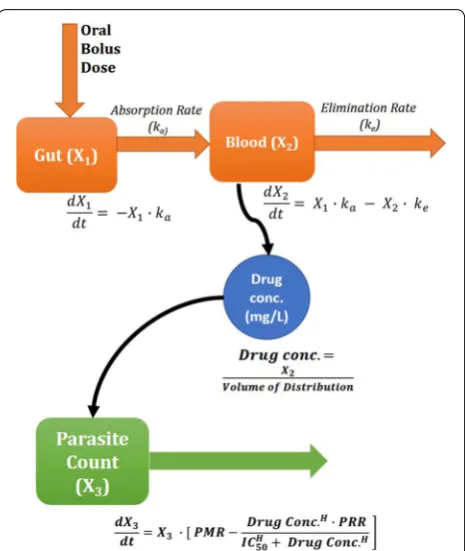
The PK model within OptiMal-PK assumes the drug is given orally, and because it is based on a previous model, it also assumes first-order absorption kinetics and distri-bution into one PK compartment. The model was hence only defined by two standard differential equations:
where X1 represents the mass of drug in the gut at time
t and is at its maximum when a dose is administered. X2 is the mass of drug in the blood at any given time, it
increases as the drug is absorbed from the gut at rate ka
and decreases as the drug is eliminated at a rate ke. Blood
concentration levels are used throughout the model instead of plasma as the model assumes that drug elimi-nation is driven by total clearance where protein binding does not alter overall exposure.
Setting the dose in the interface will then change the value of X1 accordingly to match the required dosage.
Ini-tial value for X2 is set to be 0 by default as this represents
initial drug amount in blood circulation as can be seen in Fig. 1.
The drug concentration (C) at any given time (t) is determined by dividing the drug mass in blood (X2) by
the volume of distribution (Vd).
This relationship can be simplified into terms for the apparent elimination half-life and the clearance of the drug; these parameters are required as user inputs are converted by the program into the micro-parameters as follows:
The pharmacodynamic component of the model takes into account the parasite multiplication rate per para-site life cycle (PMR = parasite multiplication rate/48 h), the concentration of drug in blood at any specific time, the PRR (the maximum Parasite Reduction Ratio occur-ring in 48 h [11, 17–19]), C50 of the drug, defined as the
(1)
dX1
dt = −ka·X1
(2) dX2
dt =ka·X1−ke·X2
(3)
C= X2
Vd
(4)
ke=
LN(2)
t1/2
(5) Vd = CL
ke
concentration of the drug required to achieve half of the maximal parasite reduction rate and the Hill slope, which defines the slope parameter of the drug’s C50. The C50
value is the concentration required to achieve half the maximal PRR which is defined by the user. This value is ideally extracted from in vitro PRR studies [20], and if not available, the IC50 value derived from traditional static 48
or 72 h assays can be used as a suitable surrogate in Opti-Mal-PK [21]. Utilizing the IC50 values from static models
have resulted in realistic predictions that match clinical results obtained from various drugs as previously shown [11].
The PD model relates drug concentration C to its effect on parasite viability. The concentration and time-depend-ent killing function f(C) for each drug is described using the standard Michaelis–Menten equation, i.e.
where Vmax is the maximal drug-killing rate, n is the slope
of the dose response curve, and C50 is the concentration
of drug at which 50 % of the maximal PRR occurs. (6)
f(C)=Vmax
Cn Cn+Cn
50
[image:3.595.306.539.84.360.2]The change in the number of parasites P over time t can be found with the standard differential equation.
where (a) is the parasite growth rate determined by the user-defined parasite multiplication rate (PMR). PMR is set by default to ten based on previous evidence [22], but could be altered by the user to reflect the different PMR values that have been reported in different regions [23].
The model additionally calculates the minimum para-siticidal concentration (MPC), a term often used to describe the minimum concentration needed to achieve a net decrease in parasite count over time. MPC is directly calculated from the drug concentration (C) that results in a net reduction in parasite load (e.g. rate of parasite kill (f(C)) > PMR, Eq. 8).
The model’s work-flow follows the schematic shown in Fig. 1.
Parameter values for all built in partner drugs sup-plied in the table (see OptiMal-PK website) were taken from the paper on which OptimMal-PK is based [11] except for atovaquone where the PK parameters were taken from [24], the IC50 data from [20] and the PRR
val-ues obtained from clinical data [25] which matches the in vivo PRR of drugs with similar mode of action [26].
Stage specificity within OptiMal-PK. A recent paper by Hodel et al. [27] investigated the accuracy of this meth-odology by modelling drugs with long and short half-lives, with and without stage specificity. The study found stage-specificity was only important for short half-life drugs with stage-specific killing (e.g. the artemisinins) because, depending on the timing of treatment, parasites might be in highly drug-tolerant stages or in much less tolerant stages. When modelling drugs with very short half-lives and stage-specific killing users should note that their results could vary but in all other instances, the model was shown to be very robust without the addition of stage-specificity.
OptiMal-PK has been designed to be a user-friendly tool for non-specialists allowing the potential activity of a developing drug or new drug combination to be assessed but care should be taken into over-interpretation of any results due to the previous complexities that have been necessarily simplified in the model.
(7)
Vmax= −0.5LN 1
PRR
(8) dP
dt =P
a−f(C)
(9) a= −0.5LN
1
PMR
Interface
OptiMal-PK is an internet-based program that uti-lizes STELLA® (Systems Thinking for Education and
Research) software. The user-friendly interface allows scientists with limited knowledge of mathematical mod-elling and/or the PK-PD dynamics of anti-malarial drugs to easily assess the predicted clinical performance of any anti-malarial drug/drug combination and explore the consequence of modifying key pharmacological proper-ties of the drug.
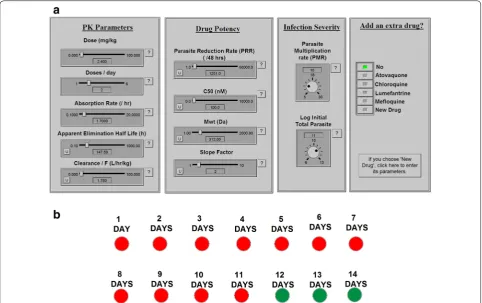
The software works in two simple steps. First the user inputs the parameters describing drug PK, PD and initial parasite load with user-friendly dials, shown in Fig. 2a, and then runs the simulation by pressing the green “run” button (Fig. 2b). The OptiMal-PK simulation calculates the minimum treatment time (days) required to clear an infection and displays the results using a simple traffic light system. A green light indicates an adequate num-ber of treatment days, i.e. the numnum-ber of days of treat-ment is sufficient to achieve a cure (defined as reaching a total parasite count of less than one, where the simu-lation stops and indicates achievement of cure). While a red light indicates that the number of days of treatment administration is insufficient to achieve a cure.
Results and discussion
Model validation
The OptiMal-PK model was based on a validated mech-anistic PK/PD model implemented in R [28] and previ-ously published by Winter and Hastings [11] To validate the methodology of the OptiMal-PK model, the drug concentration and parasite number for the first 30 days post-treatment were simulated using both the OptiMal-PK and R models. The results of both simulations for the seven anti-malarial monotherapies previously calibrated and validated in [11] were compared in house and found to be largely consistent.
Small differences in the absolute values appear to be the result of the methods used by the modelling platforms in integrating differential equations. Stella® uses the Euler’s
method to solve differential equations in 1 h time steps while the Winter and Hastings model uses an algebraic solution for the differential equations. However, parasite levels at the selected time points were consistently within
±10 % across the two models.
model, or allowing for conversion to an active metabo-lite are more appropriate for some anti-malarials (see for example [12, 29]). The purpose of the PK model within OptiMal-PK is to inform the development of a drug can-didate so the assumption of a one-compartment model is a reasonable and pragmatic first step.
It is important to note that the model makes a large number of other simplifications similar to previous mod-els. For example, OptiMal-PK does not currently include bioavailability, dose dependency, active metabolites and intercessional/intersubjective variability which are known for many drugs. However, the simple nature of the interface will allow the user to probe the effects of these variables and assess their effect. For instance, the effect of bioavailability can be easily explored by reducing or increasing the drug dosage, or by altering the clearance values. Active metabolites can be modelled by adding an extra drug with parameters that match that of the metab-olite and whose absorption rate is equal to the conversion rate to the metabolite.
For combination therapy simulations, a model of domi-nant killing was utilised, where the rate of kill is equal to that of the drug inferring the fastest kill rate at each time point as previously described in [12].
A case study—Is OZ439 sufficiently effective for delivery as a one dose therapy and how it could it be improved?
[image:5.595.57.540.88.391.2]single therapy in clinical studies, although it is accepted that the drug will be eventually deployed as a combina-tion. OptiMal-PK was utilised to predict the clinical per-formance of OZ439 in future human studies. A number of simulations were executed assuming different dos-ages and feeding states and then allowed the program to assess the minimum number of days needed to achieve total elimination of parasites in the subjects under each scenario.
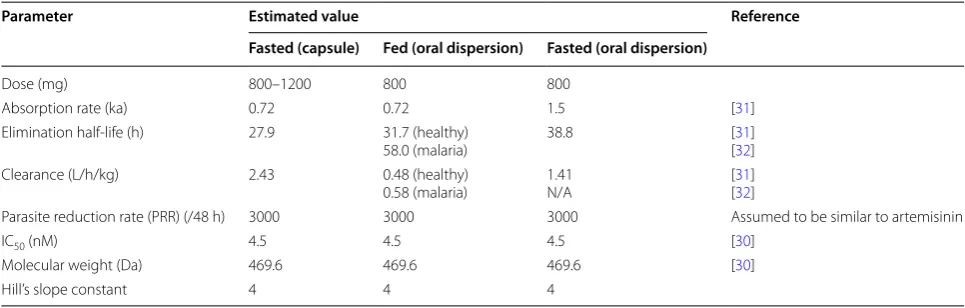
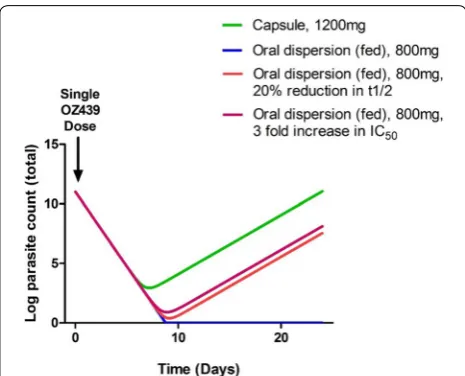
The OptiMalPK model calculated minimum number of days needed for treatment using the PK and PD param-eters that are presented in Table 1 (derived from [30–32]) In this example, different doses of OZ439 were compared in a capsule and oral dispersion forms on empty (lower exposure) or full (higher exposure) stomachs based on clinical data. The results demonstrate that a single mono-therapy dose of 800 or 1200 mg (as a capsule, it is impor-tant to note that the disposition characteristics of OZ439 capsules differ significantly from a drug dispersion for-mulation, see below) would be insufficient for the suc-cessful elimination of parasites in all patients and would result in recrudescence within 9 days after the treatment. The model predicts that 1200 mg OZ439 capsule would need at least 2 days of treatment to completely cure a malaria infection, as defined by depletion of parasite total number to one.
However, the simulations show that a single 800 mg dose of the oral dispersion formulation in fed or fasted subjects would lead to a cure following a single admin-istration; administering the drug in the capsule form, not the oral dispersion formulation, seems to fail a 1 day treatment regimen according to the model. Neverthe-less, even for the superior oral dispersion formulation, if metabolism is slightly accelerated (decreasing half-life by 20 %) in a proportion of the target population, the single dose for the oral dispersion would be rendered
insufficient in either fed or fasted subjects. These data suggest that the single dose regimen is very unforgiv-ing which could have very serious consequences in field deployment in large patient populations if OZ439 were to be deployed alone. Additionally a modest two to three-fold decrease in potency (increase in IC50 from x–y; i.e.
emergence of moderate resistance) would also make the single dose insufficient for an absolute cure (Fig. 3). Opti-Mal-PK highlights the sensitivity of single dose OZ439 to emergence of low level parasite resistance and moderate population PK variations. Given the large variability of PK parameters shown in Table 1 (30–115 %) the simula-tions here show that a single dose of OZ439 dispersion would leave a significant proportion of subjects at risk of incomplete elimination of malaria parasites, treatment failures and parasite recrudescence and increased pres-sure for resistance development.
Case study 2—effect of resistance on drug activity and mitigating strategies
Chloroquine (CQ) was for many decades a primary chemotherapeutic agent in anti-malarial therapy. Resist-ance to the 4-aminoquinolines was initially reported in Southeast Asia and South America and subsequently spread to almost every malaria endemic region in the world [33]. CQ was used as an example on how drug resistance would affect the outcome of treatment. The original chloroquine parameters are all based on those previously reported as described earlier [11]. The num-ber of days it takes to achieve a cure was investigated as drug resistance increases (IC50 was elevated in 40 %
increments, Fig. 4). Using CQ sensitive IC50 values (e.g. ≤62.7 nM [34]), the model predicts successful outcome with a 3-day treatment, consistent with published clinical data [35], and consistent with WHO guidelines for CQ [36]. When parasite CQ sensitivity values are increased
Table 1 PK and PD parameters of OZ439 after oral delivery in fasted and fed patients as reported in the literature
Parameter Estimated value Reference
Fasted (capsule) Fed (oral dispersion) Fasted (oral dispersion)
Dose (mg) 800–1200 800 800
Absorption rate (ka) 0.72 0.72 1.5 [31]
Elimination half-life (h) 27.9 31.7 (healthy)
58.0 (malaria) 38.8 [[3132]] Clearance (L/h/kg) 2.43 0.48 (healthy)
0.58 (malaria) 1.41N/A [[3132]]
Parasite reduction rate (PRR) (/48 h) 3000 3000 3000 Assumed to be similar to artemisinin
IC50 (nM) 4.5 4.5 4.5 [30]
Molecular weight (Da) 469.6 469.6 469.6 [30]
[image:6.595.56.539.562.716.2]to resistant values e.g. generally considered ≥100 nM
[37, 38], the model predicts a requirement of 4 or more days of treatment, depending on the fold increase of CQ C50 (Fig. 4), all PK parameters derived from [39] and
PD parameters from [34]. These data are in agreement with clinical trials performed in CQ resistant regions in Afghanistan where 60 % of the population failed a 5-day treatment of CQ [40].
Parameters that could be altered to reverse the effect of increasing the IC50 of CQ were then investigated.
Assum-ing a 4.6-fold increase of IC50 from 62.7 to 288.4 nM the
drug will not be able to deliver a cure within 14 days, altering the dosing regimen from once daily dosing to twice daily brings the number of days needed to achieve a cure to five to 6 days according to the model, while arti-ficially increasing the half-life by 40 % would reduce the predicted number of days needed to achieve a cure down to seven to 8 days. Increasing the PRR by tenfold from 1000 only improves the activity of CQ slightly accord-ing to the model. Although these changes are purely an academic exercise it highlights the key parameters that need to be considered in the discovery process where candidate selection could take into account these phar-macological features. Importantly, even if it were possible to achieve radical changes in the drug properties, such as increasing its PRR by tenfold or its half-life by 40 %, these changes are unable to mitigate resistance resulting from a 4.6-fold increase in the CQ IC50, emphasizing the need to
avoid resistance development in the first case by appro-priate use of forgiving dosage regimens.
Case study 3—studying the potential of long‑duration dihydroorotate dehydrogenase (DHODH) inhibitor (DSM265) for treatment of malaria
[image:7.595.57.290.86.274.2]OptiMal-PK is used here to study the therapeutic poten-tial of a drug, DMS265, with slow elimination kinetics and killing dynamics. Potency and clinical PK proper-ties were used as previously reported [26] and shown in Table 2 (PRR value was estimated to be 17 based on data shown in [26]).
[image:7.595.58.291.499.667.2]The simulations show that using the parameters in Table 2, at least four doses would be needed to achieve complete elimination of parasites in the circulation of patients. However, if metabolism is slowed down by a factor of only 10–20 % (by increasing half-life from 130 to 170 h) the drug would be capable of achieving a cure in one to two doses. These data, therefore, sug-gest that in back-up programmes aimed at delivering Fig. 3 OptiMal-PK predictions of OZ439 clinical activity. Results of
OptiMal-PK simulations on OZ439. Assuming a single dose of either 1200 mg capsule (fasted, green line), oral dispersion in fed subjects with (blue) or without (red) an assumption of 20 % reduction in t1/2 or a threefold increase in IC50 (purple)
[image:7.595.304.539.578.715.2]Fig. 4 OptiMal-PK predictions of chloroquine resistance upon its activity. Effect of resistance on outcome of chloroquine (CQ) treat-ment: The graph show the increase in number of days needed to achieve a cure with CQ at increasing IC50 values from 62.7 up to 288.4. Increasing IC50 values indicate increased resistance to the drug
Table 2 PK and PD parameters of DSM265 as reported in the literature
Human PK values are reported from allometric scaling performed by [26]
Parameter Estimated value
Dose (mg) 200–400 mg
Absorption rate (ka) N/A (assumed to be 1) Elimination half-life (h) 130 h
Clearance (L/h/kg) 0.003 (allometrically scaled from rodents)
Parasite reduction ratio (PRR)
(/48 h) 17
IC50 (nM) 13
Molecular weight (Da) 402
second-generation DHODH inhibitors, a focus on improving the therapeutic half-life of the drug may be more rewarding than a focus on potency alone.
Like OZ439, albeit with a completely different mode of action and different PK/PD properties, DSM 265 seems to be on the cusp of delivering a single dose cure. As with OZ439, the laudable aim of achieving a single dose cure, needs to take into account inherent parasite and patient variability at the population level, as the models suggest that these drugs may end up being deployed in very unfor-giving dosage regimens, setting them up for premature failure due to either inadequate clinical performance in some patients or the early development of parasite resist-ance, something that is readily achieved with DSM265 in laboratory settings under moderate drug pressure.
Conclusions
OptiMal-PK is an open access, internet-based tool designed for the wider anti-malarial drug discovery com-munity. It allows non-specialists to identify which phar-macological features of a compound are most important to the clinical performance of a new chemical entity or new drug combination. OptiMal-PK should therefore serve as an aid to critical decision-making during anti-malarial drug development programmes.
Abbreviations
ADMET: absorption, disposition, metabolism, excretion and toxicity; C: con-centration; CL: clearance; CQ: chloroquine; DHA: dihydroartemisinin; DMPK: disposition, metabolism and pharmacokinetics; IC: inhibitory concentration; MPC: minimum parasitic concentration; PD: pharmacodynamics; PK: phar-macokinetics; PMR: parasite multiplication ratio; PRR: parasite reduction ratio; MPC: minimum parasitic concentration; ka: absorption rate; ke: elimination rate; QSAR: quantitative structure–activity and relationships; T1/2: elimination half-life; TCP: target candidate profile; TPP: target product profile; Vmax: maximal kill rate; Vd: volume of distribution.
Authors’ contributions
GA model design and construction. KK performed model validation. GB conceived the project. GA, KK, SW and GB contributed to the writing of the manuscript. All authors read and approved the final version of the manuscript.
Author details
1 Research Centre for Drugs and Diagnostics, Liverpool School of Tropical Medicine, Liverpool L3 5QA, UK. 2 Present Address: State University of New York at Buffalo, Buffalo, NY 14214, USA.
Acknowledgements
The Authors would like to thank forio (Training Simulations & Predictive Ana-lytics Applications) for hosting OptiMalPK on its platform.
Competing interests
The authors declare that they have no competing interests.
Funding
Authors wish to acknowledge support from the Medical Research Council (MRC, MC_PC_12017, MC_PC_13069, MC_PC_14111 and MR/L000644/1).
Received: 7 March 2016 Accepted: 17 June 2016
References
1. Gamo FJ, Sanz LM, Vidal J, de Cozar C, Alvarez E, Lavandera JL, et al. Thousands of chemical starting points for antimalarial lead identification. Nature. 2010;465:305–10.
2. Guiguemde WA, Shelat AA, Bouck D, Duffy S, Crowther GJ, Davis PH, et al. Chemical genetics of Plasmodium falciparum. Nature. 2010;465:311–5. 3. Plouffe D, Brinker A, McNamara C, Henson K, Kato N, Kuhen K, et al. In silico activity profiling reveals the mechanism of action of antimalari-als discovered in a high-throughput screen. Proc Natl Acad Sci USA. 2008;105:9059–64.
4. Burrows JN, van Huijsduijnen RH, Mohrle JJ, Oeuvray C, Wells TN. Design-ing the next generation of medicines for malaria control and eradication. Malar J. 2013;12:187.
5. Austin DJ, White NJ, Anderson R. The dynamics of drug action on the within-host population growth of infectious agents: melding pharmacokinetics with pathogen population dynamics. J Theor Biol. 1998;194:313–39.
6. Hoshen MB, Na-Bangchang K, Stein WD, Ginsburg H. Mathematical modelling of the chemotherapy of Plasmodium falciparum malaria with artesunate: postulation of ‘dormancy’, a partial cytostatic effect of the drug, and its implication for treatment regimens. Parasitology. 2000;121:237–46.
7. Hoshen MB, Stein WD, Ginsburg H. Modelling the chloroquine chemo-therapy of falciparum malaria: the value of spacing a split dose. Parasitol-ogy. 1998;116:407–16.
8. Hoshen MB, Stein WD, Ginsburg H. Pharmacokinetic-pharmacodynamic modelling of the anti-malarial activity of mefloquine. Parasitology. 2001;123:337–46.
9. Saralamba S, Pan-Ngum W, Maude RJ, Leea SJ, Tarning J, Lindegardh N, et al. Intrahost modeling of artemisinin resistance in Plasmodium falcipa-rum. Proc Natl Acad Sci USA. 2011;108:397–402.
10. Simpson JA, Watkins ER, Price RN, Aarons L, Kyle DE, White NJ. Mefloquine pharmacokinetic–pharmacodynamic models: implications for dosing and resistance. Antimicrob Agents Chemother. 2000;44:3414–24. 11. Winter K, Hastings IM. Development, evaluation, and application of an
in silico model for antimalarial drug treatment and failure. Antimicrob Agents Chemother. 2011;55:3380–92.
12. Kay K, Hastings IM. Improving pharmacokinetic–pharmacodynamic modeling to investigate anti-infective chemotherapy with applica-tion to the current generaapplica-tion of antimalarial drugs. PLoS Comput Biol. 2013;9:e1003151.
13. Hodel EM, Kay K, Hayes DJ, Terlouw DJ, Hastings IM. Optimizing the pro-grammatic deployment of the anti-malarials artemether–lumefantrine and dihydroartemisinin–piperaquine using pharmacological modelling. Malar J. 2014;13:138.
14. Zaloumis S, Humberstone A, Charman SA, Price RN, Moehrle J, Gamo-Benito J, et al. Assessing the utility of an anti-malarial pharmacokinetic– pharmacodynamic model for aiding drug clinical development. Malar J. 2012;11:303.
15. OptiMal-PK. 2016. http://optimalpk.lstmed.ac.uk. Accessed 24 May 2016. 16. Systems I. 2006. http://www.iseesystems.com. Accessed 24 May 2016. 17. Edwards G, Krishna S. Pharmacokinetic and pharmacodynamic
issues in the treatment of parasitic infections. Eur J Clin Microbiol. 2004;23:233–42.
18. Pukrittayakamee S, Chantra A, Simpson JA, Vanijanonta S, Clem-ens R, Looareesuwan S, et al. Therapeutic responses to different antimalarial drugs in vivax malaria. Antimicrob Agents Chemother. 2000;44:1680–5.
19. White NJ. Assessment of the pharmacodynamic properties of antimalarial drugs in vivo. Antimicrob Agents Chemother. 1997;41:1413–22. 20. Sanz LM, Crespo B, De-Cozar C, Ding XC, Llergo JL, Burrows JN, et al. P.
falciparum in vitro killing rates allow to discriminate between different antimalarial mode-of-action. PLoS One. 2012;7:e30949.
21. Smilkstein M, Sriwilaijaroen N, Kelly JX, Wilairat P, Riscoe M. Simple and inexpensive fluorescence-based technique for high-through-put antimalarial drug screening. Antimicrob Agents Chemother. 2004;48:1803–6.
• We accept pre-submission inquiries
• Our selector tool helps you to find the most relevant journal
• We provide round the clock customer support
• Convenient online submission
• Thorough peer review
• Inclusion in PubMed and all major indexing services
• Maximum visibility for your research
Submit your manuscript at www.biomedcentral.com/submit
Submit your next manuscript to BioMed Central
and we will help you at every step:
23. Deans AM, Lyke KE, Thera MA, Plowe CV, Kone A, Doumbo OK, et al. Low multiplication rates of African Plasmodium falciparum isolates and lack of association of multiplication rate and red blood cell selectivity with malaria virulence. Am J Trop Med Hyg. 2006;74:554–63.
24. Hussein Z, Eaves J, Hutchinson DB, Canfield CJ. Population pharmacoki-netics of atovaquone in patients with acute malaria caused by Plasmo-dium falciparum. Clin Pharmacol Ther. 1997;61:518–30.
25. Lacy MD, Maguire JD, Barcus MJ, Ling J, Bangs MJ, Gramzinski R, et al. Atovaquone/proguanil therapy for Plasmodium falciparum and Plasmo-dium vivax malaria in Indonesians who lack clinical immunity. Clin Infect Dis. 2002;35:e92–5.
26. Phillips MA, Lotharius J, Marsh K, White J, Dayan A, White KL, et al. A long-duration dihydroorotate dehydrogenase inhibitor (DSM265) for prevention and treatment of malaria. Sci Transl Med. 2015;7:296ra111. 27. Hodel EM, Kay K, Hastings IM. Incorporating stage-specific drug action
into pharmacological modeling of antimalarial drug treatment. Antimi-crob Agents Chemother. 2016;60:2747–56.
28. R Core Team. R: a language and environment for statistical computing. Vienna: R Foundation for Statistical Computing; 2014. http://www.R-project.org/. Accessed 24 May 2016.
29. Kay K, Hodel EM, Hastings IM. Altering drug regimens to restore and enhance antimalarial drug effectiveness. Antimicrob Agents Chemother. 2015;59:6419–27.
30. Charman SA, Arbe-Barnes S, Bathurst IC, Brun R, Campbell M, Charman WN, et al. Synthetic ozonide drug candidate OZ439 offers new hope for a single-dose cure of uncomplicated malaria. Proc Natl Acad Sci USA. 2011;108:4400–5.
31. Moehrle JJ, Duparc S, Siethoff C, van Giersbergen PL, Craft JC, Arbe-Barnes S, et al. First-in-man safety and pharmacokinetics of synthetic ozonide OZ439 demonstrates an improved exposure profile relative to other peroxide antimalarials. Br J Clin Pharmacol. 2013;75:524–37.
32. Phyo AP, Jittamala P, Nosten FH, Pukrittayakamee S, Imwong M, White NJ, et al. Antimalarial activity of artefenomel (OZ439), a novel synthetic antimalarial endoperoxide, in patients with Plasmodium falciparum and Plasmodium vivax malaria: an open-label phase 2 trial. Lancet Infect Dis. 2016;16:61–9.
33. Ridley RG. Medical need, scientific opportunity and the drive for antima-larial drugs. Nature. 2002;415:686–93.
34. Mayxay M, Barends M, Brockman A, Jaidee A, Nair S, Sudimack D, et al. In vitro antimalarial drug susceptibility and pfcrt mutation among fresh Plasmodium falciparum isolates from the Lao PDR (Laos). Am J Trop Med Hyg. 2007;76:245–50.
35. Trape J-F. The public health impact of chloroquine resistance in Africa. Am J Trop Med Hyg. 2001;64(1 suppl):12–7.
36. Lalloo DG, Shingadia D, Pasvol G, Chiodini PL, Whitty CJ, Beeching NJ, et al. UK malaria treatment guidelines. J Infect. 2007;54:111–21. 37. Brasseur P, Kouamouo J, Moyou-Somo R, Druilhe P. Multi-drug resistant
falciparum malaria in Cameroon in 1987–1988. I. Stable figures of preva-lence of chloroquine- and quinine-resistant isolates in the original foci. Am J Trop Med Hyg. 1992;46:1–7.
38. Cremer G, Basco LK, Le Bras J, Camus D, Slomianny C. Plasmodium falciparum: detection of P-glycoprotein in chloroquine-susceptible and chloroquine-resistant clones and isolates. Exp Parasitol. 1995;81:1–8. 39. White NJ. Antimalarial pharmacokinetics and treatment regimens. Br J
Clin Pharmacol. 1992;34:1–10.