the systems development process
Lynley Joy Hocking BA, BComp(Hons)
Submitted in fulfilment of the requirements for the degree of Doctor of Philosophy
University of Tasmania (June 1998)
ookt,r- S°'1 5GA-0.0t-
This dissertation contains no material which has been accepted for a degree or diploma by the University or any other institution, except by way of background information and duly acknowledged in the Thesis, and to the best of the candidate's knowledge and belief no material previously published or written by another person except where due acknowledgment is made in the text of the Thesis.
This Thesis may be made available for loan and limited copying in accordance with the Copyright Act 1968
Lynley Ho;�g June,1998
lH�
Uli\�!VEIRSITY OF TASMANIAU8RARY
� �
/.( OtJ<
I tJC.
Pl D
While systems development projects have become associated with increasingly sophisticated technologies and organisational changes, the models underlying the process have not kept pace. The Legislation Systems Project (LSP) is an example of a recent project where computerised technology was employed to improve the creation of and access to legislation. This project was substantially delayed due to unforeseen technical complexity and user acceptance was an ongoing concern. It will de demonstrated that the underlying model of process, which broadly reflects the dominant model of current best practice, is strongly linked with these problems. This dissertation introduces and describes a multi-level process model which provides an in-depth exposé of the systems development process. This model reflects the closely intertwined nature of the content, context and process of change (Pettigrew
1985) and the interconnected relationship between the micro, macro and institutional levels of change.
As illustrated by descriptions of the LSP, the process can be viewed as the negotiation of meaning and interest at a micro level. This involves active participation, the
creation and sustainment of coalitions of commitment and the application of authority and expertise. This analysis builds on the work of Walsham and others who have suggested the process of systems development should be viewed primarily as social interaction.
However, there are other levels of analysis which should be considered. Process implies change over time and Giddens' (1979) three levels of temporality provide a framework for a multi-level model of the systems development process.
At an institutional level, Giddens' structuration theory provides a useful framework for describing the manner in which change is deeply embedded in its organisational context and facilitates the creation of new social institutions. Both this and the micro-level processes can be described as emergent, both over time (chronologically) and in terms of social relationships (hierarchically).
This dissertation argues that the commonly used model of the process at a macro level, the systems development lifecycle, is inadequate as it ignores the emergent nature of the process at the micro and institutional level, the ongoing influence of the organisational context and the socially negotiated nature of change. However, there are existing alternative macro-level process models which do reflect both
Acknowledgments
Firstly, the participants in the case studies, especially those involved with the LSP, for contributing their time and allowing me to observe and review their activities.
Secondly, my supervisors, Dr Chris Keen and Dr Bill Ryan for their invaluable advice and support.
Thirdly, the members of my research group and wider research community for advice, comments on drafts, and discussions on pertinent issues.
ABSTRACT 3
ACKNOWLEDGMENTS 4
PART 1 INTRODUCTION AND BACKGROUND 1
1.1 RESEARCH QUESTION AND OBJECTIVES 2
1.2 RESEARCH CONTEXT 2
1.3 SUMMARY OF CONTRIBUTIONS 3
1.4 UNDERLYING AXIOMS AND RESEARCH PREMISES 5
1.5 RESEARCH METHODOLOGY 11
1.6 THE STRUCTURE OF THIS DISSERTATION 19
PART 2 CONTEXT- SYSTEMS DEVELOPMENT AS A NON-DISCRETE ENTITY 21
2.1 COMPUTERISATION, THE PRODUCTION OF LEGISLATIONIN AUSTRALIA AND THE LSP 22
2.2 CONCEPTUALISING THE ORGANISATIONAL CONTEXT 39
2.3 THE ORGANISATIONAL CONTEXT- THE USERS 51
2.4 THE ORGANISATIONAL CONTEXT- THE SYSTEMS DEVELOPERS 72 2.5 REFLECTIONS: DEVELOPING A FRAMEWORK FOR EXAMINING SYSTEMS DEVELOPMENT ANDITS ENVIRONMENTAL CONTEXT- THE RELATIONSHIP BETWEEN GIDDENS'
STRUCTURATION THEORY AND PETTIGREW'S CONTEXTUALIST ANALYSIS 85
3.CONTENT- ESTABLISHING THE OUTCOMES OF THE CHANGE PROCESS 91
3.1 SYSTEMS DEVELOPMENT PLANNING AS A POLITICAL PROCESS 93
3.2 ACTIVE AND PASSIVE USERINVOLVEMENT 114
3.3 SYSTEMS DEVELOPMENT AS THE NEGOTIATION OF MEANING ANDINTEREST 132 3.4 CREATING AND SUSTAINING COALITIONS OF COMMITMENT OF SUPPORT 155
3.5 THE APPLICATION OF AUTHORITY AND EXPERTISE 168
3.6 REFLECTIONS: THE LSP AND CHANGE IN THE OPC 187
4.PROCESS- IS PLANNING, DEVELOPMENT AND IMPLEMENTATION 207
4.1 CHANGE MANAGEMENT ANDITS RELATION TO SYSTEMS DEVELOPMENT 208 4.2 THE SYSTEMS DEVELOPMENT LIFECYCLE MODEL OF THE PROCESS 225
4.3 CHRONOLOGICAL AND HIERARCHICAL EMERGENCE 244
4.4 ALTERNATIVE MACRO MODELS OF PROCESS 276
4.5 SOCIALINSTITUTION AND ACTION: A MULTI-LEVEL MODEL OF SYSTEMS DEVELOPMENT
CONSISTENT WITH GIDDENS' STRUCTURATION THEORY 295
5.1 SUMMARY OF CONCLUSIONS 314
5.2 SPECIFIC CONTRIBUTIONS 322
5.3IMPLICATIONS FOR THEORY 323
5.4IMPLICATIONS FOR PRACTICE 325
5.5 FUTURE RESEARCH 329
5.6 CONCLUDING REFLECTIONS 329
APPENDIX 1 REVIEW OF COMMONLY AVAILABLE SYSTEMS DEVELOPMENT
LITERATURE (PUBLISHED SINCE 1990) 332
APPENDIX 2 OPC PROCESSES AT THE BEGINNING AND END OF THE LSP 333
APPENDIX 3 BROAD CONCEPTUAL OVERVIEW OF THE ENACT SYSTEM 342
Part 1
INTRODUCTION AND BACKGROUND
Near the beginning of a typical systems development project, an analyst focuses on the work processes of the client organisation and how they can be improved. If one were to conduct such an analysis of systems development, what processes would it describe and what improvements would be suggested? How would the existing normative descriptions of the processes be aligned with what the analyst perceived? This dissertation can be likened to a systems analysis report of the process of systems development and implementation. It will suggest that the commonly-useddescriptions of the process do not adequately reflect the actions of those involved, reflect some questionable underlying assumptions and, when used normatively, can detrimentally impact on the success of such projects. This dissertation will illustrate these points with reference to several core government information systems projects in Tasmania, the most significant being the Legislation Systems Project.
The Legislation Systems Project (LSP) is a major information systems development project in the Tasmanian State Service, designed to improve the production of and access to legislation. I tracked the project in depth over three and a half years through participant observation, interviews and reading associated documentation. When I started observing the LSP, the focus was the management of the associated
organisational changes, which were anticipated to be far-reaching and challenging. These changes Included work process changes, individual and organisational role changes and potentially cultural changes. How could or should those involved in the project manage these changes? How could organisational changes be integrated with the technical developments? IT enabled change has been a focal area of interest over the last decade but how does it unfold in practice? These were questions which intrigued me and challenged those involved in the LSP.
1.1 Research question and objectives
The research question guiding this project has been:
What is the process by which core government information systems are planned, developed and implemented?
Associated research questions include:
• How is the process generally viewed and does this reflect the reality of how the process unfolds?
• How should we conceive the process of systems planning, development and implementation so it reflects what actually happens?
• How can we effectively manage this process? The research objectives have thus been:
1. Identify important attributes of the process of implementing information systems projects in their organisational context of core public sector agencies;
2. Formulate a descriptive model which elucidates these attributes; 3. Analyse existing ways of conceiving the process; and
4. Suggest issues or areas for improving the management of this process.
1.2 Research context
In summary, this dissertation focuses on the organisational implications of information systems developmenti, implementation and the effect of the
organisational context on such activities. There is overwhelming evidence that most information systems implementation failures are non-technical and there is a
recognised need for models of the change process which both capture the actual situation and are useful normatively (Hirschheim and Newman 1991; Buchanan and Boddy 1992; Clegg 1996). Human and organisational issues are recognised as the key issues for successful implementation of information technology in the future but most models of the process are simplistic or commonsense (Hirschheim and Klein
1989; Yates and Benjamin 1991). This project adds to a growing body of literature providing a richer picture of the process of developing and implementing information systems.
1 Here systems development refers to the development of an information system within its
Research in this area is often classified according to whether it focuses on factors affecting the implementation of change or the processes by which such change occurs (Lucas 1981; Franz and Robey 1987; Myers 1995). Factor research produces
conclusions based on contingency assumptions, such as "the more routine the
technology employed, the more formal the organisational hierarchy will be" (Pfeffer and Leblici 1977, Robbins and Barnwell 1994). This contingency approach can be criticised for adopting an objectivist ontology and a static view of organisations and for ignoring the process and ongoing nature of change (Barley 1990, Dawson 1994). In addition to not aligning with the underlying assumptions of this project, factor studies do not generally provide valuable insights. Significantly, they do not
incorporate issues of time, negotiation, interpretation nor the often political nature of organisational change. Franz and Robey (1987) recommended the development of more effective process models, believing that further progress required "more complex, realistic models and the development of alternative perspectives for viewing implementation" (p 207). Almost a decade later, Myers (1995) also
discussed the limitations of factor research and commented that the main finding of studies looking at the processes of organisational change was that the process mattered. Hence, there is still a need for good process models in this area. The problem with most existing process models is that they ignore the close and intertwined relationship between the process, content and context of change (Pettigrew 1985). Systems development is essentially the implementation of organisational changes which include three primary elements:
• content (what is actually changing - for example, the implementation a new technical system);
• context (the environment in which the changes take place); and • process (ie how change occurs ie the project strategy employed).
The interaction between these three elements is important, yet most studies tend to ignore the closely intertwined nature of these three aspects (Pettigrew 1995). The distinction between the context, content and process of change and a recognition of the close relationship between them forms a theoretical framework for looking at issues relating to the research question.
1.3 Summary of contributions
associated with the implementation of information systems, an area of great interest to practitioners and researchers.
Three case studies are examined. The Legislation Systems Project is the most detailed and is based on a real-time longitudinal ethnographic study, a rarity in itself. A project to aid the production of and access to legislation, the LSP is a significant focus for study for several reasons, including the very nature of the project and its context of one of all governments' core functional areas. Such real-time longitudinal studies are a rarity due to difficulties obtaining access to such projects over a long period of time, but provide a deep insight into the processes of change as they occur. The minor case studies track the development of two multi-department human resource management systems retrospectively. They are used to illustrate the concepts of hierarchical and chronological emergence before discussing them in relation to the LSP. Such large scale human resource systems are seen to be difficult systems to implement (Salmon and Proud 1993) and this project provides one solution for overcoming some of the problems by focusing on the process by which such projects are developed.
This change process can be viewed at several levels. At a micro level, the process can be viewed as one of social interaction. Giddens (1979) termed this the cliff& of temporality. He also identified two other forms of temporality: the dasien and the longue duree and this dissertation applies these concepts to the area of information systems development. Most of the literature on systems development refers to only one form of temporality, so the analysis of a systems development project according to these three levels of temporality is a significant theoretical contribution.
This dissertation identifies alternative process approaches which can be used to guide practice. At a micro level, this work supports that of Walsham (1993) and others who have argued the process is one of social interaction. Descriptions of the major LSP study illustrate that that many of the actions of those involved could be described as the negotiation of meaning and interest with the associated application of authority derived from hierarchical relationships and/or expertise. At a more macro level, the process can be described as hierarchically and chronologically emergent. This contrasts with the dominant formal tools used by the systems developers, and several alternative macro process models are evaluated in terms of their ability to reflect these types of emergence. The dominant model of the systems development process is justifiably under threat and this dissertation provides some possible alternatives to it
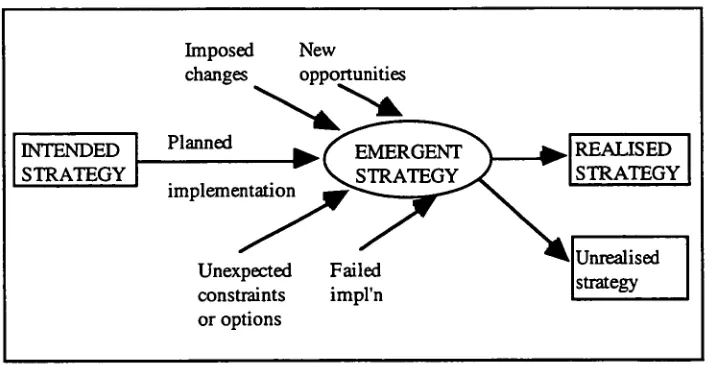
This dissertation suggests that, in practice, there is a need to recognise the often emergent nature of change in organisations. This emergence occurs both chronologically and hierarchically and can be facilitated through iteration,
involvement and incrementalism. These practices have implications for the common approaches to project management and systems development. Existing methods of project management do not cope well with emergent change issues as they tend to be based on the systems development lifecycle model, despite the existence of possibly• viable alternatives. This suggests that alternative models should be employed if organisational change is an issue. Alternatively, it suggests that if we do not cope with emergent change adequately within specific projects, the scope of IS
development projects must be much smaller than they tend to be now. We should think of major change initiatives as involving cycles of projects, rather than a project cycle, as is often the case now. In other words, there is a real need to carefully consider the scope of projects and/or ways of approaching information systems development projects. The contributions of this dissertation are discussed further in the conclusions.
1.4 Underlying axioms and research premises
Axioms are the meta-theoretical assumptions about the nature of research and reality which guide social actors, be they researchers or systems developers. Everyone makes assumptions about the way the world works and their relationship to it. These assumptions guide and influence our research approaches and outcomes, and so should be explicitly examined (Hirschheim 1985; Franz and Robey 1987; Keen 1991; Orlikowski and Baroudi 1991).
Assumptions concerning the nature of reality (ontology) and our relationship to it (epistemology) greatly impact on the process and outcomes of a research project. Given the multitude and conflicting nature of research conclusions in this area, such assumptions should be examined and closely tied to the rest of the project. The discussion here justifies a broadly interpretivist epistemological stance employing Giddens' structuration theory at an ontological level.
1.4.1 Ontology
only created through people's perceptions and actions. Those who adopt a subjectivist ontological stance, such as symbolic interactionalists, tend to focus on how human actors create social structures (Walsham 1993).
Burrell and Morgan (1979) argued these two ontological stances are mutually exclusive. This idea of strict ontological incommensurability has stimulated a great deal of debate, with some arguing that a strict division between ontological paradigms does not make sense or is harmful as it freezes debate (see for example Gioia and Pitre 1990; Jackson and Carter 1991; Ackroyd 1992; Aldrich 1992; Willmott 1993; Weaver and Gioia 1994; DeCock 1995). Giddens' structuration theory effectively resolves this debate by illustrating that the relationship between the two stances is a dualism, rather than a duality (Poole and Van de Ven 1989; Weaver and Gioia 1994). Structuration theory illustrates that change involves a process of "structuration" as new structures are created and reconstituted through peoples actions and perceptions (Giddens 1979; 1989). It is an extremely rich and potentially useful process theory (Barley and Tolbert 1997) and is used to provide a broad theoretical framework for this research project and inform the description of change at an institutional level. It effectively illustrates how the changes involved with information systems (IS)
implementation are deeply embedded in the status quo and how actions involved with the implementation of IS can create new social structures through the creation or facilitation of new roles and tasks. That is, it effectively illustrates the nature of change in organisations, a theme at the heart of this dissertation.
Giddens defined structuration as "the conditions governing the continuity or transformation of structures, and therefore the reproduction of [social] systems" (p 345). A key concept of the theory is that social structures are not viewed as a framework as it commonly is, but as "rules and resources" which are implemented during social interaction. Hence, structures are not seen as something independent of human actions, but phenomena created via their actions. At the same time, such structures have an enabling and constraining influence on these actions. Actions are defined as the continuous flow of interventions in the world by social actors.
signification cbmination legitimation
t : t
intezpretive schemes resoultes nonf
t
4
communication Power sanction
of meaning institutionalrealm/
structure
modality of structuration
interaction
intentions arerealised, goals accomplished and poweris exercised. Norms arethe rules governing behaviour by defining appropriate conduct which sustain and articulatethe structures oflegitimation(Orlikowslci and Robey 1991).
Fgure 1.1: The modalities of structurationtheory(source: Orlikowski and Robey 1991; Walsham 1992)
Structurationtheory has been used by manylooking at organisational change and technological changein particular(eg Scott Poole and DeSanctis 1990; Walsham and Han 1991;Jones and Nundakumar 1993; Knudsen 1993; Han 1994; Shanks, Hodgson et al. 1996; Dillard and Yuthas 1997). For example, Orlikowsld and Robey(1991) focused onits abilitytoincorporatetechnology andtechnological changesin organisations. Specifically,they usedthe aboveframeworktolook atinformation systems development andinformation systems use. Theyfoundtheframework was useful becauseit:
• includedtheintended and unintended consequences of human actions;
• looked at how human actions and organisational structures shapedthetechnology; and
• focused on howtechnology shapedthem andincluded historical and contextual factors.
However, structuration theory is very abstract and is difficult to apply directly to case studies (Giddens 1989; Gregson 1989). Gregson (1989) defined it as a "second order" theory which helps explain social phenomena in general terms but is difficult to transfer to empirical studies. Giddens (1989) preferred the term, "sensitising device" to describe the role of structuration theory in relation to empirical observations, and that is the way it is primarily employed here. This issue is pursued further in Chapter 4.5.
Structuration theory is of great relevance to this research project, focusing as it does on "recurrent social practices and their transformations" (Giddens 1991: p 203). While recognising the criticisms and debates surrounding the theory (eg Bryant 1991; Gregson 1989), its growing acceptance and conceptual depth makes it a good
"sensitising device" and ontological framework. It is discussed further at the end of Parts 2 and 4.
1.4.2 Epistemology
Epistemological questions are concerned with how we can perceive or research reality. Epistemology is closely linked with ontology but, while structuration theory provides an appropriate ontological stance, Giddens does not focus specifically on epistemological issues. Giddens did suggest that neither a positivist nor interpretivist epistemology is entirely suitable if one adopts structuration theory, but has not fully articulated an alternative (Bryant and Jary 1991). Hence, while employing
structuration theory here, I have adopted an interpretivist epistemological stance. Here this stance is justified.
Orlikowski and Baroudi (1991) suggested studies could reflect one of the following epistemological stances:
• positivist; • interpretivist; or • critical.
They suggested it was important for researchers to examine and justify their epistemological stance, a suggestion which is pursued here.
Most research in this area is positivist and assumes there are fixed relationships within a phenomena which can be investigated using structured instruments, formal
• it assumes a fixed/stable reality while reality is emergent and socially negotiated (Truex 1995);
• it does not take the standpoint of the researcher into consideration;
• the search for universal laws tends to make researchers ignore historical or contextual conditions (Orlikowski and,Baroudi 1991); and
it ignores the fact that people are active creators of their physical and social surroundings (Orlikowski and Baroudi 1991; Nandakumar 1993; Myers 1995). Thus positivism is not appropriate for this study.
Critical theory has become popular among some IS researchers recently (eg.
Hirschheim and Klein 1989; Hirschheim and Newman 1991; Jackson 1992; Klein and Hirschheim 1987; Klein and Hirschheim 1993; Ngwenyama 1991). Klein (1992) described three areas where critical theory was being used in IS research:
• criticisms.of the instrumental rationality underlying IS and the dominant management ideology (eg Klein and Hirschheim 1987);
• criticisms of the dominant research paradigm used in IS research (eg Hirschheim and Klein 1988, Winograd and Flores 1986, Ngwenyama 1987);
• classifications and criticisms of existing technology-driven models and an explanation of alternatives (eg Lyytinen and Klein 1985; Klein and Hirschheim
1993).
In a seemingly unrelated paper, Jackson (1992) listed the five "pillars" of critical theory and illustrated how they had been addressed in the IS literature by authors such as Hirschheim, Lyytinen, Checkland, Walsham and others. Critical theorists critique the status quo by trying to expose what they see as deep-seated structural
contradictions and attempt to transform the situation so that people are no longer alienated from their potentialities due to economic, political and cultural systems (Orlikowski and Baroudi 1991).
While this study does reflect some critical elements, a purely critical epistemological stance is not appropriate for this research topic for several reasons:
• Pure critical theory ignores the fact that people create and maintain their social world and treats the social world as separable from the people who create it (van den Berg 1980); and
• Critical theorists assume that the concepts of freedom (emancipation) and reason are inextricably linked. As Lucas (1985) argued, if there is such a thing as a priori
emancipatory) options. Additionally,the concept of emancipation can be equated withfreedom, yetfreedom can beinterpreted asthefreedomtodo something orthe
freedomfromconstraints(Berlin 1969).
• Pure criticaltheorists maintainthatthereis a highertruth(emancipation,freedom from alienation)like positivism, butreduce empirical studiesto valuejudgements. Unlikeinterpretivists,though,they maintainthatthese "highertruths" are ableto be verified non-empirically, yetthis process of verificationis not discussed(van den Berg 1980).
Van den Berg(1980) was scathing of criticaltheory generally. He describedit as "a way ofrendering Marxismindeterminate and hence unfalsifiable". He sawlittle
relationship betweentheory and practicein criticaltheory and believedthere had been adequate discussion ofissues such asthe creation of ajust society andthe alleviation ofinjustices. For him criticaltheorists added nothingtothese debates and have only contributedtothemfrom "the comfortable heights of philosophical abstraction"(p 476). While not so critical ofthe approach, Orlikowski and Baroudi(1991) also statedthat criticaltheoriststendto not be critical enough oftheir own concepts and theoretical models. Hence,this study does not adopt a purely critical stance,though it doesinclude some critical elements.
Based on an subjectivist ontological stance,interpretivists assumethat, as people create and sustain meanings and conceptsthroughtheirinteractions,therole ofthe researcherinthefield cannot be value-free. Interpretivist studies do not aimfor statistical generalisability. As Walsham and Waema(1994) pointed out,the validity ofthis approach depends not on statistical extrapolation, but onthe plausibility and reasoning ofthe description and explanation ofthe cases. Interpretive studies
generallyfocus on more complex phenomenathan positivist studies and aimtolocate theirfmdingsinthe context and,recognisingthat notwo social situations are ever exactlythe same,itis pointlesstotry and aimfor statistical generalisability.
Extrapolationfrom one or moreindividual casesis not achieved statistically, butin a theoretical sense, as plausible concepts derived are appliedto other scenarios and observations are abstractedtotheoretical concepts. The approach has gained
acceptanceforlooking attherole oftechnologyin organisations(Walsham 1995) and
is employed here.
however less fundamental than the ones aimed at the positivist approach, and can be at least partly counteracted through the choice of an appropriate research
methodology.
1.5 Research methodology
The methodology employed can impact on the contributions and conclusions of a research project and so should be explained. Broadly, this project started as what Millar and Friesen (1982) refer to as a real-time, broadly focused, non-quantitative longitudinal study of a single organisation with retrospective non-quantitative observations of two minor case studies focusing on particular issues. In the primary study, data was collected via participant and non-participant observation, interviews and the examination of associated documentation. I used interviews and document analysis to retrospectively form an historical account of the secondary case studies. As this project utilises structuration theory at as an ontological sensitising device, it should employ longitudinal, historical and contextual research methods (Barley 1986, Orlikowski 1988). Giddens argued that structuration theory helps mitigate much of the conflict between quantitative and qualitative research methods (Orlikowski 1988) but qualitative methods are primarily employed here due to the nature of the research questions.
The choice of research methodology largely depends on the research question and the underlying axioms of the study (Keen 1991). Focusing on the process by which technologically-induced change unfolds in organisations, this project does not lend itself to quantitative research methods as it requires a more holistic approach than such methods would allow. Organisational changes are highly dependant on their context and, by focusing only on specific elements, quantitative research methods can easily lead to oversights. Quantitative methods are generally not compatible with an interpretivist epistemological stance as they:
• postulate the existence of fixed causal relationships between variables; • view reality as stable; and
• perceive social structures as existing independently of the people involved. These are characteristics of a positivist epistemology. Such studies often focus on unidirectional causal relationships, have produced contradictory results and have been based on the doubtful assumption of mechanical causality (Orlikowski 1988;
The qualitative approach used hereis analysis usingreal-time ethnographicresearch methods using both participant and non-participant observation,retrospective analysis viainterviews and an examination of project documentation(Yin 1989). The use of a single primary studyrelatesto aninterpretivist stance andthe minor case studies are notincludedto suggest statistical generalisability buttoillustrate general propositions in aless abstract manner. The major case study,the LSP, wasinvestigated via ethnographic methodsto create a "thick" description of events andissues(Atkinson and Hammersley 1997). I have nottriedto completely empathise withthe subjectsin the case study asthe many differing perspectives and world views would have made thisimpossible andlimiting. However, I havetriedto understand what Geertz(1988 in Harvey and Myers 1995)termedthe "webs of significance". In other wordsthe thick description ofthe LSP aimstoreflectthe opinions and worldviews ofthose directlyinvolved withthe LSP. Participants'responsesto early drafts of sections of this dissertation suggestthat I have been ableto do so.
I observedthe LSPforthree years and a half years, with concentrated periods of involvementinthefirst six months and periodicallythroughoutthe project. I attended meetings, shadowed participants, conductedinformal andformalinterviews, observed activities, examined documentation and was sometimes activelyinvolved. Here specificissues are describedin orderto address concernsregardingrigour and validity. Specificissues which should be consideredinclude:
• the use of anin-depthlongitudinal ethnographic study; real-time versusretrospective analysis;
demonstrablerigour; the choice ofresearch site; myinvolvementinthefield; the process of data analysis;
the use oftheoryinrelationto observationsfromthefield; and the omission of data observedfrom descriptions.
These are examinedin more depth below.
1.5.1 Anin-depthlongitudinal ethnographic study
advantages over single data collection studies as they permit a better exploration time-dependant phenomena such as change (Vitalari 1985). Although not common, there are a number of well-known longitudinal studies of single cases. For example, Orlikowski (1988) investigated the diffusion of CASE tools in an
accounting/consulting firm focusing on issues of power. Such studies are widely referred to, having provided significant insights into this area of study.
1.5.2 Real-time versus retrospective analysis
While the secondary case studies retrospectively reconstruct events from interviews and documentation, the in-depth primary ethnographic study described here tracked changes as they occurred over time. The advantage of the former method is that it is quicker and does not involve wading through vast amounts of detail. The
disadvantage is that events reconstructed retrospectively tend to ignore the ambiguity and untidiness in real world situations as they unfold. In recounting events, people tend to retrospectively tidy them into a logical progressive account. Simply, the secondary case studies do not provide anywhere near the depth as the primary ethnographic study. Further illustrating the advantages and disadvantages of each approach, the secondary case studies also took much less time and effort, with the primary ethnographic study involving about 120 days of observations alone2. There were plans for several other secondary case studies, but these have proved
unnecessary as continued access to the primary case study was achieved.
1.5.3 Demonstrable rigour
As Applegate and King (1997) point out, the intellectual foundations of case study research are robust. Demonstrable rigour is achieved by making data gathering and analysis techniques explicit and transparent, as is done below. In addition to this, the validity of the descriptions and discussions of this research project are enhanced by: • aiming to find multiple sources of evidence for each observation (Yetton, Johnston
et al. 1994);
• actively looking for negative evidence (Dey 1993);
• feeding back observations and interpretations to those in the field (Pettigrew 1995; Rush and Marshall 1995);
• maintaining a log of events and interpretations to aid reflection; and
ongoing analysis through discussions with research colleagues and supervisors.
1.5.4 The choice of research site
The LSP was chosen for two primary reasons. Firstly, it involved a large degree of change from the perspective of the users. This was the focus of my research and the questions being pursued in this research project were also being asked by those involved in the LSP. Essentially, the LSP provided a slightly caricaturised or archetypical example of the themes being pursued, and my access to the project was facilitated by a common interest in these themes. Secondly, this case study is very interesting to many different groups due to the nature of the system, its interaction with its context (that is, political and legal systems) and the technology involved and it has been valuable to see the system unfold. The LSP is an important information systems development project, providing insights into significant conceptual issues.
1.5.5 My involvement in the field
It is important to reflect on the role of the researcher and how this may have affected the phenomena under investigation (Prasad 1993; Rush and Marshall 1995). As in any research project, it was impossible not to interact and be part of the observed phenomena even when trying to be a non-participant observer. Giddens (1989) termed the way in which the actions and perceptions of the researcher become part of the social interaction being observed the "double hermeneutic cycle".
On one level, the double hermeneutic cycle describes how "lay members of society routinely reincorporate social science concepts into the world" (Held and Thompson
1989: p 251). When people in the situation under investigation, or similar situations, start using the concepts developed by researchers, it illustrates the utility and
plausibility of the concepts developed by social researchers. Hence, towards the end of this longitudinal project, the concepts being developed here were presented to those involved in the study for comment. As well as being appreciated by those in the field, this was a good validity test.
The double hermeneutic cycle can also occur within social research projects, so that the actions and perceptions of the research directly influence their observations and results (Dey 1993). Interpretivists recognise this is unavoidable but that it must be at least partly addressed by actively analysing the role of the researcher as part of the research context. Issues which must be considered include:
• the role of the researcher in the social context;
• attributes of the researcher which influence their access to information; • access to individuals and information due to that role; and
In this project, my role changed over the time of my involvement in the field and occasionally I played several roles at the same time. I initially took an active role, but my involvement gradually became more passive until the last eight months of my involvement when I held a position in a closely related unit. During this time, I was not directly involved in the LSP, but was actively involved in other capacities as described further in Part 5. As well as working alongside some of the systems developers to create in-house project management guidelines, I discussed my observations with those involved in the project to check if they aligned with their interpretation of events. This proved a useful exercise, not only as it helped check the validity of the descriptions, but also because people's reactions sometimes provided further insights into how particular groups or individuals interpreted events.
Nundakumar and Jones (1997) highly recommended this participant observation research approach but noted it was only employed by 1% of papers published in widely disseminated papers between 1993 and 1996. They suggested this might be because the social dynamics in the field can be difficult to manage. Arising issues include:
• confidentiality;
• problems of obtaining access to all or some relevant sites;
• the influence of the researcher on the phenomena under investigation;
• changes in the organisational context may require a change in research focus; • a large amount of time is required for field research; and
• the researcher has to juggle the dual role of trying to appreciate the day-to-day experiences of the social actors but also continually question hidden assumptions. These were also issues I faced in the field and some of the methods for addressing them have been or are discussed below.
Even as a non-participant observer, it was impossible to remain neutral in a social situation being observed and not influence it. For example, people would seek my opinion about the project or aspects of it and those involved in the development project seemed more aware of the issues I was investigating when I was around. For instance, one time one of the systems developers turned to me and said, "See — we are letting them (the users) make the decisions here". These influences may have
1.5.6 The omission of data observed from descriptions Involvement in the field did not just involve the collection of data, but its initial interpretation as well. While the description of the LSP here aims to provide a detailed insight into the project, the overwhelming wealth of available information had to be distilled to provide meaning and relevance. Reasons for omitting data included:
• a lack of physical accessibility.
For example, when the main technical components of the project were being developed in Melbourne, an aeroplane flight away, my access to the project's development was greatly limited to perusing correspondence and interviews with participants until acceptance testing. Additionally, when the project faced long delays, it became more difficult to obtain access. This was partly because few project activities at this time occurred in Hobart, but also due to increasing concerns the project would not be a success. As the project progressed towards what looked like a successful implementation, it became easier again for me to obtain access. This access was also facilitated by the fact I was now working in the same offices as the systems developers for half the working week;
• the wealth of detail.
"Thick" descriptions result from attention to details, but it would be easy to become lost in a maze of detail and loose sight of the overview broader theories can
provide. The fact that hours were spent discussing new standardised formats for amendment legislation may be pertinent but most of the details of such meetings are not. Hence my own thick descriptions are still summaries;
• relevance.
Issues were discussed which were not pertinent to this study. These include issues not relevant to the LSP and issues which were part of the LSP but were not relevant to the theoretical area under investigation, such as technical details of the project, details concerning data conversion activities and so forth;
• confidentiality/ potential to cause harm to individuals.
to ensure I would not discuss potentially sensitive information, such as draft legislation;
• my role in the project/perspective on the project.
"What one sees depends on where one stands" and my observations are bounded by my own assumptions and viewpoint. This issue cannot be sidestepped or avoided, but is addressed by the examination of the assumptions underlying this project to a degree. Other assumptions which might influence my perspective are my
background in information technology and my alignment with the interests of the systems developers at times. I have tried to address this issue by trying to make my standpoint explicit.
1.5.7 The process of data analysis
Data analysis involved two primary steps. The first was the distillation of the wealth of information derived from the case studies into a rich description of incidents and issues of the project as it progressed via a process of summarisation. The second step involved the consideration of these incidents and issues against existing and emerging themes. These two steps have been iterative, and this is reflected in the structure of the thesis.
Field notes provided an abundance of detail and in order to gain some initial insight into it, it was necessary to try and summarise them. Thick descriptions are an important part of qualitative observations, forming the foundation for further theory building (Dey 1993; Walsham 1995). These thick descriptions display the subtleties and some of the multiple perspectives which make up "reality". Many of the recent developments in the social study of technology have produced thick descriptions which have provided a wealth of detailed information, but this needs to be structured if it is to be of use (Bijker, Hughes et al. 1989).
The structure of the thick description was not closely aligned to existing theoretical frameworks and emerged over time. I initially took a grounded approach, with observations from the field categorised initially according to incidents and issues which the systems developers and/or users had to contend with as the project progressed. Examples of such incidents and issues include:
• the fact that the impetus for the system came from outside the user organisation and the manner in which user commitment to the concept of the system was obtained; • the complicated nature of the drafting process and the actions the systems
developers took to gain an adequate understanding of this process;
• the development and promotion of a user developed prototype and the reactions of the systems developers.
Theseincidents andthemes were usedto structurethethick descriptionthatis woven in withthetheoretical discussionsinthis dissertation.
Over time, some of theseincidents andissues seemed to naturally group together around certain themes. Miles and Huberman(1994) refer to this activity as noting patterns andthemes and clusteringthem. Forinstance,thelatterthree example incidents mentioned above all seemed to concern some kind oflearning, a conceptI later refined to the negotiation of meaning.
These themes partially emergedfrom reflection on theincidents andissues at thefirst level of analysis, but were alsoinfluenced by conceptsin the existingliterature. One of the criticisms of using existing theoriesis thatitis very easy to only viewfield observations through thelens of the existing theory. However, this was avoided by not being committed to a particular theory or set of theories until relativelylatein the project. The wealth of existing theoriesfocusing on technological changein
organisations provided a range oflenses through which to view the project. Some of these theories were discounted because they did not comply with the underlying axioms of this project, assuming,for example, a deterministic relationship between technological change and changesin organisations or an objectivist view of
organisations. Some theories seemed tofit the observationsfrom thefield better than others, as will become apparent below.
Over timelinks between observationsfrom thefield and certain theories were strengthened. For example, the concept oflearning gradually evolvedinto the learning and negotiation and theninto the concept of the negotiation of meaning and interest. Thisiterative consideration of theory and observationis reflectedin the structure ofthisthesis, with discussion oftheoretical concepts and existingliterature interspersed with observations of the LSP. Aniterative approach to theory
developmentis thus highly recommended(Jorgensen 1989; Layder 1993; Miles and Huberman 1994; Walsham 1995) and has been adoptedfor this research project. In thelatter stages of the research project, ongoing datafrom thefield and reviews of my notes and other documentation were used to strengthen or discard emerging concepts. During this stage, concepts become better articulated and were sometimes adapted to ongoing observations orfurtherinformationfrom other sources. Miles and Huberman(1994) referred to this as building alogical chain of evidence and making conceptual/theoretical coherence. Thefinal stages of selective coding were combined with writingthis dissertation and discussingit with research participants and
1.6 The structure of this dissertation
This dissertation broadly follows what Yin (1989) describes as a "theory building" structure, with the literature and initial findings from the field research being
discussed alongside the descriptions of the theories employed. As well as reflecting the iterative development of research themes through the examination of relevant literature and the case studies, the broad structure of this dissertation uses Pettigrew's (1985) identification of the three fundamental elements of organisational change as a framework for discussions. That is, Parts 2, 3 and 4 focus on issues of context,
content and process respectively. Part 2 examines the issues of organisational context and the fact that systems development projects cannot be viewed as discrete from their organisational contexts. In Part 3 the focus is on how the content of such change projects is defined, illustrating the social interactions which make up the process of development at a micro-level. Moving to a more macro-level, Part 4 concentrates on the manner in which the process of systems development is conceived and will look at dominant and alternative models of process. It also touches on the process of change at an institutional level. Theoretical discussions are interspersed with ongoing descriptions and analysis of the LSP and the minor case studies to illustrate points made.
This iterative and emergent structure has been employed for several reasons. Firstly, it echoes the emergent manner in which this research project has unfolded, and the way theory has been iteratively used in relation to observations from the field.
Secondly, and most importantly, it reflects the process by which information systems initiatives such as the LSP or the two HRMS case studies unfold in practice. Finally, this structure allows a consideration of relevant themes and their immediate
Part 2
CONTEXT
— systems development as a non-discrete entity
This thesis tells the story of a major systems development project and drawsimplications from it. This story has to be placed in context and Part 2 sets the scene, so to speak, for the rest of the dissertation. Firstly, it introduces the Legislation Systems Project and places it in its broad context of computerisation and the
production of legislation in Australia in Chapter 2.1 Chapter 2.2 goes on to examine the reasons for looking at the context of systems development and illustrates that the perspective one has on the context can greatly influence how one views the process. It concludes that there must be an adequate focus on the social as well as the technical and process aspects of the organisational context of systems development. Chapter 2.3 then identifies and articulates important relevant contextual issues which should be considered in relation to particular case studies and systems development projects. These aspects are explored in relation to the primary clients of the Legislation System Project, the Office of Parliamentary Counsel, and implications for the systems
developers are suggested.
At the same time, it is also important to reflect on the context of the systems
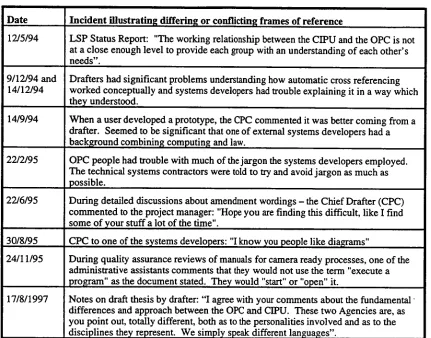
developers and the differing frames of reference which influence their interaction with their clients. The organisational context and differing frames of reference of the LSP systems developers, as compared with the drafting office are the focus of Chapter 2.4, and, again, implications for the process of systems development are drawn.
2.1 Computerisation, the production of
legislation in Australia and the LSP
The major empirical focus of this dissertation, the LSP, is a significant systems development initiative, both in terms of its practical application and its relevance to systems development theory. Here the LSP is introduced and the impetus for it explained. An examination of legislation production in Australia and the use of computers to create and access legislation reveals that trends promoting the LSP are similar to other jurisdictions. However, the initiative is unique in that the resulting system aids both the creation of and access to legislation while in other jurisdictions they are considered separately. This introduction to the LSP places the project in context and helps "set the scene" for the process of developing the resulting EnAct system.
Access to consolidated legislation has been a problem in most government
jurisdictions based on the Westminster model. Determining the state of statute law can be a time consuming and tedious task. Firstly one must obtain a copy of the original, or principle act, plus a copy of all the amendments made to it since it was passed. Then all the amendments must be manually noted on the principle act. In other words, one must manually consolidate the legislation in order to gain access to its content. Recently, commercial organisations have produced consolidated versions of legislation on CD-ROM, but these are consolidated on a periodic basis and so have to be constantly updated. Given that all citizens are expected to have a reasonable understanding of the law, this lack of access to consolidated legislation has been a significant issue for all Australian jurisdictions and other governments based on the Westminster mode13.
The Tasmanian Government has recently resolved this issue by implementing the EnAct system and providing public access to the associated document database via the internet. This dissertation describes and analyses the process by which this
3 In other countries, such as the United States and Norway, Acts are replaced by an entirely new one if they are to be amended. This alternative way of changing existing legislation avoids the
complication of having to consolidate legislation, but is said to produce delays in introducing amendments into parliament as the whole Act, rather than the amendments, is presented for debate. In other words there would be an increased tendency to rework existing provisions which were otherwise satisfactory, so impinging on the stability of the statute book.
There are obviously many aspects to this issue, but they will not be addressed here as they are outside the scope of this project. For the Tasmanian drafters and those involved with the LSP, the existing method of introducing Amendment Acts to change existing legislation was an objective,
system was planned, developed and implemented through the Legislation Systems Project (LSP).
In this chapter, the initiative is introduced and placed in context. Reflecting on the production of legislation in jurisdictions such as Tasmania and the use of computers in relation to statute law reveals that the LSP is a unique systems development initiative in that it covers both the creation of and access to statute law while these areas are considered separately in other jurisdictions. This examination also reveals the impetus for the EnAct system are similar to issues faced in other jurisdictions, so suggesting this initiative will have wider relevance.
The production of legislation is one of the core activities of government, legislation being the "framework in which governments achieve their purposes" (Crabbe 1993 quoted in Lim 1993: p 3). Considering the importance of legislative drafting in the workings of government and law courts, there is remarkably little written about the role of drafters, the processes of drafting and the influence of computers. Voermans and Verharen (1993) investigated the possibility of using knowledge-based systems as aids for drafting legislation but did not look at the actual processes of producing
legislation and the effect of the proposed technology on it. Chartrand and Ketcham (1994) looked at the opportunities for using information resources and advanced technologies in the US congress but focused on the application of computerised tools to aid the consideration of legislation and information conveyance rather than the possible consequences of using the technology. Snellen and Schokker (1992) discussed the interaction between the creation of legislation and new information systems and the application of the law enabled by new information systems, but also did not focus on the effect of information technology (IT) on the production of legislation.
2.1.1 The legislation production process in Tasmania and the LSP
Tasmania is the smallest state of Australia, with a population of approximately half a million. The Australian state governments broadly have the same functions as the Canadian provinces and operate according to the general principles of the
Westminster parliamentary system. In Tasmania there are two houses of parliament: • the House of Assembly, where the governing and opposition parties sit and the
executive government is formally positioned; and • a house of review, called the Legislative Council.
The production of legislation is a highly complex and iterative process in Tasmania and is similar to other Australian jurisdictions with two houses of parliament. Although this study is limited to an isolated example, it has implications for the legislation production processes of any government and so should be of interest to others involved in information systems development in the public sector or the production of legislation anywhere.
Here the formal aims and objectives of the LSP are described as a background to the rest of the project. These are derived from the project's business case document, the development of which is discussed in Chapter 3.1.
a) The production of legislation in Tasmania
Legislation includes a range of instruments. Acts of Parliament are the means by which government policy is most directly implemented (Lim 1993). Other instruments include subordinate legislation such as regulations, by-laws, proclamations and orders. These instruments do not generally pass through parliament but are administered by the department responsible. Here, the focus of discussions in on Acts of Parliament, though many of the same issues apply when considering subordinate legislation and the LSP covered both.
For the purposes of later discussion, it is worth clarifying some of the terms used. Acts
have been passed by both houses of parliament and have received Royal Assent and so are considered a formal part of the state's law. Bills are acts being debated by the houses of parliament, and drafts are proposed legislation before it reaches the House of Assembly.
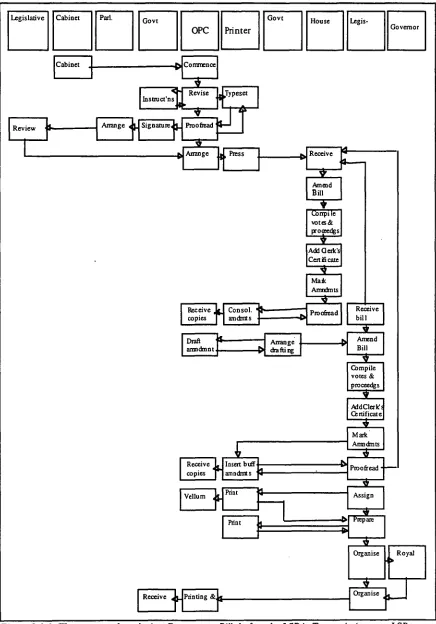
For Acts of Parliament, processes of enactment are basic parliamentary processes, where new legislation is presented, debated and passed. Most people are aware of the basic workings of parliament, at least in their own jurisdiction. In a democracy based on the Westminster model, new legislation (called a Principal Bill) or amendments to existing legislation (termed Amending Bills) are presented to one house of Parliament by an elected member of that house. The Bill is then debated and perhaps amended before being either accepted or rejected. Most of the time such Bills are introduced to the lower house before being reviewed by an upper house and in jurisdictions based on the same model but with only one house, there is no Parliamentary process of review. In the two house, bicameral system, both houses must agree to the contents of the legislation before it becomes an Act and can be enforced. Most legislation must be signed by the formal head of state (the governor or governor general) before it becomes part of the formal body of statute law. This is the model followed by all the states of Australia and the federal Commonwealth government, the federal and provincial governments of Canada and other governments based on the Westminster model. The enactment of policy into legislation is concerned primarily with political processes in and around parliament. These processes are largely outside the scope of this project and the LSP, but interact strongly with them.
Both this project and the LSP are primarily concerned with the background drafting processes and access to legislation once it passes into law. In many respects, these areas can be considered the administrative functions associated with the broader enactment processes.
As in other states of Australia, legislation is written by lawyers who specialise in the drafting of legislation, called Parliamentary Counsel or, less formally, drafters. Legislation is generally initiated by members of the governing party, usually through Cabinet and is further developed through consultation between the agency responsible for the area of policy covered by the legislation and the Office of Parliamentary Counsel (OPC) before it is reviewed by the Legislative Review Committee, printed by the Government Printing Office and debated in Parliament. The division between policy creation and drafting is not always clear but generally the instructing department is responsible for the policy articulated in a bill while drafters are
responsible for its legal effectiveness (Mason 1988). Amendments made on the floor of either house of Parliament also must be included in the legislation.
the LSP team and are believed to be part of the first thorough review of the process since it was initiated in Tasmania in 1854.
b) Impetus for the LSP
The business case for the LSP identified two critical issues associated with the production and availability of legislation in Tasmania:
• the throughput of the OPC was considered inadequate to meet the increased demand for new or amended legislation; and
• the lack of consolidated legislation was impairing access to the law, increasing the costs of business and government and reducing the effectiveness and
standing of the law and Parliament.
The importance of statute law has increased both generally and in Tasmania, with an associated increase in its volume and complexity. Governments are creating policy covering areas previously only covered by common (case) law. While the 1950
reprint of Australian Commonwealth Legislation involved about 5000 pages, a similar exercise in 1982 was estimated to include 150,000 pages (Ward 1982). The trend towards more statute law has not slowed since that time.
These trends, prelevant in most other Australian jurisdictions, were intensified in Tasmania from 1992 to 1996 by the presence of a majority government in parliament. As the governing party had the majority of seats in the house, government initiated legislation was not debated to the same degree in parliament, and the throughput of parliament increased. The Tasmanian OPC had problems keeping pace with this expanded workload. Compared with other Australian Offices of Parliamentary Counsel, the Tasmanian OPC was under-resourced and the standard of the statute book consequentially suffered. It was the poor state of the statute book, plus the perceived need for a greater throughput of legislation which has prompted the push for automatic consolidation.
Cabinet Commence
Review 4
Print Prepa4re Legislative Cabinet Pail. Govt
OPC Printer
Govt House Legis
-Governor
Instru cen; Revise _,Typeset
Arrange Signature Proofread
Press Receive
4-- Amend
sin Arrange
Conpile votes & protects
Add Clerk's Certificate
Mark Anmdmts
Receive bill
Amend Bill
4 Compile votes & proceedgs
AltICIak's Certificate Draft 4 Arrange
arnndmnt t*afti ng
Mark Anmdmts
Receive copies
Vellum
Insert buff amndritts
Proofread
Assign
Organise Royal
Receive 43_Printing &44 Organise
[image:32.570.91.527.77.701.2]*o17.:271,EPrzigEr-te1rris zafaLt.
.i--=r3er-subsection1 (1) an&i rexper.t oE vfr.ora GerctiOTaerates 'mar see*d 5 (1) (p) e % the 17.141.1k Service Ae!1973 frole:
:he prnvis{ons of that Actihel.7intapply— I
(a)!sbsdl bewpieFed'ay tide Curnmitsion onlaugh te=s Iand did2 L t ely detrattize; azi
(iy)!4.e.taiLs. csiadr.g and a.te--uing sights t.. zeupec of 1 of absence on scrod= DE sielbletai
sa•iceleave, aril Tep=a2n-eati m ks =pi*
I
meat by the'Commission v/e=4 a coati nationit of10—rstmiec,.i GrAin cortnc wib be Tosetsnot• rote Service
A et 1984 ?mem rraj'te vis.pzEillte6 cr. ert7lOYea or .the el.v.e.4.1
:hi* Art. .
ki41‘g..11). • - !..7)The Cc.m.='.sstc.t.•:..qty autlioeatpersons,. n6t. •
be.r enipio),.ect‘aitititt thethezaing ef TairtiorSin Stv..fe Servic4Act 196'd to ce7forrA the .this and ex.e:eise. the powers of —
(e) iCYCSI Officer6: or
(b)riznbe: Classacacion oaczt.— fen- Ene?V.:?0SCZ th"lsAct.
+ant741-44---•
( : ) EnIck,rnent jr.onictions or Adrninbir.s.:6-r Erections-. Ego es cbt ::nneiti; of iitc "J:osog-*.so Pee Sfruiet Act
1544.: :Nag'teLiabi-:c"*.."1...Je Cr=c1m1$4"-m; or sre-.77""•*iro4 • y 4Lretrierts--gic•wo xi'abr. by ..+4 Corerrit;ioner for .Pob1ic,c.'4 "
f
Ll'•Jr: 14:41.157 el:{13,C•
11■:1:: 10:C5t • M: 44k" kenoCaI A , t I!..".• •
hold; rr be 4vea ID,a. per:r.lz. •ezieac
this.Act; •P.ise •1.6* 6 7
sh611,be a r to1 or beLnre:ested c..7ncr.c.47d soc
Act; or
(r; 1a11, a ragent, trite in. or be it...re...est:A i :
CUra:SC: iorthe o.rc iltiroz or ze mo--.3.1 L ani fores:
przd.oct., t-Ncel..pr wits the ,expres.s permits:en .rof the
Figure 2.1.2: An example of a "pasted up" page of consolidatedlegislation (Source: Office of Parliamentary Counsel)
Theresult was a cumbersome statute bookthat was difficultto understand and apply. For example,theRacing and Gaming Actwaslastreprintedin 1974 and by 1994 had beenthe subject of 39 amendment actsresultingin over 300 separate amendments which hadto be manuallyincorporatedintothe principal act. Acts were purchased with a disclaimertothe effectthatthe government printer did not accept any
[image:33.568.78.444.86.617.2]the principal act was time consuming, prone to error and directly increased the costs of obtaining legal advice or using legislation. Additionally, the manually
consolidated versions of the legislation, termed 'paste-ups', were cumbersome, even if they were correct, as illustrated in Figure 2.1.2.
Significant amounts of time and effort were required to interpret the law from such paste-ups and mistakes resulting from this interpretation impinged on the
effectiveness of the judicial courts. In one case, the judge and the lawyers from both parties were all working from pasted-up versions of an act, each of which was different and the case was delayed until the actual state of the law could be
determined. The professional body of lawyers in the state expressed concern over the state of Tasmanian legislation and its implications for the Tasmanian legal system. There were also a number of social costs associated with the lack of consolidated legislation which promoted the LSP. Law based on unconsolidated statutes is complex and requires legal expertise to interpret, imposing unnecessary financial burdens on the community. The poor state of the statute book impacted on the effectiveness of the law, as well as the effectiveness and efficiency of the courts. It also impinged on the effectiveness of parliament, with members of both houses expressing concern about the difficulty of interpreting the legislation they were to debate. Amendment legislation was presented separately and it could be difficult for individuals to track how they related to the principal act.
c) The Legislation System Project
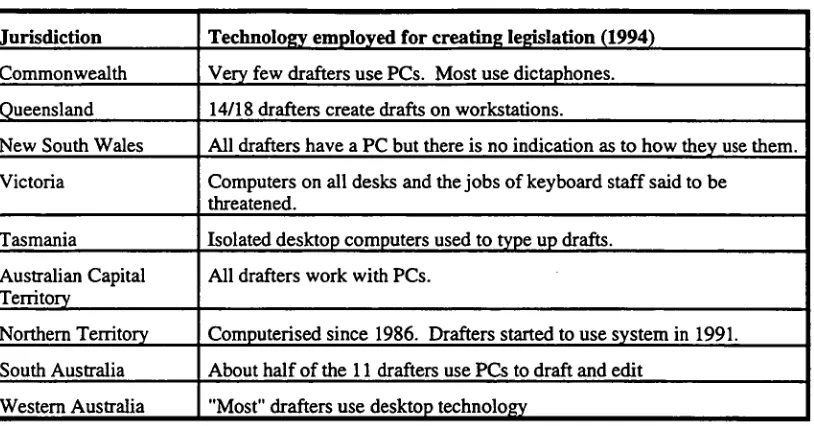
Very little computerised technology was used to aid the production of legislation in Tasmania prior to 1993, and advances in information technologies suggested solutions to the identified problems. The project's Business Case Document states:
The OPC has not benefited from improvements in information systems which have increased productivity in other areas of Government activity. Although at its core, drafting is essentially an intellectual and creative task, the process of producing legislation involves many stages which could be significantly improved by automation and access to better information systems (p 2).
The LSP formally aimed to provide:
• A legislation drafting and consolidation system within the OPC; • A legislation database controlled and maintained by the OPC; and • A communications network that provides access to the Bill drafting and
consolidation system, and the legislation database (Business Requirements Document: pp 11-12).
thisisthefirsttime automatic consolidation has been attempted. However,the overview of currentissuesinthe production oflegislationin Australia below illustratesthatthetrends promotingthe LSP are similarto otherjurisdictions.
2.1.2 The production oflegislation: Currentissues
Good qualitylegislation canleadto administrative efficiencies,reduced uncertainty when applyingthelegislation and better administrative decision making(Falkiner
1992in Lim 1993). Lim(1993)likensthe effects of producing poor quality legislationtothe high cost of maintaininginadequate software. The House of Representatives Standing Committee on Legal and Constitutional Affairs Report on Clearer Commonwealth Law(1993) suggested a number oflongstanding and new issuesin drafting also contributingtothe quality ofthelegislation. These common trends directlyinfluencedthe development ofthe LSP andtheimplementation ofthe resulting EnAct system andinclude:
• therecruitment andretention of drafters;
• general callsforlegislationthatis easierto understand; and
inadequate accessto up-to-datelegislation.
a)The recruitment and retention of drafters(ongoing backlog of work)
In mostjurisdictions,thereis nearly always a backlog of work as drafters haveto operate under stricttime pressuresto meetthe policy objectives ofthe government andindividual parliamentarians(Lim 1993). Thereis also a general shortage of trained peopleinthis area. Draftingis a specialised area oflaw andittakes considerabletimeto develop expertise. Thisis a problemin all Australian jurisdictions and had a significantimpact onthe LSP.
b)General callsforlegislationthatis easierto understand
The complexity oflegislationis commonly agreedto be anissue andresults, not only fromthelanguage employed, but alsofromthe nature ofthe policies being articulated andthe process of creatinglegislation.
Accordingto Hawkes(1994),the complexity oflegallanguage hasitsrootsinthe 13th Century, when boththe Englishlanguage andthelegal system we knowtoday were being established. Atthattime English was evolving out of Norman and other influences. Couplings of synonymous words, such as "null and void" or "cease and desist" were usedto aid clarity whenit waslikelythat people would belikelyto know
4 This comparison betweenthelegislation production process and systems developmentistakenfurther
only one of the two words and Latin terms were considered more precise than emerging local language. Long sentences were the norm, as, by law, all legislation had to be written without punctuation. Although an English statute of 1850 allowed the inclusion of full stops, the trend of long sentences persists today as novice lawyers are socialised into existing norms (Hawkes 1994).
Plain English drafting promotes the avoidance of long or convoluted sentences or unnecessary concepts and simple and clear organisation of material (Australia 1993: p 5). An.ongoing trend over the last twenty years, it began in the United States in the
1970s as part of the broader consumer movement, when people demanded insurance and other contracts that were understandable. In Australia it has been promoted by Law Reform Commissions. Plain English became an important contextual issue in the LSP, as it came to be embedded in the new system.
The complexity of legislation is commonly agreed to be an issue, but the language employed is seen as only one reason for this. Other reasons for complicated legislation include:
• complex policies to be articulated in legislation. Often policies are ill-conceived or poorly thought out. Sometimes the intrinsic complexity in a particular area may require complex legislation;
• the fact that legislation has to be created to be used by multiple audiences (Evans 1996).
• many amendments in a policy area make the corresponding legislation complex; and
• the emergent nature of the drafting process. That is, it is produced on an
incremental and iterative basis, with extensive participation. Changes often occur in policy while legislation is being created so causing the legislation to become more complicated. This approach does not aid the efficiency of the process, but is necessary to achieving effective outcomes. This emergent nature of the process became a great topic of discussion during the LSP, as will be illustrated in Part 4;
c) Inadequate access to up-to date legislation.