This is a repository copy of A sequence learning impairment in dyslexia? It depends on the
task.
White Rose Research Online URL for this paper:
http://eprints.whiterose.ac.uk/108582/
Version: Accepted Version
Article:
Henderson, Lisa M orcid.org/0000-0003-3635-2481 and Warmington, Meesha (2017) A
sequence learning impairment in dyslexia? It depends on the task. Research in
Developmental Disabilities. pp. 198-210. ISSN 1873-3379
https://doi.org/10.1016/j.ridd.2016.11.002
[email protected] https://eprints.whiterose.ac.uk/ Reuse
Items deposited in White Rose Research Online are protected by copyright, with all rights reserved unless indicated otherwise. They may be downloaded and/or printed for private study, or other acts as permitted by national copyright laws. The publisher or other rights holders may allow further reproduction and re-use of the full text version. This is indicated by the licence information on the White Rose Research Online record for the item.
Takedown
If you consider content in White Rose Research Online to be in breach of UK law, please notify us by
1
A sequence learning impairment in dyslexia? It depends on the task.
Lisa M Henderson1 & Meesha Warmington2
1 Department of Psychology, University of York
2
Abstract
Language acquisition is argued to be dependent upon an individuals’ sensitivity to serial-order
regularities in the environment (sequential learning), and impairments in reading and spelling in dyslexia have recently been attributed to a deficit in sequential learning. The present study examined the learning and consolidation of sequential knowledge in 30 adults with dyslexia and 29 typical adults matched on age and nonverbal ability using two tasks previously reported to be sensitive to a sequence learning deficit. Both groups showed evidence of sequential learning and consolidation on a serial response time (SRT) task (i.e., faster and more accurate responses to sequenced spatial locations than randomly ordered spatial locations during training that persisted one week later). Whilst typical adults showed evidence of sequential learning on a Hebb repetition task (i.e., more accurate serial recall of repetitive sequences of nonwords versus randomly ordered sequences), adults with dyslexia showed initial advantages for repetitive versus randomly ordered sequences in the first half of training trials, but this effect disappeared in the second half of trials. This Hebb repetition effect was positively correlated with spelling in the dyslexic group; however, there was no correlation between sequential learning on the two tasks, placing doubt over whether sequential learning in different modalities represents a single capacity. These data suggest that sequential learning difficulties in adults with dyslexia are not ubiquitous, and when present may be a consequence of task demands rather than sequence learning per se.
3 Sequential learning, the process through which people become sensitive to serial-order
regularities in the environment (Berry & Dienes, 1993), has been argued to be important for language learning (Conway & Christiansen, 2001). From infancy, sensitivity towards the statistical regularities of our native language allows us to develop distributional phonological knowledge (Hepper, Scott & Shahidullah, 1993; Saffran, Aslin & Newport, 1996). Notably, a lack of sensitivity to sequential information has recently been reported in adults with dyslexia (Szmalec, Loncke, Page & Duyck, 2011; Bogaerts, Szmalec, Hachmann, Page & Duyck, 2015a).
Dyslexia affects about 5% to 10% of the population and is characterised by impairments in reading and spelling that persist to adulthood (Snowling, 2008). A strong body of evidence suggests that the reading and spelling difficulties are caused by a neurocognitive deficit in phonological
processing which affects the ability to retrieve, isolate and manipulate speech sounds and hampers the learning of associations between the written and spoken forms of words (Hulme, Nash, Gooch, Lervåg, & Snowling, 2015; Ramus et al., 2003; Vellutino, Fletcher, Snowling & Scanlon, 2004; Snowling & Melby-Lervag, 2016). More recent studies suggest that this phonological deficit is most marked under conditions of high short-term memory (STM) load (Ramus & Szenkovits, 2008) and/or with the ability to access, rather than store, phonological representations (Boets et al., 2013).
4 eventually integrating a representation of the entire sequence of sounds into a word-form (e.g., the dual route cascaded model, Coltheart, Rastle, Perry, Langdon & Ziegler, 2001). Recurrences of this sequence over time leads to an increasingly robust lexical representation, allowing a familiar letter string to be automatically retrieved during reading. According to the SOLID hypothesis, individuals with dyslexia are less sensitive to such repetitions, and consequentially less likely to learn (and automatize) sequences.
Evidence for the SOLID hypothesis comes from the ‘Hebb repetition effect’ (Hebb, 1961), which has been frequently used to investigate sequence learning (e.g., Couture, Lafond, & Tremblay, 2008; Gould & Glencross, 1990; Hitch, Flude & Burgess, 2009; Mosse & Jarrold, 2008). Participants are required to immediately recall a list of stimuli (e.g., digits/words) in serial order where one particular sequence of stimuli is repeated every third trial. Recall accuracy for repeating ‘Hebb’ sequences increases considerably compared with nonrepeating ‘Filler’ sequences (the ‘Hebb
repetition effect’). This effect is argued to reflect the extent to which sequential information in verbal
STM develops into a long-term memory trace. Thus, the Hebb repetition effect has been argued to be analogous to word-form learning (Page & Norris, 2008, 2009; Szmalec, Duyck, Vaniderendonck, Barbera Mata & Page, 2009) since it reflects the extent to which a sequence of phonological units is learned as a single entity. In line with this, Bogaerts, Szmalec, De Maeyer, Page and Duyck (2016) recently reported that Hebb learning is a significant predictor of later nonword reading ability in Dutch children, supporting a role for sequential learning in reading development.
5 learning was impaired in dyslexia, STM was intact. The authors argued that this suggests that the serial order deficit cannot be reduced to a phonological STM problem (see also Hachmann, Bogaerts, Azmalec, Woumans, Duyck & Job, 2014, and Perez et al., 2012, for evidence of selective
impairments of short-term memory for serial order in dyslexia). Furthermore, it is noteworthy that 87% of the typical adults and 81% of the dyslexic participants reported awareness of the Hebb repetitions, suggesting that sequence learning was impaired in dyslexia despite participants having a certain degree of explicit knowledge.
Previous studies have reported that the Hebb repetition effect persists for at least three months (Page & Norris, 2008) and undergoes a period of off-line consolidation (the process by which an initially unstable memory trace becomes robust and amenable to automatic retrieval; Doyon et al., 2009; Robertson et al., 2004). This lends support to the analogy between Hebb learning and word-form acquisition. Individuals with dyslexia have been argued to lack automaticity when retrieving familiar word strings during reading (Kirby et al., 2010; Norton & Wolf, 2012); however, as yet, there have been few attempts to examine whether these difficulties arise at the acquisition stage, and/or during consolidation.
In one exception, Bogearts, Szmalec, Hachmann, Page & Duyck (2015) investigated the
acquisition and consolidation of the Hebb repetition effect in 25 Dutch-speaking adults with dyslexia and 25 IQ-matched controls. In a Hebb learning block, sequences of nine consonant-vowel syllables (CVs) were presented visually for immediate serial recall. The Hebb sequence was repeated on every third trial (cf. Szmalec et al., 2011) and consisted of three three-syllable groups. For Filler trials, the same syllables were used but their order was randomised. Adults with dyslexia showed a significantly smaller Hebb repetition effect than typical peers and required more repetitions of the Hebb sequence to reach the training criterion (i.e., correct recall of two consecutive Hebb trials). The group
6 Therefore, although sequential learning is weaker and slower in dyslexia, what is learned is
consolidated over time.
Despite this converging evidence, Staels and Van den Broeck (2015) failed to replicate the significantly reduced Hebb effect in adolescents and children with dyslexia, regardless of whether an identical approach to data analysis was taken (i.e., regression gradient analysis; Szmalec et al., 2011) or when state trace analysis was used to statistically equate the typical and dyslexic groups on Filler performance. The latter analysis showed that serial recall for the Filler sequences was highly predictive of serial recall for the Hebb sequences. This suggests that group differences in sequential Hebb learning could be a consequence of more general differences in serial recall or STM. Indeed, Staels and Van den Broeck (2014) compared 36 dyslexic children and 61 typical peers on an item STM task and a serial order STM task, finding that children with dyslexia were impaired on both tasks and phonological skills were closely associated with both tasks. Further evidence for the view that serial order difficulties may occur as a consequence of poor phonological STM comes from Gould and Glencross (1990), who compared children with dyslexia to typically developing peers on verbal (repeated digits) and nonverbal (repeated blocks) versions of the Hebb repetition paradigm: Whilst the dyslexic group showed poorer performance on the verbal task the two groups were comparable on the nonverbal task, suggesting that dyslexia is not characterised by a general deficit in sequential learning.
Sequential learning has also been measured using the serial reaction time (SRT) paradigm (Nissen & Bullemer, 1987), in which participants respond to each of a series of stimuli by pressing a
corresponding button. Sequential learning is revealed by a decline in performance when a predictable repeating pattern (the ‘sequenced’ condition) is replaced by a final block of randomly sequenced
7 sequential learning, there has been no attempt to examine whether these tasks tap a unified sequence learning capacity.
Word reading ability has been reported to correlate with the sequence learning effects obtained from the SRT task (Howard et al., 2006), supporting the notion that sequence learning may be reflective of the extent to which phoneme-grapheme mappings are consolidated when learning to read. Consistent with this, reduced sequence learning on the SRT task has been found in adults (Menghini, Hagberg, Caltagirone, Petrosini & Vicaria, 2006; Stoodley, Harrison & Stein, 2006) and children (Hedenius et al., 2013; Jimenez-Fernandez et al., 2011; Vicari et al., 2003, 2005) with dyslexia. Furthermore, a recent meta-analysis suggested that, when averaging across studies, individuals with dyslexia have procedural learning deficits on SRT tasks (Lum, Ullman & Conti-Ramsden, 2013). However, a growing number of studies have also reported intact SRT learning in dyslexia (Deroost et al., 2010; Kelly, Griffiths, & Frith, 2002; Russeler et al., 2006; Waber et al., 2003). These inconsistencies may be partly a consequence of participant characteristics. Studies rarely control for the presence of co-occurring conditions such as specific language impairment (SLI) which has been associated with impairments on this task (e.g., Hedenius et al., 2011; Lukacs & Kemeny, 2014; Lum, Gelgec, & Conti-Ramsden, 2010; Tomblin, Mainela-Arnold & Zhang, 2007). Other studies have reported sequence learning deficits in dyslexia only under specific conditions, including when the task taps higher-order sequence learning (i.e., the stimulus on trial n predicted the stimulus on trial n + 2) (Howard et al., 2006) or when the task is made more implicit (Jimenez-Fernandez et al., 2011; Sperling et al., 2004; Vicari et al., 2003; although see Deroost et al., 2010).
8 accuracy, although the groups were matched overall, the children with dyslexia showed a smaller sequence learning effect on day 2. The authors concluded that the sequence learning impairment in dyslexia may be most pronounced in the learning stages beyond the acquisition phase. This is consistent with other data from dyslexic participants showing intact performance initially but impairments after a delay in sequentially-demanding finger tapping tasks (Needle, Nicolson and Fawcett., 2010). However, the children with dyslexia in Hedenius et al. showed traits of SLI (e.g., significantly poorer nonword repetition and a trend for poorer receptive grammar), therefore it is possible that the reported group differences in sequence learning were a consequence of language impairment.
9 better at learning and consolidating sequential information should also have better word reading and/or spelling skills.
Method
Participants
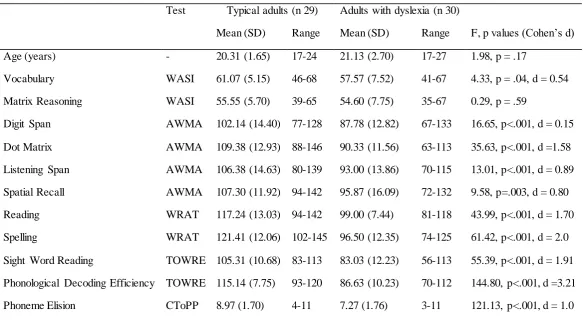
Thirty adults with dyslexia (11 males) and twenty-nine typical adults (12 males) took part in this study, recruited from the University of York and York College. Adults with dyslexia confirmed they had received a formal diagnosis of dyslexia and did not have any other documented language or learning difficulties. Although the adults with dyslexia were well compensated (to the extent they were pursuing further/higher education) they nonetheless demonstrated classic behavioural features of dyslexia on a suite of standardised tests (see Table 1). At a group level, the adults with dyslexia were well matched to typical adults on nonverbal IQ and age, but they performed significantly worse on measures of literacy (word and nonword reading accuracy and fluency and spelling), language (vocabulary and phoneme awareness), STM and working memory. Twenty-two of the 30 adults with dyslexia scored <85 on one or more of the Sight Word Reading Efficiency, Phonemic Decoding Efficiency, or Spelling subtests (see Table 1); of the remaining 8 adults with dyslexia, all scored within the low average range (<92) on at least one of these measures and had at least a 15 standard score discrepancy between one of these measures and nonverbal IQ (as measured by Matrix Reasoning). All participants were native English speakers and had normal or corrected to normal vision and hearing. This study was ethically approved by the Department of Psychology Ethics Committee, University of York, and all participants provided informed consent.
Design and materials
10 Hebb task. Participants were presented with sequences of six spoken monosyllabic and bisyllabic nonwords presented via headphones for immediate (spoken) serial recall. At recall, the participants were asked to produce the sequence from memory, by saying the nonwords aloud to the experimenter and saying “don’t know” for any omitted item (see Szmalec et al., 2011 for a similar recall procedure). On Day 1 each participant heard 26 sequences: 8 repeated sequences of the nonwords (i.e., the ‘Hebb’ sequence) and 18 ‘Filler’ sequences which contained the same nonwords in
a randomised order. We opted to use sequences of nonsense words rather than sequences of nonsense syllables (as used in Szmalec et al., 2011; Bogaerts et al., 2015a) in an attempt to maximise demands on serial order learning in a sample of well-compensated adult dyslexics. The Hebb list appeared every third trial. Two versions of this task were created with two different sets of nonwords, counterbalanced across participants (Version A: clodge, glindoon, twamket, sote, thrisp, marmuss; Version B: gleich, phleeb, subken, plexfort, twooge, knochsmeeve). On Day 2 and Day 8, participants received three trials in a standardised order (Filler, Hebb, Filler), with the order of the nonwords in each Filler trial differing to any of the Filler trials of any session. At the end of Day 8 participants were asked if they were aware of a recurring sequence across the three sessions. Less than a quarter of participants were aware of the repeated sequence (dyslexics mean 23%, SD=5.67%, typical adults mean 28%, SD=6.98%; p>.05).
SRT task (based on Henderson, Weighall, Brown & Gaskell, 2012). Participants were presented with four identical squares arranged horizontally on the computer screen. On each trial a smiley face appeared in a different square and participants pressed one of four corresponding buttons on a keyboard as quickly and accurately as possible. Five blocks of trials were presented on Day 1. Blocks comprised 72 trials, with five occurrences of a pre-specified sequence of 8 trials which were
11 traditional design is confounded by fatigue effects and increases the likelihood of explicit awareness of the sequence. The sequence was eight trials in length, with the first two trials considered as random. There were an equal number of random and sequenced trials and across the whole task the stimulus appeared in each of the four positions 25% of the time. Four practice trials were
administered. Participants received a short break between blocks of no more than 30 seconds. On Day 2 and Day 8 participants received two blocks of trials: A ‘warm-up’ blockfollowed by a ‘test block’. These blocks were the same as administered in Day 1 (counterbalanced across participants);
however, the random trials were presented in reverse order. Participants were asked if they were aware of a repeating sequence at the end of Day 8 (dyslexia mean 20%, SD=8.13%, typical adults mean 21%, SD=6.72%; p>.05).
A motor tapping task was administered to ascertain whether any observed group differences in SRT performance could be attributed to poor motor control. Participants were asked to tap a key on a keyboard as many times as possible in 5 seconds. The start and end of the 5 second interval was signalled both visually and aurally (via a tone). The task consisted of three conditions with 6 trials in each condition. In condition 1 the participants were instructed to tap one key using the index finger of their preferred hand. In condition 2 participants were instructed to alternately tap 2 keys using the index finger of their preferred hand. In condition 3 participants were instructed to alternately tap 2 keys using the first 2 fingers of their preferred hand. Across the three conditions, motor processing speed in adults with dyslexia (mean ms/tap 267ms, SD=55.54) was significantly slower than for typical adults (mean ms/tap 224ms, SD=35.11), F(1, 58)=12.77, p< .001.
Procedure
12 completed the explicit generation tasks at the end of the session. The standardised measures were administered in a separate session prior to the experimental tasks.
Results
Is the learning and/or consolidation of sequential information impaired in dyslexia?
Hebb Repetition
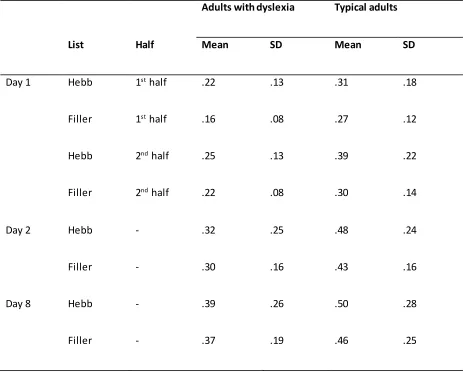
Day 1. A response was given a score of 1 if it was recalled in its correct serial position. For example, if a participant recalled items 1, 2, 5, 6 but omitted items 3 and 4, they received a score of 4. Following Mosse and Jarrold (2008, 2010) 1, the data were analysed by collapsing data from the eight
trials of each Hebb list and the 18 trials from the Filler list into scores for the first and second half of trials (see Table 2). Good split half reliability was demonstrated between the first and second halves of the Filler lists (r(59)=.77, p< .001) and the Hebb lists (r(59)=.60, p<.001).
A mixed-design ANOVA was performed on the accuracy data (i.e., proportion correct) with Group (typical adults, adults with dyslexia) as the between-subjects variable and List (Hebb, Filler) and Half (First, Second) as within-subjects variables. There was a significant main effect of Group: The dyslexic adults produced significantly less accurate serial recall responses than the typical peers, F(1, 57)=12.16, p<.001, p2=.18. There were also significant main effects of List (superior recall for
Hebb versus Filler lists), F(1, 57)=13.79, p< .001, p2=.20, and Half (superior recall in the second half
of the trials), F(1, 57)=19.45, p<.001, p2=.25, and a marginally significant List x Half x Group
interaction, F(1, 57)=3.99, p= .051, p2=.07. As predicted, typical adults did not show a significant
Hebb repetition effect in the first half of trials (mean difference .04, SD=.12, 95% CI -.01-.09,
1Szmalec et al (2011) and Bogaerts et al (2015a) analysed the Hebb repetition effect by calculating the gradient of the regression line through points representing the performance on successive Hebb repetitions and
comparing it with the gradient for corresponding Filler lists, for each individual participant. This procedure has been criticised by Staels and Van den Broek (2015) on the grounds that if two groups differ in Filler
13 t(28)=1.79, p>.05), but they did show a significant Hebb repetition effect in the second half of trials (mean difference .09, SD=.17, 95% CI .03-.16, t(28)=2.98, p<.01). For the adults with dyslexia, a small but statistically significant Hebb repetition effect was observed in the first half of trials (mean difference .05, SD=.12, 95% CI .02-.01, t(29)=2.35, p<.05), but not in the second half of trials (mean difference .03, SD=.11, 95% CI -.01-.07, t(29)=1.41, p>.05). In sum, the dyslexic adults were less accurate at serially recalling the novel word sequences overall, and in contrast to typical adults, they showed a significant Hebb repetition effect in the first, but not the second, half of trials.
Consolidation (Day 1, 2, and 8). The mean proportion of nonwords recalled in their correct serial position for Hebb and Filler conditions on Days 1, 2 and 8 of the study are presented in Table 2. To examine the influence of off-line consolidation on the Hebb repetition effect the accuracy data (i.e., mean proportion nonwords correct per trial) were entered into a 2 (Day: Day 1, Day 2, Day 8) x 2 (List: Hebb, Filler) x 2 (Group; adults with dyslexia, typical adults) mixed-design ANOVA. Day 1 data represents performance on the second half of the training trials. Data for one of the typical adults was not available for Day 2 and Day 8 due to attrition.
There was a significant main effect of List (F(1, 56)=5.48, p<.05, p2=.09): Recall accuracy
was significantly better for Hebb than for Filler trials. There was a significant main effect of Session, F(2, 112)=17.63, p<.001, p2=.24: Day 2 recall was significantly better than Day 1 recall (t(57)=-3.49,
p<.01), and Day 8 recall was significantly better than Day 2 recall (t(57)=-2.40, p<.05). There was also a significant main effect of Group, F(1, 56)=10.63, p<.01, p2=.16: Dyslexics were less accurate
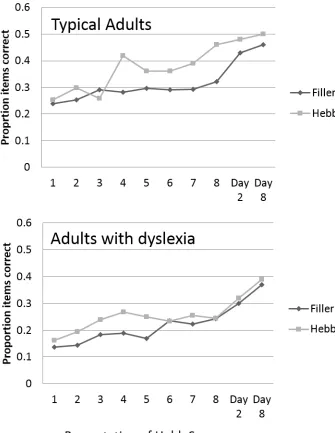
14 Hebb repetition effect on Day 1 (t(29)=1.41, p=.17), Day 2 (t(29)=.40, p=.69) or Day 8 (t(29)=0.44, p=.66). In sum, although the Hebb repetition effect was significant when collapsing across days, the difference between Hebb and Filler trials weakened rather than strengthened for the typical adults by Day 2 and remained weak on Day 8. Indeed, as well as showing improvements in Hebb recall
accuracy over the week, performance improved for Filler recall, which likely accounts for the reduced Hebb effect on Days 2 and 8.
Nevertheless, Figure 1 shows that Hebb performance did increase over the week of the experiment, therefore to examine whether Hebb performance increases over the week of the experiment to a greater extent than Filler performance, an additional exploratory analysis was performed. To produce an index of retention of the Hebb sequence over time, Bogaerts et al (2015a) subtracted the proportion correct on the first Hebb trial of their follow-up session from the proportion correct on the final Hebb trial of the initial training session for each participant, and divided these differences by participants’ final Hebb trial accuracy from the initial training session. Following this
procedure, we calculated retention scores for the Day 1 and Day 2 interval, and the Day 1 and Day 8 interval for both Hebb trials and Filler trials, and entered this data into a List (Hebb, Filler) x Session (Day 1-2 retention; Day 1-8 retention) x Group (dyslexic, typical adults) mixed-design ANOVA. There was a significant main effect of Session, F(1, 56)=9.25, p<.01, p2=.14, and a significant
Session x List interaction, F(1, 56)=20.42, p<.001, p2=.27. Similar retention scores were observed for
15 Group, F<1, List x Group, F<1, Session x Group, F<1, List x Session x Group, F<1), therefore, consistent with the preceding analysis, this suggests that dyslexic and typical adults were showing similar consolidation effects across the week of the experiment. Indeed, the pattern of significantly larger retention of Hebb than Filler recall between Day 1 and Day 8 held for both typical (mean difference = .38, SD=.93, t(27)=2.18, p<.05) and dyslexic adults (mean difference = .58, SD=1.01, t(29)=3.14, p<.01).
SRT task
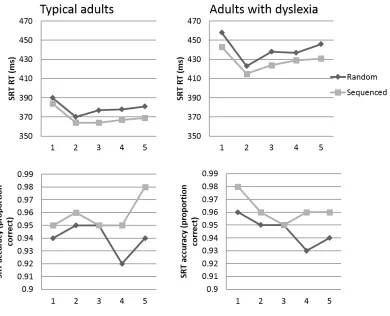
Day 1 Response time (RT). RT was analysed for correct responses only and RTs <200ms and >2.5 SDs from the mean (for each participant, and for each session) were excluded (2.1% of total trials for typical adults (SD=.01%); 1.8% of total trials for adults with dyslexia (SD=.01% ). To test the hypotheses that RTs would be faster for sequenced than random trials and that this effect would increase in magnitude across the training blocks the RT data were entered into a 2 (Group: typical adults, adults with dyslexia) X 2 (Condition: sequenced, random) X 5 (Block; 1, 2, 3, 4, 5) mixed-design ANOVA. RT was faster for sequenced than random conditions (Condition, F(1,57)=17.79, p< .001, p2=.24). RT decreased across training blocks (Block, F(4,57)=7.47, p<.001, p2=.12). Adults
with dyslexia were slower to respond overall than typical adults (Group, F(1,57)=5.38, p< .05,
p2=.09). There were no significant interactions: Condition X Block (F<1), Condition X Group (F<1),
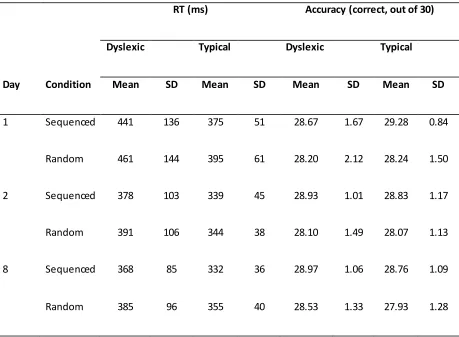
16 (t(29)=1.56,p=.13), 3 (t(29)=1.88,p=.07), or 4 (t(29)=0.97,p=.34). Therefore, although adults with dyslexia showed a slightly more variable pattern over the training blocks, importantly, both groups produced faster responses to sequenced than random conditions by the final training block. Furthermore, when collapsing across Blocks, significantly faster responses were found for sequenced than random conditions for typical adults (mean difference 9.54ms, SD=20.45, 95% CI 1.76-17.32ms, t(28)=2.51, p<.05) and adults with dyslexia (mean difference 12.19ms, SD=19.13, 95% CI 5.05-19.34ms, t(29)=3.49, p<.01). In sum, although the dyslexic group were slower than typical peers overall, there was no statistical support for a smaller sequential learning effect in dyslexia.
To ascertain the evidence for accepting the null hypothesis (i.e., no difference in sequence
learning between dyslexics and controls), the group difference in the size of the sequence learning
effect in the final training block was examined using a Bayesian independent t test (Rouder,
Speckman, Sun, Morey & Iverson, 2009; Wagenmakers, 2007), as implemented in the JASP software
(https://jasp-stats.org/). The Bayes factor (BF01), reflecting the evidence in favour of the null
hypothesis when tested against the one-tailed prediction that the difference scores for the dyslexic
group would be smaller than the control group, revealed that the data were 4.91:1 in favour of the null
hypothesis (error % 3.75; at Cauchy prior widths of 0.75, 1, and 1.5, the BF01 was 4.91, 6.67, and
9.26, respectively). Thus, the data were 4.91 times more likely to occur under a model without
including an effect of dyslexia on sequence learning, versus a model with it. This represents moderate
evidence in support of the null hypothesis.
Day 1 Accuracy. The mean number of correct trials for each participant were entered into a 2 (Group: typical adults, adults with dyslexia) X 2 (Condition: sequenced, random) X 5 (Block: 1, 2, 3, 4, 5) mixed-design ANOVA. Accuracy was higher for sequenced than random conditions (Condition, F (1, 57)=11.44, p= .001, p2 = .17). There was a significant main effect of Block (F (4, 57)= 4.69, p=
.001, p2=.08): There was no significant difference between Block 1 and 2 (t<1), Block 2 and 3
17 significantly higher than Block 4 (t(58)=2.71,p<.05). The main effect of Group was not significant, F (1, 57) = .25, p= .620, p2 = .00. There was also a significant Condition x Block interaction,
F(4,57)=2.54, p<.05, p2=.04: There was no significant difference in accuracy between random and
sequenced conditions for Block 1 (t(58)=1.71,p>.05), Block 2 (t(58)=1.56,p>.05) or Block 3 (t(58)=0.68,p>.05); however, accuracy was significantly higher for sequenced than random trials for Block 4 (t(58)=3.53,p<.01) and Block 5 (t(58)=3.26,p<.01). There were no other significant interactions (Condition X Block, Condition X Group, Condition X Block X Group, Fs<1). Pairwise t tests confirmed that neither group showed a significant difference between sequenced and random conditions for Block 1 (typical, t(28)=1.11,p>.05; dyslexia, t(29)=1.36,p>.05), Block 2 (typical, t(28)=1.61, p>.05; dyslexia, t(29)=0.68,p>.05), or Block 3 (typical, t(28)=0.74,p>.05; dyslexia, t(29)=.61,p>.05); however both groups showed higher accuracy for sequenced than random conditions in Block 4 (typical, t(28)=2.33,p<.05; dyslexic, t(29)=2.61,p<.01) and for Block 5 the effect was significant for typical adults (t(28)=2.85,p<.01) and non-significant but in the expected direction for dyslexic adults (t(29)=1.68,p>.05). Therefore, as for the RT analysis, adults with and without dyslexia showed evidence of sequential learning on the SRT task, as evidenced by significant higher accuracy for sequenced than random conditions, particularly in the final training blocks.
Consolidation (Day 1, 2 and 8) RT. To examine performance across the week of the experiment, the RT data were entered into a 2 (Group: typical adults, adults with dyslexia) X 2 (Condition: sequenced, random) X 3 (Session: Day 1, Day 2, Day 8) mixed-design ANOVA. RT was faster for sequenced than random conditions (Condition, F(1, 57)=30.25, p<.001, p2=.35). RT was
faster on Day 2 than Day 1 (t(58)=9.36,p<.001) but did not differ between Day 2 and Day 8 (t(58)<1) (Session, F (2,57)= 74.40, p< .001, p2=.57). The adults with dyslexia were slower overall than the
typical adults (Group, F (1,57)= 4.83, p< .05, p2= .08). There was a significant Day X Group
interaction (F(2,57)= 5.15, p=.007, p2= .08): On Day 1 and Day 2 the dyslexics were slower than the
18 significant (F (2,57)= 3.51, p= .033, p2= .06): RT was faster for sequenced than random conditions
on each day; however this effect was weaker on Day 2 (Day 1, t(58)=4.15,p<.001, Day 2, t(58)=2.19,p<.05, Day 8, t(58)=6.07,p<.001): The typical adults showed significantly faster responses to sequenced than random conditions at the end of Day 1 (t(28)=2.04,p<.05), and on Day 8 (t(28)=5.02, p<.001) but this effect was not significant on Day 2 (t(28)=0.82,p=.42), whereas the adults with dyslexia showed a significant sequence learning effect on all days (Day 1, t(29)=2.89,p<.01; Day 2, t(29)=2.19,p<.05; Day 8, t(29)=3.59,p<.001). There were no other significant interactions: Condition X Group (F<1), Condition X Day X Group (F (2,57)= 1.22, p= .298, p2= .02). In sum, both groups showed a nonverbal sequential learning effect on the SRT task
which became stronger by Day 8.
Consolidation (Day 1, 2 and 8) Accuracy. The accuracy data were entered into a 2 (Group: typical adults, adults with dyslexia) X 2 (Condition: sequenced, random) X 3 (Day: Day 1, Day 2, Day 8) mixed-design ANOVA. Accuracy was higher for sequenced than random conditions overall (Condition, F (1,57)= 20.73, p< .001, p2= .27). There were no main effects of Day (F<1) or Group
(F<1) and no significant interactions: Condition X Group, F<1, Day X Group, F(2,57)= 2.17, p> .05,
p2=.04, Condition X Day, F<1, Condition X Day X Group, F<1.
Is performance on the two sequential learning tasks associated?
There were no significant correlations between the Hebb repetition effect (calculated from the second half of Day 1 trials) and SRT effect (calculated from the final block of training) for SRT accuracy (typical adults, r(29)=.11, p>.05, dyslexic adults, r(30)=-.14, p>.05) or SRT RT (typical adults, r(29)=-.24, p>.05, dyslexic adults, r(30)=.10, p>.05).
Are markers of dyslexia associated with variance in sequential learning?
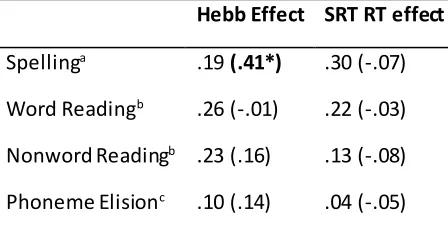
19 Filler accuracy, partialling out Filler accuracy), and SRT effect scores (= Random RT – Sequenced RT, partialling out Random RT). The Hebb effect scores were calculated from the second half of trials; SRT effect scores were calculated from Block 5 of training. For the adults with dyslexia, there was a significant positive correlation between spelling and the Day 1 Hebb effect (r=.41, p< .05). No other correlations were statistically significant.
Discussion
Sensitivity to sequential patterns in environment input has been argued to be crucial for language acquisition, and has been pinpointed as a potential core deficit of dyslexia. This study examined the learning and consolidation of sequential information in adults with dyslexia and typical peers matched on nonverbal ability and age. We examined whether two tasks previously argued to be measures of ‘sequence learning’ (the Hebb repetition and SRT tasks) tap into a common capacity, and thus
whether we would see deficits on both tasks in dyslexia and correlations between tasks. Finally, we examined whether variability in sequential learning is associated with individual differences in key markers of dyslexia.
A Hebb repetition effect was demonstrated in typical adults, consistent with previous research (Couture, Lafond, & Tremblay, 2008; Hitch, Flude & Burgess, 2009; Mosse & Jarrold, 2008; Page & Norris, 2008, 2009). Namely, repeating lists of nonwords served to significantly improve serial recall, such that in the second half (but not the first half) of the training trials adults showed superior recall of repetitive Hebb lists than compared to non-repeating Filler lists.
20 were also group differences in sequence learning across the trials on Day 1. Specifically, the adults with dyslexia demonstrated a small but significant Hebb effect over the first four trials but not over the second four trials. This falls in stark contrast to the typical adults, who showed the reverse, expected pattern: a significant Hebb effect in the second half of trials but not in the first half. A fatigue-based explanation for this group interaction is unlikely, given that the adults with dyslexia continued to show improvements in their recall of the Filler lists during the second half of trials (see Figure 1). One explanation is that ‘dual learning’ of both the correct responses and errors may occur
in Hebb repetition tasks (Couture et al. (2008). Indeed, the dyslexic group were more error-prone (likely as a consequence of poor phonological encoding), and this may have had the detrimental effect of increasing interference as a consequence of learning these errors over the course of training,
leading them to require an even greater number of sequence repetitions to recover from this
interference. An alternative explanation could be that the adults with dyslexia showed an increased susceptibility to ‘proactive interference’ during the Hebb task (see also Bogaerts, Szmalec,
Hachmann, Page, Woumans, & Duyck, 2015b). Proactive interference could have originated from the fact that the filler and Hebb lists were constructed from the same items, which means that
participants’ memory traces for previous items may have interfered with their ability to learn new
memory traces, with this effect accumulating across trials. A similar ‘proactive interference’ account of Hebb repetition deficits has been proposed in dyscalculia, which has a high co-occurrence rate with dyslexia (De Visscher, Szmalec, Van Der Linden, & Noel, 2015).
21 words (e.g., gleich, phleeb, subken, plexfort, twooge, knochsmeeve), in Staels and Van den Broeck (2015, following Szmalec et al., 2011), participants recalled strings of nine nonsense syllables (e.g., da-fi-ke-mo-pu-sa-ti-vo-zu). Thus, the phonological STM demands were arguably greater in the present study, leaving more room for interference (i.e., from phonological errors and/or recurring item presentations) over training trials.
If word learning is errorful as a consequence of a phonological deficit in dyslexia then more exposures to orthographic or phonological forms of words may be required before a correct
orthographic sequence is stored, permitting automatic retrieval from long-term memory. In line with this view we found a positive correlation between the Hebb repetition effect on Day 1 and spelling in the adults with dyslexia, such that adults with better spelling ability also showed larger sequence learning effects on the Hebb task (i.e., requiring less exposures to the sequence for effective sequence learning than adults with poorer spelling ability). Thus, the effect of a phonological deficit on
sequential learning could provide one explanation for spelling difficulties in dyslexia. Consistent with this idea, Warmington and Hitch (2014) found that errorful training procedures impaired the
acquisition of novel words in typical adults, when compared to errorless methods. The errorless advantage was underpinned by a reduction in extra-experimental intrusion errors, and persisted for at least 4 days after training. In line with the present interpretation, it was argued that errorless learning procedures improve retrieval by initiating the formation of well-specified representations in long-term memory.
22 dyslexic adults. This lends some support to a longer-lasting sequential learning effect, consistent with claims that the Hebb effect can persist for up to 3 months (Page & Norris, 2008, 2009). Importantly, these data also suggest that although dyslexic adults may have difficulties with the initial acquisition of a sequence they can consolidate what they learn.
For the SRT task, although the adults with dyslexia were slower and more variable in their responses overall and showed poorer performance on the motor control task (see also Kelly et al., 2002), both groups showed faster and more accurate responses to sequenced than random trials and showed this sequence learning effect by the end of the training task. Furthermore, the SRT sequence learning effect was more robust across the week of the experiment for the dyslexic group than for the typical controls, suggesting that both learning and consolidation of sequential information from the SRT task is spared. Together, this suggests that sequence learning on the SRT task is intact in adults with dyslexia, in line with a growing set of studies (e.g., Deroost et al., 2010; Kelly et al., 2002; Russeler et al., 2006). Some studies have argued that sequence learning is intact in dyslexia when the sequence is more explicit (e.g., Howard et al., 2006; Jimenez-Fernandez et al., 2011; Vicari et al., 2003); however, our participants were largely unaware of the repeating sequence, ruling out this explanation. Another possibility is that some of the previous reports of deficits on the SRT task in dyslexia may have been due to the presence of co-occurring language learning impairment (Lum et al., 2010; Tomblin et al., 2007; Hedenius et al., 2011; Ullman, 2004), since the present study recruited only verbally able individuals who did not have a documented history of language impairment.
23 Without replication and further study it is difficult to speculate about why individuals with dyslexia would show an initial early sensitivity to sequential information. One possibility could be that slower overall RTs allowed for an early difference to emerge between conditions in the dyslexic group. Regarding the late emergence of the sequence learning effect in Block 5, as for the Hebb task, it is possible that the adults with dyslexia were experiencing more interference from Filler items than typical adults, which resulted in them requiring a greater number of repetitions before the sequence learning effect re-emerged by Block 5.
Given the statistically robust deficit on the phonologically demanding Hebb task, but not on the SRT task, it is tempting to conclude that sequence learning difficulties in dyslexia may be more likely when the task has greater verbal or phonological STM demands (see also Gould & Glencross, 1990). Whilst this is one likely explanation, there are other ways in which the two tasks differ beyond the nature of the material that could also account for the data (e.g., the use of two different dependent variables, namely recall accuracy versus motor response time; serial list recall versus a response to each item). Therefore, an important direction for future research will be to examine the precise conditions under which a sequence learning deficit emerges in dyslexia.
There was no evidence of an association between sequence learning on the Hebb task and
sequence learning on the SRT task. Thus, an individual’s ability to learn a sequence of nonwords bore no reflection on how well they learned a sequence of spatial locations. Moreover, whilst the Hebb repetition effect on Day 1 correlated with spelling in the adults with dyslexia, we did not see
24 correlate with reading both cross-sectionally and longitudinally (Bogaerts et al., 2016) as well as with spelling in the present study, the reliability of this effect remains to be systematically examined.
In conclusion, the results from this study suggest that sequence learning difficulties are not ubiquitous in dyslexia. Markers of dyslexia (i.e., spelling) were only correlated with sequence learning for the verbally demanding Hebb task and there was no association between the two sequential learning tasks for either group, questioning whether these tasks are tapping a single capacity. Together with an accumulation of previous studies (e.g., Deroost et al., 2010; Gould & Glencross, 1990; Kelly, Griffiths, & Frith, 2002; Russeler et al., 2006; Staels & Wim Van den Broeck, 2014, 2015; Waber et al., 2003), this suggests that the pursuit for global group differences in sequence learning tasks in dyslexic versus non-dyslexic groups is unlikely to have substantial theoretical or practical importance. Rather, future studies should focus on identifying the precise conditions that influence the extent to which sequence learning can emerge over time, including the nature of the sequence to-be-learned and the influence of proactive inference and errorful learning.
References
Baddeley, A., Gathercole, S., & Papagno, C. (1998). The phonological loop as a language learning device.
Psychological review, 105(1), 158.
Berry, D. C., & Dienes, Z. (1993). Implicit learning: Theoretical and empirical issues. Hove: Lawrence Erlbaum.
Boets, B., de Beeck, H. P. O., Vandermosten, M., Scott, S. K., Gillebert, C. R., Mantini, D., ... & Ghesquière,
P. (2013). Intact but less accessible phonetic representations in adults with dyslexia. Science,
342(6163), 1251-1254.
25
Bogaerts, L., Szmalec, A., Hachmann, W. M., Page, M. P., Woumans, E., & Duyck, W. (2015b). Increased
susceptibility to proactive interference in adults with dyslexia? Memory, 23, 268-277.
Bogaerts, L., Szmalec, A., De Maeyer, M., Page, M.P.A., Duyck, W. (2016). The involvement of long-term serial order memory in reading development: A longitudinal study. Journal of Experimental Child Psychology, 145, 139-156.
Cleeremans, A., Destrebecqz, A., & Boyer, M. (1998). Implicit learning: News from the front. Trends in Cognitive Sciences, 2, 406 – 416.
Conway, C. M., & Christiansen, M. H. (2001). Sequential learning in non-human primates. Trends in
cognitive sciences, 5(12), 539-546.
Coltheart, M., Rastle, K., Perry, C., Langdon, R., & Ziegler, J. (2001). DRC: a dual route cascaded model of
visual word recognition and reading aloud. Psychological review, 108(1), 204.
Couture, M., Lafond, D., & Tremblay, S. (2008). Learning correct responses and errors in the Hebb repetition
effect: Two faces of the same coin. Journal of Experimental Psychology: Learning, Memory, and
Cognition, 34(3), 524.
Deroost, N., Zeeuws, I., & Soetens, E. (2006). Effector-dependent and response location learning of probabilistic sequences in SRT tasks. Experimental Brain Research, 171, 469-480.
Deroost, N., Zeischka, P., Coomans, D., Bouazza, S., Depessemier, P., & Soetens, E. (2010). Intact first-and
second-order implicit sequence learning in secondary-school-aged children with developmental
dyslexia. Journal of clinical and experimental neuropsychology, 32(6), 561-572.
De Visscher, A., Szmalec, A., Van Der Linden, L., & Noël, M.-P. (2015). Serial-order learning impairment
26 Di Betta, A.M., & Romani, C. (2006). Lexical learning and dysgraphia in a group of adult developmental
dyslexics. Cognitive Neuropsychology, 23, 376-400.
Dienes, Z. (2014). Using Bayes to get the most out of non-significant results. Frontiers in Psychology, 5: 781.
Douglas, V.I., & Benezra, E. (1990). Supraspan verbal memory in attention deficit disorder with
hyperactivity, normal and reading-disabled boys. Journal of Abnormal Child Psychology, 18, 617-638.
Doyon, J., Korman, M., Morin, A., Dostie, V., Tahar, A. H., Benali, H., & Carrier, J. (2009). Contribution of
night and day sleep vs. simple passage of time to the consolidation of motor sequence and visuomotor
adaptation learning. Experimental Brain Research, 195(1), 15-26.
Gould, J. H., & Glencross, D. J. (1990). Do children with a specific reading disability have a general
serial-ordering deficit?. Neuropsychologia, 28(3), 271-278.
Elbro, C. & Jensen, M.N. (2005). Quality of phonological representations, verbal learning, and phoneme awareness in dyslexic and normal readers. Scandinavian Journal of Psychology, 46, 375-384.
Forster, K. I., & Forster, J. C. (2003). DMDX: A Windows display program with millisecond ac curacy.
Behavior Research Methods, Instruments, & Computers, 35(1), 116-124.
Gathercole, S. E., Alloway, T. P., Willis, C., & Adams, A. M. (2006). Working memory in children with
reading disabilities. Journal of experimental child psychology, 93(3), 265-281.
Hachmann, W. M., Bogaerts, L., Szmalec, A., Woumans, E., Duyck, W., & Job, R. (2014). Short-term
memory for order but not for item information is impaired in developmental dyslexia. Annals of
dyslexia , 64(2), 121-136.
27 Hedenius, M., Persson, J., Tremblay, A., Adi-Japha, E., Verissimo, J., Dye, C.D., Alm, P., Jennische, M.,
Tomblin, J.B., & Ullman, M.T. (2011). Grammar predicts procedural learning and consolidation deficits in children with specific language impairment. Research in Developmental Disabilities, 32, 2362-2375.
Hedenius, M., Persson, J., Alm, P. A., Ullman, M. T., Howard, J. H., Howard, D. V., & Jennische, M. (2013).
Impaired implicit sequence learning in children with developmental dyslexia. Research in
developmental disabilities, 34(11), 3924-3935.
Henderson, L. M., Weighall, A. R., Brown, H., & Gareth Gaskell, M. (2012). Consolidation of vocabulary is
associated with sleep in children. Developmental science, 15(5), 674-687.
Hepper, P. G., Scott, D., & Shahidullah, S. (1993). Newborn and fetal response to maternal voice. Journal of
Reproductive and Infant Psychology, 11(3), 147-153.
Hitch, G., Flude, B., & Burgess, N. (2009). Slave to the rhythm: Experimental tests of a model for short-term memory and long-term sequence learning. Journal of Memory and Language, 61, 111.
Howard, J.H., Howard, D.V., Japikse, K.C., & Eden, G.F. (2006). Dyslexics are impaired on implicit higher-order sequence learning, but not on implicit spatial context learning. Neuropsychologia, 44, 1131-1144.
Hulme, C., Nash, H. M., Gooch, D., Lervåg, A., & Snowling, M. J. (2015). The Foundations of Literacy
Development in Children at Familial Risk of Dyslexia. Psychological science, 0956797615603702.
Jimenez-Fernandez, G., Vaquero, J.M.M., Jimenez, L., & Defior, S. (2011). Dyslexic children show deficits in implicit sequence learning, but not in explicit sequence learning or contextual cueing. Annual of Dyslexia, 61, 85-110.
28 Kinsbourne, M., Rufo, D. T., Gamzu, E., Palmer, R. L., & Berliner, A. K. (1991). Neuropsychological deficits
in adults with dyslexia. Developmental Medicine and Child Neurology, 33, 763–775.
Kirby, J. R., Georgiou, G. K., Martinussen, R., Parrila, R., Bowers, P., & Landerl, K. (2010). Naming speed and reading: From prediction to instruction. Reading Research Quarterly, 45, 341–362. Ht
Kramer, J.H., Knee, K., Delis, D.C. (2000). Verbal memory impairments in dyslexia. Archives of Clinical Neuropsychology, 15(1), 83-93.
Lukács, Á., & Kemény, F. (2014). Domain-general sequence learning deficit in specific language
impairment. Neuropsychology, 28(3), 472.
Lum, J.A., Gelgec, C., & Conti-Ramsden, G. (2010). Procedural and declarative memory in children with and without specific language impairment. International Journal of Language and Communication Disorders, 45, 96-107.
Lum, J. A., Ullman, M. T., & Conti-Ramsden, G. (2013). Procedural learning is impaired in dyslexia:
Evidence from a meta-analysis of serial reaction time studies. Research in developmental
disabilities, 34(10), 3460-3476.McGee, R. Williams S., Moffitt, T., & Anderson, J. (1989). A
comparison of 13-year-old boys with attention deficit or reading disorder on neuropsychological measures. Journal of Abnormal Child Psychology, 17, 37–53.
Menghini, D., Hagberg, G.E., Caltagirone, C., Petrosini, L., & Vicari, S. (2006). Implicit learning deficits in dyslexic adults: An fMRI study. NeuroImage, 33, 1218 – 1226.
Michaels, C. A., Lazar, J. W., & Risucci, D. A. (1997). A neuropsychological approach to the assessment of adults with learning disabilities in vocational rehabilitation. Journal of Learning Disabilities, 30, 544–551.
29 Mosse, E.K., & Jarrold, C. (2010). Searching for the Henn effect in Down syndrome: Evidence for a
dissociation between verbal short-term memory and domain-general learning of serial order. Journal of Intellectual Disability Research, 54, 295-307.
Nicolson, R.I., Fawcett, A.J., & Dean, P. (2001). Developmental dyslexia: The cerebellar deficit hypothesis. Trends in Neurosciences, 24(9), 508-511.
Nissen, M. J., & Bullemer, P. (1987). Attentional requirements of learning: Evidence from performance
measures. Cognitive psychology, 19(1), 1-32.
Norton, E. S., & Wolf, M. (2012). Rapid automatized naming (RAN) and reading fluency: Implications for understanding and treatment of reading disabilities. Annual Review of Psychology, 63, 427– 452. http://dx.doi .org/10.1146/annurev-psych-120710-100431
Page, M.P., & Norris, D. (2008). Is there a common mechanism underlying word-form learning and the Hebb repetition effect? Experimental data and a modelling framework. In A. Thorn & M. Page (Eds.), Interactions between short-term and long-term memory in the verbal domain.
Page, M.P., & Norris, D. (2009). A model linking immediate serial recall, the Hebb repetition effect and the learning of phonological word-forms. Philosophical Transactions of the Royal Society, Series B: Biological Sciences, 364, 3737-3753.
Perez, T. M., Majerus, S., Mahot, A., & Poncelet, M. (2012). Evidence for a specific impairment of serial
order short term memory in dyslexic children. Dyslexia , 18(2), 94-109.
Ramus, F., Rosen, S., Dakin, S.C., Day, B.L., Castellote, J.M., White, S., et al. (2003). Theories of
developmental dyslexia: Insights from a multiple case study of dyslexic adults. Brain, 126, 841 - 865.
Ramus, F., & Szenkovits, G. (2008). What phonological deficit?. The Quarterly Journal of Experimental
30 Robertson, E.M., Pascual-Leone, A., & Miall, R.C. (2004). Current concepts in procedural consolidation.
Nature Reviews Neuroscience, 5(7), 576-582.
Rudel, R.G., & Helfgott, E. (1984). Effect of Piracetam on verbal memory of dyslexic boys. Journal of the American Academy of Child Psychiatry, 23, 695-699.
Russeler, J., Gerth, I., & Munte, T.F. (2006). Implicit learning is intact in adult developmental dyslexic readers: Evidence from the serial reaction time task and artificial grammar learning. Journal of Clinical and Experimental Neuropsychology, 28, 808-827.
Saffran, J. R., Aslin, R. N., & Newport, E. L. (1996). Statistical learning by 8-month-old infants. Science,
274(5294), 1926-1928.
Snowling, M.J. (2008). Specific disorders and broader phenotypes: The case of dyslexia. Quarterly Journal of Experimental Psychology, 61(1), 142-156.
Snowling, M. J., & Melby-Lervåg, M. (2016). Oral Language Deficits in Familial Dyslexia: A Meta-Analysis
and Review.
Staels, E., & Van den Broeck, W. (2014). Order short-term memory is not impaired in dyslexia and does not
affect orthographic learning. Frontiers in human neuroscience, 8.
Staels, E., & Van den Broeck, W. (2015). No solid empirical evidence for the solid (serial order learning
impairment) hypothesis of dyslexia. Journal of Experimental Psychology: Learning, Memory, and
Cognition, 41(3), 650.
Stadler, M.A. (1993). Implicit serial learning: Questions inspired by Hebb (1961). Memory & Cognition, 21, 819 – 827.
Stoodley, C. J., Harrison, E. P., & Stein, J. F. (2006). Implicit motor learning deficits in dyslexic adults.
31 Szmalec, A., Duyck, W., Vandierendonck, A., Barbera Mata, A., & Page, M.P. (2009). The Hebb repetition
effect as a laboratory analogue of novel word learning. Quarterly Journal of Experimental Psychology, 62, 435-443.
Szmalec, A., Loncke, M., Page, M.P., & Duyck, W. (2011). Order or Disorder? Impaired Hebb learning in dyslexia. Journal of Experimental Psychology: Learning, Memory and Cognition, 37 (5), 1270-1279.
Tomblin, J.B., Mainela-Arnold, E., & Zhang, X. (2007). Procedural learning in adolescents with and without specific language impairment. Language Learning and Development, 3, 269-293.
Ullman, M.T. (2004). Contributions of memory circuits to language: the declarative/procedural model. Cognition, 92, 231-270.
Vellutino, F.R., Fletcher, J.M., Snowling, M.J., & Scanlon, D.M. (2004). Specific reading disability (dyslexia): What have we learned in the past four decades? Journal of Child Psychology and Psychiatry, 45, 2-40.
Vellutino, F.R., Stegar, J.A., Harding, C.J., & Phillips, F. (1975). Verbal vs. nonverbal paired-associates learning in poor and normal readers. Neuropsychologia, 13, 75-82.
Vicari, S., Marotta, L., Menghini, D., Molinari, M., & Petrosini, L. (2003). Implicit learning deficit in children with developmental dyslexia. Neuropsychologia, 41, 108-114.
Vicari, S., Finzi, A., Menghini, D., Marotta, L., Baldi, S., & Petrosini, L. (2005). Do children with
developmental dyslexia have an implicit learning deficit? Journal of Neurology, Neurosurgery and Psychiatry, 1-8.
Waber, D. P., Marcus, D. J., Forbes, P. W., Bellinger, D. C., Weiler, M. D., Sorensen, L. G., & Curran, T.
(2003). Motor sequence learning and reading ability: Is poor reading associated with sequencing
32 Wagner, R. K., Torgesen, J. K., & Rashotte, C. A. (1999). Comprehensive test of phonological processing.
Austin, TX: PRO-ED.
Warmington, M., & Hitch, G. J. (2014). Enhancing the learning of new words using an errorless learning procedure:
Evidence from typical adults. Memory,22(5), 582-594.
Wechsler, D. (1999). Wechsler Abbreviated Scale of Intelligence. The Psychological Corporation: Harcourt Brace & Company. New York, NY.
35 Table 1. Mean (and SD) scores for adults with dyslexia and typical adults on all of the background variables.
Test Typical adults (n 29) Adults with dyslexia (n 30)
Mean (SD) Range Mean (SD) Range F, p values (Cohen’s d) Age (years) - 20.31 (1.65) 17-24 21.13 (2.70) 17-27 1.98, p = .17
Vocabulary WASI 61.07 (5.15) 46-68 57.57 (7.52) 41-67 4.33, p = .04, d = 0.54 Matrix Reasoning WASI 55.55 (5.70) 39-65 54.60 (7.75) 35-67 0.29, p = .59
Digit Span AWMA 102.14 (14.40) 77-128 87.78 (12.82) 67-133 16.65, p<.001, d = 0.15 Dot Matrix AWMA 109.38 (12.93) 88-146 90.33 (11.56) 63-113 35.63, p<.001, d =1.58 Listening Span AWMA 106.38 (14.63) 80-139 93.00 (13.86) 70-115 13.01, p<.001, d = 0.89 Spatial Recall AWMA 107.30 (11.92) 94-142 95.87 (16.09) 72-132 9.58, p=.003, d = 0.80 Reading WRAT 117.24 (13.03) 94-142 99.00 (7.44) 81-118 43.99, p<.001, d = 1.70 Spelling WRAT 121.41 (12.06) 102-145 96.50 (12.35) 74-125 61.42, p<.001, d = 2.0 Sight Word Reading TOWRE 105.31 (10.68) 83-113 83.03 (12.23) 56-113 55.39, p<.001, d = 1.91 Phonological Decoding Efficiency TOWRE 115.14 (7.75) 93-120 86.63 (10.23) 70-112 144.80, p<.001, d =3.21 Phoneme Elision CToPP 8.97 (1.70) 4-11 7.27 (1.76) 3-11 121.13, p<.001, d = 1.0
36 Table 2. Mean (and SD) proportion of nonwords recalled in the correct serial position for Hebb and Filler trials for adults with dyslexia and typical adults.
Adults with dyslexia Typical adults
List Half Mean SD Mean SD
Day 1 Hebb 1st half .22 .13 .31 .18
Filler 1st half .16 .08 .27 .12
Hebb 2nd half .25 .13 .39 .22
Filler 2nd half .22 .08 .30 .14
Day 2 Hebb - .32 .25 .48 .24
Filler - .30 .16 .43 .16
Day 8 Hebb - .39 .26 .50 .28
37 Table 3. Mean (and SD) RT and accuracy for the sequenced and random conditions in the SRT task for Day 1, 2 and 8, for adults with dyslexia and typical adults.
RT (ms) Accuracy (correct, out of 30)
Dyslexic Typical Dyslexic Typical
Day Condition Mean SD Mean SD Mean SD Mean SD
1 Sequenced 441 136 375 51 28.67 1.67 29.28 0.84
Random 461 144 395 61 28.20 2.12 28.24 1.50
2 Sequenced 378 103 339 45 28.93 1.01 28.83 1.17
Random 391 106 344 38 28.10 1.49 28.07 1.13
8 Sequenced 368 85 332 36 28.97 1.06 28.76 1.09
38 Table 4. Partial correlations between Hebb and SRT effects on Day 1 and markers of dyslexia for typical adults (and adults with dyslexia in parentheses), controlling for Filler slopes (for Hebb slope correlations), Filler accuracy (for Hebb Effect correlations), or random RT (for the SRT correlations).
Hebb Effect SRT RT effect
Spellinga .19 (.41*) .30 (-.07)
Word Readingb .26 (-.01) .22 (-.03)
Nonword Readingb .23 (.16) .13 (-.08)
Phoneme Elisionc .10 (.14) .04 (-.05)
39
Supplementary Material
Analysis of Hebb repetition effect following Szmalec et al (2011)
Since there were more Filler lists than Hebb lists, the Filler trials were averaged (trials 1-3, 4-5, 6-7, 8-9, 10-11, 12-13, 14-14-5, 16-18), so that there were eight data points for each gradient
calculated (see Szmalec et al., 2011 for details on how gradient values are calculated). The gradient values were entered into a 2 (Group; typical adults, adults with dyslexia) x 2 (List; Hebb, Filler) x 2 (Half; First, Second) mixed-design ANOVA. The main effects of List, F(1, 57)=2.07, p>.05, p2=.04,
and Group, F(1, 57)=0.95, p>.05, p2=.02, were not significant. However, there was a List x Group
interaction, F(1, 57)=7.16, p<.05, p2=.11. The typical adults showed a significantly steeper gradient
for Hebb trials (mean gradient .03, SD=.04) than Filler trials (mean gradient .01, SD=.02) (95% CIs .004-.03, t(28)=2.73, p<.05); however, the adults with dyslexia showed no significant difference in the gradient of the slope for Hebb (mean gradient .01, SD=.03) and Filler (mean gradient .02, SD=.01) trials (95% CI -.02-.01, t(29)=-.94, p>.05). In a further exploratory analysis, the List x Group interaction remained significant when Filler accuracy was entered as a covariate, F(1, 57)=4.94, p<.05, p2=.08. In summary, adults with dyslexia showed less evidence of sequential learning during