BUILDING A SCALABLE FRAMEWORK FOR
THE COLLABORATIVE ANNOTATION OF
REAL TIME DATA STREAMS
TAO HUANG
Submitted to the faculty of the University Graduate School in partial fulfillment of the requirements
for the degree of Doctor of Philosophy
int the Department of Computer Science Indiana University
Accepted by the Graduate Faculty, Indiana University, in partial fulfillment of the requirements for the degree of Doctor of Philosophy.
Doctoral Committee
Professor Geoffrey C. Fox, Chair
Professor Gregory J. E. Rawlins
Professor Minaxi Gupta
Professor Kay Connelly
Copyright c 2013
TAO HUANG
ACKNOWLEDGEMENTS
This dissertation would not have been accomplished without the guidance and the
help of several individuals who in one way or another contributed and extended their
valuable assistance in the preparation and completion of this research. I would like
to give my sincere thanks to all these remarkable people.
First and foremost, my utmost gratitude to my advisor Prof. Geoffrey C. Fox,
distinguished scientist and director of Pervasive Technology Institute at Indiana
Uni-versity, for his encouragement and guidance in the completion of this dissertation and
the exceptional research environment he offered. His perpetual energy and
enthusi-asm in research had motivated all his advisees, including me. In addition, he was
always accessible and willing to help his students with their research. As a result,
research life in Bloomington became smooth and rewarding for me.
I was delighted to attend Prof. Gregory J. E. Rawlins’s course and have in-depth
discussion on system design and implementation with him. He sets an example of a
respectable researcher for his rigor and passion on research.
Prof. Minaxi Gupta and Prof. Kay Connelly deserve special thanks as my thesis
committee members and advisors. I could not finish this dissertation without them
generously offering time, support, guidance and good will throughout the preparation
and review. I am thankful for their suggestions, constructive comments, kindnesses
and keen intellects.
I would also like to thank all members of Community Grids Lab for the priceless
moments that we shared together. It has been a great honor to work with these
extraordinary people. I particularly thank Prof. Shrideep Pallickara from Colorado
research. I thank Ms Mary Nell Shiflet for her prompt help on my scheduling and
coordinating requests on research resources.
Last but not least, my gratitude to my family for their unflagging love and support
throughout my life, this dissertation is simply impossible without them. My parents,
Peizong Huang and Qingli Peng, have been a constant source of emotional, moral
and of course financial support during my postgraduate years, I could hardly image
how far I could achieve without them. My wife Juntao Yu has been, always, my
pillar, my joy and my guiding light, I would not have finished this degree without her
TAO HUANG
BUILDING A SCALABLE FRAMEWORK FOR THE COLLABORATIVE ANNOTATION OF REAL TIME DATA STREAMS
With the fast development of Internet technology, competent on-line collaboration
tools are currently being used daily to improve group productivity. There are no
longer such limitations for people to work on digital contents using designated
plat-forms on specific networks. They can choose different collaboration services with
diverse connectivity and user interface options. As an important feature of on-line
collaboration systems, collaborative annotation on real time streams is being
thought-fully investigated and studied by different research entities all over the world.
Sys-tems such as Vannotea[Schroeter et al., 2003] and SIDGrid[Bertenthal et al., 2007]
have been invented for common collaboration requirements such as audiovisual
com-munication and digital annotation, and they have accomplished the targets very well.
However the majority of such systems are designed and implemented to process merely
specific data such as multimedia streams, which can be hardly extended to support
generic contents such as real time data from earthquake sensors, traffic monitors
and medical instruments. It is challenging to design and develop such a framework
that supports creating, sharing and replaying annotations on generic data streams
regardless of end user’s multiplicity of connectivity and supporting platforms. In this
dissertation, we investigated major characteristics of popular collaboration and
anno-tation systems on both desktop and mobile platforms, summarized key requirements
and research difficulties of building a distributed collaborative annotation framework,
and then presented our prototype of such a system that supports annotating generic
data streams in heterogeneous environments. The analysis of experiment results
demonstrates that our decisions on the system architecture and design have provided
TABLE OF CONTENTS
CHAPTER
I. Introduction . . . 1
1.1 Annotation in Distributed Collaboration . . . 1
1.2 Motivation . . . 3
1.3 Research emphases . . . 4
1.3.1 Annotation on Generic Realtime Data . . . 4
1.3.2 Annotation Distribution and Storage . . . 6
1.3.3 Annotating Realtime Data in the Mobile Environment 8 1.3.4 Platform Design and Implementation . . . 8
1.4 Contributions . . . 10
1.5 Thesis Organization . . . 10
II. Research Background and Survey of Related Technologies . 11 2.1 Traditional Collaboration and Annotation Systems . . . 11
2.1.1 H.323 and SIP systems . . . 12
2.1.2 MRAS . . . 14
2.1.3 VideoAnnEx . . . 15
2.1.4 Vannotea . . . 16
2.1.5 SIDGrid . . . 16
2.1.6 A Collaborative Annotation Framework for Social Network Users . . . 17
2.1.7 eSports . . . 18
2.1.8 Summary . . . 19
2.2 Mobile Collaborative Annotation . . . 20
2.2.1 Mobile Annotation Systems . . . 20
2.2.2 Android Based Annotation Systems . . . 21
III. A Scalable Framework of the Collaborative Annotation . . . 23
3.1 Architecture Choices . . . 23
3.2 Messaging Systems . . . 26
3.3 Architecture of the Framework . . . 28
3.4 Session Management . . . 29
3.5 User Experience Design . . . 31
3.5.1 A Sample Desktop User Interface on Windows . . . 32
3.6 Structure and Feature Comparison . . . 33
IV. Annotation on Generic Streams . . . 37
4.1 Annotation Interface . . . 37
4.2 Stream Rendering . . . 40
4.3 Stream Archiver . . . 41
4.4 Annotation Management . . . 42
V. Annotations in the Mobile Environment . . . 44
5.1 Collaboration bewtween mobile and desktop clients . . . 45
5.2 Improved session control for the mobile environment . . . 46
5.3 Multimedia Proxy . . . 47
5.4 Adapting annotation meta-data . . . 50
VI. Jitter Reduction and Fault Tolerant Services . . . 51
6.1 Jitter Reduction Service . . . 51
6.1.1 Time Buffering Service . . . 53
6.1.2 Time Differential Service . . . 54
6.2 Replicated and Fault Tolerant Services . . . 56
6.2.1 Overview of NaradaBrokering Reliable Delivery Service 56 6.2.2 NaradaBrokering Reliable Delivery Service Extensions 63 6.2.3 Redundant and Fault-tolerant Repository/Archiving Service . . . 65
VII. Experiments of Scalability and Robustness . . . 72
7.1 Performance Experiments on Desktops . . . 72
7.1.1 Resource usage Test . . . 72
7.1.2 Annotation Latency Test . . . 73
7.2 Performance Experiments on Mobile devices . . . 74
7.2.1 Resource usage Test . . . 74
7.2.2 Latency Test . . . 75
7.3 Framework Scalability Experiments . . . 76
7.3.1 Resource usage Test . . . 76
7.3.2 Latency Test . . . 77
VIII. Conclusions and Future Work . . . 79
8.1 Summary . . . 79
8.2 Conclusion . . . 79
8.3 Future work . . . 80
REFERENCES . . . 82
LIST OF FIGURES
Figure
1.1 Two ways of presenting annotations . . . 5
1.2 Methods of annotation distribution . . . 7
1.3 Platform architecture . . . 9
2.1 H.232 system architecture . . . 13
2.2 SIP system architecture . . . 14
2.3 Microsoft Research Annotation System . . . 15
2.4 IBM VideoAnnEx . . . 16
2.5 Vannotea from University of Queensland . . . 17
2.6 The Social Informatics Data (SID) Grid . . . 18
2.7 Multimedia annotation in eSports . . . 19
3.1 Detailed system architecture . . . 29
3.2 A Snapshot of The Sample Desktop User Interface. . . 32
4.1 Three Layers of the Annotation Client Interface . . . 38
4.2 Class Diagrams of Stream Processing Interfaces. . . 39
4.3 A Running Example of the Stream Buffer . . . 41
4.4 Annotation DOM Object in plain XML . . . 42
5.1 Collaborative Annotation between Desktop and Mobile users. . . 46
5.2 Methods of annotation distribution . . . 47
5.3 Multimedia proxy for audiovisual stream playback. . . 48
5.4 Annotation interface of the mobile client. . . 49
6.1 Jitter Reduction Service . . . 53
6.2 Ideal Time Differential Service thread invocation . . . 55
6.3 Summary of interactions between entities . . . 58
7.1 CPU Usages of A Stream Archiver Saving Multimedia Streams . . 72
7.2 Time Delays of Freehand Whiteboard Events . . . 73
7.3 Resource usages of playing video streams with different parameters . 74 7.4 Start latency of playing video streams with different parameters on different networks. . . 75
LIST OF TABLES
Table
3.1 Comparison of Selected Messaging and Queuing Systems . . . 27 3.2 Comparison with Previous Systems . . . 34 4.1 Supported Multimedia Formats . . . 40 5.1 Comparison of Technologies Used to Support Different Features . . 45 7.1 Average Time Before Session List Changes under Different System
CHAPTER I
Introduction
1.1
Annotation in Distributed Collaboration
Internet has evolved tremendously during the past decade, it becomes the most
important platform for information publication, sharing and servicing. With the
deployment of high speed networks such as Internet2[Kratz et al., 2001] and 4G
LTE[3GPP, 2010], it becomes possible to access and process large amount of
dig-ital data despite location and time constraints. People tend to move their personal
data and computational jobs into Cloud platforms such as Amazon S3[Amazon LLC,
2006], Google Drive[Google Inc., 2012] and Microsoft Azure[Microsoft, 2010],
there-fore they can utilize the best computational and storage resources to serve their
purposes with minimum cost. In addition to storage and computation, on-line
col-laboration is also an importation service necessary to Internet users. It helps resolve
geographic, time and communication difficulties that people may encounter during
their inter-organizational cooperation.
During the past decade, various distributed collaboration platforms[Childers et al.,
2000][Schroeter et al., 2003][Bertenthal et al., 2007] have been designed and
imple-mented to help people in accessing, editing and collaborating on data of their interests
easily. Among all popular cooperation activities, annotation is one of the most
com-monly conducted tasks and therefore becomes an obligated feature of many
collabo-ration systems. It is also important for these platforms to support easy integcollabo-ration
Annotation in general is defined as the process of adding opinions, comments,
making notes or explanations to portions of content data. It is being used in different
application areas, varying from interpreting plain texts to commenting on multimedia
clips. People can choose to annotate their content data in multiple dimensions such
as textual criticism in 1-Dimension annotation on literatures and cartography in
spa-tial annotation. From most annotating activities being conducted over the Internet
today, we have made a conclusion that most of them focus on static data which are
prerecorded and preprocessed with relevant meta-data for analysis, processing and
reviewing afterwards. This simple “Record-Annotate-Replay” routine is useful and
effective for academic and research purposes such as training, weather forecasting
and genome decoding[Stein, 2001]. However it may not be suitable for scenarios that
require annotating and analysis on data streams being generated in real time.
One good example of annotation on real-time/live data streams would be
earth-quake prediction. Thousands of earthearth-quake sensors have been deployed in areas with
frequent crustal motions, for example California, United States and islands of Japan.
If a timely analysis and annotation on abnormal crustal activities could be done and
presented to the authority, damages and casualties caused by disasters such as Tohoku
earthquake in 2011 might be controlled at a minimal level. Another important case is
traffic control in large cities. It is common that traffic control departments of major
cities in the world are overwhelmed by live video feeds captured from all areas within
the city. An automatic traffic monitoring and accidents reporting system can help
them improve efficiency and accuracy enormously. Most recently, with the widespread
use of smart phones and hand-held devices, Near Field Communication[Want, 2011]
makes eCommerce much simpler and faster. Monitoring live transactions data over
the mobile network becomes important and useful to protect customers from identity
theft and phishing.
by a group of users that have similar interests. It is important for the supporting
platform to record both user inputs as well as the context data generated during
the collaboration. Both information have the same the importance for the user to
interpret the content. Taking on-line course training as an example: students may
have questions on particular sections of the instructor’s handouts or e-documents.
Currently they can make comments or ask questions through web forums and emails,
instructors can respond accordingly but the context of the question is lost after the
conversation finishes privately. Other students cannot benefit from the discussion
without digging into previous conversations and gaining the context. Even though
there are limited implementation of such context preservation in some systems, they
are still text oriented and cannot apply to generic data.
1.2
Motivation
There are three major motivations that drive this extensive research of a
collab-orative annotation platform on generic content data. Firstly there are high demands
of collaborative annotation in various application areas, varying from production
in-dustry to academic research institutes. Large amount of streaming data are being
generated and accumulated daily. It is impossible for a single person or group to store
or process such massive data by itself. According to Youtube statistics[YouTube LLC,
2012], 72 hours of video are uploaded to its website every minute all over the world.
2.5 quintillion bytes of data such as climate information from sensors, posts to social
media sites, digital pictures and videos, purchase transaction records, and cell phone
GPS signals are created every day[IBM Corp., 2012]. Mining and analyzing such
big data is impossible for a single computing entity or person to accomplish without
collaborative work. There are also cases, taking the Tohoku earthquake described in
previous section as example, that joint efforts are required by multiple administrative
Secondly, it would be much convenient if we are able to annotate on live data
streams. Given those typical use scenarios presented in previous section, collaborative
annotation on real time content will benefit lots of people with faster responses to
their problems in reality.
Thirdly, current systems are developed separately to serve their own purposes on
specific content data. Many duplicated efforts have been spent on similar
functionali-ties among various systems. People will benefit a great deal after we summarize their
similarity and design a universal platform with common collaboration features. A
simple integration interface will increase the adaptability of the platform even more
since now we can add supports to new types of content data without extra work.
Lastly, it is important to add support to mobile devices such as tablets and smart
phones, giving the face that they are becoming the major accessing ends to live data
streams such as video feeds and sensor data. [YouTube LLC, 2012] has stated that
traffic from mobile devices has tripled in 2011 and more than 20% of global views are
from mobile devices.
1.3
Research emphases
To address motivations listed in previous section, we identified following research
topics varying from distributed data storage to universal data support.
1.3.1 Annotation on Generic Realtime Data
There are two ways of presenting annotations on content data, either embedding
them within the actual content (for example annotations in Youtube, Wikipedia,
Google Maps and Genome Annotations) or displaying them alongside the content
(for example MRAS[Bargeron et al., 2001], Vannotea[Schroeter et al., 2003] and
ELAN[Berez, 2007]). The following picture shows a side by side comparison of these
Figure 1.1: Two ways of presenting annotations
The first method helps users interpret the annotations at exact places, thus
pro-viding better semantic understandings. It is really helpful in multidimensional
an-notations such as cartography, but there are obvious shortcomings. For example,
annotations may become too large therefore block the important portions of
underly-ing contents. This sometimes may break the semantic connections between different
parts of the content. The second method, on the contrary, keeps the integrity of the
content and provides the semantic related information such as location through
de-scriptive text comments. It is not as explicit as the first method and those comments
may be ambiguous sometimes. Since the proposed platform is designed to support
generic content data, it would be better to support both methods at the same time
when necessary.
Unlike static content data, the status of real time data streams is transient and
changes quickly. Some annotations are only meaningful at particular time spots
during rendering of those streams, therefore it is required that the platform supports
pausing/resuming the content streams while users are annotating them or viewing
annotations already added. The status of the streams being annotated should be
retained during those procedures and resumed later on. To solve this problem, three
• Digress Mode: In this annotation mode, the streams being annotated are paused
to allow the annotation to be inserted and positioned. The newly received
content data will be buffered locally and continued to be used for rendering after
the annotation process is finished. This mode is generally used by annotating on
prerecorded data streams and not recommended for real time streams since the
local buffering will cause delay of rendering and therefore asynchronous status
among different clients, which may break normal communication and correct
understanding.
• Commentary Mode: In this mode, the rendering of content data streams will not
be interrupted while being annotated. All annotations added will be received
immediately and presented on the client immediately. Annotations that are
unable to be presented in time will be stored and can be replayed when the
users choose to switch to Digress mode.
• Compound Mode: This mode is a combination of above two modes which allows
users to annotate on all streams in the session, including annotation data created
by other users.
All these three modes will be applied to different scenarios of annotation and
should be able to switch to each other according to the users choice.
1.3.2 Annotation Distribution and Storage
In order to ensure the fluency of annotating on the client side, both content and
annotation data events will be stored locally in buffered files. Since they are also
stored permanently on the remote storage service nodes, consistency must be kept so
that every client node gets the same views of both content and annotations. There
are two general methods of keeping such consistency, either through broadcasting
method, changes submitted from clients will be combined into one large batch event
and pushed to clients periodically. Figure 1.2 depicts an example of both methods in
a live annotation session.
Figure 1.2: Methods of annotation distribution
Both methods will be provided in the platform for different scenarios such as live
annotation and afterwards commenting. When users are collaborating in a live
an-notation session, it is important that they can see each other’s modifications on the
content data in time. Annotation events will be transmitted among them
immedi-ately without processing. Storage service node does make copies of these events and
generate a long batch historical file for other users to view after the live session.
Mod-ifications occurred during the reviewing processes will be added to this batch event
and then pushed to other session reviewers clients periodically. Session attendees
will not know the content under viewing is modified until they restart the process or
makes changes themselves. Through this method, the storage service can serve users
in live sessions with more resources and attention.
Due to its simplicity and generality, most annotation systems define their own
annotating languages based on XML. For example, MPEG-7[ISO/IEC Moving
Pic-ture Experts Group, 2004] standard from ISO/IEC is widely used among audiovisual
annotation systems [Savakis et al., 2003][Ren and Singh, 2005][Bargeron et al., 2001]
for fast and efficient searching for material that is of interest to the user. A set of
multimedia content data and schemes for coding those descriptions are also well
stan-dardized. Although the meta-data are stored separately from the audiovisual content,
relations between them based on timestamps are created and stored inside the XML.
Since we focus on annotating real time data streams, a similar scheme can be used
and extended based on more generic RDF[W3C RDF Group, 2004] specification to
meet our requirements.
1.3.3 Annotating Realtime Data in the Mobile Environment
Another interesting and important research is to extend the platform into mobile
environments. Due to its limited computing resource and presenting layout, mobile
devices can hardly provide the same level of user experience on annotating real time
data streams as those applications on desktops/laptops. The instability of mobile
networks such as 3G/EDGE also requires the platform to be more tolerant to high
possibility of network losses and delays. Therefore several features with rich user
ex-perience described in section 1.3.1 should be translated to simpler presentation forms
that are available on mobile devices, for example translating time-line based
annota-tions to simple tags over the video clips. Data communicaannota-tions between annotation
storage service and mobile clients might also need to be combined together at a higher
level to minimize side effects caused by unstable mobile networks.
1.3.4 Platform Design and Implementation
The final objective of this dissertation is to develop a platform prototype which
im-plements the common annotation capabilities on generic data streams in distributed
environment. This implementation will serve as a workbench to test the design in
terms of usability from both annotator and viewers points of view. The performance
and scalability of the platform will also be tested with a number of clients working
University. Figure 1.3 below depicts an outline of the proposed framework.
Figure 1.3: Platform architecture
As shown above, the platform is divided into several key components. A session
management component is deployed on a dedicated server to control session events
being generated from attending clients and service nodes. Stream archiving
compo-nent can be deployed on different machines sending constant reports to the session
server. Clients will be downloaded from the web portal with different plug-in based
on processing requirements of different data types. And all controlling and streaming
events will be transmitting over the data distribution network such as
NaradaBroker-ing[Pallickara and Fox, 2003].
To support different types of streams in client, a web interface is presented to
edu users for them to submit their own implementation of the streaming processing
interface [Huang et al., 2009]. They will be responsible for implementing stream
processing plug-in of the platform and submit it through the web portal. Once the
submission is done, the platform will be able to handle the requested type of real time
1.4
Contributions
The major contribution of this research is to provide a scalable annotation
frame-work of live data streams. It simplifies the efforts of collaborative annotation on real
time streaming data, and it also presents an efficient system that supports
cross-platform collaboration and a standard interface for generic data stream annotation.
The profiling and evaluation being done in this research also show us an more
ac-curate and efficient method for research entities to apply it on related collaboration
systems in the future.
1.5
Thesis Organization
In this research, a comprehensive survey is firstly conducted on existing distributed
annotation and collaboration systems. Through analysis of those systems, important
features and requirements are summarized for building a scalable framework for the
collaborative annotation of real time data streams. A prototype of such framework
is designed and implemented to verify the correctness of our thoughts and methods
in solving various research issues such as multi-dimensional annotation of real time
data, flexible replaying of the annotation, robust annotation storage and
distribu-tion, simple but well defined interfaces for supporting new data types and so on.
Finally, experiment results on the platform prototype testify the scalability of the
framework, and some problems we encountered during annotating live data in mobile
CHAPTER II
Research Background and Survey of Related
Technologies
Distributed collaboration and annotation systems have been developed in the past
decade all around the world. These systems are designed to service different aspects of
collaboration. Commercial H.323[Karim, 2000] systems such as Polycom and
Tand-berg provide most reliable audiovisual communication among heterogeneous networks
and therefore dominate the video conferencing market. As a free alternative, Access
Grid[Childers et al., 2000] is very popular in the academic community. Scientific
dis-cussions and lectures are being held on this system almost every day. Besides video
conferencing, document sharing and annotation is another major requirement of
cur-rent collaborative annotation systems. Tools such as Google Docs[Google Inc, 2005]
and Microsoft Office 365[Microsoft Corporation, 2011] become very popular for
doc-ument based team work over the Internet. Gradually all these tools tend to absorb
each other’s popular features. For instance, Access Grid now has basic document
sharing capabilities via its web portal while Google Docs users can video chat with
each other through either the new Gmail feature or Google+ hangout.
2.1
Traditional Collaboration and Annotation Systems
Collaborative platforms that support annotation have already been developed by
various software companies and academic groups all over the world. Several example
that a collaborative annotation framework should have and problems that it should
address.
2.1.1 H.323 and SIP systems
As the most commonly used video conferencing standard, H.323 is an
Interna-tional Telecommunications Union standard aiming at multimedia communication over
packet switched Networks. It is defined as an umbrella standard which specifies its
components to be used within an H.323-based environment. It provides conference
management functionality for audio/video conferences using the call signaling
func-tionality of H.225[ITU Recommendation H.225, 2000], H.245[ITU Recommendation
H.245, 2000]. H.225 and H.245 provide call set-up and call transfer of real-time
connections to support small-scale multipoint conferences. The H.243[ITU
Recom-mendation H.243, 1998] protocol defines some commands between the H.323
Multi-point Control Unit (MCU) and H.323 terminals to implement audio mixing, video
switch and cascading MCU. Codecs used within H.323 system are G.711[ITU
Rec-ommendation G.711, 1988] for audio, H.261[ITU Recommendation H.261, 1991] and
H.263[ITU Recommendation H.263, 1998] for video and T.120[ITU Recommendation
T.120, 1996] for data. T.120 recommendation contains a series of communication and
application protocols. It also includes services to support real-time, multi-point data
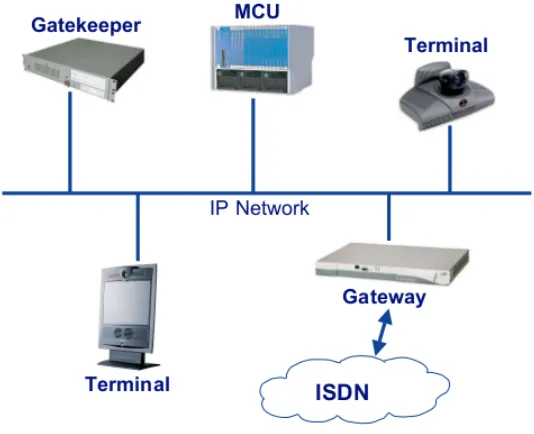
applications in collaborations sessions. Figure 2.1 below shows major components of
a typical H.323 system.
As shown above, there are following six major components:
1. Terminals are endpoints that provide audio/video/data to another endpoint.
2. Gatekeepers (GK) provide admission and call control services to endpoint. They
also provide services such as address translation, RAS control, call redirection
Figure 2.1: H.232 system architecture
3. Multipoint controller (MC) establishes a H.245 control channel with H.323
par-ticipant to negotiate media capabilities.
4. Multipoint processor (MP) provides media switching and mixing functionalities.
5. Multipoint control unit (MCU) is an endpoint that enables three or more
end-points to participate in a conference.
6. Gateway (GW) provides real-time, two-way communication between H.323
end-points and non-H.323 endend-points.
H.323 protocol defines how these components communicate with each other, and
the communication between them is defined in binary format. There are many
pop-ular products [Polycom Inc, 2000] [IVCi LLC, 2009] [OpalVoip and H323Plus, 2007]
implemented based on this standard and they can inter-operate with each other.
The Session Initiation Protocol (SIP) is a text based and HTTP-like style
(request-response) application layer protocol for establishing, modifying and terminating
such as user location resolution, capability negotiation, and call management. SIP
capabilities are basically equivalent to the services H.225 and H.245 in H.323
proto-col. Although SIP does not define the conference control procedure like H.243, there
are some researches for SIP based conference control protocol[Koskelainen et al.,
[image:25.612.185.466.195.371.2]2002][Wu et al., 2002].
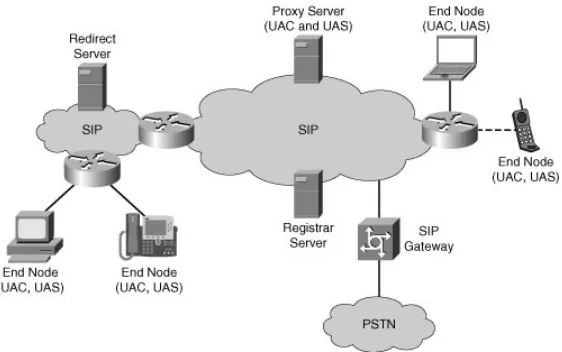
Figure 2.2: SIP system architecture
As shown in Figure 2.2, main components of a SIP system are: SIP clients, a
SIP Proxy Server, a Registrar Server, a Location Server, a Redirect Server and a
SIP MCU. The SIP Proxy Server primarily plays the role of routing and enforcing
policy of call admission. It provides an instant messaging service, forwarding SIP
Presence Event messages and SIP text messages to SIP clients. The SIP registrar
accepts REGISTER requests and saves the received information in location server.
2.1.2 MRAS
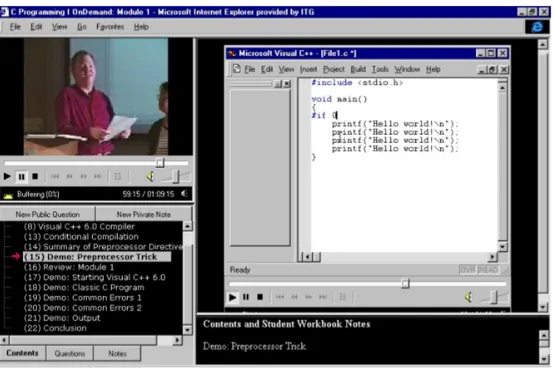
Microsoft research released its annotation system MRAS[Bargeron et al., 2001]
in 2000, the system was designed to help Microsoft employees gain better training
experience through asking questions on pre-recorded lecture videos. As show in Figure
2.3 The questions are anchored on the multimedia content and answered by the
the class content, students that have similar questions at the same time spot will
benefit from reading answers to the previous question. Collaboration is achieved
through discussions on the questions and their answers. MRAS doesn’t support live
video feeds and students who are watching the same video streams could not exchange
[image:26.612.187.464.195.381.2]their thoughts in the real time.
Figure 2.3: Microsoft Research Annotation System
2.1.3 VideoAnnEx
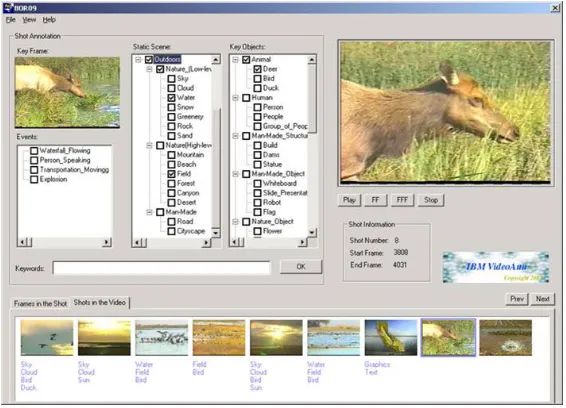
IBMs Mpeg-7 annotation tool VideoAnnEx[Smith and Lugeon, 2000] was also
released in 2000. It can parse Mpeg video files and segment them into small shot units.
Each shot unit can be annotated with a description from three default categories:
static scene, key object and event. All shot units in Figure 2.4 are stored into a
XML file as well as their descriptions/annotations following the Mpeg-7 standard.
Users can search among the descriptions and replay the video shots alongside the
description they are looking for. VideoAnnEx is a stand-alone annotation program
that as well as MRAS cannot process live video feeds, and it does not support sharing
and manipulating video streams among distributed users either. It can merely process
categories. It is difficult to extend the system without modifying its source.
Figure 2.4: IBM VideoAnnEx
2.1.4 Vannotea
Researchers from University of Queensland invented Vannotea[Schroeter et al.,
2003] to help facilitate collaborative video indexing, annotation and discussion of
video contents in a distributed broadband environment. It supports most features
that VideoAnnEx has and provides more flexibility on the meta data of video
seg-ments. In Figure 2.5, Vannotea users are able to save, browse, retrieve and share
both objective descriptions of the video files as well as subjective annotations on
them. The videos files are still limited to Mpeg-2 format and users can only create
text descriptions.
2.1.5 SIDGrid
The Social Informatics Data Grid (SIDGrid)[Bertenthal et al., 2007] from
Uni-versity of Chicago is a new cyber infrastructure designed to transform the methods
that are used by social and behavioral scientists to collect and annotate data,
Figure 2.5: Vannotea from University of Queensland
novel integration of annotation, analysis, and search for multimodal data as well as
a powerful framework for web-based, distributed collaborative annotation and
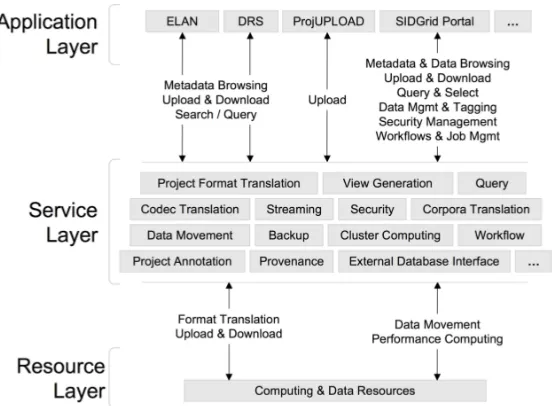
anal-ysis. As you can see from Figure 2.6, all annotation tasks are carried out through a
modified version of the open source audiovisual annotation tool named ELAN[Berez,
2007]. Researchers can work with each other using a web based central archive of
multimodal data, annotation and analysis. Though the browser-based interface helps
achieve the collaboration objectives such as searching and discussion, it still cannot
support annotating and analyzing data generated in the real time. And no
collabora-tions on ad-hoc annotation are allowed, users can only work on prerecorded content.
2.1.6 A Collaborative Annotation Framework for Social Network Users
A collaborative annotation framework[Shevade et al., 2005] from Arizona State
University was proposed in 2005 to enable members of a social network to
Figure 2.6: The Social Informatics Data (SID) Grid
low-level features, context, commonsensical and linguistic relationships. The
frame-work firstly parses three major features of the shared media, computes the feature
distances based on histograms of these features, and then uses a concept filtering
method of the user context to adapt the final recommendation results. The research
is mainly focused on its algorithm of generating more semantic relevant
recommen-dation to avoid useless new annotations. The algorithm heavily depends on features
of the shared media which are uploaded images and cannot be used on real time data
streams.
2.1.7 eSports
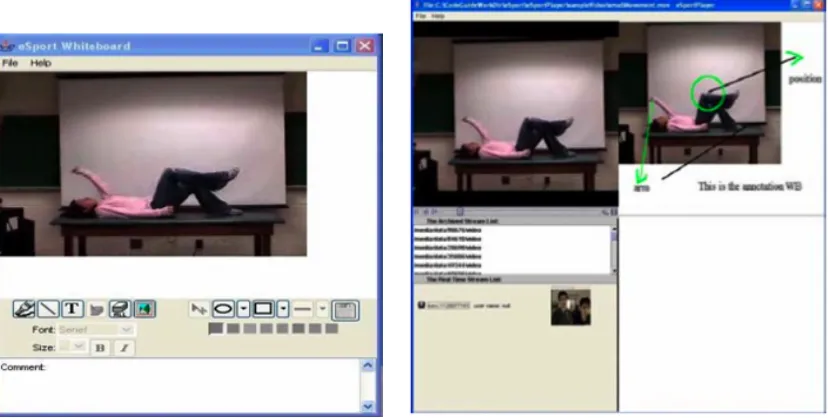
eSports[Zhai et al., 2005] developed by Community Grids Lab is another attempt
to enable collaborative annotation on multimedia content over the distributed
net-work, especially the grid-computing network. It enriched the annotation on
mul-timedia contents from simple text to more diverse forms such as graphic shapes,
audio/video clips. As its name indicates, eSports system aims to help sport coaches
train their trainees remotely through vocal and graphic annotations on real time or
of sample gestures in the video and comment on them to help students understand
their classes. Annotations and video streams are archived using NaradaBrokering
storage service and can be replayed synchronously based on their time stamp
prop-erty. Since the streams are stored as a series of NaradaBrokering events rather than
large video files, users can ask to replay any part of the stream without loading all
related events. Live chat is also implemented to improve the real time communication
[image:30.612.116.530.250.459.2]in the system.
Figure 2.7: Multimedia annotation in eSports
2.1.8 Summary
There are many other platforms/tools that share similar features of above
sys-tems. To address all the objectives/problems of building a scalable framework for
the collaborative annotation of real time data streams, it is quite obvious that the
proposed research should have following major features:
• The target system should be able to support creating, archiving and replaying
multiple forms of annotations on either real time or prerecorded data streams
• The target system should support both synchronous and asynchronous
commu-nications on both annotations and content streams.
• A robust session management is required to make the proposed system tolerant
to possible hardware or network failures.
• The target system should be adaptive to underlying networks, from high speed
Internet to unstable ad-hoc mobile networks.
2.2
Mobile Collaborative Annotation
Researches have been done on different aspects of collaborative annotation on
mobile phones. Due to the multimedia capability and location awareness of those
devices, most of the research mainly focuses on annotation on digital contents such
as photos, audiovisual data and location information. In this section, we give brief
analysis on some of these systems and explain how they affect our design.
2.2.1 Mobile Annotation Systems
Many efforts have been spent in bringing multimedia annotation on current mobile
platform. In [Yeh et al., 2004], Yeh introduces a hybrid searching technique for
location recognition based on image and keywords. It however does not support
operations in real time. Reference [Anguera et al., 2008] is an annotation system for
digital contents on cell phone but its lack of server side supports makes it impossible
for users to collaborate with each other. As an improvement of existing mobile search
systems such as Layar[Layar, 2012], [El-Saban et al., 2011] uses image and video
information in extracting information about a scene. It also associates tags with
the content for later usage and supports capturing short videos instead of images in
In [Wilhelm et al., 2004], Anita et al develops a lightweight client application
which uses camera phones to capture images and annotate on them. All the
annota-tion informaannota-tion is stored remotely on a dedicated metadata server and organized in a
faceted classification structure. This enables rich description of the images and
over-comes the limitations of strictly hierarchical metadata structures and keyword based
approaches in prior image annotation systems. However, the limited screen size of
the mobile device causes a problem for the system to display and enable navigation
on such faceted meta data structure.
Jintao et al investigate four major techniques in their paper [Wang and Canny,
2006] for collecting end-user place annotations interactively using cell phones. Based
on their usability test results, they conclude that ”photo memo plus off line editing”
is the most favorite approach in ease of use. Although their approach elaborates on
providing most convenient user interface for the end users to generate location based
annotation data on images stored on their cell phone, annotation in a team oriented
fashion was not addressed.
Most of previously described systems mainly focus on utilizing the ubiquitous
feature of mobile devices and their network access with geographic information to
support user friendly annotation experience. Few of them have talked about
support-ing collaboration between mobile and desktop users and almost none of them can
support such capability. This becomes the motive of design and implementing the
mobile extension of the collaborative annotation framework.
2.2.2 Android Based Annotation Systems
Android is one of the youngest and most promising operating system of the mobile
OS family. It is maintained by the Open Handset Alliance [Google Inc, 2009] led by
Google and it has greatly evolved since 2009. Four major versions have been released
smartphones and tablets currently available in the market. As a descendant of Linux,
android supports almost every feature of a modem computer and its user interface is
designed to be compatible with all user interactions on regular computers except that
they are touch based. The android development framework is inspired and designed
based on Oracles Java and swing toolkit which makes it easy to port existing java
based system onto the android platform.
In [Wang et al., 2011], Zixuan Wang et al present an image annotation system
based on android devices and a dedicated web server. It basically uses the android
smart phone to capture images and create tags on specific portions of them.
Rel-evant annotation of the same object on different images is grouped together based
on similarity algorithms to help the user share better semantic understanding of the
object. Most of the analysis is done by the web server after end users submit their
photo tags and android devices are merely working as input devices. Moreover, it is
quite difficult for this system to support collaborations on their images in the real
CHAPTER III
A Scalable Framework of the Collaborative
Annotation
3.1
Architecture Choices
To achieve a robust and flexible collaborative annotation framework, we
sum-marized and compared popular architecture choices made by previously introduced
systems based on various of our requirements.
Client and Server(C/S) paradigm was mostly used among early systems such as
MRAS and VideoAnnEx. Smart client talks to the server for data that need to be
displayed and commits back user inputs for permanent changes. It is the server’s
responsibility to understand both content and interaction data as well as the logic of
binding them together. Client code simply interprets the relationship and presents it
to the end user. This makes it easy to extend the system to different platforms if the
data presentation and user interaction are simple and universal. However, with the
increase of data throughput and complexity of the meta data, this centralized server
becomes a bottleneck of the system and it becomes almost impossible to be extended.
It normally ends up with deploying duplicate servers and having a dedicated task
scheduling server to load balancing the task. User interactions on different platforms
such as desktops and mobile devices may also be quite different from each other.
Sometimes it is hard to port client codes from one platform to another.
inte-grate various functionalities in different tiers. It is a kind of client-server architecture
in which the presentation, the application processing, and the data management are
logically separate processes. The simplest known multi-layer architecture is 2-tier or
client/server system. This traditional two-tier, client/server model requires clustering
and disaster recovery to ensure resiliency. While the use of fewer nodes in an
enter-prise simplifies manageability, change management is difficult as it requires servers to
be taken offline for repair, upgrading, and new application deployments. Moreover,
the deployment of new applications and enhancements is complex and time
consum-ing in fat-client environments, resultconsum-ing in reduced availability. A 3-tier information
system consists of the following layers:
• Presentation layer presents information to external entities and allows them to
interact with the system by submitting operations and getting responses;
• Business/Application logic layer or the middle-ware programs that implement
the actual operations requested by the client through the presentation layer.
The middle-tier can also control user authentication, access to resources as well
as performing some of the query processing for the client, thus removing some
of the load from the database servers;
• Resource management layer also known as data layer, deals with and
imple-ments the different data sources of an information system.
In fact, a 3-tier system is an extension of a 2-tier architecture where the application
logic is separated from the resource management layer[Edwards, 1999]. By the later
1990s, as the Internet became an important part of many applications, the industry
extended the three-tier model to an N-tier approach. As a consequence the data tier
became split into a data storage tier and a data access tier. In very sophisticated
sys-tems an additional wrapper tier can be added to unify data access to both databases
Service Oriented Architecture (SOA) is about how to design a software system that
makes use of services of new or legacy applications through their published or
discov-erable interfaces. Systems are often distributed over networks. SOA also aims to make
services interoperability extensible and effective. It prompts architecture styles such
as loose coupling, published interfaces, and a standard communication model in order
to support this goal. Systems such as eSport and SIDGrd choose this architecture to
overcome problems in C/S paradigm. Their system capabilities are delivered and
con-sumed via loosely coupled, reusable, coarse-grained, discoverable, and self-contained
services interacting via a message-based communication model(Naradabrokering in
eSports and SOAP/RESTFul messages in SIDGrid). Unlike C/S model, which is
based on design and development of tightly-coupled components for processes within
an organization, using different protocols and technologies such as CORBA, DCOM,
etc, SOA focuses on loosely-coupled software applications running across different
ad-ministrative domains, based on common protocols and technologies, such as HTTP
and XML. SOA is related to early effort on the architecture style of large scale
dis-tributed systems.
Based the analysis and comparison of above architectures, SOA is obviously the
better choice for the collaborative annotation framework to provide high throughput
streaming services such as archiving and replaying as well as robust session
man-agements. It also helps the framework become scalable by providing different levels
of servicing quality and capability. We also choose the idea of functionality
separa-tion and encapsulating in multi-tier architecture to make sharable components on the
client side to be reused on different platforms easily. More details can be found in
3.2
Messaging Systems
There are several useful standards in this field. The best known is the Java
Mes-sage Service (JMS)[Oracle, 2001] which specifies a set of interfaces outlining the
com-munication semantics in pub/sub and queuing systems. Advanced Message Queuing
Protocol (AMQP) [amqp, 2012] specifies the set of wire formats for communications;
unlike APIs, wire-formats are cross platform. In the Web service arena there are
competing standards WS-Eventing and WS-Notification but neither has developed a
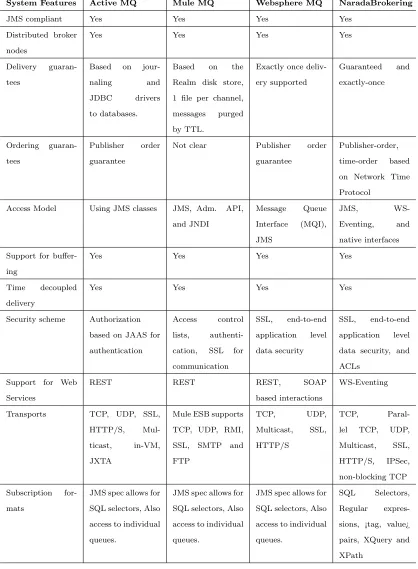
strong following. We now present in Table 3.8, a comparison between a few common
messaging and queuing systems.
We also give MuleMQ[Mule Soft, 2010b] which is the messaging framework
un-derlying the enterprise service bus (ESB) [Mule Soft, 2010a] system Mule developed
in Java of which there are 2500 product deployments as of 2010. The focus of Mule
is to simplify the integration of existing systems developed using JMS, Web Services,
SOAP, JDBC, and traditional HTTP. Protocols supported within Mule include POP,
IMAP, FTP, RMI, SOAP, SSL, SMTP. ActiveMQ [Apache, 2007] is a popular Apache
open source message broker while WebSphereMQ[IBM, 2002] is IBMs enterprise
mes-sage bus offering. Finally we list the open source NaradaBrokering[Pallickara and
Fox, 2003] that is notable for the broad range of supported transports and was
suc-cessfully used to support a software MCU (Multipoint Control Unit) for multi-point
System Features Active MQ Mule MQ Websphere MQ NaradaBrokering
JMS compliant Yes Yes Yes Yes
Distributed broker
nodes
Yes Yes Yes Yes
Delivery
guaran-tees
Based on
jour-naling and
JDBC drivers
to databases.
Based on the
Realm disk store,
1 file per channel,
messages purged
by TTL.
Exactly once
deliv-ery supported Guaranteed and exactly-once Ordering guaran-tees Publisher order guarantee
Not clear Publisher order
guarantee
Publisher-order,
time-order based
on Network Time
Protocol
Access Model Using JMS classes JMS, Adm. API,
and JNDI Message Queue Interface (MQI), JMS JMS, WS-Eventing, and native interfaces
Support for
buffer-ing
Yes Yes Yes Yes
Time decoupled
delivery
Yes Yes Yes Yes
Security scheme Authorization
based on JAAS for
authentication
Access control
lists,
authenti-cation, SSL for
communication SSL, end-to-end application level data security SSL, end-to-end application level
data security, and
ACLs
Support for Web
Services
REST REST REST, SOAP
based interactions
WS-Eventing
Transports TCP, UDP, SSL,
HTTP/S,
Mul-ticast, in-VM,
JXTA
Mule ESB supports
TCP, UDP, RMI,
SSL, SMTP and
FTP
TCP, UDP,
Multicast, SSL,
HTTP/S
TCP,
Paral-lel TCP, UDP,
Multicast, SSL,
HTTP/S, IPSec,
non-blocking TCP
Subscription
for-mats
JMS spec allows for
SQL selectors, Also
access to individual
queues.
JMS spec allows for
SQL selectors, Also
access to individual
queues.
JMS spec allows for
SQL selectors, Also
access to individual
queues.
SQL Selectors,
Regular
expres-sions, ¡tag, value¿
pairs, XQuery and
[image:38.612.116.534.78.647.2]XPath
Table 3.1: Comparison of Selected Messaging and Queuing Systems
there are some key features of messaging systems that are listed in the table but
not discussed in this brief section. These are security approach and guarantees and
mechanisms for message delivery. Time decoupled delivery refers to the situations
where the producer and consumer do not have to be present at the same time to
exchange messages. Fault tolerance is also an important property some messaging
systems such as NaradaBrokering can back up messages and provide definitive
guar-antees. This table is only illustrative and there are many other important messaging
systems. For example RabbitMQ[VMWare, 2010] is a new impressive system based
on AMQP standard.
It is quite obvious from the table 3.1 above that NaradaBrokering provides
com-plete and diverse feature supports and meets our requirements for delivering a robust
and mature collaborative platform. And you can find from the following sections
that we have taken full advantage of this messaging system to achieve fluent real time
communications between clients on both desktop and mobile platforms.
3.3
Architecture of the Framework
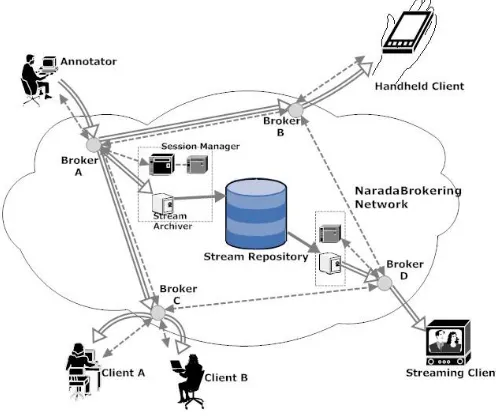
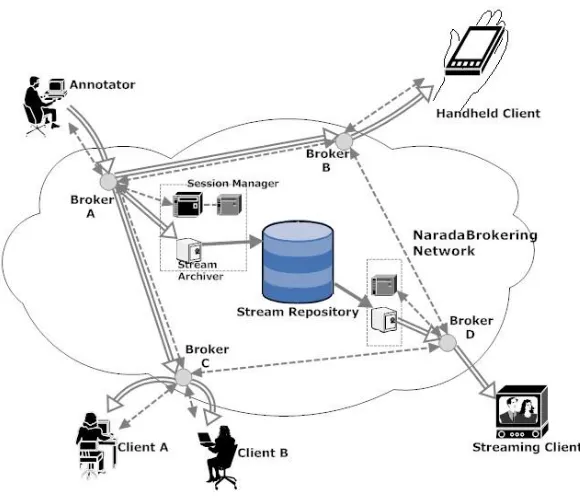
Figure 3.1 below depicts a typical scenario of using our framework. A stream
annotator is feeding a live video stream to the system and making notes on it. Client
A and B are live collaborators in the same session and they are able to ask questions
on the video stream while it is being played. Another client using a handheld device
is watching the collaboration activities between the annotator and client A and B.
Session information, annotations and stream data are transmitted and exchanged
using Naradabrokering events. All events are automatically stored into the stream
repository for later replays. Different metadata are stored in each events header,
and information within them facilitates functions such as stream synchronization and
system recovery.
Figure 3.1: Detailed system architecture
Client and Stream Archiver. Session Manager maintains all session related
informa-tion such as client joining or leaving. The client is responsible for generating content
streams as well as receiving and replaying streams from other clients. It also parses
annotation events to reproduce actual annotations on the content stream. Stream
Archiver is spawned by Session Manager to archive live streams in the stream
repos-itory, either locally or remotely. It is also responsible for retrieving archived streams
as per the clients requests.
3.4
Session Management
Due to the pub/sub nature of the Naradabrokering[Pallickara and Fox, 2003]
system, we use heartbeats to manage the session information in the system. Each
component in the system continuously publishes its own heartbeat event to public
channels. All clients will monitor heartbeat events in the session channel and
main-tain their own copies of the session status, i.e. list of active clients in current session.
them for more than three seconds. Session Manager monitors the session channel as
well and periodically broadcasts its own client list as the standard for participating
clients to synchronize their lists with. Session Manager will also monitor the service
channel to control active stream archivers and remove unnecessary ones. A status
re-port will be generated and stored in the local file system and remote stream repository
after a customizable period of time.
As the core management component of a distributed system, Session Manager
should be available all the time and be able to recover from disastrous situations
such as program crashes and power outages. We use two strategies to maintain such
durability: Local recovery and Remote recovery.
• Local recovery: Alongside the running Session Manager, a daemon process (gray
manager in Figure 1) keeps collecting session information as other clients do.
It starts taking over the management responsibility when the running manager
freezes and stops publishing standard heartbeat. It will kill the original manager
process, changes its own status by parsing the latest status report on the file
system and create another daemon process to take over its previous job. Since
clients will not check the source of the standard heartbeat, they will not know
the manager has been replaced.
• Remote recovery: We could not apply local recovery if there were hardware
problems or power outages on the running manager machine. In such
circum-stances, all clients will find a best machine among them by exchanging and
comparing their hardware information. The most appropriate client will create
the manager process, adjust its status according to the remote status report
3.5
User Experience Design
One important feature of this collaborative annotation framework is to separate
its graphic user interfaces from underlying service components such as annotation
archiving, distribution and replaying. Through such separation, user experience
re-searchers can focus on investigating capabilities and differences between targeted
supporting platforms and design best user interfaces. In general, a system based on
this annotation framework will need to provide following experiences on its client:
• A session chooser which users can select a session of their interests to join.
• A stream list which shows what content/archived streams are available for play
within the session.
• An annotation panel for displaying/rendering streams so that users can interact
with.
• A stream replay panel(Optional) which helps users to find streams that they
have opened and annotated.
• A time line panel(Optional) which enables users to select arbitrary time spot of
the opened/replaying stream so that they can add annotations at.
There can be other optional user experience elements such as stream preview
win-dow/panel as well as system/session monitor. They are defined by the system
require-ments and how to design and deliver them for various platforms is out of the scope
of this dissertation. In section 4.1 of next chapter, we give a detailed explanation on
how we separate the user interface from service components through a layered
archi-tecture for presentation, logic and data transmission. User researchers can focus on
good presentation designs without concerns about breaking underlying functionalities
3.5.1 A Sample Desktop User Interface on Windows
Figure 3.2 is a snapshot of our sample annotation client running on Windows. We
implement the client using SWT library[Eclipse, 2012], an OS-independent widget
toolkit from the Eclipse project. The client comprises a tree based client list and
three composite panels. Each panel can be maximized to show as much information
[image:43.612.171.478.223.399.2]as possible.
Figure 3.2: A Snapshot of The Sample Desktop User Interface.
The client list on the left displays all participating clients in the same session. The
user can open any data stream (video steam in the snapshot) being sent by a client.
Once the receiver of this data stream is created and started successfully, the renderer
window will be displayed in the stream renderer list on the right panel. Users can
also select to create a clone of the playing renderer to the center panel by checking
the check box underneath it. A stream progress widget is also created on the progress
panel below once the clone starts playing. Unlike the original renderer window on
the right, the cloned renderer can be positioned anywhere on the center panel and
the user is able to either rewind or fast forward the playing content by dragging the
progress indicator on its stream progress widget.
Alongside the client list, there is an archive list that only displays information of
these archived streams as if they were normal live streams. There is no difference
between them and the live stream since they are just duplicates of the stored live
streams from the event repository, loaded and published by stream archivers. More
details of archiving and replaying streams will be explained in the next section.
3.5.2 User Interfaces for other Platforms
Due to the cross platform supports of SWT and JMF, our annotation client for
Windows can be used directly on other desktop platforms such Mac OS and Linux.
The only limitation is that JMF may not have full audiovisual encoding/decoding
support on these platforms. This is not a limitation caused by the design of the
collaborative annotation framework and can be easily solved by replacing the media
component with other modern technologies.
3.6
Structure and Feature Comparison
As a descendant of GlobalMMCS [Wu et al., 2006], NaradaBrokering [Pallickara
and Fox, 2003] and other collaboration systems [Bulut, 2007] built in Pervasive
Tech-nology Insitute, this collaborative annotation framework greatly enhances
function-ality and makes their feature components such as reliable message delivery, stream
recording/archiving and media playback reusable to its users, improve the system
robustness and avoid duplicate work among derived annotation systems that share
similar characteristics. The following table 3.2 gives a structure and feature
Features GlobalMMCS High Performance
Stream Recording and
Manipulation System
[Bulut, 2007]
Collaborative Annotation
Framework
System Architecture C/S, extension
through gateways
C/S, extension through
gateways
Decoupled, Service Oriented
Cross OS support Windows/Linux Windows/Linux Windows/Linux/MacOS(Limited,
see table 4.1) /Android
Multimedia Support support from JMF support from JMF support from JMF and Android
Media Framework
Generic Stream Support Multimedia Only Yes, need translation
gate-ways
Yes, both client and service node
Reliable Data Delivery No Yes, extension to the
NaradaBrokering Reliabile
Delivery Service
Yes, extension to the
NaradaBrokering Reliabile
Delivery Service
Mobile support Basic web based
thin client
Basic web based thin client Full featured native mobile
client
Robustness Unstable, demo
only
Unstable Stable with correctly deployed
[image:45.612.112.539.74.375.2]services
Table 3.2: Comparison with Previous Systems
As you can see from the table, previous systems such as GlobalMMCS were
im-plemented based on a centralized design which makes them difficult to be extended
and scale. Various dedicated gateways were introduced to extend their supports for
other platforms. This increased the complexity of the service components on the
server side since they have to detect the payload type through multiple handshake
communications between the client and server, set up correct extension gateways to
service the incoming data stream and translate/transcode them into system formats
that service components can understand. A single failure at each step explained here
may cause the server end up in a unstable state and crash eventually.
Through a service oriented design (section 3.3), the collaborative annotation
framework introduced in this dissertation avoids above problems by decoupling
using a simplified yet robust session management scheme (section 3.4) to minimize
the system complexity and adding extra redundancy (section 6.2.3) to the
underly-ing messagunderly-ing system to ensure service availability. This service/plugin based design
also enables us to introduce new features such as generic stream support and mobiles
support. We give a complete list of them as follows:
1. Multimedia support: enables recording, rendering and archiving audiovisual
data streams through Java Media Framework [Oracle, 2004] for desktop
ma-chines and Android Media Framework[Open Handset Alliance, 2009] for mobile
devices.
2. Simple Desktop/Mobile Client Templates: simple yet complete client templates
for the framework users to reuse on different operating systems.
3. Layered Annotation Programming Interface: a decoupled programing interface
that enables framework users to extend it through different recorder and
ren-derer implementations (see section 4.1).
4. Decoupled service oriented framework: separate service/feature components
from user interfaces and underlying messaging transmission.
5. Session Manager: a simple session management service which provides robust
recovery strategies(see section 3.4).
6. Stream Archiver: a robust real time data recording and replaying service which
enables preserving and playing back annotation meta data as well as their
con-tent streams.
7. Annotation Manager: a service that provides indexing and searching within the
8. Reliable Data Delivery and Repository: an extension to the underlying
NaraBro-kering messaging system that enables reliable stream delivery as well as
stor-ing(see chapter VI).
More details for some of these features and services can be found in chapter IV
CHAPTER IV
Annotation on Generic Streams
The most important feature of this research is to provide capabilites of
collabo-rative annotation on generic real time data. In this section, we will address some
research issues we encountered during the design and implementation of the desktop
interface of the collaborative annotation platform. These issues vary from simple
integration interface for the platform users, Stream rendering and archiving and
an-notation management.
4.1
Annotation Interface
Figure 4.1 below shows three layers of our annotation interface: Transmission
layer, Logic layer and Presentation Layer from the bottom up. Each takes its own
responsibility of processing the streaming data.
The Transmission layer is responsible for creating and managing actual data
trans-mission handlers (called DataTransmitter in the source). Each transtrans-mission handler
contains a pair of NaradaBrokering event consumer and publisher, and it subscribes
itself to a particular topic specified by the ID of the stream it operates on. In order
to minimize the cost of handler creation and termination, a pool of handlers (around
5 handlers) are created during the start up of the client. Similar to the Java thread
pool, transmitting handlers are assigned and recollected by a handler manager.
The Logic layer works as an important mediating layer between the
Figure 4.1: Three Layers of the Annotation Client Interface
sender or receiver will be created to connect a stream source/renderer from the
pre-sentation layer with a transmitting handler from the transmission layer and start the
processing. There is a stream manager in this layer to manage all active senders
and receivers. The Annotation manager also sits within this layer to associate and
synchronize content data streams with the annotation streams.
The Presentation layer is the upper-most layer and it contains the graphic user
interface, stream source and renderer managers. Similar to the DataSource class
in the JMF library, a stream source is an object that can generate real time data
constantly when it is started. It can be paused or stopped. Stream renderers are
used to decode received stream data and display the content on the screen.
Figure 4.2 below is a class diagram that shows the interrelationships between the
stream source/renderer interfaces and the stream sender/receiver classes.
Figure 4.2: Class Diagrams of Stream Processing Interfaces.
behaviors of a real time data stream, users can easily write their own stream sources
and renderers to extend the system. They just need to implement those interface
methods in their existing source/rendering classes and compile them with the client
source. This will save a lot of effort as opposed to understanding and modifying source
codes of the entire system. In our current release, we have implemented several stream
sources such as video/audio capturing source, file capturing source and screen
captur-ing source and their correspondcaptur-ing renderers. With the help of the GlobalMMCS[Wu
et al., 2006] media module, our system supports various video/audio formats on