The Australian National University
Institute of the Arts
Canberra School of Art
GRADUATE DIPLOMA OF ART
1995
Monica Mitchell
REPORT
ABSTRACT
[image:2.612.1.600.15.428.2]Discovery: Research into integrating nature and the figure in ceramic sculpture. The studio work explores personal narration in clay rock forms and imagery derived from the Australian bush. The research paper investigates elements of modern art's reception in America in the early 1900s and in Australia from 1934 to 1994 focusing on Margel Hinder and the reception of modern sculpture. A study taking the form of an exhibition of ceramic sculptures exhibited at the Canberra School of Art Gallery from March 16-25, 1995 which comprises the outcome of the Studio Practice component (80%), together with a Research Paper (20%), and a Report which documents the nature of the course of study undertaken.
CONTENTS
Page No.
ABSTRACT 2
LIST OF ILLUSTRATIONS 4
INTRODUCTION 5
WORK AND WORKING METHOD 9
Clay and the Coiling Method 9
Surface Treatment 11
ILLUSTRATIONS OF MY WORK 13
CONCLUSION 37
Notes 38
Studio Work Study Proposal (80%) 39
ACKNOWLEDGEMENTS 4 0
CURRICULUM VITAE 41
LIST OF ILLUSTRATIONS
Fig. 1.Photograph of a wombat den. Tidbinbilla Nature Reserve. Tidbinbilla, A.C.T. 1994 M. Mitchell* Fig.2.Photograph of Gibraltar Point, Birrigai, A.C.T. 1994* Fig.3.Photograph of the interior of a tree from Straithnairn Homestead Gallery, Canberra, A.C.T.
1994*
Fig.4.GUSTAV VIGELAND. Monolith. 1928. 17m. granite. Vigeland Skulptural Park brochure. Oslo, Norway.
Note: MITCHELL: all first firings are 9 9 o r cone.06. (The first five use Bendigo White Stoneware clay:)
ng.5.Anonymity, 1994, 85x35x35cm. Two firings:
#2-600C blackfire, cracked 70cm.
Fig.6.Iovers, 1994, 78x40x25cm. Two firings: #2-991^ red iron oxide stain.
Fig.y.Fear and Freedom, 1995, 66x45x30cm. Three firings: #2--1215C, airbrushed with mason stains 20%(sea green, black and delphenium blue) in a
porcelain slip, cracked and warped; #3-991^^ brushed with Keane's porcelain slip.
(All of the following (14) pieces have Keane's white porcelain slip over stains, except Trapeze Artist:)
¥ig.8.Rock Shelter, 1995, 60x40x40cm. Four firings: #2-991C copper carbonate wash; #3-991^ copper
sulfate wash/little reaction; # 4 - 9 9 r e d iron oxide, crocus martis, iron silicate mason stain, and black Amaco underglaze washes.
¥ig.9.Trapeze Artist, 1994, 135x55x55cm. No firings.
[image:4.612.10.587.25.433.2](The next nine use Keanes White Raku clay and all firings are: 991^:)
Fig. 10Separation, 1995, 45x50x20cm. Two firings: chrome and red iron oxide 50/50 mixture and black Amaco underglaze wash.
Fig.ll.Mafes, 1995, 45x25x25cm. Three firings: copper sulfate wash/little reaction; #3-cobalt carbonate, copper carbonate, iron silicate and black Amaco washes.
Fig.l2Currenf Events, 1995, 55x40x20cm. Two firings: side with 2 figures-crocus martis and red iron oxide, marigold mason stain, black A. underglaze washes. Side 2- crocus martis, marigold, and black wash. Fig. 13.Greed/, 1995, 35x35x25cm. Two firings: light brown, mahogany Amaco washes. Restored 4"crack.
Vig.l4Greed II, 1995, 45x45xl5cm. Two firings: chrome and red iron oxides 60/40 wash, black Amaco wash.
Fig.lSGreed III, 1995, 60x35x25cm. Two firings: cobalt and copper carbonate and iron silicate washes.
Fig.l6Magpies, 1995, 70x35xl5cm. Two firings: chrome and red iron o. 60/40 washes, black and grey slips.
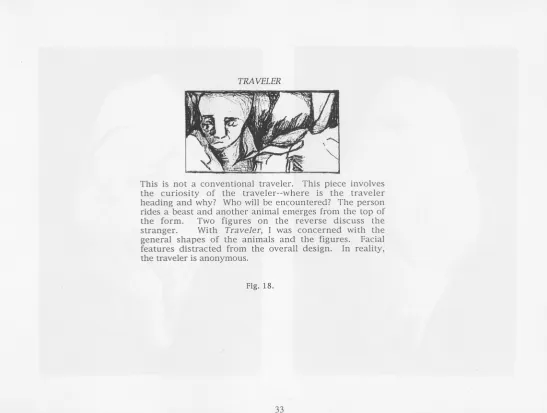
Fig. 17Guardian, 1995, 65x30x20cm. Two firings: chrome and red iron oxide 60/40 washes, black Amaco wash. Fig.lBTraveier, 1995, 85x50x35cm. Two firings: chrome and red iron oxide 60/40 wash, dark leaf green
mason stain, iron silicate and black Amaco washes. Fig.l9.STEPHEN DE STAEBLER, Face with Blue Eye, 1982 from Stephen De Staebler. the Figure, p.62. Fig.20.Photo of James "Son Ford" Thomas from his article "Skulls" in Studio Potter. VoL 16, Dec. 1987, p.23. Fig.21.JINDRA VIKOVA, Talking, 21.5" in height with white stoneware stains and glazes, from
Ceramics Monthly. Tune/July/ August 1994, p.60. Fig.22.LIZ WILLIAMS, Chacmool, Pottery in Australia. Vol. 3, No. 1, Autumn 1994, p.64. Fig.23.CARMEN DIONYSE, Sunset Glow, 16" in height, slab-built from mixed clays, surfaced with slip and
layered glazes, multifired, in Ceramics Monthly. March 1993, p.33.
INTRODUCTION
"Every square centimetre of exposed rock has the effects of aeons of erosion. The stone is shaped as though by a master sculptor fashioning abstract forms ranging from small cornices to giant stairways, from towers to mammoth castles. The whole plateau and especially the escarpment is one harmonious sculpture, perfect to the finest detail in shape and colour."!
This quote, from Stanley Breeden's Kakadu: Looking After the Country the Gasudiu Way, reveals how the rocky plateau and cliffs (in the Northern Territory) are weathered in such a way that the landscape looks like a sculpture. In designing my clay sculptures, often 1 used structures in the Australian landscape as components. Having traveled throughout Australia for eight weeks with my mother and aunt in 1988, 1 received a sample of the diverse Australian terrain. Now, in Canberra, I have only been able to explore the immediate A.C.T. region. In early April 1994, 1 spent a few days in the Tidbinbilla/Birrigai area. I went on an exhausting bushhike to the Gibraltar Point summit. Giant boulders were the platforms to view miles of mesmerizing bushland.
[image:5.612.9.556.23.432.2]was also taking a course, Aboriginal Visual Culture, taught by Sylvia Kleinert. I have been interested in Aboriginal culture for quite a while. In Kentucky, I read Breeden's Kakadu. and the Aboriginal people's concerns for the land reinforced my concerns. I was haunted by the statement that,
"...to the traditional Gagudju, to go contrary to nature, to defy its laws, is not only sacrilegious, but also flies in the face of sound economic sense. From their point of view the new people, the white people they call Balanda, who have invaded their lands, who destroy, gouge, dig, trample and over-populate large areas of country, are irresponsible on a scale beyond comprehension. They pity the newcomers for they see them destroying not only the land but ultimately themselves. They see this from a 50,000 year perspective as a people who have lived on this land for 99.6 per cent of the time it has been occupied by humans. What they have seen happening around them during the last 200 years will not sustain life for another 50,000 years, perhaps not even 1000. They put it simply, 'White man got no dreaming, him go 'nother way. White man, him go different. Him go road belong to himself.' It is a road often contrary to nature and one they see leading to the destruction of all people."2
Concerning my studio work, I was hoping to specifically use Aboriginal stories in my imagery. However, I realized early in the Aboriginal Visual Culture course that appropriating Aboriginal imagery was not something I wanted to do. 1 was too unaware of Aboriginal art and culture to utilize the information in a way which respected Aboriginal culture. Gibraltar Point gave me a new idea—to create simple rock forms with a figurative
element. The five large sculptures put more emphasis on the figurative form than the overall rock-like structure. The next series of carved rock forms also integrate the two ideas but now simple form and imagery have equal emphasis. From the start, I could not restrain the highly personal subject matter that was emerging in my clay sculptures. Because of this, I decided to use it consistently in the body of work. Throughout the work, lies a personal narration of issues concerning me this year. It has been an unusual year—wonderful and difficult, but, most importantly, a year of development. My first experience of being away from home for such a long time. At the same time my work was changing, 1 was working very diligently in the Aboriginal Visual Culture course. So fascinated by the richness of Aboriginal culture, I wanted to learn as much as I could. I wrote two unrelated papers: Mimi Rock Art and its Influence Qn Aboriginal Visual Culture and The Changing Attitudes Towards Aborigines Emerging in Film.
My interest in the mimi spirits of Western Arnhem Land Aboriginal art began with my fascination of the rocky escarpment in Kakadu National Park in the Western Arnhem Land Plateau (Northern Territory). Although I have never visited this area, researching the Western Arnhem Land Plateau created in me a desire to learn about rock art and the subject matter and style of mimi art. The Dreamtime may have begun shaping Aboriginal society more than 50,000 years ago and archaeological findings may push this number even further back.^ In the Western Arnhem Land Plateau, there are over a thousand galleries of rock art which form "...perhaps the oldest and most significant expressions of human creativity..." and, estimated to have originated over 25,000 years ago, rock art "...of both naturaUstic and narrative images. As such, it constitutes the longest historical record of any group of people."^
represent the miml, the benevolent spirit figures who make their homes in trees, waterholes, caves, termite mounds, and rocky outcrops. Aboriginal people say the mimis "...have to hide and live in caves and under the ground; they are so thin that the wind would break their necks at once...the mimis are too afraid of grown-up people. They hide, but otherwise they live like everyone else—they hunt, and love, and dance and organize their own corroborrees." ^
In the essay, I describe specific characteristics of mimi art as analyzed by George Chaloupka and E.J. Brandl in their chronological theories of mimi art. 1 mention opinions of Charles Mountford who, in 1956, carried out the first scholarly study of Arnhem Land rock art. The bulk of the essay selects several recent artworks from Aboriginal artists which represent mimi spirits or characteristics of mimi rock art. Firstly, 1 describe the use of mimi spirit imagery in the more 'traditional' rock and bark paintings of the Western Arnhem Land Plateau.
I analyze two bark paintings of Yirawala (1903-1976) from Croker Island-Mjmj Spirits (1970) and Mimi Figure (1964). I compare the structures of the recent depictions of mimi spirits with ancient mimi rock art styles. Then, 1 compare bark paintings of Bob Balirrbalirr Dirdi's Mimi Spirits (1969), Didjbarrka Dirdi's Mimi Hunter Dissecting Dead Kangaroo (1980), and Jacky Bunggarnial's The Lightning Man (1969) with an ancient rock painting from Ubirr (Obiri Rock—minimum 2000 years old). I take aspects of contemporary mimi representation and compare it to the representation of mimis on the ancient rock painting. Next, I select mimis from Mandarg, a Rembargna man, and Spider Murulimi, a Nglagbon man who adopted the Christian faith but whose favorite bark painting subjects are those of Ngalgbon and Rembargna mythology.^ Finally, I select works from two 'non-traditional' Aboriginal artists, Raymond Meeks and Trevor Nickolls. Meeks' Argoonie Doowie (1988) silkscreen reminds me of an adapted figure from the ancient mimi style. Three paintings from Trevor Nickolls: Melbourne
Dreaming (19&1), The Death of John Lennon (1981), and Oid Man Dreaming (1982) depict figures with characteristics similar to the mimi spirits on rock art. These diverse examples of Aboriginal art at the end of this century show that, although the ancient mimi rock art 'style' did disappear or was lost sometime in the distant past, it has not been forgotten and still influences today's Aboriginal artists.
In the other essay. The Changing Attitudes Towards Aborigines Emerging in Film . I viewed a variety of films from the National Library of Australia's film archives and The Australian Institute of Aboriginal and Torres Strait Islanders Studies' film archives. The representation of Australia's indigenous people in film from 1898 to the present is diverse. In the late 1800s and early 1900s, ethnographic films, as represented in The Australian
Institute of Aboriginal Studies Archive Selection: 1898-1937(1986), depict Aborigines mainly as
oddities-capturing their every exotic move on film. As I viewed the films, 1 saw how the Aboriginal people's attitudes on issues concerning Aboriginality changed as well. The early films are like candid cameras documenting the daily life of the Aborigines. In later commercial films, like
Jedda(1955), for instance, it is interesting to see how the
Aborigines become the actors. In Waiting for
H a r r y ( 1 9 7 8 ) , The Land of the Lightning B r o t h e r s ( 1 9 8 7 ) and Images of Man( 1 9 8 0 ) ,
ethnographic film has changed in this way also. The anthropologists allow the Aboriginal people to represent themselves as they would like to be viewed. Waiting for
Harry shows Aboriginal people deeply involved in the
traditions of their culture yet it is obvious that the Aborigines want to make a good film. Overall, in both the commercial and ethnographic films which I have viewed, it is clear that the films reflect the quickly changing attitudes and issues concerning the Aboriginal people at the time.
early e t h n o g r a p h i c f i l m m a k e r s are fascinated by t h e exotic Aboriginal c u l t u r e - d o c u m e n t i n g what they seem to believe is a "primitive" culture. In later archival footage and a film on missions, the evolutionist idea that the Aboriginal culture is a dying one and, therefore, it is a duty to assimilate the Aboriginal people into white society is felt. In contrast, in o t h e r ethnographic works, the anthropologist has genuine respect for documenting the f u n e r a l c e r e m o n y in W a i t i n g f o r H a r r y a n d the Cantrills respectfully d o c u m e n t the Aboriginal women with their sacred ties to the land in Grain of Voice. In later commercial films, such as The Fringe Dwellers, Nice C o l o r e d Girls, a n d Night Cries, Aborigines are r e p r e s e n t e d as struggling h u m a n beings—desperate to survive b u t also struggling with the loss of t h e i r Aboriginal traditions. The main characters in the three films are women—struggling as u r b a n Aborigines in a racist society, as women in a male-dominated society, and with themselves in understanding their Aboriginality.
The attitudes of Aboriginal people themselves is revealed changing in these films as well. Aborigines in early archival footage seem c o n t e n t in a flourishing society filled with tradition. They take pride in the tradition which they have sustained for over 20,000 years in a p u r e state. However, Aboriginal society h a s dramatically changed in examples like Mr. Trudinger's Visit to Ernabella: July 1988, which shows a somber Aboriginal society being transformed by mission life a n d perhaps losing its Aboriginal identity in the process. In all of the films viewed. Aboriginal society has changed rapidly in front of my eyes.
realized that it would be interesting to research a woman artist who traveled to Australia or an Australian woman artist who traveled overseas a n d how this new culture affected her art. I began researching Australian a n d American women artists f r o m the 1800s onward. I had a large list of names which, with the help of my supervisor Gordon Bull, was narrowed to Margel Hinder. This woman sculptor, born in the Brooklyn, New York in 1906, came to Australia in 1934 with her h u s b a n d Australian painter Frank Hinder.
Within the first six months of my stay in Australia, 1 completed handbuilding my first five large sculptures, t e s t e d a i r b r u s h e d p o r c e l a i n slips f o r my s u r f a c e s , c o m p l e t e d t h e A b o r i g i n a l Visual C u l t u r e c o u r s e , corresponded with Margel Hinder by letter and, in August, 1 interviewed her in Gordon, N.S.W., a n d a t t e n d e d her exhibition at Sydney's Bloomfield Galleries in Paddington.
After August, I transcribed the interview, p r e p a r e d for my seminar in September, wrote my research paper drafts, started on a series of nine carved rock forms, built a blackfire kiln, and did more surface tests.
1 finished building t h e carved f o r m s by mid-December. If I had not finished the handbuilding, the pieces would have dried out during the two weeks I was gone at Christmas. I tested many surface colors in the first week of January a n d s p e n t the rest of the m o n t h of January and the first week of February putting the surface colors on all of my pieces a n d firing them. This is an overview and lengthy introduction into a more specific analysis of this one year of study.
DETAILS OF MY WORK AND WORKING METHODS
Fig.3.
What do Greed, Lovers, Current Events, and Trapeze
Artist have in common? They are all sculptures with
highly personal imagery relating to issues concerning me this y e a r - a year of separation and personal discovery. Firstly, 1 will explain the technical aspect of my work, and, in displaying the illustrations of my work, 1 will explain their content and context and compare them to other relevant artists' work.
Clay and the Coiling Method
Clay is just one medium I use to express ideas. It holds endless possibilities which 1 find artistically alluring. 1 prefer the coiling method over slip-casting, throwing, or building, although, 1 occasionally slab-build. Coming from only two years of education in ceramics at Xavier University in Cincinnati, Ohio U.S.A., 1 have confidence in my handbuilding skills but less so in the glaze and surface treatment aspect. Upon seeing the number and size of kilns at the Canberra School of Art, 1 thought, 'Now 1 can work huge!'. In hindsight, perhaps 1 should have resisted the temptation. The risks involved in creating clay, coiled sculptures of the dimensions I have are numerous. Only one of the five large sculptures survived all drying and firing processes unscathed. Fear
and Freedom completely warped because the clay could not
take the stress at the high temperature (IZIS'^) which 1 was accustomed to reaching. The others cracked in the drying and firing processes. Two could not be salvaged
(Fear and Freedom and Anonymity). Restoration of a
two-foot crack in a blackfired surface is too difficult and time-consuming because of the endless variations in surface coloration. Time would not allow me such a procedure.
making my clay, but, I would use already processed white clays. First, 1 used a finely grogged white clay called Bendigo stoneware. This is a highly plastic clay which can handle stressful curves in construction. Visually, it took me a couple of months to get used to white clay-the shadows seem to be cast differently on white clay or that's the illusion 1 experienced anyway. With the large sculptures, excluding Lovers, I built an inside scaffolding with coils to add strength. The clay structure acted as a skeleton.
At first, I tried to extrude my coils but I preferred to roll them myself on the table. I use rather thins coils to create my forms because I can more easily control the thinness of the walls and the changes in direction. I use slip as a glue to connect the coils and I always score coils of differing moisture contents when 1 apply slip. I use a banding wheel to constantly turn my forms.
I look at a drawing when I am building a form. Gradually, I will stop relying on the drawing and just intuitively finish the sculpture. 1 stop building the internal scaffolding about three-fourths of the way up the sculpture and I cover the piece in plastic each night. Usually, I have two or three works in process at the same time.
The sculptures are closed forms, therefore, I must create an opening for air to escape during firing. I use a nail to make a small hole in the top of the form and a larger hole in the base. I allow the piece to dry for one to two weeks depending on its size.
This is how 1 constructed the first five sculptures. Trapeze Artist ran out of Bendigo stoneware before it was finished because I was not aware that the Bendigo Clay Company was no longer producing the stoneware clay. I desperately scrounged to find enough clay to finish the piece. I completed the entire base of Trapeze Artist in early May but kept it moist and worked on the others until I was prepared to resolve it. 1 made a platform by building and adding bricks under a piece of wood so that I was able to always work at eye level when applying coils.
Surface Treatment
Early in the first semester, I purchased some Mason stains from Walker Ceramics Co. in Fyshwick. 1 wanted to take my sculptures to stoneware temperatures—a mistake. I tested the colors in a porcelain slip and airbrushed the slips onto bisqued tiles. For me, the important aspect is the clay form not the surface; so, 1 wanted to airbrush two subtle colors on the surface. I was not satisfied with the color combinations that resulted. 1 sprayed Fear and Freedom with a combination and fired it to cone 7 anyway. What resulted was tragic. The colors were harsh and hairline cracks and warpage resulted from the high firing temperature. From this point, I decided I would no longer take the pieces to such a high temperature. I wanted to find a formula that would work at no higher than the cone .06 bisque. This was an enormous challenge for me—a person with very little glaze formulating background. For Lovers, 1 went back to an old favorite, red iron oxide stain. 1 added this to water, applied it to the entire surface, and then rubbed off layers of stain to bring out the subtle texture and details. I was striving for some sense of control and I was able to achieve it in this application.
1 experimented with the technique of blackfiring as well. I loved the surface that resulted from this Japanese reduction firing using sump oil to produce the dark oily colors and black areas. And for a few months from September to November 1 wrestled with the idea of blackfiring all of my pieces. With another ceramics student, I helped to build a medium-sized blackfire kiln and did an extensive series of blackfired tests. But I was unsettled. 1 finally decided that I did not feel confident that I would be able to use this technique to gain the control that I needed. Such a technique demands much longer practice to be able to control the outcome.
My mind was always fixed on how to finish my pieces. In late October, I decided that all of my time must be spent on hand building to finish the carved forms by December 16 when 1 was to go home to the U.S. for the
subtlety. The tests gave me some possibilities of interesting color combinations, and although 1 could test and test until I was positively sure the results would be the same, 1 had no time to waste. 1 put them on the final pieces. Because the colors basically did not change in the lower firing (cones.06), I decided to use a Keane's white porcelain slip diluted with water like a wash over the stains. I built up layers of this slip to vary opaqueness. I was also hoping for the crazing, scaly effect 1 received on one of my tests. This crazing did not occur on the final pieces. In the future, I will try to get this effect by testing.
The final goal was to follow my revised dry glaze schedule rigorously. I had to finish the pieces I scheduled for that day or I would not finish on time. I slipped additional tests into my final firings to give me a wider range for selection. Red iron oxide became one of the colors I used often in combinations. 1 used the colors sparingly. Red iron oxide absorbs into the clay and I was able to rub off thicknesses. It made a good foundation color. I used cobalt carbonate and copper carbonate sparingly and added water to make washes. I had to be careful with this because of the nature of the lack of control with these heat-reactive materials. The results on my final pieces exceeded my expectations. The blue washes of cobalt and dark metallic hue of copper added interesting features. The month of January and finishing firings in February was a stressful yet exciting time in that very few of the pieces needed refiring. I feel my most successful pieces in integrating surface and form are: Mates, Current Events, Greeds I, II and III of the carved series and Lovers of the large forms. 1 had to restore a firing crack in the base of Greed II. Greed I needed major restoration on one side where a 4-inch hole blew out during bisque firing. Although two holes were punctured into the form, the piece blew up because it was so close to the kiln floor and the base of the piece was so wide that the moisture just built up underneath and could not escape. From now on, I raise the pieces from the kiln floor with stilts or kiln shelving. I was able to restore this piece
fairly easily by pushing the piece back into the hole and filling the crack with the white slip and refiring it, then 1 sanded back the hairline crack after the firing and filled it with slip.
ILLUSTRATIONS OF MY WORK
In the following section are illustrations of the entire body of work 1 completed this year. I describe the content and context of each piece and refer to several artists whose work in some way relates to mine. The small squares are cropped copies of the original sketches I used to construct each piece. Like the Czech artist Jindra Vikova's ceramic sculptures which "...imply narration but defy simple interpretation", so to do my simple clay rock forms tell a story which can have an ambiguous meaning.8 Influenced by her visits to Mexico and Spain, Australian clay artist Liz Williams calls her 'Recuerdos' exhibition, "...her' journey' of discovery-a journey which explores the human condition by...concentrating on the essential aspects of life, so too is there an essential or minimal approach in the use of clay in constructing the sculpture."^ Perhaps these are the aspects of Liz Williams' work which I am drawn to—combining her selections of the essentials of daily life struggles with a minimal approach in using clay. It is similar to how I have used clay to present my ideas.
ANONYMITY
My first completed work. Anonymity reveals feelings of displacement which I experienced when I first arrived in Australia-the loss of identity and confusion of being in totally foreign surroundings.
LOVERS
'In "About Drawing", American ^ ceramic artist, Rudy Autio, says "I am
often asked whether or not I shape a piece with the drawing in mind. ' Generally, I answer no; 1 make the pot first, then let the drawing fit the sculpture and only rarely do 1 modify the shape to fit a f i g u r e . " ! 0 Technically, I have done the opposite. A Lovers has embracing figures
. wrapped around the form. However, unlike Rudy Autio, every line of my drawing is brought out in three dimensions. The clay form and - . , drawing are exactly connected. I ^ could have interpreted the drawing in
many different ways.
[image:15.612.37.603.15.433.2]For instance, I could have built the simple shape of the outline and carved out the image or, similar to Rudy Autio, I could have used the colors to draw the figures on the form. I chose a different path. I built the whole image at once instead of later manipulating the clay. The embracing figures are inseparable, physically and mentally. Red iron oxide stain subtlely brings out the face details and texture of the clay.
FEAR AND FREEDOM
Although not to be included in the exhibition because of cracking and warpage due to too high firing, Fear and Freedom reflects the freedom of independence and the fear of what too much freedom can bring. The fear of exploring unfamiliar territory. In Liz Williams' July 1993 ceramic sculpture installation during the Seventh National Ceramics Conference held in Adelaide, 'Recuerdos' reveals a town square filled with a variety of figures inspired by her stays in Spain and Mexico. Her work illustrates rituals and struggles of daily life where "...we are separated, incomplete, out of balance, fearful and always yearning." On the opposite side of Fear and Freedom, a smaller figure is yearning to leap out of the form while another figure,with its hand covering its head, remains full of anxiety.
ROCK SHELTER
Matisse is quoted as saying, "Supposing I want to paint the body of a woman...! ^ J try to condense the meaning of this
body by drawing its essential lines. The c h a r m will then become less a p p a r e n t at first glance, but, in the long r u n , it will begin to e m a n a t e f r o m the new image." This s t a t e m e n t is relevant to Rock Shelter in that, at first glance, it is difficult to appreciate the whole of the piece. With Rock Shelter, 1 a t t e m p t e d a r a t h e r complex idea. From one angle, 1 wanted the piece to look like a rock with a n i r r e g u l a r , s c a r r e d a n d w e a t h e r e d s u r f a c e . 1 simplified it to the e s s e n t i a l lines. From o t h e r sides, figures more clearly emerge. A female figure b e n d s over two figures which f o r m h e r back a n d a smaller f e m a l e e m e r g e s f r o m t h e b e n d i n g f i g u r e ' s b r e a s t . T h i s represents a cycle where a person takes on d i f f e r e n t roles as the protector, hero, coward and onlooker.
TRAPEZE ARTIST
Wf
,This piece was completed over five months. It has many interpretations. Mine is not uplifting.Fromremembering an aspect of the art ' \ I J ' world, corrupt business practices,
N / ^^jTrapeze Artist developed. Many figures
< ^ "^he base hold u p the trapeze artist on \ L 1/ ) \ Vop. Those on the bottom want to fly,
' » ' ' ^ but, the ones in the middle weigh down on the bottom figures. The middle figures hold the trapeze artist who is having f u n a n d performing a circus act. Some viewers have said that this piece reminds them of generations. Others have remarked that Trapeze Artist
reminds them of the Vigeland Monolith in Oslo, Norway. Whatever the i n t e r p r e t a t i o n , S t e p h e n De Staebler's s t a t e m e n t s a b o u t his a n c i e n t - l o o k i n g f i g u r e s f r o m Stephen De Staebler. the Figure, remind me of Trapeze Artist. The question is posed, "Why is the archaic figure particularly relevant now, in o u r m o d e r n society of instrumental reason?" In response, "De Staebler's figures a r e a c r i t i q u e of t h e f a l s e i d e n t i t y of e f f i c i e n t functionality which plays into the hands of the collective death instinct. In their r e t u r n to nature, they forfeit all m o d e r n i s t i c streamlining a n d as such a r e not only implicitly 'sceptical of progress and technology'; Hke De S t a e b l e r ' s h e r o T h o r e a u b u t a r e m i n d e r t h a t technologically inspired efficiency does not guarantee h u m a n i t y ' s survival...His archaic figure represents the alive but devastated self within the efficient technocrat that is the ideal modern person. De Staebler's archaic figures are wounded survivors of the streamlining process that robotizes human beings into efficient operators."!^
SEPARATION
[image:19.612.12.601.19.400.2]The first of the nine carved rock forms. It represents, also, the first time I incorporated a serrated tool to make texture on the carved surface. It deals with the idea of separation from familiar people and places. In researching the surface treatments, I looked to the work of Liz Williams. Her simple bisqued pieces reinforced the idea that ceramics does not have to be decorated with alot of color but can be quite powerful with simplicity. In "'Recuerdos': the ceramic sculpture of Liz Williams" from Potterv in Australia, the content of her work is similar to mine. She states, "My work is self-referential and being a woman that is just the way it emerges... My work is to do with personal politics, the quiet human politics that occur between a man and a woman between a mother and a child in which power can intervene."!^ Separation reflects this mental closeness.
MATES
In "The Personal Mark", Paul Soldner quotes Peter Voulkos as saying, "You don't need to draw on your pots unless you have a reason to do so, unless it will make your work s t r o n g e r . " in "Line is the Vehicle", Jim Leedy
[image:21.612.147.603.13.431.2]says "...the wedding of two-dimensional drawing and three-dimensional form in my work had produced shaped paintings that were more sculpture than painting and pottery that was strictly 'visual ware'."!^ With Mates, the drawing is the carving and the painting is the slip and wash application. Mates becomes stronger visually because of the painting technique which brings out the carving.
CURRENT EVENTS
GREED I, GREED II AND GREED III
This series of three Greed-titled pieces deals with an aspect of my personal greed involving choice.
Greed I depicts a figure clutching a rock. On the other
side is a reclining figure hoarding two rocks. It is the accumulation of a material which is essentially worthless... a rock. The rock is symbolic of wanting something which really does not amount to much. But, once one has acquired it, one wants more of the same. On one side of Greed II, the figure looks at the rock like a fortune teller looks into a crystal ball. The rock holds the future f o r the character. A choice is being contemplated—to either possess the rock or remain with the loved one represented on the other side.
Greed III, again, deals with a personal choice. The single
MAGPIES
[image:29.612.71.600.13.427.2]This whimsical piece relates to the unusual magpie birds in Canberra. i<umors spread that in the springtime, or d u r i n g mating season, the magpies swoop down on passersby, sometimes drawing blood, to protect their nests.
GUARDIAN
The idea came from my AtDoriginal art research of the physical characteristics of mimi spirits—thin, wiry creatures. Like Liz Williams' guardian figure, Chacmool
(Fig. 22). my Guardian, "...is a whole and integrated figure, it would seem, of infinite strength", but, not in physical appearance.
1 studied a variety of figurative ceramics surfaces— specifically Stephen De Staebler's and Carmen Dionyse's work. 1 tried to understand how these artists used slips to create such interesting surfaces, for example Fig. 19
Man with Blue Eye and Fig.23 Sunset Glow. In the end, 1 decided to use a simple white slip and paint stains on the surfaces of my pieces to bring out the details. Guardian,
in particular, reminds me of Jindra Vikova's Talking
TRAVELER
[image:33.612.49.597.13.426.2]This is not a conventional traveler. This piece involves the curiosity of the traveler—where is the traveler heading and why? Who will be encountered? The person rides a beast and another animal emerges from the top of the form. Two figures on the reverse discuss the stranger. With Traveler, 1 was concerned with the general shapes of the animals and the figures. Facial features distracted from the overall design. In reality, the traveler is anonymous.
Fig. 21. JINDRA VIKOVA, Talking.
CONCLUSION
il III
I
11;
CANBERRA StfiOOI. OF ART
sculptures. She had a skillful approach to colored ceramic design. Her studio was filled with blueprints of her mathematically planned clay tapestries. It was great to have met these artists who created such an inspiring environment.
I accomplished a lot this year. 1 broadened my understanding of ceramics, learned about Aboriginal art and culture, researched a fascinating modern artist--Margel Hinder, had the opportunity to meet and observe visiting artists and lecturers from around the world, and finally, created a body of work for exhibition at the Canberra School of Art Gallery in March 1995.
NOTES
1. Stanley Breeden and B. Wright, Kakadu: Looking after the Countrv the Gaaudiu Way. Simon and Schuster. Brookvale, N.S.W. 1989, p.72.
2. Ibid., p.176. 3. Ibid., p.27.
4. Anne Marie Brodv. KUNWINIKU BIM: Western Arnhem Land Painting from the Collection of the Aboriginal Arts Board. National Gallery of Victoria, 7 Dec. 1984--24 June 1985, Melbourne, 1984, p.9.
5. Robert Edwards, Aboriginal Art in Australia. Ure Smith. Sydney, 1978, p.43.
6. Karel Kupka, Dawn of Art. Angus and Robertson, Ltd. Sudney, 1965, p.75.
7. E.J. Brandl, Austrahan Aboriginal Paintings in Western and Central Arnhem Land. Aboriginal Studies Press, Canberra, 1988, p.37.
8. Jimmy Clark, "Jindra Vikova", Ceramics Monthly. June/July/August 1994, p.60.
9. Cathy Speck, "'Recuerdos': The Ceramic Sculpture of Liz Williams", Potter in Australia. Vol. 33, No. 1, Autumn 1994, p.65. 10. Rudy Autio, "About Drawing". The Studio Potter. VoL 14, No.l, Dec. 1985, p.49.
11. Speck, p.64.
12. Thom Bohnert, "Linear Order", The Studio Potter. VoL 14, No. 1, Dec. 1985, p.51.
[image:38.612.19.585.32.431.2]13. Stephen De Staebler, Stephen De Staebler. the Figure. Chronicle Books, San Francisco, 1988, p.24.
14. Speck, p.65.
15. Paul Soldner, "The Personal Mark", The Studio Potter. VoL 14, No. 1, Dec. 1985, p.64.
16. Jim Leedy, "Line is the Vehicle", Potter. VoL 14, No. 1, Dec. 1985, p.54.
17. James "Son Ford" Thomas, "Skulls", Potter. VoL 16, No. 1, Dec. 1987, p.24.
STUDIO PRACTICE STUDY PROPOSAL (80%)
General Aims: Focusing on a theme, "Discovery", I will create a narration in clay. Figurative coil-built sculptures and figurative imagery in a series of carved rock forms will reflect flora and fauna imagery drawn from my experiences of the Australian landscape, specifically areas around Canberra.
R e s e a r c h / W o r k i n g Process: In 1992, 1 had a solo
exhibition in ceramic sculpture at Xavier University in Cincinnati, Ohio. 1 researched a theme: cemeteries/angels and created a story in clay from the sketches.
At Canberra School of Art, 1 am researching natural features of my new environment and areas around Canberra. In late March 1994, I visited a rocksite forty kilometres from Canberra at Birrigai. 1 photographed the unusual rock formations of Gibraltar Point. This ignited an idea of how to integrate the figure with the land. 1 will be developing this idea in a series of large rock forms with a figurative theme relating to separation from my familiar culture in the U.S. to discovering a new culture in Australia. 1 have a strong interest in Aboriginal art and, as a requirement of my course, 1 completed in the first semester the Aboriginal Visual Culture class by Sylvia Kleinert (Tuesdays f r o m 3:00-5:30). I researched Aboriginal rock art f o r m the Western Arnhem Land Plateau, specifically mimi art and 1 have viewed many ethnographic and commercial films from the National Library film archives and the Australian Institute of Aboriginal and Torres Strait Islanders Studies. This research resulted in two papers: "Mimi Rock Art and Its Influence on Aboriginal Visual culture" and "The Changing Attitudes Towards Aborigines Emerging in Film". I am taking advantage of the many films on Aboriginal culture in researching my new environment. In the last few years, 1 have created drawings and paintings of components of the Australian landscape. 1 develop imagery in the landscapes which tell a personal story about my beliefs and discoveries Now, 1 want to
translate my attempts in drawing and painting to clay rock form sculptures. My goal is to create narrative coil-built figurative sculptures reflecting my interest in the Australian landscape. Having been to Australia twice, once in 1988 for six weeks with my mother and aunt and also in July 1993 for two weeks in Adelaide for the "7th National Ceramics Conference: Celebrating the Maker", 1 am familiar with the diverse terrains of the mysterious Australian landscape.
Methods and Resources: 1 plan to work in the ceramic
studio primarily between the hours of 9:00 am to 5:00 p m -hand building with Bendigo white stoneware clay. I will be c o i l - b u i l d i n g f i g u r a t i v e sculptures utilising photographs, sketches, small clay models and gathering inspiration from films on Aboriginal culture. I will experiment with stoneware and lower temperatures in the electric kilns and occasionally with blackfiring. 1 will be airbrushing mason stains in a porcelain slip to the surface. 1 will be experimenting with the addition of other materials such as barium, iron oxides, and copper carbonate to the mason stain slip. I will be researching natural color effects for the surface treatments. For example, the moss surface of the rocks at Gibraltar Point may be reflected on the surface treatment of my rock sculptures.
New Skills Developed: I will develop more challenging
creations in clay by: the size of my sculptures, complexity of forms—new rock forms by coil-building and slab building the imagery instead of solely carving the imagery f r o m the form. 1 want to explore new airbrushing techniques and surface treatments.
Wider Context: It is the creation of a body of work
ACKNOWLEDGEMENTS
Thank you to my supervisors Gordon Bull for his advice and enthusiasm concerning my research paper and to
Alan Watt for his guidance with my studio work. Ingo Kleinert and Nigel Lendon for coordinating the PGl program. I wish to thank: Marge! Hinder
Cathy Laudenbach and Tim Rowston for photographing my artwork.
Gilbert Reidelbauch for his help in answering my computer layout questions.
The entire ceramics staff and students for their advice and friendship. Craig Brankin for obtaining the Vigeland information from the Norwegian embassy.
My special sponsors, Marilyn and Guy Revesz
MONICA SULLIVAN MITCHELL
Born 1970, Cincinnati, Ohio USA
Education
1995 Candidate for the Graduate Diploma of Art Canberra School of Art, Institute of the Arts, ANU
1988-92 Bachelor of Arts (Major: Visual Arts/Minor: Business)
University Scholars Program Xavier University, Cincinnati, Ohio
Group Exhibitions
1989-92 Exhibited ceramics, paintings and drawings in seven exhibitions at the Xavier University Art Gallery.
Solo Exhibitions
1992 Evermore, ceramics, Xavier University Art Gallery.
Work Experience
1993-94 Objects conservator, Wiebold Studios Inc. Art and Antique Restoration, Terrace Park, Ohio. 1992-94 Independent contractor of pottery classes,
The Children's Home of Cincinnati, Ohio.
Awards/Recognition
1991 Three Arts Scholarship Fund Grant, Cincinnati Women's Club, Cincinnati, Ohio. 1990 Xavier University Art Award, Cincinnati, Ohio. 1990 "Artful Joy Captures Prize for Park Hills
Scholar/Artist" The Kentucky Post. June 5.
Professional Activities
BIBLIOGRAPHY
AUTIO, Rudy. "About Drawing". The Studio Potter. Vol. 14, No. 1, Dec. 1985 p.49-50.
BAIL,Kathy. "Fringe Benefits". Cinema Papers. 58 July 1986,
BEIER, Ulli. DreamTime-MachineTime: The Art of Trevor Nickolls.Robert Brown and Associates in Association with the Aboriginal Artists Agency. Bathurst, N.S.W., 1985. BELL, Janet, dir. The Land of the Lightning Brothers. Film Australia. 1987.
BERESFORD, Bruce, dir. The Fringe Dwellers. 1985.
BOHNERT, Thom. "Linear Order". The Studio Potter. Vol. 14, No. 1, Dec. 1985, p.51.
BRANDL, E.J. Australian Aboriginal Paintings in Western and Central Arnhem Land: Temporal Sequences and Elements of Style in Cadell River and Deaf Adder Creek Art. Aboriginal Studies Press. Canberra, 1988.
BREEDEN, S. and B.Wright. Kakadu: Looking after the Country the Gagudiu Way. Simon and Schuster. Brookvale. N.S.W. 1989.
BRODY, Annemarie. KUNWINIKII BIM: Western Arnhem Land Painting from the Collection of the Aboriginal Arts Board. National Gallery of Victoria. 7 Dec. 1984-24 June 1985, Melbourne, 1984.
BRODY, Harvey. The Book of Low-fired Ceramics. Holt, Rinehart, and Winston, New York, 1980.
CAMPBELL, M. and S. Patton.
Art of Romare Bearden 1940-1987. The Studio Museum in Harlem. Oxford University Press. New York. 1991.
CANTRILL, Arthur and Corinne, dir. Grain of Voice. Cantrill Prodcutions. 1976-1979.
CHALOUPKA, George. Burrunguv: Nourlangie Rock. NORTHART. National Library of Australia.
CHAUVEL, Charles and Elsa, dirs. ledda. Charles Chauvel Productions, 1955.
CHAUVEL-CARLSSON, Susanne. Charles and Elsa Chauvel: Movie Pioneers. University of Queensland Press. St. Lucia. 1989.
CLARK, Jimmy. "Jindra Vikova". Ceramics Monthly. June/July/August 1994, p.60-61.
DA VIES, Huw, P. Green, and M. Leigh, dirs. Australian Institute of Aboriginal Studies: Archive Selection 1898-1937. 1986.
DEBOOS, Janet, Stephen Harrison, and Leonard Smith. Handbook for Australian Potters. Hamlyn AustraUa. 1989. DE STAEBLER, Stephen. Stephen De Staebler. the Figure. Chronicle Books. San Francisco, 1988.
EDWARDS, Robert. Aboriginal Art in Australia. Ure Smith. Sydney, 1978.
HAYDON, Tom, dir. The Last Tasmanian. Australian Film Commission, 1978.
HOLMES,Jonathan. Les Blakebrough. Potter. Bay Books. Sydney, 1988.
ISAACS, Jennifer. Aboriglnalitv: Contemporary Aboriginal Painting and Prints. University of Queensland Press. St. Lucia. Queensland, 1989.
JENNINGS, Karen. "Myths and Memory: Aboriginality in Australian Films". Bulletin of the Olive Pink Society. 1(1), 1989.
KUPKA,Karel. Dawn of Art: Painting and Sculpture of Australian Aborigines. Angus and Robertson, Ltd. Sydney, 1965.
LANE, Peter. Studio Ceramics. William Collins and Sons and Co. Ltd. London, 1983.
LEEDY, Jim. "Line is the Vehicle". Studio Potter. Vol. 14, No. 1, Dec. 1985, p.54.
LEIGH, Michael. "Polemics at the Pictures: Brokering the Indigenous Image". Aboriginal Art in the Public Eve: An Art Monthlv Australia Supplement. 1992/3.
LEWIS, Darren. Rock Paintings of Arnhem Land Australia: Social. Ecological, and Material Culture Changes in the Post-Glacial Period. B.A.R. International Series. Oxford. 1988.
MC ELROY, Guy. African-American Artists: 1880-1987. Smithsonian Institution. Washington D.C., 1989.
MC KENZIE, Kim, dir. Waiting for Harrv.
Institute of Aboriginal Studies. 1978. Austrahan
MOFFATT, Tracey, dir. Nice Colored Girls(1987) and Night Cries: A Rural Tragedy n 990). Women's Film Fund and the Australian Film Commission.
MOORE,C. and S. Muecke. "Racism and the Representation of Aborigines in Film". Aust. 1. Cultural Studies. 2:1, 1984. PARKS, Dennis. A Potter's Guide to Raw Glazes and Oil Firing. Pitman Publishing Limited. London, 1980.
RHODES, Daniel. Clav and Glazes for the Potter. Sir Isaac Pitman and Sons, Ltd. London, 1957.
ROBERTS, David, dir. Film Australia, 1980. ROBIN, Denise. "The Land of the Lightning Brothers". Heritage Newsletter. VoL 10:1, March 1987. SCHWARTZMAN, Myron. Romare Bearden: His Life and ArL Harry N. Abrams. Inc. Publishers. New York, 1990. SLIVKA, Rose. Peter Voulkos: A Dialogue with Clay. Little Brown. New York, 1978.
SOLDNER, Paul. Paul Soldner: A Retrospective. Scripps College in Association with University of Washington Press, Seattle, 1991.
SOLDNER, Paul. "The Personal Mark".
14, No. 4, Dec. 1985, p.64. Vol. SODEISHA. Sodeisha: Avant-garde lapanese Ceramics. Australian Gallery Directors Council. Sydney. 1979.
Australia. Crows Nest, N.S.W. Vol. 33, No.l, Autumn 1994, p. 62-65.
SPEIGHT,Charlotte F. Images in Clay Sculpture: Historical and Contemporary Techniques. Harper and Row Publishers. New York, 1983.
SUTTON, Peter. Dreamings: The Art of Aboriginal Australia. Ringwood, 1988.
The Studio Museum in Harlem. Harlem Renaissance: Art of Black America. Harry N. Abrams. New York, 1987.
THOMAS, James "Son Ford". "Skulls". The Studio Potter. Manchester, N.H. Vol. 16, No. 1, Dec. 1987, p. 23-24.
TRUDINGER, dir. Mr. Trudinger's Visit to Ernabella: July 1988. Pitjantjatjara Yankunytjatjara Media. 1989.
VIGELAND, Gustav. Vigeland: Parken OG Musseet-The Park and the Museum, brochure.
VOGELAERE, Fons De. "Carmen Dionyse". Ceramics Monthly. Vol. 41, No. 3, March 1993, p. 32-35.
WASHINGTON, Bunch. The Art of Romare Bearden: The Prevalence of Ritual. Harry N. Abrams Inc. Publishers. New York.
WELCH, David. Aboriginal Rock Art of Kakadu National Park. Northern Territory of Australia. The Big Country Picture Company. Darwin. 1982.