promoting access to White Rose research papers
White Rose Research Online
Universities of Leeds, Sheffield and York
http://eprints.whiterose.ac.uk/
This is an author produced version of a paper published in International Journal of Educational Development.
White Rose Research Online URL for this paper: http://eprints.whiterose.ac.uk/4925/
Published paper
Wedell, M. (2008) Developing a capacity to make "English for Everyone" worthwhile: Reconsidering outcomes and how to start achieving them, International Journal of Educational Development, Volume 28 (6), 628 - 639.
ABSTRACT
Developing a capacity to make “English for Everyone” worthwhile : reconsidering outcomes and how to start achieving them..
Past decades have seen a growing assumption worldwide that national governments should provide ‘English for Everyone’ (EFE) as a core component of their school curricula. Personal and national benefits expected from such English provision are generally expressed in terms of developing learners’ abilities to communicate in English. Despite enormous financial and human investment, actual outcomes are often disappointing.
One reason for this, in many contexts, is policy makers’ wholesale appropriation of ‘native speakerist’ (Holliday 2005) EFE curriculum rhetoric and teaching-learning outcomes, without adequate consideration of the demands made on English teachers’ existing professional understandings and practices.
A new phase of international activity is urgently required in which national EFE curriculum outcomes are readjusted to more closely ‘fit’ existing contextual realities and priorities, and teacher educator capacity is developed in a manner that will enable most classroom teachers to help most learners feel that their language learning efforts are worthwhile.
.
Developing a capacity to make “English for Everyone” worthwhile : reconsidering outcomes and how to start achieving them.
Introduction
A noticeable influence on the content and structure of state education provision today, one often attributed to globalisation, is the growing international hunger for English (Tickoo 2006). Whatever their feelings about the desirability of political and economic factors influencing this ‘hunger’, governments in most parts of the world (apart, so far, from those in Francophone Africa) are responding by making the improvement of national proficiency in English a central part of their education strategy (Graddol 2006). In Japan for example the 2002 plan to cultivate ‘Japanese with English Abilities’ states (italics added)
With the progress of globalisation in the economy and in society, it is essential that our children acquire communication skills in English, which has become a common international language in order for living in the 21st century. This has become an extremely important issue both in terms of the future of our children and the further development of Japan as a nation. (Ministry of Education. Tokyo 12.07.2002.)
To try to enable children to acquire communication skills in English, educational planners in many parts of the world are changing the content and weighting of school curricula to introduce English as a core subject at ever earlier stages of public
schooling, and making success in national English examinations an ever more essential determinant of ultimate educational and/or occupational achievement.
Science in Malaysia and Oman). The discussion so far suggests that we appear, for the next few decades at least, to be entering a historical phase in which the provision of “English for Everyone” (EFE) within their state school systems will be perceived to be a key responsibility by educational policy makers in most parts of the world.
The above trends are apparent in Nunan’s recent (2003) investigation of the TESOL situation in the Asia-Pacific region, where he notes that
Few TESOL professionals can deny seeing the day-to-day results of the socio-political phenomenon of global English in the policies they encounter.
Anecdotal evidence suggests that governments around the world are introducing English as a compulsory subject at younger and younger ages. […] In business, industry and government workers are increasingly expected to develop proficiency in English[…] These demands for English offer
opportunities to the TESOL profession, but at the same time they have created many challenges for TESOL educators internationally (Nunan 2003:591)
This paper focuses on one basic challenge for those planning and managing the implementation of new national TESOL policies : namely the development of teacher educator capacity to support state system English teachers’ attempts to enable most learners to acquire ‘communication skills’ in English. This challenge does not of course exist in isolation. Related issues, particularly the need to seriously reconsider the hoped-for outcomes of many existing EFE curricula in the light of what it is realistic to demand of teachers, are referred to where relevant.
The paper has three main parts. The first reports some current perceptions regarding the extent to which state system English teachers are capable of meeting the
how to develop teacher educators’ capacity to support teachers’ curriculum implementation.
1. EFE : Curriculum expectations and classroom realities
[image:5.595.86.511.462.757.2]Nunan (2003) presents an examination of state sector English language provision in a number of countries in the East Asian region in which EFE is national policy, albeit introduced at different ages. He acknowledges (Nunan 2005) that his data reflects the views of only a small number of informants in each country. Despite this, I imagine that his discussion will be convincing for many readers in the countries concerned and many outsiders who have personal experience of working in language (teacher) education contexts in the region. Nunan’s paper deals with a range of issues relating to English language education policy and its implementation. One aspect investigated is the extent to which national EFE curriculum goals and approaches are reflected in what may commonly be seen happening in English language classrooms. Table 1 provides a summary.
Table 1. English Curriculum goals and classroom realities in a number of East Asian EFE contexts
(all page numbers in brackets come from Nunan 2003 unless stated otherwise). Country /
Region
What curriculum
statements expect teachers to be doing in English classrooms.
What may be seen happening in many English classrooms
Japan (Junior High School) (600)
Implementation of
communicative activities to enable students to
communicate their feelings or thoughts.
Teachers emphasise the development of reading and writing skills to help learners pass entrance exams to senior high school and, later, university
Korea (601)
Implementation of a
communicative-grammatical-functional syllabus.
Teaching English through English
Teachers without the language proficiency, and therefore the confidence, to teach in English.
Malaysia (602)
Implementation of a task based approach to language teaching
Formal top down traditional teaching methods persist.
Vietnam (604)
‘The prevailing rhetoric appears to be communicative’
Materials present a lot of exercises on grammar and reading
comprehension. Students have little opportunity to use the language for communicating.
Taiwan Primary and Junior High School(603)
Development of learners’ basic communicative ability. Provision of a natural and enjoyable language learning environment
Teachers who have completed training have difficulty with their own English skills and teaching pedagogy.
Hong Kong (598-599)
Use of communicative, task based and learner centred techniques and strategies.
Teachers’ own language proficiency inadequate to meet pedagogic demands.
A lack of trained teachers. Government and business
dissatisfied with the proficiency of students emerging from school system
China (595) Focus on the functional use of English and teaching that reflects concepts such as CLT and learner centredness, which are very much in (documentary) evidence.
(especially beyond key schools in large developed cities)
Traditional transmission based teaching
Teachers follow the textbook very closely.
Emphasis on grammar, reading and writing for knowledge based high stakes exams. (Wu and Fang 2002)
Table 1 shows a mismatch between what EFE curriculum rhetoric seems to hope to
see happening in classrooms, broadly teachers enabling the development of learners’
English communication skills (left column), and the more teacher fronted, grammar
and written text focussed, teaching that teachers feel confident about actually
providing (right column). While this might of course be a purely regional
phenomenon, or the result of a skewed sample of informants, literature from
elsewhere in the world suggests it is not. For example the recent invitation to teacher
educators to attend an international seminar in Chile suggests that many of the
…the teaching and learning of English within the Chilean state schools system
needs to be improved so that students leaving school can function in English.
Grammar continues to dominate ELT in all areas: initial teacher training,
curricula and consequently classroom teaching and learning. A hitherto large
proportion of teachers of English within the system who lack appropriate
levels of English themselves […] exacerbate the problem.(Ministry of
Education 2004:1)
Similar issues are noted in
Brazil:
The shortage of competent foreign language teachers has made the
introduction of foreign languages into the Brazilian school system difficult and
slow. [….] New theories of learning have been proposed in the literature but
most of them have not made a real impact on teachers’ education, on teachers’
beliefs or on the foreign language classroom. (Bohn 2003:168)
Egypt:
Meeting the national imperative to learn English has been hampered by a poor
supply of suitably qualified teachers, often lacking proficiency in English
themselves […] whose training makes no reference to the constraints that
might conflict with the philosophy of teaching materials […] where the
methodology component is quite shallow and consequently most classroom
teachers do not fully understand the principles of CLT in practice.(Gahin and
Saudi Arabia:
The gap between the content of teacher education programmes and the needs
of the classroom widens. After graduating from University many teachers lack
essential English skills, especially the ability to speak the language.(Al Hamzi
2003: 342)
and Hungary:
They ( English teachers) do not really know why they are teaching what they
are teaching .. [ which leads to] .. a lack of self-confidence from a lack of
belief about why they are doing something, a lack of a reasonable philosophy
about why they do things.(Wedell 2000:122)
All of the above come from countries where English is a foreign language, has no
official role and clearly plays little part in most learners’ daily lives outside the
classroom. Poor language proficiency and pedagogic skills among teachers and
falling pass rates in standardised English exams, is also reported by writers from
‘postcolonial periphery settings’ (Wallace 2002 citing Canagarajah 1999a) such as
Kenya (Michieka 2005, Kioko and Muthwii 2001) and Nigeria (Bambgose 2001 &
2003), where English language education is if anything more complex, since English
is an official language and the medium of instruction in schools, while again having
little or no role in most school aged learners’ daily lives.
The exact combination of reasons in each particular country, underlying the apparent
curricula, will vary. However three possible reasons, likely to be more or less true for
most of the above contexts, are noted here. The first is that there is a significant
mismatch between the existing educational norms in many of the countries mentioned
and those implicit in the expected outcomes of their, usually strongly
‘native-speakerist’ influenced (Holliday 2005), state system English curricula. In many parts
of the world such ‘communication oriented’ curricula appear to have been introduced,
by national policy makers with little thought as to what demands expected outcomes
make of their English teachers, or to their teacher educators’ capacity to provide
teachers with appropriate support.
The second relates to the additional pressures on teachers arising from the lack of
harmony between new curriculum aims and other existing components of the English
teaching system, especially high stakes exams. While this mismatch between
curriculum aims that encourage learning English for communication and the many
high stakes tests that continue to prioritise assessment of knowledge about the
language and reading comprehension through multiple choice questions, clearly
contributes substantially to the lack of achievement of such aims, I would argue that
the education of teacher educators (and so of teachers) needs to precede radical exam
change. Only when most senior members of the wider ‘culture’ of English language
education, those responsible for designing high stakes exams, (usually represented by
recognised, university based, experts in language/language teaching/teacher
education, -see section 3 below) themselves feel confident about teacher educators’
ability to help teachers adjust to the changes implied by curriculum aims, can they
feel confident about changing the exam system to test performance as well as
knowledge. After all, if they were to do so before most teachers were at least
with teachers and teacher educators, would be blamed by the public and by
policymakers.
The last relates to the excessively inflexible and ‘technological’ (Blenkin et al 1997),
or ‘hyper-rational’ (Wise 1977, Fullan 2001) manner in which EFE policies are
frequently introduced and implemented. While all three of the above reasons are
clearly interconnected (Wedell 2003), the scope of this paper allows only the first to
be discussed further.
The above extracts do not claim to provide a complete picture of existing state sector
EFE provision in any of the countries represented. They do however suggest that the
implementation of existing EFE policy is problematic, and implicitly or explicitly
identify teacher education as an issue. Such extracts (together with personal
experience of working in a number of the countries mentioned and ongoing anecdotal
evidence from experienced, international, EFE practitioners studying on postgraduate
programmes in the UK), make it seem that the conclusions Nunan draws about the
Asia Pacific region, may well be more widely applicable.
English Language policies and practice have been implemented, often at
significant cost to other aspects of the curriculum, without a clearly articulated
rationale and without detailed consideration of the costs and benefits of such
practices and policies on the countries in question. […] There is a widely
articulated belief that, in public schools at least, these policies and practices
The perception that state system EFE provision is failing, in educational environments
where English exam success is becoming ever more critical for a child’s future
prospects, has predictable consequences. Those who can afford to do so seek
alternatives. They either supplement their children’s school language learning with
additional private classes (Samsung Economic Research Institute in Korea estimates
that Koreans spend $15.3 billion annually on private English lessons- Guardian
Weekly 15.12.06) , or remove them from the state sector entirely and enrol them in
private schools, to maximise their chance of passing the key high stakes English
exams. Thus one finds the contradiction that while the stated rationale for national
EFE policy may be that access to English can ‘ empower people in their educational
aspirations and in the employment market’ (Aga Khan University Karachi, 2007), the
result of the policy is to perpetuate or exacerbate social divisions.
The extracts above suggest that inadequate state system English teacher preparation is
an important reason why public school systems are not meeting new ‘communication
oriented’ EFE curriculum goals. The wider educational change literature (Fullan 2001
Leithwood 2002, Harris 2003) notes how critical appropriate, supportive, teacher
education is for the successful implementation of change. The same is of course
equally true for changes demanded of English language teachers, as Hu (2002:651)
rightly points out
Without qualified teachers (italics added), no matter how good the curriculum,
the syllabus the textbooks and the tests are, the development of English
If English teachers working to help learners achieve the outcomes of a particular EFE
curriculum are to become ‘qualified’, it is necessary for those planning to support
them to be clear about what knowledge and skills the curriculum expects of them, and
so about how teacher educators can help them become ‘qualified’. The next section
analyses some existing EFE curriculum statements and ideas from the teacher
education/learning literature to try to identify what such knowledge and skills might
be, and how they might be ‘taught’.
2. Becoming a ‘qualified’ English teacher : the challenge for EFE teacher
educators.
Examination of the language of curriculum statements is one way of understanding
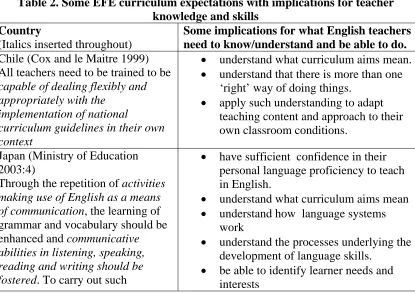
what is expected of a ‘qualified’ teacher. Table 2 below gives examples from a
number of different countries.
[image:12.595.92.507.477.770.2]
Table 2. Some EFE curriculum expectations with implications for teacher knowledge and skills
Country
(Italics inserted throughout)
Some implications for what English teachers need to know/understand and be able to do. Chile (Cox and le Maitre 1999)
All teachers need to be trained to be capable of dealing flexibly and appropriately with the
implementation of national
curriculum guidelines in their own context
• understand what curriculum aims mean. • understand that there is more than one
‘right’ way of doing things. • apply such understanding to adapt
teaching content and approach to their own classroom conditions.
Japan (Ministry of Education 2003:4)
Through the repetition of activities making use of English as a means of communication, the learning of grammar and vocabulary should be enhanced and communicative abilities in listening, speaking, reading and writing should be fostered. To carry out such
• have sufficient confidence in their personal language proficiency to teach in English.
• understand what curriculum aims mean • understand how language systems
work
• understand the processes underlying the development of language skills.
instruction effectively it is important for the teachers to establish many situations where SS can communicate in English and routinely conduct classes
principally in English.
• be able to use a range of techniques to provide opportunities to communicate. • be able to adjust classroom roles
according to type of activity.
China (Berry 2003:2)
According to the new curriculum teachers’ roles will be very different from the past. Teachers are no longer merely informants of knowledge. In addition to empowering SS with subject knowledge they are curriculum adaptors. Teachers should decide on the teaching content, design tasks as well as select and develop materials which they think
appropriate for their SS. They are planners scheduling the teaching content and materials.
• have sufficient personal language proficiency sufficient for all that follows
• understand what curriculum aims mean. • understand that there is more than one
‘right way’ of doing things. • be able to identify learner needs. • be able to evaluate and adapt/design
materials
• be able to match teaching content and approaches to their own classroom conditions. .
Kenya (Kembo-Sure 2003:210) The aim of the secondary school English syllabus is to increase total fluency in listening to, speaking, reading and writing the language.
• be personally fluent in English • understand what activities and
conditions can support the development of these skills in their learners.
• be able to use teaching techniques and materials, appropriate for their learners’ age , level, and classroom reality to enable such development.
While recognising that there is a difference in the English learning context between EFL countries like Chile, China and Japan, where the mother tongue is the medium of instruction and a country like Kenya where officially all teaching and learning takes place in English, Table 2 tries to highlight some of the complex cognitive and behavioural implications underlying the apparently simple wording of official curriculum statements. A common theme seems to be a more or less explicit
or approach appropriate for their particular classroom. For many such teachers the above expectations therefore represent a demand that they make quite fundamental changes to their existing professional ‘culture’. Even where official government statements explicitly suggest a desire to devolve more such decision making to teachers (as in the Chile and China extracts above), the transition from more authoritarian to more egalitarian structures in education (Canagarajah 2006), which require changes to long established beliefs and practices, (among educational administrators and leaders at all levels as well as among teachers, learners and parents), is a long term process. This may take from a decade to a generation to complete ( Birzea in Polyoi et al 2003), and its rate and route will vary according to innumerable national and more local contextual variables.
Nonetheless, if many EFE curricula worldwide currently have expectations of teachers similar to those in table 2, then trying to identify the content and design of the sorts of programmes that might help teachers to meet these expectations, provides a means of understanding the capacities required of the teacher educators who will design and teach on them.
Two linked content strands seem central for programmes that will begin to help teachers meet EFE curriculum expectations (see table three below). These incorporate aspects of Shulman’s (1987) content, general pedagogical, curriculum, pedagogical content and educational context knowledge. Emphasis on each ‘knowledge’ within each strand will vary, according to actual expected curriculum outcomes, particular features of a given educational culture and whether the programme aims to be a comprehensive initial teacher education or a shorter, more specifically EFE-curriculum-change-focused, in-service, teacher development programme. In most cases, since part one of this paper indicates that in many contexts at least some teachers lack confidence in their own English language proficiency, designers will additionally need to consider the importance of providing language development opportunities within the programme, and what language of instruction will be appropriate.
(dotted lines represent the likely continuous interaction between the components of the strands throughout the programme)
Strand one.
‘Knowing about/understanding’
Strand two ‘Knowing how to’ how the language used in the curriculum,
and the hoped-for outcomes, are
understood in the particular national/local context and what they assume about:
• how a language system works. • language learning processes, and
how ( if relevant) these vary according to the age of the learner.
• what the above imply for techniques that will support the development of learners’ language knowledge and skills
use strand one knowledge to make
curriculum-appropriate decisions for their classroom context, regarding for
example:
• use of teaching-learning materials • choice of teaching techniques and
activities
• assessment of learning
[image:15.595.88.513.103.327.2]Teacher educators working in curriculum contexts similar to those in table two therefore need to be ‘qualified’ to design contextually appropriate versions of at least some of the content in table three. In addition, they need some understanding of ideas from the literature about how (language) teachers learn, since these suggest that teaching approaches and learning conditions profoundly influence the impact that programmes have on teachers’ classroom practice. Some central ideas together with their apparent implications for the teacher learning process and programme design are considered in table four below.
Table 4. Some central ideas about how teachers learn, with implications for the teacher learning process and so for programme design.
Ideas about the teacher learning process
Some implications for the teacher learning process
Opportunities which programmes for English teachers need to provide (Sauvignon 2003 : 64)
The development of interpretive and reflective skills offers a very
practical and fruitful alternative for language teacher education…
• Learning to teach is a process. It continues throughout ones professional life. • The process involves thinking about learners, hoped-for-learning and context when planning, and teaching, and being prepared to rethink in the light of experience and practice.
• to think about what any new EFE curriculum is trying to do, why it has been introduced, and what it expects of teachers and learners.
• to try out new practices, observe others, give and receive
(Harris 2003, Leithwood 2002, Flores and Shiroma 2003)
In a world in which there are frequent changes to what is expected of classroom teachers, it is important that teachers are used to cooperating with and learning from each other.
Novice teachers especially need chances to try things out and to refine them through practice and through interaction with others.
If teachers are to be reflective professionals in terms of their practices and the beliefs that underlie them, teacher education courses have to be
organised accordingly and provide chances to
understand, try out and reconceptualise.
• change, which may involve the learning of new teaching
behaviours, is part of all teachers’ professional lives.
• dealing with change is easier if one collaborates with colleagues and/or more experienced experts’.
• Talking about what change implies, trying out new practices and discussing such trying out with colleagues is an important means of helping teachers to develop understanding of what is expected and confidence in their personal ability to meet expectations.
• to collaborate with colleagues and/or more experienced teachers.
• to try out approaches and techniques in practice, in real classrooms
• to obtain learner, peer and tutor responses to their ‘trying out’, and to use these to rethink and retry.
• to recognise that trying out, thinking about (with others) the results and retrying is an ongoing process throughout a teachers’ professional life. • to recognise that sharing ideas, problems, opinions with colleagues is normal
(Hunter and Benson 1997: 93)
Constructivist views of learning
Individuals do not see the world as it is, rather they see it as they are, as they have learned it to be.
• (trainee) teachers have had a long
apprenticeship of observation (Lortie 1975) in terms of their own school learning experiences.
• (trainee)teachers arrive on programmes with existing beliefs about how the world of education works. Changing these takes time.
• to identify existing beliefs and practices. • to identify any important ways in which these are different from those implied by the EFE curriculum.
• to begin to understand and become familiar with new beliefs and practices in existing classrooms.
such contexts to develop the capacity to ‘qualify’ their English teachers, they must therefore first ‘qualify’ their teacher educators.
If Graddol’s data (2006) is at all accurate when it suggests that the current worldwide demand for English is likely to continue for at least the next twenty to thirty years, it is bound to become increasingly politically unacceptable to allow the mismatch between the expectations raised by EFE policies and learners’ actual achievement to continue. Data on EFE spending around the world is
almost non existent, or at least extremely rare, because current education accounting practices generally fall short of analytical counting and so do not yield figures of expenditure by subject (Grin 2002: 26)
The only figure found in a search of the literature in English, was that offered above by a reputable research institute for annual spending on private English classes in Korea. Again if this ($15.3 billion) even approximately represents expenditure on private lessons in just one country, the public funds spent on EFE worldwide must be colossal. This immense financial investment, and the billions of individuals directly affected by unsatisfactory learning outcomes as teachers, learners and parents, suggest that sooner rather than later there will , in many contexts, be pressure on policy
makers and planners from politicians, employers and the wider public, demanding better quality state sector English provision. Merely maintaining the status quo will not be an option. The next section considers how national EFE policy makers and planners might begin the process of restoring public confidence in the value of state sector English classes.
3. The next step(s)
The process of introducing English as a key component of the school curriculum for learners in state sector schools worldwide during the last quarter of the twentieth century may be seen as the first phase of an international move towards EFE. During this initial phase, national policy makers seem generally to have given insufficient thought to existing socio-economic and educational/cultural realities, when
enable learners to achieve them. If public confidence is be restored, a second phase of activity is necessary, in which there is serious debate about outcomes, and serious commitment to developing national capacity to enable learners to achieve them.
Ideally the first stage of such a process would entail educational policy makers, planners and teacher educators (and where culturally and practically possible also classroom teachers and the wider public) engaging in a dialogue that honestly questioned some fundamental features of many existing EFE policies, in the light of actual and anticipated socio-economic and cultural realities and aspirations within the given national context. Some aspects of existing situations that might in my opinion usefully be debated include
• whether it is realistic to expect the state education system to enable all learners
in all schools to acquire all communication skills in English, or whether, recognising national educational realities and bearing important individual and national aspirations in mind, EFE curriculum outcomes should be redrafted to more precisely prioritise the development of certain aspects of
communication.
• how curriculum outcomes agreed at (i) – and materials meant to support them-
at present frequently using language, ideas and approaches imported from English-speaking western, cultural settings, can best be articulated and communicated in terms that maximise their ‘cultural continuity’ (Holliday 2001), and so are meaningful to the local educational administrators, school heads, teachers, learners and parents, who will need to understand them if they are to be achieved.
• in the light of (i) and (ii), whether the proportion of curriculum time currently devoted to English teaching at different stages within compulsory education is appropriate to enable most learners to achieve hoped-for outcomes.
• in the light of (i) to (iii), how achievement of outcomes may be supported by
adjustments to the content and/or format of high stakes English examinations.
understandings and practices expected of English teachers will therefore almost certainly include some of those outlined in table two. The capacity to ‘qualify’ teachers to meet such expectations is contingent on teacher educators being able to design and provide teacher support programmes, probably using some ideas in tables three and four, in a culturally appropriate manner. For this to be possible, it will be first be necessary to develop a national pool of ‘qualified’ English teacher educators.
Such a pool will, in most contexts, consist of two overlapping groups. A first group are those whose teacher education work is based wholly or principally within initial English teacher education programmes. Such programmes are usually situated within higher education institutions and lead to a recognised academic qualification. Some such teacher educators, especially those teaching less obviously ‘practical’ language-description- related courses, are frequently viewed (and may see themselves) as academic ‘experts’ rather than teachers of teachers. In contexts characterised by the lack of ‘fit’ noted previously between classroom implications of EFE curriculum language/outcomes and existing educational culture, some members of this group may find that the additional expectations of them as teacher educators threaten their ‘key meanings’ (Blackler and Shinmin 1984). These, it is suggested, are important in providing us with personal and professional stability and security in terms of our day to day perceptions of ourselves and of our relationships with others. When confronted with, for example, expectations of significantly changed behaviour within a
professional role, a common response is to defend the status quo in order to protect existing ‘key meanings’. The potential threat to these that communication-focussed EFE curricula may pose, together with unchanging norms in their institutional and organisational cultures, may mean that becoming ‘qualified’ teacher educators will be a slow, incremental, process for many of this group . This process may only gather real momentum at the point when funding for initial English teacher education programmes becomes more closely tied to the extent to which such programmes actually prepare teachers to meet EFE curriculum aims. Further discussion of the stages of such a process is not possible here.
The second group of teacher educators are those (many of whom may also be
happens in a nation’s classrooms after the introduction of any new EFE curriculum. Since such programmes often represent the only support available to the millions of serving English teachers worldwide, how teacher educators design and plan them, and what they actually do in the time available, is critical.
Again many members of this group are likely to be influenced by the norms of the existing educational culture. However, in most countries there are today a number of ‘key leaders’ (Henry and Walker 1991) among TESOL teacher educators ,
acknowledged and respected by their peers (Markee1997). Examples might include the authors represented in Braine (2005), and the ever larger number of TESOL professionals from around the world, some referred to in this paper, publishing in national and international language education journals. Such figures are a national EFE resource. They are likely to be sufficiently professionally experienced and contextually aware to understand how curriculum aims can be made comprehensible to English teachers in their context. It is also they, rather than civil servants/
educational administrators, who are most likely to be able to conceptualise what the need for comprehensibility implies for the content and design of trainer training programmes for fellow teacher educators. Their public support for investment in teacher-educator-capacity-building programmes, and their recruitment to participate in the design and teaching of such programmes, will strongly influence the speed at which, and extent to which, such capacity can be developed.
While some content of teacher educator/ trainer training programmes will of course be different to that on programmes for English teachers discussed above, most principles of teacher learning are equally applicable to the learning of those who teach teachers. A sequenced set of questions that might guide initial decisions about the content and design of capacity building teacher educator programmes is proposed in table five.
Table 5. A sequence of questions for English teacher educator/trainer training programme planners.
Questions relating to programme content
Questions relating to programme design/process
1. What central understandings and skills does the new curriculum demand of
English teachers?
2. What are the (two to three) most important ways in which these differ from what teachers already know and do in their classrooms?
3. Bearing (2) in mind, what is it important for teacher educators to
understand and feel confident about when providing support for teachers?
4. Bearing the professional and cultural context in mind, which of the items at (3) will most teacher educators find most difficult?
5. how long is the proposed trainer training programme?
6. bearing (3-5) and key ideas about teacher learning in mind, what teacher educator understandings and skills should the programme focus on trying to
develop?
8. which key ideas about teacher learning will the programme try to make explicit and /or model?
9. what training approaches/ formats will be most appropriate for enabling
discussion of (1) and (2)
10 how might the outcomes of such discussion (and ideas about teacher learning) be used as a basis for providing participants with chances to try out the practice of teaching teachers /designing programmes for teachers?
11. how will the programme try to
encourage and enable the development of cooperation and trust between teacher educators during and after the
programme?
12. how will the programme prepare participants to address teachers’ concerns about their (often less than ideal)
classroom realities?
Table five has frequently changed in length, with the addition and deletion of the many more detailed questions that could (and probably should) be asked. Those remaining represent a starting point for considering the content, design and process of EFE teacher educator programmes in different contexts. They try to bear in mind that budgetary considerations and the political imperative for rapid results will often mean that teacher educator/trainer training programmes (like the programmes for teachers which they will later design/teach on) are only long enough to introduce essential understandings about the curriculum, what it implies for teachers, and how teachers are thought to learn, and perhaps some initial practice in appropriate design of and ways of teaching on programmes for English teachers in the context. They also recognise the great importance of trying to develop systems to enable participants to have access to ongoing peer support over time.
There currently appears to be widespread international consensus that state education systems ought to provide opportunities for school age learners to develop an ability to use English. This paper has asserted that there is currently widespread, justified, dissatisfaction with national EFE policies which, while appearing to offer
opportunities to all learners within state education systems, often result in little obvious achievement for most. For the reputation of state sector English language provision to be rehabilitated, and become perceived as genuinely offering personally worthwhile, English learning opportunities to most learners, a new phase of
international EFE planning is needed. The first priority of such a phase is for policy makers to seriously consider how to make their national EFE curriculum outcomes more widely achievable given ‘the social, political, cultural and economic context within which they are embedded’ (Flores and Shiroma 2003:6). Whatever outcomes result, ‘effective teaching of teachers is the (original italics) key factor influencing the extent to which the implementation of new education policies and curriculum reforms takes place as intended (Malderez and Wedell 2007: xiii). A second priority thus involves taking the process of ‘qualifying’ teacher educators to help English teachers to implement them, seriously.
If the rhetoric of EFE is to begin to be reflected in classroom reality, the hundreds of hours that most learners worldwide spend learning English need to result in personally useful outcomes. For that to become the normal state of affairs within national school systems requires coherent EFE planning, which recognises that if most learners are to feel that they are gaining real benefits from their EFE experience, there first need to be ‘qualified’ English teacher educators able to support most English teachers as they begin to work with a nationally appropriate EFE curriculum
References
Aga Khan University. Karachi ( 2007) . Introduction to 4th International Seminar on English and Empowerment in the Developing World.
http://www.aku.edu/news/seminars/cel2007/cel-intro.htm ( accessed 26.02.07) Al Hamzi, S. (2003).EFL teacher preparation programmes in Saudi Arabia: Trends and Challenges. TESOL Quarterly 37/2, 341-345
Bambgose, A. (2003). A Recurring decimal in English language policy and planning. World Englishes 22/4, 419-431
Berry. R.S.Y. (2003). English language teaching and learning in mainland China: a comparison of the intentions of the English language curriculum reform and the real life teaching and learning situation in the English classroom. Hong Kong Institute of Education NAS Newsletter 4, 3-6
Blackler, F. and Shinmin, s. (1984) Applying psychology in organisations. London. Methuen.
Blenkin, G.V, Edwards, G and Kelly, A.V, (1992) Perspectives on educational change. in Harris, A, Bennett, N. and Preedy M. (eds) 1997. Organisational effectiveness and improvement in education : 216-230. Buckingham. Open
University Press.
Bohn, H. I. (2003). The Educational Role and Status of English in Brazil. World Englishes 22/2, 159-172
Braine G. (ed) (2005) Teaching English to the World: History, Curriculum and Practice. Mahwah NJ. Lawrence Erlbaum Associates.
Canagarajah S.A. (1999). Resisting linguistic imperialism in English teaching. Oxford. Oxford University Press
Canagarajah, S.A. (2006). TESOL at forty – What are the issues? TESOL Quarterly 40/1, 9-34
Cox, C. & Lemaitre, M..J. (1999) Market and State Principles of Reform in Chilean Education: Policies and Results. In G. Perry & D.Leipziger (Eds) Chile: Recent policy lessons and emerging challenges. World Bank Institute of
Development Studies : Washington D.C
Flores, M.A. & Shiroma, E. (2003). Teacher professionalisation and professionalism in Portugal and Brazil: what do the policy documents tell? Journal of
Education for Teaching 29/1 , 5-18
Fullan, M.G. (2001). The New Meaning of Educational Change (3rd Edition). Cassell : London.
Gahin, G. & Myhill, D. (2001) The Communicative Approach in Egypt: Exploring the secrets of the pyramids. TEFL Web Journal 1/2
(www.teflweb-j.org/v1n2/Gahin_Myhill.html) accessed 19/02/04 Graddol,D. (2006). English Next. British Council : London
language education policies: An introductory survey. Strasbourg. Council of Europe
Harris, A. (2003). Behind the classroom door: the challenge of organisational and pedagogical change. Journal of Educational Change. 4 , 369-382
Henry, J. & Walker, D. (Eds) (1991). Managing Innovation. Sage : London
Holliday, A. (2001). Achieving cultural continuity in curriculum innovation. In Hall, D.R., & Hewings, A. (Eds.) (2001). Innovation in English Language Teaching (pp169-177). London : Routledge,.
Holliday, A. (2005) The Struggle to teach English as an international language. Oxford. Oxford University Press.
Hu, G.W. (2002). Recent important developments in secondary English language teaching in the P.R.China. Language Culture and Curriculum. 15/1, 30-49 Hunter, W.J. & Benson, G.D. (1997). Arrows in time: The misapplication of chaos theory to education. Journal of Curriculum Studies 29/1, 87-100
Kembo-Sure. (2003). Establishing a national standard and English language curriculum change in Kenya. Language Culture and Curriculum 16/2, 197- 211
Kioko,A.N. & M..J. Muthwii. (2001). The demands of a changing society: English education in Kenya today. Language Culture and Curriculum 14/3, 210-213. Leithwood, K., Jantzi, D., and Mascall, B. (2002) .A Framework for research on large-scale reform. Journal of Educational Change 3, 7-33
Lortie, D.C. (1975). Schoolteacher: A sociological study. Chicago : University of Chicago Press
Malderez, A. and Wedell, M. (2007) Teaching teachers: Principles, processes and practices. London. Continuum
Markee, N. (1997). Managing curricular innovation. Cambridge, England: Cambridge University Press.
Michieka, M.M. (2005). English in Kenya : A sociolinguistic profile. World Englishes 24/2,173-186
Ministry of Education, Culture, Sports, Science and Technology. (2002). Regarding the establishment of an action plan to cultivate Japanese with English
abilities. Tokyo Japan. (www.mext.go.jp/english/topics/03072801.htm)
accessed 27.01.04
service) Education for Teachers of English: What can be learned from the
International Experience? Held in Santiago, Chile. April 26th 2004. Nunan, D. (2005). David Nunan responds. TESOL Quarterly 39/2, 307-308
Nunan.D (2003) The impact of English as a global language on educational policies and practices in the Asia-Pacific region. TESOL Quarterly 37/4, 589-613 Polyoi E, Fullan M.G and Anchan J.P (2003) Change Forces in Post-Communist
Eastern Europe. London : Routledge Falmer.
Sauvignon, S. (2003). Teaching English as communication : A global perspective World Englishes 22/1, 55-66
Shulman L. S 1987. Knowledge and teaching : Foundations of the new reform. Harvard Educational Review 57/1, 1-22
Tickoo, M. (2006) Language in education. World Englishes 25/1 , 167-176
Tudor, I. (2003). Learning to live with complexity : Towards an ecological perspective on language teaching. System. 31/1, 1-12
Wallace, C. (2002). Local literacies and global literacy. In Block, D. & Cameron, D. (Eds). Globalisation and Language Teaching. (pp 101-114). London : Routledge.
Wedell, M. (2003) Giving TESOL change a chance: supporting key players in the curriculum change process. System 31/4, 439-456.
Wedell, M. (2000). Managing change in a turbulent environment: The ELTSUP project in Hungary 1991-1998. Unpublished PhD thesis. Business School.
University of Glamorgan. Wales.
Wise, A. 1977 Why Educational Policies often fail: the hyperrationalisation hypothesis. Journal of Curriculum Studies 9/1 : 43-57
Young, R., & Lee, S. (1985) . EFL curriculum innovation and teachers' attitudes. In
Larson, P., Judd, E., & Messerschmidt, D. (Eds.) On TESOL 84: A brave new