Article
Two-Dimensional Modeling of the Oxidative
Coupling of Methane in a Fixed Bed Reactor:
A Comparison among Different Catalysts
Salamah Manundawee
1, Amornchai Arpornwichanop
2, Suttichai Assabumrungrat
2,
and Wisitsree Wiyaratn
1,*
1 Faculty of Industrial Education and Technology, King Mongkut’s University of Technology Thonburi, Bangkok 10140, Thailand
2 Department of Chemical Engineering, Faculty of Engineering, Chulalongkorn University, Bangkok
10330, Thailand
*E-mail: [email protected] (Corresponding author)
Abstract. A proposed two-dimensional model of the oxidative coupling of methane (OCM) to C2 hydrocarbons (e.g., C2H4 and C2H6) in a fixed bed reactor operated under
isothermal and non-isothermal conditions is described which can provide more accurate predictions of experimental data than the simplified one-dimensional model. The model includes a set of partial differential equations of the continuity, mass transfer and energy balance equations. The performance of the OCM using different catalysts was assessed in terms of CH4 conversion, C2 selectivity and C2 yield with respect to key operating
parameters, such as feed temperature (973-1173 K), CH4/O2 ratio (3.4–7.5) and gas hour
space velocity (GHSV) (18000-30000 h-1). The simulation results indicated that the
Na-W-Mn/SiO2 catalyst exhibits the best performance among all of the catalysts. The C2 yield
were 20.16% and 20.00% for non-isothermal and isothermal modes respectively which the OCM reactor is operated at a CH4/O2 ratio of 3.4, a feed temperature of 1073 K and a
GHSV of 9720 h-1. An increase in the operating temperature increases the CH4 conversion
but decreases the C2 selectivity. However, the effects of the CH4/O2 ratio and the GHSV
exhibit an opposite trend to that of the operating temperature.
Keywords: Oxidative coupling of methane (OCM), fixed bed reactor, two-dimensional model, gas hour space velocity (GHSV).
ENGINEERING JOURNAL Volume 21 Issue 3 Received 24 June 2016
Accepted 6 December 2016 Published 15 June 2017
1.
Introduction
Natural gas consists primarily of methane and is a raw material for a number of synthetic products [1]. One of many processes for natural gas utilization is oxidative coupling of methane (OCM); this process can directly convert methane into precious C2 hydrocarbons. Works on the OCM reaction have been reported
since the pioneering work of Keller and Bhasin in 1982. However, it is still a great challenge to improve on obtaining higher conversion of methane and ethylene, and high C2 hydrocarbons selectivity in the
production process [2].
In OCM process, several reactions occur simultaneously including homogeneous gas phase reactions and heterogeneous catalytic reactions, parallel and consecutive reaction with very complex reaction kinetics. Numerous kinetic reaction models have been presented to describe the performance of the OCM process over a large number of catalysts [3-7]. Several catalysts for OCM reaction were found to be effective in heterogeneous–homogeneous complex process [8] . Parameters of metal oxides, such as basicity, band gap, and electrical oxidative coupling of methane conductivity were some of the important parameters in affecting the catalyst performance. However, Li/MgO, La2O3/CaO and Na-W-Mn/SiO2 were three of the
most popular catalysts presented in the literature involving the studies of the OCM process because of their high performance [9-13]. Li/MgO is one of the most commonly studied OCM catalyst system, particularly to show that higher C2 yields (> 70%) are attained in the dense oxide membrane reactor than in
conventional packed-bed reactors and it showed high catalytic activity in the low temperature range [14-16]. In additional, La2O3/CaO demonstrated a promising result with 42% methane conversion and yield up to
20% [17]. Their kinetic reaction for OCM has been a strong interest in Na-W-Mn/SiO2 and is thus
extensively studied by several researchers. Their experimental results suggested this catalyst had appealing prospects in commercial application [18].
There are many types of reactors such as moving bed chromatographic reactor, membrane reactor, fluidized-bed reactor, catalytic jet-stirred reactor, and fixed bed reactor, have been reported. The applications of membrane reactor combining the separation and reaction in one unit to control oxygen concentration along the reactor were promising in enhancing CH4 conversion, yield and C2 selectivity for
OCM process. The performances of catalytic membrane reactor (CMR), catalyst packed bed membrane reactor (PBMR), and packed bed reactor (PBR) were compared at optimum condition and found that CMR performed best among three reactors with CH4 conversion by Bhatia and his co-workers [19]. Wang and
co-workers showed the remarkable study that the improvement of C2 selectivity was observed when catalyst
was packed in the membrane tube [20]. Fixed bed reactor is investigated in the most studied due to technically feasible and economic.Using mathematical model in fixed bed reactor study on OCM process was the easiest to design, scale up, and could be analyzed. In addition, OCM is an extremely exothermic reaction, and hot spots always occur in the catalyst. Heat removal was therefore essential for practical operation, and reactors were likely to be operated under non-isothermal condition [21]. The design of the fixed bed reactor using a two-dimensional mathematical model considering both axial- and radial-directions is more complex than that of a one-dimensional study considering only the axial axis. The two-dimensional model is more realistic and provides better prediction accuracy than the one-dimensional model. The need for the two-dimensional model becomes essential when a reactor with a large diameter is operated because the effect of radial dispersion becomes more pronounced. In the reactor design, it is important to determine a location where the hot spot is severe so that the operational problems, such as catalyst sintering, can be avoided and a suitable operating condition can be selected.
Therefore, in this study, two-dimensional mathematical modelling of the oxidative coupling of methane (OCM) to C2 hydrocarbons (C2H4 and C2H6) in a fixed bed operated under isothermal and non-isothermal
2.
Simulation
2.1. Kinetic Model
Numerous kinetic reaction models have been presented to describe the performance of the OCM process over several catalysts. Li/MgO, La2O3/CaO and Na-W-Mn/SiO2 are three of the most studied catalysts in
the literature related to the OCM process. Li/MgO exhibits high catalytic activity in the low temperature range, La2O3/CaO was one of the most common catalysts used in OCM models and Na-W-Mn/SiO2 was
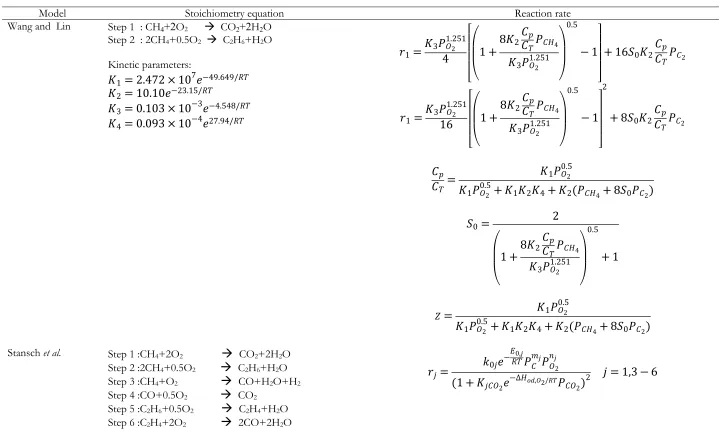
one of the most studied three-component catalyst. In the model, the kinetic mechanism and kinetic equations considered in this work were proposed by Wang and Lin [3] over a Li/MgO catalyst, Stansch et al. [4] over a La2O3/CaO catalyst and Danespayeh et al. [18] over a Na-W-Mn/SiO2 catalyst. The
stoichiometric equation and reaction rate of each of the proposed models are presented in Table 1. 2.2. Reactor Model
The transport phenomena were coupled with the reaction kinetics to develop a reactor model. The two-dimensional flow field in a fixed bed reactor was coupled with the mass and heat transport for the simulation performance of the OCM process, as well as the velocity, concentration and temperature profiles.
2.2.1. Geometry and boundary condition
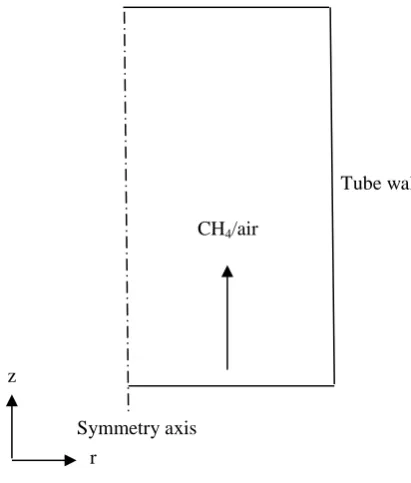
The reactor geometry considered was a 2D cylindrical one, and the flow enters the computational domain at a known velocity, composition and temperature. At the outlet, it was assumed that the convective part of the mass and heat transport vector was dominating. At the tube wall, a heat transfer was defined in non-isothermal mode, which defined the wall insulation in adiabatic operation, and the heat flux was removed from the wall in constant-wall temperature operation. The geometry of the fixed bed reactor is presented in Figure 1, which shows the scheme of the FBR. Methane and air were mixed and co-fed to an impermeable tubular reactor; the inner tube was filled with a bed of catalyst.
The reactor model was based on the following basic assumptions: two-dimensional mathematical model, steady-state operation and ideal gas behaviour. In addition, diffusivity in the catalyst bed was assumed to be via the Knudsen mechanism.
2.2.2. Governing equations
Mass balance: the mass balance for each of the eight components can be written as
(
)
(1)
The rate of production was calculated for each component from the stoichiometry of the reactions. Energy balance: the energy balance for the reactor can be written as follows.
( ) (2)
The heat source in Eq. (2), including heat of reaction and heat flux, were computed by
∑ (3)
Momentum balance: the momentum balance for reactor describes the flow in the porous media. The equation extends Darcy’s law combination with the continuity equation:
Table 1. Stoichiometric equation and reaction rate of proposed models.
Model Stoichiometry equation Reaction rate
Wang and Lin Step 1 : CH4+2O2 CO2+2H2O Step 2 : 2CH4+0.5O2 C2H6+H2O
Kinetic parameters:
[(
)
]
[(
)
]
(
)
Stansch et al. Step 1 :CH4+2O2
CO2+2H2OStep 2 :2CH4+0.5O2
C2H6+H2OStep 3 :CH4+O2
CO+H2O+H2Step 4 :CO+0.5O2
CO2Step 5 :C2H6+0.5O2
C2H4+H2OStep 6 :C2H4+2O2
2CO+2H2O
[image:4.842.61.784.98.531.2]
Model Stoichiometry equation Reaction rate
Step 7 :
C2H6
C2H4+H2Step 8 :C2H4+2H2O
2CO+2H2OStep 9 :CO+H2O
CO2+H2Step 10 :CO2+H2
CO+H2O
Danespayeh et al. Step 1 : 2CH4+0.5O2
C2H6+H2OStep 2 : CH4+2O2
CO2+H2OStep 3 :CH4+O2
CO+H2O+H2Step 4 :CO+0.5O2
CO2Step 5 :C2H6+0.5O2
C2H4+H2OStep 6 :C2H4+2O2
2CO+2H2OStep 7 :C2H4+2H2O
2CO+4H2Step 8 :C2H6
C2H4 +H2Step 9 :CO2+H2
CO+H2OStep 10 :CO+H2O
CO2+H2
The performance of the reactor was evaluated by the conversion of reactants as well as the selectivity and the yield of the products. The conversion was defined as the fraction of the reactant that was reacted to the amount of reactant fed. For example, the conversion of methane was
CH4 conversion % =
(5)
and the C2 selectivity was defined as the C2 product formed per reactant consumed.
C2 selectivity % = (6)
Moreover, the COx selectivity was defined as the COx byproduct formed per reactant consumed.
COx selectivity % =
(7)
The yield referred to the specific product formed per reactant fed.
C2 yield % =
(8)
In addition, in a fixed bed reactor, the effect of operating variables under three operating modes, i.e., isothermal, adiabatic, and non-isothermal condition, were considered.
Fig. 1. Geometry of fixed bed reactor.
2.3. Numerical Approach
The finite element method was proposed to formulate the PDE problem. In the developed finite element model, the reactor was solved with quadratic finite element basis functions using the commercial finite element simulation environment COMSOL. The software runs the finite element analysis together with meshing, which involves a partition of the geometry model into small units of simple shapes, and error control using a variety of numerical solvers. Three application modes were required to model the heat transfer by conductive and convective processes. Mass transfer by convective processes and diffusion was
CH4/air
z
r
Symmetry axis
[image:6.595.174.380.377.619.2]used to simulate the concentration and transport of eight species of interest. The Brinkman equation was applied to describe the fluid flow.
3.
Results and Discussion
The simulations were performed for OCM in a fixed bed reactor. The conditions used in the simulation are summarized in Table 2, and the catalyst properties are presented in Table 3.
Table 2. Reactor dimension and conditions.
Condition Dimension
Fixed bed reactor
Length of catalyst bed (m) 0.2
Diameter (m) 0.018
Temperature (K) 993-1173
Pressure (kPa) 101.325
CH4/O2 ratio 3.4-7.5
GHSV (h-1) 18000-30000
Table 3. Catalyst properties.
Property catalyst
Li/MgO La2O3/CaO Na-W-Mn/SiO2
Average pore radius (m) 0.0005 0.01 0.00008
Porosity (-) 0.34 0.6 0.6
Totousity (-) 2.153 3 1.089
Thermal conductivity (W/m K) 10.3 1 1.35
3.1. Model Validation
The validation of the kinetic model (for Li/MgO, La2O3/CaO and Na-W-Mn/SiO2 catalyst) was
performed first to ensure that the mathematical models could well predict the OCM performances. The model used was the two-dimensional plug flow model.
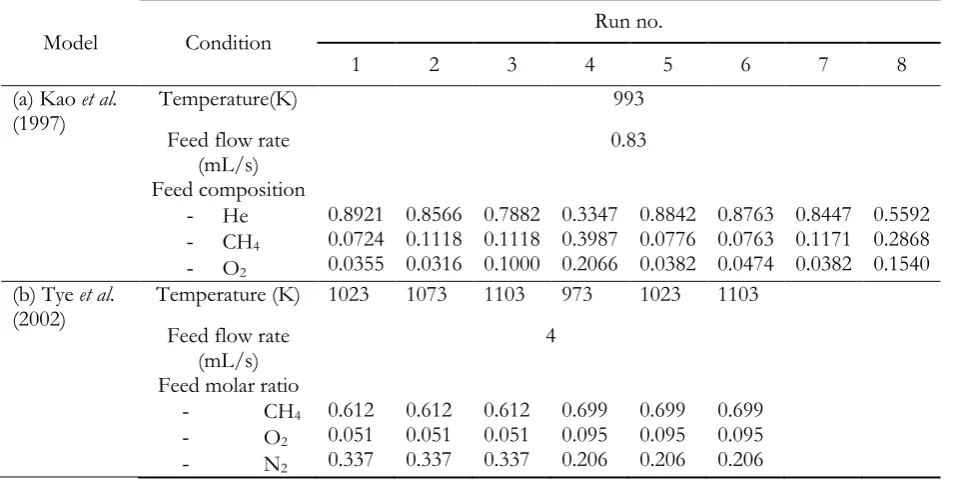
The validity of the Li/MgO catalyst using the kinetic rate expression reported by Wang and Lin [3] was assessed by comparing our simulation results with the simulation data from the literature [13] in the fixed bed reactor. Figure 2(a) shows yield of the C2 products versus the run numbers under the conditions in the
literature, which are presented in Table 4(a). Figure 2(b) shows the validation results of the La2O3/CaO
catalyst by comparing our simulation results with the simulation data reported by Tye et al. [12] in terms of the C2 yield versus the run numbers under the conditions of the literature, which are presented in Table 4
(b). Figure 2(c) shows the comparison between our results and the results reported in the literature by Daneshpayeh et al. [18] for a Na-W-Mn/SiO2 catalyst, which provided conversion of CH4 in a range of
16.5 – 19 kg m3/s at a temperature of 1048 K. Our simulation results are found to agree well with
[image:7.595.115.479.204.306.2] [image:7.595.80.516.357.442.2](a)
(b)
(c)
Fig. 2. Comparison between literature and our prediction model over Li/MgO (a.), La2O3/CaO (b.) and
[image:8.595.87.513.73.662.2]Table 4. Condition for different run number.
Model Condition Run no.
1 2 3 4 5 6 7 8
(a) Kao et al.
(1997) Temperature(K) 993
Feed flow rate
(mL/s) 0.83
Feed composition
- He
- CH4
- O2
0.8921 0.0724 0.0355 0.8566 0.1118 0.0316 0.7882 0.1118 0.1000 0.3347 0.3987 0.2066 0.8842 0.0776 0.0382 0.8763 0.0763 0.0474 0.8447 0.1171 0.0382 0.5592 0.2868 0.1540 (b) Tye et al.
(2002) Temperature (K) 1023 1073 1103 973 1023 1103 Feed flow rate
(mL/s) 4
Feed molar ratio
- CH4
- O2
- N2
0.612 0.051 0.337 0.612 0.051 0.337 0.612 0.051 0.337 0.699 0.095 0.206 0.699 0.095 0.206 0.699 0.095 0.206 3.2. Catalytst Selection
This section considers the selection of a suitable catalyst among Li/MgO, La2O3/CaO and Na-W-Mn/SiO2
catalysts at various conditions, i.e., gas hourly space velocity (GHSV), CH4/O2 ratio, and temperature. The
system was based on a fixed bed reactor under isothermal operation mode. A summary of the operating conditions in this section is presented in Table 5.
The performance of the OCM reaction was considered in terms of the CH4 conversion and the C2
selectivity. Figure 3 shows the activities of the three catalysts for GHSV in a range of 18000 to 30000 1/h. The order of the CH4 conversion follows Na-W-Mn/SiO2 > La2O3/CaO > Li/MgO. The CH4 conversion
was decreased with the increase of the GHSV for all catalysts.
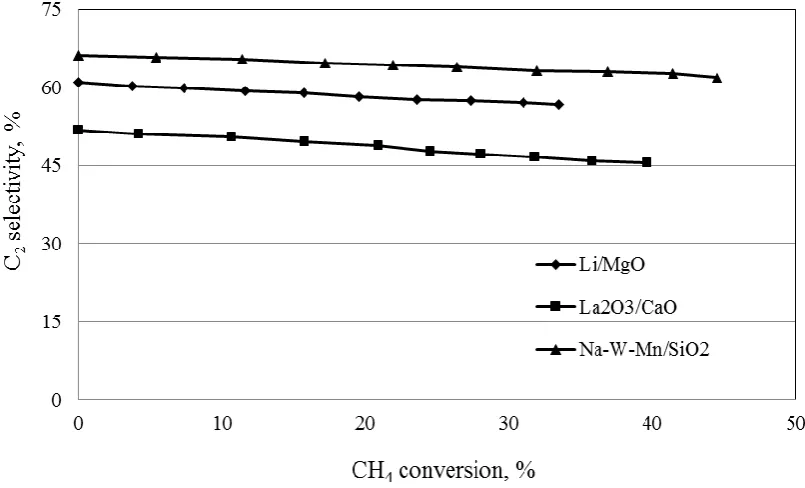
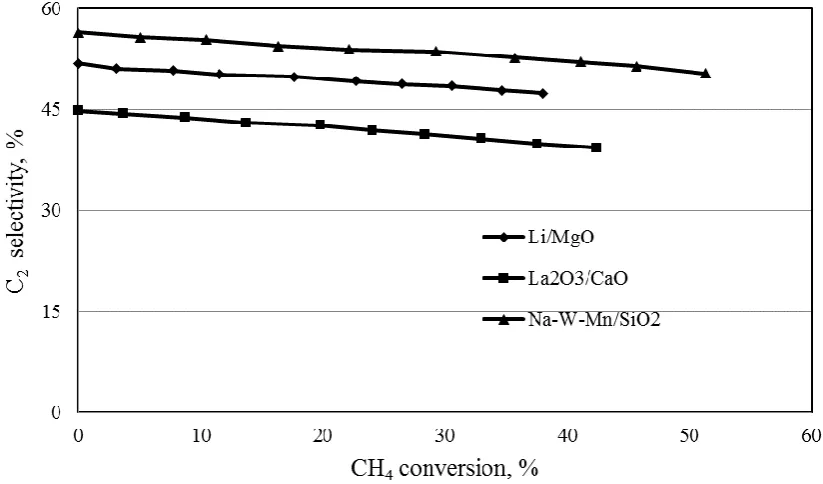
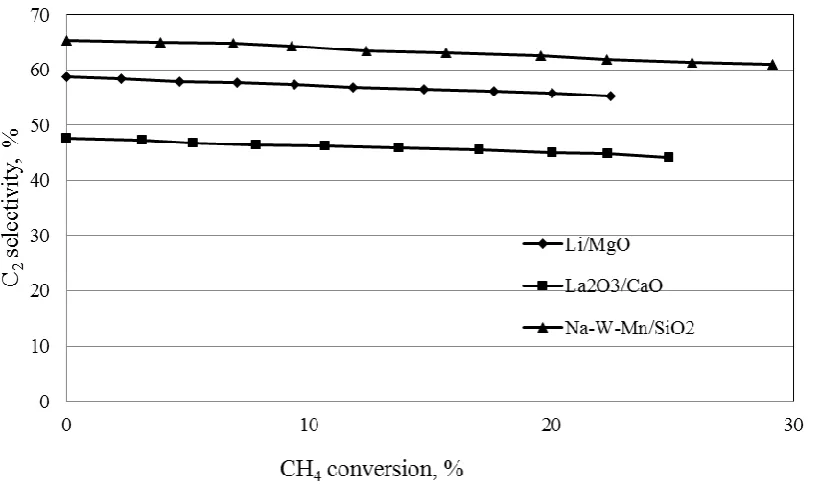
Figures 4-8 show the results of the C2 selectivity to CH4 conversion at a position of reactor length (the
inlet of the reactor at CH4 conversion was set to zero) under different conditions, which are summarized in
Table 5 from all figures; the CH4 conversion was increased and the C2 selectivity was decreased with an
increase of the distance from the inlet to the reactor for all catalysts. It was obvious that CH4 conversion
for the Na-W-Mn/SiO2 catalyst was higher than those for the La2O3/CaO and Li/MgO catalysts.
Moreover, the C2 selectivity for the Na-W-Mn/SiO2 catalyst was higher than those for the Li/MgO and
La2O3/CaO catalysts. The COx selectivity for the La2O3/CaO catalyst was higher than those for the
Li/MgO and Na-W-Mn/SiO2 catalysts at all conditions. In addition, even the La2O3/CaO catalyst provides
a CH4 conversion higher than that of the Li/MgO catalyst, but the C2 selectivity was lower. The presence of
oxygen as a co-feed reactant affected to limited CH4 conversion at different values as a result of consumed
oxygen completely in the reaction. The comparison of the OCM performance among the catalysts at various CH4/O2 ratios is shown in Figs. 4-6. The CH4 conversion was decreased while the C2 selectivity
was increased with the increase of the CH4/O2 ratio for all catalysts. Moreover, the comparison of the
OCM performance among the different catalysts at various temperatures is shown in Figs. 6-8. The CH4
conversion increased and the C2 selectivity decreased with an increase of the temperature. Note that at
higher temperature, the rate of decrease of the C2 selectivity was greater than that at lower temperature, for
example, for the Li/MgO catalyst, at 1173 K, the difference of C2 selectivity between the outlets to the inlet
was 4.43 % but at 993 K and 1073 K, the differences were 3.58 % and 3.84 %, respectively. The maximum C2 yields for all catalysts at a temperature of 1173 K and a CH4/O2 ratio of 3.4 were 30.07 %, 19.2 % and
20.43 % for Na-W-Mn/SiO2, La2O3/CaO and Li/MgO, respectively. The simulation results indicated that
[image:9.595.62.543.105.345.2]Table 5. Summary of operating condition for catalyst selection study.
Figure condition
GHSV(1/h) Temperature (K) CH4/O2 ratio
3 18000-30000 993 3.4
4 18000-30000 1173 7.5
5 18000-30000 1173 4.2
6 18000-30000 1173 3.4
7 18000-30000 1073 3.4
8 18000-30000 993 3.4
Fig. 3. The activities of Li/MgO, La2O3/CaO and Na-W-Mn/SiO2 catalysts in GHSV range of 18000 to
Fig. 4. CH4 conversion VS C2 selectivity (T=1173 K, CH4/O2 ratio = 7.5).
[image:11.595.95.493.89.340.2] [image:11.595.78.481.407.651.2]Fig. 6. CH4 conversion VS C2 selectivity (T=1173 K, CH4/O2 ratio = 3.4).
[image:12.595.78.490.82.324.2] [image:12.595.91.499.375.643.2]Fig. 8. CH4 conversion VS C2 selectivity (T=993 K, CH4/O2 ratio = 3.4).
3.3. Fixed Bed Reactor Study
From the previous section, we know that the Na-W-Mn/SiO2 catalyst exhibits the best performance for the
OCM reaction. In the present study, the Na-W-Mn/SiO2catalyst was selected for this study. The effect of
operating conditions, i.e., GHSV, temperature, CH4/O2 ratio and air flow rate, was investigated in a fixed
bed reactor under non-isothermal mode. The 2-dimensional model was used to explore the profiles of temperature and concentration in the axial and radial directions.
3.3.1. Effect of GHSV
The effect of GHSV in a range of 9000 to 33000 1/h, at a CH4/O2 ratio of 2 and at a temperature of 1073
K on the CH4 conversion and the C2 selectivity is presented in Fig. 9. The CH4 conversion decreased,
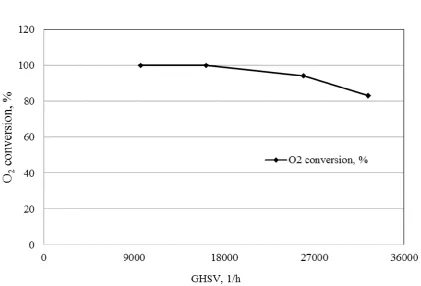
whereas the C2 selectivity increased with the increase of the GHSV. Increasing the GHSV results in a lower
contact time and hence, the CH4 and O2 conversions were decreased (Fig. 10 for O2 conversion).However,
the higher GHSV was more favourable for the C2 hydrocarbon production because the shortening of the
contact time between the C2 products with the oxygen can limit the formation of carbon oxides.
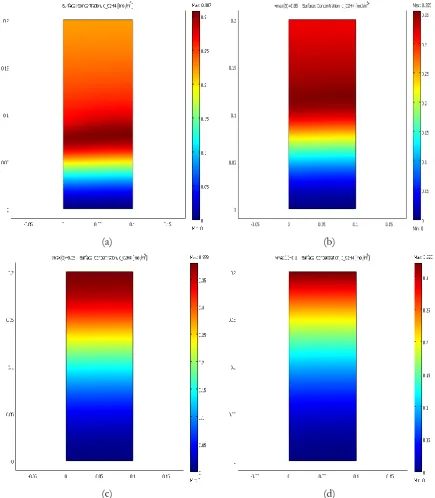
Figure 11 shows the ethylene concentration profile. The GHSV was considered at 9720 (a.), 16197.3 (b.), 25915.7 (c.) and 32394.6 (d.) 1/h, and the temperature and CH4/O2 were fixed at 1073 and 2,
[image:13.595.98.510.85.328.2]Fig. 9. Effect of GHSV on CH4 conversion and C2 selectivity.
[image:14.595.88.510.357.643.2](a) (b)
[image:15.595.79.515.84.583.2](c) (d)
(a) (b)
[image:16.595.81.513.82.586.2](c) (d)
Fig. 12. Effect of GHSV temperature profile (a.), 16197.3 (b.), 25915.7 (c.) and 32394.6 (d.) (CH4/O2= 2, T= 1073 K).
3.3.2. Effect of temperature
The effect of temperature on the CH4 conversion and the C2 selectivity is presented in Fig. 13. The
temperature was considered in a range of 993-1173 K, the CH4 /O2 ratio was 2 and the GHSV was 9720
1/h. It was found that when increasing the feed temperature, the CH4 conversion and the COx selectivity
were increased, thus decreasing the C2 selectivity. Hence, too high or too low a temperature was not
beneficial for the C2 yield. From the result, the best feed temperature would be 1073 K that represents
highest C2 yields.
temperature, the maximum temperature was found to increase as well. For the maximum temperature of up to 1543.7 K, the inlet temperature was 1123 K. The heat of reaction released in the OCM increased with the reaction temperature along the reactor. The higher temperature profiles for 1073 K and 1123 K indicate a hot spot occurring along the axis of the reactor. The temperature variation in the radial direction in the same plane lies in the range of 100 to 150 K; hence, safety is a factor that should be considered. The wall temperature was an important parameter, which was related to the heat removal.
[image:17.595.83.490.187.443.2]These results suggest finding an optimum condition to obtain the best system in this FBR study.
Fig. 13. Effect temperatures on CH4 conversion and C2 selectivity.
(c) (d)
Fig.14. Temperature profile at T = 993 (a.), 1023 (b.), 1073 (c.) and 1123(d.) K (CH4/O2 = 2, GHSV =
9720 1/h).
3.3.3. Effect of CH4/O2 ratio
The effect of the CH4/O2 ratio in a range 2-7.5 at a GHSV of 9720 1/h and a temperature of 1073 K on
the CH4 conversion and the C2 selectivity is presented in Fig. 15. The CH4 conversion was decreased,
whereas the C2 selectivity was increased with the increase of the CH4/O2 ratio. The oxygen also causes the
production of methyl radicals which cause the formation of C2 hydrocarbons. Because the oxygen content
in feed was decreased to cause an insufficient amount of oxygen in the reaction, the CH4 conversion was
decreased. However, when the oxygen concentration was high (low CH4/O2 ratio) the oxidation of
methane and the C2 product became pronounced. Figure 16 shows the oxygen and ethylene concentrations
at CH4/O2 ratios of 2 and 3.4 in Figs. 16(a) and 16(b), respectively, to provide a comparison on the OCM
performance. At a CH4/O2 ratio of 2, Fig. 16(a1) shows the O2 conversion was 100% at the first part of the
reactor and that the CH4 conversion was as high as 55.83 %. In addition, Fig. 16(a2) shows that the
ethylene concentration starts to decrease at same point of 100 % conversion of oxygen because it was oxidized to COx. The ethylene concentration was improved with increasing CH4/O2 ratio to 3.4, as shown
in Fig. 16(b). In addition, the effect of the CH4/O2 ratio has an influence on the temperature in the reactor.
Figure 17 shows the temperature profile at CH4/O2 ratios of 2 (a.) and 3.4 (b.). The hot spot disappeared
when the CH4/O2 ratio was 3.4 because the reaction site is extended along the inner wall thus reaction is
[image:18.595.84.511.84.333.2]Fig. 15. Effect CH4/O2 ratio on CH4 conversion and C2 selectivity.
DOI:10.4186/ej.2017.21.3.77
[image:20.595.78.505.83.332.2](b1) (b2)
Fig. 16. Effect of CH4/O2 ratio on concentration profile a. CH4:O2 =2, T=1073 K, GHSV =9720 1/h
b. CH4:O2 =3.4, T=1073 K, GHSV =9720 1/h.
(a) (b)
Fig. 17. Effect of CH4/O2 ratio on temperature profile a. CH4:O2 =2, T=1073 K, GHSV =9720 1/h
b. CH4:O2 =3.4, T=1073 K, GHSV =9720 1/h.
3.4. Effect of the Mode of Operation
It was interesting to compare the effect of the mode of operation, including isothermal, adiabatic and non-isothermal conditions, on the CH4 conversion, the C2 selectivity and the C2 yield. Table 6 presents the
[image:20.595.71.495.397.647.2]conditions of a CH4/O2 ratio of 3.4, a feed temperature of 1073 K and a GHSV of 9720 1/h. When
comparing the different modes, the CH4 conversion in adiabatic mode was higher than those of the
non-isothermal mode and non-isothermal mode, but it exhibited the least C2 selectivity. Moreover, operation in
adiabatic mode exhibits a hot spot (region) along the axis of the reactor, as seen from the temperature profile in Fig. 18(a). To limit the hot spot, providing some arrangement of cooling around the catalyst bed can control the temperature in the reaction, as demonstrated in the case of the non-isothermal operation mode shown in Fig. 18(b). Other methods were proposed to solve the hot spot problem, such as shortening the catalyst bed or dilution of the first portion of the catalyst bed (Moustafa et al. (2007)). The C2 yield of 20.16 % was achieved in non-isothermal mode, while they were 20.00 % and 17.62 % for
isothermal and adiabatic modes, respectively. The nature of the OCM reaction was highly exothermic. Hence, to achieve this operation condition, a cooling temperature with a high heat transfer coefficient was required.
Table 6. OCM performance at different mode operation.
Performance isothermal adiabatic Non-isothermal CH4 Conversion, % 36.14 42.27. 38.43
C2 Selectivity, % 55.35 41.68 52.46
C2 Yield, % 20.00 17.62 20.16
(a) (b)
Fig. 18. Effect of mode of operation on temperature profile a. adiabatic mode b. non-isothermal mode (CH4:O2 =3.4, T=1073 K, GHSV =9720 1/h).
The 2-dimensional model studied and analyzed the effect of operating variables such as CH4/O2 ratio,
GHSV and temperature in the fixed bed reactor on the reaction performances such as conversion, selectivity, yield via expression of surface plot for each profile (concentration and temperature profiles). The comparison of these results and Karimi et al.,2007 supported that the operating condition particularly temperature, GHSV and the CH4/O2 ratio was strongly effect the OCM reaction on C2+ selectivity, CH4
conversion and the yield of C2+ However the detailed 2D model can provide more accurate predictions of
[image:21.595.78.516.305.594.2]4.
Conclusions
Two-dimensional mathematical modeling of the oxidative coupling of methane (OCM) in a fixed bed reactor was studied in this research. The simulations were performed using the Comsol multiphysics program. The present study indicated that the models were well-validated with the previous results reported in the literature. Suitable catalysts were selected via a comparison among the Na-W-Mn/SiO2, La2O3/CaO
and Li/MgO catalysts in isothermal mode. The simulation results indicated that the Na-W-Mn/SiO2
catalyst offers the best performances among all of the catalysts under various conditions. Different operating conditions, such as temperature, CH4/O2 ratio and GHSV, influence the performance of the
OCM reactors packed with Na-W-Mn/SiO2 and operated in non-isothermal mode. Increasing the
operating temperature increased the CH4 conversion but decreased the C2 selectivity However, the effects
of CH4/O2 ratio and GHSV exhibited contrary results. Especially regarding the hot spots in the reactor, it
was found that the three operating variables (CH4/O2 ratio, GHSV and temperature) affect the occurrence
of hot spots. A suitable condition to achieve the best performance was at a CH4/O2 ratio of 3.4, a feed
temperature of 1073 K and a GHSV of 9720 1/h. The maximum C2 yield was 20.16%. In addition, from
the studies of the three modes, isothermal, adiabatic and non-isothermal, the results were found for the non-isothermal and isothermal modes; heat management can improve the performance of the OCM reactor, which can be used in a real operation in the reactor design. Moreover, the performance of the OCM may be improved when changing the reactor configuration, e.g., a catalytic membrane reactor should be considered.
Acknowledgements
The authors gratefully acknowledge the Thailand Research Fund (DPG5880003) for the financial support.
References
[1] J. H. Lunsford, “Catalytic conversion of methane to more useful chemical and fuel: A challenge for the 21st century,” Catalysis Today, vol. 63, pp. 165-174, 2000.
[2] G. E. Keller and M. M. Bhasin, “Synthesis of ethylene via oxidative coupling of methane. I. Determination of active catalysts,” Journal of Catalysis, vol. 73, pp. 9-19, 1982.
[3] W. Wang and Y. S. Lin, “Analysis of oxidative coupling of methane in dense oxide membrane reactors,” Journal of Membrane Science, vol. 103, pp. 219-233, 1995.
[4] Z. Stansch, L. Mleczko, and M. Baerns, “Comprehensive kinetics of oxidative coupling of methane over the La2O3/CaO catalyst,” Industrial & Engineering Chemistry Research, vol. 36, pp. 2568-2579, 1997.
[5] S. Lacombe, Z. Durjanova, L. Mleczko, and C. Mirodatos, “Kinetic modeling of the oxidative coupling of methane over lanthanum oxide in connection with mechanistic studies,” Chemical Engineering Technology, vol. 18, pp. 216–223, 1995.
[6] M. Traykovaa, N. Davidovaa, J. S. Tsaihb, and A. H. Weiss, “Oxidative coupling of methane the transition from reaction to transport control over La2O3/MgO catalyst,” Applied Catalysis, vol. 169, pp.
237-247, 1998.
[7] M. K. S. Shahri and S. M. Alavi, “Kinetic studies of the oxidative coupling of methane over the Mn/Na2WO4/SiO2 catalyst,” Journal of Natural Gas Chemistry, vol. 18, pp. 25–34, 2009.
[8] S. Kus, M. Otrenba, and M. Taniewski, “The catalytic performance in oxidative coupling of methane and the surface basicity of La2O3, Nd2O3, ZrO2, and Nb2O5,” Fuel, vol. 82, pp. 1331–1338, 2003.
[9] S. Pak, P. Qia, and J.H. Lunsford, “Elementary reactions in the Oxidative coupling of methane over Na2WO4-Mn/SiO2 and Na2WO4-Mn/SiO2,” Journal of Catalysis, vol. 179, pp. 220-230, 1998.
[10] S. J. Li, “Reaction chemistry of W-Mn/SiO2 catalyst for the oxidative coupling of methane,” Natural Gas Chemistry, vol. 12, pp. 1-9, 2003.
[11] H. Liu, X. Wang, D., Yung, R. Gao, Z. Wang, and J. Jung, “Scale up and stability test for oxidative coupling of methane over Na2WO4-Mn/SiO2 catalyst in a 200 ml fixed-bed reactor,” Natural Gas Chemistry, vol. 17, pp. 59-63, 2008.
[13] Y. K. Kao, L. Lei, and Y. S. Lin, “A comparative simulation study on oxidative coupling of methane in fixed-bed and membrane reactors,” Industrial & Engineering Chemistry Research, vol. 36, pp. 3583-3593, 1997.
[14] J. H. Lunsford, “The catalytic coupling of methane,” Angewandte Chemie International Edition in English, vol. 34, pp. 970–980, 2006.
[15] J. A. Langille, J. Pasaleb, J. Y. Renb, F. N. Egolfopoulosa, and T. T. Tsotsisb, “The use of OCM reactors for ignition enhancement of natural gas combustion for practical applications: Reactor design aspects,” Chemical Engineering Science, vol. 61, pp. 6637-6645, 2006.
[16] N. A. S. Amin and S. E. Pheng, “Influence of process variables and optimization of ethylene yield in oxidative coupling of methane over Li/MgO catalyst,” Chemical Engineering Journal, vol. 116, pp. 187-195, 2006.
[17] L. Mleczko, U. Pannek, M. Rothaemel, and M. Baerns, “Oxidative coupling of methane over a La2O3/CaO catalyst. Optimization of reaction conditions in a bubbling fluidized-bed reactor,” The Canadian Journal of Chemical Engineering, vol. 74, pp. 279-287, 1996.
[18] M. Daneshpayeh, K. Abbasali, M. Navid, M. Yadolah, S. Rahmate, and T. Alireza, “Kinetic modeling of oxidative coupling of methane over Mn/Na2WO4/SiO2 catalyst,” Fuel Processing Technology, vol. 90,
pp. 403-410, 2009.
[19] S. Bhatia, C. Y. Thien, A. Rahman, “Oxidative coupling of methane (OCM) in a catalytic membrane reactor and comparison of its performance with other catalytic reactors,” Chemical Engineering Journal, vol. 148, pp. 525–532, 2009.
[20] H. Wang, C. You, and W. Yung, “Oxidative coupling of methane in Ba0.5Sr0.5Co0.8Fe0.2O3-_(BSCF)
tubular membrane reactors,” Catalysis Today, vol. 104, pp. 160–167, 2005.