City, University of London Institutional Repository
Citation
:
Lekeas, George K. (2011). Regulating competence-based access to agent societies. (Unpublished Doctoral thesis, City University London)This is the unspecified version of the paper.
This version of the publication may differ from the final published
version.
Permanent repository link: http://openaccess.city.ac.uk/1144/
Link to published version
:
Copyright and reuse:
City Research Online aims to make research
outputs of City, University of London available to a wider audience.
Copyright and Moral Rights remain with the author(s) and/or copyright
holders. URLs from City Research Online may be freely distributed and
linked to.
City Research Online: http://openaccess.city.ac.uk/ [email protected]
City University London
Department of Computing
Regulating competence-based access to
agent societies
George K. Lekeas
A thesis submitted for the degree of
Doctor of Philosophy of City University London
Contents
1 Introduction 1
1.1 Motivation . . . 1
1.2 Admittance of agents to semi-open societies . . . 3
1.2.1 Joining a semi-open society . . . 4
1.2.2 An agent’s lifecycle in an artificial society . . . 6
1.2.3 Leaving a society . . . 7
1.3 Issues . . . 8
1.4 Aims & Objectives . . . 8
1.4.1 Aims . . . 8
1.4.2 Objectives . . . 9
1.5 Research Hypotheses . . . 10
1.6 Description of the approach and architecture of the tech-niques used . . . 11
1.7 Structure of the Thesis . . . 13
1.8 Previous Publications . . . 14
2 Background 15 2.1 Introduction . . . 15
2.2 Agents . . . 15
2.3 MAS & Artificial Agent Societies . . . 17
2.4 Entry to Society . . . 20
2.4.1 Admittance Criteria . . . 21
2.4.2 Authority Agents (AA) . . . 22
2.5 Game-based representation of protocols . . . 22
2.6 Summary . . . 27
3 Formal Framework 29 3.1 Introduction . . . 29
3.2 The Netbill Protocol . . . 29
3.3 Definition of a protocol in a society . . . 31
3.4 Modelling Roles in Game Protocols . . . 33
3.5 From Roles back to Game Protocols . . . 34
3.6 Game evolution in Situation Calculus . . . 35
3.6.1 Situation Calculus . . . 35
3.6.1.1 Formalisation of Situation Calculus . . . . 36
3.6.1.1.1 Fluents . . . 37
3.6.1.3 The Frame axiom . . . 38
3.6.1.4 Static Facts . . . 38
3.6.2 Evolution of a game . . . 38
3.6.3 Game Situations using the Situation Calculus . . . 39
3.6.4 Game Moves . . . 40
3.6.5 Game Situation . . . 40
3.6.6 Initial and Terminating States . . . 41
3.6.7 Valid Moves . . . 42
3.6.8 Effects of Moves . . . 43
3.7 Timed games in Event Calculus . . . 44
3.7.1 Event Calculus . . . 45
3.7.1.1 The simple version ofEvent Calculus . . 45
3.7.1.2 The axioms of theEvent Calculus. . . 46
3.7.2 Representing games in the Event Calculus . . . 46
3.7.3 Reasoning about properties in timed games . . . . 47
3.7.4 Effects of actions in timed games . . . 49
3.8 Relationship between games and LTSs . . . 49
3.9 Formal definition of Competence . . . 50
3.10 Competence and Protocol Completion . . . 55
3.11 Competence Checking as Planning . . . 56
3.11.1 Competency Profiles . . . 57
3.11.2 Hypothesising Valid Moves . . . 58
3.12 Summary . . . 59
4 Decomposing the protocol into roles 61 4.1 Introduction . . . 61
4.2 The Need for Decomposing Protocols . . . 61
4.2.1 Bisimulation . . . 63
4.2.2 τ⋆α Bisimulation . . . 64
4.2.3 Branching Bisimulation . . . 64
4.2.4 From Protocols To Individual Roles - The Algorithm 65 4.3 Repairing non-enactable game protocols . . . 69
4.3.1 Updating all silent moves . . . 69
4.3.2 Updating frontier silent moves . . . 70
4.3.3 Updating selected silent moves . . . 71
4.4 Protocols with multiple instances of the same role . . . 73
4.4.1 Verification . . . 73
4.5 Summary . . . 74
5 Case Studies 75 5.1 Introduction . . . 75
5.2 Setting the Scene - an acyclic protocol . . . 75
5.2.1 The protocol . . . 75
5.2.2 Protocol Rules in Situation Calculus . . . 76
5.2.2.1 Game Situations . . . 76
5.2.2.3 Valid Moves . . . 77
5.2.2.4 Effects of Moves . . . 79
5.2.2.5 An example run . . . 79
5.2.3 Protocol Rules in Event Calculus . . . 80
5.2.3.1 Game Situations . . . 80
5.2.3.2 Initial and Terminating Conditions . . . . 81
5.2.3.3 Valid Moves . . . 81
5.2.3.4 Effects of the Moves . . . 82
5.2.3.5 An example run . . . 83
5.3 Setting the scene - a cyclic protocol . . . 83
5.3.1 Specifying cycles in Situation Calculus . . . 85
5.3.1.1 An example run . . . 87
5.3.2 Cyclic Rules in Event Calculus . . . 87
5.3.2.1 An example run . . . 89
5.4 Entering the society - Role Assignment . . . 89
5.4.1 From Roles back to Protocols . . . 94
5.5 Games with multiple instances of the same role . . . 95
5.5.1 The English auction protocol . . . 96
5.5.2 Verifying the correctness of the description . . . 102
5.5.3 Preparation . . . 102
5.5.4 Converting the protocol specification . . . 103
5.5.5 Checking the protocol role instances for bisimilarity106 5.6 Summary . . . 108
6 Discussion 109 6.1 Introduction . . . 109
6.2 Competence Checking . . . 109
6.2.1 Singh et al. . . 110
6.2.1.1 Comparison . . . 112
6.2.2 Baldoni et al. . . 114
6.2.2.1 Comparison . . . 120
6.2.3 Endriss et al. . . 121
6.2.3.1 Comparison . . . 123
6.2.4 Alberti et al. . . 124
6.2.4.1 Comparison . . . 125
6.2.5 Giordano et al. . . 126
6.2.5.1 Comparison . . . 128
6.3 Protocol Decomposition . . . 128
6.3.1 Desai et al. . . 128
6.3.1.1 Comparison . . . 130
6.3.2 Bouaziz . . . 130
6.3.2.1 Comparison . . . 131
6.3.3 Blanc and Haumerlain . . . 132
6.3.3.1 Comparison . . . 134
6.4 Summary of Competence Checking and Role Skeleton
ap-proaches . . . 135
6.5 Protocol description languages for approaches supporting competence/protocol decomposition . . . 136
6.5.1 Desai et al. . . 136
6.5.2 Bouaziz . . . 137
6.5.3 Blanc and Haumerlain . . . 138
6.5.4 Baldoni et al. . . 139
6.5.5 Giordano et al. . . 139
6.6 Roles & Skills . . . 140
6.7 Summary . . . 146
7 Conclusions and Further Work 147 7.1 Introduction . . . 147
7.2 Overall Evaluation . . . 147
7.3 Evaluation of the research aims . . . 150
7.4 Thesis Summary . . . 152
7.5 Further Research . . . 155
7.5.1 Framework Extension . . . 155
7.5.2 Technical Improvements . . . 158
Bibliography 176
A Prolog Code for the Situation Calculus Representation 177
B Prolog Code for the Event Calculus Representation 179
C Prolog Code for Bisimulation 183
D Event Calculus Implementation for the Mail Order
Pro-tocol 191
E Mail Order Protocol in Situation Calculus 195
F Prolog code in Situation Calculus for a protocol with
loops 197
List of Figures
1.1 Application process for an agent to join an agent society . 5
1.2 Assignment of roles to an agent . . . 6
1.3 An agent leaving a society . . . 7
1.4 Our approach . . . 12
2.1 A simple request-reply protocol . . . 25
3.1 A variant of the NetBill protocol . . . 30
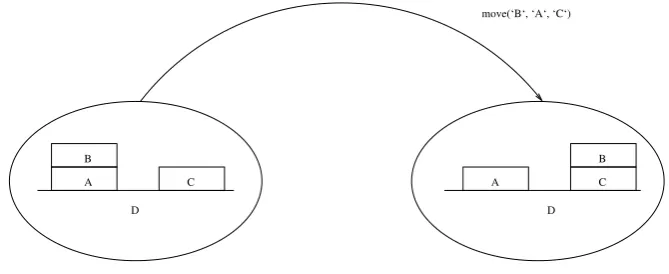
3.2 Blocks world example. . . 36
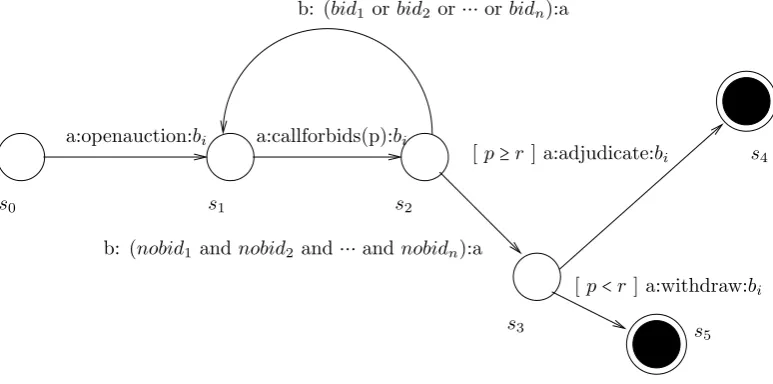
3.3 A Mail Order protocol . . . 41
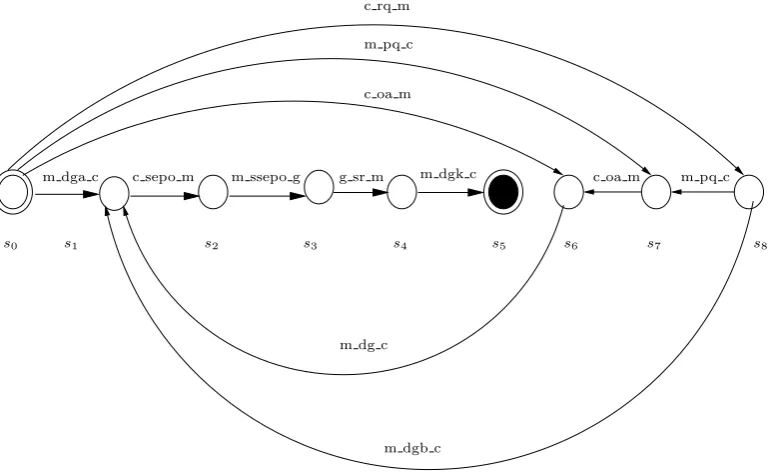
3.4 An English Auction . . . 44
3.5 A Simple Greeting Protocol . . . 55
4.1 Non-implementable protocol due to incomplete knowledge 65 (a) Full Protocol . . . 65
(b) Protocol with τ . . . 65
(c) τ⋆α Bisimulation . . . 65
(d) Branching Bisimulation . . . 65
4.2 Branching Bisimulation Equivalence Classes . . . 70
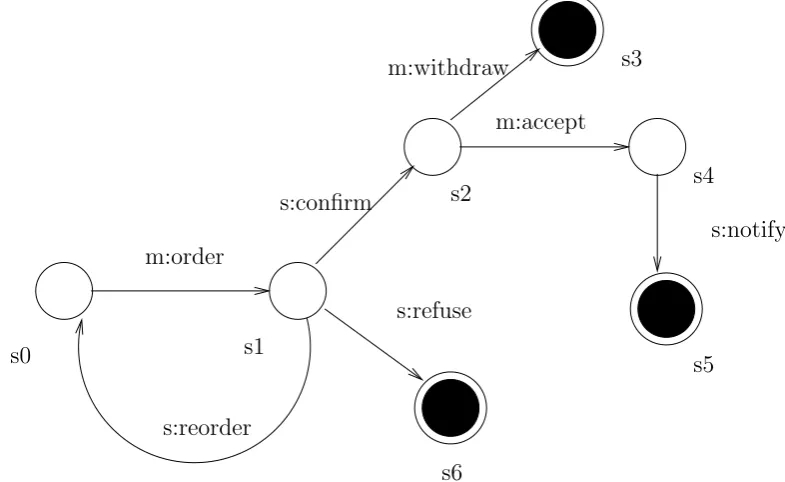
5.1 A mail order protocol . . . 76
5.2 An electronic negotiation protocol . . . 84
5.3 Branching bisimulation results for NetBill roles . . . 92
5.4 From role LTS to the whole protocol - counterexample . . 94
5.5 Role LTS for roles R1 and R2 . . . 94
5.6 Parallel Composition of the LTSs for roles R1 and R2 . . . 95
List of Tables
2.1 Comparison of society definitions . . . 19
3.1 The predicates of the simple version ofEvent Calculus . . 46 3.2 Relationship between game and LTS components . . . 50 3.3 Games where agents have different competency levels . . . 54
5.1 Gateway Role Specification . . . 93
List of Listings
2.1 umpire/4 predicate . . . 25
2.2 Example of a protocol rule . . . 26
2.3 effectsOne/4 predicate . . . 26
3.1 possible/2 example in Situation Calculus . . . 37
3.2 Definition of The Frame Axiom . . . 38
3.3 Static Facts . . . 38
3.4 Game Evolution Representation . . . 39
3.5 holds/2 predicate in Situation Calculus . . . 40
3.6 Initial Situation of a mail order protocol . . . 42
3.7 Available predicate in Situation Calculus . . . 43
3.8 Valid Moves of a mail order protocol . . . 43
3.9 Effects predicate in Situation Calculus . . . 43
3.10 Effect predicate for the mail order protocol . . . 43
3.11 Abnormal predicate in the mail order protocol . . . 44
3.12 Event Calculus Axioms . . . 46
3.13 holds/2 predicate in Event Calculus . . . 47
3.14 happens/4 definitions in Event Calculus for single events . 48 3.15 happens/4 definitions in Event Calculus for multiple events 49 3.16 Effects of a move in Event Calculus . . . 49
3.17 Competence Checking by Planning . . . 57
3.18 Move effects and checking for terminating state . . . 57
3.19 Generic form of Competency Rules . . . 57
3.20 Competence Profile for p1 . . . 58
3.21 Competence Profile for p2 . . . 58
3.22 Definition of the assume/3 predicate . . . 58
3.23 Loop Example in Situation Calculus . . . 59
3.24 Acceptable Predicate . . . 59
3.25 Cyclic Predicate . . . 59
4.1 Deriving a role from a protocol . . . 67
4.2 Computing the attributes for a role . . . 68
4.3 Updating all silent transitions . . . 69
4.4 Updating silent actions by looking at equivalence groups . 71 4.5 Updating selected silent transitions for roleR. . . 72
4.6 Verifying multiple LTSs of the same role instance . . . 74
5.1 Situation Narratives . . . 76
5.4 Available Moves in Situation Calculus . . . 78
5.5 Valid Moves in Situation Calculus . . . 78
5.6 Move effects in situations . . . 79
5.7 Local Move Effects . . . 79
5.8 Abnormal situations in Situation Calculus . . . 79
5.9 Game Results in Situation Calculus . . . 80
5.10 Initial episodes in Event Calculus . . . 81
5.11 Terminating conditions in Event Calculus . . . 81
5.12 Available moves in Event Calculus . . . 82
5.13 Valid Moves in the Event Calculus Representation . . . 82
5.14 Effects of a move (or moves) in a game episode . . . 83
5.15 Game Results in Event Calculus . . . 83
5.16 Identifying cyclic moves in Event Calculus . . . 85
5.17 cyclic pattern examples . . . 86
5.18 Electronic negotiation protocol specified in SC . . . 87
5.19 Assuming a move in Event Calculus . . . 87
5.20 Definition of a cyclic move . . . 88
5.21 Example of cyclic patterns . . . 88
5.22 Results for the electronic negotiation protocol in EC . . . 89
5.23 Representation of the NetBill protocol . . . 90
5.24 Role-specific representation for the gateway in the NetBill protocol . . . 91
5.25 The role-specific representation for gateway after the bbe reduction . . . 91
5.26 Equivalence between LTS states . . . 91
5.27 FSP code for the two bidder auction - Bidder . . . 96
5.28 FSP code for the two bidder auction - Seller . . . 98
5.29 FSP code for the two bidder auction - Auctioneer . . . 98
5.30 FSP code for the two bidder auction - System . . . 100
5.31 FSP code for the two bidder auction - Auction . . . 101
5.32 Output of LTSA for the auction model with two bidders . 103 5.33 Conversion of the output of LTSA to aut . . . 104
5.34 Protocol representation for the auction protocol . . . 104
5.35 Role-specific LTS for the first bidder . . . 104
5.36 Role-specific LTS for the second bidder . . . 105
5.37 Role-specific representation for the first bidder . . . 105
5.38 Role-specific representation for the second bidder . . . 106
5.39 Final LTS for the first bidder . . . 106
5.40 Protocol representation after the repair of silent transitions107 5.41 The first bidder after making repair changes . . . 107
5.42 First bidder after repairs and bbe . . . 107
A.1 Situation Calculus Prolog Program . . . 177
B.1 Prolog Program for Event Calculus Representation . . . . 179
C.1 Prolog Code For Bisimulation . . . 183
List of Equations
3.0 Protocol Definition for Netbill . . . 33
3.1 Valid moves for a role r . . . 51
3.2 Actions of valid moves for an agent . . . 51
3.3 Actions of the role for a fully competent agent . . . 51
3.4 Set of valid moves that the role can enact . . . 51
3.5 Set of trace runs . . . 51
3.6 Projection of traces to a set of valid moves . . . 52
3.7 Strategy of a competent under adversity agent . . . 52
3.8 Strategy of a competent under co-operation agent . . . 53
4.1 Bisimulation Definition . . . 63
Glossary
Notation Description
AA Authority Agent of an artificial agent society
bbe Branching Bisimulation Equivalence
EPO Electronic Purchase Order
FSP Finite State Processes
LTS Labelled Transition System
LTSA Labelled Transition System Analyser
mCRL2 micro Common Representation Language 2
Acknowledgements
This work would not have been possible without the invaluable help
of a number of people over the years. First, I would like to thank my
supervisors, Dr. Christos Kloukinas and Dr. Kostas Stathis for their
help and support throughout my degree. They were always available for inspiring conversations, always willing to read drafts and suggest
improvements; really the best a student can hope for.
I would also like to thank my colleagues at City University for all their
moral support and the enjoyable, long nights (and weekends) that we
spent together in the office - namely Gilberto Cysneiros, Tshiamo
Mot-shegwa,Ping Zhu,George Katopodis,Waraporn Jirapathong,Stelios
Pa-pakonstantinou, Nazanin Khalili and Aravin Naren. Special thanks
should go to the academics of the Department of Computing for un-veiling the wonderful mysteries of academic life and offering an enjoying
environment for research. The Department of Computing kindly
of-fered a three-year full-time scholarship under the Professional Pathway
scheme, without which this study would have been impossible. My
grat-itude goes toMuck van Weerdenburg andSimona Orzan for helping me
understand better the code forµCRL2 andStefano Bromuri from Royal Holloway who offered helpful advice and feedback on reading the
con-tents of a file into a Prolog list. The comments of the examiners, Dr.
Alessandra Russo and Dr. Andrew Tuson helped me to significantly improve the presentation and contents of the thesis.
Finally, I would like to thank my family for all their moral and financial
support throughout these years. None of this would have been remotely
possible without their continuous love and support. It is my dad,
Kon-stantinos, mother, Athina, sister, Joanne, and niece, Elpida, deserving
Declaration
I hereby declare that:
• my submission as a whole is not substantially the same as any that I have previously made or am currently making, whether in
published or unpublished form, for a degree, diploma, or similar
qualification at any university or similar institution
• the following parts of the work or works now submitted have pre-viously been submitted for a qualification at a university or similar
institution (only brief details required):
. . . .
. . . . . . . .
• until the outcome of the current application to this University is known, the work or works submitted will not be submitted for any
qualification at another university or similar institution.
Date: . . . Signature: . . . .
Preface
Advances in ubiquitous computing have resulted in changes to the way we access and use everyday applications, e.g. reading mail and booking tickets. At the same time, users interact with these applications in a va-riety of ways, each with different characteristics, e.g., different degrees of bandwidth, different payment schemes supported and so on. These are highly dynamic interactions, as some of the applications might be-come unavailable (either temporarily or permanently) or their behaviour may change. As the user has to deal with a large number of proactive and dynamic applications every day, he will need a personal assistant that possesses similar characteristics. The agent paradigm meets this requirement, since it exhibits the necessary features. As a result, the user will provide its personal agent assistant with a goal, e.g. I need a smartphone which costs less than three hundred pounds, and the agent will have to use a number of applications offering information on smart-phones so that it finds the requested one. This, in turn, raises a number of issues regarding the organisation and the degrees of access to these services as well as the correctness of their descriptions.
In this work, we propose the organisation of applications around the concept of artificial agent societies, to which access would be possible only by a positive evaluation of an agent’s application. The agent will provide the Authority Agent with the role it is applying for and its competencies in the context of a protocol, i.e., the messages that it can utter/understand. The Authority Agent will then check to see if the applicant agent is a competent user of the protocols; if yes, entry is granted.
Assuming that access is granted, the next issue is to decide on the pro-tocol(s) that agent receives. As providing the full protocol will cause security and overload problems, we only need to provide the part re-quired for the agent to play its role. We show how this can be done and how we can repair certain protocols so that they are indeed enactable
Chapter 1
Introduction
1.1
Motivation
The advent of ubiquitous computing opens up new possibilities for
appli-cations and changes the way that users interact with a variety of devices
to perform everyday tasks [115, 116]. Bulky computing devices have
now turned into minuscule ones that users can take with them and use
in their day to day life. As a result, small devices - e.g. mobile phones,
PDAs and watches - acquired capabilities that only powerful desktop
computers had in the not so distant past like surfing the Internet at
high speeds and accessing e-mails. The final aim of ubiquitous
comput-ing is to seamlessly integrate all these devices into people’s everyday life
so they should be able to perform tasks like making bookings or partic-ipating in auctions without going through the burden of understanding
the technicalities involved.
In the tasks of accessing the Internet or sending an e-mail, location
and/or configuration do not play a role - the services that the user is
ac-cessing arestatic. In some tasks, however, location and/or configuration
can play a crucial role. As an example, think of a tourist who is visiting
a place for the first time and he is interested in finding out the near-est rnear-estaurant or tourist centre. Another example might be a purchase
application that accepts card payments among other ways of payment,
but there is a last minute problem with the component that deals with
that aspect and a replacement has to be found or the application has to
be reconfigured and the card payments taken off as an option.
Furthermore, the time span that the application will be needed for could
choose from. In addition, the applications should exhibit a goal-oriented
and proactive behaviour (in the case that reconfiguration is needed or a
choice between providers has to be made).
These observations raise the issue of how this kind of applications will
be implemented and organised as well as how access to them will be
regulated. In terms of implementation, a number of paradigms exist such as distributed objects [107] and network programming. More recent
is that of Service-Oriented Architectures (SOA) [39, 94] in many cases
applied through web services [63, 77].
On the other hand, web services do not address the issues of pro-active
and goal-oriented behaviour; rather, the interaction is limited to
pre-defined courses of interaction as specified in each party’s configuration.
The agent paradigm [19, 78] is well suited for this purpose as proactive and goal-oriented behaviour are amongst the fundamental notions of
agency. Moreover, in complex services each agent can implement a part
of the protocol to add flexibility to the approach (e.g. one agent could
implement the purchase service, another the payment one and a third
one could implement the shipping service).
Artificial agent societies [82, 90] can be used to model such applications
as individual agents offering various services. The services will be offered
to society members, so if an agent needs to make use of a service offered by one of the society member agents, it will have to join the society.
Each service of the society will be represented through a set ofprotocols
that the agent will have to participate in. The protocols will specify
the behaviour of the participants (expressed in the form of roles) and
co-ordinate the moves that they can make in the context of executing
the protocol.
When representing a protocol, a familiar metaphor would provide the advantage of abstracting away from the technicalities and presenting
the user as well as the designer with something that they can easily
understand and use without problems [104]. In this context, we are
treating protocols as games and every move made by a participant in a
protocol is treated as a move made in a game. This is the case as both
games and protocols are rule-governed and additional components (e.g.
1.2
Admittance of agents to semi-open
so-cieties
Agents typically have a set of goals they are trying to fulfill. In order to
fulfill these goals, an agent may need to get access to a set of resources
relevant to this goal and collaborate with other agents to achieve
sub-goals [109]. However, these resources will have to be accessed from a variety of locations, in a variety of ways and each one of them will
exhibit different properties - varying degrees of bandwidth on the
con-nection they use for example or varying accuracy, price and so on. We
choose to represent the agents providing these resources as an artificial
society. Such a society may be identified by a set of network locations,
will be governed by a set of rules and will be associated with a degree
of openness. Agents requiring a resource will need to join a society that
holds the resource and conforms to the rules of that society if admitted
to it.
We look at openness from a membership viewpoint [27], not from one
considering agent architectures, standards or ontologies. In this
con-text, new agents can be accepted to the society but they will have to go
through an application process first. The application will be assessing
the agent’scompetence to interact with the other agents in that society;
informally, the agent will be allowed entry to the society if it can make
conversation with the other member agents. We will be defining
compe-tence formally later in Section 3.9, as well as describing the interactions between an agent, on one hand, and a society on the other. The latter
will be represented in the interactions by itsAuthority Agents; these are
agents that are assumed to know all the societal rules regarding what
protocols the society makes available and what roles participate in each
of them.
We will be using UML [41] to represent the activities of the interaction
between agents and societies in the form of activity diagrams. The use of the extended set of UML diagrams as the modelling language for
agent-based systems [52] has been proposed as the result of agents having
richer properties than objects [79] and, also, some UML diagrams (e.g.
class diagrams) lacking formal semantics [88].
Our interest at this stage, however, is to represent the various
interac-tions between the applicant agent and the authority agent of the society
in-tended to be at a high-level of abstraction rather than describing all the
details. As a result, we are trying to show the flow of interactions by
grouping interactions serving similar purposes into activities; activity
diagrams are very useful in this context, due to their processing-thread
semantics [79] - this will give us the flexibility of describing activities
that happen in parallel. We should note here that AUML [12] could
have been used for the same purpose as activity diagrams in bothUML
and AUML are based on Petri Nets; in fact, most of the enhancements suggested by the AUML project are now part of UML 2.0.
In general, for societies where membership is conditional the lifetime of
the agent in an artificial society can be divided into three phases [66]:
(i) application phase, where the competence of the agent is assessed
with regards to the role(s) that it is applying for (application phase);
(ii) the phase where the assignment of roles to the agent happens and it pursues the goal(s) for which it entered the society (societal phase)
- this is where the interaction with the other agents happens;
(iii) the phase where the agent’s goal(s) was (were) achieved or it is
expelled from the society (exit phase).
In this context, this thesis is primarily concerned with the study of phase
(i) with the additional focus on the communication capabilities of agents
at the time of application.
1.2.1
Joining a semi-open society
The agent will be motivated for joining a society, because it needs the
re-sources available therein to accomplish its goal. The application process
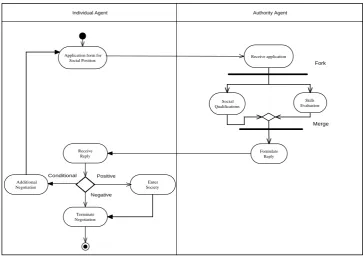
is described in Figure 1.1.
The process starts when the Authority Agent of a society receives an
application from an individual agent to occupy a role (or roles) in the
society (as an example, the role of the auctioneer in an auction house).
When the application is made, we assume that is judged on two grounds:
• a set of social qualifications; these represent anything that is not related to the societal protocols, but might be a prerequisite for
Individual Agent Authority Agent
Application form for
Social Position Receive application
Social Qualifications
Skills Evaluation
Formulate Reply Receive
Reply
Terminate Negotiation
Negative
Enter Society
Positive
Additional Negotiation
Conditional
Fork
[image:32.595.115.479.59.315.2]Merge
Figure 1.1: Application process for an agent to join an agent society
through a number of credit checks before its application can be
processed further.
• a set ofsocial skills; these relate to the communicative acts that the agent in question is capable of uttering. These acts will be checked
against the protocols that the agent will participate in under the
role(s) it is applying for, should it be accepted as a member to the
society. An example of skills could be acts likebid,register and so
on. In judging that, all other agents will be assumed to behaving
according to the protocol rules.
In the case that the agent receives a positive reply, then it enters the
society while if a negative reply is received it will have to seek another
society that fulfills its goals or acquire the new social skills and/or social
qualifications needed and then apply again for another - possibly the
same - role. There is, also, the possibility of aconditional reply in which
case the agent will have to enter another negotiation cycle - we are assuming that nothing will have changed in the meantime as a result of
which the agent might have changed its opinion in relation to joining or
not the society.
For the remainder of this thesis, we will be assuming that the agent has
all the social qualifications needed and we will be focusing on verifying
its set of social skills against the protocol requirements. We will not
agent with apositive ornegative response as to whether it is allowed
to enter the society or not.
1.2.2
An agent’s lifecycle in an artificial society
Once the agent’s request for joining the society is accepted, the agent
will need to be provided with descriptions of the protocols that it is going
to be involved in as a member of the society. Each of the protocols will
relate to a number of roles and sets of communicative acts that the agent
can use in these protocols, depending on what role it assumes in them.
During the time that the agent is part of the society, the set of protocols
needed to interact with other agents may not need to remain constant.
In an agent-oriented application of a business application domain, for
example, it is often convenient to have every user represented by an agent so that the user accesses business applications and business processes via
the agent (similar to the way people access the web via a browser). In
this setting, if the user of the agent is promoted (thus, been involved
in more and, possibly, different protocols or in the same protocols but
with different roles), the user’s agent will need to accommodate the new
assignment as well. The protocol assignment part, therefore, is not static
but might require the agent, while in the society, to have to learn to cope
with more communicative acts. This is depicted in Figure 1.2. Moreover,
we need to ensure that the agent roles in the new set of protocols that the agent receives does not contradict the ones it has at the moment,
i.e. there are no role conflicts.
Individual Agent Authority Agent
Assignment of Roles Skills
Acquisition
[image:33.595.134.463.531.707.2]may lead to
Figure 1.2: Assignment of roles to an agent
In this work, we will not be considering the dynamic part of skill
of role(s) to the agent when it enters the society. Moreover, as we only
look at the static nature of role allocation, we do not include in our
analysis any role conflict issues.
1.2.3
Leaving a society
The status of the agent as a society member will need to be revised over time. It might be the case that the agent has achieved its goal, in which
case it can leave the society (e.g. in the auction scenario because the
auction ended or the agent acquired the item it was bidding on from
another auction). On the other hand, the society might need to revise
its membership, as a result of the agent failing to comply with some of
the protocols or other constraints on membership (e.g. time constraints
due to limitations on resources availability).
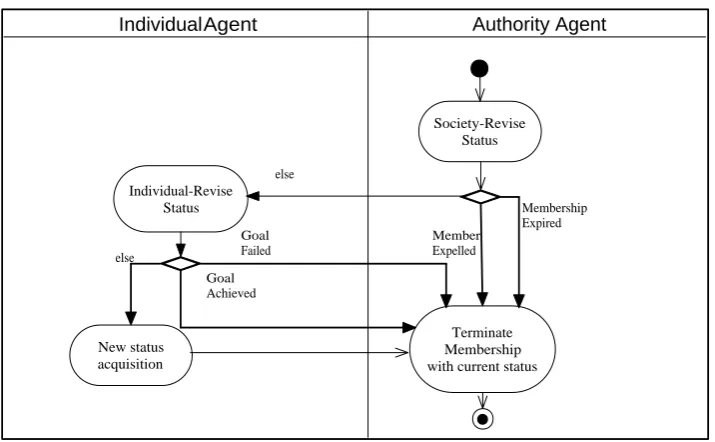
The process in the form of an activity diagram is shown in Figure 1.3.
Individual Agent Authority Agent
Society-Revise Status
Terminate Membership with current status
Membership Expired
Individual-Revise Status
else
Member Expelled
Goal Achieved
Goal Failed
New status acquisition
[image:34.595.120.478.359.580.2]else
Figure 1.3: An agent leaving a society
As we will not be looking at this phase, we will just assume that the
agent will leave the society once its goal has been achieved or the society
will expel the agent if there are any constraints that the agent violates.
Furthermore, we are not interested in the possibility of the agent
break-ing the rules of the protocol, as we only look at whether the agent can
converse with other agents participating in the protocol. We are not
interested in its actual behaviour once it joins the society, but on its
po-tential to generate conversations with the other member agents on the
1.3
Issues
Section 1.2 presents the whole lifetime of an agent within an artificial
agent society. This thesis will focus on the first part, namely the
admit-tance of an agent into an artificial society. In using this representation (artificial agent societies where memberagents provide services through
protocols in which participant agents assume roles) a number of issues
arise.
(Issue 1) how do we formulate a game-based version representation of a
pro-tocol in terms of roles and how is access to the society regulated?
(Issue 2) Assuming the agent is granted access to the society, the next
is-sue is that of the knowledge it gets upon entrance. Sure enough,
we can provide all the details of the protocol but this will
cre-ate performance and, maybe, security problems. The issue to deal
with, then, becomes: can the agent be given a minimal protocol de-scription that it can follow without worrying about the full protocol
complexity?
(Issue 3) Furthermore, one of the issues with protocols is that of protocol
decomposition [77], i.e., the breaking of complex ones into their
constituents. If the protocol is a well-designed one, then it should
be possible to decompose it into the constituent protocols (one for
each role participating in the protocol) and the resulting protocols should be implementable, i.e., they should not contain any
infor-mation not known to the agent when it has to make decisions as
to how to proceed in the course of the protocol. In this case, the
question of whether the protocol is well-designed, i.e., is
imple-mentable by the participant agents or not is raised. The question
that we need to look at is: how can we verify that a protocol is
well-designed? If it is not, can it be repaired?
1.4
Aims & Objectives
1.4.1
Aims
The aims of this thesis are:
(Aim 1) (relating to (Issue 1)) Provide a framework based on the games
• represents protocols of an artificial society;
• links the representation of protocols to social notions (roles, skills);
(Aim 2) (relating to (Issue 1)) provide a computational framework that can assess the application of an agent wishing to join the society;
(Aim 3) (relating to (Issue 2) & (Issue 3)) provide a framework that can
decompose a protocol into smaller ones containing the minimal
information that the participant will need to know and assess if it
is well-designed;
(Aim 4) (relating to (Issue 2) & (Issue 3)) provide a framework for repairing
the protocol if it is not well-designed.
1.4.2
Objectives
The objectives of the project are:
(Objective 1) (relating to (Aim 1)) produce a framework that uses the games metaphor as the main representation mechanism [104]. We chose
the games metaphor as users are familiar with the concept.
More-over, it is an intuitive metaphor as games and protocols are both
rule-governed.
(Objective 2) (relating to (Aim 1) & (Aim 2)) We aim at producing executable
specifications, which are event-based and structured; the protocols
as games representation meets these requirements as it is based
around the concept of events (moves made by the players). We
represent moves by considering the Event and Situation Calculi
frameworks to represent the evolution of the formulated protocols. We are interested in the evolution of the protocol in cases where
focus is on the global state or on concurrent actions or property
changes over time and those two frameworks have proven to be
well suited for this purpose.
(Objective 3) (relating to (Aim 2)) evaluate the approach through the use of
protocols with different structures. One structure that might cause
problems is that of loops, as it might mean that we run the danger
of looping continuously and not reaching any result. We need to
filter out these moves and allow them to occur a certain number of
have two instances of the same role - in this case, both instances
should receive the same behavioural description.
(Objective 4) (relating to (Aim 3) & (Aim 4)) use a technique that will allow us
to get a minimal version of the original protocol containing only
the rules pertinent to a specific role.
(Objective 5) (relating to (Aim 3) & (Aim 4)) use the aforementioned technique
in order to determine if the protocol is well-formed as well as repair
it so it has this property in the end.
1.5
Research Hypotheses
In the course of this research, we made the following assumptions:
(Hypothesis 1) We take a bird’s eye view of the society and look at it as a collection
of norms encapsulated in protocols and roles - nothing else (e.g.
reputation, trust) is of interest.
(Hypothesis 2) The strategies of the agents are, also, not taken into consideration as they cannot be observed.
(Hypothesis 3) We look at societies whose admittance requirements will only
de-pend on the protocols. That is, admittance to the society is only
judged on the basis of the agent’s ability to participate in the
rel-evant societal protocols. We do not take into account the current
or future composition of the society (in terms of numbers of agents
playing specific roles) and how additional preferences regarding its
composition or any other aspect can affect agent’s admittance. For
example if an auction society has reached a pre-defined maximum
number of bidders, another one applying for a bidder’s place who can perform well in the bidder’s protocol(s) will not be rejected
on the basis of a large number of bidders already present in the
society.
(Hypothesis 4) We only look at the message exchanges between societal agents
in the context of pre-defined protocols and roles. We also assume
that this exchange is free of any further constraints, e.g. due to
environmental models. If an exchange is allowed by a protocol
and the agent selects to utter that message, then the exchange
(Hypothesis 5) We are not interested in the architecture or communication
lan-guage of the individual agents. We assume that there is a shared
lingua and that agents themselves are responsible for ensuring that
they can understand the language spoken by other agents before
they make the application for entering the society.
(Hypothesis 6) We are not interested in the low-level primitives of agent com-munication. We assume that messages will always arrive to their
recipients and any problems (e.g., network delays, concurrent
com-munication and so on) are outside the scope of this work.
(Hypothesis 7) When an agent is checked against the protocols that it will play
as a society member (if admitted to the society), the check is done
assuming that the other participants are ideal and collaborative.
This means that they can perform all moves prescribed by the
pro-tocol and they always collaborate. As mentioned in (Hypothesis 3), the current composition of the society is not taken into
con-sideration at all. This means that the new agent admitted might
posses skills that the agents currently in the society cannot match.
However, this approach has the following advantages:
(a) it can serve as a first pass. Assuming agents that can realise
all moves, we can discard applicants who do not meet our
expectations. This is much easier and effective than taking
into consideration the current composition of the society and what moves each of its members can perform;
(b) it provides opportunities for expansion. As new agents are
added, the skills that cannot be put in use at the moment
might prove extremely useful later on. For example, an agent
that can take Visa payments, when no other agent in the
society can make a Visa payment now.
1.6
Description of the approach and
archi-tecture of the techniques used
This work aims at providing a framework for deciding if an agent is
competent to join a society offering services it is interested in and, if
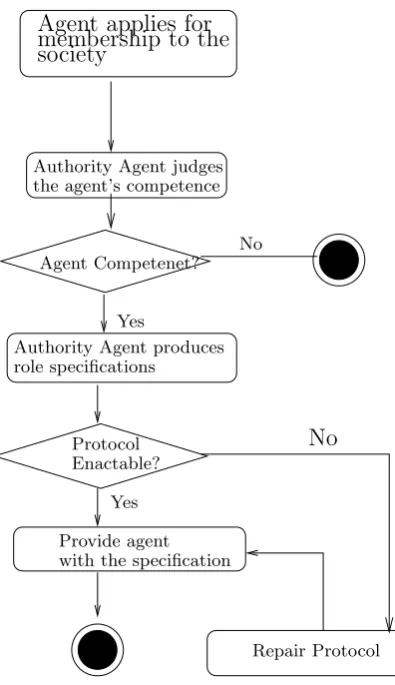
accepted, provide it with the minimal enactable protocol with actions
1 the agent applies for entry to the society providing his
communi-cation abilities (i.e., the messages it can utter/understand);
2 the Authority Agent of the society uses the game-based
formula-tion of the protocol (see Chapter 3 for the details) to decide if the
agent is competent to join the society or not;
3 provided it is considered to be competent, it will need to be
pro-vided with information on the role it is taking up. This will involve
creating a role specification from the protocol one. The technique
we use is based on an automata-theoretic technique called
branch-ing bisimulation equivalence(bbe ) Chapter 4 for the details).
4 the role specification is then checked for enactability.
• if it is found to be non-enactable, then the original protocol is modified appropriately (check Section 4.3 for the details).
The process is shown in Figure 1.4.
membership to the Agent applies for
Authority Agent judges the agent’s competence
Agent Competenet? No
Yes
role specifications
Authority Agent produces
Protocol Enactable?
Yes
Provide agent with the specification
[image:39.595.197.395.406.749.2]Repair Protocol No society
1.7
Structure of the Thesis
This is the introductory chapter, where we provide the motivation for
the research and outline its aims and objectives, as well as state any
assumptions made and listing the relevant publications. The rest of the
thesis is structured as follows:
Chapter 2 presents the background to our work. The concepts that
form the cornerstones of our work are presented briefly; namely the
con-cepts of agent societies, the original game-based protocol representation framework and roles.
We, then, move on in Chapter 3 to describe the theoretical aspect of
our model. We describe how to model roles in games protocols and how
to compose them to compose the societal protocols. This is followed
by a definition of how a protocol can be represented in both Event and
Situation calculi formulations. Once the agent is accepted into the
soci-ety and should be given the protocols it has to enact, the question that arises is whether it is competent to participate in the protocol or not.
We define the agent’s strategy and, on the basis of that, differentiate
be-tween different degrees of competence. Finally, the relationship bebe-tween
the game-based approach that we use to describe the protocols and the
LTS one we are using for representing them is discussed.
Chapter 4 looks at the algorithms for meeting our objectives, namely
de-composing the protocol into roles,repairing it if needed andproviding
the agent only with the minimal set of information required to enact its role. We discuss three different approaches for repairing a protocol,
ranging from repairing every single problematic transition to a selected
subset of them.
Once the theoretical framework and the algorithms have been discussed,
in Chapter 5 we evaluate cyclic and acyclic protocols. We look at
ex-amples in both formulations - Event and Situation Calculi. We also
present an example of breaking down a protocol that contains two in-stances of the same role, an auction with two bidders. If the protocol
is well-designed, then it should provide the same set of options for both
bidders as they enact the same role.
Chapter 6 reviews related work concerning competence (orconformance
orinteroperability), extracting rules pertinent to a role from the
descrip-tion of the whole protocol and breaking down a protocol into component
with the game-based approach that we adopt in this work.
Finally, Chapter 7 concludes the thesis by presenting its main findings.
It also draws on directions for future research.
1.8
Previous Publications
The thesis contains materials from the following publications:
(Publication 1) Agents acquiring Resources through Social Positions [66]. This publication describes the top-level framework for all stages of an
agent’s lifetime within a society. These include the application for
entrance, how it might evolve whilst in the society and the point
at which, voluntary or not, it leaves the society.
(Publication 2) An agent development framework based on social positions [65]. In
this publication, we discuss and link the main components of our
approach, namely roles and skills. Moreover, an attempt is made
to look at the problem of dynamically assigning new roles to the
agent. It also contains an initial attempt to define the concept of social position as a placeholder for roles, which we have not
explored any further as it was not required to meet our aims.
(Publication 3) Competence Checking for the Global E-Service Society Using Games
[105]. In this publication, we present the game-based framework
for representing protocols. Furthermore, we describe the evolution
of a protocol in both time-independent (Situation Calculus) and
timed (Event Calculus) games.
(Publication 4) From Agent Game Protocols to Implementable Roles [59]. In this publication, we present an algorithm for producing an individual
role specification from a protocol. We, also, address the problem of
protocols with structural problems (non-enactability) and propose
Chapter 2
Background
2.1
Introduction
In this chapter, we look at the main concepts around which our work is built and present the work already been carried out in these areas.
The presentation is done in a sequential order so that the next term
will depend on the previous one and will be motivated by that. More
specifically, we discuss the concepts of agent societies, game-based
rep-resentation of protocols, roles (and skills) and competence.
2.2
Agents
In recent years, there have been major advances in the way we perceive
and interact with computers. These advances were mainly due to the
progress made in the areas of distributed systems and networks as well
as the reductions in size and the increased penetration that computer
devices enjoy in our everyday life.
As a result, in contrast with the past, where the size of the devices as
well as the absence of open area networks made it impossible for the
user to interact with computing devices while on the move, it is now
perfectly possible to use small computing devices embedded in items
we use everyday (such as mobile phones or MP3 players) for performing
tasks that would otherwise be performed from our desktop. As an
exam-ple, many of us would use our mobile handset to connect to the Internet
and participate in auctions, book tickets, read and/or send emails, edit
In conducting these applications, one option is to have the end user
fully involved in initiating and conducting them, i.e., if the user wants
to purchase a specific item in an auction, one option would be to look
at all the auction sites himself, evaluate and follow all the auctions
that this item features in. However, a more realistic and desirable way
forward, would be to allow the software running on the device make some
decisions and give it a degree of autonomy so the interaction required
from the user would be kept to a minimum.
This way repetitive tasks can be simplified and a less error-prone system
can be built. In the aforementioned auction example, it would be much
easier if the software running on the mobile phone or the PDA could
detect that a new auction came up with an item that interests the user
and joined it automatically.
In order for the software to work that way, it should exhibit a high degree
of autonomy and be able to reason about certain properties of the user.
Furthermore, it should be goal-oriented and focus on generating different
plans for achieving the user goal(s). Finally, it should be able to operate
in an open context (environment) and exchange information with other
software entities of the same kind.
This description fits naturally the description of asoftware agent. There
is no commonly agreed definition of an agent, however there is some agreement over the characteristics that a software entity should exhibit
in order to be classified as an agent - these are as follows [19, 78]:
• encapsulates its own state - that is, every agent has its own view of the world and that might be different to the view of other agents
in the system;
• the environment where the agent is situated is dynamic and open - there are changes occurring that the agent must register (those
that are of interest to it);
• it should have the ability to reason on the basis of observations registered from the environment;
• it should be able to communicate with other agents within the same environment and execute actions based on data acquired
from the observation of the environment, the local state and the
internal reasoning that took place.
col-lectively define the weak notion of agency, i.e., the absolute minimum
characteristics that an application must possess in order to be classified
as an agent. These would be autonomy, social ability, reactivity and
pro-activity. Furthermore, agents can exhibit human-like
characteris-tics, such as benevolence, fairness and veracity, and these would define
the strong notion of agency.
2.3
MAS & Artificial Agent Societies
As an extension to the term agent, acollection of agents can be viewed
as aMulti-Agent System. A Multi-Agent system is a system made up of
software agents, where ([19]):
• not all problems can be solved with information that an agent of the system possesses;
• there is no global system control;
• data is decentralised; and
• computation is asynchronous.
In the context of the environment described in Section 2.2, physical
ev-eryday devices are transformed into computing devices. On the other
hand, due to the technological advances and the availability of
band-width, they would able to migrate from one network/platform to the other with ease. As a result, the question of how is access to these
resources going to be regulated arises.
Our view is that these network resources can be organised around the
concept ofartificial agent societies [82, 90]. These are viewed in different
ways in the literature. Davidsson defines it as a collection of agents
interacting with each other under the presence of some norms and social
laws [26]. Moreover, a distinction can be made between agent societies
and agent communities in that the latter should represent agents in
closer proximity to those belonging in an agent society. In the same
context, an agent society is defined in [93] as a collection of agents
with similar interests working towards the achievement of a goal (the
focus been on the collaboration between the agents rather than their
proximity).
• a set of agents;
• a set of constraints on the society (a description of the societal norms and rules that the agents have to obey);
• a communication language;
• a set of roles that the agents can play;
• a set of states of affairs that hold at each time at the society; and
• a set of agent owners.
Furthermore, Davidsson expands this definition in [28], to include the
following items:
• a set of agent designers;
• the environmental infrastructure in terms of communication and computation;
• the environment owner (the organisation or institution that de-fines who enters the society and what is the configuration of the
environment - roles to be assumed, communication language and
so on); and
• the environment designer.
The additional items in this definition are due to the fact that not all
system stakeholders are considered in [5] and any constraints due to
them will need to be acknowledged and explicitly stated. The societal
constraints element of the definition by Artikis would cover all the
con-straints but it is useful to look at concon-straints on a per stakeholder basis.
In [33], Doran defines the artificial society as a set of heterogeneous and
located inter-related agents. There is no assumption about the type of agents, just the assumption on the society side that it isopen, i.e., any
agent can join and leave freely. Society is formally defined as anetwork
graph where every node is a site and there are bidirectional links, called
channels, to join nodes (essentially sites will correspond to agents and
links will correspond to ways of communication). The agent members
of the society will be situated on a site and will have a unique identifier,
an owner, an internal unobservable selection strategy, might be mobile,
exchange information via the channels specified and can act on society
In [32], Dignum focuses more on the normative aspect of the
specifica-tion: an organizational-oriented view is taken upon the definition of an
artificial society. More specifically, the society is described by an
or-ganisational model and an individual (agent) model. The oror-ganisational
model is defined in deontic logic as a tupleOM = (R, CF, I, N), where:
• R is the set of role descriptions;
• CF is the communicative framework for the society (as agent will be heterogeneous and speak different languages, this framework will be used to provide common grounds for understanding
be-tween the agent members);
• I is a set of scripts to be realised in interaction scenes. Inter-action scenes can represent states in a protocol execution, while
scripts will essentially represent an execution path for reaching
these states; and
• N is the set of social laws (or norms) - this is specified in terms of contracts that, if broken, will result in the offending agent been
sanctioned.
In [48], the authors view society as a medium for agents to meet and
interact. They are characterised by their openness and the social norms
and laws that the society will need to have in place to enforce the order
in it.
The information from the approaches described above can be summarised in Table 2.1:
Property Artikis Davidsson Doran Dignum
Set of Agents ✓ ✓ ✓ ✓
Set of Constraints ✓ ✓ 7 ✓
Communication Language ✓ ✓ 7 ✓
Set of Roles ✓ ✓ 7 ✓
Set of States ✓ ✓ 7 ✓
Set of Agent Owners ✓ ✓ ✓ 7
Set of Agent Designers 7 ✓ 7 7
Environmental Infrastructure 7 ✓ 7 ✓
Environment Owner 7 ✓ 7 7
Environment Designer 7 ✓ 7 7
Table 2.1: Comparison of artificial agent society definitions
In our approach, artificial agent societies are viewed as a collection of
per-form. These societies are normative societies and are organised around
the concepts ofprotocols and roles.
More specifically, a protocol will describe a pattern of interaction
be-tween two or more agents and will describe what actions they are allowed
to take and at what states of the protocol evolution. The description
of the protocol will be in terms of behavioral components, i.e., in terms of what the agents can do when they engage with the protocol. The
behavioral recipes will be expressed in terms of roles - every role will
specify the expected behaviour of an individual in a given context [14].
As an example, we can consider the case of a user seeking to purchase
an item (e.g. a mobile phone) from an online auction. The user will pass
the information of the item he wants to purchase to his representative
agent, who will then take over and look for auction services from which it can purchase that item.
This will involve evaluating a number of auction societies with regards
to whether the item it is interested in is available as well as whether
any other auction-related preferences are met (e.g. shipment has to be
made within two days of the auction end). It will then have to join these
societies and participate in the auction(s) for the item it is interested in.
In this context, if an agent needs to get access to the resources offered
by an agent society, i.e., the services that the agents offer, such as the
auction, payment and shipping agent societies, it will need to request and
gain access to that society. In other words, the question now becomes:
what would be the criteria that we can use to grant access to an agent
into an artificial agent society.
2.4
Entry to Society
In representing collection of agents as artificial agent societies governed
by normative rules expressed in the form of protocols and roles, we
need to make a decision concerning how the society will accept (or not)
new members. There are four possibilities regarding the openess of the society to new members [27]:
• opensocieties, where agents can join and leave at any time without any restrictions;
agent is either a member and it is allowed access to the resources
offered by the society or not;
• semi-open societies where membership is granted on successful judgement of a submitted application form; and
• semi-closed societies, where entrance to new members is not lowed, but agents external to the society can nominate agents
al-ready in the society to act as their representatives.
In light of the type of systems we want to represent in our approach
(highly dynamic, adaptable, critical and fault-tolerant systems) the
op-tion of closed societies seems too restrictive for our purposes. On the other hand, the option of completely open societies might lead to
prob-lems such as poor communication and/or communication deadlocks
be-tween member and non-member agents – the same applies to semi-closed
ones, as the agent will have to entirely rely on agents who are already
members of the society.
A more realistic approach seems to be the restriction of agent entry to
the society on the basis of satisfying certain conditions. As long as these conditions are met, the agent can become a member of the society until
it accesses the resources to achieve its goals or it decides to leave the
society.
A choice has, thus, to be made regarding a number of factors that will
control the agent’s admittance (or not) to the society, namely:
• what will the admittance criteria be;
• who will conduct the check of whether the agent meets the criteria or not; and
• how will the societal behavioral rules, i.e., protocols be repre-sented.
We look at each one of them in the following Sections.
2.4.1
Admittance Criteria
The first item we need to decide is on the basis of what criteria would
the new agents be admitted into the society. As stated in Section 1.5,
competence as part of their admittance criteria. We concentrate on that
part only – societies can have other criteria as well. As an example, in a
society with one auctioneer and a million bidders if a new bidder agent
applies for membership, the current number of agents who are bidders
in that society already makes no difference (as well as other properties
of the applicant agent, e.g. the good or bad reputation it carries from
other societies that it was a member of in the same role or in similar
roles).
The question, thus, of whether an agent should be admitted to a society
or not is transformed to a question of whether it should be able to
understand and use the societal rules, as the latter are expressed in the
relevant protocols.
2.4.2
Authority Agents (AA)
Every society that is semi-open and accepts members only by
applica-tion, will need to have a way of regulating access [27]. The role of this
component will be to assess the membership applications received and
reach a decision as to whether the application will be accepted or not.
In our societies, this task is performed by one (or more)Authority Agents (AA)- their task is to know all societal rules and how they are related to
the society’s protocols, i.e., what roles participate in each protocol and
what are the conditions for making a move within each protocol. On
the basis of this knowledge, they need to decide if the applicant agent
will be granted or denied entry.
2.5
Game-based representation of
proto-cols
As the decision of the Authority Agent will be based on the actions that the agent can perform in relation to the role it is applying for
and the protocols in which the role participates in, we need a suitable
representation of protocols.
In the literature, a number of choices exist with respect to modelling
protocols. These include different types of automata [16, 57, 64] such
as Finite State Automata (both deterministic and non-deterministic),
formalism as it is easy to understand and implement - the notation of
deterministic finite automata, specifically, has been widely used [31, 89].
Another approach is to model the protocols as games [106], emphasising
the similarities between the two approaches. The protocol participants
can be seen as players, the rules of the protocol as the rules of the game
and the participants decision on their next move they make could be seen as part of their game strategy. Moreover, the starting point of the
protocol would be the starting point of the game and the final point(s)
would be when the game ends - depending on the final point reached, as
there might be many, one or the other participant would be declared the
winner. Finally, it can represent any of the protocols represented as an
FSA and can offer a higher level of granularity in the form of subgames.
In [68], a game description language is specified for playing online games consisting of a Game Manager that will be connecting a number of
General Game Playing sessions; the players do not know the rules of
the game in advance, but they can understand the language in which
they are written. The development of the language was carried out as a
response to the large explosion of state space for a number of games (e.g.
chess) and the inability to differentiate - in a standard FSA - between
changes due to player moves or game dynamics. As an example when
two players are playing a game of Tic-Tac-Toe, we need to differentiate
between the case that the game terminated because one of the players won or the network went down.
As a result, the Game Development Language (GDL) was introduced,
based on datalog⌝ [47]. This language describes the relations between
the players and the state of the game. The players of the game are
defined via therole relation, while the state of the game is described via
a series of relations -init to describe what is true at the beginning of the
game, control to describe the player who is in control, next to describe
the next player who is to make a move, legal that describes what are the legal moves in a state and does to describe the moves that a player
makes (or has made). Finally, thegoal rules will describe the goals of a
player and what he will be trying to achieve in the game.
On the other hand, theGame Manager is responsible for synchronising
the state between the players and receiving their moves. Every player
will be assigned a single role - every time that the player has to make a
apply the move if it is valid or randomly select a move and apply it if
the player submitted an invalid move or did not submit a move at all. It
will, also, be its responsibility to keep the clock for the game, i.e., if there
are any time constraints regarding the selection of moves by the players,
then Game Manager will enforce that. It can, also, provide some time
to the players for reading the rules before the start of the game. All the
communication in GDLhappens through HTTP connections.
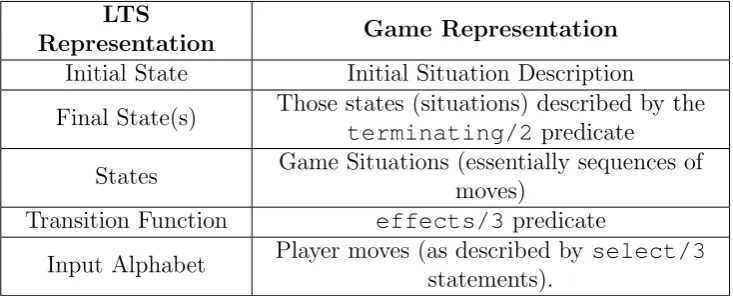
Our approach is based on the existing games framework described in
[103, 104, 106]. In this framework, for each game we need to specify the
following components:
• the state of the game;
• the moves that the players can make; and
• the rules of the game.
Moves will describe what actions are available, while the rules will
de-scribe what actions are legal. The moves are represented by Prolog
select/2 predicates in the formselect(Player, Act). The state of
the game is represented byrule/3 predicates as follows: rule(State,
Property, Conditions) meaning that property Property holds in
state State if conditions Conditions hold. Any property that we want
to check against is considered to be a goal of the player and check for
multiple properties can be done recursively (by using a Prolog list
con-struct).
When a player makes a move, this will change the state of the game
by producing some effects; these are represented by effects/2
pred-icates as follows: effects(State, Actions) defines the effects
of actions Actions on the current state State of the game. This is
further extended to the effectsRule/4 predicate, which is defined as
effectsRule(State, Action, Conditions, Actions). If the
game is in state State, if conditions Conditions of action Action are
met, then actions Actions are carried out. Action is the move that the player(s) decided to make and we need to look at Conditions one at a
time, checking that they are met; for example, in a request-query
pro-tocol we need to check that a query has been made before the agent
produces a response. In other words, if Conditions of Action are
ver-ified in the current state of the game, Action is a valid move and its
effects will be described byActions.
• check that the state we are currently in is not a terminating state;
• find the next valid move,
• apply its effects.
A distinction is made between moves that the game makes available to
the players (available), the moves that are allowed at a certain stage of
the game (legal) and the intersection of those (valid).
In order to play a game between two or more players, we have the option
of filtering the moves through anumpire. The umpire will check whether
the game is in a terminating state or not and - if not - check that a valid
move has been selected, display its effects and then call itself recursively
to check if the new state is a terminating state or not. If the game has
reached a terminating state, this will be offered as a solution – the game
can be terminated there, or the user might request more terminating
paths. The program is shown in Listing 2.1:
1 umpire(Umpire, State, Result,
game(State,Result)):-2 stop(Umpire,State,Result,terminating(State,Result)).
3
umpire(Umpire,State,Result,game(State,Result)):-4 not terminating(State, _),
5 check(Umpire,Move,State,valid(State,Move)),
6 display(Umpire,State,Move,effects(State,Move)),
7 umpire(Umpire,State,Result,game(State,Result)).
Listing 2.1: umpire/4 predicate
The check/4 predicate in Listing 2.1 can be run in both a backward
mode - the player selects a move and the umpire checks if it is valid - or
in a forward mode - all valid moves are provided to the player and he
selects one.
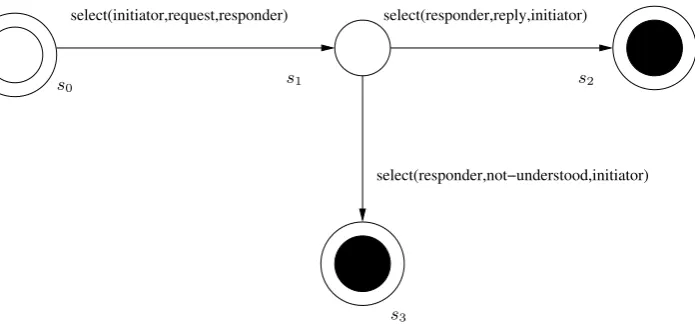
As an example, we can look at the request-reply protocol in Figure 2.1.
select(responder,not−understood,initiator) select(initiator,request,responder) select(responder,reply,initiator)
s1
s0 s2
[image:52.595.130.478.593.755.2]s3