- 1 -
A THEORETICAL GROUNDING AND TEST OF THE GEM MODEL
Jonathan Levie*
Hunter Centre for Entrepreneurship University of Strathclyde
Level 14, Livingstone Tower Richmond Street, Glasgow G1 1XH United Kingdom
Tel: (44) 141 548 3482 Fax: (44) 141 552 7602 Email: [email protected] Erkko Autio*
Imperial College London Tanaka Business School
Exhibition Road, London SW7 2AZ United Kingdom
Key Words: Entrepreneurial Activity, Entrepreneurial Framework Conditions Subject Classification Numbers: L26, L53, O43
Abstract
The Global Entrepreneurship Monitor model combines insights on the allocation of effort into entrepreneurship at the national (adult working age population) level with literature in the Aus-trian tradition. The model suggests that the relationship between national-level new business ac-tivity and the institutional environment, or Entrepreneurial Framework Conditions, is mediated by opportunity perception and the perception of start-up skills in the population. We provide a theory-grounded examination of this model and test the effect of one EFC, education and train-ing for entrepreneurship, on the allocation of effort into new business activity. We find that in high-income countries, opportunity perception mediates fully the relationship between the level of post-secondary entrepreneurship education and training in a country and its rate of new busi-ness activity, including high-growth expectation new busibusi-ness activity. The mediating effect of skills perception is weaker. This result accords with the Kirznerian concept of alertness to oppor-tunity stimulating action.
- 2 - 1. Introduction
The Global Entrepreneurship Monitor (GEM) model, first published in Reynolds et al. (1999), proposes relationships between established and new business activity and economic growth at the national level. It also proposes antecedents of these two forms of business activity. The GEM model is influential because it affects how data is collected and analysed by the GEM consor-tium. To date, the relationships between the variables in the model have lacked explicit theoreti-cal grounding. Because of this, the potential value of the GEM model for academic research re-mains unfulfilled, and it has been difficult to assess the value of empirical contributions based on GEM data. In this article, we relate the GEM model to influential theoretical frameworks in en-trepreneurship. By discussing the GEM model in the light of received theory, we make it easier to assess the empirical contributions derived using the GEM model1. We also test one set of rela-tionships embedded in the GEM model, that is, the relarela-tionships between national levels of entre-preneurship education and training, opportunity and skills perception in national populations, and types of national-level entrepreneurial activity.
The GEM model maintains that established business activity at the national level varies with
General National Framework Conditions (GNFCs), while new, or entrepreneurial, business
ac-tivity varies with national levels of Entrepreneurial Opportunity and Entrepreneurial Capacity.
These, in turn, vary with Entrepreneurial Framework Conditions (EFCs) (Reynolds et al., 2005). The GEM model is a multi-level model, in that EFCs are described at the national level, while entrepreneurial opportunity, capacity and activity are measured at the individual level and aggre-gated to the national level. Thus, the model implies that entrepreneurial activity at the individual and national levels may respond to a different set of environmental parameters than established business activity. The GEM model does not seek to associate individual-level characteristics to individual-level entrepreneurial behaviours, but rather, it focuses on structural conditions that regulate the allocation of effort into entrepreneurship at the population level. The model also im-plies that, controlling for GNFCs, governments that ensure superior EFCs should expect higher national rates of entrepreneurial activity – and higher rates of economic growth.
- 3 -
The GEM model assumes positive (if indirect) associations between EFCs and entrepreneurial activity. However, thus far, it has been unclear how these associations resonate with received theoretical frameworks in entrepreneurship, and the primary use of the model has been to guide data collection efforts. Previous explorations of the associations between EFCs and entrepreneu-rial activity have reported mainly negative bivariate correlations with early stage entrepreneuentrepreneu-rial activity (TEA) at the national level (Reynolds et al., 2002), and neutral or positive correlations with indicators of high-growth expectation entrepreneurial activity (HEA) (Autio, 2005; Autio, 2007). More positive and significant bivariate associations have been found with measures of the relative prevalence of high-growth expectation entrepreneurial activity, that is, HEA as a propor-tion of TEA (Autio, 2005; Autio, 2007). However, these cross-secpropor-tional data and bivariate corre-lation analyses have not provided rigorous tests of the association between EFCs and entrepre-neurial activity.
In this article, we test one set of relationships embedded in the GEM conceptual model, that is, the relationships between entrepreneurship education and training, opportunity and capacity per-ception, and types of national-level entrepreneurial activity. Although EFC data based on na-tional expert surveys has been collected each year since GEM started, empirical studies of the relationships between EFCs and types of entrepreneurial activity remain surprisingly rare. Fur-thermore, the few studies in existence have applied cross-sectional designs and have been the subject of obvious consequent limitations. Prompted by recent suggestions that high-growth ex-pectation entrepreneurial activity may respond to EFCs differently from early-stage entrepreneu-rial activity as a whole (Autio, 2005, 2007), we compare associations between EFCs and both TEA and HEA. Aware of the complex relationship between the wealth of nations and new busi-ness activity rates (Acs et al., this issue; Minniti et al, 2006), we also test these relationships in a sample of high income nations.
- 4 -
extensive test of relationships specified by the GEM model that has been implemented thus far. In the following sections, we first build our theoretical model. We then explain our method and discuss our empirical findings. We conclude by suggesting implications for theory, and for fur-ther research.
2. Linking the GEM model to theories of entrepreneurship
2.1 The GEM model
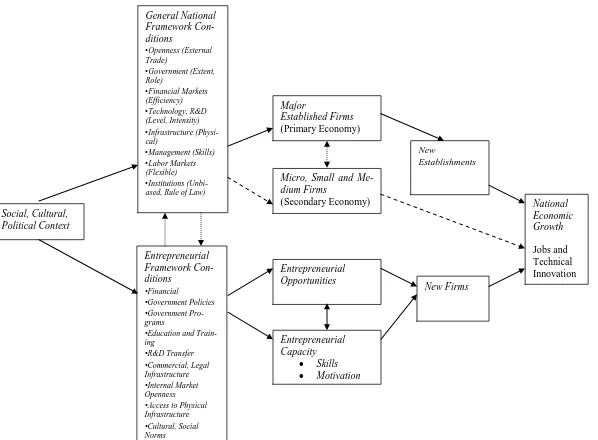
The GEM model was created by Paul Reynolds based on an idea by Michael Hay in 1997 for a World Enterprise Index that would be the equivalent for enterprise and entrepreneurship of IMD‟s World Competitiveness Yearbook and the World Economic Forum‟s Global ness Index. Reynolds wished to “provide something that complemented the Global Competitive-ness Model, which was implied more than explicated in the reports produced by the World Eco-nomic Forum at the time. An alternative to thinking that only large established firms were impor-tant; reflecting, as it were, the central contribution of David Birch to understanding business dy-namics” (Reynolds, 2008). We reproduce the GEM model as shown in Acs et al. (2005) in Fig-ure 11. As this model is rather complex, we reserve the use of italics to denote elements of the GEM model throughout this paper.
Insert Figure 1 here
- 5 -
(2004). GEM proposes that a second set of factors affects the level of new business activity, and these factors are termed Entrepreneurial Framework Conditions (EFCs).
On the left-hand side of the model, the backdrop to these two processes of creation of economic activity is what Leibenstein (1968) termed “socio-cultural and political constraints” (1968: 78). These constraints are labelled Social, Cultural, Political Context in the GEM model. They are underlying variables that would affect the way EFCs (and GNFCs) are constructed in a country. Examples might include national culture or universal values (Smith, Petersen and Schwartz, 2002), relative wealth, which would affect the ability of a government to deliver EFCs2, and type of government (for example, centralised planning versus open economy). Others might include population growth (Hunt and Levie, 2004; Levie and Hunt, 2005), and the growth rate of the economy itself (Acs and Amorós, this issue; Acs et al., 2005: 38; Lundström and Stevenson, 2005).
We turn now to the right hand side of the model, to the relationship between entrepreneurship and economic growth. Arguably the first economist to put the entrepreneur at centre stage of economic development was Schumpeter, who broke free from the prevailing comparative statics approach and recognised economies as self-transforming systems, with entrepreneurs as the agents of transformation (Schumpeter, 1934; Witt, 2002). To Schumpeter, entrepreneurs are in-novators who open up profit-making opportunities by creating temporary monopolies through their organisational and technological innovations. They constantly disturb the status quo pre-ferred by established incumbents, forcing these to react to emerging threats. This process of “creative destruction” (Schumpeter, 1947: 81) contributes to greater productivity, and hence, greater economic growth. This approach has been taken up and developed further by Leibenstein (1968), Baumol (2002) and others. Recently, Acs et al. (2004) have extended the new growth theory (Romer, 1990) by assigning an explicit role for the Schumpeterian entrepreneur as the converter of knowledge into economic knowledge, and thus, as a significant contributor to eco-nomic growth (see also Audretsch et al., 2006).
- 6 -
Austrian economists, such as von Mises (1949), Hayek (1945, 1978) and Kirzner (1997b), who emphasised the role of entrepreneurs as discoverers of arbitrage opportunities in the market. Alert entrepreneurs stumble upon market disequilibria, as manifested in, for example, under-valued resources or unmet needs. This discovery gives rise to an equilibration process, as entre-preneurs seek to exploit their discoveries for economic benefit and thus generate economic growth. Rather than tending away from economic equilibrium, as in Schumpeter‟s model, this depiction portrays entrepreneurs as tending towards equilibrium (Baumol, 2003). This perspec-tive treats entrepreneurship essentially as a market process and considers entrepreneurship to be an essential aspect of the human condition. Entrepreneurship is considered as human action “seen from the aspect of the uncertainty inherent in every action” (Mises 1949: 254); and “In any real and living economy every actor is always an entrepreneur” (Mises 1949: 253, cf Kirzner, 1997: 69). In this view, the essential question for entrepreneurship research is not who entrepre-neurs are, but rather, what do they do, under which conditions, and with what consequences (Baumol, 1996; Murphy et al., 1991; Shane and Venkataraman, 2000).
Several writers have suggested that the Schumpeterian and Kirznerian views are complementary rather than contradictory (Baumol, 2003; Shane, 2003) and that both Schumpeterian and Kirznerian entrepreneurs contribute to economic growth. The GEM model accommodates this view3 and includes both innovative, Schumpeterian entrepreneurs, and replicative arbitrageurs that make up the bulk of Kirznerian entrepreneurs. The typical Schumpeterian entrepreneur is rare and has a small chance of having a high impact on economic growth, while the Kirznerian entrepreneur is more common and has a better chance of having a low impact on economic growth. Given the greater quantity of Kirznerian entrepreneurs, however, their combined effect may be considerable, and they should not be ignored.
entrepre-- 7 entrepre--
neurship and proposed that the form of entrepreneurship an entrepreneur chooses is governed by the prevailing „rules of the game‟, or the reward structure in the economy (Baumol, 1996). He recognised two conditions in particular as central to the process of allocation of effort into pro-ductive entrepreneurship: the degree to which the rule of law is respected in the country, and the degree to which laws support the appropriation of returns from entrepreneurial efforts.
Murphy et al. proposed a similar approach to Baumol, but focused on talent, arguing that: “A
country's most talented people typically organize production by others, so they can spread their
ability advantage over a larger scale. When they start firms, they innovate and foster growth, but
when they become rent seekers, they only redistribute wealth and reduce growth.” (1991: 503).
Murphy et al.‟s analysis suggests that Baumol‟s general argument should apply also to highly talented individuals, who might be expected to engage in high potential entrepreneurship, assum-ing the opportunity costs are favourable.
We propose that it is helpful to think of the GEM model as an Austrian model of the „Baumol-ian‟ allocation of effort into productive entrepreneurship4
. This approach is reflected in GEM‟s main indicator of new business activity, the TEA index. The TEA index provides a measure of „Baumolian‟ allocation of effort to entrepreneurship within a given population. This allocation is regulated by perception of opportunity within that population in the Austrian sense of that term. GEM‟s main contribution to the Baumolian analysis is a detailed consideration of „Entrepre-neurial Framework Conditions‟ (EFCs), or exogenous structural conditions that regulate the per-ception of opportunity and the availability of entrepreneurial skills in the population. To provide insight into the relationships between these structural conditions and entrepreneurial activity, we turn to Harvey Leibenstein (1966; 1968; 1978; 1987; 1995), who has written extensively on this topic.
Like Schumpeter, Leibenstein (1968) recognised two broad types of business activity as contri-buting to economic growth: routine entrepreneurship or management, that is “the activities in-volved in coordinating and carrying on a well-established, going concern”, and “new-type” or “N-entrepreneurship”5
- 8 -
the production function are not completely known” (1968: 73 and 79). This distinction is also made in the GEM model. Established firm activity, represented by Major, Established Firms and
Micro, Small and Medium Firms – the top row of the GEM model – is distinct from new
entre-preneurial activity or New Firms - the bottom row of the model. Leibenstein linked the two ac-tivities to economic growth by suggesting that: “…growth would depend, in part, on the degree
of routine entrepreneurship, the degree to which gaps and impediments in markets exist, and the
quality, motivations, and opportunity costs of the potential gap-fillers and input-completers
available.” (1968: 79)
This description mirrors the positioning of the GEM model variables of Entrepreneurial
Oppor-tunities, the “gaps and impediments in markets” (1968: 79) as the demand side of new firm
crea-tion and Entrepreneurial Capacity or “the capacity to assess such opportunities” (1968: 80) on the supply side. Leibenstein distinguished between the „objective‟ “maximal productive possi-bilities set” (1968: 78) and the smaller „subjective‟ set of opportunities that entrepreneurs per-ceive to exist. Kirzner (1979: 117), too, recognised that, “in principle”, opportunities might be available without the entrepreneur. Shane and Venkataraman (2000) and Shane (2003) also take the view that opportunities exist independently of the observer, though they need human inter-vention to bring them to life. However, other theorists have questioned the objective existence of opportunities (see, for example, Gartner et al., 1992). Entrepreneurial Opportunities in the first iteration of the GEM model (Reynolds et al., 1999: 11) explicitly included both “existence” and “perception” of opportunities under this heading. This raises issues of operationalising existence of opportunities when, as Hayek, Kirzner and others have pointed out, information is widely dis-tributed and not available to any one individual. We show in the methods section one way of dealing with this issue. Interestingly, Leibenstein saw perception of opportunity as an element of entrepreneurial capacity, based on skill and knowledge: “[only] those individuals who have the necessary skills to perceive entrepreneurial opportunities, to carry out the required input
gap-filling activities, and to be input-completers can be entrepreneurs” (1978: 50).
opportuni-- 9 opportuni--
ty to do so. Technical business start-up skills alone are not enough – an individual must perceive an opportunity before action can be taken.
In the GEM model, Entrepreneurial Capacity contains two of Leibenstein‟s three supply-side factors: “the set of individuals with gap-filling and input-completing capacities” (1968: 78) - summarised as Skills in the GEM model, and “the degree to which potential entrepreneurs re-spond to different motivational states, especially where non-traditional activities are involved” (1968: 78-79), summarised as Motivation in the GEM model. As Leibenstein put it in a later pa-per: “What is necessary for the entrepreneur is a commitment to overcome difficulties whatever they may be in order to fully take advantage of an opportunity. Thus, motivation is a necessary element of entrepreneurship.” (1987: 197)6
According to Leibenstein, “perception of economic opportunities and the capacity to assess such
opportunities… are presumably determined in part by factors exogenous to the system such as
those involved in nurture, informal training, experience, as well as formal education of
individu-als” (1968: 80). In an alternative but complementary conceptualisation, Acs et al. (2004) have proposed that economies have a “filter” that impedes the conversion of knowledge into economic knowledge, and the thickness of that filter, its mesh size, as it were, is a result of policy, tradi-tions and path-dependence. In the GEM model, those exogenous factors that affect business ac-tivity generally, such as formal education, are labelled General National Framework Conditions, while those that are specific to the context of entrepreneurial activity, such as entrepreneurship training, are labelled Entrepreneurial Framework Conditions (EFCs).
2.2. Entrepreneurial Framework Conditions
- 10 -
“While entrepreneurship may be scarce because of a lack of input completing capacities,
some entrepreneurial characteristics may in fact be in surplus supply… …unused simply
because of the lack of the input completing capacity. …it is possible that in some cases,
small changes in the motivational state or in the reduction of market impediments may
turn entrepreneurial scarcity into an abundant supply.” (1968: 82)
In the following subsections, we consider each EFC in the GEM model and its possible effects on entrepreneurial activity, including examples of empirical findings to date.
Finance
Finance is arguably the most widely recognised regulator of allocation of effort to entrepre-neurship. As a rule, some up-front investment is required to establish a new production function in the economy, creating an obvious need for financial investment in the expectation of subse-quent returns. Finance was the only external regulator explicitly recognised by Schumpeter, who focused on the availability of bank credit, although he also mentioned private equity providers. It was clear to Schumpeter that entrepreneurship was more dependent than routine business activi-ties on credit to fund access to resources: “credit is primarily necessary to new combinations” (Schumpeter, 1934: 70).
Leibenstein was well aware that capital was important to entrepreneurs, and that access to fi-nance would vary by country. He observed that the sophistication of credit and lending systems varied across countries, and that entrepreneurs sometimes had to employ political strategies to get access to this vital resource: “In some countries the capacity to obtain finance may depend
on family connections rather than on the willingness to pay a certain interest rate. A successful
entrepreneur may, at times, have to have the capacity to operate well in the political arena
con-nected with his economic activities” (1968: 73-74).
- 11 -
in the non-financial sector (Cetorelli and Strahan, 2006; Kawai and Urata, 2002). In this regard, Leibenstein suggested that the return on an N-entrepreneurial investment had different qualities to an investment in routine entrepreneurship, and that had implications for policy and for the fi-nancial industry (1968: 82).
It is clear then that the supply of finance for entrepreneurship should be considered in any model of structural conditions for entrepreneurship.
Government Policy
Government policy is recognised an explicit regulator of entrepreneurship in the GEM model. The inclusion of this EFC in the model reflects the broad policy interest toward entrepreneurship and the associated shift in emphasis from generic „industrial policy‟ toward specific „SME‟ and „innovation‟ policies from the mid-1980s onwards (Storey, 1994; Storey and Tether, 1998). As such, however, the very existence of a distinctive „entrepreneurship policy‟ remains a subject of ongoing debate. Some contend that entrepreneurship is too broad-based a phenomenon to be bracketed into a dedicated policy box (Acs and Szerb, 2007) while others make a case for exactly such bracketing (Lundström and Stevenson, 2005). Whether such bracketing is possible or not, there appears to be a general consensus that entrepreneurship is a phenomenon that can, at the national and regional levels, be addressed by policy-makers, and that increased awareness and attention by policy-makers should be positively associated with the allocation of effort into en-trepreneurship (Audretsch et al., 2007). This view was shared by Leibenstein (1968:83), who recommended focusing on: “…the gaps, obstructions, and impediments in the market network of
the economy in question and on the gap-filling and input-completing capacities and
responsive-ness to different motivational states of the potential entrepreneurs in the population.” Policy,
thus, should focus on enhancing the efficiency of the market, as well as on providing an envi-ronment that is responsive to motivated entrepreneurs.
entrepre-- 12 entrepre--
neurial activity may vary, and entrepreneurship, in general, may have different gap-filling func-tions in different stages of economic development. Because of such complexities, GEM‟s opera-tionalization of the government policy EFC does not measure specific policies, but rather, fo-cuses on the general prioritisation of entrepreneurship in government economic policy. Although this approach does not provide a clear policy prescription for Government, it does suggest that Government should take the need to facilitate entrepreneurs into account when designing and implementing policy. This sentiment is echoed by many supra-national organisations such as the OECD (Cotis, 2007) and the EU (Directorate-General Enterprise, 2004). Other writers in the Austrian tradition have tended to focus on one aspect of government policy: regulations.
Government Regulations
Governments can directly affect entrepreneurial firms through their regulatory controls. Kirzner (1985, 1997a) in particular has shown that from an Austrian perspective, restriction of entry and exit inhibits the market process, thereby damaging economic growth. Regulations constitute one of the most widely studied external conditions for business and entrepreneurial activity, and regulatory issues are cited regularly in studies of barriers to start-ups that are based on surveys of non-entrepreneurs (Grilo and Irigoyen, 2006; van Stel et al., 2007). Some studies have found that regulations, taxes and labour market rigidities tend to load together in analyses of barriers to start-up (Volery et al., 1997; Choo and Wong, 2006; Klapper et al., 2006; Acs, Desai and Klap-per, this issue).
- 13 -
Second, unpredictable and strenuous application of regulations pushes up compliance costs, thereby increasing the cost of startup and negatively impacting profitability and the firms‟ ability to use their retained earnings to fuel growth. In this sense, regulations represent the tangible ap-plication of government policy, as felt in the immediate operating environment of entrepreneurial firms. A particularly important component of control is taxation, and there is evidence that cor-rectly applied tax policies may provide incentives for innovation and growth of firms (Keusch-nigg and Nielsen, 2002, 2004; Goldfarb and Henrekson, 2003; Puffer and McCarthy, 2001). More commonly reported findings focus on a negative relationship, as taxes impose a direct fi-nancial cost on firms, affecting their profitability and growth (Baumol, 1990; Davidsson and Henrekson, 2002; Van der Horst et al., 2000).
Government Programmes
In his discussion of exogenous factors, Leibenstein (1986: 80) recognised the role of “nurture” in building entrepreneurial capacity. Nurturing could be conducted by government agents through dedicated nurturing programmes, or professional services advisors, such as accountants, bankers, lawyers and business consultants (Fischer and Reuber, 2003; Clarysse and Bruneel, 2007). Through dedicated support programmes, governments can facilitate the operation of entrepre-neurial firms by addressing gaps in their resource and competence needs – either on a subsidised basis or by correcting the failure of the market to cater to such needs. Governments may support entrepreneurial firms through programmes through which they provide subsidies, material, and informational support for new ventures (Dahles, 2005, Keuschnigg and Nielsen, 2001, 2002, 2004). Such programmes may reduce transaction costs for the firms (Shane, 2002) and contribute towards the human capital of entrepreneurs (Fayolle, 2000, Delmar and Shane, 2003).
Education and Training
- 14 -
attitudes and behavioural dispositions (Peterman and Kennedy, 2003). Liebenstein emphasised the instrumental aspect of education, noting that: “… training can do something to increase the supply of entrepreneurship. …since entrepreneurship requires a combination of capacities, some of which may be vital gaps in carrying out the input-completing aspect of the entrepreneurial role, training can eliminate some of these gaps.” (1968: 82)
Entrepreneurship education and training as an exogenous factor is different from general educa-tion, which is included in several GNFCs. The effect of entrepreneurship education and training will be discussed more in detail in the next section, where we develop six hypotheses on the ef-fect of entrepreneurship education and training on the supply of entrepreneurship.
R&D Transfer
While Kirzner (1997) saw market opportunities as an originator of entrepreneurial action, Schumpeter (1996) emphasised the important role of technological development as a driving force behind entrepreneurial opportunities. This argument has been developed further in the „knowledge spill-over theory of entrepreneurship‟ (Acs et al., 2004; Acs, 2006; Acs et al., 2007), which represents an extension of, as well as a merger, between the „Romerian‟ and „Schumpeterian‟ models of economic growth. The knowledge spill-over theory argues that knowledge by itself is a necessary, but not sufficient, condition for economic growth. Not all in-ventions are automatically converted into innovations, and not all advances in research knowl-edge end up giving rise to commercialised, economically useful knowlknowl-edge.
New knowledge is predominantly created in research institutions and in large firms. To contrib-ute to the economy, research knowledge needs to be converted into economically useful knowl-edge, and inventions need to be converted into innovations. Acs et al. (2006) suggest that this conversion process can occur either through established incumbents (in which case the process will be regulated by their absorptive capacity) or through innovative entrepreneurial firms. Ac-cording to their theory:
“ entrepreneurship becomes central to generating economic growth by serving as a conduit,
albeit not the sole conduit, by which knowledge created by incumbent organizations spills
- 15 -
Entrepreneurship plays an important role in facilitating the exploitation of knowledge spillovers, because new knowledge is characterised by greater uncertainty and asymmetry than other eco-nomic goods. Entrepreneurial alertness and discovery are therefore required to uncover valuable new knowledge and harness knowledge slack created by unused knowledge advances generated by incumbents (Acs and Varga, 2005). Consistent with this theory, the GEM model proposes that countries in which transfer of knowledge generated by R&D from labs to entrepreneurs is rela-tively quick and cheap should generate more innovative new businesses than those in which this process is costly or slow.
Commercial and Legal Infrastructure
Commercial and Legal Infrastructure comprises business services that are necessary for the man-agement of entrepreneurial firms. Such services include availability of subcontractors, suppliers, consultants and legal, accounting, advertising, financial, telecommunication, internet and bank-ing services. Professional or business services are helpful throughout the entrepreneurial process, particularly in the management and operation of the firms (Suzuki et al., 2002). Good availability of business services permits entrepreneurial firms to focus on their core business, thereby achiev-ing efficiency and specialisation gains. Among the services needed durachiev-ing the firm formation process are legal services (Ruef, 2005). Where there is lack of legal services, this could pose an obstacle to entrepreneurship (Brenner, 1992). This may be particularly important for high poten-tial firms, which may rapidly need to obtain limited liability status and negotiate often complex legal agreements with many stakeholders.
Internal Market Openness
- 16 -
spin-off activity (Malerba and Orsenigo, 1996; Acs and Audretsch, 1990, Carree and Thurik, 2000; Klepper, 2002). In early stages, new firm entry provides an important driving factor of market dynamism, but market dynamism, in itself, also opens opportunities for entry by entre-preneurial ventures. There thus exists a two-way relationship between new firm entry and market dynamism. The exogenous factor of market structure is included in the GEM model as Internal
Market Openness, which contains two parts, Market Dynamics which focuses on the rapidity of
market change and Market Openness which deals with ease of entry to a market.
Access to Physical Infrastructure
Physical infrastructure such as transportation, land or operating space, and communication facili-ties such as internet, telephone and postal services are vital for the successful operation of entre-preneurial activities and venture start-up and growth (Trulsson, 2002; Liao et al., 2001; Hansen and Sebora, 2003). To set up a business, one usually needs access to physical infrastructure such as office and operating space, equipment and basic utilities8. The availability of such utilities will encourage the start-up of new ventures (Carter et al., 1996; Dubini, 1989).
Accessing physical infrastructure can be seen as one of the inputs that the Leibensteinian entre-preneur must pull together in his or her role as economic “gap-filler” and an “input-completer”. As he put it (1996: 75): “If six inputs are needed to bring to fruition a firm that produces a mar-ketable product, it does no good to be able to marshal easily five of them.” This factor is obvi-ously even more important to high potential entrepreneurs than to lifestyle entrepreneurs who may be able to work from home. Access to physical infrastructure for entrepreneurs can vary widely from country to country. While it may be taken for granted in many high income coun-tries, in others it can be a major issue (see e.g. Bitzenis and Nito, 2005).
Social, Cultural Norms
ac-- 17 ac--
tivities (Hayton et al., 2002; Hofstede et al., 2003; Uhlaner and Thurik, 2007), but the results of attempts to date to measure the effect of national culture on entrepreneurial activity using stan-dard national culture measures and appropriate controls have been mixed (Spencer and Gomez, 2004; Levie and Hunt, 2005), reflecting recent findings on relationships between national cul-tural values and practices generally (Javidan et al., 2006). According to Smith et al., (2002: 204), “widely-shared beliefs in given societies may mediate between cultural values and enactment of specific behaviours”, and this may explain these mixed findings. The GEM model distinguishes between national culture, labelled as Cultural Context, which is dealt with separately as a contex-tual factor, and Entrepreneurial Cultural and Social Norms, which covers context-specific be-liefs about and attitudes towards entrepreneurship9, which is treated as an EFC.
Unlike universal values, context-specific beliefs about entrepreneurship and its legitimacy can change quite rapidly (Etzioni, 1987). At the individual level, the social desirability of entrepre-neurial behaviours influences individual entrepreentrepre-neurial intentions (Ajzen, 1991). Positive cul-tural dispositions toward self-initiative, independence, innovativeness and individual effort will likely impact the perception of desirability, and hence, allocation of effort into entrepreneurship. Negative attitudes towards entrepreneurship as a barrier to entrepreneurial activity have been studied in several countries, including Russia (Kaufmann et al., 1995) and Japan (Hawkins, 1993; Helms, 2003).
- 18 -
3. Education and Training and Allocation of Effort into Entrepreneurship
While education is one of the most widely discussed and studied themes in the entrepreneurship literature, population-level evidence concerning the influence of entrepreneurship training and education on entrepreneurial activity is still lacking (Béchard and Grégoire, 2005). In this section we employ the GEM model to develop hypotheses on the effect of national-level entrepreneur-ship training and education on national-level entrepreneurial activity that are consistent with the literature on this topic. We propose that, consistent with the GEM model, entrepreneurship train-ing and education impacts national-level entrepreneurial activity through two main mecha-nisms10. One of these operates through its influence on the population‟s ability to recognise and pursue entrepreneurial economic opportunities. As the second mechanism, we contend that en-trepreneurship training also infuses individuals with the necessary technical skills and competen-cies required to launch new start-up firms.
3.1 Education, Opportunity Recognition, and Entrepreneurial Activity
For nascent ventures, the entrepreneur‟s human capital, as expressed in her education, experi-ence, and skills, constitutes arguably the most important initial resource endowment (Shrader and Siegel, 2007; Wright et al., 2007). Education enhances an individual‟s cognitive ability, thereby enabling her to better recognise an opportunity when one presents itself (DeTienne and Chandler, 2004; Parker, 2006). A key notion in mainstream entrepreneurship theories is that opportunities are discovered when the entrepreneur identifies a match between the world she observes and her unique skills, capabilities, and social capital (Eckhardt and Shane, 2003; Shane, 2000). Rather than search, Austrians argue, entrepreneurs speculate, take risks and discover (Hayek, 1945; Kirzner, 1997b). During this process, entrepreneurs constantly interact with customers and com-peting suppliers, thereby generating “…such facts as, without resort to [the competitive process] would not be known to anyone” (Hayek, 1978: 179 cf. Kirzner 1997b). This process of search and discovery places important demands on entrepreneurs‟ cognitive abilities.
oppor-- 19 oppor--
tunity and (2) the cognitive properties necessary to value it”. By prior information they mean ex-perience-based understanding of user needs in a given domain. By cognitive properties they mean an individual‟s ability to process information emanating from social interactions that take place in the market. Whether the entrepreneur will be able to see the opportunity in any given situation will depend on her ability to comprehend, analyse, and make sense of the feedback re-ceived, as well as on her ability to translate this information into the economic language of sup-ply and demand. Significant cognitive processing is required before serendipitous feedback ema-nating from social and economic interactions is converted into an enabling and action-guiding understanding of how to take advantage of a given situation, resource, or gap discovered in the marketplace.
Entrepreneurship training and education enhances the cognitive abilities required for the discov-ery of market opportunities (DeTienne and Chandler, 2004). Entrepreneurship training and edu-cation exposes individuals to stories and cases of the discovery and exploitation of entrepreneu-rial opportunities, thus providing students with examples that they can relate to when encounter-ing market gaps and undervalued resources. Such examples endow students with an understand-ing of what is possible and what is feasible, makunderstand-ing students both more alert to opportunities as well as more able to tangibly assess opportunities (Fiet, 2000). The financial component of en-trepreneurship training and education endows students with an ability to quickly assess the feasi-bility of opportunities encountered, enabling them to relate the opportunity to their own situation. Because of these cognitive effects, entrepreneurship training and education should enhance op-portunity discovery.
Hypothesis 1 At the national level, the perception of opportunity is positively associated with
the quality of entrepreneurship training and education in a country’s educational
institutions.
- 20 -
is also widely recognised in the entrepreneurship literature (Ardichvili et al., 2003). Therefore, we hypothesise:
Hypothesis 2 At the national level, the allocation of effort into entrepreneurship is positively
associated with the perception of opportunity .
The above discussion implies a mediating relationship between entrepreneurship training and education, opportunity perception, and the allocation of effort into entrepreneurship. It is argued that entrepreneurship education exercises the strongest influence on the ability of individuals in a population to perceive opportunities and subsequently to act entrepreneurially. Therefore, we propose:
Hypothesis 3 At the national level, the influence of entrepreneurship training and education on
allocation of effort into entrepreneurship is fully mediated by its influence on the
perception of opportunity.
3.2 Education, Skills and Entrepreneurial Activity
- 21 -
Hypothesis 4 At the national level, the allocation of effort into entrepreneurship will be
posi-tively associated with the prevalence of entrepreneurial skills in the population.
This „jack of all trades‟ skills profile required of entrepreneurs places important demands upon the education and training of potential new entrepreneurs (Heinonen and Poikkijoki, 2006; Levie, 2006). Most education programmes, particularly at higher levels of education, tend to focus on a single technical domain or on a given specialist profession (Bertrand, 1995). Researchers of en-trepreneurship education and training often point out that highly specialised education pro-grammes are ill suited to provide the broad-based and practice-oriented training required to teach entrepreneurial skills (Aronsson, 2004; DeTienne and Chandler, 2004; Garavan and O'Cinneide, 1994). Instead of teaching specialist technical skills, the training programmes aimed at enhancing entrepreneurial potential need to be highly practice-oriented, address a broad set of management, leadership, and organising skills and emphasise discovery-driven and contingency approaches to business planning (Honig, 2004; Levie, 2006). While many of the generalist skills required are likely picked up during the normal course of career progression, we argue that, because of the distinctive aspects of the entrepreneurial skill-set, national-level provision of entrepreneurship training and education in educational institutions will enhance entrepreneurial skills in the popu-lation: The possession of this broad skill set will infuse individuals with an entrepreneurial self-efficacy, which will prompt them to pursue entrepreneurial opportunities, once such have been discovered (Chen et al., 1998; Peterman and Kennedy, 2003). Therefore, we propose:
Hypothesis 5 At the national level, the prevalence of entrepreneurial skills within the
popula-tion will be positively associated with the provision of entrepreneurship training
and education in educational institutions.
- 22 -
Hypothesis 6 At the national level, the influence of entrepreneurship training and education on
the allocation of effort into entrepreneurship is mediated by its influence on the
prevalence of entrepreneurial skills within the population.
4. Method
4.1 Dataset
To test the hypotheses, we employed seven years of country-level panel data from the Global Entrepreneurship Monitor (GEM) research consortium‟s database, covering the years 2000 to 2006. This panel consisted of annual country-level measures, computed as weighted national av-erages of responses to over 800,000 adult-population interviews and, in a separate survey, over 1,000 interviews with experts in specific aspects of the environment for entrepreneurship in the participating countries. The two surveys were carried out annually in each participating country. The data was grouped by year and country, and the dataset contained a total of 222 year-country observations in 48 countries. The number of panel observations per country varied from 1 to 7, the average being 4.7. The dataset contained 147 year-country observations in 27 high income countries (countries with incomes greater than US$20,000) and 77 observations in 22 middle and low income countries11.
At least 2000 random interviews (in most countries by telephone, but in some countries by door-to-door interviews based on sophisticated randomization procedures) were carried out for the adult population survey. All primary data from adult-population interviews were weighted based on relevant demographic variables so as to ensure that the data was as fully representative of a given country‟s adult-age population as possible (for a detailed account of the GEM method, see Reynolds et al., 2005).
particu-- 23 particu--
larly knowledgeable in each of the nine EFCs. With at least four experts per EFC, this selection strategy was designed to produce at least 36 respondents per country each year. Of the four perts per EFC, at least one was required to be an active entrepreneur. The remaining three ex-perts per EFC were selected from among entrepreneurship academics, government policy-makers, and providers of public and private services to entrepreneurs, for example venture capi-talists. Once contacted with a detailed explanation of the project, virtually all national experts typically agreed to participate in the survey or interview.
The expert responses were combined into multi-item scales for each EFC. For example, the
Fi-nance EFC index was created from the experts responses to items A01 to A06 in the table in
Ap-pendix 1 on a 5 point Likert scale (where “completely true” = 1 and “completely false” = 5). Fac-tor analysis was used to check that all facFac-tor items loaded on a single scale and that no important cross-loadings existed for individual items. As a result, three of the original EFCs, Government Policies, Education and Training, and Market Openness, were found to have 2 separate compo-nents. These are described in the next sub-section. Factor loadings of individual scale items were used as weights when computing the resulting multi-item scale. Between 2000 and 2006, some EFC items were refined at each annual GEM planning meeting to enhance internal reliability of the multi-item scales, although almost all scales featured good reliability (Chronbach alpha) of 0.7 or greater throughout this period. The internal reliabilities (Cronbach alpha) of the multi-item scales employed in 2006 range from a low of 0.76 to a high of 0.94. Validity checks with proxies from secondary sources suggest good external validity for the scales employed. A detailed ac-count of GEM‟s expert survey method is provided in Reynolds et al. (2005).
4.2 Variables
- 24 -
Established entrepreneurs are owner-managers of entrepreneurial firms which have been in
exis-tence for at least 42 months. In terms of the GEM model, nascent and new entrepreneurs engage in new business activity (at the bottom end of the model in Figure 1) and established entrepre-neurs engage in established business activity (top end of the model). Note that these individuals may be starting or running new businesses that are either independent or part-owned by an exist-ing company; the definexist-ing condition is that they both manage and own, in whole or in part, the business. In this way, the entrepreneurial activity measures include “corporate entrepreneurs” with stakes in corporate ventures sponsored by established businesses. This inclusive approach is in line with both the Shumpeterian view of entrepreneurship (Schumpeter, 1934: 74-75) and that of Shane (2003: 224), although it goes beyond Baumol‟s “independent innovator” (2002: 55)12
.
We operationalized new business activity at the population level in three ways. Based on the pooled data of 808,000 GEM interviews, we computed the GEM Early-Stage Entrepreneurial Activity (TEA) index, labelled as TEA in our regression results, for each country-year. The TEA index indicates the percentage of the adult working-age population (18 to 64 years old) in a country who are classified as either nascent or new entrepreneurs, as defined above.
Because TEA incorporates any type of entrepreneurial activity (including self-employment at-tempts), the activity captured by this index includes both low-growth expectation and high- growth expectation entrepreneurship. In the GEM data, nearly 50% of all start-up attempts do not expect to create any jobs within five years (Autio, 2007). Only some 10% of all start-up attempts expect 20 or more jobs, and these start-up attempts are responsible for some 75% of the cohort‟s expected total number of jobs. Because of the skewness of the growth expectation distribution, we computed two more dependent variables. The High-growth Expectation TEA index, HEA, indicates the percentage of the adult working-age (18 to 64 years old) population who are classi-fied as either nascent or new entrepreneurs, and who expect to create 20 or more jobs within five years13. The HEA index captures the top 10% of the early-stage entrepreneurial population by growth expectation (or ambition).
- 25 -
entrepreneurial activity may be dominated more by low-growth expectation start-up attempts than in high-income countries. For this reason we computed the relative HEA index rHEA, which indicates the ratio between HEA and TEA: (rHEA = HEA / TEA). rHEA thus provides an indication of the anatomy, rather than population-level prevalence (or volume), of high-growth expectation entrepreneurship.
Our education predictor variables (and all other EFC variables, here employed as control vari-ables) were derived from GEM‟s national expert survey. These variables are standardized scales based on responses to multiple items as described in the previous subsection and listed in Ap-pendix 1. Excluding Education and Training, the EFC variables are presented in the regression in the customary GEM order, with the following labels:
Financial: Finance EFC
Government Policies
Government Policies: Policy EFC
Government Regulations: Regulations EFC
Government Programs: dropped due to high collinearity
R&D Transfer: dropped due to high collinearity
Commercial, Legal Infrastructure: Business services EFC
Internal Market Openness
Market Dynamics: Market dynamism EFC
Market Openness: dropped due to high collinearity
Access to Physical Infrastructure: Physical infra EFC
Cultural, Social Norms: Entrep culture EFC
The Education and Training EFC is presented separately, and is measured with two variables:
Primary and Secondary level Education and Training: Primary education EFC
Post-secondary level Education and Training: Higher education EFC
ex-- 26 ex--
pressed an opinion and agreed with the statement: “In the next six months, there will be good opportunities for starting a business in the area where I live”. Perception of capacity, labelled
Start-up skills, was measured as the percentage of working age adults who expressed an opinion
and agreed with the statement: “I have the skills, knowledge and experience required to start a business”.
We also used a number of control variables, representing the Social, Cultural and Political Con-text in the GEM model. As discussed in the previous section, it has been shown that a country‟s wealth has a significant effect on the opportunities available (Shane, 2003: 147) and its entrepre-neurial activity (e.g., Acs et al., this issue; van Stel et al., 2005). Therefore we controlled for the country‟s GDP per capita (purchasing power parity), measured as current US dollars per capita, and labelled GDP per cap (ppp). This data was obtained from the IMF database14. We also intro-duced a grand mean -centred and squared term of the GDP per capita variable into the equation to capture any curvilinear effects, labelled GDP per cap (squared). A country‟s rate of
popula-tion growth is likely to impact opportunities through increased demand for goods and services (Shane, 2003: 32). We therefore controlled for population growth rate, obtained from the IMF database and labelled Population Growth. A country‟s general economic conditions will impact
the presence of economic and start-up opportunities. We therefore controlled also the country‟s GDP growth from previous year to present year, measured in current national currency and la-belled GDP change. Also this data was obtained from the IMF database. Finally, we controlled for year effects (not shown in the tables, but data available on request).
- 27 -
Industry structures vary among countries, impacting the size distributions of firm populations (Fisman and Saria-Allende, 2004). We therefore controlled for the adult-population population prevalence of established entrepreneurial firms in the economy, labelled as Estab. e-ship rate. This data was obtained from GEM‟s adult population surveys. Contemporaneous data was used for this variable in the equations.
In order to control the robustness of our regression analyses, we also employed alternative con-trol variables. We ran the same regressions using Index of Economic Freedom indices for busi-ness freedom, trading freedom, and freedom from corruption, respectively. The IEF busibusi-ness freedom index measures the ease of starting a new firm in a given country, and it could be rea-sonably used as a proxy of GEM‟s EFC for regulations. The IEF trading freedom measures the ease with which it is to trade within a given country, as well as to engage in import and export activity. The corruption index measures the strength of corruption in a given country, providing a good proxy for its institutional stability, as well as the rule of law. These indices were used since they covered all of the participating GEM countries from 2000 to 2006, and they had not been changed during the period. Because of high correlations, specifically between the corruption in-dex and GDP per capita, not all controls could be introduced simultaneously into the equations. In total, more than 30 alternative combinations were checked. The findings reported here ap-peared robust to altering specifications of control variables.
4.3 Estimation Issues
- 28 -
and rHEA) did the Baltagi-Wu conflict with this threshold, and we therefore ran Generalised Least Squares models without controlling for serial autocorrelation in error terms.
We used the Hausman test to check whether a fixed- or random-effect specification should be used for the GLS panel regression. The Hausman test measures the correlation between the re-siduals of pooled least squares and the independent variables. The test suggested the use of fixed-effects specification for TEA, HEA rHEA models, although in some instances the test suggested the use of random-effects model. For consistency, we opted for using fixed-effects specification for all models. Fixed effects specification is less efficient than the random-effects specification due to loss in degrees of freedom, making it more conservative than the random-effects specifi-cation.
To eliminate collinearity problems, we removed any predictors with inter-correlations of 0.7 or greater. This resulted in the removal of the following controls from the model: government pro-grammes; R&D transfer; market openness15. The sigmamore specification was used when run-ning the Hausman tests because the scales of the variables used were quite different from one another – a situation to which the Hausman test is occasionally sensitive. To control for potential heteroscedasticity in error terms arising from grouping by country, we specified robust standard errors when running the models16. There were only negligible differences between robust and non-robust specifications.
The final models tested the effect of the education EFC on Opportunity perception, Start-up skills, TEA, HEA, and rHEA with the controls described above, then tested the effect of EFCs on
- 29 - 5 Results
Tables 1 and 2 indicate the results of the main tests of hypotheses H1, H2 and H3 for the full country sample and for high income countries only. Two-way significances are used for all vari-ables in all tvari-ables. Fixed-effects GLS coefficients and significance levels are shown in the tvari-ables. In the interest of space, year effects are controlled but not shown.
Table 1 shows the results of the analysis for the two education EFCs, Opportunity perception, and types of entrepreneurial activity for all countries in our sample. The leftmost column shows effects on Opportunity perception, and the remaining columns show effects on the three entre-preneurial activity variables, with and without Opportunity perception present in the equation to test the mediation hypothesis H3. We find that, in the overall dataset, Opportunity perception is not significantly associated with either of the two education EFCs. We also find that all three en-trepreneurial activity indices are positively and significantly associated with Opportunity percep-tion. Also, all three entrepreneurial activity indices are positively and significantly associated with Higher education EFC. Thus, in the overall dataset, we find support for the expected direct effects of post-secondary entrepreneurship training and education and perception of opportunity (H1), as well as for opportunity perception and entrepreneurship indices (H2), but not for the mediation effect (H3). However, Higher education EFC exhibits positive, direct associations with indices of entrepreneurial activity.
There is good reason to believe that entrepreneurial activity might be associated with different national framework conditions in high- and low-income countries, respectively (Wennekers et al., 2005). We therefore ran the same analysis for the group of high-income countries, using the per-capita income of US$20,000 as the threshold. This cut-off point gave us 27 countries and a total of 147 year-country observations to work with (average 5.4 observations per country). The results of this analysis are shown in Table 2.
Op-- 30 Op--
portunity perception emerges as significant. Thus, in the high-income countries, hypotheses H1,
H2 and H3 receive support for TEA and HEA, but not for rHEA. Interestingly, for TEA, a nega-tive and significant association is shown with Primary education EFC.
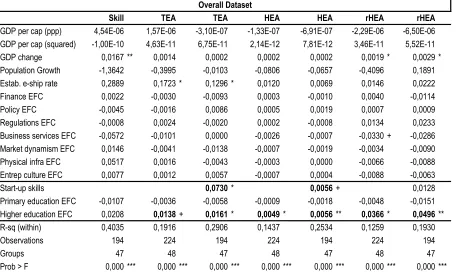
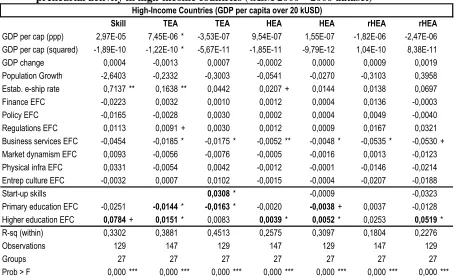
Tables 3 and 4 show the test of hypotheses H4, H5 and H6 concerning entrepreneurship training and education, perception of start-up skills and entrepreneurial activity. Again, we show separate analyses for the overall GEM dataset and for the subset of high-income countries.
The analysis comprising the full dataset is shown in Table 3. No statistically significant associa-tion is apparent for the relaassocia-tionship between Start-up skills and the two education EFCs. All en-trepreneurial activity indices exhibit a positive and significant direct association with Higher education EFC. TEA and HEA, but not rHEA, exhibit a positive and significant association with
Start-up skills. Thus, in the overall dataset, we have support for H4 (link between skills and measures of entrepreneurial activity) but not for H5 and H6 (effect of education on skills and the mediating effect). Again, we observe positive, direct associations between TEA and HEA and
Higher education EFC.
The analysis comprising high-income countries is shown in Table 4. In this sub-set, there is a positive, statistically almost significant association between Higher education EFC and start-up skills. We also observe a mediation between Higher education EFC and start-up skills for TEA. However, similar mediation is not observed for HEA or rHEA, which do not exhibit any statisti-cally significant association with start-up skills. Thus, for TEA, we have weak support for H5 (link between higher education and skills), support for H4 (link between skills and TEA), and support for H6 (the mediation effect). As for the overall sample, we also observe a direct link between Higher education EFC and HEA and rHEA.
6 Discussion
6.1 Overview of findings
- 31 -
strong and continuing policy interest toward entrepreneurship education, we considered it impor-tant to examine whether it really impacts entrepreneurship, and whether the impact might differ for different types of entrepreneurial activity. After rigorously controlling for intervening influ-ences, we found that entrepreneurship education probably does matter, and in quite specific ways. In high income countries, post-secondary entrepreneurship education and training is posi-tively associated with the level of new business activity, including high-growth expectation busi-ness activity, by enhancing the level of opportunity perception in the population at large. On the other hand, the level of post-secondary entrepreneurship education and training appears to be only weakly associated with the level of skills, and it appears to affect only levels of new busi-ness activity, and not high-growth expectation entrepreneurial activity, through its effect on per-ceived start-up skills.
- 32 -
much of received literature on entrepreneurship education and training, may be misplaced, at least in part.
The observed mediating effect between Higher education EFC, opportunity perception and en-trepreneurial activity emphasises the cognitive aspects of entrepreneurship education and train-ing. This finding is in line with the „Austrian‟ perspective on entrepreneurship. Recognising and assessing opportunities for setting up new productive functions in the economy often involves complex cognitive processing. Where others may not „see‟ anything, a cognitively endowed in-dividual may see a significant business opportunity. It appears that, consistent with much of the „Austrian‟ theorising, the cognitive aspect of the entrepreneurial market process may be the criti-cal bottleneck for entrepreneurial activity, one which educational institutions may be well posi-tioned to address17. Post-secondary entrepreneurship education may be performing an „eye-opening‟ role – hence its effect on opportunity perception – but may not be sufficiently experien-tial to give trainees the confidence that they have the necessary experience.
stu-- 33 stu--
dents will not, and probably should not, start new firms immediately after graduation, entrepre-neurship training and education may have a long-lasting effect on their entrepreneurial alertness and motivation.
We offer four possible reasons why entrepreneurship education and training in post-secondary levels of education in high income countries operates to enhance both general new business ac-tivity and high-potential entrepreneurial acac-tivity. First, such training is targeted to a population cell that has, by virtue of its educational background and social standing, the best opportunities to start new high-growth ventures. Second, such training would reach high-potential individuals when they are at a crucial stage in their professional development and thus likely to be actively making career decisions. Third, such training helps improve both the entrepreneurial self-efficacy of high-potential individuals, as well as their perceptions of the social desirability of en-trepreneurial career choices. Fourth, the alternatives of unproductive or destructive entrepre-neurship are likely to be unattractive in high income countries, because rule of law is stronger. Thus, allocation of effort by highly educated individuals into productive entrepreneurship is likely to be relatively high in high income countries. All these factors serve to boost the entre-preneurial propensities of those most likely to have the skills, will and desire to succeed. Fur-thermore, the building of entrepreneurship education capability in colleges and universities will enable the provision of advanced training at continuing professional development level to gradu-ates at any stage in their career. Such elite training of highly committed individuals is widely ac-cepted in management but less so in entrepreneurship.
- 34 -
Surprisingly, when controlling for year effects in the panel data, GDP per capita does not emerge as a significant influence on TEA in the present analysis, even though it does emerge as a nega-tive and significant influence when not controlling for year effects. Of the various control vari-ables, only the population prevalence of established entrepreneurs shows up as a statistically highly significant influence on opportunity perception, skills perception and entrepreneurial ac-tivity. An interesting mediation effect could also be observed for the prevalence rate of estab-lished entrepreneurs in the population, skills perception, and new business activity in rich coun-tries (see Table 4). These results demonstrate the important role that the existing stock of busi-ness owner-managers plays in enhancing opportunity and skills perception, and not just as a di-rect source of entrepreneurial stock (Fischer and Reuber, 2003; Leibenstein, 1968). In high in-come countries, the size of the pool of experienced entrepreneurs appears to influence the level of high-growth expectation entrepreneurial activity through its influence on opportunity percep-tion, and the level of general new business activity through its influence on skills perception.
Leibenstein recognised the value of links between entrepreneurs in building capacity as he sketched out his model of factors that affected entrepreneurial activity levels: “probably a sig-nificant part of such a model would be the interaction of different types of entrepreneurs to each other's activities” (1968: 80). This insight is supported by recent research on spinoff entrepre-neurship (Klepper, 2002; Klepper and Sleeper 2005). While much of this interaction is not or-ganised formally, there are excellent models of oror-ganised informal training for entrepreneurs by entrepreneurs, such as the Entrepreneurial Exchange in Scotland18. It is noteworthy that the En-trepreneurial Exchange was an initiative of a government agency that was rapidly taken over and funded by entrepreneurs themselves.
6.2 Limitations
- 35 -
data. We cannot exclude this possibility. Also, there are some cohort effects in our data. The principal effect, which applies to the 2001 cohort, may be a data issue that is in the process of being resolved. It may or may not make a difference to the findings.
Second, our EFC data is based on impressions of experts, rather than “hard” data. While it is true that for some EFCs, hard data is available for items that we chose to measure through experts‟ opinions, for example regulatory burdens (Djankov et al., 2002), in many cases hard data is miss-ing or at best patchy. We see the GEM Expert Survey as complementary to research based on „hard‟ data. Where our findings agree, such as where the effect of regulations on entry is con-cerned, (Klapper et al., 2006; Levie and Autio, 2008) this strengthens the credibility of both re-sults and should provide more confidence to policy-makers.
Third, we did not operationalize motivation in our empirical analysis, despite its importance in the model itself (under the general heading of capacity) and in entrepreneurship research gener-ally (Shane et al., 2003) and despite the role that entrepreneurship education and training is said to play in enhancing motivation to engage in new business activity (Peterman and Kennedy, 2003). There are several possible candidate measures of motivation in the GEM database, al-though none are ideal. Further work might explore this.
6.3 Implications for Further Research
- 36 -
and females. Repeating the analysis for startups in different industries or technology levels could also reveal different effects.
Notes
1. The box labelled New Firms was originally labelled Business Dynamics (Reynolds et al., 1999), then from 2000 to 2003 was labelled Business Churning (Reynolds et al., 2000, 2001, 2002, 2003), and from 2004 to 2005 was labelled New Firms (Acs et al., 2005; Minniti et al., 2006). In the latest iteration (Bosma et al., 2008) it is labelled Early-stage Entrepreneurial Activ-ity.
2. We would suggest adding the word “Economic” to this box in the GEM model.
3. For an alternative reconciliation of the Schumpeterian and Kirznerian positions, which the GEM model could also accommodate, see Leibenstein (1987).
4. Strictly speaking, Baumol‟s main focus was on the allocation of entrepreneurs into „produc-tive‟ and „unproduc„produc-tive‟ activities. Baumol‟s notion of the allocation of effort can easily be ex-tended to consider the allocation of effort into entrepreneurship in general.
5. In a 1978 update of his earlier paper, Leibenstein renamed this “innovational” entrepreneur-ship (Leibenstein, 1978: 40).
6. In relation to motivation, we note a recent review of entrepreneurial motivation by Shane et al. (2003) in which the authors urge researchers to control for opportunity in studies of motivation. The GEM model may act as a useful guide in this respect.
7. The focus of the GEM model is on what Baumol terms productive entrepreneurship. Thus it is not relevant to the GEM model whether, as Baumol suggests, some individuals are entrepreneu-rial and others are not, and the question is what makes entrepreneurs to choose productive over unproductive or destructive entrepreneurship, or whether anyone can behave entrepreneurially, as von Mises suggests, and the question is what prompts people to behave entrepreneurially rather than non-entrepreneurially.
8. Indeed, in some countries, entrepreneurs are not permitted to trade until they can prove they have acquired such facilities. See, for example
http://www.doingbusiness.org/ExploreTopics/StartingBusiness/Details.aspx?economyid=195,