Instructional
Engineering in
Networked
Environments
About This Book
Why is this topic important?
The Internet, now ubiquitously present in our lives, gives us all access to a major part of human knowledge. With a simple click of a mouse we can obtain materials from libraries, museums, newspapers, television and radio programs, and universities and schools located all around the world. Formal e-learning is quickly becoming popular and thousands of courses offering in-struction at many levels and in many areas are now available on the Internet. This book de-scribes new techniques for distance learning, or e-learning, and for constructing knowledge from remote information sources.
What can you achieve with this book?
The main thesis of this book is that instructional design, or instructional engineering, particu-larly in an e-learning context, must be based on knowledge engineering and is most effective when it employs graphic models representing the knowledge and competencies learners are to acquire. Furthermore, this book demonstrates why instructional engineering needs to move beyond information management to become knowledge management. This book will revolu-tionize your thinking, showing you effective new approaches to e-learning methodologies.
How is this book organized?
About Pfeiffer
Pfeiffer serves the professional development and hands-on resource needs of training and human resource practitioners and gives them products to do their jobs better. We deliver proven ideas and solutions from experts in HR develop-ment and HR managedevelop-ment, and we offer effective and customizable tools to improve workplace performance. From novice to seasoned professional, Pfeif-fer is the source you can trust to make yourself and your organization more successful.
Essential Knowledge Pfeiffer produces insightful, practical, and
comprehensive materials on topics that matter the most to training and HR professionals. Our Essential Knowledge resources translate the expertise of seasoned professionals into practical, how-to guidance on critical workplace issues and problems. These resources are supported by case studies, worksheets, and job aids and are frequently supplemented with CD-ROMs, websites, and other means of making the content easier to read, understand, and use.
Essential Tools Pfeiffer’s Essential Tools resources save time and
expense by offering proven, ready-to-use materials—including exercises, activities, games, instruments, and assessments—for use during a training or team-learning event. These resources are frequently offered in looseleaf or CD-ROM format to facilitate copying and customization of the material.
Pfeiffer also recognizes the remarkable power of new technologies in expanding the reach and effectiveness of training. While e-hype has often created whizbang solutions in search of a problem, we are dedicated to bringing convenience and enhancements to proven training solutions. All our e-tools comply with rigorous functionality standards. The most appropriate technology wrapped around essential content yields the perfect solution for today’s on-the-go trainers and human resource professionals.
Essential resources for training and HR professionals
ABOUT THE INSTRUCTIONAL TECHNOLOGY AND TRAINING SERIES
This comprehensive series responds to the rapidly
changing training field by focusing on all forms of instructional and training technology—from the well-known to the emerging and state-of-the-art approaches. These books take a broad view of technology, which is viewed as systematized, practical knowledge that improves productivity. For many, such knowledge is typically equated with computer applications; however, we see it as also encompassing other nonmechanical strategies such as systematic design processes or new tactics for working with individuals and groups of learners.
The series is also based upon a recognition that the people working in the training community are a diverse group. They have a wide range of pro-fessional experience, expertise, and interests. Consequently, this series is dedicated to two distinct goals: helping those new to technology and train-ing become familiar with basic principles and techniques, and helptrain-ing those seasoned in the training field become familiar with cutting-edge practices. The books for both groups are rooted in solid research, but are still designed to help readers readily apply what they learn.
The Instructional Technology and Training Series is directed to persons working in many roles, including trainers and training managers, business leaders, instructional designers, instructional facilitators, and consultants. These books are also geared for practitioners who want to know how to apply technology to training and learning in practical, results-driven ways. Experts and leaders in the field who need to explore the more advanced, high-level practices that respond to the growing pressures and complexities of today’s training environment will find indispensable tools and techniques in this groundbreaking series of books.
Rita C. Richey Kent L. Gustafson William J. Rothwell M. David Merrill Timothy W. Spannaus Allison Rossett
OTHER INSTRUCTIONAL TECHNOLOGY AND TRAINING SERIES TITLES
Confirmative Evaluation:
Practical Strategies for Valuing Continuous Improvement
Joan Conway Dessinger and James L. Moseley
Learning to Solve Problems: An Instructional Design Guide
Instructional
Engineering in
Networked
Environments
Copyright © 2004 by John Wiley & Sons, Inc. Published by Pfeiffer
An Imprint of Wiley
989 Market Street, San Francisco, CA 94103-1741 www.pfeiffer.com
No part of this publication may be reproduced, stored in a retrieval system, or transmitted in any form or by any means, electronic, mechanical, photocopying, recording, scanning, or otherwise, except as permitted under Section 107 or 108 of the 1976 United States Copyright Act, without either the prior written permission of the Publisher, or authorization through payment of the appropriate per-copy fee to the Copyright Clearance Center, Inc., 222 Rosewood Drive, Danvers, MA 01923, 978-750-8400, fax 978-646-8600, or on the web at www.copyright.com. Requests to the Publisher for permission should be addressed to the Permissions Department, John Wiley & Sons, Inc., 111 River Street, Hoboken, NJ 07030, 201-748-6011, fax 201-748-6008, or e-mail: [email protected]. For additional copies/bulk purchases of this book in the U.S. please contact 800-274-4434. Pfeiffer books and products are available through most bookstores. To contact Pfeiffer directly call our Customer Care Department within the U.S. at 800-274-4434, outside the U.S. at 317-572-3985, fax 317-572-4002, or on-line at www.pfeiffer.com.
Pfeiffer also publishes its books in a variety of electronic formats. Some content that appears in print may not be available in electronic books.
ISBN: 0-7879-6466-2
Library of Congress Cataloging-in-Publication Data Paquette, Gilbert
1942-Instructional engineering in networked environments / Gilbert Paquette.
p. cm.
Includes bibliographical references and index. ISBN 0-7879-6466-2
1. Internet in education. 2. Education—Computer network resources. 3. Computer-assisted instruction. I. Title.
TK5105.875.I57P33 2003 371.33'4—dc22
2003018770
Acquiring Editor: Matthew Davis
Director of Development: Kathleen Dolan Davies Production Editor: Nina Kreiden
Editor: Elspeth MacHattie
Manufacturing Supervisor: Bill Matherly Editorial Assistant: Laura Reizman Illustrations: Lotus Art
List of Figures and Tables xv
Foreword xix
M. David Merrill
Acknowledgments xxiii
Introduction xxv
Chapter 1: The E-Learning Challenge 1
The Knowledge Society 2
Knowledge Management 3
Pedagogy and Technology 5
Network-Based Learning Models 8
Processes and Development Tools 14 C O N T E N T S
Platforms and Portals 19
Summary 22
Chapter 2: Virtual Learning Centers 25
The Concept of a Learning System 26
Actors’ Roles and Resources 31
Explor@: A Web-Based Support System 40
Integrating a Learning Event into a Virtual Center 45
Versatile and Flexible Architecture 49
Summary 53
Chapter 3: Foundations of Instructional Engineering 55
Systemic Methods 56
Instructional Systems Design 60
Software Engineering 62
Knowledge Engineering 66
A Knowledge Representation System 69
Skills and Competencies 86
Summary 100
Chapter 4: MISA: An Instructional Engineering Method 103
Overview of the MISA Method 104
Conceptual Levels of a Learning System 109
Processes and Tasks 113
Operational Principles 115
Context and Frontier 119
Summary 121
Chapter 5: Instructional Engineering on the Web 125
General ADISA Features 126
Designing the Main Components of a Virtual Learning Center 132
Chapter 6: Reengineering a University Course for the Web 143
Definition of the Project 144
Preliminary Analysis 145
Architecture 149
Design of Learning Materials 156
Development and Validation 159
Delivery Planning 162
Discussion 163
Chapter 7: Engineering a Vocational E-Learning Environment 165
Definition of the Project 166
Preliminary Analysis 167
Architecture 171
Design of Learning Materials 175
Development and Validation 180
Delivery Planning 182
Discussion 183
Chapter 8: Engineering a Workplace E-Learning Environment 185
Definition of the Project 186
Preliminary Analysis 186
Architecture 191
Design of Learning Materials 192
Development and Validation 196
Delivery Planning 198
Discussion 199
Conclusion 201
Glossary 209
Notes 231
Bibliography 239
Index 249
About the Author 255
About the Series Editors 257
Figures
1–1 An Education Paradigm Shift 2
1–2 The Knowledge Management Process 4
1–3 E-Learning Processes, Tools, and Actors 15
1–4 Sample Screen for MOT: A Specialized Design Tool 17 2–1 Concept of a Learning System 27
2–2 Interrelations Among Actors in a Virtual Learning Center 32 2–3 Actors and Interaction Spaces 37
2–4 Resources Grouped into Five Spaces 39
2–5 Access Via Explor@ to a Virtual Learning Center 41 2–6 (1) Course Web Site, (2) Explor@ Browser, (3) Example of
a Resource 42
2–7 Some Explor@ Design Tools 47
2–8 Tools Displaying Individual and Group Progress in a Course 48 3–1 Foundations of Instructional Engineering 57
L I S T O F F I G U R E S A N D T A B L E S
3–2 A Conceptual Chart of Climate Change 70
3–3 Two Examples of Flowcharts 71
3–4 A Decision Tree to Diagnose Automobile Breakdowns 73
3–5 Taxonomy of Knowledge Models 79
3–6 MOT Model of a Conceptual Chart 81
3–7 MOT Model of an Algorithm 82
3–8 MOT Model of a Decision Tree 83
3–9 MOT Model for a Diagnostic Process 84
3–10 MOT Model of a Collaborative Process for Writing a Text 85 3–11 A Skills Taxonomy 87
3–12 Model of the Skill “to Simulate” 89 3–13 Model of a Deduction Skill 90
3–14 Model of the Skill Evaluation of Knowledge Acquisition 91 3–15 The Concept of a Competency 93
3–16 Model of the Tasks of a Multimedia Producer 97 3–17 Subknowledge Model and Associated Skills 98 4–1 MISA: High-Level Representation 107
4–2 Two Examples of Documentation Elements 110
4–3 Contextual Model of the MISA Method 120
5–1 ADISA: An Instructional Engineering Workbench 127
5–2 Example of an ED Form (224) 128
5–3 A Tool to Sort Instructional Materials 131
5–4 Transfer from MISA and ADISA to a Virtual Learning Center 133 5–5 Model of Web Site Material in MISA and ADISA 134
5–6 Delivery Model for a Trainer 135
5–7 Example of an Instructional Scenario in a Learning Unit 137 5–8 Learning Unit Submodel in a Course Knowledge Model 139 6–1 Result of Task ED 222: A Network of Seven Learning Events 148
6–2 Knowledge Model for LU-2 149
6–3 Knowledge Model for LU-6 150
6–4 Learning Scenarios for LU-3 152 6–5 Learning Scenario for LU-7 153
6–7 Two Pages from the Course Web Site 161
7–1 Initial Knowledge Model and One Submodel for the Project “Improve Your Efficiency with ICT” 169
7–2 Initial Instructional Model for the Project “Improve Your Efficiency with ICT” 170
7–3 Knowledge Assigned to LU Modules 172
7–4 Instructional Scenario for LU-2 174
7–5 Media Model for the Project “Improve Your Efficiency with ICT” 177
7–6 Revised LU-2 Interface and Activity Instructions 182 8–1 Knowledge Model for the Course “Operating Code” 187 8–2 Knowledge Submodel for the Course “Operating Code” 188 8–3 Instructional Scenario for the Course “Operating Code” 192 8–4 Media Model for the Course “Operating Code” 194
8–5 Media Submodel for LU-2 195
8–6 Explor@ Resources for the Course “Operating Code” 197 8–7 Web Site for the Course “Operating Code” 198
Tables
1–1 World Trends in E-Learning, by Sectors, in $US Billions 6 1–2 Characteristics Analysis of Six Techno-Pedagogical Models 14 1–3 Synthesis of Instructional Engineering and Delivery Tools 23 2–1 Actor Functions and Roles in a Virtual Learning Center 34 2–2 An Explor@ Environment for a Learner 43
3–1 Three Generations of Computer Systems 67
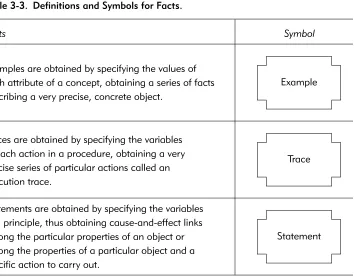
3–2 Definitions and Symbols for Abstract Knowledge Types 74 3–3 Definitions and Symbols for Facts 75
3–4 Interpretation Examples for Three Types of Knowledge 76
3–5 Main Model Categories 80
3–6 Example of a Task Description 95
3–7 Interpretation of Statements of Competency for a Multimedia Producer 99
4–1 Documentation Elements of MISA 4–0 (by Phase) 111
4–2 Documentation Elements of MISA 4.0 (by Axis) 112 4–3 Task Context “Define the Learning Units” 113
6–1 Tasks Accomplished in Phase 1 of the Project “Introduction to Artificial Intelligence” 144
6–2 Tasks Accomplished in Phase 2 of the Project “Introduction to Artificial Intelligence” 146
6–3 Tasks Accomplished in Phase 3 of the Project “Introduction to Artificial Intelligence” 150
6–4 Tasks Accomplished in Phase 4 of the Project “Introduction to Artificial Intelligence” 157
6–5 Tasks Accomplished in Phase 5 of the Project “Introduction to Artificial Intelligence” 159
6–6 Tasks Accomplished in Phase 6 of the Project “Introduction to Artificial Intelligence” 162
7–1 Explor@ Resources for the Project “Improve Your Efficiency with ICT” 179
F
OR THE PA ST SEVERAL DEC ADES instructors in the field of educational technology have focused on training instructional designers. A quick survey of graduate programs in this area indicates that the majority of the classes are geared toward instructional design from the viewpoint of learning psychology or from the viewpoint of using multimedia tools for the latest technological advances. Courses have emphasized a systematic approach to the development of instructional products usually consisting of various approaches to analysis, design, development, implementation, and evalua-tion. The assumption, especially at the master’s degree level, is that the grad-uates of these programs will find jobs that require these newly acquired skills in developing instructional products.The reality is that most instructional designers are not trained while enrolled in graduate programs labeled with some flavor of instructional tech-nology. Many are instructional designers-by-assignment; meaning, they were F O R E W O R D
recently recruited from among the professionals in a given field to develop a course. Some of these designers-by-assignment will complete short workshops in instructional design or technology tools. They are then considered pre-pared to develop instructional products.
Technology tools for putting information on the Internet or for develop-ing other technology-based instructional products are gettdevelop-ing easier and eas-ier to use. Although graduates from instructional technology academic programs or workshops once had an edge because of their technical skills, they now possess technical skills that are becoming less and less important in creating some form of technology-based training. Too often the resulting instructional products teach very poorly or do not teach at all.
To date, most of these technology development tools have focused on the technical skills required to implement a given technology, for example, to cre-ate a Web site. Very few of these tools have focused on selecting what to teach, structuring the subject matter content, sequencing the subject matter tent, presenting the content, or providing practice in skills related to the con-tent. Because these technology-facilitating tools are available, almost everyone nowadays considers him- or herself an instructional designer. Educational technologists are in the same position that computer scientists found them-selves a couple of decades ago. As computer application programs become easier and easier to use, the need for formal courses to teach these skills be-came less and less important. In the same way that applications to create tech-nology-based training become easier and easier to use, formal training in the use of these applications is becoming less and less important.
tech-nology easier, but more important how to determine the knowledge and skill to be taught, how to structure the knowledge and skill to be taught, and how to effectively and efficiently represent this knowledge and skill in databases that can be effectively used by computational devices for the purposes of instruction. They will develop instructional algorithms that can be represented in computer programs and used over and over again like the programs under-lying word processors, spreadsheets, and graphic applications.
Instructional Engineering in Networked Environments represents an impor-tant contribution to this new role for instructional technology. Dr. Paquette and his associates have diligently studied the complex issues surrounding knowledge acquisition, knowledge structure, and knowledge representation. Their work is an outstanding example of the kind of thoughtful principles and resulting tools that are required for the next generation of instructional technologists.
This work is not just another tool for developing some form of technol-ogy. Rather, it is a carefully researched set of principles for knowledge acqui-sition, structure, and representation. These principles have been captured in a wonderful conceptual tool that enables the new breed of instructional tech-nologists (telelearning systems engineers) to efficiently and effectively develop instructional products that are founded in solid principles of instruction.
In this book Professor Paquette provides one of the most sophisticated tools yet developed for a true technology of instructional engineering. All seri-ous instructional designers will find that this work significantly improves the efficiency and effectiveness of their instructional product development efforts. Future instructional engineers will find that the principles taught and the tools described will provide a foundation for future developments in instruc-tional engineering.
October 2003 M. David Merrill
Professor of Instructional Technology Utah State University
T
H E AU T H O R would like to thank the various teams of the LICEF Research Center of Télé-université who contributed to the emergence and the consolidation of the ideas presented throughout this book.More particularly, I wish to acknowledge the contributions of Claire Aubin, who was the first to suggest the creation of an instructional engineer-ing workbench and who, with Françoise Crevier, has contributed to several concepts important to the instructional engineering method discussed here; of Eric Bleicher, who is the main designer of the MOT and MOT+, tools, which produced an enormous step forward in building the method; and of Ioan Rosca, who is the main architect of the ADISA support system for MISA and who coordinated most of its data-processing development.
I also wish to acknowledge the support I received at the onset of this project from Jacqueline Bourdeau, Diane Ruelland, Chantal Paquin, and Michel Léonard. Michel provided constant support from the beginning and A C K N O W L E D G M E N T S
continues to do so. He is also responsible for most of the training sessions offered on the instructional engineering method. Ileana de la Teja, Andrée Longpré, Karen Lundgren, and Ioan Rosca have made contributions to the most recent versions of the method. Josiane Basque, Sylvie Doré, and Lise Damphousse have produced a master’s-level course at Télé-université using one of the versions of the method.
L
IKE OUR OWN EPOCH,the century of Pericles, the Renaissance, and the Age of Enlightenment were marked by significant cultural and scientific revivals. However, the creativity and discoveries of these past ages affected only a small proportion of the world’s population. The effects were nothing like the massive changes we are currently experiencing. Owing to the technological advances that have greatly increased our ability to com-municate with and learn from each other, we are now witnessing a true cul-tural revolution that is sewing together the social fabrics of the many cultures on this planet. Governments are establishing technology policies for distance education, or e-learning (electronic learning), corporations are acting on the recognition that knowledge is their main capital, and individuals, informed by the mass media about the technological innovations succeeding one another at an accelerating pace, are hastening to acquire the information-processing tools considered essential to acquire knowledge.I N T R O D U C T I O N
The vast, irreversible movement leading us toward a knowledge society gives new importance to human learning. Learning is the process by which information, scattered or structured in various domains, becomes knowledge and skills, integrated into the intellect of an individual and allowing him or her to acquire and use new competencies. In e-learning and network distrib-uted learning an individual builds knowledge from remote information sources. And this method of learning raises multiple instructional, techno-logical, and economic issues.
The Internet brings much of the human knowledge contained as infor-mation in libraries, museums, newspapers, television and radio programming, research facilities, and universities and schools directly to us wherever we are. With all this information readily accessible and easily sortable into manageable Web documents and graphics, e-learning is becoming increasingly attractive to both instructors and learners, and thousands of courses are now available via the Internet. This book describes new techniques for designing e-learning and for building knowledge from remote information sources. I call the meth-odology that manages all these techniques instructional engineering.
The Value of Instructional Engineering
Instructional engineeringis a means for going beyond information manage-ment to knowledge managemanage-ment. It is an essential support for our transition from an information society to a knowledge society. The ultimate goal of instructional engineering is to empower people with new competencies. The development of competencies, that is to say of the generic skills that people can apply to knowledge, constitutes the main goal of learning. Individuals’ competencies, their capacities to acquire, process, and communicate their knowledge, constitute the most important assets of both the individuals them-selves and their organizations.
knowledge are an essential tool for instructional engineering. This book will open your thinking to new approaches to using e-learning methodologies.
The Contents of This Book
The eight chapters of Instructional Engineering in Networked Environments address, first, basic principles; second, a specific methodology; and third, a series of case studies. Chapter One presents a synthesis of the topics covered in the book. I define the context that the evolving knowledge society and economy present, I review the various technological models for e-learning to illustrate the diversity among the approaches, and I present the processes and tools used to build an e-learning environment, emphasizing the challenges offered by the interoperability of learning objects.
Chapter Two discusses virtual learning centers and the main instructional engineering questions that occur in such environments. A virtual learning center allows e-learning designers to integrate e-learning roles, operations, and resources. This chapter suggests the dimensions of the role of the instruc-tional engineer.
Chapter Three presents the bases of instructional engineering, which I locate at the crossroads of scientific instructional design, software engineer-ing, and knowledge engineering. It also introduces an approach to knowledge representation and the idea of target competencies for learners.
Chapter Four offers the main concepts, processes, and operational prin-ciples of an instructional engineering method,MISA, that employs graphic rep-resentations of knowledge.
Chapter Five is devoted to the functions of an instructional engineering support system accessible on the Web. This workbench supports design teams as they use MISA and create learning events and build virtual learning centers. Chapters Six, Seven, and Eight present practical instructional engineering case studies. These applications of instructional engineering involving MISA and the virtual learning center concept were carried out between 1999 and 2001 in three distance training contexts: a university course, the continuing
education of members of three corporations of professionals, and a training session in a corporation.
The final section of this book encourages the reader to evaluate the chal-lenges that e-learning designers will encounter as the knowledge society becomes our everyday reality.
The Audience for This Book
This book is addressed mainly to training experts and to those who wish to better understand the challenges of technology-based learning so they can maker fuller use of the new technologies for training and teaching. In writ-ing this book, I wanted to fill the gap that exists between the traditional methods of instructional design and the new possibilities offered by the new, extremely powerful training tools we now have at our disposal. We can, obvi-ously, mimic the classroom environment by simply placing class materials (information) on a Web site, but to fully use the potential of information and communication technology (ICT), we must consider the myriad choices it opens to us for pedagogical strategies, media, communication resources, and delivery models. Up until now e-learning has been perceived as particular training contexts. In the future, due to the enormous training needs entailed by the knowledge society, the reverse seems likely to occur. The distributed classroom, connected to a network, will become a particular e-learning mode integrated, often in the same course, with various delivery models such as self-training on the Web, on-line teaching, communities of practices, and elec-tronic performance support systems in the workplace.
train-ing materials, and finally, to define the infrastructures, resources, and services necessary to deliver the course (or series of courses) and maintain its quality over time.
A failure to take this larger view before tackling the design of individual elements (the micro-design) can affect more than quality. For example, a study carried out by University of Ottawa researchers showed that the preparation of a four-hour e-learning course for the technicians of a large company required 1,156 hours of multimedia self-training development. That is, each hour of the finished course took 250 hours to prepare. This 1:250 ratio is rec-ognized as the norm in the industry for sophisticated multimedia simulations. However, according to the same study, a course of the same duration for the same type of learners that had few multimedia sources of information but instead featured continuous interactions between the learner and the trainer on the Internet required 144 hours of preparation, a 1:30 ratio.1This
com-parison shows that time and effort can be considerably reduced and that a stronger pedagogical model may be produced as a result of a simple analysis of the possible delivery alternatives.
Preparing for the Future
In 1993, Kent Gustafson remarked that “while there have been moderate additions to the tool set and some changing of perspective from a behaviorist to a cognitive psychological orientation, to date they do not represent a fun-damental change in the tool set. . . . The instructional design methodology is simply just too incomplete and too inadequate to tackle many of the chal-lenges of the next decade and the next millennium.”2
In the ten years since then, much effort has been devoted to micro-design and developing prototypes for computerized materials. This is certainly a nec-essary part of the response but it does not solve the more general problems of e-learning systems engineering. In addition, the actual e-learning authoring tools on the market rely on traditional methodology. Even when well adapted and useful in certain cases, these tools cannot cope with all the dimensions of developing and implementing e-learning environments.
The answer my colleagues and I have offered to the kinds of concerns expressed by Gustafson has been to develop the methodology presented here as an example of instructional engineering and its potential. I am convinced that e-learning and its engineering are the future of education. I also believe that knowledge modeling is the future of instructional engineering.
I hope the reader will gain from this book, regardless of the methods or tools he or she adopts thereafter, a deeper understanding of the concepts, processes, and principles that underlie the use of knowledge modeling in the field of e-learning systems engineering. I especially hope that this book will contribute to better use of the extraordinary means now at our disposal to learn, to help to learn, and to design new ways of learning. I wish you a fruit-ful reading and invite you to send your comments to my Web site, at www.licef.teluq.uquebec.ca/gp.
October 2003 Gilbert Paquette
Instructional
Engineering in
Networked
1
A
T THE ONSETof this new millennium, in the advanced societies now calledpostindustrialsocieties, most employees are knowledge professionals.This fact tells us that the information available to us will grow exponentially in the future. This imminent growth will also be fueled by the 200 million Inter-net users who spend a substantial part of their time researching and producing new information on electronic networks; communicating and sharing without borders; and exchanging data, texts, pictures, and sounds ever more rapidly.
Given this massive flow of new information—a fruitful source for new knowledge—and the activities of knowledge workers that are modifying the very nature of work and creating an enormous need for information and for highly effective methods for turning that information into knowledge, we need to ask how long traditional training and educational models can continue to prevail.
To answer that question, this chapter discusses the developing knowledge society and the rapid increase of Internet technologies and considers the impact of these changes on training needs. It then presents an overview of
1
technology-driven, pedagogical (techno-pedagogical) models for e-learning, the processes that govern the development and management of an e-learning sys-tem, and the system actors and the technological resources that support them. The chapter concludes with a survey of the e-learning delivery tools and sys-tems current at the time this book was written.
The Knowledge Society
A striking phenomenon associated with the development of the knowledge society is the shift that is occurring in the traditional education paradigm, as illustrated in Figure 1-1. The tradition in most educational institutions and in workplace training is that learning originates from a trainer or a professor who is the learner’s main source of information and expertise. The professor or trainer prepares the course, selects the instructional materials and activi-ties, and lectures and coaches the learners, who in turn solve problems and complete exercises, assignments, and projects.
Learner
Expert Learner
Learner
Information
Rumors Expertise
Learner
Figure 1-1. An Education Paradigm Shift.
We are now witnessing a radical shift of this traditional paradigm. It began four decades ago with the ubiquitous arrival of television. Today, owing to the exponential growth of information and its availability to anyone anywhere on communication networks, everyone is becoming a lifelong learner.
develop, with minimal help, abilities and knowledge superior to those of the past. They must select, process, and use the right information to communi-cate. Are we aware of the complexity of this task? Not only are learners faced with a rapidly increasing quantity of information and knowledge but they are also required to differentiate what is useful and valid from the not useful and inaccurate in that mass of available information. Traditional education does not train us to accomplish these tasks. Instead, as the Québec Council for Higher Education has recently stated (in light of the discussions held at many international conferences on education and learning since the beginning of the 1980s1): “Special attention must be given to superior cognitive capacities
(aptitudes, action planning, reasoning and problem solving) and social abili-ties (autonomy, communication and collaboration capaciabili-ties). These abiliabili-ties are those sought by employers to take [into] account the impact of ICT [infor-mation and communication technologies] on the employment market.”2
What we actually have today is not yet a knowledge society but an infor-mation society. We hope that it will become a real knowledge society. This can happen only if our education and training emphasizes the abilities that allow us to process intelligently the facts, data, and information we encounter both at work and in our daily lives. From a more general perspective, important social contradictions are developing: the globalization of the economy tends to reduce national, linguistic, and cultural diversity while centralizing power among large, private corporations; the gap continues to widen between the rich and the poor, between the educated and the uneducated, between those who master the new means of communication and those who do not have access to them. These complex problems offer major challenges. Learning models, methods, and tools must be improved. Before we can have a knowledge society we must have a knowledge revolution that results in the intelligent use and the mastery of learning technologies by the largest possible number of people.
Knowledge Management
Knowledge directly affects the competitiveness of corporations. It is not sur-prising that corporate managers are receptive when theoreticians stress the importance of managing their companies’ knowledge. For example, a full
decade ago Peter Drucker suggested that the future belongs to corporations who know how to strategically exploit their knowledge, claiming: “knowl-edge is now the decisive production factor.”3This type of discourse has been
rapidly embraced. A Delphi Group knowledge management study involving 500 organizations found that the percentage of these corporations that had started initiatives to manage knowledge within their organizations grew from 28 percent in 1997 to 51 percent in 1998, that is, in only one year.4
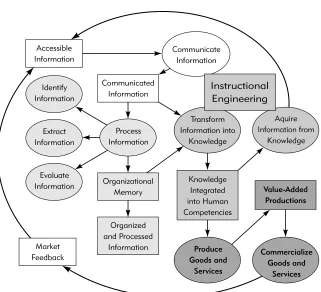
Figure 1-2 illustrates the knowledge management process in a corpora-tion. Beyond the information cycle present in every organization, more and more often management has an increased interest in developing new processes that facilitate the transformation of information into knowledge. The new knowledge, skills, and competencies acquired by the staff allow the
[image:39.504.104.425.310.602.2]organiza-Aquire Information from Knowledge Communicate Information Evaluate Information Extract Information Process Information Identify Information Commercialize Goods and Services Transform Information into Knowledge Produce Goods and Services Communicated Information Instructional Engineering Knowledge Integrated into Human Competencies Value-Added Productions Accessible Information Market Feedback Organizational Memory Organized and Processed Information
tion to improve the quality of its products and services, thus securing an advantageous position in a competitive market.
These new processes go well beyond the computer management of data or documents. They aim to secure the knowledge held by the organization’s experts. The experts’ knowledge is then documented, pooled, and reused by the other organization personnel through information, training, and perfor-mance support systems. Although such processes have always been informally present in organizations, the new awareness of their importance is leading organizations to reengineer their work processes using new technological tools. The result is improved, formal development of new knowledge, principles, methods, models, and strategies to deal with the competitive market. This new phenomenon, in contrast to the simple consultation of information in databases, puts much more emphasis on employee knowledge and compe-tencies, because higher-level knowledge requires acquisition and maintenance processes that can be learned only through informal and formal training activ-ities that are continuous, accessible, and effective.
Instructional engineering plays a crucial role in designing and delivering education and training that meets learners’ new needs whether these learners are in school, a corporation, a department, or some other kind of organiza-tional entity. Instrucorganiza-tional engineering plays a crucial role. Instrucorganiza-tional engi-neering is what designers do as they build and maintain global learning systems that focus on engaging learners in two main processes:
1. Knowledge extraction,the process of transforming the knowledge of an expert in a given field into structured information, which is sub-sequently made available to the whole organization
2. Knowledge dissemination,the process of transforming information into knowledge that is internalized by the learner as new competen-cies, typically ones useful to the learner’s organization
Pedagogy and Technology
The use of new learning technologies such as educational software, multi-media, and the Internet is growing rapidly in both North America and Europe and even in developing countries.
Since the Internet and the new training technologies became widely avail-able in the middle of the 1990s, e-learning has been growing rapidly. Net-work (Internet and intranet) and CD-ROM technologies are increasingly replacing more traditional training methods. In addition, most observers rec-ognize that Internet and intranet training is tending to supplant multimedia education provided on CDs.
The world market for workplace e-learning was evaluated by many stud-ies as being only $US 2 billion in 1999. According to Deloitte Consulting5
and W. R. Hambrecht6independent studies, companies in all countries expect
to increase their e-learning expenses from $US 3 billion in 2000 to $US 12.5 billion in 2003. This total could increase to $US 18 billion in 2005, accord-ing to the most recent estimate by IDC.7These estimates from various sources
converge. The trends are constant, leading to a situation where e-learning would account for more than half of all kinds of workplace training. In the public education sector, in universities and colleges as well as K-12, the same enormous growth is noted, as shown in Table 1-1.
Table 1-1. World Trends in E-Learning, by Sectors, in $US Billions.
2001 2003 2005
Enterprises 3.5 7.0 21.0
Colleges and universities 2.0 7.0 15.0
K-12 1.5 6.0 12.0
Source:Giga Information Group (http://www.gigaweb.com/).
dou-bled in the United States, totaling 52,270 courses offered to 1.6 million stu-dents. On the international level the number of Internet courses offered is growing rapidly as well, creating new needs for design and delivery tools and methods in both public and private educational environments.
This new pattern recognizes the vital importance of training and also that today’s training must do more than traditional training, as is suggested by sev-eral experts on organizational practice. For example, in his book The Knowledge-Enabled Organization,Daniel Tobin claims that the majority of current organizational training does not lead to measurable improvements. Rather than use traditional approaches centered on the transmission of information in a classroom, he recommends employing a new paradigm of continuous con-struction of knowledge and competencies.9
We must recognize the revolutionary potential of new educational tech-nologies. In the past, education was centered on the expert, the master, shar-ing his or her knowledge or know-how with a great number of students. In contrast, newly implemented interactive resources place the learner at the cen-ter of the educational environment and greatly reduce the time devoted to lecturing activities. This invites the trainer to change roles, defining himself or herself as an instructional designer and, more generally, as a facilitator, a motivator, and a coach.
Through e-learning, educators and trainers are beginning to mobilize technologies for knowledge and higher-level skill acquisition—and not mainly for entertainment, as has become largely the case with television. We may yet hope that the interactive communication fostered by the Internet will be in contrast to the passivity fostered by television. In much e-learning, learning events centered on competencies to be acquired can be available at any time and at any place. Through these learning events individuals can immerse themselves in learning activities and even select personalized scenarios, thus developing their aptitudes to learn how to learn.
All this potential can be mastered and channeled only through the imple-mentation of instructional principles that although well represented in the-oretical writings have not been effectively available for educational practitioners until recently. Now the advantage of allowing the learner to
construct knowledge is no longer a theory but a fact experienced by an increasingly large number of Internet users. With the ability to access and use multiple sources of information and expertise at any time and any place through television technology, CDs or DVDs, and Internet networks, the learner acquires knowledge in many ways. The educational potential of these multimedia technologies lies not only in the multisensory integration and interactivity they offer, but first and foremost in the education paradigm shift they represent, from the transfer of information by the instructor to the con-struction of knowledge by the learner.
The shift from traditional lectures to e-learning using the new training technologies requires a transition strategy, one that gives people and orga-nizations time to adapt to the new methods and training tools. The best training is that which meets the knowledge management needs of the orga-nization and of the learners. Here again instructional engineering techniques are essential, defining the most adequate technological models and the bridges that need to be built between the training of today and that of the future.
Network-Based Learning Models
The world of education is bubbling with techno-pedagogical ideas. With the extremely rapid growth in multimedia telecommunications, e-learning mod-els are proliferating, as are development tools and delivery platforms.
High-Tech Classroom
Thehigh-tech classroomis simply a traditional classroom where a number of technologies are permanently installed and used. These include sophisticated multimedia equipment, computers linked to a local or wide area network, and an electronic projector for presentations or Internet demonstrations. A videoconference system may be installed on classroom workstations. A bidi-rectional link may be provided so classroom presentations can be accessed by individuals outside the classroom (remotely located). In other words, the class-room is open to external information, but classclass-room offerings and that infor-mation are not necessarily distributed in several places.
These classrooms are often called multimedia laboratories. Now, as high-tech equipment spreads to many classrooms and other training locations, the termelectronic campus is coming into vogue.
At some schools and institutes of higher education, advantageous financ-ing plans encourage students to purchase notebook computers they can use in these classrooms, thus benefiting from the broadband networks and other equipment installed on the premises. Moreover, they can also use these com-puters as training tools outside the classroom.
Distributed Classroom
Thedistributed classroomis a virtual high-tech classroom, one spread over sev-eral distant locations.10These locations are equipped with a videoconferenc-ing system and a variety of peripheral equipment connected to a computer: cameras, voice sensitive microphones, videocassette players, and CD or DVD readers. The learning events are presented live by a professor or trainer, who delivers a lecture using a variety of instruments. In this model the students and the instructor are all present at the same time in their different rooms, linked through telecommunications. The communication is mainly one-way, from the instructor to the learners, although the learners have access to ways to ask questions and communicate with others in other rooms. Also, if all the rooms are identically equipped, the learners may use the system for seminars in which they are invited to present to each other work they have produced for the course.
There are several varieties of distributed systems. For example, some deliver the presentations to each student’s workstation rather than to a single screen viewed by all the participants present in the room, thus enhancing the interaction possibilities. Several universities and companies now use a dis-tributed classroom system to deliver training off campus and in company offices spread throughout several countries.
Hypermedia Self-Training
Hypermedia self-training11favors individual learning. The term hypermedia
refers to the hyperlinks that allow the learner to browse in a network of pages and other external resources viewable on the computer screen. The learner, working alone, accesses this network as prepared multimedia documents on the Internet, or on CD or DVD for audiovisual materials that require too much bandwidth to be viewed efficiently. The instructional material can then be entirely local (on a CD or downloaded on the workstation), on-line with audio or video streaming via the Internet, or a hybrid, part local and part on-line. Although some hypermedia material can be viewed only from one page to the next, the learner’s progression through the contents of this net-work is typically not linear. Thus the student not only can progress at his or her own pace but also can follow a flexible course plan, using the hyperlinks that appear most relevant considering his or her current or target knowledge. Self-training entails the complete absence of tutoring by a trainer. Also, there is no imposed collaboration between learners. Hence there are no place or time constraints imposed by the training model.
Since the arrival of the Internet, thousands of hypermedia courses have been published on the Web, and this number continues to increase daily. The training portals maintained by educational organizations grant access to series of such courses and programs and also various support services that consti-tute the basic elements of a virtual campus (this topic is discussed in more detail in Chapter Two).
On-Line Training
On-line training12also uses the Internet, multiple media, and hyperlinks but
inter-actions, mostly in an asynchronous mode; that is, the participants are not expected to be present simultaneously. The learners can thus progress at their own pace, interact between themselves, and use the instructional materials between the stages defined by the instructor. During each stage, the pace of the activities and most of the content of the exchanges are managed by the instructor. He or she will allocate, for example, three weeks for a module, launch a discussion, suggest work to be done, and then act as an adviser and content expert until the following module.
In this model the main technological tools are those that can be used in an asynchronous mode: newsgroups, e-mail (for private communication between the learner and the professor, tutor, or trainer), and file transfers (for exchanging documents and evaluating assignments). This model has been used for at least fifteen years in such distance or open universities as the Télé-université du Québec and the British Open University and is increasingly being employed on university campuses all over the world, where it becomes a practical alternative to classroom education.
Community of Practice
Communities of practice13may use the same asynchronous communication
tools as those used in the on-line teaching model and may also at times use tools for real-time communication, such as audio- or videoconferencing on a workstation or in a classroom. The main characteristic of this model is communication and discussion among the members of a group of specialists centered on a common task—for example, learning how to use training tech-nologies or solve specific medical problems. There is no trainer as such but rather a facilitator. As a general rule, unlike the professor or trainer the facilitator has less information than the participants, but he or she has mas-tered techniques for managing fruitful exchanges between the participants. The participants learn by exchanging information (some of which they may not have had at the beginning of their work together), and they compare var-ious practices through case studies. A document server allows them to enrich their common knowledge base. Using these tools, they can solve problems in teams or carry out projects through which they will acquire new knowledge or skills.
This model is particularly well adapted to continuing vocational educa-tion; it has been used, for example, by teachers, physicians, and engineers to increase their knowledge and improve their practice. This model has also been used in university distance learning programs in which, for example, a course module is presented as a workshop organized around a task to achieve or a practice to reinforce.
Performance Support System
Just like the community of practice, the electronic performance support sys-tem (EPSS)14is centered on a professional task. However, in this case the
training is mainly individual. It occurs in close connection with professional activities: during the activity when the learner needs training to progress in the task, after the activity when the learner wants to delve deeper into ques-tions generated by the task, or even before the activity if the learner foresees the need for additional training before starting a task. An EPSS is closely inte-grated with the computer system used on the premises of the organization offering this support to its people, and in particular with institutional data-bases. A manager or a content expert, and sometimes on-line computerized advisers, maintain various training modules and provide task assistance. The user can thus obtain just-in-time information about the tasks to be achieved. Training in this model is seen as information processing. These features make the EPSS a dynamic training environment that is increasingly popular in col-laborative learning at workplaces and in knowledge management activities.
Summary of the Models
The six e-learning models may be summed up as follows:
Three models are trainer centered: the high-tech classroom, the dis-tributed classroom, and on-line training. The remaining three models are mainly learner centered.
trainer in designated locations. The four other models are mainly asynchronous: the actors communicate between themselves or with the resources at the moment that is appropriate for them and from the location they select.
Two models, the hypermedia self-training and the performance support system, favor autonomous learning. The other models opt for communication and sometimes collaboration between learners.
Two models, the community of practice and the performance support system, are centered on the practice of a work task, or inspired by it. The other models tend to enable the processing of more general information.
Analysis of the Models
These models can be compared to each other in terms of the desirable char-acteristics suggested by the analysis of the new training contexts earlier in this chapter. Some of these characteristics pertain to flexibility, aiming to free learners (and trainers) from location and time constraints and also giving them more freedom in their use of instructional resources and their progres-sion through the instructional activities. Other characteristics focus on the accessibility of local or global information, collaboration between learners, assistance from training agents, and the usability and ergonomics of the tech-nological environment. Finally, some characteristics concern economics. They relate to the integration of work and training, the reusability of facilities, the maintenance or evolution of training environments, and finally, the relation-ship between training time and knowledge retention, to maximize training effectiveness.
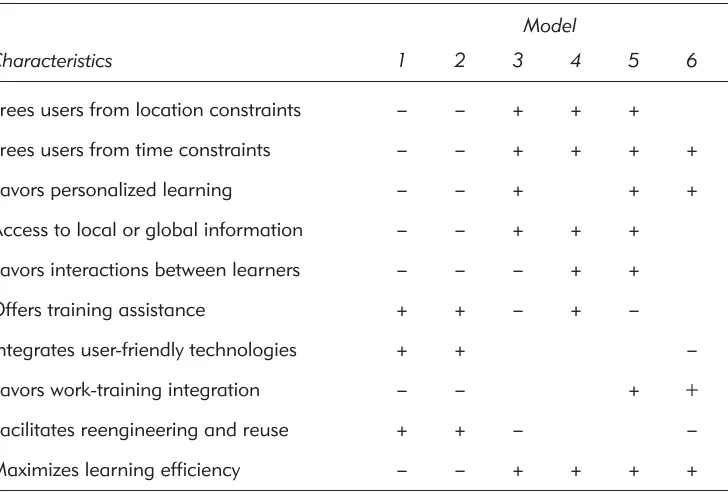
Table 1-2 summarizes the characteristics associated with each model. A plus sign (+) indicates that a model is strong in a particular characteristic, and a minus sign (−) indicates a deficiency. These evaluations are more or less sub-jective; hence I invite you to perform your own evaluations after considering mine.
Processes and Development Tools
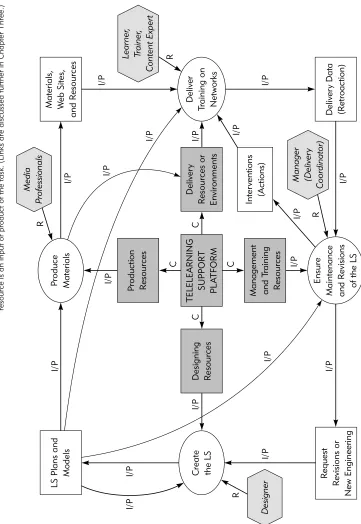
Figure 1-3 presents the main processes in an e-learning system, the actors involved, and the resources the actors use. Resourcesare any documents, soft-ware tools, and telecommunication or direct services used to input or process an activity managed by an actor. There are four main processes in the system’s life cycle, going from a creation phase to a production phase to a delivery phase and finally to a maintenance and revision phase, where defi-ciencies revealed by the delivery of the learning system (LS) are detected and improvements are made to close up the loop and start a new cycle.
[image:49.504.59.423.100.347.2]Together, these processes allow more interaction between the actors than traditional instruction does. The phases of creation, production, delivery, and maintenance and revision are enacted in a less sequential way. Although the Table 1-2. Characteristics Analysis of Six Techno-Pedagogical Models.
Model
Characteristics 1 2 3 4 5 6
Frees users from location constraints − − + + +
Frees users from time constraints − − + + + +
Favors personalized learning − − + + +
Access to local or global information − − + + +
Favors interactions between learners − − − + +
Offers training assistance + + − + −
Integrates user-friendly technologies + + −
Favors work-training integration − − + +
Facilitates reengineering and reuse + + − −
Maximizes learning efficiency − − + + + +
Figure 1-3.
E-Learning P
rocesses, T
ools, and Actors.
Note:
In diagrams such as this one, the tasks ar
e framed by ovals, the r
esour
ces or pr
oductions by r
ectangles, and the actors by hexa
gons.
An R
-link means that an actor “gover
ns,” or is r
esponsible for
, the task. A C
-link means “is composed of
,” and an I/P
-link mean
s that the
resour
ce is an input or pr
oduct of the task. (Links ar
e discussed further in Chapter Thr
ee.) Deliver y Data (R etr oaction) Deliver y R esour ces or Envir onments TELELEARNING SUPPOR T PL A TFORM
Management and T
raining
R
esour
ces
P
roduction Resour
ces
Designing Resour
ces
Inter
ventions
(A
ctions)
Materials, Web Sites,
and R
esour
ces
LS Plans and
Models Request
R evisions or New Engineering Manager (Deliver y Coordinator) Media P rofessionals Designer L ear ner , Trainer , Content Expert Deliver
Training on Networks
Ensur
e
Maintenance and R
evisions
of the LS
P roduce Materials Cr eate the LS C C I/ P R R R R I/ P C I/ P I/ P I/
P I/P
I/ P I/ P I/ P I/
P I/P
processes can be discussed as occurring in a logical iteration, to understand their practical application it is best to think of them as operating more or less in parallel, with information continually shared between them. Let us look as these processes in more detail.
Designing the Learning System
The starting point for a learning system is a problem analysis performed by an educational organization: a university, college, corporate institute, depart-ment of human resources, or community educational group. Once an edu-cational problem is defined, we can decide to start the production of a new learning system or to review an existing learning system. The first scenario is referred to as instructional engineeringand the second as reengineering.
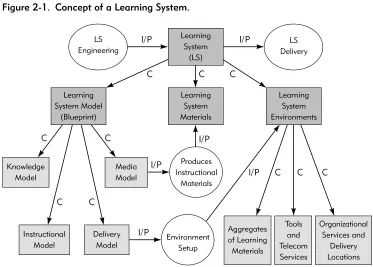
A learning system is a structured collection of materials, resources, envi-ronments, services, and human or technological infrastructures that support learning. Such a system can be described in terms of four models: a knowl-edge modeldescribing the contents and the current and target competencies; aninstructional modeldefining the course structure, learning activities, instru-ments, and other resources necessary to the learners and the human resources; a media modelestablishing the design of the Web site(s) or other resources and the design of each material used in the course, regardless of its format; and finally, a delivery modeldescribing the roles of the actors at the time of delivery, the tools and channels of communication, the environment and ser-vices used, and the plan for the implementation, management, and mainte-nance of the learning system. As shown in Figure 1-3, the creation process produces inputs (models) for the three other processes and also for itself, for continuous reengineering.
Designers may also use two other types of creation tools—integrated or nonintegrated—for courseware design. The use of nonintegrated tools makes it difficult to maintain the coherence of an e-learning system. Moreover, data transfer from one tool to another is a fastidious task that often causes errors and reduces the design team’s productivity. Finally, such a solution does not allow the full operational use of instructional engineering principles and there-fore does not adequately support the work of the design team.
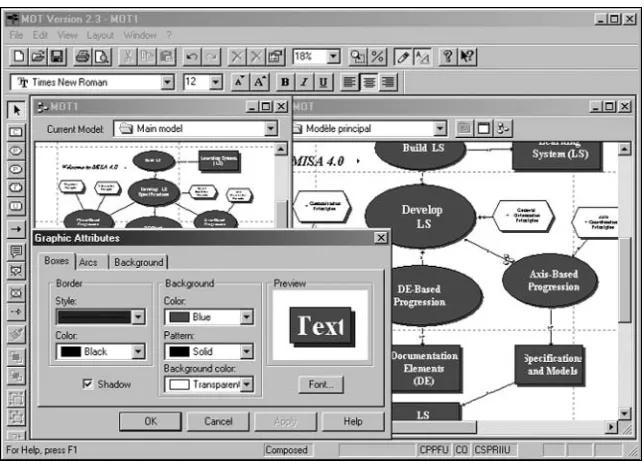
Using integrated tools such as Designer’s Edge or ADISA (discussed in Chapter Five) for courseware design ensures the coherence of the models. Such macro-design support tools, often called front-end tools,are used pri-marily to prepare work for another tool that will be used in the actual pro-duction of instructional materials for the learning system.
Producing Instructional Materials
Regardless of the courseware tools used, once the total design, or macro-design, is completed or sufficiently advanced, work can be started on the design of
[image:52.504.129.451.100.331.2]T h e E - L e a r n i n g C h a l l e n g e 1 7
individual materials, the micro-design.Then these materials can be produced, following the requirements of the media model produced at the macro-design stage. These materials will generally be integrated into (or linked to) a Web site that becomes the environment for the network of materials, activities, and services that constitute the “physical” e-learning system.
The type of development represented by these designing and production steps mobilizes important principles, methods, and tools and requires a solid methodology. It is easy to understand why many companies offer custom con-tent authoring software targeted to e-learning concon-tent creators who have little time and few means. In 1997, I counted almost 400 multimedia courseware production tools available in the United States. Most of the tools offered have production functions for the Web, and new tools are being produced specif-ically for Internet delivery. Using these custom authoring tools, organizational content experts and trainers can produce their own computerized materials. However, multimedia development still requires the production of the basic media elements: graphics, sound and video sequences, and so forth. This need can be filled by contracting with media professionals or by using prefabri-cated content from media element banks. However, this latter option may generate some monotony and infringe on copyright laws.
Delivering Training on Networks
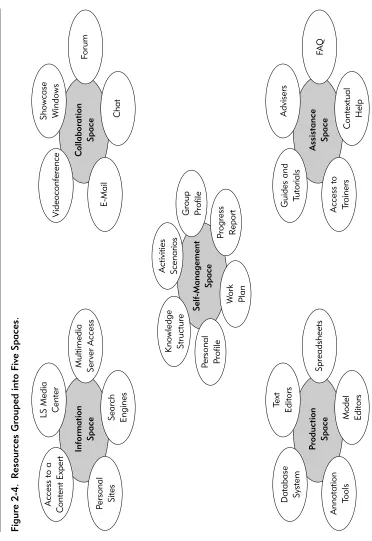
Once the materials have been validated and revised, the delivery model pro-duced in the macro-design, or creation, phase is used to guide the way they are assembled with other resources and to build the actor’s environment that will be implemented at delivery time. These resources are documents, tools, and e-services that users can employ to obtain information, produce assign-ments, collaborate with others, receive assistance in various situations, and finally, self-manage their own activities.
Many asynchronous delivery tools and services may be used in the actual transmission of the learning system to the user, such as forums, e-mail, file transfers, and bulletin boards. Synchronous delivery tools include chat rooms, audio or video streaming, bipoint or multipoint audio- or videoconferenc-ing, whiteboards, screen sharvideoconferenc-ing, and real-time e-presentations.
Maintaining and Reviewing the Learning System
As learning system delivery begins, maintenance and review activities also begin. If the system is, say, a specific university course, the responsible pro-fessor and his or her team will train the trainers, tutors, and supervising managers. The course groups are then created, trainers are assigned to groups, and the course starts. The evaluation results are sent to the regis-trar’s office by the trainers or tutors, coordinated by the supervising man-agers. The managers organize the delivery of the learning events that are their responsibility and supervise the delivery by collecting data on-line from feedback questionnaires completed by the learners and trainers, from messages exchanged by learners and trainers in forums or by e-mail, or from learners’ evaluations. The results of these analyses are transmitted back to the design team in the form of requests for changes that will improve the system.
Platforms and Portals
An e-learning platform is a software system that contains the tools and resources necessary to support the learning system actors—learners, trainers,
content experts, and managers—at delivery time.15A platform normally offers
functions that allow
Ateacher-designerto create standard courses grouping learning activi-ties, instructional multimedia resources, and self-monitoring tools for students’ activities
Alearnerto consult recommended instructional materials and resources on-line or to download those materials, to self-manage these materials and resources by observing his or her own learning evolution, to pro-duce exercise or problem solutions, and to conduct self-assessment or to transmit productions or exams for evaluation by a teacher-trainer
Learners and facilitators(tutors, content experts, animators, managers, and so forth) to communicate, to suggest discussion topics, and to col-laborate on common productions
Aplatform administrator to install the learning system and ensure its maintenance, to manage users’ access rights, and to create links to ex-ternal information systems
There are currently more than 300 distance delivery platforms available throughout the world, most of them obeying this definition. A number of comparative studies have analyzed these systems.16The majority of the
plat-forms are based on a Web hypermedia coursewareapproach, integrated to various degrees with communication tools. Thus they favor certain techno-pedagogical models such as hypermedia self-training and asynchronous on-line teaching over others such as communities of practice and performance support systems. They also assume that each Web course is conceived inde-pendently from other courses and that the functions at the institutional level are in general limited to managing training operations.
The recent evolution from platforms toward learning portalsis bringing a paradigm shift in this area, if not in practice at least in long-term objectives, because “portals carry a different training perspective rather than simply gen-eralizing access to a predefined, preformed, even predigested content.”17
processes and services offered are more important than the platforms. These environments can be structured for one or many organizations, offering inter-faces granting access to courses or instructional resources produced by various editors, on-line tutorial services, participation in professional communities, and links with performance support tools.
Perhaps increased use of learning portals can counteract the trend reflected in the finding reported by Training magazine that in all the training offered on the Internet in 1999, only 36 percent allowed interaction between peo-ple, a 14 percent decline from the interaction available in 1998.18These
fig-ures show that we still have a way to go before we make the best use of the true power of the Internet, which lies more in its capacity to create learning communities based on individuals’ interactions than in its ability to provide more and more information.
Learning portals have great potential for increasing learners’ access to for-mal and inforfor-mal training, for facilitating communication and idea exchanges within the communities of practice, for integrating various functions while proposing an organic vision of learning, and for ensuring continuity between work and training while supporting competency and knowledge management in an organization. However, this enormous potential is far from being fully exploited today.
Even if they are increasingly evolving toward openness and diversity, the most popular platforms today are limited to a variety of weak of instructional strategies, providing in proprietary formats stereotyped steps or templates that facilitate the instructional task for trainers who are new to e-learning. Although some offer tools to import materials produced outside the platform, they remain relatively closed to the integration of external instructional mate-rials. This means that course creators face problems when they wish to reuse learning system components and when they need interoperability of resources and instructional materials.
Several international groups are tackling the problems found with current platforms by developing technical specifications standards for instructional materials. The IMS Global Learning Consortium19is an international
orga-nization whose objective is to define the global architecture specifications for
on-line learning. Its members include such major manufacturers of author-ing and trainauthor-ing management tools as Allen Communications, Microsoft, PeopleSoft, Oracle, Saba, Sybase, IBM Education, Lotus, and Macromedia. Among the other organizations contributing to this standardization effort are the Aviation Industry CBT Committee20(AICC), the IEEE, ARIADNE, and
the Advanced Distributed Learning Initiative. This last organization has pro-duced the Sharable Courseware Object Reference Model (SCORM), a first definition of a reference model for computerized instructional objects that can be shared by a large variety of authoring tools and learning management systems.
Table 1-3 presents a summary of the five processes just discussed and their associated tools.
S U M M A R Y