International Journal of Innovative Technology and Exploring Engineering (IJITEE) ISSN: 2278-3075, Volume-8 Issue-8S, June 2019
Abstract: This study assesses the level of the knowledge of human-computer interaction (HCI) and user experience design (UXD) in a developing country like Malaysia. This assessment was done based on an analysis carried out from the characteristics of attendees of an HCI-focused conference held in Malaysia. The study observed among others that attendance by practitioners at the conference was comparatively low when compared to comparable conferences in western countries and was also characterized by a low level of knowledge among the HCI-focused conference attendees. The conference was more of a learner’s conference than a conference of experienced experts. The empirical results provided information regarding the low practice of HCI and UXD among practitioners and poor level of awareness of the importance of user involvement in the software development process.
Keywords: HCI and UXD knowledge, characteristics of HCI-focused conference.
I. INTRODUCTION
The start of user experience in its primary form can be traced back to the 1800s. Since the 1850s, “ergonomics” has been widely applied in a number of different disciplines such as military, academia and aviation (Waterson & Sell, 2006; Benyon, 2010; Zink & Fischer, 2013). The goal of “ergonomics” or “engineering psychology” is to optimise machine design for human operation within design limitations (Roscoe, 1997; Grudin, 2012).In the 1940s, an identical label of “human factors” appeared during the World War II in North
America as the driving force for research on machine and systems, after simple flaws in design led to accidents and loss of life (Bannon, 1991; D'Addessi et al., 2009; Ardito et al.,2013).
Revised Manuscript Received on May 22, 2019.
Idyawati Hussein, School of Computing, Universiti Utara Malaysia, 06010 UUM, Sintok, Malaysia
Azham Hussain, School of Computing, Universiti Utara Malaysia, 06010 UUM, Sintok, Malaysia
Emmanuel O.C.Mkpojiogu, School of Computing, Universiti Utara
Malaysia, 06010 UUM, Sintok, Malaysia. Department of Computer and Information Technology, Veritas University, Abuja, Nigeria
Shelena Soosay Nathan, Center for Diploma Studies, UniversitiTun Hussein Onn Malaysia, Johor, Malaysia
Zarul Fitri Zaaba, School of Computer Sciences, UniversitiSains Malaysia, 11800 Minden, Pulau Pinang, Malaysia
The study of emotions only received recognition after the debate on anger and fear by Seneca in the 1980s (Shweder et al., 2010).At that time, engineers had to deal with machine complexity and include human cognition and physiological capabilities in machine design (Proctor &Zandt, 2011, p.7).
The field of ergonomics and human factors was born to address issues regarding human error and accidents due to poor design, such as the Three Mile Island explosion (D’Addessi et al., 2009). In the ergonomics and human factors disciplines, designs incorporating usability that intended to instil pleasure of use is known as hedonomic design (Hancock, 2005), although the issue of pleasure in product use involves more than usability alone (Jordan, 1998). Hedonomics is a new discipline that is not about how to evaluate a user but how a user evaluates (Helander&Tham, 2003). The word was coined from two Greek words “hedone” which means pleasure and “nomos” which means laws or principles (Hancock, 2005). Jordan (1998) used the word “hedonic” to describe pleasure in product use that is beyond usability.
Figure 1 shows identical hierarchical needs for ergonomics and hedonomics theory from Hancock (2005) which was originally based on Maslow (1968). Hedonomics goes beyond ergonomics, from its initial prevention of pain to its contemporary promotion of pleasure in human-technology interaction. This hierarchy theory assumes that a phenomenon occurs at a particular level of complexity and subsumes others at a lower level (Pattee, 1973; Khalid, 2006). In HCI, the system must first be safe, functional and usable before it is designed to be pleasurable (Hancock, 2005). However, a person’s pleasure is shaped by culture, opportunities and position in the community (Tiberius & Hall, 2010). There are basically five extended types of pleasure: physical pleasure, socio-pleasure, psychological pleasure, reflective pleasure and normative pleasure (Jordan, 1998; Helander& Khalid, 2006). In understanding pleasure, there is much to learn about displeasure. Displeasure operates like a design constraint – knowing what to avoid – but this does not mean the designer understands how to design a pleasurable product (Khalid, 2006). In the mid-1940s, the first generation of modern computers was introduced and available mainly for military
The Knowledge of Human-Computer Interaction (HCI)
and User Experience Design (UXD) in Malaysia: An
Analysis of the Characteristics of an HCI- Focused
Conference
the Characteristics of an HCI- Focused Conference
[image:2.612.43.293.95.295.2]purposes (Proctor &Zandt, 2011). The development of the microprocessor in the late 1970s then made computers available to public users (Long, 1989).
Fig. 1 Hedonomics theory
However, early designers focused on the functional level and the target users were limited to those for whom these computers were designed, in specific fields such as engineers (Grudin, 2005).In 1947, the term “usability engineering” was introduced, and among the earliest applications was an eye tracking study by Fitts et al. (2005). It is around this time that the first head-mounted eye tracker was invented (Hartridge& Thompson, 1948; Fitts, 1954; Nielsen, 1993). However, according to Jordan (1998), the word “usability” was probably first coined in the late 1970s or early 1980s and tended to concentrate on computer-based systems.It was when the first commercial computers were introduced in the 1980s that HCI became an emerging discipline of ergonomics (Roscoe, 1997). The first conference dedicated to HCI was held in 1983 (Karat & Karat, 2003; Shackel& Day, 2009). The focus of HCI then was to ensure the usability of computing technologies by the practice of user-centred design (UCD) methods (Goransson & Sandbäck, 1999; Gulliksen et al., 1999). Some of the first studies of UCD can be found in 1983 (Hammond et al., 1983).In the 1990s, the development of the Internet and the World Wide Web introduced the field of interaction design (IxD). IxD has been acknowledged as a structured discipline due to the increased speed, functionality and capabilities of communication and computing technologies (Moggridge, 2007; Anderson & Kolko, 2011). The size and cost of computers continued to decrease and more consumer products came to contain some form of digitisation (Kolko, 2010).
User experience design (UXD) plays a vital role in the consideration of end users’ capabilities and limitations during the design and development process (Lallemand et al., 2015; Hashim et al., 2017) (see Hussain et al., 2016; 2017a; 2017b; 2017c; and 2018). An end user is a person who will use any part of a system, which is known as a touchpoint, in performing tasks that are in conjunction of his/her job or
day-to-day activities (Gulliksen, 1999; Chung & Fortier, 2013). Regardless of the end users’ knowledge and skills, their feelings and impediments are important towards complying to the human-centred design principles (also known as user-centred design (UCD)) declared in the International Standard Organisation (ISO) 9241 part 210 (2010). The importance of early and on-going focus on end users is widely accepted in the Western countries as it is clearly stated for more than a decade in their legislation. The Swedish work environment regulations (Swedish Work Environment Authority, 2001) states that employees should be given the opportunity to be involved in the design of their working conditions, and in any development work that concerns their roles (Gulliksen et al., 2006; Lazar et al., 2012). With the new unprecedented digital revolution that is being dominated by the end users, technology design should not be subjected to physical or mental strains which leads to ill-health or strains (Gulliksen et al., 2006). However, computer frustration has become a current common user experience and evidence shows that frustrations in use lead to mental illness (poor wellbeing) (Alvarez et al., 1999; Hertzum, 2010).
Digitisation is reported to be the fundamental driver of economic growth and Malaysia was ranked number 30 and 31 out of 144 countries for the Networked Readiness Index of 2013 and 2014 (Bilbao-Osorio et al., 2013; United Nations, 2014). Despite receiving the highest rank (86%) in government effort to provide online services, less than half of the Malaysian taxpayers adopted the e-personal income tax filing provided by the Inland revenues agency (Bilbao-Osorio et al., 2013). The United Nations E-Government Survey (2014) does not provide data on the extent of the actual E-government usage in countries around the world but it is found that the Malaysian E-services scored last behind Korea, Hong Kong, Singapore and Japan in a quality assessment (Dominic et al., 2011; UN, 2014). In general, quality assessment involved two perspectives: one related to the end product and the other is the process by which the end product is created (Kuuti et al., 1998). Reflecting the former quality, the participation of citizen as the end users of E-government services indicated to be deficient. Perhaps the quality of the end product (E-services) has refrained the end users from utilizing the online benefits. User experience is a common condition that indicates the quality of an organisation through anticipated use of government portals as it is the leaders in the area of E-government (Obi, 2010; Chung & Fortier, 2013; Zhao et al., 2014). The later quality is related to the development process of E-government portals. Thus, it is reasonable to investigate how digital products are designed, especially to include the critical issue of user experience (Jokela et al., 2013). Perhaps it is more significant to discover the extent to which existing practices incorporate UXD, as well as identifying significant constraints on UXD deployment in the current development process setting.
Individuation (Personal
Perfection)
Pleasurable (Promotion of Pleasure)
Usability (Priority of Preference)
Functionality (Promulgation of Process)
International Journal of Innovative Technology and Exploring Engineering (IJITEE) ISSN: 2278-3075, Volume-8 Issue-8S, June 2019
[image:3.612.323.548.62.215.2]Now, even the definition of the computer itself has changed significantly (Grudin, 2012). The ubiquitous environment has pervaded daily life and experience design has become an emerging concept that focuses on the ultimate emotion of users (Muhlhauser&Gurevych, 2009; Rogers, 2009; Kuniavsky, 2010).Figure 2 outlines how the recognition of user experience evolved, when the importance of emotion, affection and feelings was proven by psychologists to be vital (Sweder et al., 2010; Grudin, 2012). The emergence of theories such as the Theory of Happiness, Dopaminergic Theory and Affective Heuristics in emotion studies shows the significance of user experience in extending the traditional focus of HCI in cognitive theory (Pantic&Rothkrantz, 2003; Hancock et al., 2005; Khalid, 2006). In the 1960s and 1970s, emotions were first excluded in the cognitive psychology discipline because they were perceived as vague and shapeless (Dalgleish & Power, 2000). It was argued that the rational mind can always override emotions (Lazarus, 1991). The debate between feeling and thinking which recognised the importance of emotion began in the 1980s when emotion was suggested as independent of and preceding thought (Zajonc, 1980; Stein & Levine, 1987).Early theories on knowledge and thinking were also concerned with the seat of thought and memory (Solso et al., 2005). Plato claimed that thinking and knowledge occurred in the brain, while another early Greek philosopher, Aristotle, believed that thinking and knowledge were localised in the heart. This view was shared in ancient Egyptian hieroglyphics that showed that knowledge was in the heart of a human. When HCI was first introduced, most theories are fundamentally adopted from psychology and the dominant theory in psychology at the time was cognitive theory (Carroll, 2002; Kaptelinin et al., 2003; Solso et al., 2005). Likewise, in the research on human information processing, there is an increasing evidence that understanding cognitive theory are likely to provide practical solutions for designers of computer systems (Hammond et al., 1983; Norman & Draper, 1986; Bannon, 1991). An early work on the model of human processor detailed the anatomy of the brain when working with a computer which is divided into three subsystem: (1) perceptual system; (2) motor system; (3) cognitive system (Card et al., 1986). Norman (2004) suggested that the perceptual system or visceral part is all about immediate emotional impact which makes rapid judgements of what looks good or bad on a design. However, when Norman was writing, emotion was still an ill-explored part in humans (Kemeny&Shestyuk, 2010). One of the most important discoveries on emotions relates to LeDoux’s work on the neurophysiology of cognition and emotion, that revealed how the architecture of the brain gives the amygdala a privileged emotional position that is able to hijack the thinking brain (Goleman, 1995).
Fig. 2 User experience from an emotion perspective
Figure 2 shows a visual signal that goes from the eyes to the thalamus, where it is interpreted into the language of the brain. Most of the message then goes to the visual cortex, where it is analysed and assessed for meaning and appropriate response; if the response is emotional, a signal goes to the amygdala to activate the emotional centres of the brain (Lazarus, 1991; Goleman, 1995; LeDoux, 2003; Kemeny&Shestyuk, 2010). The amygdala is a small collection of neurons that in shape resembles an almond (in Latin, almond is amygdala) and is part of the limbic system that influences many central nervous system functions (Richardson, 1973).From the user experience perspective, a smaller portion of the visceral signal goes straight from the thalamus to the amygdala in a quicker transmission, allowing a faster (though less precise) response (Goleman, 1995; Norman, 2004).Thus, the amygdala can trigger an emotional response before the cortical centres have fully understood what is happening, hence hijacking the brain. “The hippocampus is crucial in recognising a face as that of your cousin, but it is the amygdala that adds you don’t really like her.”(LeDoux,2003). Likewise, the usability quality is processed at the cognitive level which is represented by the visual cortex, although user experience may override the visual cortex by directly sending an emotion signal to the amygdala (LeDoux, 2003; McCarthy, 2004). Therefore, the emergence of emotion as a study in its own right has shed light on other domains, especially in HCI where affective and pleasure components are found to be less focused in traditional usability (Marcus, 2002; Khalid, 2006; Vermeeren et al., 2010).
the Characteristics of an HCI- Focused Conference
II. METHODOLOGY
To investigate the status of HCI in practice or UXD in industry, the researchers sought to identify people attending HCI-related and/or user experience talk or conference. Gould and Lewis (1985) conducted a similar strategy and managed to differentiate between understanding and identifying the people in practice. It is expected that a study on user experience practice is best directed at people who attended a HCI-focused conference in Malaysia. A mailing list of the special interest group had not yet been established when this study began, so the researchers had to find the right local HCI conference by participating in the conference itself, to assess whether it was truly HCI focused. There are many HCI tracks in local conferences which do not reflect high quality research in HCI, as judged by the list of reviewers and the backgrounds of the committee members. The aim of this preliminary study was to uncover the current status of UXD in practice in Malaysia. The systematic literature review (SLR)study conducted earlier (Idyawati et al., 2019) indicated that the survey method was the most popular research approach adopted to explore the state-of-the-art user experience or usability practices in industry. Therefore, this study attempts to replicate previous studies from different countries, in a Malaysian context (Vredenburg et al., 2002; Vukelja et al., 2007; Ronggang et al., 2008). A questionnaire survey was thenceforth conducted among attendees of a HCI-focused conference as it was expected that they would practise UXD.
Table. 1 Survey methods and characteristics of subjects of study
Methods of Study
Partici pants
Characteristics
Pre-Study 1: Questionnaire Survey
N=23 Attended HCI talks in a
national HCI-focused
conference
Table 1 summarises participants’ characteristics, on the basis of which subjects were chosen for the preliminary stage of this research. Again, the survey method has been the most dominant method in prior research (Idyawati et al, 2019), and HCI talks or professional membership is the target for the early attempt to explore the current state of UCD in practice. This study involved a survey of over 45 respondents who were at the International Conference of User Science and Engineering, Kuala Lumpur, 29 November to 2 December 2011. This was among the first HCI-focused conferences organised by the local academic community of Malaysia. Of the 50 questionnaires distributed at the conference, 23 responses (five male (23%) and 17 female (77%) were
received, with an overall response rate of 44%. One respondent was eliminated for incomplete responses recorded on the questionnaire. Of the remaining 22, seven were academics, four postgraduate scholars, four software engineers, one a web designer, one a senior enterprise application engineer, one an IT officer and one an undergraduate. Three respondents did not indicate their job titles.
International Journal of Innovative Technology and Exploring Engineering (IJITEE) ISSN: 2278-3075, Volume-8 Issue-8S, June 2019
Fig. 3 Respondents’ demographics for the questionnaire survey
III. RESULTS
[image:5.612.46.299.377.685.2]When respondents were asked about their UX knowledge, whether qualified for practice or otherwise, only 9% (2 out of 22) chose “yes” while the remaining 91% (20 out of 22) chose “no”. The reason for this was unknown. 32% (7 out of 22) of respondents stated that the specified roles in the questionnaire did not apply to them. Two (2) who chose “others” specified “HCI researcher” and “IT” as their best-described titles.
Table. 2 Detailed description of respondents
Demographic Frequen
cy
Perc ent
Number of People Practising Sole Practitioner
<5 6 – 10 11 – 25 26 – 50 >50
2 3 3 2 3 9
9.0 14.0 14.0 9.0 14.0 41.0 Type of Company
Government
Government-linked Agencies Private/Sole Company Others
10 3 8 1
46.0 14.0 36.0 4.0
Education Background Computer Science
Human Factors/Ergonomics Information Science HCI
Psychology Engineering Social Science Marketing
12 3 6 2 0 1 1 2
55.0 14.0 27.0 9.0 0 5.0 5.0 9.0
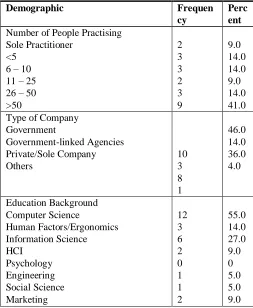
Table 2 provides a demographic profile of the respondents who answered to survey questionnaire. 40% claimed that the number of practising people in their company was more than 51, 14% identified 26 to 50 people, and six, 10 to less than 5 people. Only 9% of the respondents claimed to be the sole practitioner in their company. The result was in line with a previous study which found that the bigger the company, the higher the chance that people practised usability and HCI (Göransson et al., 2003). However, in this case, the authors believe that the respondent might have misinterpreted the question “How many employees are in your company?”, because earlier responses had identified that the respondent’s knowledge of UXD in practice was low. It appeared that the respondents could not determine the status of the current practice of UXD. Statistics show that the respondents were mostly from government agencies (46%) followed by private/sole proprietary companies (36%). The respondents’ educational backgrounds were mostly computer science (55%) and information systems (27%). A multidisciplinary component was identified as 23% of the respondents chose more than one educational background. Other backgrounds included human factors/ergonomics (14%), marketing (9%), HCI (9%), and engineering (5%). No psychology background was reported. Company location was asked as an open-ended question. 68% of the respondents’ companies (15 out of 22) were in Klang Valley locations such as Bangsar, Cyberjaya, Kajang, Selayang and Shah Alam. 9% (2 out of 22) were from Kuala Terengganu and Perak. 23% of the respondents (5 out of 22) did not respond to company location question, possibly because they were not from industry. In terms of knowledge, most of the respondents claimed not to have had training in design although they created a mental model as a user, using their own experience and intuition during the design phase. The remaining respondents did not answer this question, stating the need to be trained in UXD.66% of respondents did not include end users in development because of their belief
7 4
4 1
1 1 1
3
0 1 2 3 4 5 6 7 8
the Characteristics of an HCI- Focused Conference
that end users do not know what they want. 23% did not know where to find real users and 9% thought that end users might delay the projects’ schedules. However, 55% of the respondents agreed that UX was important. 36% thought that it depended on the project, and 9% thought that UX was not important. However, usability was perceived to be more important than UX as no respondents answered “not important” to usability. 64% of the respondents claimed to use a formal system development method, 55% to use a waterfall model, 23% had their own method developed within the company and only 5% used Rational Unified Process (RUP). Only one respondent mentioned that nothing was used. Respondents were asked to state their own goals in developing IT projects. The highest number, 32%, did not answer the question; the reason is unknown. Three respondents indicated user satisfaction as their goal. Although these figures illustrate the frequency of people with goals, however, the question did not discovered whether the goal was the most important one.
IV. DISCUSSION OF FINDINGS
Unlike overseas HCI-related conferences, HCI-focused conferences in Malaysia are not necessarily events which industry practitioners would be likely to attend. Although it was possible to study the practice of UX and HCI in Western countries from conference attendees, the participation of practitioners in Malaysia is comparatively low. This may be due to the mindset in local settings whereby a “conference is only for academic people, and not for industry people”. Surveys by Venturi and Troost (2004) and Vukelja et al. (2007) revealed results that were contrary to the characteristics of HCI conferences overseas. While practitioners’ practice can be gauged from HCI-focused conference attendees, our findings point to the low level of knowledge among people who attended local HCI conferences in Malaysia. At the time it was introduced, the term “user experience” was unfamiliar among the targeted subject of study. Potential practitioners did not understand what it meant; therefore little attention was given to “user experience”. One respondent requested the researchers to provide an option for those who were not familiar with the term. Different questions needed to be set for different levels of knowledge among the target population. Another respondent suggested the need for an explanation of “UX methods”, due to the various methods related to involving user experience and confusion about which methods the questionnaire referred to. Many surveys to identify HCI practitioners and explore their practice have been conducted at HCI-focused conferences (e.g. International Conference on Computer Human Interaction (CHI)). This study attempted a similar approach in order to select experienced UX researchers and designers, but this proved not to be the case. The empirical results provided information regarding the low practice of HCI among software developers and web designers at the time the survey was conducted. Therefore, the study on UXD practice needed to focus on the people who considered themselves as responsible for producing at least usable products or systems. It was found that in this preliminary
study, HCI knowledge among those who attended the iUser 2011 conference was low. This was, indeed, the reason they attended the conference; they did not have the fundamental knowledge to enable them to practise UXD. In cases where UX had only been recently introduced and had only limited impact (Kuuti et al., 1998), the focus was on understanding the knowledge of and the formation of goals towards UXD practice. Most respondents in this preliminary study believed that users did not know what they wanted and were therefore always excluded from the development process.
In this study, the employment of usability in practice was low, with 36% of the respondents thinking that it was determined by each project. The degree of recognition of UX was higher than expected because only 9% of the respondents thought that UX was “not important”, as compared to none who answered “not important” to usability. The poor level of awareness of the importance of user involvement in the software development process was alarming. It is no wonder that the UCD methods receiving the highest ratings were those that did not involve users, such as expert-based evaluation, heuristics evaluation, or qualitative, quick and dirty usability testing. The lack of appreciation of the basic principles of UCD continued to pose problems. This was particularly worrying since the inability to appreciate users and the lack of evaluation surely reflected on the level of practices in project development processes. The results of this study indicated a preference for methods that did not involve users. The results from this study reveal and suggest that further studies are required to investigate UXD practice in industry using participants that are real practitioners. As this current study is limited because of the low knowledge of participants in this HCI focused conference on CHI and UXD.
V. CONLUSION AND FUTURE WORK
International Journal of Innovative Technology and Exploring Engineering (IJITEE) ISSN: 2278-3075, Volume-8 Issue-8S, June 2019
REFERENCES
1. Alvarez, A., Harrison, A., & O'Shaughnessy, E. (1999). Symposium on
frustration. Journal of child psychotherapy, 25(2), 167-198.
2. Anderson, R. & Kolko, J. (2011). On Designers as Catalytis Agent.
Interaction, 17, 80.
3. Ardito, C., Buono, P., Caivano, D. V., Costabile, M. F., & Lanzilotti, R. (2013). Investigating and promoting UX practice in industry: an
experimental study. International Journal of Human-Computer studies.
4. Bannon, L. (1991). From human factors to human actors: The role of psychology and Human-Computer Interaction studies in systems design.
In J. Green & M. Kyng (Eds.), Design at Work: Cooperative Design of
Computer Systems (pp. 25-44). Hillsdale: Lawrence Erlbaum Associates
5. Benyon, D. (2010). Designing Interactive Systems: A Comprehensive
Guide to HCI and Interaction Design (2nd ed.). Essex, England: Pearson Education Limited.
6. Bilbao-Osorio, B., Dutta, S., Geiger, T., & Lanvin, B. (2013). The networked readiness index 2013: benchmarking ICT update and support for growth and jobs in a hyperconnected world. In B. Bilbao-Osorio, S. Dutta & B. Lanvin (Eds.), (pp. 5-33). World Economic Forum: The Business School for the World.
7. Card, S. K., Moran, T. P., & Newell, A. (Eds.). (1986). The psychology
of human-computer interaction. CRC Press.
8. Carroll, J. M. (2002). Introduction: Human-Computer Interaction, the
Past and the Present. In J. M. Carol (Ed.), Human-Computer Interaction
in the New Millennium: ACM Press
9. Chung, W., & Fortier, S. (2013). Context as a system, product as a component, and the relationship as experience. In A. Marcus (Ed.),
Design, User Experience, and Usability: Design Philosophy, Methods, and Tools (Vol. 8012). Las Vegas, Nevada, USA: Springer
10.D'Addessi, A., Bongiovanni, L., Volpe, A., Pito, F., & Bassi, P. (2009). Human Factors in Surgery: From Three Mile Island to the Operating
Room. 83, 249-257.
11.Dalgleish, T., & Power, M. J. (2000). Handbook of cognition and emotion. England: John Wiley & Sons Ltd.
12.Dominic, P. D. D., Jati, H., Sellappan, P., & Nee, G. K. (2011). A comparison of Asian e-government websites quality: using a non-parametric test. International Journal of Business Information Systems, 7(2), 220-246
13.Fitts, P. M. (1954). The information capacity of the human motor system
in controlling the amplitude of movement. Journal of experimental
psychology, 47(6), 381.
14.Goleman, D. (1995). Emotional intelligence: Why it can matter more
than IQ. USA: Bantam Books.
15.Göransson, B., & Sandbäck, T. (1999). Usability designers improve the
user-centred design process. Paper presented at the Proceedings for INTERACT.
16.Gould, J.D., & Lewis, C. (1985). Designing for usability: Key principles
and what designers think. Communications of the ACM, 28, 300-311.
17.Grudin, J. (2005). Three faces of Human-Computer Interaction. IEEE
Annals of the History of Computing, 1058 (October-December 2005), 1-18.
18.Grudin, J. (2012). A moving target-The evolution of Human-Computer
Interaction. In J. A. Jacko (Ed.), Human-Computer Interaction
Handbook (3 ed.). Microsoft Corporation, USA: Taylor & Francis 19.Gulliksen, J., Lants, A., & Boivie, I. (1999). User centered design -
Problems and possibilities. A summary of the 1998 PDC & CSCW workshop, SIGCHI Bulletin, Seattle, USA, 2-31.
20.Gulliksen, J., & Lantz, A. (2001). Design versus design-from the shaping of product to the creation of user experiences.
21.Hammond, N., Jorgensen, A. , MacLean, A. , Barnard, P., & Long, J.
(1983). Design practice and interface usability: Evidence from
interviews with designers. Paper presented at the Proceedings of the SIGCHI conference on Human Factors in Computing Systems, Boston, Massachusetts, United States.
22.Hancock, P. A., Pepe, A. A., & Murphy, L. L. (2005). Hedonomics: the
power of positive and pleasurable ergonomics. Ergonomics Design,
13(1), 8-14.
23.Hartridge, H., & Thomson, L. C. (1948). Methods of investigating eye
movements. The British journal of ophthalmology, 32(9), 581.
24.Hashim N.L., Adamu R. (2017). Usability evaluation of mobile banking
application interfaces. Journal of Engineering and Applied Sciences, Vol
12, Issue 21
25.Helander, M. G., & Khalid, H. M. (2006). Affective and pleasurable
design. Handbook of Human Factors and Ergonomics, Third Edition,
543-572.
26.Helander, M. G., & Tham, M. P. (2003). Hedonomics - affective human
factors design. Ergonomics, 46(13/14), 1269-1272.
27.Hertzum, M. (2010). Frustration: A common user experience. Paper
presented at the DHRS2010: Proceedings of the Tenth Danish Human-Computer Interaction Research Symposium.
28.Hussain, A., Abdullah,A., Husni, H., & Mkpojiogu, E.O.C. (2016). Interaction Design Principles for Edutainment Systems: Enhancing the Communication Skills of Children with Autism Spectrum Disorders.
Rev. Tec. Ing. Univ. Zulia. 39(8), 45-50. doi: 10.21311/001.39.8.06
29.Hussain, A., Abd Razak, M.N.F., Mkpojiogu, E.O.C. & Hamdi, M.M.F.
(2017). UX evaluation of a video streaming application with teenage
users. Journal of Telecommunication, Electronic & Computer
Engineering (JTEC), 9 (2-11), 129-131
30.Hussain, A., Isam, M., & Mkpojiogu, E.O.C. (2017). A UX assessment
of a mobile recommender app for household electrical energy savings.
Journal of Telecommunication, Electronic & Computer Engineering (JTEC), 9 (2-11)
31.Hussain, A., Mkpojiogu, E.O.C., Musa, J., & Mortada, S. (2017). A user
experience evaluation of amazon kindle mobile application. Proceedings
of the 2nd International Conference on Applied Science and Technology (ICAST’17), Kedah, Malaysia. AIP Conference Proceedings 1891 (1), 020060,
32.Hussain, A., Mkpojiogu, E.O.C., Musa, J., Mortada, S., & Yue, W.S. (2018). Mobile Experience Evaluation of an e-Reader App. Journal of Telecommunication, Electronic & Computer Engineering (JTEC), 10(1-10), 11-15.
33.Idyawati, H., Hussain, A., & Mkpojiogu, e.o.c. (2019). A review on user
centred design (ucd) and user experience design (uxd) practice in industry: investigation methods and practice constraints.
34.ISO9241-210. (2010). Ergonomics of human system interaction - Part
210: human-centered design for interactive systems. Switzerland: International Standardisation Organisation.
35.Jokela, T., Laine, J., & Nieminen, M. (2013). Usability in RFP’s: The
Current Practice and Outline for the Future Human-Computer
Interaction. Applications and Services (pp. 101-106): Springer
36.Jordan, P. W. (1998). Human factors for pleasure in product use.
Applied ergonomics, 29(1), 25-33.
37.Kaptelinin, V., Nardi, B., Bødker, S., Carroll, J., Hollan, J., Hutchins, E., & Winograd, T. (2003). Post-cognitivist HCI: second-wave theories.
Paper presented at the CHI'03 extended abstracts on Human factors in computing systems.
38.Karat, J., & Karat, C.-M. (2003). The evolution of user-centered focus in
the human-computer interaction field. IBM Systems Journal, 42(4),
532-541.
39.Khalid, H. M. (2006). Embracing diversity in user needs for affective
design. Applied Ergonomics, 37, 409-418. doi:
10.1016/j.apergo.2006.04.005
40.Kemeny, M. E., & Shestyuk, A. (2010). Emotions, the neuroendocrine and immune systems and health. In M. Lewis, J. M. Haviland-Jones & L. F. Barrett (Eds.), Handbook of Emotions (3rd ed). New York, NY, US: The Guilford Press
41.Kolko, J. (2010). Abductive thinking and sensemaking: The drivers of design synthesis. Design Issues, 26(1), 15-28.
42.Kuniavsky, M. (2010). Smart things: ubiquitous computing user
experience design: Morgan Kaufmann.
the Characteristics of an HCI- Focused Conference
44.Lallemand, C., Gronier, G., & Koenig, V. (2015). User experience: A concept without consensus? Exploring practitioners’ perspectives through an international survey. Computers in Human Behavior, 43(0), 35-48. doi: http://dx.doi.org/10.1016/j.chb.2014.10.048
45.Lazar, J., Abascal, J., Davis, J., Evers, V., Gulliksen, J., Jorge, J. A., Prates, R. O. (2012). HCI public policy activities in 2012: a 10-country discussion. interactions, 19(3), 78-81.
46.Lazarus, R. S. (1991). Emotion and adaptation: Oxford University
Press.
47.LeDoux, J. E. (2003). The emotional brain, fear and the amygdala.
Cellular and molecular neurobiology, 23(4), 727-738.
48.Long, J. (1989). Cognitive ergonomics and HCI. In Long, J. &
Whitefield, A. (Eds.), Cognitive ergonomics and HCI. Cambridge: Cambridge University Press, 4-34.
49.Marcus, A. (2002). The cult of cute: the challenge of user experience
design Interactions, November + December 2002.
50.McCarthy, J., & Wright, P. (2004). Technology as experience:
Cambridge, MA: MIT Press.
51.Moggridge, B. (2007). Designing Interactions: The MIT Press
Cambridge, Massachusetts London, England.
52.Muhlhauser, M., & Gurevych, I. (2009). Introduction to Ubiquitous
Computing. Human Computer Interaction: Concepts, Methodologies,
Tools and Applications, 1, 1-19.
53.Nielsen, J. (1993). Usability engineering. San Diego: Academic Press, Inc.
54.Norman, D.A., & Draper, S.W. (1986). User-centred systems design. Hillsdale, NJ: Lawrence Erlbaum Associates Inc.
55.Norman, D. A. (2004). Emotional design: why we love (or hate)
everyday things. New York: Basic Books.
56.Obi, T. (2010). 2010 Waseda University World e-Government Ranking.
Research report of the Waseda University Institute of e-Government,
http://www. obi. giti. waseda. ac.
jp/e_gov/World_e-Gov_Ranking10_en. pdf-Accessed February 28 2011.
57.Pantic, M., & Rothkrantz, L. J. M. (2003). Toward an affect-sensitive
multimodal human-computer interaction. Proceedings of the IEEE,
91(9), 1370-1390.
58.Pattee, H. H. (1973). Hierarchy theory: the challenge of complex
systems. New York: Braziller.
59.Proctor, R. W., & Van Zandt, T. (2011). Human factors in simple and complex systems. CRC Press.
60.Richardson, J. S. (1973). The amygdala: historical and functional
analysis. Acta Neurobiol. Exp., 33, 623-648.
61.Ronggang, Z., Shengshan, H., Xiangang, Q., & Huang, J. (2008). A survey of user-centered design practice in China. IEEE International Conference on Systems, Man and Cybernetics, 2008.
62.Roscoe, S. N. (1997). The adolescence of engineering psychology.
Human Factors History Monograph Series, 1, 1-9.
63.Shackel, B., & Day, D. L. (2009). Human-Computer Interaction -
whence and whitter? Interacting with Computers. doi:
10.1016/j.intcom.2009.04.004
64.Shweder, R. A., Haidt, J., Horton, R., & Joseph, C. (2010). The Cultural Psychology of the Emotions: Ancient and Renewed (3 ed.). New York: The Guilford Press.
65.Solso, R. L., MacLin, M. K., & MacLin, O. H. (2005). Thinking:
Concept formation, logic, and decision making Cognitive Psychology
(pp. 417-450): Pearson Allyn and Bacon
66.Stein, N. L., & Levine, L. J. (1987). Thinking about feelings: The
development and organisation of emotional knowledge. Aptitude,
learning, and instruction, 3, 165-197.
67.Tiberius, V., & Hall, A. (2010). Normative theory and psychological research: Hedonism, eudaimonism, and why it matters. The Journal of Positive Psychology, 5(3), 212-225.
68.United Nations (2014). United Nations E-Government Survey. New
York: United Nations Department of Economic and Social Affiars. 69.Venturi, G., & Troost, J. (2004). Survey on the UCD integration in the
industry. Paper presented at the NordiCHI'04, Tampere, Finland. 70.Venturi, G., Troost, J., & Jokela, T. (2006). People, organisations, and
processes: An inquiry into the adoption of user-centered design in industry. International Journal of Human-Computer Interaction, 21(2), 219-238.
71.Vermeeren, A. P. O. S., Law, E. L.-C., Roto, V., Obrist, M., Hoonhout,
J., & Vanen-Vainio-Mattila, K. (2010). User experience evaluation methods: current state and development needs. Paper presented at the Proceedings of the 6th Nordic Conference on Human-Computer Interaction: Extending Boundaries, Reykjavik, Iceland.
72.Vredenburg, K., Mao, J-Y., Smith, P. W., & Carey, T. (2002). A survey
of user-centered design practice. Paper presented at the CHI 2002, Minneapolis, Minnesota, USA. Paper retrieved from
73.Vukelja, L., Muller, L., & Opwis, K. (2007). Are Engineers Condemned
to Design? A Survey on Software Engineering and UI Design in Switzerland. Paper presented at the INTERACT 2007.
74.Waterson, P., & Sell, R. (2006). Recurrent themes and developments in
the history of the Ergonomics Society. Ergonomics, 49(8), 743-799. doi:
10.1080/00140130600676056
75.Zajonc, R. B. (1980). Feeling and thinking: Preferences need no
inferences. American psychologist, 35(2), 151.
76.Zaphiris, P., & Ang, C. S. (2009). Human Computer Interaction:
Concepts, Methodologies, Tools, and Applications
77.Zhao, F., Collier, A., & Deng, H. (2014). A multidimensional and integrative approach to study global digital divide and e-government development. Information Technology & People, 27(1), 38-62. 78.Zink, K. J., & Fischer, K. (2013). Do we need sustainability as a new
approach in human factors and ergonomics? Ergonomics, 56(3),