International Journal of Innovative Technology and Exploring Engineering (IJITEE) ISSN: 2278-3075, Volume-8 Issue-10, August 2019
Abstract: Wireless sensor networks (WSNs) have numerous advantages like easy deployment, scalability, no need of infrastructure etc. Apart these features the main drawback of WSN is limited power capacity of the sensor nodes. Hence nodes are unable to perform communication for long time duration as their limited battery power. Receive signal strength (RSS) is a prime attribute within wireless communication because lower RSS value leads to more power consumption for data transmission. This paper introduces RSS based approach to improve the power utilization of sensor nodes. A Node near to base station transmits data directly without clustering process. A weight parameter calculated for cluster head selection using RSS value of a node and geographic location of the nodes. The propose method works on heterogeneous network like SEP technique. Different power level assign to the sensor node as per distance from base station. The first group of nodes is normal nodes they transmit data directly to the base station. The proposed method balances the energy of all nodes and helps to improve total lifetime of sensor networks. The proposed method performs well compare with existing methods to improve network lifetime and total number of packet transmission.
Index Terms: Cluster Head, Node Geographic Location, power optimization, advance node, RSS, Selective Clustering.
I. INTRODUCTION
Wireless Sensor Networks (WSNs) are widely used since the last decade due to its features of easy deployment without existing infrastructure. It’s a fast-growing trend for communication having lots of low-cost sensor nodes with minimum power capacity. A sensor node is a device having an electronic circuit with a sensor element to sense physical information from the environment. These sensor nodes may be placed in a random manner to fulfill the specific task, for example, observe any physical activity, for check quantity of defined parameter, war area investigation, and natural disaster management, target checking etc. The sensor nodes work in a co-operative manner to complete a pre-defined task using the wireless network.
Normally a sensor node may connection of basic electronics component [1] sensor, radio transmitter & receiver, microcontroller and battery. The main functioning of a sensor is to continuously sense predefine event or physical value.
Radio Transceiver is used to transmit and receive signals from a sink (workstation). A transceiver is used to transmit
Revised Manuscript Received on August 05, 2019
Dr. Shiv Prasad Kori, In-Charge Principal and HOD ET&TC Deptt., Jijamata Govt. Polytechnic College, Burhanpur, M.P. 450331, India
Alok Sahelay, Lecturer Computer Science Engg. Deptt. Jijamata Govt. Polytechnic College, Burhanpur M.P. 450331, India.,
and receive signals from the sink (workstation). Microcontroller helps to process data before and after communication with sink. The battery supplies required power to an electronic device to perform any operation in the sensor node. The batteries are difficult to replace or recharge after placing within the sensor node and they provide limited power for a fixed duration. The electric energy management from this limited and non-rechargeable resource is the main problem of any WSN.
The sensor node equipped with limited energy and replacing of the battery is not possible this creates a huge problem as limited life of the sensor node. If a single node dead due to its power exhaustion whole network suffers and transmission becomes difficult. After the death of a single sensor node complete network becomes unstable. To improve the lifetime of the overall network there is a need for optimum utilization of node remaining power. A various method has been proposed related to solving the issue of optimum power utilization of sensor node in WSN in last decades this helps a lot to increase the total lifespan of WSNs and minimize energy usage at node level [19]. But there are still a lot of possibilities to improve this lifetime of WSN and minimize node power consumption.
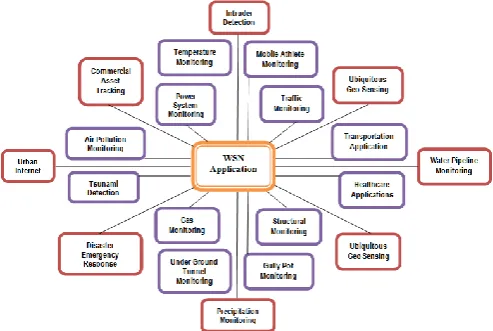
[image:1.595.305.552.550.715.2]The WSN may use for various purpose according to need every application is derived by its associated problem to manage an alternative solution can be generated to overcome that problem. The major application of WSN may be given as figure 1 for any large city.
Fig. 1. Various Applications of WSN within a city.
RSS Based Selective Clustering Technique to
Improve Power Utilization in WSN
A. Applications of sensor networks
• Track physical activity military or war field.
• To motoring inside or outside Environmental parameter.
• Civil and mechanical Structure monitoring.
• Automatic Operation on an event such as fire, water alarm automatic gate open.
• To sense radio or other hazardous material where human interaction may harmful.
• Health Monitoring to measure patient heartbeat, temperature, physical movement etc.
• Location of any Inventory product in a shopping complex.
• Future smart house or smart city application.
B. Challenges
• Low capacity sensor node power battery • Low capacity processing and storage
• Minimum bandwidth and more error probabilities • Difficult to increase network up-to 1000s sensor nodes. A Sensor node has limited energy given by batteries, these batteries are difficult to replace after deployment. Hence limited power is the main problem for any WSN. Researchers introduced many solutions to address this problem. Clustering is an important concept to reduce power consumption within WSN. Clustering helps to minimize the data transmission by grouping common node together and an only single node from this group called cluster head responsible for transmitting data of all member nodes of this cluster.
To improve network total lifespan the clustering should be done by considering the size of a cluster to solve unbalanced energy consumption problem. This paper proposed a location-based clustering algorithm with considering their RSS value. This proposed method assign two power level for nodes transmission high power level and low power level. A node assigns high power level if cluster transmits data to the base station on other hence low power level is assigned if a member node transmits data to the cluster head. Hence low power level helps to conserve energy for upcoming transmission rounds. This proposed method improves overall network lifespan.
II. WIRELESSSENSOR’SSTRUCTUREAND OPERATION
Wireless Sensor nodes are very small devices to transmit sensed information the size may be 1 inch to 4 inches. A sensor node is capable to organize automatically according to an installed algorithm for collecting information for predefined physical parameters. The purpose of the sensor node to observe conditions and send sensitive data to high power special node called base station or sink node. The sink node has a large storage space and power capacity with an infrastructure network connection. The sink node stores data from all sensor nodes within the network and analyzes data. The sensor networks are very useful to monitor any tough conditions field where difficult to collect manual data by any human. The sensor network may work for long time schedule,
break free monitoring and more reliable data without human involvement. The main limitation is the power resource for the sensor node. The tiny sensor nodes have very low power energy in form of small batteries.
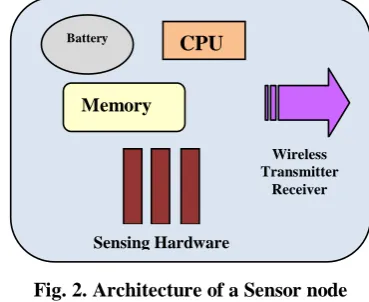
So Sensors may be defined as interconnected wireless signal transmitter and receiver electronics device with restricted Energy, processing capability, storage memory, Transmission range, and Bandwidth. Figure 2 represents a simplified block diagram of a sensor node.
CPU Battery
Memory
Sensing Hardware
Wireless Transmitter
[image:2.595.331.516.167.318.2]Receiver
Fig. 2. Architecture of a Sensor node III. RELATEDWORK
To improve wireless sensor network lifetime various clustering methods have been proposed in last decade. Clustering is a better way to manage nodes energy to improve network lifetime but many existing usage same number of nodes within a cluster hence cluster head energy utilization becomes a challenge. This section describes some of the relevant clustering methods.
Low Energy Adaptive cluster head (LEACH) protocol is the basic algorithm for selecting a cluster head within a wireless sensor network. Many improvements are introduced to maximize the lifetime of the sensor network. Paper [2] usage energy filters approach for cluster head decision in a wireless system. Cluster head transmits more data than other nodes hence cluster head must have a predefined energy limit. Plain LEACH algorithm has the same probability to be cluster head for each node but in [2] give more chance to nodes having remaining energy more than fixed energy limit.
The LEACH algorithm is also not suitable for a heterogeneous wireless network, where some nodes have extra energy power than other nodes. LEACH gives same probability to be cluster head so normal nodes with less energy fully exhausted early and the network becomes unstable. Selective Energy Protocol (SEP) helps to overcome this problem by assign different cluster head probability by gives more chance to advance node with extra energy power. Improved SEP method is mentioned in a paper [3] every node gets weighted probability according to a neighbor and remaining energy power both for cluster head selection. The node has more weight becomes cluster head. This method gives better result in comparison to traditional SEP protocol. Another approach for wireless sensor network clustering is given by Abbasi [4] by a
International Journal of Innovative Technology and Exploring Engineering (IJITEE) ISSN: 2278-3075, Volume-8 Issue-10, August 2019
of clustering protocols.This analysis helps to explain various clustering problem, challenges, conventional strategies, cluster formation, and cluster join time calculation. At last, some of the clustering algorithms are compared on basis of their join rate, cluster stability, cluster coverage area, network area size, the density of cluster and supported node quality.
The complete overview for clustering protocol is given by Arboleda [5]. The author specified few important aspects need to cover during designing clustering protocol such as the structure of the cluster, an area covered by cluster, advantages of the cluster. They give a brief study on LEACH based traditional protocol with a proactive and required calculation for WSNs. The paper also explores most important attributes of conventional clustering protocol to use them for improving clustering efficiency in the future.
Another comparative analysis for WSNs clustering protocols is given by Kumarawadu [6]. On the basis of this analysis, the author suggested parameters need to consider during CH selection. The author also analyzed the challenges and various problems regarding identity-based clustering algorithms. This work also provides a list of parameters like neighborhood data, a probability of CH and clustering algorithm that uses biologically impressed.
Some latest clustering algorithms and their performance have been analyzed by Jiang [7]. The author analyzed six latest WSN algorithms LEACH (low energy adaptive cluster head), PEGASIS, HEED (Hybrid Energy Efficient Distribution), EEUC (Energy Enhancement) etc with various responsible attributes.
A cluster head selection criterion is an important aspect of clustering because the overall performance depends on the cluster head. A paper [8] introduced a new approach to select cluster head according to the behavior of the network. The paper analyzes many existing schemes for cluster head selection and concludes with some key issue. Apart traditional approach the paper selects cluster head by neighbor nodes quantity as the main attribute. Any node having more neighbors gets more probability to be selected as a cluster head.
A new approach to maximizing network total lifetime is given by paper [9]. The paper improves SEP algorithm by uses node position and placement of advanced node properly. This method divides network transmission in two methods direct transmission by normal nodes and transmission by cluster head only for advanced nodes. This technique improves performance in comparison to existing methods.
An Energy-efficient unequal clustering algorithm (EEUC) is given by paper [10]. This method select cluster head by comparing remain energy of each node. This approach checks the distance from the base station for each node such that any two nodes have the same distance with the base node. All nodes short distance to base station create the small size of cluster and nodes are far away from base station formed a large cluster.
Another method using multi-hop routing algorithm is proposed by Gong in a paper [11]. The paper introduced the Multi-hop routing protocol with unequal clustering
(MRPUC) in this protocol nodes having more remaining energy get chance to become cluster head. The distance of between all nodes is derived and maximum and minimum distance become radius of the cluster for maximum and minimum cluster respectively.
Paper [12] describes an energy efficient method using a time parameter for the clustering algorithm. This approach partitioned network according to node power level for minimizes energy consumption. This energy level for Cluster head to transmit data through single hop or multi-hop transmission. So during single hop transmission cluster node energy is saved as compared to multi-hop transmission and cluster covers some extra nodes as the multi-hop connection. A maximum number of nodes within a cluster must have to predefine to optimum clustering protocol. A paper [13] introduced Degree and Size based clustering approach (DASCA) to restrict cluster size and next hop adjacent node. This approach helps to achieve a balanced load among all nodes within the network. The cluster head decided on basis of next hop and overall energy spent in a previous round.
Research by WeiLi [14] gives a geometric location of nodes to select cluster head. The approach calculates the geometric location of each node and elects cluster head according to its location with respect to other nodes. The approach gives better energy consumption with compare to previous methods.
IV. PROPOSEDWORK
Management of WSN Lifespan is a crucial task lot of the work done in the last decade to improve the lifetime of the sensor network. The design of sensor network protocol should be considering energy utilization of each node to increase overall network lifetime. The existing methods for clustering form the same number of a node within a cluster but this approach leads to unbalanced energy utilization for cluster head nodes. Hence this paper introduces a variable size clustering method with an advantage of RSSI value for uniform power management to cluster head node in the network and this leads to complete network lifetime span.
Clustering helps to reduce data flow in a network by grouping short distance node and transmit data using a single node called cluster head. Cluster head aggregate data of all member nodes and send to the base station within the single data packet and minimize redundancy in communication load by nearby nodes. Base station needs to process, store and archive data as a predefined purpose.
A. Proposed Distance with RSS based clustering Protocol
WSN has limited resources and very low power backup for transmission and processing sensed data. This limited power makes week signal for communication with base or sink station. Receive signal strength (RSS) is an important factor during wireless communication. If any node has low RSS value it cannot transmit data
usage more power for data transmission. Hence this work proposes a unique solution for WSN power management using the RSS value to improve the life time of the network.
This paper introduces a new approach for effective energy utilization using the geometric location of sink node and sensor nodes. The nodes location give exact calculation for transmission power requires for transmitting data to the base station to minimizing nodes power consumption. This technique collaborates with heterogeneous wireless sensor network as normal nodes having single battery power installed and an advance node having multiple batteries energy power like SEP protocol to improve network lifetime [9].
The sink node position plays an important role here if sink node placed at one corner of the network than it becomes far away from most of the nodes on another end, but if sink node is placed at a center of the network the maximum distance of any node becomes equal to the radius of the network. Hence sink node at center leads to short distance from sensor nodes and energy consumption reduces drastically. The proposed method also consider placement of all sensor nodes. All normal nodes with single battery power are placed near to sink node for low energy drain and all advance nodes with multiple battery power are placed at boundaries of the network to utilize their extra power properly. This unique nodes placement helps to increase the lifetime of the wireless sensor network.
As sensor nodes are ready for transmitting data to the sink node this transmission may take place in two types. If a normal node transmits data to sink node the data send directly without cluster formation. On the other hand if an advance node transmits data to sink node it forms a cluster before transmission and cluster head aggregate data of all member nodes then transmit this aggregate packet to sink node. Hence only cluster head requires more energy for transmitting data to sink node and member energy is saved for next round utilization. RSSI help to decide cluster head during cluster formation for efficient cluster head selection.
B. Network Architecture
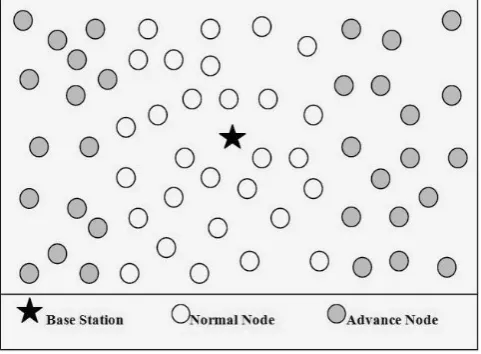
Basically, clustering algorithms deploy sensor nodes randomly within the network without considering their position. SEP method also places all sensor nodes normal and advance nodes randomly. The nodes placement is a prime issue to overcome energy wastage in any sensor network. Hence modification in node placement criteria is required in previous clustering algorithms with a setup of signal transmission power for communication. The new method proposes in this paper partition given network area into two regions, region 0 and region 1 for optimum power consumption [9]. The sink node positioned at a center of given network area. The region 0 contains all nodes near to sink node and region 1 contains all nodes far away from sink node or at boundaries of network area as figure 3.
Sensor nodes are deployed randomly for any clustering algorithm like SEP but the proposed hierarchical clustering deploys nodes by considering their energy level. Due to hierarchical clustering method have nodes some of the single
battery power and some nodes are advance with more energy level with more batteries. These advance nodes deploy randomly at boundaries of a network within region 1. The normal nodes are placed randomly but near to base station to minimize energy consumption for transmission power.
[image:4.595.308.549.181.358.2]The total nodes in a network may be divided as their energy power as total nodes n and m is a ratio of advance nodes with α times more energy than normal nodes. So a number of normal nodes in the network may be (1-m)*n ration having single energy level.
Fig. 3. Architecture Of A Sensor Node
Region 0 is defined practically as network area according to coordinates of the network for normal nodes placement as a ratio of x coordinate 30<X<80. Where X is x coordinate value of the network.
Region 1 is defined practically as network area according to coordinates of the network for normal nodes placement as a ratio of x coordinate 0<X<20 and 80<X<100. Half of the advanced nodes are deployed between 0<X<20 and remaining half nodes are deployed between 80<X<100.
This placement helps normal nodes to reduce energy consumption due to low distance transmission in region 0. Advance nodes have more energy hence extra energy is useful in region 1 for cluster formation and communicate far away from the sink node. So this arrangement balances energy consumption for both normal and advanced nodes.
C. Location Based Protocol with RSS Scheme
This section proposes a new approach for WSN communication between sensor nodes and sink. The proposed method uses RSS values of nodes whenever clustering required. Hence in this method two types of communication being used for data transmission to the sink node.
• Direct transmission without clustering • Transmission using Clustering protocol. 1) Direct Transmission without clustering
All normal nodes are placed near to sink nodes within region 0. All normal nodes require less power to transmit sense data to sink. Hence
International Journal of Innovative Technology and Exploring Engineering (IJITEE) ISSN: 2278-3075, Volume-8 Issue-10, August 2019
participate in clustering and send their data directly to sink. This approach saves normal nodes energy from clustering and aggregation overheads.
2) Transmission through Clustering Protocol
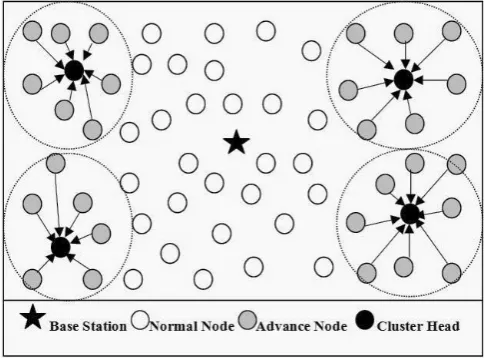
The nodes with more battery power are placed at a large distance away in comparison to normal nodes within region 1. So advance nodes require more energy power to transmit sense data to sink. If advance node communicates sink node directly all nodes have used more energy for long distance transmission. Hence advance nodes take advantage of clustering algorithm here and after cluster formation, only cluster head transmits aggregate data to sink. The member nodes of cluster send data to only cluster head which is near them so less power used to transmit data. These approach member nodes save energy for a long-lasting network.
[image:5.595.47.290.484.663.2]Cluster formation takes place only between nodes in network region 1. Cluster head receives data from all sensor nodes and creates an aggregated single packet. This aggregated single packet is transmitted to sink node using more energy in comparison to normal nodes due to long distance transmission. Sink node extracts corresponding nodes data from this aggregated packet received from cluster head. Cluster head selection during the clustering process is a crucial task because of overall clustering performance is depending on cluster head selection method. This work modified SEP method by introducing node placement and RSS value to improve network performance. Figure 1 clear idea about network topology and node placement for the proposed method. The network is partitioned into two regions, region 0 and region 1 area. Normal nodes are shown in a light color circle near to sink and advance nodes are shown in dark color circle away from the sink. Clustering will be done only for advance nodes placed on both boundaries.
Fig. 4. Nodes Sending Data To Cluster Head Architecture Of A Sensor Node.
If an optimum number of the cluster in WSN is Kopt on basis of previous experience and advance node present in the network is n. So cluster head optimal probability Poptcan be derived using SEP method for a heterogeneous network like the following equation.
n K
Popt opt (1)
Every node is considered for chosen as cluster head by assigning them a random real number between 0 and 1. If this assigned number of any node is less than or equal to predefine threshold value T(n) by eq (2) than that node becomes cluster head for the current round.
opt opt opt P r P P n T 1 mod 1 )
( if
n
G
(2)The G in above expression represents a group of all do not get chance to become cluster head within the last 1/Popt round. Padv is a probability of advance node becomes cluster
head [2] for current round is given by following equation eq 2. This equation also considers RSS value for each cluster head probability calculation.
RSS m P
Padv opt (1 )
) ( 1
(3)
Where RSS is received signal strength of the advance sensor node and φ, ψ are constants values between 0 and 1 such that φ + ψ = 1.the constants provide average between
Popt and RSS value of sensor node.
The parameter φ and ψ provide flexibility to selecting cluster head on basis of any one parameter dependent. If the network is considering high weight to RSS value than constant ψ assigned a high value (0.7 to 0.9) and φ assign
(1-ψ) value. If the network gives more weight to Popt value than assign a higher value to constant φ. in both cases sum of
φ and ψ must be 1.
Any node becomes cluster head if their probability is higher than a predefined probability threshold value T(n). The threshold value for any sensor node can be calculated by the given equation eq 4.
adv adv adv P r P P n T 1 mod 1 )
( if
P
adv
G
'
(4)Where G’ is a group of all advance nodes not taken part in clustering last 1/Popt round.
Normal nodes directly send sensed information to sink node. Advance nodes perform clustering for each round data transmission. As cluster head is selected using a balanced value of Popt and RSS then it broadcast a message to all member nodes to inform all member nodes for the current round of transmission. All member nodes within a cluster transmit sense data using low energy level like normal nodes to the cluster head. Cluster head creates aggregated packet then transmit the whole packet to sink node using high energy level. This process repeats for each round of data transmission with a new cluster head node. Figure 4 and 5 shows the overall method with graphical representation.All normal nodes are placed in region 0 require low energy level to transmit data but advance
level to transmit data. Normal nodes remain to live for a long time with single battery power due to short distance transmission using less energy. Advance nodes have extra power so they remain to live for a long time with more energy if the advance node is a member of the cluster then it behaves like normal node, use low energy level to transmit data to the cluster head. Hence energy of all cluster member advance node is saved for upcoming rounds. This technique gives balanced energy utilization to improve network lifetime.
V. RESULTANDDISCUSSION
The proposed work in this paper is implemented by considering wireless sensor network of size 100m length and 100m width in square size. The network has 150 sensor nodes with a sink node. The nodes placed as a predefined specific region for a normal and advanced node with sink placement at the center of the network. The sensor network follows first-order radio model as used by existing SEP protocol. All predefine setting and configurations are given in table 1. The simulation considers 20% and 10% of advance nodes with extra energy power placed away from the sink in the network. The extra power for an advance node is checked for 2x battery and 1x battery extra power during simulation. The optimal probability is assigned 0.1 for cluster head selection equation. The clustering process takes place on both sides of the network left side and right side of the sink node only between advanced nodes.
Table 1: Simulation Parameters
Parameters Value
Initial energy Eo 0.5 J
Initial energy of advance nodes Eo(1+α)
Energy for data aggregation EDA 5nJ/bit/signal
Transmitting and receiving energy Eelec 5 nJ/bit Amplification energy for short distance
Efs
10 pj/bit/m2
Amplification energy for long distance
Eamp
0.013 pJ/bit/m4
Probability Popt 0.1
RSS value 0-1.0
advanced nodes Percentage (m) 0.1, 0.2
The proposed method introduced in this paper is compared
with LEACH and SEP protocols to demonstrate its effectiveness to improve network lifetime. The proposed method uses the heterogeneous wireless network with different power levels assigned to sensor nodes and all other parameters having the same value initialization as SEP protocol. The results and comparison are done on basis of network consistency as first node dead, total network lifetime as last node dead and total packets transmission during network lifetime. The lifetime of WSN has measured in a unit of rounds at each round all sensor nodes send their sensed data to sink node.
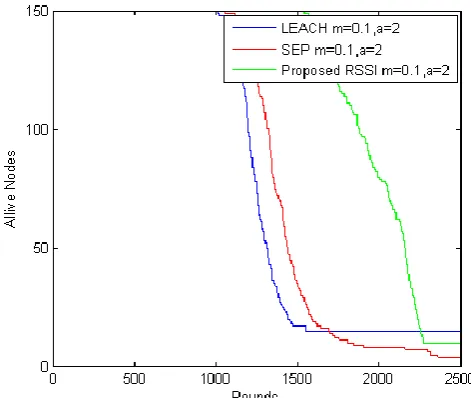
Figure 6 compares total nodes alive during the lifetime of the network with 150 nodes with 10 percentage of advanced nodes m=0.1 have double battery power a=2. On other hand figure 7 compares total nodes alive during the lifetime of the network with the same numbers of nodes with 20 percentage of advanced nodes m=0.2. The figures show behaves of proposed method that performs better in comparison to LEACH and SEP protocol.
[image:6.595.48.292.165.342.2]LEACH algorithm does not perform well for the heterogeneous environment so normal nodes dead rate goes higher and network become unstable very soon. SEP method performs better in such conditions compare to LEACH. Weighted SEP select cluster head by considering a number of neighbor nodes and remaining energy power but both normal node and advance nodes take part in clustering phase. The Propose method performs better in comparison to other existing methods by balanced clustering only in region 1 area and node position according to the energy.
[image:6.595.309.545.191.390.2]International Journal of Innovative Technology and Exploring Engineering (IJITEE) ISSN: 2278-3075, Volume-8 Issue-10, August 2019
Once a cluster is formed by RSS value consideration, cluster head transmits an aggregated packet to sink using more energy level than a normal node. Member nodes are an advanced node in a cluster but they use low energy level to transmit data till short distance cluster head.
This approach saves energy of member nodes for the next upcoming rounds and overall network lifetime drastically increases with more stability and consistency.
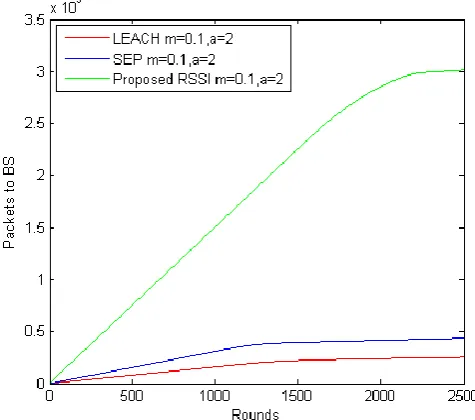
Figure 8 and Figure 9 shows the effectiveness of the proposed method by comparing total packets transmitted in the network during whole network life. The comparison is performed with values of advanced nodes m=0.1 have double battery power α=2 and again with advanced nodes m=0.2
and battery power α=1.
[image:7.595.48.292.49.242.2]Table 2: Comparison Table When m=0.2 And α=1
Table 2 and Table 3 give the total packet received to base station during simulation for the wireless sensor network. For both parameter criteria, the proposed method outperforms better in comparison with the existing method. Network life is drastically increase using balanced clustering and different power level for data transmission according to the transmission distance. RSS value consideration gives a boost to cluster head and saves energy which may drain during transmission if signals are weak.
Table 3: Comparison Table When m=0.1 And α=2
VI. CONCLUSION
This paper introduced a RSS based approach for Wireless sensor network clustering. The RSS value affected data transmission because low RSS value leaded more power consumption. The proposed scheme worked for the heterogeneous wireless network also considering nodes placement to balance power consumption of normal nodes and advance nodes. The advance nodes are placed far away from the sink to utilize their extra energy for long distance transmission. The different power level assignment helps to improve power utilization of
Protocol
Stability Period (Rounds)
Network Lifetime (Rounds)
Throughput (Packets)
LEACH 998 3684 2.49×10⁴
SEP 1089 2875 4.9×10⁴
proposed
method 1531 4119 3.1×10
5
Protocol
Stability Period (Rounds)
Network Lifetime (Rounds)
Throughp ut (Packets)
LEACH 1037 3583 2.41×10⁴
SEP 1150 3248 4.8×10⁴
proposed
method 1584 3652 3×10
[image:7.595.305.550.53.254.2]5 Fig. 9.Throughput Comparison With M=0.2 And Α=1.
[image:7.595.54.292.329.539.2] [image:7.595.312.560.494.605.2]cluster head and long distance placed node. The normal nodes and cluster member nodes use low power level for data transmission on other hands a cluster head node uses high power level to transmit data to sink node. Hence balanced energy utilization helps to improve overall network lifetime as compared to LEACH and SEP methods. The Proposed scheme improves 40% stability in compare to LEACH and SEP protocols and also increases life of nodes. Hence more numbers of nodes are alive to transmit data during network lifetime this results in high throughput about 600%. This work may be extended to improve duplicate data at the sink node. There are also lots of opportunity to minimize cluster formation time and optimum numbers of the cluster for such wireless sensor network.
REFERENCES
1. Chaurasiya, S.K.; Pal, T.; Bit, S.D.; “An Enhanced Energy-Efficient Protocol with Static Clustering for WSN”, International Conference on Information Networking (ICOIN), Kuala Lumpur, Malaysia, on pp. 58 – 63, 2011.
2. Heinzelman, W. R., Chandrakasan, A., &Balakrishnan, H., “Energy-efficient communication protocol for wireless microsensor networks”, In System Sciences, 2000. Proceedings of the 33rd Annual Hawaii International Conference, pp. 10-pp, IEEE, 2000.
3. Smaragdakis, G., Matta, I., &Bestavros, A. , “SEP: A stable election protocol for clustered heterogeneous wireless sensor networks”, Boston University Computer Science Department, 2004.
4. Abbasi, A.A.; Younis, M., “A survey on clustering algorithms for wireless sensor networks”, Comput. Commun., vol. 30, pp. 2826–2841, 2007. 5. Arboleda, L.M. C., Nasser N., “Comparison of Clustering Algorithms and
Protocols for Wireless Sensor Networks”, In Proceedings of IEEE CCECE/CCGEI, Ottawa, Canada, pp. 1787–1792, May 2006. 6. Kumarawadu, P. Dechene, D.J. Luccini, M. Sauer A., “Algorithms for
Node Clustering in Wireless Sensor Networks: A Survey”, In Proceedings of 4th International Conference on Information and Automation for Sustainability, Colombo, Sri Lanka, pp. 295–300, December 2008. 7. Jiang C., Yuan D., Zhao Y., “Towards Clustering Algorithms in Wireless
Sensor Networks— A Survey”, In Proceedings of IEEE Wireless Communications and Networking Conference, Budapest, Hungary, pp. 1–6, April 2009.
8. Maimour M., Zeghilet, H., Lepage F., “Cluster-based Routing Protocols for Energy-Efficiency in Wireless Sensor Networks”, December, 2010. DOI: http://cdn.intechweb.org/pdfs/12423.pdf
9. Alok Sahelay, Shiv Prasad Kori, “Limited Cluster Technique to Enhance Wireless Sensor Network Lifespan”, International Journal of Applied Engineering Research (IJAER), Volume 12, Number 17, pp. 6633-6640, 2017
10.Chengfa Li, Mao Ye, Guihai Chen, Jie Wu, “An Energy-Efficient Unequal Clustering Mechanism for Wireless Sensor Networks”, IEEE International Conference on Mobile Adhoc and Sensor Systems Conference, Washington, DC, pp. – 604, 2005.
11.Bencan Gong, Layuan Li, Shaorong Wang, Xuejun Zhou, “Multi-hop Routing Protocol with Unequal Clustering for Wireless Sensor Networks”, ISECS International Colloquium on Computing, Communication, Control, and Management, IEEE Computer Society, Washington, DC, USA, on page(s): 552 – 556, CCCM '08, 2008.
12.Tashtarian F., Honary M.T., Haghighat A.T., Chitizadeh J., “A New Energy-Efficient Level-based Clustering Algorithm for Wireless Sensor Networks” 6th International Conference on Information, Communications & Signal Processing, Singapore, pp. 1 – 5, 2007.
13.Gongben Can, Shaorong Wang, “A Novel Node Deployment and Clustering Scheme in Wireless Sensor Networks”, Second International Symposium on Electronic Commerce and Security,. ISECS '09, Nanchang, China, pp. 499 – 503, 2009.
14.Wei Li, Zhe Ji, Liping Cai, Li Hong, “Load-balanced Unequal Clustering Algorithm in UWB-based Wireless Sensor Network”, International Conference on Information Technology and Computer Science, ITCS 2009, Kiev, Ukraine, pp. 196 – 200, 2009.
AUTHORSPROFILE
Dr. Shiv Prasad Kori received the B.E. degree in Electronics and Telecommunication Engineering in 1994 from G.E.C. Jabalpur, India and M. Tech degree in Digital systems from MNNIT Allahabad in 2003. He has received his Ph.D from MANIT Bhopal.
He is working as In-charge Principal and Head of Electronics and Telecommunication Dept. in JM Govt. Polytechnic Burhanpur (M. P).
Mr. Alok Sahelay received the B.E. degree in Information Technology from S.A.T.I. Vidisha (M.P.) India, in 2007 and the M.Tech. degree in Computer Science Engineering from S.A.T.I. Vidisha (M.P.) India in 2012.