Computing Substrates and Life
Soichiro Tsuda1
, Klaus-Peter Zauner2
, and Yukio-Pegio Gunji1
1
Graduate School of Science and Technology Kobe University, Nada, Kobe 657-8501, Japan
[email protected], [email protected], fax: +81-78-803-5759
2
School of Electronics and Computer Science University of Southampton, SO17 1BJ, United Kingdom
[email protected], fax: +44-23-8059-2865
In Explorations in the Complexity of Possible Life, S. Artmann and P. Dittrich(Eds.), Proceedings of the 7th German Workshop on Artificial Life, July 26–28, Jena, IOS Press, 2006, pp. 39–49.
Abstract
Alive matter distinguishes itself from inanimate matter by actively maintaining a high degree of inhomogenous organisation. Information processing is quintessential to this capability. The present paper inquires into the degree to which the information processing aspect of living systems can be abstracted from the physical medium of its implementation. Informa-tion processing serving to sustain the complex organisaInforma-tion of a living system faces both the harsh reality of real-time requirements and severe constraints on energy and material that can be expended on the task. This issue is of interest for the potential scope of Artificial Life and its interaction with Synthetic Biology. It is pertinent also for information technology. With regard to the latter aspect, the use of a living cell in a robot control architecture is considered.
1
Life as information process
The difference between the living and non-living is not, as once supposed, a material difference or a difference in the applicable laws of nature [1]. Now, life appears to be delimited only by a peculiar organisation of the very same matter that forms the remaining non-living universe. This organisation can be sustained only by active maintenance which in turn necessitates the processing of information. As a consequence, life without computation is inconceivable.
This is true down to the simplest organisms and even their molecular constituents. The macro-molecules that underly the structure and function of living systems are not simply products of chemical reactions; they are individually assembled in sophisticated and tightly controlled production processes with fine grained quality control mechanisms—all of which require com-putation. Endowed with an essential information processing capability, organisms recruited it and extended it for other tasks, most prominently for acquiring nutrients, for avoiding hazards, and for reproduction.
1.1 Abstract computation
Information and operations on it can be described independent of any physical implementation. This approach turned out to be quite fruitful. Hartley derived the familiar measure of infor-mation from symbol frequencies and thus deliberately removed the physical inforinfor-mation carrier from the picture [2]. Similarly the formalisation of a human computer by Turing [3] enabled the study of computation independent of an actual realisation. Turing formulated his abstraction to show that problems do exist that cannot be solved by a computer, even if no constraints are placed on available storage space and the time it will take to arrive at a result. His abstraction also entailed a simple but general machine model for computation which subsequently turned out to be equivalent to several other formalisations of computation (in particular also equivalent to recursive functions) and was highly influential in the field of theoretical computer science. It is now generally believed that anything that in principle can be computed can also be computed on Turing’s machine [4]. In fact, the mathematical notion of what is “effectively computable” refers now to the class of problems that can be solved by Turing’s machine model. Such ma-chines, capable of carrying out any computation, are called universal. It is worth emphasising that a universal machine is always a hypothetical construct—a machine that would be restricted to a finite memory cannot be universal.
Interestingly, for a machine to be universal it does not require a sophisticated mechanism nor a complex architecture. A processor with an instruction set of only the two commands ‘increment’ and ‘decrement with conditional jump’ coupled to an unlimited random access memory would be universal in the above sense. Or, for instance, closer to Turing’s original formulation, a finite state automaton with only seven states and a capability to manipulate symbols in a sequential access memory is sufficient to be universal [4]. Accordingly, from the standpoint of what is in principle computable, many information processing systems have essentially the same power. Thus, no matter how much more complex the architecture of an information processor is compared to the aforementioned simple universal machines, it will not be able to perform a computation that could not also be performed by any of the simple universal machines.
After what has been stated regarding the equivalence of information processors it is reasonable to suppose that the computation requisite for life falls within the realm of the universal machines. It should therefore in principle be possible to abstract the information processing aspect of living matter by means of a universal computational model. This would seem to indicate that it is possible to satisfactorily capture the information processing aspect of living systems by a formal implementation, for instance, on a general purpose digital computer. But, as a matter of fact, attempts to replicate the essence of life in abstracted information processes have not resulted in convincing demonstrations of life-like phenomena. Given that Biology hardly ever takes explicit heed of the role information processing plays in the alive state of matter, a partial explanation of this may be that the processes themselves are not sufficiently understood to be formalised. Another explanation, however, arises from the possibility that the physical substrate that implements the computation is of greater relevance than the abstraction outlined above would permit. It is the latter possibility on which we will focus for the remainder of this paper.
1.2 Real computation
It is possible to estimate the ultimate limitation of physically feasible computing from the speed of light as limit for signal distribution and the constraint Heisenberg’s uncertainty principle places on discerning system states [5]. Of more immediate interest are the limitations that arise from the need of any real computation process to represent information by physical degrees of freedom. Accordingly, over the course of a computation, for every change in abstract information there has to be a corresponding change of the physical state of the hardware that implements the computation. The course of computation restricts at each stage the permissible physical states of the hardware to a subset of its possible states with concomitant thermodynamic constraints. As a result of the thermodynamic effects energy has to be expended to process information, in particular there is a fundamental minimum of energy that is required for state preparation [6].
Careful analysis revealed that it is possible to trade energy consumption, reliability, and comput-ing speed against each other [7, 8]. The energy cost of logic operations can in principle be made arbitrarily small at the expense of speed. However, if the device would be required to successfully perform a computation, the speed for this computation cannot be arbitrarily small because the physical structure of the computing device itself will degrade over time and thus there will be minimum speed required to allow for completing the computation [9]. Consequently, there will also be a minimum energy that is necessary for driving the computation towards completion.
The above consideration pertains to a computer prepared for a computation or for repeating a computational cycle; the state preparation can also be viewed as resetting the machine. Hanson rightly draws attention to the fact that a robot interacting continously with a changing envri-onment will face additional constraints on the tradeoff between energy, reliability, and speed [10]. The minimal speed of computation needs to be adequate to respond in real-time to the challenges posed by the environment, and moreover, interaction with an unpredictably changing envrionment reduces reversibility and incurs an additional cost for state preparation to delete outdated information.
Living systems, as previously stated, require computation not only to interact with their environ-ment but also, more fundaenviron-mentally, to actively maintain the intricate structure corresponding to the living state. To avoid thermodynamic equilibration a living system has to continously process the insults imposed on its organisation by the external and internal environment and take rather detailed control of its microstate to pilot it within the set of states compatible with life [11, pp.14–32]. The need for circuiting states incompatible with life places a lower bound on speed and reliability for the computation necessary to dissipate perturbations. Owing to this, computational efficiency is important to a living system and, arguably, could even be a limit-ing factor for its complexity. If we adopt the above perspective and the importance it assigns to information processing for the living state, it is worthwhile to inquire into the principles of natural information processing architectures.
2
The role of the physical substrate
regard to the physical interactions that put it into action. It follows that the physical substrate used to implement the formalism is largely irrelevant in this extreme case. In such a system the state-evolution is contrived by high energy barriers and, often, averaging. As a consequence it is flexible but inefficient with respect to speed and required material. Between these extrema lies a continuum of possible information processing mechanisms that trade-off generality for efficiency.
It is clear that in living systems the representation of information is more closely linked to the physical interaction of the representing structures than in a conventional computer. For example, let us take the case of gene regulation. The representation of the control mechanism is not on the basis of state transitions as it would be the case in a computer program. Instead, the structure of subcomponents is represented and behaviour emerges from the interactions of the subcomponents, i.e., RNA and proteins. The mapping from a DNA sequence to a specific protein structure or a particular RNA secondary structure is largely independent of this structure. The genetic code serves as abstract representation. In case of proteins the separation between processing and representation is facilitated by the essentially arbitrary mapping from codons to amino acids and in case of functional RNA it is provided by the multitude of sequences that can give rise to a particular secondary structure. The behaviour of the control scheme thus represented by DNA, however, is a direct consequence of the physical interactions of the subcomponents.
It has been stated that “the matter that makes up living systems obeys the laws of physics in ways that are expensive to simulate computationally” [13, p. 411]. Conrad offered the conjecture “that it is impossible to simulate [such a biomolecular information processing system] by a machine to which we can communicate algorithms [. . . ] without distorting its rate of operation or the amount of hardware which it requires” [14, p. 227]. The difficulties encountered in attempts to use conventional information technology for the implementation of life-like responses bear out this position.
The need of living systems to process information at a rate sufficient to maintain their material structure (‘hardware’) within an idiosyncratic set of microstates places special requirements on the substrates suitable to sustain life. This points to a more prominent role of the issue of physical substrates in information processing architectures. Particularly for architectures that ideally would posses life-like features—like, for example, robust real-time behaviour in a complex envrionment, adaptability in paradoxical and ambiguous situations, reconfiguration or self-repair—the choice of substrate is likely to be critical.
The physical substrate is certainly also critical to the power of evolutionary processes. It is hardly possible that a process as simple as merely reproduction, variation, and selection could yield systems of sophisticated complexity if not the substrate on which the process acts is amenable to complexification through evolution [15]. The difficulties in demonstrating emergent phenomena in simulated evolution are perhaps due to a problem with the substrate rather than the process [16]. Let us next proceed to an attempt at integrating living matter in a bio-hybrid architecture to, in the long term, endow a robot with some of the capabilities that are not readily accessible to information processing based on a conventional semiconductor substrate.
3
A practical approach
3.1 The information processing of Physarum polycephalum
Figure 1: The slime mold Physarum polycephalum in the diploid plasmodial state, the most prominent state of its life cycle. The picture shows a section of a Petri dish with 1–2% nutrition-free agar. The plasmodium is a single multi-nuclear cell and distributes material within the cell body through tubular structures (T) which are finely ramified at the growth front (G). Oat flakes (O) are supplied to feed the mold.
in an amoeboid-like fashion and feeds on bacteria and other organic matter. It can easily be grown on a moist agar surface (Fig. 1). Under suitable conditions a plasmodium, which starts out with a few tenth of micrometers diameter, can grow to a giant flat cell exceeding one meter in diameter and harbouring thousands of millions of nuclei.
The behaviour of the plasmodium is size-invariant. The plasmodium acts as a single integrated organism controlled by a decentralised form of information processing. It is found, for instance, that the plasmodium moves towards food sources or away from repellents as a whole cell [17]. Observations have shown too that the plasmodium can find a path through a labyrinth [18].
While in cells of micrometer size signal distribution may be facilitated by diffusion of messenger molecules, the enormous size to which plasmodia can grow necessitates an active communication infrastructure. Being a single cell, this can of course not take the from of a neuronal network. Apparently information is transmitted and processed in plasmodia of P. polycephalum by the interaction of local oscillations that also give rise to periodic contractions and expansions of the plasmodium. These spatially synchronised oscillations can be observed in every region of the cell body. If white light, which acts as repellent, shines on a local part of aP. polycephalum cell, the oscillation frequency at the stimulated location decreases and desynchronises from the globally synchronised state [19, 20]. The desynchronisation brings about a phase difference between the oscillating rhythm in the stimulated location and oscillations in the remaining parts of the cell. The phase difference propagates to other parts of the cell body through protoplasmic streaming and eventually affects global behaviour and results, for instance, in the escape of the organism from the lit zone.
A
B
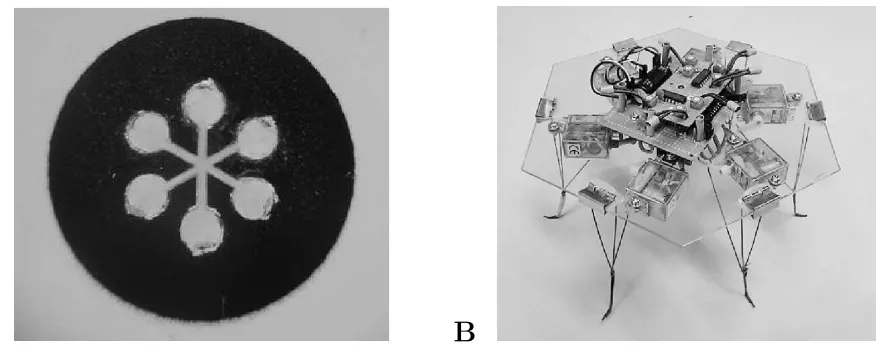
Figure 2: The giant cells of the plasmodial state of Physarum polycephalum can be grown into desired shapes through the use of a dry negative mask on a moist surface (A). The six circles at the arms of the pattern have a diameter of 1.5 mm. The part of the plasmodium within each circle can be considered as a non-linear oscillator (cf. [24, 25]). These oscillators are coupled through tubes formed by the plasmodium within the channels. The shape of the cell results in a circuit of coupled oscillators. Living non-linear oscillator circuits patterned in the form shown on the left (A) are used in robot control experiments, where each oscillator controls one leg in a hexapod robot (B). Light signals received by six sensors on the robot are converted into patterns of white-light illuminating the oscillator areas in the physarum circuit.
Our interest here, however, is not in bio-mimicry but in a bio-hybrid system that harnesses the material-based information processing capability ofP. polycephalum by integrating it into a robot control architecture.
3.2 The bio-hybrid robot system
The bio-hybrid robot consists of three components: a cell, a robot, and an interface connecting the former two. Fig. 2A shows the first component, a plasmodium of P. polycephalum grown in a defined two-dimensional shape. We refer to cells configured in such a way as ’physarum circuits’. The omnidirectional six-legged robot driven by this cell is shown in Fig. 2B. The cell is coupled optically to a computer which provides the signal transduction and processing to connect the cell with the robot.
The technique for growing a plasmodium into a predefined physarum circuit makes use of three phenomena. Firstly,P. polycephalum requires a moist environment. If it is offered with different surfaces to grow on, it will preferentially grow on a surface from which it can absorb water. Secondly, if a plasmodium of P. polycephalum is arbitrarily dissevered by external force, then any fragment large enough to include a nucleus is in general capable to live on. The cut surfaces are swiftly sealed by the gelling of leaking protoplasm and the fragment turns into a small fully functional plasmodium. Thirdly, if two plasmodia come into contact they easily fuse into a single individual organism. The second and third phenomena endow the plasmodia with robustness in an inhomogenous and disruptive natural environment. In combination they also confer a “cut-and-paste” property to the plasmodia which is a great convenience in the making of physarum circuits.
printed with a laser printer on overhead projector foil as clear shape on a solid black background; the background serves to increase contrast in the optical readout described below. In the present experiments the shape depicted in Fig. 2A with the following parameters is used. The six circles have a diameter of 1.5 mm and the width of the channels connecting the circles at the centre is 0.4 mm. The radius on which the six circles are centred is 2.25 mm. The design is based on the idea of Takamatsu et al. [24] but has been modified for the application in robot control and subsequently refined (for earlier versions see [26, 27]). From the printed foil the clear shape is cut away and the foil placed on a 1–2 mm layer or 1.5% agar in a plastic petri dish. Areas in the Petri dish that are covered by the overhead projector foil provide a dry plastic surface and areas in which the agar layer is exposed through cut-outs provide a moist surface. The parameters of the shape that have been chosen for the mask take into account both fabrication and functionality. The area of the plasmodium within a circle is small enough to be regarded as a single oscillator. The channel width is chosen such that the plasmodium will grow a single tube within it, and the length of the channels is a compromise between the speed with which the physarum circuits can be grown and the likelihood that the plasmodium grows over the dry surface of the plastic film.
Next, a plasmodium is grown on the patterned surface. The goal is to have the plasmodium evenly fill the moist area enclosed by the dry, black printed, plastic sheet, but not escape over the dry area or tunnel between the sheet and the agar layer. The growth process is started by filling all six circles in the pattern with small portions from the growth front (labeled G in Fig. 1) of a cultured plasmodium. The Petri dish with the mask is then incubated in the dark at room temperature and about 45–60% relative humidity. The six fragments in the circles of the pattern will first reform into plasmodia. Then they start to grow along the channel towards the centre of the pattern. Upon encountering each other in the centre they fuse and eventual the entire exposed agar surface bounded by the plastic mask is covered with a single plasmodium.
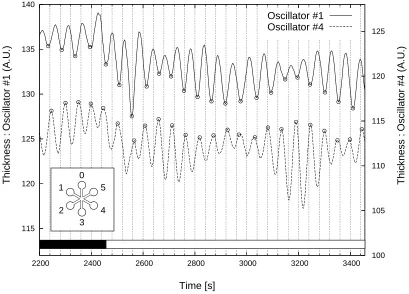
The shape of the plasmodium, visible in Fig. 2A and illustrated in the insert of Fig. 3, results in a system of six coupled non-linear oscillators [24, 25]. For the robot control experiments each oscillator is assigned to one leg of the hexapod which has only a single degree of freedom per leg (Fig. 2B). Thus the oscillation pattern of the cell is transformed into a motion pattern of the actuators and results in locomotion of the robot. Experiments with software oscillators showed that anti-phase oscillation of neighbouring (meta-position) or opposite oscillators (para-position) yields directed motion of the robot. The hexagonal body of the robot carries six light sensors, the signals of which are converted to stimuli applied to the plasmodium, thereby closing the loop between the robot acting in the environment and theP. polycephalum cell controlling it.
Another important observation regarding the behaviour of P. polycephalum is the basis for interfacing the plasmodium with the robot. Plasmodia of P. polycephalum avoid white light, i.e., they show negative phototaxis, but do not respond to orange light near 600 nm [28]. Orange light can therefore be used to follow the thickness oscillations of a plasmodium without disturbing it. A local increase in thickness of the cell is accompanied by locally reduced light transmission. Conversely, white light can be applied to locally stimulate a plasmodium.
115 120 125 130 135 140
2200 2400 2600 2800 3000 3200 3400 100 105 110 115 120 125
Thic
kness :
Oscillator #1 (A.U
.)
Time [s]
Oscillator #1 Oscillator #4
Thic
kness :
Oscillator #4 (A.U
.)
1
3 0
2
5
[image:8.595.95.504.76.370.2]4
Figure 3: Thickness oscillations in a P. polycephalum plasmodium, shown for two oscillators (1 and 4) in para-position. White light applied to oscillators 2,3,5, and 6 starting at t=2452 s stabilised the anti-phase oscillation pattern over an extended period. The insert in the lower left indicates the numbering of the oscillators; thickness scales are in arbitrary units.
Fig. 3 shows results from a typical measurement. The graphs show the variation in thickness determined by light transmission for oscillator 1 and oscillator 4 in a plasmodium shaped as shown in the insert on the lower left. Valleys in the amplitude of oscillator 1 and peaks in the amplitude of oscillator 2 are marked to aid in phase comparison. During the initial period indicated by the black bar near the x-axis the plasmodium spontaneously oscillates. With the two depicted oscillators in near anti-phase a white light stimulus was applied to all oscillators except 1 and 4. The period of the light stimulus is indicated in Fig. 3 by a white bar parallel to the x-axis. The two oscillators fall into anti-phase oscillation which is sustained until t≈3000 s.
Short-term cross correlation analysis allows for the detection of anti-phase oscillation among any combination of oscillators. After processing the data to locate the peaks of the amplitudes, the phase relationships among the six oscillators can be determined. The phase difference, φn, for two oscillators iand j can be calculated from samples (following [29]) as
φn= 2πτn/Tn
where
τn=pin−p j
n and Tn=pin+1−p
i n,
with pi n and p
j
n being then-th peak of oscillatoriand j, respectively.
Having observed spontaneous phase synchronised oscillations, oscillations with 90◦-phase shift, and anti-phase oscillations, we found that anti-phase oscillations are common among oscillators in para-position (i.e, located directly opposite to each other).
A number of studies have shown that these oscillations participate in the integration of signals that arrive at different places of the cell body and play a role in the chemotaxis, thermotaxis, and phototaxis of the plasmodia [17, 19, 30–34]. It has been reported that attractive stimuli increase the local oscillation frequency and repulsive stimuli reduce the frequency [17]. The six light sensors of the robot are coupled by local white light stimuli to the plasmodium and accordingly the effect of light stimuli on the global oscillation pattern is of particular interest in this context. Sustained phase relationships map into robot gait patterns and transitions among the synchronisation states of the six-oscillator system give rise to changes of the robot’s behaviour. Our investigations are still ongoing, but so far both stabilisation and destabilisation of phase relationships through targeted light input appear practical.
4
Summary
This paper started with life’s intrinsic need for information processing which arises from the fact that living systems require active maintenance of their intricate material organisation. Presum-ably self-organising chemical systems were the precursors of life and their self-assembly properties provided an initial form of dynamic stability that enabled the complexity of some individual sys-tems to rise above what would otherwise be probable [35]. When molecular components then transcended their structural role and became available as information carriers, they did so con-sistent with their physical interactions. This link between operations carried out on information and the physical interaction among the information carriers appears crucial to the efficiency of biomolecular architectures. However, the abstractions of the current computing paradigm are not well suited to this form of physics-driven information processing and alternatives need to be worked out.
The efficiency in material and energy requirements that comes along with operations on infor-mation that are well aligned with the interactions within the physical computing substrate may in particular benefit robotic devices. The threefold challenge of real-time performance, resource limitation, and an unforeseeable complex environment faced by robots is a good proving ground and a likely early application domain for alternative computing substrates. The second part of the paper describes a few humble steps towards the integration of a living cell into a robot control architecture. At this stage the interest is in the fusion of local information into global behaviour through decentralised intracellular processing. In the long-term, such an experimen-tal platform may support the integration and experimenexperimen-tal evaluation of concepts from Artifical Life and Synthetic Biology.
Both threads flow together as we argue that a technology capable of mimicking the astounding efficiency of information processing in organisms will need to pay much attention to the physical substrate that enacts the computation. Practical experience with bio-hybrid architectures will be invaluable on the path to extend our present computing paradigm from the formal to the physical.
Acknowledgements
References
[1] E. Mendelsohn.Heat and Life—The Development of the Theory of Animal Heat. Harvard University Press, Cambridge, MA, 1964.
[2] R. V. L. Hartley. Transmission of information. Bell System Tech. J., 7:535–563, 1928.
[3] A. M. Turing. On computable numbers with an application to the Entscheidungsproblem. In Proceedings of the London Mathematical Society, volume 42, pages 230–265, 1937. Corrections, Ibid vol. 43 (1937), pp. 544–546. Reprinted inThe Undecideable, M. Davis, ed., Raven Press, New York, 1965.
[4] M. L. Minsky. Computation: Finite and Infinite Machines. Prentice-Hall, Englewood Cliffs, N.J., 1967.
[5] W. R. Ashby. Some consequences of Bremermann’s limit for information-processing systems. In H. L. Oestreicher and D. R. Moore, editors,Cybernetic Problems in Bionics, pages 69–76. Gordon and Breach, New York, 1968.
[6] R. Landauer. Irreversibility and heat generation in the computing process. IBM Journal, 5(3):183– 191, 1961.
[7] R. W. Keyes and R. Landauer. Minimal energy dissipation in logic. IBM J. Res. & Dev., pages 152–157, March 1970.
[8] C. H. Bennet. Notes on the history of reversible computation. IBM J. Res. & Dev., 32(1):16–23, 1988. Reprinted in IBM J. Res. & Dev. 44(1/2):270–277, 2000.
[9] R. Landauer. Fundamental limitations in the computational process. Berichte der Bunsen-Gesellschaft, 80(11):1048–1059, 1976.
[10] R. Hanson. Reversible agents: Need robots waste bits to see, talk, and achieve? In D. Matzke, editor, Proceedings of Workshop on Physics and Computation: PhysComp ’92, pages 284–288, Los Alamitos, 1992. IEEE Computer Society Press.
[11] M. Conrad. Adaptability. Plenum Publishing Corp, New York, 1983.
[12] K.-P. Zauner and M. Conrad. Molecular approach to informal computing.Soft Computing, 5(1):39– 44, 2001.
[13] R. A. Brooks. The relationship between matter and life. Nature, 409:409–411, 2001.
[14] M. Conrad. The importance of molecular hierarchy in information preocessing. In C. H. Waddington, editor,Towards a Theoreritcal Biology, volume 4, pages 222–228. Edinburgh University Press, 1972. [15] M. Conrad. Towards high evolvability dynamics. In G. Van de Vijver et al., editors,Evolutionary
Systems, pages 33–43. Kluwer Academic Publishers, Dordrecht, 1998.
[16] J. F. Miller and K. Downing. Evolution in materio: Looking beyond the silicon box. In 2002 NASA/DoD Conference on Evolvable Hardware (EH’02), pages 167–176, July 15 - 18, 2002, Alexan-dria, Virginia, 2002. IEEE.
[17] A. C. H. Durham and E. B. Ridgway. Control of chemotaxis in Physarum polycephalum. The Journal of Cell Biology, 69:218–223, 1976.
[18] T. Nakagaki, H. Yamada, and A. Toth. Intelligence: Maze-solving by an amoeboid organism.Nature, 407:470, 2000.
[19] Z. Hejnowicz and K. E. Wohlfarth-Bottermann. Propagated waves induced by gradients of physio-logical factors within plasmodia ofPhysarum polycephalum. Planta, 150:144–152, 1980.
[20] K. Matsumoto, T. Ueda, and Y. Kobatake. Propagation of phase wave in relation to tactic responses by the plasmodium ofPhysarum polycephalum. Journal of Theoretical Biology, 122:339–345, 1986. [21] H. Miura and M. Yano. A model of organization of size invariant positional information in taxis of
Physarumplasmodium. Progress of Theoretical Physics, 100(2):235–251, 1998.
[22] Y. Miyake, S. Tabata, H. Murakami, M. Yano, and H. Shimizu. Environmental-dependent self-organization of positional information field in chemotaxis of Physarum plasmodium. Journal of Theoretical Biology, 178:341–353, 1996.
[23] A. Ishiguro, M. Shimizu, and T. Kawakatsu. Don’t try to control everything!: An emergent mor-phology control of a modular robot. InProceedings of 2004 IEEE/RSJ International Conference on Intelligent Robots and Systems, pages 981–985, Sendai, Japan, September 28 - October 2 2004. [24] A. Takamatsu and T. Fujii. Time delay effect in a living coupled oscillator system with the
plas-modium ofPhysarum polycephalum. Physical Review Letters, 85:2026–2029, 2000.
[25] A. Takamtsu, T. Fujii, and I. Endo. Control of interaction strength in a network of the true slime mold by a microfabricated structure. BioSystems, 55:33–38, 2000.
[27] S. Tsuda, K.-P. Zauner, and Y.-P. Gunji. Robot control: From silicon circuitry to cells. In A. J. Ijspeert, T. Masuzawa, and S. Kusumoto, editors,BioADIT 2006, volume 3853 ofLecture Notes in Computer Science, pages 20–32. Springer, 2006.
[28] T. Ueda, Y. Mori, T. Nakagaki, and Y. Kobatake. Action spectra for superoxide generation and UV and visible light photoavoidance in plasmodia ofPhysarum polycephalum. Photochemistry and Photobiology, 48:705–709, 1988.
[29] S. Nakata, T. Miyata, N. Ojima, and K. Yoshikawa. Self-synchronization in coupled salt-water oscillators. Physica D, 115:313–320, 1998.
[30] W. Korohoda, L. Rakoczy, and T. Walczak. On the control mechanism of protoplasmic streamings in the plasmodia ofMyxomycetes. Acta Protozoologica, VII(29):363–373, 1970.
[31] T. Ueda, K. Matsumoto, and Y. Kobatake. Spatial and temporal organization of intracellular adenine nucleotides and cyclic nucleotides in relation to rhythmic motility inPhysarumplasmodium. Experimental Cell Research, 162(2):486–494, 1986.
[32] T. Ueda. Self-organization ofPhysarum polycephalum: Phase locking and information control. In K. Toko and G. Matsumoto, editors, Self-Organization, chapter 4, pages 86–102. Asakura Shoten. Japan, 1996. In Japanese.
[33] T. Nakagaki, H. Yamada, and T. Ueda. Modulation of cellular rhythm and photoavoidance by oscillatory irradiation in thePhysarumplasmodium. Biophysical Chemistry, 82:23–28, 1999. [34] J. Tanaka and Y. Miyake. Modulation of intracellular rhythm and behavior ofPhysarumplasmodium
under the condition of mutual entrainment. InProceedings of the SICE 2000 Conference, pages 212– A4. The Society of Instrument and Control Engineers, 2000.