SOURCE ROUTING AND TRANSPARENT BRIDGING
INTERCONNECTIONS AND
THEIR PERFORMANCES
A thesis submitted to the University of Tasmania in partial fulfilment of the requirement
for the degree of
Master of Technology
ILHAM SAWA'UN
Department of Electrical and Electronic Engineering University of Tasmania
ABSTRACT
ACKNOWLEDGEMENT
I would like to thank for all people who help in the preparation of this thesis. In particular I wish to acknowledge :
1. Professor D.T. Nguyen, as M Tech program director, for his direction and support in preparing and improving this thesis.
2. Dr. David J.H. Lewis, as project supervisor, who has provided valuable guidance for the development of this thesis.
3. Peter Atkinson, advisory SE of IBM Australia, who has given me the specification of this project thesis and supported me with many references to start with.
4. The Indonesian government for giving me the opportunity to undertake this M Tech course.
5. All postgraduate students especially M Tech students who have helped me in the development of this thesis.
Finally, I wish to thank for my family and my girl friend for their support and encouragement during my study here.
TABLE OF CONTENTS
ABSTRACT
ACKNOWLEDGEMENT
ii
TABLE OF CONTENTS
iii
LIST OF FIGURES
GLOSSARY
vi
Chapter
1. : INTRODUCTION
1
2 : LAN BRIDGES
4
2.1 IEEE 802 STANDARDS AND OSI MODEL
4
2.2 TOKEN RING NETWORKS
5
2. 2.1 Introduction
5
2.2. 2 MAC Frame Format
6
2. 2. 3 Source Routing
8
2. 3 802.3 LANs
11
•
2.3. 1 Introduction
11
2. 3. 2 IEEE 802.3 MAC Frame
11
2. 3. 3 Transparent Bridging
12
2. 4 Source Routing and Transparent Bridging Comparison 17
2.5 BRIDGE PROBLEM OF 802.3 AND 802.5 LANs
18
3:
SOURCE ROUTING TRANSPARENT (SRT) BRIDGE21
3.1 INTRODUCTION
21
3.2 MAC SERVICE
23
3. 4 THE SPANNING TREE ALGORITHM AND PROTOCOL 29
3.5 BRIDGE MANAGEMENT
32
3.6 DISCUSSION
34
4: PERFORMANCE ANALYSIS
38
4.1 PERFORMANCE ANALYSIS FOR SOURCE ROUTING 38
4. 1. 1 Mathematical Analysis
38
4. 1. 2 Simulation of Token Ring
42
4. 1.3 Simulation of Source Routing
42
4.2 PERFORMANCE ANALYSIS OF 802.3 LANs
44
4. 2. 1 Mathematical Analysis
44
4. 2. 2 Simulation of IEEE 802.3 LAN
54
4. 2. 3 Simulation for Transparent Bridging
55
4. 3 DISCUSSION
57
5: CONCLUSION
59
REFERENCES
62
APPENDICES
64
1. Simulation Results for one Ring
64
2. SIMSCRIPT Programs for one Ring
64
3. Simulation Results for Source Routing
67
4. SIMSCRIPT Programs for Source Routing
68
5. Simulation Results for CSMA/CD LAN
76
6. SIMSCRIPT Programs for CSMA/CD LAN
76
7. Simulation Results for Transparent Bridging
80
LIST OF FIGURES
FIGURE 2.1 FIGURE 2.2 FIGURE 2.3 FIGURE 2.4 FIGURE 2.5 FIGURE 2.6 FIGURE 2.7 FIGURE 2.8 FIGURE 2.9 FIGURE 2.10 FIGURE 2.11 FIGURE 3.1 FIGURE 3.2 FIGURE 3.3 FIGURE 3.4FIGURE 4. 1
FIGURE 4.2 FIGURE 4.3 FIGURE 4.4 FIGURE 4.5 FIGURE 4.6 FIGURE 4.7 FIGURE 4.8
FIGURE 4. 9
FIGURE 4.10
FIGURE 4.11
FIGURE 4 .12
FIGURE 4.13
FIGURE 4.14
FIGURE 4.15
FIGURE 4.16
FIGURE 4.17
: IEEE 802 STANDARDS AND OS! MODEL
: FRAME AND TOKEN FORMAT
: FORMAT AND CONTENT OF SD, AC AND FC
: ROUTING INFORMATION FIELD
: IEEE 8023 MAC FRAME FORMAT
: A TYPICAL NETWORK
: THE OPERATION OF BRIDGE
: A TYP ICAL LAN CONFIGURATION
: BRIDGE FORWARDING & LEARNING FLOW
: PARALLEL BRIDGES
: DEVELOPMENT OF A SPANNING TREE
: BRIDGE DIAGRAM
: SRT BRIDGE OPERATION
: BRIDGED LANS
: SPANNING TREE TOPOLOGY
: THREE CONNECTED LAN SEGMENTS
: TOKEN RING QUEUING SYSTEM
: DELAY VS THROUGHPUT
: DELAY & NUMBER OF FRAMES IN BUFFER
: DELAY VS THROUGHPUT
: PERCENTAGES OF TRAFFIC DESTINATION
: CSMA/CD REPRESENTATION
: RESCHEDULING TRANSMISSION
: DETECTION TIME
: TRANSMISSION SCHEDULE
: UTILIZATION VS DELAY (CSMA/CD)
: UTILIZATION VS DELAY (a = 0.1)
: SIMULATION RESULTS FOR a=0.01 54
: SIMULATION RESULTS FOR a = 0.1 55
: BRIDGED LANs CONFIGURATION 56
: VARIOUS PACKET DELAYS VS UTILIZATION 57
: PERFORMANCE COMPARISON 58
4 6 7 7 11 13 13 15
CHART 16
17 17 22 28 31 32 38 39 41
VS THROUGHPUT 42
GLOSSARY
AC. Access Control. A particular field in MAC frame.
Bandwidth. The difference between the limiting frequencies of• a
continuous frequency spectrum.
Baseband. Transmission of signal without modulation. In a baseband
local area network, digital signals ('O's and l's) are inserted directly
onto the cable as voltage pulses. The entire spectrum of the cable is
consumed by the signal. This scheme does not allow
frequency-division multiplexing.
Broadband. The use of coaxial cable for providing data transfer by means
of analog (radio-frequency) signals. Digital signals are passed through
a modem and transmitted over one of the frequency bands of the
cable.
Broadcast. The simultaneous transmission of data to a number of station.
BPDU. Bridge Protocol Data Unit. A protocol data unit which is related to
bridge.
Bridge. A device that links two local area networks. It accepts packets
from network addressed to devices on the other, buffer them, and
retransmits them to other network.
Coaxial Cable. A cable consisting of one conductor, usually a small copper
tube or wire, within and insulated from another conductor of larger
diameter, usually copper tubing or copper braid.
Connectionless. A system for exchanging data in an unplanned fashion
and without prior coordination.
Connection-oriented. A system for exchanging data in which a logical
connection is established between the endpoints.
CSMA. Carrier Sense Multiple Access. A media access control technique
for multiple-access transmission media. A station wishing to transmit
first senses the medium and transmits only if the medium is idle.
CSMA/CD. Carrier Sense Multiple Access with Collision Detection. A
refinement of CSMA in which a station ceases transmission if it
detects a collision.
CRC. Cyclic Redundancy Check. An error detecting code in which the
code is the remainder resulting from dividing the bits to be checked
by a predetermined binary number.
DA. Destination Address. The address of destination station.
Data Link Layer. Layer 2 of the OSI model. Converts unreliable
transmission channel into reliable one.
ED. Ending Delimeter. A special field of MAC frame.
Encapsulation. The addition of control information by a protocol entity
to data obtained from a protocol user.
Error rate. The ratio of the number of data units in error to the total
number of data units.
PC. Frame Control. A field of MAC frame. This field defines the type of
the frame and certain MAC and information frame function.
FCS. Frame Check Sequence. An error-detecting code inserted as a field
in a block of data to be transmitted. The code serves to check for
errors upon reception of the data.
FDDI. Fibre Distributed Data Interface. FDDI is a standard for high-speed
ring LAN. It employs the Token ring algorithm.
FIFO. First In First Out. A queuing system where the first incoming frame will be firstly served.
FS. Frame Status. A field in MAC frame.
Gateway. A device that connects two system, especially if the systems use different protocols. For example,. a gateway is used to connect two independent local networks, or to connect a local network to a long-haul network.
Hosts. In any network there exists a collection of machines intended for running user (i.e. application) program. It is common to call these machines Hosts.
IEEE. Institute Electrical and Electronic Engineering. ISO. International Standard Organization.
Internetworking. Communication among devices across multiple networks.
LAN. Local Area Network. A general-purpose local network that can serve a variety of devices. Typically used for terminals, microcomputers and minicomputers.
LLC. Logical Link Control. A sub layer of Data Link Layer. LPDU. Link Protocol Data Unit.
MAC. Medium Access Control. For broadcast networks, the method of determining which device has access to the transmission medium at any time. CSMA/CD and Token are common access methods. This is a sub layer of Data Link Layer.
Mbps. Mega bits per second.
M/M/1. A queuing system with Exponential interarrival time, and Exponential service time and one server.
Optical Fibre. A thin filament of glass or other transparent material through
which a signal-encoded light beam may be transmitted by means of
total internal reflection.
OSI. Open System Interconnection. A communication model defined by
ISO.
PDF. Probability Density Function.
Physical Layer. Layer 1 of the OSI model. Concerned with the electrical,
mechanical, and timing aspects of signal transmission over a
medium.
Protocol. A set of rules that govern the operation of functional units to
achieve communication.
Protocol Data Unit. A block of data exchanged between two entities via a
protocol.
RI. Routing Information. Routing information field contains a series of
LAN and bridge numbers to be passed when transmitting a frame in
Source routing method.
RH. Routing Information Indicator. This information indicates whether
the frame contains Routing information field or not.
Ring.
A local network topology in which stations are attached to repeaters
connected in a closed loop. Data are transmitted in one direction
around the ring, and can be read by all attached stations.
SA.
Source Address. The address of source station.
SD. Starting Delimeter.
SR. Source Routing. A type of routing strategy in transmitting of frames
in Bridged LANs.
SRT.
Source Routing Transparent. A new standard for interconnection
of Source Routing and Transparent Bridging.
TB. Transparent Bridge. A Bridging strategy for bridged 802.3 LANs. Token Ring. A medium access control technique for rings. A token
circulates
around the ring. A station may transmit by seizing the token, inserted a packet onto the ring, and then retransmitting the token.Topology. The structure, consisting of paths or switches, that provides the communications interconnection among nodes of a network. Tree. A local network topology in which stations are attached to a shared
transmission medium. The transmission medium is a branching cable emanating from a headend, with no closed circuits. Transmissions propagate throughout all branches of the tree, and are received by all stations.
Twisted Pair cable. A transmission medium consisting of two insulated
• Chapter 1
INTRODUCTION
IEEE 802.3 and IEEE 802.5 LANs have many different characteristics. In physical layer level, the bit rate of an IEEE 802.3 LAN is 10 Mbps and IEEE 802.5 is 4 Mbps or 16 Mbps. In MAC level, the structure of frames and access method are different. For example, IEEE 802.3 uses a CSMA/CD access method and IEEE 802.5 uses token ring access method. Furthermore, in the network layer, IEEE 802.3 follows the connectionless oriented type and IEEE 802.5 follows the connection oriented type.
Both networks have advantages and disadvantages. They have been implemented by many organizations. It is not uncommon to implement a Token ring network in one division and an Ethernet in other division of organization so the compatibility becomes a problem.
Interconnection between two networks of the same type is commonly done by using a bridge. Before study its technology, it is better taking a look at some common situations why a single organization may end up with multiple LANs and uses bridges to connect them. Some of the reasons are [1]:
Organization Factor
Many Universities and Corporate Departments have their own LANs. Since the goal of each department is different, different departments may choose different LANs. Sooner or later, they will need to communicate with each other and bridges are needed to connect them.
Geographic Factor
Splitting the Load
In the case of higher loads, it will be necessary to split up LANs in order to reduce delay time.
Distance
In some cases, the distance between workstations may be too great (more than 2.5 kin), in with case it will be better to use separate LANs to avoid excessive long round-trip delay.
Reliability
It is better to split up a big LAN into several small LANs because if there is a problem on one LAN, the others still work; furthermore it provides opportunity to expand them.
Security
In terms of security, a bridge can examine a packet and choose not to forward sensitive traffic.
The use of bridges to connect two different and incompatible LANs will involve several problems. Token Ring networks use a source routing strategy to transmit a frame from one end to another end whereas Ethernets use a transparent bridging technique. To enable interconnection between token ring and ethernet networks, IEEE, in 1990, proposed a standard of conversion in the IEEE 802.1d standard.
This thesis studies the operation of source routing and transparent bridging, and identifies technical advantages and disadvantages of each method. Other aims are to describe the Source Routing Transparent (SRT) Bridging mechanism of IEEE 802.1d standard, to describe how SRT addresses any of the previous disadvantages of source routing and transparent
-bridging, and to identify whether there are new disadvantages which are
Chapter 2
LAN BRIDGES
2.1 IEEE 802 STANDARDS AND OSI MODEL
[image:15.557.117.461.276.613.2]This section will explain the relationship between IEEE 802 protocol
structure for LANs and the ISO Open System Interconnection Model.
Figure 2.1 shows the relationship between the IEEE 802 standards and the
OSI model [13].
OSI
IEEE
IEEE 802.1
Higher level Interface
IEEE 802.2
Logical Link Control (LLC) Higher Layer Data Link Layer Physical layer IEEE 802.3 CSMA/CD Medium Access CSMA/CD media IEEE 802.4 Token Bus Medium Access Ttoken Bus media IEEE 802.5 Token ring Medium Access Token ring media IBM cabling system
FIGURE 2.1 : IEEE 802 STANDARDS AND OSI MODEL
and 802.5 uses Token Ring. The IEEE 802.1 standard is responsible for the interface between the 802 Model and OSI Model. This task is done by IEEE 802.1a which describes the relationship between the IEEE 802 standard and the ISO-OSI Model; IEEE 802.1b specifies the Media Access Control; and IEEE 802.1d specifies the architecture and protocol for the interconnection of 802 LANs.
The IEEE 802.1d standard explains the interconnection between 802.3 and 802.5 LANs. Source Routing and Transparent Bridge, which is commonly called SR/TB, is used to interconnect IEEE 802.3 and IEEE 802.5 LANs. Such Interconnection requires a conversion software in the bridge because they have many differences in MAC level. Recently, IEEE developes new bridging method, which is called SRT (Source Routing Transparent) bridging method, to provide more interoperability between Source Routing and Transparent Bridging methods. The implementation of SRT bridge requires some modifications of Source Routing so that a conversion software is no longer needed.
2.2 TOKEN RING NETWORKS 2.2.1 Introduction
The Token Ring uses star-wired ring topology and follows the IEEE 802.5 standard protocol for signalling and token passing. The transmission media which are used can be shielded or unshielded twisted pair cables. The speed can be 4 Mbps or 16 Mbps. The maximum number of devices that can be attached is 260 and each device or workstation uses an adapter to handle token recognition and data transmission. The adapter is also responsible for frame recognition, token generation, address recognition, error checking and logging, timeout control and link-fault detection.
1 1 1
6 bytes Variable Length
Variable
4 bytes
Length byte byte 6 bytes
byte byte byte
bridge can be used to connect one ring to another ring. The bridge appears to be a normal node in a ring and it is normally a PC which has two adapters attached to each ring.
2. 2. 2 MAC Frame Format
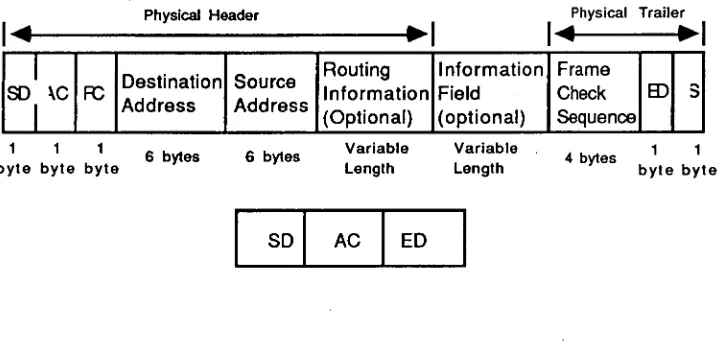
The basic transmission unit is a frame which consists of a number of fields of one or more bytes. When there is no information to be sent then the frame changes to be a token[13].
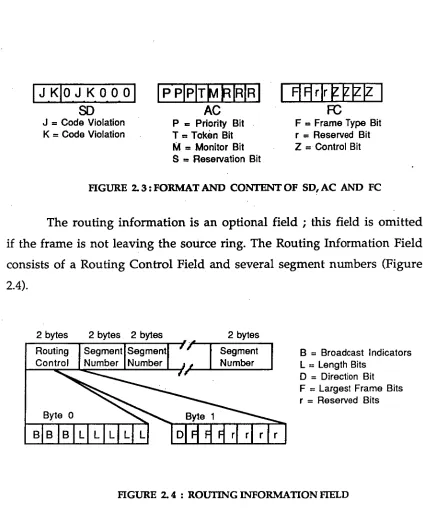
A Token has only three fields i.e. a Starting Delimeter (SD), an Access Control (AC) and an Ending Delimeter (ED) as shown in Figure 2.2. A valid token or frame will start with the Starting Delimeter byte. The next field is the Access Control field which consists of Priority Bits, a Token Bit, and a Monitor Bit (see Figure 2.3 for details). A workstation can have a frame with low priority (000) or high priority (111). A Token bit has a value of one for frame and zero for token. A Monitor bit is used to prevent continuous circulation of frames or non-zero priority tokens.
Physical Trailer
110
I
I SD \C
I
FC Destination Address Source Address Routing Information (Optional) Information Field (optional) Frame Check Sequence ED
I
mI
1 •
Physical Header [image:17.554.132.491.452.628.2]SD AC ED
FIGURE 2. 2 : FRAME AND TOKEN FORMAT
Byte 0 l!trial■■■
D
CEE1111111111
J_110 JK 0 0
01
SD
J = Code Violation K = Code ViolationPPIPIT
1
IRIRI
AC
P = Priority Bit T = Token Bit M = Monitor Bit S = Reservation BitMG11131221
FC
[image:18.553.70.493.53.579.2]F = Frame Type Bit r = Reserved Bit Z = Control Bit
FIGURE 2.3: FORMAT AND CONTENT OF SD, AC AND FC
The routing information is an optional field ; this field is omitted if the frame is not leaving the source ring. The Routing Information Field consists of a Routing Control Field and several segment numbers (Figure 2.4).
2 bytes 2 bytes 2 bytes 2 bytes Routing Segment Segment Segment
Control Number Number Number B = Broadcast Indicators L = Length Bits D = Direction Bit
F = Largest Frame Bits r = Reserved Bits
FIGURE 2.4 : ROUTING INFORMATION FIELD
There are four functions of the routing control field i.e. as Broadcast Indicator, Length Bit, Direction Bit and Largest Frame Bit Statement.
copy of the frame appears on each segment). Further explanation is in the next section.
LENGTH BITS : Length bits are used to indicate the length of the routing information field.
DIRECTION BIT: The Direction bit enables the bridge to interpret the
• route; if this bit is set to zero the bridge interprets and reads the routing
information field from left to right or vice versa.
LARGEST FRAME BITS:. The Largest frame bits indicate the length of the information field to be read. The Typical value of Largest Frame Bits are '000' (516 bytes in the information field), '001' (1500 bytes), '010' (2052 bytes) and the biggest value is '110' (17800 bytes in the information field).
Each ring has a specific number called a segment or ring number and each bridge is assigned a bridge number. Ring and Bridge Numbers will form a route designator with 12 bits for a ring number and 4 bits for a bridge number.
2. 2. 3 Source Routing
To establish an interconnection between two networks a bridge is required which works at the data link layer. In source routing, a frame flows through bridges from an originating station to a destination station by following a defined route in the routing information field of the frame. Routing information is obtained by a route determination process as described below.
ON-RING DETERMINATION PROCESS: In on-ring determination, the source station sends a X[D (Exchange Identification) command LPDU(Link Protocol Data Unit) on the local ring with the address of the destination and without any routing information. The destination station responds with a KID response LPDU. If there is no response LPDU returned within a specific amount of time then the destination is not on the local ring and the off-ring determination is initiated.
OFF-RING DETERMINATION PROCESS : In off-ring determination, there are two main dynamic route discovery processes, namely an all-route broadcast route determination and a single-route broadcast route determination.
All-route broadcast route determination
The source station sends a test or XED command LPDU to all rings where the first two bits of the RI (Routing Information) field are set to binary '10x'. This triggers all bridges to copy the LPDU frame and forward it until the destination address is reached. The frame will accumulate routing information as it passes through bridges along the way. It is possible that there is more than one route available to the destination address so that more than one LPDU reaches the destination station. Any received command LPDU will be returned as a response LPDU to the originating station by setting the first RI (Routing Information) bit to binary '0' and the direction bit to binary '1'. This forces the frame to flow back to the source station via the route as developed in the LPDU frame when it is received. The source station selects the preferred route from all returned response LPDUs.
Single-route broadcast route determination
The source station sends a KED command LPDU to all rings where the first two bits of the RI field are set to B' 11x' so that exactly one copy appears on each ring. The frame will accumulate routing information as it
passes through bridges along the way. The XID command LPDU is then returned as a response LPDU with the first two RI-bits set to B'10 ' indicating all-routes broadcast. Again, multiple response LPDUs may be received by the source station. The source station chooses the routing information from the received responses.
When a bridge receives a frame to forward to a ring, the bridge compares the route designators in the routing information field with its attached ring numbers and bridge number. Four conditions might occur in the bridge :
1.If there is a target ring number in bridge address table for all-route or single-route broadcast frame; then the bridge discards the frame because it has already circled the target ring.
2.If there is no target ring number in bridge address table for all-route or single-route broadcast frame; then the bridge adds its route designator to the frame's routing information field and forwards it.
3. If there is a ring number, bridge number and ring number combination in bridge address table for non-broadcast frame; then the bridge forwards the frame to the indicated ring.
4. If there is no ring number, bridge number and ring number combination, match in a non-broadcast frame; then the bridge discards the frame.
2 Variable 0 - m Length padding 7 bytes
I = Individual address (B'O' G = Group address (B.1')
U = Universally admin. (B'0') = Locally admin. (B'1) 48 bits
2. 3 802.3 LANs
2. 3. 1 Introduction
An IEEE 802.3 LAN (example Ethernet) uses a bus topology and
follows the CSMA/CD access protocol ( Carrier Sense Multiple Access and
Collision Detection). It uses baseband transmission method at 10 Mbps on
a common shielded 50 ohm coaxial cable. A repeater is used in every 500
metre segment to intensify the signal; the maximum number of segments
(groups of workstations) that can be attached to a particular segment is
five. For the total LAN, 1024 attachments (segment, workstation and
pheripherals) can be allowed in a distance not exceeding 2.5 kilometres.
[image:22.556.105.497.417.620.2]2. 3. 2 IEEE 802.3 MAC Frame
Figure 2.5 shows the MAC frame format of the IEEE 802.3 LAN[13].
Physical Header -01 FCS Protection
Physical Tr il ero...
0.1 Preamble SD Destination Source LF Information PAD FS
Address (DA) Address (SA)
FIGURE 2.5 : IEEE 802.3 MAC FRAME FORMAT
The Length field (LF) indicates the actual length of the information field. The maximum frame length is 1518 bytes. The Padding field contains padding characters in case the minimum frame length requirement is not met (512 bits). The FCS uses a cyclic redundancy check algorithm.
An invalid frame is not passed to the next higher protocol layer, but it is discarded at the MAC level. This can occur when the frame does not contain an integral number of bytes, or frame length field is inconsistent with the actual frame length, or the FCS value calculated by the destination station does not match the FCS value contained within the frame.
2. 3. 3 Transparent Bridging
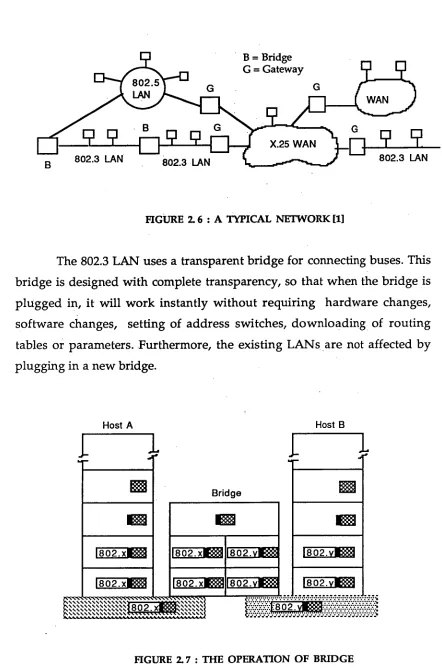
This section will study the use of bridges in an 802.3 LAN. Before studying the use of bridges, it is first desirable to understand the functional differences between repeaters, bridges and gateways.
REPEATERS : Repeaters work on the physical layer and their tasks are only to copy individual bits between cable segments.
BRIDGES: Bridges work on the data link layer and their tasks are to store and forward the frames between the LANs.
GATEWAYS: Gateways work on the network layer and their tasks are to store and forward packets between dissimilar networks.
B = Bridge G = Gateway
ci
4
4 4
[image:24.554.62.504.72.744.2]802.3 LAN 802.3 LAN 802.3 LAN
FIGURE 2.6 : A TYPICAL NETWORK [1]
[image:24.554.84.513.84.301.2]The 802.3 LAN uses a transparent bridge for connecting buses. This bridge is designed with complete transparency, so that when the bridge is plugged in, it will work instantly without requiring hardware changes, software changes, setting of address switches, downloading of routing tables or parameters. Furthermore, the existing LANs are not affected by plugging in a new bridge.
Host A Host B
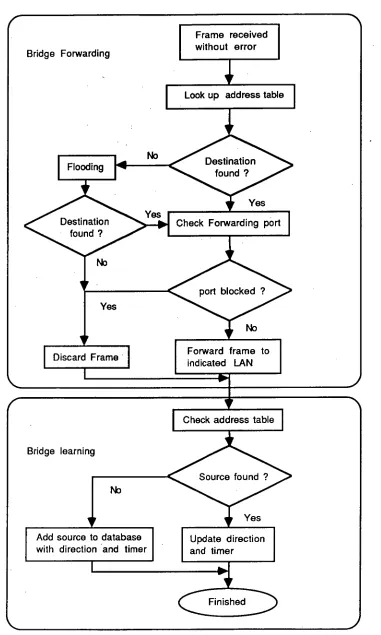
[image:24.554.109.442.449.703.2]The Transparent bridge accepts the frames and then decide whether to discard or forward an incoming frame and on which LAN to put it. These decisions are based on the address table inside the bridge. This table will list every possible destination, which LAN it belongs to, and which LAN can be passed through to get to it. Routing procedures are as follows [1];
* If the destination and source LAN are same then discard the frame.
* If the destination and source LAN are different then forward the frame.
* If the destination LAN is unknown then use "flooding"[1], explanation below.
FIGURE 2.8 : A TYP ICAL LAN CONFIGURATION
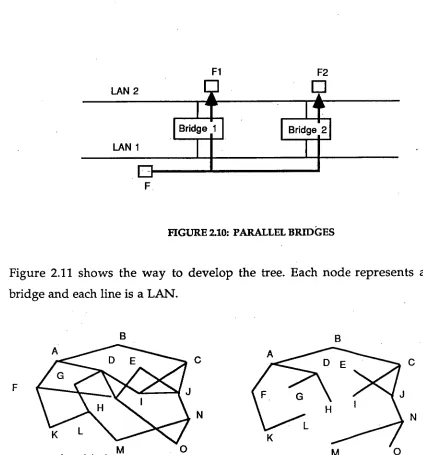
To increase reliability, parallel bridges can be used for connection of two LANs as shown at Figure 2.10[1]. However, this can cause another problem where it creates loops in the topology if a frame with an unknown destination comes to the bridge. Bridge 1 sees the unknown frame F in LAN 1 and copies it to Fl in LAN 2. On the other hand, Bridge 2 copies F to F2 in LAN 2. Furthermore, Bridge 1 sees F2 in LAN 2 and copies it to F3 in LAN 1 and on the other hand Bridge 2 sees Fl and copies it to F4 in LAN 1 and so on, causing a looping. To solve this problem, the Transparent bridge uses a "Spanning Tree"[4] to guarantee that there is only one path between the source address and the destination address, threby making looping impossible.
No
•
Bridge learningNo.
Finished Update direction and timer Add source to database
with direction and timer
Check address table Bridge Forwarding
Discard Frame Yes
Frame received without error
Forward frame to indicated LAN Look up address table
[image:27.554.113.494.77.712.2]Check Forwarding port Flooding
Fl F2
LAN 2
Bridge 1
I
Bridge 21 [image:28.554.94.487.55.270.2]LAN 1
[image:28.554.68.491.68.523.2]FIGURE 2.10: PARALLEL BRIDGES
Figure 2.11 shows the way to develop the tree. Each node represents a bridge and each line is a LAN.
An original topology Tree topology
FIGURE 2.11: DEVELOPMENT OF A SPANNING TREE
2. 4 SOURCE ROUTING AND TRANSPARENT BRIDGING
COMPARISON
which bridges will be based because the bridges learn the location of the destination address by using "backward learning". In source routing, if the destination address is unknown then a discovery frame has to be sent out to discover the routing information.
The workstation at transparent bridging does not need to worry about the bridging scheme because it is arranged by the bridge. In source routing the workstation must actively participate, so that the complexity is in the workstation rather than in the bridge. Furthermore, a failure or change of bridge position or network topology, will be handled by the workstation. In contrast, in transparent bridging those changes will be handled by the bridge.
The Transparent bridge will automatically configure the network topology and does not need network management. In source routing, the address and bridge number must be manually installed and must be unique. It may be difficult to relocate the bridge or workstation because it needs to be arranged again. If there is a mistake in this arrangement, it may be difficult to detect. On the other hand, there is no collision in source routing so the channel utilization can be increased. In this case, source routing has deterministic performance[15].
2.5 BRIDGE PROBLEM OF 802.3 AND 802.5 LANS
General problems of Token ring and Ethernet are different frame formats, different data rates, different maximum frame lengths[1]. The transmission of a frame from token ring to ethernet or vice versa requires reformatting of the frame in the bridge. This process is likely to end up with errors which are difficult to detect.
enough memory , otherwise overloading occurs and some information will be missed. Another problem which is related to the different speeds of Ethernet and Token ring, suppose ethernet transmits a long frame to token ring, and after sending the last bit it sets a timer and waits for acknowledgment. There is a big problem when the timer goes off before the bridge forwards whole bits to the slower LAN. This will cause the source LAN to retransmit the same frames again, and after several attempts it will stop and tell the higher layer that the destination station is off.
Token Ring and Ethernet have different frame lengths where the
• maximum frame length for the 10 Mbps Ethernet is 1518 bytes and for
Token Ring, 17800 bytes. This is the most serious problem. Suppose the Token Ring wants to transmit a frame of 17800 bytes to Ethernet. The Ethernet that has a maximum frame length of 1518 bytes can not accept that long frame. Splitting the long frame into a number of small frames is not the task of the bridge. In this case there is no way, and the frame must be discarded.
This section examines the specific problems between 802.3 to 802.3, 802.5 to 802.5 and 802.3 to 802.5 or vice versa, more explanation see [1]. From 802.3 to 802.3, basically there is no major problem. The only problem is if the bitrate of the bridge is slower than the bitrate of the LAN. Then the memory of the bridge may be out of buffer and drop some frames when transmitting a long continuous run of frames.
From 802.5 to 802.5, there is no major problem in this connection. The only problem is that the frame has A and C bits in the Frame Status field. This field is 'ACrrACrr' where A is to indicate that the destination station has recognized the frame, B is to indicate that the destination
station has copied the frame and r is a reserve bit. These bits are set by the destination to tell the sender. The bridge may tell the sender that the frame has been copied, whereas in fact the destination station is off.
Chapter 3
SOURCE ROUTING TRANSPARENT (SRT) BRIDGE
3.1
Introduction
Source Routing and Transparent Bridging are different methods
for interconnecting two LANs. Transparent bridging is easier to connect
and manage so that it is a widely accepted standard in the market. Source
Routing performs better but it is not fully compatible with the Transparent
Bridge. This incompatibility causes problems if the 2 systems are connected
to each other. These problems are, difficult interconnection, interoperability
problems and degraded network operation. From the customer's point of
view, they want an "agreement" between the Source Routing Bridge and
the Transparent Bridge so that they can be more compatible and can fulfil
the following conditions.
- Transparent Bridge can be used for non-Source Routing stations.
- Source Routing Bridge can be used for Source Routing stations.
- Freedom to mix Source Routing and Transparent Bridges on
the same LAN.
- Freedom to mix Source Routing and Transparent stations on the
same LAN.
- Guaranteed Connectivity between any pair of stations.
In solving these compatibility problems, the IEEE working group
proposed a draft for the SRT bridge[12]. In this draft there are changes for
SR bridge (802.1 bridging operation) and the SR station (802.5 and 802.1
end system operation), on the other hand there is no change for the TB
bridge and the TB station. This draft mentions that the MAC of the SRT
bridge should conform to the following conditions.
1. Conform to the MAC standard of the IEEE 802.3, the IEEE 802.4
and the IEEE 802.5 and conform to the LLC of the IEEE 802.2.
2. Relay and filter frames on the basis of information contained in
Higher Layer Entities
LLC Entity LLC Entity
MAC Relay Entity
1
SR LogicI
TB LogicMac Entity MAC Entity
3. Provide the capability to control the mapping of the priority of
forwarded frames.
4. Maintain the address information table required to make frame
filtering decisions and state the value of database size and the
maximum number of entries that can be held in the filtering
database.
5. Use either a 48-bit Universally Administered Address, or a 48-bit
Locally Administered Address, or a 16-bit Locally Administered
Address.
6. Implement the Spanning Tree Algorithm to reduce the Bridged
Local Area Network Topology to a single spanning tree.
7. Provide the capability to assign the value of a Bridge Priority,
Port Priority and Path Cost for each port to allow configuration
of the Spanning Tree Topology.
8. Support the Management of Bridges, explanation in Section 3.5.
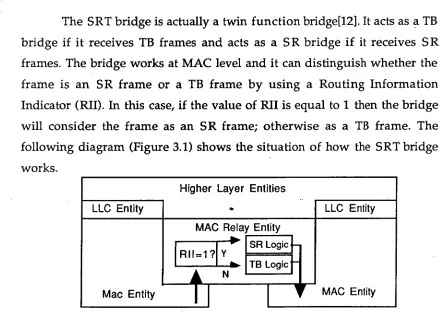
[image:33.557.56.502.415.730.2]The SRT bridge is actually a twin function bridge[12]. It acts as a TB
bridge if it receives TB frames and acts as a SR bridge if it receives SR
frames. The bridge works at MAC level and it can distinguish whether the
frame is an SR frame or a TB frame by using a Routing Information
Indicator (RI). In this case, if the value of RII is equal to 1 then the bridge
will consider the frame as an SR frame; otherwise as a TB frame. The
following diagram (Figure 3.1) shows the situation of how the SRT bridge
works.
• To further understand the SRT bridge, the next sections will explain
MAC service support, principles of operation, the spanning tree algorithm and bridge management.
3.2 MAC SERVICE
The function of the MAC bridge in Bridged Local Area Network is to connect several LANs by providing MAC services to the MAC service user in the end stations, and relaying frames between the separate MACs of the Bridged LANs. The services provided are request primitives and corresponding indication primitives conveying user data with unconfirmed service. The use of confirmed service by end stations communicating across the bridge is not supported.
The quality of MAC services provided by a bridge should not be inferior to that provided by a single LAN. The parameters to be considered are those relating to the following[12].
1. Service Availability 2. Frame loss
3. Frame misordering 4. Frame duplication
5.The transit delay experienced by frames 6. Frame lifetime
7. The undetected frame error rate
8. Maximum size of service data unit supported 9. User priority and throughput
Service Availability
the use of failed components ( e.g. repeater, cable, or bridge itself) in the data path. A bridge may deny service and discard a frame of a station in order to preserve other aspect of the MAC service when automatic reconfiguration takes place; hence service availability is lowered for that end station. To maximize the service availability, no loss of frame or delay of service should be caused by the bridge except as a consequence of a failure, removal or insertion of a bridge or as a consequence of the movement of an end station.
Frame Loss
A frame transmitted by a source station can fail to reach the destination station due to the corruption in transmission at the physical layer level. The use of the bridge can cause frame loss and it should introduce minimum additional frame loss. The bridge may discard a frame for the following reasons.
1. The maximum frame lifetime is exceeded.
2. The internal buffering capacity is full due to continuous arriving of frames at a rate in excees of that at which they can be transmitted.
3. The size of frame exceds the maximum frame length supported by the medium access control procedures employed on the LAN
to which the frame is to be relayed.
4. The frame arrives at a time when the topology of the bridge LAN is being changed to maintain other aspects of quality of services.
Frame Misordering
in order to preserve the order of arriving frames.
Frame Duplication
The bridge MAC sublayer does not permit frame duplication. The duplication is possible if there is more than one path between the source and destination stations. Once more, the protocol needs to guarantee one active path available in any pair of stations.
Transit Delay
Transit delay is the time taken to receive a frame plus that taken to access the media onto which the frame is to be relayed. Since the MAC service is provided at an abstract interface it is not possible to specify the total frame transit delay precisely.. However, it is possible to measure those components of delay associated with media access; hence the transit delay introduced by the bridge can be measured. This transit delay has to be short to ensure that the maximum life time of the frame is not exceeded.
Frame Lifetime
The Frame has a maximum lifetime and it will be discarded by the bridge if that value is exceeded. The maximum frame lifetime is necessary to ensure the correct operation of higher layer protocols.
Undetected Frame Error Rate
Maximum Service Data Unit Size
The Maximum service data unit size varies with the MAC method
and its associated parameters e.g. speed. Within bridged LANs, this value
is the smaller of that supported by the LANs. The bridge should not relay
a frame to a LAN which does not support the size of service data unit
conveyed by that frame.
Priority
The bridge MAC sublayer can provide the priority of service to the
end station. A request primitive with a high priority may be given
precedence over other request primitives made at the same station or at
other stations attached to the same LAN.
Throughput
The total throughput of the bridged LANs can be greater compared
to an equivalent single LAN because the bridge can localise traffic within a
smaller size of LAN by filtering frames. In some cases, the throughput
may be lowered by frame discard due to inability to transmit at the
required rate of the LAN.
3.3 PRINCIPLES OF OPERATION
Three main principal elements of bridge operation are; (1) Relaying
and Filtering of frames, (2) Maintenance of the information required to
make frame filtering and relaying decisions, (3) Management of the
bridge[12]. The bridge functions that supports the relaying of frames include;
a. Frame reception
f. Frame discard if maximum bridge transit delay is exceeded g. Mapping of service data units and recalculation FCS h. Selection of outbound access priority
i. Forwarding of received frames to other bridge ports j. Frame transmission
The functions that support the use of filtering information in the bridge include;
a. Permanent configuration of reserved address
b. Explicit configuration of static filtering information c. Automatic learning of dynamic filtering information d. Updating the address filtering database
e. Calculation and configuration of bridged LAN topology
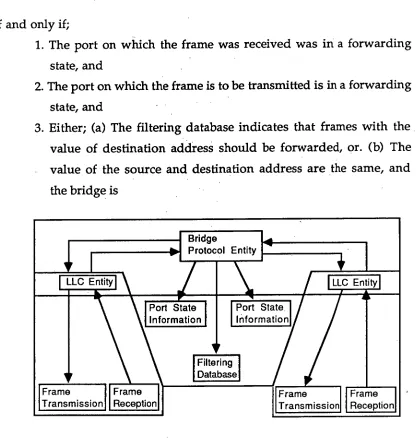
Frames are accepted at one port and delivered to other ports for transmission. The processes included in this MAC relay entity are the Forwarding process, Learning process and Filtering process. The Forwarding process is applied when passing the frame filtering address on the basis of information contained in the filtering database. The Learning process is a process to update the address in the filtering database by source address of the receiving frame. The Filtering process looks at the address information database and decides whether forward or discard the frame.
Each bridge port supports the operation of LLC procedures in order to support the other types of LLC procedure which may be used by other protocols. Figure 3.2 shows the reception and transmission of the Bridge Protocol Data Unit by the Bridge Protocol Entity. Port state information is active when the bridge management permits the port to participate in relaying frames if it is capable of doing so.
Bridge
Protocol Entity
LLC Entity
Port State Information
Port State Information
LLC Entity
Frame Transmission
!
Filtering Database
Frame Transmission
Frame Reception Frame
Reception
if and only if;
1. The port on which the frame was received was in a forwarding state, and
2.The port on which the frame is to be transmitted is in a forwarding state, and
[image:39.553.81.500.76.521.2]3. Either; (a) The filtering database indicates that frames with the value of destination address should be forwarded, or. (b) The value of the source and destination address are the same, and the bridge is
FIGURE 3.2 : SRT BRIDGE OPERATION
configured to not filter such frames in order to support the optional LLC duplicate address check function and
4. The maximum data unit size supported by the LAN to which the transmission port is attached would not be exceeded.
The forwarding process provides buffer storage for queued frames and the order of queued frames should be maintained. A frame queued by the forwarding process shall be removed from the queue if :
be made to transmit the frame on that port even if the transmission is known to have failed.
b. If the time of buffering storage is exceeded for that frame, and not subsequently transmitted.
C. If the frame lifetime is exceeded.
The frame forwarding process considers the priority of forwarded frames. The CSMA/CD access method treats all values of access priority equally.
The learning process observes the source -address of frames received on each port and updates the filtering database. If a frame with a new source address is received then the bridge will file it in filtering database, and if the filtering database is full when a new entry is made then the existing address will be removed to make room for the new entry.
The filtering database contains the address information which is configured by management action (static value) or automatically entered by the learning process (dynamic entry). Static entries can not be removed without management permission.
3.4 THE SPANNING TREE ALGORITHM AND PROTOCOL
The spanning tree algorithm and its associated bridge protocol operate to support the quality of the MAC service. This algorithm and protocol will meet the following goals.
1. To configure the active topology of bridged LANs into a single spanning tree so that there is one route between any pair of end stations.
3. To keep the structure of active topology in a period of time in order to minimize unavailable time of service.
4. Allowing the management to reconfigure the topology to meet the goals of performance management.
5. Operate transparently to the end stations.
6. The communication bandwidths consumed by the bridges in establishing and maintaining the spanning tree should be a small percentage of the total available bandwidths and the high throughput.
In order to develop the Spanning Tree Topology, MAC Bridges require :
1. A unique MAC group address, recognized by all the bridges, which indentifies the Bridge Protocol Entities of all bridges attached to an individual LAN.
2. A unique identifier for each bridge. 3. A port identifier for each bridge port.
4. A means of assigning the relative priority of each bridge within Bridged LANs.
5. A means of assigning the relative priority of each port within an individual bridge.
6. A means of assigning a path cost component to each port.
LAN 5
(1
port portI port
I ■
-
7
port
LAN 3 LAN 4 )
LAN 2
1
port port\J port 11 pont.)
\
..
1
port [image:42.553.82.490.46.480.2]LAN 1
FIGURE 3.3: BRIDGED LANs
The components of the bridge identifier of each bridge, the path cost and port identifier of each bridge port can be managed allowing a manager to select the active topology. Figure 3.3 shows a bridged LAN and Figure 3.4 is its Spanning Tree Topology.
Bridge 1 Bridge ID 42 Root Path Cost 00 Port ID 01
Path Cost 10
Port ID 02 Path Cost 10
C Port ID 01 I
Path Cost 05
1
C
I
Port ID 01 •N
Path Cost 10
Bridge 5 Bridge ID 83 Root Path Cost 05
L 'ort ID 02
.... L.,
Path Cost 05
Bridge 3 Bridge ID 45 Root Path Cost 10
I
Port ID 02 Path Cost 1011I
Port ID 02Path Cost 10
Bridge 2 Bridge ID 97 Root Path Cost 10 Port ID 02
Path Cost 05
I
Port ID 02 Path Cost 05
LAN 4
LAN 1 LAN 2
Cl
Port ID 01Path Cost 05
Bridge 4 Bridge ID 57 Root Path Cost 05
I
Port ID 02 Path Cost 05 [image:43.554.55.492.88.505.2]( LAN 5 )
FIGURE 3.4: SPANNING TREE TOPOLOGY
3.5 BRIDGE MANAGEMENT
The configuration management is responsible for the identification of communication resources, the supply of operational parameters, and the establishment and discovery of the relationship between resources. These facilities allow management to :
a.identify all bridges and their respective location and
b. identify the location of specific end stations for a particular individual LAN in bridged LANs.
c.be able to remotely reset and reinitialize specified bridges.
d. be able to control the priority of bridge port in forwarding frames. e. be able to set up a specific configuration of the spanning tree. f. be able to control the transmission of frames with specific group addresses to certain parts of bridged LAN.
The fault management is responsible for fault prevention, detection, diagnosis and correction. This facility provides the ability to identify and correct the bridge malfunction induding error logging and reporting.
The performance management is responsible for evaluation of the performance of communication resources, and is also responsible for evaluating the effectiveness of communication activities. These facilities provide the means to acquire statistics regarding performance and traffic analysis.
The security management is only responsible for protection of resources. The accounting management provides the identification and distribution of cost and the setting of charges. Unfortunately, there is no specific facility for the security and accounting management.
frame receiving, frame filtering, frame discarding, frame forwarding and other functions of frame relaying. The entities includes bridge configuration, and port configuration. For further information is in [12].
3.6 DISCUSSION
Source Routing Transparent Bridge (SRT) overcomes the interoperability problems between Source Routing and Transparent Bridging in bridged Local Area Network. This bridge acts as a Source Routing Bridge when forwarding Source Routing Frames and acts as a Transparent Bridge when forwarding Ethernet Frames. This mechanism is based on Routing Information Field of frames containing a Routing Information Indicator. When Routing Information Indicator is equal to one then the frame is treated as Source Routing Frame and if a frame contains Routing Information Indicator which is equal to zero then the frame is treated as Ethernet Frame. The main advantage of such bridge is that there is no translator required for connecting 802.3 and 802.5 LANs. In general, this concept is excellence but some difficulties remain unclear because this proposal is still not complete yet.
frame before sending to Ethernet. As mentioned in SRT Draft that some small changes for Source Routing Operation should be done so that a small change of Source Routing Algorithm can be included whereas Transparent bridge remains unchanged. The maximum frame length is the maximum frame size that is supported by all LAN types in bridged LANs. Otherwise, it may be constrained by the owner.
The problem of different frame format is not mentioned in the SRT draft proposal. This problem can be simply handled by one of the following categories of bridge operation [3]:
a. Passthrough Bridge : A bridge between two local area networks whose Data Link functions and addressing system are identical can pass frames through without changes.
b. Translation bridge : A bridge between two local area networks whose Data Link functions and addressing system are sufficiently similar (but not identical) may translate Data Link protocol to communicate between dissimilar networks.
c. Encapsulation Bridge : A bridge between two local area networks whose Data Link functions and addressing system are sufficiently dissimilar (infeasible for translation) may encapsulate a frame. In this case a frame that come from LAN A will be encapsulated by the bridge using Data Link format of LAN B so that the frame can then easily travel on LAN B.
of 6 bytes, but it may be necessary for a station to have a particular software in order to extract the information contents of frames. This software should have the ability to decide which frame is Token ring frame or Ethernet frame because the extraction of information is different between Token ring frame and Ethernet frame. Using such a system, the different frame formats are no longer a problem.
In Section 2.5, it is mentioned that 802.5 MAC frames have priority bits whereas 802.3 MAC frames have none. A small problem arises concerning the priority bits when Ethernet station sends frames to Token ring stations. In such case, bridge may give high priority to Ethernet frames before sending them to Token ring stations because they have been probably suffered a long delay due to collision.
The problem about A and C bits in the frame status field of 802.5 MAC frames still remain unclear in the SRT draft proposal. These bits are set by the destination station to tell the sender that the frame has been already copied. To overcome this problem, the bridge must wait for a replay from destination station before informing the source station whether the frame has been copied or not. Unfortunately, such solution will increase the transmission delay. The best way is to provide a command for checking the destination station whether it is on or off, before sending a stream of frames.
spanning tree configuration thus guaranteing a path along the spanning tree for frames sent without routing information, on the other hand SRT bridge supports Source Routing and provides at least one path for connecting two LANs. From customer's point of view, SRT bridge provides an opportunity to expand the existing LANs by connecting it to other similar LANs.
Chapter 4
PERFORMANCE ANALYSIS
This chapter will consider performance analysis for both Source Routing and Transparent Bridging Methods in bridged Local Area Networks. In each method, it set up a model of the system and then both simulation and queuing analysis will be employed. The simulation analysis will use the SIMSCRIPT simulation program to calculate the delay and throughput of the system. The queuing analysis will be derived based on the access strategy which is used in each bridged LAN.
4.1 PERFORMANCE ANALYSIS FOR SOURCE ROUTING 4. 1. 1 Mathematical Analysis
The bridged LANs topology which will be analyzed is made up of three serially connected LAN segments with one bridge connecting each of the two links. This topology is simply drawn as follows :
FIGURE 4.1: THREE CONNEL EL) LAN SEGMENTs
FIGURE 4.2: TOKEN RING QUEUING SYSTEM
Since the token ring uses a token circulated around the ring of N stations, it is apparent that the system has one server and there are N queues of station around the ring. The arrival rate of frames at all stations is assumed to follow Poisson Distribution and the service time follows Exponential Distribution. The service time of this system consists of two components which are the frame transmission time in each station and the propagation delay around the ring/round trip delay.
If t = round trip / propagation delay ti = frame transmission time at station i N = the number of station in particular ring then the service time (ts) will be
t5 =t +
E
ti (4.1)Let the average length of frames is m and the speed of station i on that particular LAN is q then,
ti = m/q (4.2)
If the speed of a station is the same as the other stations then Equation (4.1) will be,
As shown in Figure 4.2 that Xi is the average arrival rate of frames in station i. For the whole system the average arrival rate of frame is X, where :
N.
A. = (4.4)
i=1
To further deal with queuing analysis, the following symbols are required to simplify the problem.
tw = waiting time in the queue tq = total time spent in the system
(waiting time in the queue + service time) q = the number of frames in the system
w = the number of frames in the waiting room/buffer p = the utilization factor of the system
E(L) = average waiting time E(t) = average service time
E(tq) = average total time spent in the system
t = tw + (4.5)
E(tq) = E(ç) + E(t) (4.6)
From Little's Formula :
p = X . E(ts) (4.7)
E(w) = A.. E(t) (4.8)
E(q) = A. . E(tq)
= X . E(tw) + p (4.9)
By assuming that the buffer capacity is unlimited then the average number of frames in the system is E(q), where
E(q) —
P
(4.10)hence,
E(tq) = E(q) — =
p
X X(1-p)E(t)
(4.11)(1-p)
A particular LAN which will be analyzed has a speed of 4 Mbps, the number of stations attached to the ring is 25 and the ring size is about 600 m. The propagation delay of the twisted pair cable is taken as 5 ps per km. If the average frame size is 1 kbyte (1024 bytes), according to Equation 4.3, the service time would be :
t N tsyncronization
= 3 ;Is + 25* (1024*8/4.106) s = 51.203 ms
The average time spent in the system is a function of system utilization or throughput (utilization * max bitrate), see Equation 4.11. Using this equation the time delay will increase as the increasing of throughput as shown in Figure 4.3. It can be seen that the delay is small as the throughput is increased to 75 % of utilization or at the throughput of 3 Mbps.
1200
as
-6 1000- CD
800 -
600
400 -
200 -
0
2 3 4 Throughput
[image:52.553.80.479.432.744.2](Mbps)
• Delay
• The number of
frame in Buffer
30
20
1 0
Throughput (Mbps)
4. 1. 2 Simulation of Token Ring
[image:53.554.86.516.126.460.2]The characteristics of the delay using simulation agrees with the mathematical analysis. Figure 4.4 shows the curve of delay vs throughput and the number of frames waiting for the server vs throughput. This simulation data can be seen in the appendices (Appendix 1).
FIGURE 4.4: DELAY & NUMBER OF FRAMES IN BUFFER VS THROUGHPUT
The average number of frames waiting and the delay time increase rapidly when the throughput is more than 75 %. In the simulation, the utilization is increased by adjusting the average of the arrival rate of frame in every station. It assumes that every station has the same priority to access the token so that the queuing system is FIFO (First In First Out), and every station has the same average frame of arrival rate.
4. 1. 3 Simulation of Source Routing
5000
>. 4000 -
cø
3000 -
2000 -
1000 -
due to the queue in the bridges.
n LAN 1 to LAN 3 • LAN 1 to LAN 2 ci Delay in LAN 1
[image:54.554.86.514.131.358.2]3 Mbps
FIGURE 4.5: DELAY VS THROUGHPUT
This simulation assumes that the frames generated in every station in LAN 1 have a probability of 60 % to travel within the local ring (LAN 1), 20 % to travel to LAN 2 and another 20 % to travel to LAN 3. The frames generated in LAN 2 have a probability of 60 % to travel within ring 2 (LAN 2), 20 % to travel to LAN 1 and another 20 % to travel to LAN 3. The frames generated in LAN 3 have a probability of 60 % to have a destination station within LAN 3, 20 % within LAN 2 and another 20 % within LAN1. The generation of random numbers is needed to decide whether a frame is travelling within a local ring or a different ring. These values are selected for convenience and are representative of real traffic destination. Figure 4.6 describes these percentages.
[image:54.554.102.498.625.725.2]The speed of the bridge chosen is very slow at 56 Kbps[16] whereas the LAN speed is 4 Mbps so that the delay in the bridge is big for the frame length of 1 Kbyte as follows.
Delay = 1024 * 8 /56000 = 146.286 ms
Because of this high delay in the bridge, the frame which travels to different rings suffers long delay due to the queue at utilization above 60%. Ring 2 suffers the highest delay compared to ring 1 and ring 3 because ring 2 is responsible for the passage of frames from LAN 1 to LAN 3 and from LAN 3 to LAN 1. Ring 1 and ring 3 suffer delays which are almost the same. These data can be seen in the appendices (Appendix 3).
4.2 PERFORMANCE ANALYSIS OF 802.3 LANs 4. 2. 1 Mathematical Analysis
A Two-way B Terminator
[image:56.553.131.491.60.226.2]I
4■
I
FIGURE 4.7 : CSMA/CD REPRESENTATION
Suppose m is a message length in seconds which is message
length/channel speed. Figure 4.8 shows how to reschedule transmission.
Collision interval I 4
--011■ I
14.._
Time to detect a collisionI ,c I 2 12T I t I —god 1.4._ Sensing time
4
ed
t v = Virtual transmission time
FIGURE 4.8 : RESCHEDULING TRANSMISSION
In collision interval, there is a number of retransmissions. Suppose
j is the average number of retransmissions before success. The worst-case
detection of collision is twice the end-to-end delay, as shown in Figure 4.9.
A
time
12
FIGURE 4. 9 : DETECTION TIME
The average transmission delay can be calculated as follows[2] :
=m +t
+2
(4.12)
[image:56.553.138.446.568.695.2]if a = t /m then
t = m[ 1 + a(1+2j) ]
(4.13)
Channel utilization will be
1
(4.14)
P
=
mit
" — 1 + a(1 + 2j)
end-to-end
delay
where a =
packet length / channel speed
It is shown in the above formula that 'a' is an important factor to
adjust channel utilization. The utilization can be increased by keeping the
value of 'a' small. This can be done either by shortening the cable length
or by reducing the transmission capacity in bps ( bits per second) to increase
the value of m.
To further analyse the system, it is necessary to find out the value
of j. It is assumed that the length of the collision interval is geometrically
distributed in units of 2T with a probability parameter v [2]. The probability
of one unit long (Zr) is v, the probability of two units long 2(2t) is v(1-v),
the probability of three units long 3(2t) is v(1-v)
2
and so on. Using this
assumption, the average number of retransmissions j is shown in Equation
4.15.
00
=
kv _ =
(4.15)
k=1
Suppose there are n stations (n»1) involved in the system. Let the
probability that one station wants to transmit a frame in a 2t interval is p
then the probability that exactly one station transmits and succeeds is shown
in the following equation.
v = np (1 - p)'
...(4.16)
the number of station (n»1).
v
max
= (1 - 1/nr
i
(4.17)
If the number of stations n is very large (n .) then the value of
V
max
approaches
v
m = e
ax -
-1
for n
Using this value then the minimum value of j in Equation 4.15
becomes e or 2.71828 and Equations 4.13 and 4.14 become respectively 4.18
and 4.19.
= (1 a)
tv(minimum)m+ 6.44
(4.18)
1
(4.19)
Pmax - 1 +
6.44a
The analysis of transmission delay of CSMA/CD has been derived
in detail in [11,10,2]. Figure 4.10 is an illustration of the "Transmission
schedule". Assume the message arrival follows the Poisson distribution
process with X. messages per seconds. The transmission time of each message
is assumed to be independent identically distributed random variable with
Probability Distribution Function (PDF) 13(x), mean value m, second
moment m
2
and its Laplace transform P*(s)[11]. Refer to Figure 4.9 and
4.10, the transmission time is actually
channel sensed idle Collission detected
111' end of transmission 4'
n Transmission iv
—
-4 Yn+1 Xn+1
Un+1 arrivals Vn+1 arrivals Success detected
n+1 Transmission
[image:58.553.159.455.611.715.2]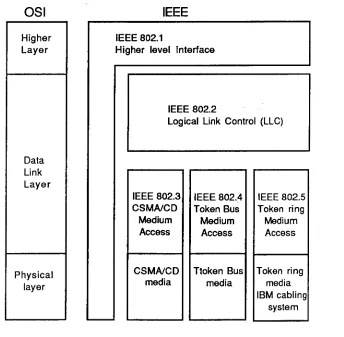
![Figure 2.5 shows the MAC frame format of the IEEE 802.3 LAN[13].](https://thumb-us.123doks.com/thumbv2/123dok_us/8473706.340907/22.556.105.497.417.620/figure-shows-mac-frame-format-ieee-lan.webp)