REPEATED INTERVIEWS
ROSLYN M.BADCOCK
_may never have been completed.
Firstly my parents for their love, support and proof
reading.
Athalie Lane whose skills in octopus making and
organization were never ending and encouraging. Also
Matthew and Julia for relaying telephone messages and
supporting their mum.
My supervisor Gemma O'Callaghan for her never ending
guidance and knowledge
I would also like to thank all the four year old children I
had the pleasure of interviewing and their parents My
thanks also to the directors and staff of all the creches
and kindergartens involved who made me feel welcome.
To Helen Hornsby for her statistical brilliance and Mac
skills. To Maurie Gourlay and Andre de Clerk who
understood. To wonderful Kate Savage who kept me
calm at the last. To Marie Ayre for ongoing counselling.
And to all my fellow students.
Page
Abstract
1. Introduction 1
2. Memory for Witnessed Events 5
2.1 Testimony Memories 6
2.2 Prior Knowledge Interactions 7
2.3 Retrieval Mechanisms Available to Children 8
2.4 Salience of Original Memory Trace 9
3. lnterveiwing Techniques 1 2
3.1 Context Reinstatement 1 2
3.1.1 The Cognitive Interview 1 3
3.1.2 Physical Reinstatement 1 5
3.1.3 Props Reinstatement 1 6
3.1.3.1 Children's Understanding of Props 1 9
4. Leading Questioning 2 2
4.1 Central versus Peripheral Events 2 5
4.2 Mnemonic and Social Factors in Suggestibility 2 6
5. Repeated Interviews 2 8
6. Aims of Research 3 4
7. Method 3 6
8. Results 4 4
9. Discussion 5 O
9.1 Props: Effect on Accurate Recall 5 O
9.2 Misleading Suggetions: Effects on Accurate
9.4 Limitations of current study and future
directions
9.5 Summary and Conclusion
References
Appendices
A Letter to Parents and Consent Form
B Subject Profiles
54 57 58
C Standardized Questioning Procedure for Memory for
Objects
D Standardized Questioning Procedure form
E Objective Questions
F Misleading Questions
G Driscoll Playkit and dolls
H Checklist for the Observer form
Photo line up
J Visitor Script
K Scoring Forms
Anova Analyses Within Subjects
Anova Analyses Between Subjects
T-Test Analyses
recall accuracy of preschool children when misleading suggestions
were provided in a repeated interview situation. The subjects were
64 four year old children who participated in a home visit followed
by questioning either one day and one week later or one week later.
Results showed no significant effects from the provision of props or
from misleading suggestions in repeated interviews. That is
children's abilities to accurately recall memory for events was not
affected from the provision of props, or the inclusion of misleading
suggestions in repeated interviews. The implication of these
findings are discussed in terms of the reliability of child eye witness
1. INTRODUCTION
Children often witness, or are themselves victims of, crime. However, their evidence is constantly questioned and disregarded in court due to perceived inabilities to accurately recall their memories. This study aims to investigate the role of props to enhance the accuracy of preschool children's recall for events. The role of props is also investigated with misleading suggestions and repeated interviews.
It has been shown that children report only small amounts of information when asked to freely recall an event but this information has been found to be accurate (Ceci, Toglia & Ross, 1987). In contrast, children report more detail when objectively questioned · about an event, but this information may not be as accurate or reliable as their free recall (Ceci, Toglia & Ross, 1987). This pattern of recalling information is also found in adult populations; however, the amount of information retrieved increases as a function of age. Research has focussed on the processes of memory and developmental differences (Marin, Holmes, Guth & Kovac, 1979).
from internal sources, such as expectation about whaf normally
happens in a particular event, and from external sources such as
misleading information (Goldmeier, 1982). Reconstruction in this
sense has a negative effect on the memory trace.
A number of possible causes for children's inferior memory have
been suggested. (1) Children are described as wanting to please
their questioners (McCloskey & Zaragoza, 1985). (2) The adult
questioning the child is often perceived as the authority by the child
(Ceci, Ross & Toglia, 1987). Children are likely to be inhibited by such individuals thus curbing their responses to questions. This has
relevance when the child is asked misleading questions, for
example in cross examination. Children are likely to doubt their
own memories and trust the authoritative figure. (3) When children
are repeatedly asked the same question they may change their
response presuming the initial response was incorrect (Nelson,
Dockrell & McKechnie, 1983). (4) Finally, it is presumed that
children's memories may fade more quickly than adults thus
predisposing them to accept misleading information (Loftus &
Davies, 1984). Any combination of these factors may be present
when children are questioned.
Recent research has focussed on retrieval methods to enhance the
recall of children and to eliminate the effects of misleading
information. These techniques have endeavoured to reinstate the
the cognitive interview (Geiselman Fisher, MacKinnon & Holland, 1986), physical reinstatement (Wilkinson, 1988) and the use of
props (Goodman & Reed, 1986) to mentally reinstate the scene.
Props have been found to interact with both accurate and inaccurate
freely recalled information in young children (four and five year
aids), but not necessarily three year olds(O'Callaghan & Sosic,
1993). However, this effect was not found in objective questioning,
that is, props neither hindered nor enhanced children's recall.
In addition central events appear to be more resilient in the human
memory when compared to peripheral events (Goodman, Aman &
Hirschman, 1987; Peters, 1987). Even though a developmental
effect can be found for susceptibility to misleading suggestion, it
appears that children, and adults alike, are able to resist misleading
suggestion when directed at central events.
Child eyewitnesses are subjected to multiple interviews by many
professionals. Multiple interviews subject the memory to the effects
of reconstruction (Goldmeier, 1982) and authoritarian influences
leading to inaccurate memory retrieval (Ceci, Ross & Toglia, 1987). Children are also found to report additional information after a long
delay following the first interview (Howe & Brainerd, 1989; Brainerd,
1985). It has been noted that this new information may be
inaccurate or accurate. Such influences may be accountable for
children's susceptibility to suggestion; however, the memory
single session but not neccesarily when an interview is repeated
(Dent & Stephenson, 1979; Tucker, Mertin & Luszcz, 1990).
This paper reviews current research and theory of children's
memory and recall abilities. The provision of props to enhance
recall is evaluated in conjunction with misleading suggestion and
2. MEMORY FOR WITNESSED EVENTS
An understanding of memory processes is essential in appreciating
the processes involved in eyewitness memory. The witness of an
incident may be actively involved in that incident or may be an
onlooker. In either case a memory trace forms in the mind of the
witness of the incident. The memory trace is subject to fading over
time. Fading refers to the natural decay of aspects of a memory
trace over time, with the central information or gist of the memory
trace generally remaining while peripheral information is lost
(Goldmeier, 1982). The act of retrieving a memory trace reduces the
effects of fading, thus facilitating the next attempt to retrieve that
memory trace (Flavell, 1985). However, the act of retrieval also
allows for the reconstruction of a memory trace. Reconstruction
refers to the importation of associated material into a memory trace
from internal sources, such as expectations, about what normally
happens in a particular event, and from external sources, such as
misleading information (Goldmeier, 1982). Therefore, if a witness
accepts misleading information, for whatever reason, it is
internalized and may be incorporated in the reconstructed memory
trace.
The act of remembering involves the combination of three
processes; encoding, storing and retrieving. Baddeley (1990) likens
these processes to a library. Memory and a library are similar in the
in a structured systematic way, with the retrieval of information
depending on the initial 'cataloguing' or encoding. An efficient
encoding and retrieval system should allow for all memory needs to
store information in a way that will allow that memory to be
accessed for many different purposes. The flexibility with which we
retrieve information from memory for novel and unanticipated
reasons is one of the most important and intriguing features of
human memory.
2.1 Testimony Memories
Brainerd and Ornstein (1991) have examined closely the type of
memories involved in testimony. They describe an interesting
combination of incidental and deliberate memory that can be both
spontaneous and prompted. When witnesses (child or adult) are
interviewed about an eyewitness memory they are asked to
describe an event from incidental memory, that is memory that
occurs when information in unintentionally processed. A witnessed
. event may seem unimportant to a child who is often asked questions
many months after an incident (Tucker, Mertin & Luszcz, 1990). A
child may not expect to remember details of a witnessed event. As a
result strategies which enhance the storing of information may not
be used at the time of witnessing the event. Therefore, information
that is recalled when questioned later is of an incidental fashion.
Later this becomes memory as the child is questioned repeatedly.
At this point strategies for retrieval are involved and may determine
When questioned in a legal context, the memories under
consideration are those that typically involve the recall of personally
experienced (either as participant or eyewitness) and highly salient
or meaningful events. However, these events have usually
occurred some time ago and the memories can change due to
further development of the child both intellectually and socially
(Brainerd & Ornstein, 1991 ). This poses problems for the questioner
in determining which pieces of information are actual memories and
which are reconstructed over time.
2.2 Prior knowledge interactions
Research indicates that prior knowledge affects how one monitors
the world, how information is coded and placed in memory, and how
it is subsequently retrieved (Chi, 1978; Chi & Ceci, 1987). One
implication of the literature on children's knowledge is that with the
passage of time, information in memory has been shown to be
altered and interpreted more consistently in the light of prior and
subsequent information. That is to say, memory may become more
reconstructive and less reproductive (Brainerd & Ornstein, 1991 ).
Research has also indicated that young children are readily able to
construct scripts or event representations of familiar routines
(Fivush, 1984; Nelson, 1986; Nelson, Fivush, Hudson & Lucariello,
1983). Scripts are generalized plans for dealing with specific
situations (e.g., a restaurant script, a school script). Younger
children have concrete, simple scripts which become increasingly
abstract and complex with age and experience. Older children are
reconstructing a specific event. Thus, they may add script details
which may not have been part of a specific experience (Nelson,
1986). Brainerd and Ornstein (1991) warn that we must be
concerned with the possibility that their delayed memory reports
may be generated on the basis of this underlying knowledge. For
example, the details of a particular day in school may be lost, and a
child's recollections may quite unconsciously be governed by his or
her general knowledge of the routines of school (Myles-Worsley,
Cromer & Dodd, 1986).
2.3 Retrieval mechanisms available to children
The number and variety of retrieval mechanisms available to
children theoretically affect a child's capacity to recall events. Yuille
(1988) has proposed that retrieval strategies are acquired with age
and the younger the child the less the number of recall strategies at
his/her disposal. It appears that the fewer the pathways to the
memory of an event, the poorer the recall for the event. Also, some
recall strategies are superior to others in aiding the retrieval of
information (Geiselman, Fisher, Mackinnon, & Holland, 1985). The
younger the child, the less likely it is that he/she will spontaneously
use the most effective recall techniques (Paivio & Yuille, 1966, in Yuille 1988). The development of effective retrieval aids is essential
in working with young children.
The importance of appropriate retrieval cues used in questioning
cues are effective for retrieval if, and only if, the cues provided have
been encoded as part of the information to-be-retrieved (Tulving &
Thomson, 1973). The relevance of this principle to the recall of
young children is that cues or questioning posed by adults may be
singularly inappropriate, as the child has conceptualized the event
very differently from the way an adult would. Further, the meanings
the child gives to certain words and sentences may be different from
that given by adults. Indeed, failure to recognize differences in
conceptual and linguistic systems may result in the child being
unable to recall information, available in his or her memory or, even
worse, to give irrelevant and inappropriate information (Thomson,
1988). The development of appropriate retrieval cues is essential in
utilising children's testimony.
2.4 Salience of original memory trace
There is considerable debate as to whether the initial memory trace
is altered as a result of questioning (Loftus, Miller & Burns, 1978;
Mccloskey & Zaragoza, 1985; Zaragoza, 1987). A number of
hypotheses have been developed to explain children's recall when
misleading information has been provided and incorporated in the
memory trace. The first possibility has been referred to as the
"erasure" hypothesis (Loftus & Loftus, 1980; McCloskey & Zaragoza, 1985). According to this hypothesis, the original memory of a child
is overwritten by the suggested information. Thus the original trace
is permanently lost. Another explanation has been called the
they saw but refrain from selecting it for a variety of reasons, many of
them social (i.e., not having to do with memory processes per se in
nature). For example , they will choose the alternative information
because they remember that the adult suggested it was true, and
the adult must know best, even when they actually remember the
correct information. Or, children may select the biased information
because of a wish to please the adult who made the erroneous
suggestion. Finally, they may choose the alternative information if
they lost all memory of the event but vaguely remember something
having been said. There is no shortage of non-mnemonic
explanations for young children's susceptibility to misinformation
(Ceci, Toglia & Ross, 1990). This issue is discussed in greater detail in chapter 4.
One of the most important findings of this research is that regardless
of the nature of the recall demand, information about activities
performed by self is recalled at a significantly higher level than
information regarding activities performed by others (Baker-Ward,
Hess & Flannagan, 1990). Therefore, children's memories would
appear to be influenced by the degree of participation in an incident.
This has implications for questioning children and using leading
questions.
Recent research has shown that children retain memories for salient
and meaningful events, for example, a class trip (Fivush, Hudson &
(Goodman, Aman & Hirschman, 1987). In addition, these memories
can be quite good over extended periods of time. In a study
reported by Brainerd and Ornstein (1991) Ornstein, Gordon, and
Braddy (in press) examined 3 and 6 year olds' retention of the
details of a visit to the pediatrician for a physical examination.
Children, at both ages, remembered most of the features of the
check up on an immediate test. The performance of the 3 year olds
decreased over delay intervals of one and three weeks, but was still
impressive. However, the memories of older children were constant
over this period. Unfortunately, little research has been conducted
to examine children's long term retention abilities, for example, over
periods of months and years. Children are often asked to recall
events over these periods of time.
Children's abilities to accurately recall memories of events can be
influenced by a number of factors; for instance, the type of retrieval
method employed by the examiner, misleading suggestions and the
number and frequency of interviews. Each of these issues are
3. INTERVIEWING TECHNIQUES
The need for effective interviewing techniques to enhance children's
recall for events is apparant, due to their inferior performance when
compared to adults. A variety of approaches have been
recommended for use with young children. One method of
enhancing children's recall was employed by Maston (1987). In this
study children were interviewed in pairs about a witnessed event.
The results showed an increase in the amount of accurate recall of
these children compared to children interviewed individually. A
further study of Maston and Engelberg (1992) extends Moston's
previous work. The study proposed that the presence and support
of friends during the giving of evidence is not likely to harm, but
rather facilitate accurate testimony. Children aged seven and ten
years interacted with a stranger. Later they were asked to recall the
incident, and to answer a series of questions, some of which were
leading. The findings of the study showed that, (1) having the
chance to discuss with fellow pupils who had not been present did
not in itself facilitate recall, (2) nor did the presence of another pupil
at the time of the interview; however, (3) the combination of the two
did significantly facilitate recall, and, also increased resistance to
leading questions. These effects were found for both age groups.
3.1 Context Reinstatement
Many other innovative approaches to reinstate the child's memory
for events have been researched in recent years. These include the
witness of a crime. In contrast the method of context reinstatement
physically places the witness back into a scene. Finally the use of
props provides an avenue for reinstating the scene in the mind by
use of imagination. Each of the methods of reinstatement are
examined below.
3.1.1 The cognitive interview
Researchers involved in improving police interviewing proposed the
cognitive interview technique in order to enhance recall (Geiselman,
Fisher, MacKinnon & Holland, 1986). The cognitive interview is an
alternative memory enhancng technique, free from the
psychological and legal constraints of hypnotically-induced
testimony. Two generally accepted cognitive psychological
priniciples of memory underpin the technique. Firstly, the memory
trace is composed of several features and the effectiveness of a
retrieval cue is related to the amount of feature overlay with the
encoded event, which is a statement of encoding specificity, and
secondly, there may be several retrieval paths to the encoded event
so that information not accesible by one retreival cue may be
accessible by a different cue (Roy, 1991).
The basic cognitive interview consists of four retrieval mnemonics.
Two mnemonics increase the feature overlap between the encoding
and retrieval. The first mnemonic is mentally to reinstate the
environmental (external) and personal (internal) context that existed
everything even partial information, regardless of the perceived
importance of the information. Two further mnemonics encourage
the use of several retrieval paths; recount the events in a variety of
orders and report events from a variety of perspectives. In addition
to the four mnemonics, a series of specific techniques was
developed to elicit specific information about physical appearance,
names, numbers, speech characteristics and conversation.
The value of the basic cognitive interview in enhancement of recall
is suggested by research evidence. Geiselman et al. (1986) found
the cognitive interview to heighten the witness's resistance to
misleading questions as evidenced by the large number of
unsolicited comments by the eyewitness regarding the misleading
information.
It is suggested that the cognitive interview either prevents the
original memory trace from being altered or prevents a competing
trace from being stored (Roy, 1991 ). The usefulness of the cognitive
interview has been tested, only minimally, with children (Geiselman
& Padilla, 1988). Children aged seven and twelve years were subjects and seemed capable of employing the specific procedures
necessary to use the technique. Overall they showed a twenty one
per cent improvement in recall relative to uninstructed control
subjects. However, the cognitive interview groups also showed
increased levels of confabulation, suggesting further development
of the cognitive interview may be necessary before advocating its
suggested that the cognitive interview requires modification and
further testing if it is to be used successfully with child witnesses
(Memon & Kohnken, 1992). These findings are based on work with
children no younger than six years of age and therefore the
likelihood of success with younger children is minimal.
3.1.2 Physical reinstatement
Wilkinson (1988) has been studying a technique to overcome some
of the difficulties children have in reporting their memories. This
retrieval technique re-instates a scene physically. Results indicate a
much higher level of accuracy and completeness in the children's
recall. The study involved pre-school children, aged three to four
years from whom it is particularly difficult to obtain verbal testimony.
The children were taken on a walk during which they witnessed an
incident. The following day half of the children were walked around
the same route, whilst being asked questioned about the witnessed
event. These children produced superior recall compared to a
control group who were asked questions about the incident, in a
room of their nursery school. The presence of contextual cues,
available on the walk, increased total recall from the 48 per cent
recorded by the control group, to an average of 80 per cent from the
experimental group. In addition, this increase did not appear to be
associated with an increase in confabulation engendered by the
presence of cues. Whilst these results are impressive their practical
application in the witness context is limited. That is, it would not
either due to stress factors placed on the child, or lack of knowledge
about the actual scene.
The exciting features of the studies by Wilkinson (1988) and Maston
(1987) are pointed out by Dent (1988) who suggested that access to
children's recall can be obtained without the distorting effect of
standard interviewing procedures. In addition the physical and
social setting of an interview appear to have a potentially strong
influence on levels of recall. Young children's recall of events
experienced in natural settings and embedded in their daily lives
leads to much higher estimates of their memory competence than
that based on artificial tasks learned in the laboratory (Davies,
1991 ).
3.1.3 Props Reinstatement
A further retrieval technique which may have more success with
very young children was suggested by Goodman and Reed (1986)
based on previous work by Price (1984) is the use of props. Such
props may consist of miniature figures and settings. These
researchers recommended the use of these props to facilitate young
children's reports by mentally (rather than physically) placing
children back in the original context of the event. Early support for
the investigation of such general props to enhance the reliability of
report from children younger than 5 years of age came from Cole
and Loftus (1987). However, props have been found to be more
complex than originally thought.
anatomically correct dolls in investigation of abuse. Some empirical support is now emerging for the use of such cues with child sexual abuse cases (Goodman & Aman, 1990) although these dolls may invite predictable play patterns which do not necessarily represent actual experienced or witnessed events (King & Yuille, 1987). There is concern however, that more investigation is needed to establish the appropriate conditions for their use (Cashmore & Bussey, 1987). Some therapists argue that the dolls should be banned on the grounds that they act as a catalyst for the release of misleading and fantasy based testimony (Yates & Terr, 1988). Recent research suggests lack of the development of appropriate norms for the use of anatomically correct dolls limits their suitability (Skinner & Bery, 1993).
Within free recall props appear to encourage some fantasy. Further
evidence suggests that the younger children may be susceptible to
perceived task demands when caregivers were present under props
testing conditions, for instance producing some response, even
though not accurate, to please the caregiver (O'Callaghan & Sosic, 1993).
Price and Goodman (1990) found that props did facilitate recall in
two and a half, four and five and a half year old children, compared
to when props were not provided, but not as much as when children
were replaced in the original context of an incident. The experiment
involved children in a series of tasks which they later recalled using
props. The props were exact replicas of materials used in the tasks,
leaving no doubt for the children that the models represented the
materials used in the tasks. Therefore, the findings have limited
application when children are the only witnesses of an event where
such detailed information would not be available to an interviewer.
In direct contrast, the studies by O'Callaghan and D'Arcy and
O'Callaghan and Sosic used props that were not as specific. That is
only general non detailed props were used in these studies which
required the children to make use of transference abilities. Such
abilities are discussed in the following section. The adaptability of
such general props could be more useful in an unknown crime
situation. However, the positive benefits would only be produced if
the children were able to understand the use of general props.
Many children lack the abilities to adequately understand the use of
props are present. Confusion may lead to reduced accuracy in the
children's recall.
3.1.3.1 Children's understanding of props
Some insight into the problems, mentioned above, that children may
have in utilising props to enhance recall has been provided by
Deloache (1991 a), Deloache, Kolstad & Anderson (1991 ).
Detection of correspondence is central to a child's understanding of
a scale model as representing life-size objects. This involves the
classical areas of transfer and analogical reasoning. Both transfer
and analogical reasoning depend on recognition of the
correspondence between two entities, x and y. Something about
one's perception of y provides access to one's knowledge
representation of x. That knowledge can then be used to help
achieve a better understanding of y. If y fails to activate x, one's
existing skills and knowledge are not brought to bear to
comprehend or solve y. Transfer and reasoning by analogy
require flexible access, the activation of a repre~entation by a
variety of objects or contexts similar, but not identical, to those
involved in acquisition.
The flexible application and accessibility of knowledge appear to be
problemmatic for individuals of any age. These processes have
long been considered especially unreliable early in development,
that is, children's knowledge often seems restricted to the specific
context in which it was acquired (Deloache, 1991 b).
predicting when young children will succeed, or fail, in applying
what they know of one situation to a different one.
A developmental shift was demonstrated in children's ability to
utilise models from two and a half years to 3 years of age
(Deloache, 1991 a; Deloache et. al., 1991 ). Children showed little
evidence of transference at age two and a half, but by age three
evidence of transference was observed. The basic experimental
format involved a child watching as a toy was hidden in a scale
model room. Then the child was asked to find not the small toy, but
a larger toy hidden in the analogous location in the room itself. In
order to find the larger toy, the child has to (1) recognize the
correspondence between the scale model and the larger room and
(2) map the location of the hidden toy in the model onto the
corresponding location in the room (Deloache, 1991 b). The results
of the imitation study support the argument that the underlying factor
responsible for young children's performance in the model task is
whether they realise there is any correspondence between the two
spaces in the first place. As Deloache (1991 b) has pointed out,
children who were aware of the correspondence were able to
transfer the stipulated action across the spaces, whether it is
placing, hiding, or finding a toy, whereas children who were
unaware of the correspondence have no basis for knowing what to
do. Deloache (1991 b) found evidence that even three year aids
needed direct instruction about the correspondence between the
models and the real objects in order to use the model as a
year old children in the O'Callaghan and Sosic study were unable
to use the props as memory aids, because their function as
representations of life sized objects was not directly highlighted, or
the correspondence between the props and original objects was not
salient enough.
To address this concern Heath (1992) attempted to incorporate the
findings of Deloache (1991 a; Deloache, 1991 b) in her study by
providing training in the use of props. She proposed that children
who were shown the use of props by having them modelled would
have less fantasy play, and that children with high rates of
comprehension may be able to use props more effectively Unlike
Price and Goodman (1991) who found children were capable of
using props to enhance recall, children in the Heath study did not
utilise the props as effectively as hoped. Future research should
focus on the limitations of young children's understanding of scale
models. However, investigators of crimes should be wary of the
limitations of reinstating an unknown scene through the use of such
general props. Props need to be of a nature that enables use in a
wide variety of situations but this development is yet to be made.
The development of effective retrieval techniques for use with young
children is one of great importance. The methods mentioned above
offer innovative approaches to reinstating an event. Of particular
interest is the effectiveness of the use of props with preschool
children. This technique will be investigated with particular
emphasis on situations that provide misleading suggestions in
4. LEADING QUESTIONING
Many references have been made throughout this review of
children's susceptibility to being misled. This area is of importance
in eyewitness testimony, and is the source of a large body of
research. For many reasons, it would appear that misleading
information impairs subjects' ability to remember what they
originally witnessed. Results of many studies have lead to the
development of the memory impairment hypothesis (Loftus, 1979a;
Loftus & Loftus, 1980). This hypothesis assumes that misleading
information alters the original information in memory, so that the
original information is lost from memory. This new information
overrides previous information. An alternative version of the
memory impairment hypothesis (Bekerian & Bowers, 1983;
Christiaansen & Ochalek, 1983) assumes that the misleading
information renders the original information inaccessible.
The research investigating suggestibility of children has been met
with contradictory findings (Warren, Hulse-Trotter & Tubbs, 1991 ).
In some previous studies children and adults were found to be
equally suggestible (Marin, Holmes, Guth & Kovac, 1979), whereas
Cohen and Harnick (1980) found children were more susceptible
than adults to suggestive questioning.
In a related study, Goodman and Reed (1986) had three year aids,
six year aids and adults interact with an unfamiliar adult for five
both objective and suggestive questions, to give free recall of the
event, and to identify the unfamiliar adult from a line up. The three
year old children remembered less of the event, and were found to
be more suggestible than the older groups.
The results of other studies in the area were in direct contrast.
These studies failed to find any developmental differences in
suggestibility, or have even found younger children to be less
suggestible than older persons. Marin et al. {1979) exposed
subjects, ranging in age from five to twenty two years of age, to a
live altercation. Each subject was asked to give a narrative account
of the event, answer some questions (both leading and non leading)
about the event, and identify the assailant from a lineup. Although a
strong suggestibility effect was found, the effect did not vary with the
age of the eyewitness. Subjects of all ages performed worse on the
leading question. Murray {1983, cited in Loftus & Davies, 1984)
presented seven to eleven year old children with a picture story.
Children's memory of the story was probed with either neutral or
leading questions. A day later the children were given a
forced-choice recognition memory task to evaluate the impact of the type of
questioning, and no developmental differences were found for
suggestibility. In another study college students and six, eight, and
ten year old children were shown a slide sequence of cartoons
(Duncan, Whitney & Kunen, 1982). Subjects were given different
types of questions about the slides (informational, suggestive, or
factual). After controlling for the amount of information remembered
the authors reported that younger children's visual memories were
Several reasons for the apparent discrepancies in the findings of
these studies were suggested by Loftus and Davies (1984). These
included the different types of events witnessed, length of exposure
to the event, length of retention intervals, and the type of questioning
used to evaluate the child's memory. This latter point is one of
interest also to Goodman and Reed (1986). One of the most
important basic differences of these studies of suggestibility is that
they used very different age groups that are known to differ in
memory performance (Chi & Ceci, 1986, in Ceci, Ross & Toglia, 1987a). The age of subjects is also an important variable to
consider in studies where developmental differences in
suggestibility were not found. In the majority of these studies very
young children ( ages three to four years old) were not sampled. It
may be that this age group is among the most vulnerable to
suggestibility effects (Ceci et al., 1987).
Preschoolers were assessed for susceptibility to suggestion (Ceci,
Ross & Toglia, 1987b). Subjects were as young as three year aids
to four year aids. In a story telling task children were given
misinformation one day later by both an adult, and a seven year old
child and then examined three days later for suggestibility effects.
The seven year old examiner produced decreased suggestibility but
the result did not conclusively show a prestige effect reported for an
adult examiner. In addition, McCloskey and Zaragoza's (1985)
modified testing procedure was used. In this case adults were also
included. Ceci et al. (1987b) found that adults were also
using the modified testing procedure. However, the most obvious
difference between these authors studies were the age of their
subjects. Ceci et al. (1987b) suggest it could be that preschoolers
are especially vulnerable to suggestion because they lack the meta
mnemonic awareness needed to protect their memory against
intrusive suggestion, and or are less knowledgeable about the need
to be vigilant to information that is counter intuitive or goes against
ones' experiences. However, according to Goodman and Helgeson
(1985), children are not necessarily more suggestible than adults,
but they can be, especially when their memory is weaker or the
questioner is of relatively higher status. It would appear that other
factors are influencing susceptibility to suggestion in young children.
These include whether events are of central importance to children
as well as mnemonic and social factors.
4.1 . Central versus Peripheral Events
The findings of studies by Goodman, Aman and Hirschman (1987)
and Peters (1987) consistently indicate that children and adults
alike are better able to recall central events, activities they have
taken part in, than peripheral events. In addition to these findings,
memories appear to be more resistant to suggestion directed at
central events. One major difference of studies of suggestibility lies
in their ecological validity, In addition these studies tried to improve
on ecological validity, that is an attempt to improve the relationship
with real life events. Some studies have included a stressful event
1987; Peters, 1987). Given the findings it would be expected that
even preschoolers may be able to resist misleading suggestions
when the information is central to their own activities when they are
participants of the event.
4.2 Mnemonic and Social Factors in Suggestibility
Mnemonic factors in suggestibility include the well-known
misinformation effect, in which misleading information presented
after the original event interferes with witnesses' subsequent reports
of recognition of the original information (Loftus, 1975; McClosky &
Zaragoza, 1985). However, memory impairment may be only one of
several causes for the misinformation effect (McCloskey &
Zaragoza, 1985). For example, misleading information may be
presented to subjects who want to be viewed favourably by the
experimenter. If this experimenter has misled these subjects, then
they are likely to report the misinformation and not the original
information (Weinberg, Wadsworth & Baron 1983). Alternatively
subjects may trust the experimenter more than their memory and will
hence report the misinformation as the original details. Dodd and
Bradshaw (1980) found adult subjects to be more suggestible when
the misleading information was presented by a purportedly neutral
bystander to the event than when it originated from a biased source.
Some subjects will remember the critical details of an event and
some other subjects will not. Failure in these cases may be due to
subjects not encoding or forgetting this information. The effect of
repeated questionings may also account for children's apparent
susceptibility to suggestion (Maston, 1990).
events that are weakly held in memory; that is, for whatever reason
the memories have not been encoded and processed sufficiently to
resist misleading suggestions. The present investigation examines
the effects of misleading suggestion with the provision of props to
5. REPEATED INTERVIEWS
Children are known to be routinely subjected to multiple interviews
about the witnessing of a crime. In addition, more than one
professional may question the witness. A number of important
issues needs investigation with regard to repeated interviews, (1)
the impact on the memory trace of repeated questioning, (2) the
effects of the same questions repeatedly asked in the one session
and (3) the effect of multiple interviews over a period of time. These
issues will be discussed in greater detail below.
The impact on the memory trace has positive and negative effects.
As mentioned above the memory is subject to fading over a period
of time. However, retrieving the memory trace reduces the effects of
fading, hence questioning witnesses about memories will maintain
that memory (Flavell, 1985). This clearly is a positive effect of
repeated questioning. A level of processing approach accounts for
how information can be affected by multiple interviews (Craik &
Lockhart, 1972; Tucker et. al. 1990). That is to say, the more
processing occurs with information, the more likely it will be
retrieved. This has both positive and negative results. Aspects of
the memory trace that are called on under questioning are more
likely to be recalled, however, those parts of the memory trace that
are not regularly called on will not be as likely to be recalled at a
later time due to fading. Reconstruction may also be of a negative
influence as distortion by means of incorporating additional pieces
of information may occur and that information may not be accurate
expectation or suggestion. For example, when misleading
questions are posed in one interview, the misleading information
may be reported in a subsequent interview due to reconstruction of
the memory trace.
The effects of repeating a question in an interview with a child have
been reported by numerous researchers (Baker-Ward et al., 1990;
Dent & Stephenson, 1979; Maston, 1987; Neilson, Dockrell &
McKechnie, 1983). There is ample evidence in Piagetian-based
studies of conservation that question repetition within a single
session decreases accuracy when emerging cognitive skills are
tested (Neilson et al. 1983). In addition, Gelman, Meck and Merkin
(1986) demonstrated that children's numerical competence is
underestimated when repeated requests lead to changed
responses.
There is also evidence to suggest that repeated testing, after a
lengthy forgetting interval, may have positive effects on the recovery
of information. Indeed, children seem to be able to refurbish their
memories of witnessed events purely as a consequence of having
those memories tested. In addition, the evidence suggests that
children demonstrate as much improvement, as a function of
repeated testing, as adults do (Brainerd, 1985; Brainerd, Kingma &
Howe, 1985; Howe & Brainerd, 1989). In these studies children and
adults were given a series of four retention tests at intervals of one
and recall performance improved approximately 1 O per cent across
the test. However, the positive effects of repeated testing will
become negative consequences if the experimenter or interviewer
attempts to mislead the subject (Ceci, Ross & Toglia, 1987a;
1987b).
Maston (1990) concludes in his review that the studies of repeated
questions show that when an adult repeats a question that has
elicited a response, children may take this as an indication that their
first answer was wrong and that they should offer a new one. It
would appear that young children change their responses in order
to make social sense of the interview situation. Donaldson (1982)
pointed out that even young children try to understand the purpose
of a repeated question. Rather than taking the question at face
value, they try to satisfy the intent of the experimenter. Siegal,
Waters and Dinwiddy (1988) creatively illustrated this process by
asking children to explain the nonconversation responses of
puppets in a one-question or two-question task: Even four year olds
assumed that puppets, who erred in the two-question task, were
trying to please the adult questioner.
While children are susceptible to response change within a single
session, they are more resistant to change in repeated interview
situations (Dent & Stephenson, 1979; Tucker, Mertin & Luszcz,
1990). Although young children can interpret a repeated question
believe that requests to repeat testimony will always prompt children
to become less accurate. For example, repeated testing is
associated with improvements in recall on serial-learning tasks,
even when subjects are given no opportunity to restudy items, and
this phenomenon has been documented for children as well as
adults (Brainerd, Reyna, Howe & Kingma, 1990 in Howe, 1991 ). In
an attempt to explain this phenomenon Payne (1987) suggests
improvements in recall at longer retention intervals (or
hypermnesia) are only obtained when subjects have the opportunity
to retrieve items during the retention interval.
Repetition in eyewitness procedures has produced mixed results. In
several studies, children who recalled an event on two occasions
actually remembered more than eyewitnesses who participated in a
single, delayed interrogation (Baker-Ward et al. 1990; Fivush &
Hammond, 1989; Goodman, Bottom, Schwartz-Kenney, & Rudy,
1991; Hudson, 1990; Tucker et al. 1990). Thus, between-session
repetition may help preserve event memories, particularly when
questions in the initial interview prompt for specific information. In
contrast, Maston (1987) found that repetition reduced the number of
correct, but not the number of incorrect replies for children age six to
ten. Because repetition after a period of one day does not
negatively affect children's testimony (Dent & Stephenson, 1979),
Maston concluded that his subjects deliberately changed responses
when the question was repeated, a finding consistent with
Together the studies mentioned above illustrate no uniform effect of
question repetition on children's performance. Rather, repetition
effects are probably a function of many variables, including timing
(within session or between session), the nature of the material to be
reported (central events or details), and the pragmatic meaning
associated with repetition for subjects of various ages. In a current
review (Bussey, Steward, Pipe, Peterson & Lawrence, 1992) one
finding was that after delays of one year after intial interviews
children's free recall was brief. In addition, children recalled similar
amounts of detail but half of this was new information. Of this new
information half was inaccurate.
A further factor affecting the testimony over repeated interviews is
the stress involved of such interviews. Goodman and Helgeson
(1985) suggest that repeated interviews may produce emotional
trauma for children in a witness interview situation. The result of this
trauma may be reduced reliability of children's testimony. They offer
a solution to this problem by suggesting that one highly trained
individual should interview children. This recommendation is an
attempt to collapse the cooperative efforts of police officers, social
workers, psychologists and attorneys and reduce the number of
interviews into one. They recommend one neutral interviewer
engage the child in testimony, while the others remain out of view.
The impact of repeated questioning can be seen in a number of
session clearly confuse the child, whereas repeated interviews
effects are not as clear. Factors including the duration of time prior
to the intial interview, the length of delay before futher interviews
also appear to affect the quality of children's recall for events.
The present study investigates the effects of repeated interviews
with a one week delay between the first and second interview. The
provision of props and misleading suggestions are also investigated
with repeated interviews. Props may aid children by positively
reinstating the scene they are asked to recall. It is expected that the
children's recall may be affected negatively by the time factor. That
is new information may be included in the recall which may be both
accurate and inaccurate. Misleading suggestions may also
negatively influence the accuracy level. The effects of the provision
for props may interact with the effects of misleading suggestion and
6. AIMS OF RESEARCH
The present study aims to investigate the use of props with
preschool children when misleading information is provided.in
repeated interviews.
It was hypothesized that;
!a. Children who used props will provide greater quantity details of
the event.
1 b. Children who used props will provide more accurate recall of
the event.
1 c. Differences in the responses to the different question types;
'dialogue', 'action',' description' will be found.
2a. Children who received misleading questions will produce a
decreased in quantity of details recalled.
2b. Children who received misleading questions will produce a
decreased in accuracy.
2c. The provision of props will aid children in resisting the
misleading suggestions.
3a.Children in the repeated interview will report less quantity when
compared to the initial interview.
3b.Children in the repeated interview will be less accurate when
Method
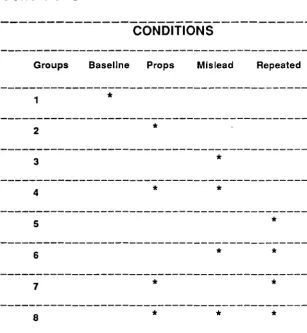
Design A 2 (cue type: props or no props) x 2 (question type: objective questions or misleading questions) x 2 (interval
type: single interview or repeated interviews) factorial design
was employed in this study in analysing the quantity and
accuracy of reports. Subjects were tested under one of eight
experimental conditions as shown in Table 1:
Table 1 Pattern of Subject Allocation in Experimental Conditions
CONDITIONS
Groups Baseline Props Mislead Repeated
1
*
2
*
3
*
4
*
*
5
*
6
*
*
7
*
*
[image:40.555.54.361.306.638.2]Additional analysis were performed on the types of item
content; 'dialogue', 'description' and 'action'.
Subjects Subjects (N = 64, age range 4.0-4.11 years), were
recruited from eleven child-care centres and three
kindergartens within Hobart and suburbs. Individual children
participated in the study after their parents or guardians gave
written consent (Appendix A). Mean CA of subjects was 4.5
years (SO =0.03 months). The male subjects (n=32) had a mean
CA of 4.5 years (SO = 0.29 months). The female subjects
(n=32) had a mean CA of 4.6 years (SO = 0.25 months).
Materials
Matching tasks tor Groups
Equal numbers of children (n=8) were assigned to experimental
conditions on the basis of their performance on a simple
memory task. Age and sex differences were balanced by
assigning subjects evenly to conditions on the basis of these
short term memory scores. Each condition had an equal number
of high and low memory scores (Appendix B for subjects
profiles).
A Memory for Objects task (O'Callaghan & O'Arcy, 1989) was
employed for this procedure. The task consisted of an array of
ten, three-dimensional objects mounted on cardboard inside a
box (Standardized instructions and scoring procedures for
Materials Relevant to Conditions
Free Recall All conditions required the subject to give a
free recall account of a home visit. Subjects were visited in
their own home by an experimenter who followed the visitor
script (appendix J) The tester followed instructions from a
'Standardized Questioning Procedure' form (Appendix D).
Responses were recorded on a sheet, verbatim.
Objective Questioning All conditions required the subject
to answer objective questions concerning the home visit. The
tester followed standardised instructions. Questions were
specific to 'dialogue', 'description' and 'action' item types with
a total of eight questions in each category (Appendix E).
Misleading Questions Four conditions required the
subjects to answer misleading questions concerning the home
visit. These questions were specific to action item type as
previous research has shown these details to more susceptible
to distortion (O'Callaghan & D'Arcy, 1989). A total of four
misleading questions replaced four original questions
(Appendix F).
Props Condition Four conditions required the child to
manipulate props from an adapted version (O'Callaghan &
attractive assessment tool for children providing concrete
retrieval cues to facilitate memory of events that occurred in
the child's household. The kit consists of a portable carry case
which folds out into an open floor plan of multiple room
household. Rooms are appropriately furnished with durable,
miniature pieces designed to discourage unrelated play. All
the furnishings were simple, non decorative representations of
standard household items. For example, the doors on the
wardrobe do not open, but provide representative details. Nine
miniature dolls representing parents, grandparents, two boys,
two girls and a baby were available. One of the adult dolls was
used to represent the visitor. See Appendix D for relevant
instructions used to orchestrate the deployment of the play
kit. (Appendix G presents a photographic record of the Driscoll
Play Kit and the miniature dolls as well as dimensional
information).
Repeat Condition Four conditions involved the child in two interviews. The first interview was the day after the home
visit as in other conditions, the second was one week later.
A 'Checklist for the Observer' form was completed du ring and
immediately after the home visit, to record information
regarding the presence of others and movements made by the
Other materials introduced during the visit included a small
quantity of green playdough, a small box of 12 colour pencils
and a blank sheet of paper for the child to illustrate a
modelled octopus.
A photo-lineup of five photos was used to identify the visitor
(Appendix I). One additional photo was casually shown in an
attempt to mislead the children.
Procedure
Experimental Procedure Matching Task
The 'Memory for Objects Task' was administered for a period of
two minutes with the child being required to recall as many of
the objects as possible after a five minute distractor period
with the tester. Scores were rated out of ten, and designated
as high (6 or more) or low (5 or less) for allocation to
conditions. The distractor period consisted of conversation
with the tester about daily activities at creche/school.
Home Visit
Visits to home were arranged between two to seven days in
advance by telephone. All families were encouraged to engage
in their normal activities and routines during the home visit.
Parents were requested to inform their child only that they
encouraged by their parents to be present when the visitor was
received at the door.
Each subject received a home visit by the research assistant
known as 'Marie' who entered the child's home and followed a
specific script (See Appendix J). In a play interaction, Marie
constructed an octopus with playdough. The child was
requested to 'draw a picture of the octopus' with the materials
provided. The drawing and the octopus were exchanged on the
termination of the visit. Marie asked the parent for 'a glass of
water', and asked the child to take her to the bathroom to
'wash her hands' after making the octopus.
Centre Visits
On the day following the home visit, children were tested at
their respective child-care centres/schools by an independent
research assistant.
Procedures Specific to Condition
1. Under free recall, subjects were encouraged to report as
much as possible concerning the home visit and activities they
engaged in. Only neutral prompts were used, such as 'Is there
anything else you can tell me about what you and the lady did?'
2. Under objective questioning conditions, subjects were
asked 24 questions concerning the home visit. Questions were
objective in nature, and were equal in number of dialogue,
description and action. In addition the questions were not
3. Under misleading questions condition, subjects were asked
24 questions concerning the home visit. Twenty were
identical to those in the objective questioning condition. Four
were misleading about actions that did not take place.
Subjects were also casually shown another photo from the
photo line up in an atten:ipt to mislead them when identifying
the visitor.
4. Under props condition, subjects were presented with the
prop setting which they were encouraged to construct as much
as possible like their own home. Subjects were also presented
with miniature figures which they named as those individuals
present during the visit. Subjects were then requested to
report their information concerning the visit using the figures
and setting to re-enact the events. More directive prompts to
encourage interaction with the props, e.g. 'can you show me'
were used than in previous studies (O'Cal_laghan & D'Arcy,
1989; O'Callaghan & Sosic, 1993).
Scoring Procedure
Quantity The total number of correct, incorrect and 'Don't Know' responses were added as separate totals.
Accuracy Under each experimental condition the following formulae were used to calculate the percentage accuracy of
(1 )% Accuracy Score
Number of Correct Responses 100
No. Correct + Incorrect Responses 1
In order to accommodate concerns for the contribution from 'Don't Know ' responses an analysis of accuracy including these responses was also calculated.
(2)0/o Accuracy Score + Don't Know Responses
Number of Correct Responses 100
x
~~~~~~~~~~~No. Correct + Incorrect Responses + Don't Knows 1
The concern for 'Don't Know' responses is that when scored as
incorrect in objective questions there is no parallel when
children provide no response in free recall. However, in the
present study both free recall and question responses, whether
to objective or misleading, were calculated as one memory
score, and therefore the issue of 'Don't Know' responses was
controlled.
Under free recall condition, the total points possible were
dependent on the extent of interaction which occurred during
the visit and were identified on the 'Checklist for the Observer
form (see Appendix K for examples of scoring forms and
procedures).
with extra points allocated for further correct information
given which was not specifically asked for.
Scoring of Item Content Categories
Under each condition, statements provided under the item type
categories (action, dialogue, and description) were analysed
separately for accuracy using the formulae mentioned above.
(See Appendix K for examples of scoring procedures)
Reliability Ratings of Scoring Procedures.
Two independent raters scored the protocols.
The formula used was as follows;
number of agreements
x
no. of agreements + no. of disagreements
100
1
Initial interrater reliability was 85.5%. Consultation was
entered into over disagreements until 100% agreement was