UMVERSITY OF TASMANIA
LIB P,PRY
Memory and Pattern: An Interrogation of the Privacy of
Consciousness Through Visual Practice
by
Amanda Connor BA, BFA (Hons), (Hobart)
Submitted in the fulfilment of the requirements for the degree of
Master of Fine Arts
University of Tasmania Hobart
THE UNniERSiTY OF TASU:ANJA
DECLARATION
Signed statement of originality
This Thesis contains no material which has been accepted for a
degree or diploma by the University or any other institution. To
the best of my knowledge and belief, it incorporates no material
previously published or written by another person except where
due acknowledgement is made in the text.
A
f6611f
--.\.AUTHORITY OF ACCESS
Signed statement of authority of access to copying
This Thesis may be made available for loan and limited copying in accordance with the Copyright Act 1968.
o
il9ow
r
wl
Amanda Connor
Abstract
In less than three years, I have accumulated over a million words in journal entries. The written outpourings constitute an intensely private realm, and yet I have sought to express the essence of the content and process of my written records, providing it with a visual form. My work features wooden constructions, including objects resembling letters of the alphabet, onto which I have transcribed hand-written fragments of text from the journal.
The central investigation of my project concerns a
dichotomy between creative expression and the privacy of consciousness, exploring the capacity of realms of creative expression to deal with this tension.
Through artistic practice and through reference to other work, I have been evaluating the potential of employing a visual language, incorporating written text, to transcend the dilemma of expressing that which lies in a highly personal realm, but is nevertheless indicative of a craving to reach beyond the barrier of loneliness and isolation.
The voice meanders in an incessant dialogue between concealment and revelation that finds its visual metaphor in the palimpsest. The creation of a haphazardly organized alphabet demonstrates the awkwardness of language and its limitations as a tool to penetrate beyond the surface of perception to objective truths, while the volume of written text expresses the relentless nature of a search for personal truth, which is specifically focussed on understanding the
dialogue between ones perception and that which one perceives, in particular, embodiments of consciousness that exist outside of ones own.
I have utilized moving images to enhance and magnify the issue of subjectivity. This component was explored at a later stage of my research, and marks a significant
development in my thinking, in which I encountered a more optimistic understanding of the potential fluidity of
subjectivity, distinct from earlier inclinations to regard the subjective realm as a fixed enclosure.
The work's function is to glorify the dilemma without solving it, aiming to induce in the viewer a mesmerized • awareness of the mystery and complexity of human
Acknowledgements
My immense gratitude to Robert Jenyns (my supervisor), Lorraine Jenyns (my associate supervisor), Jonathan Holmes (post-graduate co-ordinator), to Geoff Parr, Pat Brassington, Greg Bourke, Jane Quon, Robert Machim, Patricia Scott, the library staff, and to my family and friends.
Table of Contents
Frontispiece
Abstract iv
Acknowledgements vi
Table of Contents vii
Introduction 1
PART ONE
A Child's Tapestry 6
The Writing of Bachelard 8
Relevant Artists
Alice Aycock and Judy Pfaff 10
Materials 17 -
Colour 18
PART TWO
Talking To Myself? The Journal's Voice 22
Narrative as 'A Structure of Desire' 25
The Memory Game 33
Other Journal Records 41
The Writings of Sylvia Plath 42
Joseph Cornell's Diaries 45
THE WORK IN CONTEXT 48
Joseph Cornell 48
Susan Hiller 58
Palimpsest 63
Bourgeois/Hesse 68
PART THREE
Breton's Autobiographical Works 74
Nadja 74
Communicating Vessels 82
Mad Love 86
Studio 91
Moving Images 95
The Exhibition 99
Imaginary Letters 105
Conclusion 107
Sophie Calle 109
Sound 110
Reflections on Love 110
Memory 112
Bibliography 113
Appendices
1. List of Illustrations 116
Introduction
In order to explain the journey that constitutes my
research, it is necessary for me to tell a story about a dream, since the outcome of this research is illustrated in that dream. Among manifold poignant dreams that lace this journey, I will refer to a small number of these in the course of the paper.
In the early autumn of 2001, I woke at 3am from a strange and somewhat disturbing dream. The dream was unusual in that its enigma created an on-going preoccupation in my waking life, transforming my thinking and habits in a way that is not normally considered permissible of dreams.
The dream took place in a library; my dreaming awareness accepted it as the Art School's Carington-Smith library, but when I went over the details of the dream I remembered that the window near the carrel at which I was sitting was on a higher level,
overlooking a wide, sloped lawn with large trees in rich autumnal colours. To my astonishment, I realized this was the view I recalled from the Morris-Miller library at the Sandy Bay campus where I studied a Bachelor of Arts in the mid-to late-1980s. At the time of the dream I was embarking on my second year of studying a research higher degree at the School of Art.
I was browsing over an assortment of memorabilia, including letters, maps, greeting cards and
square with white edges, reminiscent of most of the photographs from my childhood. It depicted an area of
our backyard, towards the end of the1970s, when our house was of white weatherboard, and there were blue icsias growing at the edge of what was once a grass tennis court but was (at the time that the photograph would have been taken) lumpy with mounds of manure because we had kept and ridden ponies over it. There was a honeysuckle shrub in the corner and a forest of banksia. (In June 2002 when I returned on a rare visit to the property, I was dismayed to discover both these varieties of flora had been mercilessly cleared). The Powton tree, planted in the early 1990s was absent, but the picnic table (acquired in the early 1990s) was there, except that it was positioned parallel to the house rather than to the tennis court. Within the photo's frame, there was a gathering of people connected to my family, along with an atmosphere of festivity, and I suspected it to be a children's party.
What confronted me overwhelmingly was that in the very centre of the photograph was the vivid image of an adolescent girl. Though the teenage entity was recognizable, it did not match the time that the
photograph was taken. I would have been about eight or nine, and I did not know the person in the
photograph for many years to come. The girl's invasion in my past was the main incongruity that haunted my perception of the dream, although I was not yet equipped to wrestle with it.
from my normal understanding of the dream as an extension of my imagination, something I have a degree of control over, whether or not I am conscious of this in my dreaming mind.
My focus was drawn to this figure and to the bizarre nature of her placement (or misplacement) in the photograph. I'm not sure what happened then, but I may have zoomed in for a split second on the scene so that I was immersed in it, before half-waking, and then I was back in the library, hunting for the photograph to show to someone as evidence of my strange discovery, an anguished frenzy resulting from my inability to retrace it.
At 3am, my baffled wide-awake mind knew only that this was a dream like no others I had encountered, but I didn't know why, and I didn't speculate over its significance.
At that time it seemed so eerie to me that I fully
expected to be terrified and unable to sleep for several nights. Weird phenomena such as 'ghosts' (living or dead); all things associated with the paranormal, had always struck me with varying degrees of fear (mostly terror) when they confronted me during the night. But this way of responding began to dissolve shortly after I had this dream. An inexplicable sense of reassurance then swept over me; a voice that told me the dream wasn't sinister, and I dozed off peacefully.
period, until something triggered my memory of it, and the details flooded back to me, so that I was able to capture it in writing. By this time the preoccupation with things relating to the content of the dream had already crept into my waking life.
My exasperation in not having kept any written record of the dream initially, parallels my desire to go back to the dream and ask the apparent 'intruder', the
misplaced figure, for an explanation of its presence in a past she did not inhabit. Part of this frustration is that I am unable to determine the time that the dream took place, and to slot it in among the other crucial events that surrounded it. The time of the dream is all the more difficult to pin down because it occurred at a threshold, beyond which the urgency to record things in writing perpetuated to an extreme I had not yet encountered. It was like trying to pinpoint the time at which twilight commences.
The dream's mystery continued to haunt me in a compelling, intangible and, so it then seemed,
incongruous manner. It demanded my attention and, as if under the spell of hypnosis, I obeyed its voice. It was as if! had no choice. Its influence seeped into all areas of my life, but its main manifestation was in the vast increase of my urgency to write.
depicted in the photograph. It then became a
PART ONE
A Child's Tapestry
Weaving memories from experience has always been a vital part of my existence. I was four when I began to cultivate a habit of taking mental photographs
encapsulating moments I wanted to retain and celebrate. One of the earliest was the sensation of gazing upwards from a soft, cool lawn, at patches of sky framed by the rugged branches and large yellow green leaves of the magnolia tree in my grandparent's garden. Another was a view from a beach towel on the sand, surrounded by sun umbrellas and a patchwork of shacks and dry grass, accompanied by gentle ocean noises and children's laughter. On gloomy days I would sometimes sit in a quiet place with my eyes closed and sift through the album that my mind had compiled.
In the school playground I constructed mental
narratives, as part of a continuous autobiography that was irresistibly laced with the imaginary.
From the time I began to read books, rather than stories with pictures, I wanted to write my own. In the
classroom, I was notorious for churning out elaborate fantasy stories on paper, while in my mind, I was constructing my life story as it unfolded.
the colour, or even the necessary substance, within the outlines of matter-of-fact existence.
This realm, its vivid presence, was one I fully
embraced and possessed. Dreams were an important component, and I marvelled at how real they were, even though they took place inside my head while I was asleep. It seemed that my experience was ruled by the magic of occurrences that were exclusive to an inner world, and I placed immense value on the freedom this world offered. The imaginary was my constant refuge, and the major reason for my idealization of childhood as I remember it.
Being able to visualize, possess, and in a sense capture memories was something I continued to build on as a fundamental strategy that played a powerful dialogue with my imagination.
While imagining is experience that takes place internally, it is generally understood that the experience relies upon that which is encountered objectively, its images appropriated from a realm that is beyond subjectivity. As a child, I refused to
acknowledge this as truth (what was inside my head, ultimately, was the only reality) and, in this respect, (I confess), I was greedy with my imaginary life, and intent on keeping it all to myself.
comprised of family, friends of the family, and pre-school mates, confronting me with the statement: 'We don't exist. You only imagined us. You're imagining everything'. I didn't take this statement as truth, but it often invaded my thinking. It is a puzzling and sinister revelation (a revelation as it occurred in the dream) for a small child to absorb. I was infected by this
fundamental scepticism from a very early age.
While growing up, a well developed sense of
individuality, teamed with frequent episodes of feeling misunderstood by those around me, added to the crisis of solipsism.' Having a powerful imagination didn't help matters either, since it reinforced an awareness that I could create what I needed inside my own mind in order to sustain myself emotionally.
The Writing of Bachelard
In Air and Dreams, Bachelard asserts that imagination, contrary to the mistaken perception that it is a faculty that forms images, actually deforms the images of our perception; it is, above all, the faculty that frees us from immediate images and changes them:
[Without this transformation or] unexpected fusion of images, [he claims]: there is no imaginative act. If the image that is present does not make us think of one that is absent, if an image does not determine an abundance — an explosion — of unusual images, then there is no imagination. There is only perception, the memory of a perception, a familiar memory, an habitual way of viewing form and colour.2
Solipsism is the assertion that we have no rational grounds for believing in the existence of other forms of consciousness, because we have no logical access to these.
3
Bachelard's treatment of imagination in Water and Dreams rests on his assertion that:
The imagination is not, as its etymology suggests, the faculty for forming images of reality; it is the faculty for forming images which go beyond reality, which sing reality. 3
This is further illustrated in a contrast between the imaginable and the perceived world, with a quote from Charles Nodier's Reveries, 'The map of the imaginable world is drawn only in dreams. The universe
perceived through our senses is an infinitely small one' .4
The issue of the 'immensity' of 'daydream' is
developed in chapter 8 of Bachelard's The Poetics of Space:
One might say that immensity is a philosophical category of daydream. Daydream undoubtedly feeds on all kinds of sights, but through a sort of natural inclination, it contemplates grandeur. And this
contemplation produces an attitude that is so special, an inner state that is so unlike any other, that the
daydream transports the dreamer outside the immediate world to a world that bears the mark of infinity. 5
In Air and Dreams, Bachelard comments on the 'open' and 'elusive' nature of imagination, being 'the human psyche's experience of "openness" and "novelty". Bachelard views the Poem as 'an aspiration towards new images', corresponding to the human psyche's need for novelty. He outlines structure and mobility as opposites, and asserts that mobility of images is
Bachelard, G., Water and Dreams: An Essay on the Imagination
of Matter, E.R. Farrel [trans.], Pegasus Foundation, Dallas: 1983, p16.
Nodier, C., Reveries, Les Feuilles Vives, Paris, 1979, in ibid, p17. Bachelard, G., The Poetics of Space, M. Jolas [trans.], Beacon Press, Boston: 1994, p182.
essential to studying the psychology of the
imagination.
In the introduction to the Poetics of Space, he suggests that art is:
an increase of life, a sort of competition of surprises that stimulates our consciousness and keeps it from becoming somnolent... The image, in its simplicity
is the property of a naïve consciousness.6
Relevant Artists: Alice Aycock and Judy Pfaff
My attraction to the work of Alice Aycock and Judy
Pfaff is connected to the experience of immensity that
their work reflects.
The captivating force of Aycock's work is the product
of a vast hoard of knowledge from which she derives
inspiration. It is expressive of a network that
constitutes all the elements of a dizzyingly complex
universe.'
In his essay Alice Aycock's Impossibilism, Jonathan Fineberg writes:
The bewildering multiplicity and obscurity of her sources mirrors her experience of the overwhelming complexities of the world and expresses her drive to master them.8
Fineberg points out that it is the thought process of the
artist rather than the scientific, historical, and mythical
6 Ibid., pxxix.
7 Alice Aycock is an American artist who works primarily in a
sculptural medium.
8 Fineberg, J., Alice Aycock, Retrospektive der Projekte und Ideen
references crammed into various works that one must regard as the central subject matter of her work, and that any single work can only represent a small
fragment of this thought process 'at a given moment in its ongoing evolution'. 9
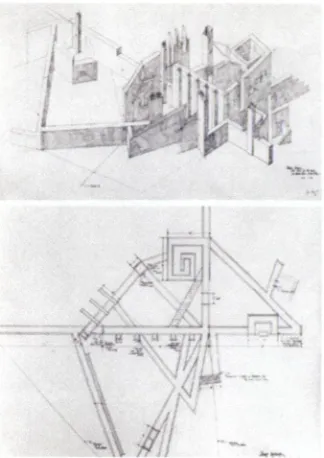
Among Aycock's most fascinating works are, as specified in their titles, 'Projects...' which consist of intricately drafted drawings; plans for possible sculptural works, many of which have as yet been unrealized in a three dimensional form. Narratives written by the artist to correspond to these projects are childlike elaborations of an imaginary historical construct, a dream-like cosmos of events. That the narrative has the impression of flowing spontaneously, with a quality of childlike gibberish bordering on lunacy, only heightens the awareness of the playful fluidity of the imagination and its potential to liquefy and reform images. This freedom stems from a joy that is innocently precocious.
The stories that juxtapose these drawings often
meander incoherently, as in The City of Walls (1978), which offers character outlines, describing an
entanglement of desire, in which:
They loved one another, that is, as one turned to another one who in turn moved in the direction of the fourth one who was in turn moving toward the fifth.. .or rather just as #1 began to have a deep neolithic longing for #3, the presence of #5
stifled/sated that longing and this in turn roused #5's passion for #2 who had for the time being sought oblivion by sucking her left thumb. [Aycock concludes the paragraph with this quirky detail]: By the way, it is
_
[image:21.554.288.450.124.353.2]Cleopatre who is fond of running a smooth cool cloth between her fingers.'°
Figure 1:
Alice Aycock
The City of Walls (1978)
Pencil on Vellum 105 x 113cm
Collection: Museum of Modern Art, New York
The mutational flow of narratives such as these reflects the sequence of dreams, the spontaneous
rearrangement of the elements among a vocabulary of perception.
The unrealized potential of such works is enticing, adding to the mystery and excitement of Aycock's process.
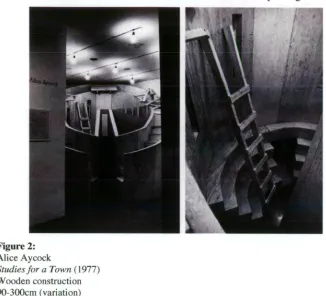
Among her sculptural works, Studies for a Town (1977), is a structure resembling a tower, built to appear as if it has been sliced on a cross-section,
offering a tiered view of its interior, a series of walls
[image:22.552.186.512.96.392.2]within walls and architectural elements comprising of
Figure 2:
Alice Aycock
Studies for a Town (1977) Wooden construction 90-300cm (variation)
330-375cm (diameter variation)
ladders, steps, chasms, arranged in such a way that its
elements play on that which is accessible and that
which is inaccessible, enticing the viewer like the
doorways in Carroll's Alice in Wonderland."
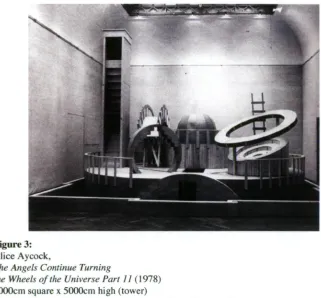
The Angels Continue Turning the Wheels of the
Universe Part 1 1 (1978) features an inverted staircase, a bridge, a dome, a ladder rising up from the ground to
empty space; objects that are physically static, but
offer a presence of movement.
I'
The proliferation of Aycock's drawings supplies a boundless potential. Her astonishing repertoire presents an intricate storehouse and displays an
Figure 3: Alice Aycock,
The Angels Continue Turning
the Wheels of the Universe Part 11 (1978) 7000cm square x 5000cm high (tower)
Executed for the Stedelijk Museum, Amsterdam (destroyed)
interaction between that which is contained within the artist's mind, and which she might create, and the demonstration of the capacity to do so. The
interweaving process, whereby elaborate and skilfully drafted plans that map Aycock's incentive to create fantastic worlds, include those which are and those which are not yet realized in a three dimensional form.
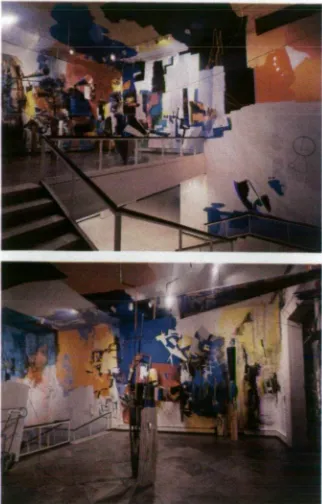
The work of Judy Pfaff demonstrates
a
theatrical and vertiginous quality as well as possessing a distinctively gestural appea1.12 The boldness and spontaneity is akin12 Judy Pfaff is a British/American artist who works primarily in
to the carefree abandonment that characterizes
[image:24.552.296.457.125.377.2]childhood creativity. In the catalogue essay to Pfaff's
Figure 4:
Judy Pfaff
Rock, Paper, Scissors (1982)
Mixed media installation Dimensions unknown
Installations: Abstraction on the Rebound, Susan Krane (assistant curator) writes that:
The quizzical dissociation initiated by Pfaff's works derives also from her nonsequential labyrinthine layerings of information- [sic] for which she has found analogies in the complexities that interrelate natural systems. 13
According to Nancy Princenthal `Pfaff's work has always been exuberant, lush and hospitable to the language of poetry and music'.14
13 ICrane, S., `Pfaff's Installations: Abstraction on the Rebound', in
Judy Pfaff, The Buffalo Fine Arts Academy: 1982, p1 1.
14 Princenthal, N., 'Judy Pfaff, Life and Limb,' in Art in America
Princenthal's article includes an overview of Pfaff s massive installation Cirque, Cirque (1995), in which 9
Figure 5: Judy Pfaff
Cirque, Cirque (1995) Mixed media 700 000 square feet
miles of metal tubing roams boldly beneath the roof of the Philadelphia Convention Centre, within a space of 700 000 square feet. Above the gold and blue
aluminium tubing, are suspended glass globes tinted yellow and blue; these are connected by fine metal bars in arrangements that suggest constellations. The central focus of Princenthal's description is its evocation of experiencing submergence in the depths of an ocean. Expanding and contracting metal coils are likened to a giant squid's tentacles, 'while smaller arabesques suggest the shimmer of a school of fish'. From the audience viewpoint at the floor of the
bioluminescence'.15 The work consists of an
imaginative rearrangement of solid material elements, transformed by the fluidity of the artist's inner vision into a captivating, otherworldly landscape.
Materials
15
From the beginnings of my sculptural practice, I chose to work with whatever I could find that attracted me. Discarded objects had a special appeal, reinforcing the serendipity of my process. The enticement of wooden off-cuts dominated my focus during my final
undergraduate year, continuing as a feature in my honours work and as my postgraduate research developed.
Throughout honours and into my postgraduate research I questioned my continual use of these off-cuts. Was I merely clinging to it because it was 'safe?' Because it had become part of a formula? Because it was readily available? My attraction to wood is linked to my interest in pattern, and those found in wood,
particularly the readily available radiata pine, (a hearty supply of which I have found in bins and on the floor of the school's wood work-shop), have a special appeal. The patterns are the visual quality of the wood's unique structure, and it is these two aspects of experience, its structure and its uniqueness, in which I am primarily concerned. I regard the patterns as the fabric of life, the seemingly random, meandering nature of experiences unfolding. Furthermore, the origin of wood is the tree, which is, for me, an image
of fundamental preoccupation, inducing endless contemplation, and is also the source of paper, the material on which we commonly write.
Because of the in between-ness of wood, with the idea of tree on one side and, on the other, paper on which I write, I see it, poetically, as an 'in between' that links it to my preoccupation with borderline states. 16
Colour
The element of colour is the most intrinsic quality of my work, stemming from a love of colour, which has been a dominant focus of my vision from a very early age.
Because of its intrinsic nature, there is a spontaneity and directness about working with colour. The artist Paul Klee said about colour:
I am entranced by colour — I do not need to pursue it. I know that it will possess me till I die. This is the great moment — I and the colour are one."
I am sceptical about colour theory that is based on objective associations because responses to colour are subjective. As a language, colour is problematical, highlighting the conflict between language as a tool for communication, and the subjective nature of
16 Hospital, J.T., Borderline,
Hodder and Stoughton, Australia: 1985. Janette Turner Hospital's novel Borderline, my first distinct encounter with the 'border' as an idea, presents the geographic borderline as a place where mysteries occur. In Turner Hospital's book, themes related to the crossover between dream and waking, between illusion and reality, are explored within the framework of a mystery story that evolves from an incident of the smuggling of an illegal immigrant over a border between two American states. The importance that documentation and collation of facts and experiences plays is an important part of the story's fabric as well, and I have dealt with this issue in further chapters of the exegesis.
17 Fisher, R., Klee, Tudor Publishing Company, New York: 1967,
experience; the way differences in perception affect our capacity to communicate.
Colour perception has been known to vary, sometimes dramatically, from subject to subject. Likewise, responses to, and preferences for, certain colours and arrangements of colours are known to be fickle.
I use colour as a projection of the work's emphasis on emotion. During my honours research, I was reluctant to paint the wood at all because of my enjoyment of the patterns within the wood. Eventually I agreed on a compromise, painting only some of the surfaces and, of these painted surfaces, I applied fewer layers of paint on some, so that the patterns remained gently
perceptible beneath the paint. I have come to regard the wood grain as relating to the origin of the
experiences, while the painted surfaces are a means of creating an emotional impact. At this stage in my honours research the work's presence became larger and more striking.
The colours I have chosen are an expression of the adolescent voice that is central to the work, and of my preoccupation with borders.
Towards the beginning of my research I experimented with colours of varying luminosity, with the
juxtaposition of complementary colours, and with gradations of various hues. I then began to investigate the intricacies of what I had viewed as a fundamentally intuitive use of colour. A clarification of the
variations of lilac, magenta, turquoise, orange-yellow and yellow-green, for example, led to the realization that this is connected to a fascination for borders of other kinds, the borders of night with dusk and dawn, between dream and wakefulness, and one which I began to explore more fully in my work, the threshold between childhood and adolescence. I specifically recall that it was during my teens that I became attracted to these colours, and would exhaust those around me with over-worn contemplations about whether a particular 'borderline' colour was closer to the primary or the secondary colour that fenced it.
In some ways, a greater leap of faith is necessary when using colour as an expressive tool. I cannot know that the colours I use will create a similar effect on the viewer that they induce in me. While intuition has been a starting point, feedback on experimentation has been of great assistance. Colour perception will vary, and associations are likely to induce different
responses, however, the response to certain contrasts will vary less. It is agreed that bold primary colours form associations with the toys of young children, while earthy, tertiary colours, often described as
'autumn colours' evoke maturity, a different kind of in between-ness.
My approach to the problem of expressing that which is private and therefore inaccessible has involved confronting and interrogating the issue, illuminating a paradox in which the objects of expression are
the link between the remoteness of personal
experience, and creative expression, which provides form to such experiences, capable of projecting an essence of privacy to an audience.
The act of recording my experience in words is a threshold, between the privacy of an inner realm, and visual expression. The journal goes at least one step beyond the internal process of absorbing perceptions and transforming them in ones mind, since it
PART TWO
Talking to Myself? The Journal's Voice
On August lst, 2001, I had a dream I was with a group of students in the ground floor postgraduate lounge looking out at Mount Wellington, which began to erupt, threatening to engulf the town in lava. Everyone started screaming and running in the direction of Evans Street and as I followed I asked someone, 'It won't really reach the school will it?' They said it probably would cover the school and the best hope anyone had was to run like hell and head for the bridge (!?) Nevertheless, I was compelled to turn back, running towards my studio. 'Where are you going?' I was asked. I didn't bother to answer. I was going to retrieve the item of highest value among all of my material possessions—my most recent diary. The volcanic eruption turned out to be a firework display, and the perceived threat entirely a false alarm.
The realization enhanced by this dream coincides with a growing awareness of the valuable role that the written record of an experienced act has played throughout most of my life.
Unfiled volumes in the form of tattered notebooks and folders crammed with loose pages recording my life's journey in words, some stored in the broken drawer of a filing cabinet, broken because it could no longer bear their weight, others in a box at the bottom of my
a diary on a daily basis, almost without fail, since I was fourteen years old, the volumes have mounted
considerably, though many, despite my recent searching, remain untraced. Except as part of the cluttered fabric of memorabilia I can't relinquish, these held little relevance for me, or their relevance was dormant, until I was forced to review them in the course of my research.
During an epic tidy up, in Easter 2001, of the bedroom mentioned, despite their pleadings to be acknowledged and utilized in current work, the diaries were initially rejected. I tried to ignore them, but nevertheless found myself flicking through the pages. But they persisted with their hauntings, until the idea to explore the issue of adolescent consciousness by incorporating the writing into my work demanded attention, and wouldn't leave me alone until I had tried it.
The Adolescent Voice
The recurring adolescent state that I have experienced has a history of manifesting itself in an excessive writing compulsion. Its most recent episode was accompanied by the exasperation of an awareness that I seem to be living in this adolescent state perpetually, a state of heightened intensity, and the degree of anxiety that arises from the dramatic transition between child and adult states of being. The writing has become a frantic attempt to examine and
My initial plan was to incorporate the letters into a children's narrative that exemplified a fascination, stemming from childhood, for the concept of doorways into worlds of the imagination. When adolescent concerns became heightened, however, there was an urgency to provide them with a voice. It was the voice of the journal that I saw as my most effective and relevant tool for exploring the intensity of adolescence.
As a prelude to the incorporation of handwritten text, I retrieved diaries I'd kept over the previous 20 years (from 1981 to 2001), and re-read sections of these, before transcribing excerpts from the diaries onto the wooden letters, using various fine tipped, gel and iridescent pens.
I built up layers of written text to illuminate the structure of remembering. In reflecting on past experiences, I have been amazed by the way that certain memories move forward while others retreat to the distance, and at the inconsistency of the perceived lengths of patches of time that are identical in terms of their measurement on the calendar.
This awareness became acute in my adolescent years. I distinctly remember telling my mother, with
18
twelve months when only one had expired on the calendar. The feeling I was describing was one of experiencing too much change in too little time, as if I was covering too much distance, and hence, a feeling of homesickness for the past that I see as the essence of adolescent melancholy.
In the work, I have sought to recreate the emotional impact of this awareness in visual terms. It is an expression of being immersed in a whirlpool of remembering, and a search to find a balance while maintaining the intensity. It is through the formal elements of the work that I have enhanced this
intensity; it is in the process of writing that a balance is achieved, by providing a level from which such
experience can be viewed more comfortably.
Narrative as 'a structure of desire'.
In On Longing, Susan Stewart writes of language giving 'shape to experience, providing through narrative a sense of closure and providing through abstraction an illusion of transcendence'.18 The central focus of Stewart's essay is the network of metaphors arising out of the way language relates to experience, or 'more specifically.. .of narrative to its objects'. In examining the ways in which narrative relates to 'origin and object' Stewart pursues an interest in what she describes as 'the social disease of nostalgia', which resonates with her choosing of 'a kind of ache' as her
title for the essay. In this sense, 'narrative' is regarded by Stewart as 'a structure of desire'. 19
The impression of converting experience to fiction was emphasized by the ritual of writing the entries on wood. It reinforced the awareness that I had lived the experiences, recorded them as memories, and rewritten them as I would fragments of a novel. I altered the words but not the experiences, in many instances refining the details, providing a more intricate reflection. In this final step of remembering, the record of the memory became something I could fully possess, still contained within as memory, but through the process of recording and embedding it into the object, it became something I could experience from a fresh perspective. It was as if the person I was writing about had become someone else, a character that I could observe, and whose endless flaws and mishaps had become comedic and poetic.
I have known the process of writing by hand to be hypnotic. When I look back over the pages it reminds me of looking at footprints in the sand, providing an awareness of the distance I have covered. The written record contributes to an impression of stretching time. Detailed entries provide an expansion of experience so that more time seems to have elapsed than when the entries are brief. I have experienced this effect as being quite dramatic and something I seek out in the elaborate recording of moments as I endeavour to augment them, desiring to suspend them in time and immortalize them in my memory.
19
The work is linked to my attraction to books and their presence as physical objects, which provide one with non-physical journeys. As a child I was conscious of the book as being a doorway into another world. If I didn't like what was going on around me I could retreat into my own imagination or read a book,
withdrawing into a world created by the imagination of an author, an alternative playground where I was safe.
It is easy to understand my childhood relish for books such as the Narnia series, Lewis Carroll's famous duo, and an array of others, that also inspired the stories I wrote in the classroom; all were manifestations of the enticing possibility of going through some kind of doorway into an imaginative world. Whether or not I finished these books, in most cases only the
introductory sections left an indelible impression on me (most of the remainder escaping my memory), because it was the passage through each doorway and the discovery of a world beyond that intrigued me, rather than the plot that developed out of this.
As a child, the book form embodied these characteristics for me. I remember my proud
awareness of how my mother loved to see me so often quietly absorbed in my reading. The term 'book-worm' became an endearing one, and something that enabled me a luxurious transgression, to escape and find freedom in impossible magical realms while offering to adult eyes, the appearance of a good child.
I regard my work as a set of fragments that may be associated with books, in which the contents have been turned out and displayed onto the cover, so that the cover and its contents have become one. The idea of placing the words on the outside of the cover, but on a tiny scale reflects a struggle between an urgency to express oneself, and a need to conceal, through fear of being misunderstood by the idiosyncratic nature of these details.
I play at seducing the viewer with the visual appeal of layers of text. This intention is distinct from the diary's initial motivation, which is the expression of moments captured in words. The latter becomes lost in the intricacy of the patterns.
My work highlights the issue of the inaccessibility of consciousness, demonstrating the limitations of the object in art that is intended to be fundamentally
with the objects I have made. They echo my
[image:38.552.259.460.180.316.2]loneliness, like the interior of a black hole, or a vacant mirror staring back at me. This is the essence of the problem I have been trying to overcome in recent work.
Figure 6
Amanda Connor
not entirely ... (2001)
multimedia installation 3000cm x 3000cm x 3000cm
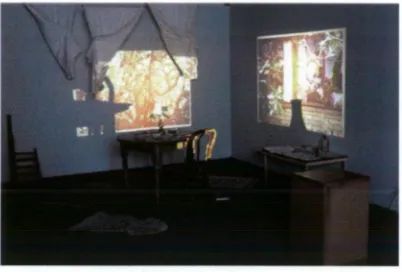
The piece titled not entirely.. .(2001) that I made for the group exhibition Half Way There, was an attempt both to evoke and transcend this dilemma.20 The emphasis, in this piece, was specifically the expression of a search for self-understanding through an excessive compulsion to record experiences in words. My
intention was to create a dialogue between looking inwards to past and private experiences in a search for origins, and looking beyond to future possibilities and to the 'otherness' that surrounds and embraces but is also distinct from the self. The autobiographical bias included images from my family home, combined with those connected to my current studio environment, and
an edited rearrangement of excerpts from a recent journal.
Figure 7
Amanda Connor
not entirely... (2000)
multimedia installation (detail) 3000cm x 3000cm x 3000cm
On an immediate level, the title not entirely... derived from the curious persistence of 'not entirelies' I encountered when I re-read the entries from volume two of 2001. At the time I wasn't consciously aware of their prevalence, but they continued to weave their way into the writing as a kind of on-going joke with pertinent implications. On a broader level, I saw it as a metaphor for the incompletion of understanding, the pursuit of mystery that is the diary's impossible quest to unravel.
[image:40.552.302.460.458.701.2]The confusion of interior and exterior is an evocation of the paradox of being affected by an outer realm while being unable to escape beyond ones perception of it. The images were chosen to evoke a melancholy desire to transcend the boundaries of solipsism. The piece expresses an urgency to form a connection to the outer through the projection of inner experience of that which lies beyond the self.
Figure 8: Janet Stemburg
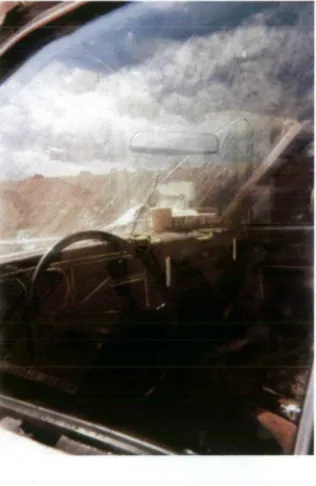
Splendor, San Miguel de Allende (1999) Photogragh
Photographer and writer, Janet Sternburg uses images that confuse interior and exterior as metaphors for our incomplete knowledge of things. The artist has stated her aim: 'to mingle inside and outside, to set them into fertile confusion'. Sternburg claims to be 'looking for a visual equivalent to the aim that Woolf claimed in her diary 'to give the moment whole, whatever it includes'.21 Sterburg also acknowledges this to be an impossible quest, and in her work she deals with questions relating to this.
Sternburg refers to her experience in the summer of 1998, in which, while writing a memoir, she finds herself trapped in the past. She describes an inability to vividly perceive her immediate surroundings. During the August of this time, she spent a week in a mountain town with striking scenery. She took with her a book of Jane Hirshfield's poetry, having saved this `for a time when I would feel loose, suspended, receptive', reading daily the essays about a writer's permeability and walking 'without destination along the streets of San Miguel Allend'. Sternburg
purchased a disposable camera, which since then became a chosen tool, loving it 'for the freedom it gives me to wait, appearing to be window shopping when instead, I'm looking into windows of time'.22
I have come to accept that creative expression has a lot to do with overcoming solipsism. To begin with, the craving to be understood, by which the expression is in many ways motivated, seems to rely upon an
acceptance of other embodiments of experience beyond ones own. If not, the endeavour to
communicate ones experiences to others would be a somewhat pointless effort.
In reflecting on Susan Stewart's statement, my
awareness of 'the illusion of transcendence' created a constant stream of echoes, in surges of delight that were a mixture of amusement, (at myself, in seeing myself in various bizarre entanglements of pathos, viewed from a lookout where I was no longer immersed in the mire) and of amazement, (at my ruthlessness in articulating what are painfully private perceptions) when I reviewed the experiences I had put down in words.
I have become increasingly aware that the value of the experience alters with the written memory of it. Essentially, I have discovered, time and time again, that what gives an experience value in retrospect is not how happy or miserable I was when the experience occurred, but how well I was able to capture it in words, and how sharp is the memory retained from it. More important was that which the experiences taught me, and how this learning enabled me to negotiate my way through the labyrinthine pathway of experience extending into the future.
The Memory Game
At the start of 2002, I decided to conduct an
the extreme. What triggered the idea was the act of transcribing fragmented excerpts from my 2001 diaries onto thinly ruled foolscap to be incorporated into the installation not entirely.
While engaged in this activity of transcribing, I
experienced a sense of viewing the recorded memories as if I was looking at a landscape from the air at that distance when the landscape starts to look like a map. In other words, the insight I gained, from reviewing experiences of the months that had gone by, created an exhilarating awareness of being able to examine them on a level beyond being immersed in the experiences; a level on which, even with all their incongruities, the patterns they made took on a poetic value. It was the difference between being lost in a forest and seeing the forest interlaced with hills and surrounded by water and myself among it all, not unlike a fictional character in a story I had invented.
clearly embedded in my mind to draw on when needed and to enhance the insight I had already gained from reviewing these experiences.
Although I achieved what I had set out to do, there was a degree of dissatisfaction about what was lacking, and my incentive to take the experiment further propelled me to continue. The exercise had merely whet my appetite to gain expertise in the memory game I had created for myself. This provoked me to continue the process in an effort to retain more and more detail about each day, including any dreams I'd recorded; how I felt when I arrived in my studio, and the
sequence of highlights that developed during the day. I also sought to broaden the repertoire of days I could recall to include those unfolding in 2002, and 2003 (in early 2004, the memory catalogue is still expanding).
The experiment became a ritual, perhaps a form of 'therapy', and then, a way of life, something virtually indispensable.
that always pass by. What I learnt from various epochs, and how it shaped my current thinking, allowed me to continue negotiating my way through life's intensity. Time and time again, the process of recording and reviewing experiences has saved me.
Despite the capacity for written language to alter and transcend experience for the writer, it may lack the capacity to bridge a gap between writer and reader. It requires thought to translate someone else's words into an expression that is capable of providing access, as far as it can be gained, to the experience of the writer. In a sense, this is an impossible quest since consciousness, by nature, is private, and we can only get an indication of what someone else is experiencing. Visual language generally creates a more direct impact on its audience, since there is a tendency to respond to visual things more emotionally.
The insatiable intricacy of my work acts to soak the viewer in a dizzying sense of an experience of being bombarded by the richness of life, of vivid
recollections of experience that must be recorded in words in order to survive.
By creating a complex network of forms, in which written records of experience have become part of the visual fabric, my aim is to overwhelm, mesmerize, and reassure; to create a sense of a dizzying calm.
The effect relates to a paradox that can be seen in the natural environment, in which the inter-relationship of forms can seem complex and chaotic, and
the philosophy of mysticism, in which the mystical
experience is, (in so far as it can be described in
words), the direct apprehension of separation and unity
perceived simultaneously within the universe. The
understanding is that of complexity, of division
between a multitude of units, but also of wholeness,
through the interconnection of these units.
23
The work is intended to create a kaleidoscope of
internal activity, and is a way of externalizing
emotional intensity. Ideally, the work's capacity
should extend to providing a refuge for emotional
intensity. Having discovered the world of the diary as
a 'safe place' for this level of intensity to exist, I have
sought to create a visual equivalent of this kind of
refuge for the viewer.
The main value of the memory game was to create a
healthy submission to the mystery of life's experience.
At the outset, I was searching for insight concerning
realms beyond my direct experience, but which formed
a dialogue of interaction with my perception. The
outcome was that the clarity of the mysteries, along
with their value, increased with each little piece that
my memory retained. It was the difference between
polishing a precious stone over and over, and cutting it
open to see what is inside it. I may not have a sharp
enough knife, but perhaps being able to peer into the
stone is all I require. What I gained was value in the
mysteries themselves, rather than complete
understanding.
23 This is a synthesis of my understanding of mysticism, derived
When I became more expert at remembering the
sequence of the experiences I recorded, my own
personal investigation drove me to replay the
experiences in my mind while trying to imagine the
occurrences from the perspective of someone else.
The exercise intensified a desire to gain insight about
what the other was thinking and feeling, and led only
to a more focussed speculation. The mystery became
all the more enticing, while the goal to expose the
reality beneath it lay no closer to my reach.
Helene Cixous
24
has outlined the tendency to avoid the
mysterious as such, 'Because ordinary human beings
do not like mystery since you cannot put a bridle on it,
and therefore, in general they exclude it, they repress
it, they eliminate it — and its
settled' .25I believe that despite a tendency, on one hand, for the
human mind to avoid focus on realms that lie beyond
its direct understanding, there is, on the other, a value
to mystery, including paradoxical concepts, which can
be appreciated through a concentrated effort to
transcend the barriers imposed by the intellect on
imagination and intuitive reasoning.
There is some confusion about the interaction of these
two concepts. Blaise Pascal, for example, condemns
the imagination as a kind of deceit that works against
Cixous is a French philosopher and writer of fiction, and on issues relating to poststructuralist feminist theory.
all kinds of reasoning, including intuition.26 In the investigation that is the central focus of my recent diary, the difficulty of sorting out intuition from imagination is often referred to, as if, through
heightened sensibility, the ability to know what is real, is confused by the tendency to rearrange things in ones mind to create an idyllic realm that may only exist in that mind.
Certainly, the pleasure that the imagination offers can far outweigh the mundanities of normal, workaday existence. The necessity of dreams may constitute the strongest argument for the importance of imagination. Not only does the process of sleep, including dreams, assist one's focus in day to day thinking, by offering a recharge phase for the mind, but problems that can not be solved by rational thinking can be resolved in a less conscious state. Here, imagination and intuition can be seen to work hand in hand.
Furthermore, there are aspects of life in which we naturally and voluntarily operate with contradiction, through a kind of faith that survival and well-being necessitates. The value of contradiction, as I see it, is precisely that it confounds the intellect, and therefore creates a freedom from the confinement of intellect. Its liberating capacity is connected to that which we can understand only by intuition, by a kind of certainty whose boundaries are blurred, whose edges are fluid, a way of knowing that can not be confirmed or encased by reason.
It is in writing that I have learned to embrace mystery, to enjoy the liberating power that lies beyond the submission to all that cannot be pinned down. This has much to do with a paradox that is connected to the realm beyond self. In writing, I try to reach out beyond self, to capture what lies outside my own realm, to own it by putting it into words. While haunted by the awareness that I can own only my perception of it, I frame it within the pages, and restore it by going over and over, by re-reading and
transcribing and reviewing the life within it. But essentially, the things I describe and try to capture in words can only be known in terms of my response to them. I can describe the tree outside my window, the twilight scene, or someone's actions towards me. But I can't know, beyond speculation, that tree, or twilight, or that person's experience. This awareness is bound to the problem of solipsism.
To go beyond solipsism is an act of faith. It is, in one respect, a refusal to remain bound to the rational demand that the existence of other minds, as
enclosures of consciousness, cannot be verified. In another, it is to immerse oneself in the mystery of what lies beyond, to pursue its essence, to attempt to bind oneself with it, while retaining a sense of identity as a unit of individual consciousness.
The importance of imagination as memory's
with attention to sequence, in order to obtain insight about the mysteries that compelled my interest in them. The quest for the solution of the mysteries perpetuated a mirage, something visible and near, yet constantly out of my reach. But while gaining self-understanding, I developed a tendency to luxuriate in the mysteries of things beyond myself, and the endless pursuit for insight.
Other Journal Records
In my exploration of the importance of giving voice to experience in words, I have been looking at a range of published journals. The written records on which I have focussed in this paper are those of the writer Sylvia Plath and of the artist Joseph Cornell.
The former is the manifestation of a young woman wrestling with life's bittersweet incongruities in her writing. I will concentrate both on the urgency for the writer to come to terms with experience in the journal record, and for the desire to serve a purpose through efforts to achieve publications of finished work.
knowledge of the artist's diaristic record contributes, in the way of insight, to the creation of the work.
The Writings of Sylvia Plath
Much of the tension that emanates from Plath's writing is indicative of the attempt to 'grasp a contradictory totality'. 27 With specific references to Plath's poetry, Mary Lynn Broe, a professor of English in New York, discusses the struggle of the young writer to find a balance between the polarities of intellect and
imagination, and the painful awareness of the conflict between the two. 28 But, as Broe suggests, the
temperament of the writer was at great odds with the success of this challenge:
Numerous versions of the fact—imagination polarity were deeply rooted within her sensibility. Each swing in that cosmic "cycle of joy and sorrow" absorbed the poet totally, depleted her emotional and physical energies, yet offered slim prescription for finding the balance between the poetic impulse and mundane
29
existence'.
Broe traces, in Plath's poetry, a process of a 'disenchantment with ideals' that 'becomes more specific, more personal, and more ominous'. 30
In Plath's world, life seems riddled with contrasts, not merely in the dialogue between things, but within things, and this is an insightful reflection of the writer's state of mind. One experience describes a momentary feeling of peace when a self-reviling state
Broe, M.L., Protean Poetic: The Poetry of Sylvia Plath, University of Missouri Press, Colombia and London: 1980, p33. Sylvia Plath was born in Massachusetts in October, 1932, and died in London in January, 1963.
Ibid., pp I-2.
Ibid., p 5. 27
28
seems to dissolve in the perceived miracle of an August night, and then recurs. The moon, as it shows itself 'from behind the small frequent clouds', is described as being 'poised like a picture puzzle that had been broken, with light in back, outlining each piece'.
She describes a smell of the decay in the air of mouldy, dead leaves, followed by a suggestion of ethereal, other worldliness.
The two lights over the front steps were haloed with a hazy nimbus of mist, and strange insects fluttered up against the screen, fragile...'
In the paragraph's concluding sentence all elements of the night scene seem to twist and contort into images depicting an inner torment in which all polarities, of volume and weightlessness, of beauty and ugliness, of calm and terror, congeal into a landscape of
incongruity.
The air flowed about me like thick molasses, and the shadows from the moon and streetlamp split like schizophrenic blue phantoms, grotesque and faintly repetitious. 31
There are passages that convey the shrill intensity of living within such extremes, and an anxiety that is tightly connected to the temporality of existence. The ambivalence in her attitude towards life, and the issue of temporality, are often juxtaposed, and possibly (in her fears associated with the decaying process of ageing) acutely intertwined.
I have the choice of being constantly active and happy or introspectively passive and sad. Or I can go mad by ricocheting in between.
Cats have nine lives, the saying goes. You have one; and somewhere along the thin, tenuous thread of your existence there is the black knot, the blood clot, the stopped heartbeat that spells the end of this particular individual which is spelled "I" and "you" and "Sylvia".
There is often a sense of duty to suppress sentiment in favour of intellect, and an inability, perhaps through the pressures faced academically, and in her career, to give adequate status to the imagination. Broe writes 'The imagination is found to be a poor risk, a tool left behind in the idyllic state of childhood and now
recovered at only too great a cost. In sum, the youthful Plath is unable to find a balance between "muck and dream." Nor can she poetically resolve the dilemma of a life careening from imaginative to practical
concerns'. 33
This is perhaps most apparent in her use of moon imagery. The duality of vacillating attitudes to existence is simply but evocatively put in a statement she made in this entry:
In this daily game of choice and sacrifice, one needs a sure eye for the superfluous. It changes every day, too. Some days the moon is superfluous, some days, most emphatically not. 34
Broe refers to a poetic juxtaposition of polarised perspectives of the moon in an early poem, highlighting her inability:
[to] maintain that duet between the illusions of the imagination (the "mica mystery of moonlight") and the
cold realities of facts countenanced by the intellect (that "pock-marked face" scrutinized through the telescope). Plath finds that she cannot join the best of both worlds; she is poised on "perilous poles that freeze us in / a cross of contradiction." Still, any reliance upon the imagination alone is doomed, for it fails to notice a burgeoning world of practical facts. 35
Joseph Come Diaries
The essential connection that I see between the writer Plath, and artist Cornell is the necessity to provide substance to an inner ache, the kind of ache that Susan Stewart outlined and adopted as the title of her essay
On Longing.36 In the case of Cornell, the concern is expressed most pertinently as 'that desperation of trying to give shape to obsession'. 37 What I find most interesting about Cornell is that while the diary record is a rather painful evocation of a desire to express intangible feelings and states of being in a more concrete form through words, the sketchiness of the written style demonstrates the inadequacy of the written language to define such states. It is in the visual medium that the artist's flair proves most successful in meeting this impossible challenge.
Cornell's manipulation of the written language is awkward and vague in contrast to Plath's, whose precision and vast vocabulary, and ability to make words malleable through unique and playful use of metaphor, characterize her expertise in giving form to
- feelings and perceptions in words.
35 Op.cit., p 25.
36 Joseph Cornell was born in New York, in December, 1903, and
died in New York in December, 1972.
For Cornell, although there is the sense of the diary as fulfilling a separate need, (a record of daily events and responses to experiences, an illustration of perceptions that require immediate capturing, an expression of desires), there is an evident crossover into the visual, a dialogue between the two mediums of expression in which preliminary sketches in words require objects that translate the expression into a visual language.
There are isolated snippets, mere phrases, floating, without punctuation: 'and the quince tree petals making a medieval tapestry of the lawn'. This
example is followed by a rambling sentence paragraph, in which perceptions flicker like the shadows and leaves themselves:
resolution of mean mood in cellar, approaching the sublime "early morning" of Monday and Tuesday — birds under the quince tree in early summer shadows sun gradually illuminating the quiet atmosphere of the rustic effects, birds and feeding etc.38
The absence of punctuation, in many instances,
emphasizes the sketchiness of the written impressions, and an abandonment of closure. It is as if closure is only appropriately sought in the enclosure of his boxes.
The abandonment of precision and structure,
emphasizing the remoteness and vague outline of the object of writing, is more apparent when that object is a mood, or a perception that is tightly linked to a state of being.
When describing impressions of visual objects that connect the artist to his work, the writing is much more specific and coherent, with descriptive paragraphs that flow, complete with punctuation and free of the dislocation that characterizes much of the diaristic record. This is clearly evident, for example, in an entry describing a visit to the buildings of the Geographic society.
An abstract feeling of geography and voyaging I have thought about before of getting into objects, like the Compass Set with map. A reminder of earliest schoolbook days when the world was divided up into irregular masses of bright colors, with vignettes of the pictorial world scattered, like toy picture-blocks. The Planetarium was another moving experience, especially on the second floor with its blue dome, silhouetted city sky-line fringing it, and the gradual appearance of all the stars in the night sky to music.39
There are also sketches in words, or as a record of process and productivity:
today around 2 thinking back to yesterday & appreciation of cellar working after Saturday completely lifted out of depression of work and nostalgia — the spontaneous making of the little Durer box — carpentry — suddenly in a wonderfully
"possessed" response of working versus general toward carpentry, even resistance. First box since Grahn & Alegra miniatures 4°
And combinations of the two:
drop of water too deep for sun so-so day in box work — glistening in sun around 3pm sunny after rain etc. yesterday grasshopper on side of house
bumblebee in the snapdragons41
In contrast to Plath, who attempts to 'play God' with the written word, to stretch it to its greatest limits, Cornell's entries tend to demonstrate the limit of
39 Ibid.,
pp95-96. 4o Ibid.,
p211.
words. Simple phrases to describe visual images, or merely to state that a thing is, show a concern with immediacy, with capturing in note form the little perceptions that lace the day and inspire the artist's work.
THE WORK IN CONTEXT
Joseph Cornell
Following the death of the artist Joseph Cornell in 1972, a bewildering accumulation of material was found in his New York house. The vast hoard conveyed a multitude of unrealized potential,
constituting an immense challenge for those attempting to gain access to the artist's secret world.
Among his completed works, those which may be regarded as the key to the driving force of the artist's desire, were his portrait—homages to women. Jodi Hauptman, in her book Stargazing in the Cinema, provides a detailed investigation of his movie star portraits, and traces the 'logic of desire' that is inherent in the attitude that lay at the heart of these works. Hauptman's crucial observation is that along with the desire Cornell expressed to retain these 'apparitions', he delighted in the mystery of their unknowableness. Hauptman declares the admiration Cornell devoted to the movie stars as 'dependent on the loss and
New York, but also in the enchanting world of the movie theatre.42
In Cornell's, Untitled (Encrusted Clown [Souvenirs for Singleton]) the peculiar balance of contrasts creates
[image:58.552.283.447.181.446.2]a special aura. The interplay of texture and colour
Figure 9: Joseph Cornell
Untitled (Encrusted Clown [Souvenirs for Singleton]) c. mid 1950-s Box construction
44.8 x 29.8 x 11.1cm
Collection Edward and Julie Minskoff
enhance the spatial depth, with the encrustation of objects upon a background that is predominately of dark blue and yellow-gold contrasts. The contrasts evoke a harmonious, universal quality that borders on being mystical, and yet, there is congestion, inducing confusion. As the depiction of an urban scene at night,
it possesses a glorious naivety. There is an invitation,
42 Hauptman, J., Stargazing in the Cinema, Yale University Press,
or more urgently, a plea, to regard the city's presence as a cosmos, which is magnified by a proliferation of opposites.
Surrounding scatterings of red/green contrasts, the aged yellow of documents are interspersed with the blue of a night sky. The dominating gold also conjures impressions of the artificial light, the street-lamps and shop lights that keep the city alive and awake at night. There are areas dappled with stars, and a cardboard sun, and watch movements are dispersed around the edge of the canvas, as if time has been taken apart and incoherently distributed. The watch particles are intermingled with cardboard trinkets, a cluttered array of discarded images whose significance is unstable. They are bits of forgotten trash that look to be picked up from the city pavements, or dug from the pockets of clothing that hasn't been worn for a while. There are objects of measurement that are devoid of their utility. The clock in the centre has no hands, and the
discoloured documents are redundant, in terms of their original purpose. The background is composed of old stock market charts, which as Hauptman points out, are the foundations of the city. There is a dichotomy between the mass of clutter, and a sense of what is absent.