ANALYSIS OF ENGINE POWER USING 3 TYPES OF PRE-COMBUSTION CHAMBER’S DESIGN
AMARUL AFIQ ADLI BIN ROSLI B041310215
BMCA
[email protected]
Report
Projek Sarjana Muda II
Supervisor : Assoc. Prof. DR. MUSTHAFAH BIN MOHD. TAHIR
Faculty of Mechanical Engineering Universiti Teknikal Malaysia Melaka
APPROVAL
“I hereby declare that I have read this thesis and in my opinion this thesis is sufficient in terms of scope and quality for the award of the degree of
Bachelor of Mechanical Engineering (Automotive).”
Signature: ...
Supervisor: Assoc. Prof. MUSTHAFAH BIN MOHD. TAHIR
ANALYSIS OF ENGINE POWER USING 3 TYPES OF PRE-COMBUSTION CHAMBER’S DESIGN
AMARUL AFIQ ADLI BIN ROSLI
This report is submitted in partial
fulfillment of the requirements for the award of a
Bachelor in Mechanical Engineering (Automotive) with honours
Faculty of Mechanical Engineering Universiti Teknikal Malaysia Melaka
DECLARATION
“I hereby declare that the work in this thesis is my own except for the summaries and quotations which have been duly acknowledge.”
Signature :………..
DEDICATION
i
ABSTRACT
ii
ABSTRAK
iii
ACKNOWLEDGEMENT
iv
TABLE OF CONTENTS
CHAPTER TITLE PAGE
APPROVAL DECLARATION DEDICATION
ABSTRACT i
ABSTRAK ii
ACKNOWLEDGEMENT iii
TABLE OF CONTENT iv
LIST OF TABLES vi
LIST OF FIGURES vii
LIST OF SYMBOLS AND UNITS ix
LIST OF ABBREVIATIONS xi
Chapter 1 INTRODUCTION 1
1.1 Project Background 1.2 Problem Statement 1.3 Objectives
1.4 Scope of work
1 2 3 4
Chapter 2 LITERATURE REVIEW 5
2.1 Overview 2.2 Natural Gas
2.3 Spark Ignition Engine 2.4 Pre-Combustion Chamber
v
2.6 Effect of PCC to the Engine Torque From Previous Case Study Result
2.5 Summary
17
21
Chapter 3 METHODOLOGY 22
3.1 Overview 3.2 Project Flow
3.3 Apparatus & Equipment 3.3.1 Single Cylinder Engine 3.3.2 Pressure Sensor
3.3.3 Crank Angle Encoder
3.3.4 Compressed Natural Gas Kit
3.3.5 Three Types of Pre-Combustion Chamber (PCC) 3.4 Summary 22 23 24 24 26 28 29 30 34
Chapter 4 RESULT AND DISCUSSION 28
4.1 Comparison of The Performance of The Engine Fuel With Gasoline, CNG and also CNG With PCC 4.2 Effect of PCC To The Engine Power
4.3 Effect of PCC To The Engine Torque 4.4 Effect of PCC To The Engine Work 4.5 Effect of PCC To The Engine Pressure
36
36 40 44 48 Chapter 5 CONCLUSION AND RECOMMENDATIONS 53
5.1 Conclusion
5.2 Recommendations
53 55
REFFERENCES 56
vi
LIST OF TABLES
TABLE NO.
TITLE PAGE
2.1
Properties of Gasoline and Compressed Natural Gas(CNG
9 3.1 Single Cylinder Engine specifications 25 3.2 112A05 High Pressure Sensor specifications 27 3.3 Differences and comparison of the three PCC design used in the
experiment 35
5.1 Value of power, torque, work and pressure of the engine for three types of PCC’s design at engine speed of 3500 rpm
54
vii
LIST OF FIGURES
FIGURE NO.
TITLE PAGE
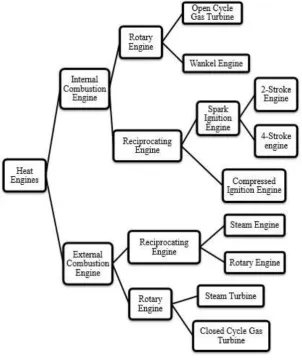
2.1 Road transportation statistic 6 22. Natural Gas used in United States of America 7 2.3 The simplification of the engine based on type and operation 8
2.4 Four Stroke engine cycle 11
2.5 The effect of different engine fuel on the engine power at
various engine speed 13
2.6 Effect of PCC on the engine power at various engine speed 14 2.7 Effect of the engine power with CNG and gasoline fuel on the
engine at various engine speed
15
2.8 Effect of PCC to the engine power compare to gasoline fuel
on the engine at various engine speed 16 2.9 Effect of different type of fuel on the engine torque at various
engine speed
17
2.10 Effect of PCC on the engine torque at various engine speed 18 2.11 Effect on torque of the engine with CNG fuel and gasoline
engine at various engine speed
19
2.12 Effect of PCC on the torque of the engine compare to gasoline fuels at various engine speed
20
3.1 Flow Chart of the research activity 23
3.2 112A05 High Pressure Sensor 26
3.3 Optical Angle Encoder installation 28 3.4 Pre-Combustion Chamber (PCC) 30
viii
3.6 Design of PCC 2 32
3.7 Design of PCC 3 33
4.1 Power output of engine using Gasoline, CNG, three types of PCC at various engine speed
37
4.2 Power of the engine using CNG and three type of PCC at various engine speed
38
4.3 Torque of the engine using Gasoline, CNG, three types of PCC at various engine speed
40
4.4 Torque of the engine using CNG and three type of PCC at various engine speed
42
4.5 Torque of the engine using CNG and three type of PCC at various engine speed
44
4.6 Work of the engine using CNG and three type of PCC at various engine speed
46
4.7 Pressure of the engine using Gasoline, CNG, three types of PCC at various engine speed
48
4.8 Pressure of the engine using CNG and three type of PCC at various engine speed
ix
LIST OF SYMBOLS AND UNITS
kJ/kg kilo Joule per kilogram MJ/kg Mega Joule per kilogram Pa Pascal
m/s meter per second
𝑄 Flow rate ͦ C Degree Celsius S Stroke length
N engine speed per one revolution rpm revolution per minute
kg/mol kilogram per mol CO2 Carbon Dioxide NOx Nitrogen Oxide CO Carbon Oxide HC Hydrogen Carbon % Percent
vol Volume
x
cc centimeter cubic mm milimeter
N.m/rpm Newton meter per revolution per minute g/kW.h gram per kilo watt hour
xi
LIST OF ABBREVIATIONS
PSM Projek Sarjana Muda
CFD Computational Fluid Dynamic
PCC Pre-Combustion Chamber
CNG Compressed Natural Gas
LNG Liquid Natural Gas
SI Spark Ignition
ICE Internal Combustion Engine
ECU Electronic Control Unit
NG Natural Gas
CI Compression Ignition
BDC Bottom Dead Centre
TDC Top Dead Centre
2D 2-Dimension
3D 3-Dimension
MPV Multi-Purpose Vehicle
1
CHAPTER 1
INTRODUCTION
1.1 BACKGROUND
Most vehicle’s engines around the world are Internal Combustion Engine (ICE). Normally Spark Ignition (SI) engine and Compression Ignition (CI) engine. For standard SI and CI engine, its normally use gasoline fuel and diesel fuel. In this modern world, people now are more concern on environmental health.
SI and CI engine that use gasoline and also diesel fuel create more pollution. The combustion of gasoline fuel will produce CO2, HC, and NOx (Engerer and Horn, 2010, Jääskeläinen and Wallace, 1993) that are hazardous to the environment.
2
However, there are several disadvantages using the Natural Gas(NG). NG are known to have lower performance output compared to the normal gasoline fueled engine. Besides that, NG fuel lead towards a decreased of power for the engine at low speed.
1.2 PROBLEM STATEMENTS
3
done on the L-type of engine and there are some limitations using this type of engine. Besides that, the PCC used is limited to only one type of PCC.
Research on this problem had come to an invention of Gas Engine With Pre-Combustion Chamber (Matsuoka et al., 2000). The main purpose of the PCC in an SI engine is to shorten the combustion duration and thereby enhance performance. (Matsuoka et al., 2000). Different design or types of PCC will result to different outcomes. The study on the Pre-Combustion Chamber is still on going to invent the best PCC design with the best result.
1.3 OBJECTIVES
There are three objectives that are used as the guideline of the study. The objectives are :
To investigate the effect using PCC in single cylinder overhead cam that use CNG as it fuel.
To determine the output performance produce using different types of bolted PCC.
4
1.4 SCOPE
In the case study, a single cylinder SI engine powered by CNG was used. An experiment is conduct by using a SI engine single cylinder with overhead cam. Different designs of Bolted PCC been used to experiment the best output result. The range for the experiments is in between 1500 rpm until 4000 rpm.
Apply the Bolted Pre-Combustion Chamber(PCC) to a single cylinder Spark Ignition(SI) engine.
Use Compressed Natural Gas (CNG) as fuel into the single cylinder SI engine.
Record the output performance of the CNG fueled for SI engine.
Analyze and study the performance result of the CNG fueled SI engine. Compare the effect of different design of PCC on the performance of the
5
CHAPTER 2
LITERATURE REVIEW
2.1 OVERVIEW
6
2.2 NATURAL GAS
Most of the present SI engine vehicle uses gasoline as their working fuel. The amount of vehicle that uses SI engine type grows by year. The statistic is shown in Figure 2.1 (Ong, H.C. et al.2012). The demand of the gasoline fuel in the market is getting higher. As the demand increasing, there are some problems occurs. The gasoline use as the fuel to most of the vehicles in this world is not a renewable and yet is harming the environment. This kind of power source has reduced gradually . Many researcher try to find the solution for the problem and come with solution by changing the working fuel use. One of the alternative found is by using NG as the working fuel to the SI engine.
Figure 2.1 : Road transportation statistic (Ong. 2012)
[image:22.595.115.493.310.573.2]7
also have a lower specific gravity than air which is between the range of 0.6 to 0.8 and that make it dissipated into air quickly.
[image:23.595.184.511.324.636.2]Besides that, NG is a safety gas fuel as it only burns with more than 15% of volume. It’s self-ignition temperature is at 537 – 540 ͦ C. For overall, NG is a much better fuel compared to any other fuel in term of environmental friendly. And because of that, it has been used for over than 150 years in many kind of industry. Besides been used as a working fuel in the transportation field, it also had been used as a cooling system and used to produce glass, steel, papers, cloth and many more. Figure 2.2 shows the Natural Gas used in United States of America in2007.
8
2.3 SPARK IGNITION ENGINE
[image:24.595.174.477.322.684.2]SI Engine stands for Spark Ignition engine. The word “spark ignition” tells the principle of the engine. This type of engine needed an additional force to ignite the working fuel used to start the combustion. The first engine was developed by Abu al-‘IZ Ibn al-Razaz al Jazari (1136-1206) then during 1860, Lenoir (1822-1900) developed the first spark plug engine. In 1876, Otto proposed four cycles engine called four strokes engine. Figure 2.3 shows the simplification of the engine types.