The integration of action
research and project
management in the
implementation of two strategic
work based learning projects
(strategic asset management and
carbon reduction) in a large
institution; resulting in a
contribution to strategic goals,
and an increased understanding
of institutional portfolios and
their interdependencies.
A thesis submitted to the University of
Southern Queensland in partial fulfilment
of the requirements for the degree of
Doctor of Professional Studies
David Povey W0096092
Abstract
This Work Based Learning (WBL) doctoral thesis, describes a study undertaken by the Author as a mature student with significant knowledge and background in Property and Facilities Management, performing in a senior executive role as the Director of Facilities at the University of Southern Queensland (USQ) in Australia.
At the outset I was seeking an appropriate opportunity to re-‐engage with structured learning that would deliver not just personal knowledge, growth and development but also add value to the workplace by creating opportunities to apply the academic dimensions in an operational setting and leveraging off those synergies, thereby enhancing divisional performance and project outcomes. That opportunity presented as the Doctor of Professional Studies (DPST) program at USQ.
The DPST program required the identification of suitable workplace projects as a platform for undertaking the program. As a result of my early analysis I had identified professional, personal and institutional contexts influencing the mapping of my doctoral journey. The congruence of these contexts produced a ‘common ground’ and it was there that I identified two significant, strategic issues at the University that required addressing. The literature associated with contemporary Facilities Management indicated that these remain fundamental issues for the FM body of practice and face all FM practitioners to a greater or lesser extent.
The work based projects undertaken were; the development of an institutional Strategic Asset Management capability to enable the alignment of the institution’s property portfolio with the strategic goals and operational needs of the institution (SAM Project), and; the management and reduction of the institution’s carbon emissions in support of increasing sustainability drivers and responsibilities (Carbon Reduction Project).
touched staff and students at every level of the organisation and indeed extended beyond the boundaries of the organisation in the case of the Carbon Reduction Project.
The study was undertaken using action research methodology to provide the overarching academic environment, with formal project management methodology applied as a way of governing and managing project implementation across the multiple dimensions of the projects. The integration of these approaches resulted in a series of academic papers at the start and conclusion of each project and the use of regular project reporting (reflecting both operational and academic progress) and the maintenance of a Learning Journal as part of my own reflective learning development. The various dimensions of both projects are fully described, as are the key outcomes and learning.
This thesis provides a case study of each project and further makes a contribution to professional practice and the body of knowledge through: the implementation frameworks developed and adopted through the study; through the outcomes and knowledge developed through the project implementations including a discussion of ‘portfolio mindedness’, through the integration of action research and project management methodologies, through my reflections and learning as a researcher practitioner seeking to affect significant change in a large institution, and; as an exponent of WBL undertaking a personal learning journey.
The key artefacts from this study have been included within the thesis as embedded content. In this way they reflect the chronology of the work and also provide substantive content for the thesis. The term ‘artefact centric’ has been used to describe this form of thesis and is one of the generally accepted formats for a WBL thesis.
As a result of the SAM and Carbon Projects, the USQ has gained a significant understanding of the footprint of its physical portfolio, and the effect of that portfolio on the organisation’s bottom line. Further it has adopted a carbon reduction strategy that will achieve 64% reductions against the 2009 carbon emissions baseline (if fully implemented).
and understanding, beyond that which might have been attained from a traditional operational delivery model, including increased reflective practice competency. Part of that knowledge and learning relates to the concept of portfolio mindedness, and the importance of such a holistic approach to the appreciation and management of institutional portfolios. In summary, the thesis describes a portfolio-‐focused approach to carbon emissions and strategic asset management, linking the two portfolios as one representation of the institutional footprint, and then expanding that concept to acknowledge the relationships which exist between institutional portfolios, and the consequent benefit for institutions and practitioners in adopting a portfolio minded approach in order to maximise the contribution to the organisation’s strategic goals.
Table of Contents
Abstract ... iii
Figure Descriptions ... x
Artefact Descriptions ... xi
Acknowledgements ... xii
Certification of Dissertation ... xiii
1 Overview – Introducing and positioning the thesis ... 14
1.1 Chapter outline ... 14
1.2 Introduction ... 14
1.3 Thesis content ... 15
1.4 Thesis framework ... 17
1.5 Thesis Context ... 18
1.5.1 Institutional Context ... 19
1.5.2 Professional Context ... 22
1.5.3 Personal Context ... 23
1.6 Approach ... 25
1.7 Format ... 31
1.8 Rich modelling ... 35
1.8.1 The Learning Journey ... 35
1.8.2 Structure ‘prompt’ ... 35
1.8.3 The Projects ... 36
1.8.4 The Project Phases ... 36
1.8.5 The presence of artefacts ... 36
1.8.6 Figures versus charts versus tables ... 37
1.8.7 Learning Journal excerpts ... 37
1.9 Summary ... 37
2 Pre-‐project – Reflecting on my learning journey and mapping the way forward ... 40
2.1 Chapter outline ... 40
2.2 Introduction ... 40
2.3 The integration of artefacts ... 41
2.4 Reflecting on my learning and development, and Artefact 1 ... 41
2.4.1 Artefact 1 ... 43
2.5 Linking the historical with the aspirational, and Artefact 2 ... 79
2.5.1 Artefact 2 ... 80
2.6 Developing a model of the elements, their relationships and Artefact 3 ... 94
2.6.1 Artefact 3 ... 96
2.7 The context for my projects ... 102
3 Project Implementation -‐ Strategic Asset Management (SAM) ... 105
3.1 Section outline ... 105
3.2 Project introduction ... 106
3.3 Environmental context and constraints ... 108
3.4 The integration of artefacts ... 108
3.5 The role of annexes, extracts and critical commentary ... 109
3.6 SAM Project ‘establishment’ phase ... 110
3.6.1 Introduction ... 110
3.6.2 Getting Started and Artefact 4 ... 113
3.6.3 Artefact 4 ... 115
3.6.4 Mapping the elements of SAM and Artefact 5 ... 124
3.6.5 Artefact 5 ... 125
3.6.6 SWOT analyses and Artefact 6 ... 128
3.6.7 Artefact 6 ... 130
3.6.8 Embedding an Action Learning approach and Artefacts 7 & 8 ... 131
3.6.9 Artefact 7 ... 133
3.6.10 Artefact 8 ... 134
3.6.11 Phase conclusion ... 135
3.7 SAM project ‘implementation’ phase ... 136
3.7.1 Introduction ... 136
3.7.2 The Project Plan and Artefact 9 ... 136
3.7.3 Artefact 9 ... 138
3.7.4 The Governance Group ... 153
3.7.5 The Working Group ... 153
3.7.6 The Project Schedule and Artefact 10 ... 154
3.7.7 Artefact 10 ... 156
3.7.8 Project Baseline ... 158
3.7.9 Academic Reporting and Artefact 11 ... 159
3.7.10 Artefact 11 ... 161
3.7.12 Operational Reporting ... 164
3.7.13 Phase conclusion ... 166
3.8 SAM Project closing phase ... 167
3.8.1 Introduction ... 167
3.8.2 Operational outcomes ... 168
3.8.3 Strategic outcomes ... 169
3.8.4 Academic Outcomes ... 169
3.8.5 Vice Chancellor’s Committee Discussion Paper and Artefact 12 ... 169
3.8.6 Artefact 12 ... 171
3.8.7 Project Closure Report and Artefact 13 ... 190
3.8.8 Artefact 13 ... 191
3.9 SAM Project conclusion ... 199
4 Project Implementation -‐ Carbon Reduction ... 205
4.1 Section outline ... 205
4.2 Project introduction ... 206
4.3 Context and constraints ... 207
4.4 The integration of artefacts ... 208
4.5 Carbon Project ‘establishment’ phase ... 209
4.5.1 Introduction ... 209
4.5.2 Getting Started and Artefact 14 ... 214
4.5.3 Artefact 14 ... 216
4.5.4 The Project framework and Artefact 15 ... 229
4.5.5 Artefact 15 ... 231
4.5.7 Embedding an Action Learning approach and Artefacts 16, 17 and 18 ... 237
4.5.8 Artefact 16 ... 239
4.5.9 Artefact 17 ... 240
4.5.10 Artefact 18 ... 241
4.5.11 Phase conclusion ... 242
4.6 Carbon Project ‘implementation’ phase ... 243
4.6.1 Introduction ... 243
4.6.2 The Project Plan and Artefact 19 ... 244
4.6.3 Artefact 19 ... 245
4.6.4 The Governance Group and Artefact 20 ... 260
4.6.5 Artefact 20 ... 262
4.6.6 The Working Group and Artefact 21 ... 264
4.6.7 Artefact 21 ... 266
4.6.8 The Project Schedule and Artefact 22 ... 267
4.6.9 Artefact 22 ... 268
4.6.10 Project Baseline and Artefact 23 ... 269
4.6.11 Artefact 23 ... 274
4.6.12 The Campus Ecological Transformation Sub-‐project (CETS) and Artefact 24 . 275 4.6.13 Artefact 24 ... 277
4.6.14 Academic Reporting and Artefact 25 ... 278
4.6.15 Artefact 25 ... 280
4.6.16 Operational Reporting and Artefact 26 ... 282
4.6.17 Artefact 26 ... 285
4.6.18 Phase conclusion ... 286
4.7 Carbon Project closing phase ... 287
4.7.1 Introduction ... 287
4.7.2 Operational outcomes ... 288
4.7.5 Project Closure Report and Artefact 27 ... 289
4.7.6 Artefact 27 ... 291
4.7.7 Vice Chancellor’s Committee Discussion Paper and Artefact 28 ... 298
4.7.8 Artefact 28 ... 300
4.7.9 Phase conclusion ... 309
4.8 Carbon Reduction Project conclusion ... 311
5 Post-‐project – Summary of Learning and reflecting on my contribution ... 318
5.1 Chapter outline ... 318
5.2 Introduction ... 318
5.3 Recapping the thesis thus far ... 319
5.4 Bringing it all together ... 321
5.5 The ‘Knowledge’ strand ... 322
5.5.1 SAM academic paper and Artefact 29 ... 322
5.5.2 Artefact 29 ... 324
5.5.4 Carbon academic paper and Artefact 30 ... 343
5.5.5 Artefact 30 ... 344
5.5.6 Other ‘knowledge’ arising from the projects ... 379
5.5.7 Format, title and portfolio mindedness ... 381
5.6 The ‘Action’ strand ... 386
5.7 The ‘Learning’ strand ... 390
5.7.1 Learning Portfolio ... 390
5.7.2 Learning Plan ... 391
5.7.3 Learning Journal and Quality Review ... 392
5.7.4 Thesis Structure and Content ... 394
5.7.5 Personal Learning ... 395
5.8 Contribution ... 397
References ... 405
Bibliography ... 411
Annexures ... 418
Annex A – Learning Journal ... 418
Annex B – Quality Review Template ... 571
Annex C – SAM Working Group Agenda ... 572
Annex D – SAM Project Control Group Agenda ... 573
Annex E – VCC Sustainability Presentation ... 574
Annex F – Carbon Reduction Working Group Agenda ... 576
Annex G – Summary of Environmental Initiatives ... 577
Annex H – SAM Paper for EmeraldInsight Publication ... 580
Annex I – Summary of Key SAM Initiatives ... 595
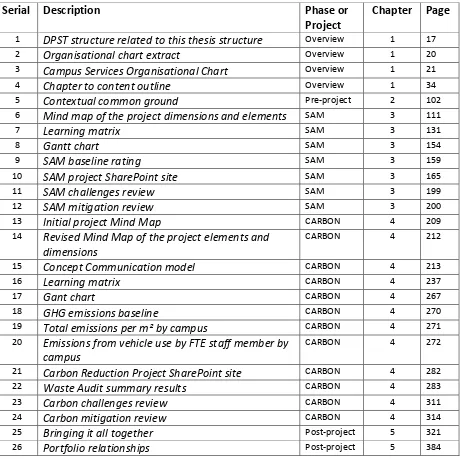
Figure Descriptions
Serial Description Phase or
Project Chapter Page
1 DPST structure related to this thesis structure Overview 1 17
2 Organisational chart extract Overview 1 20
3 Campus Services Organisational Chart Overview 1 21
4 Chapter to content outline Overview 1 34
5 Contextual common ground Pre-‐project 2 102
6 Mind map of the project dimensions and elements SAM 3 111
7 Learning matrix SAM 3 131
8 Gantt chart SAM 3 154
9 SAM baseline rating SAM 3 159
10 SAM project SharePoint site SAM 3 165
11 SAM challenges review SAM 3 199
12 SAM mitigation review SAM 3 200
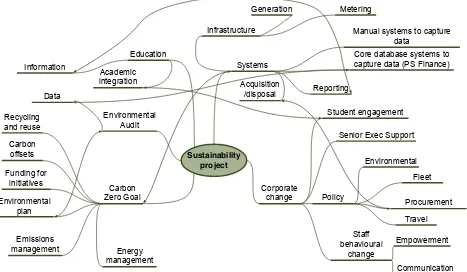
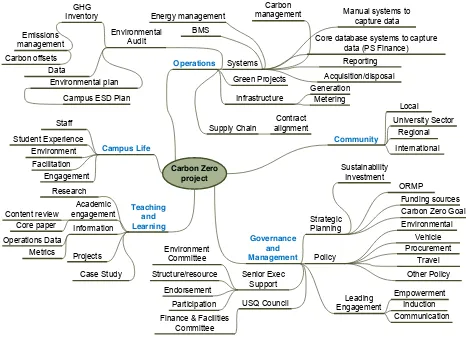
13 Initial project Mind Map CARBON 4 209
14 Revised Mind Map of the project elements and
dimensions
CARBON 4 212
15 Concept Communication model CARBON 4 213
16 Learning matrix CARBON 4 237
17 Gant chart CARBON 4 267
18 GHG emissions baseline CARBON 4 270
19 Total emissions per m² by campus CARBON 4 271
20 Emissions from vehicle use by FTE staff member by
campus
CARBON 4 272
21 Carbon Reduction Project SharePoint site CARBON 4 282
22 Waste Audit summary results CARBON 4 283
23 Carbon challenges review CARBON 4 311
24 Carbon mitigation review CARBON 4 314
25 Bringing it all together Post-‐project 5 321
26 Portfolio relationships Post-‐project 5 384
[image:10.595.70.530.170.629.2]
Artefact Descriptions
Serial Description Phase or
Project Chapter Page
1 Learning Portfolio Pre-‐project 2 43
2 Learning Plan Pre-‐project 2 80
3 DPST Getting Started Pre-‐project 2 96
4 SAM Getting Started Paper SAM 3 115
5 SAM Elements SAM 3 125
6 SWOT Analyses SAM 3 130
7 Quality Review Template SAM 3 133
8 Learning Journal Extract SAM 3 134
9 Project Plan SAM 3 138
10 Project Schedule SAM 3 156
11 Academic Reporting SAM 3 161
12 Vice Chancellor’s Committee Discussion Paper SAM 3 171
13 Project Closure Report SAM 3 191
14 Getting Started Paper Carbon 4 214
15 Project Framework – Academic Paper Extract Carbon 4 231
16 Quality Review Template Carbon 4 239
17 Learning Journal Extract Carbon 4 240
18 Action Research Applied -‐ Academic Paper Extract Carbon 4 241
19 Project Plan Carbon 4 245
20 Project Control Group Minutes Carbon 4 262
21 Working Group Minutes Carbon 4 266
22 Project Schedule Carbon 4 268
23 Environmental Audit Proposal Extract Carbon 4 274
24 Campus Ecological Transformation Proposal Extract Carbon 4 277
25 Academic Reporting Carbon 4 278
26 Media Release Carbon 4 285
27 Project Closure Report Carbon 4 291
28 Vice Chancellor’s Committee Reduction Strategy
Paper
Carbon 4 300
29 SAM academic paper Post
project 5 324
30 Carbon academic paper Post
project
5 344
Acknowledgements
To Professor Ken Stott, through your enthusiasm and vision for the Professional Studies Program at the University of Southern Queensland you were the catalyst which started me on this journey; thank you.
To Dr. Neil Peach, your mentoring and guidance over the past four years have kept me focused, motivated and on track. Your contribution has been invaluable. Your ability to understand the way that I perceive the world and to communicate within that frame of reference, whilst simultaneously challenging and expanding it, has been greatly appreciated. You were always able to see through the undergrowth at the times when I had lost the path and was hacking at the bushes. I acknowledge the extraordinary role you have played in my learning journey; thank you.
To friends and colleagues, who have made contributions to my journey and perhaps revisited their own professional and learning aspirations and activities; thank you and good luck on your own journeys. I particularly thank the staff of Facilities Management at every level, who understood and engaged with not just the tasks and goals of the projects undertaken, but also the philosophy that underpins them. They are a credit to themselves and the USQ and are a truly professional community.
To my wife and children, who have sustained me in this journey through their direct support, understanding, faith and sacrifice and in particular their acceptance of a part time father and husband. Thank you. I will make it up to you.
To my parents who constantly expressed a sense of pride, excitement and confidence in my undertakings; thank you. Your unwavering support means a lot to me.
In closing the acknowledgements, I thank the University of Southern Queensland, for supporting my activity and recognising the learning and organisational value of the projects undertaken.
Certification of Dissertation
I certify that the ideas, experimental work, results, analyses, software and conclusions reported in this dissertation are entirely my own effort, except where otherwise
acknowledged. I also certify that the work is original and has not been previously submitted for any other award, except where otherwise acknowledged.
Signature of Candidate Date:
ENDORSEMENT
1
Overview – Introducing and positioning the thesis
1.1 Chapter outline
This Chapter has the following form: • Introduction
• Thesis content • Thesis framework • Thesis context • Approach • Format
• Rich modelling • Summary 1.2 Introduction
This thesis is the culmination of my learning journey to date. As the latest and arguably the most significant element of that journey, it describes not only the historical background to my learning but the delivery of two significant work based learning (WBL) projects, undertaken as a practitioner researcher in the Doctor of Professional Studies (DPST) program at the University of Southern Queensland (USQ).
This thesis captures the key actions, interventions, reflections, knowledge and learnings arising from my own learning journey and positions them within the Action Research framework that was used to underpin delivery of the WBL projects.
Cherry (1994) in her monograph on Action Research cites Turner (1989) in likening a thesis to a stout piece of rope -‐ one which you should be able to pull on at any point and find that it doesn’t come away in one’s hand and that each strand of the rope is an integral part of the whole. She suggests that there are three constituent strands to this whole, being action (making a noticeable difference to the world); knowledge (collective wisdom) and learning (developing individual and collective capability). These strands are a useful frame of reference for presenting and reporting the outcomes of my work and will be adopted at various points within the thesis, and particularly in Chapter Five.
development of this thesis (in order to represent that ‘whole’ most effectively) has been an important part of my personal and professional learning journey.
My approach to this thesis (it’s content and structure, and the process used to prepare it) goes to the heart of the values and the aspirations that drove me to undertake my doctoral learning journey as part of a work based learning program. These values and aspirations are well reflected by McNiff when she said:
I care passionately about what I am doing, because I care passionately about the people I am supporting, and I care about my own visions and values. My position as a manager is strengthened, I believe, because I see myself as a learner, in company with others whose learning I am supporting (McNiff, 2000, p.236)
This thesis has been developed and compiled to reflect my journey as a learner and very specifically as a work based learner, as this is understood in its contemporary context (Armsby, 2000; Costley, 2010; Garnett, 2010; Garnett, 2009; Lester, 2004). The next part of this section summarises the content, structure and process used to prepare this thesis, and then the following section will pick up more fully on the work based learning context of this thesis.
1.3 Thesis content
In regard to content, this thesis contains material covering Cherry’s three strands [action, learning and knowledge] and it is constituted of materials (artefacts) that I have developed for a range of audiences and at different points in time throughout this journey. It contains documents that were prepared not just for academic assessment but also for specific organisational, professional and personal reasons. It also contains documents that were prepared several years ago, at the beginning of my doctoral learning journey, and whilst I may feel uncomfortable about these inclusions (when I review those artefacts and reflect that I would have written things quite differently now), I believe that their inclusion is an essential component in recognising and validating the importance of my own personal and professional development as a practitioner researcher.
We shall not cease from exploration And the end of all our exploring Will be to arrive where we started And know the place for the first time
(Eliot, 1943, p. 38)
What we call the beginning is often the end And to make an end is to make a beginning
This is where we start from (Eliot, 1973)
Both of these quotes give an insight into the cyclical nature of learning (Dick, 2002; Illeris, 2008; Turnbull, 2009), including professional development. They also bring into clear light, from my personal perspective, the importance of acknowledging what I didn’t know at the beginning of this doctoral learning journey. I can achieve this acknowledgement through reflection of the learning outcomes.
This insight requires me to expose and reflect on the phases (or cycles) of my own learning and requires me to have the confidence to incorporate materials (in the form of artefacts) within this thesis which are not a reflection of my current standard or depth of learning. I am able to do this because of the values which prompted me and sustained me with the energy to undertake this doctoral learning journey in the genuine belief that it will enrich and deepen my learning.
Lifelong learning is characterised by Jarvis as:
I have compiled this thesis at a time when I am (and as a result of becoming) a more ‘experienced’ person.
That experience and learning has allowed me the confidence and capacity to set out my actions, interventions, reflections, knowledge and learnings (in a predominantly chronological manner) and as previously mentioned incorporate a diverse range of artefacts developed throughout the course of my learning journey.
1.4 Thesis framework
In this section I will introduce the thesis framework. I will start by reaffirming that the overall framing of this thesis has been developed as a further reflection of the actual process I have followed as a practitioner researcher, from the commencement of my doctoral learning journey through to completion, and resulting in a generally chronological alignment of the framework.
The considerations around the thesis framework were further informed by the structure of the DPST program at USQ. The resultant thesis form essentially comprises four key steps (a) preparing a Learning Portfolio (b) preparing a learning plan (c) planning, development and implementation of the projects set out in my learning plan and (d) reviewing learnings and preparing this thesis.
The structural relationship of this thesis to the DPST framework is illustrated below in Figure 1.
Portfolio of
Learning Learning Plan
Work Based Project 1 Strategic Asset
Management
Work Based Project 2 Carbon Reduction
Summary of Learning
Historical Learning and Learning Aspirations - Chapter 2
Plan, Implement & Review WBL Project - Chapter 3
Plan, Implement & Review WBL Project - Chapter 4
Final Review - Chapter 5
USQ Doctor of Professional Studies Structure
Thesis Structure
Preliminary Review and Introduction -
Chapter 1
Figure 1: DPST structure related to this thesis structure
Chapter covering the planning, implementation and review of two related but separate projects); Chapters One and Five are the ‘bookends’ for these phases and provide the ‘experienced’ commentary and reflections that bring the phases and projects together as a whole.
A number of other ‘design’ aspects of this thesis are also based on Williams’ approach to thesis writing and this is covered in more detail in the Thesis Format section later in this Chapter.
This concludes the preliminary discussion of the thesis framework, noting that a full discussion of the final format is provided later in this Chapter.
The next section will build on the initial framework discussion by setting the thesis against the Institutional, professional and personal contexts. These contexts held varying levels of influence over the type of doctoral study, the selected work based projects and the resultant thesis, and together these sections provide the rationale for the final form of this thesis.
1.5 Thesis Context
This section provides particular details of the context in which this thesis and the development work that it describes, has been undertaken.
Armsby (2000, p. 40) makes it clear that “work based learning is context bound and grounded in practice” and my use of the word ‘development’ follows Armsby, in that her position on work based doctoral studies is one that strongly resonates with my own values and aspirations, as noted earlier. Specifically Armsby (2000, p. 36) says that “another way of describing work based learning research and development is project planning and development”. My one reservation with that translation is that in a professional practitioner environment, ‘project planning and development’ would not generally have a personal learning association and so the initial interpretation may not be as inclusive as the original work based learning identifier.
Notwithstanding my caution around the term, the ‘planning and development’ work set out in this thesis arose from the contextual ‘common ground’ found at the intersection of my personal aspirations and ambitions, my professional experience and standing, my organisational position and responsibilities, and my relationships with a wide range of work colleagues. This is distinctly different to the more traditional academic research based doctoral approaches, and may be the work based learning equivalent to ‘a gap in the literature’ or ‘research problem’.
learning journey; mapping the next stage of that journey from my position on the previously described contextual ‘common ground’.
My approach is consistent with the findings of Lester and Doncaster (2002), as reported by Lester (2004, pp. 3-‐4), in that one of the key reasons practitioners like me see benefit in current work based learning programs, is that it provides a framework for “taking forward an area of application, maintaining a high level of thinking and action within and around it, and encouraging reflective and critical thinking that goes beyond the immediate practice thinking”.
Lester’s framework has had a profound impact on my own approach to my planning and development work and permeates all dimensions of the work described in this thesis. This impact will be seen in the way in which I have prepared for this learning journey (described in Chapter Two), designed, developed and implemented two, significant work based learning projects (described in Chapters Three and Four) and concluded this learning journey through reflection and review of my achievements and learning (Chapter Five). The next part of this section describes more fully the institutional, professional and personal contexts for the ‘planning and development’ work of this thesis.
1.5.1 Institutional Context
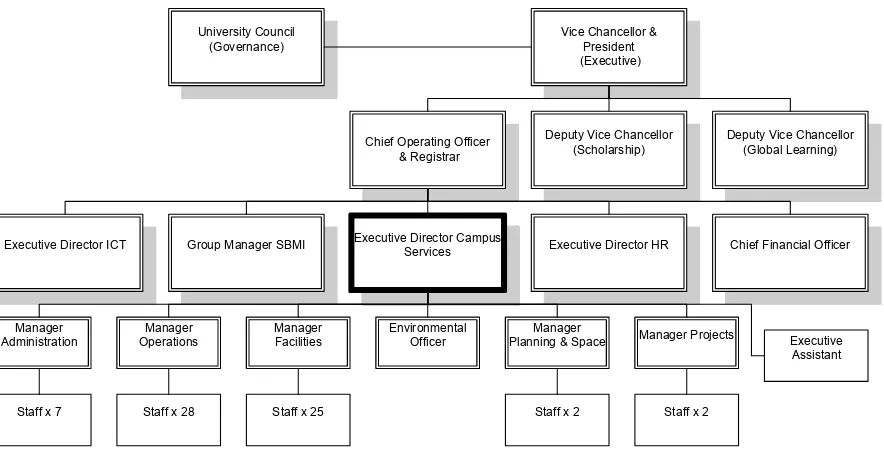
During the life of this study I have been employed at the University of Southern Queensland, initially in the role of Group Manager Facilities Management and later as the Executive Director Campus Services. The role involves overall responsibility for the University’s built environment and property portfolio. My position within the organisation is shown in the partial organisation chart below at Figure 2. The chart shows the top few layers of the University’s administrative structure and the functions and staff numbers associated with my role.
Vice Chancellor & President (Executive)
Deputy Vice Chancellor
(Scholarship) Deputy Vice Chancellor (Global Learning) Chief Operating Officer
& Registrar
Executive Director Campus
Services Executive Director HR
Group Manager SBMI Chief Financial Officer
Executive Director ICT
Environmental Officer
Manager Planning & Space Manager
Facilities Manager Projects
Manager Operations
Staff x 28 Staff x 25 Staff x 2 Staff x 2
Executive Assistant Manager
Administration
Staff x 7
University Council (Governance)
Figure 2: Organisation chart extract
It can be seen that the position of Executive Director Campus Services is one of five direct reports to the Chief Operating Officer, responsible collectively for the delivery of key corporate services to the organisation, often paraphrased as ‘enabling the enterprise environment in which the teaching and learning occur’. The Chief Operating Officer and peers in the ‘group of five’ have played important parts in the progression of my work based doctoral development projects.
The University Council is also included in the diagram and its role is to provide governance oversight of the University executive and operations. The Council is supported by a small number of sub-‐committees and these were directly involved, as part of their remit, in the development projects set out in this thesis.
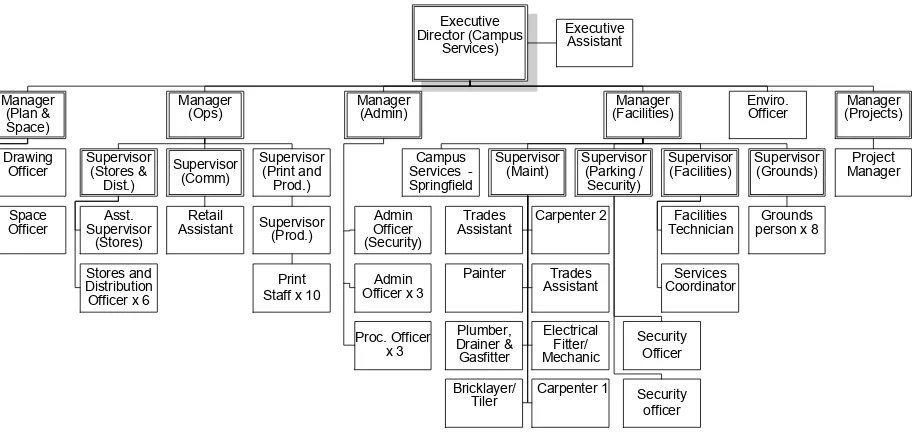
To provide further understanding of the context in which the study and the WBL projects were undertaken, the supporting campus services structure is provided below at Figure 3.
[image:20.595.80.522.123.350.2]
Figure 3: Campus Services Organisation Chart
Figure 3 provides an indication of the nature and scale of the team that I was organisationally responsible for during the course of my doctoral learning journey. As illustrated, within the Campus Services Section there are numerous managers, supervisors and staff many of whom participated in the development projects set out in this thesis. My work as a practitioner researcher and learner worker has heightened the need for me to more fully understand and appreciate (from a positive critical review perspective) my role within the organisation, as well as the operation of my organisation from both an internal and external perspective.
My understanding in that regard has been heightened as a direct result of the interplay between the academic framework (and demand for research rigour) required of my work based learning degree and the operational demands of the organisation in regard to timeliness, budget and performance. Dick (2002, p. 167) refers to the trade off, in action research, between “discovering general truths and being relevant to the local situation”. Armsby contends that:
The work based learner is both helped and hindered by his or her organisational context. But the context is part of the reason for the research and hence cannot be denied. Work based learners must grapple with being a part of the problem, situation or development they are investigating (Armsby, 2000, p. 35)
In designing and developing my work based projects I was compelled to look ‘below the surface’ of the organisational charts above and to develop an appreciation of USQ’s
Executive Director (Campus Services) Enviro. Officer Executive Assistant Manager (Admin) Admin Officer x 3
Admin Officer (Security) Proc. Officer x 3 Manager (Facilities) Campus Services - Springfield Supervisor (Facilities) Facilities Technician Services Coordinator Supervisor (Grounds) Grounds person x 8 Supervisor
(Maint)
Bricklayer/
[image:21.595.82.538.73.289.2]organisational dynamics. The learnings and findings from this exploration are set out in the later chapters of this thesis.
1.5.2 Professional Context
My professional life to date is more fully described in Chapter Two. However, to set the professional context for this study I will comment that my career and interests have been based around facilities management and estates management across a range of organisations and institutions. Therefore my priority in identifying and selecting the work based projects was that those projects should be in the field of facilities management, or estates management, and preferably projects which addressed contemporary issues in those fields and would potentially make a contribution to professional knowledge and practice. The final desirable criteria from my perspective was to undertake projects that would be of strategic significance for the USQ, thereby creating a valuable contribution to my host organisation and potentially ensuring appropriate recognition and support for the work.
Professional journals 1 and conferences regularly host discussion of strategic asset management (SAM), ranging from small organisations through to internal entities and retail chains, each with their own understanding and application of SAM. Within the University sector there is also significant discussion and varying degrees of understanding and capability, ranging from simple asset maintenance planning through to fully integrated strategic asset management frameworks linking the asset portfolio to the ‘product’ of the organisation. Indeed that discussion has led to the development of the Tertiary Education Facilities Management Association (TEFMA) SAM guidelines being developed (discussed further in Chapter Three). The currency of the SAM debate and the lack of a SAM framework at USQ prompted the exploration of this capability development as an appropriate, strategic level project for the work based learning vehicle.
At the time of developing the Learning Plan (provided in Chapter Two) there was a need to identify a second project. During my investigation to identify a first project, I had also observed the number of articles relating to energy efficiency and carbon reduction projects that also appeared in the FM Journals. I was also mindful of the changing environment with regard to state and federal legislation, essentially driving the prudent management of carbon emissions at all levels nationally.
To digress momentarily with a personal observation as an FM practitioner; on arrival at USQ in 2008, I was struck by the general lack of awareness (at a regional, institutional and individual level) of the need to manage environmental footprints and particularly carbon emissions. Further, there was an apparent lack of basic resources and infrastructure in
support of those objectives. The areas of most progress and visibility were rainwater collection tanks and solar panels (photo-‐voltaic and water heating). My frame of reference for this observation relates to the New Zealand environment where carbon reduction, reuse, recycling and waste management initiatives generally appear as integrated elements in societal infrastructure at all levels.
This personal perspective, the legislative drivers, the Facilities Management community interest and the USQ aspiration to be carbon neutral by 2020, combined to suggest a sustainability (later to become carbon reduction) project would be a suitable second work based learning project. The key point of difference for this project compared to the majority of articles I had reviewed was the organisational level focus rather than a single building or piece of infrastructure, and it was this holistic perspective that attracted me and would potentially make the contribution to professional knowledge and practice.
1.5.3 Personal Context
Just as the previous sections have highlighted the importance of the institutional and professional contexts in which work based planning, development and implementation occurs, this section highlights the importance of the personal context for such work.
The personal context for work based learning has several dimensions. One dimension, relevant to my own doctoral learning, highlights that any research is a form of human activity and that our minds are the ‘instruments’ through which all data is generated and then interpreted (Cherry, 1999). This can lead to the view implicit in Usher and Edwards (1994) question as cited by Armsby (2000, p. 40) “Can research ever be anything more than a subtle form of writing the self?” My work at the beginning of the doctoral learning journey to develop and present a Learning Portfolio and a Learning Plan (as set out in Chapter Two) awakened my awareness and appreciation of this personal dimension, its significance in undertaking this doctoral learning, and its contribution to rigour in research.
Another relevant dimension highlights the potential bias introduced by the multiple roles held by the individual practitioner-‐researcher within their work place and the potential influences and ramifications created by their organisational position. This is further influenced by the individual’s previous experiences, organisational aspirations and so on; all of which will impact on and influence that individual’s efforts to develop rigorous and meaningful conclusions and findings (Allison, Fall 2000; Armsby, 2000; Lester, 2004; Zuber-‐ Skerritt, 2007). My personal learning in designing, developing and sustaining a nexus between my work (including my professional independence and integrity) and my research (from an academic perspective) has been both rewarding and effective and this aspect is further explored in the following section of this chapter.
considerations that influenced my decision to engage in my particular, personal doctoral learning journey and the attendant work based learning projects. These considerations included:
•
My particular point of personal development and circumstances (described in the Learning Portfolio provided within Chapter Two)•
The needs of the host organisation, as defined within the USQ Strategic Plan 2009-‐ 2013 under Goal 9 – Enterprise (paraphrased as: an efficient enterprise operation, and; carbon neutrality by 2020)•
The alignment of the potential work based learning projects and Action Research approach with those organisational needs and my particular role responsibilities and spheres of influence•
The alignment of the projects with my areas of professional interest•
The potential for the learning and outcomes from those projects to make a contribution to the body of professional practice and knowledge (described in the Learning Plan within Chapter Two)•
The synergy inherent in the work based learning paradigm in facilitating an environment of academic and operational activity that would deliver the desired organisational and individual learning and operational outcomes•
The opportunity to develop the USQ Facilities Management team through their engagement and participation with the projects•
The potential contribution to my professional future through the delivery of these significant strategic projects and the subsequent award of Doctor of Professional StudiesThese considerations were then used as the foundation for the multi lateral negotiations, which took place on the contextual ‘common ground’ mentioned earlier. As a result I formulated a plan of action designed to satisfactorily meet the needs of the various stakeholders who occupied this ‘common ground’ with me. Clearly, I was an equally significant stakeholder in the planning, along with my immediate work supervisor, academic supervisor and numerous colleagues and staff.
The notion that this negotiated approach constitutes a proxy for the traditional ‘gap in the literature’ approach (adopted for framing other doctoral research) has been introduced already in this Chapter, and it is considered in more detail later in this Section.
Following a review of the literature in regard to reflective practices (Turnbull, 2009; Cherry, 1999; Kitchener, 2006; Westberg, 2001; Peters, 2009) and as part of the negotiation process (and in this case it was a self-‐negotiation), I resolved that I would actively maintain a learning journal to enhance my capacity to deal with the complexity associated with the new environment I was about to enter.
The development of the required self discipline and the consequent maintenance of a Learning Journal has proved to be of significant benefit, not only to my professional development (through increased self reflection) in the longer run, but also in heightening my day to day capacity to contribute more effectively to the work based learning projects I undertook as part of this doctoral learning. Armsby says that:
It is the specific or individualised context of the organisation that contributes to the development of theory. However, insider researchers will bring their subject expertise and, experiential knowledge to the problem and this is likely to influence the development of theory. Through reflective practice, influences on the development of theory can be acknowledged” and further “Through written self-‐ criticism and continued efforts to become aware of one's own subjective constructions, a more reasoned methodology can be developed (Armsby, 2000, p.37)
Evidence of the reflective practice that underpins and complements my approach to the planning and development of the work based projects, is provided in the succeeding chapters of this thesis. Later, in Chapter Five, I also outline my ‘thinking on my thinking’ in order to demonstrate my progression and development as a more ‘experienced’ person as well as a practitioner researcher.
I have provided the institutional, professional and personal contexts informing my choice of work based learning projects. The next section considers my approach to the study against those same contexts.
1.6 Approach
Kitchener (2006), Peters (2009) and Whitehead (2012).
A particularly relevant description of work based learning is provided by Armsby who states: In work based learning, research, development and reflective practice are located within a real social and work based community that gives them meaning rather than in a hypothetical or devised scenario. The focus is on ‘real’ research and development projects and reflection on ‘real’ pragmatic and applied activities is what makes work based learning meaningful to practitioner researchers…a variety of influences within the organisation and the individual affect the worker researcher’s perceptions and choice of methodology. These must be acknowledged and considered to enable a real project outcome or product (Armsby, 2000, p. 42)
This expression of work based learning is particularly relevant to the situation I found myself in, seeking to identify and develop significant projects, within a complex and dynamic organisational environment, using myself and other staff as practitioner researchers.
Raelin expresses a similar definition of work based learning:
This expression of the benefits of work based learning reflected my own operationally focused management practice prior to engaging with the DPST program and ‘struck a chord’ with me in regard to my professional aspirations.
Lester (2004) describes doctoral level work based projects, and contends that such projects should act as “a vehicle for real-‐world developments and for high-‐level professional capability”. He further states that such projects may need to:
Be adequate for the 'swamps,' 'messes' and 'wicked problems' encountered by senior professionals in their practice situations. It may draw on technical and disciplinary knowledge, but it also needs to engage fully with the knowledge-‐in-‐use that thinking practitioners develop and use in the course of their work (Lester, 2004, p. 7)
As part of my initial assessment and negotiation (described earlier), I formed a view that the chosen projects would fulfill at least some of the expectations described by Lester. My experience as set out in this thesis confirms my earlier projections but it has only been by doing the work (designing, developing and implementing the projects) that I have been able to arrive at this evidenced conclusion. This highlights the uncertainty that is most likely to arise in work based learning projects that are established on the common ground between organisational, personal and academic perspectives. As such the researcher is not starting with a ‘known gap’ in the literature and just as importantly is not starting with an environment over which they have complete, or even strong, control.
I have come to understand and experience that the common ground on which work based learning is undertaken is indeed thixotropic. I have learned that this compels an approach that is open and flexible, shaped by the context and environment, but at the same time is able to eventually solidify to a point where conclusions and ‘warranted assertions’ can be validly demonstrated.
A portfolio perspective is something that has been used in several disciplines to enhance management capacity to improve organisational performance. Marketing, risk and finance are examples of disciplines outside of facilities management that have utilised such a perspective and just as physical scientists have recognised that understanding and managing a tree is different to managing a forest, portfolios comprise a multiplicity of ‘individual units’ and managing the sum of the parts is significantly different to managing the individual units. In my discussion in Chapter Five of this thesis and in regard to the knowledge contributions of my work, I will discuss the ramifications of ‘portfolio mindedness’ in the operations of facilities management and the manner in which this unanticipated dimension of my work has emerged during the doctoral journey.
As a further illustration of being open to new connections and learnings, later in this chapter I will set out the rationale that has lead to my specific development and formatting of this thesis. It was unexpected on my part that I would again encounter the notion of ‘portfolio mindedness’ albeit this time in an academic application. That is, the way in which some academic authorities use the term portfolio to describe a particular way of bringing together thesis presentations for professional doctorates (Scott, 2004).
Such a ‘portfolio’ thesis comprises individual artefacts/documents that may have been prepared for different audiences at different times, but the portfolio thesis brings the disparate components together in a manner that makes the ‘whole’ greater than the sum of the parts. As noted, the issue of ‘portfolio mindedness’ will be considered further in Chapter Five when I seek to bring together the different strands of my learning as an end to this particular stage of the journey.
• not knowing where the data will lead you, and
• it is not just the researcher’s understanding that emerges but so does the research methodology.
I too would have identified these as risks at the outset, but given the strong alignment between my approach, my values as alluded to earlier, the three contexts previously described and my experiences in implementing the two work based learning projects, I now see these ‘risks’ as distinct advantages of the methodology.
An important clarification of my approach is that whilst I have endeavoured as much as possible to adopt a ‘data driven’ stance to my planning and development work, I will often use ‘action research’ as a term that describes my research method. This will become apparent in the subsequent chapters and to avoid any confusion some preliminary explanation is warranted. Again, I will use Dick because his position on this issue closely represents my o