Comprehensive Parametric Polymorphism:
Categorical Models and Type Theory
Neil Ghani1, Fredrik Nordvall Forsberg1, and Alex Simpson2 1
Department of Computer and Information Sciences, University of Strathclyde 2 Faculty of Mathematics and Physics, University of Ljubljana
Abstract. This paper combines reflexive-graph-category structure for relational parametricity with fibrational models of impredicative poly-morphism. To achieve this, we modify the definition of fibrational model of impredicative polymorphism by adding one further ingredient to the structure:comprehensionin the sense of Lawvere. Our main result is that suchcomprehensive models, once further endowed with reflexive-graph-category structure, enjoy the expected consequences of parametricity. This is proved using a type-theoretic presentation of the category-theoretic structure, within which the desired consequences of parametricity are derived. The formalisation requires new techniques because equality re-lations are not available, and standard arguments that exploit equality need to be reworked.
1
Introduction
According to Strachey [26], a polymorphic program isparametric if it applies the same uniform algorithm at all instantiations of its type parameters. Reynolds [23] proposedrelational parametricity as a mathematical model of parametric poly-morphism. Relational parametricity is a powerful mathematical tool with many useful consequences; see [27,21,13] for numerous examples.
The polymorphic lambda-calculus, λ2, (a.k.a. System F) was introduced independently by Girard [11] and Reynolds [22]. It serves as a model type theory for (impredicative) polymorphism, and thus provides a significant testing ground for ideas on relational parametricity. In this paper we address the question:
What is the fundamental category-theoretic structure needed to model relational parametricity forλ2, which is both i) minimal, in assuming as little structure as possible; but ii) strong enough to ensure the expected consequences of parametricity hold?
It is perhaps surprising that this question does not yet have an established answer. On the one hand, category-theoretic models for λ2were developed many years ago by Seely [25]. They are studied systematically asλ2fibrations in Jacobs [15]. On the other, the fundamental category-theoretic structure needed to model relational parametricity is also known. The crucial ingredient is the notion of
used explicitly by O’Hearn and Tennent [20], and Robinson and Rosolini [24], and reached maturity in theparametricity graphs of Dunphy and Reddy [7,8].
To obtain minimal structure for relational parametricity forλ2, it is natural to combine the structure ofλ2fibrations with that of parametricity graphs. This results in the notion of λ2 parametricity graph, which we define in Section 3. Sadly,λ2parametricity graphs enjoy the expected properties of parametricity only in the special case that the underlying category is well-pointed. (Similar observations, for different but related notions of model, are made in [6,7,8].) Since well-pointedness rules out many categories of interest in semantics (e.g., functor categories) this limits the generality of the theory.
One way of circumventing the restriction to well-pointed categories was proposed by Birkedal and Møgelberg [6], who developed a more elaborate category-theoretic structure, which overcomes the limitation by modelling Plotkin and Abadi’s logic for parametricity [21]. This method of modelling the combination of λ2with an extraneous logic has been been refined and simplified by Hermida [12]. Nonetheless, it does not enjoy the simplicity in conception of combining the structure of category-theoretic models ofλ2with that of parametricity graphs. To obtain our minimal structure, we retain the original idea of combining parametricity graphs with category-theoretic models ofλ2. However, we imple-ment this in a perhaps unexpected way. We modify the notion ofλ2model. We ask forλ2fibrations to additionally satisfy Lawvere’scomprehension property. Not only are the resultingcomprehensive λ2fibrations natural in their own right as models of λ2, but, when combined with parametricity-graph structure to form comprehensiveλ2parametricity graphs, they do indeed enjoy all expected consequences of parametricity.
Sections 2 and 3 define comprehensiveλ2fibrations and comprehensiveλ2
parametricity graphs respectively. In Section 4, we present a type theory λ2R, corresponding to our category-theoretic structure, which provides a simple system for reasoning about parametricity. The type theoryλ2Ris similar to Dunphy’s System P [7], and Abadi, Cardelli and Curien’s System R [1], to which it is compared in Section 7.
In Section 5, we develop the technical machinery needed to reason inλ2R. A key obstacle is that the system does not includeequality relations. This means that graph relations, which are a crucial ingredient in standard arguments involving relational parametricity, are not in general definable. In Section 5, we instead identify two forms ofpseudograph relations, whose subtle interrelationship allows us to establish the consequences we need. One kind of pseudograph relation is immediately definable using the fibrational structure built into the notion of parametricity graph. The other type of pseudograph requires opfibrational
structure. We use an impredicative encoding to show that opfibrational structure is definable inλ2R, and hence always present in comprehensiveλ2parametricity graphs. In Section 6, we finally apply the technical machinery and establish that the expected consequences of relational parametricity are indeed derivable in λ2R, and hence hold in comprehensiveλ2parametricity graphs.
(i) The definition of comprehensiveλ2fibrations as models ofλ2.
(ii) The definition of a new category-theoretic notion of model of relational para-metricity, obtained by combining parametricity graphs and comprehensive λ2fibrations intocomprehensiveλ2parametricity graphs.
(iii) The extraction of λ2R as the type theory intrinsic to comprehensive λ2
parametricity graphs.
(iv) The derivation of the expected consequences of parametricity inλ2R, and hence in comprehensiveλ2parametricity graphs. This requires novel tech-niques: establishing theopfibrationproperty of comprehensiveλ2 parametric-ity graphs, and the use ofpseudograph relations.
In the category-theoretic parts of the paper, we assume familiarity with fibred category theory, for which Jacobs [15] is our main reference. Nevertheless, a substantial portion of the paper is presented in purely type-theoretic terms, and may be read without reference to the accompanying category-theoretic material.
2
Comprehensive
λ
2 Fibrations
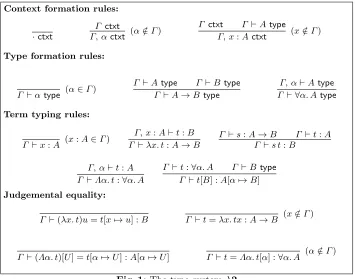
In Fig. 1, we recall the polymorphicλ-calculusλ2. We use x, y, . . . to range over term variables, andα, β, . . . to range over type variables. Our presentation has four judgements: Γ ctxt, stating thatΓ is a well-formed context; Γ `Atype,
stating thatAis a well-formed type in contextΓ; Γ `t:A, stating that the
termthas typeAin contextΓ; and judgemental equality Γ `t1=t2:A. We assumeβ andη-equalities for both term abstraction,λ, and type abstraction, Λ. Equality is also assumed to be a congruence relation, although the rules guaranteeing this have been omitted from Fig. 1 for brevity.
A minor departure from many presentations ofλ2is that we interleave type variables and term variables in a single context. This approach is not only natural, but indeed standard when λ2 is considered in the context of dependent type theory; for example, when derived as an instance of a pure type system [3]. Since there is no dependency ofλ2types on term variables, such interleaving is syntactically vacuous. Nevertheless, we shall see below that its presence does have semantic implications.
We next recall the standard category-theoretic notion ofλ2fibration, which models λ2. We directly restrict the definition to the split case to circumvent coherence issues that would otherwise arise, cf. [15].
Definition 1 (λ2 fibration). A λ2 fibration is a split fibration p : T → C, where the base categoryChas finite products, and the fibration:
(i) is fibred cartesian closed;
(ii) has a split generic objectU [15, Def. 5.2.1] — we writeΩforp U; (iii) and has fibred-products along projectionsX×Ω - X inC.
Context formation rules:
·ctxt
Γ ctxt
Γ, αctxt (α /∈Γ)
Γ ctxt Γ `Atype
Γ, x:Actxt (x /∈Γ)
Type formation rules:
Γ `αtype (α∈Γ)
Γ `Atype Γ `Btype
Γ `A→Btype
Γ, α`Atype
Γ ` ∀α. Atype
Term typing rules:
Γ `x:A (x:A∈Γ)
Γ, x:A`t:B Γ `λx. t:A→B
Γ `s:A→B Γ `t:A Γ `s t:B
Γ, α`t:A Γ `Λα. t:∀α. A
Γ `t:∀α. A Γ `Btype
Γ `t[B] :A[α7→B]
Judgemental equality:
Γ `(λx. t)u=t[x7→u] :B Γ `t=λx. tx:A→B (x /∈Γ)
[image:4.612.131.486.114.393.2]Γ `(Λα. t)[U] =t[α7→U] :A[α7→U] Γ `t=Λα. t[α] :∀α. A (α /∈Γ)
Fig. 1:The type systemλ2
The above definition differs slightly from [15, Def. 8.4.3(b)] in that we do not include fibred coproducts in condition (iii). These are not needed to modelλ2, and their existence is anyway derivable in parametric models.
In aλ2fibration, we writeTX for the fibre category overX. We also useX
as a subscript when referring to structure inTX; e.g.,1X is the specified terminal
object inTX, and⇒X is the exponential structure inTX. Givenf: X - Y inC, we writef∗ for the reindexing functorTY →TX, andA∗f: f∗A - A for the specified cartesian lifting off relative to A. We also writeQ
Ω for the
specified right adjoint, given by (iii), to reindexing functorsπ∗1:TX →TX×Ω.
We recall in outline the semantic interpretation ofλ2in aλ2fibrationT→C. A contextΘ=α1, . . . , αn of type variables is interpreted as then-fold product
JΘK=Ω
n in
C. A typeAin type-variable context Θ is then interpreted as an object JAKΘ of T overJΘK, defined by induction on the structure of A, using cartesian closure for function types, fibred products for universal types, and the reindexing (πi)∗U of the generic object along the projection πi: Ωn - Ω to interpret αi over JΘK. Finally, the interpretation of a term Γ ` t : A is obtained by splittingΓ into its component contexts:Θ of type variables, and∆ of term variables. Then∆=x1:A1, . . . , xm:Amis interpreted as the product
In the above outline, one sees that the structure of aλ2fibration fits uneasily alongside our mixed contexts of interleaved type and term variables, since these have to be separated to define the semantic interpretation. Independent type theory, where no such separation is possible, a more direct semantic interpretation is achieved using Lawvere’scomprehension property [18] to model the process of context extension [14]. It is natural to apply the same idea toλ2.
Definition 2 (Comprehensive λ2 fibration). A λ2 fibration p : T → C iscomprehensive if it enjoys thecomprehension property [15, Def. 10.4.7]: the terminal-object functorX 7→1X:C→Thas a specified right adjointK:T→C.
Requiring a specified right adjoint maintains consistency with our policy of working with split fibrational structure. GivenAinTX, we writeκA:KA - X for the ‘projection’ map obtained by applyingpto the counit1KA - Ain T.
To show that comprehensiveλ2fibrations permit a direct, inductive-on-syntax semantic interpretation, we present the interpretation ofλ2types in detail. A context Γ ctxt is interpreted as an object JΓK ofC; and a typeΓ `Atype is interpreted as an objectJAKΓ inTJΓK. These are defined by mutual induction,
together with mapsπα
Γ:JΓK - Ω for every contextΓ containingα.
J·K=1 JαKΓ = (π
α
Γ)∗U π α Γ, α=π2 JΓ, αK=JΓK×Ω JA→BKΓ =JAKΓ ⇒JΓKJBKΓ π
α Γ, β=π
α
Γ ◦π1(β6=α) JΓ, x:AK=KJAKΓ J∀α. AK=
Y
ΩJAKΓ, α π α
Γ, x:A=π α Γ ◦κJAKΓ
Having made the above definitions, a termΓ `t:A is interpreted as a global element JtKΓ: 1JΓK - JAKΓ in TJΓK. The definition, which we omit, is a
straightforward induction on the derivation of Γ `t:A.
The appropriateness of comprehensiveλ2fibrations as a notion of model for λ2is supported by soundness and completeness results.
Theorem 3 (Soundness forλ2).IfΓ `t1=t2:Athen, in every
comprehen-sive λ2fibration, we haveJt1KΓ =Jt2KΓ.
Theorem 4 (Full completeness for λ2). There exists a comprehensive λ2
fibration satisfying:
(i) for every typeΓ `Atype, every global point1
JΓK - JAKΓ is the denotation
JtKΓ of some termΓ `t:A; and
(ii) for all termsΓ `t1, t2:A satisfyingJt1KΓ =Jt2KΓ, we haveΓ `t1=t2:A. Theorem 3 is proved by a routine induction on equality derivations, and Theorem 4 by construction of a syntactic model, which has the requisite properties.
3
Comprehensive
λ
2 Parametricity Graphs
category consists of a pair of categories, V, the vertex category, and E, the
edge category, together with functors∇1,∇2:E→Vand∆:V→Esatisfying
∇1∆= idV=∇2∆. Informally, one thinks ofEas a category whose objects are binary ‘relations’ between objects of V. Then ∇1,∇2 are ‘projection’ functors, and∆ maps an object to its ‘identity relation’.
We shall be guided by the following general thesis. A model of relational parametricity, irrespective of the type theory for which it is considered, should form a reflexive graph category, in the (2-)category of structure-preserving functors between models of the type theory in question.This thesis is supported by the following considerations. Endowing the edge category E with the categorical structure needed to interpret types corresponds to giving types a relational interpretation. The preservation of this structure by the projection functors∇1,∇2 means that the relational interpretation commutes with the usual non-relational interpretation of types. The preservation of structure by∆, in combination with the identity property discussed later, corresponds to Reynolds’identity extension
property [23].
In the context of the present paper, we need to specialise the above recipe to (comprehensive)λ2fibrations. Amorphismfrom one (comprehensive)λ2fibration
p0:T0→C0 to anotherp:
T→Cis given by a pair of functors,H:T0 →Tand L:C0→Csuch thatp H =L p0, and such thatH, Lpreserve all other specified structure (including the choice of cartesian morphisms in the splitting) on the nose. By a reflexive graph of (comprehensive)λ2fibrations, we thus mean a pair of (comprehensive) λ2fibrations with functors between them:
R(T)
∇T
1, ∆T, ∇T2
- T
R(C) pR
?
-∇C
1, ∆C, ∇C2 C
p
?
(1)
where each of the three pairs∇T
1,∇C1 and∇T2,∇C2 and ∆T, ∆C is a morphism of (comprehensive) λ2fibrations, and where each of the triples∇T
1,∇T2, ∆T and
∇C
1,∇C2, ∆C is a reflexive graph category. We emphasise thatpR:R(T)→ R(C), in (1), is an arbitrary (comprehensive)λ2fibration fitting into the diagram. The notationR(·) is merely mnemonic, and does not imply thatR(T) is obtained using a particular construction fromT.
One needs to add further conditions to the above structure to ensure that the objects of R(T) behave sufficiently like relations. In [19], this was addressed by requiring the fibre categoryR(T)1R(C), over the terminal object, to coincide with
a particular category oflogical relations overT1C. As well as only being applicable
ifT1C has (sufficient) finite limits, this requirement also has the weakness that
remedy this, we instead need axiomatic structure for a category of relations, in a form that is suitable for being imposed fibrewise on pR. This is provided by Dunphy and Reddy’s notion ofparametricity graph [7,8], which we now recall.
A reflexive graph category∇1,∇2: E→V, ∆:V→Eis said to berelational if the functorh∇1,∇2i:E→V×Vis faithful. This property allows one to think of morphisms in E as pairs of relation-preserving maps from V. Accordingly, we call objects of E relations, we write R: A ↔ B to mean an object R of E with ∇1R = A and ∇2R = B, and we write f ×g: R - S to mean that there is a (necessarily unique) maph:R - S inEwith∇1h=f and
∇2h=g. A reflexive graph category satisfies theidentity property if, for every h: ∆A - ∆BinE, it holds that∇1h=∇2h. This allows one to think of∆A as an identity relation on A(although, cf. Sect. 5 for caveats). In a relational reflexive graph category, the identity property is equivalent to the fullness of the functor∆. Aparametricity graph is a relational reflexive graph category with the identity property, for which the functorh∇1,∇2i:E→V×Vis a fibration. The fibration property supports the following definition mechanism. LetR:A↔B be a relation inE. Then, given morphismsf:A0
- Aandg:B0 - B inV, reindexing produces aninverse image relation [f×g]−1R:A0↔B0.3
The main category-theoretic definition of this paper is a fibrewise adaptation of parametricity graph to the context of comprehensive λ2fibrations.
Definition 5 ((Comprehensive) λ2 parametricity graph).A (comprehen-sive)λ2parametricity graph is a reflexive graph of (comprehensive)λ2fibrations, as in (1), that satisfies, for all objects W ofR(C) andX ofC:
(Relational) The functorh∇T
1,∇T2iR(T)W:R(T)W →T∇C1W×T∇C2W is faithful.
(Identity property) The functor∆T
TX: TX→ R(T)∆CX is full. (Fibration) h∇T
1,∇T2iR(T)W:R(T)W →T∇C1W×T∇C
2W is a cloven fibration.
Moreover, for everyφ:W0 - W in R(C), we require the commuting square
R(T)W
(pR)∗φ
- R(T)W0
T∇C
1W×T∇C2W
h∇T
1,∇T2iR(T)W
?
p∗(∇C
1φ)×p∗(∇C2φ) - T∇C
1W0×T∇C2W0
h∇T
1,∇T2iR(T)W0
?
(where the notation distinguishes reindexing functors determined bypandpR) to give a cleavage-preserving fibred functor fromh∇T
1,∇T2iR(T)Wtoh∇T1,∇T2iR(T)W0.
This definition could by strengthened by asking for the parametricity-graph fibrations to be split instead of merely cloven. Such a strengthening does not
3
affect any of the results in the sequel, and may seem natural given our use of split fibrations in all previous definitions. Nevertheless, our choice of definition reflects the fact that the weaker cloven assumption is all that is needed to avoid coherence issues arising in the semantic interpretation of the type theoryλ2R
introduced in Sect. 4 below.
It is Def. 5, with the comprehension property included, that provides our answer to the question highlighted in the introduction. (The definition without comprehension is included for comparison purposes only.)
4
A Type System for Relational Reasoning
We define a type systemλ2R, suggested by the structure of comprehensiveλ2
parametricity graphs. This system is similar, in many respects, to System R of Abadi, Cardelli and Curien [1] and System P of Dunphy [7], to which we shall compare it in Sect. 7.
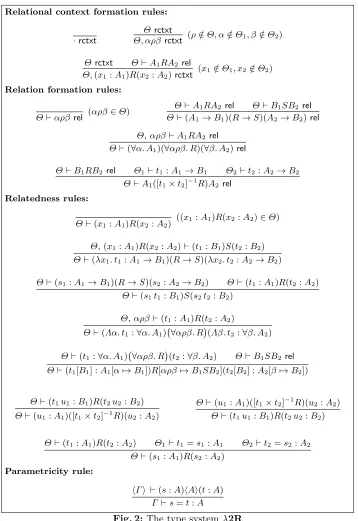
The rules forλ2Rare given by Fig. 1 (it extendsλ2) in combination with Fig. 2. The latter adds three new judgements: Θ rctxt says thatΘ is a
well-definedrelational context; Θ`A1RA2rel says thatRis arelationbetween types A1 andA2, in relational contextΘ; and Θ`(t1:A1)R(t2:A2) is a relatedness
judgement, asserting thatt1:A1 is related tot2:A2 by the relationR.
Relations, in Fig. 2, are built up from a collection ofrelation variables ρ, . . ., which, for clarity, we choose to keep disjoint from type and term variables. In the rules, we make use of three operations (·)1, (·)2 andh·i, defined in Fig. 3, which implement reflexive graph structure on syntax. The (·)i operations project
a relational context to a typing context, whereas theh·i operation acts in the other direction. In the definition of the latter, we associate a distinct relation variableρα to every type variableα. Lemma 7 below states how these operations relate typing and relational judgements.
The rules for building relational contexts and relations, in Fig. 2, require some explanation. In adding an assertion αρβ to a relational context Θ, all variablesα, β, ρneed to be sufficiently fresh. However, the formulation of λ2R
Relational context formation rules:
·rctxt
Θrctxt
Θ, αρβrctxt (ρ /∈Θ, α /∈Θ1, β /∈Θ2)
Θrctxt Θ`A1RA2rel
Θ,(x1:A1)R(x2:A2)rctxt (x1∈/Θ1, x2∈/Θ2)
Relation formation rules:
Θ`αρβrel (αρβ∈Θ)
Θ`A1RA2 rel Θ`B1SB2 rel
Θ`(A1→B1)(R→S)(A2→B2)rel
Θ, αρβ`A1RA2 rel
Θ`(∀α. A1)(∀αρβ. R)(∀β. A2)rel
Θ`B1RB2 rel Θ1`t1:A1→B1 Θ2`t2:A2→B2 Θ`A1([t1×t2]−1R)A2rel
Relatedness rules:
Θ`(x1:A1)R(x2:A2) ((x1:A1)R(x2:A2)∈Θ)
Θ,(x1:A1)R(x2:A2)`(t1:B1)S(t2:B2) Θ`(λx1. t1:A1→B1)(R→S)(λx2. t2:A2→B2)
Θ`(s1:A1→B1)(R→S)(s2:A2→B2) Θ`(t1:A1)R(t2:A2) Θ`(s1t1:B1)S(s2t2:B2)
Θ, αρβ`(t1:A1)R(t2:A2)
Θ`(Λα. t1:∀α. A1) ∀αρβ. R
(Λβ. t2:∀β. A2)
Θ`(t1:∀α. A1) ∀αρβ. R
(t2:∀β. A2) Θ`B1SB2 rel
Θ`(t1[B1] :A1[α7→B1])R[αρβ7→B1SB2](t2[B2] :A2[β7→B2])
Θ`(t1u1:B1)R(t2u2:B2)
Θ`(u1:A1)([t1×t2]−1R)(u2:A2)
Θ`(u1:A1)([t1×t2]−1R)(u2:A2) Θ`(t1u1:B1)R(t2u2:B2)
Θ`(t1:A1)R(t2:A2) Θ1`t1=s1:A1 Θ2`t2=s2:A2 Θ`(s1:A1)R(s2:A2)
Parametricity rule:
[image:9.612.130.488.125.646.2]hΓi `(s:A)hAi(t:A) Γ `s=t:A
The operations(−)i (fori∈ {0,1}) on relational contexts:
(·)i=·
(Θ, α1ρα2)i= (Θ)i, αi
(Θ,(x1:A1)R(x2:A2))i= (Θ)i, xi:Ai
The operationh−ion contexts and types:
h·i=· hαi=ρα
[image:10.612.130.485.116.250.2]hΓ, αi=hΓi, α ραα hA→Bi= (hAi → hBi) hΓ, x:Ai=hΓi,(x:A)hAi(x:A) h∀α. Ai=∀α ραα.hAi
Fig. 3:Syntactic reflexive graph structure
two such operations:R[αρβ7→ASB] substitutes, in the relationR, the typeA for all left occurrences ofα, the type Bfor all right occurrences ofβ (which may itself beα), and the relationS for all occurrences ofρ; similarly,S[x7→s, y7→t] substitutes, in the relation S, the term sfor all left occurrences of x, and the termtfor all right occurrences ofy (which may itself bex). Note that relations can indeed contain terms and (hence) type variables, due to the [t1×t2]−1R construction, where we considert1as occurring on the left, and t2 on the right.
Lemma 6 (Substitution lemma).
(i) IfΘ`A1RA2 relandΘ, α1ρ α2`(t1:B1)S(t2:B2)then
Θ`(t1[α17→A1] :B1[α17→A1])S[α1ρα27→A1RA2](t2[α27→A2] :B2[α27→A2]).
(ii) If Θ`(t1:A1)R(t2:A2) andΘ,(x1:A1)R(x2:A2)`(s1:B1)S(s2 :B2)
then Θ`(s1[x17→t] :B1)S[x17→t1, x27→t2](s2[x27→t2] :B2).
The relatedness rules of Fig. 2 include the expected rules for relationsR→S and∀αρβ. R, which mimic the analogous type constructions inλ2. The rules for [t1×t2]−1Rimplement its intended interpretation as an inverse image construction. In addition, a further rule expresses an extensionality principle for relations with respect to judgemental equality. Such an intermixing of relatedness judgements with equality judgements is legitimised by statement (i) of the lemma below.
Lemma 7.
(i) IfΘ`(t1:A1)R(t2:A2)then (Θ)i`ti:Ai.
(ii) IfΓ `t:Athen hΓi `(t:A)hAi(t:A).
general form given, is derivable from its empty-context version:`(s:A)hAi(t:A) implies`s=t:A. Thus the parametricity rule is equivalent to asking for the relational interpretation of a closed type to act as an identity relation between closed terms—a weak version of Reynold’sidentity extensionproperty [23]. We discuss the relational interpretation of open types in Sect. 5.
We outline the semantic interpretation ofλ2R. Given a comprehensiveλ2
parametricity graph, the contexts, types and terms of λ2 are interpreted in the comprehensive λ2 fibration p : T → C, as in Sect. 2. In addition, we interpret a relational contextΘas an objectJΘKofR(C), and a syntactic relation Θ`ARBrel as a semantic relationJRKΘ:JAK(Θ)1 ↔JBK(Θ)2 inR(T)JΘK. The
definitions of JΘK and JRKΘ interpret context extension, function space and
universal quantification using the structure of the comprehensive λ2fibration pR : R(T) → R(C), where relation variables αρβ are interpreted using the generic object ofpR. For the inverse-image relationΘ`A
1([t1×t2]−1R)A2rel, we have thatJt1K(Θ)1 andJt2K(Θ)2 determine mapsJA1K(Θ)1 - JB1K(Θ)1 and
JA2K(Θ)2 - JB2K(Θ)2inTJ(Θ)1KandTJ(Θ)2Krespectively. The fibration property
ofh∇T
1,∇T2iR(T) JΘK
then givesJ[t1×t2]−1RK:JA1K(Θ)1 ↔JA2K(Θ)2as the inverse
image ofJRK:JB1K(Θ)1 ↔JB2K(Θ)2 along these maps.
In the above semantic interpretation, the comprehension property is needed in order to interpret a relational contextΘ as an objectJΘKofR(C), and essential use is made of this in the definition ofJ[t1×t2]−1RK. Were the comprehension property of models dropped, it would be possible to rejig the semantics to interpret a restricted calculus with inverse-image relations definable only in relational contexts containing no term variables, but not fullλ2R.
The semantics is supported by soundness and completeness theorems.
Theorem 8 (Soundness for λ2R).In every comprehensiveλ2parametricity graph:
(i) if Γ `t1=t2:A thenJt1KΓ =Jt2KΓ; and
(ii) ifΘ`(t1:A1)R(t2:A2)then Jt1K(Θ)1×Jt2K(Θ)2: 1JΘK - JRKΘ.
Theorem 9 (Full completeness for λ2R). There exists a comprehensive λ2
parametricity graph satisfying the following.
(i) For every type Γ `A type, every global point 1
JΓK - JAKΓ is the
denota-tionJtKΓ of some termΓ `t:A.
(ii) For all termsΓ `t1, t2:AsatisfyingJt1KΓ =Jt2KΓ, we have Γ `t1=t2:A.
(iii) For every relationΘ`A1RA2 type, every global point1JΘK - JRKΘ arises
as Jt1K(Θ)1×Jt2K(Θ)2 for terms t1, t2 such thatΘ`(t1:A1)R(t2:A2).
Theorem 8 is proved by induction on derivations. We highlight that the soundness of the parametricity rule follows from the identity property of comprehensiveλ2
parametricity graphs. Theorem 9 is proved by a term model construction.
5
Direct-image and Pseudograph Relations
As already discussed, the parametricity rule of Fig. 2 interprets the relationhAi
however, this interpretation is not available. Consider an open typeα`A(α)type
(where we write A(α) to highlight the occurrences of α in A). Then we have αρα`A(α) hAi(ρ)
A(α)rel. However, the independent handling of left and right variables inλ2R (forced by the semantic correspondence with comprehensive λ2parametricity graphs), means that the latter relation is equivalent toαρβ`
A(α) hAi(ρ)
A(β)rel; i.e., it is a family (indexed by relations ρ) of relations between different types. Indeed, the distinctness of left and right type variables means λ2R has no facility for formulating relations between open types and themselves. In particular, λ2R contains no mechanism for defining identity relations on open types. Nonetheless, the relationhAican act as a kind of pseudo-identity relation for typeA where the parametricity rule can establish equalities fromhAi-relatednessin relational contexts of the formhΓi.
Graphs of functions are ubiquitous in standard arguments involving relational parametricity. Since we have only pseudo-identity relations, we correspondingly have onlypseudographs available inλ2R. SupposeΓ `f :A→B. Define:
gr∗(f) := [f×idB]−1hBi
Clearly hΓi `A gr∗(f)B rel. Its defining property is that (x:A)gr∗(f) (y:B) holds if and only if (f x:B)hBi(y:B). Mathematically, there is, however, another natural pseudograph relation, forf, betweenAandB. This is the relationgr!(f) defined by (x:A)gr!(f)(y:B) if there existsw:Asuch that (x:A)hAi(w:A) and y = f w. Since, by (ii) of Lemma 7,f mapshAi-related values to hBi-related values,gr!(f)⊆gr∗(f). However, becausehAiandhBiare not identity relations, there is no need for this inclusion to be an equality. We shall need to make use of both forms of pseudograph relation to derive the standard consequences of parametricity. In order to do so, we must first provide a definition ofgr!(f) in λ2Ritself, and establish formal analogues of the informal observations above.
The main construction we need is that ofdirect-image relations [t1×t2]!R, dual to inverse-image relations. This is achieved using an impredicative encoding.
Theorem 10 (Direct-image relations). Using the definition
[t1×t2]!R:= [iB1×iB2]
−1(∀αρα.([(− ◦t
1)×(− ◦t2)]−1(R→ρ))→ρ)
whereiB abbreviatesλb. Λα. λt. t b:B→ ∀α.(B→α)→αand(−◦tj)abbreviates
λ(vj:Bj→α). λ(xj:Aj). vj(t1xj),λ2R supports the derived rules below.
Θ`A1RA2 rel
Θ1`t1:A1→B1 Θ2`t2:A2→B2 Θ`B1([t1×t2]!R)B2 rel
Θ`(u1:A1)R(u2:A2) Θ`(t1u1:B1) [t1×t2]!R
(t2u2:B2)
Θ`C1QC2 rel Θ1`v1:B1→C1 Θ2`v2:B2→C2 Θ`(u1:B1) [t1×t2]!R
(u2:B2) Θ`(v1◦t1:A1→C1) R→Q
(v2◦t2:A2→C2 Θ`(v1u1:C1)Q(v2u2:C2)
It is now straightforward to define the second form of pseudograph relation discussed above. Suppose thatΓ `f:A→B and definehΓi `A gr!(f)B relby:
gr!(f) := [idA×f]!hAi .
To understand the relationship between the two pseudograph relations we introduce some notation. GivenRandSsuch thatΘ`ARB relandΘ`ASB rel, letΘ`R⊆S abbreviateΘ,(x:A)R(y:B)`(x:A)S(y:B).
Lemma 11. If Γ `f :A→B then:
(i) hΓi `gr!(f)⊆gr∗(f); and
(ii) hΓi `(s:A)gr∗(f) (t:B)iffΓ `f s = t:B iffhΓi `(s:A)gr!(f) (t:B).
We comment that, in spite of item (ii), the converse inclusion to (i) does not hold in general. Property (ii) applies only in contexthΓi, and thus implies nothing about what happens if further relational assumptions are added.
Theorem 10 has a semantic analogue: direct image relations correspond to opfibrational structure on comprehensiveλ2parametricity graphs.
Theorem 12. In any comprehensiveλ2parametricity graph, for every objectW
ofR(C), the functorh∇T1,∇T2iR(T)W:R(T)W →T∇C1W×T∇C2W is an opfibration.
6
Consequences of Parametricity
Systemλ2Ris strong enough to prove the familiar consequences of parametricity.
Theorem 13 (Consequences of Parametricity). Systemλ2R proves:
(i) The unit (terminal) type can be encoded as 1=∀α. α→α.
(ii) The product ofAandB can be encoded as A×B =∀α.(A→B→α)→α. (iii) The empty (initial) type can be encoded as 0=∀α. α.
(iv) The sum ofA andB can be encoded asA+B=∀α.(A→α)→(B→α)→α. (v) Existential types can be encoded as∃α. T(α) =∀α.(∀β.(T(β)→α))→α. (vi) The type ∀α.(T(α)→α)→α is the carrier of the initialT-algebra for all
functorial type expressionsT(α).
(vii) The type∃α.(α→T(α))×α is the carrier of the finalT-coalgebra for all functorial type expressionsT(α).
This result forλ2R implies that analogous category-theoretic properties (which we do not state for lack of space) hold for comprehensiveλ2parametricity graphs.
SupposeΓ, α`T type. We writeT(α) to highlight the occurrences ofαin T, and T(A) for the substitution T[α7→ A]. If αoccurs only positively in T (i.e., not on the left-hand side of an odd number of arrows) then it is standard thatT defines an endofunctor on types. IfΓ0`f :A→B, whereΓ0 extendsΓ, then we use the notationΓ0`T(f) :T(A)→T(B) for the functorial action of T. This action preserves identities and composition up to judgemental equality. In addition, the corresponding relational substitution preserves pseudo-identity relations; i.e.,hTi(hAi) (by which we mean the substitutionhTi[αραα7→ hAi])
syntactically coincides withhT(A)i. Also, the functorial action lifts to relations: ifΘ`(f:A→B)(R→S)(f0:A0→B0), whereΘ extends hΓi, then:
Θ`(T(f) :T(A)→T(B))(hTi(R)→ hTi(S))(T(f0) :T(A0)→T(B0)) .
Using these facts (which assert that T is a reflexive-graph functor [8]) one establishes the following properties of the action ofhTion pseudograph relations.
Lemma 14. Supposeαoccurs positively inΓ, α`T typeandΓ0 `f:A→B, whereΓ0 extendsΓ.
(i) hΓ0i ` hTi(gr∗(f))⊆gr∗(T(f)).
(ii) hΓ0i `gr!(T(f))⊆ hTi(gr!(f)).
Our proof of this lemma closely mirrors the proof of the Graph Lemma in [9], which exploits the fact thatgraph relations can be defined either using inverse image, analogously togr∗(f), or using direct image, analogously togr!(f).
We now explain how Lemma 14 bears on the proofs of the universal properties of initial algebras and final coalgebras. GivenT as above, standard constructions produce aT-algebra and aT-coalgebra that can be shown to be weakly initial and weakly final respectively, without invoking parametricity. The parametricity rule is used to establish the uniqueness part of the universal property. In the initiality and finality arguments, one is led to considerT-algebra andT-coalgebra homomorphisms respectively:
T(A) T(h)- T(B) T(A)
T(h0)
- T(B)
A a
?
h - B
b
?
A a06
h0 - B b0 6
where the diagrams are given by terms, in a context Γ0 extending Γ, which commute up to judgemental equality. Lemma 14 allows one to prove the following crucial properties as consequences of the commutativity of the above diagrams.
hΓ0i `(a:T(A)→A) hTi(gr∗(h))→gr∗(h)(b:T(B)→B)
hΓ0i `(a0: A→T(A)) gr!(h0)→ hTi(gr!(h0))
(b0:B→T(B))
7
Related and Further Work
System R of [1] and System P of [7] share withλ2R the property of having a syntax in which function space and universal quantification are basic constructions on relations. Indeedλ2Ris especially similar to System P, which also has the inverse-image-relation constructor [t1×t2]−1R. The most significant difference is that, in System P, the formation rule for this construction is restricted: the terms t1, t2 are not allowed to contain free term variables. However, they are permitted to contain so-calledindeterminates, which, in the semantics of System P, range overglobal elements in models. This device allows System P to be used to establish consequences of parametricity inwell-pointed models [7]. In λ2R, our general arguments for consequences of parametricity make essential use of the possibility for t1 andt2 to contain free term variables. As already observed in Sect. 4, the comprehension property of our models is crucial to the semantic interpretation of inverse-image relations in such cases.
System R of [1] departs fromλ2R(and System P) in two main ways. The first is that, in System R, every type A has an associated identity relation
A∗.4 A key rule of System R (written in our notation) is that Θ ` x A∗x, whenever x : A appears anywhere in relational context Θ. This rule breaks the independence between left and right variables in the relational judgements of λ2R. (For example, property (i) of Lemma 7 fails.) The second difference is that System R has an explicit syntax for defining graph relations, rather than the inverse-image construct ofλ2R (and System P), which would be more general in that context. Due to the presence of both identity and graph relations, the arguments, in System R, for consequences of parametricity proceed along standard lines [1]. However, System R currently lacks a corresponding semantic story of the kind we have used in this paper in justification ofλ2R.
In fact, the interplay between models and syntax could be pushed much further than in the present paper. By adding primitive product types toλ2andλ2R, one can strengthen our full completeness results by obtaining syntactic categories that are initial in an appropriate 2-category of strict structure-preserving morphisms of models. It would be more natural, however, to broaden both the notion of model, by replacing splittings of fibrations with cleavages, and the notion of morphism, by permitting non-strict structure preservation. With such a relaxation, coherence issues arise, but one would expect to obtain (pseudo-)initiality of the syntactic model of λ2R (without any need to extend the syntax with products).
For lack of space we have not presented any concrete models in this paper. In fact, any instance of the more elaborate axiomatic structure from [6] can be re-construed (albeit in a nontrivial way) as a comprehensiveλ2parametricity graph. So our minimal structure at least generalises the known models of parametricity. However, we do not know whether our structure encompasses any genuinely new models of relational parametricity that truly exploit the (potential) added generality of our approach.
4
The results of the present paper should be contrasted with those of other recent work by first two authors and colleagues [9,10]. In this paper, we have axiomatised category-theoretic structure modelling relational parametricity for the specific type theoryλ2, where the resulting structure encompasses both ‘syntactic’ and ‘semantic’ models. In contrast, [9,10] axiomatise the category-theoretic structure required on a ‘semantic’ model for Reynolds’ original set-theoretic definition of relational parametricity [23] to generalise to the model. Interestingly, the category-theoretic notion of bifibration occurs both as a central ingredient in the axiomatisation of [9,10], and, in the guise of direct-image relations, as a vital tool in the present paper. A novelty in the present paper is that the bifibrational structure is derived rather than assumed.
From a type-theoretic perspective, one advantage of the approach followed in this paper is that the passage from the original type theory (λ2) to the relational version (λ2R) appears not to depend on specific properties of the former, other than that essential use is made of judgemental equality in the formulation of the parametricity rule. We believe that this potential flexibility may be useful for transferring our methods to dependent type theories, where parametricity is an active area of study [2,4,5,17].
The proof-relevant setting of dependent type theory, however, requires mod-ifications to our semantic framework. In particular the relational property of parametricity graphs must be relaxed. Ongoing work on a higher-dimensional, proof-relevant form of parametricity may show how to remove this requirement.
Acknowledgements.We thank Bob Atkey, Claudio Hermida, Rasmus Møgelberg and the anonymous reviewers for helpful discussions and comments. This research was supported by EPSRC grants GR/A11731/01, EP/E016146/1, EP/K023837/1 and EP/M016951/1.
References
1. Mart´ın Abadi, Luca Cardelli, and Pierre-Louis Curien. Formal parametric poly-morphism. Theoretical Computer Science, 121(1&2):9–58, 1993.
2. Robert Atkey, Neil Ghani, and Patricia Johann. A relationally parametric model of dependent type theory. In Suresh Jagannathan and Peter Sewell, editors,POPL, pages 503–515. ACM, 2014.
3. Henk Barendregt. Introduction to generalized type systems. Journal of Functional Programming, 1(2):125–154, 1991.
4. Jean-Philippe Bernardy, Thierry Coquand, and Guilhem Moulin. A presheaf model of parametric type theory. In Dan R. Ghica, editor,MFPS, ENTCS, pages 17–33. Elsevier, 2015.
5. Jean-Philippe Bernardy, Patrik Jansson, and Ross Paterson. Proofs for free.Journal of Functional Programming, 22:107–152, 2012.
6. Lars Birkedal and Rasmus E. Møgelberg. Categorical models for Abadi and Plotkin’s logic for parametricity. Mathematical Structures in Computer Science, 15:709–772, 2005.
8. Brian Dunphy and Uday Reddy. Parametric limits. InLICS, pages 242–251, 2004. 9. Neil Ghani, Patricia Johann, Fredrik Nordvall Forsberg, Federico Orsanigo, and Timothy Revell. Bifibrational functorial semantics of parametric polymorphism. In Dan R. Ghica, editor,MFPS, ENTCS, pages 67–83. Elsevier, 2015.
10. Neil Ghani, Fredrik Nordvall Forsberg, and Federico Orsanigo. Parametric poly-morphism — universally. In Valeria de Paiva, Ruy de Queiroz, Lawrence S. Moss, Daniel Leivant, and Anjolina G. de Oliveira, editors, WoLLIC, volume 9160 of LNCS, pages 81–92. Springer, 2015.
11. Jean-Yves Girard. Interpr´etation fonctionelle et ´elimination des coupures dans l’arithm´etique d’ordre sup´erieur. PhD thesis, University of Paris VII, 1972. 12. Claudio Hermida. Fibrational relational polymorphism. Available at http://
maggie.cs.queensu.ca/chermida/papers/FibRelPoly.pdf, 2006.
13. Claudio Hermida, Uday Reddy, and Edmund Robinson. Logical relations and parametricity — a Reynolds programme for category theory and programming languages. ENTCS, 303:149–180, 2014.
14. Bart Jacobs. Comprehension categories and the semantics of type dependency. Theoretical Computer Science, 107(2):169–207, 1993.
15. Bart Jacobs. Categorical Logic and Type Theory. Elsevier, 1999.
16. Yoshiki Kinoshita, Peter W. O’Hearn, John Power, Makoto Takeyama, and Robert D. Tennent. An axiomatic approach to binary logical relations with applications to data refinement. In Mart´ın Abadi and Takayasu Ito, editors,TACS, pages 191–212, 1997.
17. Neelakantan R. Krishnaswami and Derek Dreyer. Internalizing relational para-metricity in the extensional calculus of constructions. In Simona Ronchi Della Rocca, editor,CSL, pages 432–451, 2013.
18. F William Lawvere. Equality in hyperdoctrines and comprehension schema as an adjoint functor. Applications of Categorical Algebra, 17:1–14, 1970.
19. QingMing Ma and John C. Reynolds. Types, abstractions, and parametric polymor-phism, part 2. In Stephen D. Brookes, Michael G. Main, Austin Melton, Michael W. Mislove, and David A. Schmidt, editors,MFPS, volume 598 ofLNCS, pages 1–40. Springer, 1991.
20. Peter W O’Hearn and Robert D Tennent. Parametricity and local variables.Journal of the ACM, 42(3):658–709, 1995.
21. Gordon Plotkin and Mart´ın Abadi. A logic for parametric polymorphism. In Marc Bezem and Jan Friso Groote, editors,TLCA, volume 664 ofLNCS, pages 361–375. Springer, 1993.
22. John Reynolds. Towards a theory of type structure. In B. Robinet, editor, Pro-gramming Symposium, volume 19 ofLNCS, pages 408–425. Springer, 1974. 23. John Reynolds. Types, abstraction and parametric polymorphism. In R. E. A.
Mason, editor,Information Processing, pages 513–523, 1983.
24. E.P. Robinson and G. Rosolini. Reflexive graphs and parametric polymorphism. In LICS, pages 364–371. IEEE Computer Society, 1994.
25. Robert A.G Seely. Categorical semantics for higher order polymorphic lambda calculus. Journal of Symbolic Logic, pages 969–989, 1987.
26. Christopher Strachey. Fundamental concepts in programming languages. Higher Order Symbolic Computation, 13(1-2):11–49, 2000.