An Exploratory Study to Design an Adaptive Hypermedia system for
online-advertisement
Dana A. Al-Qudah, Alexandra I. Cristea and Shi Lei Department of Computer Science, University of Warwick, Coventry, CV4 7AL
{D.Al-Qudah, A.I.Cristea,L.Shi}@ warwick.ac.uk
Keywords: Adaptive hypermedia, E-Advertising, E-business, Social Networks, Requirements gathering
Abstract: The revolutionary world of the World Wide Web has created an open space for a multitude of fields to develop and propagate. One of these major fields is advertisement. Online advertisement has become one of the main activities conducted on the web, heavily supported by the industry. Importantly, it is one of the main contributors to any businesses’ income. However, consumers usually ignore the great majority of adverts online. This research paper studies the field of online advertisement, by conducting an exploratory study to understand end users’ needs for targeted online advertisement using adaptive hypermedia techniques. Additionally, we explore social networks, one of the booming phenomena of the web, to enhance the appropriateness of the advertising to the users. The main current outcome of this research is that end users are interested in personalised advertisement that tackles their needs and that they believe that the use of social networks and social actions help in the contextualisation of advertisement.
1 INTRODUCTION
Adaptive hypermedia aims at tailoring the content
presented based on users’ knowledge, capabilities
and interests, amongst others (Brusilovsky, 2007). Its main application area is e-learning. This paper however focusses on another application for adaptive hypermedia, which is much less explored: that of online advertising, defined as the process of delivering a marketing message using the World Wide Web, to attract more consumers (Goy et al 2007). It is a well-known fact that consumers usually ignore adverts (Nielsen 2003). The overall research aim is to find a way in which online advertising can be provided, so that it is not intrusive to users and is smoothly integrated into the general purpose of the website visited, so that users should be drawn to the advert. Thus the overarching research question is:
Can e-advertising be designed in such a way that it is non-intrusive, smoothly integrated, aligned with user expectations, and attractive to users?
Our main hypothesis is therefore:
H0: Personalisation, based on customisation and adaptive hypermedia techniques, as well as social networking data provide the means to create
non-intrusive, smoothly integrated, attractive adverts, aligned with user expectations.
Here, we test the validity of this hypothesis by dividing it into sub-hypotheses, evaluated with end-users. Concretely, this paper is a result of an exploratory design experiment (section 3) conducted to extract the main user needs and properties required of an adaptive hypermedia system for online advertisement, based on social networks.
The experiment uses a user centred methodology
that guides the participants through the stages of exploring and designing the new system (Adams, 2004). The additional advantage of this approach is that it not only allows us to test the main hypothesis, but it also provides a starting point for any system designer who would wish to create viable implementations for this relatively unexplored area (see sections 2, related work, and 5 on discussion).
2 RELATED WORK
application fits all’ (Holden et al 2009). Whilst it is great that companies can address customers around the globe, clients from different countries or locations can have very different needs, or be subject to completely different legal frameworks. A major challenge of e-commerce is to produce a more personalized commercial as well as advertising experience (Goy et al 2007). In 2005, statistics showed that 80% of internet users were interested in getting personalized content for the sites they visit (ChoiceStream 2005). Adaptive advertisement looks at each user as a standalone case and provides personalized content based on user-modelling approaches (Kazienko & Adamski, 2007). User modelling is one of the key aspects in user-adaptive systems (Kobsa, 2007). Their foremost objective is to collect data about the user to respond to the users’
needs. The correct definition and maintenance of user models is predicted to be central to the application of adaptive advertising as well, with one of the main challenges the proper selection of the user model variables, and their relationships. Another important issue is the data collection source. Part of the research is aimed at data collection from social networks, to gather some (or all of) the relevant user model information. These platforms provide a rich source of user-information for within-platform as well as outside applications. Famous platforms like Facebook and Twitter have large and growing numbers of users (more than 908,000,000 users on Facebook and 500,000,000 users on Twitter in 2004), and increasing wealth of personal information about these users (Socialbakers, 2012). Hence, social platforms have become the main target of online advertisement, with more than 20% of the ads already promoted via these platforms (Dunay & Krueger 2009).
What is clear is that, due to the huge availability of information about products, and the loss of trust in traditional advertisement, businesses need to rethink their advertisement strategies (Qiao, 2008). One strategy is to look at social network as a source of user data, where personalisation can be provided
based on users’ profiling (Qiao, 2008). Our research aims to explore this fast growing area and find a balance between parameters to be modelled and user response. Thus, the research described here starts with the users from the very beginning, which can improve the chances of success of a system (Preece et al 2002). The aim was to understand different
customers’ perceptions, which are crucial in designing a system that fulfils their needs (Sanders, 2002). Thus, the methodology applied in this experiment was a user-centred design process.
3 EXPERIMENT
In order to implement the user-centred experimental design process (Vredenburg et al 2002) and the participatory design (Schuler & Namioka 1993), we needed to enrol the help of real users. Fortuitously, when it comes to online advertising, any web user qualifies as online adverts user. Certainly in the Western world, with a close second in Eastern Europe, the great majority of the population is a web user, with more than 2,405,520,175 users in the world and 518.6 million users in Europe as per a recent survey conducted on June 2012 (internetworldstats, 2012).
To perform a controlled experiment, it was decided that the experiment was to be conducted with the help of a class of 3rd year students enrolled in the Computer Science degree, Faculty of Engineering Sciences in Foreign Languages, at the University “Politehnica” of Bucharest, Romania,
studying a course entitled ‘Web Application and Development’. Out of an overall student population of 35, 21 volunteered to take part of the experiment. The positive effect of this process was that these students were actively engaged and determined to help, instead of being coerced in any way. Also, the relatively small sample size ensured that the whole experiment was relatively easy to coordinate, that all opinions could be properly listened to, discussed and recorded, and that the overall atmosphere could be kept quite informal, and thus conducive of honest and straightforward discussions. The experiment lasted slightly over two hours, based on the natural flow of the interactions and (monitored) discussion. In these two hours, the methodology of the user-centred design process was applied, based on two important thinking techniques: the brainstorming technique and the six hats thinking technique.
The brainstorming technique, a very popular supervised thinking approach (Osborn, 1963), is used to collect as much as data as possible on the problem, then classify it into main points for further investigation, producing so called “spider diagrams”
users may not be capable to completely explore some aspects. For instance, a system administrator’s
perspective may not be as clear to the average user. As in our study we used Computer Science students, they were able to embrace relatively easily most aspects of system design. The experiment was conducted over three main phases, as follows.
In the first phase, a questionnaire was conducted to examine the current knowledge on topics related to e-commerce, e-advertisement and personalisation. This phase lasted for 20 minutes.
The second phase was a short seminar, for around half an hour, introducing participants to the experiment and the framework
The third phase was the most labour-intensive for the students, comprising the system requirements
gathering stage, as well as the participants’
involvement in the design process. This phase lasted the longest, for over an hour, as participants were encouraged to discuss their ideas in full.
These stages were conducted to follow the user centred methodology. Thus, the participants expressed what they thought by filling in the questionnaire. Then, they moved to the doing stage, where they used the existing tools. That was covered in the short seminar, where participants could get familiar with the platforms that use related principles
to the current system’s goals. The final stage is to let the participants make what they want to have, through getting them to actually design a preliminary version of the proposed system.
3.1 The Questionnaire
The first step of the experiment was to help participants express what they think, as per user-centred methodology (Abras et al 2004). At the beginning of the experiment, the participants were not sure about what they were expected to deliver. So the questionnaire was the tool to make them express their ideas, by examining their current level of their understanding in relation to the expected outcome of the experiment. The questionnaire was divided into three main sections. After collecting the needed demographic data, their current level of e-commerce knowledge was examined. This was through a set of questions about popular e-commerce websites (such as Amazon and eBay). It also covered concepts related to e-advertisement, in terms of concept definition, importance, reaction to online ads and important related social networks and websites that are famous for online ads. The final section was about their future expectations from e-commerce and e-advertisement websites, considering that advertisement is a model of e-commerce. In all the sections, questions related to personalised advertisement were asked. Also, the
knowledge or opinions about the type of social interaction related to these ads, the targeted websites that the users may find most beneficial in terms of online ads was elicited.
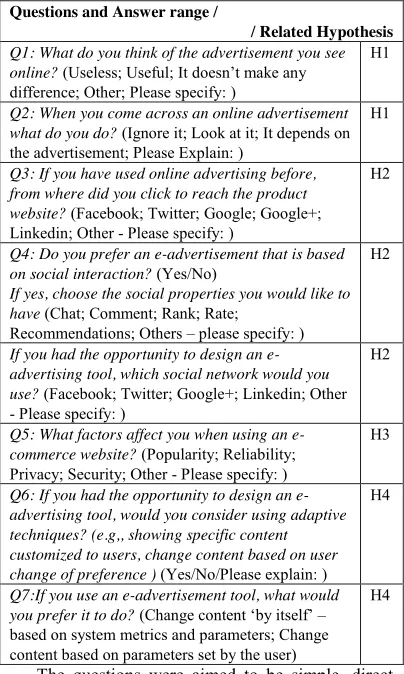
The overarching hypothesis introduced at the beginning of the paper is further broken down into sub-hypotheses, which were the underpinning to the questionnaire (Table 1):
H1: Advertising is considered to be a major activity, performed on the web by individuals – not only by companies or businesses.
H2: Social networks are useful for personalised e-commerce and e-advertisement applications.
H3: There are many factors affecting online advertising and commerce, such as scalability, reliability, privacy and security.
[image:3.595.303.505.341.678.2]H4: Personalization of commerce and e-advertisement tools will increase their usage.
Table 1: Questions, Answer range, and their related (sub-) Hypotheses
Questions and Answer range /
/ Related Hypothesis Q1: What do you think of the advertisement you see online? (Useless; Useful; It doesn’t make any difference; Other; Please specify: )
H1
Q2: When you come across an online advertisement what do you do? (Ignore it; Look at it; It depends on the advertisement; Please Explain: )
H1
Q3: If you have used online advertising before, from where did you click to reach the product website? (Facebook; Twitter; Google; Google+; Linkedin; Other - Please specify: )
H2
Q4: Do you prefer an e-advertisement that is based on social interaction? (Yes/No)
If yes, choose the social properties you would like to have (Chat; Comment; Rank; Rate;
Recommendations; Others – please specify: )
H2
If you had the opportunity to design an e-advertising tool, which social network would you use? (Facebook; Twitter; Google+; Linkedin; Other - Please specify: )
H2
Q5: What factors affect you when using an e-commerce website? (Popularity; Reliability; Privacy; Security; Other - Please specify: )
H3
Q6: If you had the opportunity to design an e-advertising tool, would you consider using adaptive techniques? (e.g,, showing specific content customized to users, change content based on user change of preference ) (Yes/No/Please explain: )
H4
Q7:If you use an e-advertisement tool, what would you prefer it to do?(Change content ‘by itself’ – based on system metrics and parameters; Change content based on parameters set by the user)
H4
whole process took place in English, as the degree the students were following taught all classes in English. Nevertheless, the questionnaire design took into account that English was only the second language for these students. Questions were designed in such a way as to be neutral. For instance, instead of asking a positively loaded
question, such as ‘Do you like the online advertisement that you see?’ the question used was phrased as: ‘What do you think of the advertisement you see online?’ (see Q1 in Table 1 below, showing questions and related hypotheses). Moreover, participants were asked to comment, where necessary, on their answers, to contextualize them.
3.2 The Seminar
The questionnaire established the baseline, the beliefs and needs of the participants based on their own prior knowledge. Phase 2 was dedicated to expanding this knowledge, via a seminar. This corresponded to the second phase of the user-centred methodology, where the participants needed to become familiar with related systems, via a lecture-like process, as well as via hands-on experiences (Abras et al 2004). During the session, participants interacted via discussions, as they familiarized themselves with the examples displayed, building on their own experiences and knowledge. The seminar discussed e-commerce platforms, their importance; the models derived from these platforms - such as online stores, online-auctioning and online advertisements. It also exposed upon social networks and popular examples, such as Facebook, Twitter and Google+ (http://plus.google.com). A part of the allocated time was spent on the topic of adaptive hypermedia systems, their application and some case studies of online advertisements in adaptive hypermedia. The presentation also mentioned the well-known commercial system AdSence, by Google (google.com/ads 2012) as well as a research-based system called AdRosa, created by Kazienko and Adamski (Kazienko & Adamski, 2007). The final part of the seminar introduced the thinking techniques that were going to be used in the next phase, since some of the students were not familiar with brainstorming and the six-hat technique.
3.3 The Design Phase
In this phase, the third step of the user-centred methodology, participants (Abras et al 2004) were encouraged to design their own version of the system, by setting up a list of requirements that they wanted to see fulfilled. The twelve students worked in two equal sized groups. They were allowed to
choose in which group to work, as some felt more comfortable working with certain peers. The participants were supervised by two facilitators: (1) an expert on e-commerce systems, ensuring that participants were deploying the appropriate knowledge, without directly intervening with any design ideas; (2) an expert on experiments monitoring, providing feedback on the experiment atmosphere and timeframe.
The participants started the process by firstly using the brainstorming thinking technique. Here, they created a spider diagram (Howse et al 2005), and they suggested functionality-oriented solutions. Next, the participants used the six-thinking hats
technique, where they expressed stronger beliefs, by giving voice to their emotions, and attempting to think outside the box. As a result, in this phase, they produced a list of usability-related problems, and discussed possible solutions. By the end of this session, students had a clearer understanding and a set of expectations of an adaptive online system for e-commerce. They presented their work to each other and to the facilitators in a semi-formal presentation, and received feedback from both the other participants and the facilitators. They created, beside the set of requirements based on their expectations, also visual representations of the design modules required in their ideal systems. The feedback resulted in a set of recommendations presented in the result section, and then discussed.
4 RESULTS
Our two sets of results are described below.
4.1 Questionnaire Results
As their starting level of understanding of e-commerce and e-advertising, students showed that they were mostly familiar with websites such as Amazon and eBay. H1 was confirmed to some degree by the number of students agreeing that online advertising is considered as a major activity on the web. It should be noted that, due to the limited number of participants in the experiment, the results here cannot claim quantitative statistical significance. Instead, they represent an exploratory, idea-generating study, aiming at qualitative results.
(Q2, Figure 1), feels that ‘it depends on the advertisement’. This shows that students don’t find
adverts a negative experience per se (only 16% ignore them), nor positive (15% response). Thus, contextualisation (and potentially adaptation, customisation) of the advert may be crucial in ensuring that the advert appears at the right time in the right place. Similarly, H2 is supported, as students considered that social networks have an impact on the usage of any advertisement or e-commerce activity. The second image in Figure 3 indicates the exposure and popularity of social networks. Interestingly, 45% of the users get their advertisement information from Facebook.
[image:5.595.133.253.270.439.2]The third hypothesis suggested that there are many factors affecting online advertising and e-commerce. The response to the question Q5 related to this hypothesis was as shown in Figure 2.
Figure 2: Factors affecting online advertisement The students correctly noticed that social applications offer little in terms of privacy, but make up for it in terms of personal recommendations and reliability, thus explaining their popularity. The security of the applications is related somewhat to the privacy provided, and thus is of lesser importance. Hence, a preliminary pre-selection and order of relevance of the factors that are expected to
influence online advertising in e-commerce based on social networks has been obtained. The students were very interested in getting personal recommendations and personalised services.
The final, fourth hypothesis suggested that personalisation will play a role in the usage of the system. The students responded highly positively to questions related to this hypothesis. They answered the questions about getting personalised advertisements with a percentage of 83% of them desiring a personalised experience, while only 17% being against it. Students have also shown interest in different types of advertisements, listed below according to the importance students associated to them (percentages in brackets), as follows:
Recommendation for products (47%), products that satisfy their needs (41%), and Customised profiles (12%).
4.2 Requirement list
As students reached the stage of designing their own system, the final product was to create a set of requirements they considered necessary (and, in most cases, sufficient) in their ideal systems. These requirements were further grouped by the facilitator based on their experience, as well as the diagrams and requirements lists and feedback from the users, into two main categories, the input and output of the desired personalised advertisement system:
1. It should be based on (input): User modelling techniques. Browsing and purchasing history. 2. It should provide (output):
Live notifications about the advertisement in terms of what has been clicked on or viewed by other users. Targeted advertisements using social networks.
Extended advertisements to cover mobile applications.
Social capability to interact, chat, comments about the advertisement.
5 DISCUSSION & CONCLUSIONS
The main aim of the experiment was to understand the user needs regarding personalised advertisement systems based on social networks. Many systems on the web offer different types of targeted advertisements. We explored ideas from the
end-users’ perspective regarding their perceptions of an adapted system taking in consideration their needs.
The main important outcome showed the students’
[image:5.595.95.289.516.594.2]interest in personalised advertisement using social Figure 1: Reaction to online advertisements (Q2)