A combined
rh
-adaptive scheme based on domain subdivision.
Formulation and linear examples
Harm Askes
∗;1;†and Antonio Rodrguez-Ferran
2;‡1Faculty of Civil Engineering and Geosciences;Koiter Institute Delft=Delft University of Technology;
P.O. Box 5048;2600 GA Delft;The Netherlands
2Departament de MatemÂatica Aplicada III;Universitat PolitÂecnica de Catalunya;E.T.S. d’Enginyers de
Camins;Canals i Ports;Jordi Girona 1 i 3;08304 Barcelona;Spain
SUMMARY
An adaptive scheme is proposed in which the domain is split into two subdomains. One subdomain consists of regions where the discretization is rened with anh-adaptive approach, whereas in the other subdomain node relocation orr-adaptivity is used. Through this subdivision the advantageous properties of both remeshing strategies (accuracy and low computer costs, respectively) can be exploited in greater depth. The subdivision of the domain is based on the formulation of a desired element size, which renders the approach suitable for coupling with various error assessment tools. Two-dimensional linear examples where the analytical solution is known illustrate the approach. It is shown that the combined rh-adaptive approach is superior to its components r- and h-adaptivity, in that higher accuracies can be obtained compared to a purely r-adaptive approach, while the computational costs are lower than that of a purely h-adaptive approach. As such, a more exible formulation of adaptive strategies is given, in which the relative importance of attaining a pre-set accuracy and speeding-up the computational process can be set by the user. Copyright ? 2001 John Wiley & Sons, Ltd.
KEY WORDS: mesh adaptivity; remeshing; Arbitrary Lagrangian–Eulerian; r-adaptivity; h-adaptivity; rh-adaptivity
1. INTRODUCTION
Mesh-adaptive strategies are a necessary tool to make (non-linear) nite element analysis applicable to engineering practice [1–5]. Without mesh-adaptive strategies the quality of the nite element solution cannot be assessed objectively. Moreover, mesh-adaptive strategies are indispensable to limit the computer costs needed to obtain nite element solutions for the large-scale structures of engineering practice. In this paper, we distinguish between two goals for using mesh adaptivity in nite element analysis.
∗Correspondence to: Harm Askes, Faculty of Civil Engineering and Geosciences, Koiter Institute Delft=Delft University of Technology, P.O. Box 5048, 2600 GA Delft, The Netherlands
†E-mail: [email protected]
‡E-mail: [email protected]
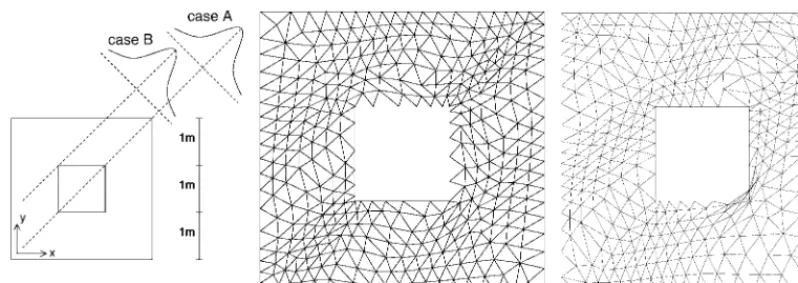
Figure 1. Square with a hole—geometry and temperature elds (left),r-adapted mesh for case A (centre) and r-adapted mesh for case B (right).
Firstly, adaptive strategies can be used to attain a prescribed accuracy. This goal is best
met with an h-, p- or hp-adaptive scheme in combination with a sound error estimator. These
schemes enable the addition and deletion of degrees of freedom, and the mesh connectivity is allowed to change. As a consequence, these schemes oer topological exibility, but the expenses in terms of computer time associated to these adaptive techniques are relatively high [2].
Secondly, adaptive strategies may be used in order to limit the computer costs. For
large-scale three-dimensional analyses mesh optimization can reduce the computer time and mem-ory requirements of an analysis by several orders of magnitude. For instance, a signicant
speed-up of the computational process can be obtained by an r-adaptive scheme such as
the Arbitrary Lagrangian–Eulerian (ALE) method [6; 7]. The constant number of degrees of
freedom and the constant element connectivity make these methods inexpensive. Since the
computational costs involved with ALE remeshing can be made as low as O(N), with N
the number of nite elements, the overhead of r-adaptive remeshing included in a nite
el-ement implel-ementation can be made negligible [8; 9]. However, the xed number of degrees
of freedom and mesh connectivity limit the applicability of r-adaptive remeshing. This is
illustrated in Figure 1, where r-adaptivity is used to optimize a nite element discretization
of a thermal problem. (Details of this problem can be found in Section 5.) The solution for the temperature follows a bell-shaped prole along the main diagonal from upper left to lower right. If the bell-shape is centred at the main diagonal from lower left to upper right
(cf. case A in Figure 1, left), then r-adaptivity is an eective tool to improve the
discretiza-tion (Figure 1, centre). On the other hand, if the centre of the bell-shape is shifted upwards (cf. case B in Figure 1, left), the non-convex corners of the hole lead to element
entan-glement when r-adaptivity is used (Figure 1, right). Thus, the applicability of r-adaptivity
is limited.
The properties and the application elds of both types of adaptive schemes (sophisticated, expensive schemes versus inexpensive schemes of limited applicability) are thus complemen-tary. This has led to the idea that the advantageous properties of both schemes could be combined. Each scheme should be used where and when it is suited most. Combinations of
dimensions [10–12]. The focus of this paper will be on combined rh-adaptive schemes for nite element analysis.
The approach followed is to decompose the domain into two subdomains. The rst sub-domain consists of all regions in the sub-domain where the element sizes are close (to a certain
extent) to the desired element sizes. In these regions, node relocation (r-adaptivity) based on
the ALE technique is carried out. The second subdomain contains the remainder of the
do-main, where element sizes dier signicantly from the desired element sizes. Here, h-adaptive
mesh renement or mesh de-renement is applied. The subdivision of the domain is based
on the concept of a desired element size, which is a common ingredient in most error
assess-ment procedures. Thus, the approach can be generalized to various elds of application. A numerical parameter can be provided by the user which sets the bounds of the criterion with
which an element is assigned to the r-adaptive subdomain or to the h-adaptive subdomain.
When this parameter favours larger r-adaptive subdomains, consequently more emphasis is
put on computational speed-up and less on numerical accuracy. Conversely, other values for this parameter lead to a larger relative importance of numerical accuracy as compared to computational speed-up. Thus, the user can control the relative importance of attaining a pre-scribed accuracy and speeding-up the computational process, and a more exible formulation of adaptive strategies is obtained.
In the present study, only linear examples are treated where the exact error is known. If the approach is to be extended to other application elds, then error estimators and error indicators must be included [2]. However, the complete proposed algorithm is based on the formulation of a desired element size, by which extension to other error assessment tools is straightforward. In case of a non-linear analysis also an algorithm for the transfer of the
state variables must be provided [8; 13]. The focus of this paper is on the subdivision of
the domain and the construction of a new discretization. Application of error estimators and error indicators and the inclusion of a transfer algorithm will be dealt with in a forthcoming contribution.
The present paper is organised as follows. First, error assessment is discussed, as well as how an optimal element size can be derived. Next, the subdivision of the domain into
an h-adaptive subdomain and an r-adaptive subdomain is treated. This subdivision is based
on error assessment. Then, the generation of a new discretization for the two subdomains is treated. Two-dimensional examples are presented to illustrate the approach. Open questions and future developments are addressed next.
2. ERROR ASSESSMENT AND OPTIMAL ELEMENT SIZES
The basis of any adaptive strategy is error assessment. It must be known in which regions of the domain the discretization is ne enough, in which regions renement is needed, and in which regions de-renement can be accepted. In general, three methods of assessing the error exist, where we use the classication of Huerta and coworkers [2]:
• For a small subclass of (academic) problems, the exact solution is known. Then, it is
possible to compute the exact error as the dierence of the exact solution and the
• The so-callederror estimatorsapproximate the exact error. Since they providequantitative information about the exact error, error estimators can be used to reach a prescribed
accuracy. Error estimators must have a solid mathematical basis [2; 14]. The computation
of error estimators is relatively expensive.
• Finally, error indicators only give relative information about the exact error. An error
indicator is based on heuristic considerations and denotes where the error is large and
where it is small, but nothow large or small. A sound mathematical basis is lacking, and
no quantitative measure of the exact error is provided. However, an error indicator is cheap in terms of computational costs. Error indicators can be based on variations of the solution, strain projection norms, element distortion and jump or average of state variables, e.g., each of which are readily available in a nite element analysis. Contrary to error estimators, error indicators do not necessarily have an upper bound.
Once an error tolerance is set, an optimality criterion can be used to translate the (exact or
estimated) error distribution into a eld of desired element size. If an error indicator is used, the user has to specify a coupling between error indicator and desired element size. In this
paper, only exact errors are used, therefore a mathematically based optimality criterion will
be used.
Several methods exist to relate the exact error or the estimated error to an element size that is expected to meet the accuracy requirements [15–19]. It has been shown that the optimality
criterion proposed in References [15; 16] leads to meshes with the lowest number of elements.
The desired size hdes for element i is related to the current size hcur of element i according
to [15; 16; 19]
hdes
i =hcuri √NÁdeskukkek i
!1=(p+d=2)
(1)
where h is a characteristic element size such as the diameter,Á is the prescribed relative error
(prescribed accuracy), p is the maximum degree of the complete interpolation polynomials,
d is the number of spatial dimensions, kuk andkeki are the energy norm of the solution eld
u for the whole domain and the local errore for element i, respectively, dened via
kak2
i =
Z
i
∇aC∇ad and kak2=NPcur
i=1kak 2
i (2)
with C the discretised Jacobian of the problem (the tangent stiness matrix) and Ncur the
current number of elements. In Equation (2) it is assumed that C is positive denite. It can
be seen from Equation (1) that a larger error tolerance Áleads to larger values for the desired
element size. On the other hand, a larger local error kek2
i leads to a smaller desired element
size. In Equation (1), Ndes is the desired number of elements, given by [15]
Ndes= NPcur
i=1
keki Ákuk
d=(p+d=2)!1+d=2p
(3)
Note that the desired number of elements increases with a decreasing error tolerance and with
increasing local errors, while it decreases for increasing values of the polynomial degree p. A
closer investigation of Equations (1) and (3) reveals that the desired element size decreases
Remark 1. Equation (1) relies on the assumption that the order of convergence of the
nite element approximation coincides with the polynomial degree p. It is well known that
this does not hold near a singularity [20], where convergence is controlled by the strength of the singularity. However, as pointed out in Reference [21], the inuence of the singularity on the solution decreases during the adaptive renement. For this reason, Equation (1) is used all over the domain to keep the remeshing process as simple as possible.
3. SUBDIVISION OF THE DOMAIN
When the desired element sizes have been computed, basically three types of regions in the computational domain can be distinguished:
• Regions where the current element size does not dier too much from the desired element
size.
• Regions where the current element size is signicantly smaller than the desired element
size.
• Regions where the current element size is signicantly larger than the desired element
size.
We will dene the ratio of current element size over desired element size as the Renement
Ratio:
RR= current element size
desired element size (4)
where current element size and desired element size are taken from Equation (1). The
re-nement ratio denotes whether an element has a size which is close to optimal (RR≈1), too
small (RR¡1) or too large (RR¿1). In the remainder of this paper the following idea is
applied: if the current element size is more or less optimal (RR≈1), then r-adaptivity will
be applied. If the current element size diers signicantly from the desired element size, then locally a new discretization will be constructed to meet the desired element sizes, which is
basically an h-adaptive approach. We adopt
if 0¡RR¡1= allow h-de-renement (5)
if 1=6RR6 relocate the nodes (6)
if ¡RR¡∞ apply h-renement (7)
with ¿1 a scalar parameter that can be provided by the user. Based on the distribution of
the renement ratio, the domain can be subdivided into h-adaptive regions (the h-adaptive
subdomain) and r-adaptive regions (the r-adaptive subdomain). By assigning specic values
to , the user can put a relative importance to either subdomain. For instance, taking relatively
large values for will lead to a relatively larger-adaptive subdomain. As such, the properties
of r-adaptivity (signicant computational speed-up, limited capabilities to decrease the error)
Figure 2. Smoothening of theh-adaptive (gray) and r-adaptive (white) subdomains: initial conguration (left), conguration after smoothening of the h-adaptive subdomain (centre) and conguration after
smoothening of the r-adaptive subdomain (right).
will result in larger h-adaptive subdomains, so that computational speed-up is less pronounced
but higher accuracies can be attained.
Remark 2. Note that the subdivision of the domain is based on the computed desired
element size. As such, it is independent of the error measure that is used.
The subdomains that result from Equations (5)–(7) can yield a scattered pattern of small
r-adaptive zones and small h-adaptive zones. Obviously, it is not desirable to assign a single
element with RR¿ to the h-adaptive subdomain if this element is surrounded by elements
where 1=6RR6. Therefore, both subdomains are smoothened. For the triangular elements
adopted here, this means that each element is assigned to a certain zone when at least two neighbouring elements (i.e. sharing one edge) belong to this zone. To facilitate the adjustment
of the number of elements, the h-adaptive subdomain is given preferential treatment in the
smoothening procedure. First,r-adaptive elements that have at least twoh-adaptive neighbours
are added to the h-adaptive subdomain. When this is nished, the process is reversed: each
h-adaptive element with at least two r-adaptive neighbours becomes an r-adaptive element.
In this manner, more regular subdomains are obtained, see Figure 2 for an illustration of this approach.
4. REMESHING
After the domain has been split, a new discretization must be supplied for each subdomain. Since both subdomains are disjoint, the best available remeshing tools can be applied in each case. In the current study, the interface between the two subdomains remains xed, i.e. nodes
from the intersection between the r-adaptive subdomain and the h-adaptive subdomain are
not allowed to move (no r-adaptivity), neither is it allowed that new nodes are added on the
interface (no h-adaptivity). This treatment of the interface is a rst attempt, and other options
4.1. h-adaptive subdomain
For theh-adaptive subdomain we directly apply the desired element sizes that emerge from the
Li–Bettess optimality criterion [16] (cf. Equation (1)). This distribution of desired element
sizes is used as input for the mesh generation module, by which the h-adaptive process
is nished. Consequently, the quality of the mesh generator is decisive for a successfull
application of h-adaptivity. Currently, good mesh generators are widely available for various
two-dimensional element types. Three-dimensional mesh generators that are capable of meeting prescribed desired element sizes throughout the domain are becoming also available.
4.2. r-adaptive subdomain
In the r-adaptive subdomain a dierent strategy is followed. Since no elements are added
to this subdomain, relative information is needed, that is, in which parts of the subdomain nodes should be concentrated, and from which parts of the subdomain nodes can be taken away [2]. The strategy employed here is the equidistribution of a relocation indicator. The
relocation indicator, denoted K, takes large values where small elements are desired and vice
versa. Equidistribution of this relocation indicator is stated as [22; 23]
Kii=Kjj or
Z
i
Kd =Z j
Kd ∀i; j (8)
with i the volume of element i. Equation (8) can be rewritten in a dierential format as
[23]
@ @
K(x)@x@
= 0 (9)
which is used to solve for the nodal positions x. Equation (9) can be repeated for each spatial
co-ordinate, so that generalization towards two and three-dimensional problems is
straightfor-ward. The co-ordinates in Equation (9) denote a reference system with respect to which
the node relocation is carried out. This co-ordinate system must be chosen independent of the spatial co-ordinates, and remains xed throughout the analysis [22–25]. Normally, the initial
nodal positions are taken for . Then, the best choice for K would be the inverse of the
desired element size:
K=desired element size1 (10)
It can be seen directly from Equation (8) that equidistribution then leads to an optimal mesh, i.e. where each element takes its desired size, provided that the total number of elements is large enough.
It is also possible to take the current nodal positionsxcur instead of in Equation (9) if the
change of the reference system is accounted for. This is highly advantageous, since then the
initial co-ordinates need not be stored. Furthermore, in a combined rh-adaptive approach it can
be a cumbersome task to assign a referential co-ordinate (which is needed for r-adaptivity)
to a node that has been added (by means of h-adaptivity) in an intermediate stage of
term in Equation (9) gives
@ @xcur
K(x)@x@xcur@x@cur
@xcur
@ = 0 (11)
The factor @xcur=@ is proportional to the current element size and it is non-zero. If we
substitute Equation (10) into Equation (11) and dene a new relocation indicator ˜K as
˜
K= current element sizedesired element size=RR (12)
then a new equidistribution dierential equation is found with a format similar to that of Equation (9):
@ @xcur
RR(x)@x@xcur
= 0 (13)
Note that Equation (13) only contains quantities of the current conguration, and is based on the computation of a desired element size. Thus, generality is preserved.
Remark 3. Equation (13) represents a non-linear system of equations, which has to be
solved in ther-adaptive subdomain. Explicit algorithms have been devised to solve this system
with the order of the computational costs O(N), where N is the number of elements involved.
Thus, the remeshing in the r-adaptive subdomain is highly ecient [9; 22].
Remark 4. Equation (9) as well as Equation (13) must be solved together with a set of
boundary conditions. These boundary conditions are normally taken as prescribing for all boundary nodes a zero displacement normal to the boundary [24].
Remark 5. Since dierent stages in the analysis may lead to dierent subdivisions of the
domain, a varying r-adaptive subdomain is taken as the basis of solving Equation (13). For
a straightforward implementation Equation (13) can also be solved on the complete domain,
provided that all nodes of the h-adaptive subdomain are considered to be boundary nodes and
are, thus, xed (in all spatial directions).
Remark 6. In Equation (13), no assumptions have been made on the element type that is
used. Indeed, the remeshing strategy of the r-adaptive subdomain is valid for any element
type (in contrast, mesh generators for h-adaptive remeshing do depend on the applied element
type).
5. EXAMPLES
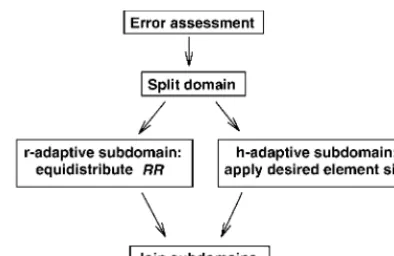
The algorithm is summarised in Figure 3. This algorithm has been implemented in the
object-oriented nite element code CASTEM 2000 [26]. Linear triangular elements have been taken.
Linear thermal problems with known analytical solution have been used to test the algorithm.
In Section 5.1, we have taken the subdivision parameter constant, while the eect of a
Figure 3. Algorithm.
5.1. Fixed subdivision parameter
The rst example deals with a rectangular strip with height = 4 m and width = 1 m. The
con-ductivity of the material c= 1 W=mK. If the origin of the axes is located at the centre of the
strip with the y-axis parallel to the longer side of the specimen, the exact temperature eld
uexact is expressed as uexact= 5 exp(−2y2) K. The numerical solution unum follows from the
partial dierential equation
c∇2u
num= −q (14)
with −q, a source term which is taken as the second derivative of uexact times c. Essential
boundary conditions u are imposed as u=uexact on the boundary of the domain. A relative
error tolerance Á= 0:05 has been prescribed (cf. Equation (1)). As an illustration of the rh
-adaptive algorithm an analysis has been performed with = 2:5.
The distribution of the energy norm of the error (cf. Equation (2) with e=uexact−unum)
is depicted in Figure 4a. From this error distribution the renement ratio has been computed (Figure 4b), after which the domain is split (Figure 4c). A new discretization is constructed
based on h-adaptivity in the central part and based on r-adaptivity in the outermost parts (see
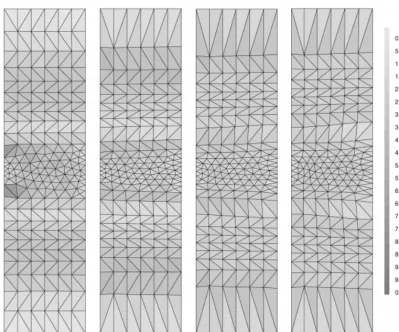
Figure 4d). The two subdomains are joined and taken as input again for the same analysis. This procedure is repeated four times. The consecutive error distributions are plotted in Figure
5. After the rst remeshing step all elements’ renement ratios fall within the interval [1=; ],
so that only node relocation is performed in the later stages. Thus, the topology of the initial mesh is preserved in the outermost parts of the domain throughout the analysis.
The development of the energy norm of the error kek, given by (cf. Equation (2))
kek2=NPcur
i=1kek 2
i (15)
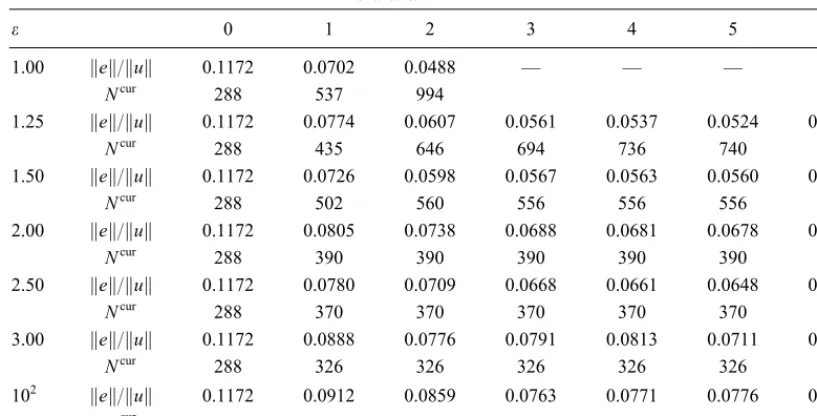
is shown in Table I. The table gives the development of the error and the number of elements
for dierent values of . In this table, the integer column headers denote the analysis index, i.e.
a ‘0’ denotes the initial computation, a ‘1’ denotes the computation after one step remeshing,
etc. A fullh-adaptive analysis (= 1) and a fullr-adaptive analysis (= 102) have been added
Figure 4. Example of a strip—energy norm of the error (a), renement ratio (b), splitting the domain (c) and remeshing (d).
remeshing step. The relative errors and numbers of elements are summarized in Figure 6,
where the mesh convergence behaviour for dierent values of is depicted.
Examining Table I and Figure 6, it can be concluded that lower values of(relatively much
h-adaptivity, relatively little r-adaptivity) lead to higher accuracies. The lower the value of ,
the lower the relative error becomes. For these lower values of more elements are added
during the analysis. For higher values of the eect ofr-adaptivity is more pronounced, which
can be seen from the longer vertical line segments in Figure 6. Although for higher values of
, the number of elements is invariant during the later stage of computation, still a signicant
increase in accuracy can be obtained. Indeed, the mesh convergence of the rh-approach is
higher than that of the pure h-adaptive technique, and for the higher values of the mesh
convergence improves.
Discrepancies from the general tendency (higher accuracy for lower values of , higher
eciency for higher values of ) are caused by a more scattered subdivision of the domain.
For instance, the overall performance of = 2:0 is worse than that of = 2:5. In the rst
case the h-adaptive subdomain and the r-adaptive subdomain consist of more parts than for
Figure 5. Example of a strip—error distribution after one, two, three and four steps remeshing (a–d, respectively).
form, which poses more constraints on the h-adaptive remeshing as well as on the r-adaptive
remeshing. The same reasoning holds for the analysis with = 3:0, where a temporary decrease
of accuracy is followed by an increase of accuracy (see Table I). The obtained accuracy can be improved by articially decreasing the prescribed relative error. Thus, while we still aim
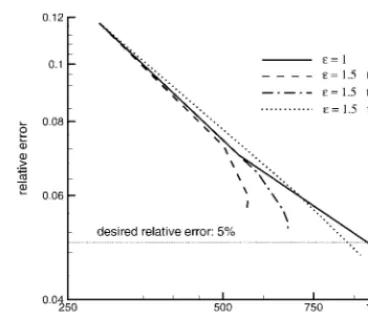
at a relative error of 5 per cent, we impose a lower value for Á. Figure 7 shows the mesh
convergence behaviour for analyses with = 1:5 when Á is varied. We observe a gradual
decrease of the nal error, while the mesh convergence behaviour is still better than that
of the full h-adaptive analysis. For Á= 0:04 the relative error is below the desired value of
5 per cent.
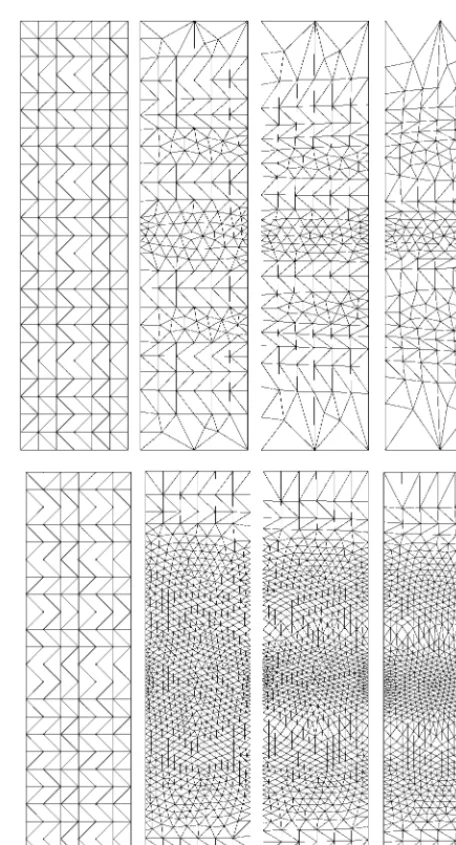
Figure 8 shows the mesh developments for two dierent prescribed relative errors, Á= 0:05
and 0.025, respectively, and = 2. In the rst remeshing step with Á= 0:05 four r-adaptive
zones can be recognized, separated by three h-renement zones in the centre and two h
-de-renement zones at the extremes of the domain. On the other hand, in the Á= 0:025 analysis
Table I. Example of a strip—relative error kek=kuk and number of elementsNcur for dierent values of .
0 1 2 3 4 5 6
1.00 kek=kuk 0.1172 0.0702 0.0488 — — — —
Ncur 288 537 994
1.25 kek=kuk 0.1172 0.0774 0.0607 0.0561 0.0537 0.0524 0.0514
Ncur 288 435 646 694 736 740 738
1.50 kek=kuk 0.1172 0.0726 0.0598 0.0567 0.0563 0.0560 0.0558
Ncur 288 502 560 556 556 556 556
2.00 kek=kuk 0.1172 0.0805 0.0738 0.0688 0.0681 0.0678 0.0676
Ncur 288 390 390 390 390 390 390
2.50 kek=kuk 0.1172 0.0780 0.0709 0.0668 0.0661 0.0648 0.0638
Ncur 288 370 370 370 370 370 370
3.00 kek=kuk 0.1172 0.0888 0.0776 0.0791 0.0813 0.0711 0.0699
Ncur 288 326 326 326 326 326 326
102 kek=kuk 0.1172 0.0912 0.0859 0.0763 0.0771 0.0776 0.0778 Ncur 288 288 288 288 288 288 288
Figure 6. Example of a strip—mesh convergence for dierent values of.
domain. For both analyses most of the h-adaptation takes place in the rst remeshing step. In
subsequent steps, the majority of the domain belongs to the r-adaptive subdomain.
In a second example, we study the evolution of the error in the two subdomains. The geometry is shown in Figure 9. We follow the same approach as in the previous example,
now with uexact= 5 exp(−5y2) K and c= 1 W=mK. The desired relative error is Á= 0:05, so
thatÁkuk= 0:497. Two values for have been compared, namely= 1:5 and = 2:0. In Figure
10, the subdivision of the domain into an h-adaptive subdomain and anr-adaptive subdomain
[image:12.595.182.368.321.487.2]Figure 7. Example of a strip—mesh convergence for dierent values of Á.
We compute the norm of the error in theh- and the r-adaptive zones separately in order to
illustrate how the error evolves in each subdomain. This cannot be done in a straightforward
manner, since the h-adaptive zones and the r-adaptive zones themselves evolve during the
adaptive process. Thus, the error in each subdomain changes from one mesh to another due to (i) remeshing and (ii) a changing subdivision of the domain. Therefore, the subdomains must be ‘xed’ for a correct investigation of the error development in each subdomain. We
have projected the error distribution onto the subdomains of the previous mesh. For instance,
the error in the r-adaptive subdomain of the initial mesh (Figure 10, top row) is compared to
exactly the same area of the domain, but now taken from the mesh after remeshing (Figure
10, middle row). In this manner, the error development in both subdomains can be measured in an objective sense. Table II shows the energy norm of the error in the whole domain, the
r- and the h-adaptive subdomain, as well as the number of elements of each of these domains.
Note that kek2=kek2
r+kek2h (cf. Equation (2)). From the number of elements as well as from
Figure 10 it can be seen that the r-adaptive subdomain grows with respect to the h-adaptive
subdomain for ongoing remeshing steps. For larger the r-adaptive subdomain is larger. The
error norms show that large decreases in error can be obtained in the h-adaptive subdomain,
whereas the accuracy gain in the r-adaptive subdomain is smaller.
Thirdly, the example of Section 1 is analysed again, but now with the combinedrh-adaptive
approach. The geometry can be found in Figure 1, while we take the loading conditions of
case B. As such, the exact temperature elduexact= 3 exp(−1:5s2) wherebys=12√2(x−y−1).
Furthermore, the conductivity c= 1 W=mK. Again, the desired relative error Á= 0:05. Figure
11 shows the relative error as a function of the number of elements for various values of .
Basically, the same trends as with the other examples are found. Larger values for lead to
higher rates of mesh convergence, while lower values for lead to higher nal accuracies.
In Figure 12, the nal meshes for the various values of have been plotted. Note that the
purely r-adaptive approach (= 100) leads to element entanglement for this example (see
also Figure 1, right). Furthermore, the analysis with = 2 leads to some very badly shaped
elements around the lower-right corner of the hole. This demonstrates the need for a certain
Figure 8. Example of a strip—mesh development for= 2, prescribed relative errorÁ= 0:05 (top row) andÁ= 0:025 (bottom row).
5.2. Varying subdivision parameter
In the previous section, the subdivision parameter has been xed. In this section, the eect
of a varying is studied. Two strategies are proposed, which follow dierent reasonings. The
Figure 9. L-shape example—geometry.
For the rst approach we have taken an expression for that decreases with a decreasing
error as
=Ákkeukk (16)
In the limit state, i.e. askek approachesÁkuk,goes to one. Consequently, the interval [1=; ]
on basis of which elements are assigned to the r-adaptive subdomain becomes smaller and
smaller. In other words, a signicant part of the domain will remain h-adaptive (contrary to
the case of a xed value for , see Section 5.1). Thus, the number of elements can easily be
adjusted in all remeshing steps. The example of the strip is analysed again but now with
ac-cording to Equation (16). The desired relative errorÁ= 0:05. The mesh convergence behaviour
is depicted in Figure 13. As a reference also the case of a xed = 1:0 (full h-adaptive) is
plotted in this gure. It can be seen that the mesh convergence behaviour is not an
improve-ment of the results obtained with a xed (cf. Figure 6). Although elements are added in
all remeshing steps, the numerical error arrests at a certain stage and does not decrease any-more. The reason for this behaviour is the relatively complex form of the interface between
the h-adaptive subdomain and the r-adaptive subdomain. Whereas for a ÿxed this interface
becomes more and more simple and eventually disappears (see Figure 10, for instance),
a decreasing maintains a signicant h-adaptive subdomain even in later remeshing steps. As
a consequence, the interface between the r-adaptive subdomain and theh-adaptive subdomain
does not disappear but remains of relatively complex form. This poses topological constraints
on the h-adaptive remeshing as well as on the r-adaptive remeshing, by which the decrease
in error is severely reduced. To mitigate this deciency, more exible formulations of the interface should be considered. However, this falls beyond the scope of the present study.
A totally dierent approach is to let increaseduring the analysis. This is motivated by the
fact that a small (much h-adaptivity) in the rst remeshing steps is more suitable to meet
the desired number of elements more precisely in an early stage of the analysis, whereas a
larger (much r-adaptivity) in later remeshing steps facilitates the ne-tuning of the nodal
co-ordinates. Thus, the interface between the two subdomains has a less complicated form
Figure 10. L-shape example—subdivision into h-adaptive subdomain (gray) and r-adaptive subdomain (white) for= 1:5 (left column) and= 2:0 (right column); ini-tial mesh (mesh 0—top row), mesh after one remeshing step (mesh 1—middle row)
and mesh after two remeshing steps (mesh 2—bottom row).
the remeshing process. We have adopted the following denition of :
=Áÿkkuekk + 1 (17)
where ÿis a numerical parameter. Note that ≈1 for relatively large values of kek, whereas
→1=ÿ+ 1 if kek approaches Ákuk. Thus, goes to 2 if ÿ= 1, goes to 1.5 if ÿ= 2, etc.
The mesh convergence behaviour of the strip example with Á= 0:05 for an increasing is
Table II. L-shape example—error development and number of elements.
Step 1 Step 2 Step 3
Mesh 0→Mesh 1 Mesh 1→Mesh 2 Mesh 2 →Mesh 3
= 1:5 kek 1.02592 0.92105 0.92105 0.59855 0.59855 0.57943
Ncur 852 821 821 1245 1245 1247
kekr 0.25229 0.24051 0.43249 0.40300 0.59222 0.57271
Ncur
r 230 230 538 538 1221 1221
kekh 0.99442 0.88909 0.81319 0.44255 0.08683 0.08799
Ncur
h 622 591 283 707 24 26
=2.0 kek 1.02592 0.85628 0.85628 0.75951 0.75921 0.69872
Ncur 852 740 740 844 844 844
kekr 0.59277 0.51634 0.64836 0.64987 0.75921 0.69872
Ncur
r 487 487 665 665 844 844
kekh 0.83734 0.68309 0.55932 0.39310 0 0
Ncur
[image:17.595.163.389.90.471.2]h 365 253 75 179 0 0
Figure 11. Square with a hole—mesh convergence for xed values of.
for increasing is better than that of a full h-adaptive analysis. For the case →1:25 (ÿ =
4) the desired relative error is met. Compared to the xed case, more elements are added
in an early stage of the analysis, so that the nal error is lower.
Also, the example of the square with a hole is analysed with the increasing according
to Equation (17). Figure 15 shows the mesh convergence behaviour for various values of ÿ,
whileÁ= 0:05. For the case→1:25 the error tolerance is met. Compared to the corresponding
analyses with xed values of (see Figure 11), the mesh convergence rate is somewhat
Figure 12. Square with a hole—nal meshes for = 100 (top left), = 2 (top right), = 1:5 (bottom left) and = 1:25 (bottom right).
6. DISCUSSION
The paper aims to combine the advantageous properties of two adaptive strategies, namely,
node relocation (r-adaptivity) and adjusting element sizes and mesh topology (h-adaptivity).
Basically, r-adaptive strategies are recognized to be computationally inexpensive but with
lim-ited applicability, whereas h-adaptive strategies are suitable for meeting a prescribed accuracy
at the cost of a higher computational eort.
In the current study, the domain under consideration is split into two subdomains. In the regions where the element sizes do not dier too much from the desired element sizes node
relocation is applied. In the remainder of the domain, an h-adaptive approach is chosen. The
subdivision of the domain as well as the construction of a new discretization in both subdo-mains is based on the computation of a desired element size, so that generality is preserved.
Through this domain subdivision, each remeshing technique (r-adaptivity, h-adaptivity) can
be used in the subdomain where it is suited most.
Figure 13. Example of a strip—mesh convergence for a decreasing according to Equation (16).
Figure 14. Example of a strip—mesh convergence for an increasing according
to Equation (17).
Figure 15. Square with a hole—mesh convergence for an increasing according
to Equation (17).
is desired. As such, the present approach can be regarded as an enhancement of the h
-adaptive nite element method in which parts of the domain are remeshed with the cheaper
r-adaptive technique. Conversely, the proposed combined rh-adaptive strategy may be seen
as an extension of r-adaptive approaches, namely where h-adaptivity is used if r-adaptivity is
deemed unsuitable.
A numerical parameter has been introduced that can be set by the user in order to at-tach more importance to accuracy or to computational speed-up. Alternatively, this parameter
can be computed as a function of the error level. If more weight is put on h-adaptivity,
[image:19.595.276.460.280.442.2]Conversely, if r-adaptivity is emphasized, then the mesh convergence behaviour is better
while attaining a prescribed error level may become impossible. Compared to a purely h
-adaptive technique, the computational costs are lower in the combined rh-adaptive approach.
With a suitable choice for the above-mentioned numerical parameter the same accuracy can be obtained with a smaller number of nite elements. On the other hand, the
pro-posed combined rh-adaptive strategy oers better accuracies than a purely r-adaptive
approach.
Features that will be addressed in the future include the following:
• The treatment of the intersection between the r- and the h-adaptive subdomain has not
been investigated in depth. In the present study, only a xed interface is considered, which
can have an interfering eect on the adaptivity process in ther-adaptive subdomain as well
as the h-adaptive subdomain. Future investigations should include r- and=or h-adaptivity
at the intersection.
• Using the numerical parameter as a criterion to split the domain has been a rst attempt.
More sophisticated algorithms may be used and compared. Furthermore, the case of a
decreasing value for the subdivision parameter should be studied in combination with
a less rigid treatment of the interface between the two subdomains. It is expected that
through this combination the mesh convergence behaviour of rh-adaptive schemes can be
improved.
• In the present study, only exact errors have been used. The performance of the proposed
rh-adaptive strategy should also be assessed with error estimators and error indicators.
• The extension towards non-linear problems requires an algorithm to transfer the state
variables. As with the adaptation of the mesh dierent stress transfer algorithms can be used that suit the two subdomains best.
ACKNOWLEDGEMENTS
We wish to thank Pedro Dez and Antonio Huerta for the various technical discussions. Furthermore, we gratefully acknowledge the Commissariat a l’ Energie Atomique, France, for the availability of the nite element code CASTEM 2000.
REFERENCES
1. Zienkiewicz OC, Zhu JZ. Adaptivity and mesh generation. International Journal for Numerical Methods in Engineering1991;32:783–810.
2. Huerta A, Rodrguez-Ferran A, Dez P, Sarrate J. Adaptive nite element strategies based on error assessment.
International Journal for Numerical Methods in Engineering1999;46:1803–1818.
3. Ladeveze P, Rougeot Ph, Blanchard P, Moreau JP. Local error estimators for nite element linear analysis.
Computer Methods in Applied Mechanics and Engineering1999;176:231–246.
4. Babuska I, Strouboulis T, Gangaraj SK, Upadhyay CS. Pollution error in theh-version of the nite-element method and the local quality of the recovered derivatives. Computer Methods in Applied Mechanics and Engineering1997;140:1–37.
5. Hager P, Wiberg N-E. Adaptive eigenfrequency analysis by superconvergent patch recovery.Computer Methods in Applied Mechanics and Engineering1999;176:441–462.
6. Hughes TJR, Liu WK, Zimmermann TK. Lagrangian–Eulerian nite element formulation for incompressible viscous ows.Computer Methods in Applied Mechanics and Engineering1981;29:329–349.
7. Donea, J. Arbitrary Lagrangian–Eulerian nite element methods. In Computational Methods for Transient AnalysisChapter 10, Belytschko T, Hughes TJR (eds). Elsevier: Amsterdam, 1983; 474–516.
9. Askes H, Sluys LJ. Remeshing strategies for adaptive ALE analysis of strain localisation.European Journal of Mechanics A=Solids 2000;19:447–467.
10. Cao T. Adaptive H- and H-R methods for Symm’s integral equation.Computer Methods in Applied Mechanics and Engineering1998;162:1–17.
11. Ammons BA, Vable M. Anhr-method of mesh renement for boundary element method.International Journal for Numerical Methods in Engineering1998;43:979–996.
12. Kita E, Higuchi K, Kamiya N. r- and hr-adaptive boundary element method for two-dimensional potential problem.Computers and Structures 2000;74:11–19.
13. Ortiz M, Quigley JJ. Adaptive mesh renement in strain localization problems. Computer Methods in Applied Mechanics and Engineering1991;90:781–804.
14. Dez P, Egozcue JJ, Huerta A. A posteriori error estimation for standard nite element analysis. Computer Methods in Applied Mechanics and Engineering1998;163:141–157.
15. Li LY, Bettess P. Notes on mesh optimal criteria in adaptive nite element computations. Communications in Numerical Methods in Engineering1995;11:911–915.
16. Li LY, Bettess P, Bull JW, Bond T, Applegarth I. Theoretical formulations for adaptive nite element computations.Communications in Numerical Methods in Engineering 1995;11:857–868.
17. Zienkiewicz OC, Zhu JZ. A simple error estimator and adaptive procedure for practical engineering analysis.
International Journal for Numerical Methods in Engineering1987;24:337–357.
18. O˜nate E, Bugeda G. A study of mesh optimality criteria in adaptive nite element analysis. Engineering Computations1993;10:307–321.
19. Dez P, Huerta A. A unied approach to remeshing strategies for nite elementh-adaptivity.Computer Methods in Applied Mechanics and Engineering1999;176:215–229.
20. Zhu JZ, Zienkiewicz OC. Adaptive techniques in the nite element method. Communications in Applied Numerical Methods1988;4:197–204.
21. Zienkiewicz OC, Zhu JZ. Error estimates and adaptive renement for plate bending problems. International Journal for Numerical Methods in Engineering1989;28:2839–2853.
22. Bode L. Strategies numeriques pour la prevision de la ruine des structures du genie civil. Dissertation E.N.S. de Cachan=CNRS=Universite Paris 6, 1994.
23. Pijaudier-Cabot G, Bode L, Huerta A. Arbitrary Lagrangian–Eulerian nite element analysis of strain localization in transient problems.International Journal for Numerical Methods in Engineering1995;38:4171–4191. 24. Huerta A, Casadei F. New ALE applications in non-linear fast-transient solid dynamics. Engineering
Computations1994;11:317–345.
25. Huerta A, Liu WK. Viscous ow with large free surface motion. Computer Methods in Applied Mechanics and Engineering1988;69:277–324.