i
FACE DETECTION USING PROBABILISTIC NEURAL NETWORK (PNN)
W. NURUL ALIAA BT W. MAZLAN
This report is submitted in partial fulfilment of requirement for the award of Bachelor Electronic Engineering (Electronic Telecommunication) with Honours.
Faculty of Electronic and Computer Engineering Universiti Teknikal Malaysia Melaka
ii
UNIVERSTI TEKNIKAL MALAYSIA MELAKA
FAKULTI KEJURUTERAAN ELEKTRONIK DAN KEJURUTERAAN KOMPUTER BORANG PENGESAHAN STATUS LAPORAN
PROJEK SARJANA MUDA II
Tajuk Projek : Face Detection Using Probabilistic Neural Network (PNN)
Sesi
Pengajian : 0 9 / 1 0
Saya W. NURUL ALIAA BT W. MAZLAN
(HURUF BESAR)
mengaku membenarkan Laporan Projek Sarjana Muda ini disimpan di Perpustakaan dengan syarat-syarat kegunaan seperti berikut:
1. Laporan adalah hakmilik Universiti Teknikal Malaysia Melaka.
2. Perpustakaan dibenarkan membuat salinan untuk tujuan pengajian sahaja.
3. Perpustakaan dibenarkan membuat salinan laporan ini sebagai bahan pertukaran antara institusi pengajian tinggi.
4. Sila tandakan ( √ ) :
SULIT*
*(Mengandungi maklumat yang berdarjah keselamatan atau kepentingan Malaysia seperti yang termaktub di dalam AKTA RAHSIA RASMI 1972)
TERHAD** **(Mengandungi maklumat terhad yang telah ditentukan oleh organisasi/badan di mana penyelidikan dijalankan)
TIDAK TERHAD
Disahkan oleh:
__________________________ ___________________________________
(TANDATANGAN PENULIS) (COP DAN TANDATANGAN PENYELIA)
iii
“I hereby declare that this report is the result of my own except for quotes as cited clearly in the references.”
Signature :
iv
“I hereby declare that I have read this report and in my opinion this report is sufficient in terms of scope and quality for the award of Bachelor of Electronic
Engineering (Electronic Telecommunication) with Honours”
Signature : ……….
Supervisor’s Name : EN. KHAIRUL AZHA B. ABD. AZIZ
v
ACKNOWLEDGEMENTS
Alhamdulillah , I am most grateful to Almighty ALLAH s.w.t. for blessing me with good health and ideas in completing this research successfully.
Thousand of thanks to my supervisor, En. Khairul Azha b A. Aziz for giving me a chance to do my project under his supervises. I would like to show my highest gratitude for his invaluable support, patient, assistance and especially his encouragement to this project. I truly have learnt a lot and all this would not be without his guidance.
I also would to thanks to my family for their supporting especially my parents. Lots of love for them. To my siblings and family members who were always stand by my side to encourage, advice and support me during this entire project.
Last but not least, to all my fellow friends, thank you very much for your contribution in giving me a moral support throughout my project development period.
vi
ABSTRACT
vii
ABSTRAK
viii
CONTENT
CHAPTER TITLE PAGE
PROJECT TITLE i
VERIFICATION FORM STATUS REPORT ii
DECLARATION iii
SUPERVISOR VERIFICATION iv
ACKNOWLEGEMENT v
ABSTRACT vi
ABSTRAK vii
CONTENTS viii
LIST OF TABLE xi
LIST OF FIGURE xii
LIST OF ABBREVIATION xiv
I INTRODUCTION
1.1 Project Background 1
1.2 Project Objective 2
1.3 Problem Statement 3
1.4 Scope of Project 3
1.5 Summary of Methodology 3
1.6 Report Structure 4
II LITERATURE REVIEW
2.1 Neural Network 5
ix
2.1.2 Disadvantages of Neural Network 7
2.2 Probabilistic Neural Network (PNN) 8
2.2.1 Advantages and Disadvantages of PNN 9
2.3 Grayscale Image 10
2.4 Histogram Equalization 11
2.5 Other Neural Networks Methods 12
2.5.1 Neural Network with Spread Value (RBFNN) 12 2.5.2 Face Detection Using Eigenface and Neural
Network 15
III METHODOLOGY
3.1 Matlab Software 19
3.1.1 Matlab for Image Processing 20
3.1.2 M-Files 21
3.2 PNN Architecture 20
3.2.1 Algorithm of PNN 23
3.2.2 Operation of PNN Network 26
3.3 Block Diagram 29
3.4 Convert RGB Image To Grayscale 30
3.5 Preprocessing for face detection 31
3.5.1 Steps in Preprocessing 32
3.6 Sliding Window 33
3.7 Network Training 34
3.8 Network Testing 35
3.9 Project Flow Chart 36
IV RESULT AND DISCUSSION
4.1 Result 38
x
V CONCLUSION AND RECOMMENDATION
5.1 Conclusion 47
5.2 Recommendation 48
REFERENCESS 49
xi
LIST OF TABLE
NO TITLE PAGE
2.1 Summary of the Best Setting for RBF Face Detection 14
2.2 Experimental Results of Simplified Systems 18
4.1 Percentage of Face and Non-face 38
xii
LIST OF FIGURE
NO TITLE PAGE
1.1 General Block Diagram for Face Detection. 2
2.1 Graphical of Neural Network (NN) 6
2.2 Block Diagram of PNN Networks have Four Layers 8 2.3 Pixel Values in a Grayscale Image Define Gray Levels 11
2.4 Structure of RBF Neural Network 12
2.5 Using RBF with the value of Centre 25 and Spread 4 14 2.6 Using RBF with the value of Centre 25 and Spread 5 15 2.7 Block diagram for Face Detection using Eigenface and Neural Network 15
2.8 Examples of the Eigenface 16
2.9 Results with an additional training with false detection in the BiolD
dataset (a) Before training (b) After training 17 3.1 Architecture of Probabilistic Neural Network (PNN) 22
3.2 Radial Basis Function 27
3.3 Gaussian Function 27
3.4 RBF Function of two variables 28
3.5 Weighted by the RBF Function 28
3.6 Spread of RBF Function 29
3.7 Block Diagram of Face Detection Using PNN 29
3.8 RGB Image to Grayscale Image 30
3.9 The Basic Algorithm used for face detection 31
3.10 Steps in Preprocessing Window 32
3.11 Examples of Faces 34
3.12 Examples of Non-Faces 34
xiii
3.14 Project Flow Chart 37
4.1 Graph of the Percentage of Face and Non-face 39
4.2 Graph of FAR and FRR 41
4.3 PNN with spread 0.1 42
4.4 PNN with spread 0.3 42
4.5 PNN with spread 0.7 43
4.6 PNN with spread 2 43
4.7 PNN with spread 3 44
4.8 PNN with spread 4.5 44
4.9 PNN with spread 6 45
4.10 Block Diagram of Network Training 46
xiv
LIST OF ABBREVIATION
NN - Neural Network
PNN - Probabilistic Neural Network
RBFNN - Radial Basis Function Neural Network
HMM - Hidden Markov Model
FAR - False Acceptance Rate FRR - False Rejection Rate
CHAPTER 1
INTRODUCTION
This chapter will briefly discuss on the project overview. The objective,
scope, problem statement, summary of methodology and thesis outline will be
presented in this chapter.
1.1 Project Background
Face detection is the first step in face recognition system as the output will be
used as the input to the face recognition system. The face detection is an important
preprocessing step for face recognition. To make the face recognition system
practical, it is necessary to detect the faces effectively and correctly.
One of the methods for face detection is Neural Networks (NN) which lies under
the category of image based approach. The advantages using NN are adaptive in
nature, use of a training phase for learning the relationships in the input data,
generalization capabilities provide a means of coping with noisy or incomplete data
[3].
Face detection is concerned with finding whether or not there are any faces in
a given image. In this project, Probabilistic Neural Networks (PNN) method is use
to detect frontal views of faces in a grayscale image. Matlab software is use to
2
The aim of this project is to detect the one face in one image. For training,
CBCL Face Database [13] is used.
[image:16.612.182.495.125.310.2]Input output
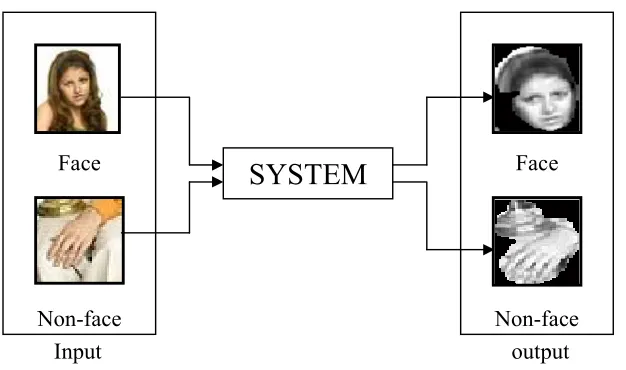
Figure 1.1: General Block Diagram for Face Detection
Based on figure 1.1, it shows how the system works generally. In this system
a number of face and non-face are enter to the system. As a result, the percentage of
face and non-face is calculated to see how many faces and the effectiveness that the
system can detect.
1.2 Project Objectives
The objectives in this project are to develop a face detection system using
Probabilistic Neural Networks (PNN) and to compare the result using PNN method
with other neural network method such as Radial Basis Function Neural Network
(RBFNN). This system will develop using Matlab software. Besides that, other
objectives are:
• To apply Matlab programming for face detection such as algorithm
development.
• To apply and improve the knowledge about image processing which are
widely use in face detection project. Face
Non-face
Face
3
• To develop the PNN in face detection successfully.
• To understand the face detection using PNN system.
1.3 Problem Statement
As we know, face detection always related with security system. We can see
the criminals are increases in Malaysia lately. For PNN project, I want to prove that
this system is suitable to use for face recognition project to prevent the criminals.
1.4 Scope of Project
The scope in this project is use Matlab software to develop the project.
Matlab programming is use for face detection. Besides that, this project focuses in
Neural Network method using Probabilistic Neural Networks (PNN). The aim is to
detect one image for one face. For face detection, grayscale is use as an input. The
CBCL database [13] is use as a data base for network training and testing.
1.5 Summary of Methodology
In this project, there are several method used for PNN system. Firstly, Matlab
software is used to develop the system. This software expressed in mathematical
notation. For image processing, pre-processing image is used. In pre-processing,
several algorithms are used such as grayscale image, extract window, histogram
equalization for lighting balancing and filter image. Then PNN system is used to
develop this project. There are four layers in PNN’s architecture. This system is
trained with 2429 data and 4548 data from [13]. For testing, only 999 data face and
899 non-face data from [13] are used and other testing the picture from [14] is taken
4
1.5 Report Structure
Chapter one briefly introduces the overall of the project title face detection
using Probabilistic Neural Networks (PNN). The introduction consists of overview,
objective, problem statement, scope of work and structure report.
Meanwhile chapter two discuss about the background of study related to face
detection using PNN method. Literature review will produce overall structure of the
face detection which shows the relationship between project research and theoretical
concept.
Chapter three will explain about the project methodology. Project
methodology give details about the method used to solve the problem to complete the
project. The method used such as collecting data method, process and analysis data
method, modelling and etc.
Chapter four consists of result and discussion of the project, finding and
analysis throughout the research and project development.
Lastly, chapter five is the project conclusion. This chapter rounds up the final
achievement of the whole project and reserves suggestions for possible future
researches.
CHAPTER 2
LITERETURE REVIEW
This project is divided into few parts; consist of neural network (NN) method,
focusing on Probabilistic Neural Networks (PNN), other methods of neural network
(NN) and advantages and disadvantages of neural network and Probabilistic Neural
Networks (PNN).
An approach to complete this project will be discussed in this chapter. It
consists only in software part only.
2.1 Neural Network (NN)
An Artificial Neural Network (ANN) is an information processing paradigm
that is inspired by the way biological nervous systems, such as the brain, process
information. The key element of this paradigm is the novel structure of the
information processing system. It is composed of a large number of highly
interconnected processing elements (neurons) working in unison to solve specific
problems. ANNs, like people, learn by example. An ANN is configured for a specific
application, such as face detection or data classification, through a learning process.
Learning in biological systems involves adjustments to the synaptic connections that
exist between the neurons. [4]
A neural network is a powerful data modeling tool that is able to capture and
6
development of neural network technology stemmed from the desire to develop an
artificial system that could perform intelligent tasks similar to those performed by the
human brain. Neural networks resemble the human brain in the following two ways;
they acquire knowledge through learning and the knowledge is stored within
inter-neuron connection strengths known as synaptic weights. The true power and
advantage of neural networks lies in their ability to represent both linear and
non-linear relationships and in their ability to learn these relationships directly from the
data being modeled. Traditional linear models are simply inadequate when it comes
to modeling data that contains non-linear characteristics. [5]
The most common neural network model is known as a supervised network
because it requires a desired output in order to learn. The goal of this network type is
to create a model that maps the input to the output using historical data so that the
model can then be used to produce the output when the desired output is unknown
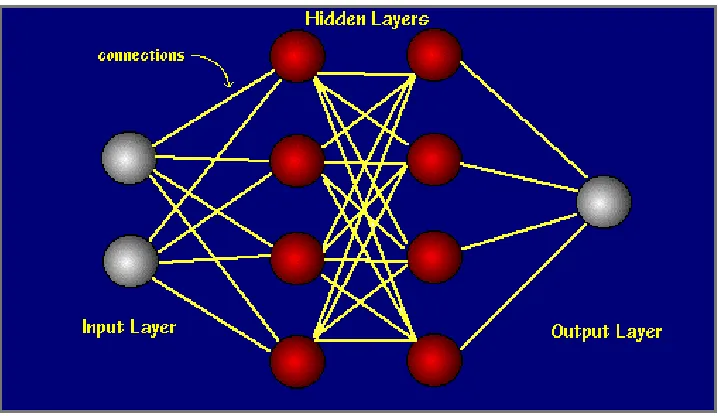
[image:20.612.169.528.357.565.2][5]. A graphical of neural networks is shown in figure 2.1.
Figure 2.1: Graphical of Neural Networks (NN)
Artificial neurons with information processing abilities somewhat comparable
to the human neuron were therefore made to suit this design. These neurons receive
inputs from other sources, combine them in some way, perform a generally nonlinear
operation on the result, and then output the final result. The neurons are typically
7
is presented to the network through the input layer, which communicates to one or
more hidden layers where the actual processing is done by a system of weighted
connections. These hidden layers then link to an output layer which produces the
output [5].
2.1.1 Advantages of Neural Networks
Neural networks, with their remarkable ability to derive meaning from
complicated or imprecise data, can be used to extract patterns and detect trends that
are too complex to be noticed by either humans or other computer techniques. A
trained neural network can be thought of as an expert in the category of information
it has been given to analyze. Other advantages include: [4]
• Adaptive learning: An ability to learn how to do tasks based on the data given
for training or initial experience.
• Self-Organization: An ANN can create its own organization or representation
of the information it receives during learning time.
• Real Time Operation: ANN computations may be carried out in parallel, and
special hardware devices are being designed and manufactured which take
advantage of this capability.
• Fault Tolerance via Redundant Information Coding: Partial destruction of a
network leads to the corresponding degradation of performance. However,
some network capabilities may be retained even with major network damage.
2.1.2 Disadvantages of Neural Networks
Besides with the advantages of neural networks, it still has several
disadvantages in this system. The disadvantages of neural networks are this system
need lots of training to analyze the data, it also need lots of work to select appropriate
2.2 Probabilistic Neural Network (PNN)
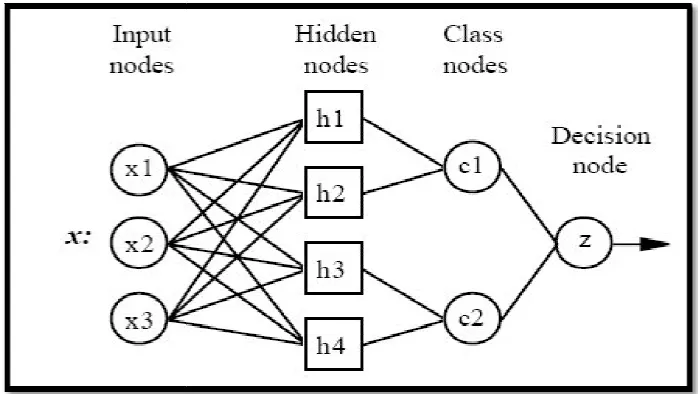
Probabilistic neural networks can be used for classification problems (i.e.
face detection). When an input is presented, the first layer computes distances from
the input vector to the training input vectors, and produces a vector whose elements
indicate how close the input is to a training input. The second layer sums these
contributions for each class of inputs to produce as its net output a vect
probabilities. Finally, a
picks the maximum of these probabilities, and produces a 1 for that class and a 0 for
the other classes [6].
[image:22.612.149.498.294.491.2]The following diagram illustrates a
Figure 2.2: Block
• Input layer: There is one neuron in the input layer for each predictor
variable. In the case of categorical variables,
the number of categories. The input neurons (or processing bef
layer) standardize the range of the values by subtracting the median and
dividing by the interquartile range. The input neurons then feed the values to
each of the neurons in the hidden layer.
Probabilistic Neural Network (PNN)
Probabilistic neural networks can be used for classification problems (i.e.
face detection). When an input is presented, the first layer computes distances from
to the training input vectors, and produces a vector whose elements
indicate how close the input is to a training input. The second layer sums these
contributions for each class of inputs to produce as its net output a vect
probabilities. Finally, a compete transfer function on the output of the second layer
picks the maximum of these probabilities, and produces a 1 for that class and a 0 for
The following diagram illustrates a block diagram of PNN Network
Block Diagram of PNN Networks have Four Layers
There is one neuron in the input layer for each predictor
variable. In the case of categorical variables, N-1 neurons are used where
the number of categories. The input neurons (or processing bef
layer) standardize the range of the values by subtracting the median and
dividing by the interquartile range. The input neurons then feed the values to
each of the neurons in the hidden layer.
8
Probabilistic neural networks can be used for classification problems (i.e.
face detection). When an input is presented, the first layer computes distances from
to the training input vectors, and produces a vector whose elements
indicate how close the input is to a training input. The second layer sums these
contributions for each class of inputs to produce as its net output a vector of
ompete transfer function on the output of the second layer
picks the maximum of these probabilities, and produces a 1 for that class and a 0 for
block diagram of PNN Network:
ayers
There is one neuron in the input layer for each predictor
1 neurons are used where N is
the number of categories. The input neurons (or processing before the input
layer) standardize the range of the values by subtracting the median and
9
• Hidden layer: This layer has one neuron for each case in the training data
set. The neuron stores the values of the predictor variables for the case along
with the target value. When presented with the x vector of input values from
the input layer, a hidden neuron computes the Euclidean distance of the test
case from the neuron’s center point and then applies the RBF kernel function
using the sigma value(s). The resulting value is passed to the neurons in the
pattern layer.
• Pattern layer / Summation layer: The PNN network there is one pattern
neuron for each category of the target variable. The actual target category of
each training case is stored with each hidden neuron; the weighted value
coming out of a hidden neuron is fed only to the pattern neuron that
corresponds to the hidden neuron’s category. The pattern neurons add the
values for the class they represent (hence, it is a weighted vote for that
category).
• Decision layer: The decision layer compares the weighted votes for each
target category accumulated in the pattern layer and uses the largest vote to
predict the target category.
Besides face detection, typical uses for PNN such as optical character
recognition, facial recognition, texture analysis, data validation, sales forecasting,
shape recognition, pattern recognition and etc [12].
2.2.1 Advantages and Disadvantages of PNN
Probabilistic Neural Networks have found their way into countless
applications that require static pattern classification. Their main advantage is that
they are easy to use and that they can approximate any input or output map [7]. Other
advantages of PNN are:
• The training speed of PNN is faster than back propagation (BP) paradigm [1].
• The ability of the network to generalize to detect the face is approximately
the same [2].
• The networks are nonlinear hybrid networks, typically containing a single
10
• All the weights of the network are calculated analytically [7].
• PNN networks approach Bayes optimal classification.
• PNN networks generate accurate predicted target probability scores.
While the disadvantage by using PNN is training is slowly and impractical for a
large amount of training data, which are typically three times more training samples
than network weights [7]. Other than that, PNN networks require more memory
space to store the model.
2.3 Grayscale Image
A grayscale image (also called gray-scale, gray scale, or gray-level) is a data
matrix whose values represent intensities within some range. Matlab stores a
grayscale image as an individual matrix, with each element of the matrix
corresponding to one image pixel. By convention, this documentation uses the
variable name I to refer to grayscale images.
The matrix can be of class uint8, uint16, int16, single or double. While
grayscale images are rarely saved with a colormap, Matlab uses a colormap to
display them.
For a matrix of class single or double, using the default grayscale colormap,
the intensity 0 represents black and the intensity 1 represents white. For a matrix of
type uint8, uint16, or int16, the intensity intmin(class(I)) represents black and the
intensity intmax(class(I)) represents white [6]. For uint8, the integer values in the