Glenn Michael Moy
A thesis submitted for the degree of
Doctor of Philosophy at
The Australian National University
© Glenn Michael Moy
This research was supervised by Dr Craig Savage, but unless otherwise indicated, the work presented herein is my own.
None of the work presented here has ever been submitted for any degree at this or any other institution of learning.
Acknowledgments
'Gratitude is the heart's memory.'
-French Proverb.
I am thankful for the friendship and support of a great number of people during the course of this thesis. Firstly, I would very much like to thank my supervisor, Dr Craig Savage for his constant support and encouragement. His advice and enthusiasm has shaped both this work and my own development as a physicist. I am especially thankful for his ability to see the big picture - both in physics and life in general.
I would also like to thank those who have helped me in producing this thesis. In particular thanks to Geoff Ericksson, Dan Gordon and Joseph Hope for proof reading various parts of this thesis. I have been supported by an Australian Postgraduate Research Award.
Over the course of my PhD I have had the pleasure of sharing my office with Joe Hope and Dan Gordon. I could not have asked for better friends to share the ups and downs of a PhD with. Thank you for many deep con versations, and happy lunches on "the grassy knoll". Our many discussions, both on physics and other topics have greatly influenced the work in this PhD. Thanks also go to other members of the physics department. I have benefited greatly from the helpful insight of Mark Andrews. Thanks also to Jurgen Es- chner, Tim Ralph, Allan Baxter, David McClellan, Hans Bachor, Geoff Ericks son, Brett Cuthbertson, PingKoy Lam and Andrew White who have all helped me in various ways through the course of my PhD.
Thanks also to Geoff, Brett, Joe and Dan who taught me that shooting at others with a suitably large cannon is a good stress-management technique and to Ping-Koy and Joe, for inviting me to join in a couple of games of Magic.
Abstract
We investigate the pumped and damped atom laser. A rate equation model of the atom laser is presented. This model is based on the geometry of a hol low optical fibre with output coupling achieved through a Raman transition which changes the state of the atoms to an untrapped state. Calculations are presented for overlap elements and transition rates and these lead to rate equa tions which describe the dynamics of the atom laser. We demonstrate the pres ence of a threshold in these rate equations and show that Bose-enhancement leads to a large number of bosons accumulating in the ground state mode of the trap.
We give a description of output coupling based on a change of state through Raman transitions. We present an output coupling model based on change of state, and solve this model for the output spectrum and number of atoms in the cavity. We obtain analytic solutions in the limit of broadband cou pling. The spectral width of the output spectrum and the shape of the output spectrum is investigated as a function of the coupling strength and of time.
We discuss the use of the Born and Markov approximations in describing the dynamics of an atom laser. We investigate the applicability of the quan tum optical Born-Markov master equation for describing output coupling. We discuss conditions for when the Born-Markov approximations are valid for output coupling atoms from a trap. We present results based on an exact method in the regimes in which the Born-Markov approximation fails. The exact solutions in some experimentally relevant parameter regimes give non exponential loss of atoms from a cavity. We discuss the effects of gravity and atom-atom interactions in the system using a mean field model.
We derive a pump model for an atom laser based on spontaneous emission of atoms into the lasing mode. We show that this is equivalent to other pump models discussed in the context of optical and atom laser theory. We investi gate solutions to the input-output equations with the addition of this pumping term and discuss these results in the Born-Markov regime. We also consider the regime where these approximations fail. We extend the mean field model presented earlier to describe the output coupling from a Bose-Einstein con densate. We introduce a phenomenalogical pumping term into this model to provide a mean-field description of a pumped and damped atom laser.
Contents
Acknowledgments v
Abstract vii
1 Introduction 1
1.1 Thesis p la n ... 2
1.2 Summary of major r e s u lts ... 4
1.3 The optical la s e r... 4
1.4 What is an atom la se r... 6
1.4.1 Components of an atom la s e r ... 6
1.4.2 Experimental progress towards the atom l a s e r ... 8
1.4.3 Coherence, BECs and the atom la s e r ... 10
1.4.4 One definition of a la s e r ... 14
1.4.5 Differences between atom laser and optical la se r... 17
1.5 Models of atom lasers... 19
1.5.1 Rate equation a p p ro a c h ... 20
1.5.2 Master equation approach... 22
1.5.3 Mean-field approach... 31
2 An atom laser based on Raman transitions 37 2.1 Introduction... 37
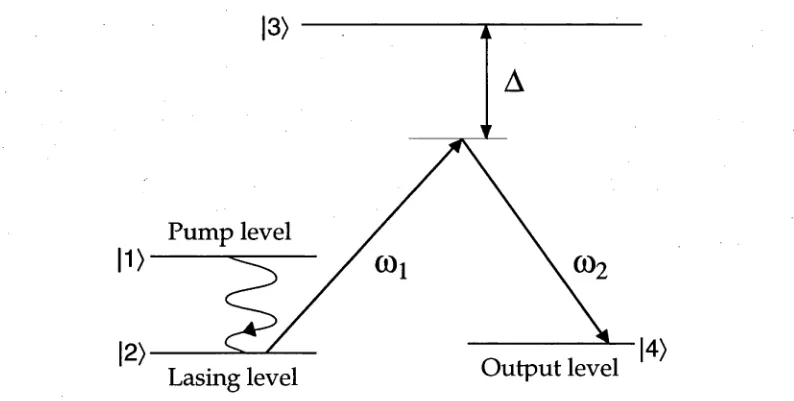
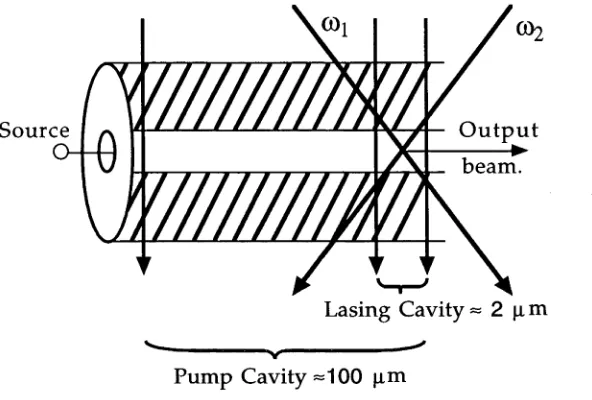
2.2 Atom laser s c h e m e ... 38
2.2.1 M o d e l... 38
2.2.2 Getting atoms into the lasing mode ... 39
2.2.3 Getting atoms out of the lasing m o d e ... 40
2.3 Implem entation... 41
2.3.1 Hollow optical fibres... 41
2.3.2 Implementing the cavities in a hollow optical fibre . . . . 44
2.4 Population of the lasing m o d e... 47
2.4.1 Wavefunction overlap between c a v itie s... 47
2.4.2 Parameter v a lu e s ... 51
2.5 Output coupling... 52
2.5.1 Transition ra te ... 52
2.5.2 Practical considerations... 55
2.6 The atom laser rate eq u atio n s... 57
2.7 C onclusions... 62
3 Output coupling for an atom laser by state change 63
3.1 Introduction... 63
3.2 M odel... 65
3.2.1 Output coupling through Raman transition... 66
3.2.2 Simplifications ... 71
3.3 Equations of motion and so lu tio n s... 73
3.4 Solution m ethod... 75
3.5 Output s p e c tru m ... 79
3.5.1 Short time lim it... 79
3.5.2 Long time l i m i t ... 80
3.5.3 Small T ... 81
3.5.4 Large T ... 83
3.6 Comparison with o p t i c s ... 84
3.7 C onclusions... 85
4 An atom laser master equation and the Born-Markov approximation 87 4.1 Introduction... 87
4.2 The Born-Markov master equation t e r m ... 88
4.3 Exact solutions... 89
4.4 Deriving the Born-Markov master eq u atio n ... 91
4.5 Timescale co n d itio n s... 92
4.6 The validity of the Born-Markov approximation... 96
4.7 Non-Markovian master e q u a tio n ... 100
4.8 Effects of gravity and interactions... 101
4.9 Multimode model in the trap b a s is ...104
4.10 C onclusions...106
5 Pumping, loss, and the atom laser 107 5.1 Introduction...107
5.2 M odel...108
5.3 Motivation of the pumping t e r m ... 109
5.4 Equations of motion ... 113
5.4.1 Pumping - in the Born and Markov approximations . . . 114
5.5 Pumping - without tracing over the output f i e l d ...117
5.6 Failure of the steady state a ssu m p tio n ... 121
5.7 Mean-field atom laser model ...122
5.7.1 Addition of pumping to the m o d e l...123
5.8 C onclusions...126
6 Conclusions 127
B Integrals for Mk{t) 133
C Derivation of Born-Markov master equation 135
D Solution to Volterra equation 137
Bibliography
Contents xi
List of Figures
1.1 Layout of optical l a s e r ... 5
1.2 Experimental output c o u p le r ... 9
1.3 Interference pattern of two expanding condensates ... 11
1.4 Schematic layout of the model of Holland et a l ... 24
1.5 Schematic layout of the model of Wiseman et a l... 27
1.6 Schematic layout of the model of Guzman et a l... 28
1.7 Schematic layout of the model of Wiseman et a l... 30
1.8 Schematic diagram of the model of Z h an g ... 33
2.1 Diagram of atomic states and output coupling lasers... 38
2.2 Possible implementation of our atom laser... 39
2.3 Number of atoms in lasing mode as a function of tim e ... 60
2.4 Steady state number of atoms in the lasing m o d e ... 61
3.1 Energy level diagram for Raman coupling... 67
3.2 \Mk(t)\2 as a function of ujk ... 79
3.3 Short time: |Mfc(£)|2 as a function of ujk ... 80
3.4 Long time behaviour of {b\bk) as a function of uok ... 82
3.5 Comparison of the "lorentzian" linewidth to the full width of I Mk 12 as a function of coupling s tr e n g th ... 83
3.6 Steady state behaviour of (b\bk) as a function of cok for the large coupling l i m i t ... 84
4.1 Comparison between (a^(t)a(t)) found using the Born-Markov master equation and the exact solution... 99
4.2 Comparison between (a\t)a(t)) found using the Born master equation and the exact so lu tio n ...101
4.3 Effect of introducing gravity into the m o d e l...104
4.4 Number of atoms in j = 0 and j = 2 modes of atomic trap . . . 106
5.1 Number of atoms in condensate mode, Nc as a function of time 123 5.2 Number of condensed and non-condensed atoms for the
pumped and damped mean-field theory as a function of time . 125
Chapter 1
Introduction
Atom - "A hypothetical body, so small as to be incapable of fur ther division."
Laser - "A gum-resin mentioned by Roman writers, obtained from an umbelliferous plant called laserpicium.”
-Shorter Oxford English Dictionary, 1944.
Atom optics is the study and use of the wavelike nature of atoms. With the development of Bose-Einstein condensates in alkali atoms, there has been enormous progress in this field. Early work in this field led to the develop ment of atom optical devices which are the atomic analogues of optical mir rors, beam splitters, interferometers, and cavities. One of the future goals of atom optics is to develop a source of coherent matter waves which is anal ogous to the optical laser. The development of a source of coherent matter waves would potentially have as great an influence on atom optics as the de velopment of the optical laser did for quantum optics in the 1960's.
The name which has been most universally used to describe a source of co herent matter waves is "atom laser". Other terms which have been proposed include CAB (Coherent Atomic Beam) [1], MASTA (Matter wave Amplifica tion by Stimulated Transfer of Atoms) and BOSER. These suggestions have been made, in part, to avoid the use of the word "laser" in the name given to a matter wave generator. Originally the acronym "laser" stood for "Light Am plification by Stimulated Emission of Radiation". This definition is clearly not appropriate for a device which does not produce a light beam. Despite this, the strong connection between the physics which describes a coherent atom beam and that of the laser has led to the general acceptance of the term "atom laser". Both the optical laser and the atom laser are devices which produce a beam of bosons (particles with integer spin) with specific properties relating to coherence and intensity. In the former case the bosons are photons, while in the latter case the bosons are atoms.
Optical lasers produce beams of photons with high coherence and spec tral brightness. These properties are used in many aspects of our day to day
lives and in almost all fields of scientific endeavor. Optical lasers in m odern society occur in devices ranging from superm arket scanners and CD players to laser pointers. They have been used in various surgical techniques and in m odern fibre optic communication. Similarly, the use of the laser in scientific disciplines is wide ranging.
Like the optical laser, an atom laser would emit a coherent and spectrally bright beam of bosons. These properties would make the atom laser a use ful atomic source for atom optics experiments. However, while atoms are in many ways similar to photons, there are obvious differences. Such differences mean that the atom laser will have uses which are considerably different from those envisioned by comparison with optical devices. Particular areas of atom optics that would benefit from an atom laser include lithography, nanotech nology and atomic interferometry. One of the possible advantages of atoms over photons is that atoms have internal electronic structure. This may lead to practical uses of the atom laser for quantum coding or computation. A further difference between atoms and photons is that they have different dispersion relations. This may lead to different output properties from the atom and pho ton lasers. Finally, atoms interact with one another, while photons do not.
The experimental feasibility of the atom laser was given a dramatic boost in 1995 with the developm ent of a Bose-Einstein condensate (BEC) in alkali gases [2-5]. To create a BEC, a large num ber of bosonic atoms are cooled to tem peratures of a few nanoKelvin. At sufficiently low tem peratures the ther mal de Broglie wavelengths of atoms will overlap. A phase transition occurs which leads to a macroscopic num ber of atoms populating a single mode. This highly populated mode, the condensate mode, bears many similarities to the lasing mode in an optical laser. The BEC is usually assumed to have a global phase due to spontaneously broken gauge symmetry. This is similar to the phase of an optical laser - though there are important differences which we dis cuss later. In principle a Bose-Einstein condensate, consisting of a single mode which is populated by a large num ber of atoms with a global phase, could be turned into an atom laser by the introduction of a suitable output coupling mechanism and pum p. We discuss these and other related ideas more fully in section 1.4.
1.1 Thesis plan
This thesis is arranged as follows:
§1.1 Thesis plan 3
which have been proposed to date. We separate these into three main classes based on the theoretical framework on which they are built. These classes are (a) rate equation models, (b) master equation models and (c) mean-field models.
In Chapter 2 we present our rate equation model of an atom laser. We consider a geometry based on a hollow optical fibre. We also model output coupling through a Raman transition, which allows the atoms to change state to an untrapped state. The calculations are done in three dimensions, and overlap elements and transition rates are calculated explicitly. We create rate equations similar to those obtained independently by other groups and we show the presence of threshold behaviour in our model.
The model presented in Chapter 2 allows us to investigate the workings of an atom laser, but gives no information about the quantum statistics, spectrum or other properties of the output beam. In Chapter 3 we begin to consider a fully quantum mechanical model of the atom laser. We present an output coupling model based on change of state, and solve this model for the output spectrum and number of atoms in the cavity. These solutions show results which would not be expected from a standard master equation description of the atom laser.
In Chapter 4 we attempt to reformulate the output coupling theory of Chapter 3 in a master equation context. We show that this is only possible in certain parameter regimes, and that the Born-Markov approximation fails in the case of large output coupling rates. This is due to a combination of factors, including the different parameter regimes appropriate for atoms, the atom dispersion relations and the nature of the atom reservoir. Our solutions in some regimes lead to an atom number in the cavity which does not decay to zero. We present a mean-field theory of our output coupling which includes the effects of gravity on the atoms and show that the atom number does decay to zero for long times in this case. Because of the assumption that the atoms can be described by a mean field it is impossible to use this model to describe the statistics of the output field.
1.2 Summary of major results
The primary results of this thesis have been accepted for publication in the following journal articles:
The rate equation model outlined in Chapter 2 appeared in the paper:
• G.M. Moy, J.J. Hope and C.M. Savage: An atom laser based on Raman tran sitions, Phys. Rev. A, 55, 3631,1997.
The work outlined in Chapter 3 on the output spectrum obtained by cou pling atoms out of a single mode trap has appeared as a Rapid communication:
• G.M. Moy and C.M. Savage: Output coupling from an atom laser by state change, Phys. Rev. A, 56,1087,1997.
The work presented in Chapter 4 on the Born and Markov approximations in relation to output coupling from an atom laser has been accepted for pub lication in the Physical Review A, and is tentatively scheduled for publication as:
• G.M. Moy, J.J. Hope and C.M. Savage: The Born and Markov approximation for atom lasers, Phys. Rev. A, 1999.
A further paper, related to the work presented in Chapter 5 is in prepara tion.
• G.M. Moy, J.J. Hope and C.M. Savage: A pumped and damped atom laser.
1.3 The optical laser
In this section we give a brief discussion of the workings of a typical optical laser. This section is included to give readers unfamiliar with optical laser theory a somewhat simplified overview of how an optical laser works. Our approach comes from Siegman [6], in which a detailed semiclassical laser the ory is presented. A quantum mechanical theory of the laser can be found in [7], The quantum theory will be discussed further in the context of atom laser models in later chapters.
§1.3 The optical laser 5
mirror mirror
R=100% R=80%
/
feedback and oscillation
Atoms (laser medium)
i i I i
Pumping process
[image:18.529.145.453.137.370.2]laser beam ouput
Figure 1.1: Schematic layout of optical laser reproduced from Siegman 16].
laser medium. Population inversion means that a greater number of atoms (we assume the laser medium is atoms here) are in an excited state than in the lower energy level. Atoms in the higher energy levels can relax back to the lower energy level, emitting a photon of electromagnetic radiation in the pro cess. This photon has a particular frequency corresponding to the frequency of the transition between the excited and lower energy levels.
Once a population inversion has been obtained any electromagnetic radi ation, with a frequency which is close to this atom transition frequency, can be coherently amplified if it passes through the laser medium. This occurs through Bose enhancement, in which photons (bosons) in a particular mode of a cavity or resonator (and hence with a particular frequency) stimulate the production of further bosons in that mode. The mirrors provide a feedback mechanism so that the additional photons created in the Bose-stimulation are not lost from the system instantaneously, but can themselves stimulate the production of further photons of the same frequency.
1.4 What is an atom laser
Before we discuss the atom laser, it is important to consider more closely what is meant by the term "atom laser". This is a topic which has been considered at some length by various authors - most notably by Wiseman [8] and Hol land [9]. We will discuss these here. While we present a number of definitions and related ideas here, ultimately we will avoid choosing a particular defini tion of what qualifies as an atom laser in this thesis. Instead we focus on the various properties that we may require out of an atomic source which may be considered analogous to the optical laser. For instance the rudimentary atom laser produced by output coupling a BEC [4] does not have some of the de sirable properties one would require of an atom laser. Nevertheless, it does have properties which are the atomic analogue of a pulsed optical laser. We therefore choose to include this and other similar devices in the term "atom laser".
In the following section we begin by describing the basic components in volved in an atom laser scheme, drawing on analogies between these compo nents and the optical laser.
1.4.1 C om p on en ts o f an atom laser
From an experimental point of view the question "What is an atom laser" could be better interpreted as "how do I make an atom laser?" Various schemes have been suggested for atom lasers. Many of these are based on an analogy with the optical laser. There are a number of basic components which all (atom) lasers have. These have been discussed to various degrees by au thors producing atom laser models. Here we describe three basic components which are present in all atom laser schemes.
1. A cavity, or resonator.
2. A source of bosons - partially coupled to the resonator.
3. An output mechanism.
§1.4 Wha t is an a tom laser 7
A cavity
The first requirement for a laser is a resonator or cavity. This is required to create the lasing mode. During the operation of a laser the lasing mode is populated with a large number of bosons. In the optical laser, the cavity is typically created using two mirrors. A large number of bosons, (photons in this case) populate a mode or a number of modes of the optical cavity. In an optical laser, the lasing mode is usually a high order mode of the cavity.
In an atom laser, the resonator is usually an atomic trap. In a typical atom laser a large number of bosonic atoms populate the ground state mode of the system. More generally, one could consider populating non-ground state modes for a Bose-Einstein condensate or atom laser [11].
A source
The second requirement for an atom laser is the presence of a source of bosons. That is, a laser requires some form of pumping. In an optical laser, this corre sponds to the emission (creation) of photons from an atomic sample. Typically the sample has been pumped so that the atoms undergo population inversion as discussed in section 1.3.
The photons which are created do not all populate the lasing mode, how ever. Rather there are two possibilities for an excited state in the source. It can irreversibly introduce new photons into the lasing mode, or the excited state may be lost in a spontaneous process.
A final property of an optical source is that it can be depleted. While the source may be continually replenished on some time scale, it is nevertheless not possible to produce an arbitrarily large number of photons in an arbitrarily short time.
These considerations are also required for an atomic source. That is, there must be a finite production of bosonic atoms which are coupled into the lasing mode, along with a loss channel where atoms are not transferred into the las ing mode. At first glance the ability of the atom laser to deplete the source and the presence of a loss channel may seem unimportant. We will see later that these properties are important for the presence of behaviour such as threshold and linenarrowing.
A n ou tp u t coupler
For atoms, output coupling may be somewhat more complex. In principle, atoms can tunnel out of atomic cavities. This process is equivalent to optical output coupling through a partially transparent mirror. Unfortunately, in an atom laser, tunneling is not a practical method of getting large output flux out of a trap. This is due to the extremely small tunneling rates which occur for physically realisable confining potentials and the exponential dependence of tunneling rate on trap parameters. Typically, some other method, such as having the atoms undergo an atomic transition, must be employed to transfer the atoms to a non-trapped state. In this state they no longer experience the confining potentials which form the cavity. To create a directed beam of atoms, it may also be necessary to give the atoms a kick. This could be achieved through acceleration due to gravity, or a momentum kick from laser photons.
1.4.2 Experimental progress towards the atom laser
In this section we review experimental progress to date towards producing an atom laser. Currently this work has centred around systems which imple ment a cavity and an output coupler. Because these schemes do not provide a continuous source of atoms, the atom lasers dem onstrated to date are pulsed.
The first experimental "atom laser" was produced at MIT in 1996 [12] with sodium atoms condensed in a magnetic trap. In this experiment, an rf output coupler was used to create Bose condensates in a superposition of trapped and untrapped states. O utput pulses of coherent atoms were demonstrated. In the initial experimental work, the issue of the coherence of the output beam was not considered in detail. In the Bose-Einstein condensate produced in the magnetic trap, a macroscopic population of the ground state of the system was achieved.
The output coupling of the atoms was achieved through an rf-induced tran sition of the atoms into a non-trapped state. Gravitational acceleration gives the output a direction. A simple model of the output coupling process is pre sented below.
The simplest model of output coupling involves a single two-level system [12]. The system has two states, |1) and |2), with state |1) trapped. The system begins with a BEC of atoms in this state. A resonant rf pulse is applied to the BEC so that states |1) and |2) become coupled. State |1) evolves into the superposition
cos(u>r t/2)|1) + sin(cjfiT/2)|2). (1.1)
Here ljr is the single particle Rabi frequency. For the many particle system, the wavefunction of the system is given by
N I
n\§1.4 Wha t is an a tom laser 9
where \ N — n, n) is the many-particle state with n atoms coupled out into state 12). N is the total number of atoms in the system. From Eq. (1.2) we see that the fraction of atoms coupled out of the condensate oscillates with the single particle Rabi frequency.
In practice the experiment performed by Mewes et ol. [12] used a three- state system in which the rf radiation coupled the trapped = -1 state to an untrapped, mp = 0 state. This, in turn was coupled to the Mp = 1 state which is expelled as atoms in the mp = 1 state are strong field seekers and are accelerated away from the trap centre. Experimental results from the output coupler are shown in Fig. 1.2.
The atom laser at 200 H* repetition rate
0 Density (arbitrary units) 1
< field of view 2.5 mm x 5 0 m m )
[image:22.529.18.518.25.717.2]1.4.3 Coherence, BECs and the atom laser
So far we have discussed the atom laser by analogy with components found in an optical laser. The reason a laser is an interesting device in physics, however, is due to the nature of its output, and not due to the components which make it up. The output of a laser has a narrow output spectrum, is intense and coherent. Similar properties are required from an atom laser.
The simplest definition of an atom laser, which we introduced earlier, is that an atom laser is a device which emits a coherent beam of atoms. We now discuss what is meant by coherence in the context of an atom beam. To begin with, coherence is not a particle property, but rather a property of fields. Thus, to describe atom-coherence it is useful to use a second quantized description of atoms. By using a second quantized description it is possible to consider an atom field that is formally very similar to the photon field.
Generally, what is meant by coherence depends on the situation in which the term is used. One typical signature of coherence, which is required in clas sical optics, relates to the ability to produce well defined interference fringes. The visibility of fringes, however relates only to the first-order spatial coher ence.
Spatial coherence - theory and experiment
First Order C o h eren ce
As we have discussed above the ability to observe interference fringes is re lated to the first order coherence function which is defined as
g1(xl, x2) = G1(xl, x2)
y^G1(xl, xl) Gl (x2,x2) (1.3)
where
G1 (rcl, x2) = (ip\xl)ip(x2)). (1.4)
In these equations we have used the operator, tf>(x) to describe the field annihilation operator at position x. From the definition given in Eq. (1.3) we note that we can achieve fringes with perfect visibility (gl (xl, x2) = 1) for any single mode excitation. This is one of the reasons a "leaky BEC" is a prime candidate for an atom laser. In a BEC a large number of atoms are cooled into a single mode. Theoretically, the first order coherence function of a Bose- Einstein condensate is approximately unity and will show clear interference fringes.
§1.4 Wha t is an a tom laser 11
created in a double-well potential. The potential was switched off and the condensates left to expand over a period of 40ms after which time they over lapped. High contrast matter-wave interference fringes were observed indi cating that the BECs were first order coherent. The technical details of this experim ent are outlined in Andrews et al. [13]. In particular, issues regarding other possible explanations for the interference patterns, such as the fringes be ing due to density waves of two colliding condensates, were considered. Fig. 1.3 shows the interference pattern of two expanding condensates observed af ter 40ms time-of-flight. These experiments dem onstrate evidence of spatial
0
I I :
0 5 1
Absorption
Figure 1.3: Interference pattern of two expanding condensates. The right and left figures correspond to different powers of the argon ion light sheet used to separate the two condensates. (Figure reproduced from Andrews et al. [13]).
coherence over the extent of the condensates.
Second Order Coherence
[image:24.529.7.518.21.593.2]source. Nevertheless, as for the optical case, the presence of interference fringes does not distinguish a coherent field from a filtered chaotic field of a thermal source.
The second order coherence function is used in optics to describe a cor relation between two separate photon detection events. Similarly, for matter waves, the second order coherence function distinguishes between a thermal and coherent source. The second order spatial coherence function is defined as [14]
g2( x l , x 2 ) = . (1.5)
( ^ ( x 1)ip(x1)) ( ^ ( x 2) ^ ( x 2))
In particular, the zero separation second order coherence function is given by
g2( x, x) . In the case of an homogeneous source, the second order coherence function for a thermal gas is g 2( x , x) = 2 and for a BEC or coherent source
g2( x , x ) = 1. A general discussion of the second order coherence function in
the non homogeneous case is given in [15]. Experimentally, the second or der coherence of a matter wave source or BEC can be investigated through measuring the atom-atom interaction energy of the condensate [15,16]. This is because for a short-range potential, the interaction energy is proportional to the probability that two atoms are at the same position, which is in turn pro portional to g2( x, x) . Experimental evidence summarized in [16] is consistent with g 2( x , x ) = 1.0 ± 0.2. This supports the assumption that condensates do suppress local density fluctuations and have second order spatial coherence functions which are approximately unity. In fact, the different spatial distribu tions of condensate and thermal atoms in a trap mean that the experimental determinations of g2( x, x) give only its spatial average, and as such may actu ally underestimate the degree of coherence attainable in an atom laser [15].
Third Order Coherence
§1.4 Wha t is an a tom laser 13
Temporal coherence - theory and experiment
First Order Coherence
Currently only a pulsed source of m atter waves has been produced in the lab oratory. Ultimately one would w ant a continuous output beam which is sta tionary. A stationary beam is one in which the first order temporal coherence, g ^ \ t -f-r,t) = g(1)(r) does not depend on t. The first order temporal coherence function for an atom laser beam is defined as
#(1)(r) = g(l\ t + r, t) _______ (at(t + r)g(t))_______
y/{rf(t)a(t))y/(rf(t + r)a(t + r)) (aj(t + T)a(t)) _ C(1)(r)
(a+a) (a+a)
(1.6)
(1.7)
where we define operators, a( t ) , a\ t ) , at a fixed point in space, such that the operator I(t) = a\t)a(t) can be interpreted as the atom-flux at some specified position [8]. The notation used in Eq (1.7) suppresses the t dependence and is valid for a stationary beam. The first order temporal coherence function is a useful measure of phase fluctuations, which we require to be small for a laser like source.
For a laserlike, first order temporally coherent source, g{l\ r ) % 1 , Vr. This
is in contrast to a non-first order coherent source, in which over time the phase of the field gradually becomes decorrelated from its value at time t. That is g(1)(r) tends to zero as r tends to infinity. Currently no continuous matter- wave source has been experimentally built, however even when such a source is built, it is clearly impossible to have a source which has </(1)(r) remain ap proximately unity for an infinite am ount of time. We discuss a practical first order coherent criterion put forward by Wiseman in the following section. This would relate to a continuous source of m atter waves which could be obtained by continuously pum ping a BEC.
Second Order Coherence
As well as first order temporal coherence, a laser beam also requires higher order temporal coherence. The second order temporal coherence function is defined as
g {2)(t +
3 2 (t)
-f- r)a{t + ))
(a*(t)a(t)) (ci*(< + r)a(t + r ) ) '
(: I(t + T) l ( t ) : )
( I) 2
(1.8)
The second definition, Eq. (1.9) for the second order coherence function is given for a stationary beam in terms of the normally ordered expectation value. The second order coherence function is related to amplitude correla tion and is approximately unity for a coherent source. One consequence of having a second order coherent source of matter waves is shown in the arrival times of bosons in the output. As for the optical laser, a filtered thermal beam leads to superpoissonian statistics for the arrival time of bosons, whereas a source with <7(2)(t) = 1 has Poissonian statistics.
In this section we have introduced some concepts of coherence for atom lasers. These indicate that the output from a Bose-Einstein condensate can be regarded as a highly coherent beam of matter waves.
Using notions similar to the ones discussed in these sections, Wiseman [8] has put forward a specific definition of an (atom) laser. While we will not re strict ourselves in this thesis to this definition (for instance it excludes pulsed atom lasers of the style we have discussed above) it provides one clear defi nition of what properties one may require from a continuous, coherent matter wave source. In its most succinct form, this definition states that a laser is a device which "produces an output which is well approximated by a classical wave of fixed amplitude and phase." Accompanying this are various criteria which elucidate this general principle.
1.4.4 O n e d efin itio n of a laser
The first requirement, suggested by Wiseman [8], for a source to be considered an atom laser is
1. Directionality: The output is highly directional.
This criteria introduces the idea that a laser should produce a beam. This enables one to define a direction of propagation and directions of diffrac tion. For a laser source, one would normally wish to limit the amount of spreading of the laser beam through diffraction. This can be achieved through waveguides (both for the optical and atomic case). It would be preferable for the output of a laser to have a few, or ideally a single, transverse mode. This can be achieved by employing waveguides with sufficiently narrow confinement in the transverse directions.
The second condition Wiseman discusses regards monochromaticity.
2. Monochromaticity: The longitudinal spatial frequency of the out put beam has a small spread.
§1.4 Wha t is an a tom laser 15
however in practice this is never possible. As we discussed in section 1.4.3, a large number of atoms populating the lowest energy mode of a system such as in a BEC, is perfectly monochromatic in the sense that the atoms in the BEC have a single well defined energy. When it is coupled out of the trap it will have a range of energies in free space. When we require the beam of atoms to be monochromatic we mean that this spread in energy is as small as possible.
If we consider an output beam with a spread in spatial frequencies, 5k
about a mean k then we want the spread to be sufficiently narrow to give a large coherence length. Here we define the spatial frequency, k in the refer ence frame in which the laser is at rest. We need to choose this frame as the spatial frequency, k will transform with a change of reference frame under a Galilean transformation. Typically, we want the coherence length to be long on a scale compared with the de Broglie wavelength of the atom beam in this rest frame. Thus we have the condition that >> A, and from A = 2ir/k
and /coh = l/5k we get the condition 5k « k, as given by Wiseman. This monochromaticity condition can also be defined in terms of a frequency spread as 5co « Co. Here we have defined the frequency, Coin terms of the kinetic en
ergy,
(1.10)
where M is the mass of the individual atoms.
This monochromaticity condition discussed must hold for an arbitrary laser - be it a photonic laser or a matter laser. However, for massive parti cles an extra requirement needs to be considered. An atom wavepacket trav elling over time will spread. We define a characteristic lengthscale over which this spreading takes place, the dispersion length. A further condition on the output from the laser is that the dispersion length is much greater than the wavelength of the output. This condition is
'disp » (1-11)
The dispersion length, /^isp = ^/(2{5k)2), is defined as the distance over which the variance of the initial wavepacket doubles. This condition is already guar anteed by the monochromaticity condition given earlier.
The first two of Wiseman's criteria only depend on first order coherence. As discussed in section 1.4.3 this is all that is required if we wish to do atom inter ferometry with our atom laser beam. However, there are other measurements one could make on a single mode which depends on higher order coherence.
The two final conditions which Wiseman presents as requirements for an atom laser relate to the presence of higher order coherence. The conditions are
in the sense that Vr|(: I(t + r)I(t) :) - ( I ) 2\ « (I)2
4. Well defined phase: The output phase fluctuations are small in the sense that f <It\G1(t)\ > > 1.
The term, Gl (r), here is the unnorm alized version of the first order co herence function, defined in section 1.4.3. Wiseman motivates these two conditions by defining operators, b(t),tf(t), such that I(t) = b\t)b(t) is the atom-flux at some specified position (see section 1.4.3). Conditions 3 and 4 are then obtained from the fundam ental principle that for a laser we require the output to be well approxim ated by a classical wave of fixed intensity and phase. That is that the operator b(t) can be approximated by ße~tut with
ß a complex number. This does not m ean that (b(t)) ~ ß , however as this expectation value is always zero for an atomic field (see section 1.4.5). Instead Wiseman suggests the criterion that b(t) is be well approxim ated by ß e ~ lUjt if
(b\mt))
= \ß\2, (1.12)and if the fluctuations in I(t) are sufficiently small, as given by the two- time correlation function for I{t). Using the definition given in section 1.4.3, W iseman's condition that the normally ordered fluctuations in intensity are m uch less than the average intensity squared is equivalent to saying that \g(2\ r ) — 1| < < 1. That is, we require the output of the laser to be (approx imately) second order coherent.
The final criterion - that a laser has a well defined phase - is a criterion which is related to the monochromaticity condition mentioned earlier. In sec tion 1.4.3 we mentioned that in practice we cannot have a beam which has gd)(r ) ~ i for all times, r. The relevant quantity, therefore, is how long it takes for g (l\ r ) to decay. Wiseman defines the characteristic time for this decay, the
coherence time as roo
rcoh = / I g {l)(r)\dT. (1.13)
This is the time over which the phase of the field is approximately constant. As a result, m easurements of phase m ust be made on a timescale which is smaller than rco^. To make an accurate m easurem ent we need to have a large num ber of bosons arrive on this timescale, one requires that (7) x tco^ >> 1, where / is the output flux of bosons. This is equivalent to condition 4, given by Wiseman.
Furthermore, this condition can be restated in terms of the w idth of the pow er spectrum. The pow er spectrum is defined as
P(w) =
4
/ eiwrG{l)(T)dT.§1.4 Wha t is an a tom laser 17
Typically this spectrum has a well defined shape (for instance Lorentzian), with a linewidth, Su. The smaller Suo is, the closer the field is to being perfectly monochromatic. The linewidth, Su is related to the time over which the phase of the field is approximately constant, Sco = 1/r so that condition 4 can be written as a further condition on the monochromaticity of the output source,
8w « (/). Unlike the earlier monochromaticity condition, condition 4 can not be made more valid by longitudinally accelerating the atom laser beam.
The four conditions discussed above give a detailed definition of an atom laser as presented by Wiseman.
Similar conditions have been put forward by Holland et al. [9]. These crite ria can be summarized as
1. The atoms have a long temporal coherence length corresponding to a very narrow fluctuation spectrum.
2. The atoms have a long spatial coherence length.
3. The spectral width of the output decreases in direct proportion to the number of intracavity bosons.
4. The source must contain an extremely small band of frequencies and only a very narrow cone of spatial modes.
These criteria are strongly related to those we have already discussed and are again based on the coherence criteria discussed in section 1.4.3. For instance, the first criteria requires the output to have a long coherence time. We have already seen that having a long coherence time, r compared with the average intensity is equivalent to having a suitably well defined phase. Similarly hav ing a long spatial coherence length leads to the monochromaticity condition. The final two properties were suggested to differentiate the output of a laser from a device which produces a long coherence length by filtering the out put field from a high temperature thermal source. One disadvantage of using these criteria is that by mentioning the intracavity number, the definition of the laser depends on both the output field and on the properties of the source.
Finally, it should be noted when considering these definitions that the meaning of atom-laser is most well defined by usage. In optics, there are many example of "lasers" which certainly do not satisfy at least one of the criteria outlined above. With this in mind, we will tend to keep a relatively broad view throughout this thesis of what qualifies a device as an atom-laser.
1.4.5 Differences between atom laser and optical laser
the differences between atom and optical lasers are also of considerable in terest to those investigating atom lasers. We summarize below some of these differences:
Atoms have mass. As well as affecting their dispersion relation, this means that atoms are accelerated by gravity. A matter wave beam will fall un less supported by a waveguide.
Atoms have a different dispersion relation to photons. This changes the de tails of the dynamics of the atom laser, along with its coherence proper ties and mechanisms for its decay and decoherence that are related to the dispersion relation. We discuss this further in Chapter 4.
Atoms interact with each other. Repulsive interactions typically create addi tional spreading of the output beam. Interactions also tend to destroy coherence properties of the atom laser.
Atom lasers work in different parameter regimes. There are various quanti ties which are different in the atom case. One example, which we discuss in Chapter 4 is that the system frequency, cj0 for a typical atom trap is many orders of magnitude smaller than for a typical optical trap. More over, atoms populate the ground state single mode of a trap in all atom laser currently proposed, whereas lasers tend to operate on (typically more than one) higher modes of the laser cavity.
§1.5 Models of atom lasers 19
which addresses this question of "why a condensate can be thought of as having a definite phase" is given by Barnett et al. in [19]
The significance of each of these differences will be discussed in more detail in later chapters of this thesis.
1.5 Models of atom lasers
A number of proposals for atom laser models have been put forward. The basic operation of these is similar to that outlined above, however the details of the schemes and the theoretical framework on which they are based differs somewhat. We outline the basic models which have been proposed here, be fore moving on to discuss our own model. We choose to break up our discus sion of models of atom lasers into three main groups. These groups categorize the theoretical framework used to describe the atom laser. These are:
1. Rate equation models
2. Master equation (quantum operator) models
3. Mean field models
Each of these approaches has various advantages and disadvantages. Many early atom laser models (including our own model which we discuss in Chapter 2) were based on rate equations. These models analyse the atom laser using an equivalent approach to the semiclassical theory of optical lasers. Like semiclassical optical models, these atom laser models are relatively sim ple and ignore many of the quantum mechanical features of the laser output. In the regimes where they are valid, they are a useful tool for understanding the basic mechanisms and working regimes of the atom laser. They have the disadvantage, however that they are unable to properly describe the coherence properties of the output from the atom laser. In view of the criteria we previ ously discussed as to what constitutes an atom laser, this is a serious flaw. Of course, such a criticism can also be made of the rate equation approach for op tical lasers. In fact, despite this flaw, rate equations do provide a useful tool for describing aspects of the laser dynamics such as the onset of a threshold, and the role of Bose-enhancement. Despite the inability to model the output spec trum of the atom laser, the output is designed in these approaches to behave like a laser. Indeed, we have already discussed that output coupling atoms from a trap in which a large number of atoms has built up in a single mode leads to coherence properties similar to those found in the laser.
which describes the quantum state of the atom laser system. This allows the quantum mechanical state of the laser output to be fully investigated. The most obvious disadvantage of these schemes is the requirement for many sim plifications in these models to make the analysis possible. A further problem with this approach, which we discuss in Chapter 3, is that the terms commonly used in the master equation treatm ent involve approximations which are not necessarily valid w hen output coupling atoms from an atomic trap. For this reason we also discuss general "quantum operator models" which may not use the standard master equation formalism to describe the atom laser.
The final approach is a quantum mean-field approach. Mean field atom laser models are typically based on the modelling of a BEC. The nonlinear Schrödinger equation is used to describe the atom laser. Terms are introduced which describe the pum ping and output coupling. These models lie som e where in between rate equation models and full master equation models in describing the atom laser. The biggest disadvantage of these models is that they, by necessity, assume that the field is in a coherent state. This means that the quantum statistics of the output cannot be obtained - as we have lost infor mation about the quantum field fluctuations by making the mean field approx imation. Despite this, the mean-field approach is useful in describing realistic output coupling experiments because it allows atom-atom interactions to be introduced into models. In Chapter 5 we consider a mean field model of a pum ped and dam ped atom laser.
We now present an overview of the published atom laser schemes to date.
1.5.1 Rate equation approach
There are three main rate equation atom laser schemes which have been sug gested to date [20-22].
Olshanii et al.
§1.5 Models of atom lasers 21
and show that the zero momentum state becomes preferentially populated. The equation of motion for nb(p), the mean occupation number of atoms in state b with momentum p,is given by
'Y (J Q
™b(p) = -lb(p) Mp) + ^ t f a ( l + M p)) - - y N v M p ) (1.15)
The first term describes the losses of atoms out of the cavity. The second term describes the feeding of the state \b,p) due to the emission of a photon. This includes the spontaneous and stimulated emission events. The final term describes the opposite process - the reabsorption of emitted photons, a is the absorption cross-section of a photon. N ß is the number of photons present in
volume V. In the first term, the loss rate 75 is assumed to be of the form
I pi 2
7b(p) = 760 + a — (1.16)
Po
so that loss is a minimum for p — 0. Though they do not model this explicitly, they discuss the use of a velocity selective excitation from 6 to another un trapped state as a possible mechanism through which this could be employed. Another simplification in these equations is that the decay rates to all acces sible levels are assumed to be constant, 7«/Ahev A more realistic approach, which we discuss in the context of our model in Chapter 2, would have these rates depend on Franck-Condon factors describing the overlap of the initial atomic wavefunction in state a with the trap wavefunctions for the state |bp). Such overlap factors have also been employed by Spreeuw et al in the model we discuss in the next subsection.
Two other rate equations are required to describe the atom laser model. These give the rate of change of the number of atoms in state a, Na and the number of photons Nß respectively,
N a = fl« - 7a N a (l + ^ p ) + (1.17)
7 , = + 7.1V. (1
+~w
t)-
(1.18)where Nb is defined as Nb = J2Pnb(p) and 7 “ 1 is the time of flight of a photon across the box of volume V.
From the three equations of motion for nb(p), Na and Nß respectively, a steady state solution can be obtained for the number of atoms in the lasing mode, b with momentum p. This steady state solution shows that a threshold
to the optical laser in which, above threshold, a large number of bosons can accumulate in a zero momentum mode.
Spreeuw et al.
Spreeuw et al. have produced a similar rate equation model based on a res onator created out of blue detuned optical dipole force traps [20]. These can be loaded continuously with laser cooled atoms. These cooled atoms change state into a trapped state which becomes preferentially populated. This pop ulation then enhances further transitions into this state. Whereas Olshanii et al. work in the regime where V >> A3, Spreeuw et al. consider the opposite regime. They present equations of motion for the mean occupation numbers
Nu given by
Ne =
r - r Ä U l + £ S J V j ,
(1.19)n„ — +
ryve5j,
+Aq
(1.20)where Ne is the mean population of the excited state in their model. Nv is the mean population in each of the bound levels, labeled by v, in an optical lattice. The terms, Sv give Franck-Condon overlap factors with each of the states, v, and kv describes the loss out of the state labeled by v. The term r gives the pumping rate into the model. These rate equations lead to a threshold condition in which a large number of atomic bosons populate a single (ground) mode of the resonator.
We have independently considered a rate equation approach to an atom laser [22]. This model is presented, along with various practical considera tions, in Chapter 2. In particular, we consider an output coupling based on a change of state, such as is obtained through a Raman transition. We describe a geometry which is based on the implementation of an atom laser in a hollow optical fibre.
1.5.2 Master equation approach
A number of master equation based models of the atom laser have been pre sented in the literature [1,9,23,24]. These models fall into two basic groups, separated by the mechanism used for transferring atoms from the source to the laser mode. One mechanism involves optical cooling [25-27]. The other uses evaporative cooling [28].
§1.5 Models of atom lasers 23
This causes an irreversible transfer of atoms into the lower internal state. The chief problem in such schemes is photon re-absorption, in which atoms may be lost from the laser mode. Furthermore optical cooling has not been used to produce a Bose-Einstein condensate to date, though an optical trap has been used to confine a BEC [29].
By contrast, evaporative cooling employs atom-atom collisions to transfer atoms into the ground state. A typical mechanism involves two atoms in the source mode colliding, leading to one atom in the lasing mode and the other in a higher energy mode. The atom in the higher energy mode is lost due to evaporative cooling. This works by selectively removing atoms with higher than average energy. Because this atom is lost the collision process is effec tively irreversible. This leads, after rethermalization of the remaining atoms, to a distribution of atoms with successively lower average energy. While this process has already been employed in producing BEC, it is probably not as useful for an atom laser. A BEC is an equilibrium phenomenon whereas an atom laser involves a continuous pumping process. Furthermore, collisions between atoms, which are necessary for such schemes to work, may lead to phase fluctuations and hence an increased linewidth in the output [23]. Due to this, models that involve collisions as part of the lasing mechanism may not be able to produce a true atom laser. Collisions are also present in models which involve optical cooling. In optical cooling schemes, however, it may be possible to reduce the collisional effects while still retaining lasing action.
We now give a brief overview of some of the master equation models pre sented to date.
A tom lasers b a sed on evaporative c o o lin g
Holland et al.
The first atom laser model based on evaporative cooling was proposed by Hol land et al. [9]. Variations on this model were subsequently suggested by Wise man et al.. The basic proposal of Holland et al. is as outlined in Fig. (1.4). Bosonic atoms are confined in an harmonic trap. The pumping mechanism (Fig. 1.4a) involves a thermal atomic source. This has a suitably wide energy spread so as to couple to many eigenstates of the potential. Holland et al. then use an evaporative mechanism to remove high energy atoms from the trap and thus allow a steady state output of atoms from the ground state of the trap.
To allow this mechanism to be investigated they consider the simplest model which incorporates the four essential features which occur in the trap. These are
1. the creation of an atom in the trap from the pump field
(a)
A
P(E) Thermal Pump
Redistribution by Collisions
----► High Energy Loss
----► Atom Laser Output
(b) Evaporation
Output
Coherent Output
Figure 1.4: Schematic layout of the model of Holland et al (Reproduced from Holland
et al. [9]).
3. collisions which introduce atoms into the ground state, or scatter atoms out
4. the loss of an atom from the ground state through output coupling
A three level model (see Fig. 1.4(b)) is sufficient to describe these features. Atoms are injected with rate k.\ in level one and are lost with rates k0 and k2
from the zeroth level and level two respectively. This system is described by the Hamiltonian
H = Ho+ V
2
Hq = ^ hujj a'jdj
j - o
2
V = h 9 j k i m a ] a l a i a m, j < M < m j , k , l , m=0
where a3is the second quantized annihilation operator for level j . The coeffi cients gijki correspond to total transfer rates between levels by collisions.
[image:37.529.50.483.103.478.2]be-§1.5 Models o f atom lasers 25
come important at sufficiently high densities. The second level is eliminated as a large damping from this level is assum ed for evaporative cooling. This leads to the following Master equation
The loss terms are assumed to be of the standard (Born-Markovian) Lindblad form, defined by
The effective redistribution rate, Qr is obtained from the adiabatic elimination as proportional to \g0 2u |2/ K2
-This allows equations for the num ber statistics, Pn,k{t), defined as the
(nk\p(t)\nk), to be obtained. Here \nk) describes a state with n atoms in level zero and k = 0 or k = 1 atoms in level one. Level one is rapidly depleted by the process of two level one atoms colliding to create a level zero atom and a level two atom. The level two atom is lost almost instantaneously from the system. Using this model, results are presented for the evolution of the num ber statistics for the ground state. Using the initial condition that the trap is empty, they find the population in the trap grows until a balance is reached between the pum ping and output coupling. The final num ber statistics they obtain are Poissonian with mean atom num ber 2k1/(3k0). Thus w hen loss out
of the lasing mode is sufficiently small k0 < < k1, a large population can build
up in the lasing mode (ground state). This leads to a dense spectrum of de Broglie matter waves.
Holland et al also consider the fluctuation spectrum for the ground state. While they use collisions to provide a mechanism for evaporative cooling, these also disrupt the coherence of the ground state. In order to produce a state with a well defined phase they consider param eter regimes where fir is much larger than the frequency shifts in Vf. They produce fluctuation spectra for the case where the nonlinear contribution from K is small. They find that, as for an optical laser, linenarrowing occurs as the population of the ground state increases.
However, this result is not possible in a refinement of H olland's model, produced by Wiseman et al. Indeed, Wiseman et al. shows that in simple
mod-1
= - j [Vi,p\ + KiV[ai]p + flrV[ala\\p
m : —n
where
(1.22)
els of an atom laser based on evaporative cooling, the linewidth of the laser output is always broader than the bare linewidth of the laser mode. Thus they claim that evaporative cooling mechanisms may not be able to produce a re alistic atom laser, as required by the four definitions discussed earlier in this chapter.
Wiseman et al.
Wiseman et al. [24] discuss a model which is essentially similar to the one pre sented above. The first difference between the two models is the description of the irreversible dynamics of mode 1. The approximation that Holland makes involves allowing atoms to leak into the trap, but not out of the trap. This is not possible for an atom laser which is pumped by a thermal reservoir of atoms. We have seen that Holland et al. use the form n xV[a\\p to describe the dynamics of mode 1. Wiseman et al. use the more realistic form
p = Ki( N + l)V[ai]p + Ki NV[a\]p. (1-25)
In fact, there is no limit in which the extra terms introduced by Wiseman et al.
can be ignored. The extra term is always strictly larger than the term which Holland includes. After proceeding in an identical manner to that discussed above, Wiseman produces the full master equation,
l
p = -i[V,p] + KiV[ai]p + KiN(V[ai] + V[a\])p -f YV[ala\]p, i=0
p _ ^2 1 ^"021112 (k2/ 2 ) 2 + A2
V — Iooooöc)2ao T Voioidla\a0ai T Vmia\2 a2T vaQa\2aoa2. (1-26) where we have now used a notation introduced by Wiseman, VtJki which is equivalent to the coefficients, gtJu discussed above. The coefficient T is related to Qr presented earlier and v = (A /k2)T. These processes are shown diagram-
matically in the figure, Fig. 1.5 reproduced from [24].
If it is assumed that k0 « kX/ there are two distinct parameter regimes depending on the relative size of T and k0. These two regimes, termed the strong and weak collision regimes by Wiseman, correspond to F >> k0 and
V << k0 respectively.
In the strong collision regime, T >> k0 the number of atoms in the source
flue-§1.5 Models of a tom lasers 27
^ Evaporation O u tp u t T herm al
Reservoir
C o h eren t O u tp u t
Figure 1.5: Schematic layout of the model of Wiseman et al (Reproduced from Wise
man et al. [24]).
tuations which become Poissonian far above threshold. However, the phase diffusion rate is greater than the output flux of atoms. This makes the use of the term ''atom laser" somewhat inappropriate in this regime. If the collisions are very strong, the assumption that there is at most two atoms in the source mode can be made even if the pumping is not weak. This leads to similar results to those obtained by Holland et al. in their model. The relative magni tude of the phase fluctuations in this case are found to be better than for the preceding case. The linewidth, however, which is dominated by the excess phase diffusion, is always greater than the bare linewidth
In the weak collision regime, T << k0 it is only possible to get a large popu lation in the laser mode if A >> 1. Physically this says that if the collisions are weak then we need a strong pumping of the source mode so as to populate the laser mode. As both the source and laser mode will have a large population Wiseman makes the assumption of a well-defined amplitude for these modes. A P function representation is used which leads to a Fokker-Planck equation. An analysis of the power spectrum and fluctuation spectrum leads to results which are considerably worse than an ideal laser. The linewidth, in particular, is much greater than an ideal laser above threshold and in fact, is larger than the bare linewidth of the lasing mode. However, in this regime, the phase diffusion rate may still be slow in the sense of being much less than the total loss rate of atoms from the round mode of the trap. Nevertheless, these poor results for laser linewidths leads Wiseman to suggest that for an atom laser in which collisions play an essential role (such as through evaporative cooling) it may not be possible to have a laser with close to ideal (narrow) linewidth. In other models of lasers which do not rely on collisions these problems may be avoided - as, at least in principle, steps could be made to reduce the effects of collisions.
[image:40.529.108.401.133.226.2]op-tical cooling we discuss briefly another proposal for an atom laser which uses inelastic atom-atom interactions as the lasing mechanism. While this model is similar to the general proposal of Holland and Wiseman discussed above the details of this proposal are quite different.
Guzman et al.
[image:41.529.37.493.271.440.2]In [1], Guzman et al. discuss a proposal for an atom laser (or Coherent Atomic- Beam generator). A schematic representation of the matter wave resonator scheme they propose is shown in Fig. 1.6.
Figure 1.6: Schematic layout of the model of Guzman et al (Reproduced from Guzman et al. [1]).
The scheme achieves longitudinal confinement of matter waves via a Fabry-Perot for atoms. They suggest that the end mirrors (see Fig. 1.6) may be formed using focussed laser beams or by evanescent waves. The transverse confinement is achieved through laser cooling beams. They consider the case of large detunings between atomic transition and the light fields. This is essen tial in an atom laser to reduce spontaneous heating. It also allows the excited atomic states to be adiabatically eliminated.
![Figure 1.1: Schematic layout of optical laser reproduced from Siegman 16].](https://thumb-us.123doks.com/thumbv2/123dok_us/1878451.145085/18.529.145.453.137.370/figure-schematic-layout-optical-laser-reproduced-siegman.webp)


![Figure 1.4: Schematic layout of the model of Holland et al.et al (Reproduced from Holland [9]).](https://thumb-us.123doks.com/thumbv2/123dok_us/1878451.145085/37.529.50.483.103.478/figure-schematic-layout-model-holland-et-reproduced-holland.webp)

![Figure 1.6: Schematic layout of the model of Guzman et al.et al (Reproduced from Guzman [1]).](https://thumb-us.123doks.com/thumbv2/123dok_us/1878451.145085/41.529.37.493.271.440/figure-schematic-layout-model-guzman-et-reproduced-guzman.webp)
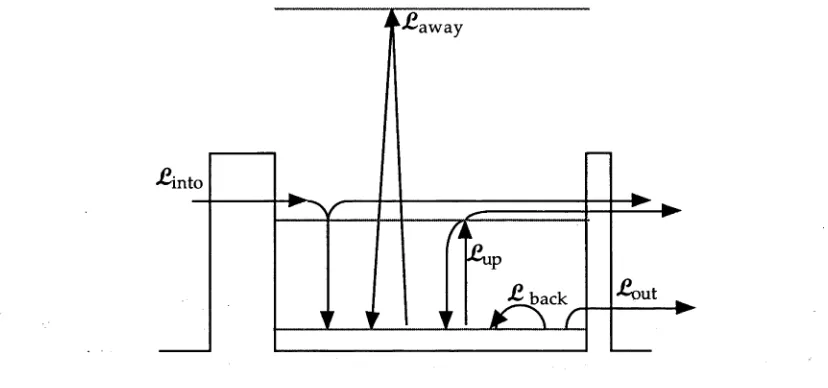
![Figure 1.8: Schematic diagram of the model of Zhang et al.et al (Reproduced from Zhang [32]).](https://thumb-us.123doks.com/thumbv2/123dok_us/1878451.145085/46.529.79.484.114.452/figure-schematic-diagram-model-zhang-et-reproduced-zhang.webp)