Int. J. Electrochem. Sci., 10 (2015) 7941 - 7954
International Journal of
ELECTROCHEMICAL
SCIENCE
www.electrochemsci.org
The Fabrication of Multilayers of Conducting Polymers and Its
High Capacitance Performance
Electrode for Supercapacitor
Xiumei Ma1,§, Danhua Zhu1,§, Daize Mo1, Jian Hou2, Jingkun Xu1,*, Weiqiang Zhou 1,* 1
Jiangxi Key Laboratory of Organic Chemistry, Jiangxi Science and Technology Normal University, Nanchang 330013
2
State key laboratory for marine corrosion and protection, Luoyang ship material research institute, Qingdao, 266101, China
*
E-mail: [email protected]
§ Xiumei Ma and Weiqiang Zhou, These authors contributed equally to this work.
Received: 24 June 2015 / Accepted: 20 July 2015 / Published: 26 August 2015
In this work, 3-layered PEDOT/PBEDOT-BT/PEDOT electrode processed by alternated layers of poly(3,4-ethylenedioxythiophene) (PEDOT) and poly[5,5'-bis(2,3-dihydrothieno[3,4-b][1,4]dioxin-5-yl)-2,2'-bithiophene](PBEDOT-BT) were prepared by electrochemical layer-by-layer deposition. The electrochemical and structural properties and the capacitive properties of it were investigated through the methods of scanning electron microscopy, atomic force microscopy, galvanostatical charge-discharge, cyclic voltammetry and electrochemical impedance spectroscopy techniques. In all cases, the capacitive properties of 3-layered PEDOT/PBEDOT-BT/PEDOT systems were better than those of individual conducting polymers (PEDOT or PBEDOT-BT), which may be caused by the synergistic effects at the interfaces between consecutive layers and the higher porosity of the 3-layered materials. Furthermore, 3-layered PEDOT/PBEDOT-BT/PEDOT electrode has been used to fabricate a symmetric supercapacitor (assembled by two identical electrodes), which showed a high specific capacitance (97 F g-1) and an excellent specific energy (260 Wh kg-1).
Keywords: Supercapacitors, Poly(3,4-ethylenedioxythiophene), Conducting polymers, Multilayer, Electrodeposition
1. INTRODUCTION
materials, namely carbon materials, conducting polymers (ECPs), transition metal oxides and hydroxides, and their compounds [6].
ECPs, such as polyaniline (PANI), polypyrrole (PPy), polythiophene (PTh) and their derivatives [7], as promising electroactive materials for supercapacitor, have been extensively studied by many researchers. Among them, poly (3,4-ethylenedioxythiophene) (PEDOT) was an excellent ECPs electrode material because of chemical stability and good thermal performance, high electrical conductivity (up to 550 S cm-1), lower toxicity, fast electrochemical switching, and especially wider potential window (> 2.0 V) [8-11]. However, PEDOT presented a moderate value of theoretical specific capacitance (210 F g-1) compared to PANI (750 F g-1) and PPy (620 F g-1) [9] because of its relatively high molar mass. In order to reach their theoretical specific capacitance, the ECPs composites with nanostructure carbon materials or metal oxides, novel dopant schemes, microstructure modification of ECPs, and developing asymmetric devices were developed in the past research [12-16].
On the other hand, electrochemical layer-by-layer (LbL) technique used to prepare bilayers or multilayer made of two or more different ECPs through electrodeposition techiniques was developed. In this methodology, individual anodic polymerization processes was used to prepare films formed by different layers and as-prepared ECPs/ECPs composite shown some interesting properties when compared with the individual ECPs homopolymers, such as highly porous structure, high specific capacitance, and good cycleability [17-20]. Xu et al [21] prepared PEDOT/PPy composite electrode by electropolymerization PEDOT on the surface of PPy, which shown much higher specific capacitance (> 200 F g-1) than the values of either pure PEDOT or PPy electrode due to the synergic effect of PEDOT and PPy. Moreover, David Aradilla and co-workers [19] recently reported a multilayered conducting systems that alternate PEDOT and poly(N-methylpyrrole) (PNMPy), the multilayer showed better electrochemical performance and a excellent ability to store charge than each of the two individual ECPs. This improvement was attributed to both the synergistic effects at the interfaces between consecutive layers and the higher porosity of the prepared multilayered materials. Later, they also fabricated symmetric supercapacitors that based on three-layered ml-PEDOT/PNMPy supercapacitor and the specific capacitance of this supercapacitor not only significantly higher than that of the PEDOT but also similar to the advanced ultracapacitors reported in the literature [18]. In addtion, the researchers also perpared other multisystems and bilayers, include ml-PEDOT/PPy [17], ml-PEDOT/poly(N-cyanoethylpyrrole) (PNCPy) [19], PPy/PNMPy [22], and PPy/PPy [23-24]. Poly[5,5'-bis(2,3-dihydrothieno[3,4-b][1,4]dioxin-5-yl)-2,2'-bithiophene](PBEDOT-BT) (Scheme 1) [25], a PEDOT based copolymers, showed higher specific capacitance values (171 F g-1 at 1 A g-1) than PEDOT and excellent stability. Based on the above results, we fabricated multilayer systems based on PEDOT and PBEDOT-BT to acheieve better capacitance performances of the corresponding supercapacitor electrodes.
BT/PEDOT electrodes were tested by galvanostatical charge-discharge, cyclic voltammetry (CV) and electrochemical impedance spectroscopy (EIS) techniques. In addition, the morphology of the electrodes were also minutely studied by using scanning electron microscopy (SEM), cross-section SEM micrographs, and atomic force microscopy (AFM).
Scheme 1. The structure of PBEDOT-BT and PEDOT.
Scheme 2. Scheme of the supercapacitors assembled with two identical electrodes of 3-layered PEDOT/PBEDOT-BT/PEDOT deposited on indium tin oxide (ITO) films.
2. EXPERIMENTAL 2.1 Materials
(Bu4NPF6) were purchased from Energy Chemical (Shanghai, China) and used as received. Acetonitrile (CH3CN, > 99%, Beijing East Longshun Chemical Plant) and dichloromethane (CH2Cl2) was purified by distillation with calcium hydride under a nitrogen atmosphere before use.
2.2 Materials Characterization
The surface morphologies images and cross-section SEM micrographs of the polymers were attained on a JEOL JSM-6700F microscope operated at 5 kV. The AFM measurements were conducted on a NanoScope IIIa MultiMode in contact mode at room temperature under ambient conditions with commercially available etched silicon nitride probes. The root-mean-square roughness was tested by the statistical application of the Nanoscope software, which evaluates the average considering all the values recorded in the topographic image with exception of the maximum and the minimum.
2.3 The preparation of the polymer films
In this work, the potentiostatic method was employed to prepare polymer film at suitable electrode potential on indium tin oxide (ITO) substrate in a one-compartment cell with a CHI 660B potentiostat/galvanostat (Shanghai Chenhua Instrumental Co., Ltd. China). The electrolyte solution was 5 mL CH3CN containing 10 mM m L-1 monomer and 0.1 M L-1 Bu4NPF6. PEDOT and PBEDOT-BT films were prepared at a constant potential of 1.4 V and 0.7 V vs. Ag/AgCl, respectively. The polymerization time used to produce individual PEDOT films was 30 s. The electrochemical LbL technique was used to prepare the 3-layered PEDOT/PBEDOT-BT/PEDOT films. The working electrode was immersed for a period of 10 s to prepare the each layer. The total polymerization time, 3 ×10 s = 30 s, was identical to that of individual PEDOT films. All the electrochemistry experiments were operated in a three electrode cell at room temperature. Indium tin oxide (ITO) and platinum wire (1.0 mm diameter) were used as the work electrode and the counter electrode, respectively. An Ag/AgCl electrode was used as the reference electrode. After polymerization, the working electrode was washed thoroughly with CH2Cl2 to remove any residue, and then dried under the air for further characterization.
2.4. Electrochemical Characterization
operated in the frequency range of 100 kHz to 0.01 Hz with an AC voltage amplitude of 5 mV, and an open circuit potential of 1.0 V (vs Ag/AgCl).
[image:5.596.71.527.198.531.2]3. RESULTS AND DISCUSSION 3.1 Structure Characterization
Figure 1. SEM images of PEDOT (A, B) and 3-layered PEDOT/PBEDOT-BT/PEDOT PBEDOT-BT-BO (C, D). Magnification: (A) and (C), 2000×, (B) and (D) 10,000×.
BT/PEDOT electrode creates efficient diffusion paths for electrolyte ions, which would significantly accelerate the intercalation of ions and enhance the utilization rate of electrode materials [26].
Figure 2. Cross-section SEM micrographs of the 3-layered PEDOT/PBEDOT-BT/PEDOT film. Magnification: (A) 20000×, (B) 50000×.
Figure 2 A&B presents the high resolution micrographs of the cross-section of a 3-layered PEDOT/PBEDOT-BT/PEDOT film, which allows the visual identification of alternated layers of PEDOT and PBEDOT-BT. The cross-section image of it also proves to be the porous structure of the 3-layered PEDOT/PBEDOT-BT/PEDOT electrode.
Figure 3. Height AFM images of 3-layered PEDOT/PBEDOT-BT/PEDOT (a) and PEDOT (b).
[image:6.596.61.545.124.307.2] [image:6.596.60.547.472.652.2]
electrode, respectively. These values confirm that the intermediate PBEDOT-BT layer increases the roughness of the external PEDOT layer. Above all, 3-layered PEDOT/PBEDOT-BT/PEDOT presents both increased and enlarged pores than PEDOT films, explaining the different SC values determined for the two such systems.
3.2 Capacitance performances of the electrodes
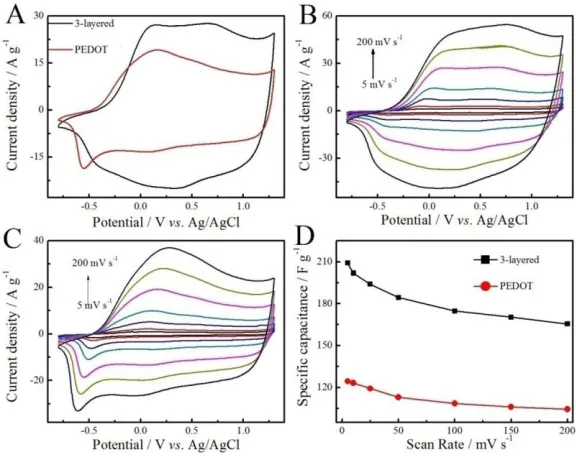
[image:7.596.154.442.193.421.2]Figure 4. (A) Cyclic voltammograms of 3-layered PEDOT/PBEDOT-BT/PEDOT and PEDOT electrodes at scan rate of 100 mV s-1; Cyclic voltammograms of 3-layered PEDOT/PBEDOT-BT/PEDOT (B) and PEDOT (C) electrodes in monomer-free CH3CN-Bu4NPF6 (0.1 M) at potential scan rates of 200, 150, 100, 50, 25, 10, and 5 mV s-1, and specific capacitance of the electrodes as a function of its scan rate (D).
Table 1. The specific capacitance of 3-layered PEDOT/PBEDOT-BT/PEDOT and PEDOT electrodes under different scan rate
Scan rate (mV s-1) 5 10 25 50 100 150 200
PEDOT/PBEDOT-BT/PEDOT (F g-1) 209 202 194 184 178 170 166
PEDOT (F g-1) 124 123 119 113 109 106 104
[image:7.596.75.525.572.636.2]
4A). The CV curve consisting of a couple of broad anodic and cathode peaks was very different from that of electric double layer capacitance whose CV curve is normally close to an ideal rectangular shape. This suggested that the charge capability of 3-layered PEDOT/PBEDOT-BT/PEDOT film is due to its ability to undergo electro-oxidation and electro-reduction [27]. The curves’ shape only slightly changed even at the high scan rate of 200 mV s-1, which resulted from the improved mass transportation within the electrode materials. With the scan rates increasing, gradually increasing current densities of the CV curves was observed and both the oxidation and the reduction peaks have a shift to more positive and negative potential, respectively, which was probably ascribed to the diffusion of PF6- ions. At low scan rates the PF6- ions diffuse more slowly, so the active materials can have a full reaction with PF6- ions and have a higher utilization ratio [28]. The peak current densities are in proportion to the potential scan rate, which indicates the reversible and not diffusion-limited electrochemical processes of the electrodes. The specific capacitances derived from CV tests can be obtained from the following Equation (1):
V mv
q q
C a c
s
2
In which Cs (F g-1), qa, qc, v (V s-1), m (g), and ΔV (V) are the specific capacitance, the sums of
anodic and cathodic voltammetric charges on the anodic and cathodic scans, the scan rate, the mass of the active material and the potential range of CV, respectively.
The calculated specific capacitances according to the CV curves at scan rates of 5-200 mVs-1 are presented in Figure 4D. From the CV curves in Figure 4B, the specific capacitances of the 3-layered PEDOT/PBEDOT-BT/PEDOT electrodes are calculated to be 209, 202, 194, 184, 175, 170 and 166 F g-1 at scan rates of 5, 10, 25, 50,100, 150 and 200 mV s-1. The specific capacitance of the 3-layered PEDOT/PBEDOT-BT/PEDOT electrode can reach 209 F g-1 and PEDOT electrode can reach 124 F g-1 at 5 mV s-1. Even though the specific capacitance of the 3-layered PEDOT/PBEDOT-BT/PEDOT electrode decreases with the scan rate increasing, the specific capacitance still has an ideal value. The observed decrease can be explained based on the ion-exchange mechanism. It will take enough time for PF6- to transfer between the solution and the surface of the electrode material to allow intercalation/extraction into/out of the electrodes when charging/discharging. When at low scan rate, such as 5 mVs-1, PF6- has enough time to transfer and there is much more charge transferred than that at a high scan rate; thus more charge can be stored, resulting in higher specific capacitance [29]. As stated above, the 3-layered PEDOT/PBEDOT-BT/PEDOT electrode in Bu4NPF6 (0.1 M)/CH3CN electrolytes clearly has excellent electrochemical capacitive performance, even at a high scan rate.
[image:9.596.116.485.72.357.2]
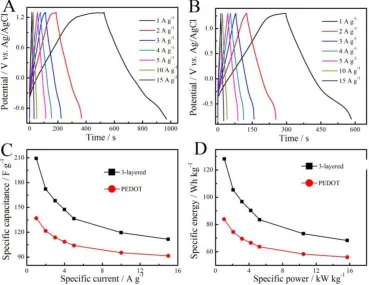
Figure 5. Galvanostatic charge/discharge curves of 3-layered PEDOT/PBEDOT-BT/PEDOT (A) and PEDOT (B) in CH3CNsolution containing 0.1 M Bu4NPF6 at different current density; (C) Specific capacitance of the electrodes as a function of current density; (D) Specific power as a function of specific energy
Table 2. The specific capacitance of 3-layered PEDOT/PBEDOT-BT/PEDOT and PEDOT electrodes under different current densities
Specific current (A g-1) 1 2 3 4 5 10 15
PEDOT/PBEDOT-BT/PEDOT (F g-1) 209 172 158 147 136 120 111
PEDOT (F g-1) 136 122 114 109 104 95 91
The specific capacitance (C) obtained from galvanostatic charge/discharge method was calculated according to the equation as follows (4):
V m
t I C
the same conditions. From these results, we can concluded that the specific capacitance of the 3-layered PEDOT/PBEDOT-BT/PEDOT electrode is significantly better than many other traditional conducting polymers, such as PTh (117 F g-1) [30], PPy (186 F g-1) [31], PANI (216 F g-1) [32], and polyselenophene (PSe) (72.2 F g-1) [33]. Such good rate capability in the 3-layered PEDOT/PBEDOT-BT/PEDOT electrode can be ascribed to the reduced diffusion path of ions and the highly accessible surface area for the porous nanowires structure.
Specific energy and specific power are also two significant parameters to evaluate the power application of supercapacitor. An excellent supercapacitor should provide high energy density and high specific capacitance at high charging-discharging rates (current densities). Specific energy (E in Wh kg-1) and specific power (P in W kg-1) derived from galvanostatic charge/discharge tests can be calculated from Equations (3) and (4), respectively:
2
2 1
V C
E (3)
t E P
(4)
in which C (F g-1), ΔV (V), and Δt (s) are the specific capacitance, the potential range of the charge/discharge, and discharge time, respectively. Figure 5D is the plots of estimates of specific energy and specific power for the 3-layered PEDOT/PBEDOT-BT/PEDOT electrode in the electrolyte. While the specific power increases as the current increased from 1 to 15 A g-1, the specific energy decreases. The 3-layered PEDOT/PBEDOT-BT/PEDOT electrode shows a high specific energy and specific power. The specific energy of the 3-layered PEDOT/PBEDOT-BT/PEDOT electrode decreases from 36 to 23 Wh kg-1, while the specific power increases from 115 to 1160 kW kg-1. For comparison, the PEDOT electrode shows a small specific energy (from 17 to 10 Wh kg-1) and corresponding specific power (from 119 to 1313 kW kg-1) values.
[image:10.596.169.427.498.690.2]
These results indicated the high specific power and specific density of the 3-layered PEDOT/PBEDOT-BT/PEDOT electrode, and this electrode may have potential application in the field of supercapacitor.
[image:11.596.172.424.454.641.2]EIS is a good method used to evaluate the electrochemical performance of the electrodes. Figure 6 shows the Nyquist plots of the EIS spectra of the electrodes. The two impedance curves show a semicircle in the high frequency region and a nearly vertical straight line in the low frequency region, suggesting that the electrode process is dominated by charge transfer and charge diffusion, respectively [34]. The bulk solution resistance Rs, which can be used to evaluate the resistance associated with the
transports within the porous structures and charge-transfer resistance Rct was obtained from the
Nyquist plots, where the high frequency semicircle intercepts the real axis at Rs and (Rs+Rct). The
solution resistance Rs of 3-layerer/ITO PEDOT/PBEDOT-BT/PEDOT electrode and PEDOT electrode was tested to be 50.0 Ω and 65.3 Ω, respectively. These low resistances may result from the porosity of the two systems, which benefit the access and escape of dopant anions into the inner polymer. In addition, the higher porosity of 3-layered PEDOT/PBEDOT-BT/PEDOT electrode is consistent with its lower resistance. The charge-transfer resistance Rct was evaluated to be 2.5 Ω for 3-layer/ITO PEDOT/PBEDOT-BT/PEDOT electrode and 4.6 Ω for PEDOT, respectively. These low values should result from the porous structure of the two materials, which increases the kinetic of electron transfer through redox processes. As Rct, which is also called Faraday resistance, is a limiting factor for the
specific power and the low Faraday resistance would lead to high specific power. The data from EIS spectra clearly demonstrate the 3-layered PEDOT/PBEDOT-BT/PEDOT electrode has slightly better capacitance behavior compared to PEDOT electrode.
Figure 7. Cycle life of 3-layered PEDOT/PBEDOT-BT/PEDOT and PEDOT electrode in CH3 CN-Bu4NPF6 solution.
number of the 3-layered PEDOT/PBEDOT-BT/PEDOT materials in Bu4NPF6 (0.1 M)/CH3CN electrolytes are shown in Figure 7. The stability of the 3-layered PEDOT/PBEDOT-BT/PEDOT electrode was not very competitive. The 3-layered PEDOT/PBEDOT-BT/PEDOT electrode shows relative poor specific capacitance retention at scan rate of 150 mV s-1. After the initial 200 cycles, the 3-layered PEDOT/PBEDOT-BT/PEDOT electrode maintains 44.2% retention (28% for PEDOT electrodes) of its initial value. The obvious degradation in the specific capacitance of the 3-layered PEDOT/PBEDOT-BT/PEDOT electrode possibly results from the broad work potential window of the electrodes (The electrochemical stability of each ECP is strictly effected by its working potential range and/or polymer degradation caused by overoxidation [37]).
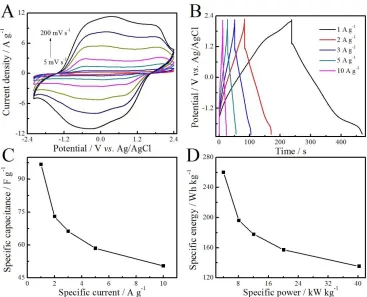
Figure 8. (A) CV curves and (B) galvanostatic charge/discharge curves of the self-assembled supercapacitor based on two identical 3-layered PEDOT/PBEDOT-BT/PEDOT electrodes, (C) Specific capacitance as a function of specific current of the symmetric supercapacitor, (D) Specific energy as a function of specific power.
[image:12.596.115.482.249.546.2]
the cell. The SC calculated for the assembled supercapacitor with two identical 3-layered PEDOT/PBEDOT-BT/PEDOT electrodes (97 F g-1) is significantly higher (∼123%) than that obtained for the supercapacitor based on two identical PEDOT electrodes. the SC values obtained for 3-layered PEDOT/PBEDOT-BT/PEDOT supercapacitor is only ∼9% lower than those measured for chemically modified graphene ultracapacitors (∼99 F/g) under similar experimental conditions [38].
4. CONCLUSIONS
In summary, a facile LbL electrodeposition technique was employed to fabricate porous 3-layered PEDOT/PBEDOT-BT/PEDOT electrode, and the potential applications in supercapacitors of the prepared electrode was explored in detail. The 3-layered PEDOT/PBEDOT-BT/PEDOT electrode exhibits higher specific capacitances with 209 F g-1 at 1 A g-1 and better cyclic ability. The outstanding performance comes from both the higher porosity and the synergistic effects at the interfaces between consecutive layers of the 3-layered film. A symmetric supercapacitor (SC) based on it shown a relatively high specific capacitance (97 F g-1) and a high specific energy value of 260 Wh kg-1. Therefore, the novel 3-layerd PEDOT/PBEDOT-BT/PEDOT is expected to be a promising electrode material for supercapacitors.
ACKNOWLEDGEMENTS
This work was supported by the Jiangxi Provincial Department of Education for postgraduate (YC2014-S435), National Natural Science Foundation of China (grant number: 51463008), Natural Science Foundation of Jiangxi Province (grant number: 20142BAB216029)
References
1. L.L. Zhang, X.S. Zhao, Chem. Soc. Rev., 38 (2009) 2520-2531. 2. P. Simon, Y. Gogotsi, Nat. Mater., 7(2008) 845-854.
3. J.R. Miller, P. Simon, Science, 321 (2008) 651-652
4. A.S. Adekunle, B.O. Agboola, K.I. Ozoemena, E.E. Ebenso, J.A.O. Oyekunle, O.S. Oluwatobi, J.N. Lekitima, Int. J. Electrochem. Sci., 10 (2015) 3414-3430
5. K.J. Sun, H.P. Wang, H. Peng, Y.J. Wu, G.F. Ma, Z.Q. Lei, Int. J. Electrochem. Sci., 10 (2015) 2000-2013
6. Y. Zhang, H. Feng, X.B. Wu, L.Z. Wang, A.Q. Zhang, T.C. Xia, H.C. Dong, X.F. Li, L.S. Zhang, Int. J. Hydrogen. Energ., 34 (2009) 4889-4899.
7. C. Peng, S.W. Zhang, D. Jewell, G.Z. Chen, Prog. Nat. Sci., 18 (2008)777-788. 8. W.K. Li, J. Chen, J.J. Zhao, J.R. Zhang, J.J. Zhu, Mater Lett., 59 (2005) 800-803. 9. K. Lota, V. Khomenko, E. Frackowiak, J Phys Chem Solids., 65(2004)295-301. 10.A. Czardybon, M. Lapkowski, Synth. Met., 119 (2001) 161-162.
11.B.E. Conway, Conway in Electrochemical Supercapacitors, Kluwer, New York, 1999. 12.G.P. Pandey, A.C. Rastogi, C.R. Westgate, J. Power. Sources, 245 (2014)857-865. 13.B. Babakhani, D.G. Ivey, Electrochim. Acta., 55 (2010) 4014-4024.
16.M. Wilamowska, A. Lisowska-Oleksiak, J. Power. Sources, 194 (2009) 112-117.
17.D. Aradilla, M. M. Pérez-Madrigal, F. Estrany, D. Azambuja, J. I. Iribarren, C. Alemán, Org. Electron., 14 (2013) 1483-1495.
18.D. Aradilla, F. Estrany, C. Aleman, J. Phys. Chem. C., 115 (2011) 8430-8438. 19.D. Aradilla, F. Estrany, R. Oliver, C. Alemán, Eur. Polym. J., 46 (2010) 2222-2228.
20.F. Estrany, D. Aradilla, R. Oliver, E. Armelin, C. Alema, Eur. Polym. J., 44 (2008) 1323-1330. 21.J.Wang, Y. L. Xu, X.Chen, X.F. Du, J. Power. Sources, 163 (2007) 1120-1125.
22.A.Wodja., K. Maksymiuk, J. Electroanal. Chem., 424 (1997) 93-99. 23.A. Kepas., M. Grzeszczuk, J. Electroanal. Chem., 582 (2005) 209-220.
24.M. Grzeszczuk, J. Kalenik, A. Kepas-Suwaran, J Electroanal Chem., 626 (2009) 47-58.
25.D.Z. Mo, W.Q. Zhou, X.M. Ma, J.K. Xu, D.H. Zhu, B.Y. Lu, Electrochim. Acta, 132 (2014) 67-74. 26.X.M. Ma, W.Q. Zhou, D.Z. Mo, Z.P. Wang, J.K. Xu, Synth. Met., 203 (2015) 98-106.
27.D.Z. Mo, W.Q. Zhou, X.M. Ma, J.K. Xu, Electrochim. Acta, 155 (2015) 29-37.
28.Y.L. Xiao, Y. Lei, B.Z. Zheng, L. Gu, Y.Y. Wang, D. Xiao, RSC Adv., 5 (2015) 21604-21613. 29.H. Pang, C.Z. Wei, Y.H. Ma, S.S. Zhao, G.C. Li, J.S. Zhang, J. Chen, S.J. Li, Chem. Plus. Chem.,
78 (2013) 546-553.
30.B. Senthilkumar, P. Thenamirtham, R.K. Selvan, Appl. Surf. Sci., 257 (2011) 9063-9067. 31.J. Wang, Y.L. Xu, X. Chen, X.F. Sun, Compos. Sci. Technol., 67 (2007) 2981-2985. 32.Y.E. Miao, W. Fan, D. Chen, T.X. Liu, ACS Appl. Mater. Interfaces 5 (2013) 4423-4428. 33.J.W. Park, S.J. Park, O.S. Kwon, C. Le, J. Jang, Chem. Mater., 26 (2014) 2354-2360. 34.N. Li, D. Shan, H. Xue, Eur. Polym. J., 43 (2007) 2532-2539.
35.Y. Xiao, C. Long, M.T. Zheng, H.W. Dong, B.F. Lei, H.R. Zhang, Y.L. Liu, Chinese Chem. Lett., 25 (2014) 865-868.
36.M.J. Shi, S.Z. Kou, B.S Shen, J.W. Lang, Z. Yang, X.B. Yan, Chinese Chem. Lett., 25 (2014) 859– 864.
37.T. Kobayashi, H.Yoneyamal, H. Tamura, J. Electroanal. Chem., 177 (1984) 281-291. 38.M.D. Stoller, S. Park, Y. Zhu, J. Na, R.S. Ruoff, Nano. Lett., 8 (2008) 3498-3502.