Int. J. Electrochem. Sci., 7 (2012) 1908 - 1916
International Journal of
ELECTROCHEMICAL
SCIENCE
www.electrochemsci.org
Dichromate Ion-selective Sensor Based on Functionalized
SBA-15/ Ionic Liquid/MWCNTs/Graphite
M. R. Ganjali1,*, Z. Rafiei-Sarmazdeh,1 T. Poursaberi,2 S. J. Shahtaheri,3 P. Norouzi,1 1
Center of Excellence in Electrochemistry, University of Tehran, Tehran, Iran 2
Research Institute of Petroleum Industry, Tehran, Iran 3
Department of Occupational Health, School of Public Health, Tehran University of Medical Sciences, Tehran, Iran
*
E-mail: [email protected]
Received: 27 January 2012 / Accepted: 17 February 2012 / Published: 1 March 2012
SBA-15 channels was modified by aluminum complex of 8-hydroxyquinoline. The new synthesized nano-material had a selective interaction with dichromate ions which was studied by fluorescence spectroscopy. A new modified SBA-15 was then used in making a new dichromate nano-composite carbon paste electrode. Since carbon paste electrode based on MWCNTs and RTILs show better performance in comparison with traditional carbon paste electrodes, the electrode was composed of 5% Multi-walled Carbon Nanotube (MWCNT), 55% graphite powder, 20% room temperature ionic liquid (RTIL) and 20% modified SBA-15. MWCNT in the composition of the paste improve the dynamic working range, detection limit, response time, lifetime, and stability of the nano-composite sensor due to its high conductivity. Replacement of paraffin oil with RTIL improved the sensitivity of the sensor from a near-Nernstian slope to Nernstian one. The sensor worked well with a Nernstian response of -28.6±0.3 mV decade-1 of Cr2O72- anion in a wide dynamic concentration range of 1.0× 10⁻⁶-1.0×10⁻¹ M. The electrode had relatively short response time (about 23 s), and it was found to produce stable responses for more than 8 weeks.
Keywords: Potentiometry, Dichromate, Sensor, Ion selective electrode, Room temperature ionic liquid, Multi-walledCarbon Nanotube
1. INTRODUCTION
adhesion. Chromate and dichromate salts of heavy metals, lanthanides and alkaline earth metals are only very slightly soluble in water and are thus used as pigments. The lead containing pigment Chrome Yellow was used for a very long time before environmental regulations discouraged its use [2]. When used as oxidizing agents or titrants in a redox chemical reaction, chromates and dichromate convert into trivalent chromium, Cr(III), salts of which typically have a distinctively different blue-green color. Techniques used in determination both forms of chromium include spectrophotometry [3-5], spectrofluorimetry [6], ion chromatography with atomic absorption spectrometry [7,8], differential pulse polarography [9], differential pulse voltammetry [10], and gas chromatography [11].
Potentiometry by ion selective electrodes are simple, low cost, accurate and rapid method which is the reason behind the increasing interest of their uses [12-24]. Carbon paste electrodes are a class of ion selective electrodes with a high physical stability, long lifetime, the versatility of chemical modification, miniaturization, and rapid renewal of the electrode surface [25-34].
[image:2.596.199.401.400.564.2]Large-scale nano-structured materials such as SBA-15 and MCM-41 have attracted significant interest in development of chemical sensors [35-37]. SBA-15, among the mesoporous silica compounds, possessing hexagonal arrays of uniform pores with ultra large pore diameters, large surface area, high pore volume and thicker pore walls, excellent homogeneity and chemical/mechanical stability is a potential candidate for interacting with guest species on its surface [38,39].
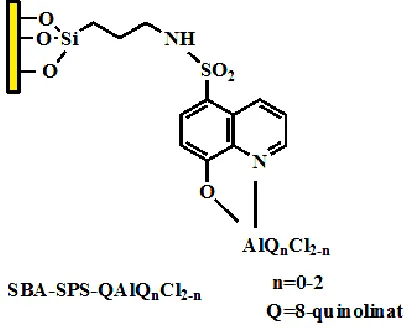
Figure 1. Chemical structure of modified SBA-15
Carbon paste electrode based on MWCNTs and RTILs types of electrodes show superior performance over traditional carbon paste electrodes.
Multi-walled carbon nanotubes (MWCNTs) have been also used in the compositions of carbon paste electrodes [26-34] due to their surprising physicochemical properties, such as ordered structures with high aspect ratios, ultra-light weight, high thermal conductivity, metallic or semi-metallic behavior, high surface area, high electrical conductivity and remarkable mechanical strength [40, 41].
temperature, ion-exchange properties, extraction and catalytic activity, high ionic conductivity and good electrochemical and thermal stability [33,34].
Previous fluorescent study [42] showed a selective interaction between the modified SBA-15 (Scheme 1) and dichromate anion in comparison with a number of common anions. The nano-material was then applied as a suitable sensing material in construction of a Cr2O72- nano-composite carbon paste sensor. The structure of the modified SBA-15 has been shown in Fig. 1.
2. EXPERIMENTAL SECTION
2.1. Apparatus
A Corning ion analyzer 250 pH/mV meter was used for the potential measurements at 25.0±0.1 °C. A glass cell where the carbon paste electrode was used consisting of an R684 model Analion Ag/AgCl double junction electrode as a reference electrode.
2.2. Reagents and Materials
The multi-walled carbon nanotubes (MWCNTs) with 10-40 nm diameters, 1-25 μm length, core diameter: 5-10 nm, SBET: 40-600 m2/g, Vtotal: 0.9 cm3/g, bulk density 0.1 g/cm3, true density 2.1 g/cm3 and with 95% purity were purchased from a local company (Iran). Graphite powder with a <50 μm particle size (Merck), and 2.2 g/cm3
density; along with the paraffin oil (Aldrich) of the highest purity, and 1-n-butyl-3-methylimidazolium tetrafluoroborate [bmim]BF4, were used for the preparation of the carbon pastes. The sensing element, modified SBA-15, was synthesized as described elsewhere [42].
2.3. Carbon Paste electrode
Various amounts of modified SBA-15, graphite powder, paraffin (in case of traditional carbon paste) and 1-n-butyl-3-methylimidazolium tetrafluoroborate [bmim]BF4, and MWCNTs (in case of nano-composite sensor) were thoroughly mixed. The resulting mixtures were transferred into a glass tube. The electrode body was fabricated from a glass tube of 5 mm i.d. and a height of 3 cm. After the mixture was homogenized, the paste was carefully packed into the tube tip to avoid possible air gaps, often enhancing the electrode resistance. A copper wire was inserted into the opposite end to establish electrical contact [26-34]. The external electrode surface was smoothed with soft abrasive paper to produce a new surface and replacing the carbon paste. The electrode was finally conditioned for 48 h by soaking in a 1.0×10⁻³
M dichromate solution.
2.4. Emf measurements
Ag, AgCl(s), KCl (3 M) || sample solution | nano-composite carbon paste surface | copper wire Calibration graph was drawn by plotting the potential, E, versus the logarithm of dichromate ion concentration.
3. RESULTS AND DISCUSSIONS
Mesoporous silica is a form of silica which is recently used widely in nanotechnology. The most common types of mesoporous nanoparticles are MCM-41 and 15. Mesoporous silica SBA-15 possesses large pore size, uniform channel and large surface area. Hence, they are an excellent carrier in construction of chemosensors. The selectivity behavior of a certain chemosensor is greatly dependant on the sensing materials used in its structure [43-49]. The straight channel of SBA-15 is beneficial for facilitating the entering and diffusion of the target ions. In this work, the channels of SBA-15 was modified by aluminum complex of 8-hydroxyquinoline. Due to the affinity of the modified SBA-15 toward dichromate ion according to the previous fluorescence studies [42], it was used as a suitable sensing element in construction of a number of potentiometric electrodes with different composition and modification. Also, it was found that a stable complex having a certain stoichiometric ratio between the receptor (modified SBA-15) and Cr2O72- was formed.
3.1. Electrode composition and modification
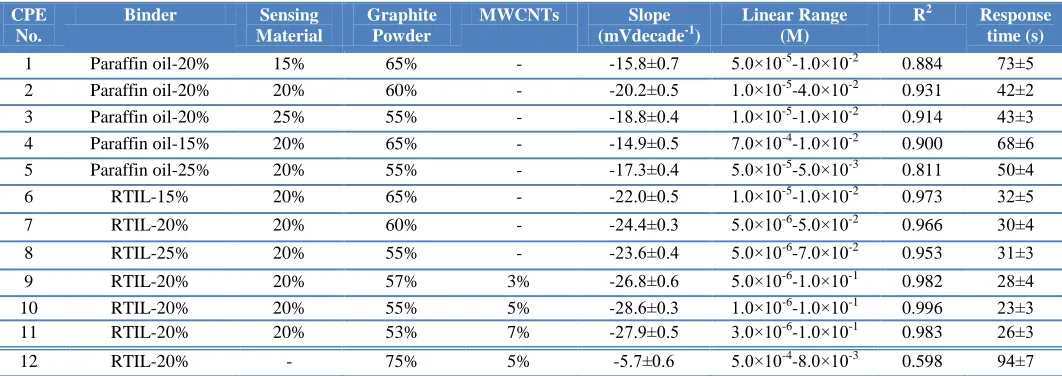
[image:4.596.34.565.568.756.2]To find the best performance of the electrode, different compositions were made according to Table 1. As it can be seen, paste composition no. 2 revealed that the optimum amount of modified SBA-15 should be 20%. In this case the traditional carbon paste electrode showed a near Nernstian slope of about -21.5 mV decade-1 in the absence of any modifier.
Table 1. The optimization of the carbon paste ingredients CPE
No.
Binder Sensing Material
Graphite Powder
MWCNTs Slope (mVdecade-1)
Linear Range (M)
R2 Response
time (s)
1 Paraffin oil-20% 15% 65% - -15.8±0.7 5.0×10⁻⁵-1.0×10⁻² 0.884 73±5
2 Paraffin oil-20% 20% 60% - -20.2±0.5 1.0×10⁻⁵-4.0×10⁻² 0.931 42±2
3 Paraffin oil-20% 25% 55% - -18.8±0.4 1.0×10⁻⁵-1.0×10⁻² 0.914 43±3
4 Paraffin oil-15% 20% 65% - -14.9±0.5 7.0×10⁻⁴-1.0×10⁻² 0.900 68±6
5 Paraffin oil-25% 20% 55% - -17.3±0.4 5.0×10⁻⁵-5.0×10⁻³ 0.811 50±4
6 RTIL-15% 20% 65% - -22.0±0.5 1.0×10⁻⁵-1.0×10⁻² 0.973 32±5
7 RTIL-20% 20% 60% - -24.4±0.3 5.0×10⁻⁶-5.0×10⁻² 0.966 30±4
8 RTIL-25% 20% 55% - -23.6±0.4 5.0×10⁻⁶-7.0×10⁻² 0.953 31±3
9 RTIL-20% 20% 57% 3% -26.8±0.6 5.0×10⁻⁶-1.0×10⁻¹ 0.982 28±4
10 RTIL-20% 20% 55% 5% -28.6±0.3 1.0×10⁻⁶-1.0×10⁻¹ 0.996 23±3
11 RTIL-20% 20% 53% 7% -27.9±0.5 3.0×10⁻⁶-1.0×10⁻¹ 0.983 26±3
Changing paraffin oil, which is an organic binder, with RTIL, improved the sensitivity of the sensor to a near-Nernstian slope (no. 7). Enhancement of the electrochemical behavior of RTIL based electrodes can be related to its enhanced conductivity. Because of the good solubility and high viscosity, the IL can form a layer on the carbon particles and can fill in the empty spaces between carbon particles, so the conductivity of the IL-based electrodes was greatly enhanced compared to the traditional CPE. Also, RTIL can be a better solvent and extract the analyte from the solution to the electrode surface. High conductivity of MWCNT increases the dynamic working range and response time of the sensor. Addition of 5% of MWCNT to the composition was found to increase the response to a Nernstian slope of about -58.3 mV decade-1 (no. 10).
Consequently, the composition containing 20% modified SBA-15, 5% MWCNT, 20% RTIL and 55% graphite showed the best performance with Nernstian slope of -28.6 mV decade-1 (no. 10). According to Table 1, the electrode having the best composition but absent the sensing element (no.12) showed too low potential response.
3.2. Calibration curve
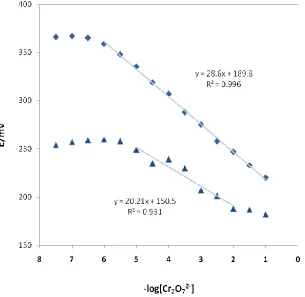
Figure 2. The calibration curves of the Cr2O72- carbon paste sensors (traditional electrode no. 2 and nano-composite electrode no. 10)
[image:5.596.150.455.346.643.2]
range of the modified electrode as shown in Fig. 2 was found to be between 1.0×10⁻⁶-1.0×10⁻¹ M. By extrapolating the linear parts of the ion selective calibration curve, the detection limit of an ion selective electrode can be calculated. In this work the detection limit of the sensor is calculated 1.0× 10⁻⁶ M which was obtained by the extrapolating of the two segment of the calibration curve in Fig. 2.
3.3. pH effect study
In order to investigate the effect of pH on the potential response of the sensor, the potentials were measured at a fixed concentration of dichromate ion (1.0×10⁻⁴ M and 1.0×10⁻³ M) having different pH values. The pH was altered from 2-10 by adding HCl or NaOH. The electrode works satisfactorily in the pH of 4, and no interference from H+ or OH– is observed. In the acidic pH the dichromate ion species is dominant to the other form of chromium according to the pH speciation program (Predominance diagram). The chromate ion is the predominant species in alkaline solutions, but dichromate can become the predominant ion in very acidic solutions. Thus, using sodium acetate/acetic acid buffer (0.1 M), the pH was adjusted to 4 in the experiments.
3.4. Dynamic response time
The response time of an ion-selective electrode is also an important factor for any analytical application. The average response time of the electrodes, defined as the required time for the electrodes to reach a cell potential of 90% of the final equilibrium values, after successive immersions in a series of solutions, each having a 10-fold concentration difference [43-50] was found to be 25±2 seconds. The resulting potential–time responses for the mentioned electrode were obtained by changing dichromate concentration from 0.000001 to 0.1 M (by fast injection of μL-amounts of a concentrated solution of K2Cr2O7). Results showed that the potentiometric response time of the electrode was about 23±3 s in whole concentration range.
3.5. Interference studies
The selectivity behavior, expressed as the relative response of the sensor to the primary ion over the other ions present in the solution. It is obviously one of the most important characteristics of a selective sensor. Potentiometric selectivity coefficients, describing the preference of the suggested electrode for an interfering ion, X, with reference to dichromate ion, were determined by the matched potential method (MPM) [51-55]. The MPM is recommended by IUPAC to overcome the difficulties associated with the methods based on the Nicolsky–Eisenman equation.
According to this method, the specified activity (concentration) of the primary ion is added to a reference solution (0.000001 M dichromate ion, in this case) and the potential is measured.
The matched potential method selectivity coefficient,
k
AMPM,X is then given by the resulting primary ion to the interfering ion activity (concentration) ratio,k
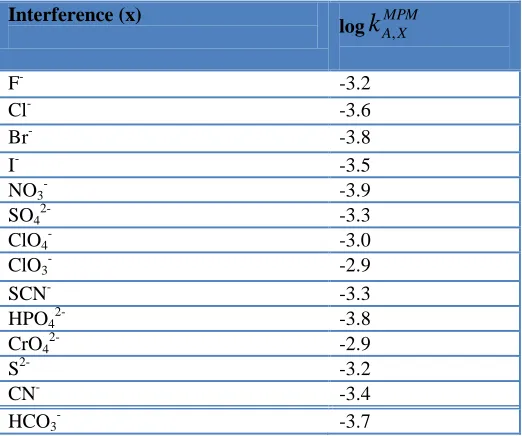
AMPM,X = ∆adichromate/aX. [image:7.596.169.430.261.479.2]The resulting values for dichromate nano-composite sensor are listed in Table 2. As it can be seen from Table 2, anions tested have not significance interfere in the monitoring of dichromate ion. Since the interaction between the modified SBA-15 with dichromate is a kind of anion coordination to the metal center of the modifier (Aluminum complex of 8-hydroxyquinoline), and not according to Hofmeister series (i.e. hydrophobicities of the anions).
Table 2. Selectivity coefficients of various interfering anions for the electrode no. 10
Interference (x)
logkAMPM,X
F- -3.2
Cl- -3.6
Br- -3.8
I- -3.5
NO3- -3.9
SO4
2--3.3
ClO4- -3.0
ClO3- -2.9
SCN- -3.3
HPO42- -3.8
CrO42- -2.9
S2- -3.2
CN- -3.4
HCO3- -3.7
3.6. Lifetime
Lifetime of the nano-composite electrode was studied by periodically recalibrating and using the electrode to measure its potentiometric response to dichromate ion in the standard solutions in a period of time. After the conditioning step the electrodes were repeatedly calibrated three times a day during a period of two months (the electrode worked one hour per day). Before eight weeks no significant change in the performance of the electrode was observed. This shows that the lifetime of the proposed electrode was about 8 weeks. After 8 weeks, the slope of the nano-composite sensor decreases from -28.3 to -16.8 mV per decade and the detection limit reduces from 1.0×10⁻⁶ M to 1.5×10⁻⁴ M.
4. CONCLUSION
was used as a selective sensing element in construction of a nano-composite carbon paste electrode and traditional carbon paste electrode for measurement of dichromate ions. Carbon paste electrode based on MWCNTs and RTILs show superior performance over traditional carbon paste electrodes. Adding MWCNT improve the dynamic working range, detection limit, response time, lifetime, and stability of the nano-composite sensor. Using RTIL instead of paraffin oil also improved the sensitivity of the sensor from a near-Nernstian slope to Nernstian one. The electrode based on modified SBA-15, MWCNT and RTIL exhibits linear response over a wide concentration range of 1.0× 10⁻⁶-1.0×10⁻¹ M with a Nernstian slope of -28.6±0.3 mV decade-1, and a short response time of 23±3 s.
References
1. D.E. Kimbrough, Y. Cohen, A.M. Winer, L. Creelman, and C.A. Mabuni, Crit. Rev. Env. Sci. Technol. 29 (1999) 1.
2. A. Gerd, H. Jost, H. Klaus, S. Christoph, K. Ulrich, K. Herbert, S. Peter, O. Manfred, "Chromium Compounds". Ullmann's Encyclopedia of Industrial Chemistry. Weinheim: Wiley-VCH, (2005). 3. J.C. de Andrade, J.C. Rocha and N. Baccdn, Analyst, 109 (1984) 645.
4. J.C. de Andrade. J.C. Rocha and N. Baccan. Analyst, 110 (1985) 197.
5. M.J. Arrabal. P.V. Gonzales, C.C. Gamer. A.S. Misiego and A.M. de la Pena, Analyst, 119 (1994) 1537.
6. V. Kabasakalis, Anal. Lett., 26 (1993) 2269. 7. K.S. Subramanian, Anal. Chem., 60 (1988) 11. 8. R.M. Milacic and J. Stupar. Analyst, 119 (1994) 627.
9. C. Harzdorf and G. Janser. Anal. Chim. Acta, 165 (1984) 201.
10.J. Golimowskr, P. Valenta and H.W. Nuernberg. Fresenius J. Anal. Chem., 322 (1985) 315. 11.H. Schaller and R. Neeb. Fresenius J. Anal. Chem., 327 (1987) 170.
12.M. R. Ganjali, M. Rezapour, M. R. Pourjavid, and S. Haghgoo, Anal. Sci., 20 (2004) 1007. 13.H. A. Zamani, M. R. Ganjali and M.J. Pooyamanesh, J. Brazil. Chem. Soc., 17 (2006) 149. 14.J. Koryta and K. Stulik, Ion Selective Electrodes, Cambridge University Press, Cambridge (1983) 15.M. R. Ganjali, M. Tahami, M. Shamsipur, T. Poursaberi, and S. Haghgoo, M. Hosseini,
Electroanalysis, 15 (2003) 1038.
16.M. R. Ganjali, P. Norouzi, F. S. Mirnaghi, S. Riahi and F. Faridbod, IEEE Sensors J., 7 (2007) 1138.
17.M.R. Ganjali, H.A. Zamani, P. Norouzi, M. Adib and M. Accedy, Acta Chim. Slov., 52 (2005) 309. 18.H. A. Zamani, G. Rajabzadeh and M. R. Ganjali, J. Brazil. Chem. Soc., 17 (2006) 1297.
19.F. Faridbod, M. R. Ganjali, R. Dinarvand, and P. Norouzi, Sensors, 8 (2008) 2331.
20.H. A. Zamani, G. Rajabzadeh, M. R. Ganjali and P. Norouzi, Anal. Chim. Acta, 598 (2007) 51. 21.A. S. Al Attas, Int. J. Electrochem. Sci., 4 (2009) 9.
22.H. A. Zamani, M. R. Ganjali, P. Norouzi, and S. Meghdadi, J. Appl. Electrochem., 37 (2007) 853. 23.V. K. Gupta, R. N. Goyal and R. A. Sharma, Int. J. Electrochem. Sci., 4 (2009) 156.
24.A. S. Al Attas, Int. J. Electrochem. Sci., 4 (2009) 20.
25.M. Javanbakht, A. Badiei, M. R. Ganjali, P. Norouzi, A. Hasheminasab and M. Abdouss, Anal. Chim. Acta, 601 (2007) 172.
26.F. Faridbod, M. R. Ganjali, B. Larijani, M. Hosseini, K. Alizadeh and P. Norouzi, Int. J. Electrochem. Sci, 4 (2009) 1528.
27.M. R. Ganjali, N. Motakef-Kazami, F. Faridbod, S. Khoee, P. Norouzi, J. Hazard. Mater. 173 (2010) 415.
29.M. R. Ganjali, H. Khoshsafar, A. Shirzadmehr, M. Javanbakht and F. Faridbod, Int. J. Electrochem. Sci., 4 (2009) 435
30.F. Faridbod, M. R. Ganjali, B. Larijani, M. Hosseini and P. Norouzi, Mater. Sci. Eng. C, 30 (2010) 555
31.H. Yaghoubian, H. Karimi-Maleh, M. A. Khalilzadeh and F. Karimi, Int. J. Electrochem. Sci. 4 (2009) 993.
32.H. J. Wang, C. M. Zhou, J. H. Liang, H. Yu, F. Peng and J. Yang, Int. J. Electrochem. Sci. 3 (2008) 1258.
33.M. R. Ganjali, S. Aghabalazadeh, M. Rezapour, M. Hosseini and P. Norouzi, Int. J. Electrochem. Sci., 5 (2010) 1743.
34.F. Faridbod, M. R. Ganjali, M. Pirali-Hamedan and P. Norouzi, Int. J. Electrochem. Sci., 5 (2010) 1103.
35.L. Mercier, and T.J. Pinnavaia, Adv. Mater. 9 (1997) 500.
36.R. Metivier, I. Leray, B. Lebeau, and B.J. Valeur, Mater. Chem. 15 (2005) 2965. 37.T. Balaji, M. Sasidharan, and H. Matsunaga, Anal. Bioanal. Chem. 384 (2006) 488. 38.J. Li, T. Qi, L. Wang, C. Liu, and Y. Zhang, Mater. Lett. 61 (2007) 3197.
39.J.N. Zhang, Z. Ma, J. Jiao, H.F. Yin, W.F. Yan, E.W. Hagaman, J.H. Yu, and S. Dai, Langmuir 25 (2009) 12541.
40.K. Kostarelos, L. Lacerda, G. Pastorin, W. Wu, S. Wieckowski, J. Luangsivilay, S. Godefroy, D. Pantarotto, J. P. Briand, S. Muller, M. Prato and A. Bianco, Nat. Nanotechnol., 2 (2007) 108. 41.M. R. Ganjali, S. Aghabalazadeh, M. Khoobi, A. Ramazani, A. Foroumadi, A. Shafiee and P.
Norouzi, Int. J. Electrochem. Sci., 6 (2011) 52.
42.M. Hosseini, V. K. Gupta, M. R. Ganjali, Z. Rafiei-Sarmazdeh, F. Faridbod, H. Goldooz, A. R. Badiei, P. Norouzi, Anal. Chim. Acta, 715 (2012) 80.
43.M. R. Ganjali, Z. Memari, F. Faridbod, R. Dinarvand and P. Norouzi, Electroanalysis, 20 (2008) 2663.
44.M. R. Ganjali, H. Ganjali, M. Hosseini, and P. Norouzi, Int. J. Electrochem. Sci., 5 (2010) 965. 45.A. K. Jain, V. K. Gupta, L. P. Singh, P. Srivastava and J. R. Raisoni, Talanta 65 (2005) 716. 46.V. K. Gupta, R. Jain, M.K. Pal, Int. J. Electrochem. Sci., 5 (2010) 1164.
47.F. Faridbod, M. R. Ganjali, B. Larijani, E. Nasli-Esfahani, S. Riahi, and P. Norouzi, Int. J. Electrochem. Sci., 5 (2010) 653.
48.M. R. Ganjali, A. Rouhollahi, A. R. Mardan, M. Hamzeloo, A. Moghimi, and M. Shamsipur, Michrochim. J., 60 (1998) 122.
49.M. R. Ganjali, T. Poursaberi, M. Hosseini, M. Salavati-Niasari, M. Yousefi, and M. Shamsipur, Anal. Sci., 18 (2002) 289.
50.M. R. Ganjali, S. Rasoolipour, M. Rezapour, P. Norouzi, A. Tajarodi, Y. Hanifehpour, Electroanalysis, 17 (2005) 1534.
51.M. R. Ganjali, T. Poursaberi, F. Basiripour, M. Salavati-Niasari, M. Yousefi, and M. Shamsipur, Fresenius J. Anal. Chem., 370 (2001) 1091.
52.M. R. Ganjali, R. Kiani-Anbouhi, M. Shamsipur, T. Poursaberi, M. Salavati-Niasari, Z. Talebpour, M. Emami, Electroanalysis 16 (2004) 1002.
53.H. Behmadi, H. A. Zamani, M. R. Ganjali, P. Norouzi, Electrochim. Acta, 53 (2007) 1870.
54.M. R. Ganjali, F. Aboufazeli, S. Riahi, R. Dinarvand, P. Norouzi, M. H. Ghasemi, R. Kiani-Anbuhi and S. Meftah, Int. J. Electrochem. Sci, 4 (2009) 1138.
55.M. R. Ganjali, R. Nemati, F. Faridbod, P. Norouzi, F. Darviche, Int. J. Electrochem. Sci, 3 (2008) 1288.