Efficient Algorithm s for Sorting and
Synchronization
A ndrew Tridgell
A thesis submitted for the degree of
Doctor of Philosophy at
The Australian National University
Except where otherwise indicated, this thesis is my own original work.
A cknow ledgm ents
The research that has gone into this thesis has been thoroughly enjoyable. That en joyment is largely a result of the interaction that I have had with my supervisors, col leagues and, in the case of rsync, the people who have tested and used the resulting software.
I feel very privileged to have worked with my supervisors, Richard Brent, Paul Mackerras and Brendan McKay. To each of them I owe a great debt of gratitude for their patience, inspiration and friendship. Richard, Paul and Brendan have taught me a great deal about the field of Computer Science by sharing with me the joy of discovery and investigation that is the heart of research.
I would also like to thank Bruce Millar and Iain Macleod, who supervised my initial research in automatic speech recognition. Through Bruce, Iain and the Com puter Sciences Laboratory I made the transition from physicist to computer scientist, turning my hobby into a career.
The Department of Computer Science and Computer Sciences Laboratory have provided an excellent environment for my research. I spent many enjoyable hours with department members and fellow students chatting about my latest crazy ideas over a cup of coffee. Without this rich environment 1 doubt that many of my ideas would have come to fruition.
The Australian Telecommunications and Electronics Research Board, the Com monwealth and the Australian National University were very generous in providing me with scholarship assistance.
Thanks also to my family who have been extremely understanding and support ive of my studies. I feel very lucky to have a family that shares my enthusiasm for academic pursuits.
Finally I'd like to thank my wonderful wife, Susan, who has encouraged me so much over the years. Many people told us that having two PhD students under the one roof is a recipe for disaster. Instead it has been fantastic.
Abstract
This thesis presents efficient algorithms for internal and external parallel sorting and remote data update. The sorting algorithms approach the problem by concentrat ing first on highly efficient but incorrect algorithms followed by a cleanup phase that completes the sort. The remote data update algorithm, rsync, operates by exchang ing block signature information followed by a simple hash search algorithm for block matching at arbitrary byte boundaries. The last chapter of the thesis examines a num ber of related algorithms for text compression, differencing and incremental backup.
C ontents
Acknowledgments iii
Abstract iv
Introduction 1
1 Internal Parallel Sorting 3
1.1 How fast can it g o ? ... 4
1.1.1 Divide and conquer ... 4
1.1.2 The parallel merging problem... 5
1.1.2.1 The two processor problem... 5
1.1.2.2 Extending to P processors ... 6
1.1.3 Almost s o r t i n g ... 7
1.1.4 Putting it all together... 8
1.2 Algorithm D etails... 8
1.2.1 Nomenclature... 8
1.2.2 Aims of the Algorithm... 9
1.2.3 Infinity Padding ... 10
1.2.4 Balancing ... 11
1.2.5 Perfect Balancing... 12
1.2.6 Serial S o rtin g ...13
1.2.7 Primary M e rg e ... 14
1.2.8 Merge-Exchange O peration... 15
1.2.9 Find-Exact A lg o rith m ... 16
1.2.10 Transferring E lem ents... 18
1.2.11 Unbalanced M erging... 18
Contents vi
1.2.13 C le a n u p ... 21
1.3 Performance... 22
1.3.1 Estimating the S p e e d u p ... 22
1.3.2 Timing R e s u lts ... 23
1.3.3 Scalability... 24
1.3.4 Where Does The Time Go? ... 26
1.3.5 CM5 vs AP1000 ... 27
1.3.6 Primary Merge Effectiveness... 29
1.3.7 Optimizations...30
1.4 Comparison with other algorithm s... 31
1.4.1 Thearling and S m ith ...31
1.4.2 Helman, Bader and J a J a ... 32
1.5 C onclusions... 33
2 External Parallel Sorting 34 2.1 Parallel Disk Systems...34
2.2 Designing an algorithm ... 35
2.2.1 Characterizing parallel s o rtin g ... 36
2.2.2 Lower Limits on I / O ...36
2.2.3 Overview of the algorithm ... 37
2.2.4 Partitioning... 37
2.2.5 Column and row sorting... 39
2.2.6 C om pletion... 40
2.2.7 Processor allocation ...41
2.2.8 Large k ... 41
2.2.9 Other partitionings... 42
2.3 Performance... 42
2.3.1 I/O Efficiency...45
2.3.2 Worst c a s e ... 45
2.3.3 First pass completion...46
2.4 Other Algorithm s... 46
Contents vii
3 The rsync algorithm 49
3.1 Inspiration... 49
3.2 Designing a remote update a lg o rith m ... 50
3.2.1 First attem pt... 51
3.2.2 A second t r y ... 51
3.2.3 Two sig n a tu re s...52
3.2.4 Selecting the strong signature... 53
3.2.5 Selecting the fast signature ...54
3.2.6 The signature search algorithm ... 55
3.2.7 Reconstructing the f i l e ... 58
3.3 Choosing the block size ... 58
3.3.1 Worst case o v e rh e a d ...59
3.4 The probability of failure... 60
3.4.1 The worst case ... 60
3.4.2 Adding a file signature... 61
3.5 Practical performance...62
3.5.1 Choosing the fo rm a t...63
3.5.2 S p e e d u p ... 64
3.5.3 Signature performance... 67
3.6 Sum m ary... 68
4 rsync enhancements and optimizations 69 4.1 Smaller signatures... 69
4.2 Better fast signature algorithm s... 70
4.2.1 Run-length encoding of the block match to k e n s ... 72
4.3 Stream compression... 73
4.4 Data transformations...75
4.4.1 Compressed f ile s ... 75
4.4.2 Compression r e s y n c ...76
4.4.3 Text transformation...77
4.5 Multiple files and pipelining...79
Contents viii
4.7 Summary... 81
5 Further applications for rsync 83 5.1 The xdelta alg o rith m ...83
5.2 The rzip compression algorithm... 85
5.2.1 Adding an ex p o n en t...86
5.2.2 Short range redundancies...87
5.2.3 Testing r z i p ... 89
5.3 Incremental backup system s...91
5.4 rsync in H T T P ...92
5.5 rsync in a network filesystem ... 93
5.6 Conclusion... 94
6 Conclusion 95 A Source code and data 97 A.l Internal parallel sorting ...97
A.2 External parallel s o r tin g ...98
A.3 r s y n c ... 98
A.4 r z i p ...98
A.5 rsync data s e ts ... 99
A. 6 rzip data s e ts ... 99
B Hardware 100 B. l API000 ... 100
B.2 CM5... 100
B.3 RS6000 ... 101
Introduction
While researching the materials presented in this thesis I have had the pleasure of covering a w ider range of the discipline of Com puter Science than most graduate stu dents. My research began w ith the study of automatic speech recognition using H id den Markov Models, decision trees and large Recurrent N eural Networks[Tridgell et al. 1992] bu t I was soon draw n into studying the details of parallel sorting algo rithms when, while implementing my Neural N etw ork code on a CM5 multicom puter, I discovered that suitable parallel sorting algorithms were unavailable.
I was surprised to find that practical parallel sorting algorithms offered a lot of scope for active research, perhaps more than the rather densely populated field of au tomatic speech recognition. As I have always enjoyed w orking on new algorithms, particularly algorithms where efficiency is of prim ary concern, I jum ped at the chance to make a contribution in the field of parallel sorting. This led to the research pre sented in the first chapter of this thesis and away from my original field of study.
While completing this research I had the opportunity to participate in a coopera tive research center research project called the PIOUS project[Tridgell 1996] in which I worked on a parallel filesystem for multicomputers. This research led to the creation of a parallel filesystem called HiDIOS[Tridgell and Walsh 1996] which led me to in vestigate the natural extension of the problem of internal parallel sorting - external parallel algorithm. The result is the research presented in the second chapter of this thesis.
The rest of the thesis is dedicated to the rsync algorithm which provides a novel method of efficiently updating files over slow netw ork links. The rsync algorithm was a direct result of my work on parallel filesystems and external parallel sorting algorithms. The link is a simple text searching algorithm[Tridgell and H awking 1996] that I developed and which is used by an application running on the HiDIOS parallel filesystem. It was this text searching algorithm which provided the seed from which the rsync algorithm was able to grow, although the algorithm presented in this thesis
Contents 2
bears little resemblance to that seed.
Chapter 1
Internal Parallel Sorting
My first introduction to the problem of parallel sorting came from a problem in the implementation of an automatic speech recognition training program. A set of speech data needed to be normalized in order to be used as the input to a recurrent neural network system and I decided that a quick-and-dirty way of doing this would be to sort the data, then sample it at regular intervals to generate a histogram.
This is a terribly inefficient way of normalizing data in terms of computational complexity but is a quite good way in terms of software engineering because the availability of easy to use sorting routines in subroutine libraries makes the amount of coding required very small. I had already used this technique in the serial version of the speech recognition system so it seemed natural to do the same for the parallel version.
With this in mind I looked in the subroutine library of the parallel machine I was using (a Fujitsu AP1000 [Ishihata et al. 1991] running CellOS) and discovered that there was a problem with my plan - the library totally lacked a parallel sorting routine. I had been expecting that there would be a routine that is the parallel equivalent of the ubiquitous qsort() routine found in standard C libraries. The lack of such a routine was quite a surprise and prompted me to look into the whole issue of parallel sorting, totally ignoring the fact that I only wanted a parallel sorting routine in order to solve a problem that didn't really require sorting at all.
A survey of the literature on parallel sorting routines was rather disappointing. The routines were not at all general purpose and tended to place unreasonable re strictions on the amoimt of data to be sorted, the type of data and the number of CPUs in the parallel system. It became clear that the world (or at least my corner of
§1.1 H ow fast can it go? 4
it) needed a fast, scalable, general-purpose parallel sorting routine.
The rest of this chapter details the design, im plem entation and performance of just such a routine.
1.1
H ow fast can it go?
A question that arises w hen considering a new algorithm is "How fast can it go?". It helps greatly w hen designing an algorithm to understand the limits on the algorithm's efficiency. In the case of parallel sorting we can perform some simple calculations which are very revealing and which provide a great deal of guidance in the algorithm design.
It is well known that comparison-based sorting algorithms on a single CPU require log A/! tim e1, which is well approximated[Knuth 1981] by /Vlog/V. This limitation arises from the fact the the unsorted data can be in one of N\ possible arrangem ents and that each individual comparison eliminates at most half of the arrangem ents from consideration.
An ideal parallel sorting algorithm which uses P processors would reduce this time by at most a factor of P, simply because any deterministic parallel algorithm can be sim ulated by a single processor with a time cost of P. This leads us to the ob servation that an ideal comparison-based parallel sorting algorithm w ould take time £log N.
Of course, this totally ignores the constant com putational factors, communication costs and the memory requirements of the algorithm. All those factors are very im por tant in the design of a parallel sorting algorithm and they will be looked at carefully in a later part of this chapter.
1.1.1 Divide and conquer
We now consider parallel sorting algorithms which are divided into two stages. In the first stage each processor sorts the data that happens to start in its local memory and in the second stage the processors exchange elements imtil the final sorted result
§1.1 How fast can it go? 5
is obtained. It seems natural to consider dividing the algorithm in this manner as efficient algorithms for the first stage are well known.
How long would we expect each stage to take? The first stage should take 0( ^ log simply by using an optimally efficient serial sorting algorithm on each processor2. This clearly cannot be improved upon3.
The more interesting problem is how long the second stage should take. We want the overall parallel sorting algorithm to take logjV) time which means we would ideally like the second stage to take O(^logP) time. If it turns out that this is not achievable then we might have to revisit the decision to split the algorithm into the two stages proposed above.
1.1.2 The parallel merging problem
The second stage of the parallel sorting algorithm that is now beginning to take shape is to merge P lists of N/P elements each stored on one of P processors. We would like this to be done in 0 ( j log/5) time.
1.1.2.1 The two processor-problem
Let us first consider the simplest possible parallel merging problem, where we have just two processors and each processor starts with ^ elements. The result we want is that the first processor ends up with all the small elements and the second processor ends up with all the large elements. Of course, "small" and “large" are defined by reference to a supplied comparison function.
We will clearly need some communication between the two processors in order to transmit the elements that will end up in a different processor to the one they start in, and we will need some local movement of elements to ensure that each processor ends up with a locally sorted list of elements4.
2I shall initially assume that the data is evenly distributed between the processors. The problem of balancing will be considered in the detailed description of the algorithm.
3It turns out that the choice of serial sorting algorithm is in fact very important. Although there are numerous "optimal" serial sorting algorithms their practical performance varies greatly depending on the data being sorted and the architecture of the machine used.
§1.1 How fast can it go? 6
Cell 1 Cell 2 Cell 3 Cell 4 Cell 5 Cell 6 Cell 7 Cell 8
f
i
i
i
r
r
i
i
<--
<-- <--
<-- I
SteP3
Figure 1.1: The parallelisation of an eight way hypercube mergeBoth of these operations will have a linear time cost with respect to the number of elements being dealt with. Section 1.2.8 gives a detailed description of an algorithm that performs these operations efficiently. The basis of the algorithm is to first work out what elements will end up in each processor using a 0(logN) bisection search and then to transfer those elements in a single block. A block-wise two-way merge is then used to obtain a sorted list within each processor.
The trickiest part of this algorithm is minimizing the memory requirements. A simple local merge algorithm typically requires order N additional memory which would restrict the overall parallel sorting algorithm to dealing with data sets of less than half the total memory in the parallel machine. Section 1.2.12 shows how to achieve the same result with 0(y/N) additional memory while retaining a high degree of efficiency. Merging algorithms that require less memory are possible but they are quite computationally expensive [Ellis and Markov 1998; Huang and Langston 1988; Kronrod 1969].
1.1.2.2 Extending to Pprocessors
Can we now produce a P processor parallel merge using a series of two proces sor merges conducted in parallel? In order to achieve the aim of an overall cost of
log/5) we would need to use 0(\ogP) parallel two processor merges spread across the P processors.
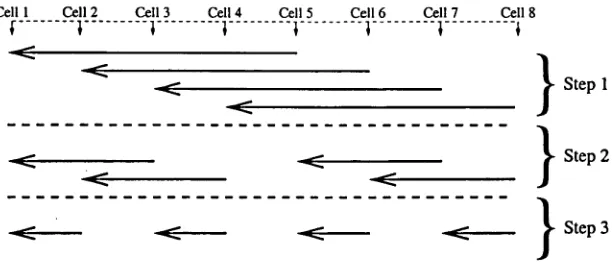
The simplest arrangement of two processor merges that will achieve this time cost is a hypercube arrangement as shown for eight processors in Figure 1.1.
[image:15.518.128.436.101.234.2]par-§1.1 How fast can it go? 7
alel steps with each step taking O(^) time to complete. There is only one problem, it doesn't workl
11.3 Almost sorting
Tiis brings us to a central idea in the development of this algorithm. We have so fa: developed an algorithm which very naturally arises out of a simple analysis of tie lower limit of the sort time. The algorithm is simple to implement, will clearly bt very scalable (due to its hypercube arrangement) and is likely to involve minimal lead balancing problems. All these features make it very appealing. The fact that the fhal result is not actually sorted is an annoyance that must be overcome.
Once the algorithm is implemented it is immediately noticeable that although the fhal result is not sorted, it is "almost" sorted. By this I mean that nearly all elements ae in their correct final processors and that most of the elements are in fact in their arrect final positions within those processors. This will be looked at in Section 1.3.6 bit for now it is good enough to know that, for large N, the proportion of elements tlat are in their correct final position is well approximated by 1 — P/VN.
This is quite extraordinary. It means that we can use this very efficient algorithm t( do nearly all the work, leaving only a very small number of elements which are n)t sorted. Then we just need to find another algorithm to complete the job. This ":leanup" algorithm can be designed to work for quite small data sets relative to the total size of the data being sorted and doesn't need to be nearly as efficient as the iiitial hypercube based algorithm.
§1.2 Algorithm Details 8
1.1.4 Putting it all together
We are now in a position to describe the algorithm as a whole. The steps in the algo rithm are
• distribute the data over the P processors
• sort the data within each processor using the best available serial sorting algo rithm for the data
• perform log P merge steps along the edges of a hypercube
• find which elements are unfinished (this can be done in log{N/P) time) • sort these unfinished elements using a convenient algorithm
Note that this algorithm arose naturally out of a simple consideration of a lower bound on the sort time. By developing the algorithm in this fashion we have guaran teed that the algorithm is optimal in the average case.
1.2 Algorithm Details
The remainder of this chapter covers the implementation details of the algorithm, showing how it can be implemented with minimal memory overhead. Each stage of the algorithm is analyzed more carefully resulting in a more accurate estimate of the expected running time of the algorithm.
The algorithm was first presented in [Tridgell and Brent 1993]. The algorithm was developed by Andrew Tridgell and Richard Brent and was implemented by Andrew Tridgell.
1.2.1 Nomenclature
P is the number of nodes (also called cells or processors) available on the parallel machine, and N is the total number of elements to be sorted. Np is the number of elements in a particular node p (0 < p < P). To avoid double subscripts NPj may be written as Nj where no confusion should arise.
§1.2 Algorithm Details 9
When giving "big O" time bounds the reader should assume that P is fixed so that 0(N) and 0(N/P) are the same.
The only operation assumed for elements is binary comparison, written with the usual comparison symbols. For example, A < B means that element A precedes ele ment B. The elements are considered sorted when they are in non-decreasing order in each node, and non-decreasing order between nodes. More precisely, this means that Epj < Epj for all relevant i < j and p, and that Epi < Eqj for 0 < p <q < P and all relevant /, j.
The speedup offered by a parallel algorithm for sorting N elements is defined as the ratio of the time to sort N elements with the fastest known serial algorithm (on one node of the parallel machine) to the time taken by the parallel algorithm on the parallel machine.
1.2.2 Aims of the Algorithm
The design of the algorithm had several aims: • Speed.
• Good memory utilization. The number of elements that can be sorted should closely approach the physical limits of the machine.
• Flexibility, so that no restrictions are placed on N and P. In particular N should not need to be a multiple of P or a power of two. These are common restrictions in parallel sorting algorithms [Ajtai et al. 1983; Akl 1985].
In order for the algorithm to be truly general purpose the only operator that will be assumed is binary comparison. This rules out methods such as radix sort [Blelloch et al. 1991; Thearling and Smith 1992].
It is also assumed that elements are of a fixed size, because of the difficulties of pointer representations between nodes in a MIMD machine.
§1.2 Algorithm Details 10
The algorithm starts with a number of elements N assumed to be distributed over P processing nodes. No particular distribution of elements is assumed and the only restrictions on the size of N and P are the physical constraints of the machine.
The algorithm presented here is similar in some respects to parallel shellsort [Fox et al. 1988], but contains a number of new features. For example, the memory over head of the algorithm is considerably reduced.
1.2.3 Infinity Padding
In order for a parallel sorting algorithm to be useful as a general-purpose routine, arbitrary restrictions on the number of elements that can be sorted must be removed. It is unreasonable to expect that the number of elements N should be a multiple of the number of nodes P.
The proof given in [Knuth 1981, solution to problem 5.3.4.38] shows that sort ing networks will correctly sort lists of elements provided the number of elements in each list is equal, and the comparison-exchange operation is replaced with a merge- exchange operation. The restriction to equal-sized lists is necessary, as small examples show5. However, a simple extension of the algorithm, which will be referred to as in finity padding, can remove this restriction6.
First let us define M to be the maximum number of elements in any one node. It is clear that it would be possible to pad each node with M — Np dummy elements so that the total number of elements would become M x P. After sorting is complete the padding elements could be found and removed from the tail of the sorted list.
Infinity padding is a variation on this theme. We notionally pad each node with M — Np "infinity" elements. These elements are assumed to have the property that they compare greater than any elements in any possible data set. If we now consider one particular step in the sorting algorithm, we see that these infinity elements need only be represented implicitly.
Say nodes p\ and pi have N\ and Ni elements respectively before being merged in
5 A small example where unequal sized lists fails with Batchers's merge-exchange sorting network is a 4 way sort with elements ([1] [0] [1] [0 0]) which results in the unsorted data set ([0] [0] [1] [0 1]).
§1.2 Algorithm Details 11
procedure hypercube_balance(integer base, integer num) if num = 1 return
for all i in [0..num/2)
pair_balance (base+i, base+i+(num+1)/2)
hypercube_balance (base+num/2, (num+1)/2)
hypercube_balance (base, num - (num+1)/2) end
Figure 1.2: Pseudo-code for load balancing
our algorithm, with node p\ receiving the smaller elements. Then the addition of in finity padding elements will result in M — N\ and M — N2 infinity elements being added to nodes p\ and p2 respectively. We know that, after the merge, node p2 m ust contain the largest M elements, so we can be sure that it will contain all of the infinity elements up to a maximum of M. From this we can calculate the num ber of real elements which each node m ust contain after merging. If we designate the num ber of real elements after merging as N[ and N'2 then we find that
' N'2 = max(0, N\ + N2 — M)
and
N[ = Nx+N 2 - N ' 2
This means that if at each merge step we give node p\ the first N[ elements and node p2 the remaining elements, we have implicitly perform ed padding of the nodes w ith infinity elements, thus guaranteeing the correct behavior of the algorithm.
1.2.4 Balancing
The aim of the balancing phase of the algorithm is to produce a distribution of the elements on the nodes that approaches as closely as possible N/ P elements per node.
The algorithm chosen for this task is one which reduces to a hypercube for values of P which are a power of 2. Pseudo-code is show n in Figure 1.27.
When the algorithm is called, the base is initially set to the index of the smallest node in the system and num is set to the num ber of nodes, P. The algorithm operates
§1.2 Algorithm Details 12
recirsively and takes logP steps to complete. When the num ber of nodes is not a pover of 2, the effect is to have one of the nodes idle in some phases of the algorithm. Because the node which remains idle changes w ith each step, all nodes take part in a pah balance w ith another node.
Vs can be seen from the code for the algorithm, the actual work of the balance is perorm ed by another routine called pair-balance. This routine is designed to exchange elenents between a pair of nodes so that both nodes end up w ith the same number of eements, or as close as possible. If the total num ber of elements shared by the twc nodes is odd then the node w ith the lower node num ber gets the extra element. Coisequently if the total num ber of elements N is less than the num ber of nodes P,
thei the elements tend to gather in the lower num bered nodes.
1.25 Perfect Balancing
A sight modification can be made to the balancing algorithm in order to improve the perormance of the merge-exchange phase of the sorting algorithm. As discussed in Secion 1.2.3, infinity padding is used to determine the num ber of elements to remain in eich node after each merge-exchange operation. If this results in a node having less elenents after a merge than before then this can lead to complications in the merge- exciange operation and a loss of efficiency.
Io ensure that this never happens we can take advantage of the fact that all merge operations in the prim ary merge and in the cleanup phase are perform ed in a direction suci that the node w ith the smaller index receives the smaller elements, a property of thesorting algorithm used. If the node with the smaller index has more elements than the other node, then the virtual infinity elements are all required in the other node, anc no transfer of real elements is required. This means that if a final balancing phase is iitroduced where elements are draw n from the last node to fill the lower numbered noies equal to the node with the most elements, then the infinity padding method is no required and the num ber of elements on any one node need not change.
§1.2 Algorithm Details 13
sorting of blocks of elements that have been allocated using the standard memory allocation procedures. It would be possible to remove this restriction by allowing ele ments within one node to exist as non-contiguous blocks of elements, and applying an un-balancing phase at the end of the algorithm. This idea has not been implemented because its complexity outweighs its relatively minor advantages.
In the current version of the algorithm elements may have to move up to logP times before reaching their destination. It might be possible to improve the algorithm by arranging that elements move only once in reaching their destination. Instead of moving elements between the nodes, tokens would be sent to represent blocks of el ements along with their original source. When this virtual balancing was completed, the elements could then be dispatched directly to their final destinations. This to- kenised balance has not been implemented, primarily because the balancing is suffi ciently fast without it.
1.2.6 Serial Sorting
The aim of the serial sorting phase is to order the elements in each node in minimum time. For this task, the best available serial sorting algorithm should be used, subject to the restriction that the algorithm must be comparison-based8.
If the number of nodes is large then another factor must be taken into considera tion in the selection of the most appropriate serial sorting algorithm. A serial sorting algorithm is normally evaluated using its average case performance, or sometimes its worst case performance. The worst case for algorithms such as quicksort is very rare, so the average case is more relevant in practice. However, if there is a large variance, then the serial average case can give an over-optimistic estimate of the performance of a parallel algorithm. This is because a delay in any one of the nodes may cause other nodes to be idle while they wait for the delayed node to catch up.
This suggests that it may be safest to choose a serial sorting algorithm such as heapsort, which has worst case equal to average case performance. However, experi ments showed that the parallel algorithm performed better on average when the serial sort was quicksort (for which the average performance is good and the variance small)
§1.2 Algorithm Details 14
procedure primary_merge(integer base, integer num) if num = 1 return
for all i in [0..num/2)
merge_exchange (base+i, base+i+(num+1)/2) primary_merge (base+num/2, (num+1)1 2)
primary_merge (base, num - (num+1)/2) end
Figure 1.3: Pseudo-code for primary merge
than when the serial sort was heapsort.
Our final choice is a combination of quicksort and insertion sort. The basis for this selection was a number of tests carried out on implementations of several algorithms. The care with which the algorithm was implemented was at least as important as the choice of abstract algorithm.
Our implementation is based on code written by the Free Software Foundation for the GNU project[GNU 1998]. Several modifications were made to give improved performance. For example, the insertion sort threshold was tuned to provide the best possible performance for the SPARC architecture used in the AP1000[Ishihata et al. 1993].
1.2.7 Primary Merge
The aim of the primary merge phase of the algorithm is to almost sort the data in minimum time. For this purpose an algorithm with a very high parallel efficiency was chosen to control merge-exchange operations between the nodes. This led to sig nificant performance improvements over the use of an algorithm with lower parallel efficiency that is guaranteed to completely sort the data (for example, Batcher's algo- rithm[Batcher 1968] as used in the cleanup phase).
The pattern of merge-exchange operations in the primary merge is identical to that used in the pre-balancing phase of the algorithm. The pseudo-code for the algorithm is given in Figure 1.3. When the algorithm is called the base is initially set to the index of the smallest node in the system and num is set to the number of nodes, P.
§1.2 Algorithm Details 15
merge-exchange operation. As with the pre-balancing algorithm, if P is not a power of 2 then a single node may be left idle at each step of the algorithm, with the same node never being left idle twice in a row.
If P is a power of 2 and the initial distribution of the elements is random, then at each step of the algorithm each node has about the same amount of work to perform as the other nodes. In other words, the load balance between the nodes is very good. The symmetry is only broken due to an unusual distribution of the original data, or if P is not a power of 2. In both these cases load imbalances may occur.
1.2.8 Merge-Exchange Operation
The aim of the merge-exchange algorithm is to exchange elements between two nodes so that we end up with one node containing elements which are all smaller than all the elements in the other node, while maintaining the order of the elements in the nodes. In our implementation of parallel sorting we always require the node with the smaller node number to receive the smaller elements. This would not be possible if we used Batcher's bitonic algorithm[Fox et al. 1988] instead of his merge-exchange algorithm.
Secondary aims of the merge-exchange operation are that it should be very fast for data that is almost sorted already, and that the memory overhead should be mini mized.
Suppose that a merge operation is needed between two nodes, p\ and pi, which initially contain N\ and Nj elements respectively. We assume that the smaller elements are required in node p\ after the merge.
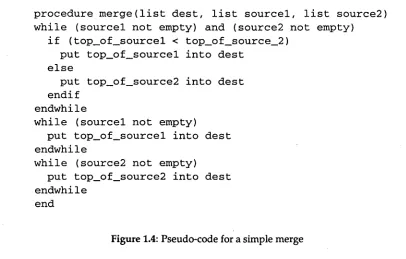
In principle, merging two already sorted lists of elements to obtain a new sorted list is a very simple process. The pseudo-code for the most natural implementation is shown in Figure 1.4.
§1.2 Algorithm Details 16
procedure merge(list dest, list sourcel, list source2) while (sourcel not empty) and (source2 not empty)
if (top_of_sourcel < top_of_source_2) put top_of_sourcel into dest
else
put top_of_source2 into dest endif
endwhile
while (sourcel not empty)
put top_of_sourcel into dest endwhile
while (source2 not empty)
put top_of_source2 into dest endwhile
[image:25.518.60.466.107.366.2]end
Figure 1.4: Pseudo-code for a simple merge
does not require this destination array.
In order to achieve this, it is clear that the algorithm must re-use the space that is freed by moving elements from the two source lists. We now describe how this can be done. The algorithm has several parts, each of which is described separately.
The principle of infinity padding is used to determine how many elements will be required in each of the nodes at the completion of the merge operation. If the complete balance operation has been performed at the start of the whole algorithm then the result of this operation must be that the nodes end up with the same number of elements after the merge-exchange as before. We assume that infinity padding tells us that we require N[ and N'2 elements to be in nodes p\ and p2 respectively after the merge.
1.2.9 Find-Exact A lgorithm
When a node takes part in a merge-exchange with another node, it will need to be able to access the other node's elements as well as its own. The simplest method for doing this is for each node to receive a copy of all of the other node's elements before the merge begins.
§1.2 Algorithm Details 17
node will be required to complete the merge, and to transfer only those elements. This reduces the communications cost by minimizing the number of elements transferred, and at the same time reduces the memory overhead of the merge.
The find-exact algorithm allows each node to determine exactly how many ele ments are required from another node in order to produce the correct number of ele ments in a merged list.
When a comparison is made between element £i^_i and E2^ \-a then the result
of the comparison determines whether node p\ will require more or less than A of its own elements in the merge. If £1^-1 is greater than E2N^_A then the maximum number of elements that could be required to be kept by node p\ is A —1, otherwise the minimum number of elements that could be required to be kept by node p\ is A.
The proof that this is correct relies on counting the number of elements that could be less than £i^_i. If £i^_\ is greater than E2^ _ A then we know that there are at least N[ — A + 1 elements in node p2 that are less than £14-1. If these are combined with the A —1 elements in node p\ that are less than £1^-1, then we have at least N[ elements less than £14-1. This means that the number of elements that must be kept by node p 1 must be at most A —1.
A similar argument can be used to show that if £1^-1 < E2)N^_A ^ en number of elements to be kept by node p\ must be at least A. Combining these two results leads to an algorithm that can find the exact number of elements required in at most logN\ steps by successively halving the range of possible values for the number of elements required to be kept by node p\.
Once this result is determined it is a simple matter to derive from this the number of elements that must be sent from node p\ to node p2 and from node p2 to node p\.
§1.2 Algorithm Details 18
the CM5 and AP1000.
We assume for the remainder of the discussion on the merge-exchange algorithm that after the find exact algorithm has completed it has been determined that node p\ must retain L\ elements and must transfer Li elements from node p2
-1.2.10 Transferring Elements
After the exact number of elements to be transferred has been determined, the actual transfer of elements can begin. The transfer takes the form of an exchange of elements between the two nodes. The elements that are sent from node p\ leave behind them spaces which must be filled with the incoming elements from node p2. The reverse
happens on node p2 so the transfer process must be careful not to overwrite elements
that have not yet been sent.
The implementation of the transfer process was straightforward on the CM5 and AP1000 because of appropriate hardware/operating system support. On the CM5 a routine called CMMD_send_and_receive does just the type of transfer required, in a very efficient manner. On the API000 the fact that a non-blocking message send is available allows for blocks of elements to be sent simultaneously on the two nodes, which also leads to a fast implementation.
If this routine were to be implemented on a machine without a non-blocking send then each element on one of the nodes would have to be copied to a temporary buffer before being sent. The relative overhead that this would generate would depend on the ratio of the speeds of data transfer within nodes and between nodes.
After the transfer is complete, the elements on node p\ are in two contiguous sorted lists, of lengths L\ and N[ — L\. In the remaining steps of the merge-exchange algorithm we merge these two lists so that all the elements are in order.
1.2.11 Unbalanced Merging
§1.2 Algorithm Details 19
This may occur if the data is almost sorted, for example, near the end of the cleanup phase.
In this case the task which node p\ must undertake is to merge two lists of very different sizes. There is a very efficient algorithm for this special case.
First we determine, for each of the L2 elements that have been transferred from p\, where it belongs in the list of length L\. This can be done with at most f^logLi comparisons using a method similar to the find-exact algorithm. As L2 is small, this number of comparisons is small, and the results take only 0(L2) storage.
Once this is done we can copy all the elements in list 2 to a temporary storage area and begin the process of slotting elements from list 1 and list 2 into their proper destinations. This takes at most L\ + L2 element copies, but in practice it often takes only about 2L2 copies. This is explained by the fact that when only a small number of elements are transferred between nodes there is often only a small overlap between the ranges of elements in the two nodes, and only the elements in the overlap region have to be moved. Thus the unbalanced merge performs very quickly in practice, and the overall performance of the sorting procedure is significantly better than it would be if we did not take advantage of this special case.
1.2.12 Block-wise Merging
The block-wise merge is a solution to the problem of merging two sorted lists of ele ments into one, while using only a small amount of additional storage. The first phase in the operation is to break the two lists into blocks of an equal size B. The exact value of B is unimportant for the functioning of the algorithm and only makes a difference to the efficiency and memory usage of the algorithm. It will be assumed that B is
0{yjL\+L2), which is small relative to the memory available on each node. To sim plify the exposition also assume, for the time being, that L\ and L2 are multiples of B.
§1.2 Algorithm Details 20
the destination list. As each block in either of the two source lists becomes em pty they are added to the destination list.
As the merge proceeds there are always exactly 2B free spaces in the three lists. This means that there m ust always be at least one free block for the algorithm to have on the destination list, whenever a new destination block is required. Thus the ele m ents are merged completely w ith them ending up in a blocked list format controlled by the destination list.
The algorithm actually takes no more steps than the simple merge outlined earlier. Each element moves only once. The drawback, however, is that the algorithm results in the elements ending up in a blocked list structure rather than in a simple linear array.
The simplest method for resolving this problem is to go through a re-arrangement phase of the blocks to p u t them back in the standard form. This is w hat has been done in m y implementation of the parallel sorting algorithm. It w ould be possible, how ever, to modify the whole algorithm so that all references to elements are perform ed w ith the elements in this block list format. At this stage the gain from doing this has not w arranted the additional complexity, but if the sorting algorithm is to attain its true potential then this w ould become necessary.
As m entioned earlier, it was assumed that L\ and L2 were both multiples of B. In
general this is not the case. If L\ is not a multiple of B then this introduces the problem that the initial breakdown of list 2 into blocks of size B will not produce blocks that are aligned on multiples of B relative to the first element in list 1. To overcome this problem we m ust make a copy of the L\ mod B elements on the tail of list 1 and use this copy as a final source block. Then we m ust offset the blocks w hen transferring them from source list 2 to the destination list so that they end up aligned on the proper boundaries. Finally we m ust increase the am ount of tem porary storage to 3B and prim e the destination list w ith three blocks to account for the fact that we cannot use the partial block from the tail of list 1 as a destination block.
§1.2 Algorithm Details 21
gap turns out to be a trivial extension of the m ethod for handling the fact that L\ may not be a multiple of B. We just add an additional offset to the destination blocks equal to the gap size and the problem is solved.
1.2.13 Cleanup
The cleanup phase of the algorithm is similar to the prim ary merge phase, but it must be guaranteed to complete the sorting process. The m ethod that has been chosen to achieve this is Batcher's merge-exchange algorithm. This algorithm has some useful properties w hich make it ideal for a cleanup operation.
The pseudo-code for Batcher's merge-exchange algorithm is given in [Knuth 1981, Algorithm M, page 112]. The algorithm defines a pattern of comparison-exchange op erations which will sort a list of elements of any length. The w ay the algorithm is nor mally described, the comparison-exchange operation operates on two elements and exchanges the elements if the first element is greater than the second. In the applica tion of the algorithm to the cleanup operation we generalize the notion of an element to include all elements in a node. This means that the comparison-exchange operation m ust make all elements in the first node less than all elements in the second. This is identical to the operation of the merge-exchange algorithm. The fact that it is possi ble to make this generalization while maintaining the correctness of the algorithm is discussed in Section 1.2.3.
§1.3 Performance 22
1.3 Performance
In this section the performance of my implementation of the parallel sorting algorithm given above will be examined, primarily on a 128 node AP1000 multicomputer. While the AP1000 is no longer a state of the art parallel com puter it does offer a reasonable num ber of processors which allows for good scalability testing.
1.3.1 Estimating the Speedup
An im portant characteristic of any parallel algorithm is how much faster the algorithm performs than an algorithm on a serial machine. Which serial algorithm should be chosen for the comparison? Should it be the same as the parallel algorithm (running on a single node), or the best known algorithm?
The first choice gives that which is called the parallel efficiency of the algorithm. This is a measure of the degree to which the algorithm can take advantage of the parallel resources available to it.
The second choice gives the fairest picture of the effectiveness of the algorithm itself. It measures the advantage to be gained by using a parallel approach to the problem. Ideally a parallel algorithm running on P nodes should complete a task
P times faster than the best serial algorithm running on a single node of the same machine. It is even conceivable, and sometimes realizable, that caching effects could give a speedup of more than P.
A problem w ith both these choices is apparent w hen we attem pt to time the serial algorithm on a single node. If we wish to consider problems of a size for which the use of a large parallel machine is worthwhile, then it is likely that a single node cannot complete the task, because of memory or other constraints.
This is the case for our sorting task. The parallel algorithm only perform s at its best for values of N which are far beyond that which a single node on the CM5 or AP1000 can hold. To overcome this problem, I have extrapolated the timing results of the serial algorithm to larger N.
§1.3 Performance 23
Sorting 32-bit integers on the 128-node AP1000 Elements per
second x 106 projected serial rate ----serial rate x 128 + parallel rate x
[image:32.518.95.444.104.341.2]Num ber of Elements
Figure 1.5: Sorting 32-bit integers on the AP1000
estimate these contributions I have perform ed a least squares fit of the form:
time(/V) = a + b log N + cN -f dNXogN.
The results of this fit are used in the discussion of the perform ance of the algorithm to estimate the speedup that has been achieved over the use of a serial algorithm.
1.3.2 Timing Results
Several runs have been made on the AP1000 and CM5 to examine the performance of the sorting algorithm im der a variety of conditions. The aim of these runs is to determ ine the practical performance of the algorithm and to determ ine w hat degree of parallel speedup can be achieved on current parallel computers.
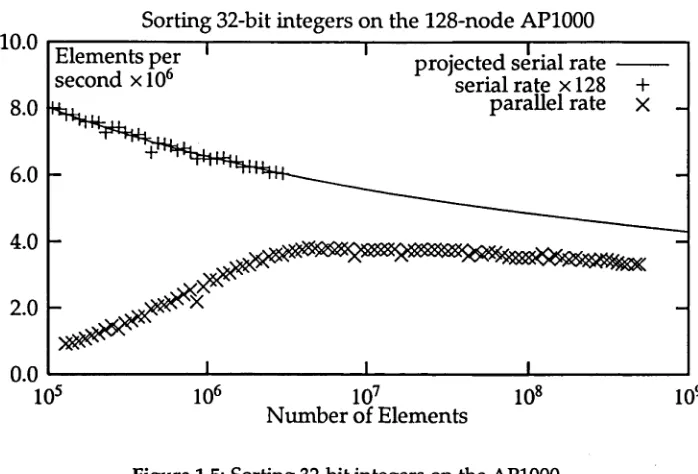
The results of the first of these runs are show n in Figure 1.5. This figure shows the performance of the algorithm on the 128-node AP1000 as N spans a wide range of values, from values which w ould be easily dealt w ith on a workstation, to those at the limit of the APlOOO's memory capacity (2 Gbyte). The elements are 32-bit ran dom integers. The comparison function has been p u t inline in the code, allowing the function call cost (which is significant on the SPARC) to be avoided.
§1.3 Performance 24
This time includes all phases of the algorithm, and gives an overall indication of per formance.
Shown on the same graph is the performance of a hypothetical serial computer that operates P times as fast as the P individual nodes of the parallel computer. This performance is calculated by sorting the elements on a single node and multiplying the resulting elements per second result by P. An extrapolation of this result to larger values of A is also shown using the least squares m ethod described in Section 1.3.1.
The graph shows that the performance of the sorting algorithm increases quickly as the num ber of elements approaches 4 million, after which a slow falloff occurs which closely follows the profile of the ideal parallel speedup. The roll-off point of 4 million elements corresponds to the num ber of elements that can be held in the 128KB cache of each node. This indicates the importance of caching to the performance of the algorithm.
It is encouraging to note how close the algorithm comes to the ideal speedup of
P for a P-node machine. The algorithm achieves 75% of the ideal performance for a 128-node machine for large N.
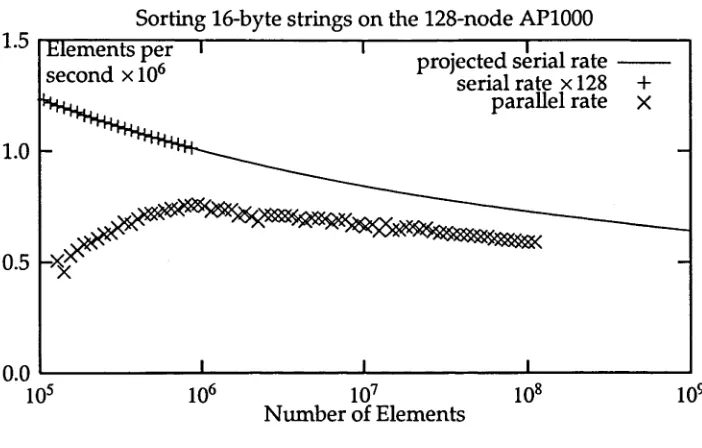
A similar result for sorting of 16-byte random strings is show n in Figure 1.6. In this case the comparison function is the C library function strcmp(). The roll-off point for best performance in terms of elements per second is observed to be 1 million elements, again corresponding to the cache size on the nodes.
The performance for 16-byte strings is approximately 6 times worse than for 32-bit integers. This is because each data item is 4 times larger, and the cost of the function call to the strcmp() function is much higher than an inline integer comparison. The parallel speedup, however, is higher than that achieved for the integer sorting. The algorithm achieves 85% of the (theoretically optimal) P times speedup over the serial algorithm for large N.
1.3.3 Scalability
var-§1.3 Performance 25
Sorting 16-byte strings on the 128-node AP1000 Elements per r
second x 106 projected serial rate ----serial rate x 128 + parallel rate
x
107
[image:34.518.92.443.105.329.2]N um ber of Elements
Figure 1.6: Sorting 16-byte strings on the API000
ied. The percentages refer to the proportion of the ideal speedup P that is achieved. The num ber of elements per node is kept constant to ensure that caching factors do not influence the result.
The left-most data point shows the speedup for a single node. This is equal to 1 as the algorithm reduces to our optimized quicksort w hen only a single node is used. As the num ber of nodes increases, the proportion of the ideal speedup decreases, as communication costs and load imbalances begin to appear. The graph flattens out for larger numbers of nodes, which indicates that the algorithm should have a good efficiency w hen the num ber of nodes is large.
§1.3 Performance 26
Percentage of potential speedup with 105 16-byte strings per node
including all nodes —i— only powers of 2
[image:35.518.95.444.107.322.2]—X--Number of Nodes
Figure 1.7: Scalability of sorting on the AP1000
1.3.4 Where Does The Time Go?
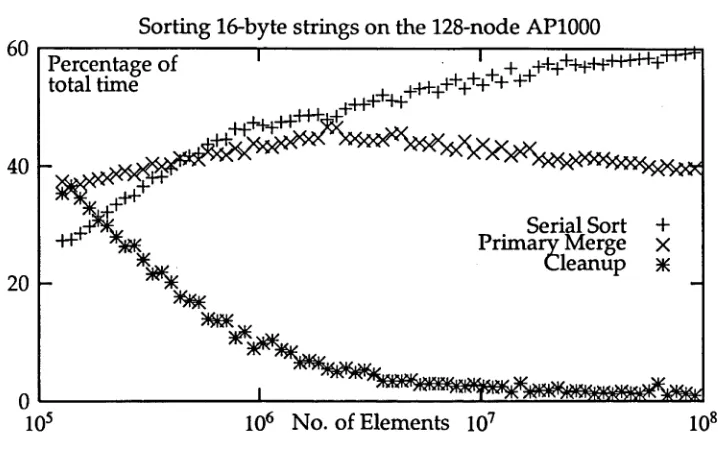
In evaluating the performance of a parallel sorting algorithm it is interesting to look at the proportion of the total time spent in each of the phases of the sort. In Figure 1.8 this is done over a wide range of values of N for sorting 16-byte strings on the AP1000. The three phases that are examined are the initial serial sort, the primary merging and the cleanup phase.
This graph shows that as N increases to a significant proportion of the memory of the machine the dominating time is the initial serial sort of the elements in each cell. This is because this phase of the algorithm is 0(N\ogN) whereas all other phases of the algorithm are O(N) or lower. It is the fact that this component of the algorithm is able to dominate the time while N is still a relatively small proportion of the capacity of the machine which leads to the practical efficiency of the algorithm. Many sorting algorithms are asymptotically optimal in the sense that their speedup approaches P for large N, but few can get close to this speedup for values of N which are of of interest in practice [Natvig 1990].
§1.3 Performance 27
Sorting 16-byte strings on the 128-node AP1000 Percentage of
total time
Serial Sort + Prim ary Merge x Cleanup x
[image:36.518.88.447.101.329.2]106 No. of Elements 107
Figure 1.8: Timing breakdown by phase
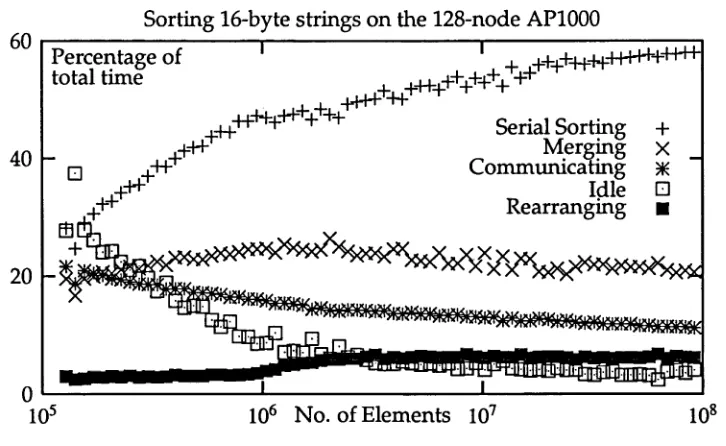
A second way of splitting the time taken for the parallel sort to complete is by task. In this case we look at w hat kind of operation each of the nodes is performing, which provided a finer division of .the time.
Figure 1.9 shows the result of this kind of split for the sorting of 16-byte strings on the 128-node AP1000, over a w ide range of values of N. Again it is clear that the serial sorting dominates for large values of N, for the same reasons as before. W hat is more interesting is that the proportion of time spent idle (waiting for messages) and communicating decreases steadily as N increases. From the point of view of the parallel speedup of the algorithm these tasks are wasted time and need to be kept to a minimum.
1.3.5 CM5 vs AP1000
§1.3 Performance 28
60
40
20
0
IO5 106 No. of Elements 107 108
Figure 1.9: Timing breakdown by task
The AP1000 is a single-user machine and the timing results obtained on it are very consistent. However, it is difficult to obtain accurate timing information on the CM5. This is a consequence of the time-sharing capabilities of the CM5 nodes. Communication-intensive operations produce timing results w hich vary widely from run to run. To overcome this problem, the times reported here are for runs with a very long time quantum for the time sharing, and w ith only one process on the machine at one time.
Even so, we have ignored occasional anomalous results which take much longer than usual. This means that the results are not completely representative of results that are regularly achieved in a real application.
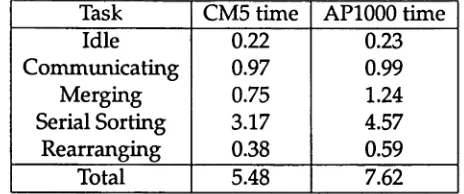
In Table 1.1 the speed of the various parts of the sorting algorithm are shown for the 32-node A PI000 and CM5. In this example we are sorting 8 million 32-bit integers.
For the communications operations both machines achieve very similar timing results. For each of the computationally intensive parts of the sorting algorithm, how ever, the CM5 achieves times which are between 60% and 70% of the times achieved on the AP1000.
Sorting 16-byte strings on the 128-node AP1000 Percentage of
total time
i44iH-+-H-+T+++"+H+
-H-+J_, 4 ^ f * + ++++ +
Serial Sorting + Merging
x
Communicating xIdle □ Rearranging ■
[image:37.518.85.448.104.327.2]§1.3 Performance 29
[image:38.518.151.383.104.201.2]Task CM5 time AP1000 time Idle 0.22 0.23 C om m unicating 0.97 0.99 M erging 0.75 1.24 Serial Sorting 3.17 4.57 R earranging 0.38 0.59 Total 5.48 7.62 Table 1.1: Sort times (seconds) for 8 million integers
the CM5 in the clock speeds. This explains m ost of the perform ance difference, b u t not all. The rem ainder of the difference is d u e to the fact th at sorting a large n um ber of elem ents is a very m em ory-intensive operation.
A m ajor bottleneck in the sorting procedure is the m em ory b a n d w id th of the nodes. W hen operating on blocks w hich are m uch larger th an the cache size, this results in a high d ependency on how often a cache line m u st be refilled from m em ory and how costly the operation is. Thus, the rem ainder of the difference betw een the tw o m achines m ay be explained by the fact th at cache lines on the CM5 consist of 32 bytes w hereas they consist of 16 bytes on the AP1000. This m eans a cache line load m ust occur only half as often on the CM5 as on the AP1000.
The results illustrate how im p ortan t m inor architectural differences can be for the perform ance of com plex algorithm s. At the sam e time the vastly different netw ork structures on the tw o m achines are no t reflected in significantly different com m unica tion times. This suggests that the parallel sorting algorithm presen ted here can p er form w ell on a v ariety of parallel m achine architectures w ith different com m unication topologies.
1.3.6 Primary Merge Effectiveness
The efficiency of the parallel sorting algorithm relies on the fact that after the prim ary m erge phase m ost elem ents are in their correct final positions. This leaves only a small am o u n t of w ork for the cleanup phase.
§1.3 Performance 30
-X---X-' P=64
P=128
100000 le+06 le+07 le+08
No. of Elements
Figure 1.10: Percentage completion after the primary merge
It is probably possible to analytically derive this form for the primary merge per centage completion but unfortunately I have been unable to do so thus far. Never theless it is clear from the numerical result that the proportion of unsorted elements remaining after the primary merge becomes very small for large N. This is important as it implies that the parallel sorting algorithm is asymptotically optimal.
1.3.7 Optimizations
Several optimization ''tricks" have been used to obtain faster performance. It was found that these optimizations played a surprisingly large role in the speed of the algorithm, producing an overall speed improvement of about 50%.
The first optimization was to replace the standard C library routine memcpy() with a much faster version. At first a faster version written in C was used, but this was eventually replaced by a version written in SPARC assembler.
The second optimization was the timing of the block size of sends performed when elements are exchanged between nodes. This optimization is hidden on the CM5 in the CMMD_send_and_receive() routine, but is under the programmer's control on the AP1000.
[image:39.518.79.455.105.322.2]§1.4 Comparison with other algorithms 31
too small then overheads slow down the program, but if it is too large then too many copies must be performed and the system might run out of memory. The value finally chosen was 4\/L\ + L2.
The method of rearranging blocks in the block-wise merge routine can have a big influence on the performance as a small change in the algorithm can mean that data is far more likely to be in cache when referenced, thus giving a large performance boost.
A very tight kernel for the merging routine is important for good performance. With loop unrolling and good use of registers this routine can be improved enor mously over the obvious simple implementation.
It is quite conceivable that further optimizations to the code are possible and would lead to further improvements in performance.
1.4 Comparison with other algorithms
There has been a lot of research into parallel sorting algorithms. Despite this, when I started my work on sorting in 1992 I was unable to find any general purpose efficient parallel sorting algorithms suitable for distributed memory machines. My research attempted to fill in that gap.
This section examines a number of parallel sorting algorithms where performance results are available for machines comparable with those that my research used.
1.4.1 Thearling and Smith
In [Thearling and Smith 1992] Kurt Thearling and Stephen Smith propose a parallel integer sorting benchmark and give results for an implementation of an algorithm on the CM5. Their algorithm is based on a radix sort, and their paper concentrates on the effects of the distribution of the keys within the key space using an entropy based measure.
The use of a radix based algorithm means that the algorithm is not comparison- based and thus is not general purpose. Additionally, the sending phase of the algo rithm consumes temporary memory of 0(N) which reduces the number of elements that can be sorted on a machine of a given size by a factor of 2.
§1.4 Comparison with other algorithms 32
sorting 64 million uniformly distributed 32 bit elements on 64 CM5 processors was 17 seconds.
To provide a comparison w ith their results I used an in-place forward radix sort (based on the American flag sort[McIlroy et al. 1993]) for the local sorting phase of our algorithm and ran a test of sorting 64 million 32 bit elements on 64 cells of the AP1000. I then scaled the timing results using the ratio of sorting speed for the AP1000 to the CM5 as observed in earlier results9. This gave a comparative sorting time of 17.5 seconds. By using a more standard (and memory consuming) radix sort a time of 15.8 seconds was obtained.
The interesting part of this result is how different the two algorithms are. Then- algorithm uses special prefix operations of the CM5 to com pute the radix histograms in parallel then uses a single all to all communication stage to send the data directly to the destination cell. About 85% of the total sort time is spent in the communication stage. Despite the totally different algorithm the results are quite similar.
1.4.2 Helman, Bader and JaJa
In [Helman et al. 19961 David Helman, David Bader and Joseph JaJa detail a sample sort based parallel sorting algorithm and give results for a 32 node CM5, directly com paring their results with the results for our algorithm as presented in [Tridgell and Brent 1995; Tridgell and Brent 1993]. They also compare their results w ith a wide range of other parallel sorting algorithms and show results indicating that their algorithm is the fastest in m ost cases.
Like the Thearling algorithm Helman's algorithm uses a radix sort, although in this case it is applied independently to the elements in each node. This still leaves them w ith an 0 (N) memory overhead and the problem that the algorithm is not gen eral purpose because a comparison function cannot be used in a radix sort.
The table they show comparing their algorithm w ith ours (which they call the TB algorithm) shows results for sorting 8 million uniformly distributed integers on a 32 node CM5. They give the results as 4.57 seconds for their algorithm and 5.48 seconds for ours.
§1.5 Conclusions 33
To give a fairer comparison I again replaced the quicksort algorithm in my imple mentation with the American flag in-place radix sort and scaled for AP1000 to CM5 differences. This gave an equivalent sorting time of 3.9 seconds.
1.5 Conclusions
The parallel sorting algorithm presented in this chapter arises from a very simple analysis following a decision to split the algorithm into a local sorting phase followed by a parallel merge. The use of a fast but incorrect initial merge phase followed by a simple cleanup algorithm leads to a very high degree of parallel efficiency.
Chapter 2
External Parallel Sorting
This chapter considers the problem of external parallel sorting. External sorting in volves sorting more data than can fit in the combined m em ory of all the processors on the machine. This involves using disk as a form of secondary memory, and it presents some very interesting challenges because of the huge difference betw een the band- w idths and latencies of m em ory and disk systems.
2.1 Parallel Disk Systems
There are a large variety of different disk 1 /O systems available for parallel computers. In some systems each CPU has its own private disk and in others there is a central bank of disks accessible from all CPUs.
For this w ork I assum ed the following setup:
• a distributed m em ory parallel computer
• a parallel filesystem where all CPUs can access all the data
The particular setup I used was a 128 cell AP1000 w ith 32 disks and the HiDIOS parallel filesystem[Tridgell and Walsh 1996].
The requirement of a filesystem where all CPUs can access all the data isn't as much of an im pedim ent as it m ight first seem. Almost any distributed filesystem can easily be given this property using a remote access protocol coupled to the message passing library1.
^ h e AP1000 has only local disk access in hardware. Remote disk access is provided by the operating system.
§2.2 Designing an algorithm 35 100000 10000 1000 100 10 1 0.1
[image:44.518.93.455.106.319.2]1 10 100 1000 10000 100000 le+06 le+07 block size (bytes)
Figure 2.1: Aggregate throughput with varying block-size
2.2 Designing an algorithm
An external parallel sorting algorithm has design constraints quite different from an internal algorithm. The main differences are:
• the average number of I/O operations per element needs to be minimized. • the I/O requests need to be gathered as far as possible into large requests • the algorithm should, if possible, run in-place to allow data sets up to the full
size of the available disk space to be sorted
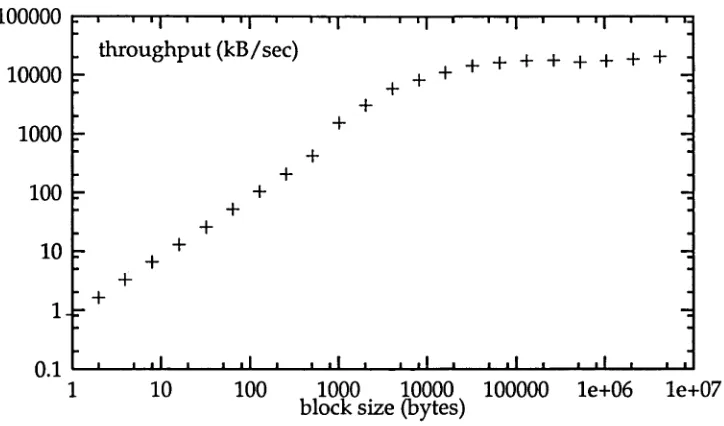
The dramatic difference that the gathering of I/O requests can make is demon strated by the write throughput results in Figure 2.1. The graph show the aggregate write throughput on a 128 cell AP1000 with 16 disks2. With the throughput varying by four orders of magnitude depending on the size of the individual writes it is clear that an algorithm that does a smaller number of larger 1/O requests is better than one which does a large number of small requests.
2Some results in this chapter are for a system with 32 disks and others are for a system with 16 disks. The machine 1 used was reconfigured part way through my research.
- , • -1 ' • ■1 ■ ■ 1 ' '1 * - throughput (kB/sec)
+ + + + + + + + + + + * + _ + - + - + - + -- + + + + + - +