A STUDY ON
PAKKAVATHAM
Dissertation Submitted To
THE TAMIL NADU DR.M.G.R Medical University
Chennai – 32
For the Partial fulfillment for The Award of Degree of
DOCTOR OF MEDICINE (SIDDHA)
(Branch – III, SIRAPPU MARUTHUVAM)
DEPARTMENT OF SIRAPPU MARUTHUVAM
Government Siddha Medical College
A STUDY ON
PAKKAVATHAM
Dissertation Submitted to
THE TAMIL NAUD DR.M.G.R.MEDICAL UNIVERSITY
Chennai -2
For the Partial fulfillment for the Award of Degree of
DOCTOR OF MEDICINE (SIDDHA)
Branch - III
Department of Sirappu Maruthuvam Government Siddha Medical College
Palayamkottai - 627 002 September - 2008
Submitted by
Dissertation Subject : A STUDY ON PAKKAVATHAM
Submitted By : DR.S.SARAVANAN
Branch III Final M.D(s)
Department of Sirappu
Maruthuvam
Govt. Siddha Medical College,
Palayamkottai.
In the Disc : Topic, Photographs, Charts
Software Used : MS.Word.
Fonts Used in Tamil : Amudham, Senthamil.
Fonts Used in English : Times New Romen.
Typing and Designed by : Annai Xerox & DTP,
INTRODUCTION
NATURE AND HUMAN BEINGS are the wonderful creations of God. Pray and praise the god for creating Nature which provide Land, Water, Air, resources, rain, for human beings for their better survival; It is the ultimate duty of human being is to protect the nature and live in Nature.
Indian Sub Continent is famous for its own medical system which strictly confines with principles of nature called Indigenous system. Indigenous system includes Siddha, Ayurvedha and Unani.
Of those indigenous system, Siddha system of medicine is practised in Tamilnadu. It is necessary to know some facts about Tamilnadu before knowing about Siddha medicine.
“ï_ ¼>V[¤ \õ ¼>V[ÅV ïVéݼ>
kVØáV| x[¼>V[¤B JÝ>Âz½ ‡ >tµz½
As per above quotation the time of origin of Tamil race was immemorial.
Tamilians are Dravidan peoples who are living the landscape between the river Pagruli and Capecomarin.
“ÃÂò¹ gu®ÂzD z\öÂ
¼ïVâ½uzD Öç¦l_ c^á
Wé©Ã«©A ‡ >tµåV|”
They are speaking the language called Tamil, Tamil language is considered to be the superior language than other Dravidian languages. Tamil and Tamilnadu are unseparable.
“ØÄÍ>tµ åVئÐD ¼ÃV]M¼é
Ö[ÃÝ ¼>[ kÍm ÃV¥m ïV]M¼é” “BV\¤Í> Ø\Vaï¹¼é >tµØ\Va
¼ÃV_ ÖM>Vï ¨ºzD ïV¼ðVD”
Tamilnadu is famous for its own literature treasure. Their literature had popular works in love, mankind, hospitality, under Agavilakiyangal and warfare bravery in Puravilakiyangal” The famous Tamil works such as patthupattu, Ettuthokai, Kurunthogai, Padhinenkeel kanakkukal, Aga nanooru, Pura nanooru, and also spiritual works called Saiva Thirumuraigal and Divya prabanthangal which reflects saiva and vainava religious cultures .
Tamil Medicine or Siddha system of medicine is originated from Lord siva, the Supreme God of Tamils and he is also considered to be chief of Siddhars and chief of Sangam poets.
“ØÄV_o¦¼k ¼>sÂz Ä>VEkت[ÃV[”
... ... ...
From Lord shiva it was gifted to Tamils by people called siddhars.
Siddhars are people who are not only physicians but also they are social reformers,
Siddhars knowledge in the field of medicine, Natural Science, Iatro Chemistry, Alchemy and literature are extra ordinary one.
Siddhar the word derived from the term ‘Siddhi’ means perfection or Achievement.
According to siddha system, Medicine, and Nature are unseparable and inter-dependent.
Both the external environment and human body is composed of five basic elements called Pancha boothams which includes land, Water, Fire, Air and Ether. They variation in the ratio of Pancha boothams in nature, reflects as natural calamities such as flood, famine, cyclone, eruptions and volcanoes.
According to siddhars, the ultimate aim of human being is to attain the external bliss; and free from three bondages such as Aanavam, kanmam and Maayai.
To attain external bliss, human body is considered to be the media. So it must have to be protected from diseases. They postulated certain principles of health and hygiene admixtured with psychiatry, yoga, meditation, natural- science, spiritualism in Siddha system of medicine.
The Pini must be cured by “Marunthu”, the term Marunthu means which cures physical, mental illness and possess preventive aspects from diseases and also to postpone the Fatal.
According to Siddhar Thirumoolar
“\®©Ãm c¦_ ¼åVçB \òÍØ>ªéVzD
\®©Ãm cá ¼åVçB \òÍØ>ªßÄVKD
\®©Ãm ÖM ¼åVF k«Vç\Âz
\®©Ãm ÄVçk \òÍØ>ªéV¼\”
The art of practise of treating, curing illness and preventing illness is called ‘Maruthuvam’. Those who practise such a science are called Maruthuvars.
The physiological functioning of body is based on principles of 96 thathuvas, which includes the functions of sensory and motor systems, psyco-somatic and pscho immuno systems, 6 vital centres, 5 kosams which includes Circulatory, Respiratory, Excretory and Reproductive systems.
The diseases are classified on the basis of Vatha, pitha and kapha and on the basis of affection of vital organs and systems into 4448 types. Of which vatha diseases are 80 in number, and pitha are 40 in number and of Kabha are 20 in number.
The Medicine is divided into internal and external medicines. Each are of 32 types.
Internal medicines are classified on the basis of their potency and Expiry.
The diagnosis is based upon three dhosha theory. They follow precise diagnostic method caused Envagai thervu or Pinniyarium muraimai and elicited the root cause of
diseases.
The therapeutics is based on the principles of Arusuvai, Mukkutram and pancha Bootha principles. They have also taken into account of paruva kaalams, Astrology, Genetic factors in relation to diseases.
The successful of treatment is based on harmony among the physician, pharmacist, patient and medicine.
cuÅk[ yì©ÃV[ \òÝmçwß ØÄ_kVت[
ũêVu íu¼Å \òÍm ‡ ]òÂzÅ^.
The author had choosen the disease Pakka Vaatham (Hemiplegia) for my
dissertation subject, because it is one of the type of Vatha disease which affects the individuals in higher incidence.
It is not only cripples the individual but also cripples his own family and society. It’s increased occurence in recent times is due to sedentary life styles, abnormal dietary habits.
Cerebro vascular events is the 3rd commonest cause of morbidity and mortality in the world.
The description mentioned in the Siddha literatures about the disease impressed the author very much. Hence I choosen the disease Pakkavaatham.
The disease is correlated with the Cerebro Accident called “stroke syndrome”
as mentioned in Allopathy.
I had choosen the drug Kodiveli Chooranam as internal medicine and Kiranthi kadhi thylam as external applications. .
As it is a herbal formulation it is purely safe and free from adverse effects.
AIM AND OBJECTIVES
AIM
To collect various school of thoughts mentioned in Siddha literatures such as Yugi Vaithya Chinthamani, Siddha Maruthuvam, Agathiar Gunavaagadam, Para Rasa Sekaram about the disease Pakka Vatham.
To analyse and review the ideas in above mentioned literatures with references to present trend.
To analyse and review the disease Pakka Vatham on the basis of its affection on various organ systems, Pori Pulangal, Mukkutram and udal Kattukal.
To apply the principles of Envagai Thervu, Neerkuri, Neikuri, in establishing diagnosis and prognosis.
To study the extent of correlation with aetio pathology, classification, symptomatology and diagnostic methods on par with allopathic view.
To conduct the clinical study on Pakka Vatham in both in patient and out patient Departments with reference to Sex, age, Socio-economic status, Habits, Habitat, Life style, Thinaigal and paruvakaalangal.
To study about the pre disposing factors contributing this disease.
To assess the risk factors under modifiable and non modifiable risk factors.
To study about Preventive aspects.
To apply the principles of management as advised by Siddhars regarding Elimination of cause, prevention of recurrence, Treatment of disease with co-existing clinical conditions, such as Hypertension, Diabetes mellitus etc.,
To perform Pharmacological analysis to evaluate the
Anti coagulant action
Analgesic action
Acute Anti inflammatory action
To perform the toxicological analysis of dissertation drug.
To apply the modern parameters on investigation side to confirm and follow the prognosis.
To apply the principles of pathiyam specific to this disease.
SIDDHA ASPECT
The siddha system of medicine deals each and every corner of science, when viewed in its proper perspective, the body is nothing less than an evolutionary wonder, an unbelievably complex instrument capable of supporting limitless possibilities for human life.
This marvel nature can be studied from many points view, the conceptual model that "Siddha" uses to understand the principles of nature functioning is called "Pancha Butham" or the "Theory of Five Elements". This theory serves as the foundation for all of Siddha's diagnostic and treatment modalities and has allowed physicians for millions of years who successfully detect and treat imbalances any where in human life.
The Ancient Siddha literatures classify the diseases into the number of 4448. The classification is based on the "Three Dosha Theory". In such a way Eighty types vaadha diseases are classified and "Pakkavaadham" is one of them. Before reviewing the specific science and symptoms of "Pakkavaadham" the details of vaadham are important and basic.
DEFINITION
Vaadham is one of the Three humours namely Vaadham, Piththam, and Kabham and it consists of Vayu (Air) and Aahaayam (Sky), the two of five elements i.e., Pancha Butham.
Elements which become THODAMS in the Body
Aahaayam (Space)
Vayu (Air) Vaadha Thodam
Teyu (Fire) Piththa Thodam
Appu (Water)
It would be incorrect to think of the "Thodams" only as the Three dynamic elements manifesting in the body. These active elements are always supported by the two unchanging elements, for change can only happen upon the foundation of non-change. Thus Vayu and Aahaayam combine to become 'Vaadha Thodam' which controls all aspects of movements as well as space with in the body. In spite of this combination, however, "Vaadha Thodam" sends to primarily display the characteristics of Vayu-wind. The words "dry, light, cold, quick, rough, minute and mobile" describes the characteristics of "Vaadha Thodam".
Teyu, in conjunction with some of the qualities of vayu and Appu, becomes "Piththa Thodam" This is the function that governs all the body's conversion processes as well as its heat and energy producing capacities. 'Piththa Thodam' in primarily characterized by the qualities of Teyu, which are "hot, sharp, penetrating, light, acidic, and slightly oily".
‘Appu’ supported by “Piruthivi” becomes “Kabha Thodam” and controls liquefaction, lubrication and cohesion. It is also responsible for giving solidity and structure to the body. 'Kabha Thodam' primarily reflects the qualities of the water, but also some traits of the earth elements, consequently, 'Kabham' is heavy, slow cold, steady, solid and oily.
Another interesting feature of the 'Thodas' is that each has a taste (mWRit) associated with it.
“Vaadham” is mostly Pungent, “Piththam” is Sour and
“Kabham” is Sweet.
“
thjkha; gilj;J
gpj;j td;dpaha; fhj;J - nrl;g
rPjkha; Jilj;J
”
THODAMS AND THEIR FUNCTIONS
Vaadha Thodam Separation / Movement
Piththa Thodam Conversion / Transformation
Kabha Thodam Cohesion / Liquidity
These three humours Vaadham, Piththam and Kabham are more or less correlated with Air, Gastric juice and saliva respectively. They circulate in the body system in different proportions and help in the digestion of food and other general physiological functions of the body. Each of them has different functions. Yet it is harmony, the right proportion of each, the proper combination of the three humours which are responsible for maintaining the good health.
When the all-environmental items like diet, weather etc., disturb Vaadham, it looses its control, which may by diminished or exaggerated. So the other two “Thodams” are also disturbed which are in peculiar Equilibrium State. Finally this may lead to "Vaadha" diseases.
LOCATIONS
Generally “Vaadham” lives in, 1. Abaanan
2. Edakalai 3. Kaamakodi
4. Undhiyin keezh moolam 5. Hip region
Physiologically 'Vaadham' which has no alterations, lives in Gastro Intestinal Tract, Bones, Ear, Thigh, Hip and Skin.
NATURAL PROPERTIES OF VAADHAM
1. Giving briskness
2. Expiration and Inspiration
3. Functioning the mind, thoughts and body
4. Regulation of the "Fourteen Physiological Reflexes", (Vegam) 5. Functioning the "Seven Udarkattukal" uniformly
6. Protection and strengthening of the Five sensory organs. (Iymporigal)
FUNCTIONS OF VAADHAM :
1. Body ache 2. Pricking pain 3. Tearing pain 4. Nerve weakness 5. Shivering 6. Mental distress 7. Dryness 8. Movements 9. Weakness 10. Joints pain 11. Traumatic pain 12. Dislocation of joints 13. Weakness of organs 14. Pilo-erection 15. Paralysis of limbs 16. Polydypsia
17. Severe pain in calf and thigh muscles 18. Bony pricking pain
19. Anuria and constipation
20. Unable to do flexion and extension of the limbs. 21. All tastes to be like astringent.
22. Excess salivation and
QUALITIES OF VAADHAM
Own Qualities
1. Kadinam - rough 2. Varatchi - dry 3. Elesu - light 4. Kulirchi - cold 5. Asaidhal - unstable 6. Anuththuvam - subtle
Opposite Qualities
1. Mirudhu - soft 2. Pasumai - unctuous 3. Paluvu - heavy 4. Akkini - hot 5. Sthiram - stable 6. Katti - solid
RELATION WITH TASTE
The tastes, which increase 'Vaadham' are Sour and Astringent.
"
g[spJth; tp";R';fwp ahw;g{hpf; Fk;thjk;
xspa[th; ifg;ngwpy; gpj;JrPWk; - fpspbkhHpna
fhh;g;gpdpg;g[ tp";rpw;fgk; tp";R"; rl;oujr;
nrug; g[zh; nehaqfhnj
”
-
fz;qrhkpak;
The Tastes, which neutralizes Vaadham, are Sweet, Sour and Salt.
“
thj nkypl;lhy; kJuk; g[spa[g;g[
nrjKwr; bra;a["; rpiwak; - Xjf;nfs;
fhue; Jth; frg;g[ fhl;L"; Ritbay;yhk;
RELATION WITH ELEMENTS
Vaadham = Vali + Aahaayam The Vali is present in bitter, pungent and astringent. The Ahaayam is present in bitter only
Sweet = Earth + Water Sour = Earth + Fire Salt = Water + Fire Bitter = Air + Sky Pungent = Air + Fire Astringent = Earth + Air Vaadham = Air + Sky Piththam = Fire
Kabham = Water + Earth
Three phases of “Prapakam” (Metabolism)
PRAPAKAM THODAM TASTE FUNCTION
Inippu Kabham Sweet Moistening of Food
Pulippu Piththam Sour Conversion of Food
Karppu Vaadham Pungent Absorption and Separation of food
ALTERATIONS OF VAADHAM
Vaadham is specialized in Aadi, Aavani Purattaasi, and Ippasi physiologically.
The three humours are affected either themselves or with Udal Thaadukkal, pathologically.
The type of alterations of Vaadham are :
1. Thannilai Valarchi (
jd;dpiy tsh;r;rp
)Limitation : Hatefulness of the things which are causing Thannilai Valarchi and likeness of the things which are getting opposite properties are the limitations of "Thannilai Valarchi”
Duration : Vaadham gets “Thannilai Valarchi” during Mudhuvenir kaalam (Aani and Aadi)
2. Vetrunilai Valarchi (
ntw;W epiy tsh;r;rp
) :Definition : A kutram, Which is provoked to other locations is called "Vetrunilai Valarchi"
Limitation : Signs and symptoms of the affected kutram and the
pathological conditions of the Udal Thaadhukkal give the details of the limitations.
Duration : Vaadham gets "Vetrunilai Valarchi" during Kaar kaalam (Aavani and Purattaasi)
3. Thannilai Adaidhal (
jd;dpiy miljy;
)Definition : A provoked kutram, which is neutralizing in its own property is called Thannilai Adaidhal.
Duration : The provoked Vaadham neutralizes during Koodhir kaalam (Ippasi and Kaarthigai)
FACTORS WHICH ALTER VAADHAM
1. When hot foods are mixed with Vaadham, "Vaadham" gets "Thannilai Valarchi".
2. When cold is mixed with Vaadham, "Vaadham" gets 'Vetrunilai valarchi'.
“
tha[tpd; Fzj;Jld; Nlqfpy;
tha[tpdpl';fspy; neha;fSz;L
tha[tpy; Fsph;r;rpjhd; Toonyh
te;jpLk; eypfSk; ntwplj;nj
tha[tpy; mdy;jUk; bea;g;gike;jhy;
tha[t[k; ml';fpLk; tha;ikapJ
tha[tpd; gpzpfisg; nghf;fplnt
tFj;jpLk;
KdpbkhHp
fz;oLnk
”
rpj;j kUe;Jth';f RUf;fk;
DESCRIPTION OF VAADHAM
The Siddha classical texts divide the general principles of vaadham into ten subsidiary forms differ from one another by their localization in the body (Anatomical) and by their particular functions (Physiological). They are,
(1) PIRAANAN (Heart Center)
It corresponds to the Cardiac plexus and refers to the chest. It maintains the action of the heart the functioning of the mental faculties of perception and concentrations and also cares for the arteries, veins and nerves. It regulates the respiration and digestion. It is otherwise called as "Uyirkkaal".
(2) ABAANAN (Moolaadharam center)
It corresponds to the Pelvic plexus and controls the excretion. It is focused in the lower part of the gut and also occupies the sites in the bladder and genitals. It has a tendency to travel downwards. It moves in the whole Genito Urinary Tract and regulates the defaecation, micturition, menstruation, parturition and ejaculation. It is otherwise termed as "Keezhnokkumkaal"
(3) VIYAANAN (Fore head center)
nutrients and blood throughout the entire body. It is also known as "Paravukaal" (4) UDHAANAN (Throat Center)
This corresponds to the pharyngeal plexus in the throat region and controls speech and breathing. It is also responsible for the physiological reflex actions like vomiting, hiccup, cough, etc., It has the tendency to travel upwards. It is otherwise named as "Melnokkukaal"
(5) SAMAANAN (Navel Center)
It corresponds to the solar plexus in the naeval region and controls digestion. It selects the useful substances from the swallowed food and supplies them to the whole body. It balances the other 'Vayus' it is also called "Nadukkaal"
(6) NAAGAN
It is responsible for the intelligence of an individual, winking, singing and hair raising.
(7) KOORMAN
It is responsible for yawning, closing of mouth (immovable of lower jaw) winking, shedding of tears, vision and opening of the eyes.
(8) KIRUGARAN
It is responsible for salivation and nasal secretion. It helps in digestion and meditation. It produces cough and sneeze.
(9) DHEVATHATHTHAN
It is responsible for laziness, lassitude, to quarreling arguing, begging and also for much anger. It helps movements of the eyeball in various directions and is present in genital and anal region.
from the body by blowing up the cranium only on the third day after death.
BEHAVIORAL CHARACTERISTICS OF VAADHA DHEHI
1. Performs activity - Very rapidly
2. Motivated enthusiastic and excitable - Very Easily
3. Moods - Change quickly
4. Learns - Very quickly and easily
5. Quality of mind - Quick, creative and imaginative but restless
6. Memory - Inconsistent varies between weak
7. Digestion - Inconsistent varies between weak and strong
8. Appetite - Variable can ship meals occasionally.
9. Quantity of food eaten - Variable
10.Taste preference - Sweet, Sour, and Salty
11.Thirst - Varies
12. Food preference - Warm, Moist Foods
13. Drink preference - Hot
14. Frequency of bowel movements - Irregularly
15. Consistency of feces - Hard, Dry Stools
16. Perspiration - Moderate
17. Sexual desire - Small
18. Amount of sleep - Usually 5-6 hours.
19. Quality of sleep - Light, easily interrupted
20. Type of dreams - Fear, Flying, Running, Jumping Climbing trees and mountains
21. Response to challenge - Uncertain, Worried and indecisive
22. Speech - Fast, omitting words and digressing
PHYSICAL CHARACTERISTICS OF VAADHA DHEHI
1. Shape of Face - Thin body, and elongated plain looking 2. Complexion - Dark, brownish or Black.
3. Involuntary bodily movement - Twitching, jerking and fine tremors 4. Body weight - Light and below normal
5. Built - Lean, thin, tall or short.
6. Texture or Quality of skin - Dry,coarse, rough, cracked or scaling
and birth marks
7. Skin moistness - Dry
8. Body temperature - Low, cold extremities 9. Stamina - Short
10. Shape and quality of eyes - Small bulging and deep set with thin and lashes scanty eye lashes.
11.Characteristics of eyes - Dry, frequent blinking
12.Teeth - Very small or protruding crooked, easily cracked
13. Nails - Short, rough, brittle, dark and luster ness 14. Lips - Dark, dry and cracked
15. Size and shape of fingers - Very short or long stubby and thick 16. Colour and texture of hair - Thin, Coarse, dry and wiry, darker in
color or balding. 17. Body hairs - Scanty
18. Joints - Loose or rigid pronounced crack and pop 19. Veins - Prominent or branching close to surface 20. Chest - Long, sunken thin ribs easily visible. 21.Body odour - Little or no smell or perspiration
AETIOLOGY OF VAADHA DISEASES
The aetiological factors for all types of Vaadha diseases including "Pakkavaadham" have been described generally in "Yoogimunivar vaithya sindhaamani perunool - 800" and "Agasthiyar kanma kaandam - 300"
I. In Yoogi munivar Vaidhaya Sindhaamani - 800
1. Breach of trust.
2. Abusing from the pious elderly people and priests. 3. Exploitation of charitable properties.
4. Ingratitude with mother, father and teacher
5. Excessive eating of bitter, astringent and pungent tastes. 6. Intake of dry and old cooked rice.
7. Drinking of raw rainwater.
8. Sleeping during day and awakening during night. 9. Undue starvation
10. Lifting of carrying of heavy loads. 11. Sexual pre-occupations.
12. Disregarding attitude with God 13. Refusing food destitute and hermits. 14. Disregarding the advice of preceptors.
15. Involving in murdering stealing, lieing and lustful activities. 16. Indulging in sexual act during exaggerated vaadham
17. Walking for a long distance. 18. Exposure to chillness.
19. Excessive in take of curd, immediately after excessive intake of vegetables, fruits and tubers will lead to twisting pain in the vertebral column and pain in ankle, knee joints.
"
vd;dnt thje;jh bdz;gjhFk;
,fj;jpny kdpjh;fSf; bfa;a[khW
gpd;dnt bghd;djidna nrhu";bra;J
td;dnjtr; brhj;jpy; nrhu";bra;J
khjhgpjh FUit kwe;j ngh;f;Fk;
fd;dnt epe;ij bra;jhy;
fhaj;jpw; fye;jpLnk thje;jhnd
”
“
jhbdd;w frg;nghL Jth;g g[iwg;g[
rhjfkha; kp";RfpYk; rikj;j tz;zk;
Mbdd;w thwpdJ g[rpj;j yhYk;
Mfhaj; njwyJ Foj;jhYk;
ghbdd;w gfYwf;f kpuhtpHpg;
gl;odpna kfpt[Wjy; guhbka;jy;
njbdd;w bkhHpahh; nkw;rpe;ij ahjy;
rPf;fpukha; thjkpJ brdpf;Fe; jhnd
”
“
Mdhd tud;widna kjpahkhe;jh;
mfjp gunjrpah;fl; fd;d kPahh;
nfhdhd FUbkhHpia kwe;j ngh;fs;
bfhiy fst[ bgha; fhk'; Fwpj;j ngh;f;F
Cdhd rle;jd;dpy; thjk; te;J
cw;gtpf;Fk; ntjj;jpd; cz;ikjhnd
”
- a{fp itj;jpa rpe;jhkzp
“
gfunt thjkJ nfhgpj; jg;ngh
gz;ghf bgz;nghf kJjhd; bra;apy;
efunt btFJhu tHpelf;fpy;
espuhd fhw;Wnk gdpnkw; gl;lhy;
kpfunt fha;fs; fdpfpH';F jd;id
II. In Agasthiar Kanma Kaandam - 300
Kanmam means the deeds good or bad by an individual in previous and present births.
1. Murdering the Children 2. Cutting the living trees
3. Breaking the legs of living animals
4. Cutting the branches and leaves of living trees.
"
Ehbyd;w thjk; te;jtif jhndJ
Jz;ikaha;f;
fd;kj;jpd; tifiaf; nfS
fhypny njhd;wpaJ fLg;g njJ
iffhypy; Klf;fpaJ tPf;fnkJ
nfhypny gLfpd;w tpUl;r khd
FHe;ij kue;jd;id btl;ly;nky; njhy;rPty;
ehtpny rPtbre;J fhy; Kwpj;jy;
ey;ybfhk;g[ jiHKwpj;jy; eypj;jy; jhnd
”
- mfj;jpah; fd;kfhz;lk;
CLASSIFICATION OF VAADHA DISEASES
In classification of Vaadha disease, we can find contradictory view regarding the number.
(1) In Yoogi Vaidhya Sindhaamani Perunool - 800 :
Eighty Types of Vaadha diseases are described.
“
vd;dnt thjkJ vz;gjhFk;
”
(2) In Ashtaanga Sangiragam and
(3) Noi Naadal and Noi Mudhal Naddal Part II Vaadha diseases have been classified as eighty five types on the symptomatology and involvement of different parts of the body.
(4) Eighty one types of Vaadha diseases have been described in Theraiyar Vaagadam
(5) In Dhanvandhiri Vaidhdhiyam and
(6) In Jeeva Rakshaamirdham Eighty nine types of Vaadha diseases have been noted.
(7) In Agasthiyar - 2000
Forty types of Vaadha diseases are in the upper half on the body and forty in lower half of the body and the total number is eighty.
“
vz;gJ thjkhF kpUtif gLj;jpf; fhzpy;
ez;g[W miuf;F nkny ehw;gJ thjkhFk;
gz;nru iuf;Ff; fPnH gj;J ehd;fhFbkd;W
tz;Lnrh; FHypdhns thjj;jpd; TWjhnd
”
- mfj;jpah; 2000
(8) In Bohar Vaidhdhiyam 700Eighty Vaadha diseases are told.
“
thr;brd;w thjk; vz;gJt[k; nghFk;
”
(9) In Agasthiyar Gurunaadi - 235 and
(10) In Agasthiyar Raththina Surukkam - 500
Eighty four Vaadha diseases have been reported.
CLINICAL FEATURES
The signs and symptoms of Vaadha diseases have been given in many siddha classical textbooks as follows.
(I) In Agasthiyar Naadi
(1) Weakness of the limbs (2) Sluggishness
(3) Stiffness and (4) Numbness
“
brhy;ynt thj kJ kPwpw;why;
nrhh;tile;j tha[tpdhy; njfbk';Fk;
bky;y iffhy; mrjp a[z;lhFk;
bka;Kl';Fk; epkpubthz;zhj; jpkph; cz;lhFk;
”
- mfj;jpah; eho
(II) In Theraiyar Vaagadam
1. Loss of appetite 2. Back ache 3. Fever 4. Cough 5. Sleeplessness 6. Shivering 7. Pain in the joints 8. Head ache
9. Excessive yawning 10. Constipation
15. Tremors
“
jf;ftha[ nfhgpj;jhy; re;Jt[ise;J jiynehth
kpf;f\hp bfhl;lhtpl; l';bfhpa[ ky';fl;Lk;
xf;feuk;g[jhd; Kl';fKyh;e;J tha;eP +hptUk;
kpf;fFspUk; eLf;fKkha; nkdpFswp tU';fhnz
”
-
njiuah;
thflk;
“
thjtPW md;dkpw';fhJ fLg;g[z;lhk; tz;zKz;lhk;
nkhJ fl;Lnuhfk; RuKz;lh kpUkYkh Kw';fhbjd;Wk;
XJNhpa thjkdyhF eLf;fKz;lhk; bghUs;fsha;e;
jPbjdnt euk;gprpj;J re;Jfs; njhW'; fpLf;Fe; jhnd
”
-
njiuah;
thflk;
III. In Agasthiar - 2000
1. Giddiness
2. Stabbing pain in the face 3. Redness of eyes
4. Ulcer
5. Abdominal distension
6. Joint pain in upper and lower limbs 7. Numbness in limbs
8. Oliguria 9. Drowsiness 10.Chillness of body
“
thjj;jpd; Fznkbjd;dpy; kaf;Fe;jpa';Fk; kyh;rptf;Fk;
ghj';Fsph;e;J rUt';fk;gw;wp elf;FKf'; fL;f;F";
rPjj;Jlnd tapWg[z;zh"; rphpg;gpj; jJ';bjwp \r;rhk;
nghjj; jz;zPh;jhd; th';Fk; g[fGk; g";r Fzkhnk
”
“
fhy;if fLf;Fe; jpkpUz;lh'; fz;qk; Jh';fp nrhgpf;FK
khyj;jl'; fhz khdidaha; khnjthj nuhfkpnj"
"thjj;jpd; Fzj;ijf; nfz;kpd; tapWhJk; bghUkpf; bfhs;Sk;
jhJw;w t[lk;g[ iffhy; re;Jfs; fLg;g[ njhd;Wk;
”
mfj;jpah; - 2000
THE FEATURES OF EXAGGERATION OF VAADHAM
1. Body weakness and darkness 2. Linking to eat hot foods 3. Shivering
4. Abdominal distension 5. Constipation
6. Diminution of immunity 7. Giddiness
8. Insomnia 9. Laziness
THE FEATURES OF DIMINUTION OF VAADHAM
1. Body ache
2. Hoarseness of voice 3. Loss of memory 4. Semi consciousness 5. Difficulty to do any work 6. Paleness and coolness of body 7. Excessive salivation
8. Heaviness of body 9. Anorexia
10. Cough, sleep and abdominal distension
dhosa equilibrium.
3. And then the ten vayus, seven udarkattugal and other structures are also affected according to the severity of the illness.
4. By the affection of 'Piranaan' wheezing, cough, dyspnoea, nasal congestion and indigestion may occur.
5. By the vitiation of 'Abaanan' constipation, Oliguria and menstrual disorders may occur.
6. By the affection of 'Udhaanan' heart, chest, mouth and eyes are affected and hiccup, vomiting and heart burn are formed.
7. By the vitiation of 'Viyaanan' muscle wasting loss of sensation, giddiness, coma, body ache, numbness, itching and tingling sensation are formed.
8. By the affection 'Samaanan' disturbances of other vayus abdominal distension, anorexia malnutrition and indigestion may occur.
9. When 'Saaram' is affected anorexia, laziness, lassitude, weakness and dryness of skin are formed.
10. When 'Senneer' is affected nerve weakness, dryness, mental disorders, haematuria, jaundice, anaemia, anorexia, spleenomegaly and skin diseases
may occur.
11. When 'Oon' is affected muscle wasting, dropsy, body ache, oedema and weakness of five sensory organs are formed.
12. When 'Koozhuppu' is affected body debility, bodyache, joints pain, spleenomegaly and tiredness may occur.
13. When 'Enbu' is affected arthritis, joint pain, osteophyte formation and other bone diseases are formed.
body and bone diseases may occur.
15. When 'Sukkilam' is affected lustfulness, urinary calculus, bleeding during coitus, orchitis and diseases of genitalia are found.
16. When 'Piththam' is affected anorexia, anaemia, indigestion, blurring of vision, dryness and darkness of skin, vomiting, giddiness, burning sensation of the body and difficulty to do works are formed.
17. When 'Kabham' is affected respiratory disorders, indigestion tastelessness, burning sensation of eyes and joint diseases may occur.
In Vaadha diseases Abaanan, Viyaanan, Samaanan, Naagan, Koormam, and Dhevathathatan are affected generally Saaram, Senneer, Oon, Kozhuppu, Enbu, and Moolai are also affected one by one.
NAADI NADAI
In Vaadha diseases the following stages of naadi are formed generally.
1. Exaggeration of Vaadha naadi 2. Vaadha piththa thondha naadi 3. Vaadha kabha thondha naadi 4. Kabha vaadha thondha naadi and 5. Kabha piththa thondha naadi
PAKKA VAADHAM DEFINITION
Pakka - A prefix which means "Side"
the one side.
Pakkavaadham is one of the Vaadha diseases, which is described in "Yoogi munivar vaidhya sindhaamani perunool - 800". It is a condition which deals with the exaggeration of Vaadham, spreads all over the body, and produces pain, paralysis to the one half of the body (paralysis of upper and lower limb of one side), excessive sweating and paleness of body.
KURIKUNANGAL(Signs and symptoms)
"
cz;ikah a[lk;bgy;yhk; tha[ thfp
cah;fpd;w ehoaJ mirt[ kpd;wpf;
fz;ikaha;f;
fhakP jpdpny nawpf;
frf;fpna
apHpe;Jnk typj;Jf; fhqk;
gz;ikaha;g;
gf;fj;j yprpt[ Kz;lha;g;
ghhpj;J
gizf;
ifa['; fhY'; nfhqk;
td;ikah
a[lk;bg';Fk; tpah;it fhqk;
bkypt[ gf;f thjj;jpd; tptue; jhnd
”
a{fp itj;jpa rpe;jhkzp
1. Exaggeration of Vaadham and it spreads all over the body
2. Constriction of the arteries
3. Immobilization of the body
4. Production of the pain all over the body
5. Paralysis of one half of the body
6. Paralysis of upper and lower limbs on the side
7. Paleness of the body
8. Excessive sweating
Pre Symptoms
By any way the vaadham is exaggerated and it leads to heaviness of the body, constipation, angryful, palpitation & fainting before the occurance of stroke.
Aetiology
i. Ingestion of vaadha vitiated foods ii. Intake of alcohol
iii. Getting excess of angry
iv. It may occur as an associated disease for syphilis and heart diseases.
v. Without showing any pre symptoms it may exist suddenly either during work or awakening from the bed.
vi. It may develop by numbness, tremors and ends with paralysis.
Symptoms
i. In ablitity to use one half of the body ii. Loss of functions of upper and lower limbs. iii. Unable to flex and extend the lower limbs. iv. Presence of circumduction gait.
v. Deviation of mouth.
vi. Difficulty to close the eye lids or partially closed. vii.Drolling of saliva.
viii.Unable to speak.
Pathogensis
1. Exaggeration of vaadham by ingested food and habits. 2. Vitiated vaadham itself initiates piththam and kabham. 3. Vitiated Vaadham
(1) affects Abaanan and causes constipation
(3) affects viyaanan and causes circulatory disorder. It damages the functions of upper and lower limbs, assimilatory processes, giddiness and wasting of muscles.
(4) affects samanan and causes indigestion, pleurasy, gastric disturbances, and pain abdomen.
PINIYARIMURAIMAI (Diagnosis)
It is very important part of the treatment. It is helpful to select the correct line of treatment and good prognosis. It is based upon the following diagnostic methods.
I) PORIAAL ARIDHAL
The physician should examine the patient’s porigal with physician’s porigal.
1. Mei : Feels all types of sensations 2. Vaai : For knowing taste
3. Kan : Meant for vision 4. Mooku : For knowing the smell 5. Sevi : For hearing
II) PULANNAL ARIDHAL
The physician should examine the patient’s pulangal 1. Hearing - Ear
2. Vision - Eye 3. Taste - Tongue 4. Sensation - Skin 5. Smell - Nose
III) VINAADHAL (Interrogation)
IV) ENNVAGAI THERVUGAL
The prime method adopted to diagnose the disease is by means of ‘Ennvagai thervugal’. The value of ennvagai thervugal is very important for diagnosing purposes, which is the unique and special method describing in siddha medicine. Hence the following makes the diagnosis.
1. NAADI (PULSE)
The study of 'Naadi' is the important factor in 'Ennvagai thervugal' which gives almost the correct diagnosis. Naadi may be studied at ten places in the body, which are Heel, Genital Organ, Abdomen, Chest, Ear, Nose, Neck, Hand, Eyebrow and Vertex. But the study of naadi at hand is the best because the radial artery is located superficially. The unique factor which pertaining the soul in the body is known as 'Naadi'. Naadi must be studied in right hand for men and left hand for women. The three Uyir thaadhukkal are formed by the combination of
Edakalai + Abaanan - Vaadham
Pinkalai + Piraanan - Piththam
Suzhumunai + Samaanan - Kabham
They can be felt one inch below the wrist on the radial side by means of palpation with the tip of the index, middle and ring finger corresponding of Vaadham, Piththam, and Kabham respectively. The three humours exist in the ratio of 1:1/2 :1/4 normally. Derangement of this ratio leads to various diseases.
“
fhpKfdoia thH;j;jp
ifjdpy;
eho
ghh;f;fpy;
bgUtpuy';
Fyj;jpy;
gpoj;jo
eLnt bjhl;lhy;
xU tpunyhoy; thjk;
cah;
eLtpuypy;
gpj;jk;
jpUtpuy;
\d;wpnyhoy;
mfj;jpah; - 2000
In cases of vaadha diseases the following stages of Naadi are seen.
(1) Exaggeration of Vaadham (2) Vaadha piththa thondha naadi (3) Vaadha kabha thondha naadi (4) Kabhavaadha thondha naadi (5) Kabhapitha thondha naadi
(2) SPARISAM (PALPATION)
By sparisam the temperature of skin (heat and cold) smoothness or roughness, sweat, dryness, hard patches, swelling, growth of abdominal organs, tenderness and nourishment can be felt.
(3) NAA (TONGUE)
By the examination of tongue its color, coating, dryness, deviation, movements, variations in taste, ulcer and the conditions of teeth and gums can be noted.
(4) NIRAM (COLOR)
By the examination of niram, the type of Dhegam (Body), cyanosis, redness, pallor, yellowish discoloration can be noted.
Vaadha Dhegi - Dark Color
Piththa Dhegi - Yellow or Red Color
Kabha Dhegi - White or Yellow Color
(5) MOZHI (SPEECH OR VOICE)
sharpness of vision must be noted.
(7) MALAM (STOOLS)
By the examination of malam, its nature, color, quantity. Presence of blood, or mucous can be noted.
(8) MOOTHTHIRAM (URINE)
The examination of urine is classified into two types
i) Neerkuri ii) Neikuri
NEERKURI
It includes examination of colour, odour, deposits, quantity and frothy nature.
NEIKURI
Preparation of patient: Prior to the day of urine examination for neikuri and neerkuri the patient is advised to take the balanced diet and the quantity of food must be proportionate to his appetite. He should have a good sleep.
METHOD
After waking up in the early morning, urine collected in the glass container must be examined within 1½ hours. A drop of gingili oil is added through the side of the vitreous without any disturbing. The nature of neikuri should be noted in direct sunlight.
OBSERVATION
If the drop of oil
1. Lengthens like a Snake - Vaadha neer
2. Spreads like a Ring - Piththa neer
Ring in pearl, Snake in pearl etc - Thondha neer
“
mubtd ePz;o od; m`nj thjk;
”
“
MHpnghy; gutpd; m`nj gpj;jk;
”
“
Kj;bjhj;J epw;fpd; bkhHptbjd; fgnk
”
Besides Ennvagai thervugal the disease can also be diagnosed by means of the other methods namely thinaigal, paruvakaalangal, uyir thaadhukkal, udal thaadhukkal, Gnanaendhriyangal and kanmendhiryangal, hence a thorough knowledge about the disease can be studied out systematically and properly in siddha system of medicine.
PITHTHAM
Piththam is located in Urinary bladder, Heart, Head, Umblicus, Pinkalai, Piraanan, Abdomen, Stomach, Sweat, Blood, Eye and skin. It is classified into five types they are
1. Anarpiththam : It digests all the ingested particles
2. Ranjagapiththam : It gives colour to the blood.
3. Saadhaga piththam : It is used to complete the work properly what he thinks in the mind.
4. Alosaga piththam : It gives vision to the eye.
5. Piraasaga piththam : It gives color to the skin.
KABHAM
Kabham is located in Samaanan, Semen, Fat, Bone- marrow, Nose, Chest, Nerves, Bones, Brain, Large intestine, Stomach and Pancreas. It is divided into five types. They are
1. Avalambagam : It controls the other four types of kabham 2. Kiledhagam : It moistens the food
UDAL THAADHUKKAL
There are seven udhal thaadhukkal in human body. They are
1. Saaram : It strengthens the body and mind.
2. Senner : It gives power, knowledge, and boldness to he mankind
3. Oon : It gives the structure and shape to the body and is responsible for the movements of the body
4. Kozhuppu : It lubricates the joints and facilitates their functions
5. Enbu : It protects the joints and facilitates their functions
6. Moolai : It is present in the bones and gives strength
7. Sukkilam / Suronidham : Meant for reproduction.
GNAENENDHIRYANGAL
The five Gnaenendhiryangal are
1. Mei (Skin) : Feels all types of sensations
2. Vaai (Mouth) : For knowing taste
3. Kan (Eye) : Meant for vision
4. Mookku (Nose) : For knowing the smell
5. Sevi (Ear) : For hearing.
KANMENDHIRIYANGAL
The five kanmenthiryangal are
2. Kaal (Leg) : For Walking
3. Vaai (Mouth) : For speaking
4. Eruvaai (Anus) : For Defaecation
5. Karuvaai (Genital) : For Reproduction
THINAIGAL
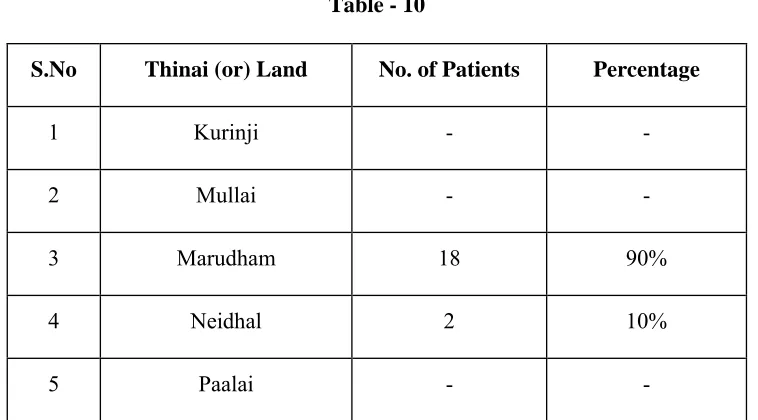
Nilam is classified into five types. They are
1. Kurinji : Mountain and its surroundings.
2. Mullai : Forest and its surroundings. Piththa noigal, Vaadha noigal, Liver diseases are common.
3. Marutham : Field and its surroundings. Safest place to maintain good health.
4. Neidhal : Sea and its surrounding. Vaadha diseases and liver enlargements are common.
5. Paalai : Desert and its surroundings. Vaadha, Piththa and kabha noigal are common.
Study of five lands is very much needed, as some diseases are common in the particular lands.
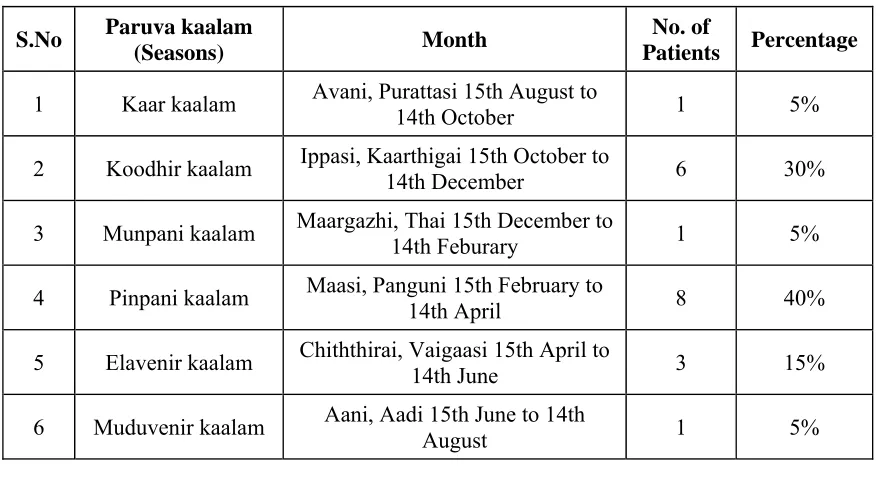
PARUVA KAALANGAL
A year is classified into six seasons, each constituting two months, They are
1. Kaarkaalam - Aaavani and Purattaasi
2. Koodhirkaalam - Iyppasi and Kaarththigai
3. Munpanikaalam - Maargazhi and Thai
Some of the diseases, during a particular season are commonly prevalent and study of it will also be such useful to diagnose.
The final diagnosis is confirmed by summarizing all the clinical findings observed by the above methods.
NOIKANIPPU VIVAADHAM (DIFFERENTIAL DIAGNOSIS)
There are certain other Vaadha diseases which resemble the clinical symptoms. As "Pakka Vaadham" but they differ in some ways. The careful and clear history taking and examination will reveal the correct diagnosis. They are
1. PATSCHA VAADHAM :
(gl;rthjk;)
The clinical features are
1. The legs loose its activity as dead's one 2. Immobility of leg
3. Unable to walk
4. No hand grip to both hands, and loose its sensation 5. Tingling sensation
6. Deviation of mouth and Drolling of saliva 7. Body itself to be very hot.
“
jhdhd fhy;nfhzpr; brj;jhw; nghyj;
jhf;fhd jiujdpny eyf;bfhz;lJ
fhdhd iffbshd;Wk; gpobfh lhJ
fdkhd czh;r;rpapd;wpf; iffs; nrhWk;
khdhd kaph;Tr;Re; jpkph;t[z; lhFk;
tha;jhD';
nfhzpna
jz;zPh;
tPGk;
-
a{fp
itj;jpa
rpe;jhkzp
–
800
2. URAGADHA VAADHAM :
(cufjthjk;)
The clinical features are
1. Pain present in the eyebrow, ear and half of the body. 2. Paralysis of the half of the body rarely
3. Involuntary movements of head and mouth 4. Chillness, tingling sensation of the body 5. Excess salivation
“
mw;g[jkha; nehthfpg; g[Ut'; fhJ
m';fj;jpw;
ghjpjhd; typj;bjg; nghJe;
jw;g[jkha;f; nfhzpna jiya[k; tha[e;
jhtnt kpf eL';fpf; Fwpj;j TRk;
tpw;g[jdha; tpHpfSe;jhd; kpifg;g[whJ
bkypthfp
rhPubky;yhk;
tpah;it
ahFk;
g[w;g[jdha; tha; ePU kpfnt a{Wk;
g[ifnk Uunt jj;jpd; ngnu
”
- a{fp itj;jpa rpe;jhkzp
3. ARPUDHA VAADHAM
(mw;g[jthjk;)
1. Vaadham mostly exaggerated during intercourse, getting angry, singing loudly, chewing betal nut, threatening and scolding others.
2. The exaggerated Vaadham leads to the paralysis and deviation of mouth.
“
jPh;f;fkha; !;jphPa';fk; gz;qk; nghJe;
jpLf;bfdnt thh;j;ijnfh gpj;jnghJk;
Cf;fkh a[wj;Jjhk; ghLk; nghJk;
kHfhd Kfe;jd;dpy; tha['; nfhlhj;
jhh;f;fkha; kpfr;rpjwp tha['; nfhq";
rh';fkh
aw;g[jth
je;jh
dhnk
”
- a{fp itj;jpa rpe;jhkzp
4. AMARAKANDA VALI :
(Fjpiu typ)
1. Initially, Pain all over the body 2. The limbs loose its strength 3. Fainting occurs
4. Occurrence of convulsions 5. Laughing
6. Excess sweating present in neck, head, shoulder and face. 7. Tongue and face paralyses unilaterally
8. Burning sensation and pain presents in throat, shoulders and back after the completion of convulsions.
“
,Jnt aku fz;ltyp
,';Fk; ehf;f Kf';nfhqk;
kJnt iffhY'; bka;ba';F
koe;J Joj;jhw; nghYisa[k;
a[ghJnt fz;l"; rpuRKfk;
g[Jbts;sk; nghw; ePbuhGFk;
kpfnt be";Re; njhw;KJFk;
gw;wp typf;Fk; cjuKnk
”
a{fp itj;jpa rpe;jhkzp
MUKKUTRA VERUPAADUGAL (PATHOGENESIS)
1. Any one or other etiological factors vitiate vaadham
3. And then Vayus, Udhalkattugal and other structures are also affected.
4. When Vaadham is vitiated body weakness, constipation, diminution of immunity, giddiness and sleeping disturbances are appeared.
Anar Piththam - Anorexia
Ranjaga Piththam - low haemoglobin level. Alosaga Piththam - Diminished vision
Saadhaga Piththam - Difficulty to use upper limb and lower limb of the affected side.
(6) In Kabham
Avalambagam - Cough, Disturbances of other Kabhams Pothagam - Unable to differentiate the tastes Tharpagam - Burning sensation of the eyes.
(7) In Vayus
Piraanan - Cough Abaanan - Constipation
Udhaanan - Numbness, tingling sensation, pain, muscle wasting in the affected side.
Samaanan - Disturbances of other Vaayus Naagan - Mental disturbances
Koorman - Productive cough Kirugaran - Productive cough Dhevathaththan - Sleeping disturbances
(8) In Udal Tathugal
Saaram - Tiredness, anorexia, mental depression
Senneer - Anorexia, low heamoglobin, level affected side Oon - Pain and muscle wasting in the affected side
Kozhuppu - Difficulty to raise the upper and lower limb of the affected side
Enbu - Pain in the Joints
TREATMENT OF PAKKAVAADHAM
In Siddha system of medicine the main aim of the treatment is removal of Udalpinigal (due to alterations of uyir thadhukkal and udal thadhukkal) and Ulappinigal (due to Schizophrenia). Treatment is not only for removal of disease but for the prevention and improving the body condition also. This said to as follows.
1. Kaapu 2. Neekkam and 3. Niraippu
Ayyan Thiruvalluar says about physicians duty "Study the disease; spy the cause; seek subsiding ways and do what is proper and effective" and "The man well versed in medical lore, would measure the patient, disease and time before the healing work begins".
“
neha;eho neha;Kjy; eho mJjzpf;Fk;
tha; eho tha;g;gr; bray;
”
-
jpUf;Fws;
“
cw;whd st[k; gpzpast['; fhyK';
fw;whd; fUjpr; bray;
”
-
jpUf;Fws;
So, it is essential to know the disease, the cause, the nature of the patient, severity of illness, the seasons and time of occurrence must be observed clearly.
The treatment is divided into three types in siddha system of medicine namely Dheva Maruththuvam, Maanida Maruththuvam, Asura Maruththuvam. The Deva Maruththuvam which is one by Parpam, Chendhooram, Sunnam, Padhangam, Kattu, Kalangu and Kurukuligai etc., is high potent and quick effective.
LINE OF TREATMENT
2. Medicines, internal and external are to be given for the affected Uyir Thaadhukkal, Udal Thaadhukkal and Vaayus.
3. The Sirappu Maruthuvam are Thokkanam must be done after application of oil for the strengthening the affected part. Varmam, Yogaasanam, Piraanaayaamam and Thiyaanam are also applied as supportive therapy to get quick relief.
4. Physical exercises for both upper and lower limbs must be advised to improve the muscle tone.
5. The food and habits, which are avoiding and adding, are also determined clearly.
6. Kanma neekkam is apart of treatment and it must also be done properly before the treatment.
TREATMENT (1) PURGATIVE
It corrects the vitiated Vaadham
“
ngjpahy; thjk; jhGk
”
Murukkanviththu at early morning is given one day before starting the main treatment for given some patients.
“
XJfpd;w kyf;fl;il bahHpa itj;jhy;
clypYs;s thijbayh bkhL';fpg; nghFk;
”
(2) MEDICINES
i. The Anti - Vaadha drugs the both internal medicine and the external applications are given to relieve the symptoms and strengthen the affected parts.
iii. The 'Kayakalpha' drugs like Chithramoolam are more effective to Vaadha diseases and also for rejuvenating therapy.
(3) THOKKANAM (MASSAGE)
Massage is the first friend, which serves the human beings from the time of birth. It is excellent for relieving muscle aches, muscle weakness, muscular atrophy and it is powerful non-drug method to promote sleep by using medicated oils. To be a good massager, one needs to look at the formation and function of the human Physiology and Anatomy musculature. The Physician should be physically and mentally healthy.
Massage which works with blood vascular system, to improve the circulation of blood to the affected parts, nervous system, and lymphatic system. It's works on the body, both levels of physical and mental. It balances the three Dhosam.
1. PHYSICAL
Rubbing of the body produces heat and increases the blood circulation. It affects the lymphatic system and supplies more blood to the affected area. Body heat and vitality increase as the heart and circulatory open up to provide fresh oxygen and vital energy to all parts of the body while simultaneously drained out waste gases and toxins. As it increases circulation of blood any body temperature massage should be avoided during high blood pressure and Hyper pyrexia.
2. PSYCHE
Through touch massage works on the nervous system and affects the circulation of growth hormone. All feelings and fantasies of the massager one transmitted to the person getting the massage.
3. SIRAPPU MARUTHUVAM
Varumam, Thokkanam, Yogaasanam, Piranaayaamam and Thiyaanan are the sirappu maruthuvam in the treatment of "Pakkavaadham" and they are done as supportive therapy for quick relief.
1. YOGAASANAM (Postures)
The yogaasanams are reliable supportive or sometimes main part of treatment of Vaadha diseases generally or specially. This therapy is regarded as a science as well as a method that allow living a harmonious life. The yogaasanaas are useful not only to revive the body and also to strengthen the nervous system. It is more important than physiotheraphy for not spending more physical energy and also provides the mind to be calm. To regenerate the glands and treats the physical and mental illness, they bring the human body under the complete control of the mind.
In cases of improved 'Pakkavaadham' Bhujangaasanam, Shalabhasanam, Pawanamuktasana and in cases of fully affected "Pakka vaadham" Savaasanam are very useful.
1. Bujangaasanam Position
Lie prone on the blanket keeping the legs together, chin touching the ground and the legs facing up, stretch the hands straight forward, alongside the head resting the palms of the ground.
Procedure
1. Bring the arms back to the level of the 12th rib bone. keep the hands bent at elbows, least pressure to be exerted on the hands maintain the elbows touching the body let it not spread out.
2. Shalabhasanam Position
Lie prone on the blanket, keeping the legs and hands together, chin and palm facing the floor and heal facing up. Rest the face towards the floor.
Procedure
Raise the legs upwards without bending the knees for that knee facing towards top and lesser pressure to be exerted by hands on the body to provide support.
Wait for few minutes and then return the same to initial stage.
3. Pawanamuktasanam Position
He supine on the Plantar the keeping the legs together heel posterior of the thigh, back palms of hands and scapular of the shoulder touching the ground and the face, chest, knees, toes of legs facing upwards.
Procedure
1.Bring the knees close to the neck and that thigh touches the chest closely, chin and fingers of the legs faces upwards, knees bend at the level of nipples.
2.Raise the head first and this upper portion of the trunk slowly and shin touches the knees, tie the hands with one another on the shin to keep the knee close to chest as able as possible.
4. Savaasanam Position
Procedure
1. Slightly stretch the body and allow the whole body to relax completely.
2. By concentrating the mind on different parts of the body starting form the toes to the head, a feeling of relaxation is propagated.
5. Maharaasanam – I
Stages of Maharaasanam - I
1. Ask the patient to lie in the supine position with the fingers showing Muththirai.
2. Turn the hip and lower limbs towards right side while the neck and head facing left side. Repeat the same in opposite direction.
3. Ask the patient to come back the initial position. Flex knee close to the thigh.
4. In the same position, ask the patient to turn the knee to the left side while neck & head facing towards right side.
5. Repeat the same in upward direction.
6. Ask the patient to come back the initial position. Hold the right leg over to left leg.
7. Turn the hip towards right side while head and neck facing towards right side. Repeat the same in opposite left direction.
8. Ask the patient to flex the left elbow and left knee. Repeat the same in opposite direction.
Stages of Maharaasanam - II
1. Ask the patient to lie down in the floor fact, chest, palms, knees touches the floor as shown in fig - 1
2. Turn the face trunk and hip to the left side. Repeat the same in the right side.
3. Ask the patient to come back to the initial position. Hold the feet touch the thigh by flexing the knee.
4. Turn the feet to the left side while trunk and face towards right side.
5. Repeat the same in the opposite side. Ask the patient to hold the right leg over the left leg and turn the hip towards left side and then right side.
6. Ask the patient to raise the left upper limb and flex the right knee.
7. Repeat the same in opposite side. Ask patient to lie down relax.
(II) PIRANAAYAAMAM
Piraanaa means vital force or oxygen or cosmic energy.
Niyama means the control of the Piraanan.
Regular practice of the "Piraanaayaamam and Asanaas combined with control of the mind will combat negative elements such as ignorance, laziness, inertia and over excitement as well as increasing the will power.
Procedure
One respiration consists of the cycle of inspiration, retention and expiration. 1. First, inhale one part of air through left nostril (Pooragam)
These six events complete a cycle of Piraanaayaamam
The main object of Piraanaayaamam is to acquire mastery of the vital force, action with in the body. It improves the functions of Piraanan, nourishes the body cells, purifies blood and tones up nerves.
OXYGEN FOR NERVES
The excitability of the central nervous system, i.e., its ability to become active, varies under different conditions.
One of the conditions for normal activity of the brain and spinal and cord is an adequate supply of oxygen to the nerve cells. The cells of the brain and spinal cord consume much more oxygen than the cells of other organs. An inadequate supply of oxygen leads to a decrease in the nerve cells and may kill them. It is also clear that changes in the blood circulation in the brain impair the brain’s activity because they disturb the normal supply of oxygen and nutrients.
ROLE OF THE NERVOUS SYSTEM
The nervous system regulates the activities of the different organs and of the entire organism. Muscular contraction, glandular secretion, heart action, metabolism and the many other processes continuously operating in the organism are controlled by the nervous system.
The nervous system links the various organs and systems, co-ordinates all their activities and ensures the integrity of the organism.
Human Anatomy and Physiology
by V.TATARINOV
(III) THIYAANAM (MEDITATION)
“
bfhy;yhd; bgha;Twhd; fstpyhd; vz;Fzd;
ey;yhd; mlf;f Kilahd; eLr;bra;a
ty;yhd; gFj;Jz;ghd; khrpyhd; fl;fhkk;
,y;yhd; ,akj;jpil apy;epd;whnd
”
“
Jha;ik mUSd; RUf;fk; bghiw brt;it
tha;ik epiyik tsh;j;jny kw;wpait
fhk'; fst[ bfhiybadf; fhz;git
nekpaP
iue;J epakj;j dhnk
”
-
jpU\yh;
Thiyaanam means the continuous flow of the mind towards "Aathmaa" (soul or mind) through the total exclusion of all ideas foreign to it. The principle disciplines for Thiyaanam are eyamam and niyamam. Eyamam includes non-violence, truth fullness, non-stealing, and sensation of all women as mothers and sisters except wife and not speaking and doing useless matters. Niyamam means outer and inner purity, contentment austerities, study of scripture and devotion to God. By Thiyaanam man can know himself, so it is helpful in stressful mental conditions and gives relaxation to mind.
“Yogic physical culture, unlike the many western systems of physical culture, does not make a pretence of merely developing the superficial muscles of the body, but the exercises do make them healthy and strong, particularly the trunk muscles, by requisitioning their help to tone up all the involuntary organs of the body which are mainly concerned with such processes as digestion, evacuation, circulation, respiration and section, and through them, the automatic nervous system which regulates their activities from “Yogic asanas for health and vigour ” V.G.Rele, L.M & S., F.C.P.S.
(IV) EXERCISES
EXERCISES FOR HAND
1. Stand in relaxed position
2. Raise both the upper limbs evenly upwards and join together above the hand.
3. Bring the upper limbs as in the initial stage.
4. Raise both the upper limbs up to the shoulder level in front of the chest and join together.
5. Extend the upper limbs outwards to the maximum extend while facing the face and palms in same direction.
6. Move the right and left upper limbs alternatively and simultaneously back and front.
7. Raise the up to shoulder level and bring the forearm in front of the chest. Then hold both the thumbs touching together.
8. Stand in the relaxed position and turn the hip. Turn shoulder, neck and head to the left side and do the same turn towards right side.
9. Stand in the knee flexed position and turn the hip, trying to make a circle.
EXERCISES FOR LEGS
1. Ask the patient to sit comfortable as shown in fig.1
2. Bring the both great toes touching together.
3. Turn the both feet towards right side as shown in fig.3
4. Again turn the both feet towards left side as shown in fig.4
5. Flex the right knee and lie over the left thigh. Hold the toes by using the fingers.
7. Ask the patient to be in knee down position, bring the fingers join together behind the hip.
8. Hold the hands in the same position supporting the hip.
9. Ask the patient to bring the fingers behind the buttocks.
5. PATHTHIYAM (Diet regimen)
Paththiyam is also an important part of treatment. It is divided into three types namely Echcha Paththiyam, Kadum Paththiyam and Migakkadum paththiyam. Uppilla paththiyam is also mentioned in many ancient siddha literatures, especially for the vaadha diseases.
Uppillaa Paththiyam
The salt free dieting during treatment and then the same duration of salt free redieting are followed strictly. The day after fried salt must add in diet and taking oilboth with milk of Omam and cow's ghee. Then only salt may be added in diet.
With this, the following food and habits must also be followed. Add twicely
cooked rice, brinjal, green vegetables and non-vegetables diet like kaadai (
fhil
) koudhaari(
bfsjhhp
) udumbu (cLk;g[
) and vellaadu (bts;shL
)Avoid the tubers and other Vaadha vitiated foods.
Avoid the exposure of Cold air.
The bed must be clean without moisture.
Keep the mind peaceful
Padhaarththa Guna Sindhaamani (gjhh;j;j Fz rpe;jhkzp) advices the following foods for Vaadha diseases.
“
br';fG ePh;nfhl;le; njd;kpsF ey;byz;bza;
j';FbgU'; fha'; jGjhiH - v';bf';F
Tl;LrpW Kj;Jbea; njhjpy; cGe;jpitfs;
thl;Lkzp yj;ij kjp
”
- gjhh;j;j Fz rpe;jhkzp
Proper dietetic regimen enhances the effect and bioavailability of the drug and in conductive to the maintenance of good health. If dietetic regimen is not followed properly, certain foods may incompatible and antagonize the drug effect and produce harmful effects to the body.
“
gj;jpaj;jp dhny gyDz;lhFk; kUe;J
gj;jpa';fs; nghdhy; gyd; nghFk; - gj;jpaj;jpy;
gj;jpank btw;wpjUk; gz;ojUf; fhjypdhw;
gj;jpank cj;jpbad;W ghh;
”
njiuah; akf btz;gh
VAADHA PACIFYING FOOD LIST
Grains : Barley, Amaranth, Wheat, oats and Quinea.
Legumes : Mung beans, Aduki beans, Split yellow mung dal, Red and yellow split pea. Urad dal. All these should be cooked to a soft consistency.
Fruits : Sweet and sour tastes, like grapes, lemons, pears, bananas, sweet organs dates, figs, apples (preferably cooked) avocados berries and a small amount of raisins.
Vegetables : Sweet vegetables like beets, cauliflower, leeks, carrots, asparagus, cilantro, fennel and a small amount of garlic, green beans, green chilies, okra, parsnips pumpkins and radishes (Preferably cooked)
Dairy : Fresh, whole and homogenized milk ghee and a small amount of butter.
Meats : White meat like chicken, fish, or turkey (Baked or broiled) and chickens broth.
Nuts : A small amount of almonds, pecans and sesame seeds.
Oils : Sesame and olive in a smaller amount.
6. KANMA NEEKKAM (EXPIATION)
Kanma means the deeds which are bad, committed by an individual in this and previous births. So he must expiate, it to get better relief before the treatment.
To expiate the misdeeds of kanmam Planting the young trees.
Establishing the gardens. Laying roads and pathways. Digging wells
Ponds for public use. Constructing temples and
Denouements to poor children must be done.