i
University of Southern Queensland, Australia
Tissue Conductivity based Human Head Model Study for
EEG
A Dissertation Submitted by
Md. Rezaul Bashar
ii
Abstract
The electroencephalogram (EEG) is a measurement of neuronal activity inside the brain over a period of time by placing electrodes on the scalp surface and is used extensively in clinical practices and brain researches, such as sleep disorders, epileptic seizure, electroconvulsive therapy, transcranial direct current stimulation and transcranial magnetic stimulation for the treatment of the long term memory loss or memory disorders.
The computation of EEG for a given dipolar current source in the brain using a volume conductor model of the head is known as EEG forward problem, which is repeatedly used in EEG source localization. The accuracy of the EEG forward problem depends on head geometry and electrical tissue property, such as conductivity. The accurate head geometry could be obtained from the magnetic resonance imaging; however it is not possible to obtain in vivo tissue conductivity. Moreover, different parts of the head have different conductivities even with the same tissue. Not only various head tissues show different conductivities or tissue inhomogeneity, some of them are also anisotropic, such as the skull and white matter (WM) in the brain. The anisotropy ratio is variable due to the fibre structure of the WM and the various thickness of skull hard and soft bones. To our knowledge, previous work has not extensively investigated the impact of various tissue conductivities with the same tissue and various anisotropy ratios on head modelling.
iii
spherically and realistically shaped head geometries for the head model construction. We also investigate the sensitivity of inhomogeneous and anisotropic conductivity on EEG computation.
v
Acknowledgements
I would like to express my gratitude to my principal supervisor A/Prof Yan Li for offering me the opportunity to perform this research under her supervision, support, motivation, encouragement, advice, comments and discussions. I owe much gratitude to my associate supervisor Dr Peng (Paul) Wen for his guidance, continuous support, encouragement, his knowledge and willingness to answer my questions, discussions about current research issues and critically evaluating my work during my whole research period. I would not imagine carrying out this research without his constant support and help.
I would like to thank Dr Guang Bin Liu, Department of Psychology for his support to understanding the most complex organ of the human body, the brain and its function at the beginning of this research. I would also like to thank A/Prof Shahjahan Khan, Department of Mathematics & Computing and Md. Masud Hasan (Sunshine Coast University) for their assistance in the understanding of statistical analysis.
I would like to thank Professor Mark Sutherland, Director of Centre for Systems Biology for the support of my partial international tuition fees and grants to attend conference.
I wish to thank my colleagues in our research group for their discussions and comments during our discussions, especially in the monthly seminars.
I also want to thank the Australian Research Council discovery grant for my scholarship, Department of Mathematics & Computing for my studentship and travel grant to attend international conferences and the higher degrees research office for International research excellence award during my study.
I would like to thank Dr Ian Weber, Learning and Teaching Support Unit, USQ and Lynne A. Higson, West Queensland for their efforts to correct my English.
Last but not least, I offer my gratitude to my wife Mst Asmaul Husna and my lovely son Md Samiul Bashar for their endless support and enduring love.
vi
Table of Contents
Abstract i
Declaration iii
Acknowledgement iv
Table of Contents v
List of Figures x
List of Tables xv
List of Acronyms xviii
Notation and Symbols xx
Publications xxi
1 Introduction 1
1.1 Electroencephalography and Head Modelling 2
1.2 Significance of Head Modelling 3
1.3 The Originality of this Dissertation 5
1.4 Organization of the Dissertation 6
2 Features of Human Head 8
2.1Anatomy of Human Head 2.2
8
2.1.1 Anatomy of the brain 8
2.1.1.1 Anatomy of the neuron 11 2.2.1.2 Physiology of the neuron 12
2.1.2 Anatomy of the skull 13
2.1.3 Anatomy of the scalp 14
2.2 Generation and Collection of EEG 15
2.3 Electric Features of the Head 17
2.4 Summary 18
3 Human Head Model and Tissue Conductivity 20
3.1 Human Head Modelling 20
3.1.1 Spherical head model 20
3.1.2 Realistic head model 21
3.2 Electrical Conductivity of Head Tissues 23 3.3 Tissue Conductivity used in the Dissertation 26
vii
3.5 Methods to Determine Inhomogeneous Tissue Conductivity 27 3.5.1 Pseudo conductivity based inhomogeneous conductivity
generation
28 3.5.2 The brain tissue inhomogeneity 28 3.5.3 The skull tissue inhomogeneity 29 3.5.4 The scalp tissue inhomogeneity 29 3.6 Methods to Determine Anisotropic Tissue Conductivity 30
3.6.1 White matter anisotropy 30
3.6.1.1 The Volume constraint 31 3.6.1.2 The Wang’s constraint 33
3.6.2 Skull Anisotropy 33
3.7 Inhomogeneous and Anisotropic Tissue Conductivity Approximation methods
35 3.7.1 Conductivity ratio approximation model 36 3.7.2 Statistical conductivity approximation model 36 3.7.3 Fractional anisotropy based inhomogeneous and
anisotropic
conductivities model
37
3.7.4 The Monte Carlo method based inhomogeneous and anisotropic
Conductivities model
39
3.8 Conclusion and Contribution 41
4 The Forward Problem and its Solution using FEM 42
4.1 Maxwell’s and Poisson’s Equations 42
4.2 Boundary Conditions 45
4.3 The Current Source or Dipole Model 46
4.4 The EEG Forward Problem 47
4.5 General Algebraic Formulation of the EEG Forward Problem 48 4.6 Electric Potential in a Multi-layer Spherical Model 49 4.7 Numerical Solution of the EEG Forward Problem 51
4.7.1 Direct approach 51
4.7.2 Subtraction approach 52
4.7.3 The finite element method 53
4.7.3.1 Why do we select FEM? 53 4.7.3.2 Formulation of FEM 54
4.8 Summary 57
5 Effects of Tissue Conductivity on Head Modelling 58
5.1 Methodology and Tools 58
5.1.1 A spherical head model construction 58
5.1.2 Used tools 60
5.2 Influence of Anisotropic Conductivity 61
viii
5.2.2 Head model construction 61
5.2.3 Simulation setup 61
5.2.4 Simulation results 63
5.2.5 Conclusion 64
5.3 Influence of Inhomogeneous and Anisotropic Tissue Conductivities
64
5.3.1 Objective of the study 64
5.3.2 Conductivity ratio approximation model 65 5.3.2.1 Simulation setup 65 5.3.2.2 Simulated results 66
5.3.2.3 Conclusion 68
5.3.3 Statistical conductivity approximation model 68 5.3.3.1 Simulation setup 69 5.3.3.2 Simulation results 70
5.3.3.3 Conclusion 71
5.3.4 Fractional Anisotropy based conductivity model 71 5.3.4.1 Head model construction and simulation 71 5.3.4.2 Simulations and results 71
5.3.4.3 Conclusion 73
5.3.5 The Monte Carlo method based conductivity model 73
5.3.5.1 Simulation 74
5.3.5.2 Simulation results 74
5.3.5.3 Conclusion 75
5.3.6 Effects of conductivity variations on EEG 76 5.3.6.1 Objective of the study 76 5.3.6.2 Head model construction 76 5.3.6.3 Simulation setting and computing 76
5.3.6.4 Conclusion 80
5.3.7 Implementation of inhomogeneous and anisotropic conductivity using stochastic FEM
80
5.3.7.1 Objective of the study 80
5.3.7.3 Simulation setup 81
5.3.7.4 Simulation results 82
5.3.7.5 Conclusion 87
5.4 Conclusion and Contribution 87
6 Advanced study 89
6.1 Local Tissue Conductivity 89
6.1.1 Aims of the study 89
ix
6.1.3 Local tissue conductivity based head model I 91 6.1.3.1 Spherical head model construction 91 6.1.3.2 Realistic head model construction 93 6.2.3.3 Conductivity assignment 95
6.2.3.4 Simulations 95
6.2.3.5 Simulation results 96 6.1.4 Local tissue conductivity based head model II 101 6.1.4.1 Head models construction 101 6.1.4.2 Simulation and results 102
6.1.4.3 Discussion 103
6.2 EEG Analysis on Alzheimer’s Disease Sources 105
6.2.1 Aims of the Study 105
6.2.2 Introduction 105
6.2.3 Methods 106
6.2.3.1 Finite element conductivity 107 6.2.3.2 Source modelling 107 6.2.3.3 Simulation and results 108
6.2.3.4 Discussion 110
6.3 Conclusion 111
7 Sensitivity Analysis 113
7.1 Head Model Construction 113
7.2 Uncertain Conductivity Approximation 113
7.3 Sensitivity Parameter Definition 115
7.4 Implementation and Experimentation 117
7.5 Experimental Results 117
7.5.1 Results in the spherical head models 117 7.5.2 Results in the realistic head model 121
7.6 Discussion and Conclusion 122
8 Conclusion 124
8.1 Main Contributions 124
8.1.1 A series of head model construction on inhomogeneous and anisotropictissue conductivity
125
8.1.2 Systematically studied the effects of inhomogeneous and anisotropic tissues on EEG computation
126
8.1.3 Local tissue conductivity on head modelling 126 8.1.4 Computation of sensitivity indexes for inhomogeneous
and anisotropic conductivity
x
8.2 Future Work 127
8.2.1 The model improvement 128
8.2.2 Segmentation 128
8.3.3 Conductivity 128
xi
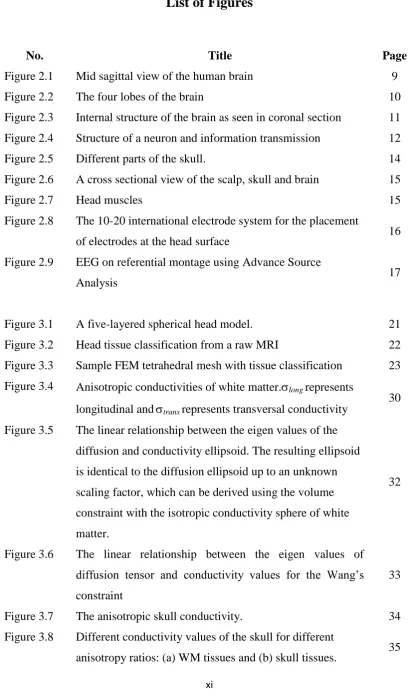
List of Figures
No. Title Page
Figure 2.1 Mid sagittal view of the human brain 9
Figure 2.2 The four lobes of the brain 10
Figure 2.3 Internal structure of the brain as seen in coronal section 11 Figure 2.4 Structure of a neuron and information transmission 12
Figure 2.5 Different parts of the skull. 14
Figure 2.6 A cross sectional view of the scalp, skull and brain 15
Figure 2.7 Head muscles 15
Figure 2.8 The 10-20 international electrode system for the placement
of electrodes at the head surface 16
Figure 2.9 EEG on referential montage using Advance Source
Analysis 17
Figure 3.1 A five-layered spherical head model. 21 Figure 3.2 Head tissue classification from a raw MRI 22 Figure 3.3 Sample FEM tetrahedral mesh with tissue classification 23 Figure 3.4 Anisotropic conductivities of white matter.longrepresents
longitudinal andtransrepresents transversal conductivity
30
Figure 3.5 The linear relationship between the eigen values of the diffusion and conductivity ellipsoid. The resulting ellipsoid is identical to the diffusion ellipsoid up to an unknown scaling factor, which can be derived using the volume constraint with the isotropic conductivity sphere of white matter.
32
Figure 3.6 The linear relationship between the eigen values of diffusion tensor and conductivity values for the Wang’s constraint
[image:11.595.109.521.77.774.2]33
Figure 3.7 The anisotropic skull conductivity. 34 Figure 3.8 Different conductivity values of the skull for different
xii
Figure 3.9 Fractional anisotropy for WM 38
Figure 3.10 Conductivity ratio Vs fractional anisotropy (FA). 38 Figure 3.11 Volume constrained conductivities produced by Monte
Carlo method. Conductivity analysis using histogram: (a) radial conductivities and (b) tangential conductivities
40
Figure 4.1 Boundary between two compartments. 1 and 2 are conductivities of tissue layer 1 and 2, respectively, and the normal vector en is the interface.
45
Figure 4.2 A dipole model. r0 is the location of dipole centre. +I0 is current source and –I0 is the current sink points. d is distance from source to sink and I(r) is current field at a point r.
47
Figure 4.3 The angle between vectors pointing to surface position r and dipole location rq is denoted . The angle the dipole q makes with the radial direction at rq is denoted . The angle between the plane formed by rq and q, and the plane formed by rq and r is denoted
50
Figure 5.1 Spherical head model construction 59 Figure 5.2 (a) Value of conductivity ratio (lt) between longitudinal
and transverse conductivity for each WM element generated by CRA, (b) clear view of (a) from 102 to 103 WM elements, (c) longitudinal (long.) and transverse (trans.) conductivity values for each WM elements based on
lt of (a) using Volume constraint, and (d) clear view of (c)
from 102 to 103 WM elements
66
Figure 5.3 (a) Value of lt (conductivity ratio) between longitudinal and transverse conductivity for each WM element generated by SCA, (b) clear view of (a) from 102 to 103 WM elements, (c) longitudinal and transverse conductivity values for each WM elements based on lt of (a) using
xiii
Volume constraint, and (d) clear view of (c) from 102 to 103 WM elements
Figure 5.4 Probability density function of Rayleigh distribution. 77 Figure 5.5 Inhomogeneous anisotropic conductivities produced by
SCA. (a)–(d) WM elements and (e)-(h) skull elements. 78 Figure 5.6 Effects of inhomogeneous anisotropic WM conductivity on
EEG: (a) relative errors () values (in percentage) and (b) correlation coefficient () values.
83
Figure 5.7 Effects of inhomogeneous anisotropic skull conductivity on EEG: (a) relative errors () values (in percentage) and (b) correlation coefficient () values.
84
Figure 5.8 Effects of inhomogeneous anisotropic WM and skull conductivities together on EEG: (a) relative errors () values (in percentage) and (b) correlation coefficient () values.
85
Figure 5.9 Effects of inhomogeneous anisotropic head model on EEG: (a) relative errors () values (in percentage) and (b)
correlation coefficient () values.
86
Figure 5.10 Topographic visualization of the scalp electrode potentials. (a) head model (A) and head model (D): (b) from the parallel Volume constraint, (c) from the parallel Wang’s constraint, (d) from the perpendicular Volume constraint and (e) from the perpendicular Wang’s constraint
conductivity for the first dipole (elevation angles /5.22 and azimuth angle /4).
87
Figure 6.1 Simplified local tissue conductivity based three-layered
spherical head model showing different tissues. 92 Figure 6.2 Local scalp tissue conductivity approximation. The
conductivity for scalp (skin) is 0.33 S/m, wet skin (place of electrodes) is 0.1 S/m and fat is 0.04 S/m.
93
xiv
Figure 6.4 RDM and MAG from assigning local conductivity to different layers in a three-layered spherical head model using the somatosensory cortex (SC) and the thalamic dipoles. In the above figures, label Br, Sk and Sc represent brain, skull and scalp, respectively.
97
Figure 6.5 RDM and MAG from assigning local conductivity to different layers in a four-layered spherical head model using the somatosensory cortex and the thalamic dipoles. In the above figures, label Br, Sk and Sc represent the brain, skull and scalp, respectively.
98
Figure 6.6 RDM and MAG from assigning the local conductivity to
different layers in the realistic head model for both dipoles. 100 Figure 6.7 The brain is viewed from the outer side and front with the
hippocampus and amygdala. 107
Figure 6.8 Location of one of the AD sources in RA by the cross hairs
in different views. 108
Figure 6.9 RDM (a) and MAG (b) errors from different brain tissue
distortion levels on source to source basis. 109 Figure 6.10 RDM (a) and MAG (b) errors from RA and LA sourced
without and with different brain tissue distortion levels to SC sourced normal EEG.
109
Figure 6.11 Contour view of scalp potentials obtained from somatosensory cortex (a) reference model, (b) five percent, (c) ten percent, (d) fifteen percent and (e) twenty percent brain tissue distortions.
110
Figure 6.12 Electrode positions (left ear-Nasion – right ear). Odd
number with electrode names indicate left hemisphere, even number with electrode names indicate right hemisphere.
111
Figure 7.1 WM conductivity uncertainty: (a) mean relative errors (m) and (b) mean correlation coefficient (m) values generated by incorporating WM conductivity uncertainty. RefA and
xv
RefB represent the Reference Models A and B, respectively.
long represents the longitudinal and trans represents the
transversal conductivities with V for Volume constraint and W for Wang’s constraint.
Figure 7.2 Skull conductivity uncertainty: (a) mean relative errors (m) and (b) mean correlation coefficient (m) values generated by incorporating skull conductivity uncertainty. RefA or RefB stands for either reference model A or B. tan
represents the tangential and rad represents the radial conductivities with V for Volume constraint and W for Wang’s constraint.
119
Figure 7.3 The scalp conductivity uncertainty: (a) mean relative errors (m) and (b) mean correlation coefficient (m) values. RefA or RefB stands for either reference model A or B. tan represents the tangential and rad represents the radial conductivities with V for Volume constraint and W for Wang’s constraint.
xvi
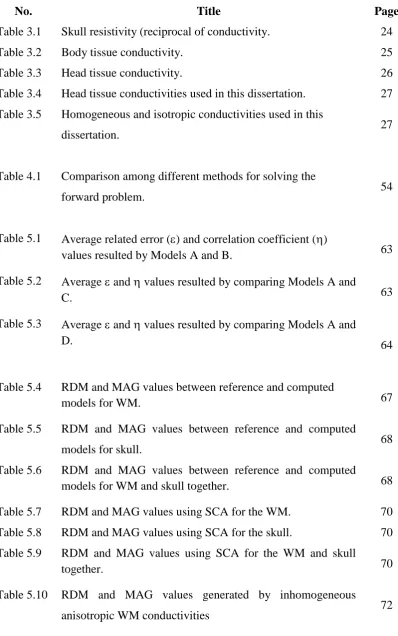
List of Tables
No. Title Page
Table 3.1 Skull resistivity (reciprocal of conductivity. 24
[image:16.595.117.516.112.749.2]Table 3.2 Body tissue conductivity. 25
Table 3.3 Head tissue conductivity. 26
Table 3.4 Head tissue conductivities used in this dissertation. 27 Table 3.5 Homogeneous and isotropic conductivities used in this
dissertation. 27
Table 4.1 Comparison among different methods for solving the
forward problem. 54
Table 5.1 Average related error () and correlation coefficient ()
values resulted by Models A and B. 63
Table 5.2 Average and values resulted by comparing Models A and
C. 63
Table 5.3 Average and values resulted by comparing Models A and
D. 64
Table 5.4 RDM and MAG values between reference and computed
models for WM. 67
Table 5.5 RDM and MAG values between reference and computed
models for skull. 68
Table 5.6 RDM and MAG values between reference and computed
models for WM and skull together. 68
Table 5.7 RDM and MAG values using SCA for the WM. 70 Table 5.8 RDM and MAG values using SCA for the skull. 70 Table 5.9 RDM and MAG values using SCA for the WM and skull
together. 70
Table 5.10 RDM and MAG values generated by inhomogeneous
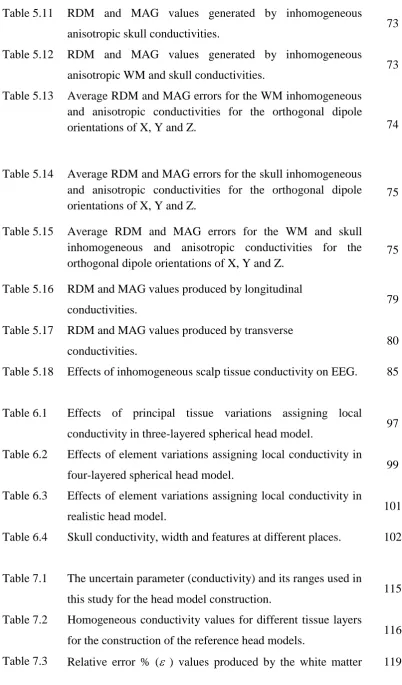
xvii
Table 5.11 RDM and MAG values generated by inhomogeneous
anisotropic skull conductivities. 73
Table 5.12 RDM and MAG values generated by inhomogeneous
anisotropic WM and skull conductivities. 73 Table 5.13 Average RDM and MAG errors for the WM inhomogeneous
and anisotropic conductivities for the orthogonal dipole
orientations of X, Y and Z. 74
Table 5.14 Average RDM and MAG errors for the skull inhomogeneous and anisotropic conductivities for the orthogonal dipole orientations of X, Y and Z.
75
Table 5.15 Average RDM and MAG errors for the WM and skull inhomogeneous and anisotropic conductivities for the orthogonal dipole orientations of X, Y and Z.
75
Table 5.16 RDM and MAG values produced by longitudinal
conductivities. 79
Table 5.17 RDM and MAG values produced by transverse
conductivities. 80
Table 5.18 Effects of inhomogeneous scalp tissue conductivity on EEG. 85
Table 6.1 Effects of principal tissue variations assigning local
conductivity in three-layered spherical head model. 97 Table 6.2 Effects of element variations assigning local conductivity in
four-layered spherical head model. 99
Table 6.3 Effects of element variations assigning local conductivity in
realistic head model. 101
Table 6.4 Skull conductivity, width and features at different places. 102
Table 7.1 The uncertain parameter (conductivity) and its ranges used in
this study for the head model construction. 115 Table 7.2 Homogeneous conductivity values for different tissue layers
[image:17.595.111.514.65.751.2]xviii
conductivity perturbations for different dipole eccentricities. Table 7.4 Sensitivity indexes for different conductivities in the
spherical head model comparing with the reference model A. 120 Table 7.5 Sensitivity indexes for different conductivities in realistic
xix
List of Acronyms
AD- Alzheimer’s disease AP – Action potential
ASA- Advanced source analysis BEM – Boundary Element Method BEV –Brain element variation BTDL- Brain tissue distortion level CC – Correlation coefficient
CDL – Cortical dipole layer
CRA- Conductivity ratio approximation CSF – Cerebrospinal Fluid
CT- Computed tomography DB- Dipole bunch
DT- Diffusion tensor
DT-MRI- Diffusion tensor magnetic resonance imaging EEG- Electroencephalography
FA- Fractional anisotropy FE – Finite Element
FDM – Finite Difference Method FEM – Finite Element Method GM- Gray matter
LTC-Local tissue conductivity MAG – Magnification factor MEG- Magnetoencephalography MLE- Maximum likelihood estimator MRI-Magnetic resonance imaging
PDF- probability density function
SC-Somatosensory cortex
xx SCEV – Scalp element variation
SEV – Skull element variation
RDM – Relative difference measure RE- Relative errors
VC- Volume constraint
xxi
Notations and Symbols
- Charge density ()
µ - Mean or homogeneous conductivity of a tissue layer
- Anisotropy or conductivity ratio
2
– Variance of conductivity
- Conductivity
- Conductivity tensor
t, – Transversal conductivity of the white matter, Tangential conductivity of the
skull
trans – Transversal conductivity of the white matter
long – Longitudinal conductivity of the white matter
rad – Radial conductivity of the skull
tan – Tangential conductivity of the skull
-Relative error
-Correlation coefficient B - Magnetic field D - Electric field E- Electric field H - Magnetic field K+ - Potassium ion Na+ – Sodium ion Cl- – Chloride ion
xxii
Publications
1. Bashar, M. R., Li, Y. and Wen, P., Effects of Local Tissue Conductivity on Spherical and Realistic Head Models, Australasian
Physical & Engineering Sciences in Medicine, Vol 33, No 3, pp. 333-342, 2010.
2. Bashar, M. R., Li, Y. and Wen, P., Uncertainty and sensitivity analysis for anisotropic inhomogeneous head tissue conductivity in
human head modelling, Australasian Physical & Engineering Sciences
in Medicine, Vol 33, No 2, pp. 145-152, 2010.
3. Bashar, M. R., Li, Y. and Wen, P., Study of EEGs from
Somatosensory Cortex and Alzheimer’s Disease Sources, International
Journal of Medicine and Medical Sciences, Vol 1, No 2, pp. 62-66, 2010 .
4. Bashar, M. R., Li, Y. and Wen, P., A systematic study of head tissue inhomogeneity and anisotropy on EEG forward problem computing,
Australasian Physical & Engineering Sciences in Medicine, Vol 33, No 1, pp. 11-21, 2010.
5. Bashar, M. R., Li, Y. and Wen, P., Effects of Local Tissue Conductivity on Spherical and Realistic Head Models, Australasian
Physical & Engineering Sciences in Medicine, Vol 31, No 2, pp. 122-130, 2008.
6. Bashar, M. R., Li, Y. and Wen, P., Effects of the Local and Spongiosum Tissue Conductivities on Realistic Head Modelling,
International Conference on Complex Medical Engineering, (CME 2010), 13 -15 July, Gold Coast, Australia, 2010.
7. Bashar, M. R., Li, Y. and Wen, P., EEG analysis on skull
conductivity perturbations using realistic head mode, International
Conference on Rough Set and Knowledge Technology (RSKT2009), 14-16 July, 2009, Gold Coast, Australia.
xxiii
head modelling, IEEE International Conference on Computer and
Information Technology (ICCIT 2008), 24-25 December, 2008, Khulna, Bangladesh.
9. Bashar, M. R., Li, Y. and Wen, P., Effects of white matter on EEG of multi-layered spherical head models, IEEE International Conference
on Electrical and Computer Engineering (ICECE 2008), 20-22 December, 2008, Bangladesh.
10.Bashar, M. R., Li, Y. and Wen, P., Tissue conductivity anisotropy inhomogeneity study in EEG head modelling, International