City, University of London Institutional Repository
Citation
:
Henry, L. and Conners, F. (2008). Short-Term Memory Coding in Children With Intellectual Disabilities. American Journal on Mental Retardation, 113(3), pp. 187-200.This is the unspecified version of the paper.
This version of the publication may differ from the final published
version.
Permanent repository link:
http://openaccess.city.ac.uk/3328/Link to published version
:
Copyright and reuse:
City Research Online aims to make research
outputs of City, University of London available to a wider audience.
Copyright and Moral Rights remain with the author(s) and/or copyright
holders. URLs from City Research Online may be freely distributed and
linked to.
City Research Online: http://openaccess.city.ac.uk/ [email protected]
Short-term memory coding in children with intellectual disabilities
Running Head: Short-term memory coding and ID
Key Words: Intellectual disabilities, children, short-term memory, memory coding
Acknowledgements:
This research was funded by a Research Award from the Faculty of Arts and Human
Sciences, London South Bank University. Thank you to Himisha Parmar for assistance
with data collection. Our thanks also go to the students and teachers from the following
schools that were kind enough to participate: The Vines School; Lady Margaret
Primary School; Piper Way School; Oaklands School; and Southfields Community
Abstract
Children with intellectual disabilities (ID) and peers matched for mental (MA) and
chronological age (CA) carried out picture memory span tasks with phonologically
similar, visually similar, long, or non-similar named items, to examine visual and verbal
coding strategies. The CA group showed effects consistent with advanced “verbal”
memory coding (phonological similarity and word length effects). Neither the ID nor
MA groups showed evidence for memory coding strategies. However, children in these
groups with mental ages above 6 years showed significant visual similarity and word
length effects, broadly consistent with an intermediate stage of “dual” visual and verbal
coding. These results suggest developmental progressions in memory coding strategies
The purpose of the current study was to examine memory coding on a pictorial memory
span task in children with and without ID, within the framework of the working
memory model devised by Baddeley and Hitch (1974; Baddeley, 1986; 2007). This
influential model proposes a number of components with specialised and interacting
roles. Overall attentional control is provided by the “central executive”. Two
subsidiary “slave systems” provide active storage for speech-based information (the
“phonological loop”) and visual/spatial information (the visuospatial sketchpad). The
“episodic buffer” (Baddeley, 2000) acts as a “back-up store” and integrates information
from different modalities and systems, including visual/verbal modalities and long-term
knowledge. This paper concerns short-term memory coding and the strategic
conversion of visual, but nameable, input into phonological codes.
According to the framework of the working memory model (Baddeley, 1986; 2007),
items that are spoken have automatic access to the “phonological store”, one of the two
components of the phonological loop. Phonological, or verbal, codes are created by the
input itself. Visual items that can be named (e.g. pictures, written words, written letters)
require an additional phase of phonological recoding to “convert” the visually presented
material into a phonological code. Once this code has been created, the material can be
stored in the phonological loop and verbally rehearsed to avoid decay in this
time-limited store, just as automatically entered material can be. This latter, “indirect” route
requires the individual to adopt a verbal recoding strategy by using the “articulatory
control process”. Generally, unless blocked from using this strategy by articulatory
supression, adults will use phonological coding to recall visually presented nameable
stimuli. There are many demonstrations of phonological similarity effects for similar
Conrad & Hull, 1964, Baddeley, 1966). Note that although Baddeley (1986) argues for
confusion in the phonological store, some authors point out that confusion at recall or
reconstruction is also possible (e.g. Cowan, Saults, Winterowd & Sherk, 1991;
Hasselhorn & Grube, 2003).
Recall of visually-presented phonologically encodable material provides a particularly
interesting test of short-term memory coding and strategy use. Conceptualisations of
how serial recall operates generally postulate that stored memory traces are used at the
recall phase to “reconstruct” the items based on the information or features that remain
(e.g. Frick, 1988a; 1988b). If the memory trace is stored in terms of phonological
characteristics, the individual must consult what remains of the sound trace and attempt
to reconstruct the items. For items stored in terms of their visual characteristics,
reconstructing lists of items would proceed by reconstructing items based on the
remaining visual features. Manipulating feature similarity is one way of disrupting the
serial recall process. For example, for a child using a visual coding strategy,
reconstructing items with common visual features (visually similar pictures) would be
more difficult than reconstructing items that do not share visual features. Similarly, for
a child using a verbal strategy, this reconstruction process would be more difficult for
items sharing phonological characteristics (rhyming items).
The use of verbal recoding relies on translation of visual input into a phonological code
via the articulatory rehearsal process (Baddeley, 1986; 2007). An additional role for the
articulatory rehearsal process is that of verbal rehearsal, recitation of the contents of the
phonological store to forestall decay. Verbal rehearsal is often inferred from the
short-named items as they take longer to rehearse sub-vocally (Baddeley, Thomson &
Buchanan, 1975). There is much debate over whether word length effects always
indicate verbal rehearsal (e.g. Cowan, Day, Saults, Keller, Johnson & Flores, 1992;
Henry, 1991; Henry, Turner, Smith & Leather, 2000, Romani, McAlpine, Olson,
Tsouknida & Martin, 2005; Yuzawa, 2001). Nevertheless, a conservative and relatively
uncontroversial assumption would be that word length effects in the picture memory
span task indicate verbal coding (or phonological recoding); slightly more
controversially, word length effects reflect either a preparation and/or recitation of the
verbal output sequence, a simple naming strategy or full cumulative verbal rehearsal.
Simple naming or phonological recoding may be a precursor to the development of full
verbal rehearsal (Gathercole & Hitch, 1993; Henry & Millar, 1993; Yuzawa, 2001).
Importantly, these assumptions are much easier to defend if the potentially confounding
effects of verbal output are controlled (e.g. Henry, 1991), therefore, all span tasks in the
current study required non-verbal (picture pointing) recall.
Hence, the picture memory span task was used to examine verbal rehearsal, or at least
verbal recitation strategies, via manipulating the articulatory length of picture names.
Items with longer names are not more difficult to reconstruct (as occurs in visual and phonological similarity effects); in fact, they may be easier (Brown & Hulme, 1995;
Romani et al., 2005). However, because longer names take longer to articulate and,
hence, allow more time for decay of the memory trace, those children using verbal
rehearsal or verbal recitation of the output sequence will recall fewer long items
according to the working memory model (Baddeley, 1986). Note that the beneficial
by the detrimental effects of longer articulatory length during the verbal recitation or
rehearsal of the output sequence (Cowan, Wood, Nugent & Treisman, 1997).
Experimental evidence is consistent with a gradual development in the strategic
approach to memory coding in the picture memory span task. There is evidence for the
emergence of phonological similarity effects from around 5 or 6 years, suggestive of
“covert speech” coding (Conrad, 1971); and evidence of visual but not phonological
coding in 4- and 5-year-olds (Brown, 1977; Hayes & Shulze, 1977). Word length
effects seem to emerge around 7 years on picture memory span tasks where children are
not allowed to “name” or label items during input (Halliday, Hitch, Lennon & Pettipher,
1990; Henry, 1991; Henry et al., 2000; Hitch, Halliday, Schaafstal & Heffernan, 1991).
More recent work has tried to document the development of visual similarity,
phonological similarity and word length effects in more detail. Although few studies
have compared all three effects together, the evidence, again, indicates a stage-like
development. First, at the preschool level, children appear to use no particular coding
strategy (Palmer, 2000); next they move to using visual strategies at around 5 years
(Hitch, Halliday, Schaafstal & Schraagen, 1988; Hitch, Woodin & Baker, 1989; Hitch et
al., 1991; Longoni & Scalisi, 1994; Palmer, 2000); followed by a period of “dual”
visual and verbal coding between 6 and 8 years (Palmer, 2000); and finally the most
mature stage of predominantly verbal strategy use emerges at around 10 years (Hitch et
al., 1988; 1989; 1991). There are at least two key phases in the progression towards
verbal/phonological encoding: (1) the child learns to verbally recode pictorial material;
and (2) the child repeats these names singly or in groups during the input and/or
process developing from simple naming to cumulative rehearsal. Both stages require
the use of a voluntary strategy. The process of “naming” pictures may need to become relatively habitual and rapid (possibly linked to the process of learning to decode text)
before it is used for verbal recoding, naming and rehearsal (Henry & Millar, 1993).
In the interim phases, children may also be relying on concurrent visual codes (Palmer,
2000), and this may continue into adulthood in circumstances when verbal coding is
made difficult (Logie, Della Sala, Wynn & Baddeley, 2000; Walker, Hitch & Duroe,
1993). Hitch et al. (1989) and Palmer (2000) both noted, regarding the developmental
“shift” from phonological codes to visual codes, that the more developmentally
advanced verbal coding strategy is simply added to the child’s repertoire, rather than
replacing the earlier visual strategy.
The characteristics of short-term memory development in children with intellectual
disabilities (ID) are less clearly specified. Burack and Zigler (1990) found poorer
performance on a picture memory matching span task by children with ID, in
comparison to mental age matched controls, but did not test any of the described effects.
Rosenquist, Connors and Roskos-Ewoldsen (2003) found visual similarity effects in
adolescents with mild ID (mean mental age 8 years) on a picture matching span task,
which is consistent with their participants being at the visual encoding or dual visual
and verbal coding phase (Palmer, 2000).
Other available evidence derives from auditory verbal word span tasks and is consistent
with the view that children with ID encode auditory information phonologically (the
effects have been found using auditory presentation of rhyming words; although they
may be attenuated due to the absence of additional confusion caused by verbal rehearsal (Hulme & Mackenzie, 1992; Jarrold, Baddeley & Hewes 2000; Rosenquist et al., 2003;
Varnhagen, Das & Varnhagen, 1987). Some studies have found no evidence for word
length effects in children with ID (Hulme & Mackenzie, 1992; Rosenquist et al., 2003),
or for speech rate differences between those with ID and controls that might imply
rehearsal differences (Kanno & Ikeda, 2002). Other studies have found word length effects (Jarrold et al., 2000; Kanno & Ikeda, 2000; Kittler, Krinskey-McHale &
Devenny, 2004; Russell, Jarrold & Henry, 1996), but an argument has been put forward
that these reduce or disappear when the potentially confounding effects of verbal output
are controlled (Jarrold et al., 2000). Overall, it can be suggested that children with ID
are unlikely to use verbal rehearsal on auditory verbal word span tasks, although they do
use verbal coding when the input is verbal, i.e. the “automatic route”.
Henry and MacLean (2002) also proposed that working memory in children with ID
was characterised by an absence of voluntary verbal strategies. They found, for
children with ID, that auditory verbal word span was poorer than mental age level,
whereas, spatial and visual short-term memory span exceeded mental age levels
(although still remaining poorer than chronological age level). They suggested that on
memory span tasks where verbal strategies could be used to enhance performance,
children with ID were disadvantaged because they were less likely to use such strategies
(e.g. Belmont, 1978; Brown, 1974; Ellis, 1970; Jarrold et al., 2000). By contrast, spatial
span and visual span, by virtue of their emphasis on non-verbalisable memory materials,
are not tasks in which verbal strategies can easily be used; hence performance deficits
(2003) who found that children with ID performed better on a non-verbal visual complexity task than mental age matched peers.
However, to date, previous work has not addressed potential differences in rehearsal or
verbal coding strategies for visually presented material that can be named (i.e. familiar
pictures). Nor has the relationship between the use of verbal coding been examined
amongst individuals with ID, relative to their current level of intellectual development.
Here, additional analyses of children with ID who have higher (over 6 years) and lower
(under 6 years) mental ages are included in order to begin to map out the developmental
trajectory of strategic memory coding in those with ID on the picture memory span task.
Therefore, children studied sets of pictures that varied in terms of visual similarity,
phonological similarity of object names, and length of object names in comparison to a
set of control pictures. The predictions were as follows. Typically-developing children
of 10 years (CA group) should show evidence of phonological similarity and word
length effects, consistent with the most mature verbal recoding strategy and the
additional use of verbal rehearsal (although note reservations around the straightforward
assumption that word length effects always reflect verbal rehearsal even when verbal
output is controlled). Typically-developing children of 5 years (MA group) should
show evidence of visual similarity effects, consistent with the less mature phase of
visual coding. Predictions for children of 10 years with ID were speculative: if they
performed at a level commensurate with their mental age level, they should show recall
levels and memory coding in line with the MA group (hence, visual similarity effects).
intellectual disability per se, so a further prediction was that those with ID who had
more advanced mental ages may also show more advanced memory coding strategies.
Method
Design
A two-factor mixed design included one between participants factor, group (3 levels),
and one repeated measures factor, picture type (4 levels). Three groups of children
were: 10-year-old children with ID; 10-year-old typically-developing children (CA
comparison group); and 5-year-old typically-developing children (MA comparison
group). Four measures of picture span included: pictures with one-syllable names that
were neither visually nor phonologically similar (“control”), pictures with
phonologically similar names (“phonologically similar”), pictures which looked visually
similar (“visually similar”), and pictures with longer names (three-syllables, “long”).
Participants
There were 36 8- to 13-year-old children with ID (mean chronological age 10 years 6
months), all attending special schools or special educational units within mainstream
schools in England. Children with nonverbal IQs in the ID range below 79 were
included in this study; this represents a delay of at least three years compared to
mainstream peers. Information on diagnosis was not specifically sought, therefore, the
sample of children with ID is likely to be heterogeneous with respect to the aetiology of
the ID. There were no participants with Down syndrome, however.
There were 62 typically-developing children, 30 4- to 5-year-old children in the mental
12-year-old children in the chronological age comparison group (mean chronological age 10
years), all drawn from mainstream schools in England. Only children with nonverbal
IQs of 80 and above were included in these groups. Full details of the sample groups,
including adjusted raw scores on the IQ measure are given in Table 1. There were no
significant differences between the MA and ID groups in terms of mental age or raw
ability scores on the Pattern Construction test from the BAS II (Scheffe tests: the CA
group were higher on both as expected, p < .05). Similarly, there were no differences
between the ID and CA groups in terms of chronological age (Scheffe tests: the MA
group were younger as expected, p < .05).
Nonverbal IQ was estimated using the Pattern Construction subtest from the British
Ability Scales II (BAS II, Elliott, 1996). Pattern construction is suitable for children
with mental and chronological ages down to below three years and has UK norms,
enabling all children in the current study to be assessed using the same measure. The
test was selected based on previous research indicating that it was an appropriate
measure across the age and ability range used here, distinguishing children in special
and mainstream schools better than a verbal test covering the same age range (BPVS II:
Henry & Gudjonsson, 2007). There is, in fact, no single UK-normed ability test of both
verbal and nonverbal abilities that covers the mental age range from 3 to 18 years
required here. Scores were pro-rated (there is one other nonverbal reasoning test in the
BAS II battery, but it only covered the age range 5 to 18 years) and used to estimate an
overall nonverbal reasoning index.
Note that estimating IQ can become difficult at lower ability levels; the BAS II provides
ability levels in the ID group were assigned scores of 47 (n=12), but at least some of
these scores will be too high because of the restricted low ability range, so caution must
be used in interpreting the IQ scores. On the other hand, the range of estimates for
mental age (test age equivalent) provided by the BAS II manual comfortably included
every participant in this study, so every child could be assigned a mental age equivalent level based on raw scores. Hence, the mental age estimates are a more accurate
reflection of the ability levels of our ID group than the IQ estimates. IQ estimates are,
however, included in Table 1. Also included in Table 1 are the raw ability scores on the
BAS II Pattern Construction test (the numerical difference in scores between the MA
and ID groups was non-significant).
In accordance with ethical approval guidelines at the institution at which this research
was carried out, informed written consent was obtained from parents prior to
participation. Before sessions, the investigator also asked whether the child would like
to participate. The task was popular and no child refused to take part.
Table 1 about here
Procedure and Materials
All children were tested at their schools in two sessions, presented to the children as an
opportunity to do some “special work” with the Experimenter. The first session
included Pattern Construction and two of the picture memory span tasks. The second
session included the remaining two picture memory span tasks. The first session lasted
The Picture Memory Task. There were four sets of nine items for this task, each set being used for one memory span measure. Each of the 36 items was a familiar, highly
imageable object name, illustrated on a 14cm x 9cm white card as a black and white line
drawing. The control object names were: kite, bus, frog, clown, cake, sheep, ring, owl,
drum (mean Age of Acquisition (AoA) on a scale of 1-7 = 2.02, range 1.7-2.65; mean
imageability on a scale of 1-7 = 6.39, range 5.95-6.7). The phonologically similar
object names were: cat, hat, bat, pan, van, fan, hand, lamp, ant (mean AoA = 2.11, range
1.15-2.9, mean imageability = 6.24, range 5.9-6.7). The visually similar object names
were: knife, torch, pen, nail, sock, spoon, tie, brush, key (mean AoA = 2.17, range
1.45-2.9, mean imageability = 6.17, range 5.8-6.45). Finally, the long object names were:
banana, elephant, strawberry, butterfly, telephone, umbrella, ladybird, television,
caterpillar (mean AoA = 2.2, range 1.7-2.55, mean imageability = 6.48, range 6.25-6.7).
There were no differences between the item sets in terms of mean AoA or imageability.
Ratings were from Morrison, Chappell & Ellis (1997).
The phonologically similar items were not all direct rhymes, because of the difficulty of
obtaining enough highly familiar object names in such a set; but all items shared the
same vowel sound which is regarded as the most important factor affecting
phonological similarity for one-syllable items (e.g. Nimmo & Roodenrys, 2004). For
one item in this set (fan), ratings of AoA and imageability were unavailable from
Morrison et al. (1997), but the word was included given constraints on obtaining
suitable words in this set and the fact that this item was familiar and could be
unambiguously depicted as a line drawing. Visually similar items were illustrated as
one-syllable or three-one-syllables respectively and care was taken that illustrations were not
visually similar. Examples of the pictures are given in Figure 1.
Figure 1 about here
Response boards were 42cm x 30cm in size and contained all nine object pictures from
each stimulus set in a 3 by 3 array. Five response boards for each stimulus set were
prepared and the nine object pictures in appeared a different random order on each one.
This was to prevent participants learning the spatial locations of the items on the
response boards during memory span tasks; response boards were changed with every
memory trial (although note that this may have increased demands on selective attention
for participants).
The memory task was presented as follows. Children were first shown the stimulus
cards and they were named by the experimenter. Naming by the experimenter was
necessary in order to ensure that children were given the correct labels for items,
although the Experimenter did not encourage children to name pictures alongside her, to
reduce the scope for priming verbal strategies. Children were then shown a response
board and it was explained that all of the pictures in the card set were also shown on this
board. Children were asked to look at a series of presented cards, beginning with lists
of just one item, but progressing on to longer lists, and then to point to the cards they
had seen in serial order on the response board. Each picture card was presented for
approximately 1 second in the same spatial location and then removed from view.
Previous work in this area has generally presented pictures in a fixed horizontal row,
This has the effect of introducing an additional element to the task, that of spatial
location. To keep the task as similar as possible to verbal serial recall, the current study
employed a sequential visual presentation whereby all items were presented in the same
spatial location and cards were not placed face down in a left to right spatial array.
Children were instructed not to name the cards out loud to avoid adding overt verbal
input (e.g. Hitch et al., 1991). If they were observed to do so, the Experimenter
reminded them again. These instructions were largely successful, with the exception of
8 children with ID who persisted in naming pictures. For each analysis reported, an
identical analysis excluding these 8 “namers” was carried out. In no case were the
results different, therefore, analyses for the full sample only are reported.
Following presentation of the list of picture cards, one of the 5 response boards was
revealed and the child attempted to point to the list items in serial order. The response
choices included all 9 items in the pool such that item and order information was required, given the documented importance of the requirement for serial order report
(Avons, 1998; Avons & Mason, 1999; Avons, Ward & Melling, 2004).
All of these methodological points (avoiding spatial cues, non-verbal recall method,
serial order report) make the serial picture recall task as similar as possible to the
analogous serial verbal recall task. They also ensure that if the child is using verbal
coding, this has been the result of a deliberately employed strategy, not one encouraged
by verbal labelling at input or verbal recall methods.
Four practice items and a smaller 30cm x 20cm response board showing the practice
using lists of one item and two trials using lists of two items were presented to each
child. When introducing the lists of two items, the Experimenter specifically asked
children to “point to the first picture first and the second picture second” to emphasise
the order requirement. On rare occasions, extra practice trials were administered if the
child understood that they were to recall the pictures, but failed to grasp the order
requirement (i.e. recalled the correct pictures in the wrong order). During the span
tasks, the Experimenter ensured that the order requirement was repeated if necessary.
The four memory span tasks were presented in counterbalanced order, two in session 1
and two in session 2. Tests began with lists of one item for the younger children and
those with intellectual disabilities; tests began with two items for the older children and
credit was given for passing list lengths of one. Three trials were presented at each list
length and testing proceeded up to the next level provided at least two of the three trials
were entirely correct (in serial order). Span score was the longest list correctly recalled
on at least two out of three trials, with a bonus of 0.5 if one list at the next (failed) level
had been correct (as two correct trials represented a “pass” at a particular span level, one
correct trial represented a “half” pass).
Note that scores on visual memory span tasks can often be in the range of “one”, i.e.
lower than auditory verbal span scores, particularly if a participant is using less mature
visual coding strategies to recall the items (visual memory is hypothesised to hold much
less material than verbal memory) or no coding strategies at all. Remembering one
picture and locating it on a response board with 9 alternative choices is a non-trivial task
for very low ability children, with a chance performance of 1 in 9. Very few children
children with ID who obtained scores of 0.5 on visually similar pictures (i.e. one trial
out of three correct), but their other scores were 1 or higher. One child with ID obtained
scores of 0.5 on all picture types.
Reliability of the picture memory span task:
As the span tasks consisted of three trials at each list length, it was possible to calculate
memory span scores from all trial 1 scores, all trial 2 scores and all trial 3 scores.
Together with the overall span score, there were four estimations of span for each task
and these were used to estimate reliability (this method is similar to that used by Engle,
Tuholski, Laughlin & Conway, 1999; see also Henry, 2001). The correlations between
the four span estimations were averaged to provide reliability estimates as follows:
control picture span = .89 (range .83 - .94); phonologically similar picture span = .79
(range .67 - .89); visually similar picture span = .89 (range .82 - .94); and long word
picture span = .80 (range .60 - .92). All of the span measures were reliable, with no
single estimate below a moderately reliable level. In order to check for reliability of
scoring within groups, the procedure was carried out separately for each participant
group. The overwhelming majority of correlations were highly significant; only 4
relationships out of 72 were not significant, two in each of the MA and CA groups.
Therefore, the scoring was reliable for all participants, even those with lower span
scores (the MA and ID groups).
Results
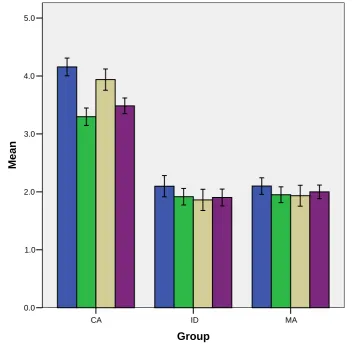
Mean picture memory spans for the three groups are given in Figure 2 (error bars
represent +/- 1 one standard error of the mean). A two-factor mixed analysis of
of group (3) revealed a significant main effect of group, F (2, 95) = 57.20, p < .001,
partial eta squared (η²) = .546. Post hoc Scheffe tests indicated that those in the CA group had higher picture spans (mean = 3.72) than those in either the MA or ID groups
(p < .001); but that the MA (mean = 2.00) and ID (mean = 1.94) groups did not differ.
There was also a main effect of picture type, F (2.80, 265.57) = 9.35, p < .001, η² = .090 (Huynh-Feldt correction for violation of sphericity as recommended by Field, 2005).
Planned contrasts tested for the hypothesised effects of word length, visual similarity
and phonological similarity by examining only the specific comparisons of interest to
the study hypotheses; namely, performance on control items was compared to
performance on each of the other three picture types. Across participant groups, there
was a phonological similarity effect (F (1,95) = 22.66, p < .001, η² = .193), a visual similarity effect (F (1,95) = 6.93, p < .05, η² = .068) and a word length effect (F (1,95) = 23.06, p < .001, η² = .195).
However, of particular interest was whether different short-term memory codes were
used by children within each experimental group. This was examined by looking at the
interaction between picture type and group. This interaction was significant, F (5.59,
265.57) = 4.36, p < .001, η² = .084 (Huynh-Feldt correction). To explore the differences in recall between different picture types, and, hence, memory coding, in more detail,
separate one-way repeated measures analyses of variance were performed on the picture
memory scores for each group separately.
For children with ID and children in the MA comparison group, the effect of picture
type was not significant. For children in the CA group, there was a highly significant
only the comparisons relevant for the study hypotheses, revealed a phonological
similarity effect (F(1,31) = 18.73, p < .001, η² = .377); and a word length effect (F(1,31) = 21.52, p < .001, η² = .410); but no visual similarity effect.
Figure 2 about here
Analyses by Mental Age
It was predicted that children in the MA and ID groups would show visual similarity
effects; in fact, no effects were found. However, it is possible that the groups
encompassed children at a number of stages of development, masking potential effects.
The final analyses looked in more detail at the MA and ID groups, testing whether any
emerging effects of visual similarity, phonological similarity or word length might
relate more specifically to mental age: i.e. lower mental age children might be at a less
advanced stage of memory coding than higher mental age children. Children in both
groups were classified as having a “high” mental age if they obtained mental age levels
of 6 years 0 months or above on the BAS II nonverbal reasoning measure, based on the
literature showing that a major stage transition towards verbal coding occurs at 6 years
(Palmer, 2000). There were 10 “high” mental age children in the MA group (mean
mental age 7;3) and 12 in the ID group (mean mental age 7;11). The remaining 20
children from the MA group and 24 children from the ID group were classified as
having “low” mental ages, below 6 years 0 months (mean mental ages respectively were
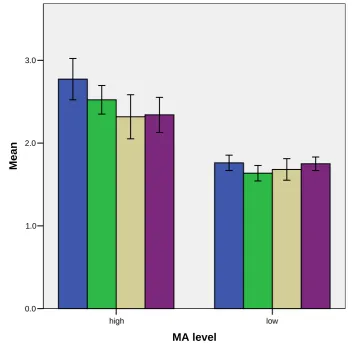
5;5 and 4;9). Mean picture span scores for each mental age group are given in Figure 3.
A group (ID, MA) x mental age level (high, low) x picture type (control, phonological,
F (1,62) = 16.34, p < .001, η² = .209, indicating higher spans for those with higher mental age levels, as would be expected (see Figure 3). There was an interaction
between mental age level and group, F(1,62) = 7.68, p < .01, η² = .110, reflecting a larger mental age difference in span level within the ID group as opposed to the MA
group (mean spans ID: high = 2.77, low = 1.53; mean spans MA: high = 2.15; low =
1.92). [Note this mirrored the larger MA difference between low and high mental age
individuals in the ID group]. The effect of group was not significant; nor was the
three-way interaction between picture type, group and mental age level.
The effect of picture type was significant, F (2.93, 181.39) = 3.82, p < .05, η² = .058 (Huynh-Feldt correction), but was qualified by a significant interaction between picture
type and mental age level, F (2.93, 181.39) = 3.03, p < .05, η² = .047 (Huynh-Feldt correction). Separate one-way anovas confirmed a significant effect of picture type in
the high mental age group, F (3, 129) = 2.98, p < .05, η² = .124, but not in the low mental age group (F=1.05). Planned contrasts on only the relevant comparisons for our
study hypotheses in the high mental age group indicated a significant visual similarity
effect, F (1,21) = 6.60, p = .018, η² = .239, a significant word length effect, F (1,21) = 8.09, p < .01, η² = .278, but no phonological similarity effect.
Figure 3 about here
Discussion
The type of memory coding used by children with ID was examined using picture
memory span tasks assessing effects of visual similarity, phonological similarity and
verbal input during presentation (labelling by children was discouraged) and utilising a
pointing response to avoid verbal output. In this way, any evidence of verbal coding
could be ascribed to the participant, rather than the task requirements. Similarly,
potential spatial cues were minimised by presenting all items in the same spatial
location and then removing them, rather than presenting and then covering items in a
left to right horizontal row as is often done (e.g. Hitch et al., 1988; 1989; Rosenquist et
al., 2003). Stages of memory coding development were examined and included the
“pre-memory” coding strategy stage, the “visual” coding stage, the “dual visual and
verbal” coding stage (e.g. Brown, 1977; Hayes & Schulze, 1977; Hitch et al., 1988;
1989; Longoni & Scalisi, 1994; Palmer, 2000), and the most mature stage of “verbal”
coding.
Children with ID showed no clear evidence as a group of using memory coding
strategies, suggesting that they were at the “pre-coding” phase of development. In this
respect, they resembled the MA comparison group (approximately 5 years old) both in
terms of level of recall (there were no group differences in level of picture span
performance) and in terms of their “flat” profile of performance across picture types.
By contrast, the CA comparison group of typically-developing 10-year-old children
showed clear effects of both phonological similarity and word length, supporting
previous findings with 10 and 11-year-olds (Hitch et al., 1988; 1989; Longoni & Scalisi,
1994). These children were at the “verbal” coding stage, a developmental level
sufficiently advanced to allow the translation of the pictures into names, storage in a
phonological code, and the use of picture names for some form of verbal rehearsal or
verbal repetition prior to or during recall. As the task presented no verbal information
length effects can be regarded as reflecting the deliberate use of a verbal memory
coding strategy. Arguments remain over whether word length effects are pure
reflections of verbal rehearsal (e.g. Cowan et al., 1992; Henry et al., 2000; Romani et
al., 2005; Yuzawa, 2001), however, they are clearly indicative of some form of verbal
coding, particularly under conditions of visual presentation and non-verbal recall as
were used in the current study. Many would also claim that some form of preparation
of the speech output plan, naming of individual items or verbal rehearsal of the speech
output plan takes place for those showing word length effects with non-verbal recall
methods (Henry, 1991).
Although, overall, children in the ID and MA groups appeared to use no memory
coding strategies, the profile of performance for children in these groups was different
when they were divided into “high” mental age (6 years and above) and “low” mental
age (below 6 years) groups. This suggested that developments in memory coding
strategies were linked with increases in mental age. The reason for examining more
detailed changes within the MA and ID groups, based on mental age, related to
cross-sectional and longitudinal findings by Palmer (2000) who provided evidence for
developmental transitions from no strategy use below the age of 5 years, to visual
encoding at about age 5 years, to dual visual and verbal encoding at around age 6-8
years. There was not enough data to do more than divide the sample into above and
below mental age 6 years, a key cut-off point with respect to the development of verbal
coding strategies.
Results from the combined MA and ID groups showed that those with mental ages
no strategy use. Those with mental ages over 6 years showed significant visual
similarity effects and significant word length effects (see Figure 3), broadly consistent
with dual coding as found by Palmer (2000). This small, but significant interaction
between mental age and picture type is indicative of developmental progressions in
memory coding within the MA and ID groups. Note that there was no main effect of
group (span scores were equivalent between the two groups as already noted) and there
were no interactions between picture type and ID status to suggest that patterns of
performance differed in the ID and MA groups. Mental age appeared to be a more
important determinant of memory coding stage than ID status. Nor was there any
evidence for a discrete visual coding stage. There was not enough data to test this latter
point thoroughly in the current study, although it should be pointed out that previous
reports of visual similarity effects in 5-year-olds have used methods involving verbal
recall and/or a left to right spatial array of face-down pictures after presentation. The
spatial array method may encourage visual confusions if children are using the array as
a “spatial cue” (looking at the spatial location of individual pictures and trying to
visualise them). Here, visual coding had to be initiated without the aid of spatial
location cues provided by an array of face down cards.
The results have been described as broadly consistent with dual visual and verbal
coding for the higher mental age MA and ID children. The most straightforward
evidence for dual coding, however, would have been to find both visual and
phonological similarity effects (suggestive of visual and verbal coding), but no word
length effect (suggestive of more advanced use of rehearsal-style strategies). Here,
visual similarity and word length effects were found, but the phonological similarity
that the ID and MA children with mental ages over 6 were using a simple naming
strategy, but not full verbal rehearsal. This assumption can be well justified from the
literature on the development of verbal rehearsal strategies. Several authors have
postulated an intermediate stage of simple item naming before the development of full
cumulative verbal rehearsal that would occur at around the ages of 6-8 years (e.g.
Gathercole & Hitch, 1993; Henry & Millar, 1993).
In the current picture span task, a child using simple naming may name each item once
and then attempt to recall the series. Phonological similarity would have a detrimental
effect to the extent that these named items become confused. However, a child using a
naming and verbal rehearsal compounds the effect of phonological similarity with every repetition of the list, hence, producing a stronger similarity effect. Several authors have
noted the possibility of a “double” effect of phonological similarity stemming from both
the phonological store and the verbal rehearsal process (e.g. Henry & Millar, 1993;
Hulme & Mackenzie, 1992; Rosenquist et al., 2003). The effect of phonological
similarity has also been reported to increase with age in typically developing children,
consistent with additional confusion as verbal rehearsal develops (Hulme & Tordoff,
1989). A compound process of confusion may also occur with long named items. The
stage of simple naming may produce a moderate detrimental effect on recall, because
long-named items take longer to name, but this effect could be accentuated if the
participant also engages in cumulative verbal rehearsal of the list items. There is
evidence that simple naming of items may be enough to produce a significant word
To explain the current results in our higher mental age MA and ID groups (absence of
phonological similarity effect, presence of word length effect), one would have to
assume that the initial detrimental effect of simple naming were stronger in the case of
long words than in the case of phonologically similar words. On this basis, a small, but
non-significant, effect of phonological similarity emerges, together with the larger,
significant, effect of word length. By contrast, children in the CA group were 10 years
old and had reached the stage of mature verbal strategy use, so showed robust effects of
both phonological similarity and word length, hypothesised to derive from both naming
items and repeating them in sequence either once or repeatedly as in cumulative verbal
rehearsal. By this stage, there was no evidence for dual visual coding in the picture
memory span task. In summary, it is proposed that children with mental ages of 6-8
years, regardless of ID status, were using a “dual” visual and verbal coding strategy
whereby the verbal coding took the form of simple naming rather than full cumulative
verbal rehearsal.
Although previous work with children with ID has not specifically compared visual and
verbal coding, Rosenquist et al. (2003) found significant visual similarity effects in
children with mild ID (mean mental age 8 years 1 month). This is consistent with
current findings; here, the higher mental age group of children with ID showing visual
similarity effects had an average mental age of 7 years 3 months. Nevertheless, the
children with higher mental ages were also those with milder intellectual disabilities, so
it may be that developmental progress through the phases of memory coding outlined
earlier is constrained by overall intellectual development. Those with lower ability
levels, i.e. moderate ID, may never reach the higher levels of both performance and
lower levels of performance than those with mild ID on more demanding working
memory tasks (Henry, 2001) and on eyewitness memory tasks (Henry & Gudjonsson,
2003); whereas those with mild and borderline ID can in some circumstances approach
memory performance levels of typically-developing age-matched controls.
Palmer (2000) stresses that even when children move beyond the dual coding phase to
exclusive verbal coding, they nevertheless return to visual codes or dual coding in
certain circumstances. This conjecture is supported by other work. There is evidence
for the use of dual codes in short-term storage for adults (Hue & Erickson, 1988) and
for the use of visual coding when verbal coding is blocked in older children (Hitch et
al., 1989) and adults (Logie et al., 2000; Walker et al., 1993). In fact, such evidence
forms part of the rationale for Baddeley’s (2000) inclusion of the episodic buffer as a
new component in working memory, integrating material from different modalities.
The absence of evidence for strategy use in children with mental ages below 6 years
may indicate that they were relying on semantic representations, an argument that has
recently been put forward to explain the abolition of word length effects under
articulatory suppression in adults (Romani et al., 2005). Rosenquist et al. (2003) also
suggested that individuals with ID might use semantic coding to recall word lists; and
Kittler et al. (2004) noted the enhanced use of semantic codes in individuals with Down
syndrome. Clearly, some explanation must be put forward for the recall of around 2
items that was achieved by children who were apparently using no strategy. Further
An alternative explanation for the absence of strategic evidence in lower scoring
participants is that floor effects prevented them from showing significant effects. This
possibility cannot be entirely discounted, although two arguments can be offered against
it. First, children in this study with low spans could obtain scores ranging from 0
through to 0.5, 1, 1.5 and 2. Thus, although low MA participants obtained mean scores
of around 1.75, there was room for variation below this. Secondly, previous studies
have reported significant visual similarity effects with performance levels in control and
visually similar span tasks respectively of 1.9 versus 1.41 (Hitch et al., 1989), 2.07
versus 1.40 (Hitch et al., 1988) and 2.37 versus 2.05 (Palmer, 2000; although
3-year-olds showed no effects with mean performance of around 1.75). The only cautionary
note is that these studies used fixed span lists of three items with verbal recall rather
than a span procedure with non-verbal recall as was used here, so results may differ for
this reason. It is possible that confusions only develop at longer list lengths when more
items are competing with each other, although one would assume that the current
response method (using response boards with 9 pictures to choose from) would have
produced confusions at the recall stage. Further work could investigate this issue by
contrasting fixed span lists and span procedures using otherwise similar methodologies.
In conclusion, 10-year-old children with ID were much like younger typical children of
comparable mental age (5 years) with respect to their level of recall and use of memory
coding strategies in a picture memory span task. Those with lower mental ages
remained at the initial “pre-strategy” development stage and did not utilise memory
coding strategies. The evidence was broadly consistent with the view that those in the
MA and ID groups with higher mental ages (over 6 years) adopted a developmentally
(10-year-olds) showed the expected, developmentally mature, effects of phonological similarity
and word length indicative of verbal coding and some form of verbal rehearsal or verbal
recitation of the list items.
References
Avons, S.E. (1998). Serial report and item recognition of novel visual patterns. British Journal of Psychology, 89, 285-308.
Avons, S.E. & Mason, A. (1999). Effects of visual similarity on serial report and item
recognition. The Quarterly Journal of Experimental Psychology, 52A, 217-240. Avons, S.E., Ward, G. & Melling, L. (2004). Item and order memory for novel visual
patterns assessed by two-choice recognition. The Quarterly Journal of Experimental Psychology, 57A, 865-891.
Baddeley, A.D. (1966). Short-term memory for word sequences as a function of
acoustic, semantic and formal similarity. Quarterly Journal of Experimental Psychology, 18, 362-365.
Baddeley, A.D. (2000). The episodic buffer: A new component of working memory?
Trends in Cognitive sciences, 4, 417-423.
Baddeley, A.D. (1986). Working Memory. Oxford: OUP.
Baddeley, A.D. (2007). Working Memory, Thought, and Action. Oxford: OUP. Baddeley, A.D. & Hitch, G.J. (1974). Working memory. In Bower, G.A. (Ed.) The
Psychology of Learning and Motivation, Vol. 8, pp. 47-89. New York: Academic Press.
Baddeley, A..D., Thomson, N. & Buchanan, M. (1975). Word length and the structure
of short-term memory. Journal of Verbal Learning and Verbal Behavior, 14, 575-589.
Belmont, J.M. (1978). Individual differences in memory: The cases of normal and
Brown, R.M. (1974). Effects of recall order, cue placement, and retention interval on
short-term memory of normal and retarded children. Perceptual and Motor Skills, 39, 167-178.
Brown, R.M. (1977). An examination of visual and verbal coding processes in
preschool children. Child Development, 48, 38-45.
Brown, G.D.A. & Hulme, C. (1995). Modelling item length effects in memory span:
No rehearsal needed? Journal of Memory and Language, 34, 594-621. Burack, J.A. & Zigler, E. (1990). Intentional and incidental memory in organically
mentally retarded, familial retarded, and nonretarded individuals. American Journal on Mental Retardation, 94, 532-540.
Conrad, R. (1971). The chronology of the development of covert speech in children.
Developmental Psychology, 5, 398-405.
Conrad, R. & Hull, A.J. (1964). Information, acoustic confusion and memory span.
British Journal of Psychology, 55, 429-432.
Cowan, N., Saults, J.S., Winterowd, C. & Sherk, M. (1991). Enhancement of 4-year-old
children’s memory span for phonologicalyl similar and dissimilar word lists.
Journal of Experimental Child Psychology, 51, 30-52.
Cowan, N., Day, L., Saults, J.S., Keller, T.A., Johnson, T. & Flores, L. (1992). The role
of verbal output time in the effects of word length on immediate memory.
Journal of Memory and Language, 34, 1-17.
Cowan, N., Wood, N.L., Nugent, L.D. & Treisman, M. (1997). There are two
word-length effects in verbal short-term memory: Opposed effects of duration and
complexity. Psychological Science, 8, 290-295.
Ellis, N.R. (1970). Memory processes in retardates and normals. In N.R. Ellis (Ed.),
International review of research in mental retardation, Volume 4 (pp. 1-32). New York: Academic Press.
Engle, R.W., Tuholski, S.W., Laughlin, J.E. & Conway, A.R.A. (1999). Working
memory, short-term memory, and general fluid intelligence: A latent variable
approach. Journal of Experimental Psychology: General, 128, 309-331. Field, A. (2005). Discovering statistics using SPSS, Second Edition. London: Sage. Frick, R.W. (1988a). Issues of representation and limited capacity in the visuospatial
sketchpad. British Journal of Psychology, 79, 289-308.
Frick, R.W. (1988b). Representation, recovery, and limited capacity in an auditory
short-term store. British Journal of Psychology, 79, 213-240.
Gathercole, S.E. & Hitch, G.J. (1993). Developmental changes in short-term memory:
A revised working memory perspective. In A. Collins, S.E. Gathercole, M.A.
Conway, & P.E. Morris (Eds.) Models of short-term memory. Hove, UK: Psychology Press.
Halliday, M.S., Hitch, G.J., Lennon, B. & Pettipher, C. (1990). Verbal short-term
memory in children: The role of the articulatory loop. European Journal of Cognitive Psychology, 2, 23-38.
Hasselhorn, M. & Grube, D. (2003). The phonological similarity effect on memory span
in children: Does it depend on age, speech rate, and articulatory suppression?
International Journal of Behavioral Development, 27, 145-152.
Hayes, D.S. & Schulze, S.A. (1977). Visual encoding in preschoolers’ serial retention.
Henry, L.A. (1991). The effects of word length and phonemic similarity in young
children’s short-term memory. Quarterly Journal of Experimental Psychology,
43A, 35-52.
Henry, L.A. (2001). How does the severity of a learning disability affect working
memory performance? Memory, 9, 233-247.
Henry, L.A. & Millar, S. (1993). Why does memory span improve with age? A review
of the evidence for two current hypotheses. European Journal of Cognitive Psychology, 5, 241-287.
Henry, L.A. & MacLean, M. (2002). Working memory performance in children with
and without intellectual disabilities. American Journal on Mental Retardation, 107, 421-432.
Henry, L.A. & Gudjonsson, G.H. (2003). Eyewitness memory, suggestibility and
repeated recall sessions in children with mild and moderate intellectual disabilities. Law and Human Behavior,27, 481-505.
Henry, L.A. & Gudjonsson, G.H. (2007). Developmental and individual differences in
the eyewitness recall and suggestibility of children with intellectual disabilities.
Applied Cognitive Psychology, 21, 361-381.
Henry, L.A., Turner, J.E., Smith, P.T. & Leather, C. (2000). Modality effects and the
development of the word length effect in children. Memory, 8, 1-17.
Hitch, G.J., Woodin, M.E. & Baker, S. (1989). Visual and phonological components of
working memory in children. Memory & Cognition, 17, 175-185.
Hitch, G.J., Halliday, S., Schaafstal, A.M. & Schraagen, J.M.C. (1988). Visual working
Hitch, G.J., Halliday, M.S., Schaafstal, A.M. & Heffernan, T.M. (1991). Speech, “inner
speech” and the development of short-term memory: Effects of picture labelling
on recall. Journal of Experimental Child Psychology, 51, 220-234. Hue, C-W. & Erickson, J.R. (1988). Short-term memory for Chinese characters and
radicals. Memory & Cognition, 16, 196-205.
Hulme, C. & Mackenzie, S. (1992). Working memory and severe learning difficulties. Hove, U.K.: Erlbaum.
Hulme, C. & Tordoff, V. (1989). Working memory development: The effects of speech
rate, word length, and acoustic similarity on serial recall. Journal of Experimental Child Psychology, 47, 72-87.
Jarrold, C., Baddeley, A.D. & Hewes, A.K. (2000). Verbal short-term memory deficits
in Down Syndrome: A consequence of problems in rehearsal? Journal of Child Psychology and Psychiatry, 41, 233-244.
Kanno, K. & Ikeda, Y. (2002). Word-length effect in verbal short-term memory in
individuals with Down’s syndrome. Journal of Intellectual Disability Research, 46, 613-618.
Kittler, P., Krinskey-McHale, S.J., Devenny, D.A. (2004). Semantic and phonological
loop effects on verbal working memory in middle-age adults with mental
retardation. American Journal on Mental Retardation, 109, 467-480. Logie, R.H., Della Sala, S., Wynn, V. & Baddeley, A.D. (2000). Visual similarity
effects in immediate serial recall. . The Quarterly Journal of Experimental Psychology, 53A, 626-646.
Longoni, A.M. & Scalisi, T.G. (1994). Developmental aspects of phonemic and visual
Morrison, C.M., Chappell, T.D. & Ellis, A.W. (1997). Age of acquisition norms for a
large set of object names and their relation to adult estimates and other variables.
Quarterly Journal of Experimental Psychology, 50A, 528-559.
Nimmo, L.M. & Roodenrys, S. (2004). Investigating the phonological similarity effect:
Syllable structure and the position of common phonemes. Journal of Memory and Language, 50, 245-258.
Palmer, S. (2000). Working memory: A developmental study of phonological recoding. Memory, 8, 179-193.
Romani, C., McAlpine, S., Olson, A., Tsouknida, E. & Martin, R. (2005). Length,
lexicality, and articulatory suppression in immediate recall: Evidence against the
articulatory loop. Journal of Memory and Language, 52, 398-415.
Rosenquist, C., Conners, F.A. & Roskos-Weoldsen, B. (2003). Phonological and
visuo-spatial working memory in individuals with intellectual disability. American Journal on Mental Retardation, 108, 403-413.
Russell, J., Jarrold, C. & Henry, L. (1996). Working memory in children with autism
and with moderate learning difficulties. Journal of Child Psychology and Psychiatry, 37, 673-686.
Varnhagen, C.K., Das, J.P. & Varnhagen, S. (1987). Auditory and visual memory span:
Cognitive processing by TMR individuals with Down syndrome and other
etiologies. American Journal of Mental Deficiency, 91, 398-405.
Walker, P., Hitch, G.J. & Duroe, S. (1993). The effect of visual similarity on short-term
memory for spatial location: Implications for the capacity of visual short-term
memory. Acta Psychologia, 83, 203-224.
Yuzawa, M. (2001). Effects of word length on young children’s memory performance.
Table 1 Details of participants including age, mental age, estimated non-verbal
I.Q., and raw ability score (pattern construction sub-test, BAS II) for children with ID,
children of similar mental age (MA) and children of similar chronological age (CA).
Standard deviations are given in brackets.
Participant details
Groups
Children with ID
(n=36)
MA Controls
(n=30)
CA Controls
(n=32)
Chronological Age
(s.d.)
10 yrs 6 m
(20 m)
5 years 1 m
(4.5 m)
10 years 0 m
(13 m)
Mental Age
(s.d.)
5 yrs 10 m
(21 m)
6 years 0 m
(14 m)
10 years 9 m
(18 m) Non-verbal I.Q. (s.d.) 60.94 (12.58) 113.67 (11.86) 105.81 (10.82)
Raw Ability Score
Captions
Figure 1 Examples of pictures from the control, phonologically similar, visually
similar and long-named sets
Figure 2 Mean Memory spans for control, phonologically similar, visually similar
and long-named pictures for children with ID, MA controls and CA controls
Figure 3 Mean Memory spans for control, phonologically similar, visually similar
and long-named pictures for children in the ID and MA groups with “high” (6;0 and
Figure 2
MA ID
CA
Group 5.0
4.0
3.0
2.0
1.0
0.0
Mean
long visual phonol control
Error bars: +/- 1.00 SE
Figure 3
low high
MA level 3.0
2.0
1.0
0.0
Mean
long visual phonol control