This is a repository copy of Derivation of ligands for the complement C3a receptor from the C-terminus of C5a.
White Rose Research Online URL for this paper: http://eprints.whiterose.ac.uk/99926/
Version: Submitted Version
Article:
Halai, R., Bellows-Peterson, M.L., Branchett, W. et al. (8 more authors) (2014) Derivation of ligands for the complement C3a receptor from the C-terminus of C5a. European Journal of Pharmacology, 745. pp. 176-181. ISSN 0014-2999
https://doi.org/10.1016/j.ejphar.2014.10.041
Reuse
Derivation of ligands for the complement C3a receptor from the
C-terminus of C5a
Reena Halaia,*, Meghan L Bellows-Petersonb,*, Will Branchettc, James Smadbeckb, Chris
A Kieslichb, Daniel E Crokera, Matthew A Coopera, Dimitrios Morikisd, Trent M
Woodruffe, Christodoulos A Floudasb,#, Peter N Monkc,#
*equal contributing authors
#
equal corresponding authors ([email protected]; tel. +44 114 226 1312;
[email protected]; +1 609 258 4595)
a
Institute for Molecular Bioscience, The University of Queensland, Brisbane, QLD 4072, Australia
b
Department of Chemical and Biological Engineering, Princeton University, Princeton, NJ, USA.
c
Department of Infection and Immunity, Sheffield University Medical School, Sheffield, UK
d
Department of Bioengineering, University of California, Riverside, CA, USA
e
Abstract
The complement cascade is a highly sophisticated network of proteins that are well regulated and
directed in response to invading pathogens or tissue injury. Complement C3a and C5a are key
mediators produced by this cascade, and their dysregulation has been linked to a plethora of
inflammatory and autoimmune diseases. Consequently, this has stimulated interest in the
development of ligands for the receptors for these complement peptides, C3a receptor, and C5a1
(C5aR/CD88). In this study we used computational methods to design novel C5a1 receptor
ligands. However, functional screening in human monocyte-derived macrophages using the
xCELLigence label-free platform demonstrated altered specificity of our ligands. No
agonist/antagonist activity was observed at C5a1, but we instead saw that the ligands were able to
partially agonize the closely related complement receptor C3a receptor. This was verified in the
presence of C3a receptor antagonist SB 290157 and in a stable cell line expressing either C5a1 or
C3a receptor alone. C3a agonism has been suggested to be a potential treatment of acute
neutrophil-driven traumatic pathologies, and may have great potential as a therapeutic avenue in
this arena.
Key words: C3a receptor; C5a1 receptor; peptide design; in silico sequence selection;
1.
Introduction
Complement activation proceeds through cascades of enzymatic reactions leading to
inflammation, phagocytosis, lysis, and augmentation of antibody production (Markiewski and
Lambris, 2007). Two major products of complement activation are the protein fragments C3a
and C5a, beneficial in infections but also mediating inflammatory diseases (Peng et al., 2009).
C5a exerts a number of effects through its classical receptor, C5a1 (C5aR/CD88) (Klos et al.,
2013), such as recruiting neutrophils and macrophages to sites of injury, releasing
granule-associated enzymes and vasoactive mediators, increasing vascular permeability and adhesion,
inducing smooth muscle contractions and stimulating the release of proinflammatory cytokines.
C5a also interacts with a second receptor, C5a2, although the functions of this receptor are not
fully determined (Croker et al., 2013; Li et al., 2013). Increased amounts of C5a are associated
with a number of pathological conditions, including lupus, ischemia/reperfusion injury, Crohn’s disease, cystic fibrosis, gingivitis, atherosclerosis, myocardial infarction, fibrosis, allergy, diabetes type I, and disorders of the central nervous system (Manthey et al., 2009).
Inhibition of C3a and C5a interactions with their respective receptors, C3a receptor and C5a1,
has been targeted for drug design (Bellows-Peterson et al., 2012; Monk et al., 2007). However, a
recent study has suggested that C3a and C5a1 have opposing roles in neutrophil-mediated
pathology (Wu et al., 2013). In a model of intestinal injury, the authors of this study showed that
C3a receptor is not chemotactic for neutrophils, but rather, constrains neutrophil mobilization.
Therefore C3a receptor agonism and C5a1 antagonism may have similar therapeutic effects in
acute neutrophil-driven pathologies (Schofield et al., 2013).
C3a and C5a are 77- and 74-residue proteins, with 32% sequence identity and similar
three-dimensional structures (Klos et al., 2013). A common mechanism of function utilizes the
C-terminal cationic domain which inserts into the activation site of respective receptors. Removal
of the conserved C-terminal arginine has complex effects on functionality (Croker et al., 2013;
Reis et al., 2012). Past drug design efforts have focused on designing peptides and
peptidomimetics by modifying the C-terminal regions (Klos et al., 2013). Additional recent
computational methods to design C3a receptor agonist and antagonist peptides
(Bellows-Peterson et al., 2012), including the current study.
A two-stage de novo protein design framework previously described (Bellows-Peterson et al.,
2012; Bellows et al., 2010a; Bellows et al., 2010b; Fung et al., 2008; Fung et al., 2005; Fung et
al., 2007; Klepeis et al., 2003; Klepeis et al., 2004) was applied to the design of C5a-derived
peptides. The peptides were functionally screened on the reporter cell line, RBL-2H3 transfected
with human C3a receptor or C5a1 or on human monocyte-derived macrophages (HMDM) using
label-free methods that provided cell activation read-outs. Several hits were identified and, based
on the activation profiles, these hits appeared to be C3a agonists. Screening of the peptides in the
presence of C3a receptor and C5a1 antagonists confirmed C3a receptor as the target. Thus
2.
Materials and Methods
2.1 Computational design of peptides
The computational design framework (described in detail in the Supplementary Material) was
broadly as described previously (Bellows-Peterson et al., 2012).
2.2 Peptide synthesis
All octa-, hepta-, and hexapeptides tested were synthesized by GenScript (Piscataway, NJ) with
acetylated N-termini at >95% purity. Purity was confirmed with HPLC. The C-terminus was
unblocked in all peptides.
2.3 Cell culture
Human monocytes were isolated from blood donations to the Australian Red Cross Blood
Service (Kelvin Grove, Queensland). The isolation of mononuclear cells was as described
previously by Halai et al. (Halai and Cooper, 2012). Briefly, mononuclear cell layer was
separated using density gradient centrifugation with Ficoll-Paque Plus (GE Healthcare). MACS
magnetic beads (Miltenyi Biotec) were incubated with the cells for 15 min at 4 °C before passing
through an LS column (Miltenyi Biotec) to select for the CD14+ cells. Selected monocytes were
plated at a density of 1.5 x 10⁷in Iscove’s Modified Dulbecco’s Medium (IMDM) (Invitrogen
Life Technologies) containing L-glutamine supplemented with 10% Fetal Bovine Serum (FBS),
50 IU/ml penicillin and 50 g/ml streptomycin. Human macrophage colony-stimulating factor
(M-CSF) (Peprotech) was added to media to allow cells to differentiate into human
monocyte-derived macrophages (HMDM). Over the 7 day differentiation process, cells were incubated at
37 °C and 5% CO2.
2.4 Cell impedance assay (xCELLigence RTCA)
HMDM were seeded overnight at 30,000 cells/well in 384-well E-Plates (Roche). Approximately
24 h later, HMDM media was exchanged for serum-free IMDM and equilibrated at 37 °C and
5% C02 for 2 h prior to ligand addition. Ligands were prepared at a final DMSO concentration of
0.5% (or less) in serum-free IMDM. Antagonists PMX53 and SB 290157 were incubated for 1 h
receptor activation in these cells. After agonist addition, measurements were taken continuously
for ~1.5 h at 37 °C. The RTCA software was used for data analysis, with statistical analysis
using GraphPad Prism 5.0c (GraphPAD Software Inc., San Diego, CA).
2.5 Rat Basophilic Leukemia Cell Degranulation Assay
RBL-2H3 cells transfected with either human C5a1 or human C3a receptor (Cain and Monk,
2002) were routinely cultured in Dulbeccos Modified Eagles Medium, 10% (v/v) fetal calf
serum, and 400 mg/Liter G-418 at 37°C in 5% CO2. Degranulation was measured by assaying for -hexosaminidase activity in the cell supernatant, as described previously (Monk et al., 1994). In agonist assays, degranulation was calculated as a percentage of maximal activity in
response to 200 nM recombinant human C3a, human C5a (Cain and Monk, 2002), or 10 nM
agonist hexapeptide, FLPLAR (Scully et al., 2010). For antagonist assays, cells were pretreated
with peptides for 10 min prior to the addition of C3a, C5a, or FLPLAR. EC50, IC50, and standard
3.
Results
3.1 Computational Results
For each run (Supplementary Table 1), 200 peptide sequences were generated using the Distance
Bin Model (Fung et al., 2008; Rajgaria et al., 2008). This produced 6400 total sequences. Each sequence was subjected to fold specificity calculations using both AMBER and FAMBE-pH and ranked accordingly. Top sequences from each run are combined in Supplementary Table 2. The
sequences shown were either the top few sequences in the run, or sequences that showed
promising features such as a charged residue in positions 67 or 68 or a hydrophobic residue in
position 70 or 72 (as in the native sequence).
The designed peptide sequences displayed a number of patterns, including the mutation to Trp in
position 73 (also seen in the most potent antagonists thus far (Finch et al., 1999)) and the
preference for a charged residue in position 68. Position 68 showed a preference for a charge
residue, either positive or negative. When positively charged, the amino acid of choice was Arg,
as opposed to the native Lys. Nearly all the runs tended to rank a hydrophobic residue in position
70 highly, despite the fact that all the templates also allowed hydrophilic residues in that
position.
3.2 Screening peptides on HMDM using the xCELLigence
The 61 peptides, initially dissolved in dimethyl sulfoxide (DMSO) at 10mM, were screened at a
single dose of 8M on HMDM using an impedance based label-free system, the xCELLigence;
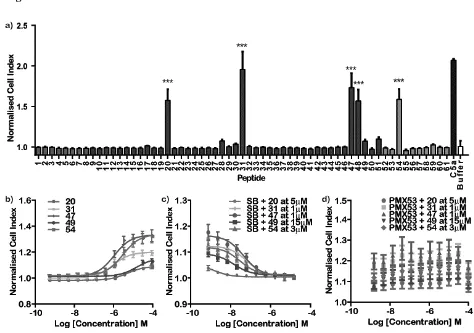
DMSO at <0.5% was found to have no effects in this assay. Fig. 1A shows the identification of 5
significant hits (P<0.001), peptides 20, 31, 47, 48 and 54. Peptide 49 was identified as a potential
hit from independent data (data not shown) despite not evoking a response in the initial screen
and so was retested at the full dose range along with the five identified hits (see Fig. 1B).
Interestingly, a full dose response could not be obtained for peptide 48 (data not shown).
However, peptide 49 showed weak activity, despite failing in the initial single dose screen. The
EC50 of the hits has been summarised in Table 1.
3.3 Identifying the target receptor for the hits
antagonists, SB 290157 and PMX53, respectively (see Fig. 1C and 1D). A dose dependent
inhibition of the cell index was observed for peptides 20, 31, 47, 49 and 54 in the presence of the
competitive antagonist SB 290157 when activated with a concentration of peptide approximating
to the EC50. The IC50 of SB 290157 in the presence of peptides 20, 31, 47, 49 and 54 is
highlighted in Table 1. No change was observed in the peptide-evoked cell index in the presence
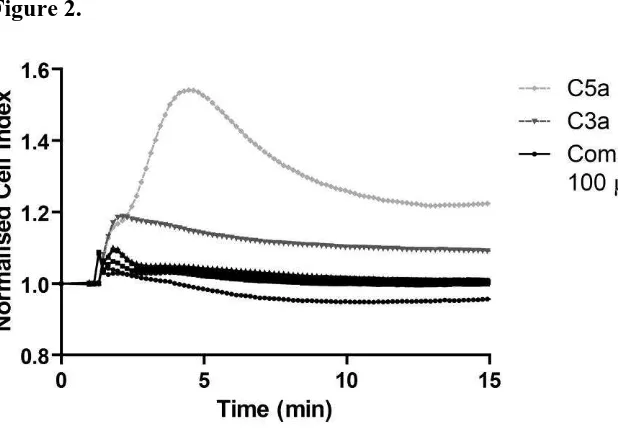
of PMX53 (see Fig. 1D). The xCELLigence activation profiles are depicted in Fig. 2, where all
the peptides even at a very high dose (100µM) have a monophasic profile more similar to that of
C3a than of C5a. Despite some being partial agonists at the C3a receptor, none of the peptides
were able to antagonise C3a activation of HMDM when tested at 10µM (data not shown).
3.4 Rat Basophilic Leukemia Cell Degranulation assay
RBL-2H3 cells transfected with either human C5a1 or human C3a receptor (Cain and Monk,
2002) were used to confirm hits detected in HMDM, using degranulation as a read-out (Monk et
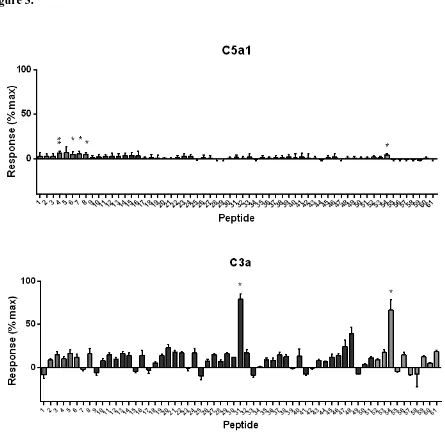
al., 1994). In cells transfected with C5a1, very weak agonist activity was detected in two groups
of peptides, although even at 100µM (the maximal dose achievable in the presence of the
DMSO, which has adverse effects >1%), the activation obtained was 5-10% of the maximum
activation achieved by a high dose of C5a (Fig. 3, top panel). In contrast, two peptides (31 and
54) produced very strong activation of C3a receptor (Fig. 3, lower panel) at 100µM. In
antagonist assays using two different doses of C5a that caused 50% or 100% degranulation, none
of the peptides had any antagonist activity, even when pre-incubated with cells at the maximum
4.
Discussion
The design of C5a receptor agonists and antagonists employed only the structure of C5a. Thus we were only able to use the fold specificities as a metric for ranking the sequences. Four
separate flexible templates were used for the design, combining them with eight runs defining the mutation sets and biological constraints for a total of 32 runs (see Supplementary Table 1). With
all these combinations, we generated 6400 total sequences. We reduced this set to 61 sequences
(Supplementary Table 2) by selecting the top few sequences from each run, or highly ranked
sequences that looked interesting based on inspection (e.g. using different mutations not seen in
the top ranked sequences). The majority of the runs reproduced the G73W mutation seen in the
potent agonist by Finch et al. (Finch et al., 1999).
These 61 sequences were then synthesized and screened using the xCELLigence, a label-free
impedance-based biosensor, in human monocyte derived macrophages (HMDM), which have
been shown to express the C5a1 receptor in relatively high abundance. The xCELLigence was
our primary choice for testing as it is sensitive enough to allow detection in native cells and
provides a pathway independent cell activation response, making it a useful broad screening tool
(Halai and Cooper, 2012). From the 61 peptide set tested, five clear hits (20, 31, 47, 49 and 54)
were identified (Fig. 1A).
Interestingly, the receptor signalling profile generated by these hits more closely resembled that
of C3a than C5a1, as highlighted in Fig. 2. The receptor activation and kinetics between C3a and
C5a1 differ significantly, where the evolution of the signal peaks at ~1 min after peptide addition
for C3a receptor and ~4 min after peptide addition for C5a1. The intensity of the signal varies
too, where a cell index of 1.98 and 4.53 is observed for C3a receptor and C5a1, respectively. As
the receptors for both C3a and C5a are expressed in HMDM, it is entirely feasible these peptides
were activating C3a receptor instead of C5a1. To discriminate whether the signal observed for
peptides 20, 31, 47, 49 and 54 on HMDM was attributable to C3a or C5a, a C3a receptor
antagonist, SB 290157, and C5a1 antagonist, PMX53, was employed.
C3a receptor antagonist SB 290157 showed a dose-dependent inhibition of the signal observed
these hits. These observations were further supported, when no dose-dependent inhibition of the
signal was observed in the presence of C5a1 antagonist, PMX53 (Fig. 2D), despite incubating at
a higher starting concentration than SB 290157. To further validate this specificity, the peptides
were tested in RBL-2H3 cells transfected with either human C5a1 or human C3a receptor. The
peptides were screened as agonists against both C3a receptor and C5a1. As the results in Fig. 3
show, only C3a receptor responded strongly to the peptides, with high levels of degranulation
produced by a subset of the peptides identified in the HMDM screen. The differences in the
screens could be due to receptor expression levels (likely to be higher in the transfected cell line)
or to the different read-out. Tested as C5a1 antagonists, the peptides had no effect at all
confirming the very weak or absent interaction with this receptor.
Although these peptides were designed using the C-terminal domain of C5a, they demonstrated
activity at C3a receptor, but not C5a1. C3a receptor/C5a1 promiscuity is not unusual and has been
previously observed for whole C3a and a synthetic peptide agonist (Ames et al., 1996) and a
chimeric C5a with the C3a C-terminal pentapeptide (Bautsch et al., 1992). In fact, early efforts to
create potent and selective antagonists of C5a1 led to only partial agonists (Taylor and Fairlie,
2005). This may be due to the fact that most potent peptides had a mutation of Gly to Pro at
position 73, disrupting the turn conformation of the C-terminus. Researchers at Merck were some of the first to succeed in creating a small peptide inhibitor of C5a receptors. Their compound, the hexapeptide MeFKPdChaFr
(N-methylphenylalanine-Lys-Pro-D-cyclohexylalanine-Phe-D-arginine), was shown to be an antagonist but also had partial agonist
behavior (Drapeau et al., 1993). Finch et al. (Finch et al., 1999) optimized the Merck peptide
using a cyclization strategy. Their best antagonist, AcF[OPdChaWR]
(AcPhe[Lornithine-Pro-D-cyclohexylalanine-Trp-Arg], brackets denote cyclization; i.e. PMX53), had receptor affinity in
receptor in regulating neutrophil mobilisation after acute intestinal injury, opening up C3a
receptor agonism as a potential therapeutic avenue. Using the sequences identified in this study,
new peptide mimetics can be designed and synthesised. Analysis of the sequences
(Supplementary Table 1) of the active peptides reveals a conserved ‘Leucine (L)-Tryptophan
(W)-Arginine (R)’ sequence at the C termini, as well as a conserved Tyrosine (Y) two amino
acids before the LWR motif. The Leucine and the Arginine are also found in the same positions
at the C termini in the superagonist ‘W-W-G-K-K-Y-R-A-S-K-L-G-L-A-R’ (Bellows-Peterson et al., 2012; Ember et al., 1991), and seem to be important for determining the activity towards C3a receptor. This is not surprising as Ember et al. (Ember et al., 1991) described the C terminus
interacting with the primary binding site and the N terminus with a secondary site. As we have
already been able to show activity towards the C3a receptor, future work to increase potency
should focus on the N termini, more specifically incorporating hydrophobic residues that are
implicated to form interactions with the secondary site according to Ember et al.(Ember et al.,
1991). However, our other peptide sequences harbouring these amino acids did not show any
significant activity, so these amino acids may be working in conjunction with other key residues
in the active three-dimensional structural conformation to elicit the activity observed.
Systematic and sequential amino acid replacements and truncations of the active peptide
sequences may provide further insight into the key residues critical for the agonist activity
observed at the C3a receptor. This knowledge will be key in optimizing the potencies of these
peptides further, in the hope of developing them as therapeutics (Reid et al., 2013).
In conclusion, our screen identified several potent small peptide C3a receptor agonists. The lack
of C5a1 hits, and hits for C3a receptor indicates promiscuity of C3a receptor and C5a1 ligand
binding sites. Presumably the smaller size of these peptides enabled binding to C3a receptor.
These C3a receptor agonist hits could be extended towards acute therapies to limit neutrophil
mobilization in disease (Wu et al., 2013) or used as a basis for development of C3a receptor
5. Acknowledgments
This work was supported by grants from NSF (CAF and DM), NIH (R01 GM52032, CAF; R24
GM069736, CAF and DM), the Tobacco-Related Disease Research Program (DM), US
Environmental Protection Agency, EPA (R 832721-010, CAF) and British Heart Foundation
PG/09/018/25279 (PM). Although the research described in the article has been funded in part by
the US Environmental Agency’s STAR program, it has not been subjected to any EPA review and therefore does not necessarily reflect the views of the Agency, and no official endorsement should be inferred. A portion of this research was made possible with Government support by
DoD, Air Force Office of Scientific Research, National Defense Science and Engineering
6. References
Ames, R.S., Nuthulaganti, P., Kumar, C., 1996. In Xenopus oocytes the human C3a and C5a receptors elicit a promiscuous response to the anaphylatoxins. FEBS Lett 395, 157-159. Bautsch, W., Kretzschmar, T., Stuhmer, T., Kola, A., Emde, M., Kohl, J., Klos, A., Bitter-Suermann, D., 1992. A recombinant hybrid anaphylatoxin with dual C3a/C5a activity. Biochem J 288 ( Pt 1), 261-266.
Bellows-Peterson, M.L., Fung, H.K., Floudas, C.A., Kieslich, C.A., Zhang, L., Morikis, D., Wareham, K.J., Monk, P.N., Hawksworth, O.A., Woodruff, T.M., 2012. De Novo Peptide Design with C3a Receptor Agonist and Antagonist Activities: Theoretical Predictions and Experimental Validation. Journal of Medicinal Chemistry 55, 4159-4168.
Bellows, M.L., Fung, H.K., Taylor, M.S., Floudas, C.A., Lopez de Victoria, A., Morikis, D., 2010a. New compstatin variants through two de novo protein design frameworks. Biophys J 98, 2337-2346.
Bellows, M.L., Taylor, M.S., Cole, P.A., Shen, L., Siliciano, R.F., Fung, H.K., Floudas, C.A., 2010b. Discovery of entry inhibitors for HIV-1 via a new de novo protein design framework. Biophys J 99, 3445-3453.
Cain, S.A., Monk, P.N., 2002. The Orphan Receptor C5L2 Has High Affinity Binding Sites for Complement Fragments C5a and C5a des-Arg74. Journal of Biological Chemistry 277, 7165-7169.
Croker, D.E., Halai, R., Fairlie, D.P., Cooper, M.A., 2013. C5a, but not C5a-des Arg, induces upregulation of heteromer formation between complement C5a receptors C5aR and C5L2. Immunology and cell biology 91, 625-633.
Drapeau, G., Brochu, S., Godin, D., Levesque, L., Rioux, F., Marceau, F., 1993. Synthetic C5a receptor agonists: Pharmacology, metabolism and in vivo cardiovascular and hematologic effects. Biochem Pharmacol 45, 1289-1299.
Ember, J.A., Johansen, N.L., Hugli, T.E., 1991. Designing synthetic superagonists of C3a anaphylatoxin. Biochemistry 30, 3603-3612.
Finch, A.M., Vogen, S.M., Sherman, S.A., Kirnarsky, L., Taylor, S.M., Sanderson, S.D., 1997. Biologically Active Conformer of the Effector Region of Human C5a and Modulatory Effects of N-Terminal Receptor Binding Determinants on Activity. Journal of Medicinal Chemistry 40, 877-884.
Finch, A.M., Wong, A.K., Paczkowski, N.J., Wadi, S.K.e., Craik, D.J., Fairlie, D.P., Taylor, S.M., 1999. Low-Molecular-Weight Peptidic and Cyclic Antagonists of the Receptor for the Complement Factor C5a. J Med Chem 42, 1965-1974.
Fung, H.K., Floudas, C.A., Taylor, M.S., Zhang, L., Morikis, D., 2008. Toward Full-Sequence De Novo Protein Design with Flexible Templates for Human Beta-Defensin-2. Biophys J 94, 584-599.
Silico Sequence Selection Problem in De Novo Protein Design. J Comb Optim 10, 41-60. Fung, H.K., Taylor, M.S., Floudas, C.A., 2007. Novel Formulations for the Sequence Selection Problem in De Novo Protein Design with Flexible Templates. Optim Method Softw 22, 51-71.
Halai, R., Cooper, M.A., 2012. Using label-free screening technology to improve efficiency in drug discovery. Expert Opinion on Drug Discovery 7, 123-131.
Kawatsu, R., Sanderson, S.D., Blanco, I., Kendall, N., Finch, A.M., Taylor, S.M., Colcher, D., 1996. Conformationally biased analogs of human C5a mediate changes in vascular permeability. J Pharmacol Exp Ther 278, 432-440.
Klepeis, J.L., Floudas, C.A., Morikis, D., Tsokos, C.G., Argyropoulos, E., Spruce, L., Lambris, J.D., 2003. Integrated Structural, Computational and Experimental Approach for Lead Optimization: Design of Compstatin Variants with Improved Activity. J Am Chem Soc 125, 8422-8423.
Klepeis, J.L., Floudas, C.A., Morikis, D., Tsokos, C.G., Lambris, J.D., 2004. Design of Peptide Analogs with Improved Activity using a Novel de novo Protein Design Approach. Ind Eng Chem Res 43, 3817-3826.
Klos, A., Wende, E., Wareham, K.J., Monk, P.N., 2013. International Union of Pharmacology. LXXXVII. Complement peptide C5a, C4a, and C3a receptors. Pharmacological reviews 65, 500-543.
Li, R., Coulthard, L.G., Wu, M.C., Taylor, S.M., Woodruff, T.M., 2013. C5L2: a controversial receptor of complement anaphylatoxin, C5a. FASEB J 27, 855-864.
Manthey, H.D., Woodruff, T.M., Taylor, S.M., Monk, P.N., 2009. Complement component 5a (C5a). Int J Biochem Cell Biol 41, 2114-2117.
Markiewski, M.M., Lambris, J.D., 2007. The role of complement in inflammatory diseases from behind the scenes into the spotlight. Am J Pathol 171, 715-727.
Monk, P.N., Pease, J.E., Barker, M.D., 1994. C5a stimulus-secretion coupling in rat basophilic leukaemia (RBL-2H3) cells transfected with the human C5a receptor is mediated by pertussis and cholera toxin-sensitive G proteins. Biochem Mol Biol Int 32, 13-20.
Monk, P.N., Scola, A.M., Madala, P., Fairlie, D.P., 2007. Function, structure and therapeutic potential of complement C5a receptors. Br J Pharmacol 152, 429-448.
Reis, E.S., Chen, H., Sfyroera, G., Monk, P.N., Kohl, J., Ricklin, D., Lambris, J.D., 2012. C5a receptor-dependent cell activation by physiological concentrations of desarginated C5a: insights from a novel label-free cellular assay. Journal of immunology 189, 4797-4805. Schofield, Z.V., Woodruff, T.M., Halai, R., Wu, M.C., Cooper, M.A., 2013. Neutrophils-a key component of ischemia-reperfusion injury. Shock 40, 463-470.
Scully, C.C.G., Blakeney, J.S., Singh, R., Hoang, H.N., Abbenante, G., Reid, R.C., Fairlie, D.P., 2010. Selective hexapeptide agonists and antagonists for human complement C3a receptor. J Med Chem 53, 4938-4948.
Taylor, S.M., Fairlie, D.P., 2005. Discovery of potent cyclic antagonists of human C5a receptors, Structural Biology of the Complement System. CRC Press.
Wu, M.C., Brennan, F.H., Lynch, J.P., Mantovani, S., Phipps, S., Wetsel, R.A., Ruitenberg, M.J., Taylor, S.M., Woodruff, T.M., 2013. The receptor for complement component C3a mediates protection from intestinal ischemia-reperfusion injuries by inhibiting neutrophil mobilization. Proc Natl Acad Sci U S A 110, 9439-9444.
Table 1. Peptides, sequences EC50 and IC50 concentrations (SB 290157) determined for the five
hits, 20, 31, 47, 49 and 54 identified in HMDM, using the impedance-based biosensor, the
xCELLigence. The bold-faced letters denote the conserved residues amongst the sequences
Peptide number Sequence EC50 (M) IC50 (M)
20 Ac-NNYNLWR 5.8×10⁻⁶ 1.3×10⁻⁹
31 Ac-RHYP LWR 1.1×10⁻⁶ 6.7×10⁻⁸
47 Ac-RLYP LWR 1.2×10⁻⁶ 4.4×10⁻⁸
49 Ac-TI YR LWR 1.7×10⁻⁵ 1.5×10⁻⁸
7.
Figure Legends
Figure 1. Identification of hits and target on HMDM using the xCELLigence (a) initial screen of
61 peptides at 8 M on HMDM (n=4-6). Asterisk indicate P<0.001. Bars are shaded according to
peptide length (see Supplementary Table 2) (b) Dose-response curves for peptides on HMDM
(n=3-5), (c) Dose-dependent antagonism of response using C3a receptor antagonist SB 290157
(SB) when agonised with the EC50 concentrations of hits (n=3-5), and (d) Dose-dependent
antagonism of response using C5a1 antagonist PMX53 when agonised with the EC50
concentrations of hits (n=3-5).
Figure 2. xCELLigence response profiles for C3a and C5a at 100 nM, and peptides 20, 31, 47,
49 and 54 at 100 M. A two-peak profile is evident for C5a, whereas a single peak profile is
apparent for C3a. Peptide profiles more closely resemble C3a activation than C5a activation.
Figure 3. Agonist activity of peptides at human C5a1 and C3a receptors expressed in rat
basophilic leukemia cells (RBL-2H3). Peptides were dissolved in DMSO and incubated at 50 M
with RBL-2H3 cells transfected with the appropriate receptor for 15 min. Degranulation was measured as the secretion of -hexosaminidase. Results are expressed relative to maximal stimulation with 200nM C5a (C5a1) or 100nM hexapeptide agonist FLPLAR (C3a) after
subtraction of background. Statistical significance of the difference from zero was assessed using
a one-sample t test (* P<0.05; ** P<0.001). Bars are shaded according to peptide length (see