Collective Communications for HPJava
Sang Boem Lim*, Bryan Carpenter§, Geoffrey Fox§, and Han-ku Lee†
* Supercomputing Application Technology Department, Korea Institute of Science and Technology Information (KISTI)
DaeJeon, Republic of Korea [email protected]
§
Community Grid Labs, Indiana University Bloomington, IN 47404 USA {dbcarpen, gcf }@indiana.edu
†School of Internet & Multimedia Engineering, Konkuk University Seoul, Republic of Korea
Abstract— We discuss implementation of high-level collective communication library, called Adlib, for scalable programming in Java. We are using Adlib as basis of our system, called HPJava. Many functionalities of Java version of high -level communication library is following its predecessor–C++ library developed by in the Parallel Compiler Runtime Consortium (PCRC). However, many design issues are reconsidered and re-implemented according to Java environment. Detailed functionalities and implementation issues of this collective library will be described.
Keywords: Collective Library, HPJava, High-performance communication Library
1.0
Bakground
A C++ library called Adlib [2] was completed in the Parallel Compiler Runtime Consortium (PCRC) [3] project. It was a high-level runtime library designed to support translation of data-parallel languages. Initial emphasis was on High Performance Fortran (HPF), and two experimental HPF translators used the library to manage their communications [4] [5]. It incorporated a built-in representation of a distributed array, and a library of communication and arithmetic operations acting on these arrays. The array model supported general HPF-like distribution formats, and arbitrary regular sections.
essentially all Fortran 90 arithmetic transformational functions on distributed arrays and various additional HPF library functions.
Initially HPJava used a JNI wrapper interface to the C++ kernel of the PCRC library. The library described here borrows many ideas form the PCRC library, but for this project we rewrote high-level library from the scratch for Java. It was extended to support Java object types, to target Java based communication platforms and to use Java exception handling— making it “safe” for Java.
2.0
Features of HPJava
In this section, we present a high level overview of our HPJava. Some predefined classes and some extra syntax for dealing with distributed arrays are added into the basic language, Java. We will briefly review the features of the HPJava language by showing simple HPJava examples. In this section, we will only give an overview of features. Detailed description of those features will be presented in the Section 3.
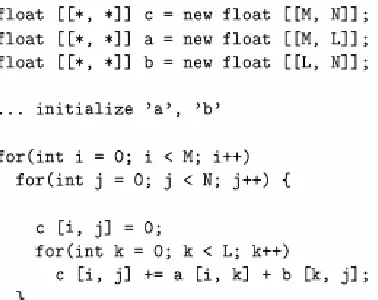
[image:2.596.203.392.328.478.2]Figure 1: Sequential Matrix multiplication in HPJava.
Figure 1 is a basic HPJava program for sequential matrix multiplication. This program is simple and similar to the ordinary Java program. It uses simple sequential multiarrays— a feature HPJava adds to standard Java. A multiarray uses double brackets to distinguish the type signature from a standard Java array. The multiarray and ordinary Java array has many similarities. Both arrays have some index space and store a collection of elements of fixed type. Syntax of accessing a multiarray is very similar with accessing ordinary Java array which uses single brackets, but an HPJava sequential multiarray uses double bracket and asterisks for its type signature. The most significant difference between ordinary Java array and the multiarray of HPJava is that the distributed array is true multi-dimensional array like the arrays of Fortran, while ordinary Java only provides arrays of arrays. These features of Fortran arrays have adapted and evolved to support scientific and parallel algorithms.
divide the communication library of HPJava into two parts: the high-level Adlib library, and the low-level
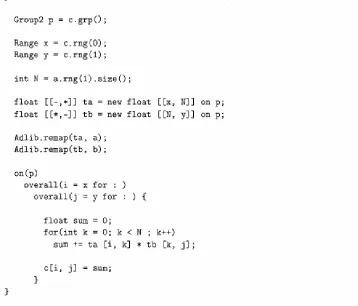
[image:3.596.117.475.215.521.2]mpjdev library. The Adlib library is responsible for the collective communication schedules and the mpjdev library is responsible for the actual communication. One of the most characteristic and important communication library methods, remap(), takes two arrays as arguments and copies the elements of the source array to the destination array, regardless of the distribution format of the two arrays
Figure 2: A general Matrix multiplication in HPJava.
3.0
Implementation of Collectives
In this section we will discusses Java implementation of the Adlib collective operations. For illustration we concentrate on the important remap operation. Although it is a powerful and general operation, it is actually one of the more simple collectives to implement in the HPJava framework.
Constructor and public method of the remap schedule for distributed arrays of float element can be described as follows:
class RemapFloat extends Remap { RemapFloat (float # dst, float # src) {...} public execute() {...}
}
The remap schedule combines two functionalities: it reorganizes data in the way indicated by the distribution formats of source and destination array. Also, if the destination array has a replicated
distribution format, it broadcasts data to all copies of the destination. Here we will concentrate on the former aspect, which is handled by an object of class RemapSkeleton contained in every Remap object.
During construction of a RemapSkeleton schedule, all send messages, receive messages, and internal copy operations implied by execution of the schedule are enumerated and stored in light-weight data structures. These messages have to be sorted before sending, for possible message agglomeration, and to ensure a deadlock-free communication schedule. These algorithms, and maintenance of the associated data structures, are dealt with in a base class of RemapSkeleton called BlockMessSchedule. The API for the supe r class is outlined in Figure 3. To set-up such a low-level schedule, one makes a series of calls to sendReq and recvReq to define the required messages. Messages are characterized by an offset in some local array segment, and a set of strides and extents parameterizing a multi-dimensional patch of the (flat Java) array. Finally the build() operation does any necessary processing of the message lists. The schedule is executed in a “forward” or “backward” direction by invoking gather() or scatter().
Figure 3: API of the class BlockMessSchedule.
However we do wish to describe in a little more detail the implementation of the higher-level RemapSkeleton schedule on top of BlockMessSchedule. This provides some insight into the structure HPJava distributed arrays, and the underlying role of the special Range and Group classes.
To produce an implementation of the RemapSkeleton class that works independently of the detailed distribution format of the arrays we rely on virtual functions of the Range class to enumerate the blocks of index values held by each process. These virtual functions, implemented differently for different distribution formats, encode all-important information about those formats. To a large extent the communication code itself is distribution format independent.
Some of the relevant virtual functions of the range are displayed in the API of Figure 4. The most relevant methods optionally take arguments that allow one to specify a contiguous or striped subrange of interest. The Triplet and Block classes represent simple struck-like objects holding a few int fields describing respectively a “triplet” interval, and the strided interval of “global” and “local” subscripts that the distribution format maps to a particular process. In the examples here Triplet is used only to describe a range of processcoordinates that a range or subrange is distributed over.
Figure 4: Partial API of the class Range.
4.0
Conclusions and Future Work
We have discussed in detail the design and development of high-level library for HPJava— this is essentially communication library. The Adlib API is presented as high-level communication library. This API is intended as an example of an application level communication library suitable for data parallel programming in Java. This library fully supports Java object types, as part of the basic data types. We discussed implementation issues of collective communications in depth. The API and usage of other types of collective communications were also presented.
The initial release of HPJava was made on April 1, 2003. It is freely available from www.hpjava.org. This release includes complete HPJava translator, two implementations of communication libraries (mpiJava -based and multithreaded), test suites, and all the applications described in this dissertation. In the future, further optimization of the HPJava translator is needed.
5.0
Reference
[1] Agrawal, A. Sussman, and J. Saltz. An integrated runtime and compiletime approach for parallelizing structured and block structured applications. IEEE Transactions on Parallel and Distributed Systems, 6, 1995.
[2] Bryan Carpenter, Guansong Zhang, and Yuhong Wen. NPAC PCRC runtime kernel definition. Technical Report CRPC-TR97726, Center for Research on Parallel Computation, 1997.
[3] Parallel Compiler Runtime Consortium. Common runtime support for high performance parallel languages. In Supercomputing ‘93. IEEE Computer Society Press, 1993.
[4] John Merlin, Bryan Carpenter, and Tony Hey. shpf: a subset High Performance Fortran compilation system. Fortran Journal, pages 2-6, March 1996.
[5] Guansong Zhang, Bryan Carpenter, Geoffrey Fox, Xiaoming Li, Xinying Li, and Yuhong Wen.