Abstract: The discarded object dart during alumina extraction from bauxite ores in Bayers process is Red Mud. The solid/ liquid insoluble by-product dumped in exposed red mud ponds which are radioactive, highly alkaline and environmental contaminant to soil, surface water and ground water and possess disposal threats. Recent trend in increased urbanization and modernization has plenty of use of exterior flooring by concrete pavers block depending upon traffic load and volume. Present work is to know whether this red mud can be reused as a sustainable construction material to replace cement. The XRF spectroscopic advantage is taken to determine the composition identities between red mud and OPC cement. The study reveals the optimized percentage of red mud blend with cement after neutralization normalization. It cannot be disposed of easily. Attempt has been made to use bajri as the coarse aggregate instead of 12mm chips. The crusher by-product is having less use as construction materials. So the spare of cement by compensating with red mud and use of bajri shall be cost effective, environmentally sustainable and convenient disposal of the harmful waste. The mechanical characteristics like compressive, flexural, and split tensile strength etc., at 0%, 10%, 20%, 30% and 40% replacement of cement by red mud is found by using compressive testing machine (CTM) and universal testing machine (UTM) adhering to IS : 15658 (2006) and amended in 2011. The 20% OPC cement substitution by red mud is found to be adequate and will maintain sustainability.
Keywords: Mechanical Strength, Concrete, Red mud; Bajri, Pavers block.
I. INTRODUCTION
One of the major pollutant end products excreted from Bayer process in alumina production is red mud. The traditional method of throwing away of red mud (RM) is by ponding which has degradable environmental impacts. During rain, RM from the tank may spilled out or cause a breach and inundate nearby areas, contaminating the surface water by mixing, ground water by leaching processes. Disposal constraints of large quantities of ponded Red Mud (RM) poses space limitations as the RM is harmful due to its high pH value (11-13) and high alkalinity. Literature reveals, the RM from Damanjodi, Odisha (where the research sample
Revised Manuscript Received on November 06, 2019.
Pabitra Das Mohapatra, Department Civil Engineering, Centurion University of Technology and Management, Odisha, India.
Siba Prasad Mishra, Department Civil Engineering, Centurion University of Technology and Management, Odisha, India.
Sipalin Nayak, Department Civil Engineering, Centurion University of Technology and Management, Odisha, India.
Mohammed Siddique, Department Mathematics, Centurion University of Technology and Management, Odisha, India
is taken) contains six major oxides named CaO (1-2%),
SiO2(4-6%), Fe2O3(48-54%), Al2O3(17-20%),
TiO2(3-4%), and Na2O (3-5%), Na2O and small quantities of numerous minor elements and LOI (Loss on Ignition) is 10-14%, (Sutar et al, 2014[1]& Dodoo et al., 2017[2]). Presently researches are conducted by treating RM as cemetitous material after normalization. Cement is the most important material in structural constructions (mortar, CC or RCC) as the bonding materials used with stones, sand, bricks, blocks and paver blocks. Since cement manufacture involves high change in thermal energy associated with heavy atmospheric pollutants like CO2 and other GHG gasses affecting the atmospheric sustainability Fig -1. The direct Bayer’s trail RM exhibit radio activity Wyatt P. 2018[3].The waste red mud (RM) if conjoined to replace cement, then it will be cost effective, sustainable and energy conservation.
II. LITERATURE REVIEW
Sawant R. A. B. et al. 2012[4], Sarod D., et al, 2015[5], Gowsalya. R et al 2015[6] reported about red mud as partial
[image:1.595.348.507.461.606.2]replacement of Portland cement at different proportions and
Fig. 1: Red mud Pond at Lanjigarh, Odisha also with other ingredient like ultra-fines, fly ash etc. Bishetti P. N., et al., 2014[7], Pujar S. M. et al., 2014[8] reported that the Red Mud poses problems of disposal and environmental degradation. The high alkalinity (pH ranging from 10-13.5) red mud, which is caustic causes GW pollution during disposal, leading to health hazards. Cementous behaviour of the red mud proves to be befitting substitute for cement. Pujar et al, 2014[8]. Deepika et al., 2017 [9], Varghese M., 2017[10], have partly replaced cement by red mud in concrete for different fractions and estimated its impact on the
Optimized Structural Performance of Paver
Blocks of Bajri Concrete: NRM Partly
Substituting Cement
Optimized Structural Performance of Paver Blocks of Bajri Concrete: NRM Partly Substituting Cement
mechanical strength and assessed its adaptability in concrete. Deelwal et al., 2014[11]have reported about the physical properties of RM like Sp. Gr., Particle size distribution, Atter Berg’s limit, OMC and MDD, and recommended for its possible uses as geo-tech material.
Red mud can have three fold benefits like waste disposal, raw material and added values when best used as building materials like colours, bricks, roads, benches, Krebs, sea defenses, litter bins, pipes, floor and tiles and many more (Tauber et al., 1971[12], Knight J. C. et al., 1986[13], Bhat et al., 2002[14], Lima et al., 2017[15]). Though not yet proved to be economical, researches are going on the metallurgical uses of red mud for extraction of iron, titania, as a ferriferous agglomerate and as a bentonite binding pellets in blast furnace and recovery of alkali, minor elements (Prasad P. M. et al, 1985[16], Kumar R., et al., 1995[17], and Dmitriev A., 2018[18]), The catalytic activity and other uses of red mud are as hydrogenation (organic compounds), catalysis of ceramics in manufacture of sanitary ware, pottery, special glazed tiles, ferrites and glasses, and de-chlorinating tetra-chloro-ethylene (Kara, et al, 1995[19], Snigdha et. al., 2008[20],Busto et. al., 2016[21]).
Velumaniet. al., 2017[22], mentioned that Paver blocks of CC with textile sludge as per IS 15658-2006 , have identical strength as that of M20 and M30 pavers block concrete by replacement of cement by red mud upto 35%. Blending by 10% of cement by red mud in the mortar of pavers block had high compressive strength and is cost effective Batham G., 2018[23]. Deshmukh et.al, 2014[24]reported that red mud convey improved resistance to chloride dissemination as it withstand RPC (rapid chloride permeability) Test. Kulkarni S 2018[25], have mentioned the industrial wastes like fly ash, RM, and GGBFS (ground granulated blast furnace slag) can bring green revolution concrete world. According to IS 15658: 2011 (modified), the non-traffic areas are without vehicular traffics and light-traffic areas have daily traffic < 150 numbers of commercial light vehicles above 30 kN laden weight.
Present Interest of investigation
Cement and its products are the leading usable construction materials which is energy intensive and producing 6% of the global CO2 emission (1.8GT/year assessed in 2005) as the 3rd largest source of Anthropogenic emission,of the globe next to water and earth(IEA GHG R&D programme, 200826], Sarod D., 2015[5]).Globally the production of CO2 in the years 2014, 2015 and 2016 were 1.51 ± 0.12 GtCO2,1.44 GtCO2and 1.46 ± 0.19 GtCO2respectively. The average CO2 level in atmosphere has raised from 250 ppm before industrial revolution to present as 407ppm. . It is high time to explore substitutes of cement to save our mother earth from climatic dogma of CC, RCC and cement mortar to wane cement production.
India being one of the largest producers of alumina, record of ~3 billion tones of red mud is available in waste ponds near alumina refining industries (after Bayer’s Process) and adding @ 120 MT of red mud annually without any ore in red mud containing trace amount of heavy metals and radio nuclides, disposed in ponds, is contaminating the surface and ground water. It is found to be reuse Power et al., 2009[27]. The high alkalinity (pH: 11-13) are creating solemn threat to the water and environment and kills all vegetation’s all around, Venkatesh S., 2019[28].A considerable work has been done to use this detrimental waste as to use this waste in
[image:2.595.302.540.159.367.2]manufacture of iron & steel, alumina, titania, and alkali, as building materials like brick, LWA (light weight aggregates), tiles manufacture for roofs and floors with cements, manufacture of pottery, bricks, sanitary ware, colored tiles , glasses, glazes, sanitary gadgets, and many others like fertilizer, waste treatment and filler (Parekh et al, 1976[29], Prasad P.M. et al., 1985[16]). About 1 -2.5 MT of RM is evolved during production of 1MT of alumina depending upon the raw ore.
Fig. 2: How RM obtained from Bayers Process Present study:
The designed uses of paving blocks are based upon the traffic and the loading pattern. It is decided by testing the compressive, tensile and flexural, shear forces on the concrete or mortar used to make the blocks/tiles. Before study, it is searched to identify the similar constituents between cement (OPC) and normalised Red mud (NRM) so that it can replace the former. Present study is a crack to the problem to find the % of partial substitute of red mud with cement used in construction of Paver Blocks. The present work includes collection of RM waste from NALCO, at Damanjodi, Odisha and normalising it for use. The blending of the NRM replacing as partial replacement of cement under various proportions and studying its physical, mechanical properties and laboratory properties as needed for paver tiles as per IS 15658 -2006 which are less studied Fig -2.
Neutralisation of Red Mud: The RM is highly alkaline and cannot be used directly. So it is neutralized by commercial HCl solution to reduce the pH value
[image:2.595.324.526.599.732.2]from 10-13 to <8.5 after grinding, powdered, and sieved by 1.18mm sieve to uniform grain size for use as cement replacement Gowsalya. R. et al., 2015[6].
XRF spectroscopy of NRM and OPC:
The distribution of particles size of the RM is almost identical to that of cement Varghese M. 2017[10]. The X-Ray Fluorescence spectrometer a non-destructive versatile tool is used for regular analyses of minerals, rocks, sediments and fluids of high atomic weight compounds or elements. It
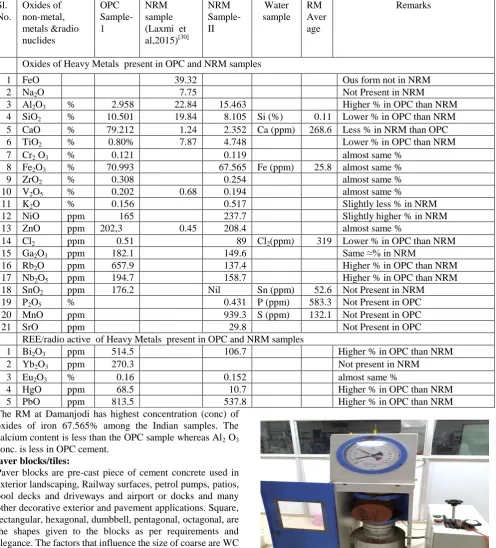
[image:3.595.51.548.181.730.2]employs wavelength-dispersive spectroscopy, used to find the non-metals, metals, metalloids and rare earth metals directly either in % or ppm. The constituents of the RM sample and Portland cement (PC)and water samples were found by the XRF spectroscopy and the % of oxides of different metal, non-metals and radionuclide’s in the XRF Spectrometer of CUTM are in Table 2 and Fig-3:
Table 2: Comparison of non-metals, metals and Radio nuclides in Cement and RM samples from Damanjodi, Odisha (XRF results)
Sl. No.
Oxides of non-metal, metals &radio nuclides
OPC Sample-1
NRM sample (Laxmi et al,2015)[30]
NRM Sample- II
Water sample
RM Aver age
Remarks
Oxides of Heavy Metals present in OPC and NRM samples
1 FeO 39.32 Ous form not in NRM
2 Na2O 7.75 Not Present in NRM
3 Al2O3 % 2.958 22.84 15.463 Higher % in OPC than NRM
4 SiO2 % 10.501 19.84 8.105 Si (%) 0.11 Lower % in OPC than NRM
5 CaO % 79.212 1.24 2.352 Ca (ppm) 268.6 Less % in NRM than OPC
6 TiO2 % 0.80% 7.87 4.748 Lower % in OPC than NRM
7 Cr2 O3 % 0.121 0.119 almost same %
8 Fe2O3 % 70.993 67.565 Fe (ppm) 25.8 almost same %
9 ZrO2 % 0.308 0.254 almost same %
10 V2O5 % 0.202 0.68 0.194 almost same %
11 K2O % 0.156 0.517 Slightly less % in NRM
12 NiO ppm 165 237.7 Slightly higher % in NRM
13 ZnO ppm 202,3 0.45 208.4 almost same %
14 Cl2 ppm 0.51 89 Cl2(ppm) 319 Lower % in OPC than NRM
15 Ga2O3 ppm 182.1 149.6 Same ≈% in NRM
16 Rb2O ppm 657.9 137.4 Higher % in OPC than NRM
17 Nb2O5 ppm 194.7 158.7 Higher % in OPC than NRM
18 SnO2 ppm 176.2 Nil Sn (ppm) 52.6 Not Present in NRM
19 P2O5 % 0.431 P (ppm) 583.3 Not Present in OPC
20 MnO ppm 939.3 S (ppm) 132.1 Not Present in OPC
21 SrO ppm 29.8 Not Present in OPC
REE/radio active of Heavy Metals present in OPC and NRM samples
1 Bi2O3 ppm 514.5 106.7 Higher % in OPC than NRM
2 Yb2O3 ppm 270.3 Not present in NRM
3 Eu2O3 % 0.16 0.152 almost same %
4 HgO ppm 68.5 10.7 Higher % in OPC than NRM
5 PbO ppm 813.5 537.8 Higher % in OPC than NRM
The RM at Damanjodi has highest concentration (conc) of oxides of iron 67.565% among the Indian samples. The calcium content is less than the OPC sample whereas Al2 O3
conc. is less in OPC cement. Paver blocks/tiles:
Paver blocks are pre-cast piece of cement concrete used in exterior landscaping, Railway surfaces, petrol pumps, patios, pool decks and driveways and airport or docks and many other decorative exterior and pavement applications. Square, rectangular, hexagonal, dumbbell, pentagonal, octagonal, are the shapes given to the blocks as per requirements and elegance. The factors that influence the size of coarse are WC ratio, grade/quality of cement, aggregate sizes, and methods of curing, air entrainment, size and shape of specimen, quality of concrete ingredients. Normal sizes of the paver blocks and their purpose of use at site are in Table 3:
Optimized Structural Performance of Paver Blocks of Bajri Concrete: NRM Partly Substituting Cement
Table 3: Paver blocks in different traffic categories, sub grade, and correction factors as per Pavers India (http://paversindia.com/iscode.html) (IS 15658-2006)
Sl. Grade Thick ness
Cor. Factor Sub grade CBR % Place of use
Unit mm Plain/cham
Fere din mm
Sub grade Thick mm
1 M 30 50 0.96/1.3 Blocks
Sand bed WBM/WMM Coarse Sub base
60-80 20-40 250 200
Buildings & monuments, premises, slopes, levees foot paths, patios, gardens,
2 M 35 60 1.0/1.06 Blocks
Sand bed WBM/WMM Coarse Sub base
60-80 20-40 250 200
Ramps, car parks, farm/ shop complexes, beach sites, tourist resorts, roads, low volume traffics,
3 M 40 80 1.12/ 1.18 Blocks
Sand bed WBM/WMM Coarse Sub base
60-80 20-40 250 200
Arterial roads, city streets, utility cuts, medium low volume roads,
4 M 50 100 1.18/ 1.24 The placing of the paver blocks > 100mm thickness need special sub base preparation is needed as per underneath soil after up-holding OMC condition
Bus stand, Industrial &Mandi complexes, black cotton soils and service stations and factory floors
5 M 55 120 1.28/1.34 Mines area, ports, harbors and docks,
airport and container terminals
III. MATERIALS
Recent trend in concrete industry emphasizes on mechanical properties like self-compacting concrete (SCC) instead of traditional concrete mix by introducing local available waste materials as constituents of CC and even with CRMs (cement replacement materials).The vibrator compaction era is gone. The possible ingredients used for SCC are Pumecrete, Majumdar and Mishra S. P. 2017[31], silica fume, RM and fly ash. Introduction of red mud with these cemetitous materials are SCC category which prevent segregation and permit the concrete to move easily under self-weight. The materials used for making concrete specimens are Cement, Fine aggregate, Plastic coated course aggregate, water. The code IS 15868: 2006 (amended in 2011) depicts about cement pavers blocks, slabs, bricks, squares, tiles used for civil construction. Cement:
Grade of cement OPC43packed by Dec 2018 and used in Jan-2019, specific gravity of cement 3.14, fineness of cement 310 m²/Kg ,initial setting time 33min & final setting time 586min, Conforming IS Codes: IS: 8112 – 1989. According to manufacturer, the compressive strength of cement mortar after 28-days curing (IS 4031(6)-1988), is > 43 MPa.
Neutralized Red mud:
The red mud discussed for the study has specific gravity (sp. Gr) = 2.85, density (ρ) = 2187 kg/m3 and fineness modulus is >12000 cm2/gm. The RM used is alkaline due to high pH and so neutralization is essential to deactivate by processes of neutralization like adding CO2, adding
seawater, bioleaching and the methods sintering to maintain pH value at 8.0 following the process adopted by Pujar et al 2014[8].
Corse Aggregates:
Course aggregates comprising a maximum size of (0-10) mm, locally called Bazri, having fineness modulus of 6.05, specific gravity of 2.67 as per the recommendations of IS: 15658 (2006) were used in saturated surface dry condition,
water absorption is 1.5% is used for casting the pavers block and as per IS: 383-2016 (amended)
Fine Aggregate:
Fine aggregates used for preparation of M-30 grade specific gravity of 2.61, fineness modulus of 2.7 & water absorption 1.5% in saturated surface dry condition, from the test we can say that Fine Aggregate (Sand) is Medium Sand. It is conforming to Zone III grading as per IS: 383-2016, natural sand grain size4.75-mm maximum was used as fine aggregate.
Water:
College tap water was used in red mud substituted cement concrete with 38% water cement ratio ate a room temperature ranging 280C- 350. The water cement ratio was maintained.
Properties of SCC concrete:
After preparation of the concrete cubes for the paver blocks the different tests conducted are the compressive, flexural, tensile strengths, modulus of rupture, split tensile and the shear force of the blocks. All the tests were conducted either in Universal Testing Machine of Concrete Lab of CUTM, The UTM machine (Model BSUT- 100-ZE, Blue star design and manufactured in China), of maximum measuring range 0-1000KN of different cubes, cylinders and beams prepared in the Lab at different blending by RM. The concrete after placement due to its self-weight no compacting action like vibration is not needed and the concrete get compacted
Test for compressive strength; Specimen:
Compressive strength of CC is the structural capability to cart the loads on surface without crack formation, deformation or deflection. The tests for compressive strength of the blocks were done by compression testing machine (CTM) of capacity 100 KN Fig -4and so also by universal testing machine (UTM) of capacity 1000KN(Fig -5)as per the specification given in
(as per IS code Page6, Table-3) is given as: Comp strength ≥ fck+0.825*accepted S.D. approximated upto 0.5N/m2 and av.
comp. strength (fc)= Load (P)/ compression area (A) where, P = applied maximum load (N)and cross section (CS)Area (A) in mm2. The characteristic compressive strength should not be less than the design. According to standard practice the 7th day, 14th day and 28th day achievement of compressive strength should be 65%, 90% and 99% respectively. For M30 grade the CS should be after 7, 14 and 28 days should be 20, 27 and 30 N/mm2 respectively (https://theconstructor .org/concrete/compressive-strength-concrete-cube-test/1561/
Test for Split tensile strength; Specimen:
The split tensile strength is considered as an indirect method of finding the optimum tensile strength of concrete cylinder that splits crosswise along the vertical diameter according to IS 5816 (1999). The test cylindrical specimens should have size of 100mm dia x 200mm length. The split tensile strength (fct) = 2P/π * dl, where P = the optimum
applied load (N), l = the length of test sample (mm) and d = diameter test sample (mm) The split tensile strength is found by CTM but as per recommendation ASTM test methods C 39/C 39M with continuous application of load without shock at constant rate of range 0.7 to 1.4 MPa/minute (1.2 to 2.4 MPa/minute as per IS 5816 1999) until the specimen splits. Test for flexural strength test; Specimen:
The Flexural strength or modulus of rupture (MOR) is the evaluation of tensile strength of un-reinforced beam or slab made of concrete to counterattack failure in bending. The
Flexural strength ( where P = Maximum load (N),
L = Length of the beam (mm) and d = Thickness of the beam (mm).(IS 15658:2006, page-16) used in the present
procedure. The flexural strength test on CC is shown by means of either 3- point load test as per ASTM C78 or center point load test as per ASTM C293. The test is conducted the concrete shaft, beam or cantilever to access the property, quality of materials, the structural excellence, and to predict the durability, resistance of the entities by UTM. Flexural strength perceives the extent of stress/forces an un-reinforced slab; beam and other structures can survive at bending failures and depends of materials casted, proportion mix, size preparedness, handling and the curing. The MOR (fr) is ~
10% to 20% of the compressive strength provided by the
concrete. The MOR ( where
and = compressive strength of concrete. The units of MOR is psi/ MPa which signifies the ability of unreinforced CC slab or beam to resist bending failure
Ingredients of concrete:
The characteristics of the materials used as ingredient of concrete are tested in the laboratory as per Kulkarni et al., 2018[25] and compared with their respective IS code and found that the materials are within permissible limits of the code provisions. The comparative statement is given in Table-4
Table 4: - Physiognomies of ingredients of concrete compared with IS code provision
Sl. Ingredient Tests conducted Results of expt. conducted IS: 12269-1987need
1 Cement(OPC-43 Grades)
IS: 8112 – 1989
Specific Gravity: Cement- IS: 4031 (Part-11) –2005
Sp. gravity (3.14) 3.15
Normal consistency test- IS: 4031 (Part-4) – 1999
Normal Consistency: 32.5% 30%-35%
Initial and Final Setting Time: IS: 4031 (P-5) –1999
Initial -33mnts >30
Final:-586mnts <600
IS 4031-(1) (1996) Fineness 310 m²/Kg >225
2 Course Aggre- gate. (Bazri)
Coarse Aggt.:(Sieve Analysis)- IS: 2386(Part-1) –2016
Specific gravity 2.67 Is-383-2016(R)
IS 15658 (2006) 3 Fine aggregate
(the inert filler
IS: 2386 (Part-1) – 2016
Silt content - IS: 2386 (P-1) – 2016, Sp. Gr.: fine aggregate - IS: 2386 (P-3) -2016
River sand zone III Sp.gr.2.61
Is-383-2016 (R) 2016)
4 Normalized Red Mud (powered)
Physical properties of NRM Wet density: 1.75, Sp. Gr.: 2.785, LL(%) 48.89, PL (%): 35.77 and PI: 13.12± 0.49
Tharani P et al., 2017[41],Feng& Wang 2018 [32]& lab results
Red mud Fineness 4,1%
Methodology
The design mix was calculated according to traditional concrete mix design for M30 grade conforming to IS 10262: 2009. The M30 concrete mix design should have targeted
strength (IS 456 – 2000) was as , where
= target average compressive strength after 28 days curing, fck= Characteristic compressive strength after 28 days
curing and S = Standard deviation (S = 4N/mm²). The % of addition of red mud varied from 0%, 10%, 20%, 25%, 30% and 40% by weight of cement and the specimen was casted. The compression testing samples were cast in cubes of 70X
Optimized Structural Performance of Paver Blocks of Bajri Concrete: NRM Partly Substituting Cement
Fig. 5 : Flexural test by UTM (Model BSUT- 100-ZE, Blu star design and manufactured in China)
Casting of specimen:
The coarse aggregate (Bajri), the river sand and Cement, were taken as per mix design proportion 1:1.71:2.35 to prepare concrete of M 30 grade. Cement was substituted with red mud by 10, 20, 25, 30, and 40, % after the ingredients were homogeneously dry mixed. Later the water was added (@W/C= 0.362) and the mix was homogeneously variegated Fig
.
6(a) and Fig.
6(b).Fig. 6 (a): The trial specimen during casting
Fig. 6 (b): The trial specimen after 28days curing This green concrete (after slump test and CF (compaction factor), was moulded as cubes, beams and cylinders and was compacted by hand compaction in 3-layers and later vibrated over the compaction table and kept for a day and later the remoulded cubes were wrapped by gunny bags placed in curing tank where allowed to tank curing for 7days, 14 days and 28 days. The water cured specimens were taken out for conducting the tests like. Mechanical strength properties (Compressive strength, Split tensile strength, Flexural strength test etc).
Universal Testing Machine (UTM):
Universal Testing Machine (UTM) of 100T capacity is
used for testing tensile, compressive, torsion, bending and flexural tests. The metal slices, concrete cubes, cylinders and RCC beams can be tested for their mechanical properties by this machine. Present test is conducted in the Centurion University of Technology and Management Laboratory and the results/graphs are considered for technical uses. A result sample after 7days, 14days and 28days curing is given in Fig 7 (a), (b) and (C)
Fig 7 (a):Beam: 20% RM Substitute (7days curing)
Fig.7(b):MortarCub:30% RM substitute(14 days curing)
[image:6.595.305.549.144.313.2] [image:6.595.46.289.343.566.2]IV. RESULTS&DISCUSSIONS
The Chemical constituents of red mud and cement were checked by X-ray fluorescent spectrometer and it was found that there is low percentage of CaO present in the red mud in comparison to the same in the cement used. Deshmukh et al 2014[24] reported that the Cemetitous properties of red mud are less than cement. However the binding properties develops when the blended material react with water develop compressive strength due to formation of CSH (Calcium silicate hydrate).
Aspect ratio (L/T):
The concrete paver tiles prepared is of size 200mm x 200mm x 55mm, which has aspect ratio length/ thickness (L/T) = 200mm/55mm = 3.63 <4, hence the pavers block is within recommended dimensions prescribed by IS: 15658 -2006, page 5
Compressive strength (Only mortar cubes)
In order to compare the results obtained by adding 0%-40% varying amounts of red mud mixed with plain cement concrete and prepared a sample. The results of the compressive strength after 7 days ,14 days, and 28 days of curing are as presented in Table:-5
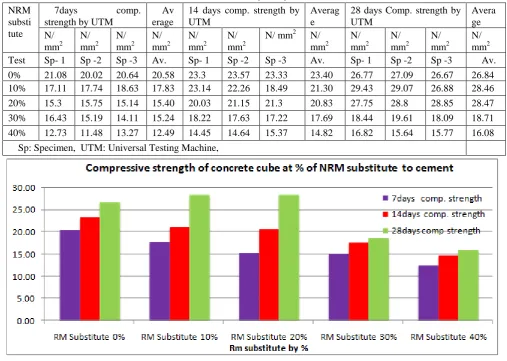
Compressive strength (with coarse aggregate as bajri) Bajri is a crushed stone product of size < 10 mm obtained from crusher yards and has almost less utility in concrete making. The compressive strength of mortar added with the crusher Bajri has more compressive strength. Attempt has been made to replace 12mm chips by same amount of bajri to impart higher compressive strength to the pavers’ tiles in low traffic areas. Concrete cubes were prepared and tested for the different mechanical strength of the specimen cubes and cylinder. The compressive strength is in Table 6
From the sets of determination of compressive strength of concrete cubes (bajri + sand +cement +NRM) it is observed that the compressive strengths of cubes are much higher than the cubes made up of cement mortar only. So can be concluded that bajri can be used for higher strength of low traffic paver tiles.
From the % of replacement of NRM by cement it can also be accepted that upto 20% replacement of normalised red mud in lieu of cement can resist better strength than that of mortar paver tiles to withstand loads of light traffic (Fig -9).
Table5: Cement mortar cubes of river sand, OPC cement with different % substitute by (NRM) %
Substit ute
7days comp. strength by UTM 14 days comp. strength by UTM 28 days Comp. strength by UTM N/
mm2
N/ mm2
N/ mm2
N/ mm2
N/ mm2
N/ mm2
N/ mm2
N/ mm2
N/ mm2
N/ mm2
N/ mm2
N/ mm2 Sp- 1 Sp -2 Sp -3 Av. Sp- 1 Sp -2 Sp -3 Av. Sp- 1 Sp -2 Sp -3 Av. 0% 19.3 21.56 21.3 20.72 21.49 23.78 21.95 22.41 22.71 25.22 25.22 24.38 10% 16.86 21.77 16.43 18.35 21.49 22.15 18.37 20.67 23.2 26.22 20.94 23.45 20% 20.15 18.55 17.73 18.81 19.95 19.96 17.78 19.23 23.01 20.38 19.3 20.89 30% 15.71 6.53 12.16 11.47 16.89 8.48 10.39 11.92 14.96 14.76 8.9 12.87 40% 11.42 12.26 10.24 11.31 11.82 13.26 12.16 12.41 13.38 7.06 10.22 10.22 Sp: Specimen, UTM: Universal Testing Machine,
[image:7.595.45.563.328.500.2]From the trial results it is observed that up to substitution of the NRM by 20% the mortar can with stand load up to 21N/mm2. The compressive strength is reduced comparatively when the replacement > 30%
Optimized Structural Performance of Paver Blocks of Bajri Concrete: NRM Partly Substituting Cement
Table 6: Cement cube with bajri (<10mm), river sand and, OPC cement with different % substitute by Normalised Red Mud (NRM)
NRM substi tute
7days comp.
strength by UTM
Av erage
14 days comp. strength by UTM
Averag e
28 days Comp. strength by UTM
Avera ge N/
mm2 N/ mm2
N/ mm2
N/ mm2
N/ mm2
N/ mm2
N/ mm2 N/
mm2
N/ mm2
N/ mm2
N/ mm2
N/ mm2
Test Sp- 1 Sp -2 Sp -3 Av. Sp- 1 Sp -2 Sp -3 Av. Sp- 1 Sp -2 Sp -3 Av.
0% 21.08 20.02 20.64 20.58 23.3 23.57 23.33 23.40 26.77 27.09 26.67 26.84
10% 17.11 17.74 18.63 17.83 23.14 22.26 18.49 21.30 29.43 29.07 26.88 28.46
20% 15.3 15.75 15.14 15.40 20.03 21.15 21.3 20.83 27.75 28.8 28.85 28.47
30% 16.43 15.19 14.11 15.24 18.22 17.63 17.22 17.69 18.44 19.61 18.09 18.71
40% 12.73 11.48 13.27 12.49 14.45 14.64 15.37 14.82 16.82 15.64 15.77 16.08
Sp: Specimen, UTM: Universal Testing Machine,
Fig 9 : Compressive strength of Bajri concrete cubes with different % of NRM replacing cement Results of the flexural strength determination:
The beams of size 275mm x 75mm x 75mm is casted taking bajri as course aggregate, river sand, OPC cement and NRM at different percentages. The breaking load is found as per the IS- 15658:2006 (Annex –G, page -16) and the results are given in Table- 7 and fig- 10. The suggested breaking load for pedestrian/ residential paths allowed is 2KN and residential drive ways is 3KN. Different beams are casted with various % of NRM substation of cement and the
breaking load (flexural strength) is obtained using UTM after 7days, 14 and 28days curing.
[image:8.595.44.553.578.764.2]From the output results of UTM, it is observed that after 28days curing the cubes attain the flexural load satisfactorily. The breaking load is highest (4.30KN) when the paver’s bajri concrete is admixed with 20% NRM replacing OPC. Hence it can be used for residential, public pedestrian pathways, light vehicles moving in residential approaches, petrol pumps etc comfortably.
Table 7: Breaking load for the concrete specimen for pavers block with % of NRM replacement NRM
substitute
7days comp. strength 14 days comp. strength 28 days comp. strength
KN KN KN KN KN KN KN KN KN KN KN KN
Test Sp- 1 Sp -2 Sp -3 Av. Sp- 1 Sp -2 Sp -3 Av. Sp- 1 Sp -2 Sp -3 Av.
0% 1.17 0.71 1.15 1.010 2.15 1.8 2.15 2.04 3.82 2.89 3.1 3.27
10% 1.04 1.13 2.12 1.430 1.83 2.1 2.89 2.27 2.73 3.79 4.1 3.54
20% 1.27 1.23 2.39 1.630 2.73 2.6 3.89 3.07 4.29 3.72 4.89 4.30
30% 1.16 0.07 0.11 0.447 2.1 0.9 1.67 1.55 2.56 1.7 3.18 2.48
Sp: Specimen, UTM: Universal Testing Machine,
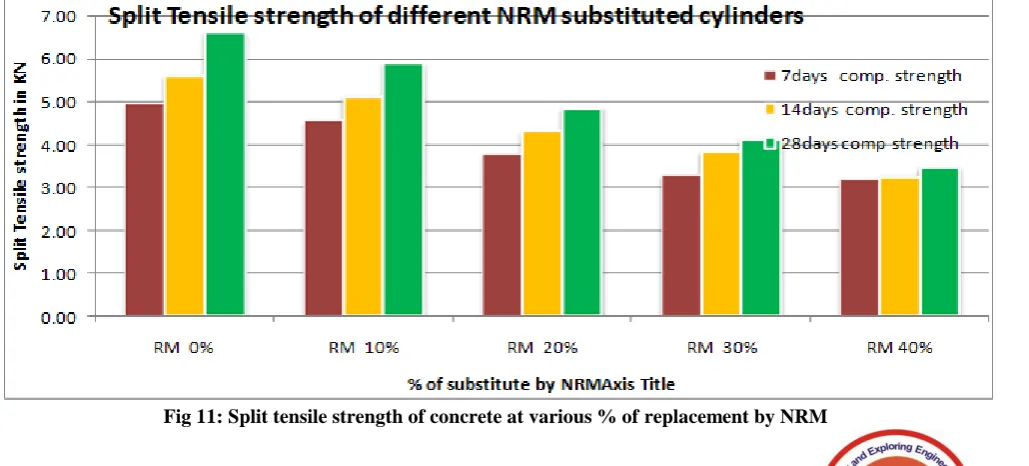
[image:9.595.46.556.339.492.2]Fig 10: Flexural strength of concrete at various % of replacement by NRM Table 8: Split tensile strength of the paver’s concrete specimen tested by CTM NRM subs-
titute
7days comp. strength 14 days comp. strength 28 days Comp. strength
KN KN KN KN KN KN KN KN KN KN KN KN
Test Sp- 1 Sp -2 Sp -3 Av. Sp- 1 Sp -2 Sp -3 Av. Sp- 1 Sp -2 Sp -3 Av.
0% 4.81 5.02 5.13 4.99 5.12 5.8 5.98 5.63 6.32 6.67 6.88 6.62
10% 4.38 4.56 4.79 4.58 5.15 4.8 5.42 5.13 5.87 5.73 6.14 5.91
20% 3.89 3.51 4.03 3.81 4.62 4.3 4.12 4.34 5.37 5.01 4.25 4.88
30% 3.53 3.47 2.92 3.31 4.75 3.9 2.92 3.84 5.2 4.27 3.02 4.16
40% 3.11 3.42 3.14 3.22 3.18 3.5 3.15 3.27 3.29 3.97 3.2 3.49
Sp: Specimen, CTM: compressive Testing Machine,
Split Tensile Test:
As per code IS 15658 -2011 the splitting strength (tensile) of the trial specimen should be 0.1 MPa; and failure load (F) to be approaching 10N/mm Fig 11 and Table -8.
[image:9.595.46.561.545.778.2]Optimized Structural Performance of Paver Blocks of Bajri Concrete: NRM Partly Substituting Cement
It is found that the substitution of NRM give optimized result when cement is replaced by 20% of NRM. So paver blocks were casted of size 200mm x 200 mm x 55mm their compressive strength were tested by CTM. The comparative result is
[image:10.595.45.555.97.225.2] [image:10.595.48.554.282.703.2]shown in Table 9
Table 9: The evaluation of the comp. strength of Pavers blocks after 7, 14, 24 days curing: NRM subs
titute (%)
Comp. strength
7days curing
Comp. strength 14days curing
Comp. strength 28days curing
Average 28days curing
% kN/mm2 kN/mm2 kN/mm2 kN/mm2
0% (T-1) 22.89 22.89 26.63 26.36
0% (T-2) 19.56 21.94 25.78
0% (T-3) 20.67 22.61 26.67
20% (T-1) 17.08 22.11 26.59 26.53
20% (T-2) 17.79 21.20 26.02
20% (T-3) 17.79 21.50 25.97
From the comparison of cement mortar cube with 0% substitute and 20% replacement of cement by normalized red mud indicates that the final strength is achieved by the 20% NRM substituted blocks. The compressive strength is equalized to the 20% NRM substituted paver blocks after 28days though it is comparatively less after 7days and 21days curing.
Discussion:
Table10: Studies made on partially replacing of neutralized Red Mud (NRM) by Cement Sl. concrete
Gr./ mortar
Tests conducted % replaced RM in
concrete mix
Optimum replacement
Authors reference
1 M30 compressive strength,
split tensile strength
5%,10%,15%,20%,25% ,30%,40%. RM
25% (equivalent to controld concrete)
Rathod et al.,
2013[33]Venkatesh et al., 2019[28]
2 M-30
(NRM)
compressive strength, split tensile strength
0%, 5%,10%, 15%, 20%, 25%
20% NRM but less workability
Gowsalya. R et al 2015[6],
3 M-30
(NRM)
comp. strength split tensile strength, Flexure Strength Test
0%, 5%, 10%, 15%, 20% of RM & 5% of hydrated lime
15% NRM Ashok P et. Al., 2014[34]
4 RM
(MALCO)
Comp. strength split tensile strength, Tensile Strength Test
0%,10%, 15%, 20% RM + lingo sulphonates
15%NRM (WL dark/ brown complots mixture
Depika K et al., 2017[9]
5 RM (M-40,
M-50)
comp. strength split tensile strength, Flexure Strength Test
0%,10%, 15%, 20% RM + (0%, 5%,
10% RM replacement
Sai S. P., 2017[37]
6 RM,M-20,
M-25 and M-30
Comp. Strength, Splitting Tensile Strength, Flexural Strength
0%, 16%, 17%, 18%...24% RM
18% replacement in all three grades
Pateliya S., 2017[9]
7 M-30 Comp. Strength, Splitting
Tensile Strength, Flexural Strength
0%, 5%, 10%, 15%, 20%, 25% RM
15% replacement Metilda D. L., 2015[35]
8 M-20(NAL
CO)
Comp. Strength, Flexural Strength
0%, 5%, 10%, 15%, 20%, 30% , 40% RM
20% replacement Nayak S & Mishra S. P et. Al, 2017[36]
9 M-30 Comp., split tensile,
flexural strength
0%, 5%, 10%, 15%, 20%, 25%, RM
20% Peter J., 2018[38]
10 M 40 Compression and split
tensile test
0%, 10%, 20%, 30%, 40%
30% (replacing Machine sand)
Thangamani K, 2018[38]
11 M-25 compressive strength
split tensile strength
0%, 5%, 10%, 15%, 20%, (RM)
15% (but mech. Prop.decline
12 M-30 with bajri as coarse aggt.
Comp. strength, split tensile, flexural strength and aspect ratio
0%, 10%, 20%, 30%, 40%
20% by NRM Present work
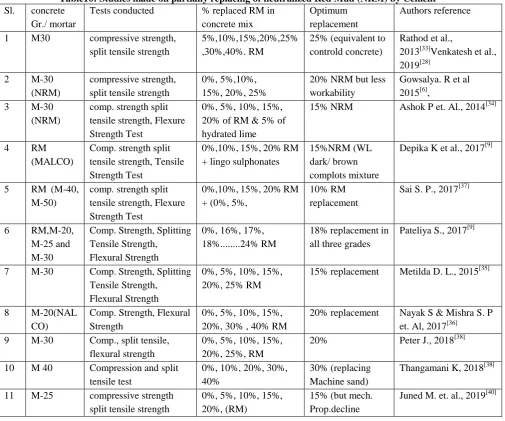
Mechanical strengths of NRM substituted or other waste materials used for manufacturing paver blocks have been found by different researchers and the list of works is enlisted in Table 10.The present work is random testing of mechanical strength of pavers’ concrete blocks with a replacement of 10, 20, 30% & 40% of NRM. To arrive at an optimized % of blending it is essential to have further studies 1% rise of RM substitute between 20%, 21%, 22% …
V. CONCLUSION
The constituents of NRM are analogous to cement as observed from the results X –Ray fluorescent spectroscopy, hence cement can be substituted by NRM and shall make it cost effective and achieve sustainability to the environment. But the quantity of Al2O3 and CaO is observed more in OPC
than the NRM obtained from Damanjodi. The NRM has less cemetitous properties as it contains less % of CaO. But when the NRM react with cement and water, the cemetitous properties is built up due to increased process of hydration and gain strength in concrete. The compressive strength of light/no traffic floor is found to have high values of more than 25 MPa , when RM replacement is 20% and providing binder so that the new pavers can have sound strength for pedestrians and light vehicles. Since RM is a contaminant waste and bajri (local stone product) having less use in CC and RCC constructions, the cement can be replaced by 20% NRM and can be cost effectively used for manufacture of concrete paver blocks for pedestrians of no traffic or less traffic floors and pathways.
REFERENCES
1. Sutar H. K., Mishra S. C., Sahoo S. K., Chakraverty A P., Maharana H.
S., 2014, Progress of Red Mud Utilization: An Overview” , American Chemical Science Journal. Science domain international, Vol-4(3), 255-279, www.sciencedomain.org
2. Dodoo-Arhin D., Rania A., Nuamaha A., Agyei B., David T., Obadac
O., Yayaa A., 2017, Awaso bauxite red mud-cement based composites:
Characterisation for pavement applications,Case Studies in
Construction Materials, Elsevier,Vol-7, PP- 45-55,
https://doi.org/10.1016 /j.cscm .2017. 05.003
3. Wyatt Pontius, 2018, Environmental and Radiation Concerns of Red
Mud, PH241, Stanford Univ., Winter 2018,
http://large.stanford.edu/courses/2018/ph 241/ pontius1/
4. Sawant R. A. B., Kumthekar M. B., Diwan V. V., Hiraskar K. G., 2012,
Experimental Study on Partial Replacement of Cement by Neutralized Red Mud in Concrete” , International Journal of Engineering and Advanced Technology (IJEAT).
5. Sarode D., Deshmukh M. P., Pendhari S. S., Alam I., 2015, Partial Replacement of Cement in Mortar with Red Mud and Ultra fines, Conference: 2nd R N Raikar Memorial International Conference and Bantia- Basheer International Symposium on Advances in Science and Technology of ConcreteAt: Mumbai, IndiaVolume: Volume II, ISBN No.81-86876-16-2
6. Gowsalya. R, Bhagyalakshmi. A, 2015, Experimental Study on Partial
Replacement of Cement by Red Mud, International Journal of Engineering Research & Technology (IJERT), ISSN: 2278-0181, Vol -3(4), pp-1-4
7. Bishetti P. N., Pammar L., (2014) “Experimental study on utilization of
industrial aste in concrete”, Int. Jr. of Technical Research and Applications, Vol-2(4), pp-49-52
8. Pujar S. M., Prakash K.B., 2014, Effect of Replacement of Cement by
Red mud on the Properties of Concrete, Int. Jr of Sc. & Eng. Research, Vol- 5 (9), pp- 805-814
9. Deepika K., Ananthakumar S., Mariadoss R, Nanthagopal J.,
Saravanakumar V., 2017, Experimental Investigation of Concrete by Red Mud as Replacement of Cement and Using Strengthening Admixture, International Journal of Innovative Research in Science, Vol-6 (3), pp- 3928-3933, DOI:10.15680/IJIRSET.2017.0603164
10. Varghese M., 2017, Partial Replacement of Cement using Red Mud in
SCC, Int. Jr. of Innovative Research in Sc., Eng. and Technology, Vol. 6
(5), pp- 8333-8338, http:/
/www.ijirset.com/upload/2017/may/175_Partial.pdf
11. Deelwal K., Dharavath K., Kulshreshtha M. (2014) “Evaluation of
characteristic properties of red mud for possible use as a geotechnical material in civil construction”, International Journal of Advances in Engineering & Technology, Vol-7(3), PP-1053-59.
12. Tauber, T., Hill, R. K., Crook, D. N. and Murray, M. J., 1971, Red mud
residues from alumina production as a raw material for heavy clay products. J. Austr. Ceram. Soc., 7 (1), pp. 12-17
13. Knight, J.C., Wagh A. S., Reid W.A., 1986, The Mechanical Properties
of Ceramics from Bauxite Waste, Journal of Materials Science, 21, pp. 2179-2184
14. Bhat P.N., Ghosh D.K., Desai M.M., 2002, Immobilisation of beryllium
in solid waste (red-mud) by fixation and vitrification, Waste Management, 22, pp. 549–556
15. Lima M. S. S., Thives L. P., Haritonovs V., Bajars K., 2017, Red mud
application in construction industry:review of benefits and possibilities, IOP Conf. Ser.: Mater. Sci. Eng. 251 012033, 251 PP- 1-10, doi:10.1088/1757-899X/251/1/012033
16. Prasad P. M., Kachawha J. S., Gupta R. C., Mankhand T. R., Sharma, J.
M., 1985,Light metal science and technology, Switzerland: Trans. Tech. Publication Ltd.; PP- 31,
17. Kumar R, Srivastava J. P., Prem Chand,1998, Utilisation of iron values
of red mud for metallurgical application, Envir. waste management in non-ferrous metallurgical industries, In: Bandopadhyay A, Goswami N. G., Rao R. P, editors. Jamshedpur: NML, PP- 108–19
18. DmitrievAndrey, 2018, The Comprehensive Utilisation of Red Mud
Utilisation in Blast Furnace, Open access peer-reviewed chapter, Open access peer-reviewed chapter, Intech open, pp-1-14 DOI: 10.5772/intechopen.80087
19. Kara M., Emrullahoglu, O. F., 1995, Study of Seydisehir red mud wastes
as brick and rooing tiles. In Fourth Euroceramics, Vol. 12, ed. I. Braga, S. Cavallini and G. F. Di Cesare, Faenza Editrice,, Italy, PP- 155-162, 20. Snigdha S.,.Batra V. S. 2008, Catalytic applications of red mud, an
aluminium industry waste: A review, Elsevier, Applied Catalysis B:Environmental,Vol-81(1–2),PP-64-77,
https://www.sciencedirect.com/science/article/pi/S0926337307004468
21. Busto R. V., Gonçalves M., Coelho L. H., 2016, . Assessment of the use
of red mud as a catalyst for photodegradation of bisphenol A in wastewater treatment, Pubmed, Water Sci Technol. Vol-74(6), PP-1283-1295..
22. Velumani P., Senthil Kumar S., 2017, Production of sludge incorporated
paver blocks for efficient waste management, Taylor and Francis,
Journal of the Air & Waste Management, DOI:
10.1080/10962247.2017.1395373To link to this article:
23. BathamGeeta, 2018, Strength enhancement of paver block using red
mud, International Research Journal of Engineering and Technology (IRJET), Vol- 05(7), pp-585-589
24. Deshmukh M. P., Sarode D.D., Avijit C., 2014, Effect of Partial Replacement of Crushed Fine Aggregates with an Industrial Waste (Red Mud) on Chloride Penetration of Concrete, Inpresco, International Journal of Current Engineering and Technology, Vol 4(6), pp- 4026-4029
25. KulkarniSupriya, 2018, Experimental Study on Red Mud, Fly Ash and
Optimized Structural Performance of Paver Blocks of Bajri Concrete: NRM Partly Substituting Cement
26. IEA Green House gas R & D Programme, (IEA GHG), 2008, CO2
capture in cement Industry, 2008/3,
https://ieaghg.org/docs/General_Docs/Reports/2008-3.pdf
27. Power, G., Grafe, M., and Klauber, C., (2009), Review of Current Bauxite Residue Management, Disposal and Storage:Practices, Eng. and Sc.. CSIRO Document DMR-3609
28. Venkatesh C.,Madduru S. Rama Chand, Nerella, Ruben, 2019, A State
of the Art on Red Mud as a Substitu-tional Cementitious Material, Annales de Chimie: Science des Materiaux, Vol. 43(2), April, 2019, pp. 99-106
29. Parekh, B. K., Goldberger W. M., 1976, An assessment of technology
for possible utilization of Bayer process Muds, EPA 600/2-76-301, Washington D.C. (1976),
30. Lakshmi T.D.V., Prasad DSV, M Anjan Kumar, Raju GVR Pr., 2015,
Stabilization of Industrial Waste Red-Mud with Cement, International Journal of Research and Innovations in Earth Science, Vol- 2 (1), pp- 5-9
31. Majumdar P. and Mishra S. P., 2017. “Management of Pumice Crete as
LWC/LWA construction material with Fly Ash as part cement substitute”, International Journal of Development Research, 7, (07), 13978-13984.
32. FengYanbo., Yang C., 2018, Analysis on Physical and Mechanical
Properties of Red Mud Materials and Stockpile Stability after Dilatation, Adv. In material S. and Eng, Vol-2018, Article ID 8784232, 14 pages, https://doi.org/10.1155/2018/8784232
33. Rathod R. R., Suryawanshi N. T., , Memade P. D.,2012, Evaluation of
the properties of Red Mud Concrete, IOSR Journal of Mechanical and Civil Engineering (IOSR-JMCE), PP: 31-34
34. Ashok P, Suresh kumar M. P., 2014, Experimental Studies On Concrete
Utilising Red Mud As a Partial Replacement Of Cement With Hydrated Lime, IOSR Journal of Mechanical and Civil Engineering (IOSR-JMCE), PP- 01-10
35. Metilda D. L. Selvamony C., Anandakumar R., Seeni A., 2015,
Investigations on optimum possibility of replacing cement partially by red mud in concrete ,. Academic journals. Vol-10(4), PP.137-143.
36. Nayak S., Mishra S P., Panda S., 2017, Red Mud, the cutting edge of
self-compacting concrete, INPRESSCO, International Journal of Current Eng. and Technology, Vol 7(2), pp.390 -396
37. P. SyamSai and ChandanaSukesh, Strength Properties of Concrete By
Using Red Mud as a Replacement of Cement with Hydrated Lime. Int. Jr. of Civil Engineering and Technology, 8(3), 2017, pp. 38–49
38. Peter J. Ruksana C. M, Peter A., Mohan S., 2018, Strength
Characteristics Study on Red Mud Concrete, International Journal of Research in Engineering, Science and Management, Vol-1(9), PP – 259-263
39. Thangamani K, 2018, Constant replacement of cement with red mud
and partial replacement of sand with m. sand in concrete, JETIR May 2018, Vol 5 ( 5), PP- 1065-1070
40. Juned M. , Ahmad A., 2019, Experimental Study of Concrete Strength