Abstract: Commercially available trash collector boats are often designed in large size to cater to the high trash loading for surface water cleaning purpose. On the other hand, for small streams and drainage, the manual cleaning method is often used. This situation is undesirable since it can lead to health problem and diseases to the operator due to the number of impurities present in the water. This paper highlights a proposed design of a trash collecting boat for cleaning purposes in small area applications such as lakes, small streams and drainage. The trash collector boat is designed to be a small and automated boat capable of collecting floating solids off the water surface and store them temporarily. The trash will be manually collected at the end of the operation. The design methodology has been accomplished using engineering design method to propose a suitable design of portable trash collector boat based on commercially available design. With the aid of Autodesk Inventor 2009, a 3D representation of the trash collector boat was generated to visualize all the details regarding the trash collector boat. System fabrication will be conducted using appropriate material to ensure the efficiency of trash collector boat. Testing and analysis were conducted to evaluate the system performance, monitoring unit performance and loading capacity of the portable trash collector boat. The results found that the collector boat is capable of handling a maximum trash load of 6 kg in a single operation.
Index Terms: Prototype design; Surface water; Trash collector boat; Waste management
I. INTRODUCTION
Water surfaces including lakes and river are among the important feature for the world. They do not only serve as water resources for humankind but also provide valuable ecosystems for varieties of flora and fauna. However, with the increasing number in urban population and growth of industries, lakes and rivers are suffering from pollution problem [1]. Floating solids including beverages can, plastic bottles, food packaging, container, straws and Styrofoam cups are among the major solid waste that can be found in the surface water [2,3]. These waste materials that are being effortlessly dumped into the water bodies and create a harmful environment to human as well as animals and plants [4,5]. The unwanted presence of these wastes in the surface water will also contribute to the environmental problems such as drain logging and flash flood as well as potential diseases such as
Revised Manuscript Received on August 05, 2019.
S.H.Y.S. Abdullah, Faculty of Innovative Design and Technology, Universiti Sultan Zainal Abidin, Gong Badak Campus, 21300 Kuala Nerus, Terengganu, Malaysia.
M.A.A Mohd Azizudin, Faculty of Innovative Design and Technology, Universiti Sultan Zainal Abidin, Gong Badak Campus, 21300 Kuala Nerus, Terengganu, Malaysia.
A. Endut, Faculty of Innovative Design and Technology, Universiti Sultan Zainal Abidin, Gong Badak Campus, 21300 Kuala Nerus, Terengganu, Malaysia.
malaria and typhoid [6]. Hence, to overcome this situation a trash collecting system for surface water was developed for the rejuvenation of water bodies.
Trash collector boat has been widely used for cleaning purposes of the water bodies. There are quite a number of commercially available collector boat including rubbish collecting system [7], Buddy [8], Water Witch [9], Cataglop [10] and Trash Hunter [11]. Most of them are designed and equipped with several functions such as scrapper and hydrocarbon separator to efficiently remove waste materials and floating solids in the waterways. However, the current design of trash collector boats is mostly focused on large area application such as river and sea [12]. The commercially available design of a trash collector boat requires a high manpower to operate the system [13]. On top of that, the large size of the trash collector boat makes it impossible to be used in cleaning small areas such as small streams and drainage [14]. Manual cleaning by hand is not an appropriate measure due to high impurities content in water bodies that may be hazardous and harmful to the operator [15].
Therefore, as a solution to this problem, a smaller size of trash collector boat has been designed to collect waste and floating solid from a narrow and small area such as small streams and drainage system. The trash collector boat was designed with an automatic conveyor system to collect the floating solids and can be remotely controlled from a distance. The prototype is also portable, user-friendly and environmentally friendly.
The objective of this study is to design and develop a prototype of a portable trash collector boat for small and narrow space application. The design of the trash collector boat was conducted using engineering design method and system analysis to determine the most suitable design. In addition, the 3D model of the proposed trash collector boat was constructed to obtain a general view of the design. The performance of the prototype was tested and evaluated to determine the effectiveness of the developed design in collecting floating solids from surface water.
II. DESIGNMETHODOLOGY
The methodology for designing trash collector boat is based on the engineering design and system analysis. Particular attention is given to the available design of trash collector boat since they are the basic reference to the development of the concurrent design.
A. Function Analysis Method
The aim of function analysis method is to establish the functions required by the
trash collector boat to perform the desired task which is to collect floating
Design and Prototype Development of Portable
Trash Collector Boat for Small Stream
Application
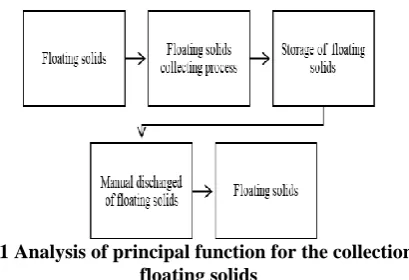
solids from surface water. Fig. 1 shows how a trash collector boat should perform in the desired manner. It begins with collecting process where floating solids were collected off the water surface. Next, the collected floating solids will be stored temporarily in the storage container and lastly, the trash will be manually collected at the end of the process.
Fig. 1 Analysis of principal function for the collection of floating solids
B. Performance Specification Method
[image:2.595.55.283.420.662.2]The aim of setting the performance specification is to make an accurate specification of the performance required by the trash collector boat. It is important to have the specific requirements of performance for the trash collector boat to fulfil the demand and need. The specification will only consider the most significant criteria that contribute to the performance of the system. The initial characteristic of performance requirements is summarized in Table 1.
Table. 1 Initial deduction for performance specification of trash Collector boat
Specification Characteristic
Hull form Catamaran
Hull material Fiberglass
Length of boat 800 – 1200 mm
Width of boat 600 – 700 mm
Height of boat 500 – 600 mm
Maximum load capacity
3 – 6 kg
Weight 8 – 10 kg
Max speed 10 km per hour
Operation speed 10 – 20 km per hour
Boat System Radio control
Travel distance 30 Meters
Monitoring FPV Wi-Fi Camera,
android app and battery indicator
Monitoring range 30 m
Conveyor Controlling Relay
Conveyor controlling range
30 m
The initial deduction for performance specification was selected by considering various factors that may affect the overall performance of the collector boat. Practically, the factors involved are related to the operational environment for the system which would be the small area such as lakes, small streams and drainage. Hence, a smaller size of the collector boat as indicated by the length and width of the boat is considered in the prototype development. It is important to consider the nature of the operational environment to ensure that the system effectively operating at the working site. The trash collector boat is also expected to be lighter (approximate weight of 8 – 10 kg) for portability. The boat system is controlled by an RF transmitter and receiver which allowed the user to control the boat remotely. In addition, the incorporation of the monitoring system in trash collector boat including Wi-Fi camera, android application and the battery indicator is to ensure better monitoring of the operation of trash collector boat. Thus, the result tested of trash collector performance would be the final specification performance.
C. Quality Function Deployment Method
The aim of the quality function deployment method is to set targets to be achieved for the engineering characteristics of a product which is to satisfy the customer requirements. Trash collector boat is an alpha prototype so the function is about 75%, thus allowing the product to be used by the consumer. Nevertheless, this trash collector is not a mass production type of invention, hence it is not very popular or well-known and only recognized by a certain organization or people. Therefore, the target user for the trash collector boat can be from a small cleaning company or individual user.
D. Morphological Chart Method
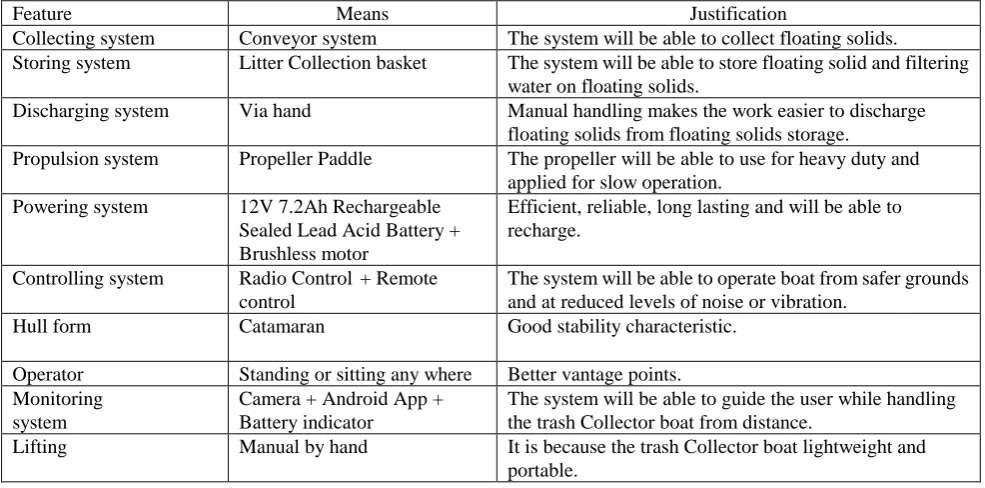
The morphological chart method functions to present a complete range of alternative design solutions for a product, and hence to widen the search for potential new solutions. This method requires a list of features that are essential to the trash collector boat systems. Each feature will be compared to select the intended objective and a chart is drawn to include all the possible sub-solutions for the system. The essential generic features of a trash collector boat are as follows i) means of collecting floating solids, ii) means of storing floating solids, iii) means of discharging floating solids, iv) means of moving the boat, v) means of support to increase stability vi) means of system to assist the overall function and lastly vii) location for operator. Table 2 lists the available means for each feature of a trash collector boat based on the available design of trash collector boat. The best characteristic for trash collector boat was evaluated from the morphological chart and summarized in Table 3.
Table. 2 Morphological chart for comparison of rubbish collecting system
Feature Means
Collecting system Multipurpose drop-in-pod system
Quick release system Turbine pull system Conveyor system
Storing System Litter Collection basket
Discharging system Via crane Via conveyor Via pump Via hand
Propulsion system Fix propeller Adjustable elevation
screw propeller
Screw propeller Propeller Paddle
Powering system 25-40 HP high thrust, 4 stroke outboard diesel engine
12V 7.2Ah
Rechargeable sealed lead acid battery
Brushless motor
Controlling system Boat steering wheels Radio control Remote control
Hull form Catamaran V-shape hull Barge Trimaran
Operator Seated at forward Seated at amidships Seated at aft Standing or sitting
any where
Monitoring Camera Android App Battery indicator
[image:3.595.52.545.264.508.2]Lifting Hydraulic Robotic Crane Manual by hand
Table. 3 Best characteristics for trash collector boat based on morphological chart evaluation
Feature Means Justification
Collecting system Conveyor system The system will be able to collect floating solids.
Storing system Litter Collection basket The system will be able to store floating solid and filtering water on floating solids.
Discharging system Via hand Manual handling makes the work easier to discharge
floating solids from floating solids storage.
Propulsion system Propeller Paddle The propeller will be able to use for heavy duty and
applied for slow operation.
Powering system 12V 7.2Ah Rechargeable
Sealed Lead Acid Battery + Brushless motor
Efficient, reliable, long lasting and will be able to recharge.
Controlling system Radio Control + Remote control
The system will be able to operate boat from safer grounds and at reduced levels of noise or vibration.
Hull form Catamaran Good stability characteristic.
Operator Standing or sitting any where Better vantage points.
Monitoring system
Camera + Android App + Battery indicator
The system will be able to guide the user while handling the trash Collector boat from distance.
Lifting Manual by hand It is because the trash Collector boat lightweight and
portable.
III. DESIGNDEVELOPMENT A. 3D Model
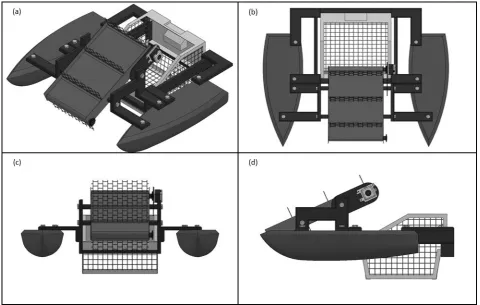
The design for trash collector boat for small area application was completed using Autodesk Inventor 2019 software, and a 3D model had been generated for the purpose of visualizing the requirements and specification that had been determined throughout the analysis. Four drawings are previewed with different angles of view; isometric view, front view, top view and side view as illustrated in Fig. 2.
The basic design of the trash collector boat is based on the catamaran boat with two hulls positioned at both sides of the trash collector boat. The unique feature of Catamaran hull was selected to reduce the water resistance and improve the stability of the trash collector boat. Several modifications
Fig. 2 (a) Isometric view (b) Top view (c) Front view and (c) Side view of trash collector boat
B. Body Fabrication
The body of the trash collector boat is divided into five main parts including frame, dustbin electronic board, hull and motor cover. Each part is built using different methods and types of materials. Every parts of the trash collector boat can be easily assembled and disassembled, except for the frame and the electronic board. Table 4 summarizes the function of each parts of trash collector boat. Several criteria were considered in the selection of materials to fulfil the objectives of the construction of a lighter collector boat. Proper selection of materials is very important to determine the right method of construction. In addition, the durability and strength of the boat are also influenced by the type of material used in the fabrication of the trash collector boat. The main body of the trash collector boat which is the frame, dustbin and conveyor system were constructed using square hollow mild steel and stainless steel net. Stainless steel was chosen since it is durable and lightweight material. On top of that, it does not
[image:4.595.58.539.49.354.2]corrode when in contact with water allowing their usage in the surface water. The Catamaran hull was fabricated using fibreglass material. Fibreglass is a lightweight material that is mostly used in boat fabrication [16]. It is durable and high in strength which makes it a suitable material for the hull. An electro-galvanized sheet was used in the fabrication of electronic box to store all the electronic components of the trash collector boat due to the high level of thickness which will prevent from water intrusion to the electric and electronic components of the trash collector boat. The motor cover was made using PVC material since it is durable and lightweight.
Table 4. Main components of trash collector boat
Component Function Material Characteristic
Frame As a support to the
prototype
Square hollow mild stainless steel
Durable Lightweight High strength
Dustbin As a temporary floating
solids storage
Stainless steel net Durable Simple design Lightweight Easy handling Conveyor system As a trash collector Square hollow mild
stainless steel and rubber gasket
Hull As a buoy to float the prototype in surface water
Fiberglass Durable
Water resistance Anti-corrosive Electronic box As a storage for
electronic components and power supplies
Electro-Galvanized (E.G) sheet
Used to keep electrical part Higher level of thickness
control High strength Durable
Motor Cover Install brushless motor PVC Durable
Lightweight Water resistance
C. System Fabrication Boat system
Boat system composes of three main components including boat, remote control and adjustable step-down power supply module. It uses two motors to drive and operate the boat within 30 m distance control with 27 MHz frequency. An adjustable step-down module was used to reduce the power supply from 12 V to 7.2 V to suit the requirement of the boat system. A rechargeable sealed lead battery is used to supply power to the system.
Conveyor system
The conveyor system is the main feature for the trash collector boat to collect floating solids and debris from surface water. The conveyor system has been featured in most trash collector boat design since it can effectively collect trash and floating solid off the water surface [7,17]. The conveyor was fabricated using aluminium, gasket rubber and PVC pipe. Wire mesh was attached to the conveyor for trash collecting purpose. The system is equipped with a DC motor speed that enables the user to control the speed of the conveyor according to the collection area. In addition, a relay wireless remote control was installed into the conveyor system to allow the control of the forward and backward movement of the conveyor. The relay wireless controller can be operated within a distance of 300 m.
Monitoring System
Monitoring system consists of a camera with android application SYMA FPV and battery indicator. This system was incorporated to facilitate the operation of the prototype in terms of movement control. An FPV Wifi Camera Cam was used that supports real-time image transmission within 100 m range. It allows the user to monitor the condition of the river or the direction of the boat.
D. Testing and Analysis
The trash collector boat prototype was tested to ensure that any system and parts installed are effectively working. The monitoring system of the trash collector boat such as the camera, lamp and battery indicator was also evaluated. The product testing was completed at the university lake.
IV. PROTOTYPEEVALUATION
A. Product Specification and Description
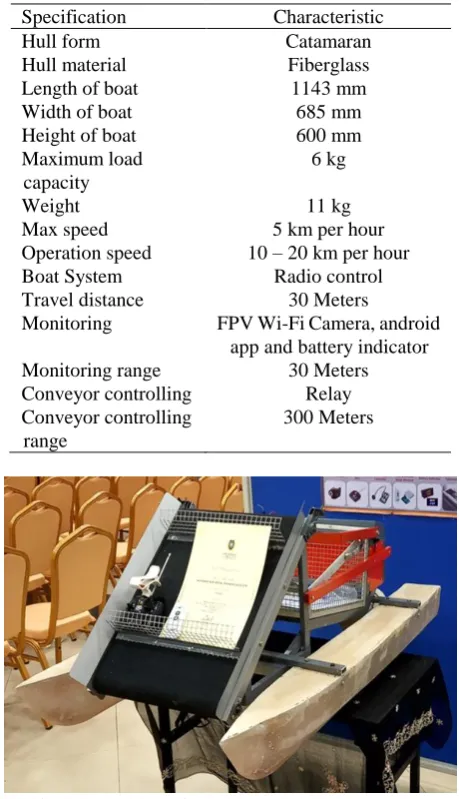
[image:5.595.311.541.221.621.2]The detailed product specification and description of trash collector boat prototype is presented in Table 5. The finished product of the prototype is shown in Fig. 3.
Table 5. Product specification and description of portable trash collector boat
Specification Characteristic
Hull form Catamaran
Hull material Fiberglass
Length of boat 1143 mm
Width of boat 685 mm
Height of boat 600 mm
Maximum load capacity
6 kg
Weight 11 kg
Max speed 5 km per hour
Operation speed 10 – 20 km per hour
Boat System Radio control
Travel distance 30 Meters
Monitoring FPV Wi-Fi Camera, android
app and battery indicator
Monitoring range 30 Meters
Conveyor controlling Relay
Conveyor controlling range
[image:5.595.311.542.222.625.2]300 Meters
Fig. 3 Prototype of portable trash collector boat
B. Working Performance System Performance
The boat system works well with the movements and speed corresponding to the collecting process of floating solids. However, the radio connection is not stable that will result in connection loss for a few times during the testing. For the conveyor system, it was found that that the rotational power is capable to hold a maximum
attached to the conveyor belt. Nevertheless, the speed controller and the relay of the conveyor system is working efficiently.
Monitoring Performance
The monitoring system of the trash collector boat consists of a camera, LED light and battery indicator. The camera works properly during product testing however the display quality is quite low due to the low-resolution camera (2 MP). Further improvement should be considered to improve the quality of the image for better monitoring of the trash collector boat. On the other hand, the LED light attached to the collector boat works properly. The brightness of the LED light is sufficiently illuminating the front area of the boat during the trash collection process. Battery indicator works properly by showing the digital numbers and displaying the amount of battery left. The battery indicator is visible on android application from the camera because it located in front of the camera.
C. Loading Capacity
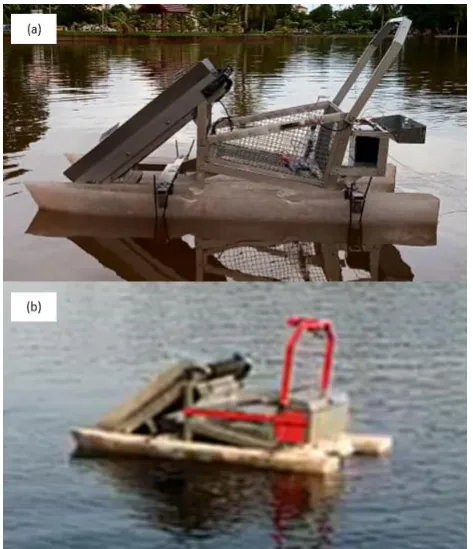
[image:6.595.51.288.472.747.2]The loading capacity of the trash collector boat prototype was investigated by inspection of water displacement level during operation. Fig. 4 shows the water displacement level of trash collector boat during the product testing in the university lake. Before any trash loading as shown in Fig. 4(a), the water displacement level is quite low indicating that the hulls are capable to accommodate the weight of trash collector in water. Fig. 3(b) shows the water displacement level after full loading of trash in the dustbin. The trash collector boat can achieve a maximum loading capacity of 6 kg in a single operation. From observation, there is a slight increment in the water displacement level when compared to before loading. The hulls are capable to hold the weight of both collector boat and trash without being sunk. This show the good performance of trash collector boat in full load mode.
Fig. 4 Water displacement level of trash collector boat (a) Before loading (b) After full load
V. CONCLUSION
This study has successfully developed a prototype of a trash collector boat. The collector boat is small in size compared to available trash collector boat in the market and suitable for small and narrow space cleaning purpose. The trash collector boat was equipped with a rotating conveyor system and monitoring system that can be remotely controlled from afar. Performance test that has been done showed that the collector boat efficiently collected up to 6 kg of floating solid in a single operation. This indicates the good performance of trash collector boat in cleaning water surface. The use of this trash collector boat can reduce the water pollution in small streams and drain clogging problem in an environmental-friendly and user-friendly manner.
ACKNOWLEDGMENT
The authors would like to thank all the faculty staff and member that provide help and assistance throughout the project completion.
REFERENCES
1. Rafique SMSM, & Langde A Design and fabrication of river cleaning machine. Int. Jour. Sci. Adv. Res. Tech. 2017;3(11):63–65
2. 8 Most Common Types of Garbage Found in the Ocean. Available on https://www.banthebottle.net/articles/8-most-common-types-of-garba ge-found-in-the-ocean accessed on 10/03/2018
3. Sreenivasan J, Govindan M, Chinnasami M, & Kadiresu I. Solid Waste Management in Malaysia – A Move Towards Sustainability. In Waste Management - An Integrated Vision. InTech. Publ. Ltd. 2012; 4. Hua AK. Analytical and detection sources of pollution based
environmetric techniques in Malacca river, Malaysia. Appl. Ecolo. Environ. Res. 2017;15(1):485–499
5. The Ban on Microbeads – Why It Matters and Why It’s Still Not
Enough Available on
https://www.banthebottle.net/articles/the-ban-on-microbeads-why-it-matters-and-why-its-still-not-enough accessed on 12/03/2018 6. Tiwari RV, Maheshwari A, Srivastava MC, & Sharma A. Design and
Fabrication of Project on Water Bodies Cleaning Robot. Int. Jour. Engine. Manage. Res. 2018;3:15–17
7. Kader ASA, Saleh, MKM, Jalal MR, Sulaiman OO. Design of rubbish collecting system for inland waterways. Jour. Trans. Engine. 2015;2(2): 1–13
8. Water Witch Workboats - Multipurpose pollution control, marina, & amp; waterway maintenance. Available on https://waterwitch.com/en/ accessed on 01/01/2019
9. Liverpool Waterwitch Marine & Engine. Co. Ltd. Available on https://waterwitch.com/en/products/waterwitch/ accessed on 02/01/2019
10. Ecoceane livre un bateau de dépollution à la ville de Paris. Available on https://www.meretmarine.com/fr/content/ecoceane-livre-un-bateau-de -depollution-la-ville-de-paris accessed on 02/01/2019
11. Aquarius Systems - On the cutting edge of water management technology. Available on http://www.aquarius-systems.com/ accessed on 01/01/2019
12. Dambhare A, Golekar K, Giri A, & Take S. Efficient lake garbage collector by using pedal, Int. Jour. Rec. Trends Engine. Res. 2016;2(4):327–340
13. Padwal AB, Tambe MS, Chavare PS, Manahwar RK, & Mhatre MS Review paper on fabrication of manually controlled drainage cleaning system. Int. Jour. Sci. Engine. Res. 2017;8(3):204–208
14. Manikandan S, Mohan Raj G, Nandhakumar M, Neelamanikandan P, Sateesh R, & Balakrishnan N. Design and fabrication of automatic drainage cleaning system. Int. Res. Jour. Adv. Engine. Tech. 2018;4(2):3084–3091
16. Lee SH, Lee YG, & Kim SH On the development of a small catamaran boat. Ocean Engine. 2007;34 (14-15):2061-2073
17. Munde K, & Wagh MN. Design and analysis of river water skimmer. Int. Jour. Rec. Trends Engine. Res. 2018;4(7): 126–132
AUTHORSPROFILE
S.H.Y.S Abdullah is currently served as the Post-Doctoral Research Officer in the Faculty of Innovative Design and Technology, where she contributes to the faculty publications and research activities.
M.A.A Mohd Azizudin is a graduate student in the Department of Manufacturing Technology from Faculty of Innovative Design and Technology. He is responsible in the prototype development for project completion.