International Journal of Innovative Technology and Exploring Engineering (IJITEE) ISSN: 2278-3075,Volume-8 Issue-12, October, 2019
A Fuzzy-TOPSIS Method for Optimizing of
Forging Problems
Dhiraj Kumar, Sharifuddin Mondal
Abstract: Forging industry consists of simple procedural steps, but a lots of problems are associated with the forging industries. This paper describes the major problems in forging industries along with their cause and effect that reduce the extent of profits. An attempt has also been made to apply Fuzzy multi-criteria combined with TOPSIS method in ranking the problems on the basis of various parameters. This approach improves the quality of manufacturing for forging goods, material availability & its price, fuel supply, technology upgradation, material wastage etc. The proposed approach is very useful due to its capability of providing optimal results with incomplete significant information. The study is the first of its type in forging industries. A numerical model is considered to indicate the effectiveness of the present technique.
Keywords: Fuzzy Logic, TOPSIS, Optimization Technique, Forging Industry
I. INTRODUCTION
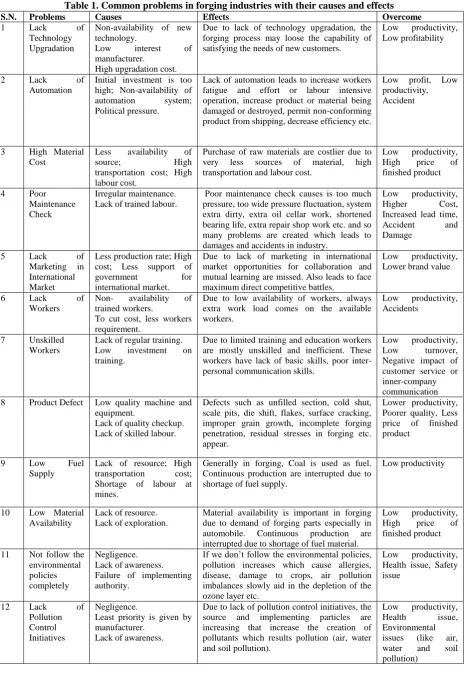
Forging is a metal working process at elevated temperature in which metal deformed plastically under controlled condition. It is used to get a preset shape or size by exerting compressive force with mean of different type of die, hammer and press or an upsetting machine. Most commonly used metals include aluminum, brass & copper, carbon, very hard tool steels, alloy & stainless steel, titanium, and high temperature alloys which contain molybdenum, nickel or cobalt. Forging finds largest application in agriculture, aerospace, automotive, material handling & several industrial equipment, national defense, construction, mining. With the help of forging process, parts can be created stronger as compared to other metal working process but a lots of problems are associated with the forging industries. These problems along with their causes and effects are listed in table 1. Fuzzy-TOPSIS (Technique for Order of Preference by Similarity to Ideal Solution) is being adopted by many researchers for evaluating performance of different manufacturing processes like EDM (Electric discharge machining) [1, 2,3], Laser drilling [4], Turning [5], Robust design [6], Milling [7], Welding [8], Product infant failure [9], Sustainable city logistic planning [10]. Organizations performance [11], Supplier evaluation and management [12, 13], Group decision making [14], Vehicle technologies [15], Electronics industry [16], Design (Cost Management) [17], Rapid prototyping [24] etc.
Revised Manuscript Received on October 10, 2019
Dhiraj Kumar, Research Scholar, Department of Mechanical Engineering, NIT Patna, Mahendru, Patna-800005, Bihar, [email protected].
Sharifuddin Mondal, Asst. Professor, Department of Mechanical Engineering, NIT Patna, Mahendru, Patna-800005, Bihar, [email protected].
Table 1. Common problems in forging industries with their causes and effects
S.N. Problems Causes Effects Overcome
1 Lack of
Technology Upgradation
Non-availability of new technology.
Low interest of
manufacturer. High upgradation cost.
Due to lack of technology upgradation, the forging process may loose the capability of satisfying the needs of new customers.
Low productivity, Low profitability
2 Lack of
Automation
Initial investment is too high; Non-availability of
automation system;
Political pressure.
Lack of automation leads to increase workers fatigue and effort or labour intensive operation, increase product or material being damaged or destroyed, permit non-conforming product from shipping, decrease efficiency etc.
Low profit, Low productivity, Accident
3 High Material
Cost
Less availability of
source; High
transportation cost; High labour cost.
Purchase of raw materials are costlier due to
very less sources of material, high
transportation and labour cost.
Low productivity,
High price of
finished product
4 Poor
Maintenance Check
Irregular maintenance. Lack of trained labour.
Poor maintenance check causes is too much pressure, too wide pressure fluctuation, system extra dirty, extra oil cellar work, shortened bearing life, extra repair shop work etc. and so many problems are created which leads to damages and accidents in industry.
Low productivity,
Higher Cost,
Increased lead time,
Accident and
Damage
5 Lack of
Marketing in International Market
Less production rate; High cost; Less support of
government for
international market.
Due to lack of marketing in international market opportunities for collaboration and mutual learning are missed. Also leads to face maximum direct competitive battles.
Low productivity, Lower brand value
6 Lack of
Workers
Non- availability of
trained workers.
To cut cost, less workers requirement.
Due to low availability of workers, always extra work load comes on the available workers.
Low productivity, Accidents
7 Unskilled
Workers
Lack of regular training.
Low investment on
training.
Due to limited training and education workers are mostly unskilled and inefficient. These workers have lack of basic skills, poor inter-personal communication skills.
Low productivity,
Low turnover,
Negative impact of customer service or inner-company communication
8 Product Defect Low quality machine and
equipment.
Lack of quality checkup. Lack of skilled labour.
Defects such as unfilled section, cold shut, scale pits, die shift, flakes, surface cracking, improper grain growth, incomplete forging penetration, residual stresses in forging etc. appear.
Lower productivity, Poorer quality, Less price of finished product
9 Low Fuel
Supply
Lack of resource; High
transportation cost;
Shortage of labour at mines.
Generally in forging, Coal is used as fuel. Continuous production are interrupted due to shortage of fuel supply.
Low productivity
10 Low Material
Availability
Lack of resource. Lack of exploration.
Material availability is important in forging due to demand of forging parts especially in
automobile. Continuous production are
interrupted due to shortage of fuel material.
Low productivity,
High price of
finished product
11 Not follow the environmental policies completely
Negligence. Lack of awareness. Failure of implementing authority.
If we don’t follow the environmental policies, pollution increases which cause allergies, disease, damage to crops, air pollution imbalances slowly aid in the depletion of the ozone layer etc.
Low productivity, Health issue, Safety issue
12 Lack of
Pollution Control Initiatives
Negligence.
Least priority is given by manufacturer.
Lack of awareness.
Due to lack of pollution control initiatives, the source and implementing particles are increasing that increase the creation of pollutants which results pollution (air, water and soil pollution).
Low productivity,
Health issue,
Environmental issues (like air,
water and soil
pollution)
to explore the important error factors of human being in Taiwan (Department of Emergency). (Surface Coating Method) are the major design perspectives in remanufacturing. Hsieh et.al. [18] used HFACS (Human
factors analysis and classification system), fuzzy TOPSIS,
and AHP (analytic
International Journal of Innovative Technology and Exploring Engineering (IJITEE) ISSN: 2278-3075,Volume-8 Issue-12, October, 2019
factors of human being in Taiwan (Department of Emergency). Marbini & Kangi [20] applied Fuzzy-TOPSIS for analyzing the stock exchange in Tehran. It is found that, by agreement between risk & return in stock, this profit should be maximized within designed portfolio. Sirisawat & Kiatcharoenpol [21] utilized Fuzzy & AHP combined with TOPSIS to analyze the RLB (Reverse Logistics Barriers) in industry for electronics applications. In this study, authors mainly aimed on the categorization of RLB and ranking barriers & solution of RL implementation. Liu & Wei [22] investigated Fuzzy-TOPSIS to analyze the risk factors considering questionnaire survey and estimate the overall risk levels of EV (electric vehicle) charging infrastructure Public-Private Partnership (PPP) projects. Walczak & Rutkowska [23] adopted Fuzzy-TOPSIS for the personalized ranking of projects in a participatory budget (PB). But the researches on forging problems by Fuzzy-TOPSIS approach is negligible and need more studies. Fuzzy-TOPSIS approach is a powerful tool to find out optimal setting of process parameters in any manufacturing technique but still it is not applied to forging in literature. In present paper, we select a Fuzzy-TOPSIS based approach for multi-criteria decision making. An attempt has been made to highlight the problems that are causing the most of the damage. In decision making, FST (Fuzzy Set Theory) is applied to find a pattern of vagueness & unpredictability. Linguistic terms are considered for representing the preferences of decision maker in FST. The decision makers give linguistic rankings for the forging problem to the concerned criteria and corresponding alternatives that are combined by using Fuzzy-TOPSIS, the main benefit is that it differentiate between the better ( Benefit criteria) & less the better ( Cost criteria). It also helps to select a solution that is near to positive ideal solution & away from negative ideal solution. Recommendation is made for procurement to the alternative with maximum score. Linguistic data are chosen to analyze forging criteria characteristics. Sensitivity analysis is also conducted to find out the best problem solver of forging problems. Various strategic recommendations were made to overcome the forging problems mentioned. Remaining part of the work is presented in following sequence as section 2, linguistic fuzzy set & Fuzzy-TOPSIS are discussed, section 3, a fuzzy multi-criteria method for forging problems is described, section 4, approach of numerical application, section 5, conclusions remarks of present work.
II. LINGUISTIC FUZZY SET AND FUZZY-TOPSIS
A. Linguistic fuzzy set
In FST, conversion scales are adopted to get fuzzy numbers from the linguistic term. In present work, we utilized the properties of two triangular Fuzzy numbers to estimate the criteria & alternatives. These properties are given below: 1: Property of addition
2: Property of subtraction
3: Property of multiplication
4: Property of division
5: Property of inverse
6: Property of symmetric image
7: Property of multiplication by a constant
8: Property of division by a constant
9: Property of a constant division by fuzzy number
Fuzzy ratings & linguistic variables are applied for the alternatives. The linguistic variables & fuzzy ratings applied for the criteria are presented in table 2 and table 3 respectively.
Table 2. Linguistic membership function for alternatives with rating
Linguistic term Membership function
Worse (WE) (0.2,0.2,0.4)
Bad (BD) (0.2,0.4,0.6)
Medium (ME) (0.4,0.6,0.8)
Good (GD) (0.6,0.8,1.0)
Better (BE) (0.8,1.0,1.0)
Table 3. Linguistic membership function for criteria with rating
Linguistic term Membership function
Very small (VS) (0.2,0.2,0.4)
Small (S) (0.2,0.4,0.6)
Medium (ME) (0.4,0.6,0.8)
Much (MU) (0.6,0.8,1.0)
More (MO) (0.8,1.0,1.0)
B. Fuzzy-TOPSIS
Fuzzy-TOPSIS is one of the many approaches being used to determine the selected criteria against multiple alternatives. This approach, consist of nine steps is now explained below: 1. First, Criteria ratings and Alternatives ratings are assigned.
2. Then, Criteria and Alternatives aggregate fuzzy ratings are computed.
3. Now, we compute the decision matrix of Fuzzy.
4. Then, normalization of decision matrix of Fuzzy
𝑅 = [𝑟 𝑖𝑗]𝑚𝑥𝑛, (6)
𝑖 = 1,2, … , 𝑚; 𝑗 = 1,2, … , 𝑛 Where
5. Now, we compute the matrix of weighted normalized.
6. Then, we compute the FPIS & FNIS.
7. Now, we compute the distances of each alternative from FPIS & distances of each alternative from FNIS.
8. Finally, we compute the each alternatives closeness coefficient(𝐶𝐶𝑖).
9. Alternatives are ranked a/c to 𝐶𝐶𝑖.
Where, Alternatives, 𝐴𝑗 (j=1, 2… m); Criteria, 𝐶𝑖 (i=1, 2… n); Aggregate Fuzzy weight (𝑤𝑗), 𝑤𝑗 = (𝑤𝑗 1, 𝑤𝑗 2, 𝑤𝑗 3); 𝐷 = Alternatives decision matrix of Fuzzy; 𝑅 = Normalized decision matrix of Fuzzy; 𝑉 = Weighted normalized matrix if Fuzzy; 𝐴∗ = FPIS; 𝐴− = FNIS; 𝑑
𝑖 ∗ = Distances of each alternative from FPIS; 𝑑𝑖− = Distances of each alternative from FNIS; 𝐶𝐶𝑖 = Closeness coefficient
III. FUZZY MULTI-CRITERIA METHOD FOR
FORGING PROBLEMS: CRITERIA SELECTION
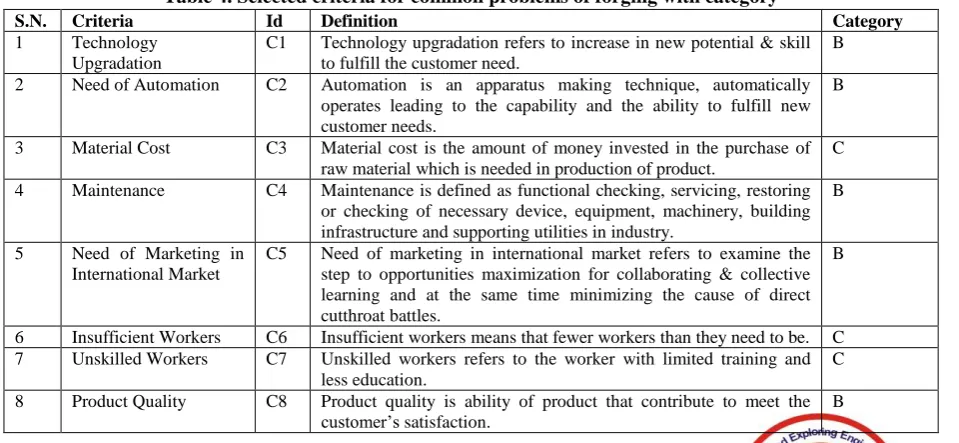
[image:4.595.62.542.541.762.2]First of all, select the criteria for evaluating common problems of forging. After going through literature review on forging problems and from practical experience of working at Heavy Engineering Corporation Limited, Ranchi, India, the criteria are selected. The criteria used for selecting are chosen based on expert opinions to incorporate their possible working practices. They generally consider linguistic values to criteria rating & corresponding alternatives. Linguistics terms cannot be used to do mathematical operation, they are transformed into Fuzzy triangular number so that these can be used in Fuzzy-TOPSIS. Total 12 criteria are selected. These criteria are Technology Upgradation (C1), Need of Automation (C2), Material Cost (C3), Maintenance (C4), Need of Marketing in International Market (C5), Insufficient Workers (C6), Unskilled Workers (C7), Product Quality (C8), Fuel Supply (C9), Material Availability (C10), Adherence to environmental policies (C11), and Pollution Control Initiatives (C12). The different criteria are presented in table 4 in details.
Table 4. Selected criteria for common problems of forging with category
S.N. Criteria Id Definition Category
1 Technology
Upgradation
C1 Technology upgradation refers to increase in new potential & skill to fulfill the customer need.
B
2 Need of Automation C2 Automation is an apparatus making technique, automatically
operates leading to the capability and the ability to fulfill new customer needs.
B
3 Material Cost C3 Material cost is the amount of money invested in the purchase of raw material which is needed in production of product.
C
4 Maintenance C4 Maintenance is defined as functional checking, servicing, restoring
or checking of necessary device, equipment, machinery, building infrastructure and supporting utilities in industry.
B
5 Need of Marketing in
International Market
C5 Need of marketing in international market refers to examine the step to opportunities maximization for collaborating & collective learning and at the same time minimizing the cause of direct cutthroat battles.
B
6 Insufficient Workers C6 Insufficient workers means that fewer workers than they need to be. C
7 Unskilled Workers C7 Unskilled workers refers to the worker with limited training and less education.
C
8 Product Quality C8 Product quality is ability of product that contribute to meet the customer’s satisfaction.
International Journal of Innovative Technology and Exploring Engineering (IJITEE) ISSN: 2278-3075,Volume-8 Issue-12, October, 2019
9 Fuel Supply C9 Fuel supply is defined as the abundant/sufficient fuel reached in the
industry in time.
B
10 Material Availability C10 Material availability refers to the material readily available and abundantly.
B
11 Adherence to
environmental policies
C11 It means the understanding and adherence to environmental policies to improve its products, service and processes to minimize waste and improving recycling activities.
B
12 Pollution Control
Initiatives
C12 Pollution control initiatives work on pollution source reduction and implementing particles that reduce or eliminate the creation of pollutants.
B
*B = Benefit Criteria, C = Cost Criteria
After the investigation & identification of best alternative using selected criteria, the analysis of sensitivity is performed to find the effect on decision making of criteria weight.
IV. NUMERICAL DEMONSTRATION
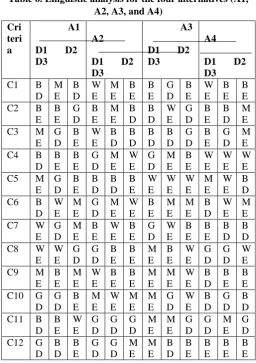
In this section, the implementation of proposed approach is illustrated to evaluate the forging problems. There are total four alternatives assumed such as A1, A2, A3 and A4. All alternatives are then assessed by executing the forging criteria presented in Table 4 with the help of three decision makers as D1, D2, and D3. All alternatives for every criteria from Table 2 are used to give linguistic rating to the criteria presented in Table 3 by the decision makers. All obtained ratings for criteria and alternatives are listed in Tab. 5 & Tab. 6 respectively.
The aggregated fuzzy weights (𝑤𝑖𝑗) is determined for every criterion with the help of Eq. (3), e.g. for aggregated fuzzy weight criteria C1 is denoted by 𝑤𝑗 = (𝑤𝑗 1, 𝑤𝑗 2, 𝑤𝑗 3) where
𝑤𝑗 1= min𝑘 0.6,0.6,0.4 , 𝑤𝑗 2=
1
3 0.8,0.8,0.6 , 𝑤𝑗 3=
3 𝑘=1
max𝑘(1.0,1.0,0.8) = 𝑤𝑗 = (0.4,0.733,1.0)
Similarly, the other criteria aggregate weights are determined.
Then, the alternatives aggregate fuzzy weights are determined based on Eq. (2), e.g. the aggregate rating for alternative A1 for criteria C1 is found out with the half of the rating supplied by the three decision makers as:
𝑎𝑖𝑗 = min𝑘 0.2,0.4,0.2 , 𝑏𝑖𝑗 =
1
3 0.4,0.6,0.4 , 𝑐𝑖𝑗 =
3 𝑘=1
max𝑘(0.6,0.8,0.6) = (0.2,0.466,0.8)
[image:5.595.57.535.49.160.2]Similarly, the other alternatives aggregate ratings with respect to the 12 criteria are calculated.
Table 5. Linguistic analysis for the 12 criteria
Criteria Decision makers D1 D2 D3
C1 MU MU ME
C2 S MO S
C3 ME MO MO
C4 MO MO MO
C5 VS MO ME
C6 MU ME MO
C7 MU ME ME
C8 S MO MU
C9 VS ME MO
C10 ME MO MO
[image:5.595.298.555.184.548.2]C11 VS S S
Table 6. Linguistic analysis for the four alternatives (A1, A2, A3, and A4)
Cri teri a
A1 D1 D2 D3
A2
D1 D2 D3
A3 D1 D2 D3
A4
D1 D2 D3
C1 B
D M E B D W E M E B E B E G D B E W E B E B E
C2 B
E B E G D B E M E B D B D W E G D B E B D M E
C3 M
E G D B E W E B D B D B D B D G D B E G D M E
C4 B
D B E B E G D M E W E G D M E B E W E W E W E
C5 M
E G D B E B D B D B E W E W E W E M E W E B D
C6 B
D W E M E G D M E W E B E M E M E B D W E M E
C7 W
E G D M E B E W E B E G D W E B E B E B D B D
C8 W
E W E G D G D B E B E M E B E W E G D G D W E
C9 M
E B E M E W E B E B E M E M E W E B D B E B E
C10 G
D G D B E M E W E M E M E G D W E B D G D B D C11 B
D B E W E G D G D G D M E M E G D G D M E G D
C12 G
D B D B E G D G D M E M E B D B E B E B E B E
Next, normalization is carried out for the fuzzy decision matrix of all alternatives with the half of Eq. (6–8), e.g. the alternative normalized rating A1 for criteria C1 is calculated as
𝑐𝑗∗= max𝑖 0.8,1.0,1.0,1.0 = 1.0
𝑎𝑗−= min𝑖 0.2,0.2,0.6,0.2 = 0.2
While C1 is a benefit criteria,
𝑟 𝑖𝑗 =
0.2 1.0,
0.466 1.0 ,
0.8
1.0 = (0.2,0.466,0.8)
Similarly, the normalized values for all 12 criteria are determined for every alternative. The values of 𝑎𝑗− & 𝑐𝑗∗ are chosen as 1 and 1 respectively. The weighted decision matrix of fuzzy for all four alternatives is determined using Eq. (9). The weighted decision matrix of fuzzy for all alternatives are calculated by using equation (3), (7) & (8), e.g. criteria fuzzy weight C1
𝑣 𝑖𝑗 = 0.2,0.466,0.8 ∗ 0.4,0.733,1.0 =
(0.08,0.342,0.8)
Similarly, for all 12 criteria and their four alternatives, fuzzy weight are figure out. Then, we have determined the FPIS
(𝐴∗) and the FNIS (𝐴−) based on using Eq. (10) and (11) for every alternatives, e.g. for criteria C1, 𝐴−= 0.08 and
𝐴∗= 1.0. In the same way, computations are completed for
rest of the criteria. Then, the distance 𝑑𝑣(∗) of each alternative is calculated with the help of the fuzzy positive ideal matrix (𝐴∗) and fuzzy negative ideal matrix (𝐴−) using Eq. (12) and (13). For e.g., for alternative A1 & criteria C1, the distances 𝑑𝑣(𝐴1, 𝐴∗) & 𝑑𝑣(𝐴1, 𝐴−) are determined given below:
𝑑𝑣 𝐴1, 𝐴− = 1
3 0.08 − 0.08
2+ 0.342 − 0.08 2+ 0.8 − 0.08 2 =
0.442
𝑑𝑣 𝐴1, 𝐴∗ = 1
3 0.08 − 1.0
2+ 0.342 − 1.0 2+ 0.8 − 1.0 2 =
0.663
Likewise, the distances for rest of the criteria are computed for all the alternatives. Then, the distances 𝑑𝑖∗ and 𝑑𝑖− are determined respectively using Eq. (12) and (13). Closeness coefficient (𝐶𝐶𝐼) for the twelve criteria and four alternatives are computed and plotted in table 7 and 8 respectively.
Table 7. Closeness coefficient (𝑪𝑪𝒊) for the twelve criteria
By comparing the 𝐶𝐶𝑖 values of the twelve criteria (Table 7), it has been found out that C12 ˃ C8 ˃ C10 ˃ C1 ˃ C2 ˃ C11 ˃ C9 ˃ C4 ˃ C7 ˃ C6 ˃ C5 ˃ C3 which indicates the criteria weight for solving the forging problems and improves the industrialization revolution in forging industries. By comparing the 𝐶𝐶𝑖 values of the four alternatives (Table 8), it can be seen that A2 ˃ A1 ˃ A3 ˃ A4. Therefore, it can be said that supplier A2 has the best problems solver of common problem of forging as per the view of the decision making committee.
Table 8. Closeness coefficient
(𝑪𝑪𝒊) for
the four alternatives
Alternatives
A1 A2 A3 A4
𝑑𝑖− 6.421 6.613 5.966 5.945
𝑑𝑖∗ 7.203 7.248 7.475 7.548
𝐶𝐶𝑖 0.471 0.477 0.443 0.440
Rank 2 1 3 4
A. Analysis of Sensitivity
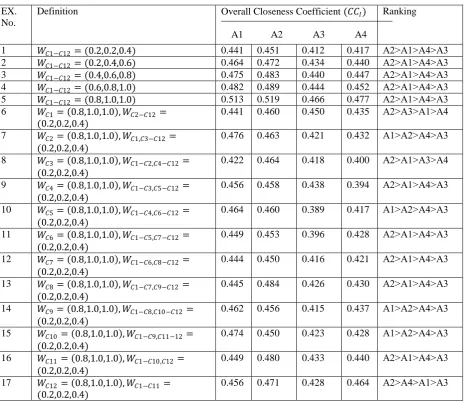
To evaluate the criteria impact, weights represented by 𝑊𝐶𝑖 for criteria 𝐶𝑖 (where𝑖 = 1,2, … , 𝑛) are determined to find out the best problem solver of common problems of forging. The sensitivity analysis is also conducted. Total 17 experiments were performed & details are shown in Table 9.
Criteria 𝑑𝑖− 𝑑𝑖∗ 𝐶𝐶𝑖 Rank
C1 2.247 2.353 0.488 4
C2 2.384 2.566 0.481 5
C3 1.646 2.740 0.375 12
C4 1.873 2.225 0.457 8
C5 1.859 2.819 0.397 11
C6 1.925 2.669 0.419 10
C7 2.146 2.793 0.434 9
C8 2.441 2.509 0.493 2
C9 2.240 2.645 0.458 7
C10 2.268 2.334 0.492 3
C11 1.367 1.476 0.480 6
International Journal of Innovative Technology and Exploring Engineering (IJITEE) ISSN: 2278-3075,Volume-8 Issue-12, October, 2019
Table 9. Sensitivity analysis experiments EX.
No.
Definition Overall Closeness Coefficient (𝐶𝐶𝐼)
A1 A2 A3 A4
Ranking
1 𝑊𝐶1−𝐶12= (0.2,0.2,0.4) 0.441 0.451 0.412 0.417 A2˃A1˃A4˃A3
2 𝑊𝐶1−𝐶12= (0.2,0.4,0.6) 0.464 0.472 0.434 0.440 A2˃A1˃A4˃A3
3 𝑊𝐶1−𝐶12= (0.4,0.6,0.8) 0.475 0.483 0.440 0.447 A2˃A1˃A4˃A3
4 𝑊𝐶1−𝐶12= (0.6,0.8,1.0) 0.482 0.489 0.444 0.452 A2˃A1˃A4˃A3
5 𝑊𝐶1−𝐶12= (0.8,1.0,1.0) 0.513 0.519 0.466 0.477 A2˃A1˃A4˃A3
6 𝑊𝐶1= 0.8,1.0,1.0 , 𝑊𝐶2−𝐶12 =
(0.2,0.2,0.4)
0.441 0.460 0.450 0.435 A2˃A3˃A1˃A4
7 𝑊𝐶2= 0.8,1.0,1.0 , 𝑊𝐶1,𝐶3−𝐶12 =
(0.2,0.2,0.4)
0.476 0.463 0.421 0.432 A1˃A2˃A4˃A3
8 𝑊𝐶3= 0.8,1.0,1.0 , 𝑊𝐶1−𝐶2,𝐶4−𝐶12=
(0.2,0.2,0.4)
0.422 0.464 0.418 0.400 A2˃A1˃A3˃A4
9 𝑊𝐶4= 0.8,1.0,1.0 , 𝑊𝐶1−𝐶3,𝐶5−𝐶12=
(0.2,0.2,0.4)
0.456 0.458 0.438 0.394 A2˃A1˃A4˃A3
10 𝑊𝐶5= 0.8,1.0,1.0 , 𝑊𝐶1−𝐶4,𝐶6−𝐶12=
(0.2,0.2,0.4)
0.464 0.460 0.389 0.417 A1˃A2˃A4˃A3
11 𝑊𝐶6= 0.8,1.0,1.0 , 𝑊𝐶1−𝐶5,𝐶7−𝐶12=
(0.2,0.2,0.4)
0.449 0.453 0.396 0.428 A2˃A1˃A4˃A3
12 𝑊𝐶7= 0.8,1.0,1.0 , 𝑊𝐶1−𝐶6,𝐶8−𝐶12=
(0.2,0.2,0.4)
0.444 0.450 0.416 0.421 A2˃A1˃A4˃A3
13 𝑊𝐶8= 0.8,1.0,1.0 , 𝑊𝐶1−𝐶7,𝐶9−𝐶12 =
(0.2,0.2,0.4)
0.445 0.484 0.426 0.430 A2˃A1˃A4˃A3
14 𝑊𝐶9= 0.8,1.0,1.0 , 𝑊𝐶1−𝐶8,𝐶10−𝐶12=
(0.2,0.2,0.4)
0.462 0.456 0.415 0.437 A1˃A2˃A4˃A3
15 𝑊𝐶10= 0.8,1.0,1.0 , 𝑊𝐶1−𝐶9,𝐶11−12 =
(0.2,0.2,0.4)
0.474 0.450 0.423 0.428 A1˃A2˃A4˃A3
16 𝑊𝐶11= 0.8,1.0,1.0 , 𝑊𝐶1−𝐶10,𝐶12=
(0.2,0.2,0.4)
0.449 0.480 0.433 0.440 A2˃A1˃A4˃A3
17 𝑊𝐶12= 0.8,1.0,1.0 , 𝑊𝐶1−𝐶11 =
(0.2,0.2,0.4)
0.456 0.471 0.428 0.464 A2˃A4˃A1˃A3
It can be observed from Table 9, all criteria weights for first five experiments are set equal to (0.2,0.2,0.4), (0.2,0.4,0.6), (0.4,0.6,0.8), (0.6,0.8,1.0), and (0.8,1.0,1.0). The weight of each criteria for experiment 6–17 is set as highest (0.8,1.0,1.0) in successive experiment and lowest value (0.2,0.2,0.4) for the remaining criteria. The objective is to observe the criteria influencing highly the decision making process. As an illustration, the criteria C1 has the highest weight (0.8,1.0,1.0) for experiment 6, whereas the weight (0.2,0.2,0.4) for remaining criteria. The analysis of sensitivity is carried out and its result are presented in Fig. 1. It is observed from Fig. 1 & Table 9 that, alternative A2 score highest in 13 experiments (Expt. No. 1–6, 8–9, 11–13, 16-17) out of 17 experiments while alternative A1 score 4 votes for remaining experiments. Hence, we can conclude that alternative A2 emerging as the winner with a majority of votes (76.47%) and relatively insensitive to criteria weights for our decision making process.
B. Recommendations
There are following various strategic recommendations made to deal with the forging problem.
(1) Procurement of raw material is the fundamental item and required serious attention. The dimension (length & diameter) of the raw material should be selected such that
there is minimum wastage of material during further operation. This will result in increment of maximum raw material availability & ultimately decrease the raw material wastage.
(2) Proper layout is always encourageable. The proper process layout helps in easy movement of material and the workforce required to movement of material. This will be not increasing production rate only but also save the wastage of time and money.
(4) The management play a very significant role in development of any industries. Employee should always be motivated by their management. The employee can be motivated by either by developing personnel or by increasing their financial growth. The proper awareness regarding security & safety also enhance employee’s morale.
(5) Some important control measures of pollutions are as follows:
(b) Industry Site Selection: The site of an industry should be selected by considering weather & topographical characteristics at that location.
(c) Industrial Waste Treatment: The industrial waste must be discharged after proper treatment.
(d) Plantation: To control the level of dust, smoke & pollutants in the atmosphere, there should be intensive plantation in that region.
(e) Government Regulation Act: Government should set a monitoring committee to regulate the level prescribed by pollution control board against the industry not confirming the prescribed level.
(f) Environmental Impacts Assessment: This assessment should be carried out on regular basis to evaluate and identify the hazardous and severe effects of pollutant disposed by industries on natural eco-system.
(g) Stringent Implementation & Environmental Protection Act: Environment Protection Act should be followed strictly and there should be provision of punishment for concerned person.
V. CONCLUSIONS
The degree of proper project selection has been highly affecting the rate of success for any project of industries particularly in forging industry. In this aspect, the Fuzzy-TOPSIS which is one of the hybrid approach to select the problem and also estimating all influencing parameter’s weightage to select the alternatives. A number of alternatives have been looked over by considering the various criteria, which are highly responsible for different types of problems. The Fuzzy-TOPSIS approach is being used to get order of priority among the alternatives.
The proposed approach has three steps. In step1, the evaluating criteria of forging problems are noticed. These criteria are Technology Upgradation, Need of Automation, Material Cost, Maintenance, Need of Marketing in International Market, Insufficient Workers, Unskilled Workers, Product Quality, Fuel Supply, Material Availability, Adherence to environmental policies, and Pollution Control Initiatives. In step 2, Linguistic ratings to the alternatives & criteria provided by the experts as (a) Fuzzy-TOPSIS approach has been used to aggregate the ratings and generation of an overall closeness coefficient score for every alternatives to measure the forging problem solver.
(b) The forging problem solver having highest score is the best among alternatives.
In step 3, the influence of criteria on weights in decision making process is determined by performing sensitivity analysis.
REFERENCES
1. S. Dewangan, S. Gangopadhyay, C. K. Biswas, “Study of surface integrity and dimensional accuracy in EDM using Fuzzy TOPSIS and sensitivity analysis”, Measurement, 2015, 63:364–376
2. S. P. Sivapirakasam, J. Mathew, M. Surianarayanan, “Multi-attribute decision making for green electrical discharge machining”, Expert Systems with Applications, 2011, 38:8370–8374
3. M. R. Shabgard, M. A. Badamchizadeh, G. Ranjbary, K. Amini, “Fuzzy approach to select machining parameters in electrical discharge machining (EDM) and ultrasonic-assisted EDM processes”, Journal of Manufacturing Systems, 2013, 32:32– 39
4. M. Priyadarshini, P.P. Tripathy, D. Mishra, S. Panda, “Multi characteristics optimization of Laser Drilling process parameter using Fuzzy-TOPSIS method”, Materials Today, 2017, 4, 8:8538-8547 5. A. Gok, “A new approach to minimization of the surface roughness
and cutting force via fuzzy TOPSIS, multi-objective grey design and RSA”, Measurement, 2015, 70:100–109
6. S. S. Yang, S. K. Ong, A. Y. C. Nee, “A Decision Support Tool for Product Design for Remanufacturing”, Procedia, 2016, CIRP 40:144 – 149
7. R. E. Breaz, O. Bologa, S. G. Racz, “Selecting between CNC milling, robot milling and DMLS processes using a combined AHP and fuzzy approach”, Procedia Computer Science, 2017, 122:796–803 8. S. M. Mirhedayatian, S. E. Vahdat, M. J. Jelodar, R. F. Saen, (2013)
“Welding process selection for repairing nodular cast iron engine block by integrated fuzzy data envelopment analysis and TOPSIS approaches”, Materials and Design, 2013, 43:272–282
9. Y. H. He, L. B. Wang, Z. Z. He, M. Xie, “A fuzzy TOPSIS and Rough Set based approach for mechanism analysis of product infant failure”, Engineering Applications of Artificial Intelligence, 2016, 47:25–37
10. A. Awasthi, S. S. Chauhan, “A hybrid approach integrating Affinity Diagram, AHP and fuzzy TOPSIS for sustainable city logistics planning”, Applied Mathematical Modelling, 2012, 36:573–584 11. H. Gupta, “Assessing organizations performance on the basis of
GHRM practices using BWM and Fuzzy TOPSIS”, Journal of Environmental Management, 2018, 226:201–216
International Journal of Innovative Technology and Exploring Engineering (IJITEE) ISSN: 2278-3075,Volume-8 Issue-12, October, 2019
13. Y. Beikkhakhian, M. Javanmardi, M. Karbasian, B. Khayambashi, “The application of ISM model in evaluating agile suppliers selection criteria and ranking suppliers using fuzzy TOPSIS-AHP methods”, Expert Systems with Applications, 2015, 42:6224–6236
14. [14] B. Vahdani, S. M. Mousavi, R. T. Moghaddam, “Group decision making based on novel fuzzy modified TOPSIS method”, Applied Mathematical Modelling, 2011, 35:4257–4269
15. [15] N. C. Onat, S. Gumus, M. Kucukvar, O. Tatari, “Application of the TOPSIS and intuitionistic fuzzy set approaches for ranking the life cycle sustainability performance of alternative vehicle technologies”, Sustainable Production and Consumption, 2016, 6:12-25
16. [16] S. Agrawal, R. K. Singh, Q. Murtaza, “Prioritizing critical success factors for reverse logistics implementation using fuzzy-TOPSIS methodology”, Journal of Industrial Engineering International, 2016, 12:15–27
17. [17] A. K. Rajak, M. Niraj, S. Kumar, “Designing of fuzzy expert heuristic models with cost management toward coordinating AHP, fuzzy TOPSIS and FIS approaches”, Sadhana, 2016, 41(10) :1209– 1218
18. [18] M. C. Hsieh, E. M. Y. Wang, W. C. Lee, L. W. Li, C. Y. Hsieh, W. Tsai, C. P. Wang, J. L. Huang, T. C. Liu, “Application of HFACS, fuzzy TOPSIS, and AHP for identifying important human error factors in emergency departments in Taiwan”, International Journal of Industrial Ergonomics, 2018, 67:171–179
19. [19] Z. Ayag, R. G. Ozdemir, “Evaluating machine tool alternatives through modified TOPSIS and alpha-cut based Fuzzy-ANP”, Int. J. Production Economics, 2012, 140:630–636
20. [20] A. H. Marbini, F. Kangi, “An extension of fuzzy TOPSIS for a group decision making with an application to Tehran stock exchange”, Applied Soft Computing, 2017, 52:1084–1097
21. [21] P. Sirisawat, T. Kiatcharoenpol, (2018) “Fuzzy AHP-TOPSIS approaches to prioritizing solutions for reverse logistics barriers”, Computers & Industrial Engineering, 2018, 117:303–318
22. [22] J. Liu, Q. Wei, “Risk evaluation of electric vehicle charging infrastructure public-private partnership projects in China using fuzzy TOPSIS”, Journal of Cleaner Production, 2018, 189:211-222 23. [23] D. Walczak, A. Rutkowska, “Project rankings for participatory
budget based on the fuzzy TOPSIS method”, European Journal of Operational Research, 2017, 260:706–714
24. [24] H. S. Byun, K. H. Lee, “A decision support system for the selection of a rapid prototyping process using the modified TOPSIS method”, Int J Adv Manuf Technol, 2005, 26: 1338–1347
AUTHOR PROFILES
Dhiraj Kumar is doing his Ph.D in Mechanical Engineering at NIT Patna, Bihar, India. His research areas are optimization and control of manufacturing processes.