Trust in multi-agent systems
S A R V A P A L I D. R A M C H U R N, D O N G H U Y N H and
N I C H O L A S R. J E N N I N G S
School of Electronics and Computer Science, University of Southampton, Southampton SO17 1BJ, UK e-mail: [email protected], [email protected]; [email protected]
Abstract
Trust is a fundamental concern in large-scale open distributed systems. It lies at the core of all interactions between the entities that have to operate in such uncertain and constantly changing environments.Given this complexity,these components,and the ensuing system,are increasingly being conceptualised,designed,and built using agent-based techniques and,to this end,this paper examines the specific role of trust in multi-agent systems.In particular,we survey the state of the art and provide an account of the main directions along which research efforts are being focused. In so doing,we critically evaluate the relative strengths and weaknesses of the main models that have been proposed and show how,fundamentally, they all seek to minimise the uncertainty in interactions. Finally, we outline the areas that require further research in order to develop a comprehensive treatment of trust in complex computational settings.
1 Introduction
Many computer applications are open distributed systems in which the(very many) constituent components are spread throughout a network, in a decentralised control regime,and which are subject to constant change throughout the system’s lifetime. Examples include peer-to-peer computing (Oram, 2001),the semantic Web (Berners-Lee et al., 2001), Web services (McIlraith et al., 2001),e-business(Deitelet al., 2001),m-commerce(Vulkan, 1999;Sadeh, 2002),autonomic computing (Kephart & Chess, 2003), the grid (Foster & Kesselman, 1998), and pervasive computing environments (Schmeck et al., 2002). In all of these cases, however, there is a need to have autonomous components that act and interact in flexible ways in order to achieve their design objectives in uncertain and dynamic environments(Simon, 1996). Given this, agent based computing has been advocated as the natural computation model for such systems (Jennings, 2001).
re-entering and hence avoid punishment for any past wrong doing.For example,an agent could sell low-quality products,leave the system as soon as it gets paid(so avoiding retribution from buyers or authorities operating in the system),and then subsequently rejoin the system unscathed.Third, an open distributed system allows agents with different characteristics(e.g.policies,abilities,roles) to enter the system and interact with one another.Given this,agents are likely to be faced with a number of possible interaction partners with varying properties.For example,several agents might offer the same type of Web service,but with different efficiencies(e.g.speed of execution)or degrees of effectiveness(e.g.providing richer forms of output).Fourth,an open distributed system allows agents to trade products or services(e.g.through various forms of auctions or market mechanisms), and collaborate(e.g.by forming coalitions or virtual organisations)in very many ways.Therefore, agent designers are faced with a choice of a number of potential interaction protocols that could help them achieve their design objectives.Moreover,the choice about which interaction protocol (or mechanism)to adopt is important since each protocol may enforce a different set of rules of encounter and each protocol may result in a different outcomes for the agents involved (e.g. the eBay auction allows the last highest bidder to win,while the Vickrey auction allocates the goods to the agent with the highest valuation).
Specifically, we can characterise the key interaction problems in such contexts through the following questions:
1. How do agent-based system designers decide how to engineer protocols (or mechanisms) for multi-agent encounters?
2. How do agents decidewhoto interact with?
3. How do agents decidewhento interact with each other?
In devising a protocol,it is intended that the sequence of moves of the agents and the allocation of resources, brought about by applying the protocol,are made in such a way that they prevent agents from manipulating each other (e.g. through lies or collusion) so as to satisfy their selfish interests.Therefore,having such protocols in place provides guarantees that should facilitate the choice of interaction partners at any given time. However, protocols may, at times, be subject to tradeoffs,among the rules they enforce,in trying to achieve their objectives(Sandholm, 1999; Dash et al. 2003) (e.g. in voting, while some constraints force truth-telling, they may lead to intractability).In such cases,it is left to the agents to decide how,when,and with whom to interact without any guarantees that the interaction will actually achieve the desired benefits.To make such decisions would require agents to be fully informed about their opponents,the environment,and the issues at stake. Such information should enable agents to devise probabilities for particular events happening and, hence, allow them to act in a way that maximises their expected utility (Savage, 1954). Moreover, given such information, agents should be able to act strategically by calculating their best response given their opponents’ possible moves during the course of the interaction(Binmore, 1992).
However,both the system(enforcing the protocol)and the agents may have limited computa-tional and storage capabilities that restrict their control over interactions.Moreover,the limited bandwidth and speed of communication channels limit the agents’ sensing capabilities in real-world applications. Thus in practical contexts it is usually impossible to reach a state of perfect information about the environment and the interaction partners’ properties, possible strategies, and interests (Axelrod, 1984; Binmore, 1992; Russell & Norvig, 1995). Agents are therefore necessarily faced with significant degrees of uncertainty in making decisions(i.e.it can be hard or impossible to devise probabilities for events happening).In such circumstances,agents have to trust each other in order to minimise the uncertainty associated with interactions in open distributed systems.
Trust is a belief an agent has that the other party willdo what it says it will(being honest and reliable)orreciprocate(being reciprocative for the common good of both),given anopportunity to defectto get higher payoffs(adapted from(Dasgupta, 1998))1.
Broadly speaking,there are two main approaches to trust in multi-agent systems.Firstly,to allow agents to trust each other, there is a need to endow them with the ability to reason about the reciprocative nature,reliability,or honesty of their counterparts.This ability is captured through trust models.The latter aim to enable agents to calculate the amount of trust they can place in their interaction partners.A high degree of trust in an agent would mean it is likely to be chosen as an interaction partner and (possibly) a reciprocative strategy used towards it over multiple interactions.Conversely,a low degree of trust would result in it not being selected(if other,more trusted,interaction partners are available)or a non-reciprocative strategy adopted against it over multiple interactions(if there is no better alternative).In this way,trust models aim to guide an agent’s decision making in deciding on how,when,and who to interact with.However,in order to do so, trust models initially require agents to gather some knowledge about their counterparts’ characteristics.This can be achieved in many different ways including:through inferences drawn from the outcomes of multiple direct interactions with these partners or through indirect information provided by others.The direct interaction case leads us to consider methods by which agents can learn or evolve better strategies to deal with honest and dishonest agents such that payoffs are maximised in the long run.The indirect interaction case requires agents to be able to develop methods to reliably acquire and reason about the information gathered from other agents. While trust models pertain to the reasoning and information gathering ability of agents, the second main approach to trust concerns the design of protocols and mechanisms of interactions(i.e. the rules of encounter). These interaction mechanisms need to be devised to ensure that those involved can be sure they will gain some utility if they rightly deserve it(i.e.a malicious agent cannot tamper with the correct payoff allocation of the mechanism). Thus we expect agents to interact using a particular mechanism only if it can be trusted.For example,an English auction can be trusted(by the bidders)to some extent since it ensures that the auctioneer cannot tamper with the bids since these are publicly voiced. However, the same auction cannot be trusted (by the auctioneer) to elicit the bidders’ true valuation of the auctioned goods (because the dominant strategy of this mechanism is to bid lower than one’s true valuation of the goods and slightly higher than the current bid).This highlights the need for protocols that ensure that the participants will find no better option than telling the truth and interacting honestly with each other.
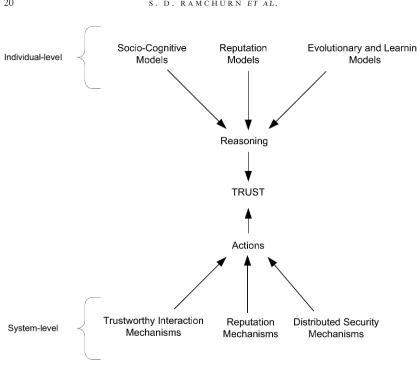
As can be seen,trust pervades multi-agent interactions at all levels.With respect to designing agents and open multi-agent systems we therefore conceptualise trust in the following ways:
• individual-level trust, whereby an agent has some beliefs about the honesty or reciprocative nature of its interaction partners;
• system-level trust,whereby the actors in the system are forced to be trustworthy by the rules of encounter (i.e.protocols and mechanisms)that regulate the system2.
objective without some loss in efficiency,and,in such cases,trust models at the individual level are important in guiding an agent’s decision making.Similarly,where trust models at the individual level cannot cope with the overwhelming uncertainty in the environment,system-level trust models, through certain mechanisms,aim to constrain the interaction and reduce this uncertainty.
Generally speaking,the various issues concerning trust at these two levels have been dealt with separately in the literature,each forming a different piece of the puzzle,without any consideration for how they all fit together.To rectify this position,this paper presents a critique on the work that has been carried out on trust in multi-agent systems. More specifically, we evaluate the most prominent trust models that have been presented and show how they all fit together at the individual and at the system level.From this,we develop a general classification of approaches to trust in multi-agent systems and outline the open challenges that need to be addressed in order to provide a comprehensive view of trust in computational systems.
The rest of the paper is organised as follows. Section 2 deals with models that fit into the individual aspect of trust.We describe and evaluate the trust models that have been devised using learning and evolutionary techniques,reputation,and socio-cognitive concepts.Section3deals with system-level trust where we illustrate different mechanisms that enforce certain properties of the interaction and hence the trustworthiness of agents involved.Section4concludes and outlines the key future lines of research.
2 Individual-level trust
Here we take the viewpoint of an agent situated in an open environment trying to choose the most reliable interaction partner from a pool of potential agents and deciding on the strategy to adopt with it(i.e.thewho,when,andhowof interactions mentioned in Section1).As we have indicated, there are a number of ways the agent can go about doing this.Firstly,they could interact with each of them and learn their behaviour over a number of encounters.Eventually,they should be able to select the most reliable or honest agents from the pool or devise an appropriate strategy to deal with the less(or more) reliable ones. In this case, the agent reasons about the outcome of the direct interactions with others.Secondly,the agent could ask other agents about their perception of the potential partners.If sufficient information is obtained and if this information can be trusted,the agent can reliably choose its interaction partners.In this case,the agent reasons about interactions that others have had with their potential partners(indirect interactions).Thirdly,the agent could characterise the known motivations of the other agents. This involves forming coherent beliefs about different characteristics of these agents and reasoning about these beliefs in order to decide how much trust should be put in them.
Given the above, we can classify trust models at the individual level as either learning (and evolution)based,reputation based,or socio-cognitive based.While the learning and evolutionary models aim to endow agents with strategies that can cope with lying and non-reciprocative agents, reputation models enable agents to gather information in richer forms from their environment and make rational inferences from the information obtained about their counterparts.Socio-cognitive models adopt a rather higher level view of trust that takes the knowledge of motivations of other agents for granted and proposes ways to reason about these motivations. The remainder of this section follows this classification and outlines the main models in each of the various categories.
2.1 Learning and evolving trust
(Dasgupta, 1998). For example,defecting in an interaction could mean that the agent does not satisfy the terms of a contract,sells poor-quality goods,delivers late,or does not pay the requested amount of money to a seller.In these examples,defection could get higher payoffs for the agent defecting(e.g.the seller gets paid more than the actual value of the goods sold)and cause some utility loss to the other party(e.g.the buyer loses utility in buying a low-quality product at a high price).However,defection may reduce the possibility of future interactions since the losing agent would typically attempt to avoid risking future utility losses. In contrast, if both interaction participants cooperate,we assume that they get an overall higher payoffin the long run(Axelrod, 1984).For example,a seller delivering goods on time or selling goods of a high quality may result in future purchases from the buyer.In all these cases,we are generally assuming that the agents already know the payoffs associated with each of their actions.
If the payoffs of each encounter are known,the agents can reason strategically by assessing the best possible move of their opponent and hence devising their own best response.This analysis falls within the realm of game theory (von Neuman & Morgenstern, 1944). The latter regards all interactions as games with different payoffs (e.g. winning or losing the game) for the individual players (i.e. the interaction partners).Most games assume that the move of an opponent is not known in advance. In such one-shot games, the safest (i.e. minimising possible loss), and not necessarily the most profitable,move will be chosen unless there can be some way to ascertain that the other party can be trusted3.Thus,if an agent believes its counterpart is reciprocative,then the former will never defect,otherwise it will,and both could end up with lower payoffs than if they trusted each other or learnt to trust each other.This belief may only be acquired if the game is repeated a number of times such that there is an opportunity for the agents to learn their opponent’s strategy or adapt to each other’s strategy.
To this end we will first consider models that show how trust,through reciprocation(of positive deeds),can be learnt or evolved over multiple direct interactions(Section2.1.1).These interaction models,however,greatly simplify the interactions to extreme notions of cooperation and defection. In reality we believe these two extremes can rather be considered the two ends of an axis measuring the success of the outcome of the interaction.In this context,cooperation could mean,for example, that a seller actually delivers some goods(rather than not delivering at all),but some slight delay in the delivery might still be considered poor cooperation(rather than complete defection).Hence the perception of an agent of another party’s trustworthiness is relative to the level of satisfaction of the outcome. We therefore consider, in Section 2.1.2., how the payoffs in the individual interactions can actually be modelled in realistic applications.
2.1.1 Evolving and learning strategies
The most common example used to illustrate the evolution of trust or cooperation over multiple interactions is Axelrod’s tournaments revolving around the Prisoner’s Dilemma4 Axelrod, 1984). Within very controlled settings,Axelrod’s tournaments have shown that the tit-for-tat strategy was the most successful(reaping higher average points over all the encounters)relative to other selfish or nicer(i.e.mostly cooperative)strategies.Tit-for-tat cooperates on the first move and imitates the opponent’s move in the remaining interactions. By adopting this strategy, agents are, in fact, trusting each other but would punish untrustworthy behaviour if it ever happens(and also forgive if trustworthy behaviour is shown again). If two agents adopt tit-for-tat (or permanently
3 The moves chosen will also be dependent on the risk attitude(risk seeking,risk neutral,or risk averse)of the agent. In this respect, we conceive of trust as a means to minimise the risk perceived by the agent
(Dasgupta, 1998;Yamagishiet al. 1998;Molmet al. 2000.
4 The Prisoner’s Dilemma is a game involving two prisoners that have to decide whether to cooperate by not
cooperative strategies)it is shown that they end up with the highest payoffs compared to all other strategies.However,when faced with other selfish strategies,tit-for-tat does not get the maximum payoff,although it actually gets a higher payoffthan most other strategies.This is because tit-for-tat loses on the first encounter.
It is therefore required that an agent adapts its strategy according to the type of environment (agents therein) they encounter in order to minimise losses and foster cooperation. By allowing agents to adapt,Wu and Sun have shown that trust can actuallyemergebetween them(Wu&Sun, 2001).This means that the agents evolve a trusting relationship (i.e. a cooperative strategy) by evaluating the benefit of each possible strategy over multiple interactions.A multi-agent bidding context,in which a number of seller agents bid for contracts in an electronic marketplace,is chosen to exemplify the concept.It is first shown that when agents are allnice(always cooperating)to each other,sellers tend to learn to exploit them.To counter this,the nice agents learn to use tit-for-tat to minimise their losses. As a result, the nasty sellers (exploitative agents) then learn to be reciprocative since cooperating would bring them more benefit than defecting in the long run.Thus, trust emerges as a result of the evolution of strategies over multiple interactions.This example also shows that the evolution of strategies allows nice agents to beat nasty ones in the long run. However,while strictly applying to the bidding context,Wu and Sun’s model does not take into account the fact that there might be some utility loss(in the short run)in cooperating with the other party(e.g.giving away some resources).
In this respect, while acknowledging a cost to cooperation, Sen (1996)5 demonstrates how reciprocity can emerge when the agents learn to predict that they will receive future benefits if they cooperate. In a more recent set of experiments, Sen and Dutta give clear guidelines about evolutionary stable strategies(Sen&Dutta, 2002) (not necessarily tit-for-tat)in different types of environments(with different sorts of strategies).They show that collaborative liars(collaborating defectors) perform well whenever the number of interactions is small and the number of philanthropic agents(always cooperating)is large.However,reciprocative strategies perform better in all other scenarios they tested.Besides proving that reciprocation pays,these results show that the length and number of interactions matter when it comes to evaluating another agent’s trustworthiness. If the number of interactions is too low, then trust cannot be built. This is corroborated by Muiet al. (2002)in their probabilistic trust model which identifies a threshold for the number of encounters needed to achieve a reliable measure of an opponent’s trustworthiness based on performance appraisal.
In the case where this threshold cannot be reached, other techniques must be used to elicit trustworthiness.In this respect,Mukherjeeet al. (2001)have shown how trust can be acquired if agents know their opponent’s chosen move in advance.They show that,in the case where the agents do not reveal or only partially reveal(only the first mover does)their actions before their opponent acts, no amount of trust is built since it is optimal for the opponent to always choose to defect. However, in the bilateral information revealing scenario(both agents reveal their actions), both agents trust each other through mutually learning to choose an action that results in higher outcomes than predicted for the non-learning situation.It is to be noted that their model(as well as Sen’s),besides assuming a static environment,uses an arbitrarily defined function to calculate the cost of interacting and returns from future actions (the basis of which might need more investigation but has proven to be quite successful in the applications that have been simulated). Up to this point, all the above models deal strictly with the problem of cooperation between self-interested parties. However, not all multi-agent interactions are strictly competitive. For example,agents may be self-interested,but still need to achieve a maximum payoffas a group or society since the latter determines their individual payoffs (e.g. individuals contributing an unspecified amount of money to build a road in their community – the total amount collected decides whether the road will be built,giving utility to the individuals,otherwise the money is used
for a secondary purpose).This is the problem tackled by Birk(2000, 2001). It is thus shown that trust may not only emerge from the evolution of strategies(Birk, 2000),but can also arise strictly out of learning(Birk, 2001).The learning method Birk exposes uses a continuous caseN-prisoner’s dilemma as a basis for simulation.This involves agents contributing to a common fund required for the society to achieve its goals,but each agent is tempted to contribute less than the equal split of the total investment required, in the hope that others will contribute more. In this context, a cooperative strategy (i.e. contributing more than the equal split) gradually predominates in an environment where bad agents(i.e.contributing less)are in the majority.This is because the low investment obtained by the society impacts negatively on the utility of each individual member as well, forcing the latter to learn to cooperate to get higher payoffs.However, as the number of cooperative agents increases,the agents learn to defect again to get better payoffs(this is similar to what Wu and Sun’s model predicts).Birk’s results additionally show that the society reaches an equilibrium with a high level of trust(or cooperation)among its members.
The above learning and evolutionary models of multi-agent strategic interactions assume complete information (e.g. strategies, payoff matrix) for the multi-agent learning algorithms to work.These results have typically been obtained through simulations using very strict assumptions and settings rather than real-life scenarios where the main assumption of complete information about payoffs simply does not hold.Also,most of the learning models conceive the outcome of interactions as being bi-stable,that is,either a defection or cooperation.To be more realistic,we believe agents need to infer,from the information gathered through their direct interactions,how their opponents are performing and how their performance is affecting their goals.This leads on to devising realistic trust metrics.
2.1.2 Trust metrics
For an agent to computationally model its trust in its opponent,it is first required that the former can ascribe a rating to the level of performance of its opponent. The latter’s performance over multiple interactions can then be assessed to check how good and consistent it is at doing what it says it will.Therefore,in addition to a performance rating,an agent also needs a means ofkeeping trackof the performance of an agent (in its direct interactions with it). To this end,Witkowski et al. (2001)propose a model whereby the trust in an agent is calculated based on their performance in past interactions(the context is a trading scenario for an intelligent telecommunications network where bandwidth is traded, the quality and quantity of which is varied depending on the trust suppliers and buyers have in each other).The update to the trust value is different for the different types of agents defined in the system.Specifically,consumers update their trust value according to the difference between their bids and the received goods (bandwidth in this case).The better the quality(size)of the goods the higher the increase in trust and conversely for low-quality goods.A higher trust in a seller would then result in it being chosen for future purchases(conversely for low trust).In contrast,the supplier agents update their trust in the consumers according to the extent to which the quality (size) of the goods (bandwidth) supplied has been exploited. If the quality offered was not fully used, then the trust goes down since it implies that the consumer has dishonestly asked for more than they actually needed.If the quality is fully exploited,the trust goes up. Results of the experiments show how trust(of consumers in suppliers)is effectively strongly dependent on the ability of suppliers to cope with the demand6.
The model used by Witkowskiet al.simplifies the calculation of trust through equations that deal with measurable quantities of bandwidth allocation and bandwidth use.Other models such as those of Muiet al. (2002),Sen and Sajja(2002)and Schilloet al. (2000)consider the performance
of an agent to be simply a bi-stable value(good or bad).While these models achieve the objectives of the agents for the specific simulation settings studied,they cannot generally be used more widely because realistic interactions in an open distributed system involve richer outcomes(e.g.quality of goods traded,efficiency of task handling,duration of task).To overcome this,we need more generic means of assessing performance over time. To this end, Sabater and Sierra(2002) (through the REGRET system)do not just limit the overall performance to a bi-stable value or to an efficiency measure(as per Witkowskiet al.),but rather attribute some fuzziness to the notion of performance. Thus,depending on the context,the performance of an agent can be subjectively judged on a given scale where −1 represents very poor performance, 0 represents neutral,and +1 represents being very good.REGRET actually gives richer semantics to ratings(or impressions)by defining their particular characteristics.For example,an agent can express a satisfaction−0.5for the delivery date of some goods and +1 for the price of the same goods.These impressions are then analysed and aggregated using fuzzy reasoning techniques to elicit a representative value for the overall impression(or trust)of one agent on another.
In contrast to Witkowskiet al.’s model,REGRET’s evaluation of trust is not only based on an agent’s direct perception of its opponent’s reliability,but it also evaluates its behaviour with other agents in the system. This is carried out because only perceiving direct interactions can pose a number of problems.For example,in an open system,it would be very difficult for an autonomous agent to select an interaction partner if the agent itself had never interacted with another party(i.e. it has no history to analyse).Moreover,the method opens itself to attack by strategic liars which, knowing how they are rated by the other side,can adapt their behaviour(e.g.clients overloading their channels)to make the other party believe it is trustworthy(i.e.fully using its bandwidth).In such cases an agent could be better offevaluating other environmental parameters(such as asking other agents about their impressions of each other)in an attempt to get a more reliable rating of their opponents.However, a number of problems arise in doing this. For example, information gathered from other agents could be wrong or incomplete. Such problems are exemplified and studied in Section2.2.
2.2 Reputation models
Reputation can be defined as the opinion or view of someone about something(Sabater&Sierra, 2002).Here we consider that this view can be mainly derived from anaggregation of opinionsof members of the community about one of them7.In multi-agent systems,reputation can be useful when there are a large number of agents interacting (e.g. online auctions, stock-trading). Reputation should,for example,enable buyers to choose the best sellers in the system(e.g.on eBay, the buyers rate the sellers they interact with and this rating is provided to future buyers for them to choose the most reliable seller(s)).Moreover,reputation can induce sellers to behave well if they know they are going to be avoided by future buyers as a result of their reputation going down due to bad behaviour.These different aspects of reputation divide the field into the following lines of research:
• devising methods togather ratingsthat define the trustworthiness of an agent,using relationships existing between members of the community;
• devising reliable reasoning methods to gather as much information from the aggregation of ratingsretrieved from the community;
• devising mechanisms topromote ratings thattrulydescribe the trustworthiness of an agent.
7 Here we distinguish between trust and reputation in the sense that the former is derived from direct
The last of the above items is dealt with in Section 3.2 (since it falls within the realm of system-level trust).For now we will be concerned with the first two items because these are at the level of individual agents.
In order to organise the retrieval and aggregation of ratings from other agents,most reputation models borrow the concept of asocial networkfrom sociology(Burt, 1982;Buskens, 1998).Similar to human societies,this assumes that agents are related to each other whenever they have roles that interconnect them or whenever they have communication links (e.g. by observation, direct communication,or as information sources)established between one another.Through this network of social relationships,it is assumed that agents,acting as witnessesof interactions,can transmit information about each other(Panzarasaet al., 2001).Information takes the form of a performance rating(e.g.good or bad,seller delivers late,buyer never paid)as explained in Section2.1.2.Such a rating could then be shared by the different nodes of the social network,thus giving rise to the concept of reputation.
2.2.1 Retrieving ratings from the social network
Yu and Singh(2000a)tackle the problem of retrieving ratings from a social network through the use ofreferrals.In this context,referrals are pointers to other sources of information similar to links that a search engine would plough through to obtain a Web page or url.Through referrals,an agent can provide another agent with alternative sources of information about a potential interaction partner(particularly if the former cannot handle the latter’s request itself).Yu and Singh propose a method of representing a social network(based on a referral network(Singhet al., 2001))and then provide techniques to gather information through the network (Yu & Singh, 2003). Specifically,they show how agents can explore a network by contacting their neighbours and can use referrals gathered from the latter to gradually build up a model of the social network. Furthermore, Schillo et al. (2000) enrich the representation of an existing social network by annotating nodes of the network to represent their particular characteristics.Thus each node of the network holds two values: (i) the trust value which describes the degree ofhonesty of the agent represented by the node;and(ii)the degree ofaltruism(i.e.being good to others even at the expense of one’s own utility). Both of these values are used to deduce the trustworthiness of witnesses queried at the time of calculating the reputation of potential interaction partners(see Section2.2.2). From an established social network it is then possible to derive higher-level concepts.For example, Sabater and Sierra(2002)and Yu and Singh(2002a)derive the concept of agrouporneighbours from the social network by identifying those nodes(agents)that are close together(linked together). Thus,having a social network represented allows an agent to select and contact those agents they need in order to get a proper measure of the reputation of another agent.For example,Yu and Singh’s model takes into account ratings from those agents that are close(by virtue of the number of links separating them with a potential interaction partner)to choose witnesses for a particular agent.Underlying this is the assumption that closer witnesses will return more reliable ratings.
It is further assumed,in all of the above models,that witnesses share ratings freely(i.e.without any profit).This is a relatively strong assumption which can be removed if proper mechanisms are implemented (as will be seen in Section3.2). Therefore,given that agents have represented their social network and properly extracted the ratings of their counterparts from the network,they then need to aggregate these ratings so as to form a coherent impression of their potential interaction partners.
2.2.2 Aggregating ratings
are less people not reporting bad ratings even though these people have had bad experiences. Having no rating is not considered as a bad rating,nor as a good rating,and is simply discarded from the aggregation.Moreover,ratings are open to manipulation by sellers trying to build their reputation. While the latter problem can be dealt with by designing sophisticated reputation mechanisms(see Section3.2),the former problem can be solved at the level of the agent’s reasoning mechanism.
To this end,Yu and Singh(2002b)deal with absence of information in their reputation model. The main contribution of their work is in aggregating information obtained from referrals while coping with the lack of information.More specifically, they use the Dempster Shafter theory of evidence to model information retrieved(Yageret al., 1994).The context is the following:an agent may receive good or bad ratings(+1or−1)about another agent.When an agent receives no rating (good or bad), how should it classify this case? In Yu and Singh’s model, a lack of belief (or disbelief) can only be considered as a state of uncertainty (where all beliefs have an equal probability of being true).Dempster’s rule allows the combination of beliefs obtained from various sources(saying an agent is trustworthy,untrustworthy,or unknown to be trustworthy or not)to be combined so as to support the evidence that a particular agent is trustworthy or not.Moreover, together with a belief derived from ratings obtained,an agent may hold a belief locally about the trustworthiness of another due to its direct interaction with it.However,in such cases,the ratings obtained from witnesses are neglected.Nevertheless,their measure of reputation does not discredit nor give credit unnecessarily to agents(as eBay does)in the absence of information.
As can be seen,Yu and Singh do not deal with the possibility that an agent may lie about its rating of another agent.They assume all witnesses are totally trustworthy.However,an agent could obtain some benefit by lying about their rating of an opponent if they are able to discredit others so that they appear to be more reliable than them.In this respect,Schilloet al. (2000)deal with the problem of lying witnesses.They first decompose the rating into social metrics of trust and altruism (as discussed above – see Section2.2.1).The latter metrics are used in a recursive aggregation over the network taking into consideration the probability that the witnesses queried may lie to (or betray)the querying agent.In this way,the value obtained for the trust in an agent is more reliable than fully trusting witnesses as in the case of Yu and Singh’s model(which assumes cooperative settings).The probability of a witness lying to the querying agent is actually learnt over multiple interactions in Schilloet al.’s model.Similarly,Senet al.extend this work and demonstrate how agents can cope with lying witnesses in their environment through learning rather than attributing subjective probabilities to the event of a witness lying (Sen et al., 2000; Sen & Sajja, 2002). Specifically, they develop a reputation model which makes the same simplifying assumptions as those illustrated in Section 2.1. Their approach shows how the sharing of trust values (or reputation)can benefit reciprocative agents in the long run. In the short run though,selfish and lying agents still benefit from totally reciprocative agents.Furthermore,it is shown that,over time, colluding agents cannot exploit reciprocative agents if these learn the behaviour of the former and share their experience with others of a similar type.The reciprocative agents then become selfish towards these lying and completely selfish agents so as to minimise utility loss in interacting with them.Their model,however,fails when the number of witnesses in the environment falls below a given threshold.This is because a sufficiently high number of witnesses is needed to report ratings about most lying agents in population.If this is not the case, there is a higher probability of a reciprocative agent interacting with a lying one which has not previously been encountered by the witnesses.
(sociological)approach closer to real-life settings.Thus their reputation value,which is represen-tative of the trust to be placed in the opponent, is a weighted sum of subjective impressions derived from direct interactions(theindividual dimension of reputation),the group impression of the opponent,the group impression on the opponent’s group,and the agent’s impression on the opponent’s group (together, all of these compose the social dimension of reputation). Now, the weights on each term allow the agent to variably adjust the importance given to ratings obtained in these diverse ways.Moreover, older ratings, devised as shown in Section 2.2.1,are given less importance relative to new ones.The strong realism of REGRET also lies in its definition of an ontological dimensionthat agents can share to understand each other’s ratings(e.g.a travel agent being good might imply low price for one agent,but may imply good quality seats reserved for another).However,REGRET does not handle the problem of lying(strategically)among agents. Ratings are obtained in a cooperative manner (from an altruistic group) rather than in a competitive setting(where witnesses are selfish).Moreover,the aggregation method REGRET uses can be sensitive to noise since ratings are simply summed up. In contrast, Mui et al.’s model calculates the probability of an agent being trustworthy on the next interaction by considering the frequency of(positive and negative)direct impressions conditional upon the impressions gathered from the social network(Mui et al., 2002). This approach, we believe,is less sensitive to noisy ratings from the network.
2.3 Socio-cognitive models of trust
The approaches to modelling trust at the individual level that we have considered in the previous sections are all based on an assessment of the outcomes of interactions. For example, learning models consider the payoffs of each individual strategy,while reputation models assess outcomes of both direct and indirect interactions (i.e. third-party assessments). However, in assessing the trustworthiness of an opponent,it may also be important to consider the subjective perception8on the latter since it enables a more comprehensive analysis of the characteristics of the opponent (Dasgupta, 1998;Gambetta, 1998).For example,the tools and abilities available to that opponent could be(subjectively)assessed to check whether or not the agent can indeed use these to carry out an agreed task. Such beliefs or notions are normally stored in an agent’s mental state and are essential in assessing an agent’s reliability in doing what they say they will(i.e.being capable),or their willingness to do what they say they will(i.e.being honest).
In this respect,we report the line of work initiated by Castelfranchi and Falcone(Castelfranchi & Falcone, 1998, 2000a, b; Falcone & Castelfranchi, 2001). In particular, they highlight the importance of a cognitive view of trust (particularly for Belief–Desire–Intention agents (Wooldridge, 2002))in contrast to a mere quantitative view of trust(Sections2.1and2.2).
The context they choose is that of task delegation where an agentxwishes to delegate a task to agenty.In so doing agentxneeds to evaluate the trust it can place inyby considering the different beliefs it has about the motivations of agenty.They claim the following beliefs are essential(inx’s mental state)to determine the amount of trust to be put in agenty by agent x(these have been adapted and summarised).
• Competence belief: a positive evaluation ofy byx saying thaty is capable of carrying out the delegated task as expected. If agent y is not capable, there is no point in trusting them to accomplish the task fully.
• Willingness9belief:xbelieves thatyhas decided and intends to do what they have proposed to do.If agentyis not believed to be willing to do the task,they might be lying if they say they want to do so.This would then decreasex’s trust iny.
8 By subjective,we mean that these beliefs are formed according to the assessment of the environment and the opponent’s characteristics which could also include an analysis of past interactions.
• Persistence9belief:xbelieves thatyis stable enough about their intention to do what they have proposed to do.Ifyis known to be unstable,then there is added risk in interacting withy,hence a low trust would be put inyeven though they might be willing to do the task at the point the task is delegated.
• Motivation belief: x believes that y has some motives to help x, and that these motives will probably prevail over other motives negative to x in case of conflict. This highlights the possibility foryto defect as argued in Section2.1.The motives mentioned here are the same as the long-term gains obtainable in helpingxachieve their goals.Ify is believed to be motivated (to be helpful or positively reciprocative as in Section2.1), thenxwill tend to trust them.
To devise the level of trust agentxcan place in agenty,agentxwould need to consider each of the above beliefs(and possibly others).These beliefs actually impact on trust,each in a different way,and these need to be taken into account in a comprehensive evaluation of all beliefs concerned. For example,the competence belief is apre-requisite to trust another agent,while the motivation belief would vary according to the calculation of the future payoffs to the agents over multiple interactions.This kind of strategic consideration becomes even more important when such beliefs are known to all actors(i.e.the preferences of agents are public).For example,what could happen if agentyknows thatxtrusts them,or relies on them?The authors claim that this may increase the trustworthiness ofxiny’s mind,the self-confidence ofy,or their willingness to servex,which in turn changes the trustworthiness ofy.Agentx can then take into account the possible effects of their trust in y (even before performing the delegation) to support their decision of delegating. However, Castelfranchi and Falcone’s approach is strongly motivated by humans which are not always rational beings(as opposed to what we expect agents to be)10
As opposed to the cognitive approach of Castelfranchi and Falcone, Brainov and Sandholm (1999)support the need to model an opponent’s trust(as described above)with a rational approach (they specifically target the context of non-enforceable contracts).They do so by showing that if an agent has a precise estimation of its opponent’s trust(in the former),this leads to maximum payoffs and trade between the two agents. However, if trust is not properly estimated, it leads to an inefficient allocation of resources between the agents involved (hence a loss in utility) since both underestimate or overestimate their offers on exchanged contracts.It is also shown that it is in the best interests of the agents, given some reasonable assumptions, to actually reveal their trustworthiness in their interaction partner(to efficiently allocate resources)!
While still in its infancy,the socio-cognitive approach to modelling trust takes a high-level view of the subject.However,it lacks the rational grounding(as shown by Brainov and Sandholm)in rational mechanisms which learning and reputation models(and mechanisms)provide.In effect,the socio-cognitive approach could exploit the assessment performed by these models to form the core beliefs illustrated above. Thus, speaking generally, all the individual models of trust could contribute to a comprehensive evaluation of trust at the individual level. This would take into account strategies learnt over multiple interactions,the reputation of potential interaction partners, and finally the latter’s believed motivations and abilities regarding the interaction.However,it can be computationally expensive for an agent to reason about all the different factors affecting their trust in their opponents.Moreover,as highlighted earlier,agents are limited in their capacity to gather information from various sources that populate their environment.Given these limitations, instead of imposing the need to devise trust at the individual level,it can be more appropriate to shift the focus to the rules of encounter so that these ensure that interaction partners areforcedto be trustworthy. In this way, these rules of encounter can, at times, compensate for the limited applicability of individual-level trust models(conversely,whenever the rules of encounter cannot
guarantee that interacting agents will be trustworthy,we might need to resort to individual-level trust models to do so).
3 System-level trust
In the context of open multi-agent systems, we conceive of agents interacting via a number of mechanisms or protocols that dictate the rules of encounter.Examples of such mechanisms include auctions, voting, contract-nets, market mechanisms, and bargaining, to name but a few (see Sandholm, 1999) for an overview of these). These mechanisms take agents to be completely self-interested and therefore need to make sure that the rules of encounter prevent lying and collusion between participants.Generally speaking,such requirements impose some rigidity on the system(e.g.an English auction forces bidders to reveal their bids).However,these rules enable an agent to trust other agents by virtue of the different constraints imposed by the system. These constraints can be applied in a number of ways.Firstly, it is sometimes possible to engineer the protocol of interaction such that the participating agents find no gain in utility by lying or colluding.Secondly,an agent’s reputation as being a liar(or truthful)can be spread by the system. Thus,knowing that their future interactions will be compromised if they are reputed to be liars, agents can be forced to act well(up to the point they leave a system).Thirdly,agents can be screened upon entering the system by providing proof of their reliability through the references of a trusted third party.
Against this background,we subdivide system-level trust in terms of(i)devising truth-eliciting interaction protocols, (ii)developing reputation mechanisms that foster trustworthy behaviour,and (iii)developing security mechanisms that ensure new entrants can be trusted.This is the structure that we adopt in the following subsections.
3.1 Truth-eliciting interaction protocols
In order to ensure truth-telling on the part of agents involved in an interaction, a number of protocols and mechanisms have been devised in recent years(see Sandholm(1999)for an overview). These protocols aim to prevent agents fromlyingorspeculatingwhile interacting(e.g.lying about the quality of goods sold or proposing a higher price than one’s true valuation for goods to be bought). They do so by imposing rules dictating the individual steps in the interaction and the information revealed by the agents during the interaction.Thus,by adhering to such protocols it is expected that agents should find no better option than telling the truth.Given the aim of this paper, we do not wish to delve into a detailed explanation of all available protocols (i.e. the Vickrey–Clarke–Groves(VCG)class of mechanisms)that have such properties and enforce them to a certain degree(see Mas-Colellet al. (1995)and Dashet al. (2003)for such a wider analysis). Rather we will focus on one such protocol(namelyauctions,since these are the most widely used mechanism in multi-agent system applications).
There are four main types of single-sided auctions,namely the English,Dutch, First-price-sealed-bid,and Vickrey.In the English auction,each bidder is free to raise his bid until no bidder is willing to raise any further,thus ending the auction.The Dutch auction instead starts with a very high ask price and reduces it in steps until one of the bidders bids for the item and wins the auction.The First-price-sealed-bid involves agents submitting their bids without knowing others’ bids. The highest bidder wins the auction.In the Vickrey auction,the bids are sealed but the winner pays the price of the second highest bid.
either a lower valuation(in the case of Dutch and First-price-sealed-bid)or to bid only a smaller amount more than the current highest bid up to one’s true valuation(in the case of the English auction). In contrast, the Vickrey auction does enforce truth-telling by biddersand is a common example of the class of VCG mechanisms. Here, a bidder’s dominant strategy is to bid its true valuation since doing otherwise,given uncertainty about other bids and the final price to be paid, would result in some loss in utility.Bidding higher than its true valuation could end up with the agent paying more than its valuation and bidding lower than its true valuation could make it lose the auction altogether.
As pointed out above,the main weakness of the Vickrey mechanism is that it does not ensure truth-telling on the part of the auctioneer.The latter could still lie about the winning bid since bids are private and known only to the auctioneer(and obviously to each of the bidders in private,unless there is some amount of collusion).The auctioneer could thus ask for a higher price than the second highest bid(just below the highest bid)from the highest bidder.In so doing,the auctioneer reaps a higher benefit than it should without the bidders knowing.In this respect,Hsu and Soo(2002) have implemented a secure(i.e.ensuring the privacy of bids and the allocation of the goods to the true winner) multi-agent Vickrey auction scheme. The scheme differs from the original Vickrey auction in that it involves an additional step of choosing the auctioneer from among the bidders (advertised on a blackboard). The bidders submit their encrypted bids to a blackboard. The auctioneer is selected at random from the bidders and it is given a key to access all sealed bids. Using this key,it can only compare the bids’ values.Thus,the auctioneer can only determine the order of bids and allocate the second highest bid to the winner. This scheme also allows the auctioneer(also a bidder),the winner,and the second highest bidder to verify the result by using their keys to check the bids shown on the blackboard.
However,the Vickrey auction,and the other main ones stated above,are not collusion proof. This means that agents can collaborate to cheat the mechanism by sharing information about their bids.Collusion would first necessitate that the agents know each other before they place their bids and therefore arrange to place bids that do not reveal their true preferences(e.g.agents withholding their bids in a Dutch auction until the ask price has gone very low,or some bidders colluding with the auctioneer to artificially raise the ask price in an English auction to force others to pay a very high price,or bidders colluding to beat competitors in a Vickrey auction).To prevent the latter from happening,Brandt(2001, 2002) extends the work of Hsu and Soo by devising a collusion proof auction mechanism that ensures the privacy and correctness of any(M+1)th-price auction(i.e.an auction where the highest Mbidders win and pay a uniform price determined by the (M+1)th price).In this type of auction,bids aresealedand the highest bid wins the auction but pays aprice determined by the auctioneer(e.g.in the Vickrey auction the second highest price is paid).Only the auctioneer and the bidder know the highest bid.To allow bidders to verify whether the winning bid is actually the highest (hence checking the trustworthiness of the winner and auctioneer) the protocol devised by Brandt distributes the calculation of the selling price between the individual buyers using some cryptographic techniques.However,the only other agent,apart from the seller, able to calculate the exactvalue of the selling priceis the winner of the auction.The protocol also ensures that bids are binding.These conditions,combined with the fact that the protocol can be publicly verified,allow the identification of malicious bidders which would have tampered with the bids and prevent collusion from affecting a single bidder.While being very powerful,the protocol is computationally expensive for a large number of agents but works well for small numbers.
from accessing future runs of the auction(Brandt, 2002).If an agent knows it will lose utility in the future due to bad behaviour in the present,it will find no better option but to act in a trustworthy way.In this respect,earlier in the paper(see Section2.1)we have shown how agents could learn to actually adapt their strategy (reciprocative or not) in order to maximise their long term payoffs against different strategies over multiple runs of an auction.
However,as pointed out in Section1,open multi-agent systems allow agents to interact with any other agent in the environment.This could allow malicious agents to move from group to group whenever they are detected by a given group of agents and therefore exploit trustworthy agents as they move around.In order to prevent this from happening, agents can be made to share their ratings of their opponent with other agents in the environment once they have interacted with them. Techniques to allow agents to gather ratings and aggregate those in a sensible way were presented in Section2.2.However,it was shown that these techniques do not consider the fact that we expect agents to share(true)ratings only if it brings them some utility.In open multi-agent systems,this can be achieved through reputation mechanisms which we discuss in the next section.
3.2 Reputation mechanisms
As was seen in Section2.2,the reputation models described do not take into account the fact that the agents are selfish and therefore will not share information unless some benefit can be derived from doing so.Furthermore,these reputation models(e.g.REGRET or Yu and Singh’s model)do not motivate the use of reputation by some agents to elicit good behaviour from other agents.These models aim to endow agents with a better perception of their opponent and do not consider the effect of doing so on an opponent when the latter is aware of it! Given these shortcomings of reputation models,reputation mechanisms consider the problem of inducing trustworthy behaviour and modelling the reputation of agentsat the system level. Reputation mechanisms can operate through centralised or distributed entities that store ratings provided by agents about their interaction partners and then publicise these ratings,such that all agents in the environment have access to them.In this case,it is the system that manages the aggregation and retrieval of ratings as opposed to reputation models which leave the task to the agents themselves. In so doing, reputation mechanisms can be used to deter lying and bad behaviour on the part of the agents. Moreover,reputation mechanisms aim toinduce truthful ratingsfrom witnesses and actually make itrationalfor agents to give ratings about each other to the system.Such a mechanism,that makes it rational for participants to use it,is said to be incentive compatible(Resnick&Zeckhauser, 2002). More specifically,Zacharia and Maes have outlined the desiderata for reputation mechanisms, particularly with regards to how ratings are aggregated and how these impact on the behaviour of the actors in the system (Zacharia & Maes, 2000).They do not propose such requirements for agent-based reputation systemsper se,but as we move into agent-mediated electronic commerce (Heet al., 2003b),it is obvious that such mechanisms will guide agent-based reputation systems. These desiderata are listed below.
1. It should be costly to change identities in the community.This should prevent agents from entering the system,behaving badly,and coming out of the system without any loss of utility or future punishment bearing upon them.
2. New entrants should not be penalised by initially having low reputation values attributed to them. If new entrants have low reputation they are less favoured though they might be totally trustworthy. This actually makes the system less appealing to agents (with bad reputation) intending to(re-)enter the system.
3. Agents with low ratings should be allowed to build up reputation similar to a new entrant.This allows an agent to correct its behaviour if it has been shown to be badly behaving in the past. 4. The overhead of performing fake transactions should be high.This prevents agents from building
their own reputation.
to others.However,this can be contentious if reputation determines the level of profit the agent acquires since it could lead to the creation of monopolies or cartels in the market.
6. Agents should be able to provide personalised evaluations.This involves giving more than just a simple rating of +1 to −1to allow a better evaluation of the reputation of another agent.For example, the REGRET system implements richer ratings that can be shared using the ontological dimension (see Section2.2.2).
7. Agents should keep a memory of reputation values and give more importance to the latest ones obtained. This is needed to keep the reputation measure as up to date as possible and helps prevent an agent from building up a positive reputation by interacting well and then starting to defect (the last defection having a greater effect than its past good behaviour).
With respect to the above requirements, Zacharia and Maes present two reputation systems (targeted at chatrooms, auctions, and newsletters): SPORAS and HISTOS. While these are not strictly multi-agent systems,they present techniques to aggregate ratings intelligently and reflect the real performance of human users in an online community.In both cases,the aggregation method allows newer ratings to count more than older ones. SPORAS,however,gives new entrants low initial reputation values and therefore reduces their chance of being selected as possible interaction partners.This is a tradeoffafforded to prevent identity switching.This is because an agent having low reputation would not be any better offby re-entering the system with a new identity.HISTOS is an enhancement to SPORAS which takes into account the group dynamics as in REGRET.In particular,HISTOS looks at the links between users to deduce personalised reputation values(i.e. taking into account the social network).This enables an agent to assemble ratings from those it trusts already rather than those it does not know.Moreover,both HISTOS and SPORAS have been shown to be robust to collusion.This is because those agents that are badly rated themselves have a diminished effect on the reputation of others and those they might want to protect.However, as the authors point out themselves,the major drawback is that users are reluctant to give bad ratings to their trading partners.This is because there is no incentive to give ratings in the first place (i.e.it is not incentive compatible).
In an attempt to make their reputation mechanism incentive compatible,Jurca and Faltings (2002, 2003)introduce side payments to make it rational for agents to share reputation information. Thus agents can buy and sell reports to and from special information agents supplied by the system. Reports are values between0and1,where0represents completely bad behaviour and1represents absolute trustworthy behaviour.Agents are only allowed to sell a report for an agent when they have previously bought reputation information for that agent.This ensures that agents cannot sell reputation information they make up by themselves.They additionally propose two conditions to make a reputation mechanism robust to lying witnesses:
• agents that behave as good citizens(report truthfully)should not lose any utility; • agents that give false reports should gradually lose utility.
In their model,they aim to fulfil the above conditions by implementing information agents which pay only for reports(to one agent)if they match the next report given by another agent(having interacted with the same agent as the previous one). In this way, the authors claim that agents revealing truthfully get paid and those that do not will lose money in buying reports and not getting paid when they sell them on.However,this method does not work if most agents lie about the reports or if they collude in giving false reports.Moreover,they assume that information agents already store some reputation information after bootstrapping the system.This overly simplifies the process of reputation management and additionally does not take into account the case of new entrants into the system.More work is therefore needed to make this model applicable to open multi-agent systems.
‘‘Goodwill Hunting’’(GWH)as a more realistic feedback mechanism,for a trading environment. This system:
• induces sellers of variable quality goods to truthfully reveal the quality of their goods; • provides incentives to buyers to truthfully reveal their feedback.
The GWH algorithm uses the threat of biased future reporting of quality(of goods to be sold) in order to induce sellers to truthfully declare the individual qualities of their items.Specifically,the mechanism keeps track of the seller’s ‘‘goodwill’’.This value represents the seller’s trustworthiness. It is adjusted by the quality reported by buyers. Good reports bias goodwill positively and bad reports bias it negatively.To induce sellers to reveal the true quality of their goods,the goodwill factor is used to adjust the quality they wish to broadcast for the goods they wish to sell.Thus if the seller has low goodwill,the quality of the goods it tries to publicise will be actually shown to have a lower quality by the system.
To induce buyers to report their ratings of sellers,they are given rebates on future transactions in the system.It is then shown that,if buyers report untruthfully,they can drive out sellers of good quality goods, and therefore lose the opportunity of buying high-quality goods. However, the mechanism makes several somewhat unrealistic assumptions about online markets.For example,it assumes that sellers are monopolists;that is,they are the only ones to sell a particular product(of varying quality).Also it assumes that buyers will interact with sellers only once.These assumptions are needed to simplify the analysis of the model. As the author points out, among other enhancements,it is still to be shown how the mechanism fares against strategic reporting from buyers whereby they force a seller to reduce the price of their goods by giving them bad ratings, hence damaging their reputation.
The reputation mechanisms detailed above and the interaction mechanisms discussed in Section 3.1try to enforce trustworthy behaviour by minimising the opportunity for agents to defect to gain higher payoffs (see our definition of trust in Section 1). As has been shown, more of these mechanisms still need to be developed. In the case where interaction protocols and reputation mechanisms cannot guarantee trustworthy behaviour,there still exists a need to give agents in an open system the possibility of proving their trustworthiness so as to enable other agents to recognise them as reliable interaction partners.One way this could proceed is by providing references from highly-recognised sources.This is similar to the case of a job seeker providing its credentials to its potential new employer. Note that this process is not the same as reputation building and acquisition which pertains to the recognition of an entire community.Rather,credential assessment falls within the realm of network security which we discuss next.
3.3 Security mechanisms
In the domain of network security11,trust is used to describe the fact that a user can prove who they say they are (Mass & Shehory, 2001). This normally entails that they can be authenticated by trusted third parties(i.e.those that can be relied upon to be trustworthy and as such areauthorities in the system(Grandison&Sloman, 2000).At a first glance,this does not completely fit with our initial definition of trust(see Section1),but it is certainly a basic requirement for the trust models and mechanisms described earlier to work (see Sections 2.1–2.3, 3.1, 3.2). This is because these models are based on the fact that agents can berecognised by their identityand would therefore require authentication protocols to be implemented.
To this end, Poslad et al. (2002) have recently proposed a number of security requirements that they claim are essential for agents to trust each other and each other’s messages transmitted
11 We do not wish to give a complete account of network security mechanisms since this is beyond the scope
of this paper. Rather, we will focus on the main concepts and models that strictly pertain to multi-agent systems.For a wider reading on network security for open distributed systems see Grandison and Sloman
across the network linking them(i.e.to ensure messages are not tampered with by malicious agents).
• Identity: the ability to determine the identity of an entity. This may include the ability to determine the identity of the owner of an agent.
• Access permissions:the ability to determine what access rights must be given to an agent in the system,based on the identity of the agent.
• Content integrity:the ability to determine whether a piece of software,a message,or other data has been modified since it has been dispatched by its originating source.
• Content privacy:the ability to ensure that only the designated identities can examine a message or other data.To the others,the information is obscured.
The authors specify these requirements for the FIPA (Foundation for Intelligent Physical Agents) abstract architecture (FIPA, 2002). These basic requirements can be implemented by a public key encryption and certificate infrastructure (Grandison & Sloman, 2000). A digital certificate is issued by a certification authority(CA) and verifies that a public key is owned by a particular entity.The public key in a certificate is also used to encrypt and sign a message in a way that only its owner can examine the content and be assured about its integrity. The two most popular public key models are PGP(Pretty Good Privacy)and the X.509 trust model(Adam& Farrel, 1999). The former supports a web of trust in that there is no centralised or hierarchical relationship between CAs,while the latter is a strictly hierarchical trust model for authentication (Grandison & Sloman, 2000). However, these authenticating measures do not suffice for open multi-agent systems to ensure that agents act and interact honestly and reliably towards each other. They only represent a barrier against agents that are not allowed in the system or only permit their identification in the system.In order to enforce good behaviour in the system,it is instead possible that certificates are issued to agents if these meet specific standards that make them trustworthy.
In order to achieve this,trusted third parties are needed to issue certificates to agents that satisfy the standards of trustworthiness (i.e. being reciprocative, reliable, honest). For example, agents would need to satisfy certain quality standards(e.g.products stamped with the Kitemark or the ‘‘CE’’ marking are assured to conform to the British standards and the European community standards respectively)and terms and conditions for the products they sell(e.g.sellers have to abide by a14-day full-refund return policy in the UK for any goods they sell).It is only upon compliance with these quality standards that the agent would be able to sell its products.To this end,Herzberg et al. (2000)present a policy-based and certificate-based mechanism which can assign roles to new entrants. A certificate in this work is signed by some issuer and contains some claims about a subject.There is no restriction on what claims can be.For example,there may be claims about organisation memberships (company employee, etc.), capabilities of the subject, or even the trustworthiness(or reliability)of the subject in the view of the issuer.
The mechanism in Herzberget al. (2000)also enables a party to define policies for mapping new entrants to predefined business roles.Thus an agent can ensure that a new entrant will act according to the settings defined by their role or access rights.The role assigned to an agent carries with it a number of duties and policies they need to abide by.If the agent undertakes the role,they are forced to abide by the given rules of good behaviour.The process of role assignment and access provision is performed in a fully distributed manner,where any party or agent may be a certificate issuer. Moreover,it is not required that certificate issuers be known in advance.Instead,it is sufficient that, when requested,an agent that issues certificates provides sufficient certificates from other issuers to be considered a trusted authority according to the policy of the requesting party. This allows distributed trust to build up among parties in an open environment(Mass&Shehory, 2001).