This is a repository copy of
Effect of cement grade and fineness of slag on the early age to
medium term properties of binary blends
.
White Rose Research Online URL for this paper:
http://eprints.whiterose.ac.uk/120071/
Version: Accepted Version
Proceedings Paper:
Adu-Amankwah, S, Black, L orcid.org/0000-0001-8531-4989 and Zajac, M (2013) Effect of
cement grade and fineness of slag on the early age to medium term properties of binary
blends. In: 33rd Cement and Concrete Science Conference. 33rd Cement and Concrete
Science Conference, 02-03 Sep 2013, Portsmouth, UK. .
This is an author produced version of the paper, 'Effect of cement grade and fineness of
slag on the early age to medium term properties of binary blends,' presented at the 33rd
Cement and Concrete Science Conference.
[email protected] https://eprints.whiterose.ac.uk/ Reuse
Unless indicated otherwise, fulltext items are protected by copyright with all rights reserved. The copyright exception in section 29 of the Copyright, Designs and Patents Act 1988 allows the making of a single copy solely for the purpose of non-commercial research or private study within the limits of fair dealing. The publisher or other rights-holder may allow further reproduction and re-use of this version - refer to the White Rose Research Online record for this item. Where records identify the publisher as the copyright holder, users can verify any specific terms of use on the publisher’s website.
Takedown
If you consider content in White Rose Research Online to be in breach of UK law, please notify us by
1
33rd Cement and Concrete Science Conference Paper Number XX
2-3 September 2013 University of Portsmouth
Effect of cement grade and fineness of slag on the early age to
medium term properties of binary blends
Samuel Adu-Amankwah1, Leon Black1, Maciej Zajac2
1Institute for Resilient Infrastructure, School of Civil Engineering, University of Leeds, Leeds, LS2 9JT, UK 2Heidelberg Technology Center GmbH , Rohrbacher Str. 95, 69181 Leimen, Germany
ABSTRACT
The hydration and microstructural evolution of cementitious materials are dependent on both the mineralogical and physical attributes of the constituent materials. This paper ascertains the influence of
constituent materials’ fineness on hydration and the evolution of mechanical properties of CEM I-slag composite cements. The clinker to supplementary cementitious material ratio was maintained at 50:50 and the sulphate content kept constant in all mixes. Compressive strength development was followed over time, with hydration followed by isothermal calorimetry and chemical shrinkage. Results from these techniques show that, for a given clinker, a more finely ground slag was consistently superior to a coarser slag. Furthermore, calorimetry revealed that the intensity of alite hydration and the secondary peak attributable to participation of aluminates from slag in hydration were also greater when using a finer slag. Finely ground clinker also accelerates slag hydration. The early age strengths in the binary blends were weaker than the control specimens, but this was offset beyond 7 days when using finer slag blends. Blending of higher grade CEM I (52.5R) and fine slag also yielded comparable early age strength to a CEM I- 42.5R mix.
1. INTRODUCTION
High levels of supplementary cementitious materials (SCMs) present an option to cement producers for meeting carbon footprint reduction targets. Ground granulated blast furnace slag, limestone and pulverized fuel ash are widely reported SCMs. This is due to their potential to offer technical advantages, plus the opportunity to utilize wastes from other production streams. The availability of these materials are however not unlimited. Optimization of the physical properties in relation to strength and durability requirements per unit replacement is essential for maximizing the use of SCMs. However, being a secondary product, blast furnace slag still requires some processing, for example, grinding to the appropriate fineness, for incorporation in cement.
All things being equal, a finer material has a greater specific surface area so should react faster than a coarser material. Increasing the fineness of ground slag or clinker in composite cements offsets the lower rate of hydration at early age (Nakamura et al., 1992). Similarly, higher clinker fineness accelerates hydration (Binici et al., 2007; Merzouki et al., 2013). Slag composites containing finely ground clinker is expected to be activated earlier. This is due to accelerated clinker hydration consequently providing the requisite pH at early ages. Similarly, the reactivity of ground slag increases with fineness. It has however been suggested that, slag with higher fraction of particles below 10 microns compensate for lower strength at early age (Wang et al., 2005). Adjusting the size distribution of cement constituents especially below
10 microns influence early age performance while larger particle fractions effectively have later stage benefits.
The method of formulating composite cements is also an important parameter affecting the production economics and the physical features of the anhydrous materials, as well as the hydrates. The question then is; which constituent should be ground finer in composite cements? Slag is harder to grind compared to clinker. Consequently, intergrinding of clinker and slag leads to accumulation of clinker in the finer fraction while slag remains in the coarser fraction. The effect is lower reactivity of slag especially at early age hence marginal improvements in compressive strengths (Kumar et al., 2008; Öner, 2000).
Understanding the relationship between fineness, hydration kinetics and mechanical properties is imperative for optimizing the fineness of slag in composite blends with clinker. This study uses a range of different techniques to assess the extent of hydration and consequently the effect of using either fine or commercial grade slags, blended with normal or high strength clinker, on mechanical properties.
2. MATERIALS AND METHODS
2
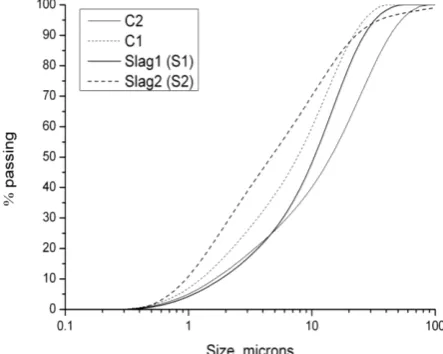
performed in a laboratory ball mill. Longer resident time in the mill as expected increased the fraction of slag below 10 microns. The two cements and S1 were industrial grade materials. Particle size distributions, median particle size (D50) and Blaine
fineness of the materials are shown in Figure 1 and Table1 respectively. The clinker to SCM ratio was maintained at 50:50 taking into consideration the 5% limestone added as minor addition during production of the anhydrous cement. Sulphate content was also maintained at 3% in all mixes. The percentage composition of the blended cements was thus 51:47:2: CEMI:slag:anhydrite: respectively.
Figure 1: Particle size distribution of materials investigated
determined by laser granulometry.
Table1. Physical properties of materials
Material D50 (µm) Blaine fineness
(cm2/g)
CEM I-52.5R (C1) CEM I-42.5R (C2) Slag 1 (S1) Slag 2 (S2)
7.5 15 10 4.5
5930 3830 4540 7490
Compressive strength development was followed using mortar samples prepared from 1:3:0.5 (cement:sand:water) mixes with testing at 1, 2, 7, 14 and 28 days.
Hydration was followed by isothermal conduction calorimetry and chemical shrinkage. For calorimetry, 6g of powder was weighed into an ampoule and 3g of water added. Samples were mixed for 2 minutes using a vortex mixer, with heat evolution rate and total heat evolved measured for 28 days at 20oC using an 8 channel TAM Air
calorimeter. Reference channels were filled with the same mass of a quartz paste with the same W/B ratio
Paste specimens for chemical shrinkage were prepared using 15g of paste with a water:binder ratio of 0.5. Shrinkage was assessed according to the method described in (Geiker, 1983; Kocaba et al., 2012). The pastes were hand mixed for 2
minutes and placed at the bottom of a plastic beaker. The pastes were then covered with 5g of water carefully pipetted to avoid surface disturbance before being topped with coloured oil and sealed with a bung through which a 1mL pipette was passed.
3. RESULTS AND DISCUSSION
Compressive strength
Compressive strength development of the CEM I mixes plus the corresponding slag composites are shown in Figures 2 and 3, for CEM I 52.5 and CEM I 42.5 respectively. The contribution of slag to strength development was as expected for both cement classes. Though the early age strengths were lower in the composite cements than in the CEM I mixes, the use of a finer slag led to higher compressive strengths, such that beyond 7 days performance was superior to the CEM I mixes. The coarse/commercial grade slag mixes meanwhile remained slightly weaker than their equivalent CEMI mix up to 28 days. However, equivalent strength was obtained from the mix containing CEMI-52.5R and coarse slag (C1S1) to the pure CEM I-42.5R mix.
Figure2: Compressive strength of CEMI-52.5R and composite
cements: C1-CEMI-52.5R; C1S1- CEMI-52.5R+ coarse slag; C1S2- CEMI-52R+ fine slag.
Figure3: Compressive strength of CEMI-42.5R and composite
[image:3.595.59.281.223.400.2]3
Calorimetry
Heat evolution curves for all of the mixes normalized to the mass of paste, are shown in Figures 4 and 5 respectively. Substitution of clinker with 50% GGBS reduces the heat evolution peak associated with alite hydration as a result of dilution of the CEM I matrix. Additional peaks are however amplified in the slag blends; the position and intensity of these peaks depend on the fineness of supplement.
Figure4: Heat flow: CEMI-52.5R and composites.
These observations are consistent with those reported previously (Le Saout and Scrivener, 2006). The more finely ground CEM I 52.5 cement showed a more intense alite hydration peak. This peak also occurred slightly earlier than in the CEM I 42.5 mixes. Secondly, intensities of the aluminate peak in composite cements, irrespective of slag fineness, were greater in the CEMI-52.5 blends than in those of CEMI-42.5. This corresponds to the higher proportion of fines (Figure1) as well as higher specific surface area of particles (Table1) in the CEM I-52.5 cement than the CEMI-42.5. The aluminate peak, marked as II (in Figures 4 and 5) was accelerated by the fineness of both the cement and the slag.
Figure5: Heat flow: CEMI-42.5R and composites.
Cumulative heat flow normalized to the proportion of CEM I is shown in Figure 6. Clearly, heat flow per unit mass of cement is enhanced in the presence of slag irrespective of cement grade. Similar observations for slag blends have been
reported elsewhere (Kocaba et al., 2012). Provision of nucleation sites and extra space for clinker hydration products to grow as well as hydration of slag account for this higher cumulative heat flux in blended cements (Lothenbach et al., 2011). Work is also underway to distinguish between these different effects.
Figure6: Cumulative heat flow, normalized to mass of CEMI
Chemical shrinkage
Hydration can also be followed using chemical shrinkage. The technique is particularly useful for studying hydration of amorphous materials such as slag which is otherwise indistinguishable from C-S-H by XRD (Kocaba et al. 2012). Figure 7 shows volumetric changes in pastes due to hydration of CEM I-52.5 and CEM I-42.5 plus their composite blends, normalized to CEM I content. The highest shrinkage in each CEM I category was associated with the finely ground slag. This corresponds to the reactivity of slag and agrees with compressive strength and calorimetry data. Again, further work is underway to distinguish between slag reactivity and acceleration of hydration due to the filler effect.
4
4. CONCLUSIONS
Preliminary results from an investigation into the effect of slag fineness on hydration kinetics and durability have been presented. Two cements and two slags, each of differing fineness have been investigated by chemical shrinkage and isothermal calorimetry, plus compressive strength.
Finer grinding of either slag, clinker or both can be used to improve early age performance, such that 50% replacement of CEMI-42.5R with fine slag or CEMI-52.5R with normal slag are viable alternatives to low heat cements.
4. REFERENCES
Binici, H., Aksogan, O., Cagatay, I.H., Tokyay, M., Emsen, E., 2007. The effect of particle size distribution on the properties of blended cements incorporating GGBFS and natural pozzolan (NP). Powder Technology, 177(3): 140-147.
Geiker, R.M., 1983. Studies of Portland Cement Hydration: Measurements of Chemical Shrinkage and a Systematic Evaluaiton of Hydration Curves by Means of Dispersion Model. Ph.D Thesis, Technical University of Denmark, Technical University of Denmark.
Kocaba, V., Gallucci, E., Scrivener, K.L., 2012. Methods for determination of degree of reaction of slag in blended cement pastes. Cement and Concrete Research, 42(3): 511-525.
Kumar, S. et al., 2008. Mechanical activation of granulated blast furnace slag and its effect on the properties and structure of portland slag cement. Cement and Concrete Composites, 30(8): 679-685.
Le Saout, G., Scrivener, K., 2006. Early Hydration of Portland Cement with Corundum Addition: 409-416.
Lothenbach, B., Scrivener, K., Hooton, R.D., 2011. Supplementary cementitious materials. Cement and Concrete Research, 41(12): 1244-1256.
Merzouki, T., Bouasker, M., Houda Khalifa, N.E., Mounanga, P., 2013. Contribution to the modeling of hydration and chemical shrinkage of slag-blended cement at early age.
Construction and Building Materials, 44(0): 368-380.
Nakamura, N., Saki, M., Swamy, R.N., 1992. Effect of Slag Fineness on the Development of Concrete Strength and Microstructure. ACi sPECIAL pUBLICATION, 132: 1343-1366.
Öner, M., 2000. A study of intergrinding and separate grinding of blast furnace slag cement. Cement and Concrete Research, 30(3): 473-480.