The Common Structure of Paradoxes in
Aggregation Theory
Umberto Grandi
Abstract
In this paper we analyse some of the classical paradoxes in Social Choice Theory (namely, the Condorcet paradox, the discursive dilemma, the Ostrogorski paradox and the multiple election paradox) using a general framework for the study of aggre-gation problems called binary aggreaggre-gation with integrity constraints. We provide a definition of paradox that is general enough to account for the four cases mentioned, and identify a common structure in the syntactic properties of the rationality assump-tions that lie behind such paradoxes. We generalise this observation by providing a full characterisation of the set of rationality assumptions on which the majority rule does not generate a paradox.
1
Introduction
Most work in Social Choice Theory (SCT) started with the observation of paradoxical situ-ations. From the Marquis de Condorcet (1785) to more recent American court cases (Korn-hauser and Sager, 1986), a wide collection of paradoxes have been analysed and studied in the literature on Social Choice Theory (see, e.g., Nurmi, 1999). More recently, researchers in Artificial Intelligence (AI) have become interested in the study of collective choice prob-lems in which the set of alternatives has a combinatorial structure (Lang, 2007; Xia et al., 2011). Novel paradoxical situations emerged from the study of these situations, and the combinatorial structure of the domains gave rise to interesting computational challenges.
This paper concentrates on the use of the majority rule on binary combinatorial domains, and investigates the question of what constitutes a paradox in such a setting. We identify a common structure behind the most classical paradoxes in SCT, putting forward a general definition of paradox in aggregation theory. By characterising paradoxical situations by means of computationally recognisable properties, we aim at providing more domain-specific research with new tools for the development of safe procedures for collective decision making. We base the analysis on our previous work on binary aggregation with integrity con-straints (Grandi and Endriss, 2011), which constitutes a general framework for the study of aggregation problems. In this setting, a set of individuals needs to take a decision over a set of binary issues, and these choices are then aggregated into a collective one. Given a rationality assumption that binds the choices of the individuals, we define a paradox as a situation in which all individuals are rational but the collective outcome is not. We present some of the most well-known paradoxes that arise from the use of the majority rule in differ-ent contexts, and we show how they can be expressed in binary aggregation as instances of this general definition. Our analysis focuses on the Condorcet paradox (1785), the discursive dilemma in judgment aggregation (List and Pettit, 2002), the Ostrogorski paradox (1902) and the more recent work of Brams et al. (1998) on multiple election paradoxes.
a paradox, and in Theorem 4 we identify them as those formulas that are equivalent to a conjunction of clauses of size at most 2.
The paper is organised as follows. In Section 2 we give the basic definitions of the frame-work of binary aggregation with integrity constraints, and we provide a general definition of paradox. In Section 3 we show how a number of paradoxical situations in SCT can be seen as instances of our general definition of paradox, and we identify a syntactic property that is common to all paradoxical rationality assumptions. Section 4 provides a characterisation of the paradoxical situations for the majority rule and Section 5 concludes the paper.
2
Binary Aggregation with Integrity Constraints
In this section we provide the basic definitions of the framework of binary aggregation with integrity constraints (Grandi and Endriss, 2011), based on work by Wilson (1975) and Dokow and Holzman (2010). In this setting, a number individuals each need to make a yes/no choice regarding a number of issues and these choices then need to be aggregated into a collective choice. Paradoxical situations may occur when a set of individual choices that is considered rational leads to a collective outcome which fails to satisfy the same rationality assumption of the individuals.
2.1
Terminology and Notation
Let I = {1, . . . , m} be a finite set of issues, and let D = D1 × · · · ×Dm be a boolean combinatorial domain, i.e., |Di| = 2 for all i ∈ I. Without loss of generality we assume
that Dj ={0,1} for all j. Thus, given a set of issues I, the domain associated with it is
D={0,1}I. Aballot B is an element ofD.
In many applications it is necessary to specify which elements of the domain are rational and which should not be taken into consideration. Propositional logic provides a suitable formal language to express possible restrictions of rationality on binary combinatorial do-mains. IfI is a set ofmissues, letPS={p1, . . . , pm}be a set of propositional symbols, one
for each issue, and letLPS be the propositional language constructed by closingPSunder
propositional connectives. For any formulaϕ∈ LPS, let Mod(ϕ) be the set of assignments
that satisfy ϕ. For example, Mod(p1∧ ¬p2) = {(1,0,0),(1,0,1)} whenPS ={p1, p2, p3}. Anintegrity constraint is any formula IC∈ LPS.
Integrity constraints can be used to define what tuples inDwe considerrational choices. Any ballotB∈ Dis an assignment to the variablesp1, . . . , pm, and we callBarational ballot
if it satisfies the integrity constraintIC, i.e., ifBis an element of Mod(IC). In the sequel we shall use the terms “integrity constraints” and “rationality assumptions” interchangeably.
Let N ={1, . . . , n} be a finite set of individuals. We make the assumption that there are at least 2 individuals. Each individual submits a ballot Bi ∈ D to form a profile B = (B1, . . . , Bn). We write bj for the jth element of a ballot B, and bi,j for the jth
element of ballotBi within a profileB= (B1, . . . , Bn). Given a finite set of issuesI and a
finite set of individualsN, anaggregation procedureis a functionF :DN → D, mapping each
profile of binary ballots to an element ofD. LetF(B)j denote the result of the aggregation
of profileBon issuej.
2.2
A General Definition of Paradox
Consider the following example: Let IC = p1 ∧p2 → p3 and suppose there are three individuals, choosing ballots (0,1,0), (1,0,0) and (1,1,1). Their choices are rational (they all satisfyIC). However, if we employ themajority rule, i.e., we accept an issuejif and only if a majority of individuals do, we obtain the ballot (1,1,0) as collective outcome, which fails to be rational. This kind of observation is often referred to as a paradox.
Definition 1. Aparadox is a triple (F,B,IC), whereF is an aggregation procedure,B is a profile inDN,
ICis an integrity constraint inLPS, andBi ∈Mod(IC) for alli∈ N but
F(B)6∈Mod(IC).
A closely related notion is that of collective rationality:
Definition 2. Given an integrity constraintIC∈ LPS, an aggregation procedureF is called collectively rational (CR) with respect toIC, if for all rational profilesB ∈Mod(IC)N we have thatF(B)∈Mod(IC).
Thus, F is CR with respect to IC if it lifts the rationality assumption given by ICfrom the individual to the collective level, i.e., ifF(B)∈Mod(IC) wheneverBi∈Mod(IC) for
all i ∈ N. An aggregation procedure that is CR with respect to IC cannot generate a paradoxical situation withIC as integrity constraint. Given an aggregation procedure F, letLF[F] ={ϕ∈ LPS|F is CR with respect toϕ}be the set of integrity constraints that
are lifted byF.
3
Unifying Paradoxes in Binary Aggregation
In this section we present a number of classical paradoxes from SCT, and we show how they can be seen as instances of our Definition 1. In Section 3.1 we introduce the Condorcet paradox, and we show how settings of preference aggregation can be seen as instances of binary aggregation by devising a suitable integrity constraint. Section 3.2 repeats this construction for the framework of judgment aggregation and for the discursive dilemma. In Section 3.3 we then deal with the Ostrogorski paradox, in which a paradoxical feature of representative majoritarian systems is analysed, and in Section 3.4 we focus on the paradox of multiple elections. In Section 3.5 we conclude by identifying a common structure in the integrity constraints that lie behind those paradoxes.
3.1
The Condorcet Paradox and Preference Aggregation
One of the earliest observation of paradoxical behaviour of the majority rule was made by the Marquis de Condorcet in 1785. A simple version of the paradox he discovered is explained in the following paragraphs:
Condorcet Paradox. Three individuals need to decide on the ranking of three alternatives{4,#,}. Each individual expresses her own ranking and the col-lective outcome is aggregated by pairwise majority: an alternative is preferred to a second one if and only if a majority of the individuals prefer the first alternative to the second. Consider the following situation:
4
<
1#
<
1<
24
<
2#
#
<
3<
34
4
<
#
<
<
4
3.1.1 Preference Aggregation
Condorcet’s paradox was rediscovered in the second half of the XXth century while a whole theory ofpreference aggregationwas being developed (see, e.g., Gaertner, 2006). This frame-work considers a finite set of individuals N expressing preferences over a finite set of al-ternativesX. A preference relation is represented by a binary relation overX. Preference relations are traditionally assumed to be weak orders, i.e., reflexive, transitive and com-plete binary relations. Another common assumption is representing preferences as linear orders, i.e., irreflexive, transitive and complete binary relations. In the sequel we shall as-sume that preferences are represented as linear orders, writing aP b for “alternative a is strictly preferred to b”. Each individual in N submits a linear order Pi, forming a profile P = (P1, . . . , P|N |). Let L(X) denote the set of all linear orders on X. Given a finite set
of individuals N and a finite set of alternatives X, asocial welfare function is a function
F :L(X)N → L(X).
3.1.2 Translation
Given a preference aggregation problem defined by a set of individuals N and a set of alternativesX, let us consider the following setting for binary aggregation. Define a set of issuesIX as the set of all pairs (a, b) inX. The domainDX of aggregation is{0,1}|X |
2
. In this setting, a binary ballotB corresponds to a binary relationP overX: B(a,b)= 1 if and only if a is in relation tob (aP b). Given this representation, we can associate with every SWF for X and N an aggregation procedure that is defined on a subdomain of DN
X. We
now characterise this domain as the set of models of a suitable integrity constraint. Using the propositional languageLPSconstructed over the setIX, we can express
prop-erties of binary ballots inDX. In this caseLPSconsists of|X |2propositional symbols, which
we callpab for every issue (a, b). The properties of linear orders can be enforced on binary
ballots using the following set of integrity constraints, which we shall callIC<:1
Irreflexivity: ¬paafor alla∈ X
Completeness: pab∨pba for alla6=b∈ X
Transitivity: pab∧pbc→pacfora, b, c∈ X pairwise distinct
Note that the size of this set of integrity constraints is polynomial in the number of alter-natives inX. In case preferences are expressed using weak orders rather than linear orders, it is sufficient to replace the integrity constraints of irreflexivity inIC< with their negation
to obtain a similar correspondence between SWFs and aggregation procedures.
3.1.3 The Condorcet Paradox in Binary Aggregation
The translation presented in the previous section enables us to express the Condorcet para-dox in terms of Definition 1. Let X = {4,#,} and let N contain three individuals. Consider the profileB forIX in the following table, where we have omitted the values of
the reflexive issues (4,4) (always 0 byIC<), and specified the value of only one of (4,#)
and (#,4) (the other can be obtained by taking the opposite of the value of the first), and accordingly for the other alternatives.
4# # 4
Agent 1 1 1 1
Agent 2 1 0 0
Agent 3 0 1 0
Maj 1 1 0
1We will use the notation
Every individual ballot satisfiesIC<, but the outcome obtained using the majority ruleMaj
(which corresponds to pairwise majority in preference aggregation) does not satisfy IC<:
the formula p4#∧p# →p4 is falsified by the outcome. Therefore, (Maj,B,IC<) is a
paradox by Definition 1.
3.2
The Discursive Dilemma and Judgment Aggregation
The discursive dilemma emerged from the formal study of court cases that was carried out in recent years in the literature on law and economics, generalising the observation of a paradoxical situation known as the “doctrinal paradox” (Kornhauser and Sager, 1986). Such a setting was first given mathematical treatment by List and Pettit (2002), giving rise to an entirely new research area in SCT known asjudgment aggregation.
Discursive Dilemma. A court of three judges has to decide on the liability of a defendant under the charge of breach of contract. An individual is consid-ered liable if there was a valid contract and her behaviour was such as to be considered a breach of the contract. The court takes three majority decisions on the following issues: there was a valid contract (α), the individual broke the contract (β), the defendant is liable (α∧β). Consider the following situation:
α β α∧β
Judge 1 yes yes yes Judge 2 no yes no Judge 3 yes no no
Majority yes yes no
All judges express consistent judgments: they accept the third proposition if and only if the first two are accepted. However, even if there is a majority of judges who believe that there was a valid contract, and even if there is a majority of judges who believe that the individual broke the contract, the individual is considerednot liable by a majority of the individuals.
3.2.1 Judgment Aggregation
Judgement aggregation (JA) considers problems in which a finite set of individualsN has to generate a collective judgment over a set of interconnected propositional formulas (see, e.g., List and Puppe, 2009). Formally, given a propositional language L, anagenda is a finite nonempty subset Φ⊆ L that does not contain doubly-negated formulas and is closed under complementation (i.e,α∈Φ whenever ¬α∈Φ, and¬α∈Φ for non-negatedα∈Φ). Each individual in N expresses ajudgment set J ⊆Φ, as the set of those formulas in the agenda that she judges to be true. Every individual judgment setJ is assumed to be
complete (i.e., for each α ∈ Φ either α or its complement are in J) and consistent (i.e., there exists an assignment that makes all formulas in J true). Denote by J(Φ) the set of all complete and consistent subsets of Φ. Given a finite agenda Φ and a finite set of individualsN, aJA procedure for Φ andN is a functionF :J(Φ)N →2Φ.
3.2.2 Translation
Given a JA framework defined by an agenda Φ and a set of individuals N, let us now construct a setting for binary aggregation with integrity constraints that interprets it. Let the set of issuesIΦ be equal to the set of formulas in Φ. The domainDΦof aggregation is therefore{0,1}|Φ|. In this setting, a binary ballotBcorresponds to a judgment set: B
α= 1
if and only if α∈J. Given this representation, we can associate with every JA procedure for Φ andN a binary aggregation procedure on a subdomain ofDN
As we did for the case of preference aggregation, we now define a set of integrity con-straints for DΦ to enforce the properties of consistency and completeness of individual judgment sets. Recall that the propositional language is constructed in this case on |Φ| propositional symbols pα, one for every α ∈Φ. Call an inconsistent set of formulas each
proper subset of which is consistent minimally inconsistent set (mi-set). Let ICΦ be the following set of integrity constraints:
Completeness: pα∨p¬αfor allα∈Φ
Consistency: ¬(V
α∈Spα) for every mi-setS⊆Φ
While the interpretation of the first formula is straightforward, we provide some further explanation for the second one. If a judgment set J is inconsistent, then it contains a minimally inconsistent set, obtained by sequentially deleting one formula at the time from
J until it becomes consistent. This implies that the constraint previously introduced is falsified by the binary ballot that represents J, as all issues associated with formulas in a mi-set are accepted. Vice versa, if all formulas in a mi-set are accepted by a given binary ballot, then clearly the judgment set associated with it is inconsistent.
Note that the size ofICΦmight be exponential in the size of the agenda. This is in agree-ment with considerations of computational complexity: Since checking the consistency of a judgment set is NP-hard, while model checking on binary ballots is polynomial, the trans-lation from JA to binary aggregation must contain a superpolynomial step (unless P=NP).
3.2.3 The Discursive Dilemma in Binary Aggregation
The same procedure that we have used to show that the Condorcet paradox is an instance of our general definition of paradox applies here for the case of the discursive dilemma. Let Φ be the agenda{α, β, α∧β}, in which we have omitted negated formulas, as for anyJ∈ J(Φ) their acceptance can be inferred from the acceptance of their positive counterparts. Consider the profileB forIΦdescribed in the following profile:
α β α∧β
Judge 1 1 1 1 Judge 2 0 1 0 Judge 3 1 0 0
Maj 1 1 0
Every individual ballot satisfies ICΦ, while the outcome obtained by using the majority rule contradicts one of the constraints of consistency, namely¬(pα∧pβ∧p¬(α∧β)). Hence, (Maj,B,ICΦ) constitutes a paradox by Definition 1.
3.3
The Ostrogorski Paradox
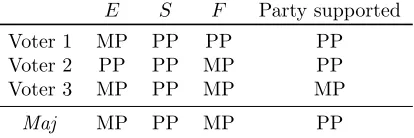
A less well-known paradox concerning the use of the majority rule on multiple issues is the Ostrogorski paradox (Ostrogorski, 1902).
E S F Party supported
Voter 1 MP PP PP PP
Voter 2 PP PP MP PP
Voter 3 MP PP MP MP
[image:7.612.193.400.109.178.2]Maj MP PP MP PP
Table 1: The Ostrogorski paradox.
the foreign policy F. Thus, the elected party (the PP) is in disagreement with a majority of the individuals on a majority of the issues.
3.3.1 The Ostrogorski Paradox in Binary Aggregation
In this section, we provide a binary aggregation setting that represents the Ostrogorski paradox as a failure of collective rationality with respect to a suitable integrity constraint.
Let {E, S, F} be the set of issues at stake, and let the set of issues IO = {E, S, F, A}
consist of the same issues plus an extra issue A to encode the support for the first party (MP). A binary ballot over these issues represents the individual view on the three issues
E,S andF: if, for instance,bE= 1, then the individual supports the first party MP on the
first issueE. Moreover, it also represents the overall support for party MP (in case issueAis accepted) or PP (in caseAis rejected). In the Ostrogorski paradox, an individual votes for a party if and only if she agrees with that party on a majority of the issues. This rule can be represented as a rationality assumption by means of the following integrity constraintICO:
pA↔[(pE∧pS)∨(pE∧pF)∨(pS∧pF)]
An instance of the Ostrogorski paradox can therefore be represented in the following profile:
E S F A
Voter 1 1 0 0 0 Voter 2 0 0 1 0 Voter 3 1 0 1 1
Maj 1 0 1 0
Each individual accepts issue A if and only if she accepts a majority of the other issues. However, the outcome of the majority rule is a rejection of issue A, even if a majority of the issues gets accepted by the same rule. Therefore, the triple (Maj,B,ICO) constitutes
a paradox by Definition 1.
3.4
The Paradox of Multiple Elections
Whilst the Ostrogorski paradox was devised to stage an attack against representative sys-tems of collective choice based on parties, the paradox of multiple elections (MEP) is based on the observation that when voting directly on multiple issues, a combination that was not supported nor liked by any of the voters can be the winner of the election (Brams et al., 1998; Lacy and Niou, 2000). While the original model takes into account the full prefer-ences of individuals over combinations of issues, if we focus on only those ballots that are submitted by the individuals, then an instance of the MEP can be represented as a paradox of collective rationality. Let us consider the following simple example:
A B C
Voter 1 1 0 1 Voter 2 0 1 1 Voter 3 1 1 0
Maj 1 1 1
The outcome of the majority rule is the acceptance of all three issues, even if this combination was not voted for by any of the individuals.
While there seems to be no integrity constraint directly causing this paradox, we may represent the profile in the example above as a situation in which the three individual ballots are bound by a constraint, e.g.,¬(pA∧pB∧pC). Even if each individual accepts at
most two issues, the result of the aggregation is the unfeasible acceptance of all three issues. As can be deduced from our previous discussion, every instance of the MEP gives rise to several instances of a binary aggregation paradox for Definition 1. To see this, it is sufficient to find an integrity constraint that is satisfied by all individuals and not by the outcome of the aggregation.2 On the other hand, every instance of Definition 1 in binary aggregation may represent an instance of the MEP, as the irrational outcome cannot have been voted for by any of the individuals.
3.5
The Common Structure of Paradoxical Integrity Constraints
We can now make a crucial observation concerning the syntactic structure of the integrity constraints that formalise the paradoxes we have presented so far.
First, for the case of the Condorcet paradox, we observe that the formula encoding the transitivity of a preference relation is the implication pab∧pbc → pac. This formula is
equivalent to¬pab∨ ¬pbc∨pac, which is a clause of size 3, i.e., it is a disjunction of three
different literals. Second, the formula which appears in the translation of the discursive dilemma is also equivalent to a clause of size 3, namely¬pα∨ ¬pβ∨ ¬p¬(α∧β). Third, the formula which formalises the majoritarian constraint underlying the Ostrogorski paradox, is equivalent to the following conjunction of clauses of size 3:
(pA∨ ¬pE∨ ¬pF)∧(pA∨ ¬pE∨ ¬pS)∧(pA∨ ¬pS∨ ¬pF)∧
∧(¬pA∨pE∨pF)∧(¬pA∨pE∨pS)∧(¬pA∨pS∨pF)
Finally, the formula which exemplifies the MEP is equivalent to a negative clause of size 3. Thus, we observe that the integrity constraints formalising the most classical paradoxes in aggregation theory all feature a clause of size at least 3.3
4
The Majority Rule: Characterisation of Paradoxes
In this section we generalise the observation made in the previous section, and we provide a full characterisation of the class of integrity constraints that are lifted by the majority rule as those formulas that can be expressed as a conjunction of clauses of maximal size 2.Under the majority rule, an issue is accepted if and only if a majority of the individuals accept it. Let NB
j be the set of individuals that accept issue j in profile B. In case the
number of individuals is odd, themajority rule(Maj) has a unique definition by accepting issue j if and only if |NB
j | > n+1
2 . The case of an even number of individuals is more problematic, to account for profiles in which exactly half of the individuals accept an issue
2Such a formula always exists: consider the disjunction of the formulas specifying the individual ballots. 3This observation is strongly related to a result proven by Nehring and Puppe (2007) in the framework
and exactly half reject it. We give two different definitions. The weak majority rule ( W-Maj) accepts an issue if and only if|NjB|> n
2, favouring acceptance. The strict majority
rule (S-Maj) accepts an issue if and only if|NB j |>
n+2
2 , favouring rejection.
4.1
Odd Number of Individuals: The Majority Rule
We begin with a base-line result that proves collective rationality of the majority rule in case the integrity constraint is equivalent to a conjunction of 2-clauses. Let2-clausesdenote the set of propositional formulas inLPS that are equivalent to a conjunction of clauses of
maximal size 2.4
Proposition 1. The majority rule is collectively rational with respect to 2-clauses.
Proof. Let us first consider the case of a single 2-clauseIC=`j∨`k, where`jand`k are two
literals, i.e., atoms or negated atoms. A paradoxical profile for the majority rule with respect to this integrity constraint features a first majority of individuals not satisfying literal`j,
and a second majority of individuals not satisfying literal `k. By the pigeonhole principle
these two majorities must have a non-empty intersection, i.e., there exists one individual that does not satisfy both literals`j and`k, but this is incompatible with the requirement
that all individual ballots satisfyIC. To conclude the proof, it is sufficient to observe that ifICis equivalent to a conjunction of two clauses, then all individuals satisfy each of these clauses, and by the previous discussion all these clauses will also be satisfied by the outcome of the majority rule.
An easy corollary of this proposition covers the case of just 2 issues:
Corollary 2. If |I|62, then the majority rule is collectively rational with respect to all integrity constraintsIC∈ LPS.
Proof. This follows immediately from Proposition 1 and from the observation that every formula built with two propositional symbols is equivalent to a conjunction of clauses of size at most 2 (e.g., its conjunctive normal form).
As we have remarked in Section 3.5, all classical paradoxes involving the majority rule can be formalised in our framework by means of an integrity constraint that consists of (or is equivalent to) one or more clauses with size bigger than two. We now generalise this observation to a theorem that completes the characterisation of the integrity constraints lifted by the majority rule. We need some preliminary definitions and a lemma.
Call aminimally falsifying partial assignment (mifap-assignment) for an integrity con-straint IC an assignment to some of the propositional variables that cannot be extended to a satisfying assignment, although each of its proper subsets can. We first prove a a cru-cial lemma about mifap-assignments. Given a propositional formulaϕ, associate with each mifap-assignmentρ forϕa conjunction Cρ =`1∧ · · · ∧`k, where `i =pi ifρ(pi) = 1 and
`i=¬pi ifρ(pi) = 0 for all propositional symbolspi on whichρis defined. The conjunction
Cρ represents the mifap-assignmentρand it is clearly inconsistent withϕ.
Lemma 3. Every non-tautological formulaϕis equivalent to(V
ρ¬Cρ)withρranging over all mifap-assignments ofϕ.5
Proof. LetAbe a total assignment forϕ. Suppose A6|=ϕ, i.e.,Ais a falsifying assignment forϕ. Sinceϕis not a tautology there exists at least one suchA. By sequentially deleting propositional symbols from the domain ofA we eventually find a mifap-assignmentρA for 4The set of2-clausescan be equivalently defined by closing the set of 2-CNF under logical equivalence. 5Formulas¬C
ϕ included in A. Hence, A falsifies the conjunct associated withρA, and thus the whole
formula (V
ρ¬Cρ). Assume nowA|=ϕbutA6|= (Vρ¬Cρ). Then there exists aρsuch that
A|=Cρ. This implies thatρ⊆A, asCρ is a conjunction. Sinceρis a mifap-assignment for
ϕ, i.e., it is a falsifying assignment forϕ, this contradicts the assumption thatA|=ϕ.
We are now able to provide a full characterisation of the set of integrity constraints that are lifted by the majority rule in case the set of individuals is odd. Recall from Section 2 that LF[F] is the set of integrity constraints that are lifted by F.
Theorem 4. LF[Maj] =2-clauses.6
Proof. One direction is entailed by Proposition 1: the majority rule is CR with respect to formulas in 2-clauses. For the opposite direction assume that IC 6∈ 2-clauses, i.e., IC is not equivalent to a conjunction of 2-clauses. We now build a paradoxical profile for the majority rule. By Lemma 3 we know thatICis equivalent to the conjunctionV
ρ¬Cρof all
mifap-assignmentsρfor IC. We can therefore infer that at least one mifap-assignmentρ∗
has size>2, for otherwiseICwould be equivalent to a conjunction of 2-clauses.
Consider the following profile. Let y1, y2, y3 be three propositional variables that are fixed by ρ∗. Let the first individual i1 accept the issue associated with y1 if ρ(y1) = 0, and reject it otherwise, i.e., let b1,1 = 1−ρ∗(y1). Furthermore, let i1 agree with ρ∗ on the remaining propositional variables. By minimality ofρ∗, this partial assignment can be extended to a satisfying assignment forIC, and letBi1 be such an assignment. Repeat the
same construction for individuali2, this time changing the value ofρ∗ ony2and extending it to a satisfying assignment to obtainBi2. The same construction fori3, changing the value
ofρ∗ on issue y3 and extending it to a satisfying assignment Bi3. Recall that there are at
least 3 individuals inN. If there are other individuals, let individualsi3s+1 have the same ballot Bi1, individuals i3s+2 ballot Bi2 and individualsi3s+3 ballot Bi3. The basic profile
for 3 issues and 3 individuals is shown in the following table:
y1 y2 y3
i1 1-ρ∗(y1) ρ∗(y2) ρ∗(y3)
i2 ρ∗(y1) 1-ρ∗(y2) ρ∗(y3)
i3 ρ∗(y1) ρ∗(y2) 1-ρ∗(y3)
Maj ρ∗(y1) ρ∗(y2) ρ∗(y3)
As can be seen in the previous table, and easily generalised to the case of more than 3 individuals, there is a majority supportingρ∗on every variable on whichρ∗is defined. Since
ρ∗is a mifap-assignment and therefore cannot be extended to an assignment satisfyingIC, the majority rule in this profile is not collectively rational with respect toIC.
4.2
Even Number of Individuals: Weak and Strict Majority
While a result analogous to Theorem 4 for the case of an even number of individuals cannot be proven, we provide the following result (proof is omitted for lack of space).
Proposition 5. W-Maj and S-Maj are CR with respect to 2-clauses in which one literal is negative and one is positive. W-Maj is CR with respect to positive 2-clauses, in which all literals occur positively. S-Maj is CR with respect to negative 2-clauses, in which all literals occur negatively.
6This result may be considered a “syntactic counterpart” of a result by Nehring and Puppe (2007) in the
5
Conclusions
The first conclusion that can be drawn from this paper dedicated to paradoxes of aggre-gation is that the majority rule is to be avoided when dealing with collective choices over multiple issues. This fact stands out as a counterpart to May’s Theorem (1952), which proves that the majority rule is the only aggregation rule for a single binary issue that satisfies a set of highly desirable conditions. The sequence of paradoxes we have analysed in this paper shows that this is not the case when multiple issues are involved. While this fact may not add anything substantially new to the existing literature, the wide variety of paradoxical situations encountered in this paper stresses even further the negative features of the majority rule on multi-issue domains.
A second conclusion is that most paradoxes of SCT share a common structure, and that this structure is formalised by our Definition 1, which stands out as a truly general definition of paradox in aggregation theory. Moreover, by analysing the integrity constraints that underlie some of the most classical paradoxes, we were able to identify a common syntactic feature of paradoxical constraints. Starting from this observation, we have provided a full characterisation of the integrity constraints that are lifted by the majority rule, as those formulas that are equivalent to a conjunction of clauses of size at most 2.
The paradoxical situations presented in this paper constitute a fragment of the problems that can be encountered in the formalisation of collective choice problems. For instance, paradoxical situations concerning voting procedures (Nurmi, 1999), which take as input a set of preferences and output a set of winning candidates, are not included in our analysis. Recent work on paradoxes of aggregation also pointed at similarities within different frameworks, e.g., comparing the Ostrogorski paradox with the discursive dilemma (Pigozzi, 2005), or proposing a geometric approach for the study of paradoxical situations (Eckert and Klamler, 2009). The MEP gives rise to a different problem than that of collective rationality, not being directly linked to an integrity constraint established in advance. The problem formalised by the MEP is rather the compatibility of the outcome of aggregation with the individual ballots. Individuals in such a situation may be forced to adhere to a collective choice which, despite it being rational, they do not perceive as representing their views (Grandi and Pigozzi, 2012). Some answers to the problem raised by the multiple election paradox have already been proposed in the literature on AI, by for instance devising a suitable sequence of local elections (Xia et al., 2011), or by approximating the collective outcome (Conitzer and Xia, 2012).
References
S. Airiau, U. Endriss, U. Grandi, D. Porello, and J. Uckelman. Aggregating dependency graphs into voting agendas in multi-issue elections. InProceedings of IJCAI-2011, 2011.
S. J. Brams, D. M. Kilgour, and W. S. Zwicker. The paradox of multiple elections. Social Choice and Welfare, 15(2):211–236, 1998.
Condorcet, Marie Jean Antoine Nicolas de Caritat, Marquis de.Essai sur l’application de l’analyse `
a la probabilit´e des d´ecisions rendues `a la pluralit´e des voix. Paris, 1785.
V. Conitzer and L. Xia. Paradoxes of multiple elections: An approximation approach. InProceedings of KR-2012, 2012.
E. Dokow and R. Holzman. Aggregation of binary evaluations. Journal of Economic Theory, 145 (2):495–511, 2010.
D. Eckert and C. Klamler. A geometric approach to paradoxes of majority voting in abstract aggregation theory. InProceedings of ADT-2009, 2009.
W. Gaertner. A Primer in Social Choice Theory. Oxford University Press, 2006.
U. Grandi and U. Endriss. Binary aggregation with integrity constraints. InProceedings IJCAI-2011, 2011.
U. Grandi and G. Pigozzi. On compatible multi-issue group decisions. InProceedings of LOFT-2012, 2012.
L. A. Kornhauser and L. G. Sager. Unpacking the court. Yale Law Journal, 96(1):82–117, 1986. D. Lacy and E. M. S. Niou. A problem with referendums. Journal of Theoretical Politics, 12(1):
5–31, 2000.
J. Lang. Vote and aggregation in combinatorial domains with structured preferences. InProceedings of IJCAI-2007, 2007.
J. Lang and L. Xia. Sequential composition of voting rules in multi-issue domains. Mathematical Social Sciences, 57:304–324, 2009.
C. List and P. Pettit. Aggregating sets of judgments: An impossibility result. Economics and Philosophy, 18(1):89–110, 2002.
C. List and C. Puppe. Judgment aggregation: A survey. InHandbook of Rational and Social Choice. Oxford University Press, 2009.
K. O. May. A set of independent necessary and sufficient conditions for simple majority decision. Econometrica, 20(4):680–684, 1952.
K. Nehring and C. Puppe. The structure of strategy-proof social choice. Pt. I: General characteri-zation and possibility results on median spaces. J. Economic Theory, 135(1):269–305, 2007. H. Nurmi. Voting paradoxes and how to deal with them. Springer, 1999.
M. Ostrogorski. La d´emocratie et l’organisation de partis politiques. Calmann-Levy, Paris, 1902. G. Pigozzi. Two aggregation paradoxes in social decision making: the Ostrogorski paradox and the
discursive dilemma. Episteme: A Journal of Social Epistemology, 2(2):33–42, 2005. R. B. Wilson. On the theory of aggregation.Journal of Economic Theory, 10(1):89–99, 1975. L. Xia, V. Conitzer, and J. Lang. Strategic sequential voting in multi-issue domains and
multiple-election paradoxes. InProceedings of ACM-2011, 2011.
Umberto Grandi
Institute for Logic, Language and Computation University of Amsterdam