RELEASE BILAYER TABLETS OF CARVEDILOL”
A dissertation submitted to
THE TAMILNADU Dr. M.G.R.MEDICAL UNIVERSITY, CHENNAI. In partial fulfillment of the requirements for the award of degree of
MASTER OF PHARMACY
IN
PHARMACEUTICS
BYREG. NO: 26091388
Under the guidance of
Mrs. S. Allimalarkodi M. Pharm., M.Sc. Bioinformatics
Assistant Professor
Department of Pharmaceutics
OCTOBER-2011
Mrs. S. Allimalarkodi, M. Pharm., M.Sc. Bioinformatics
Asst.Professor,
Department of Pharmaceutics,
The Erode College of Pharmacy & Research Institute
Erode – 638112.
CERTIFICATE
This is to certify that the investigation in this thesis entitled “Development
and Evaluation of Sustained Release Bilayer Tablets of Carvedilol submitted to
the Tamil Nadu Dr. M.G.R Medical University, Chennai, for the partial fulfillment
of the award of Degree of Master of pharmacy in Pharmaceutics, was carried out
by Regd. No. 26091388 in the Department of Pharmaceutics. The Erode College
of Pharmacy and Research Institute, Erode 638112, under my guidance and
supervision.
This work is original and has not been submitted in part or full to any other
degree or diploma of this or any other university.
Dr.V. Ganesan, M. Pharm., Ph.D., Professor and HOD of Pharmaceutics,
The Erode College of Pharmacy and Research Institute,
Erode- 638112.
CERTIFICATE
This is to certify that the investigation described in this thesis entitled
“Development and Evaluation of Sustained Release Bilayer Tablets of
Carvedilol”, submitted to the Tamil Nadu Dr. M.G.R Medical University, Chennai
for the partial fulfillment of the award of Degree of Master of Pharmacy in
Pharmaceutics was carried by Reg. No. 26091388 in Department of
Pharmaceutics, under the guidance of Mrs. S. Allimalarkodi, M. Pharm., M.Sc.
Bioinformatics., The Erode College of Pharmacy and Research Institute, Erode
638112.
This work is original and has not been submitted in part or full to any other
degree or diploma of this or any other university.
This is to certify that the investigation in this thesis entitled “Development
and Evaluation of Sustained Release Bilayer Tablets of Carvedilol”, submitted
in partial fulfillment for the award of degree of Master of Pharmacy in
Pharmaceutics, were carried out in the laboratories of The Erode College of
Pharmacy & Research Institute, Erode, by Reg., No., 26091388 under the guidance
of Mrs. S. Allimalarkodi,M. Pharm., M.Sc Bioinformatics., Asst. Professor in
the Department of Pharmaceutics. The Erode College of Pharmacy and Research
Institute, Erode 638112.
Place: Erode
The research work embodied in this dissertation work entitled
“Development and Evaluation of Sustained Release Bilayer Tablets of
Carvedilol” was carried out by me in Department of Pharmaceutics,The Erode
College of Pharmacy & Research Institute, Erode, under the direct supervision
of Mrs. S.Allimalarkodi, M. Pharm., M.Sc. Bioinformatics., Asst. Professor
Department of Pharmaceutics, The Erode College of Pharmacy & Research
Institute, Erode – 638112.
This dissertation submitted to The Tamil Nadu Dr. M. G. R. Medical
University, Chennai, as a partial fulfillment for the award of degree of Master of
Pharmacy in Pharmaceutics during the academic year 2010 – 2011.
The work is original and has not been submitted in part or full for the award
for any other Degree or Diploma of this or any other University.
Place: Erode.
Date: Reg., No. 26091388
The joyness, satisfaction and euphoria that come along with successful
completion of any work would be incomplete unless we mention the names of the
people who made it possible, whose constant guidance and encouragement served
as a beam of light and crowned out the efforts.
First of all, it is by the love and blessings of God (my parents) that I am
able to complete my investigation studies successfully and I present this piece of
work which I am eternally indebted.
I owe a debt of gratitude to my Research Guide Mrs. S.Allimalarkodi, M.Pharm., MS.c Bioinformatics., Asst.Professor Department of Pharmaceutics, The Erode College of Pharmacy and Research Institute,
Erodefor spending her valuable time for giving me knowledge and guiding me in successful completion of my research work..
I now take this opportunity to express sincere thanks to our
Principal, HOD, Department of Phamaceutics, Dr. V.GANESAN, M.Pharm, Ph.D., for valuable guidance and constant encouragement throughout the project work.
I also thankful to our Department Staff Mr. S.P.Senthil M.Pharm., (Ph.D)., Mr.T.Ethiraj M.Pharm., Mrs.T.Sudhamani M. Pharm.,
I am also thankful to, Dr. V.S.Saravanan, M. Pharm., Ph.D., Professor
&HOD,Department of Pharmaceutical Analysis, Mr.T.M.Kulanthaivel,M.Pharm., Assistant Professor, and Mr. Ravi Kumar, M. Pharm., for helping me in guiding throughout the
research work. I am also thankful to, Mr. A. Nataraajan, B.A., HDC, Secretary and Correspondent. The Erode College of pharmacy and
Research Institute.
I am greatly indebted to All DEPARTMENT FACULTIES of The Erode College of Pharmacy and Research Institute, Erode, for their
scholarly guidance, precious advice, direct supervision and constant
Librarian Mr Varadarajan, B.A., M.L.I.S & all office staffs and non-techning staffs for providing timely assistance throughout the entire work.
With no words I can hearties and deep gratitude to my dear friends
Mr.Thanga Ezhil Kumaran, Mr.V.Venkadesh, Mr.T.Raghupathi Mr.C.Ranjith kumar, Mr.T.Balan, Mr.T.Jeeva, Mr.V.Gangadhar, Mr.P.Guru who always believed in me and stood with me in good and bad times, special thanks to them for their friendship adherent love
affection, encouragement they always showered on me. I take this
opportunity to thank all my dearest friends.
The completion of this dissertation is not only fulfillment of my
dreams but also the dreams of my PARENTS, Mrs. M. Sakkeena, Mr. H. Mohammed Liyakath Ali, SISTERS Mrs. M. Fathila Nisrin M. Phil., Ms. M. Syed Ali Fathima B.E., relatives and friends who have taken a lot of pain for me in completion of higher studies.
My Sincere thanks to SPY PRINTERS where my work has taken a
life in the form of a book.
A word of thanks to all those gentle people associate with this
work directly or indirectly whose names have been to unable to mention
here.
ERODE – 638112.
INDEX
Chapter No CHAPTER NAME Page No
1
Introduction
1
2
Literature Review
25
3
Drug Profile
31
4
Polymer Profile
34
5
Aim & Plan of Work
40
6
Methodology
42
7
Results
58
8
Discussion
90
9
Summary & Conclusion
93
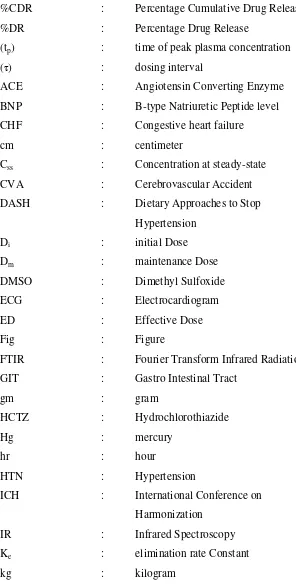
%CDR : Percentage Cumulative Drug Release
%DR : Percentage Drug Release
(tp) : time of peak plasma concentration
(τ) : dosing interval
ACE : Angiotensin Converting Enzyme
BNP : B-type Natriuretic Peptide level
CHF : Congestive heart failure
cm : centimeter
Css : Concentration at steady-state
CVA : Cerebrovascular Accident
DASH : Dietary Approaches to Stop
Hypertension
Di : initial Dose
Dm : maintenance Dose
DMSO : Dimethyl Sulfoxide
ECG : Electrocardiogram
ED : Effective Dose
Fig : Figure
FTIR : Fourier Transform Infrared Radiation
GIT : Gastro Intestinal Tract
gm : gram
HCTZ : Hydrochlorothiazide
Hg : mercury
hr : hour
HTN : Hypertension
ICH : International Conference on
Harmonization
IR : Infrared Spectroscopy
Ke : elimination rate Constant
[image:9.612.195.491.123.709.2]Ks : desired release rate
LD : Lethal Dose
MDDS : Modified Drug Release
MEC : Minimum Effective Concentration
mg : milligram
mg/ml : milligram/millilitre
mins : minutes
ml : millilitre
mm : millimeter
mmHg : millimeter mercury
nm : nanometer
no : number
NSAID : Non Steroidal Anti Inflammatory
Drug
PVP : Polyvinyl Pyrrolidone
R2 : Regression coefficient
rpm : rotations per minute
sec : second
SR : Sustained Release
SRDDS : Sustained Release Drug Delivery
system
t1/2 : elimination Half life
TPR : Total Peripheral Resistance
USP : United States of Pharmacopoeia
UV : UltraViolet
W/V : Weight/Volume
W/W : Weight/Weight
S.No TITLE Page No
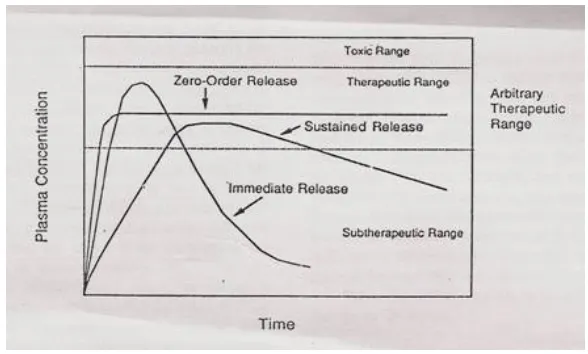
1 Drug level verses time profile showing differences between
zero order, controlled release, slow first order sustained release
and release from conventional tablet.
2
2 Shows the external appearance of the bilayer tablets of
formulation F3 containing HPMC 4000.
58
3 Standard curve of Carvedilol in acid buffer (pH 1.2) 59
4 Standard curve of Carvedilol in phosphate buffer (pH 6.8) 60
5 Graph 3: Shows zero order kinetics of F1, F4, F7 82
6 Graph 4: Shows zero order kinetics of F2, F5, F8 83
7 Graph 5: Shows zero order kinetics of F3, F6, F9 83
8 Graph 6: Shows first order kinetics of F1, F4, F7 84
9 Graph 7: Shows first order kinetics of F2, F5, F8 84
10 Graph 8: Shows first order kinetics of F3, F6, F9 85
11 Graph 9: Shows Higuchi model of F1, F4, F7 85
12 Graph 10: Shows Higuchi model of F2, F5, F8 86
13 Graph 11: Shows Higuchi model of F3, F6, F9 86
14 Graph 12: Shows Peppa’s model of F1, F4, F7 87
15 Graph 13: Shows Peppa’s model of F2, F5, F8 87
Table
No TITLE
Page No
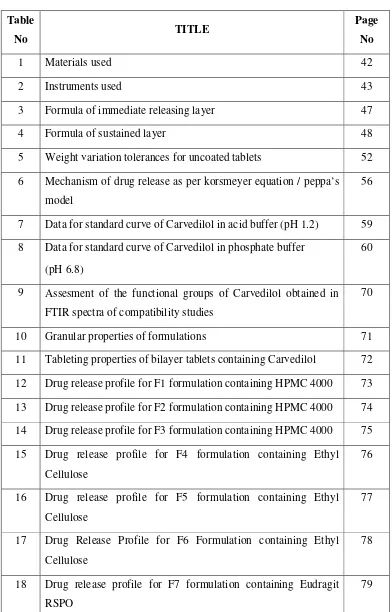
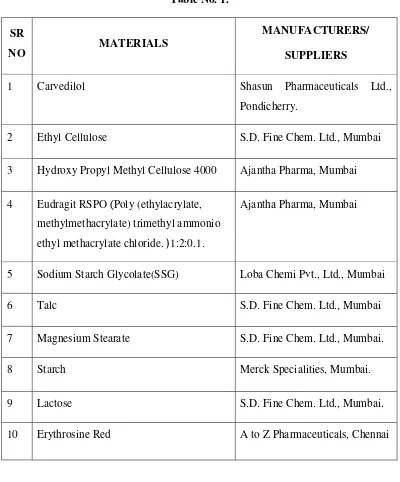
1 Materials used 42
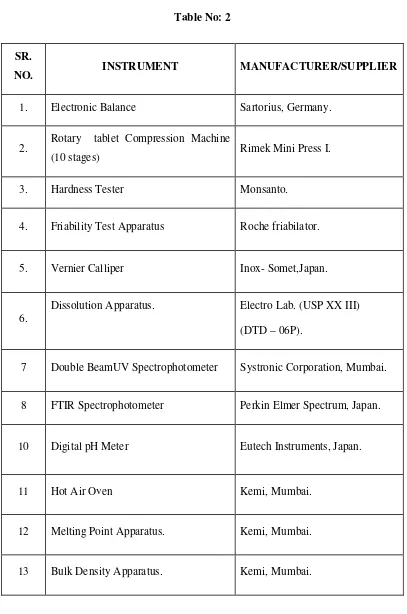
2 Instruments used 43
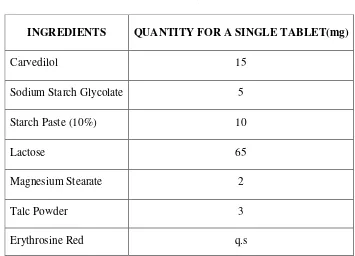
3 Formula of immediate releasing layer 47
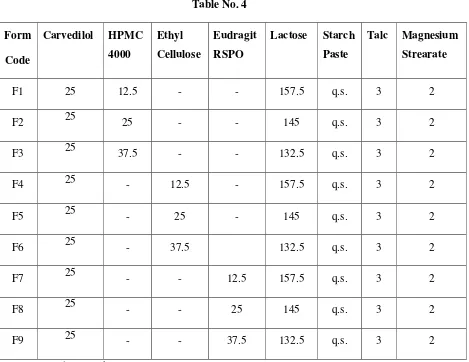
4 Formula of sustained layer 48
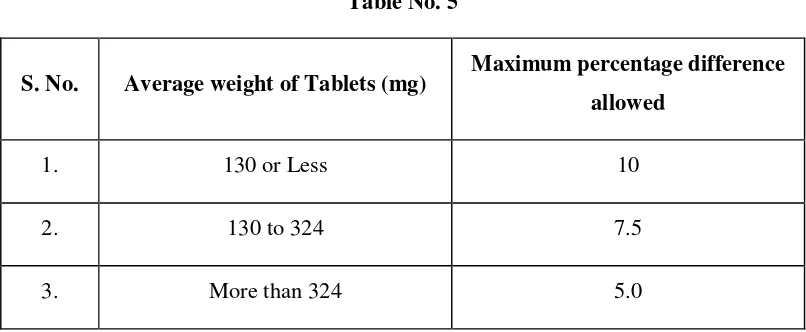
5 Weight variation tolerances for uncoated tablets 52
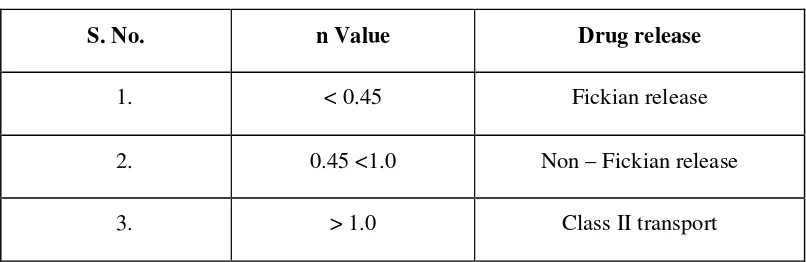
6 Mechanism of drug release as per korsmeyer equation / peppa’s
model
56
7 Data for standard curve of Carvedilol in acid buffer (pH 1.2) 59
8 Data for standard curve of Carvedilol in phosphate buffer
(pH 6.8)
60
9 Assesment of the functional groups of Carvedilol obtained in
FTIR spectra of compatibility studies
70
10 Granular properties of formulations 71
11 Tableting properties of bilayer tablets containing Carvedilol 72
12 Drug release profile for F1 formulation containing HPMC 4000 73
13 Drug release profile for F2 formulation containing HPMC 4000 74
14 Drug release profile for F3 formulation containing HPMC 4000 75
15 Drug release profile for F4 formulation containing Ethyl
Cellulose
76
16 Drug release profile for F5 formulation containing Ethyl
Cellulose
77
17 Drug Release Profile for F6 Formulation containing Ethyl
Cellulose
78
18 Drug release profile for F7 formulation containing Eudragit
RSPO
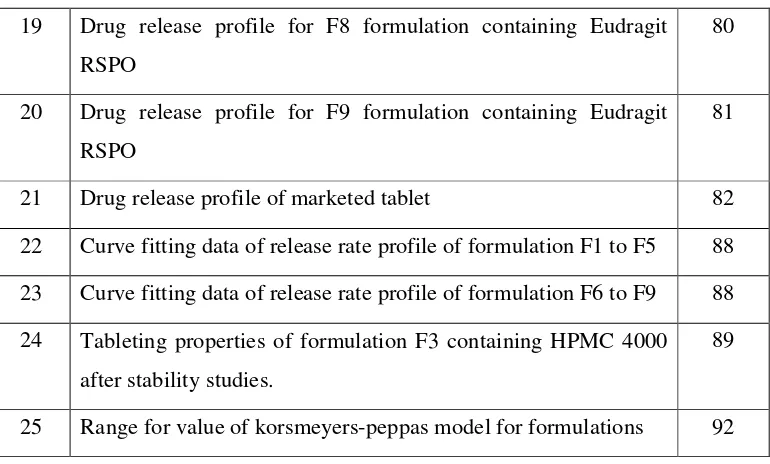
[image:12.612.121.513.92.704.2]RSPO
20 Drug release profile for F9 formulation containing Eudragit
RSPO
81
21 Drug release profile of marketed tablet 82
22 Curve fitting data of release rate profile of formulation F1 to F5 88
23 Curve fitting data of release rate profile of formulation F6 to F9 88
24 Tableting properties of formulation F3 containing HPMC 4000
after stability studies.
89
[image:13.612.126.511.76.308.2]S.No
Particulars
Page No1 FTIR spectra of carvedilol 61
2 FTIR spectra of HPMC 4000 62
3 FTIR spectra of Ethyl Cellulose 63
4 FTIR spectra of Eudragit RSPO 64
5 FTIR spectra of Sodium Starch
Glycolate
65
6 FTIR spectra of carvedilol+ HPMC
4000
66
7 FTIR spectra of carvedilol+ Ethyl
Cellulose
67
8 FTIR spectra of carvedilol+ Eudragit
RSPO
68
9 FTIR spectra of carvedilol+ Sodium
Starch Glycolate
Dept. of Pharmaceutics, The Erode College of Pharmacy and Research Institute. Page 1
1. INTRODUCTION
Drug delivery is the method of process of administering a pharmaceutical
compound to achieve a therapeutic effect in humans or animals. Drug delivery
technologies modify drug release profile, absorption, distribution and elimination for
the benefit of improving product efficacy and safety, as well as patient covinenience
and compliance. Drug release is from diffusion, degradation, swelling and affinity
based mechanisms. Most common routes of administration include the preffered non-
invasive peroral (through the mouth), topical (skin), transmucosal (nasal, buccal/
sublingual, vaginal, ocular and rectal) and inhalation routes. Many medications such
as peptides and proteins, antibodies, vaccines and gene based drugs, in general may
not be delivered using these routes because they might be susceptible to enzymatic
degradation or cannot be absorbed in to the systemic circulation efficiently due to
molecular size and charge issues to be therapeutically effective. For this reason many
protein and peptide drugs have to be delivered by injection or a nanoneedle array.
Current efforts in the area of drug delivery include the development of targeted
delivery in which the drug is only active in the target area of the body and sustained
release formulations in which the drug is released over a period of time in a controlled
manner from a formulation.
1.1 SUSTAINED RELEASE DOSAGE FORM: 1, 2
Sustained release dosage forms are designed to achieve a prolonged
therapeutic effect by continuously releasing medication over extended period of after
administration of a single dose. In case of injectable dosage forms, this period may
vary from days to months. In the case of orally administrator forms, however this
period is measured in hours and critically depends on residence time of the dosage
formsin the gastro intestinal tract. The term “controlled release” has become
associated with those systems from which therapeutic agents may be automatically
delivered at pre defined rates over a long period of time. Products of this type have
been formulated for oral, injectable and topical use and include inserts for placement
in the body cavities as well.
Dept. of Pharmaceutics, The Erode College of Pharmacy and Research Institute. Page 2 Fig no 1: Drug level verses time profile showing differences between zero order, controlled release, slow first order sustained release and release from conventional tablet.
In general, the main aim of sustained release dosage form is to maintain the
therapeutic blood level or tissue level of the drug for an extended period of time. This
is usually accomplished by attempting to obtain zero order release from the dosage
form. Zero order release constitutes of the amount of drug in the delivery system (i.e.;
a constant release rate). Sustained release systems generally don’t attain this type of
release and usually try to – zero order release by providing drug in a slow first order
fashion (i.e.; concentration dependent).
1.1.1. Rationale of sustained drug delivery: 3, 4
The basic rationale for controlled drug delivery is to alter the pharmacokinetic
and pharmacodynamics of pharmacologically active moieties by using novel drug
delivery systems or by modifying the molecular structure and/or physiological
parameters inherent in selected route of administration. It is desirable that the duration
of drug action become more to design properly. Rate controlled dosage form, and less,
Dept. of Pharmaceutics, The Erode College of Pharmacy and Research Institute. Page 3 As mentioned earlier, primary objectives of controlled drug delivery are to ensure
safety and to improve efficiency of drugs as well as patient compliance. This is
achieved by better control of plasma drug levels and frequent dosing. For
conventional dosage forms, only the dose (D) and dosing interval can vary and, for
each drug, there exist a therapeutic window of plasma concentration, below which
therapeutic effect is in sufficient, and above which toxic side effect are elicited. This is
often defined as the ratio of median lethal dose (LD50) to median effective dose
(ED50)
1.1.2. Modified – release delivery systems:
a. Delayed – release:
It is used repetitive, intermitting dosing of a drug from one or more immediate release units incorporated into single dosage form.
b. Sustained release:
It includes any drug delivery systems that achieve slow release of drug
over an extended period of time. If the systems can provide some control, whether this
be of a temporal or spatial nature, or both of drug release in the body.
c. Site specific targeting:
It refer to targeting of a drug directly to a certain biological location. In case site specific release, the target is adjacent or in the diseased organ or tissue.
d. Receptor targeting:
The target is the particular receptor for a drug within an organ or tissue.
Advantages of sustained drug delivery:
1. Avoid patient compliance problem.
a) Employ less amount drug
b) Minimize or eliminates local and systemic side effects.
c) Obtain less protestations or deduction in drug activity with chronic use.
Dept. of Pharmaceutics, The Erode College of Pharmacy and Research Institute. Page 4 2. Improve efficacy in treatment.
a) Cure or controlled condition more promptly.
b) Improve control of condition i.e.; reduce fluctuation in drug level.
c) Improve bioavailability of some drugs.
d) Make use of special effects.
3. Economy.
Disadvantages of sustained release dosage forms:
a) Unpredictable and often poor in-vitro in vivo correlations, dose dumping,
reduced potential for dosage adjustment and increased potential first pass
clearance.
b) They are more costly.
c) Poor systemic availability in general.
d) Effective drug release time period is influenced and limited by GI residence
time.
e) Need additional patient education.
f) Dugs having very short half.
1.1.3.Classification of oral sustained/controlled release systems: 5, 6 A. Continous release systems
1. Dissolution controlled release systems
a) Matrix type b) Reservoir type
2. Diffusion controlled release systems
a) Matrix type b) Reservoir type
3. Dissolution and diffusion controlled release systems
4. Ion exchange resins drug complexes
5. Slow dissolving salts and complexes
Dept. of Pharmaceutics, The Erode College of Pharmacy and Research Institute. Page 5 7. Osmotic pressure controlled systems
8.Hydrodynamic pressure controlled systems
B. Delayed transit and continuous release systems
1. Altered density systems
I. High density
II. Low density
III. Floating
2. Mucoadhesive systems
3. Size based systems
C. Delayed released systems
1. Intestinal release systems
2. Colonic release systems
1.1.4. Factors Affecting Sustained Release Dosage Forms: 7, 8
Factors governing the design of sustained /controlled release dosage forms.
A. Drug related factors
1. Aqueous solubility
2. Partition coefficient
3. Molecular size
4. Drug stability
5. Protein binding
B. Biological factors
1. Absorption
2. Distribution
3. Elimination
Dept. of Pharmaceutics, The Erode College of Pharmacy and Research Institute. Page 6 5. Margin of safety
6. Side effects
7. Disease state
1.2. METHODS:9,10
Granulation is the act or process of forming or crystallizing into grains. Granules typically have a size range between 0.2 to 4.0 mm depending on their
subsequent use.
Synonym "Agglomeration": Agglomeration processes or in a more general
term particle size enlargement technologies are great tools to modify product
properties. Agglomeration of powders is widely used to improve physical properties
like: wettability, flowability, bulk density and product appearance.
Granulation is carried out for various reasons, one of those is to prevent the
segregation of the constituents of powder mix. Segregation is due to differences in the
size or density of the component of the mix. Normally, the smaller and/or denser
particles tend to concentrate at the base of the container with the larger and/or less
dense ones on the top. An ideal granulation will contain all the constituents of the mix
in the correct proportion in each granule and segregation of granules will not occur.
Many powders, because of their small size, irregular shape or surface
characteristics, are cohesive and do not flow well. Granules produced from such a
cohesive system will be larger and more isodiametric, both factors contributing to
improved flow properties.
Some powders are difficult to compact even if a readily compactable adhesive is
included in the mix, but granules of the same powders are often more easily
compacted. This is associated with the distribution of the adhesive within the granule
and is a function of the method employed to produce the granule.
For example, if one were to make tablets from granulated sugar versus
powdered sugar, powdered sugar would be difficult to compress into a tablet and
Dept. of Pharmaceutics, The Erode College of Pharmacy and Research Institute. Page 7 poor flow and compression characteristics.These small particles would have to be
compressed very slowly for a long period of time to make a worthwhile tablet. Unless
the powdered sugar is granulated, it could not efficiently be made into a tablet that has
good tablet characteristics such as uniform content or consistent hardness.
1.2.1. Granulation techniques
In pharmaceutical industry, two types of granulation technologies are employed,
namely, Wet Granulation and Dry Granulation.
Wet Granulation
Wet granulation, the process of adding a liquid solution to powders, is one of
the most common ways to granulate. It involves the massing of a mix of dry primary
powder particles using a granulating fluid. The fluid contains a solvent which must be
volatile so that it can be removed by drying, and be non-toxic. Typical liquids include
water, ethanol and isopropanol either alone or in combination. The liquid solution can
be either aqueous based or solvent based. Aqueous solutions have the advantage of
being safer to deal with than solvents.
Water mixed into the powders can form bonds between powder particles that are
strong enough to lock them together. However, once the water dries, the powders may
fall apart. Therefore, water may not be strong enough to create and hold a bond. In
such instances, a liquid solution that includes a binder (pharmaceutical glue) is
required. Povidone, which is a polyvinyl pyrrolidone (PVP), is one of the most
commonly used pharmaceutical binders. PVP is dissolved in water or solvent and
added to the process. When PVP and a solvent/water are mixed with powders, PVP
forms a bond with the powders during the process, and the solvent/water evaporates
(dries). Once the solvent/water has been dried and the powders have formed a more
densely held mass, then the granulation is milled. This process results in the formation
of granules.
The process can be very simple or very complex depending on the
Dept. of Pharmaceutics, The Erode College of Pharmacy and Research Institute. Page 8 that is available. In the traditional wet granulation method the wet mass is forced
through a sieve to produce wet granules which is subsequently dried.
1.3. TABLETS:11,12
Solid medicaments may be administered orally in the form of powders, pills,
cachets, capsules or tablet. These dosage forms contain a quantity of drug which is
given as a single unit and they are known collectively as solid unit dosage forms, even
in the case of sustained action preparations which, technically, contain the equivalent
of several normal doses of drug.
1.3.1. General properties of Tablet dosage forms:
1. A tablet should have elegant product identity while free of defects like chips,
cracks, discoloration, and contamination.
2. Should have sufficient strength to withstand mechanical shock during its
production packaging, shipping and dispensing.
3. Should have the chemical and physical stability to maintain its physical
attributes over time
4. The tablet must be able to release the medicinal agents in a predictable and
reproducible manner.
5. Must have a chemical stability over time so as not to follow alteration of the
medicinal agents.
1.3.2. BILAYER SUSTAINED RELEASE TABLETS: 13, 14
Pharmaceutical products designed for oral delivery are mainly conventional
drug delivery systems, which are designed for immediate release of drug for rapid
absorption. These immediate release dosage forms have some limitations such as:
1. Drugs with short half-life require frequent administration, which increases the
chances of missing dose of drug leading to poor patient compliance.
2. A typical peak-valley plasma concentration-time profile is obtained which
Dept. of Pharmaceutics, The Erode College of Pharmacy and Research Institute. Page 9 3. The unavoidable fluctuations in the drug concentration may lead to under
medication or overmedication as the CSS values fall or rise beyond the therapeutic range.
4. The fluctuating drug levels may lead to precipitation of adverse effects
especially of a drug with small therapeutic index, whenever overmedication
occurs.
In order to overcome the drawbacks of conventional drug delivery systems,
several technical advancements have led to the development of controlled and
sustained drug delivery system. However despite of many advantages offered by oral
sustained release dosage forms they have few disadvantages and Lag time is one of them. In order to achieve sustained therapeutic action oral SRDDS will release the
drug at a slow rate and thus during the initial stages of medication, the plasma drug
concentration generally stays below the minimum effective concentration and as a
result the patient does not get any therapeutic benefit.
Bilayer SR tablets are a solution to above problem. These preparations provide
an immediate dose required for the normal therapeutic response, followed by the
gradual release of drug in amounts sufficient to maintain the therapeutic response for a
specific period of time. The major advantage of this category is that, in addition to the
convenience of reduced frequency administration, it provides levels that are devoid of
the peak and valley effect. Bilayer tablets are novel drug delivery systems where
combinations of two or more drugs in a single unit having different release profiles
which improves patient compliance, prolong the drug action, avoid saw tooth kinetics
resulting in effective therapy along with better control of plasma drug levels.
Two layer tablets may be designed for sustained release-one for the immediate
release of the drug and second layer for extended release thus maintaining prolonged
blood level. Layers may be colour differently to identify the product the weight of
each layer can be accurately controlled in contrast to putting one drug of a
Dept. of Pharmaceutics, The Erode College of Pharmacy and Research Institute. Page 10 1.4. DISEASE PROFILE:15
1.4.1. REVIEW OF CONGESTIVE HEART FAILURE:
Congestive heart failure facts
• Congestive heart failure (CHF) is a condition in which the heart's function as a
pump is inadequate to meet the body's needs.
• Many disease processes can impair the pumping efficiency of the heart to
cause congestive heart failure.
• The symptoms of congestive heart failure vary, but can include fatigue,
diminished exercise capacity, shortness of breath, and swelling.
• The diagnosis of congestive heart failure is based on knowledge of the
individual's medical history, a careful physical examination, and selected
laboratory tests.
• The treatment of congestive heart failure can include lifestyle modifications,
addressing potentially reversible factors, medications, heart transplant, and
mechanical therapies.
• The course of congestive heart failure in any given patient is extremely
variable.
Congestive heart failure
Congestive heart failure (CHF) is a condition in which the heart's function as a
pump is inadequate to deliver oxygen rich blood to the body. Congestive heart failure
can be caused by:
1. diseases that weaken the heart muscle,
2. diseases that cause stiffening of the heart muscles, or
3. diseases that increase oxygen demand by the body tissue beyond the
capability of the heart to deliver adequate oxygen-rich blood.
The heart has two atria (right atrium and left atrium) that make up the upper
chambers of the heart, and two ventricles (left ventricle and right ventricle) that make
Dept. of Pharmaceutics, The Erode College of Pharmacy and Research Institute. Page 11 blood when the muscles contract. The contraction of the ventricle muscles is called
systole.
Many diseases can impair the pumping action of the ventricles. For example, the
muscles of the ventricles can be weakened by heart attacks, infections (myocarditis) or
toxins (alcohol, some chemotherapy agents). The diminished pumping ability of the
ventricles due to muscle weakening is called systolic dysfunction. After each
ventricular contraction (systole) the ventricle muscles need to relax to allow blood
from the atria to fill the ventricles. This relaxation of the ventricles is called diastole.
Diseases such as hemochromatosis (iron overload) or amyloidosis can cause
stiffening of the heart muscle and impair the ventricles' capacity to relax and fill; this
is referred to as diastolic dysfunction. The most common cause of this is longstanding
high blood pressure resulting in a thickened (hypertrophied) heart. Additionally, in
some patients, although the pumping action and filling capacity of the heart may be
normal, abnormally high oxygen demand by the body's tissues (for example, with
hyperthyroidism or anemia) may make it difficult for the heart to supply an adequate
blood flow (called high output heart failure).
In some individuals one or more of these factors can be present to cause
congestive heart failure. The remainder of this article will focus primarily on
congestive heart failure that is due to heart muscle weakness, systolic dysfunction.
Congestive heart failure can affect many organs of the body. For example:
• The weakened heart muscles may not be able to supply enough
blood to the kidneys, which then begin to lose their normal ability
to excrete salt (sodium) and water. This diminished kidney function
can cause the body to retain more fluid.
• The lungs may become congested with fluid (pulmonary edema)
and the person's ability to exercise is decreased.
• Fluid may likewise accumulate in the liver, thereby impairing its
Dept. of Pharmaceutics, The Erode College of Pharmacy and Research Institute. Page 12 • The intestines may become less efficient in absorbing nutrients and
medicines.
• Fluid also may accumulate in the extremities, resulting in edema
(swelling) of the ankles and feet.
Eventually, untreated, worsening congestive heart failure will affect virtually every
organ in the body.
Causes of congestive heart failure
Many disease processes can impair the pumping efficiency of the heart to cause
congestive heart failure. In the United States, the most common causes of congestive
heart failure are:
• coronary artery disease
• high blood pressure (hypertension)
• longstanding alcohol abuse
• disorders of the heart valves
unknown (idiopathic) causes, such as after recovery from myocarditis
Less common causes include viral infections of the stiffening of the heart
muscle, thyroid disorders, disorders of the heart rhythm, and many others.
It should also be noted that in patients with underlying heart disease, taking
certain medications can lead to the development or worsening of congestive heart
failure. This is especially true for those drugs that can cause sodium retention or affect
the power of the heart muscle. Examples of such medications are the commonly used
nonsteroidal anti-inflammatory drugs (NSAIDs), which include ibuprofen (Motrin and
others) and naproxen (Aleve and others) as well as certain steroids, some medication
for diabetes (such as rosiglitazone [Avandia] or pioglitazone [Actos]), and some
Dept. of Pharmaceutics, The Erode College of Pharmacy and Research Institute. Page 13 Symptoms of congestive heart failure
The symptoms of congestive heart failure vary among individuals according to the
particular organ systems involved and depending on the degree to which the rest of the
body has "compensated" for the heart muscle weakness.
An early symptom of congestive heart failure is fatigue. While fatigue is a
sensitive indicator of possible underlying congestive heart failure, it is
obviously a nonspecific symptom that may be caused by many other
conditions. The person's ability to exercise may also diminish. Patients may
not even sense this decrease and they may subconsciously reduce their
activities to accommodate this limitation.
As the body becomes overloaded with fluid from congestive heart failure,
swelling (edema) of the ankles and legs or abdomen may be noticed. This can
be referred to as "right sided heart failure" as failure of the right sided heart
chambers to pump venous blood to the lungs to acquire oxygen results in
buildup of this fluid in gravity-dependent areas such as in the legs. The most
common cause of this is longstanding failure of the left heart, which may lead
to secondary failure of the right heart. Right-sided heart failure can also be
caused by severe lung disease (referred to as "cor pulmonale"), or by intrinsic
disease of the right heart muscle (less common)
In addition, fluid may accumulate in the lungs, thereby causing shortness of
breath, particularly during exercise and when lying flat. In some instances,
patients are awakened at night, gasping for air.
Some may be unable to sleep unless sitting upright.
The extra fluid in the body may cause increased urination, particularly at night.
Accumulation of fluid in the liver and intestines may cause nausea, abdominal
Dept. of Pharmaceutics, The Erode College of Pharmacy and Research Institute. Page 14 Congestive heart failure diagnosed
The diagnosis of congestive heart failure is most often a clinical one that is
based on knowledge of the patient's pertinent medical history, a careful physical
examination, and selected laboratory tests.
A thorough patient history may disclose the presence of one or more of the
symptoms of congestive heart failure described above. In addition, a history of
significant coronary artery disease, prior heart attack, hypertension, diabetes, or
significant alcohol use can be clues.
The physical examination is focused on detecting the presence of extra fluid in the
body (breath sounds, leg swelling, or neck veins) as well as carefully characterizing
the condition of the heart (pulse, heart size, heart sounds, and murmurs).
Useful diagnostic tests include the electrocardiogram (ECG) and chest X-ray
to detect previous heart attacks, arrhythmia, heart enlargement, and fluid in and
around the lungs. Perhaps the single most useful diagnostic test is the echocardiogram,
in which ultrasound is used to image the heart muscle, valve structures, and blood
flow patterns. The echocardiogram is very helpful in diagnosing heart muscle
weakness. In addition, the test can suggest possible causes for the heart muscle
weakness (for example, prior heart attack, and severe valve abnormalities). Virtually
all patients in whom the diagnosis of congestive heart failure is suspected should
ideally undergo echocardiography early in their assessment.
Nuclear medicine studies assess the overall pumping capability of the heart
and examine the possibility of inadequate blood flow to the heart muscle. Heart
catheterization allows the arteries to the heart to be visualized with angiography (using
dye inside of the blood vessels that can be seen using X-ray methods). During
catheterization the pressures in and around the heart can be measured and the heart's
performance assessed. In rare cases, a biopsy of the heart tissue may be recommended
to diagnose specific diseases. This biopsy can often be accomplished through the use
of a special catheter device that is inserted into a vein and maneuvered into the right
Dept. of Pharmaceutics, The Erode College of Pharmacy and Research Institute. Page 15 Another helpful diagnostic test is a blood test called a BNP or B-type
natriuretic peptide level. This level can vary with age and gender but is typically
elevated from heart failure and can aid in the diagnosis, and can be useful in following
the response to treatment of congestive heart failure.
The choice of tests depends on each patient's case and is based on the
suspected diagnoses.
Treatment of congestive heart failure
Lifestyle modifications
After congestive heart failure is diagnosed, treatment should be started
immediately. Perhaps the most important and yet most neglected aspect of treatment
involves lifestyle modifications. Sodium causes an increase in fluid accumulation in
the body's tissues. Because the body is often congested with excess fluid, patients
become very sensitive to the levels of intake of sodium and water. Restricting salt and
fluid intake is often recommended because of the tendency of fluid to accumulate in
the lungs and surrounding tissues. An American "no added salt" diet can still contain 4
to 6 grams (4000 to 6000 milligrams) of sodium per day. In individuals with
congestive heart failure, an intake of no more than 2 grams (2000 milligrams) of
sodium per day is generally advised. Reading food labels and paying close attention to
total sodium intake is very important. Severe restriction of alcohol consumption also
is advised.
Likewise, the total amount of fluid consumed must be regulated. Although
many people with congestive heart failure take diuretics to aid in the elimination of
excess fluid, the action of these medications can be overwhelmed by an excess intake
of water and other fluids. The maxim that "drinking eight glasses of water a day is
healthy" certainly does not apply to patients with congestive heart failure. In fact,
patients with more advanced cases of congestive heart failure are often advised to
limit their total daily fluid intake from all sources to 2 quarts. The above guidelines for
sodium and fluid intake may vary depending on the severity of congestive heart
Dept. of Pharmaceutics, The Erode College of Pharmacy and Research Institute. Page 16 An important tool for monitoring an appropriate fluid balance is the frequent
measurement of body weight. An early sign of fluid accumulation is an increase in
body weight. This may occur even before shortness of breath or swelling in the legs
and other body tissues (edema) is detected. A weight gain of two to three pounds over
two to three days should prompt a call to the physician, who may order an increase in
the dose of diuretics or other methods designed to stop the early stages of fluid
accumulation before it becomes more severe.
Aerobic exercise, once discouraged for congestive heart failure patients, has
been shown to be beneficial in maintaining overall functional capacity, quality of life,
and perhaps even improving survival. Each person's body has its own unique ability to
compensate for the failing heart. Given the same degree of heart muscle weakness,
individuals may display widely varying degrees of limitation of function. Regular
exercise, when tailored to the person's tolerance level, appears to provide significant
benefits and should be used only when the individual is compensated and stable.
1.4.2. REVIEW OF HYPERTENSION:16
Hypertension (HTN) or High Blood Pressure is a cardiac chronic medical condition in which the systemic arterial blood pressure is elevated. It is the opposite of
hypotension. Hypertension is classified as either primary (essential) hypertension or
secondary hypertension; About 90–95% of cases are categorized as "primary
hypertension," which means high blood pressure with no obvious medical cause. The
remaining 5–10% of cases (Secondary hypertension) are caused by other conditions
that affect the kidneys, arteries, heart or endocrine system.
Persistent hypertension is one of the risk factors for stroke, myocardial infarction, heart failure and arterial aneurysm, and is a leading cause of chronic kidney
failure. Moderate elevation of arterial blood pressure leads to shortened life
expectancy. Dietary and lifestyle changes can improve blood pressure control and
decrease the risk of associated health complications, although drug treatment may
prove necessary in patients for whom lifestyle changes prove ineffective or
Dept. of Pharmaceutics, The Erode College of Pharmacy and Research Institute. Page 17 Classification
The variation in pressure in the left ventricle (blue line) and the aorta (red line) over
two cardiac cycles ("heart beats"), showing the definitions of systolic and diastolic
pressure.
Classification
Systolic pressure Diastolic pressure
mmHg kPa mmHg kPa
Normal 90–119 12–15.9 60–79 8.0–10.5
Prehypertension 120–139 16.0–18.5 80–89 10.7–11.9
Stage 1 140–159 18.7–21.2 90–99 12.0–13.2
Stage 2 ≥160 ≥21.3 ≥100 ≥13.3
Isolated systolic
hypertension
≥140 ≥18.7 <90 <12.0
Blood pressure is usually classified based on the systolic and diastolic blood
pressures. Systolic blood pressure is the blood pressure in vessels during a heart beat.
Diastolic blood pressure is the pressure between heartbeats. A systolic or the diastolic
blood pressure measurement higher than the accepted normal values for the age of the
individual is classified as prehypertension or hypertension.
Hypertension has several sub-classifications, including hypertension stage I,
hypertension stage II, and isolated systolic hypertension. Isolated systolic
hypertension refers to elevated systolic pressure with normal diastolic pressure and is
common in the elderly. These classifications are made after averaging a patient's
resting blood pressure readings taken on two or more office visits. Individuals older
than 50 years are classified as having hypertension if their blood pressure is
consistently at least 140 mmHg systolic or 90 mmHg diastolic. Patients with blood
pressures higher than 130/80 mmHg with concomitant presence of diabetes mellitus or
kidney disease require further treatment.
Hypertension is also classified as resistant if medications do not reduce blood
Dept. of Pharmaceutics, The Erode College of Pharmacy and Research Institute. Page 18 Exercise hypertension is an excessively high elevation in blood pressure
during exercise. The range considered normal for systolic values during exercise is
individual is at risk for developing hypertension at rest.
Signs and Symptoms
Mild to moderate essential hypertension is usually asymptomatic.
Accelerated Hypertension
Accelerated hypertension is associated with headache, drowsiness, confusion,
vision disorders, nausea, and vomiting. These symptoms are collectively called
hypertensive encephalopathy. Hypertensive encephalopathy is caused by severe small
blood vessel congestion and brain swelling, which is reversible if blood pressure is
lowered.
Secondary Hypertension
Some additional signs and symptoms suggest that the hypertension is caused
by disorders in hormone regulation. Hypertension combined with obesity distributed
on the trunk of the body, accumulated fat on the back of the neck ('buffalo hump'),
wide purple marks on the abdomen (abdominal striae), or the recent onset of diabetes
suggests that an individual has a hormone disorder known as Cushing's syndrome.
Hypertension caused by other hormone disorders such as hyperthyroidism,
hypothyroidism, or growth hormone excess will be accompanied by additional
symptoms specific to these disorders. For example, hyperthyrodism can cause weight
loss, tremors, heart rate abnormalities, reddening of the palms, and increased
sweating. Signs and symptoms associated with growth hormone excess include
coarsening of facial features, protrusion of the lower jaw, enlargement of the tongue,
excessive hair growth, darkening of the skin color, and excessive sweating. Other
hormone disorders like hyperaldosteronism may cause less specific symptoms such as
numbness, excessive urination, excessive sweating, electrolyte imbalances and
Dept. of Pharmaceutics, The Erode College of Pharmacy and Research Institute. Page 19 In pregnancy
Hypertension in pregnant women is one symptom of pre-eclampsia.
Pre-eclampsia can progress to a life-threatening condition called Pre-eclampsia, which is the
development of protein in the urine, generalized swelling, and severe seizures. Other
symptoms indicating that brain function is becoming impaired may precede these
seizures such as nausea, vomiting, headaches, and vision loss.
In addition, the systemic vascular resistance and blood pressure decrease
during pregnancy. The body must compensate by increasing cardiac output and blood
volume to provide sufficient circulation in the utero-placental arterial bed.
In Children
Some signs and symptoms are especially important in newborns and infants
such as failure to thrive, seizures, irritability, lack of energy, and difficulty breathing.
In children, hypertension can cause headache, fatigue, blurred vision, nosebleeds, and
facial paralysis.
Even with the above clinical symptoms, the true incidence of pediatric
hypertension is not known. In adults, hypertension has been defined due to the adverse
effects caused by hypertension. However, in children, similar studies have not been
performed thoroughly to link any adverse effects with the increase in blood pressure.
Therefore, the prevalence of pediatric hypertension remains unknown due to the lack
of scientific knowledge.
CAUSE
Essential Hypertension
Essential hypertension is the most prevalent hypertension type, affecting 90–
95% of hypertensive patients. Although no direct cause has been identified, there are
many factors such as sedentary lifestyle, smoking, stress, visceral obesity, potassium
Dept. of Pharmaceutics, The Erode College of Pharmacy and Research Institute. Page 20 mass index greater than 25), salt (sodium) sensitivity, alcohol intake, and vitamin D
deficiency that increase the risk of developing hypertension. Risk also increases with
aging, some inherited genetic mutations, and having a family history of hypertension.
An elevated level of renin, a hormone secreted by the kidney, is another risk factor, as
is sympathetic nervous system overactivity. Insulin resistance, which is a component
of syndrome X (or the metabolic syndrome), is also thought to contribute to
hypertension. Recent studies have implicated low birth weight as a risk factor for adult
essential hypertension.
Secondary Hypertension
Secondary hypertension by definition results from an identifiable cause. This
type is important to recognize since it's treated differently to essential hypertension, by
treating the underlying cause of the elevated blood pressure. Hypertension results in
the compromise or imbalance of the pathophysiological mechanisms, such as the
hormone-regulating endocrine system, that regulate blood plasma volume and heart
function. Many conditions cause hypertension. Some are common, well-recognized
secondary causes such as renovascular hypertension and Cushing's syndrome, which
is a condition where the adrenal glands overproduce the hormone cortisol.
Hypertension is also caused by other conditions that cause hormone changes, such as
hyperthyroidism, hypothyroidism (citation needed), and certain tumors of the adrenal
medulla (e.g., pheochromocytoma). Other common causes of secondary hypertension
include kidney disease, obesity/metabolic disorder, pre-eclampsia during pregnancy,
the congenital defect known as coarctation of the aorta, and certain prescription and
Dept. of Pharmaceutics, The Erode College of Pathophysiology
A diagram explaining factors affecting
Most of the mechanisms associated with secondary hypertension are generally
fully understood. However, those associated with
far less understood. What is known is that
course, with total peripheral resistance
to normal levels but TPR is increased. Three theories have been proposed to expla
this:
• Inability of the kidneys to excrete sodium, resulting in
factors such as
excretion with the
• An overactive
retention of sodium and water. The increase in
vasoconstriction leads to hypertension.
• An overactive
responses.
Dept. of Pharmaceutics, The Erode College of Pharmacy and Research Institute. A diagram explaining factors affecting arterial pressure
Most of the mechanisms associated with secondary hypertension are generally
fully understood. However, those associated with essential (primary) hypertension
far less understood. What is known is that cardiac output is raised early in the disease
total peripheral resistance (TPR) normal; over time cardiac output drops
to normal levels but TPR is increased. Three theories have been proposed to expla
Inability of the kidneys to excrete sodium, resulting in
factors such as Atrial Natriuretic Factor being secreted to promote salt
excretion with the side effect of raising total peripheral resistance.
An overactive Renin-angiotensin system leads to vasoconstriction
retention of sodium and water. The increase in blood volume
vasoconstriction leads to hypertension.
An overactive sympathetic nervous system, leading to increased stress
responses.
Pharmacy and Research Institute. Page 21 Most of the mechanisms associated with secondary hypertension are generally
imary) hypertension are
is raised early in the disease
(TPR) normal; over time cardiac output drops
to normal levels but TPR is increased. Three theories have been proposed to explain
Inability of the kidneys to excrete sodium, resulting in natriuretic
being secreted to promote salt
of raising total peripheral resistance.
vasoconstriction and
blood volume plus
Dept. of Pharmaceutics, The Erode College of Pharmacy and Research Institute. Page 22 It is also known that hypertension is highly heritable and polygenic (caused by
more than one gene) and a few candidate genes have been postulated in the etiology of
this condition.
Recently, work related to the association between essential hypertension and
sustained endothelial damage has gained popularity among hypertension scientists. It
remains unclear, however, whether endothelial changes precede the development of
hypertension or whether such changes are mainly due to longstanding elevated blood
pressures.
Diagnosis
Hypertension is generally diagnosed on the basis of a persistently high blood
pressure. Usually this requires three separate sphygmomanometer measurements at
least one week apart. Diagnosis often entails three separate visits to the physician's
office. Initial assessment of the hypertensive patient should include a complete history
and physical examination. Exceptionally, if the elevation is extreme, or if symptoms
of organ damage are present, then a diagnosis may be made and treatment started
immediately.
Once the diagnosis of hypertension has been made, physicians will attempt to
identify the underlying cause based on risk factors and other symptoms, if present.
Secondary hypertension is more common in preadolescent children, with most cases
caused by renal disease. Primary or essential hypertension is more common in
adolescents and has multiple risk factors, including obesity and a family history of
hypertension. Laboratory tests can also be performed to identify possible causes of
secondary hypertension, and to determine whether hypertension has caused damage to
the heart, eyes, and kidneys. Additional tests for diabetes and high cholesterol levels
are usually performed because these conditions are additional risk factors for the
Dept. of Pharmaceutics, The Erode College of Pharmacy and Research Institute. Page 23 Prevention
The degree to which hypertension can be prevented depends on a number of
features including current blood pressure level, sodium/potassium balance, detection
and omission of environmental toxins, changes in end/target organs (retina, kidney,
heart, among others), risk factors for cardiovascular diseases and the age at diagnosis
of prehypertension or at risk for hypertension. A prolonged assessment that involves
repeated blood pressure measurements provides the most accurate blood pressure level
assessment. Following this, lifestyle changes are recommended to lower blood
pressure, before the initiation of prescription drug therapy. The process of managing
prehypertension according the guidelines of the British Hypertension Society suggest
the following lifestyle changes:
• Weight reduction and regular aerobic exercise (e.g., walking): Regular
exercise improves blood flow and helps to reduce the resting heart rate
and blood pressure.
• Reduce dietary sugar
• Reduce sodium (salt) in the body by disuse of condiment sodium and
the adoption of a high potassium diet which rids the renal system of
excess sodium. Many people use potassium chloride salt substitute to
reduce their salt intake.
Additional dietary changes beneficial to reducing blood pressure include the
DASH diet (dietary approaches to stop hypertension) which is rich in fruits and vegetables and low-fat or fat-free dairy products. Research sponsored by
the National Heart, Lung, and Blood Institute. showed this diet to be effective.
In addition, an increase in dietary potassium, which offsets the effect of
sodium has been shown highly effective in reducing blood pressure.
Discontinuing tobacco use and alcohol consumption has been shown to lower
blood pressure. The exact mechanisms are not fully understood, but blood
pressure (especially systolic) always transiently increases following alcohol or
nicotine consumption. Abstaining from cigarette smoking reduces the risks of
Dept. of Pharmaceutics, The Erode College of Pharmacy and Research Institute. Page 24 Vasodialators such as niacin.
Limiting alcohol intake to less than 2 standard drinks per day can reduce
systolic blood pressure by between 2-4mmHg.
Reducing stress, for example with relaxation therapy, such as meditation and
other mindbody relaxation techniques,by reducing environmental stress such
as high sound levels and over-illumination can also lower blood pressure.
Jacobson's Progressive Muscle Relaxation and biofeedback are also beneficial,
such as device-guided paced breathing,although meta-analysis suggests it is
not effective unless combined with other relaxation techniques.
Increasing omega 3 fatty acids can help lower hypertension. Fish oil is shown
to lower blood pressure in hypertensive individuals. The fish oil may increase
Dept. of Pharmaceutics, The Erode College of Pharmacy and Research Institute. Page 25
2.LITERATURE REVIEW
Sonia Pandey et al, (2010) Carvedilol was formulated as a bilayered buccal tablet in order to avoid the first-pass effect and decrease the drug loss using different polymers
and excipients. Eight formulations were made using different ratio of carbopol 934P
and HPMC K4M.The formulations were tested for in vitro drug release, in vitro
bioadhesion, moisture absorption and in vitro drug permeation through porcine buccal
mucosa. The dissolution of Carvedilol from all the prepared tablets into phosphate
buffer (pH 6.8) was controlled and followed by non-fickian release mechanism.
Dissolution studies of the tablets of optimized batch containing 5% Carbopol
934P/65% HPMC K4M/30% lactose showed 82.7% release of drug in 6 h. The
mucoadhesive strength and residence time of the optimized batch are 17.93 g and 9.45
h respectively. The swelling index and microenvironment pH of the optimized batch
after 6 h are 77.54 and 6.76 respectively. Procured sample of carvedilol was tested for
its identification by taking FTIR of pure drug. Drug excipient compatibility was done
at 30°C ,65% ± 5%RH, and 40°C 75% ± 5%RH using open and closed vial for four
weeks and observed for physical changes.
Ziyaur Rahman et al, (2006) Investigated was to develop a bilayer floating tablet (BFT) for captopril using direct compression technology. HPMC K-grade and
effervescent mixture of citric acid and sodium bicarbonate formed the floating layer.
The release layer contained captopril and various polymers such as HPMC-K15M,
PVP-K30 and Carbopol 934p, alone or in combination with the drug. The floating
behaviour and in vitro dissolution studies were carried out in a USP 23 apparatus 2 in
simulated gastric fluid (without enzyme, pH 1.2). Final formulation released
approximately 95% drug in 24 h in vitro, while the floating lag time was 10 min and
the tablet remained floatable throughout all studies. Final formulation followed the
Higuchi release model and showed no significant change in physical appearance, drug
content, floatability or in vitro dissolution pattern after storage at 45 °C/75% RH for
three months.
Swamy P.V. et al, (2011) Design and evaluate bilayer buccal tablets of granisetron hydrochloride (an anti-emetic drug), inorder to overcome bioavailability problems, to
reduce dose dependent side effects and frequency of administration. Bilayer buccal
Dept. of Pharmaceutics, The Erode College of Pharmacy and Research Institute. Page 26 combination of polymers (such as sodium alginate, HPMC 50 cps andCarbopol 934p)
and ethyl cellulose as an impermeable backing layer to release the drug in a
unidirectional way toward the mucosa, thus avoiding loss of drug due to wash out by
saliva. The designed tablets were evaluated for various physical and biological
parameters, drug content uniformity, in-vitro drug release, short-term stability, drug-
excipient interactions (FTIR). The formulation SAF with the drug matrix layer 1
composition- sodium alginate (47% w/w), Carbopol 934p (3% w/w), PVP K-30
(binder, 30% w/w) and mannitol (channeling agent, 15% w/w) was found to be
promising. This optimized formulation exhibited an in vitro drug release of 94% in 8 h
along with satisfactory bioadhesion strength (4.6 gm).Short-term stability studies
(40±2 C/75±5% RH for 3 months)
N.G.Raghavendra Rao et al, (2010) Develop controlled zero‐order release glipizide bilayered matrix tablets using different grades of hydroxy propyl methyl
cellulose (HPMC) as novel release modifier along with xanthan gum (XG), guar gum
(GG), and karaya gum (KG) as release retardants. Bilayered matrix tablets of glipizide
were prepared by wet granulation method. The release rate were modulated by
varying concentration of different types of rate controlling material as well as in a
combination of two different rate controlling material. After evaluation of physical
properties of tablets, the in vitro release study was performed in phosphate buffer pH
7.4 upto 12 hrs. The effect ofpolymer concentration and polymer blend concentration
were studied. All precompressional parameters were found to be within acceptable
standard limits. It was observed that bilayer matrix tablets contained polymer blend of
HPMC/Ethyl cellulose were successfully sustained the release of drug upto 12 hrs.
The release data were fit into
different kinetic models (zero order, first order and Korsemeyer‐Peppas powers law equation). The DSC and FTIR studies demonstrated that there was no interaction
between polymers and drug. Stability studies were carried out according ICH
guidelines. Stability studies (40±2oC/75±5% RH) for 6 months indicated that
Dept. of Pharmaceutics, The Erode College of Pharmacy and Research Institute. Page 27 N.N.Rajendran et al, (2011) Establish Bi‐layer tablets containing Metformin HCl as sustained release and Pioglitazone HCl as immediate release layer.Sustained layer
were prepared by wet granulation method using different viscosity grade of HPMC
(HPMC K4M & HPMC K100M) as polymers and immediate release layer were
prepared by direct compression method using superdisintegrants such as sodium
starch glycolate and crosscarmellose sodium. The tablets were evaluated for
physicochemical properties. All the values were found to be within limit. In vitro
release studies were carried out by USP type‐2 paddle apparatus. The result showed that combinations of polymers namely HPMC K100M and HPMC K4M in sustained
layer can control the release of drug. The in vitro release profiles of drug from
sustained release layer could be best expressed by Higuchi’s equation as the plots
showed high linearity (R2 >0.988) and diffusion was the dominant mechanism of drug
release. The formulations (P6M7) having immediate release layer produces immediate
effect within 54 second followed by sustained release (97.35%) at 8 hrs and it
comparable with innovator.
Anilkumar J. Shinde et al, (2010) Investigation was to prepared a gastroretentive floating drug delivery system (GFDDS) of cephalexin( CFL). Sustained release of
floating tablets of cephalexin were formulated employing the hydrophilic polymer
hydroxy propyl methyl cellulose (HPMC), gas generating agent sodium bicarbonate
and citric acid. A 32 factorial design was applied systematically; the amount of citric
acid (X1) and amount of HPMC K100M (X2) were selected as independent variables.
The time required for 50% drug release (t50%), percentage drug release at 12 hours
(Q12) and percentage drug release at 6 hours (Q6) were selected as dependent
variables. The results of factorial design indicated that high level of HPMC K100M
and citric acid favors preparation of floating sustained release tablet of cephalexin.
The granules were prepared by wet granulation method and evaluated for their
granules properties.
R.Nagaraju et al, (2009) Salbutamol and theophylline are available in conventional dosage forms, administered four times a day,leading to saw tooth kinetics and
Dept. of Pharmaceutics, The Erode College of Pharmacy and Research Institute. Page 28 form will enhance the patient compliance and prolong bronchodilation. Various
polymers, such as hydroxy propyl methylcellulose K4M (HPMC- K4M), hydroxy
propyl methylcellulose K100M (HPMC- K100M), xanthan gum, ethyl cellulose and
hydroxy propyl methylcellulose phthalate (HPMC-P) were studied. HPMC-P and
HPMC- K4M were found to be best in controlling the release. In-vitro dissolution
studies were carried out for all the bi-layered tablets developed using USP dissolution
apparatus type 2 (paddle). It was found that the tablet FB15-FW3 showed 50% release
of salbutamol in first hourand the remaining was released for eight hours. However,
theophylline was found to be released as per the U