Resolving couples’ work-family conflicts: the complexity of decision-making and the introduction of a new framework
Abstract
The goal of this study is to develop a theoretical framework in order to illuminate the cues involved in real life work-family conflict resolution within dual-earner couples. We draw on episodic and longitudinal data from qualitative diaries kept for a one month period by both members of 24 dual-earner couples (48 participants) with child dependants, as well as from introductory and subsequent in-depth qualitative interviews with the couples, both together and apart. Two distinct types of work-family decision-making: a) anchoring decisions and b) daily decisions were revealed, each of which were differentially impacted by enabling and constraining cues, considerations of fairness and equity, and beliefs, values and preferences. The findings suggest that the decision-making process engaged in by couples in incidents of work-family conflict does not progress in a logical sequence, but instead involves numerous complex negotiations and interactions. A decision-making framework encapsulating these findings is reported, highlighting the cues considered when making both types of work-family conflict decisions, and the relationships between them.
Introduction
Work intensification and the long-hours culture in the UK have led to employees, in particular managers and professionals, working some of the longest hours in Europe (DTI, 2003). Dual-earner couples now make up 66 percent of households with dependent children, in contrast to 45 percent in 1971 (Collingwood, Bakeo and Clarke, 2004). Consequently, an increasing number of dual-earner couples raising families now face the pressure of balancing multiple roles. Indeed, the majority of employees experience a conflict between work
conflict unfold. As Medved (2004: 128) suggests, “It is through these everyday actions and interactions that we get a glimpse of the practices that constitute work and family balance, or alternatively conflict.” On this basis, a framework has been developed which captures the everyday interactions that comprise how decisions are made when work-family conflicts are encountered. We contribute to this literature by explicating this decision-making process and providing a more nuanced understanding of how such conflict is managed within couples.
The work-familyinterface
Work-family conflict has been described as a form of inter-roleconflict in which role pressures from the work and family domains are, in some respect, incompatible (Greenhaus and Beutell, 1985). Much research on work-family conflict has focused on establishing its antecedents and consequences (e.g. Grzywacz and Marks, 2000; Parasuraman and Greenhaus, 1997) which are treated as objective characteristics of the individual, their family, or their work (Zedeck, 1992).Greenhaus (2008) noted that a number of recent reviews of the field have drawn attention to some of the limitations in our knowledge and understanding of the work-family interface (e.g. Casper et. al., 2007; Greenhaus and Parasuraman, 1999). Such limitations are of both a theoretical and methodological nature, including the relative lack of attention paid to the impact of contextual influences (Greenhaus, 2008). As noted by Eby and colleagues (2005) in their review of the work–family literature, research has tended to focus on the centrality of the work role in peoples’ lives, rather than the family role. This
overemphasis on the work domain results in a limited perspective on the totality of work– family experiences. Although in some work–family research attention has been given to control at work (e.g., Clark, 2002; Thomas and Ganster, 1995), none has been given
stressors and workplace policies as the key predictors (Byron, 2005). There is also a growing literature on work-family facilitation, which considers how participation in the work role is made easier by virtue of the family role or vice versa (van Steenbergen et al., 2007). This perspective, assuming that resources can expand rather than being finite, argues that engaging in greater role commitment can actually provide a greater overall benefit.
Other research has explored different types of coping strategies used by individuals
experiencing work-family conflict (e.g. Wiersma, 1994; Kreiner et al, 2009). The concept of family adaptive strategies was discussed by Moen and Wethington (1992: 234) who define these strategies as, “the actions families devise for coping with, if not overcoming, the challenges of living and for achieving their goals in the face of structural barriers”. The three strategies they suggested were making changes in work or family roles, obtaining support from a partner and utilizing family-orientated programs provided by an employer.
Researchers have since made attempts to list more specific types of coping strategies used specifically by individuals experiencing work-family conflict (e.g. Wiersma, 1994; Kreiner et al, 2009). Furthermore, Maertz and Boyar (2011) reviewed frameworks of strategies used to manage work and family responsibilities and concluded that all frameworks leave out at least one construct expressed in another model, and that some constructs overlap within and across frameworks with many representing different levels of specificity.
‘levels’ approach where conflict is conceptualised and measured as a consolidated level. Here the “level of work interfering with family (WIF) and family interfering with work (FIW) carried around in memory” at the time of measurement is captured (Maertz and Boyar, 2011: 70). This focus upon levels prevents any of the specific details of work-family conflict events from being uncovered or explored. For instance, inter-role incompatibilities beginning at a specific time and place, different patterns of work-family conflicts over time, or the effects of attempts to cope with or resolve these work-family conflicts are concealed.
An alternative approach focuses upon events and episodes. Much of the extant episodic research concerns the relationships between conflict, mood and other outcomes, using daily diaries or surveys exploring how mood can spillover across domains (Poppleton, Briner, and Kiefer, 2008). Other research deals with interpersonal crossover effects, which refers to the impact that one person’s mood has on those closest to them (e.g. Bakker et al, 2009). Medved (2004) used interviews to focus upon women negotiating work and family life using daily accounts of their work and family routines. Three distinct categories of practical actions employed were identified: routinizing strategies for managing daily routines; improvising strategies for managing interruptions to these routines; and restructuring practical actions. Although Medved (2004) touched upon the reasoning behind participants’ decisions to use particular strategies, a detailed exploration of the reasoning behind the use of these strategies was not provided. As she suggested, although the interview data used provided “valuable recollections and sensemaking of past and current work and family routines… it does not illicit descriptive data” (Medved, 2004: 143) of strategy use over time, for which other methods are required.
decisions on three cues: internal cues which describe an individual’s priorities regarding work and family explained by role salience (Lobel and St Clair, 1992); role sender cues describing the priorities of the other individuals involved in the situation, who may exert varying amounts of pressure or support regarding participation in the other role; and finally, role activity cues, which describe characteristics of the activity, such as whether each activity could be rescheduled. Their initial study employed a vignette methodology with part-time MBA students. In the subsequent study, they used the critical incident technique, where respondents were asked to recall the last time they had to make a decision between work and family. These studies yielded important findings demonstrating the impact these cues have on individual’s decision-making processes when faced with a work-family conflict. However, the vignette method, as acknowledged by the authors, does not necessarily indicate what individuals would do in a real life situation (Greenberg and Eskew, 1993).The critical incident technique, while allowing the exploration of real-life events, is retrospective and so, it is possible that participants may not have recalled the incidents or cues affecting their decision-making accurately (Schwarz, 1999). It is also difficult to know whether the incidents and resolution strategies chosen were typical of daily conflicts, or whether participants may have chosen exceptional incidents that were particularly salient in their minds due to their rarity (Schwarz, 1999).
focus is upon couples; secondly, daily diary studies are employed to gain a day-to-day account of how conflicts are dealt with as they happen; and thirdly, we use a mixture of qualitative methods (diaries and interviews) to achieve a detailed and in-depth understanding of conflicts and the decision-making process. Specifically, through this qualitative analysis we address the research question: How do couples negotiate their work and family
responsibilities when they encounter a conflict between the two?
Methodology
Forty-eight people took part in the study, which comprised twenty-four dual-earner couples all responsible for child dependents. They were from a variety of organizations and
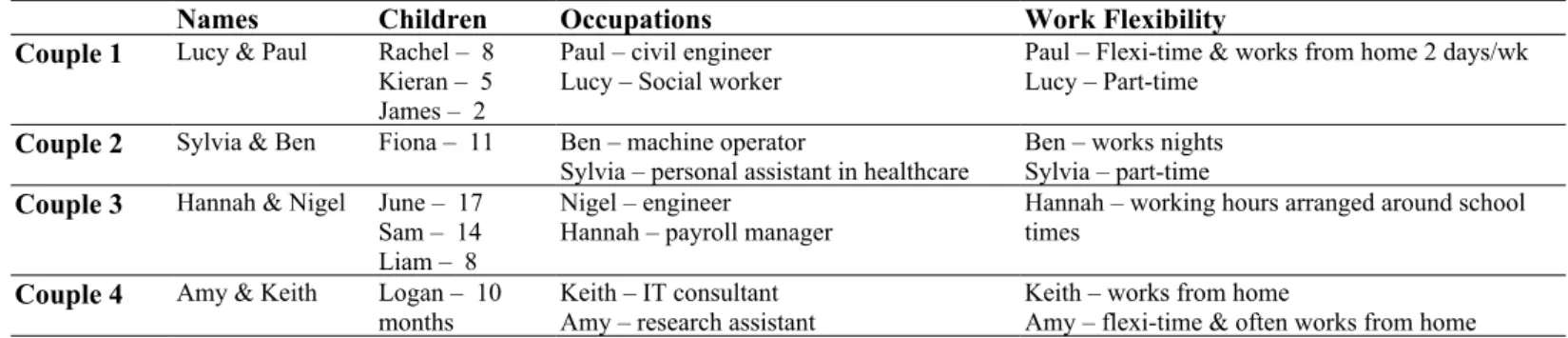
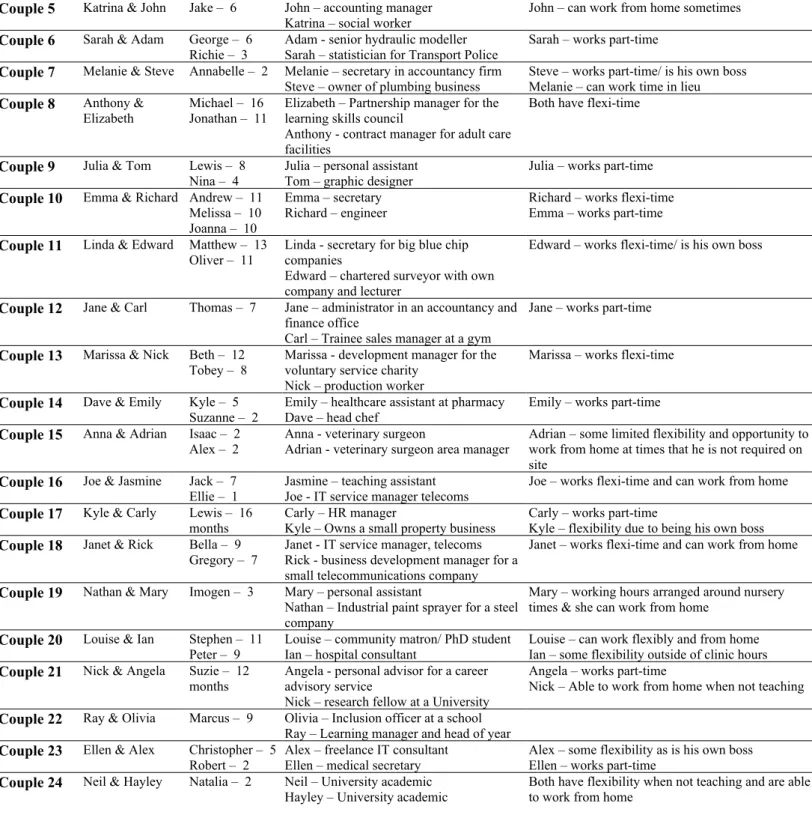
occupations in both the public and the private sector. Participants were recruited during spring 2009 using self-selection and snowball sampling. Although this method of sampling can cause problems of representativeness, due to respondents being most likely to identify other potential respondents similar to themselves (Saunders, Lewis and Thornhill, 2003), given the rather specific requirements of the desired population this was the most effective way of recruiting the necessary number of participants. Participants were recruited in this way until the ‘saturation’ point was reached meaning that no new information or themes were emerging from the data (Taylor and Bogdan, 1998: 93). An information sheet explaining why the research was being carried out was presented to potential participants. Details of the sample and their occupations can be found in Table One. It is important to note that all names have been changed to protect the identity of the participants.
[Insert Table One about here]
Each initial interview lasted between thirty and ninety minutes and took place in the
work-family conflict, how decisions were made, and how potential conflicts were resolved. Interviews were audio-recorded and transcribed verbatim for analysis. All participants were then given a diary to keep individually for four weeks where they were asked to report all incidents of work-family conflict experienced and the consequent decisions made as they occurred. This was a fairly long period of time to ask participants to maintain commitment to the study but was necessary to ensure that sufficient conflicts were reported as it was not expected that conflicts would be reported every day. A copy of the instructions provided for completing the diaries can be found in the Appendix. Four weeks later, when the couples had completed the diaries, a second follow-up interview was conducted, this time individually. This acted as an opportunity for participants to discuss any issues that had been raised while completing the diary.
A particular challenge associated with diary studies is the level of participant commitment and dedication required, which is rarely required by other types of research (Bolger et al, 2003). Several practices were put in place as a means of addressing this problem. Firstly, the demands of being involved in the study and the particular requirements were made explicit to all potential participants from the outset as suggested by Symon (2004). This helped to ensure that participants did not become involved in the study without serious consideration and, subsequently, that they were committed to the process from the beginning. The initial interview was also utilised as an opportunity to provide clear instructions regarding exactly what participants were being asked to record in the diaries, including the amount of detail required. The use of event-contingent diaries requires a clear definition of the triggering event and therefore the importance of recording minor, routine work-family conflicts was
the level of commitment required to continue recording events over a four week period (Bolger et al, 2003). However, this was infrequently noted in participants’ diaries. The success of these practices was ascertained via the quality of the diary entries produced and from participant’s personal reflections in the follow-up interviews.
43 decisions were reported in participant’s interviews and 255 daily conflict episodes were reported within their diaries (see Table 2). Conflicts were reported on around twenty per cent of observed diary days which was considered a good response rate. This varied between each participant with some reporting conflicts more frequently than others. The least number of conflicts reported throughout the four week diary period was three and this was by Nigel. The greatest number reported was fourteen by both Janet and Marissa.
[Insert Table 2 about here]
There was great consistency between the conflict incidents reported within each couple with each account frequently including additional information leading to a more detailed picture of what had occurred. Notably, numerous incidents were reported by female participants that were not recorded by their partners. The sophistication of responses recorded within the diary entries also varied. While some participants provided in-depth discussions of the incidents reported, as well as their accompanying thought processes, others provided much less detail regarding their own reasoning when recording these incidents. For these participants, the follow-up interviews proved particularly useful in gaining extra insight into the incidents that had been discussed in their diary entries. In this way, using diaries in conjunction with interviews helps to counteract some of the limitations of using either method alone and allowed for a detailed picture of events and experiences to be captured.
view of exploring how couples managed work-family conflict situations and the
accompanying reasoning processes leading to particular decisions. The initial template was developed by the first author who examined a sub-set of the transcript data (diaries and interviews from one couple), and defined codes in light of the research question regarding experiences of work-family conflict and decision making. Codes were organized
hierarchically with the highest-level codes representing broad themes and the lower levels describing more narrowly focused themes within these broader themes (King, 2004). The full sets of transcripts and diaries were then worked through systematically, identifying those sections of text that were relevant to the research questions and marking them with the corresponding code from the initial template. Next, further changes were made to the template; this time with several themes being grouped together. For instance, ‘the
availability of support’ and ‘financial considerations’ were grouped together as lower order themes under the broad theme of ‘enabling and constraining factors’, which more effectively described the impact that these factors were having on participants’ decision-making. This template then served as the basis for interpretation of the dataset and can be seen in Table 2. The authenticity of the template analysis was assured in two ways. Firstly, interpretation was discussed in follow-up interviews with participants to clarify meaning and to involve the participants in the analytic process. Secondly, the second author of the paper was also involved in discussing the thematic analysis so that any alternative interpretations could be considered.
demonstrate a more detailed approximation of participant’s decision making process in a way that a list of themes could not. These were used in conjunction with template analysis to effectively describe each individual conflict, providing a more detailed analysis of the data regarding how couples made decisions. As is the case in qualitative research, the categories employed are not considered as exhaustive or mutually exclusive but instead as
representations of how couples made sense of their daily lives during the process of diary completion and associated interviewing (Medved, 2004).
Findings
In this section, we focus upon the different types of decisions made and the cues that impacted upon the decision-making process.
Distinguishing between types of decisions
Through the analysis of the data, it became apparent that there was a clear conceptual distinction between two different kinds of decisions. These will be referred to asanchoring
decisions anddailydecisions. Anchoring decisions are major decisions about the overall approach to work-life conflict taken by the couple. They provided a framework within which other day to day decisions were made and tended to be made at key points in the couples’ lives, for example, when they first had children. Examples are the decision that both would continue to work; the decision that one member of the couple would work part-time; or the decision to move to another job. For instance, Sarah explained why she decided to return to work part-time rather than full-time:
“I did want to go back but I didn’t want to go back full-time because I didn’t want to have kids that somebody else had brought up.... When you work full-time somebody else sees more of your child than you do”
sick and unable to go to school on a particular day, how to resolve the conflict between a meeting at work which clashed with a school event, or whether or not to engage in extra work while at home with their family.
Anchoring and daily decisions were clearly linked. For example, an anchoring decision impacted upon daily decision-making by creating a framework within which work and family commitments and resultant conflicts were managed on a daily basis. One example was
provided by Paul, who after his first child was born chose to give up contract work for employment at the council because “working for the council is more flexible and involves less travelling than contract work”. This anchoring decision meant that he had flexible hours which impacted upon how daily decisions were made. He was regularly able to be involved in the school run reporting, for instance, "I chose to cater for the family before work” or that he and his partner had “talked in the morning and I could take the children to school and still get to work relatively early”. The consequence of this anchoring decision on daily decisions was also apparent in his partner’s diary entries. For example, on several occasions Lucy was required to work extra hours at times when she also needed to look after the children. This type of conflict tended to be easily resolved by relying on Paul’s flexible work arrangements. Lucy reported in response to one conflict, "it really helps that my husband works from home”, emphasizing the importance of this anchoring decision in the resolution of daily work-family conflicts.
Carly’s busy days it’s all me.” This highlights how her anchoring decision to take a
promotion impacted upon their daily decision-making as a couple. Anchoring decisions can create daily conflicts as well as constrain the support options available for conflict resolution. It also meant that such conflicts would continue to be difficult to resolve in the future.
A further example of the linkages between the two types of decisions is how recurring problems in daily decision-making led to rethinking an original anchoring decision. For example, Olivia and her partner Ray, both high school teachers, decided to leave the school where they were working together and move to a new school, due to their boss’s lack of flexibility regarding family commitments. Olivia explained how she finally made the decision to leave based on her boss’s disapproval of how they had handled the daily conflict that occurred when their son burnt his hand on a radiator:
“Marcus was only a tiny baby and when we were getting him ready in the morning he banged his hand on the radiator and he burnt his hand so as any normal parent would do, we got him in the car and took him to hospital. We phoned in work and said we’d be late. We got him sorted then took him to my mums and both went in work. Half an hour after being in work we both got told off because we’d both been to the hospital with him.... She was horrible. She just didn’t see....family life didn’t exist, everything was work....I actually walked out and I said I’m not coming back, and I didn’t, did I? One of the things that finally made me do that was when we took Marcus to hospital. It was the best decision I ever made. It was a build-up of everything”
Cues impacting upon decision-making
As well as revealing the distinction between anchoring and daily decisions and the inherent links between the two, various cues that had an impact on such decision-making were also brought to light, including the differential impact of these cues on the two types of decisions. The term ‘cues’ is used here to describe anything, whether contextual or internal, that had an impact on the decision-making process involved in a couple’s selection of a resolution strategy. Resolution strategies discussed by participants in the current study were support – seeking, integration, and rescheduling. These strategies were not mutually exclusive and some form of support was usually necessary when using all strategies. In identifying the various cues that influenced such decision-making, we label them here as enabling and constraining cues, fairness considerations, and beliefs, values and preferences.
Enabling and constraining cues
These cues are related to the context within which couples must make their decisions. Enabling cues refer to those that enable a decision to be made more easily by providing a greater number of options to the couples when dealing with work-family conflicts. Conversely, constraining cues are those that constrain decision-making by limiting the
couple’s available options in dealing with such conflicts. The reason that these two seemingly opposing categories have been grouped together is because of their interrelated nature. If a particular enabling cue was not present or was lacking this would usually become a
constraining cue and therefore it makes sense to discuss these in parallel. We now address the key enabling and constraining cues identified: financial cues and availability of support.
resources. Dave and Emily discussed how financial necessity limited their options when making the anchoring decision of whether or not to both return to work after having children:
Dave: “Work is very important, as it is the main source of income for the family. Without my wage we would not afford the mortgage, holidays, and general household financial commitments.”
Emily: “Our main priority is being able to pay the bills etc, whilst family is very important to us; if we have to work, we have to work.... It’s always easy for people to say they put their family ahead of everything else but in the real world that is not always practical, as we work to provide for our family....”
Emily went on to discuss the cost of childcare in terms of further constraints this put on how, and when, she was able to work. It was not feasible for her to work during the day while her partner was at work, as childcare costs would negate her earnings; therefore she had to work evenings. This constraint severely limited her options. However, the impact of financial decision-making on anchoring decisions was shown to be multifaceted, moving beyond considerations of couples’ current financial situations. They also took into consideration the impact of long-term financial factors in relation to the maintenance of financial security. For example, Anna and Adrian, who had 18-month old twins and both worked as veterinary surgeons, discussed why this was an important factor in their decision to both return to work after having twins, despite this meaning that Anna would be earning little more than the cost of childcare.
Anna: “We work for contractors so if they lose the contract we don’t have a job. It’s never 100% secure.”
Carly echoed such a consideration when discussing her decision to return to work,
highlighting how her partner being self-employed meant that, “there’s so much risk that we can’t financially afford for me not to work.”
Finances were also shown to have some impact on daily decision-making; acting as a
constraint. This was discussed in relation to restricting participants’ flexibility to take time off work for family events, regardless of preferences. In his diary, Rick wrote about being unable to take the day off work for his son’s birthday because “no work, no pay and no annual leave left.” In the interview with his partner, they discussed how it was essential for both to work so they could afford to pay the bills, which also meant that they could not afford to take unpaid leave. This constrained their decision-making by limiting their available options when faced with such a conflict. Dave also discussed the impact of finances when deciding to work on what should have been his day off, explaining that he “would have preferred to stay at home” with his family but “with bills and a new garden to pay for I chose extra work.” Overall, a consideration of financial issues was vital to how couples made work-family decisions.
was “in a fortunate position that the nature of my job allows me to do this”. Flexitime was an important form of organisational support that enabled non-work commitments to be met. Where there was a lack of support available at work this often had an impact on anchoring decisions. For example, although Mel had previously enjoyed her job in the hotel industry, she decided to change jobs to work as a secretary once she became a parent due to the lack of flexibility in her job undermining her role as a parent:
“I used to work in a hotel before we had Annabelle. I worked there for 12 years as a deputy manager and because of the role that I was playing then I wouldn’t have just been given set hours....you sometimes have to work until 11pm at night or you do an early shift where you work until 3pm from 6am. But then they wanted me to stay overnight for a full weekend and that sort of really made me....I didn’t want to do that, even though it was only one a month, I mean it’s a full weekend away, and when Annabelle would have only been small, so I decided against it.”
This demonstrates not only the impact that the amount of available support in the workplace has on individuals’ anchoring decisions, but also how these anchoring decisions can be made in order to reduce the amount of daily constraints placed upon decision-making in the future.
Less formal sources of support also impacted daily decision-making. Several participants discussed a type of unspoken, informal agreement with their boss based on a mutual trust and understanding. Nathan and Mary discussed this type of arrangement in their interview and talked about the benefits this had in incidents of work-family conflict:
Mary: “I think it’s more a favour for you because you’re classed as a good worker so it was like go on but be as quick as you can kind of thing.”
Nathan: “Yeah, just sort of nipping out then getting back as quick as I could. But I mean policy wise, if you’re away two hours they can make you make that back up on a Saturday....I had to just call the works manager over and explain, the wife’s away, mother-in-law’s gone with her and she’d normally pop down so like nursery doesn’t open until 8am so I’ll have to come in late and he just said don’t worry about it. But he’s alright if you’re alright with him.”
experiencing constraints placed upon her decision-making by an unsupportive and inflexible superior at work on an occasion where she was required to work away from home:
“For me to go for a two day trip, I said to management, for that day we had to be there for a 9am start and I said can I not get there at 10am so I don’t have to stay over, and straight away he came back....and you can tell straight away that person who makes that decision will not have children or an understanding....because he turned round straight away and said no you have to get there for 9am.”
A decision that is constrained is shown to have a negative impact not only on the individual, in the form of increased stress, but also on others in the family domain and subsequently on concentration at work. Janet reported in her diary that she was “Still worrying about this decision” which continued to have a knock-on effect on both her work and personal life over the following days. This worry resulted in further daily conflicts due to her thinking about the situation while at work and consequently creating a conflict as to whether she should take time out of work and make arrangements for the time she would be working away. This in turn resulted in conflict with her partner Rick when she rang him at work to discuss the arrangements. In seeing how this conflict unfolded, the longitudinal nature of the research enabled the observation of the impact of organisational structures on constraining decision-making over time.
“I wouldn’t have had any backup...All my family work and Ben’s too so we couldn’t rely on anybody, we had to sort everything out ourselves so that was the only way of doing it really....you can’t always rely on other people can you?”
This lack of support in the home domain led to Sylvia’s decision to work part-time and to choose to work for the healthcare sector in a more family-friendly organisation. In this way, the amount of support available at home can act to both enable and constrain decision-making.
Support at home was discussed more frequently, and in much greater detail, with regards to daily decision-making. This included considerations of the work responsibilities and work flexibility of those in the home domain. These cues were mentioned by all participants at some point throughout their diaries as crucial in their daily decision-making. The job flexibility of others had a great impact on the availability of support in participants’ home domains. This was most frequently discussed in relation to the flexibility of their partners’ jobs. For those participants whose partner had an inflexible job, this also had an impact on daily decision-making by acting as a constraining factor. Mary’s partner Nathan was unable to take their daughter to nursery because “Nathan has to leave the house at 6:45am and nursery opens at 8am” and Janet’s partner Tim was also unable to participate in the school run “because of work constraints”. In both cases, they turned to grandparents for help. As well as general job flexibility, specific work task flexibility at the particular time of the conflict situation was also frequently mentioned as an important factor in decision-making. For example, Anthony and his partner Elizabeth, who both had fairly flexible jobs working for the council, explained how they tended to deal with work-family conflicts. Anthony said:
“We sort of look at priorities really. Like today and tomorrow I can’t get out of these meetings whereas Elizabeth’s got more flexibility.”
simultaneously consider enabling factors, as well as the opposing constraints, placed upon each of them on a daily basis and these considerations form the basis of decisions made.
When both members of a couple had limited work flexibility, they often looked at other available support options, also taking into consideration the job and task flexibility of others as well as their non-work commitments and preferences. The latter considerations are important cues when assessing the availability of outside support but such cues are often considered as secondary when seeking support within the couple. If support was limited in both domains, this also led to integration strategies. Under such constraints, Anna took her twin babies to the abattoir where she worked as a last resort:
“Just filling them with breadsticks, balls, toys, anything they wanted to eat, I didn’t care! It was just like keep quiet in the car for one hour. The poor babies were in the car seat, you know no movement or anything”.
This demonstrates how a lack of work flexibility accompanied by limited support from the home domain can lead to reliance on undesirable resolution strategies.
Fairness Judgements
with regards to the resolution of specific work-family conflicts. Such considerations
sometimes led to the rejection of support seeking as a viable option altogether. For example, Janet and Rick discussed their reluctance to seek support from their neighbours, although this had been offered, because they were aware that they had their own needs and commitments to attend to.
Janet: But they’ve now started doing a little job of their own so I feel I can’t now ask
Rick: And one of them has had a new baby.
Janet: So I feel like I’m putting on them even though they say....I just wouldn’t do it now. It would be a last resort, in an emergency.
This example illustrates that it is not simply the availability of support that is important but also that the type of support available is fair and appropriate, given the particular situation. Participants also frequently discussed consideration of the impact on those offering support in terms of the amount of support provided previously, or agreed to provide in the future. In general, participants were less likely to seek further support from someone who they deemed to be already doing more than their fair share. For example, Lucy decided not to attend a work meeting outside of her working hours and Jasmine made the decision to bring her work home with her rather than stay at work to complete it. In both cases this was because they did not want to rely on further support from their parents, who had already, provided invaluable help.
Lucy: “I hate asking dad and his partner as they do enough already looking after James on Tuesdays to save us paying more nursery fees”
Jasmine: “It was easier and quicker to do the work at school as I had all the facilities I needed to do it there. But I already felt guilty enough that my mum had Jack all day and although she loved it I knew they were back at ours in the morning to do the school run when Joe [her partner] was in London.”
understanding had an impact on whether or not participants decided to seek such support from others in the first place. This was usually discussed in relation to non-family members. Sylvia discussed her decision to ask another mother from her daughter’s school to pick her daughter up on occasions when she was unable to leave work on time:
“She’s done it with me though as well to be honest. It got like a pattern at one stage where I’d pick Hannah up for her and she’d pick Fiona up for me.”
This demonstrates the increased likelihood of seeking help as this enabled both parties to maintain a feeling of equity. On the other, hand when participants felt that they would not be able to offer support in return, therefore leaving them unable to sustain such a reciprocal arrangement, this made them reluctant to accept support from others. Emma talked about this in her diary when discussing different possibilities of childcare during the school holidays:
“Difficult to get friends/neighbours to help out and I find it difficult to ask when I am limited in what I can offer in return.”
So although support seeking often acted as a solution to work-family conflicts, it also entailed problems creating extra ‘work’ and pressure for these couples who already had numerous other pressures. In summary, feelings of fairness and equity play an important role and the decision to seek support is complex and cannot be explained simply by its availability.
Beliefs, Values and Preferences
whether they valued organised childcare as being beneficial to their children and whether they believed that their working was beneficial to their children both financially and
emotionally. For example, Mel explained the decision that she would move to a more flexible job and her partner would work part-time:
“I wouldn’t want to put her in nursery full-time. I don’t believe in having a child and then putting them into someone else’s care for 5 days. That’s my personal thing and I’d rather her stay with me one day.... even though she really, really enjoys it
[nursery]; she loves being there I don’t really want her in 5 days. It’s a personal thing.”
Ed, who worked full-time but very flexibly so his work could fit in around the needs of the children, talked about his decision to take on a less demanding career to enable him to be the main carer. This decision was impacted upon by his personal beliefs about what it meant to be a good parent and the value he placed on this:
“I think if it didn’t mean that much to me [being a parent] I would possibly have decided to stay in a career and work all the hours that god sends. There are people who think that is their role as a parent and I’m not saying that is wrong but that’s the way they decided to approach their life and this is the way I decided to approach mine.”
Conversely, several couples expressed strong beliefs regarding the value they placed upon organised childcare, with a view that this was important and beneficial for their children. Anna and Adrian both shared this belief and discussed it at some length in their interview:
Anna: “I think it’s very good for the children to go to the nursery. We are very lucky because we deeply think that it’s the best thing for them to spend time with other children and with so many activities, things that we would never do at home.” Adrian: “At the beginning we were thinking in money because we have two so it is double paying at the nursery so it is quite high. So if you are making numbers, a nanny makes sense. Maybe it would make sense but we think that we prefer the nursery because the contact of the babies with everyone, to different people”
role of parent enabled them to invest more energy in this role. Rather than leading to a depletion of their energy, it appeared to increase it, having a positive impact on both
themselves and their children. The self-awareness of such effects impacted upon participants decisions to return to paid work as they viewed this as a strategy that enabled them to be “better” parents. By looking at the wider system of beliefs and values it was evident that the internal cues that had an impact upon decision-making were not limited to role salience but were more complex. For example, the importance of one role did not always lead to the individual investing less time in the other role as this could depend upon other beliefs and values held by the individual. The complexity of the impact of participants’ beliefs, values and preferences was succinctly expressed by Joe:
“Currently with school runs and my desire to spend quality time with my family, I am just managing to work my contracted 37 hours a week and sometimes I’m not as focused on my job as I should be. I do feel that you need to put the extra hours in to get noticed and move up the ladder. I am reluctant to do this because I want a good family life. However, my desire to move up the ladder and ultimately earn more money has increased tenfold since having my own family. A bit of a conundrum.” Here the importance placed on his role as a father increased Joe’s desire to invest more time and energy in both the home and work domains, meaning that the decision to invest in the home domain would not necessarily be the result of work-family conflict situations.
Discussion
as the analysis has demonstrated, are a distinct type of decision-making impacted upon by their own set of cues.
Secondly, within previous literature, different types of coping strategies used by individuals to manage work and family have been uncovered which demonstrate clear similarities to the strategies reported by participants in the current study, such as support-seeking, integrating, and rescheduling (e.g. Kreiner et al, 2009, Maertz and Boyar, 2011). However, the current study goes beyond this by revealing the complex processes involved in relying upon a particular resolution strategy, including the different cues that have an impact upon this process. In particular, we highlight the importance of obtaining the perspectives of both members of a couple and the interrelated cues that impact upon each of them and how these lead to a joint conclusion. Although there are useful general heuristics related to work-family conflict episodes in recent research (e.g., Medved, 2004; Kreiner et al., 2009; Repetti et al., 2009; Shepherd & Haynie, 2009), no previous model or framework has demonstrated specifically how a conflict episode unfolds, how its results may carry forward to subsequent episodes, or how these accumulate over time to influence role performance and satisfaction.
conflict experienced occurred because childcare arrangements fell through or because participants were asked to complete extra work, the same cues would be used to reach a decision on how this should be resolved. The way in which these cues interacted to lead to such a decision was an inter-personal process. This process relied on negotiations
incorporating not only those factors that both enabled and constrained each individual and couple, but also a concern with maintaining equity and balance both within the couple and with external others. These rather complex negotiations were also framed by previously made anchoring decisions. The findings reported imply that a set model portraying an invariable description of how this process occurs is implausible as it is too complex and varied to be defined in a stable, linear step by step fashion, hence the preference for a more flexible framework.
[Insert Figure 1 about here]
In Figure 1, the Left-Right bi-directional arrow between the anchoring decisions and daily decisions represents the important conceptual link previously discussed. While anchoring decisions had both a constraining and an enabling effect on daily decisions, these daily decisions could also accumulate in a way that resulted in anchoring decisions being made in an attempt to improve daily experiences.
Enabling/constraining cues and personal preferences are highlighted as having an impact on both anchoring and daily decisions. However, the arrow linking preferences to daily decisions is a dashed arrow, representing the somewhat weaker direct effect that preferences were seen to have on daily decision-making. Preferences were impacted upon by the more enduring beliefs and values of a person which extended beyond preferences; a link which is
a ‘good parent’ were discussed in relation to anchoring decisions, rather than daily decisions. This is not to say that such beliefs and values did not have an impact on daily decision-making, but rather that this impact was indirect, via anchoring decisions. In the reports of their daily decision-making processes, participants tended to focus more on practical issues and necessities, such as financial cues and the availability or lack of support, and did not discuss such enduring beliefs and values.
The leftwards arrow highlights how considerations of fairness and equity had an impact on preferences regarding which of the available options to use to resolve a particular conflict. However, such considerations appeared to be much more than a preference or desire. In line with social exchange and equity theory (Homans, 1958; Adams,1965), equity is attained if the ratio of one's rewards to one's costs is perceived to be equal to a partner's rewards – to – costs ratio. Hence participants were sometimes less willing to rely on available support to resolve work-family conflicts. Indeed the specifics of moral obligations, such as how much and how soon you should reciprocate, are vague and can vary across relationships. As noted, equity theory can provide insights toward understanding close, intimate relationships (e.g. Hatfield et al, 1979, 1985). However, a consideration of fairness and equity has not
previously been explored directly in relation to couples making work-familydecisions. These findings suggest that this might be a fruitful avenue for further research.
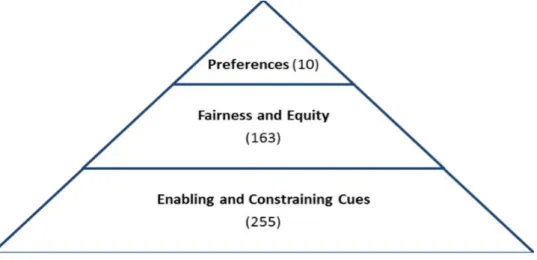
In terms of understanding theoretically how the cues relate to each other, a diagrammatical representation, highlighting the general order in which these cues are likely to impact daily decision-making, is presented in Figure 2.
[Insert Figure 2 about here]
decision-making process. As can be seen from Table 2, availability of support was considered in all incidents reported by all couples. If there was no support available in either domain, this was when a decision was usually made to integrate activities in an attempt to combine both work and home responsibilities in some way without the need of support from others. However, as previously mentioned, the utilisation of available support would depend upon considerations of fairness and equity in relation to all parties involved in the conflict – resolution scenario. It was often these two factors that worked in conjunction to reach the final solution in daily incidents. These findings demonstrating the importance of the availability of support concur with previous research (e.g. Greenhaus and Powell 2003, 2006; Maertz and Boyar, 2011) but extend this by highlighting the importance of specifying not only whether support is
available, but also whether or not available support is actually used. Support has previously received a great deal of attention in the literature but the focus has frequently been upon whether or not the availability of support reduces work-family conflict, either directly or via its potential to alter the impact of stressors that lead to work–family conflict, such as role conflict and role ambiguity (e.g. Carlson and Perrewé, 1999; Thomas and Ganster, 1995). The literature on coping strategies has also acknowledged the importance of support-seeking (e.g. Kreiner et al, 2009; Maertz and Boyar, 2011). However, the contingencies related to its use as a resolution strategy in specific incidents of work-family conflict have not previously been explored. Here we have also drawn attention to some of the negative aspects of support, as well as to the positives. Recent research findings have suggested that support receipt can increase distress in recipients (Gleason et al, 2008, Seiger and Wiese, 2009) which, based on the current research findings, could be due to the related feelings of inequity and the extra work involved in maintaining reciprocal relationships.
were only considered as an additional cue when all other cues were satisfied. In other words, if satisfactory support was available in both domains, with limited constraints, and fairness considerations had already been taken into account, then on occasion preferences were permitted a small role in daily decision-making. It is important to highlight that this is a representation of cues impacting upondailydecision-making only and that a similar
representation of anchoring decision-making looks somewhat different. From Figure 3, it can be seen that the impact of beliefs and values play a somewhat equal role to that of
constraining/enabling cues when making such decisions, while equity considerations are absent.
[Insert Figure 3. about here]
The framework produced here along with the hierarchy of cues provides insights into the way in which decisions are made in incidents of work-family conflict. We would emphasize that the analysis suggests that this process cannot be represented by a set pattern or sequence of cues that will consistently lead to a particular resolution decision. Rather, we have
demonstrated that the decision-making processes around work-family conflict are complex, involving the interaction of numerous cues and negotiations between members of a couple.
Conclusions
This analysis contributes to the literature firstly, by making the conceptual distinction between anchoring and daily decisions, secondly, through making empirically explicit the complexity of decision-making in incidents of work-family conflict, including the variety of cues which impact upon the process and thirdly, theoretically, by highlighting how the variety of cues relate to each other in couples’ decision-making processes. These
doing so, attention could be drawn to the impact of past events on subsequent work-family conflicts to demonstrate that each conflict cannot be understood out of context. The current research therefore demonstrates the importance of taking a longitudinal approach.
One potential limitation here is that participants were primarily white, middle class,
heterosexual couples with access to full-time employment. Cultural cues can influence the variables involved in work-family conflict for dual-earner couples in a variety of ways. For example, culture can influence the meaning and relative priority of work and family (Lewis, 1999) and might also have an impact on willingness to accept support. Beyond this,
individuals from under-represented groups often experience unique career issues, such as stereotyping, restricted opportunities and other stresses that are likely to have an impact on their experiences of work, as well as their experiences of trying to balance this with having a family (Allen et al, 2000; Ozbiligin et al, 2011). Therefore, it is important that future research addresses these issues by including studies using a more diverse range of participants.
Finally, we believe that a focus on the types of decisions that employees regularly face, and the cues informing these decisions, can enable the creation of work-family policies that more effectively support daily decision-making processes. This in turn can foster positive work and family life experiences, benefiting not only employees and organisations but also society as a whole.
References
Adams J S (1965) Inequity in social exchange. In: Berkowitz L (ed.)Advances in Experimental Social Psychology2: 267-299. New York: Academic Press.
Allen T D, Herst D E L, Bruck C S, and Sutton M (2000) Consequences associated with work-to-family conflict: A review and agenda for future research,Journal of Occupational Health Psychology5(2): 278-308.
Bakker A B, Westman M, and van Emmerik, I J H (2009) Advancements in crossover theory,
Ball F L J, Cowan P, and Cowan, P C (1995) Who’s got the power? Gender differences in partners’ perceptions of influence during marital problem-solving discussions,Family Process34: 303-321.
Bartley S J, Blanton P W, and Gilliard J L (2005) Husbands and wives in dual-earner marriages: Decision-making, gender role attitudes, division of household labor, and equity,
Marriage and Family Review37(4): 69–74.
Bolger N, Davis A, and Rafaeli E (2003) Diary methods: Capturing life as it is lived.Annual Review of Psychology54: 579-616.
Bruck C S and Allen T D (2003) The relationship between big five personality traits, negative affectivity, type A behavior, and work-family conflict, Journal of Vocational Behavior63: 457-472.
Butler A, Grzywacz J, Bass B, and Linney K (2005) Extending the demands -control model: A daily diary study of job characteristics, work-family conflict and work-family facilitation.
Journal of Occupational and Organizational Psychology78: 155-169.
Byron K. (2005) A meta-analytic review of work-family conflict and its antecedents,Journal of Vocational Behavior67: 169-198.
Carlson D S and Perrewé P L (1999) The role of social support in the stressor-strain
relationship: An examination of work-family conflict,Journal of Management25 (4): 513-540.
Casper W J, Eby L T, Bordeaux C, Lockwood A and Lambert D (2007) A review of research methods in IO/OB work-family research,Journal of Applied Psychology92 (1): 28-43. Clark S C (2002) Employees’ sense of community, sense of control, and work/family conflict in Native American organizations,Journal of Vocational Behavior61: 92-108.
Collingwood Bakeo A. and Clarke L. (2004) Child population. In:The health of children and young people. London: The Stationery Office.
Department of Trade and Industry (DTI) (2003) Working Long Hours: A Review of the Evidence,Employment Relations Research Series 16. The Institute for Employment Studies http://webarchive.nationalarchives.gov.uk/+/http://www.bis.gov.uk/files/file11543.pdf, accessed 1 May 2013.
Eby L T, Casper W, Lockwood A, Bordeaux C, and Brinley A (2005) Work and family research in IO/OB: Content analysis and review of the literature (1980-2002),Journal of Vocational Behavior66: 124-197.
Fox G L and Murry V M (2000) Gender and families: Feminist perspectives and family research,Journal of Marriage and the Family62:1160-1172.
Gleason M E. J, Iida M, Shrout P E, and Bolger N (2008) Receiving support as a mixed blessing: Evidence for dual effects of support on psychological outcomes,Journal of Personality and Social Psychology94: 824–838.
Greenberg J and Eskew D E (1993) The role of role playing in organizational research.
Journal of Management19(2): 221-241.
Greenhaus J H (2008) Innovations in the study of the work-family interface: Introduction to the special section,Journal of Occupational and Organizational Psychology81: 343-348. Greenhaus J H and Beutell N J (1985) Sources of conflict between work and family roles,
Academy of Management Review10(1): 76-88.
Greenhaus J H and Parasuraman S (1999) Research on work, family, and gender: Current status and future direction. In: Powel G N (Ed.)Handbook of gender and work391–412. Newbury Park, CA: Sage.
Greenhaus J H and Powell G N (2003) When work and family collide: Deciding between competing role demands,Organizational Behavior and Human Decision Processes90: 291-303.
Grzywacz J G and Marks N F (2000) Reconceptualizing the work-family interface: An ecological perspective on the correlates of positive and negative spillover between work and family,Journal of Occupational Health Psychology5(1): 111-126.
Hatfield E (1985) Passionate and companionate love. In: Sternberg R J and Barnes M L (Eds.)The Psychology of Love 191-217. Cambridge, MA: Yale University Press.
Hatfield E, Utne M K and Traupmann J. (1979) Equity theory and intimate relationships. In: Burgess R L and Huston T L (Eds.)Social exchange in developing relationships99-133. New York: Academic Press.
Homans G C (1958) Social behavior as exchange,American journal of sociology, 597-606.
Holmes E K, Erickson J J, and Hill E J (2012) Doing what she thinks is best: Maternal psychological wellbeing and attaining desired work situations,Human Relations65(4): 501-522
King N (2004) Using templates in the thematic analysis of text. In: Cassell C and Symon G (Eds.)Essential Guide to Qualitative Methods in Organizational Research. London: Sage. Kossek E E, Lewis S, and Hammer L B (2010) Work—life initiatives and organizational change: Overcoming mixed messages to move from the margin to the mainstream,Human Relations63: 3-19.
Kreiner G E (2006) Consequences of work-home segmentation or integration: A person-environment fit perspective,Journal of Organization Behavior27: 485-507.
Kreiner G E, Hollensbe E C, and Sheep M L (2009) Balancing borders and bridges: Negotiating the work-home interface via boundary work tactics,Academy of Management Journal52(4): 704-730.
Lobel S and St. Clair L (1992) Effects of family responsibilities, gender, and career identity salience on performance outcomes,Academy of Management Journal35: 1057-1069. Maertz C P Jr. and Boyar S L (2011) Work– family conflict, enrichment, and balance under ‘levels’ and ‘episodes’ approaches,Journal of Management37: 68–98.
Mäkelä L and Suutari V (2011) Coping with work-family conflicts in the global career context,Thunderbird International Business Review53(3): 365-375.
Medved C E (2004) The everyday accomplishment of work and family: Exploring practical actions in daily routines,Communication Studies55: 128–45.
Moen P and Wethington E (1992) The concept of family adaptive strategies.Annual Review of Sociology18, 233-251.
My Family Care (2011)Working parents and carers flexible working survey
http://www.myfamilycare.co.uk/download_files/Flexible-Working-Survey-Summary-Report-2011.pdf, accessed 20 May 2013
Ozbilgin M F, Beauregard T A, Tatli A, and Bell M P (2011)Work Life, Diversity and Intersectionality: A Critical Review and Research Agenda,International Journal of Management Review13(2): 177-198.
Parasuraman S and Greenhaus J H (1997)Integrating work and family: Challenges and choices for changing world. Westport, CT: Quorum.
Poppleton S, Briner R B, and Kiefer T (2008) The roles of context and everyday experience in understanding work-non-work relationships: A qualitative diary study of white- and blue-collar workers, Journal of Occupational and Organizational Psychology81: 481-502. Powell G N and Greenhaus J H (2006) Managing incidents of work–family conflict: A decision-making perspective,Human Relations59: 1179-1212.
Repetti R, Wang S W, and Saxbe D (2009) Bringing it all back home: How outside stressors shape families’ everyday lives,Current Directions in Psychological Science18: 106-111. Saunders M, Lewis P, and Thornhill A (2003)Research Methods for Business Students(3rd Edition). Financial Times, Prentice Hall: Harlow
Schwarz N (1999) Self-report: How the questions shape the answers,American Psychologist
54: 93-105.
Seiger C P and Wiese B S (2009) Social support from work and family domains as an antecedent or moderator of work–family conflicts?Journal of Vocational Behavior75: 26-37.
Shepherd D A and Haynie J M (2009) Family business, identity conflict, and an expedited entrepreneurial process: A process of resolving identity conflict,Entrepreneurship Theory and Practice33: 1245-1264.
Tardy C H (1985) Social support measurement,American Journal of Community Psychology
13: 187-202.
Taylor S J and Bogdan R (1998)Introduction to qualitative research methods: A guidebook and resource(3rd ed.). New York: John Wiley & Sons.
Thomas L T and Ganster D C (1995) Impact of family-supportive work variables on work-family conflict and strain: A control perspective,Journal of Applied Psychology80: 6-15. Van Steenbergen E F and Ellemers N (2009) Is managing the work-family interface worthwhile?: Benefits for employee health and performance, Journal of Organizational
Behavior 30(5): 617-642.
Wayne J H, Musisca N, and Fleeson W (2004) Considering the role of personality in the work-family experience: Relationships of the big five to work-family conflict and facilitation,
Journal of Vocational Behavior64:108-130
Westring A F and Ryan A M (2010) Personality and inter-role conflict and enrichment: Investigating the mediating role of supportHuman Relations,63:1815-1834.
Wicker A W and Burley K A (1991) Close coupling in work-family relationships: Making and implementing decisions in a new family business and at home,Human Relations44(1): 77-92.
Wiersma U J (1994) A taxonomy of behavioral strategies for coping with work–home role conflict,Human Relations47: 211-22.
Williams K J and Alliger G M (1994) Role stressors, mood spillover, and perceptions of work-family conflict in employed parents,Academy of Management Journal37(4): 837-68. Zedeck S (1992) Introduction: Exploring the domain of work and family concerns. In: Zedeck S (Ed.)Work, Families and Organizations1-32.Jossey-Bass, SanFrancisco. Zimmerman D H and Wieder D L (1977) The diary: Diary-interview method,Urban Life
5(4):479-498.
Table 1:Overview of participants
Names Children Occupations Work Flexibility
Couple 1 Lucy & Paul Rachel – 8 Kieran – 5 James – 2
Paul – civil engineer
Lucy – Social worker Paul – Flexi-time & works from home 2 days/wkLucy – Part-time Couple 2 Sylvia & Ben Fiona – 11 Ben – machine operator
Sylvia – personal assistant in healthcare Ben – works nightsSylvia – part-time Couple 3 Hannah & Nigel June – 17
Sam – 14 Liam – 8
Nigel – engineer
Hannah – payroll manager Hannah – working hours arranged around schooltimes Couple 4 Amy & Keith Logan – 10
Couple 5 Katrina & John Jake – 6 John – accounting manager
Katrina – social worker John – can work from home sometimes Couple 6 Sarah & Adam George – 6
Richie – 3 Adam - senior hydraulic modellerSarah – statistician for Transport Police Sarah – works part-time Couple 7 Melanie & Steve Annabelle – 2 Melanie – secretary in accountancy firm
Steve – owner of plumbing business Steve – works part-time/ is his own bossMelanie – can work time in lieu Couple 8 Anthony &
Elizabeth Michael – 16Jonathan – 11 Elizabeth – Partnership manager for thelearning skills council Anthony - contract manager for adult care facilities
Both have flexi-time
Couple 9 Julia & Tom Lewis – 8
Nina – 4 Julia – personal assistantTom – graphic designer Julia – works part-time Couple 10 Emma & Richard Andrew – 11
Melissa – 10 Joanna – 10
Emma – secretary
Richard – engineer Richard – works flexi-timeEmma – works part-time Couple 11 Linda & Edward Matthew – 13
Oliver – 11 Linda - secretary for big blue chipcompanies Edward – chartered surveyor with own company and lecturer
Edward – works flexi-time/ is his own boss
Couple 12 Jane & Carl Thomas – 7 Jane – administrator in an accountancy and finance office
Carl – Trainee sales manager at a gym
Jane – works part-time
Couple 13 Marissa & Nick Beth – 12
Tobey – 8 Marissa - development manager for thevoluntary service charity Nick – production worker
Marissa – works flexi-time
Couple 14 Dave & Emily Kyle – 5
Suzanne – 2 Emily – healthcare assistant at pharmacyDave – head chef Emily – works part-time Couple 15 Anna & Adrian Isaac – 2
Alex – 2 Anna - veterinary surgeonAdrian - veterinary surgeon area manager Adrian – some limited flexibility and opportunity towork from home at times that he is not required on site
Couple 16 Joe & Jasmine Jack – 7
Ellie – 1 Jasmine – teaching assistantJoe - IT service manager telecoms Joe – works flexi-time and can work from home Couple 17 Kyle & Carly Lewis – 16
months Carly – HR managerKyle – Owns a small property business Carly – works part-timeKyle – flexibility due to being his own boss Couple 18 Janet & Rick Bella – 9
Gregory – 7 Janet - IT service manager, telecomsRick - business development manager for a small telecommunications company
Janet – works flexi-time and can work from home
Couple 19 Nathan & Mary Imogen – 3 Mary – personal assistant
Nathan – Industrial paint sprayer for a steel company
Mary – working hours arranged around nursery times & she can work from home
Couple 20 Louise & Ian Stephen – 11
Peter – 9 Louise – community matron/ PhD studentIan – hospital consultant Louise – can work flexibly and from homeIan – some flexibility outside of clinic hours Couple 21 Nick & Angela Suzie – 12
months Angela - personal advisor for a careeradvisory service Nick – research fellow at a University
Angela – works part-time
Nick – Able to work from home when not teaching Couple 22 Ray & Olivia Marcus – 9 Olivia – Inclusion officer at a school
Ray – Learning manager and head of year Couple 23 Ellen & Alex Christopher – 5
Robert – 2 Alex – freelance IT consultantEllen – medical secretary Alex – some flexibility as is his own bossEllen – works part-time Couple 24 Neil & Hayley Natalia – 2 Neil – University academic
Hayley – University academic Both have flexibility when not teaching and are ableto work from home
Table 2.
Occurrences ofdailyandanchoringwork-family conflicts and the cues drawn on by participants in seeking conflict resolutionNo. of Incidents No. of couples Types of Daily Conflict: Getting to work on time or helping family 36 14
Completing work or getting home on time 33 14
Work distractions while at home 9 7
Family distractions while at work 19 6
Children’s events during usual working hours 51 17
Usual childcare not available 42 18
Children unwell during usual working hours 19 12
Total no. of Daily Conflicts: 255
Resolution Strategies: Seek support 160 24
Integrate 22 12
Take time off work 96 20
Reschedule 14 9
Daily Decision-Making Cues: Enabling and Constraining Factors (total) 255 24
Availability of Support 255 24
At home 156 24
At work 99 24
Financial Constraints 17 9
Fairness and Equity (total) 163 22
Support Seeking 94 20
Time Investment 69 19
Preferences (total) 10 5
Types of Anchoring Conflict: Whether or not to return to work 19 19 Whether to work part-time or full-time 15 15 Whether or not to leave an organisation 4 4
Whether or not to seek promotion 5 3
Total no. of Anchoring Conflicts: 43
Anchoring Decision-Making
Cues: Enabling and Constraining Factors (total) 42 24
Availability of Support (total) 21 17
At home 7 4
At work 14 13
Financial Constraints 21 18
Beliefs, Values and Preferences (total) 39 24 What it means to be a good parent 16 11
Appendix.Instructions for Completing Diary Entries
Understanding Work-Life Balance
The purpose of this research is to explore how couples make decisions when faced with conflicting work and family responsibilities.
Previous research has indicated that dual-earner couples often experience such incidents on a daily basis; therefore I am keen to find out your own experiences using this day to day diary. However, some days you may find that you have less to report than on others so please do not feel that you have to write the same amount each day. Please try to fill in the diary as soon as possible after each incident occurs. It is important that the decision-making process is fresh in your mind so you can record this process as accurately as possible.
Please record as many details as possible each time you have to make a decision regarding conflicting work and family responsibilities. Please try to include the following details:
o The decision that you arrived at regarding the two competing activities
o The cues that affected how you arrived at this decision
o The outcome of the decision made and how you felt about it.
o Any other details that you think might be relevant.
Your experiences are valuable as this is the way in which future research can move forward and make a difference.
Anything that you write in this diary will be strictly confidential. If you have any queries at anytime while completing the diary please feel free to contact me via the contact details below. I will also contact you during this time to see how it is going.
Many thanks for your help with this research E-mail:*********************
Mobile: ***********
Week 1
Day 1 Date: Monday ____________
Please record any decisions that you had to make today regarding how to deal with competing work and family responsibilities. Please include the decisions you made, how you arrived at these decisions, and how you felt about them afterwards, as well as any other details that you feel may be relevant.
Please describe any decisions where you made a choice between work and family today
What did you decide to do?
How did you arrive at this decision? Please describe in as much detail as you can the decision process that you went through and ALL the cues that had an impact on the decision you made.
What was the outcome of the decision that you made? Please explain how you felt about the decision and anything that occurred as a result of the decision.
Please use this space to add any other comments that you feel might be relevant
Figure 1.Decision-Making Framework
Figure 2.Diagram depicting the hierarchy of cues considered by participants when making
dailydecisions
Figure 3.Diagram depicting the cues considered by participants when makinganchoring
decisions. Beliefs
and Values
Fairness and Equity Preferences
Enabling and Constraining Cues:
Financial considerations Availability of support
Anchoring
Decisions DecisionsDaily
Anchoring Decisions Enabling and Constraining