http://eprints.whiterose.ac.uk/81779/
Version: Published Version
Book:
Atwell, ES (1999) The Language Machine. The British Council . ISBN 0-86355-438-5
[email protected]
https://eprints.whiterose.ac.uk/
Reuse
Unless indicated otherwise, fulltext items are protected by copyright with all rights reserved. The copyright
exception in section 29 of the Copyright, Designs and Patents Act 1988 allows the making of a single copy
solely for the purpose of non-commercial research or private study within the limits of fair dealing. The
publisher or other rights-holder may allow further reproduction and re-use of this version - refer to the White
Rose Research Online record for this item. Where records identify the publisher as the copyright holder,
users can verify any specific terms of use on the publisher’s website.
Takedown
If you consider content in White Rose Research Online to be in breach of UK law, please notify us by
VIEW LICENCE
QUIT DOCUMENT
F
or centuries, scholars and scientists have dreamed of a mechanical device with the power of language. That dream is now a reality. The language machine that will listen, understand, translate and speak is rapidly becoming a part of everyday life. This book, commissioned by The British Council from Eric Atwell at the University of Leeds, explores some of the technological, social and educational implications of language machines in the years to come. Will we need to learn languages in the 21st century?Copyright © The British Council 1999
All rights reseved. No part of this publication may be reproduced, stored in a retrieval system or transmitted in any form or by any means, electronic, mechanical, photocopying, recording, or otherwise, without the prior permission of the copyright holder.
Published by The British Council http://www.britishcouncil.org
10 Spring Gardens London SW1A 2BN United Kingdom
Digital book production by Catchline http://www.english.co.uk
The Catchline team:
Editorial director: Margaret Keeton Publishing manager: Sjanoche Wakely Design consultant: Carlton Larode
Original cover design by Carlton Larode
Recommended citation reference: Eric Atwell (1999) The Language Machine. London: British Council
ISBN 0 86355 439 3
(This digital book is also available in conventional print format ISBN 0 86355 438 5)
Contents
The language machine
6
Research labs to desk-tops
14
Turning theory into practice
18
The problems with machines
28
UK advantage?
38
Real-life situations
44
Future scenarios
50
Glossary 58
References 60
Questions for debate
64
This season’s
must-have: the
wristwatch translator
See page 53
Language machines
helping with
disabilities
See page 54
Imagine picking up the telephone to speak to
someone in another country. You have no
common language but you are still able to
communicate, each of you speaking and hearing
your own language.
This is the power of language engineering.
–
Linglink Project Report to the EU
(1997)
I propose to consider the question ‘Can
machines think?’ This should begin with
definitions of the meaning of the terms
‘machine’ and ‘think’.
– Alan Turing,
Preface
How will computers be used for language learning in 2020? Will we still be learning languages at all? This book goes some way towards answering those questions.
Potentially, computers let you choose your own speed of learning, your own method, and your own vocabulary to reflect your own interests. The concept of ‘the classroom’, where learning takes place in groups for economic reasons, is itself under threat. The success of individual computer-based learning in subjects such as maths and physics has already proved that.
But isn’t language a social skill? Language, yes. Language learning, not necessarily. Teachers may soon be able to concentrate on productive tasks, while the donkey work of practice takes place between individuals and their computers.
So language use will never be replaced by machines? We can’t be sure of that either. This book shows how close we are to Douglas Adams’ babelfish becoming reality. There is no point in suggesting that diplomats will never negotiate via a translation machine, or that politicians will never rouse a crowd of people with translation machines stuck to their ears. If the technology is available, people will use it.
The technology of the language machine may have begun crudely, perhaps even comically. But if one day, I find myself speaking Welsh while my wife answers in Slovak, who will need a world language?
Watch this space: this is how the motor car began.
Rhodri Jones
Manager, English 2000 The British Council
Progress and
Prospects
‘The success of language engineering research and tech-nological development is bound to have an impact on our economic future because it can be applied across such a wide range of information systems and services with such significant benefits.
… The information society will permeate virtually every area of life involving interactions between people and organisations, in both the public and private spheres. [Language Technology] will enable the information society through intuitive, human-centred modes of interaction with products and services. These will include spoken interaction, removing the need for keyboards and keypads, the use of many different languages to process information and interact with devices – as well as the ability to communicate across language barriers.’
Language Engineering: Progress and Prospects ‘98, The EU Commission (1998)
Surveying the territory
Language machines – machines that in some sense simulate human language and human language behaviour – are used daily around us. Indeed, such machines already have a long history, and have acquired a place in our culture and our expectations.
This book provides a survey of the current state of speech and language technology, focusing particularly on machine translation and speech recognition, highlighting the histories and academic disciplines contributing to their development; it examines the components and tech-nologies; possible pitfalls; main developers; current and potential uses; predicted developments; and paints some likely scenarios for the future impact of the language machine. Finally, this book focuses on current and prospective developments that could have an impact on demand in the marketplace for language teachers and language-based professions in the foreseeable future.
It may help to define what constitutes ‘the foreseeable future’. The Future of English? (Graddol, 1997) contains projections for as far ahead as 2050; the BT Technology Calendar (page 12) includes predictions to 2045. The developments alluded to in this book are based on an arbitrary forward look of approximately 20 years.
Precise predictions are of course, dangerous: nobody knows for sure what the rate of progress will be in language machine development. Yet what we can be sure about is that personal computing technology is developing – at an almost alarming rate. We need only to look around to see that many applications which once seemed impossible or fantastical, are possible today.
The impact?
The question, ‘What will it all mean?’ is a fundamental one, and is addressed at many points throughout this book. Here, it may be easier or preferable to explain by example. The following passage from the Linglink Project Reportto the EU (1997) illustrates some prospective uses and markets for the language machine, which may themselves
The language
machine
form a starting point for a consideration of possible
implications:S
S ‘Think how much more easily you could use your computer, by simply telling it what to do. Suppose also that many of the features of your car were voice operated, such as using the telephone, selecting a CD, opening the windows, and learning about traffic conditions ahead.
Consider how much time you would save if a computer could find exactly the information you are looking for, from multilingual sources, and do it much more efficiently than you.
Imagine picking up the telephone to speak to someone in another country. You have no common language but you are still able to communicate, each of you speaking and hearing your own language.
Access to systems and services through natural language will make them available to everyone. The barriers will be gone. Machines will understand what we tell them and we shall understand each other better.
Through language engineering we can find ways of living comfortably with technology. Our knowledge of language can be used to develop systems that recognise speech and writing, understand text well enough to select information, translate between different languages, and generate speech as well as the printed word.
By applying such technologies we have the ability to extend the current limits of our use of language. Language enabled products will become an essential and integral part of everyday life.
This is the power of language engineering; using the power of language.
Linglink Project Report to the EU (1997)
Short forms
AI Artificial Intelligence
CALL Computer Assisted Language Learning
HLT Human Languages Technology IT Information Technology MAT Machine Assisted Translation MT Machine Translation
PC Personal Computer
SLE Speech and Language Engineering SR Speech Recognition
SALT / SLT Speech And Language Technology
WWW World Wide Web
What’s in a name?
This book is a survey of language machines – what they are; where they’ve come from; the present-day research; implications for the language industries; and the impressive range of UK and EU collaboration on speech and language technology.
This book also explores another theme – how language machines may evolve from their present use in high-cost, high-specification systems, to practical, everyday contexts in education, industry, busines and the home.
What makes a language machine?
The term language machine is used throughout this book, but it is really an umbrella term for several developments in computer technology. Such developments will provide us with opportunities to carry out familiar tasks in new ways. For example, we will be able to do the following:
* talk to machines and have them transcribe accurately what we have said (speech recognition);
* talk to machines and have them understand the basic content of what we have said, so they can respond appropriately to a question about information that they contain, or to which they can provide access (speech understanding);
* use machines that translate words automatically from one language to another (whether we input words by speech, handwriting, by scanning text or using a keyboard), or use machines to translate our words to several languages (machine translation);
* produce a draft of our words in another language for subsequent refinement (machine-assisted translation); * read out loud screen-based text such as email, Web
pages or word-processed documents (speech synthesis); * search through databases of multilingual documents
without needing the ability to speak, type or read all of the languages involved;
* issue commands to ‘intelligent devices’ – such as a car radio or a mobile phone – using only our voices;
* speak to a computer and get feedback on the ‘correctness’ of pronunciation or the appropriateness of lexical choices and grammar style;
* use computers interactively in the teaching of languages.
At the heart of each of these lies a model of language that understands not simply the vocabulary of one or more languages, but also grammar, syntax and semantics.
A language machine is therefore a computer that is capable, in one way or another, of extracting and acting on the meaning of words.
describing words
the technology
Is it a language
machine?
To be called a language machine, a language model must lie at the heart of a computer system, enabling natural language to be understood and processed in an intelligent way. The essential components of a language machine are outlined on page 20.
Perhaps predictably, jargon and acronyms litter the field, making it difficult for newcomers to find their way. To help, a glossary is included on pages 58–59, and for more information, Web and book references are given on pages 60–63.
… So is it SALT?
SALT – Speech And Language Technology – is a term used to describe the growing inter-disciplinary field which brings together theory and practical applications of linguistics, computing, engineering, and a host of allied areas. SALT is only one of several rival names and acronyms for the field – HLT (Human Language Technology), and SLE (Speech and Language Engineering) are others – but SALT has been the term favoured by the UK Department of Trade and Industry in promoting industrial applications of the technology.
One of the more difficult areas to define – partly because of the interdisciplinary, exploratory nature of the subject – is the limits of Speech and Language Technology. The question ‘does this technology count as SALT?’ is, at the very least, a starting point.
From childrens’ toys which respond to spoken instructions, to a digitised voice giving a telephone caller push-button choices, it is clear that many current computing technologies have acquired the ability to handle natural language in some way. Indeed, we can see technology and language meeting in an ever-growing number of domains – the Internet facilitates transmission of email messages and publication of text in World Wide Web pages; word processors are ubiquitous in the production of print; computer-assisted language learning (CALL) systems can augment traditional modes of language teaching and learning through exercises in vocabulary, grammar, reading, writing, listening and speaking skills. As these technologies develop and converge, we may even increasingly expect voice to be part of our interaction with machines, perhaps anticipating the usefulness of the language machine in practical contexts such as language teaching and learning.
The same technologies apply not only to English but to other languages. Email messages need not be in English: technology can be used to transmit and receive any sequence of characters – ;-) or 8-{*} – and the World Wide Web allows a wide variety of different data types and formats to be transparently interwoven, so that a Web page can include images, sound, and text.
Yet these technologies are not true SALT technologies: they do not process or model language in an ‘intelligent’ way. Intelligence is required of the person using the system, rather than the system itself. Recent word processors may provide spell-checkers and guidance on grammar and points of style, but incorporate only rudimentary ‘Artificial Intelligence’ models of English. Likewise, most Computer Assisted Language Learning (CALL) systems (particularly those restricted to drills of vocabulary or points of grammar) cannot truthfully be described as having a ‘deep’ knowledge or model of English beyond a list of items to be learnt: the software would work just as effectively if it were equipped with drills of chemical formulae or historic dates and events. (For information about the CALL research which does use language machine technology, see page 49.)
Dreaming of speaking machines
For centuries, scholars, scientists, magicians and even tricksters have dreamed of mechanical devices with the power of language. The language machines now available – which recognise natural language, process it in some intelligent way, and communicate the result in natural language – are the outcome of a long process of research and development in several related fields.
Machines that talk – what we now know as speech synthesisers – are the oldest of the technologies that make up the language machine. One of the earliest documented accounts relates to the young Isaac Newton, who in the 17th century, observed that filling a glass with beer gave rise to a series of vowel-like sounds from ‘oo’ to ‘ee’.
In the 18th century, several attempts were made to produce mechanical ‘talking heads’. In 1791 for example, Wolfgang von Kempelen – an inventor from Bratislava – created a device with bellows which could create human-like sounds. Although the device might now be called a rudimentary speech synthesiser, the machine was not taken as seriously as it might have been. Von Kempelen had earlier attempted to create an intelligent machine that could outplay a human at chess. The machine turned out to be a
telling histories
1791 – 2020
From Turing’s child-machine to a 25 thousand dollar race
‘In 1950, Computing Machinery and Intelligence, a famous paper by British pioneer Alan Turing, postulated a program that could imitate human conversation so well that “an average human interrogator will not have more than 70% chance of making the right identification [as between human and computer] after five minutes of questioning”. He predicted this 70% level for around 2000. …
Each year $2000 and a bronze medal goes to the most human-like approximation to Turing’s definition, thanks to the Loebner Prize competition … $25,000 is up for grabs if the program’s chance of being rumbled gets below Turing’s 70%. This year’s Loebner winner scored 89%. …
Turing’s prescription was: stage one, build an educable system; stage two, educate it. (Educable means that professional teachers can take over without further help from implementers.) Turing called instances of stage one ‘child machines’. They could be achieved today by an integration of new conversational agent technologies with state-of-the-art machine learning.’ (The Guardian, June 24 1999.)
Getting to grips
with basics
See pages 8 & 9
1791 Kempelen’s speaking machine 1863 Bell’s ‘talking head’
1872 Edison invents electric typewriter 1876 Bell patents telephone
1887 Sound recording machines invented 1939 Bell Telephones demonstrates Voder
speech synthesis machine 1950 ‘Turing test’ proposed
1970 Successful synthesis of female voice 1976 EC begins development of Machine
Translation technology
1977 Texas Instruments produce Speak & Spell toy with voice synthesis 1984 Apricot computers in UK build
speech recognition into portable PC 1993 Apple Newton Personal Digital
Assistant uses handwritten input 1994 British National Corpus compiled 1997 Altavista/Digital provide free web
translation service
fraud, powered by a chess-playing dwarf.
Some years later the British scientist Charles Wheatstone created an improved model of the Kempelen machine, which was later to capture the imagination of Alexander Graham Bell – the inventor of the telephone. In 1863 Bell produced his own ‘talking head’. The device could articulate the sound ‘mama’ sufficiently clearly to cause a neighbour to enquire after the baby’s welfare.
Perhaps it is unclear whether these experiments and developments belong to the realm of science, technology, music, magic, or public entertainment (Bell’s brother Melville once took to the Edinburgh stage with a false beard and foreign accent to demonstrate one machine), but all these early attempts at speech synthesis arose from attempts to reproduce the articulatory apparatus of a human vocal tract, using bellows and resonating chambers. It was not until after World War II, when the science of acoustic analysis was more developed, that an alternative approach of synthesising speech sounds directly became possible. And it was not until the 1970s that synthesis of a female voice was successfully achieved.
The state of the art today,S which includes ‘speech morphing’, allows the speaking and singing voices of particular individuals to be mimicked by computers. Like the discreet digital changes to photographs that can remove and add objects or body parts to the finished picture, the modern ‘speaking machines’ raise important ethical questions: how much trust should we have in what we hear? Do we have any rights to our own vocal
identity?S
When destiny calls, have the confidence to answer
‘In 1876, Bell and Watson demonstrated their new device to Western Union, but the company’s executives failed to see its potential. “Mr Bell,” they wrote to him, “after careful consideration of your invention, while it is a very interesting novelty, we have come to the conclusion that it has no commercial possibilities,” adding that they saw no future for “an electrical toy”. … In the next twenty years … Bell’s telephone company, renamed American Telephone and Telegraph, became the largest corporation in America, with stock worth $1,000 a share. The Bell patent became the single most valuable patent in history .’ (Bryson, 1994)
Future scenarios
See pages 50 to 53
S’The evolution of human intelligence keeps pace with the evolution not only of language, but of technologies supporting and processing language.’
(O’Donnell, 1998)
Remember your reactions on learning to use a word processor, and seeing your words appear – and disappear – on a monitor screen? ‘The computer not only made it easier for me to write; it had also changed the very substance of what I was writing, and in that sense, I suspect, it had an enormous effect on my thinking.’ (Johnson, 1997)
To 2045: the BT Technology Calendar
British Telecom Laboratories keep a close eye on current and potentialS future developments in IT*. They have even produced a Technology Calendar for 1997–2045 (Pearson, 1997) with predicted technology developments ‘derived from literature searches, discussion with experts and logical deduction’. The predictions of greatest relevance to this book are listed opposite. Note that these predictions cover technical developments – computers will get smaller, faster, smarter – alongside social developments – computers will be increasingly integrated into, and essential for, everyday life and work.
The later predictions may seem far-fetched, or at least difficult to have confidence in, although the same might have been true if a typical home or office of today could be described to a reader in the 1950s. Whether or not predictions about thought-input and direct brain-linksS are plausible, it is noticeable that key developments of language machines come relatively early in the calendar.
A widespread expectation
Another source of predicted developments in IT is Philips’ Vision of the Future online Web magazine. The Philips Corporate Design team has developed more detailed descriptions of a number of future devices and technologies; again, language machine technologies such as speech synthesisS and machine translation play a key part in their vision.
A more academic look at the future of IT is presented in Computing Tomorrow (Milner and Wand, 1996), a collection of papers by computer science professors from UK universities, in which a chapter is devoted to natural language processing. In the most recent UK university Research Assessment Exercise (RAE), the journal Computational Linguistics was one of the ten journals most cited by computer science researchers.
Together, these are clear indicators of the centrality of the language machine in the UK computer science academic community.
seeing futures
emerging
SArtificial Intelligence researcher Minsky has warned: ‘Do not be bullied by authoritative pronounce-ments about what machines will never do. Such statements are based on pride, not fact.’ (Cochrane, 1997)
The pursuit of the
speaking machine
See pages 10 & 11
S‘Speech-synthesis chips which
turn text into speech will soon be possible and could, for example, be incorporated into fax machines to read messages aloud to blind and partially-sighted recipients.’ (Philips Vision of the Future online magazine, 1997)
SFrom first imaginings …
1997
1998
2000
2002
2003
2004
2005
2007
2012
2018
2025
2030
wristwatch telephone
machine recognition of body language and gestures automatic text summarisation and abstracts
wrist computer and/or PC Card wallet computer natural language home information retrieval and
interaction
electronic newspaper hand videophone
visual computer personalities on screens
one-chip, multi-speaker voice recognition
information technology literacy essential for any employment
real time language translation for print and voice
voice synthesis quality to human standard full voice-interaction with machine
processing vague information by ‘common-sense inference’
domestic robots: small, specialised attractive portable translation device for simple conversation
systems to understand text and drawings (e.g. patent information)
robots for almost any job in home or hospital
Artificial Intelligence technology, imitating the thinking processes of the brain
thought recognition as everyday input means
learning superseded by transparent interface to smart computer
more robots than people in developed countries full direct brain link intelligence enhancement by
The BT Technology Calendar organised its dated predictions under a number of headings, but in one category – Wild Cards – it offered a list of ‘things that could happen almost anytime…’
The items listed are eclectic, but illustrate the difficulties involved in predicting what will happen next:
? Stock market crash ? End of the nation state ? Climatic instability ? New age attitudes blossom ? Human mutation
? Humans access net directly ? Life expectancy approaches 100 ? Nanotechnology takes off ? No-carbon economy worldwide ? Rise of an American dictator ? Self-aware machine intelligence ? Time travel invented
? Major technology accident ? Asteroid hits earth
? Social breakdown in US or Europe ? Whole generation unable to
effectively read, write, think or work
An academic heritage
The history of research within various academic disciplines into speech and language technology is a long one. Within university linguistics departments, for example, compu-tational linguistics is a growing sub-field. Some linguists use computers – in either research or teaching – as powerful tools for analysing or modelling aspects of language. The grammar of English, for example, can be modelled by a set of formal rules; used by a computer program to generate new sentences or parse a corpus of test sentences. This application is comparable to geneticists’ use of computer models of gene-sequences or geographers’ use of computer maps and databases.
In a computer science department, natural language pro-cessing is seen – similarly to Artificial Intelligence, human-computer interaction, and multimedia – as a sub-field of computer science. Speech and language technology is a potentially powerful way to give us ‘natural’ communi-cation with computers, and to facilitate various types of ‘computer-mediated’ communication between people.
Language is also important in related fields, for example of telecommunications, or ‘telematics’ – a term conceived by European Union (EU) research funding agencies – within which language engineering is concerned with building speech and language processing resources, and components for integration into telematics systems.
Where languages meet computer science
Speech and language technology has a number of different names and perspectives. No single academic viewpoint is more ‘valid’: there are at least as many language researchers in computing as in linguistics departments. Speech and language technology researchers additionally span a wide range of related fields; at the University of Leeds, for example, the Centre for Computer Analysis of Language And Speech (CCALAS) has had members working in fields as diverse as Artificial Intelligence, communication studies, computer-based learning, com-puter studies, education, English, electrical engineering,
Research labs
to desk-tops
linguistics and phonetics, modern languages, operational research and information systems, philosophy, psychology, and transport studies. Each contributing discipline underpins the language machine in different ways. Briefly highlighted below are the contributions of just two: linguistics and computer science.S
Linguistics The language machine needs a theoretical framework within which the components of a language model and their interrelation can be defined, much of which can be derived from the field of linguistics.S One example is the division of language processing into a hierarchy of levels – phonetics, lexis, syntax, semantics, pragmatics and discourse modelling (see box, page 16).
Computer science As a language machine is a software system running on a computer, it can draw on many areas:
* theoretical computer science provides theory on the use of formal simulations and mathematical models of computation;
* natural-language processing is now a specialist sub-field, providing algorithms such as statistical language modelling techniques for computer processing of language (including analysis of English syntax and semantics) and dialogue management systems;
* software engineering contributes concepts of modular software design, re-usable language engineering components and resources, and an emphasis on robustness to cope with realistic, unrestricted natural language;
* Artificial Intelligence also makes an important contribution. A robust language machine must have a large-scale linguistic knowledge base, knowledge of language processing encoded in data, and rules for manipulating and making inferences from that data. It must also be able to adapt or ‘learn’, improve its own processing on the basis of ‘training’ or past behaviour. Knowledge-based systems and machine learning are key Artificial Intelligence research topics (Atwell, 1993).
SComputer science undergraduate
courses often include software engineering, theoretical computer science, natural language pro-cessing, and Artificial Intelligence: students now encounter language machines as practical problems as well as theoretical ideas. See for example, courses at:
http://www.leeds.ac.uk/ students/ugmodules/comp.htm
SLanguage? Not as we expect it:
‘Aaron Williamson’s installation and performance Hearing Things (The Oracle) connected a microphone in the gallery space with a computer running speech recognition soft-ware. The microphone picked up all sounds, speech or not, and the indiscriminating computer was left to do its job. The resulting
“creative mishearings” were a testament to the way human attributes resist simulation and systematisation. Williamson, who is profoundly deaf … added another layer of translation by interpreting the text output with body-heavy movement’. (Haskel, 1999)
A use for everyone?
New technology typically enters the mass market from origins in research and development – often military or scientific. The language machine is likely to find a similar route: out of the science labs, via the niche markets which have supported and funded its development, combined into third-part products, and made available through resellers and distributors in the wider consumer markeplace.S
Personal computing and the Internet Any widespread take-up of language machines is tied to the broader take-take-up of related new technologies, and in particular to the rapid developments in personal computing and the Internet – which together are currently driving the rapid ‘socialisation’ of IT. As these combined forces bring many forms of technology to a wider public, so we can expect language machines to become widespread.S
creating popular
markets
The contribution
of computing
See page 15
The language of language processing
Phonetics: the study of speech processes, including the production, perception, and analysis of speech sounds from both an acoustic and a physiological point of view.
Lexis: the study of words or vocabulary items in a language, including all forms having individual meaning or grammatical function.
Syntax: the study of the grammatical arrangement of words and morphemes in the sentences of a language or of languages in general.
Semantics: the study of meaning in language, and the principles that govern the relationship between words and sentences and their meanings.
Pragmatics: the analysis of language in practice, taking account of the context of language use.
Discourse modelling: the analysis of linguistic phenomena that range over more than one utterance or sentence.
SDevelopments in speech and
language technology are much more likely to be influenced by the spread of personal computing, the consumer market, and take-up of the Internet than by any academic developments in theory, models or algorithms in linguistics or computer science.
SWidespread commodity product?
Education The practical applications for speech and language technology are many, and several are explored in this book. But what of one of the first uses many people think of for a language machine? Teaching and learning.S
Although it is natural to assume that the needs of teaching and learning should contribute to the develop-ment of language machines, this has not been the case, and indeed researchers and teachers still struggle to marry their different disciplines. One reason is that the practical tasks involved in teaching languages to humans are fundamentally different from those involved in teaching computers.
Teaching a machine – machine learning – is a sub-field of Artificial Intelligence. A machine learns behaviour through exposure to a ‘training set’ of examples. Natural-language learningS systems thus learn how to analyse and process natural-language by being given examples of expected input together with appropriate analyses (Charniak, 1993; Atwell, 1996).
Office and home In some systems, voice has already arrived at the desk-top: Apple Computer’s recent operating systems include English speech-to-text, which can read back screen-based text or ‘alert’ messages in 25 different voices. While some users may struggle to find an application for a talking computer, others – such as the visually impaired – will find this technology beneficial.
What of applications such as translation? To develop a machine-translation system, a researcher could use a corpus of English sentences and their French equivalents to derive an algorithmSfor mapping from English to French. Machine translation systems are now widely used for gist or ‘first-draft’ translation.
Whatever the application area, language practitioners and linguistic professionals should be involved in helping to plan and integrate the future use of language machines, whether as a substitute for conventional human-to-human interaction, or for the delivery of language teaching.
SAlgorithms … Natural-language
learning … Hidden Markov Models … neural networks?
See Glossary, pages 58–59
Too expensive
to be useful?
See page 28
SEnglish language teachers and
learners, according to a report on a survey of user requirements for the ISLE project (ISLE, 1999) desired, above all, a ‘conversation practice machine’ as an aid to learning: with such a system a learner could ‘chat’ in ordinary spoken English to practise every-day conversational language skills.
SNatural-language learning
Why create language machines?
Speech and language technology researchers, like practitioners in many scientific disciplines, can find it difficult to agree on a simple, comprehensive definition of their discipline and its boundaries. It is, however, possible to outline some of the objectives and interests that language machine researchers have in common:
Creating computer models of language One common core aim is to build computer models of human language and speech, such as models of grammar, vocabulary, speech production and recognition, and language learning. Computer models do not have to use graphics to ‘visualise’ aspects of language: they can be conceptual as well as visual. A set of formalised grammar rules defining the phrase-structure of part of the English language constitutes a ‘model’. Such models have applications in several disciplines and research areas.
Building computerised language resources Researchers generally make use of computerised language resources in developing language machines, either directly or indirectly. These resources may include: corpora (collections of texts); lexical databases (computerised dictionaries); and software ‘tools’ to access such resources and link them to other software systems (page 27 lists available resources). In themselves these resources are a huge investment supporting potential uses in many different disciplines.
A corpus can help not only in direct research: it may also help indirectly. One example would be in guiding the development of a new English dictionary. Once completed the dictionary itself could be subsequently incorporated into a language processing system.
Assisting natural communication between people and computers Language machine developers have a common interest in using language to make communication between people and computers more ‘natural’.
With a natural-language spoken dialogue system, for example, people can access information on a computer
Turning theory
18
into practice
using the language of ordinary, everyday conversation.S
This has several practical applications. Routine tele-phone enquiry services or call centres can be augmented or replaced by spoken dialogue systems that access computer databases; the Dutch national railway telephone enquiry service (tel: 00-31-900-9292) already offers this option to enquirers held in a queue (Bod, 1998). With implications for staffing costs and service ‘round the clock’, it is easy to see why many telecommunications companies are investing in language engineering.
Assisting communication between people A related objective for language machine developers is to assist or enrich direct human-to-human communication by using language machines as intermediaries. CommunicationS
between people may be either spoken or based on written text – and language machines can have a part to play in both types of interaction.
Machine translation systems already help people to communicate across language barriers. Yet the potential for this use exists not only across continents: the language machine also has a role to play within multilingual countries. The UK internal market is one such opportunity highlighted by The Engineering and Physical Science Research Council (below).
Wealth creation Speech and language technology has significant commercial potential. In the UK, the Department of Trade and Industry actively promotes its take-up and commercial exploitation by UK industry.S It is a view shared by funding bodies. The EPSRC highlights the economics of multilingualism:
Supporting the languages of [the UK’s] ethnic minorities in this way could have rich economic rewards … Thus Urdu, Gujurati, Punjabi and Cantonese become important targets for the domestic translation industry to be able to handle. They are also the languages of some of our major trading partners and the language of trade is the language of the customer. (EPSRC, 1998)
SToday’s travelling professionals use a combination of lap-top computer, modem and phone to access large computer systems located elsewhere. Tomorrow, they may reach their computer, to issue commands and requests for information, simply with a mobile phone – and their voice.
Global trading
benefits to the UK
See page 43
SCommunication is a vital part of any workplace – so expect to see language machines built into off-the-shelf word processors and software. Some professions are already using the technology: publishers have employed speech and language techniques to help build language teaching
dictionaries and textbooks.
SIndustrial uses? Manufacturers
Defining shared approaches
In 1995, the US National Science Foundation and the European Commission commissioned a comprehensive survey of the state of the art in Human Language Technology (Cole et al, 1995), which reviewed the field in terms of the components or modules that are needed for an overall, holistic speech and language processing system.
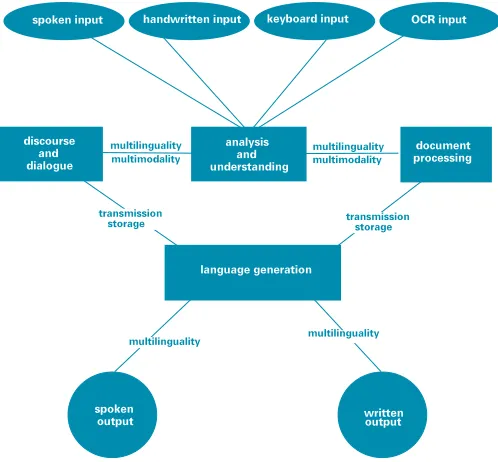
These components – what makes up a language machine – are broken down into the various steps of the technology: input of words (spoken or written); analysis; understanding; spoken output or text generation; dialogue; document processing; multilingual ability; multimodality; mathem-atical models; language resources; storage; transmission; and evaluation.
Figure 1 shows how these components interact: mathematical models, language resources, transmission, storage and evaluation modules can be called by any of the other elements.
what’s involved
input to output
multimodality multilinguality
analysis and understanding
language generation
document processing discourse
and dialogue
spoken input handwritten input OCR input
spoken
output writtenoutput
transmission storage
multilinguality multilinguality multimodality
multilinguality
keyboard input
[image:21.496.187.436.399.630.2]transmission storage
Figure 1: The essential components of a system defined as SALT – Speech And Language Technology
The components in this diagram are definitive of a SALT application: any true language machine must include one or more of these modules and any software system built on one or more of these components constitutes a language machine.
Language technologists work within each of these areas, and universities and funding agencies seek to support research activities here – these areas may also indicate the type of potential uses for the language machine that we can expect to emerge in the office workplace of the future.
Spoken language input The challenge of spoken language input is to take acoustic signals (the soundwaves of speech) and convert them into characters, words, and sentences that a computer can analyse. There are two approaches to handling spoken input:
* Speech recognition: this converts input spoken language into the standard computer text representation (Ascii characters) by ‘transcribing’ as faithfully as possible; * Speech understanding: extracts the ‘gist’ or ‘meaning’
underlying the input speech, passing these key words and concepts to another application.
Speech input ‘add-ons’ to word processors, such as IBM ViaVoice or Dragon NaturallySpeaking, use speech recog-nition to attempt faithful transcriptions of dictated speech.S
A speech understanding interface to a computer-based information system, on the other hand, may not need to transcribe every word as long as it can spot the key words and phrases of the query. In the example of a speech input/output Loebner prize contestant (pages 10, 24), for example, spotting the word ‘mother’ might trigger the response: ‘Tell me more about your family.’
Early speech recognition research systems were tuned to the voice of a specific user.S Nowadays, speech recognition systems are generally trained to expect standard American or British English, until or unless taught otherwise. Many can adapt to the pronunciation and accent of an individual speaker if that person has the patience to read out training sentences.
While speech recognisers can adapt their original language model, they can have particular difficulties where a user’s speech varies significantly from the standard model: pronunciation, heavy accents or varying styles of English as spoken by non-native learners can each affect recognition. Yet speech recognition systems have found educational uses: the ISLE system (see page 62) has a spoken language model based on British English, and aims to detect and diagnose non-native learners’ pronunciation
SSpeaking to books? The author’s
original manuscript for this book was prepared using IBM ViaVoice speech recognition software, rather than a traditional keyboard and mouse. The software had difficulty with the phrase ’ELT practitioners’, offering instead: eel teeth practitioners
reality practitioners the empty practitioners guilty practitioners ancillary Capriati
Speech recognition allows authors to dictate documents directly; grammar and style checkers can then be used to polish documents and bring to the author’s attention text that might benefit from more of their time.
SIBM’s UK speech recognition
research team was at one time led by a Yorkshireman, and some of their demonstrations featured this regional accent.
difficulties by highlighting specific phonemes where the learner deviates from the model.
Written or printed language input Another way to produce written text – or, rather, printed text – is to type it into a word processor, email or desktop publishing package. For many people, however, a lack of keyboard skills can make using a computer a daunting, slow or potentially embarrassing task. The text may also exist in typed or printed form, but the ‘electronic’ copy may not be available or in a usable file format.
To address these scenarios, language machines need techniques for recognising handwritten script and incorporating optical character recognition (OCR). In the case of OCR, text is scanned and the image is then interpreted and converted into an Ascii text file. Most OCR packages can be trained to recognise particular fonts or typefaces to reduce errors in interpretion: applying a spell-checker to the initial output will often further reduce transcription errors.
Handwritten text can present more daunting problems: few people’s handwriting is as consistent – or as clearly legible – as a typeface, and the recognition techniques must also take into account joining strokes and other variables.
Language analysis and understanding Whether language is input as speech, by scanning, in writing or typed via a keyboard, the next stage involves linguistic analysis of the character-sequences.
Words must be first identified in a computer dictionary using a ‘lemmatiser’, which computes the root (or lemma) for any input word. The dictionary may also be used by a part-of-speech tagger (see page 48), which computes the grammatical word-class of each word, and by a semantic tagger, which annotates each input word with a represen-tation of its ‘meaning’. A parser then adds grammatical phrase-structure to each input sentence. Generally, the system has to build a representation of the ‘semantics’ or meaning of each sentence. This representation is passed on to an application; in a database interface, for example, it
listen, analyse
understand
Medieval style or
machine stylus?
‘As a calligrapher, I was fascinated by the palm-top com-puter “assistants” that replaced a keyboard with a rectangular writing surface and stylus.
Despite 20 years experience as a calligrapher, and daily approving comments on the regularity and attractiveness of my handwriting, the successful use of these “assistants” alludes me. My hand-writing, according to exasperated sales staff and exhibitors, is ‘too good’ for the basic recognition techniques used by the machine. My classical italic hand joins too many of the letters for the “assistant” to readily distinguish them. Does a style of handwriting developed to remain legible at greater speed – so that court clerks could keep records of court proceedings in medieval Italy – have to be abandoned to help a machine?’ (Friedrich Sporle)
could be used as a query to retrieve information.
Linguists and language engineers have not yet been able to agree a standard set of part-of-speech tags, semantic tags, phrase-structure trees, or semantic representations to use in language analysis and annotation. As a result, the EU has funded research and development projects to try to agree standards (EAGLES and MATE: see Web references, page 62): examples of annotation at each level are available in the reports from these projects.
Language generation If the application calls for a reply or response in English, this response needs to be generated. Unless this subsystem can ‘know about’ and use grammar and meaning, it will be limited to simply producing ‘canned text’ or predefined sentences. The peacekeeper’s translator, for example (page 45), uses a speech recogniser for spoken English input, but the output translation is selected from a set of digitally pre-recordedphrases.S
Spoken output technologies A speech synthesiser converts Ascii text into spoken language output. This requires a variety of subsystems. A ‘text chunker’, for example, breaks running text into meaningful ‘chunks’ or ‘tone units’, telling the synthesiser where to insert pauses, raise or lower pitch, and so on in order to make the synthesised speech intelligible and easier to listen to.
Current speech synthesisers, such as BT Laureate, IBM ViaVoice Outloud and Home Page Reader, can output simple sentences and mimic a range of different speakers. Despite these advances, however, they can produce ‘unnatural’ intonation and occasional mispronunciations when attempting to deal with unrestricted natural
dialogue.S
Discourse and dialogue Some language machines attempt to combine language input and output to allow a ‘natural conversation’ or dialogue with the computer. This calls for a dialogue management system that includes all the above components, along with models of overall discourse structure, principles of pragmatics and so on, to ensure
S’Computerised voice
synthesisers often have a tendency to sound rather, well, robotic. For years, researchers have worked to improve such systems’ intonation so that it matches the “prosody” rules that people use to add grammatical meanings to strings of words – for example, the way that the pitch of a voice falls at the end of a sentence, or rises before a question-mark. But even the most well-spoken computers tend to sound bored, and their endless droning can irritate human listeners.’ (The Economist, February 27 1999 p. 96)
SMany researchers believe that
we’re more likely to be using natural speech input than listening to synthesised natural speech output: ‘One-chip multi-speaker voice recognition’ will be achieved before ‘voice synthesis quality is up to human standard’.
The BT Technology Calendar. (Pearson, 1997)
Language
smooth interaction. The ideal spoken dialogue system could meet the Turing Test (Turing 1950), designed to determine whether an AI system was truly ‘thinking’. Turing’s suggestion was that, if a human engaged a computer in conversation and the responses from the computer were indistinguishable from those of a human, the computer could be said to be thinking.S
Document processing Dialogue modelling is less relevant to written language, but systems for processing written texts do need other types of ‘overarching’ models: intelligent tools for text editing, retrieval, information extraction, summarisation, and so on. As word processors become increasingly sophisticated and incorporate these types of functionality, the boundaries between language machine and word processor are starting to blur. English language learners can clearly benefit from access to ‘language-aware’ functions in word processors, although they do need to be aware of their possible fallibility.
Multilinguality A machine translation (MT) system translates text from one language into another, and may even deal with spoken input or output. They may also involve language identification: determining which language is being used given a printed or spoken signal. Most research has concentrated on English and, to a lesser extent, other European languages. For languages and language-pairs that have no comprehensive machine-translation system, tools for machine-assisted machine-translation – such as bilingual dictionaries and term-banks – may be useful.
An obvious potential concern for language teachers and language professionals, such as interpreters and translators, is whether MT (and the language machine in a broader sense) could make language-learning – and hence language teachers – redundant.S
Current MT systems remain imperfect, and there are still many social, business and political situations in which being able to communicate directly in a shared language is greatly preferable to computer-mediated communication.
talk back
and translate
SThinking computers? The annual
Loebner Prize, evolved in part from Turing’s ideas, offers a prize for the ‘most human computer’. Contestants are currently limited to keyboard input and on-screen replies, but the longer-term aim of the contest is to progress to spoken dialogue input and replies – in effect, an English language conversation.
SRedundant? MT ‘only works well
with simplified source texts, or to produce a “gist” version ... of documents that, for economic reasons, would otherwise never be translated at all. There is certainly no prospect in the foreseeable future of human translators being made redundant by such systems!’ With Machine-Assisted Translation however: ‘the computer provides sophisticated aids to enhance the efficiency and consistency of the translation, but the human remains in charge and makes all the decisions.’ (Rothwell, 1998, describing the University of Leeds MA in Applied Translation Studies.)
Multimodality With rapid advances in multimedia computing, techniques for combining language with image, gesture, and facial movement are increasingly being explored. Many Web-based chat facilities now allow the use of cartoon figures, often referred to as ‘avatars’. These raise issues relating to role-play and the creation of online identities as much as language machine technology. Some speech synthesisers, for example IBM ViaVoice Outloud, provide a cartoon face to accompany the synthesised speech, so you can ‘see’ someone speaking to you.S
Manufacturers continue to search for likely new multimedia products to create and develop emergent markets. One example is BT’s domestic videophone, withdrawn from sale in 1999 due to lack of demand: the new Orange videophone is already planned for release.
The European dilemma …
In the 1980s, the EU funded the Eurotra project to develop a machine translation system for trans-lating between languages of member states. Much of the funding went to individual research centres in member states, along with a free hand to develop their theories. The result was a range of different system modules from different sites, based on different models or theories of language. While potentially interesting as a vehicle for comparisons between rival linguistic theories, it was arguably not a good engineering approach to issues such as algorithm and component reusability. Eventually, the EU bought in technology – Systran – developed outside the Eurotra project. For some researchers, Systran bore the stigma of being composed of a bundle of techniques that may have worked in practice but were not theoretically well founded. The EU, however, decided it was better to have an inelegant system that worked than an elegant one that didn’t.
… with no clear solution?
The translation demands for the European Commission are huge – the translation department, based in Luxembourg, now employs nearly 2000 staff. Not surprisingly, the centre continues to seek translation methods such as voice activation tech-niques, to take it into the future, with varying degrees of success:
‘The Commission has been developing machine translation techniques since 1976, and it now operates a machine translation procedure called EC/Systran, based on the product developed by Systran. “Any official in any of the European institutions can send his or her text for translation to this system by e-mail,” explains Mr. Theologitis. “Turnaround time for any document, virtually regardless of length, is around ten minutes.”’ Voice activitation trials, on the other hand, remain ‘inconclusive.’ (International Herald Tribune, January 25 1999)
SVirtual immortality?
Transmission and storage In the real world, applications have to deal with noisy environments, transmission over networks, and other signal processing difficulties. A specialist topic of research covers issues of speech coding and enhancement to reduce noise and transmission costs.
Mathematical methods Some theoretical techniques apply at several ‘levels’ in language machines: statistical lang-uage models or neural networks can ‘learn’ by being exposed to a corpus of exemplar language data. Machine learning based on mathematical pattern-matching models is, however, very different from human learning.
Evaluation Another overarching issue, touching all other sub-fields, is evaluation: comparison of rival systems in terms of accuracy, speed, and more intangible qualities such as ‘usefulness’ and ‘user acceptability’.
While quantitative evaluation (of aspects such as accuracy and speed) can be done using a ‘test corpus’, qualitative assessment calls for people to use the machine. Any valuable evaluation of language machine applications in language teaching, for example, calls for teachers and students. Although speed and accuracy of language-processing modules are important, the key concern must be whether people really feel that they benefit.S
knowledge
communication
Language resources: hundreds, thousands, millions – and growing
Many areas of research and development require large-scale resources, such as language corpora, lexical resources, and software tools and components. A major research issue relates to the collation of reusable, large-scale resources that can serve the needs of many different language machines. One of the first corpora, collected in the 1970s, was LOB – Lancaster-Oslo/Bergen – which contains one million words. Some 20 years on, the BNC – British National Corpus – was compiled, with one hundred million words. These much larger collections are called VLCs – Very Large Corpora.
For the speech and language technology researcher, such a text corpus can be used to ‘train’ a language machine: a machine-learning algorithm or program can be applied to the corpus for example, to extract a language model automatically. A text corpus may also be used to test a language machine and evaluate the coverage of its language model – for example, by counting how many sentences a grammatical analysis program can parse correctly.
Systran in the EU
See box page 25
Resources for developing the language machine
Spoken corpus resources
Recordings of words, sentences, scripted speech, spontaneous monologues, dialogues. Collations of written texts.
Part-of-speech word-tagged text (each word is annotated with a Part of Speech tag). Treebanks: sentences annotated with syntactic phrase structure.
Spoken corpora: digitised acoustic signal aligned to transcription.
Parallel corpora: English sentences aligned to translations in another language. Learner corpora: English learners’ text or speech with errors (pronunciation, spelling,
grammar, etc.) marked, and annotated with corrections.
Lattice corpora: the uncertain output of a speech recogniser, including a set of Ascii ‘candidates’ for each spoken word.
Parallel-annotated corpora: a single text sample annotated with several of the above levels of linguistic analysis.
Lexical resources
Wordlists for a wide range of languages.
Machine-readable dictionaries (MRDs): headwords, parts-of-speech, pronunciation, inflected forms, and meaning definitions.
Lexical resources tailored for specific systems, e.g. specialist terminology banks. Bilingual dictionaries for machine translation and computer-assisted translation. Lists of collocations, idioms, proverbs, compound terms, and so on.
Thesauri showing synonyms and other lexical relations. Wordnet: a network of semantic relationships between words.
Software tools and demonstrators
Lemmatiser: gives the root or lemma for any input word.
Part-of-speech tagger: gives the grammatical wordclass of each word in running text. Parser: adds grammatical phrase-structure to each input sentence.
Semantic tagger: annotates each input word with ‘meaning’ (e.g. from a dictionary). Concordancer: examples of selected keywords, as they appear in context in a corpus. Machine translator: translates text from one language into another.
Speech recogniser: converts input spoken language into Ascii text. Speech understander: extracts the ‘meaning’ underlying the input speech. Speech synthesiser: converts Ascii text into spoken language output.
Text chunker: breaks running text into meaningful ‘chunks’, for example, to make synthesised speech more intelligible.
What slows development?
There are several problems facing the researcher – and indeed the potential customer – for the language machine, some of which may continue to hold back the development of the technology well into the future. This section examines seven key problems.
Problem 1
The language machine is expensive
Speech and language technology has, in the past, had a reputation for requiring computers with powerful processors and large amounts of memory and disk storage space, allied to in-house research and development teams who develop and install language machines and integrate them into current systems.
This situation is now changing, thanks to rapid increases in computing technology. Much like advanced graphics and Internet access, technologies previously restricted to university research laboratories are increasingly available on home and office computers.
One concrete example of this is speech recognition technology. IBM, like many others, have used the basic algorithm used in speech recognition – known as Hidden Markov Modelling – since the 1970s. In the 1980s, they developed impressive speech recognition demonstrators in their research laboratories, although showing them at conferences and exhibitions required advanced computing hardware and speech research experts.
The same demonstration (or perhaps a more convincing one) now can be taken into small business premises, colleges, schools or homes – without the need for a researcher or a lorry full of hardware. You can buy a speech recognition package off the shelf, or may even get one free as a promotional item with a PC magazine.
This move, from research laboratories to everyday use,S
leaves some academic researchers feeling redundant. Speech recognition is no longer a technology research issue, as the theoretical problems are (supposedly) largely
The problems
with machines
solved. Further evidence of this trend is provided by the British EPSRCS responsible for providing funds for fundamental, theoretical research in UK universities. A recent policy discussion document on the future of research on Human Factors in Information Technology (EPSRC, 1998) proposes that university researchers can no longer make a useful contribution to speech technology theory, and that the EPSRC therefore should stop funding research in this field.
But even though some speech and language applications have reached the level of availability and price of everyday PC software, this is still beyond the reach of many language professionals.
Take, for example, English language teachers and learners in developing countries,S where class sizes of 50 to 100 students are common, and a blackboard with chalk is often a luxury. Even in Western schools, where computers are more commonly available, speech and language technology remains difficult to use in whole classroom teaching. Language machines are usually designed for an individual: a speech recogniser, for example, is limited to a single headset-microphone and using it in classroom situations is difficult beyond occasional demonstrations.
Manufacturers of CALL software that incorporates speech recognition – for example, Talk To Me (Auralog 1996), ISLE Interactive Spoken Language Education (ISLE, 1999) – recognise these difficulties and deliberately target individual language learners with home PCs rather than classroom groups. This development, alongside moves to greater learner autonomy and the increase in open learning approaches, may in time offer new ways of constructing the learning experience, while fundamentally changing the balance between classroom and individual learning. Inequality of home PC access may however become a pressing issue, and perhaps makes more important the role of study centres and librariesS offering access for all. In providing points of access to new technology, such centres may perhaps in the process reinvent themselves as technology junctions.
SEPSRC – Engineering and
Physical Science Research Council – is one of seven agencies funding research in UK universities. Its role is to promote and support strategic and applied research, advance knowledge and technology that contributes to economic competitiveness and life quality, and promote understanding in the fields of engineering and the physical sciences.
S‘Information technology is important in tackling social exclusion because anyone can walk in to a library, sit down and start tapping away – at absolutely no cost.’ – Chris Smith, the Secretary of State for Culture, Media and Sport. (The Independent, June 19 1999)
SCompare two countries: in 1998,
an IBM PC cost the same in London and Bucharest. Average monthly salaries in GBP: British – £1600
Romanian – £45
Problem 2
The language machine has been developed
without consultation
On the whole, developers have not asked users what they want from speech and language technology. Research has been driven by the interests of researchers rather than potential customers, and has tended to focus on tackling theoretically interesting problems rather than examining usefulness. In the past, for example, much computational linguistics research was led by linguists whose primary aim was to implement linguistic theories.
The EU learnt from its experience in the 1980s with the Eurotra project (box, page 25), and is now funding a pro-gramme of language engineering research where users must be consulted at all stages. In the case of the ISLE project, designed to respond to German and Italian learners’ pronunciation of English, teachers and learners have been involved at every stage, from initial drafting of research plan through to specification of requirements and verification of the final system. (ISLE project, see page 62)
Problem 3
The language machine doesn’t match the
expectations of customers
Some potential customers expect the language machine to be able to understand everything and to match human language-processing, even though people themselves often display a considerable talent for misunderstanding!
Although the language machine clearly falls well below human standardsS for language processing at present, there are a growing number of tasks for which it is arguably adequate. In practice, the best current machine translation systems are at least as good as a fairly competent second language learner. This may be quite acceptable for some tasks: imperfect translation may be adequate for the reader to gather the ‘gist’ of a text, or for a first draft to be polished and corrected by a professional, human translator.