Int. J. Electrochem. Sci., 8 (2013) 10163 - 10169
International Journal of
ELECTROCHEMICAL
SCIENCE
www.electrochemsci.org
Short Communication
Electrical properties of composite polymer electrolytes based on
PEO-SN-LiCF
3SO
3Rui Yang, Shichao Zhang*, Lan Zhang, Wenbo Liu*
School of Material Science and Engineering, Beihang University, Beijing, 100191, China
*
E-mail: [email protected]
Received: 23 May 2013 / Accepted: 3 July 2013 / Published: 1 August 2013
A composite polymer electrolyte (CPE) composed of poly (ethylene oxide) (PEO), succinonitrile (SN) and lithium trifluoromethanesulfonate (LiCF3SO3) was prepared to improve the ionic conductivity and
electrochemical stability of the PEO based solid state electrolyte. The dependence of conductivity of CPEs on temperature was measured, and a maximum room temperature (293 K) ionic conductivity of 7.0×10⁻⁴ S cm−1 was obtained for membrane, which is composed of PEO-SN-25wt% LiCF3SO3 and
dried at 30℃. Moreover, this CPE showed a high electrochemical stability potential of more than 5.0 V versus Li.
Keywords: composite polymer electrolyte; ionic conductivity; electrochemical stability window
1. INTRODUCTION
has been reported that in the plastic crystalline phase of highly polar SN, various salts can be dissolved to endow solid electrolytes with high ionic conductivity in a wide temperature range, and the ionic conductivity at 25℃ can reach 3×10⁻³ S cm-1 [10]. LiCF3SO3 is a bulky lithium salt, which exhibits
great charge delocalization favorable to ionic dissociation in solvating polymers such as PEO. Besides, it presents several significant advantages such as good mechanical stability and “plasticizing” effect (decreases the crystallinity of the host polymer and facilitates the transportation capability of ions) [12, 13]. Moreover, the PEO-LiCF3SO3-based CPEs showed broad electrochemical window [14]. Lizhen
Fan et.al [7-8, 15] investigated PEO-based system with SN as plasticizer, and they have done some preliminary job on the effect of LiCF3SO3 on PEO-SN systems.
Herein, we investigated the influence of LiCF3SO3 concentration on the structure, morphology,
and conductivity of the PEO: SN: LiCF3SO3 polymer electrolyte, and a high room temperature ionic
conductivity of 7.0×10⁻⁴
S cm-1 was obtained when the CPEs was dried at 30℃.
2. EXPERIMENTAL
The polymer electrolytes were prepared by a solution casting technique. Prior to use, PEO (Mw=1.0×10⁶
) and LiCF3SO3 (Aldrich) was vacuum-dried for 24 h at 50℃ and 120℃, respectively.
SN (Aldrich) was used without further purification. Anhydrous acetonitrile from Shanghai Chemical Regent Company were used as solvents.
The molar ratio of EO segments (repeating unit of PEO) to SN was fixed at 16:10 as the composites got suitable strength and flexibility [15]. Predetermined amount of LiCF3SO3, SN and PEO
were added into acetonitrile in sequence under intense stirring to form a uniform mixture at 30℃. And then, the mixture was cast onto a Teflon plate followed by the evaporation of the solvent in a dry box for 1 day. The final CPEs were obtained by further drying the as-prepared films in vacuum at 30℃ for 48 h. These procedures yielded translucent homogenous films of thickness of about 180 um, and the area of the sample is 1.55 cm2. The as-prepared CPEs were denoted as PEO-SN-x% (wt) LiCF3SO3, in
which “x” stood for the percentage of LiCF3SO3 to PEO (wt), which ranged from 0 to 30.
X-ray diffraction (XRD) patterns were recorded by a Rigaku-D/max 2400. Advance instrument equipped with Cu kα radiation (λ=1.5406 Å) performed at 40 kV and 40 mA. A scan rate of 5.0° min-1
in the range of 10-60° (2θ) was used to detect the crystallinity of CPEs.
Ionic conductivity of the CPEs was determined by electrochemical impedance spectroscopy (EIS). The film was sandwiched between two stainless steel (SS) electrodes to form a symmetrical SS/electrolyte/SS cell. The cell was placed into a high and low temperature test chamber. For each temperature, at least 1 hour were waited to reach the thermal equilibrium of the CPE before the impedance response was recorded. The impedance tests were carried out in the frequency range of 100 KHz to 10 Hz at the amplitude of 5 mV from 0 to 60℃ on IMe6 electrochemical interface software.
LiCF3SO3/(DOL+DME) (1:1, vol) electrolyte) sandwiched between. An IMe6 Electrochemical
Interface was used to run the voltammetry at a scan rate of 5 mV s-1.
3. RESULTS AND DISCUSSION
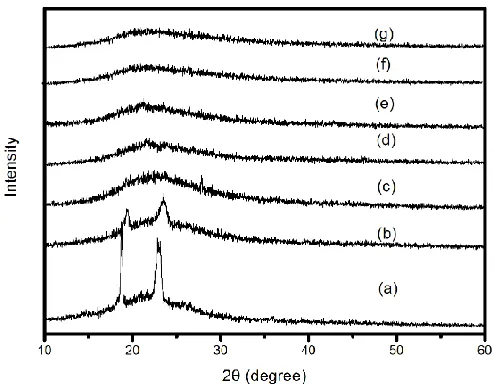
Figure 1. XRD pattern of (a-g) PEO-SN-x wt% LiCF3SO3 (x=0, 5, 10, 15, 20, 25, 30)
The XRD patterns of CPEs at room temperature are shown in Fig.1. The patterns of PEO-SN-x% (wt) LiCF3SO3 (x=0, 5, 10, 15, 20, 25, 30) membranes are presented by line a to g. It shows typical
XRD pattern of crystalline PEO (2θ=19 and 23.5°) [16] in line a and b. It can be observed that, in line c to g, with the concentration of LiCF3SO3 increasing, the intensity of the diffraction peaks becomes
weaker and broader, suggesting the decreasing in crystallinity of PEO, which may attribute to the coordination interactions between the ether O atoms of the PEO and Li+ which rooted in the dissociation of LiCF3SO3 into PEO-SN environment. Meanwhile, it also can be observed in the XRD
pattern that for the concentration of the LiCF3SO3 ranging from 10 to 30 wt%, there are no peaks
corresponding to LiCF3SO3 or PEO, which indicates the complete dissolution of salt in the amorphous
region of polymers and inhibit the crystallization of PEO-SN-x% (wt) LiCF3SO3 complexes. From
Fig.1, it can be seen that the samples with even 20-30 % (wt) of LiCF3SO3 have no diffraction peaks in
the XRD patterns, which is different from the previous work about the PEO-LiCF3SO3system [17].
This is probably due to the uniform disperse of both PEO and LiCF3SO3 into the composite system,
and the interaction between O atoms in PEO and Li atoms from the salt greatly reduced the crystallinity of them.
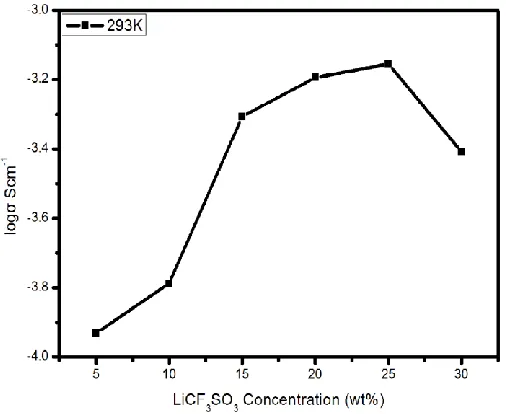
Fig.2 shows the comparison of conductivity of CPEs with different contents caused by the variation of salt concentration. It has been noticed in Fig.2 that the conductivity increases with the increasing content of LiCF3SO3 in the range of 5 % to 25 %. However, the conductivity declines when
the percentage of LiCF3SO3 keeps on increasing. The amount of LiCF3SO3 deeply affects the ionic
[image:3.596.173.420.167.359.2]
the ionic mobility and number of carrier ions when the lithium salt content is relatively low, as works have been reported [18, 19].
Figure 2. Effect of salt content on the conductivity of PEO-SN-x wt% LiCF3SO3 (x=5, 10, 15, 20, 25
and 30) complexes under different temperatures
Figure 3. Impedance plots of PEO-SN-25wt% LiCF3SO3 at different temperatures
While as the content of salt keeps on increasing, the build-up of charge carriers is offset by the retarding effect of ion aggregates such as ion pairs and ion triplet formation, which causes constraints in ionic and polymer segmental mobility [20]. Therefore, the conductivity reaches a max value at 25 wt% of LiCF3SO3, which shows a balance between these two opposing forces: increasing of the
[image:4.596.170.423.126.333.2] [image:4.596.161.431.408.607.2]
Ionic conductivities of the as-prepared CPEs under different temperature were measured, and the typical impedance plots of PEO-SN-25wt% LiCF3SO3 are shown in Fig.3. The plots show a spike
at the whole frequency region under the whole temperature range. The conductivity of the polymer electrolyte can be calculated from the equation σ= L/(AR), where A is the area of electrode, L is the thickness of the film, and R is the bulk resistance from ac impedance. Testing results show that, the PEO-SN-25wt% LiCF3SO3 exhibits an ionic conductivity (σ) of 7×10⁻⁴ S cm-1 at 293 K.
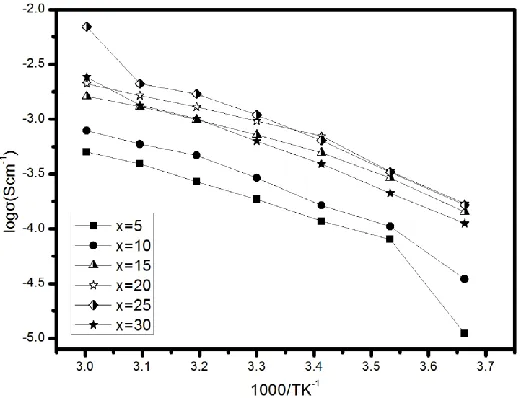
Figure 4. Temperature dependence of ionic conductivity of PEO-SN-x wt% LiCF3SO3 (x =5, 10, 15,
20, 25 and 30).
Fig.4 shows the temperature dependence of ionic conductivity of PEO-SN-x wt% LiCF3SO3 (x
=5, 10, 15, 20, 25 and 30). The ionic conductivity of PEO-SN-x wt% LiCF3SO3 is measured from 0 to
80 °C, as outlined in Fig.4. The overall conductivity increases with the increasing content of LiCF3SO3
in the range of 5% to 25%, especially under room temperature, while such effects were rather limited at higher temperatures. Particularly, for x=25 and x=30, the conductivity shows a sharp increase from 323 to 333 K, which may cause by the melt of SN [10]. PEO-SN-25wt% LiCF3SO3 features ionic
conductivity of 7.0×10⁻⁴S cm-1 at 20°C, increased almost by one order of magnitude compared to the PEO-SN-5wt% LiCF3SO3 system. At 60 °C, we can see from Fig.4 that the PEO-SN-25wt%
LiCF3SO3 CPEs has conductivity greater than 10−3S cm-1, showing an enhancement of about 10 times
that of PEO-SN-5wt% LiCF3SO3.
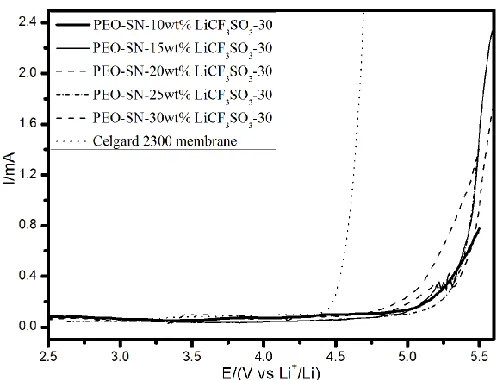
Electrochemical stability window of the polymer electrolyte was obtained by linear voltage sweep. Fig.5 displays the linear voltage sweep curves of Celgard 2300 membrane doped liquid electrolyte and PEO-SN-25wt% LiCF3SO3 CPE at room temperature. The irreversible onset of the
[image:5.596.166.426.203.402.2]
decreases with LiCF3SO3 content and exceed 4.8 V vs. Li even though the content of LiCF3SO3 is 10
wt%.
Figure 5. Current–voltage response of Celgard 2300 membrane and PEO-SN-x wt% LiCF3SO3 (x=10,
15, 20, 25, 30) composite polymer electrolyte obtained at room temperature.
The as-prepared PEO-SN-LiCF3SO3 CPE shows a wider electrochemical stable window than
LiPF6/EC+DEC (1:1, vol) electrolyte with Celgard 2300 membrane, therefore, it may be able to be
used as candidate electrolyte in rechargeable lithium batteries whose working voltage is higher than 4.5 V versus Li.
4. CONCLUSION
The PEO-SN-LiCF3SO3 CPEs films were prepared with various compositions by solution
casting method. The addition of LiCF3SO3 can reduce the crystallinity of the composites effectively. A
maximum conductivity of 7.0×10⁻⁴
S cm-1 at 293 K was obtained for the PEO-SN-25wt% LiCF3SO3,
and it increased with increasing measuring temperature. The electrochemical stability window of the PEO-SN-25wt% LiCF3SO3 exceeds 5.2 V versus Li. The high decomposition voltage enables the
present CPEs as candidate electrolyte materials for solid-state rechargeable lithium batteries.
ACKNOWLEDGEMENTS
This work was supported by the National Basic Research program of China (973 Program, 2013CB934001), the National Natural Science Foundation of China (51274017, 51074011), the National 863 Program of China (2011AA11A257, 2008AA03Z208), and the Shanghai Aerospace Science and Technology Innovation Fund Project (SAST201269).
References
[image:6.596.174.424.129.319.2]
2. P. V. Wright, Br. Polym. J. 7 (1975) 319.
3. F. Croce, G. B. Appetecchi, L. Persi, B. Scrosati, Nature 394 (1998) 456.
4. C. Berthier, W. Gorecki, M. Minier, M. B. Armand, J. M. Chabagno, P. Rigaud, Solid State Ionics 11 (1983) 91.
5. F. Croce, R. Curini, A. Martinelli, L. Persi, F. Persi, F. Ronsi, B. Scrosati, J. Phys. Chem. B 103 (1999) 10632.
6. H. M. Xiong, X. Zhao, J. S. Chen, J. Phys. Chem. B 105 (2001) 10169.
7. L. Z. Fan, Y. S. Hu, A. J. Bhattacharyya, J. Maier, Adv. Funct. Mater. 17 (2007) 2800. 8. L. Z. Fan, J. Maier, Electrochem. Commun. 8 (2006) 1753.
9. S. Das, S. J. Prathapa, P. V. Menezes, T. N. G. Row, A. J. Bhattacharyya, J. Phys. Chem. B 113 (2009) 5025.
10.P. J. Alarco, Y. Abu-Lebdeh, A. Abouimrane, M. Armand, Nat. Mater. 3 (2004) 476.
11.X. L. Wu , S. Xin , H. H. Seo , J. Kim, Y. G. Guo, J. S. Lee, Solid State Ionics 186 (2011) 1. 12.W. Cheung, K. B. Chin, E. R. Greene, M. C. Smart, S. Abbrent, S. G. Greenbaum, G. K. S.
Prakash, S. Surampudi, Electrochim. Acta 48 (2003) 2149
13.M. Armand, W. Gorecki, R. Andreani, in: B. Scrosati (Ed.), Proceedings of the Second International Conference on Polymer Electrolytes, Elsevier, New York, 1990, p. 91. 14.A. Vallee, S. Besner, J. Prud’Homme, Electrochim. Acta 37 (1992) 1579.
15.L. Z. Fan, X. L. Wang, F. Long, X. Wang, Solid State Ionics 179 (2008) 1772.
16.J. Ulanski, P. Polanowski, A. Traiez, M. Hofmann, E. Dormann, E. Lauhina, Synthetic Metals 94 (1998) 23.
17.N. K. Karan, D. K. Pradhan, R. Thomas, B. Natesan, R. S. Katiyar, Solid State Ionics 179 (2008) 689.
18.S. H. Kim, J. Y. Kim, H. S. Kim, H. N. Cho, Solid State Ionics 116 (1999) 63.
19.Y. W. Chen-Yang, H. C. Chen, F. J. Lin, C. W. Liao, T. L. Chen, Solid State Ionics 156 (2003) 383.
20.M. Ulaganathan, S. S. Pethaiah, S. Rajendran, Materials Chemistry and Physics 129 (2011) 471. 21.S. Rajendran, M. Sivakumar, R. Subadevi, J. Power Sources 124 (2003) 225.