Open Access
BMC Infectious Diseases 2002,
2 x
Research article
Characterisation of silent and active genes for a variable large
protein of Borrelia recurrentis
Vincent Vidal
1,4
, Sally Cutler*
2
, Ian G Scragg
1,5
, David JM Wright
3
and
Dominic Kwiatkowski
1
Address: 1Molecular Infectious Disease Group, Weatherall Institute of Molecular Medicine, Oxford, 2Department of Bacterial Diseases, Veterinary Laboratory Agency, Addlestone, Surrey, 3Cell & Molecular Biology, Imperial College of Science, Technology and Medicine, South Kensington campus, London, 4ISTAC SA, campus IPL, 1 rue du professeur Calmette, F59000, Lille, France and 5University of Dundee, Dundee, DD1 4HN, UK
E-mail: Vincent Vidal - [email protected]; Sally Cutler* - [email protected]; Ian G Scragg - [email protected]; David JM Wright - [email protected]; Dominic Kwiatkowski - [email protected]
*Corresponding author
Abstract
Background: We report the characterisation of the variable large protein (vlp) gene expressed
by clinical isolate A1 of Borrelia recurrentis; the agent of the life-threatening disease louse-borne relapsing fever.
Methods: The major vlp protein of this isolate was characterised and a DNA probe created. Use
of this together with standard molecular methods was used to determine the location of the vlp1B. recurrentis A1 gene in both this and other isolates.
Results: This isolate was found to carry silent and expressed copies of the vlp1B. recurrentis A1 gene on plasmids of 54 kbp and 24 kbp respectively, whereas a different isolate, A17, had only the silent
vlp1B. recurrentis A17 on a 54 kbp plasmid. Silent and expressed vlp1 have identical mature protein coding regions but have different 5' regions, both containing different potential lipoprotein leader sequences. Only one form of vlp1 is transcribed in the A1 isolate of B. recurrentis, yet both 5' upstream sequences of this vlp1 gene possess features of bacterial promoters.
Conclusion: Taken together these results suggest that antigenic variation in B. recurrentis may
result from recombination of variable large and small protein genes at the junction between lipoprotein leader sequence and mature protein coding region. However, this hypothetical model needs to be validated by further identification of expressed and silent variant protein genes in other
B. recurrentis isolates.
Background
Expression of a variant surface antigen is utilised by a wide variety of pathogenic micro-organisms to evade the im-mune defences of the host, thereby prolonging the dura-tion of infecdura-tion and increasing the likelihood of transmission. In the early part of the last century
micro-biologists first observed this process in relapsing fever caused by Borreliae as the spirochaetes recovered from each relapse differed serologically. The classical molecular description of this phenomenon comes from studies of Borrelia hermsii, an aetiologic agent of tick-borne relapsing fever. Variable major proteins are the dominant surface
Published: 14 October 2002
BMC Infectious Diseases 2002, 2:25
Received: 12 August 2002 Accepted: 14 October 2002
This article is available from: http://www.biomedcentral.com/1471-2334/2/25
antigen [1], which are involved in evasion of the host's immune system as Borreliae emerging at each relapse ex-press a different antigenic form [2]. Detailed molecular analysis has revealed that the corresponding genes are ar-ranged into silent and expressed copies on different plas-mids [3,4]. Antigenic variation occurs by replacement of the entire open reading frame of the expressed gene by a previously silent one, or by activation of a previously si-lent downstream gene [3–8]. Recently the variant major proteins, formerly denoted Vmp, have been divided into two groups based on size, namely the variant large pro-teins (encoded by vlp genes of typical size 1 kbp) and var-iant small proteins (encoded by vsp genes of typical size 0.6 kbp).
The present study considers the related organism B. recur-rentis, the causative agent of louse-borne relapsing fever (LBRF). LBRF is a systemic inflammatory disease, which, if untreated, is associated with mortality rates of up to 40% [9]. This is reduced to 2–4% by use of antibiotics. Al-though the disease is relatively localised at present, with an endemic focus in Ethiopia, the potential for epidemics remains. Indeed the most recent outbreak occurred in the Sudan [10]. The disease is characterised by high fevers due to production of inflammatory mediators by the host in response to spirochaetal toxins [11,12]. It has been shown that the major pro-inflammatory molecule of B. recurren-tis clinical isolate A1 is highly homologous to Vlp12B. hermsii HS1, and is here referred to as Vlp1B. recurrentis A1[13]. Studies of the molecular biology of B. recurrentis have been hampered by the lack of an animal model. The first cultivation of a clinical isolate in vitro was achieved in 1993 [14] and to date eighteen clinical isolates have been characterised by their plasmid profile and by the expres-sion of a putative Vlp or Vsp [15]. As the first step to study antigenic variation in B. recurrentis, we report the com-plete organisation and characterisation of vlp1B. recurrentis A1 gene coding for the variant surface antigen of this iso-late.
Methods
Borrelia recurrentis isolates
Isolates A1 and A17 from Ethiopian patients with LBRF and were subcultured in vitro as previously described [14,15]. There was no change in protein profiles or plas-mid DNA banding patterns during this investigation com-pared with those observed for each isolate following original isolation from patients described previously [14,15].
Nucleic acid purification
Plasmid and chromosome-rich DNA fractions were pre-pared as described [30]. Total RNA was purified using the
TRI Reagent method [31] (Sigma) and resuspended in RNase-free water.
Probe labelling
The 715 bp PCR product amplified from part of the ex-pressed vlp1B. recurrentis A1 gene [13] was labelled with α32P-dCTP by random-priming (Amersham-Pharmacia
Biotech). Oligonucleotide probes (LLS1, CACCA CTAT-CATCATCATCAAT and LLS2, TCATCACCATCACCAG-CACC) were labelled with γ32P-ATP by enzymatic
phosphorylation with polynucleotide kinase (Roche Mo-lecular Biochemicals; the sequences corresponding to the probes LLS1 and LLS2 are double-underlined in Fig. 2). All radioactive probes were purified (Chromaspin-10, Clontech) prior to hybridisation.
Library construction and screening
Plasmid DNA from isolate A1 was digested to completion with HindIII. Fragments of relevant sizes were gel purified using QIAEXII kit (Qiagen) and ligated in pBluescript lin-earised with HindIII. A portion of the ligation reaction was used to transform library efficient E. coli DH5α strain (GIBCO-BRL). Colonies were lifted onto Hybond-N membranes (Amersham-Pharmacia Biotech) and hybrid-ised at high stringency with the 715 bp vlp1 probe as de-scribed [32]. After a second round of screening, positive clones were sequenced on an ABI377 automated sequenc-er using BigDye Tsequenc-erminator (Applied Biosystem). Se-quences were assembled and analysed using the Wisconsin Genetics Computer Group, Madison, WI soft-ware package.
Southern hybridisation
Eight hundred nanograms of DNA were digested with a range of restriction enzymes. Digestion products were fractionated on a 1% agarose TAE gel. After electrophore-sis the gel was treated as described [32] prior to capillary transfer onto Hybond-N membranes (Amersham-Phar-macia Biotech) in 10 × SSC overnight. Following UV-crosslinking, blots were hybridised in Rapid-Hyb solution (Amersham-Pharmacia Biotech) and washed using high stringency conditions (0.5 × SSC/0.1% SDS and 0.1 × SSC/0.1% SDS at 65°C each for 15 minutes).
Field inversion gel electrophoresis
One microgram of plasmid DNA from isolates A1 or A17 were separated by field inversion gel electrophoresis on a 1% agarose, 0.5 × TBE gel using the predefined pro-gramme P1 to separate DNA fragments between 150 kbp and 5 kbp (Biorad).
Northern hybridisation
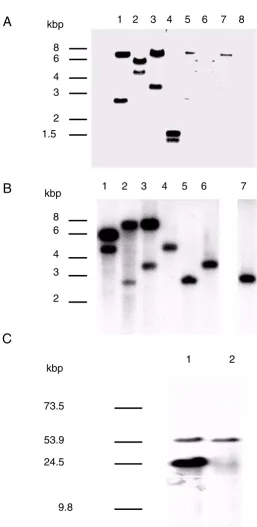
UV-crosslink-Figure 1
vlp1B. recurrentis A1 is plasmid encoded and duplicated in isolate A1. A: Plasmid (lane 1 to 4) and chromosome-rich (lane
5 to 8) DNA were digested with EcoRI (lane 1 and 5), HindIII (lane 2 and 6), XbaI (lane 3 and 7), and DraI (lane 4 and 8), trans-ferred to a membrane and hybridised under high stringency with the 715 bp vlp1 probe. B: Plasmid DNA from isolate A1 (lane 1 to 3) and isolate A17 (lanes 4 to 6) and total DNA from isolate A17 (lane 7) were digested with HindIII (lane 1 and 4), EcoRI (lane 2, 5, and 7), XbaI (lane 3 and 6), and treated as described above. C: Intact plasmids from isolate A1 (lane 1) and isolate A17 (lane 2) were separated by field inversion gel electrophoresis (predefined program P1, Biorad) and treated as described above.
A
B
C
1 2 3 4 5 6 7 8
8 6 4 3
2 1.5
kbp
1 2
9.8 24.5 53.9 73.5 kbp
1 2 3 4 5 6 7
8 6
4 3
[image:3.612.154.411.95.622.2]Figure 2
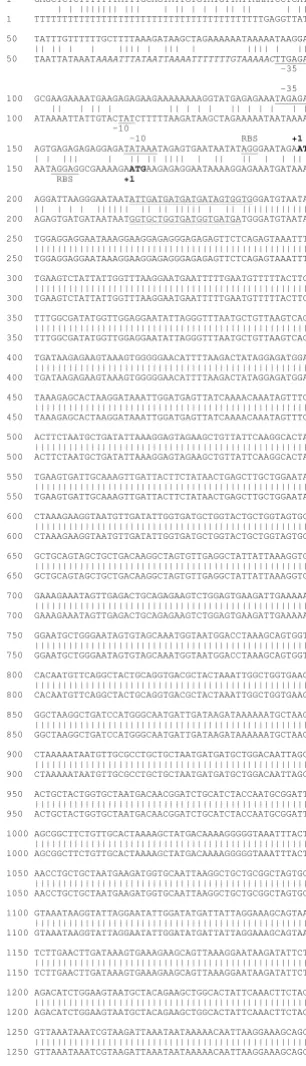
Ungapped DNA sequence alignment of the two forms of vlp1B. recurrentis A1 The upper row represents the sequence
derived from the slower migrating 54 kbp plasmid of figure 1C. The sequence corresponding to the UP element consensus found in the bottom row sequence is italicised. The putative '-35' and '-10' elements and ribosome binding sites are underlined. Translation start sites are shown in bold. Region complementary to LLS1 and LLS2 probes are double-underlined. Accession number for both sequences are given in the methods section.
1 GAGCTCTCTTTTTTTATTTGCAGTATTGTGTATGTTATTAAATCCTCATT | | ||||||| ||| | || | | | || || | ||| 1 TTTTTTTTTTTTTTTTTTTTTTTTTTTTTTTTTTTTTTTTTGAGGTTATT 50 TATTTGTTTTTTGCTTTTAAAGATAAGCTAGAAAAAATAAAAATAAGGAG || || | | |||| | ||| | |||| | || 50 TAATTATAAATAAAATTTATAATTAAAATTTTTTTGTAAAAACTTGAGAA
-35 -35 100 GCGAAGAAAATGAAGAGAGAAGAAAAAAAAGGTATGAGAGAAATAGAGAG || | || | || | | | || | | | | | 100 ATAAAATTATTGTACTATCTTTTTAAGATAAGCTAGAAAAATAATAAAAA
-10
-10 RBS +1 150 AGTGAGAGAGAGGAGATATAAATAGAGTGAATAATATAGGGAATAGAATG | | ||| | || || |||| | || || | | || 150 AATAGGAGGCGAAAAGAATGAAGAGAGGAATAAAAGGAGAAATGATAAAT RBS +1
200 AGGATTAAGGGAATAATATTGATGATGATGATAGTGGTGGGATGTAATAG || | | | |||||| || || ||||| | || ||||||||||||| 200 AGAGTGATGATAATAATGGTGCTGGTGATGGTGATGATGGGATGTAATAG 250 TGGAGGAGGAATAAAGGAAGGAGAGGGAGAGAGTTCTCAGAGTAAATTTT |||||||||||||||||||||||||||||||||||||||||||||||||| 250 TGGAGGAGGAATAAAGGAAGGAGAGGGAGAGAGTTCTCAGAGTAAATTTT 300 TGAAGTCTATTATTGGTTTAAGGAATGAATTTTTGAATGTTTTTACTTCT |||||||||||||||||||||||||||||||||||||||||||||||||| 300 TGAAGTCTATTATTGGTTTAAGGAATGAATTTTTGAATGTTTTTACTTCT 350 TTTGGCGATATGGTTGGAGGAATATTAGGGTTTAATGCTGTTAAGTCAGA |||||||||||||||||||||||||||||||||||||||||||||||||| 350 TTTGGCGATATGGTTGGAGGAATATTAGGGTTTAATGCTGTTAAGTCAGA 400 TGATAAGAGAAGTAAAGTGGGGGAACATTTTAAGACTATAGGAGATGGAT |||||||||||||||||||||||||||||||||||||||||||||||||| 400 TGATAAGAGAAGTAAAGTGGGGGAACATTTTAAGACTATAGGAGATGGAT 450 TAAAGAGCACTAAGGATAAATTGGATGAGTTATCAAAACAAATAGTTTCG |||||||||||||||||||||||||||||||||||||||||||||||||| 450 TAAAGAGCACTAAGGATAAATTGGATGAGTTATCAAAACAAATAGTTTCG 500 ACTTCTAATGCTGATATTAAAGGAGTAGAAGCTGTTATTCAAGGCACTAG |||||||||||||||||||||||||||||||||||||||||||||||||| 500 ACTTCTAATGCTGATATTAAAGGAGTAGAAGCTGTTATTCAAGGCACTAG 550 TGAAGTGATTGCAAAGTTGATTACTTCTATAACTGAGCTTGCTGGAATAA |||||||||||||||||||||||||||||||||||||||||||||||||| 550 TGAAGTGATTGCAAAGTTGATTACTTCTATAACTGAGCTTGCTGGAATAA 600 CTAAAGAAGGTAATGTTGATATTGGTGATGCTGGTACTGCTGGTAGTGCT |||||||||||||||||||||||||||||||||||||||||||||||||| 600 CTAAAGAAGGTAATGTTGATATTGGTGATGCTGGTACTGCTGGTAGTGCT 650 GCTGCAGTAGCTGCTGACAAGGCTAGTGTTGAGGCTATTATTAAAGGTGT |||||||||||||||||||||||||||||||||||||||||||||||||| 650 GCTGCAGTAGCTGCTGACAAGGCTAGTGTTGAGGCTATTATTAAAGGTGT 700 GAAAGAAATAGTTGAGACTGCAGAGAAGTCTGGAGTGAAGATTGAAAAAG |||||||||||||||||||||||||||||||||||||||||||||||||| 700 GAAAGAAATAGTTGAGACTGCAGAGAAGTCTGGAGTGAAGATTGAAAAAG 750 GGAATGCTGGGAATAGTGTAGCAAATGGTAATGGACCTAAAGCAGTGGTT |||||||||||||||||||||||||||||||||||||||||||||||||| 750 GGAATGCTGGGAATAGTGTAGCAAATGGTAATGGACCTAAAGCAGTGGTT 800 CACAATGTTCAGGCTACTGCAGGTGACGCTACTAAATTGGCTGGTGAAGT |||||||||||||||||||||||||||||||||||||||||||||||||| 800 CACAATGTTCAGGCTACTGCAGGTGACGCTACTAAATTGGCTGGTGAAGT 850 GGCTAAGGCTGATCCATGGGCAATGATTGATAAGATAAAAAATGCTAAGA |||||||||||||||||||||||||||||||||||||||||||||||||| 850 GGCTAAGGCTGATCCATGGGCAATGATTGATAAGATAAAAAATGCTAAGA 900 CTAAAAATAATGTTGCGCCTGCTGCTAATGATGATGCTGGACAATTAGCT |||||||||||||||||||||||||||||||||||||||||||||||||| 900 CTAAAAATAATGTTGCGCCTGCTGCTAATGATGATGCTGGACAATTAGCT 950 ACTGCTACTGGTGCTAATGACAACGGATCTGCATCTACCAATGCGGATTT |||||||||||||||||||||||||||||||||||||||||||||||||| 950 ACTGCTACTGGTGCTAATGACAACGGATCTGCATCTACCAATGCGGATTT 1000 AGCGGCTTCTGTTGCACTAAAAGCTATGACAAAAGGGGGTAAATTTACTC |||||||||||||||||||||||||||||||||||||||||||||||||| 1000 AGCGGCTTCTGTTGCACTAAAAGCTATGACAAAAGGGGGTAAATTTACTC 1050 AACCTGCTGCTAATGAAGATGGTGCAATTAAGGCTGCTGCGGCTAGTGCA |||||||||||||||||||||||||||||||||||||||||||||||||| 1050 AACCTGCTGCTAATGAAGATGGTGCAATTAAGGCTGCTGCGGCTAGTGCA 1100 GTAAATAAGGTATTAGGAATATTGGATATGATTATTAGGAAAGCAGTAAA |||||||||||||||||||||||||||||||||||||||||||||||||| 1100 GTAAATAAGGTATTAGGAATATTGGATATGATTATTAGGAAAGCAGTAAA 1150 TCTTGAACTTGATAAAGTGAAAGAAGCAGTTAAAGGAATAAGATATTCTG |||||||||||||||||||||||||||||||||||||||||||||||||| 1150 TCTTGAACTTGATAAAGTGAAAGAAGCAGTTAAAGGAATAAGATATTCTG 1200 AGACATCTGGAAGTAATGCTACAGAAGCTGGCACTATTCAAACTTCTACT |||||||||||||||||||||||||||||||||||||||||||||||||| 1200 AGACATCTGGAAGTAATGCTACAGAAGCTGGCACTATTCAAACTTCTACT 1250 GTTAAATAAATCGTAAGATTAAATAATAAAAACAATTAAGGAAAGCAGCG |||||||||||||||||||||||||||||||||||||||||||||||||| 1250 GTTAAATAAATCGTAAGATTAAATAATAAAAACAATTAAGGAAAGCAGCG
1300 TCATCTTTATGCATGAGAGTTGTTTTCCTTTTTTGTATTTTATTATGTCT |||||||||||||||||||||||||||||||||||||||||||||||||| 1300 TCATCTTTATGCATGAGAGTTGTTTTCCTTTTTTGTATTTTATTATGTCT 1350 CGTTGCAACATTTATTATTTTTTTATTTATCATGTGCTAATAATAAATCT |||||||||||||||||||||||||||||||||||||||||||||||||| 1350 CGTTGCAACATTTATTATTTTTTTATTTATCATGTGCTAATAATAAATCT 1400 GGAGTTCTGGCTACTGCTATTGCGGCTGCTAATAGTAGTACTGGTGCAGC |||||||||||||||||||||||||||||||||||||||||||||||||| 1400 GGAGTTCTGGCTACTGCTATTGCGGCTGCTAATAGTAGTACTGGTGCAGC 1450 TACTAATGCGGATCTAGCAGCAGCAGTAGCTCTTAAAGCCAATTACTAAA |||||||||||||||||||||||||||||||||||||||||||||||||| 1450 TACTAATGCGGATCTAGCAGCAGCAGTAGCTCTTAAAGCCAATTACTAAA 1500 ACTGGTAAATTTAGTGATGCTGCTAATGATGTTGGAGCAGTTAAGGCAGC |||||||||||||||||||||||||||||||||||||||||||||||||| 1500 ACTGGTAAATTTAGTGATGCTGCTAATGATGTTGGAGCAGTTAAGGCAGC 1550 AGCAACAAGTGCAGTCAATAAGGTATTAGGAATACTTAATTTAATAATTA |||||||||||||||||||||||||||||||||||||||||||||||||| 1550 AGCAACAAGTGCAGTCAATAAGGTATTAGGAATACTTAATTTAATAATTA 1600 GGAAAACAGTAAGTATTAATATAAATAAGATAAGATAAGAGAAGCTGTTA |||||||||||||||||||||||||||||||||||||||||||||||||| 1600 GGAAAACAGTAAGTATTAATATAAATAAGATAAGATAAGAGAAGCTGTTA 1650 AGGGAATACAGTACTCTGAAACAGTTGGAGCTAATTTAAACCGAAGCTT
ing, blots were hybridised in Rapid-Hyb solution (Amersham-Pharmacia Biotech) and washed using high stringency. When labelled oligonucleotides were used as probes, hybridisations were carried out at 1°C below the calculated melting temperature.
Database accession numbers
Expressed vlp1B. recurrentis A1: AJ237608; Silent vlp1B. recur-rentis A1: AJ237609.
Results
vlp1B. recurrentis A1 is plasmid encoded
A probe encoding a 715 bp portion of the expressed vlp1B. recurrentis A1, generated by microsequencing [13] was used to characterise vlp1 in two distinct B. recurrentis isolates. Plasmids and chromosome-rich extracts from isolate A1 were digested with several restriction endonucleases. This was followed by Southern hybridisation with the 715 bp vlp1 probe. Restriction enzymes that do not cleave the re-gion of DNA encompassing the hybridisation probe were used.
As shown in figure 1A, two bands were detected in the plasmid extract under high stringency hybridisation con-ditions. A third band of 43 kbp was observed at lower stringency conditions (data not shown). In contrast, the chromosomal-rich extract gave only weak hybridisation signals, probably caused by contaminating plasmid DNA. When the same experiment was performed on total and plasmid DNA from isolate A17 under high stringency, only one band could be detected (fig. 1B; lane 4 to 7). To confirm these findings, plasmids from both isolates were separated using field inversion gel electrophoresis (FIGE). Ethidium bromide staining revealed six major plasmid species in the range of 10 to over 100 kbp (not shown). Hybridisation under high stringency with the vlp1 probe detected a common band between isolate A1 and A17 corresponding to a plasmid of about 54 kbp (fig. 1C). This was also detected by the vlp1 probe in 10 further isolates possessing the 54 kbp plasmid. However, an extra band was detected in isolate A1 corresponding to a plas-mid of about 24 kbp. Similarly, this 24 kbp band was also present in three other isolates falling into the same group of B. recurrentis[15]. Densitometry analysis showed that the signal intensity of the 24 kbp plasmid was about 3 to 4 times higher than the intensity given by the 54 kbp plas-mid. These results show that vlp1B. recurrentis is plasmid-en-coded and in isolate A1 the two vlp1 loci are localised on different plasmids. These results also raise the possibility that silent and expressed copies of vlp1 are present in B. re-currentis A1, whereas isolate A17 possesses only the silent copy.
Sequence of the vlp1B. recurrentis A1 loci
To investigate further the vlp1B. recurrentis loci we screened a partial library of isolate A1 plasmid DNA with the vlp1 probe. Positive clones of two different sizes were ob-tained, corresponding to thevlp1 loci carried on the 54 and 24 kbp plasmids depicted in figure 1C. The ungapped alignment of the two copies of vlp1B. recurrentis A1 is present-ed in figure 2; sequence 1 is derivpresent-ed from the slower mi-grating 54 kbp plasmid. Overall these two sequences are about 65% A/T rich in keeping with the low G/C content of borrelial DNA [16]. There is an extensive region (1461 bp) of strict identity that starts in the vlp1B. recurrentis open reading frame and extends beyond the stop codon. An ad-ditional feature of this region is the presence downstream of the open reading frame starting at nt1385 of a 300 bp segment that possesses 73% identity with the vlp1B. recur-rentis A1 gene itself. Analysis of the translated sequences showed that the N-terminal component is not conserved, the identity between the two sequences starts one residue before the unique cysteine. Both N-terminal sequences code for a putative lipoprotein leader signal sequence [17,18], consistent with the finding that Vlp1B. recurrentis A1 has a lipid modification [13]. The divergence in the 5' end of the vlp1 coding region extends upstream where the two sequences are highly dissimilar. Interestingly, the up-stream region of sequence 2 is richer in pyrimidine than that of sequence 1 (pyrimidine content of 59% and 34% respectively). However, both upstream regions possess a potential ribosome binding site and imperfect -10 and -35 regions, the consensus recognition site for σ 70 RNA polymerase. In addition sequence 2 has a nearly perfect consensus UP element [19], the binding site for the C-ter-minal domain of the RNA polymerase, and an unusually long uninterrupted tract of 42 dT. Of note, another poten-tial translational start is found in sequence 2 at nucleotide 191, with the -10 region starting at position 141 (not shown).
Taken together these results show that the two vlp1B. recur-rentis A1 genes code for the same mature protein but have a different lipoprotein leader sequence. In addition, the presence of putative promoter features in upstream re-gions of both genes leaves the question of silent and ex-pressed copies unresolved.
vlp1B. recurrentis is organised into silent and expressed
cop-ies
Figure 3
vlp1B. recurrentis A1 is organised into silent and expressed copies. Total RNA from isolates A1 and A17 were separated
on an agarose gel, blotted to a membrane and hybridised with specific probes. A: 715 bp vlp1; B: LLS1-specific probe; C: LLS2-specific probe
2.6
1.9
1.4
0.96
0.62
0.28
A
1
17
A
A
1
17
A
A
1
17
A
A
B
C
isolate A1, but not in A17. No signal was detected when the oligonucleotide probe LLS1 specific for leader se-quence 1 was used. In contrast, the LLS 2 specific probe detected a 1.2 kb RNA corresponding to vlp1B. recurrentis A1 message only in RNA extracted from isolate A1. Of note, probe LLS2 detected a message of about 800 b only in iso-late A17 RNA. These results demonstrate that there is a si-lent and expressed copy of vlp1 in B. recurrentis A1; sequence 2 in figure 2 representing the expressed copy of vlp1B. recurrentis A1.
Discussion
The dominant surface antigen of Borrelia is a variant pro-tein encoded by a large repertoire of genes, only one of which is expressed at anyone time. In contrast to other borreliae, the study of antigenic variation in B. recurrentis has been hampered by the lack of an animal model of in-fection. Isolates can only be recovered from patients and further characterised in vitro. Nevertheless, as the first step to better understand this phenomenon, we report the first complete characterisation of vlp1B. recurrentis A1 gene from a clinical isolate. This gene has common features with vari-ant protein genes from other Borrelia species but has some intriguing features.
In isolate A1, which expresses the Vlp1B. recurrentis A1 pro-tein [13,15], there are two copies of vlp1B. recurrentis A1, one on a 54 kbp plasmid and the other on a 24 kbp plasmid. This is reinforced by the observation of hybridisation with these two plasmids and the 715 bp vlp1 probe in other A1 group members (isolates A2–A4) [15]. The third plasmid, which hybridised at lower stringency, may carry an A1-like, but different vlp gene. In isolate A17, which expresses a different form of variant protein, vlp1B. recurrentis A17 is found only on the 54 kbp plasmid. Sequence analysis shows that absolute identity between the two vlp1 copies in isolate A1 starts 5 nucleotides upstream of the unique cysteine codon. This cysteine is the N-terminal amino acid of the mature Vlp1B. recurrentis and is the attachment point for the lipid modification of the variant protein [17,20]. Upstream of this region the two copies are divergent but both sequences fit the lipoprotein leader consensus se-quence. Using oligonucleotides probes specific for these two leader sequences we demonstrate by Northern analy-sis that only the vlp1B. recurrentis A1 copy present on the 24 kbp plasmid is expressed in isolate A1. This result suggests that silent vlp1B. recurrentis A1, carried on a 54 kbp plasmid, may have undergone a duplicative translocation to the ac-tive expression site on a 24 kbp plasmid. Of note, 12 the 18 B. recurrentis clinical isolates described to date, one of which is isolate A17, possess a plasmid migrating in the region of 24 to 31 kbp [15].
This organisation is similar to that of other relapsing fever borreliae in which expressed and archived variant protein
genes are located on different plasmids [6,21,22]. In these borreliae, the use of an animal model of infection has al-lowed the precise delineation of events taking place dur-ing an antigenic switch. In B. hermsii, antigenic variation occurs by replacement of one variable gene with another downstream from a telomeric promoter. In B. turicatae, gene conversion is more extensive, involving 10 or more kilobases downstream of the promoter giving rise to changes in the size of the plasmid carrying the expression site [22]. However, a third of B. recurrentis clinical isolates do not possess a plasmid migrating in the 24 kbp region [15]. Hence, it is possible that this plasmid was lost during in vitro cultivation or alternatively, as these isolates ex-press a major antigen [15], there may exist an exex-pression site located on a different plasmid. Indeed, activation of an alternative expression site has already been described in B. hermsii[23], utilised for expression of the vector transmission associated protein Vtp33 [24].
Based on the sequence alignment between silent and ex-pressed vlp1B. recurrentis A1, it is tempting to speculate that the recombination site having given rise to expressed vlp1 is located where the two sequences become identical; that is within the open reading frame itself. Such a model would be supported by the finding that the probe specific for the lipoprotein leader sequence of the expressed vlp1B. recurrentis recognises a message of around 800 bases in RNA purified from isolate A17. The size of this message is in agreement with the theoretical size of the major antigen, Vsp17B. recurrentis A17, expressed by isolate A17 as deter-mined previously by protein gel electrophoresis [15]. Fur-ther analysis of sequences from oFur-ther variant protein genes should answer this point.
It is not clear how a rapid and successful antigenic switch is achieved in either B. recurrentis or B. hermsii[25] since for both species there is an approximately threefold excess of the expression plasmid compared to the silent plasmid. Clearly, maintenance and copy number for the two plas-mids are differentially controlled and this may provide an opportunity to specifically modulate the copy number of the silent plasmid prior to a switching event.
perfect UP element consensus sequence there exists a long polydT tract. Silencing of the archived variant protein gene copies in B. hermsii is due to the absence of a promot-er upstream of these genes [6], whpromot-ereas in B. turicatae some silent variant protein genes lack promoter features while others lack both a promoter signature and an initi-ation codon [22]. Unexpectedly, we find that the silent copy of vlp1B. recurrentis A1 contains all the features neces-sary for expression. Although the upstream sequences of silent and expressed vlp1B. recurrentis A1 are dissimilar, both copies have a consensus lipoprotein leader sequence and putative characteristic features of a constitutive promoter. These observations are based on the assumption that pro-moters in B. recurrentis are similar to those in Escherichia coli. However, only mRNA corresponding to the expressed copy could be detected in isolate A1. It is possible that the promoter present in the silent copy is not recognised as functional. An alternative interpretation is that in B. recur-rentis transcription of the silent copy of the vlp1B. recurrentis A1 gene is actively repressed. Such a silencing mechanism to prevent inappropriate expression of a variant protein gene has not been reported previously for Borreliae [6,27,28] and may be unique to B. recurrentis. Active re-pression of surface antigen gene exre-pression has been de-scribed in trypanosomes and is achieved by telomere silencing [29] and further investigation is required to de-termine whether a similar process operates here. In that context, it would be interesting to pinpoint the location of the silent vlp1B. recurrentis A1 gene relative to plasmid ends.
Conclusions
The clinical isolate of B. recurrentis, A1, was demonstrated to contain two copies of a vlp1 gene on plasmids of 54 and 24 kbp. In a further isolate, A17, not expressing this gene, the vlp1 gene was only present on a 54 kbp plasmid. Northern blotting confirmed the expression site was locat-ed on the 24 kbp plasmid. The cloning and sequencing of the vlp1B. recurrentis A1 loci have highlighted the broad sim-ilarities in the organisation of variant protein genes in re-lapsing fever Borreliae. However this work has also uncovered some putative features that may be unique to B. recurrentis and that warrant future studies. Unlike other relapsing fever Borrelia studied to date, the upstream se-quences of both silent and expressed genes contain fea-tures necessary for expression, suggesting the possibility of control of transcription through a silencing mechanism.
Authors' contributions
VV carried out the majority of the experimental work re-ported for A1 and A17. SC obtained the isolates during field investigation and independently located bands car-rying A1-like genes in all 18 clinical isolates. IS undertook some of the experimental investigations. VV did the initial drafting of the manuscript with assistance from DK, SC
and DW. These authors also assisted in the conception and design of the study.
Competing interests
None declared.Acknowledgements
This work was supported by the Medical Research Council (UK) and the Wellcome Trust.
References
1. Barbour AG, Tessier SL, Stoenner HG: Variable major proteins of
Borrelia hermsii. J Exp Med 1982, 156:1312-1324
2. Stoenner HG, Dodd T, Larsen C: Antigenic variation of Borrelia
hermsii. J Exp Med 1982, 156:1297-1311
3. Kitten T, Barbour AG: Juxtaposition of expressed variable
anti-gen anti-genes with a conserved telomere in the bacterium Bor-relia hermsii. Proc Natl Acad Sci U S A 1990, 87:6077-6081
4. Plasterk RH, Simon MI, Barbour AG: Transposition of structural
genes to an expression sequence on a linear plasmid causes antigenic variation in the bacterium Borrelia hermsii. Nature
1985, 318:257-263
5. Barbour AG: Antigenic variation of a relapsing fever Borrelia
species. Annu Rev Microbiol 1990, 44:155-171
6. Barbour AG, Burman N, Carter CJ, Kitten T, Bergström S: Variable
antigen genes of the relapsing fever agent Borrelia hermsii are activated by promoter addition. Mol Microbiol 1991, 5:489-493
7. Donelson JE: Mechanisms of antigenic variation in Borrelia
hermsii and African trypanosomes. J Biol Chem 1995,
270:7783-7786
8. Restrepo BI, Carter CJ, Barbour AG: Activation of a vmp
pseudo-gene in Borrelia hermsii: an alternate mechanism of antigenic variation during relapsing fever. Mol Microbiol 1994, 13:287-299
9. Johnson WD Jr: Borrelias species (relapsing fever). In Principles
and practice of infectious diseases (Edited by: Mandell GL, Bennett JE, Dolin R) New York: Churchill Livingstone 1994, 2141-2143
10. Orloski K, Tharmaphornpilas P, O'Leary D, Ryan M, Schreifer M, Shoo R, et al: Epidemic louse-borne relapsing fever, Rumbek
County, Sudan 1998–9. Am J Trop Med & Hyg 1999, 61(Supple-ment 3):223-4Abstract 173
11. Fekade D, Knox K, Hussein K, Melka A, Lalloo DG, Coxon RE, War-rell DA: Prevention of Jarisch-Herxheimer reactions by
treat-ment with antibodies against tumor necrosis factor alpha. N
Engl J Med 1996, 335:311-315
12. Negussie Y, Remick DG, DeForge LE, Kunkel SL, Eynon A, Griffin GE:
Detection of plasma tumor necrosis factor, interleukins 6, and 8 during the Jarisch-Herxheimer Reaction of relapsing fever. J Exp Med 1992, 175:1207-1212
13. Vidal V, Scragg IG, Cutler SJ, Rockett KA, Fekade D, Warrell DA, Wright DJ, Kwiatkowski D: Variable major lipoprotein is a
prin-cipal TNF-inducing factor of louse-borne relapsing fever. Nat
Med 1998, 4:1416-1420
14. Cutler SJ, Fekade D, Hussein K, Knox KA, Melka A, Cann K, Emilianus AR, Warrell DA, Wright DJ: Successful in-vitro cultivation of
Borrelia recurrentis. Lancet 1994, 343:242
15. Cutler SJ, Moss J, Fukunaga M, Wright DJ, Fekade D, Warrell D:
Bor-relia recurrentis characterization and comparison with
re-lapsing-fever, Lyme-associated, and other Borrelia spp. Int J
Syst Bacteriol 1997, 47:958-968
16. Fraser CM, Casjens S, Huang WM, Sutton GG, Clayton R, Lathigra R, White O, Ketchum KA, Dodson R, Hickey EK, Gwinn M, Dougherty B, Tomb JF, Fleischmann RD, Richardson D, Peterson J, Kerlavage AR, Quackenbush J, Salzberg S, Hanson M, van Vugt R, Palmer N, Adams MD, Gocayne J, Venter JC, et al: Genomic sequence of a Lyme
disease spirochaete, Borrelia burgdorferi. Nature 1997,
390:580-586
17. Hayashi S, Wu HC: Lipoproteins in bacteria. J Bioenerg Biomembr 1990, 22:451-471
18. Klein P, Somorjai RL, Lau PC: Distinctive properties of signal
se-quences from bacterial lipoproteins. Protein Eng 1988, 2:15-20
19. Estrem ST, Gaal T, Ross W, Gourse RL: Identification of an UP
el-ement consensus sequence for bacterial promoters. Proc Natl
20. Scragg IG, Kwiatkowski D, Vidal V, Reason A, Paxton T, Panico M, Dell A, Morris H: Structural Characterisation of the
Inflamma-tory Moiety of a Variable Major Lipoprotein of Borrelia
recur-rentis. J Biol Chem 2000, 275:937-941
21. Barbour AG, Restrepo BI: Antigenic variation in vector-borne
pathogens. Emerg Infect Dis 2000, 6:449-457
22. Pennington PM, Cadavid D, Bunikis J, Norris SJ, Barbour AG:
Exten-sive interplasmidic duplications change the virulence pheno-type of the relapsing fever agent Borrelia turicatae. Mol
Microbiol 1999, 34:1120-1132
23. Barbour AG, Carter CJ, Sohaskey CD: Surface protein variation
by expression site switching in the relapsing fever agent
Bor-relia hermsii. Infect Immun 2000, 68:7114-7121
24. Schwan TG, Hinnebusch BJ: Bloodstream-versus tick-associated
variants of a relapsing fever bacterium. Science 1998,
280:1938-1940
25. Kitten T, Barbour AG: The relapsing fever agent Borrelia hermsii
has multiple copies of its chromosome and linear plasmids.
Genetics 1992, 132:311-32
26. Sohaskey CD, Zuckert WR, Barbour AG: The extended
promot-ers for two outer membrane lipoprotein genes of Borrelia spp. uniquely include a T-rich region. Mol Microbiol 1999,
33:41-51
27. Zhang JR, Norris SJ: Genetic variation of the Borrelia burgdorferi
gene vlsE involves cassette-specific, segmental gene conver-sion. Infect Immun 1988, 66:3698-3704
28. Zhang JR, Hardham JM, Barbour AG, Norris SJ: Antigenic variation
in Lyme disease borreliae by promiscuous recombination of VMP-like sequence cassettes. Cell 1997, 89:275-285
29. Rudenko G, Blundell PA, Dirks Mulder A, Kieft R, Borst P: A
ribos-omal DNA promoter replacing the promoter of a telomeric VSG gene expression site can be efficiently switched on and off in T. brucei. Cell 1995, 83:547-553
30. Barbour AG, Garon CF: Linear plasmids of the bacterium
Bor-relia burgdorferi have covalently closed ends. Science 1987,
237:409-411
31. Chomczynski P: A reagent for the single-step simultaneous
iso-lation of RNA, DNA and proteins from cell and tissue sam-ples. Biotechniques 1993, 15:532-537
32. Sambrook J, Fitsch EF, Maniatis T: Molecular Cloning: A
Labora-tory Manual, Cold Spring Harbor Cold Spring Harbor Press 1989
Pre-publication history
The pre-publication history for this paper can be accessed here:
http://www.biomedcentral.com/1471-2334/2/25/prepub
Publish with BioMed Central and every scientist can read your work free of charge
"BioMedcentral will be the most significant development for disseminating the results of biomedical research in our lifetime."
Paul Nurse, Director-General, Imperial Cancer Research Fund
Publish with BMCand your research papers will be:
available free of charge to the entire biomedical community
peer reviewed and published immediately upon acceptance
cited in PubMed and archived on PubMed Central
yours - you keep the copyright
[email protected] Submit your manuscript here:
http://www.biomedcentral.com/manuscript/