This is a repository copy of Carers' roles in personal budgets : tensions and dilemmas in front line practice.
White Rose Research Online URL for this paper: http://eprints.whiterose.ac.uk/93476/
Version: Accepted Version
Article:
Mitchell, Wendy Ann orcid.org/0000-0002-1608-2368, Brooks, Jenni
orcid.org/0000-0001-7735-3718 and Glendinning, Caroline (2015) Carers' roles in personal budgets : tensions and dilemmas in front line practice. British Journal of Social Work. pp. 1433-1450. ISSN 1468-263X
https://doi.org/10.1093/bjsw/bcu018
Reuse
Items deposited in White Rose Research Online are protected by copyright, with all rights reserved unless indicated otherwise. They may be downloaded and/or printed for private study, or other acts as permitted by national copyright laws. The publisher or other rights holders may allow further reproduction and re-use of the full text version. This is indicated by the licence information on the White Rose Research Online record for the item.
Takedown
If you consider content in White Rose Research Online to be in breach of UK law, please notify us by
Carers’ Roles in Personal Budgets: Tensions and
Dilemmas in Frontline Practice
Wendy Mitchell*, Jenni Brooks, Caroline Glendinning
Social Policy Research Unit (SPRU)
University of York
York, YO10 5DD
UK
This is a pre-copyedited, author-produced PDF of an article accepted for publication in
The British Journal of Social Work following peer review. The version of record Mitchell,
W. A., Brooks, J., & Glendinning, C. (2015). Carers' roles in personal budgets: tensions
and dilemmas in front line practice. British Journal of Social Work, 45(5), 1433-1450.
10.1093/bjsw/bcu018 is available online at:
C
arers’
Roles in Personal Budgets: Tensions and Dilemmas in
Frontline Practice
Abstract
Adult social care in England emphasises the service and support personalpreferences
of disabled and older people. Personal budgets play a central role in this development.
Carers in England have also secured rights to assessment and support in their
care-giving roles. However, these policies have developed largely separately, with little
consideration of the interdependencies between disabled and older people and their
carers. There is limited evidence detailing current practice. This paper explores current
practice, particularly, how far social care practitioners recognise and balance the needs
and interests of service users and carers, especially those with cognitive and/or
communication impairments. The paper reports findings from nine qualitative focus
groups (47 participants) conducted in 2012 with practitioners involved in service user
personalisation and carer assessments from older people and learning disability teams
across three English authorities. Findings indicate inconsistencies in practice. Although
practitioners felt they sought to involve carers, practices varied between authorities,
teams and colleagues in the same team. Clear and timely links between processes for
service users and carers were absent. Practice was discussed most frequently around
service user assessments; other stages of personalisation appeared ad-hoc. Areas of
confusion and tension are identified. Future policy and practice developments and
Keywords
Assessment, carers, direct payments, disabled and older people, personal budgets,
Carers’
Roles in Personal Budgets: Tensions and Dilemmas in Frontline
Practice
Introduction
Personalisation is at the heart of English adult social care policy and practice
(Department of Health (DH), 2001; DH, 2005; DH, 2007; DH, 2010) aiming to prioritise
the aspirations and preferences of service users. Commonly used terms, such as
consumer directed support, self-directed care, person-centred planning and
co-production all aim to enhance service users’ voice in, and influence over, the services
they receive (Leadbeater, 2004; Needham, 2011).
In England, family carers who provide regular and substantial amounts of care have
also secured rights to assessments of their needs and may also receive services (or
cash grants) to support them in their care-giving roles (Carers (Recognition and
Services) Act, 1995; Carers (Equal Opportunities) Act, 2004; HM Government, 2008;
DH, 2010). However, these separate policy and practice developments appear to
overlook the interdependencies that often exist between disabled and older people and
the relatives and friends supporting them (Fine and Glendinning, 2005; Kröger, 2009).
The services and support provided to disabled or older people can have important
benefits for carers too (Think Local Act Personal (TLAP), 2013). These impacts can be
direct, where services for the disabled or older person, such as day or respite care, can
quality services. Conversely, older and disabled people eligible for publicly-funded
support usually have the level of support they receive reduced if they also receive help
from a carer.
There are both potential tensions as well as synergies between the needs and interests
of disabled and older people and those of family carers. Hence, whilst recognising the
interdependent relationships between carers and service users, carers as individuals
with their own needs should not be forgotten. Despite this, carers have received
relatively little attention within research on personalisation (Flynn, 2005; Glendinning et
al., 2008; Moran et al., 2012a; Jones et al., 2012b; Newbronner et al., 2011). This
marginalisation appears inconsistent with the widespread public recognition and policy
initiatives that have raised the profile of carers and their needs over the past 15 years
(HM Government, 2008; Carers UK, 2010; DH, 2010; Larkin and Dickinson, 2011).
This paper reports research exploring how frontline practitioners recognise and attempt
to balance the needs and interests of older and disabled people and their carers who
provide regular and substantial amounts of care, within the current personalisation
paradigm.
Practice and research contexts
Current English adult social care practice usually involves assessment of an individual’s
support needs, in which the disabled or older person is encouraged to play an active
the assessment, but are usually discounted when it comes to estimating the services
and/or funding allocated to the individual, so long as the carer is willing and able to
continue providing that level of support.
The assessment is used to estimate an ‘indicative’ personal budget - a guide to the level
of resources available to fund the individual’s support. The disabled or older person
then plans how to use those resources and the budget is finalised and support plans
approved by the local authority. By 2011-12, 432,349 working age adults and older
people were estimated to be receiving personal budgets across England, an increase of
38 per cent over the previous year. In total, over half of those receiving community (that
is, non-residential) support received this in the form of a personal budget (ADASS,
2012).
Carers also have legal rights (Carers (Recognition and Services) Act, 1995; Carers and
Disabled Children Act, 2000; Carers (Equal Opportunities) Act, 2004; HM Government,
2008, 2010; DH, 2010) to an assessment of their own needs, including those relating to
education, employment and training. These rights are independent of the person they
support. Depending on the outcome of the assessment, carers may receive a cash
personal budget, or funding for a break from care-giving. In 2009-10 only four per cent
of carers reported having been assessed (Princes Royal Trust for Carers and
Crossroads Care 2010; see also Seddon et al., 2007). By March 2012, 51,191 carers
reported receipt of a personal budget, with just under half as a one-off cash payment
Research into the impacts of direct payments (service users given cash payments
instead of services in kind) has found carers faced additional responsibilities, such as
recruiting and employing paid care workers (Carers UK, 2008, Grootegoed et al., 2010).
However, these additional responsibilities could be offset by benefits for carers. For
example, increasing independence for the disabled or older person could facilitate
opportunities for carers to reduce their caring responsibilities. The national evaluation of
the individual budget (IB) pilot projects in England compared carers of IB recipients with
carers of people receiving conventional social care support (Glendinning et al., 2008).
Consistent with earlier studies, the former group of carers was often involved in
managing the disabled or older person’s IB and in co-ordinating her/his support
arrangements and so spent more time on care-related activities than carers of people
using conventional services. However, outcomes (such as carers quality of life, health
and well-being) were better for carers of IB recipients than for carers of people receiving
conventional support (Glendinning et al., 2009; Moran et al., 2012a; Jones et al., 2012b)
(see also TLAP, 2013).
The introduction of personal budgets appears to have occurred, at least initially, with
little consideration of the possible alignment with local authority responsibilities towards
carers. The study of the impact of IBs on carers (Glendinning et al., 2009) found few
local authority carer lead officers had played an active role in the introduction of IBs.
There were inconsistencies between the 13 IB pilot sites in how help provided by family
carers was treated in the disabled/older person’s assessment and in calculating the
and resource allocation processes of IBs for disabled and older adults and those used
for carers; and inconsistencies in the roles carers were expected to play in helping
IB-holders plan and manage their IB. Potential practice differences experienced by carers
of older people and carers of people with learning disabilities were identified, suggesting
further exploration was needed.
Research commissioned by Carers UK has also identified considerable variability in
how (self-) assessment forms for personal budgets consider carers’ needs (Clements et
al., 2009). Both the Commission for Social Care Inspection (CSCI) (2008) and the
Social Care Institute for Excellence (SCIE) (2009) have reminded local authorities of
their obligations to adhere to legislation and practice on supporting carers as they
implement personalisation.
Official guidance (DH, 2010) recommends that service user assessments should
routinely ask carers how much help they are willing and able to give. It also advocates
that support needs currently met by family carers should be recognised and recorded in
service user assessments. Alongside this, carers have rights to a full, separate
assessment of their own needs.
Assessments of carers’ needs and those of service users should be co-ordinated so
that information from both assessments can be brought together to inform support
planning. Indicative budgets should take into account the availability of support from
budget reflects the carer’s actual willingness and ability to provide support. However,
how far carer’s own needs should be taken into account in estimating a service user’s
indicative budget (as long as they carer is ‘willing and able’ to continue providing that
support) is unclear. Furthermore, service user assessments should also consider any
support or services carers may themselves need in order to continue caring.
Transparent and equitable approaches to allocating resources to support carers in their
own right are recommended, with maximum choice and control for carers over how
those resources are used. Support plans should address the needs of both service user
and carer, with services and support to sustain the caring role (as far as the carer
wishes) included in the service users’ personal budget.
The Study
This paper reports practitioner findings drawn from a wider study of English adult social
care practice regarding carers’ roles in the assessment, planning, management and
review of personal budgets. (In the remainder of the paper ‘personalisation processes’
refers to the processes of assessment; planning how a personal budget is used and
managed; and subsequent reviews of support arrangements). The wider study focused
on service users with cognitive or communication impairments and their carers,
particularly, carers of older people and those with learning disabilities. The IB pilot
project evaluation (Glendinning et al., 2009) suggested possible differences in practice
between carers of older people and carers of people with learning disabilities and
hence, the need to further explore the role of these differences. Carers with cognitive or
supporting service users to express their needs and aspirations and in planning support.
The tensions for practitioners in identifying and responding to the separate needs of
service users and carers, while at the same time acknowledging - and perhaps relying
for effective communication on carers - their interdependence are therefore likely to be
particularly acute. The study explored how far practitioners recognised and balanced
service users’ and carers’ needs, given this interdependence, in personalisation
processes. Carers and service users’ personal experiences and evaluations of
practitioners practice during personalisation processes were also explored.
The study had three stages. First, a survey of local authority policy and practice in two
English regions; second, interviews with senior managers and focus groups with
frontline practitioners in three local authorities; and finally, interviews with service users
and carer dyads. The study was approved by the Social Care Research Ethics
Committee and research governance approval was gained from the three in-depth study
sites. This paper reports evidence from stage two of the wider study, the focus groups
with frontline practitioners. It focuses on the everyday practice of staff working with
service users and carers and how they balanced the interests of service users and
carers within the broader policy context of personalisation. (Findings from stages one
and two of the study are reported separately.)
Fieldwork
Three English authorities were selected as in-depth study sites from those completing
rural authority and a unitary authority. In each authority, practitioners in older people’s
and learning disability teams with experience of working with service users with
cognitive or communication impairments were invited to participate in focus group
discussions. Older people and learning disability team leaders identified and sent
project information to all relevant staff in each authority. Contact details of staff willing to
participate were then passed onto the researchers by these team leaders.
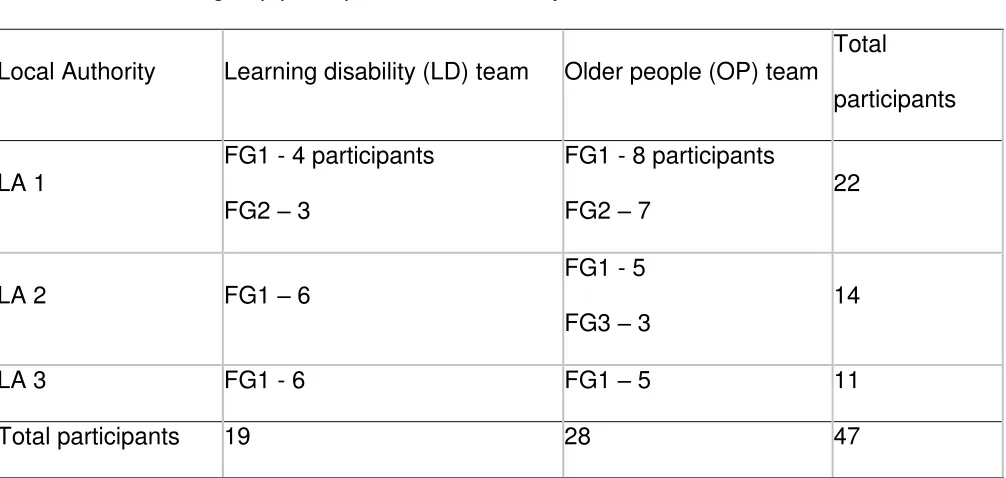
Nine focus groups were conducted, involving 47 qualified social workers and
non-professional social care staff who conducted assessments and/or reviews (see Table 1).
Insert Table 1 here
Focus groups were conducted in workplace locations. They lasted between 90 and 120
minutes and with participants’ permission were audio recorded. Two researchers
facilitated each group. A semi-structured topic guide encouraged participants to discuss
their practice in recognising the separate, but related, needs of service users and
carers; relevant training undertaken; and use of any formal guidance about managing
the interests of service users and carers. Additional issues relating to service users with
Data analysis
The focus groups were transcribed and analysed using the Framework Approach
(Ritchie and Spencer, 2004). Framework is a qualitative data analysis method where
researchers engage in a process of data summarization, theme identification and
comparison across cases and themes.
Data was initially summarised and compared; common themes across the authorities
were then identified and any differences between practitioners working with older
people and people with learning disabilities noted. Researchers familiarised themselves
with the transcripts, then developed a charting framework from the topic guide and any
clear emerging themes. Both researchers piloted the framework and agreed
adjustments. Data was then placed into charts (one for each authority) by one
researcher and a sample of charts was cross-checked by the other researcher to
facilitate consistency and validity. Summary charts were developed, one summarising
the focus groups by authority, the other by team (older person or learning disability).
Conclusions were drawn and verified, including tracing data back to source.
Results
General comments
Differences in practice were apparent between the three authorities and between teams
of practitioners working with older people and learning disabled people. However, these
apparent within authorities, between teams and within teams.
For example, workers in learning disability teams noted differences between their own
practice and colleagues in older people’s teams. Staff in learning disability teams
thought that they were able to work more closely with service users and carers due to
the longevity of their relationships with some service users and carers. This longevity
was felt to help facilitate greater sensitivity to service user and carer dynamics and
readiness to listen to both parties. Staff in older people’s services concurred that
learning disability colleagues were likely to have worked with service users and carers
over a longer period of time.
Despite these differences, it was agreed by all focus group participants that their
authorities recognised the importance of involving carers in service user personalisation
processes.
Assessments
Involving carers in service user assessments
Practitioners working with both groups of service users reported that carers’ presence
and participation in service user assessments was usual practice. Carers’ needs were
reported to be ‘taken into account’ during serviceusers’ assessments, through specific
questions which carers answered in relation to their caring role and feelings about this.
For example, practitioners reported asking carers about their willingness and ability to
by the service user assessment form. One worker described the questions in the
service user assessment as ‘a mini assessment tool’ for carers (Social Services Officer,
LA2, LD FG1). However, others questioned the adequacy of service user assessments
to identify carers’ needs.
“the form pushes you more into that way of thinking, about how much is
the carer doing rather than the impact it’s having on the carer. And I think
if you haven’t always considered the carer, I don’t think that form
necessarily says you’re to do that, not really.”
(Care Assessor, LA1, OP FG2)
Limited space on service user assessment forms to record carers’ views of their own
support needs was noted in two authorities, so the level of detail could be very
restricted. Some staff sought to address this by using other spaces on service user
assessment forms, for example using sections headed ‘community’or ‘additional
information’to record carers’ views and needs.
The wording on service user assessment forms could also hamper identification of
carers’ needs. For example, ‘task orientated’ questions focused on practical caring
activities rather than emotional and social aspects of caring. The limitations of relying on
service user assessments for carers to discuss their own needs and wishes were
“I think a joint assessment you get the, you get the more practical things
of what the carer does, I don’t think you get so much about the emotional
impact because I don’t think they feel able to say that in front of their
mother/father.”
(Care Assessor, LA1, OP FG2)
Practitioners tried to compensate for this by displaying sensitivity to carers during such
‘joint’ assessments.
“By the time we’ve sat there for an hour and a half, maybe two hours,
we’re well aware of the carer’s needs. You can, their body language,
their stresses, and they will just, they will just feed it to you, they will just
offload it to you at the time.”
(Care Assessor, LA3, OP FG1)
Practitioners were also aware of their role helping carers to express their own needs
during service user assessments or express their feelings towards the person they
cared for.
“I think when you’re talking to the service user and the carer, it becomes
evident sometimes, or with more questioning, what someone can
continue to do. And sometimes I find carers probably don’t actually want
to say it, but you’ve got to try and help them to say it to the [service
(Social Worker, LA2, OP FG2)
Carer assessments
Practitioners reported that they routinely informed carers of their right to a separate
assessment, usually at the end of the service user’s assessment. However, there
appeared little consistency within authorities or teams over when separate carer
assessments were conducted. Some were done at the same time as the service user
assessment, others on a separate occasion, which could be up to a month later. Where
there were delays between service user and carer assessments, it was unclear how
information from a carer assessment was linked to the service user assessment and
how this might contribute to determining the service user’s personal budget.
Practice also varied around who should conduct carer assessments. Some
practitioners, from both older people and learning disability teams, thought it best the
same practitioner conducted both assessments. Practitioners could then draw on their
knowledge of each person and be more sensitive to the dynamics of service user/carer
relationships.
“I know they do have carers, people specifically for carers’ assessments
in other authorities, but I think if you’re involved in the case, you know the
relationships and the family dynamics, which sometimes you wouldn’t
miss something... You know those family dynamics, and I think it gives
you a better insight into the pressures of that particular carer.”
(Care Assessor, LA1, OP FG2)
Others believed that a different carers’ assessor could encourage carers to articulate
their own support needs and wishes, especially if tensions between service users and
carers existed.
Although practitioners reported complying with the legal duty to inform carers of their
right to a separate carer assessment, they differed in opinion about the value of these.
Carer assessments were considered to have real benefits when they were a passport to
services, such as respite or emergency care. However, staff in one authority believed
carers’ assessments could raise carers’ expectations inappropriately, because even if
carers’ own needs were assessed, the support they could offer was frequently limited.
“I mean the carer’s assessment itself, I think it’s a bit misleading.
Perhaps they want to go on courses, they want to have the opportunity to
learn, to do the best for themselves and the service user, but then [in] the
end, what can we offer?”
(Social Worker, LA2, OP FG2)
Whether carers themselves wanted a separate assessment was also debated. Staff
carers actually wanted or felt separate assessments were necessary. Some carers were
reported to feel that their needs had been addressed within the service user
assessment, while others viewed separate carer assessments as repetitive and time
consuming.
“It’s not very often that a carer’s there and involved in quite a detailed
assessment [of the service user’s needs], and then wants another
assessment in their own right.”
(Social Worker, LA2, OP FG2)
Other practitioners emphasised the emotional importance of separate assessments for
carers, providing time and space for carers’ to consider their own personal needs.
“I think the thing about carers’ assessments that’s often forgotten is it
actually allows the carer the opportunity to have that time to speak about
their needs, whereas if they’re part and parcel of somebody else’s
assessment, they don’t often get that opportunity to identify their own
needs. It’s somebody else’s needs that they can talk about, but not
actually their own and what’s important to them. And I think sometimes
they just need that time for somebody to listen to them in their own right,
and that’s as important”
Support planning
Earlier research (Glendinning et al., 2009; Moran et al., 2012a; Jones et al., 2012b)
suggested that being involved in planning support to be purchased with a personal
budget may be an indicator of positive outcomes for carers.
However, practitioners in all three authorities frequently viewed support planning
primarily as a continuation of the service user’s assessment, rather than a separate
process conducted at a later date and informed by knowledge of the likely size of the
personal budget. Practitioners reported that both needs and potential support
arrangements were discussed during service users’ assessments. Practitioners in all
three authorities described how they usually wrote up support plans after the service
user assessment meeting and sent these back to the service user and carer to check.
Indeed, practitioner involvement in support planning was considered necessary, in order
to word plans ‘appropriately’ so that they would be approved by personal budget panels.
Many practitioners also used the terms ‘care plan’ and ‘support plan’ interchangeably,
suggesting that there was often little difference between previous care planning and
support planning associated with personal budgets.
“The support plan is no different from the assessment. It’s the same
information; it’s just going on a separate piece of paper. What’s the
person’s [service user’s] needs and how are we going to meet their
needs is what the whole process is about so I don’t make a big issue
(Social Worker, LA3, LD FG1)
Although practitioners described how support plans focused on service users’ needs,
staff in all three authorities reported that carers were also involved in support planning
discussions, as these frequently took place during service users’ assessments.
Moreover, involving carers was considered important; ‘a good service user support plan
was a good support plan for the carer’, as their needs were often interwoven, especially
when the service user and carer lived together. For example, short breaks or daytime
activities for service users also provided carers with breaks from carer giving. This view
was voiced most frequently by staff working in learning disability teams.
SW1: “… almost always a good package of care and a good assessment
of the service user does everything that the carer wants.”
SW2: “I think just a break is very often what they [carers] need.”
(Social Workers, LA3, LD FG1)
A number of practitioners pointed out that a good support plan for service users also
had indirect benefits for carers, providing peace of mind that the service user would be
well cared for or occupied during the day. Staff in both older people and learning
disability teams also explained that if carers were not involved and their own needs not
addressed through the service user support plan, there was increased likelihood of
“You can draw up the most wonderful plan and then you suddenly find
that the carer’s shutting various things down because it doesn’t work for
them, or it doesn’t work for the family, you know, so you’ve got to include
them.”
(Social Worker, LA2, LD FG2)
Practitioners across the three authorities described different practices around including
carers’ own needs in service user support plans. As with service user assessments, in
two authorities, some practitioners felt their authority’s support plan forms did not
provide enough space for them to record carers’ support arrangements and so had to
find alternative spaces which could lead to variations in how much detail support for
carers was recorded.
“Sometimes I put family stuff under ‘community’. To me it’s a real glaring
error that there is no [space] in that support plan that actually lets you put
in carers’ needs. And when you’re squeezing it in, then you feel that [the
carer] must feel that it’s not taken seriously, whereas I know I’m taking it
perfectly seriously.”
(Social worker, LA3, LD FG1)
In the third authority, practitioners generally felt their authority’s documents were
adequate. For example, as practitioners in one older people’s team explained, if a
would support the carer. The support plan would effectively be two plans in one,
documenting both service user and carer support.
“…the carers get a support plan but it’s on the service user’s plan as
well, so you know on there what they’re getting. It’s all incorporated.”
(Care Assessor, LA1, OP FG2)
However, it was unclear how needs identified through separate carer assessments
could be included in service users’ support plans, given that the former generally took
place separately and perhaps some weeks after the latter had been completed. It was
also not clear whether, following a full carer’s assessment and identification of any carer
support needs, these would be recorded on the service user’s support plan. Some staff
reported that carer-specific support was not routinely recorded on service user support
plans.
When asked about conflicts between service users and carers, staff in both older people
and learning disability teams reported that conflicts were most likely to arise during
assessment and support planning when decisions about service users’ support were
being made. Common sources of conflict concerned service users’ abilities and support
needs; managing risk; ensuring service user safety; promoting service user
independence; and when/how carers took breaks from caring-giving. Staff reported that
managing conflict between service users and carers was not easy, ‘good’ social work
associated with personalisation.
Managing personal budgets
Personal budgets can be held by the local authority, managed by a third party, such as,
a support organisation or carer, or allocated as a cash direct payment to the service
user. Earlier research (Glendinning et al., 2009) suggested that carers taking on the
management of a personal budget in the form of a direct payment may be reflected in
an increase in time spent on care-related tasks.
Practitioners confirmed they were expected to mention direct payments as an option to
all service users and carers, and routinely did this. Direct payments were generally
discussed in service user assessment meetings so carers were frequently present. In
fact, carers were often reported to be the person who chose whether the direct payment
option was taken up. (This may reflect the study’s two user groups and be different for
practitioners working with other service users, such as, those with physically disabilities
or mental health conditions).
Discussions with carers about direct payments centred on their administration. Separate
conversations with carers, without the service user present, asking them if they felt able
to manage the service user’s direct payment, were not routinely conducted. The
prevailing assumption reported was if the service user was unable to manage a direct
“The carer would be the first point of call for me to, to ask them if they
could manage the direct payment, before I would go anywhere else.”
(Social Worker, LA2, OP FG2)
However, discretion over whether carers were encouraged to take on the management
of a service users’ direct payment was reported, particularly if practitioners believed
there was a risk of financial mismanagement. Some practitioners also reported that
carers did not want the responsibility and administration they felt accompanied direct
payments.
Reviews
Practitioners reported that most service users had routine (annual) reviews unless
changing circumstances prompted unplanned reviews. Staff in all three LAs reported
that carers were generally present at service user reviews. This was expected,
especially if the carer had been involved in the initial assessment. Practitioners reported
that review meetings frequently replicated the service user’s initial assessment and
therefore asked about the carer’s willingness and ability to continue providing care.
Carers’ own needs may also change, and at different times from those of the person
they support. However, separate carer reviews were less common. Even if a separate
carer’s assessment had been conducted, practitioners would often try to review service
users’ and carers’ needs at the same time unless there was family conflict, carers
service user’s needs. However, practitioners acknowledged that, as with joint
assessments, joint reviews also reduced carers’ opportunities to discuss their own
support needs in depth and in private.
Carers of service users with communication and cognitive impairments
Staff across all three authorities and teams acknowledged that, while they tried to treat
all carers the same, they relied more on carers of service users with cognitive or
communication impairments to provide information about the latter’s needs and wishes.
“I think you set out to try and make the client [the] centre of the
assessment. Then often, halfway through, you realise the client’s not
particularly able or some of it is unreliable information. It sometimes
switches over unintentionally and sometimes the carer can take over.”
(Care Assessor, LA2, OP FG1)
However, the danger of relying too heavily on carers to speak for service users was also
recognised, especially the risk of carers presenting their own views as those of the
service user, or carers prioritising their own views over those of service users.
“You’ve got to be a little bit careful how you interpret what’s being said to
you, and try and double check. I mean even if somebody can’t talk to me,
I would still have eye contact and I would be talking to them direct, even
(Care Assessor, LA1, OP FG2)
To avoid over-reliance on carers’ views, practitioners noted the importance of
recognising and responding to service users’ non-verbal communication. However,
practitioners also recognised that involving service users was not easy; getting to know
how each person communicated could take several visits.
Discussion
Personalisation raises challenges for routine social care practice as practitioners seek
to develop a more facilitative and co-productive role of assisting individuals to identify
their own support needs and commission services that meet these needs (Burton et al.,
2012; Carr, 2010). The role and importance of carers as ‘experts’ in relation to the
person they support has also gained credence alongside recognition of carers’ right to
their own services and support (Carers (Recognition and Services) Act, 1995: Carers
(Equal Opportunities) Act, 2004; HM Government, 2008, 2010; DH, 2010). These
developments create some major challenges for frontline practice.
Study limitations
Data reported in this paper was derived from focus groups with samples of staff from
older people’s and learning disability teams in three English authorities. Participants
were volunteers and so may not be representative in their views and practices. The
carers these staff worked with were also likely to be more involved in service user
of any clear or consistent patterns amongst staff in their reported practice suggests this
reflected wide ranging and diverse staff practice. The number of staff participating in
each focus group also varied, this may have influenced their level of participation. The
presence of colleagues may similarly have inhibited some participants’ openness and
honesty. However, participants expressed many different (and sometimes conflicting)
opinions. The relatively small samples mean care needs to be taken in drawing wider
conclusions. Nevertheless, the study’s in-depth, qualitative insights provide important
additions to our understanding of the challenges that practitioners currently face in
respecting both the individuality of service user and carer needs, and their
interdependence. These insights highlight some important practice issues which have
broader relevance.
Findings overview
Although practitioners felt they sought to involve carers, practices varied between
authorities, teams and colleagues in the same team. Clear and timely links between
processes for service users and carers were frequently absent. The importance of
professional judgment was recognised but practitioners also acknowledged that
inconsistent practice could lead to inequitable treatment of carers with some carers’
support needs recorded in more depth than others.
Carers were commonly involved in service user assessments. Practitioners generally
fulfilled their statutory duty (DH, 2010) by recording, during service user assessments,
assessments with carers present were also felt to facilitate consideration of carer
support needs, aided by specific questions and prompts on service user assessment
forms. Ascertaining the level of support provided by carers and their willingness and
ability to continue providing this was important as it had implications for the level of
service users’ personal budgets.
However, practitioners were less consistent in their views about whether the service
user’s assessment was an adequate tool to capture carers’ needs. Some practitioners
criticised service user assessment forms for lacking clear instructions on where and
how to record carers’ views. If carers’ views were recorded elsewhere on the
assessment form, there was a risk these might not be taken into account when
calculating the service user’s personal budget. Clearer questions on service user
assessment forms about carers’ views and needs, and space to record carers’ answers,
may be needed. However, recording carers’ willingness and ability to provide support is
not the same as recording carers’ own needs and support preferences.
Research (Seddon et al., 2007) has documented the gap between carer assessment
policy and practice, within the latter often ad-hoc and inconsistent. Practitioners in this
study reported meeting their duty to offer carers their own assessment. However, some
carers were reported not to want a further assessment of their own when they had
already contributed to the assessment of the person they supported. When carer
assessments were conducted and who conducted them varied across authorities, There
According to these practitioners, if separate carer assessments were conducted,
information from these was not routinely linked to service user assessments. This was
because the carer’s assessment could be conducted some time after the service user’s
assessment and support plan had been completed.
Support planning was a further area of inconsistent practice. Across all three authorities,
practitioners felt that carers were involved in support planning discussions as they were
usually involved in service user assessments during which support plans were
discussed. Practitioners also recognised that the service user’s support plan needed to
be acceptable to the carer for it to be sustainable. However, it was not clear how any
carer needs identified through a separate carer assessment, or carer support
arrangements, including possibly, a separate carer’s personal budget could be
co-ordinated with the support arrangements of the service user. Despite this, although
carers can get personal budgets in their own right, practitioners in these focus groups
did not discuss carers personal budgets and had very limited knowledge of them.
Practice guidance (DH, 2010) advocates that carers’ needs should be ‘routinely
reviewed’ alongside those of service users. Practitioners reported that carers’ needs
were reviewed insofar as they were usually present at service user reviews. However,
beyond this, practitioners reported little consistency over whether, how and when any
separate carer reviews were conducted. This also meant that any changes in service
user or carer support arrangements were unlikely to be reflected in the other’s support
procedures for both service users and carers, especially the latter.
Conclusions
This study illustrates the tensions practitioners face trying to recognise and balance the
needs and wishes of service users and carers in current personalisation processes.
Carers and service users’ lives are interwoven and inter-dependent, and good support
arrangements for service users may go some way to meeting the needs of carers as
well. However, other outcomes that carers may want in areas, such as, life-long
learning, employment or leisure, are unlikely to be discussed in the course of a service
user assessment. Indeed some of these desired outcomes may conflict with those of
the person they support. Yet separate carer assessments were not routinely conducted
and when they were, it was not clear how they were co-ordinated with those of service
users, if at all.
Although practice guidance exists (DH, 2010) it is also important to recognise that
standardised guidance may not always be the most appropriate or relevant to meet the
needs of individual carers and service users. In this study practitioners frequently faced
complex situations, such as balancing limited authority resources, budgets and staffing
levels with requirements to meet carers identified needs and/or support expectations.
Alongside this, staff discretion was also valued, particularly, practitioners’ professional
expertise and personal knowledge of individual carer preferences. How to balance
these competing demands whilst also ensuring equitable but sensitive carer inclusion
How to overcome tensions created by the separation of legislative requirements and
practice guidance regarding service users and carers also remains unresolved. It is not
clear how far this separation will be remedied by the English Care and Support Bill (DH,
2013), which aims to give carers the same legal rights to assessments and support as
the service users they support. Thus, it may no longer be sufficient simply to ask carers
a few questions about whether they are willing and able to continue providing support to
a service user as part of the latter’s assessment. There may be stronger legal
obligations on local authorities to conduct separate assessments of carers’ own needs
and desired outcomes. Yet, at the same time, the interdependency of older and
disabled people and their carers cannot be overlooked. Carers will continue to derive
indirect benefits from knowing that the service user has an appropriate, quality support
plan. Some types of support, such as, daytime activities or respite care may also
provide direct benefits to both. It will therefore continue to be important for service user
and carer assessments and support plans to be better co-ordinated with each other.
This may prove challenging, given the diversity of practice this paper has reported.
Funding Statement
This article presents independent research commissioned by the NIHR School for
Social Care Research (SSCR).
Acknowledgements
The authors would like to thank the practitioners who participated in the study and the
are those of the authors and not necessarily those of the NIHR School for Social Care
Research or the Department of Health (DH), NIHR or NHS.
References
ADASS (2012) Personal Budgets Survey (March 2012) accessed (January 2013) from:
http://www.adass.org.uk/images/stories/Policy%20Networks/Resources/Key%20Docum
ents/PersonalBudgetsSurveyMarch2012.pdf.
Burton, J., Toscano, T. and Zonouzi, M. (2012) Personalisation for Social Workers:
Opportunities and Challenges for Frontline Practice, Berkshire, Open University Press.
Carers (Equal Opportunities) Act (2004) London, HMSO.
Carers and Disabled Children Act (2000) London, HMSO.
Carers (Recognition and Services) Act (1995) London, HMSO.
Carers UK (2008) Choice or Chore? Carers’ Experiences of Direct Payments, London,
Carers UK.
Carers UK (2010) The Coalition Programme for Government: What it Means for Carers,
Carr, S. (2010) Personalisation: A Rough Guide, London, SCIE.
Clements, L., Bangs, J. and Holzhausen, E. (2009) Individual Budgets and Carers,
accessed (January 2013) from:
http://www.lukeclements.co.uk/resources-index/files/PDF%2005.pdf.
Commission for Social Care Inspection (2008) Cutting the Cake Fairly, London, CSCI.
Department of Health (2013) Care and Support Bill, London, HMSO.
Department of Health (2010) Carers and Personalisation: Improving Outcomes, London,
DH.
Department of Health (2007) Putting People First: A Shared Vision and Commitment to
the Transformation of Adult Social Care, London, DH.
Department of Health (2005) Independence, Well-Being and Choice: Our Vision for the
Future of Social Care for Adults in England, London, DH.
Department of Health (2001) Valuing People: A New Strategy for Learning Disability for
Fine, M. and Glendinning, C. (2005) ‘Dependence, independence or inter-dependence?
Revisiting the concepts of ‘care’ and ‘dependency’’, Ageing and Society, 25(4),
pp.601-621.
Flynn, M. (2005) Developing the Role of Personal Assistants, Leeds, Skills for Care.
Glendinning, C., Arksey, H., Jones, K., Moran, N., Netten, A. and Rabiee, P. (2009) The
Individual Budgets Pilot Projects: Impact and outcomes for Carers, York, Social Policy
Research Unit.
Glendinning, C., Challis, D., Fernandez, J., Jacobs, S., Jones, K., Knapp, M.,
Manthorpe, J., Moran, N., Netten, A., Stevens, M. and Wilberforce, M. (2008) Evaluation
of the Individual Budgets Pilot Programme: Final Report, York, IBSEN.
Grootegoed, E., Knijn, T. and da Roit, B. (2010) ‘Relatives as paid care-givers: how
family carers experience payments for care’, Ageing and Society, 30(3), pp.467-89.
HM Government (2010) Recognised, Valued and Supported: Next Steps for the Carers
Strategy, London, HM Government.
HM Government (2008) Carers at the Heart of 21st Century Families and Communities,
Jones, K., Netten, A., Rabiee, P., Glendinning, C., Arksey, H. and Moran, N. (2012b)
‘Can individual budgets have an impact on carers and the caring role?’ Ageing and
Society, doi:10.1017/S0144686X12000748.
Kroger, T. (2009) ‘Care research and disability studies: nothing in common?’Critical
Social Policy, 29(3), pp.398-420.
Larkin, M. and Dickinson, H. (2011) Personalisation: What will the Impacts be for
Carers? Working Paper 64, University of Birmingham, Birmingham TSRC.
Leadbeater, C. (2004) Personalisation through Participation: A New Script for Public
Services, London, Demos.
Moran, N., Arksey, H., Glendinning, C., Jones, K., Netten, A. and Rabiee, P. (2012a)
‘Personalisation and carers: whose rights? Whose benefits?’ British Journal of Social
Work, 42(3), pp.461-479.
Needham, C. (2011) ‘Personalisation; from storyline to practice’. Social Policy and
Administration, 45, pp.54-68.
Newbronner, L., Chamberlain, R., Bosanquet, K., Bartlett, C., Sass, B. and Glendinning,
C. (2011) Keeping Personal Budgets Personal: Learning from the Experience of Older
Princess Royal Trust for Carers and Crossroads Care (2010) No Breaks for Carers: A
Report on Primary Care Trusts and Delivery of the National Carers’ Strategy, London,
Princess Royal Trust for Carers and Crossroads Care.
Ritchie, J. and Spencer, L. (1994) ‘Qualitative data analysis for applied policy research’,
in Bryman, A. and Burgess, R. (eds), Analysing Qualitative Data, London, Routledge.
Seddon, D., Robinson, C., Reeves, C., Tommis, Y., Woods, B. and Russell, I. (2007) ‘In
their own right: translating the policy of carer assessment into practice’, British Journal
of Social Work, 37, pp.1335-1352.
Social Care Institute for Excellence in conjunction with Carers UK (2009)
Personalisation Briefing: Implications for Carers, London, SCIE.
Think Local Act Personal (2013) National Personal Budgets Survey 2013: accessed
Table
Table 1 Focus group participants: local authority and service area
Local Authority Learning disability (LD) team Older people (OP) team Total
participants
LA 1
FG1 - 4 participants
FG2 – 3
FG1 - 8 participants
FG2 – 7
22
LA 2 FG1 – 6
FG1 - 5
FG3 – 3
14
LA 3 FG1 - 6 FG1 – 5 11